
Oscillatory Correlates of Habituation: EEG Evidence of Sustained Frontal Theta Activity to Food Cues


Abstract
1. Introduction
2. Methodology
2.1. Participants
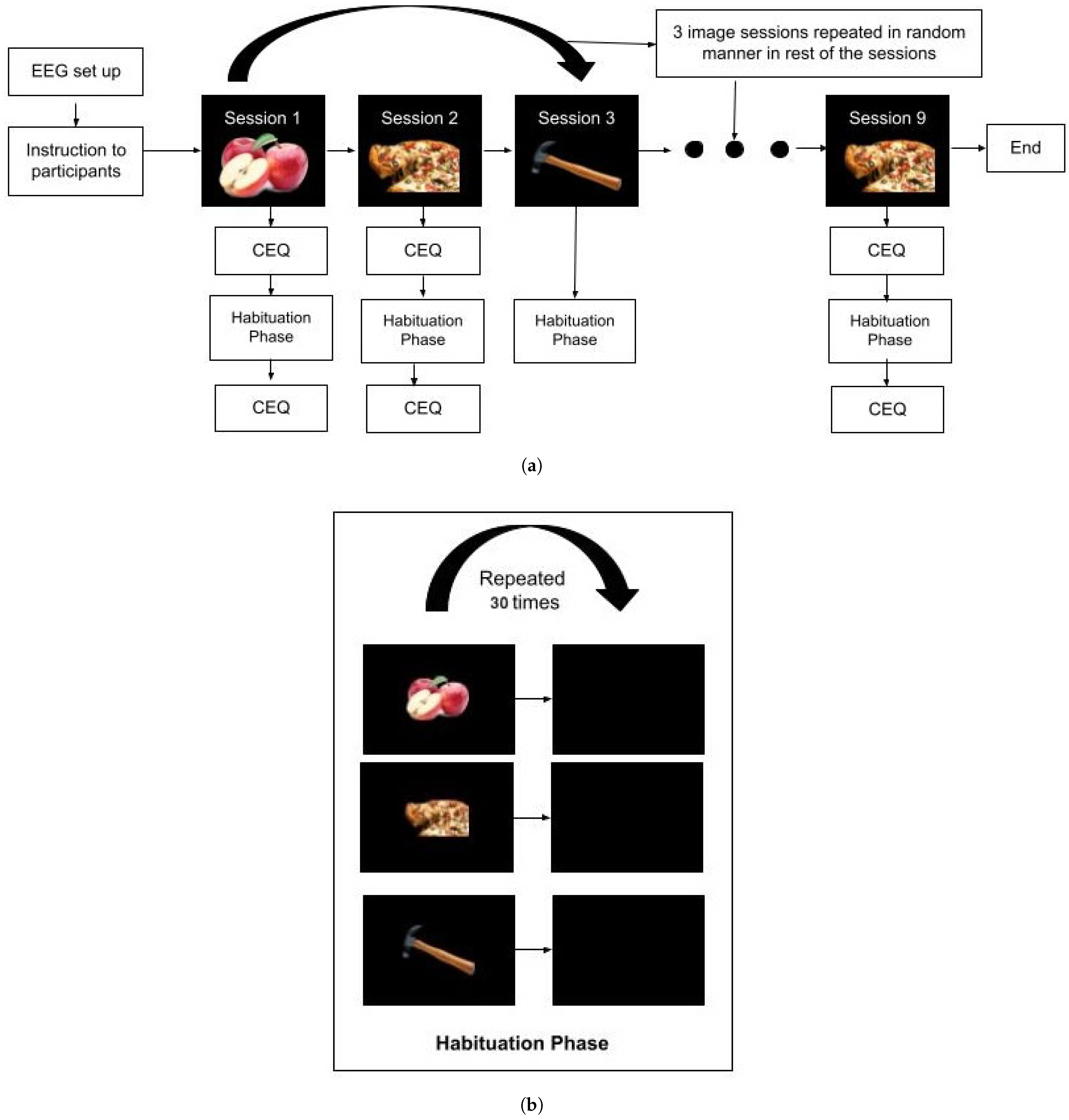
2.2. Experimental Design and Procedure
2.3. EEG Data Acquisition and Pre-Processing
Statistical Analysis
3. Results
3.1. Behavioural Measures
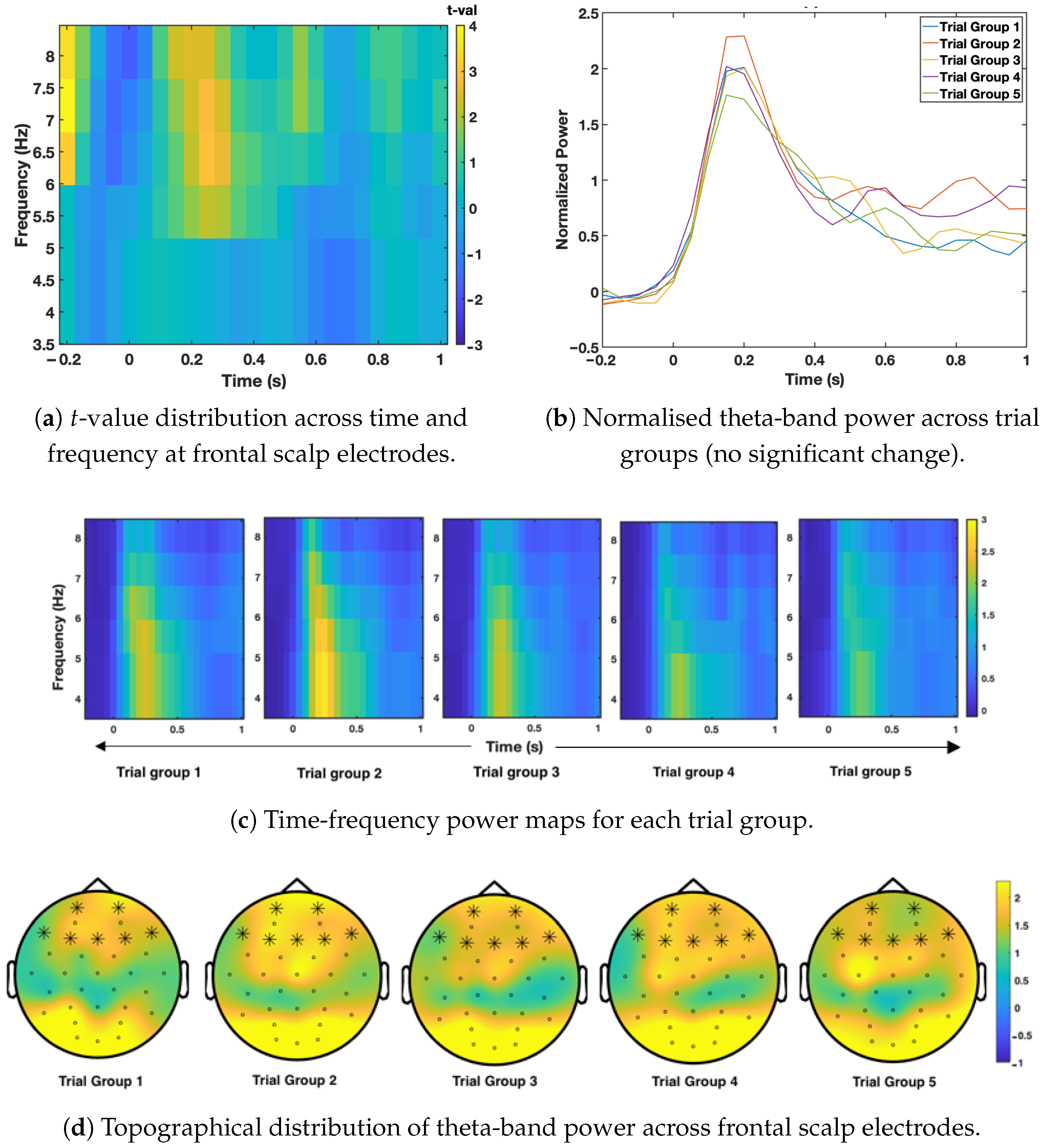
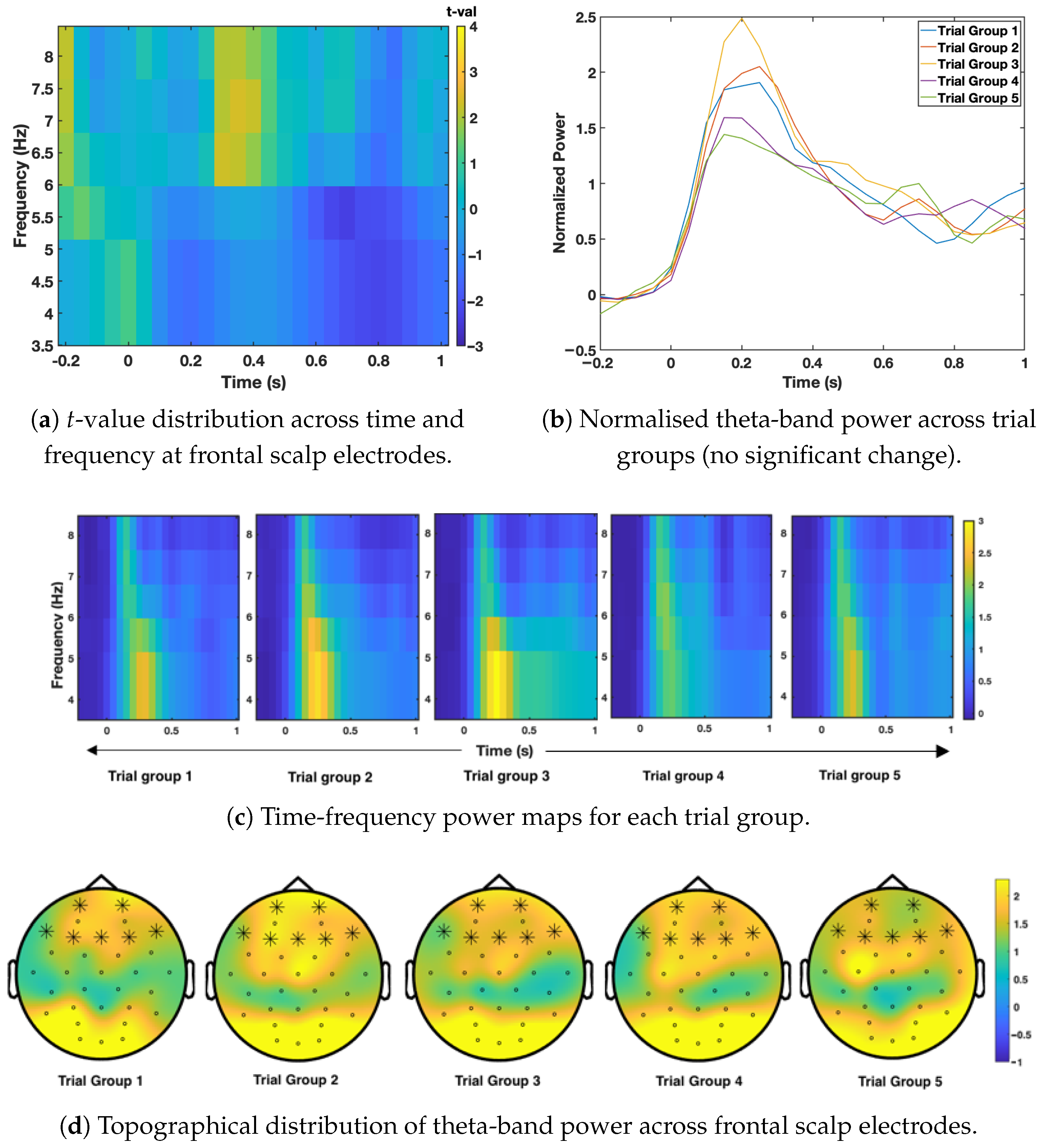
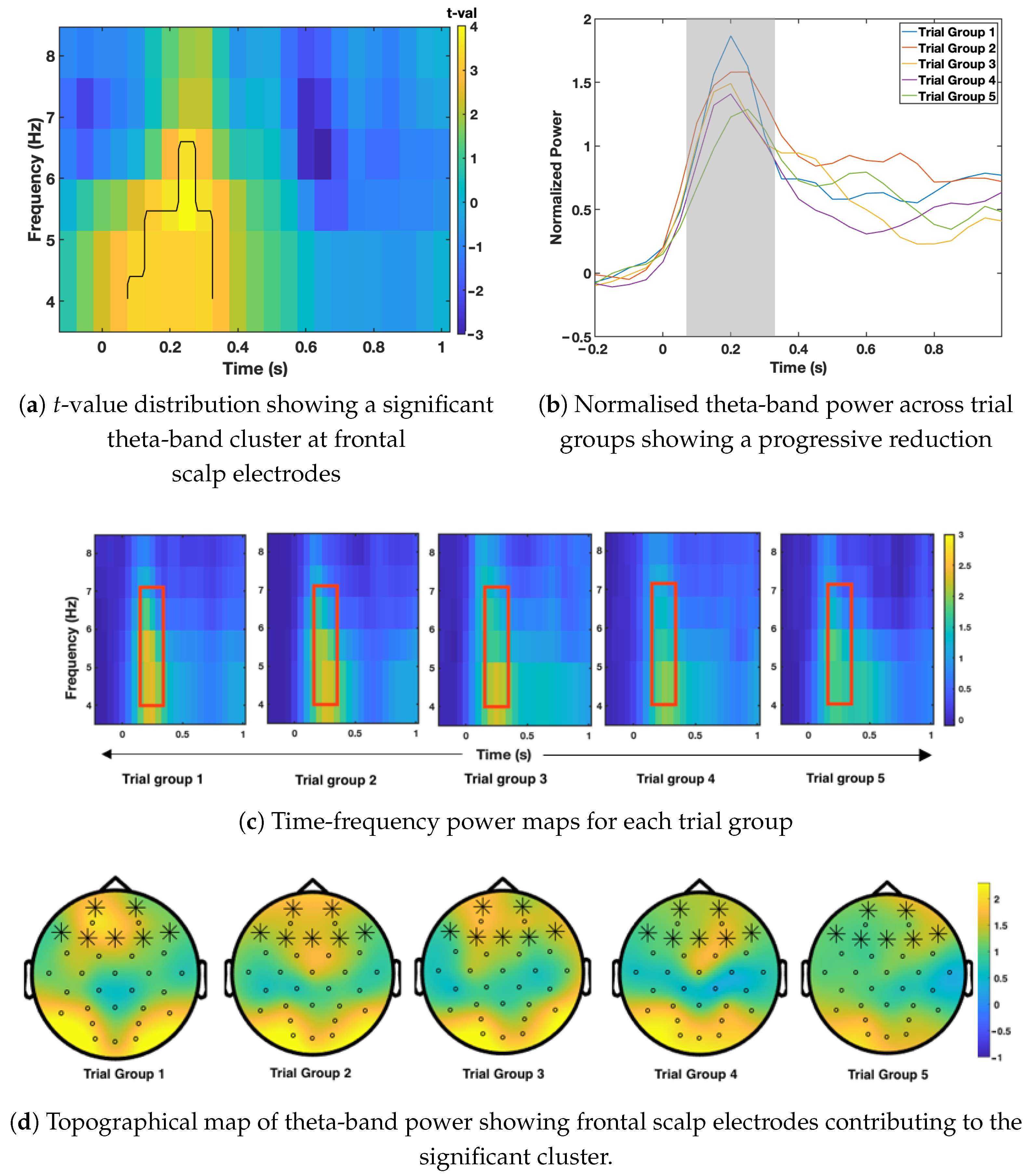
3.2. Neurophysiological Measures
4. Discussion
5. Conclusions
Supplementary Materials
Author Contributions
Funding
Institutional Review Board Statement
Informed Consent Statement
Data Availability Statement
Acknowledgments
Conflicts of Interest
Abbreviations
| EEG | Electroencephalogram |
| ERP | Event-Related Potential |
| CEQ | Craving Experience Questionnaire |
| ISI | Inter-Stimulus Interval |
| CMS | Common Mode Sense |
| DRL | Driven Right Leg |
References
- Epstein, L.H.; Temple, J.L.; Roemmich, J.N.; Bouton, M.E. Habituation as a determinant of human food intake. Psychol. Rev. 2009, 116, 384. [Google Scholar] [CrossRef]
- Duraisingam, A.; Soria, D.; Palaniappan, R. Examining the Neurophysiology of Attentional Habituation to Repeated Presentations of Food and Non-Food Visual Stimuli. Algorithms 2025, 18, 525. [Google Scholar] [CrossRef]
- Epstein, L.H.; Paluch, R.A. Habituation of facial muscle responses to repeated food stimuli. Appetite 1997, 29, 213–224. [Google Scholar] [CrossRef] [PubMed]
- Epstein, L.H.; Rodefer, J.S.; Wisniewski, L.; Caggiula, A.R. Habituation and Dishabituation of Human Salivary Response. Physiol. Behav. 1992, 51, 945–950. [Google Scholar] [CrossRef]
- Epstein, L.H.; Robinson, J.L.; Temple, J.L.; Roemmich, J.N.; Marusewski, A.; Nadbrzuch, R. Sensitization and Habituation of Motivated Behavior in Overweight and Non-Overweight Children. Learn. Motiv. 2008, 39, 243–255. [Google Scholar] [CrossRef]
- Meule, A.; Kübler, A.; Blechert, J. Time course of electrocortical food-cue responses during cognitive regulation of craving. Front. Psychol. 2013, 4, 669. [Google Scholar] [CrossRef]
- Biehl, S.C.; Keil, J.; Naumann, E.; Svaldi, J. ERP and oscillatory differences in overweight/obese and normal-weight adolescents in response to food stimuli. J. Eat. Disord. 2020, 8, 14. [Google Scholar] [CrossRef] [PubMed]
- Makeig, S.; Debener, S.; Onton, J.; Delorme, A. Mining event-related brain dynamics. Trends Cogn. Sci. 2004, 8, 204–210. [Google Scholar] [CrossRef] [PubMed]
- Klimesch, W. Alpha-band oscillations, attention, and controlled access to stored information. Trends Cogn. Sci. 2012, 16, 606–617. [Google Scholar] [CrossRef]
- Knyazev, G.G. Motivation, emotion, and their inhibitory control mirrored in brain oscillations. Neurosci. Biobehav. Rev. 2007, 31, 377–395. [Google Scholar] [CrossRef]
- Cavanagh, J.F.; Frank, M.J. Frontal theta as a mechanism for cognitive control. Trends Cogn. Sci. 2014, 18, 414–421. [Google Scholar] [CrossRef]
- Gibney, K.D.; Kypriotakis, G.; Versace, F. Individual differences in late positive potential amplitude and theta power predict cue-induced eating. Addict. Neurosci. 2023, 7, 100106. [Google Scholar] [CrossRef]
- Nijs, I.M.; Franken, I.H.; Muris, P. Food-related Stroop interference in obese and normal-weight individuals: Behavioral and electrophysiological indices. Eat. Behav. 2010, 11, 258–265. [Google Scholar] [CrossRef]
- Burger, K.S.; Stice, E. Neural responsivity during soft drink intake, anticipation, and advertisement exposure in habitually consuming youth. Obesity 2014, 22, 441–450. [Google Scholar] [CrossRef]
- Ghobadi-Azbari, P.; Mahdavifar Khayati, R.; Ekhtiari, H. Habituation or sensitization of brain response to food cues: Temporal dynamic analysis in an functional magnetic resonance imaging study. Front. Hum. Neurosci. 2023, 17, 1076711. [Google Scholar] [CrossRef] [PubMed]
- Foxe, J.J.; Snyder, A.C. The role of alpha-band brain oscillations as a sensory suppression mechanism during selective attention. Front. Psychol. 2011, 2, 154. [Google Scholar] [CrossRef] [PubMed]
- Engel, A.K.; Fries, P. Beta-band oscillations-signalling the status quo? Curr. Opin. Neurobiol. 2010, 20, 156–165. [Google Scholar] [CrossRef] [PubMed]
- Toepel, U.; Knebel, J.F.; Hudry, J.; le Coutre, J.; Murray, M.M. Gender and weight shape brain dynamics during food viewing. PLoS ONE 2012, 7, e36778. [Google Scholar] [CrossRef] [PubMed]
- Polanía, R.; Krajbich, I.; Grueschow, M.; Ruff, C.C. Neural oscillations and synchronization differentially support evidence accumulation in perceptual and value-based decision making. Neuron 2014, 82, 709–720. [Google Scholar] [CrossRef]
- Tashiro, N.; Sugata, H.; Ikeda, T.; Matsushita, K.; Hara, M.; Kawakami, K.; Kawakami, K.; Fujiki, M. Effect of individual food preferences on oscillatory brain activity. Brain Behav. 2019, 9, e01262. [Google Scholar] [CrossRef]
- Leung, S.O. A Comparison of Psychometric Properties and Normality in 4-, 5-, 6-, and 11-Point Likert Scales. J. Soc. Serv. Res. 2011, 37, 412–421. [Google Scholar] [CrossRef]
- Smith, Y.M. Italian Cuisine Is World’s Most Popular. 2019. Available online: https://yougov.co.uk/topics/consumer/articles-reports/2019/03/12/italian-cuisine-worlds-most-popular (accessed on 4 November 2022).
- Blechert, J.; Meule, A.; Busch, N.A.; Ohla, K. Food-pics: An image database for experimental research on eating and appetite. Front. Psychol. 2014, 5, 617. [Google Scholar] [CrossRef]
- May, J.; Andrade, J.; Kavanagh, D.J.; Feeney, G.F.; Gullo, M.J.; Statham, D.J.; Skorka-Brown, J.; Connolly, J.M.; Cassimatis, M.; Young, R.M.; et al. The Craving Experience Questionnaire: A Brief, Theory-Based Measure of Consummatory Desire and Craving. Addiction 2014, 109, 728–735. [Google Scholar] [CrossRef] [PubMed]
- Geisler, M.W.; Polich, J. P300, Food Consumption, and Memory Performance. Psychophysiology 1992, 29, 76–85. [Google Scholar] [CrossRef]
- Wardle, J. Eating Style: A Validation Study of the Dutch Eating Behaviour Questionnaire in Normal Subjects and Women With Eating Disorders. J. Psychosom. Res. 1987, 31, 161–169. [Google Scholar] [CrossRef] [PubMed]
- Delorme, A.; Makeig, S. EEGLAB: An open source toolbox for analysis of single-trial EEG dynamics including independent component analysis. J. Neurosci. Methods 2004, 134, 9–21. [Google Scholar] [CrossRef]
- Oostenveld, R.; Fries, P.; Maris, E.; Schoffelen, J.M. FieldTrip: Open source software for advanced analysis of MEG, EEG, and invasive electrophysiological data. Comput. Intell. Neurosci. 2011, 2011, 156869. [Google Scholar] [CrossRef] [PubMed]
- Cohen, M.X. Analyzing Neural Time Series Data: Theory and Practice; MIT Press: Cambridge, MA, USA, 2014. [Google Scholar]
- Maris, E.; Oostenveld, R. Nonparametric Statistical Testing of EEG- and MEG-Data. J. Neurosci. Methods 2007, 164, 177–190. [Google Scholar] [CrossRef]
- Bae, G.Y.; Luck, S.J. Dissociable decoding of spatial attention and working memory from EEG oscillations and sustained potentials. J. Neurosci. 2018, 38, 409–422. [Google Scholar] [CrossRef]
- Groves, P.M.; Thompson, R.F. Habituation: A Dual-Process Theory. Psychol. Rev. 1970, 77, 419. [Google Scholar] [CrossRef]
- Schmidt, R.; Sebert, C.; Kösling, C.; Grunwald, M.; Hilbert, A.; Hübner, C.; Schäfer, L. Neuropsychological and Neurophysiological Indicators of General and Food-Specific Impulsivity in Children with Overweight and Obesity: A Pilot Study. Nutrients 2018, 10, 1983. [Google Scholar] [CrossRef] [PubMed]
- Stoeckel, L.E.; Weller, R.E.; Cook III, E.W.; Twieg, D.B.; Knowlton, R.C.; Cox, J.E. Widespread Reward-System Activation in Obese Women in Response to Pictures of High-Calorie Foods. NeuroImage 2008, 41, 636–647. [Google Scholar] [CrossRef] [PubMed]
- Toepel, U.; Knebel, J.F.; Hudry, J.; le Coutre, J.; Murray, M.M. The brain tracks the energetic value in food images. Neuroimage 2009, 44, 967–974. [Google Scholar] [CrossRef] [PubMed]



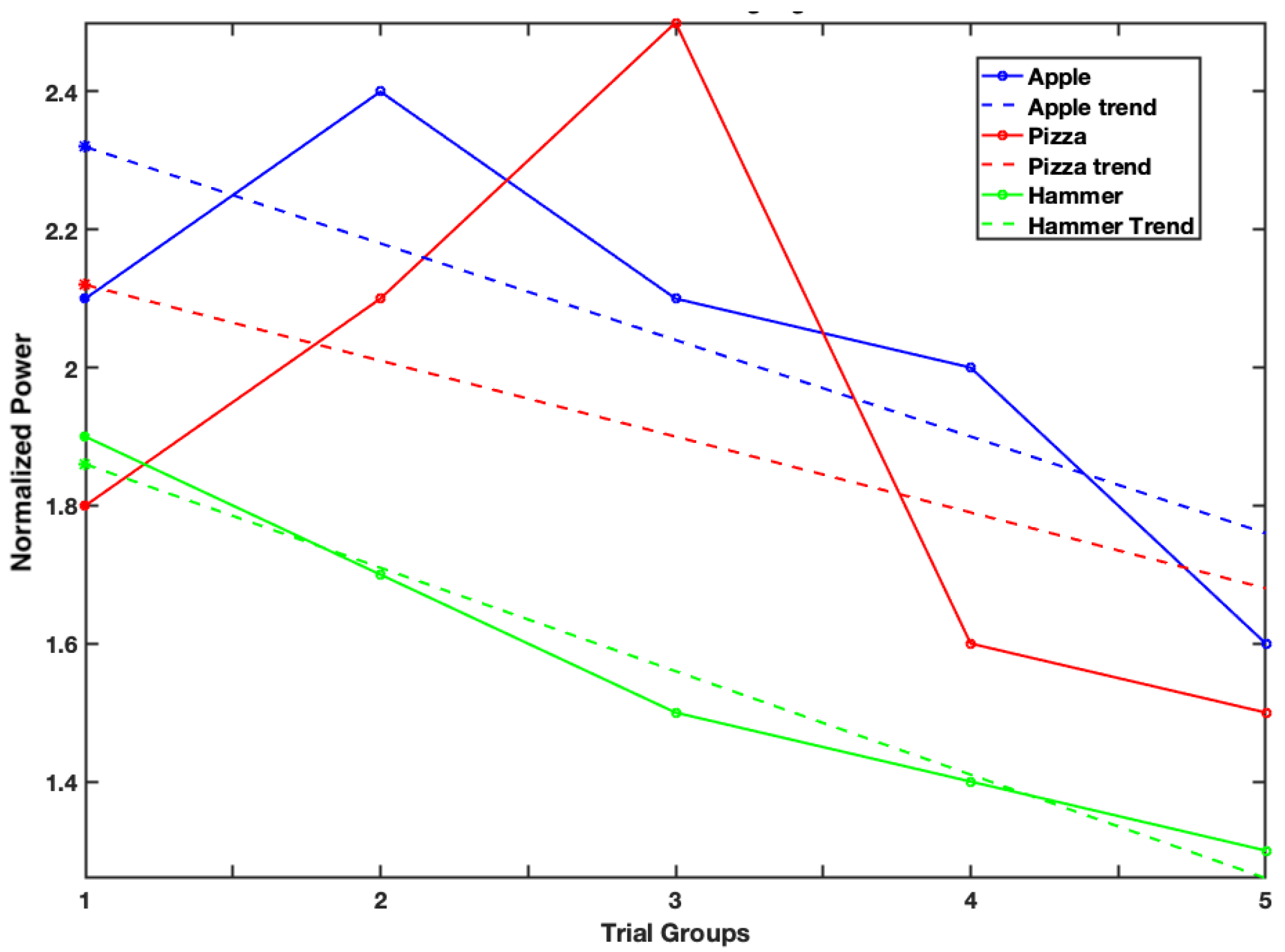
| Image | Slope | Intercept | Mean Slope | SD |
|---|---|---|---|---|
| Apple | 2.46 | 0.0006 | 0.0922 | |
| Pizza | −0.11 | 2.23 | 0.0509 | 0.1058 |
| Hammer | 2.07 | −0.0024 | 0.0885 |
Disclaimer/Publisher’s Note: The statements, opinions and data contained in all publications are solely those of the individual author(s) and contributor(s) and not of MDPI and/or the editor(s). MDPI and/or the editor(s) disclaim responsibility for any injury to people or property resulting from any ideas, methods, instructions or products referred to in the content. |
© 2026 by the authors. Licensee MDPI, Basel, Switzerland. This article is an open access article distributed under the terms and conditions of the Creative Commons Attribution (CC BY) license.
Share and Cite
Duraisingam, A.; Soria, D.; Palaniappan, R. Oscillatory Correlates of Habituation: EEG Evidence of Sustained Frontal Theta Activity to Food Cues. Sensors 2026, 26, 1001. https://doi.org/10.3390/s26031001
Duraisingam A, Soria D, Palaniappan R. Oscillatory Correlates of Habituation: EEG Evidence of Sustained Frontal Theta Activity to Food Cues. Sensors. 2026; 26(3):1001. https://doi.org/10.3390/s26031001
Chicago/Turabian StyleDuraisingam, Aruna, Daniele Soria, and Ramaswamy Palaniappan. 2026. "Oscillatory Correlates of Habituation: EEG Evidence of Sustained Frontal Theta Activity to Food Cues" Sensors 26, no. 3: 1001. https://doi.org/10.3390/s26031001
APA StyleDuraisingam, A., Soria, D., & Palaniappan, R. (2026). Oscillatory Correlates of Habituation: EEG Evidence of Sustained Frontal Theta Activity to Food Cues. Sensors, 26(3), 1001. https://doi.org/10.3390/s26031001