Specificity of Pairing Afferent and Efferent Activity for Inducing Neural Plasticity with an Associative Brain–Computer Interface
 , and
, and
Abstract
1. Introduction
2. Materials and Methods
2.1. Participants
2.2. Experimental Setup
2.3. Stimulation
2.3.1. Transcranial Magnetic Stimulation
2.3.2. Peripheral Electrical Stimulation
2.4. Recordings
2.4.1. EEG
2.4.2. EMG
2.5. Data Analysis
2.5.1. Determining Peak Negativity
2.5.2. Motor-Evoked Potentials
2.6. Statistical Analysis
3. Results
4. Discussion
5. Conclusions
Author Contributions
Funding
Institutional Review Board Statement
Informed Consent Statement
Data Availability Statement
Acknowledgments
Conflicts of Interest
Abbreviations
| BCI | Brain–computer interface |
| PES | Peripheral electrical stimulation |
| MRCP | Movement-related cortical potential |
| EEG | Electroencephalography |
| TMS | Transcranial magnetic stimulation |
| WE | Wrist extension |
| PG | Palmar grasp |
| PN | Peak negativity |
| MEP | Motor-evoked potential |
| ECRL | Extensor carpi radialis longus |
| EMG | Electromyography |
| RMT | Resting motor threshold |
| MT | Motor threshold |
| PT | Perception threshold |
| MEPmax | Maximum peak-to-peak MEP amplitude |
| S50 | Intensity needed to obtain 50% of MEPmax |
| ANOVA | Analysis of variance |
References
- Feigin, V.L.; Brainin, M.; Norrving, B.; Martins, S.; Sacco, R.L.; Hacke, W.; Fisher, M.; Pandian, J.; Lindsay, P. World Stroke Organization (WSO): Global stroke fact sheet 2022. Int. J. Stroke 2022, 17, 18–29. [Google Scholar] [CrossRef] [Scilit]
- van der Vliet, R.; Selles, R.W.; Andrinopoulou, E.; Nijland, R.; Ribbers, G.M.; Frens, M.A.; Meskers, C.; Kwakkel, G. Predicting upper limb motor impairment recovery after stroke: A mixture model. Ann. Neurol. 2020, 87, 383–393. [Google Scholar] [CrossRef] [Scilit]
- Todhunter-Brown, A.; Sellers, C.E.; Baer, G.D.; Choo, P.L.; Cowie, J.; Cheyne, J.D.; Langhorne, P.; Brown, J.; Morris, J.; Campbell, P. Physical rehabilitation approaches for the recovery of function and mobility following stroke. Cochrane Database Syst. Rev. 2025. [Google Scholar]
- Langhorne, P.; Coupar, F.; Pollock, A. Motor recovery after stroke: A systematic review. Lancet Neurol. 2009, 8, 741–754. [Google Scholar] [CrossRef] [Scilit] [PubMed]
- Krakauer, J.W. Motor learning: Its relevance to stroke recovery and neurorehabilitation. Curr. Opin. Neurol. 2006, 19, 84–90. [Google Scholar] [CrossRef] [Scilit]
- Pascual-Leone, A.; Dang, N.; Cohen, L.G.; Brasil-Neto, J.P.; Cammarota, A.; Hallett, M. Modulation of muscle responses evoked by transcranial magnetic stimulation during the acquisition of new fine motor skills. J. Neurophysiol. 1995, 74, 1037–1045. [Google Scholar] [CrossRef] [Scilit]
- Biasiucci, A.; Leeb, R.; Iturrate, I.; Perdikis, S.; Al-Khodairy, A.; Corbet, T.; Schnider, A.; Schmidlin, T.; Zhang, H.; Bassolino, M. Brain-actuated functional electrical stimulation elicits lasting arm motor recovery after stroke. Nat. Commun. 2018, 9, 2421. [Google Scholar] [CrossRef] [Scilit]
- Mrachacz-Kersting, N.; Ibáñez, J.; Farina, D. Towards a mechanistic approach for the development of non-invasive brain-computer interfaces for motor rehabilitation. J. Physiol. 2021, 599, 2361–2374. [Google Scholar] [CrossRef] [Scilit] [PubMed]
- Qu, H.; Zeng, F.; Tang, Y.; Shi, B.; Wang, Z.; Chen, X.; Wang, J. The clinical effects of brain–computer interface with robot on upper-limb function for post-stroke rehabilitation: A meta-analysis and systematic review. Disabil. Rehabil. Assist. Technol. 2024, 19, 30–41. [Google Scholar] [CrossRef] [Scilit]
- Cantillo-Negrete, J.; Carino-Escobar, R.I.; Carrillo-Mora, P.; Rodriguez-Barragan, M.A.; Hernandez-Arenas, C.; Quinzaños-Fresnedo, J.; Hernandez-Sanchez, I.R.; Galicia-Alvarado, M.A.; Miguel-Puga, A.; Arias-Carrion, O. Brain-computer interface coupled to a robotic hand orthosis for stroke patients’ neurorehabilitation: A crossover feasibility study. Front. Hum. Neurosci. 2021, 15, 656975. [Google Scholar] [CrossRef] [Scilit]
- Niazi, I.K.; Kersting, N.M.; Jiang, N.; Dremstrup, K.; Farina, D. Peripheral Electrical Stimulation Triggered by Self-Paced Detection of Motor Intention Enhances Motor Evoked Potentials. IEEE Trans. Neural Syst. Rehabil. Eng. 2012, 20, 595–604. [Google Scholar] [CrossRef] [Scilit]
- Xu, R.; Jiang, N.; Mrachacz-Kersting, N.; Lin, C.; Asin, G.; Moreno, J.; Pons, J.; Dremstrup, K.; Farina, D. A Closed-Loop Brain-Computer Interface Triggering an Active Ankle-Foot Orthosis for Inducing Cortical Neural Plasticity. Biomed. Eng. IEEE Trans. 2014, 20, 2092–2101. [Google Scholar]
- Jochumsen, M.; Cremoux, S.; Robinault, L.; Lauber, J.; Arceo, J.; Navid, M.; Nedergaard, R.; Rashid, U.; Haavik, H.; Niazi, I. Investigation of Optimal Afferent Feedback Modality for Inducing Neural Plasticity with A Self-Paced Brain-Computer Interface. Sensors 2018, 18, 3761. [Google Scholar] [CrossRef] [Scilit] [PubMed]
- Niazi, I.K.; Navid, M.S.; Rashid, U.; Amjad, I.; Olsen, S.; Haavik, H.; Alder, G.; Kumari, N.; Signal, N.; Taylor, D.; et al. Associative cued asynchronous BCI induces cortical plasticity in stroke patients. Ann. Clin. Transl. Neurol. 2022, 9, 722–733. [Google Scholar] [CrossRef] [Scilit] [PubMed]
- Cervera, M.A.; Soekadar, S.R.; Ushiba, J.; Millán, J.d.R.; Liu, M.; Birbaumer, N.; Garipelli, G. Brain-computer interfaces for post-stroke motor rehabilitation: A meta-analysis. Ann. Clin. Transl. Neurol. 2018, 5, 651–663. [Google Scholar] [CrossRef] [Scilit]
- Jochumsen, M.; Niazi, I.K.; Taylor, D.; Farina, D.; Dremstrup, K. Detecting and classifying movement-related cortical potentials associated with hand movements in healthy subjects and stroke patients from single-electrode, single-trial EEG. J. Neural Eng. 2015, 12, 056013. [Google Scholar] [CrossRef] [Scilit]
- Ibáñez, J.; Serrano, J.I.; Del Castillo, M.D.; Monge-Pereira, E.; Molina-Rueda, F.; Alguacil-Diego, I.; Pons, J.L. Detection of the onset of upper-limb movements based on the combined analysis of changes in the sensorimotor rhythms and slow cortical potentials. J. Neural Eng. 2014, 11, 056009. [Google Scholar] [CrossRef] [Scilit]
- Solis-Escalante, T.; Müller-Putz, G.; Pfurtscheller, G. Overt foot movement detection in one single Laplacian EEG derivation. J. Neurosci. Methods 2008, 175, 148–153. [Google Scholar] [CrossRef] [Scilit]
- Pfurtscheller, G.; Da Silva, F.L. Event-related EEG/MEG synchronization and desynchronization: Basic principles. Clin. Neurophysiol. 1999, 110, 1842–1857. [Google Scholar] [CrossRef] [Scilit]
- Ramos-Murguialday, A.; Schürholz, M.; Caggiano, V.; Wildgruber, M.; Caria, A.; Hammer, E.M.; Halder, S.; Birbaumer, N. Proprioceptive feedback and brain computer interface (BCI) based neuroprostheses. PLoS ONE 2012, 7, e47048. [Google Scholar] [CrossRef] [Scilit]
- Ang, K.K.; Chua, K.S.G.; Phua, K.S.; Wang, C.; Chin, Z.Y.; Kuah, C.W.K.; Low, W.; Guan, C. A Randomized Controlled Trial of EEG-Based Motor Imagery Brain-Computer Interface Robotic Rehabilitation for Stroke. Clin. EEG Neurosci. 2015, 46, 310–320. [Google Scholar] [CrossRef] [Scilit] [PubMed]
- Mrachacz-Kersting, N.; Kristensen, S.R.; Niazi, I.K.; Farina, D. Precise temporal association between cortical potentials evoked by motor imagination and afference induces cortical plasticity. J. Physiol. 2012, 590, 1669–1682. [Google Scholar] [CrossRef] [Scilit]
- Mrachacz-Kersting, M.; Jiang, N.; Stevenson, A.J.T.; Niazi, I.K.; Kostic, V.; Pavlovic, A.; Radovanović, S.; Djuric-Jovicic, M.; Agosta, F.; Dremstrup, K.; et al. Efficient neuroplasticity induction in chronic stroke patients by an associative brain-computer interface. J. Neurophysiol. 2016, 115, 1410–1421. [Google Scholar] [CrossRef] [Scilit] [PubMed]
- Svejgaard, B.; Modrau, B.; Hernández-Gloria, J.J.; Wested, C.L.; Dosen, S.; Stevenson, A.J.; Mrachacz-Kersting, N. Associative brain-computer interface training increases wrist extensor corticospinal excitability in patients with subacute stroke. J. Neurophysiol. 2025, 133, 333–341. [Google Scholar] [CrossRef] [Scilit] [PubMed]
- Brunner, I.; Lundquist, C.B.; Pedersen, A.R.; Spaich, E.G.; Dosen, S.; Savic, A. Brain computer interface training with motor imagery and functional electrical stimulation for patients with severe upper limb paresis after stroke: A randomized controlled pilot trial. J. Neuroeng. Rehabil. 2024, 21, 10. [Google Scholar] [CrossRef] [Scilit]
- Mrachacz-Kersting, N.; Aliakbaryhosseinabadi, S. Comparison of the efficacy of a Real-time and Offline Associative Brain-Computer-Interface. Front. Neurosci. 2018, 12, 455. [Google Scholar] [CrossRef] [Scilit]
- Rossi, S.; Hallett, M.; Rossini, P.M.; Pascual-Leone, A. Safety, ethical considerations, and application guidelines for the use of transcranial magnetic stimulation in clinical practice and research. Clin. Neurophysiol. 2009, 120, 2008–2039. [Google Scholar] [CrossRef] [Scilit]
- Devanne, H.; Lavoie, B.A.; Capaday, C. Input-output properties and gain changes in the human corticospinal pathway. Exp. Brain Res. 1997, 114, 329–338. [Google Scholar] [CrossRef] [Scilit]
- Jochumsen, M.; Niazi, I.K.; Signal, N.; Nedergaard, R.W.; Holt, K.; Haavik, H.; Taylor, D. Pairing voluntary movement and muscle-located electrical stimulation increases cortical excitability. Front. Hum. Neurosci. 2016, 10, 482. [Google Scholar] [CrossRef] [Scilit]
- Khaslavskaia, S.; Sinkjaer, T. Motor cortex excitability following repetitive electrical stimulation of the common peroneal nerve depends on the voluntary drive. Exp. Brain Res. 2005, 162, 497–502. [Google Scholar] [CrossRef] [Scilit]
- Ridding, M.C.; Ziemann, U. Determinants of the induction of cortical plasticity by non-invasive brain stimulation in healthy subjects. J. Physiol. 2010, 588, 2291–2304. [Google Scholar] [CrossRef] [Scilit]
- Cooke, S.F.; Bliss, T.V. Plasticity in the human central nervous system. Brain 2006, 129, 1659–1673. [Google Scholar] [CrossRef] [Scilit] [PubMed]
- Thickbroom, G.W. Transcranial magnetic stimulation and synaptic plasticity: Experimental framework and human models. Exp. Brain Res. 2007, 180, 583–593. [Google Scholar] [CrossRef] [Scilit] [PubMed]
- Wolters, A.; Sandbrink, F.; Schlottmann, A.; Kunesch, E.; Stefan, K.; Cohen, L.G.; Benecke, R.; Classen, J. A temporally asymmetric Hebbian rule governing plasticity in the human motor cortex. J. Neurophysiol. 2003, 89, 2339–2345. [Google Scholar] [CrossRef] [Scilit] [PubMed]
- Schwarz, A.; Höller, M.K.; Pereira, J.; Ofner, P.; Müller-Putz, G.R. Decoding hand movements from human EEG to control a robotic arm in a simulation environment. J. Neural Eng. 2020, 17, 036010. [Google Scholar] [CrossRef] [Scilit]
- Jochumsen, M.; Niazi, I.K. Detection and classification of single-trial movement-related cortical potentials associated with functional lower limb movements. J. Neural Eng. 2020, 17, 035009. [Google Scholar] [CrossRef] [Scilit]



| WE + Radial PES | WE + Ulnar PES | WE + Sham Radial PES | PG + Radial PES | |
|---|---|---|---|---|
| Peak Negativity and stimulation parameters | ||||
| PN | −41 ± 99 | −39 ± 149 | 21 ± 155 | −52 ± 113 |
| RMT | 45 ± 10 | 47 ± 11 | 45 ± 10 | 46 ± 9 |
| PES | 16.3 ± 3.8 | 2.6 ± 0.8 | 0.7 ± 0.4 | 16.7 ± 3.3 |
| TMS results | ||||
| Pre|Post|Post-30 | Pre|Post|Post-30 | Pre|Post|Post-30 | Pre|Post|Post-30 | |
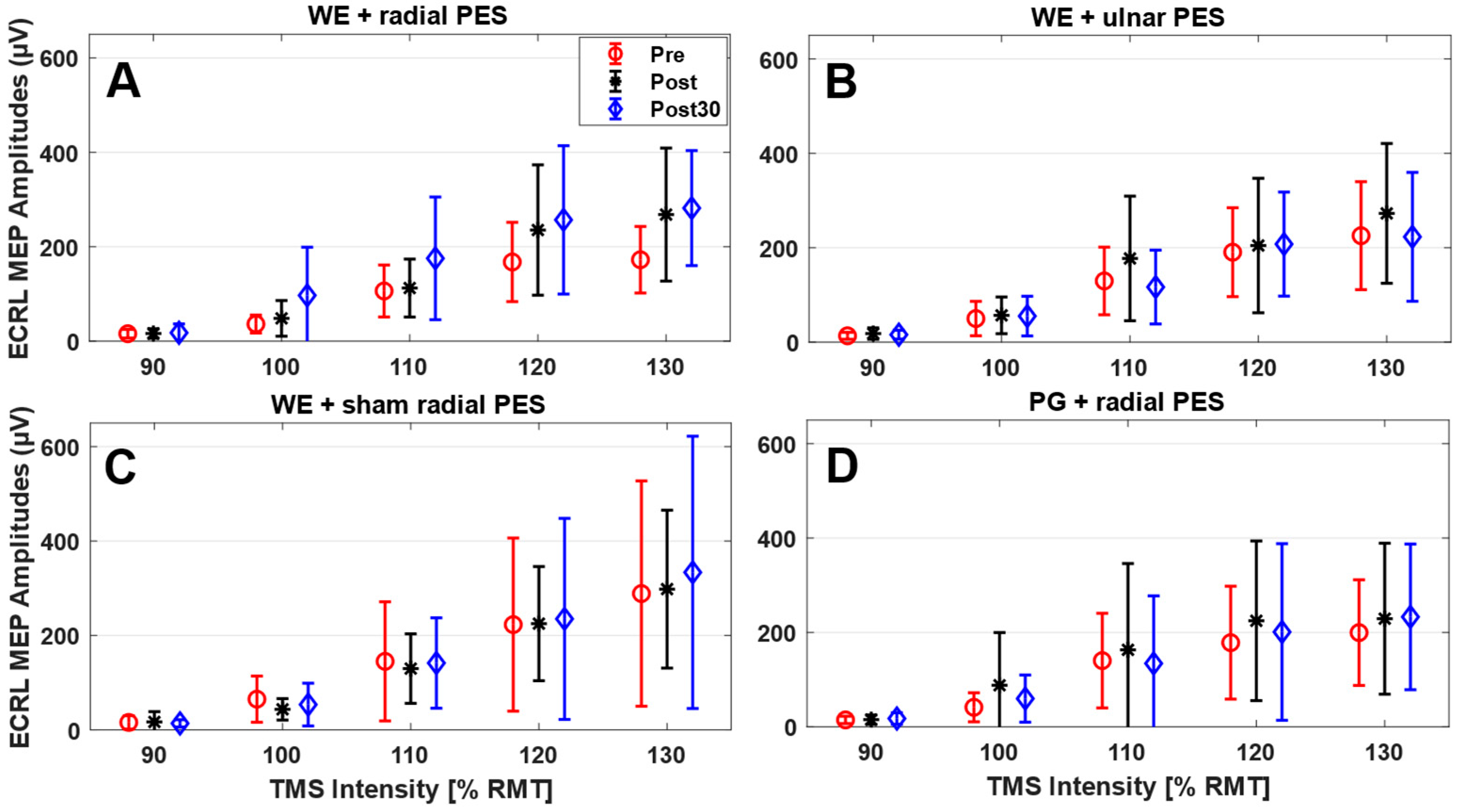
| MEPmax | 191 ± 77|291 ± 139 *|309 ± 143 * | 232 ± 112|287 ± 147|241 ± 136 | 296 ± 248|299 ± 174|342 ± 298 | 218 ± 124|262 ± 182|243 ± 170 |
| S50 | 49 ± 12|50 ± 12|48 ± 12 | 51 ± 12|52 ± 12|52 ± 15 | 49 ± 12|49 ± 12|50 ± 12 | 49 ± 8|49 ± 12|50 ± 12 |
| Slope | 0.65 ± 0.58|0.64 ± 0.46|0.64 ± 0.46 | 0.42 ± 0.23|0.82 ± 0.89|0.64 ± 0.58 | 0.43 ± 0.31|0.41 ± 0.15|0.42 ± 0.23 | 0.53 ± 0.35|0.64 ± 0.62|0.51 ± 0.35 |
Disclaimer/Publisher’s Note: The statements, opinions and data contained in all publications are solely those of the individual author(s) and contributor(s) and not of MDPI and/or the editor(s). MDPI and/or the editor(s) disclaim responsibility for any injury to people or property resulting from any ideas, methods, instructions or products referred to in the content. |
© 2026 by the authors. Licensee MDPI, Basel, Switzerland. This article is an open access article distributed under the terms and conditions of the Creative Commons Attribution (CC BY) license.
Share and Cite
Dalgaard, K.S.; Lavesen, E.R.; Sulkjær, C.S.; Stevenson, A.J.T.; Jochumsen, M. Specificity of Pairing Afferent and Efferent Activity for Inducing Neural Plasticity with an Associative Brain–Computer Interface. Sensors 2026, 26, 549. https://doi.org/10.3390/s26020549
Dalgaard KS, Lavesen ER, Sulkjær CS, Stevenson AJT, Jochumsen M. Specificity of Pairing Afferent and Efferent Activity for Inducing Neural Plasticity with an Associative Brain–Computer Interface. Sensors. 2026; 26(2):549. https://doi.org/10.3390/s26020549
Chicago/Turabian StyleDalgaard, Kirstine Schultz, Emma Rahbek Lavesen, Cecilie Sørenbye Sulkjær, Andrew James Thomas Stevenson, and Mads Jochumsen. 2026. "Specificity of Pairing Afferent and Efferent Activity for Inducing Neural Plasticity with an Associative Brain–Computer Interface" Sensors 26, no. 2: 549. https://doi.org/10.3390/s26020549
APA StyleDalgaard, K. S., Lavesen, E. R., Sulkjær, C. S., Stevenson, A. J. T., & Jochumsen, M. (2026). Specificity of Pairing Afferent and Efferent Activity for Inducing Neural Plasticity with an Associative Brain–Computer Interface. Sensors, 26(2), 549. https://doi.org/10.3390/s26020549