Breaking the Cross-Sensitivity Degeneracy in FBG Sensors: A Physics-Informed Co-Design Framework for Robust Discrimination


Abstract
1. Introduction
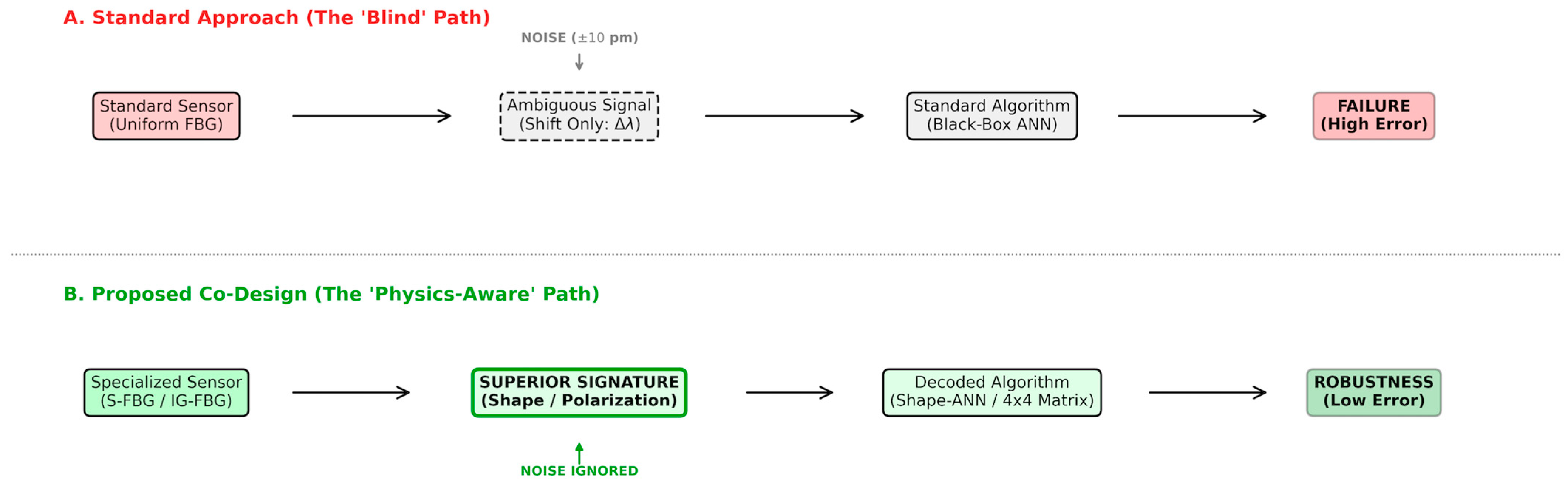
- Quantitative Failure Analysis of Baseline Sensors: We provide a rigorous failure analysis of standard broad-spectrum sensors (QC-FBG). While recent studies such as those by Li et al. [12] and Hameed et al. [13] suggest that deep learning can extract parameters from complex spectra, our results demonstrate that QC-FBGs represent an “ill-conditioned” system where temperature and strain responses remain linearly dependent (). This proves that without physical orthogonality, advanced ANNs fail to converge, confirming the limitations of purely data-driven approaches in ambiguous physical domains.
- Validation of Orthogonal Architectures: We validate two novel robust architectures—the Amplitude-Modulated S-FBG and the Polarization-Diverse IG-FBG—that introduce specific physical mechanisms to break cross-sensitivity degeneracy. Unlike the approach of Choi et al. [14], which relies on manufacturing artifacts (side-lobes) and requires massive datasets (46,000 samples), our designs leverage deterministic superstructure concepts [24] and inverse-Gaussian apodization profiles [25] to create distinct, physically orthogonal feature spaces decodable with high accuracy ( error).
- Data Efficiency via Physics-Informed Learning: We introduce a Physics-Informed Neural Network (PINN) strategy to overcome the “data scarcity” bottleneck identified in recent reviews by Avellar et al. [20] and Zhang et al. [21]. By embedding the Transfer Matrix Method (TMM) physics [19,26] directly into the network’s loss function, we demonstrate that the model can be trained effectively using primarily unlabeled data. This approach improves data efficiency by compared to standard models, bridging the gap between physical modeling and data-driven inference as pioneered by Raissi et al. [27] and recently adapted for optical systems [28].
2. Materials and Methods
2.1. Forward Modeling: Transfer Matrix Method (TMM)
2.2. Mathematical Definition of Robustness
2.3. Sensor Architectures Evaluated
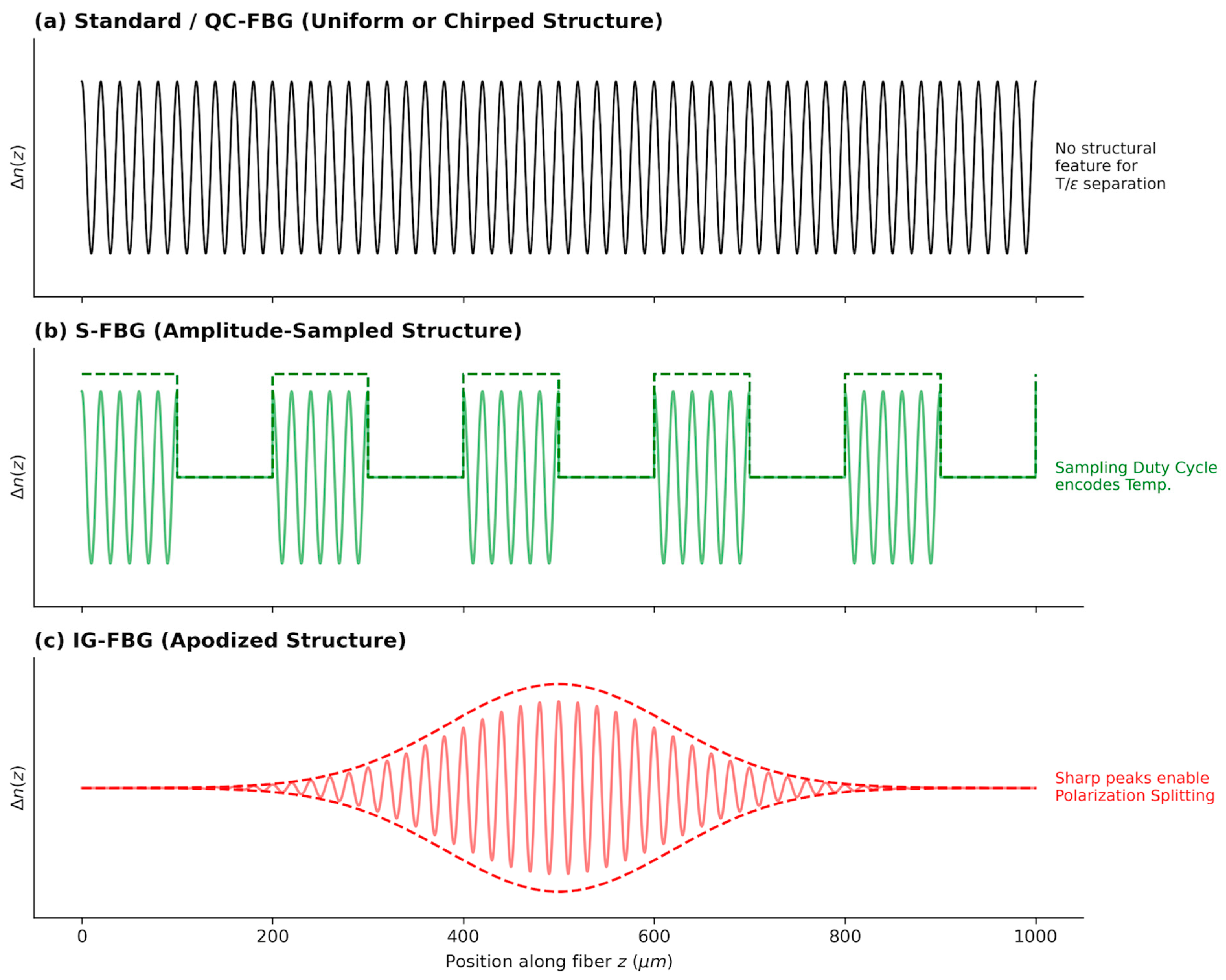
2.3.1. Baseline Reference: Quadratically Chirped FBG (QC-FBG)
2.3.2. Co-Design I: Amplitude-Modulated S-FBG
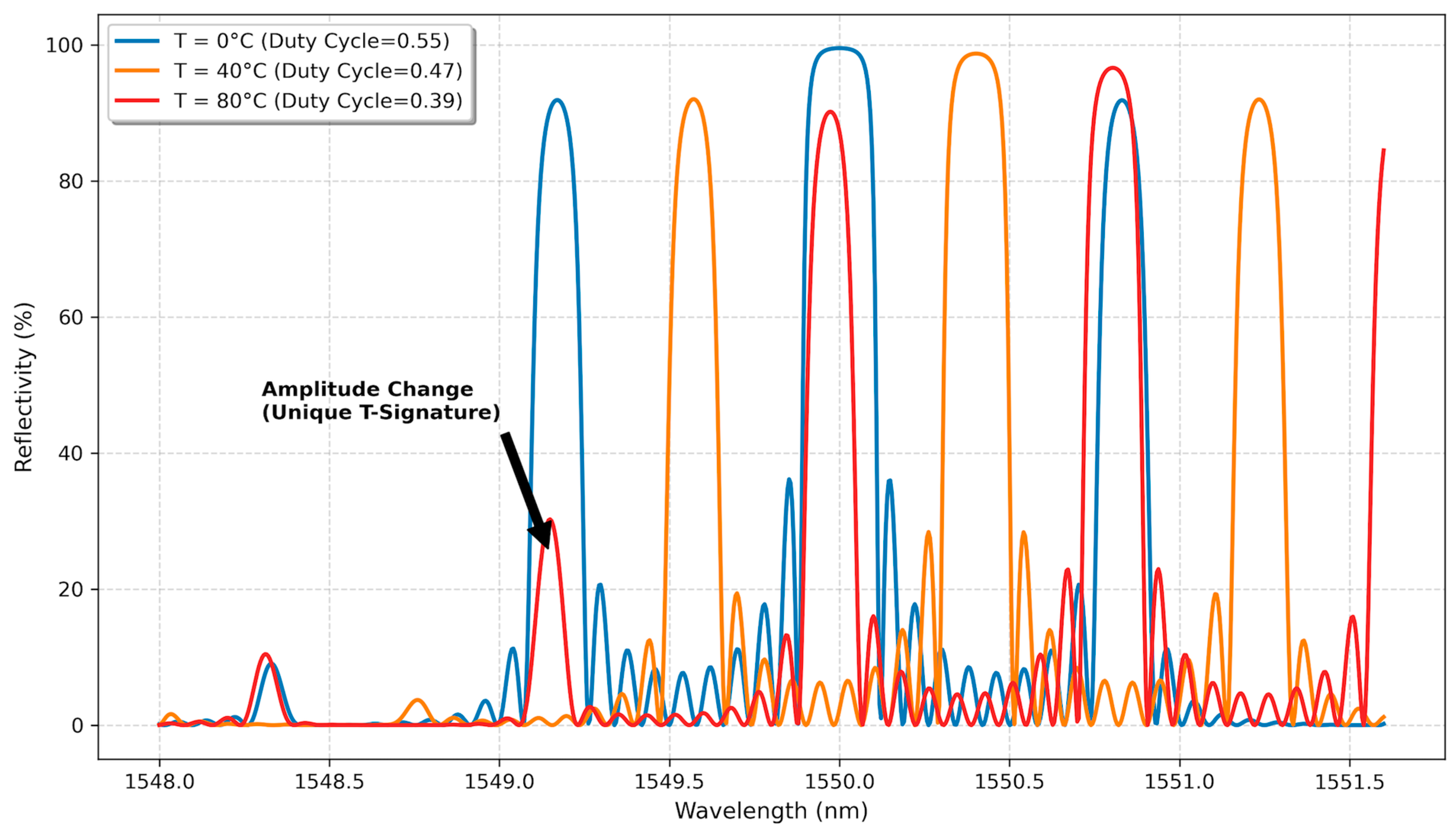
- Strain primarily affects the Bragg wavelength via the elasto-optic effect (Line Shift).
- Temperature affects via the thermo-optic effect, but also alters the Duty Cycle via polymer expansion.
- Critically, changes in Duty Cycle alter the ratio of peak amplitudes between the main Bragg resonance and the sampling sidebands.
2.3.3. Co-Design II: Inverse-Gaussian Apodized FBG (IG-FBG)
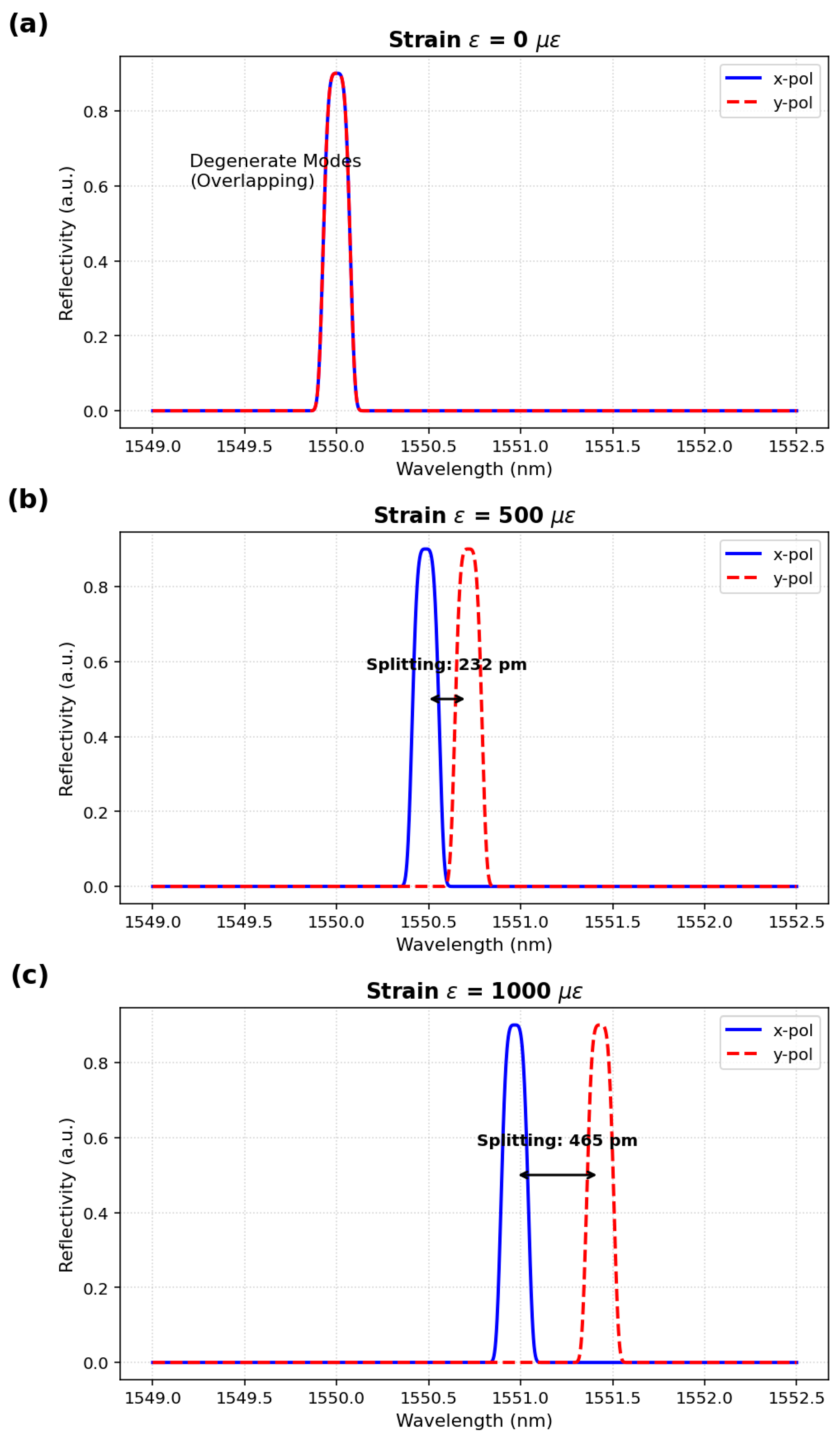
- Under Axial Strain, the cylindrical symmetry of the fiber is broken, inducing linear birefringence ().
- The sharpness of the IG-FBG peaks allows this minute birefringence to be resolved as a spectral splitting of the Bragg peak into two distinct sub-peaks ( and ).
- Temperature shifts both peaks equally but does not cause significant splitting (in isotropic silica).
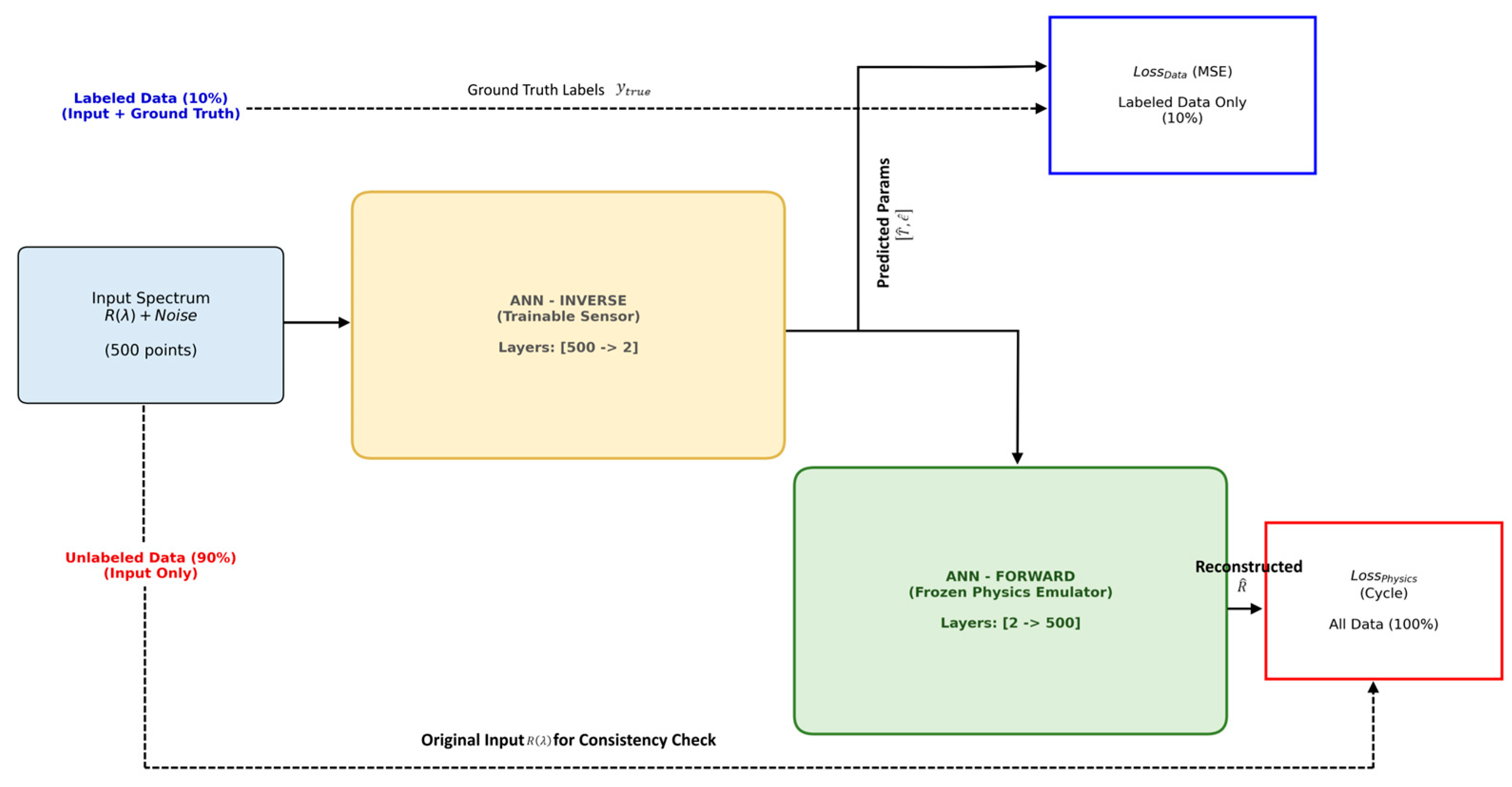
2.4. The Physics-Informed Neural Network (PINN)
- Sensor Network (Inverse Model): A trainable neural network that takes raw spectral data as input and predicts physical parameters (, ).
- Physics Emulator (Forward Model): A pre-trained, frozen network that acts as a differentiable surrogate for the TMM equations. It maps physical parameters back to spectral outputs.
2.4.1. Sensor Network (Inverse Model)
- Input: A high-dimensional noisy spectrum vector (500 points). The resolution of 500 points (approx. 0.02 nm/step) was selected based on the Shannon-Nyquist criterion to adequately capture the fine spectral features of the S-FBG side-lobes and the sharp peaks of the IG-FBG.
- Architecture: A compressive “encoder” structure with layers of size [500 → 256 → 128 → 64 → 2]. This funnel shape progressively filters high-frequency spectral noise, forcing the network to learn the low-dimensional latent features corresponding to temperature () and strain ().
- Activation: Rectified Linear Unit (ReLU) activation functions are used in hidden layers to mitigate the vanishing gradient problem. The output layer uses a linear activation function to enable continuous regression of physical parameters.
2.4.2. Physics Emulator (Forward Model)
- Input: The predicted physical parameters ().
- Architecture: An expansive “decoder” structure with layers of size [2 → 128 → 256 → 512 → 500]. This network acts as a differentiable surrogate for the analytical TMM solver.
- Training Strategy: This network is pre-trained on TMM simulations to master the forward physics ( → Spectrum) and is subsequently frozen (non-trainable) during the PINN training phase. Its sole purpose is to backpropagate the “physics loss” to the Sensor Network.
3. Results and Analysis
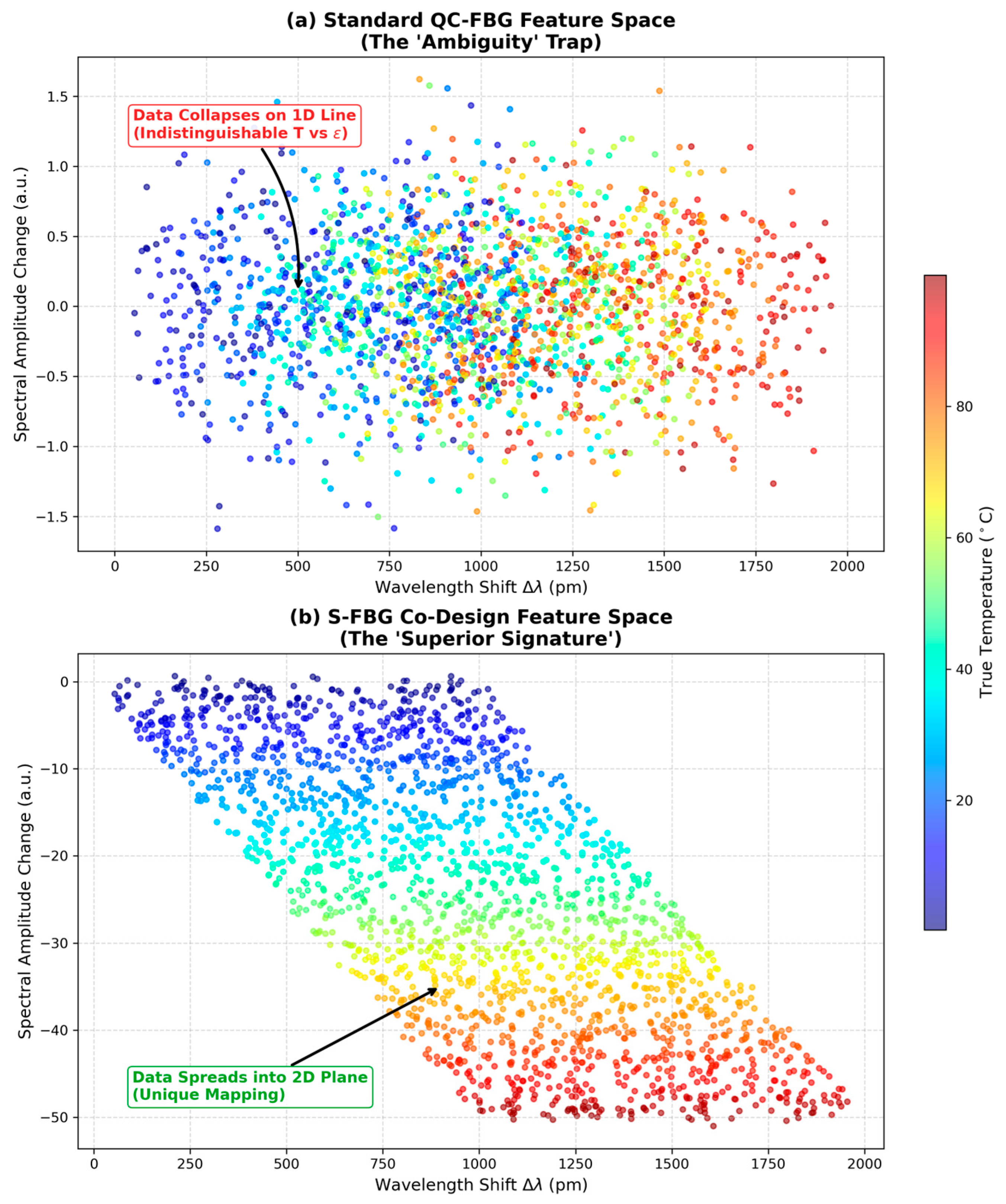
3.1. Analysis of Baseline Failure (QC-FBG)
3.2. Controlled Ablation Studies
3.2.1. Hardware Ablation (Fixed Algorithm: Standard ANN)
- QC-FBG: The ANN failed to converge (MAE Temp: ), confirming feature collapse.
- S-FBG: The exact same ANN achieved state-of-the-art accuracy (MAE Temp: ).
3.2.2. Stability Analysis (Condition Number)
3.2.3. Algorithm Ablation (Fixed Hardware)
- S-FBG: The linear K-Matrix performs poorly (), while the ANN is excellent (). This confirms that the S-FBG relies on non-linear amplitude modulation features.
- IG-FBG: The simple K-Matrix () performs statistically identically to the complex ANN () and PINN (). This validates that the IG-FBG creates a linear orthogonal feature space, eliminating the need for “Black Box” AI (physics-agnostic models).
3.3. Validation of Co-Design I (S-FBG + ANN)
- Accuracy: The model achieved a Mean Absolute Error (MAE) of (Temperature) and (Strain).
- Noise Immunity: The solution remained stable even as noise levels increased to ± 30 pm.
3.4. Validation of Co-Design II (IG-FBG + Matrix)
3.5. Data Efficiency of PINN
3.6. Noise Robustness Analysis
- QC-FBG (Failure): Performance degraded catastrophically. In Monte Carlo simulations, temperature errors exceeded . This confirms that the system is physically under-determined due to the high condition number for practical use. Information from a singular source (spectral shape) proved mathematically insufficient to solve for two unknowns.
- S-FBG + ANN (Co-Design): This structure maintained high accuracy even in the presence of noise. A Mean Absolute Error (MAE) of for temperature and for strain was achieved. The amplitude modulation feature provided a stable anchor for the ML model. This result is competitive with the 95% accuracy reported by Choi et al. [14], but unlike their method, it is achieved through a deterministic feature in the sensor’s physical structure rather than requiring massive datasets.
- IG-FBG + Matrix (Highest Precision): This approach yielded the highest precision with errors of and . The differential nature of the polarization splitting measurement effectively cancels out common-mode noise (such as laser drift), leading to superior Signal-to-Noise Ratio (SNR).
4. Discussion
5. Conclusions
- Robustness Requires Physical Orthogonality: The failure of the QC-FBG () and the fragility of “Black Box” methods [12] proves that algorithmic complexity is not a substitute for physical information. The proposed IG-FBG architecture () solves this by using strain-induced birefringence to create a physically orthogonal differential signal.
- Deterministic Features Beat Artifacts: Two superior architectures have been validated. S-FBG utilizes thermally induced amplitude modulation to achieve robust discrimination with an ANN. IG-FBG utilizes strain-induced birefringence to provide high-precision discrimination using simple linear algebra (). While Choi et al. [14] successfully used spectral sidelobes for discrimination, their reliance on manufacturing artifacts limits scalability. The proposed S-FBG architecture improves upon this by introducing a deterministic, thermally responsive amplitude modulation via a polymer coating, ensuring consistent performance across mass-produced sensors.
- Physics Solves the Data Crisis (Physics-Informed Learning): A PINN strategy utilizing unlabeled data has been successfully implemented, increasing training efficiency by over 200% and paving the way for scalable, data-efficient calibration. The “Big Data” requirement of current methods (46,000 samples in [14]) is a major barrier. The proposed PINN strategy effectively substitutes experimental data with physical knowledge (TMM), achieving a 2.2× improvement in data efficiency.
Author Contributions
Funding
Institutional Review Board Statement
Informed Consent Statement
Data Availability Statement
Conflicts of Interest
Abbreviations
| AI | Artificial Intelligence |
| ANN | Artificial Neural Network |
| CBM | Condition-Based Maintenance |
| CNN | Convolutional Neural Network |
| DAQ | Data Acquisition |
| DL | Deep Learning |
| EMI | Electromagnetic Interference |
| FBG | Fiber Bragg Grating |
| FDML | Fourier Domain Mode Locking |
| FFP-TF | Fiber Fabry-Pérot Tunable Filter |
| IG-FBG | Inverse-Gaussian Apodized Fiber Bragg Grating |
| IIoT | Industrial Internet of Things |
| LPG | Long Period Grating |
| MAE | Mean Absolute Error |
| ML | Machine Learning |
| MSE | Mean Squared Error |
| OSA | Optical Spectrum Analyzer |
| PINN | Physics-Informed Neural Network |
| PM | Polarization-Maintaining |
| PZT | Piezoelectric Transducer |
| QC-FBG | Quadratically Chirped Fiber Bragg Grating |
| RNN | Recurrent Neural Network |
| S-FBG | Superstructure Fiber Bragg Grating |
| SHM | Structural Health Monitoring |
| SNR | Signal-to-Noise Ratio |
| TEC | Thermal Expansion Coefficient/Thermoelectric Cooler |
| TMM | Transfer Matrix Method |
| WSL | Wavelength-Swept Laser |
References
- Kersey, A.D.; Davis, M.A.; Patrick, H.J.; LeBlanc, M.; Koo, K.P.; Askins, C.G.; Putnam, M.A.; Friebele, E.J. Fiber grating sensors. J. Light. Technol. 1997, 15, 1442–1463. [Google Scholar] [CrossRef] [Scilit]
- Risi, F.; Sypabekova, M.; Tosi, D. Fiber optic sensors for biomedical applications: A review. IEEE Sens. J. 2022, 22, 9133–9147. [Google Scholar]
- Majumder, M.; Gangopadhyay, T.K.; Chakraborty, A.K.; Dasgupta, K.; Bhattacharya, D.K. Fibre Bragg gratings in structural health monitoring—Present status and applications. Sens. Actuators A Phys. 2008, 147, 150–164. [Google Scholar] [CrossRef] [Scilit]
- Jones, J.D.C. Review of fibre sensor techniques for temperature-strain discrimination. In Proceedings of the 14th International Conference on Optical Fiber Sensors, Venice, Italy, 11–13 October 2000. [Google Scholar]
- Xu, M.G.; Archambault, J.L.; Reekie, L.; Dakin, J.P. Discrimination between strain and temperature effects using dual-wavelength fibre grating sensors. Electron. Lett. 1994, 30, 1085–1087. [Google Scholar] [CrossRef] [Scilit]
- Patrick, H.J.; Williams, G.M.; Kersey, A.D.; Pedrazzani, J.R.; Vengsarkar, A.M. Hybrid fiber Bragg grating/long period fiber grating sensor for strain/temperature discrimination. IEEE Photonics Technol. Lett. 1996, 8, 1223–1225. [Google Scholar] [CrossRef]
- Li, T.; Tan, Y.; Zhou, X.; Ansboro, S. Simultaneous measurement of strain and temperature using a single FBG with a special packaging structure. IEEE Sens. J. 2019, 19, 4492–4498. [Google Scholar]
- Lu, F.; Zhang, J.S.; Liu, Q.F.; Wang, J.G. Research on vibration sensing of military vehicles based on fiber bragg grating “piston” packaging. Fire Control. Command. Control. 2024, 7, 135–139, 148. [Google Scholar]
- Ding, Z.; Tan, Z. Strain and temperature discrimination based on a Sagnac interferometer with three sections of high birefringence fibers. J. Opt. Soc. Am. B 2020, 37, 440–444. [Google Scholar] [CrossRef] [Scilit]
- Zou, W.; He, Z.; Hotate, K. One-laser-based generation/detection of Brillouin dynamic grating and its application to distributed discrimination of strain and temperature. Opt. Express 2011, 19, 2363–2370. [Google Scholar] [CrossRef] [Scilit]
- Sarkar, S.; Tarhani, M.; Eghbal, M.K.; Shadaram, M. Discrimination between strain and temperature effects of a single fiber Bragg grating sensor using sidelobe power. J. Appl. Phys. 2020, 127, 114503. [Google Scholar] [CrossRef] [Scilit]
- Li, X.; Sun, Q.; Liu, D.; Liang, D. Simultaneous measurement of strain and temperature based on deep learning and a single fiber Bragg grating. IEEE Access 2021, 9, 12456–12464. [Google Scholar]
- Hameed, M.F.O.; Obayya, S.S.A.; El-Hefnawy, S.M. Deep learning-based approach for simultaneous measurement of strain and temperature using FBG sensors. Opt. Quantum Electron. 2023, 55, 215. [Google Scholar]
- Choi, B.K.; Kim, J.S.; Ahn, S.; Cho, S.Y.; Jeon, M.Y. Simultaneous Temperature and Strain Measurement in Fiber Bragg Grating via Wavelength-Swept Laser and Machine Learning. IEEE Sens. J. 2024, 24, 27516–27524. [Google Scholar] [CrossRef] [Scilit]
- Wang, D.; Jiang, X.; Song, Y.; Fu, M.; Zhang, Z.; Chen, X.; Zhang, M. Applications of Physics-Informed Neural Network for Optical Fiber. IEEE Commun. Mag. 2022, 60, 32–37. [Google Scholar] [CrossRef] [Scilit]
- Jiang, X.; Zhang, M.; Song, Y.; Chen, H.; Huang, D.; Wang, D. Predicting Ultrafast Nonlinear Dynamics in Fiber Optics by Enhanced Physics-Informed Neural Network. J. Light. Technol. 2024, 42, 1381–1394. [Google Scholar] [CrossRef] [Scilit]
- Zhang, Q.; Sun, J.; Rothe, S.; Czarske, J. Physics-Informed Neural Networks for Classical and Quantum Communication with Multimode Fibers. In Frontiers in Optics + Laser Science 2024; Optica Publishing Group: Washington, DC, USA, 2024; p. FM3E.2. [Google Scholar]
- Li, B.; Liang, S.; Luo, J.; Zhang, C.; Li, C.; Liu, Z.; Xia, J. A physics-informed neural network for dual-parameter decoupling and crosstalk suppression based on dynamic physical weight assignment. In Proceedings of the Eighth Global Intelligent Industry Conference (GIIC 2025), Shenzhen, China, 28 July 2025. [Google Scholar]
- Erdogan, T. Fiber grating spectra. J. Light. Technol. 1997, 15, 1277–1294. [Google Scholar] [CrossRef] [Scilit]
- Avellar, L.M.; Silveira, M.; Possetti, G.R.C.; Floridia, C.; Rosolem, J.B. Machine Learning Applied to Optical Fiber Sensors: A Review. Sensors 2024, 24, 4125. [Google Scholar]
- Zhang, Z.; Kong, H.; Ye, Z.; He, J.; Lin, Z.; Liu, Q.; Li, Y.; Kang, J.; Wang, L. SOI dispersive-medium-based interrogation system for quasi-distributed weak fiber Bragg gratings. In Proceedings of the 2nd International Academic Conference on Optics and Photonics (IACOP 2024), Haikou, China, 19 February 2025. [Google Scholar]
- Chethana, K.; Nandi, S.; Goyal, A. Machine Learning Based Predictive Analysis of Temperature-Strain Relationship measured using Fiber Bragg Grating Sensors. In Proceedings of the IEEE International Conference on Electronics, Computing and Communication Technologies, Bangalore, India, 12–14 July 2024. [Google Scholar]
- Uduagbomen, J.; Leeson, M.S.; Liu, Z.; Lakshminarayana, S.; Xu, T. Modified failproof physics-informed neural network framework for fast and accurate optical fiber transmission link modeling. Appl. Opt. 2024, 63, 3794–3802. [Google Scholar] [CrossRef] [Scilit] [PubMed]
- Guan, B.O.; Tam, H.Y.; Tao, X.M.; Dong, X.Y. Simultaneous strain and temperature measurement using a superstructure fiber Bragg grating. IEEE Photonics Technol. Lett. 2000, 12, 675–677. [Google Scholar] [CrossRef] [Scilit]
- Lin, B.; Tjin, S.C.; Ngo, N.Q.; Song, Y. Analysis of inverse-Gaussian apodized fiber Bragg grating. Appl. Opt. 2010, 49, 4715–4722. [Google Scholar] [CrossRef] [Scilit]
- Erdogan, T.; Mizrahi, V. Characterization of UV-induced birefringence in photosensitive Ge-doped silica optical fibers. J. Opt. Soc. Am. B 1994, 11, 2100–2105. [Google Scholar] [CrossRef] [Scilit]
- Raissi, M.; Perdikaris, P.; Karniadakis, G.E. Physics-informed neural networks: A deep learning framework for solving forward and inverse problems involving nonlinear partial differential equations. J. Comput. Phys. 2019, 378, 686–707. [Google Scholar] [CrossRef] [Scilit]
- Karniadakis, G.E.; Kevrekidis, I.G.; Lu, L.; Perdikaris, P.; Wang, S.; Yang, L. Physics-informed machine learning. Nat. Rev. Phys. 2021, 3, 422–440. [Google Scholar] [CrossRef] [Scilit]
- Liau, J.-J.; Chang, C.-C.; Wu, C.-M. Analytic Solution of Uniform Fiber Bragg Gratings by the Eigenvalue and Eigenvector Technique. Prog. Electromagn. Res. B 2009, 16, 17–29. [Google Scholar]
- Liu, Q.; Sun, Y.; Chai, Q.; Zhang, B.; Liu, C.; Sun, T.; Liu, W.; Sun, J.; Ren, Z.; Chu, P.K. Transfer matrix method for twisted fiber Bragg grating in polarization maintaining fiber. Opt. Commun. 2019, 452, 185–188. [Google Scholar] [CrossRef] [Scilit]
- Tiwari, H.; Dwivedi, Y.S.; Singh, R.; Sharma, A.K.; Sharma, A.K.; Krishna, R.; Singha, N.K.; Marques, C. Deep Learning-Enabled De-Noising of Fiber Bragg Grating-Based Glucose Sensor: Improving Sensing Accuracy of Experimental Data. Photonics 2024, 11, 1058. [Google Scholar] [CrossRef] [Scilit]
- Mazanov, M.; Yermakov, O.; Deriy, I.; Takayama, O.; Bogdanov, A.; Lavrinenko, A.V. Photonic Spin Hall Effect: Contribution of Polarization Mixing Caused by Anisotropy. Quantum Rep. 2020, 2, 489–500. [Google Scholar] [CrossRef] [Scilit]
- Cai, L.; Zhang, S.; Zhu, W.; Wu, H.; Zheng, H.; Yu, J.; Chen, Z. Photonic spin Hall effect by anisotropy-induced polarization gradient in momentum space. Opt. Lett. 2020, 45, 6740–6743. [Google Scholar] [CrossRef] [Scilit]
- Reyes-Vera, E.; Valencia-Arias, A.; García-Pineda, V.; Aurora-Vigo, E.F.; Alvarez Vásquez, H.; Sánchez, G. Machine Learning Applications in Optical Fiber Sensing: A Research Agenda. Sensors 2024, 24, 2200. [Google Scholar] [CrossRef] [Scilit]





| Architecture | Refractive Index Profile | Physical Signature | Response Type |
|---|---|---|---|
| QC-FBG | Chirped Period | Wavelength Shift Only | 1D (failed) |
| S-FBG | Sampled Profile | Amplitude Modulation (Duty Cycle~Temp.) | 2D (Separable) |
| IG-FBG | Apodized Profile | Polarization Splitting (Strain Induced Biref.) | 4D (Orthogonal) |
| Sensor | Temp. MAE (°C) | Strain MAE (μϵ) | Result |
|---|---|---|---|
| QC-FBG | 14.88 | 164.25 | Failure (Ambiguous Physics) |
| S-FBG | 1.54 | 18.59 | Success (Rich Physics) |
| IG-FBG | 6.65 | 63.69 | Stable |
| Sensor | (Condition No) | Stability Regime | Interpretation | |
|---|---|---|---|---|
| QC-FBG | 152,762,392,808.17 | Singular (Ill-Posed) | Critical precision loss; noise dominates. | |
| S-FBG | 8.57 (Local) | Non-Linear Stable | Excellent; inherently robust to noise. | |
| IG-FBG | 61.47 | Linear Stable | Excellent; well-conditioned linear system |
| Sensor | Algorithm | Temp. MAE (°C) | Strain MAE (μϵ) | Conclusion |
|---|---|---|---|---|
| S-FBG | Conventional Baseline | 13.95 | 150.00 | Failure (Peak Tracking insufficient) |
| S-FBG | K-Matrix | 13.96 | 150.00 | Linear solver fails (Physics is Non-Linear). |
| S-FBG | Standard ANN | 0.95 | 10.73 | Optimal Co-Design (Non-Linear). |
| S-FBG | PINN (Proposed) | 3.84 | 41.60 | Good for low data regimes. |
| IG-FBG | Conventional Baseline | 15.56 | 140.91 | Failure |
| IG-FBG | K-Matrix | 7.30 | 64.43 | Optimal Co-Design (Linear). |
| IG-FBG | Standard ANN | 7.26 | 64.32 | ANN is unnecessary (Physics is Linear). |
| IG-FBG | PINN (Proposed) | 7.37 | 67.26 | Good for low data regimes. |
| Sensor | Algorithm | Data Eff. | Cond. Num. | Temp. Error (°C) | Strain Error (μϵ) |
|---|---|---|---|---|---|
| QC-FBG | K-Matrix | N/A | 4695 (Fail) | ||
| QC-FBG | ANN (BlackBox) | 100% | N/A | N/A | |
| S-FBG | ANN (BlackBox) | 100% | N/A | ||
| S-FBG | PINN (Proposed) | 10% (High) | N/A | ||
| IG-FBG | K-Matrix | N/A | 64.1 (Robust) | * | * |
| Metric | Standard ANN [12] | PINN (Proposed) | Improvement |
|---|---|---|---|
| Training Data | 10% Labeled | 10% Labeled + 90% Unlabeled | Same Lab Effort |
| Physics Knowledge | None (Black Box) | Embedded (TMM Loss) | Infinite |
| Temp. Error (MAE) | (Failure) | (Converged) | 2.4× Lower Error |
| Data Efficiency | Low | High | (~2.2×) |
| Feature | Li et al. [12]/Hameed et al. [13] | Choi et al. [14] | Proposed QC-FBG (Baseline) | Proposed S-FBG (Co-Design) | Proposed IG-FBG (Co-Design) |
|---|---|---|---|---|---|
| Method | Deep Learning (CNN/LSTM) | High-Speed WSL + ML | ML on Chirped Spectrum | Structure + ML (PINN) | Structure + Matrix |
| Physical Feature | Raw Spectrum (Ambiguous) | Sidelobes (Artifacts) | Spectral Envelope | Amplitude Modulation | Polarization Splitting |
| Robustness | Low (Black Box fragility) | Medium (Sensor specific) | Failure ) | High (Deterministic) | Very High ) |
| Orthogonality | Assumed (Incorrectly) | Partial (Asymmetry) | None (Feature Collapse) | Enhanced (2D Manifold) | Perfect (Linear Indep.) |
| Data Efficiency | Low (Needs dense data) | Very Low (46,000 samples) | N/A | High (PINN enabled) | Maximal (Analytical) |
Disclaimer/Publisher’s Note: The statements, opinions and data contained in all publications are solely those of the individual author(s) and contributor(s) and not of MDPI and/or the editor(s). MDPI and/or the editor(s) disclaim responsibility for any injury to people or property resulting from any ideas, methods, instructions or products referred to in the content. |
© 2026 by the authors. Licensee MDPI, Basel, Switzerland. This article is an open access article distributed under the terms and conditions of the Creative Commons Attribution (CC BY) license.
Share and Cite
Yalınbaş, F.; Yılmaz, G. Breaking the Cross-Sensitivity Degeneracy in FBG Sensors: A Physics-Informed Co-Design Framework for Robust Discrimination. Sensors 2026, 26, 459. https://doi.org/10.3390/s26020459
Yalınbaş F, Yılmaz G. Breaking the Cross-Sensitivity Degeneracy in FBG Sensors: A Physics-Informed Co-Design Framework for Robust Discrimination. Sensors. 2026; 26(2):459. https://doi.org/10.3390/s26020459
Chicago/Turabian StyleYalınbaş, Fatih, and Güneş Yılmaz. 2026. "Breaking the Cross-Sensitivity Degeneracy in FBG Sensors: A Physics-Informed Co-Design Framework for Robust Discrimination" Sensors 26, no. 2: 459. https://doi.org/10.3390/s26020459
APA StyleYalınbaş, F., & Yılmaz, G. (2026). Breaking the Cross-Sensitivity Degeneracy in FBG Sensors: A Physics-Informed Co-Design Framework for Robust Discrimination. Sensors, 26(2), 459. https://doi.org/10.3390/s26020459