Article

Breaking the Cross-Sensitivity Degeneracy in FBG Sensors: A Physics-Informed Co-Design Framework for Robust Discrimination


Faculty of Engineering, Department of Electrical and Electronics Engineering, Bursa Uludağ University, 16059 Bursa, Türkiye
*
Author to whom correspondence should be addressed.
Sensors 2026, 26(2), 459; https://doi.org/10.3390/s26020459
Submission received: 8 December 2025 / Revised: 30 December 2025 / Accepted: 8 January 2026 / Published: 9 January 2026
(This article belongs to the Special Issue Advanced Optical Sensors Based on Machine Learning: 2nd Edition)

Abstract

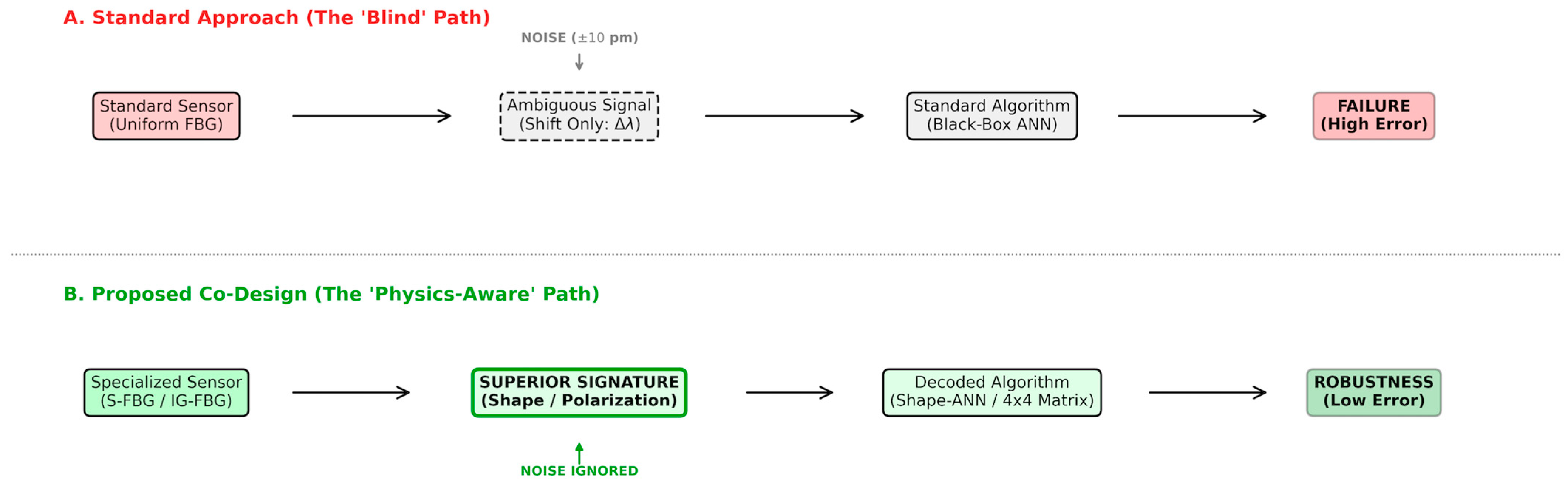
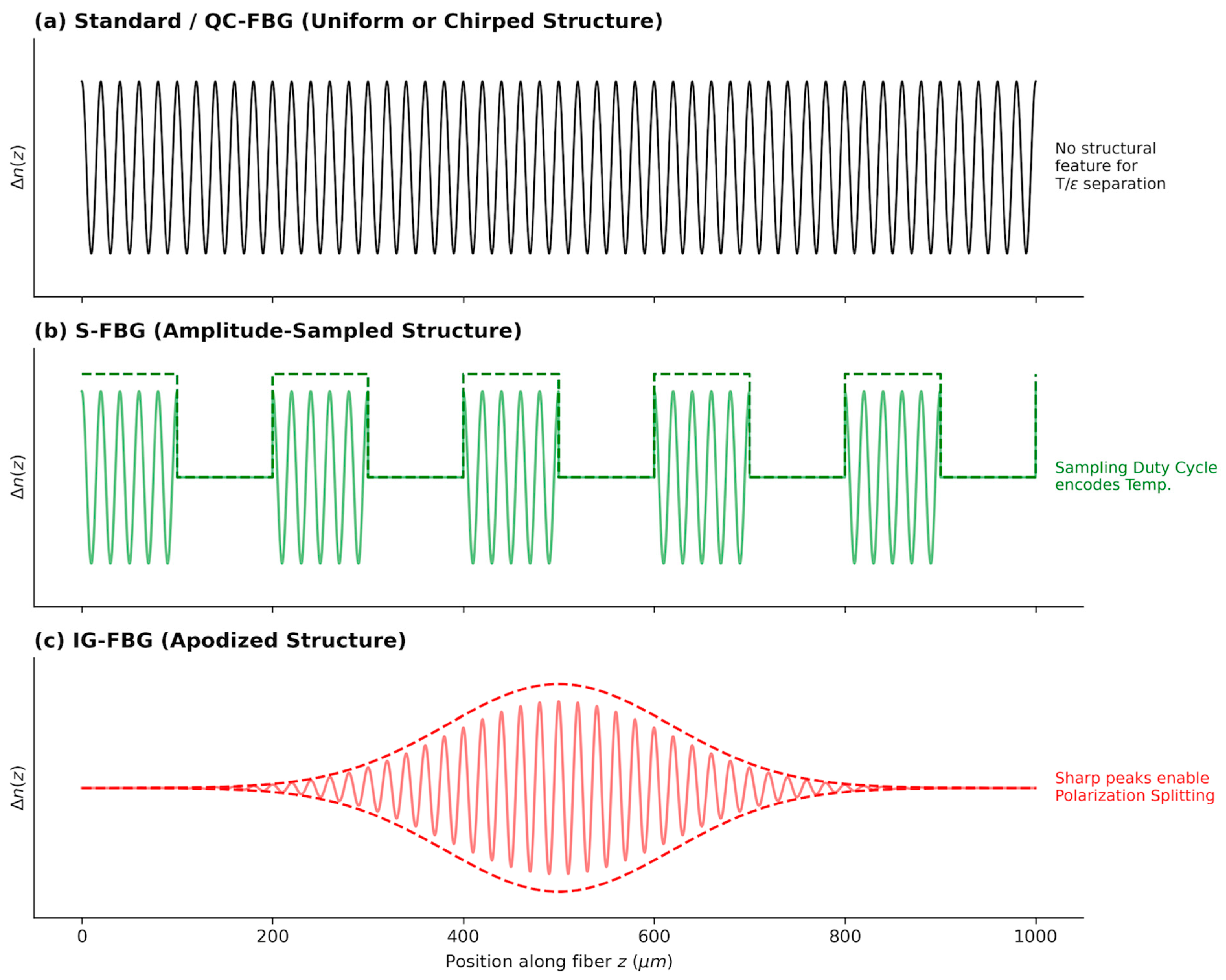
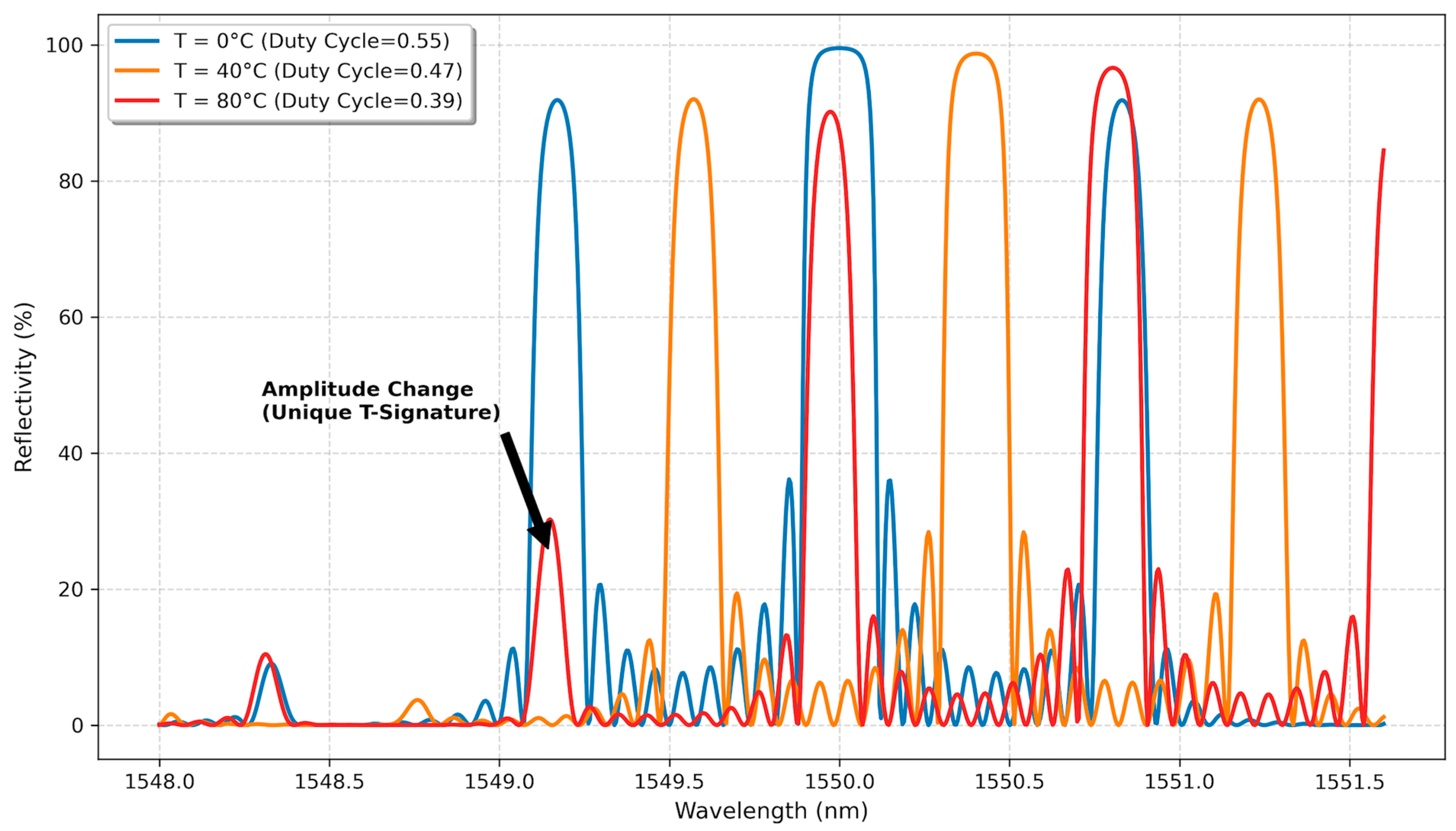
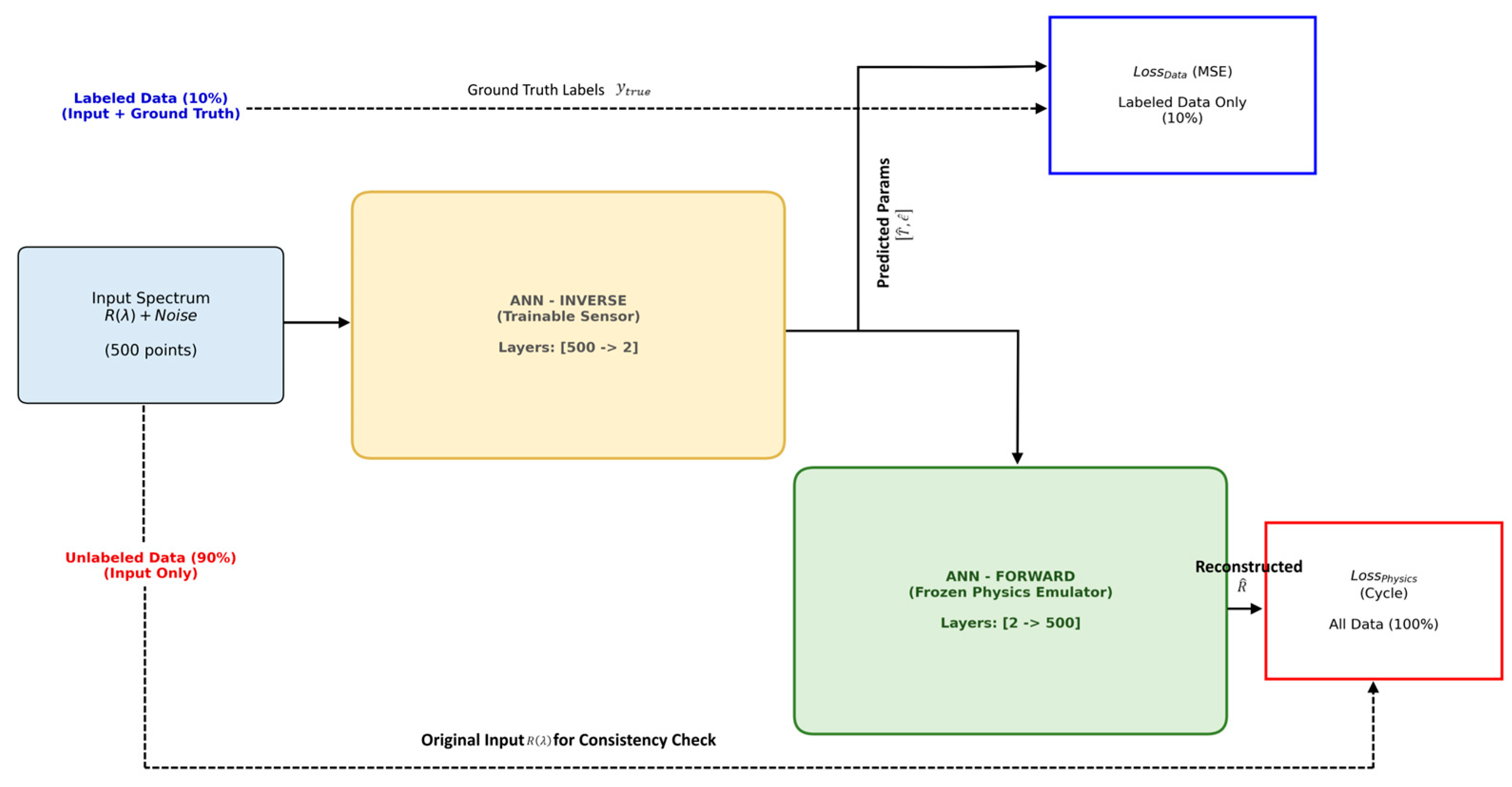
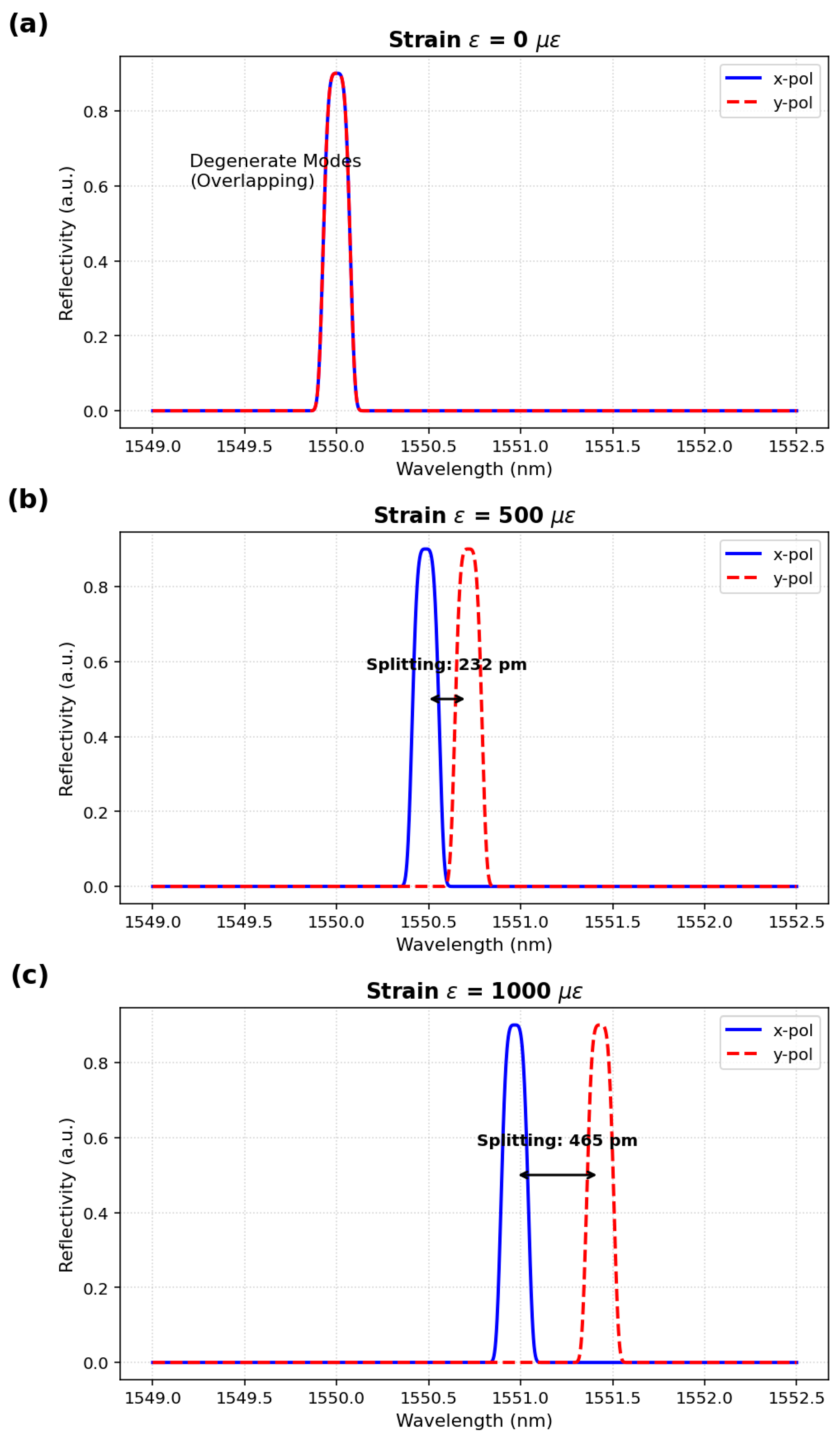
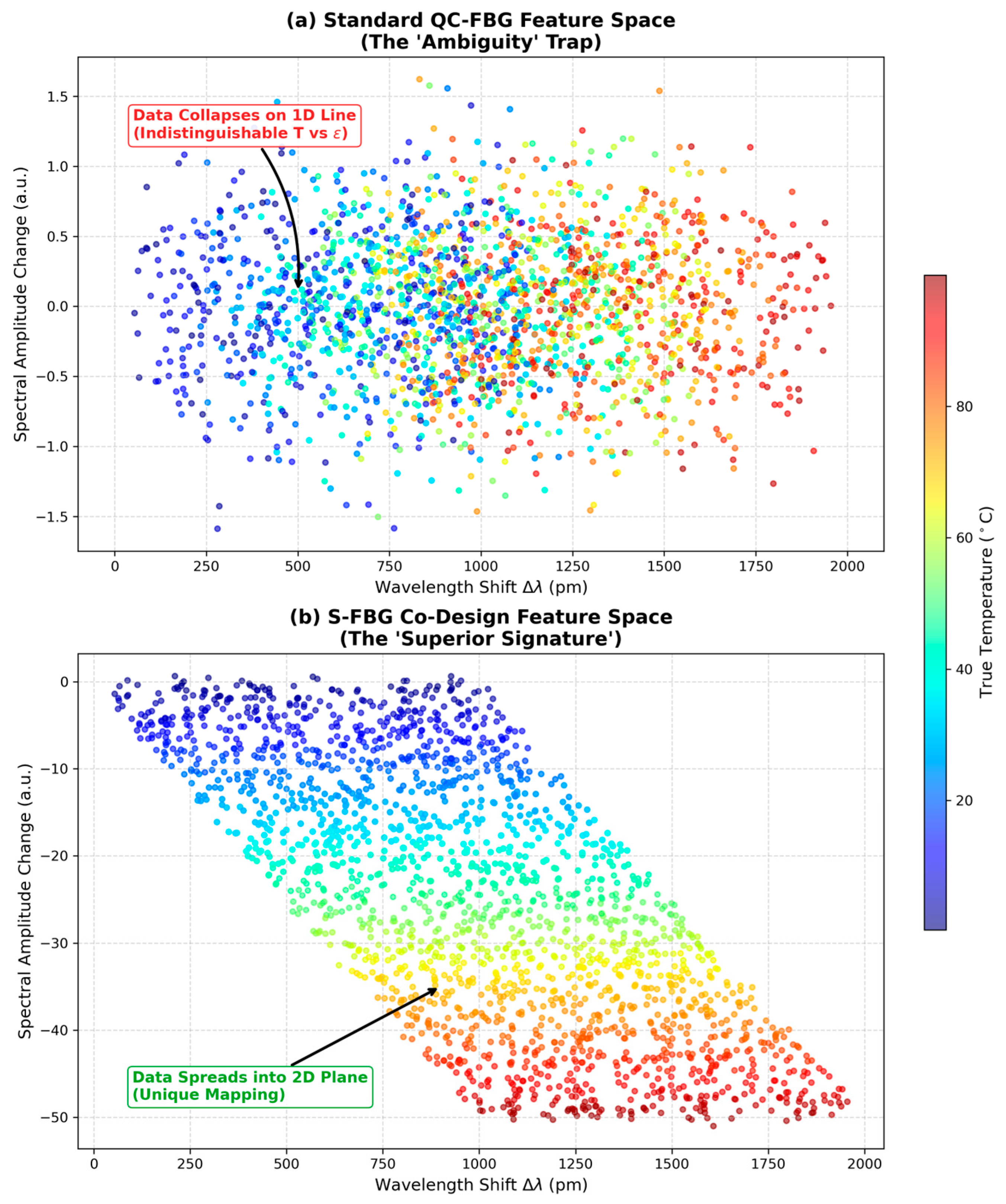
The simultaneous measurement of strain and temperature using Fiber Bragg Grating (FBG) sensors presents a significant challenge due to the intrinsic cross-sensitivity of the Bragg wavelength. While recent studies have increasingly employed “black-box” machine learning algorithms to address this ambiguity, such approaches often overlook the physical limitations of the sensor’s spectral response. This paper challenges the assumption that advanced algorithms alone can compensate for data that is physically ambiguous. We propose a “Sensor-Algorithm Co-Design” methodology, demonstrating that robust discrimination is achievable only when the sensor architecture exhibits a unique, orthogonal physical signature. Using a rigorous Transfer Matrix Method (TMM) and 4 × 4 polarization analysis, we evaluate three distinct architectures. Quantitative analysis reveals that a standard Quadratically Chirped FBG (QC-FBG) functions as an “ill-conditioned baseline” failing to distinguish measurands due to feature space collapse (Kcond>4600). Conversely, we validate two robust co-designs: (1) An Amplitude-Modulated Superstructure FBG (S-FBG) paired with an Artificial Neural Network (ANN), utilizing thermally induced duty-cycle variations to achieve high accuracy (~3.4 °C error) under noise; and (2) A Polarization-Diverse Inverse-Gaussian FBG (IG-FBG) paired with a 4 × 4 K-matrix, exploiting strain-induced birefringence (Kcond64). Furthermore, we address the data scarcity issue in AI-driven sensing by introducing a Physics-Informed Neural Network (PINN) strategy. By embedding TMM physics directly into the loss function, the PINN improves data efficiency by 2.2× compared to standard models, effectively bridging the gap between physical modeling and data-driven inference, addressing the critical data scarcity bottleneck identified in recent optical sensing roadmaps.
Keywords: fiber bragg grating; cross-sensitivity; physics-informed neural networks; transfer matrix method; sensor fusion fiber bragg grating; cross-sensitivity; physics-informed neural networks; transfer matrix method; sensor fusion