Method for Monitoring the Safety of Urban Subway Infrastructure Along Subway Lines by Fusing Inter-Track InSAR Data
 ,
,
Abstract
1. Introduction
2. Materials and Methods
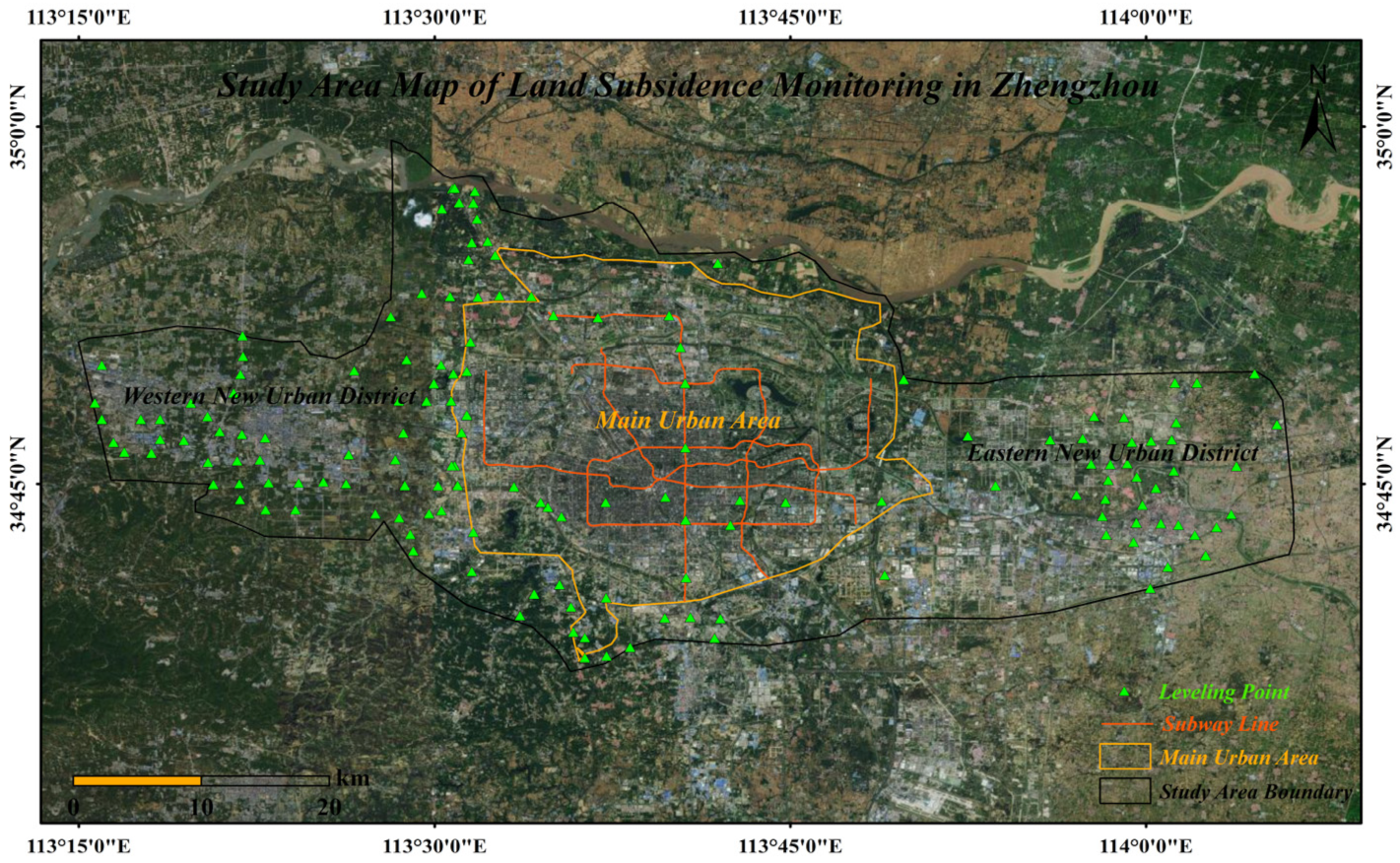
2.1. Study Area
2.2. Data
2.2.1. SAR Data
2.2.2. Optical Imagery Data
2.2.3. Leveling Data
2.3. Research Methods
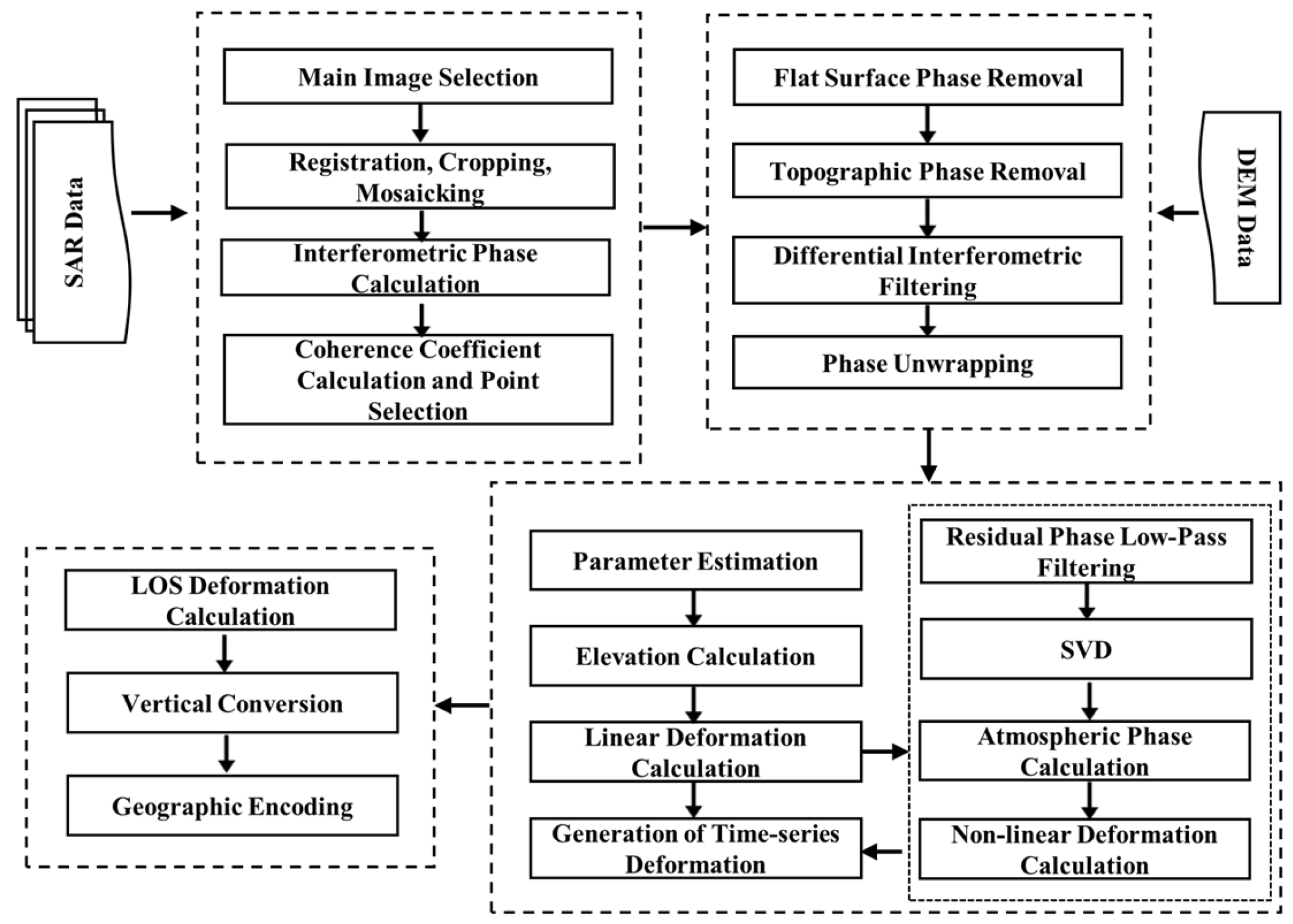
2.3.1. SBAS-InSAR Method
2.3.2. InSAR Mosaicking Method
3. Results
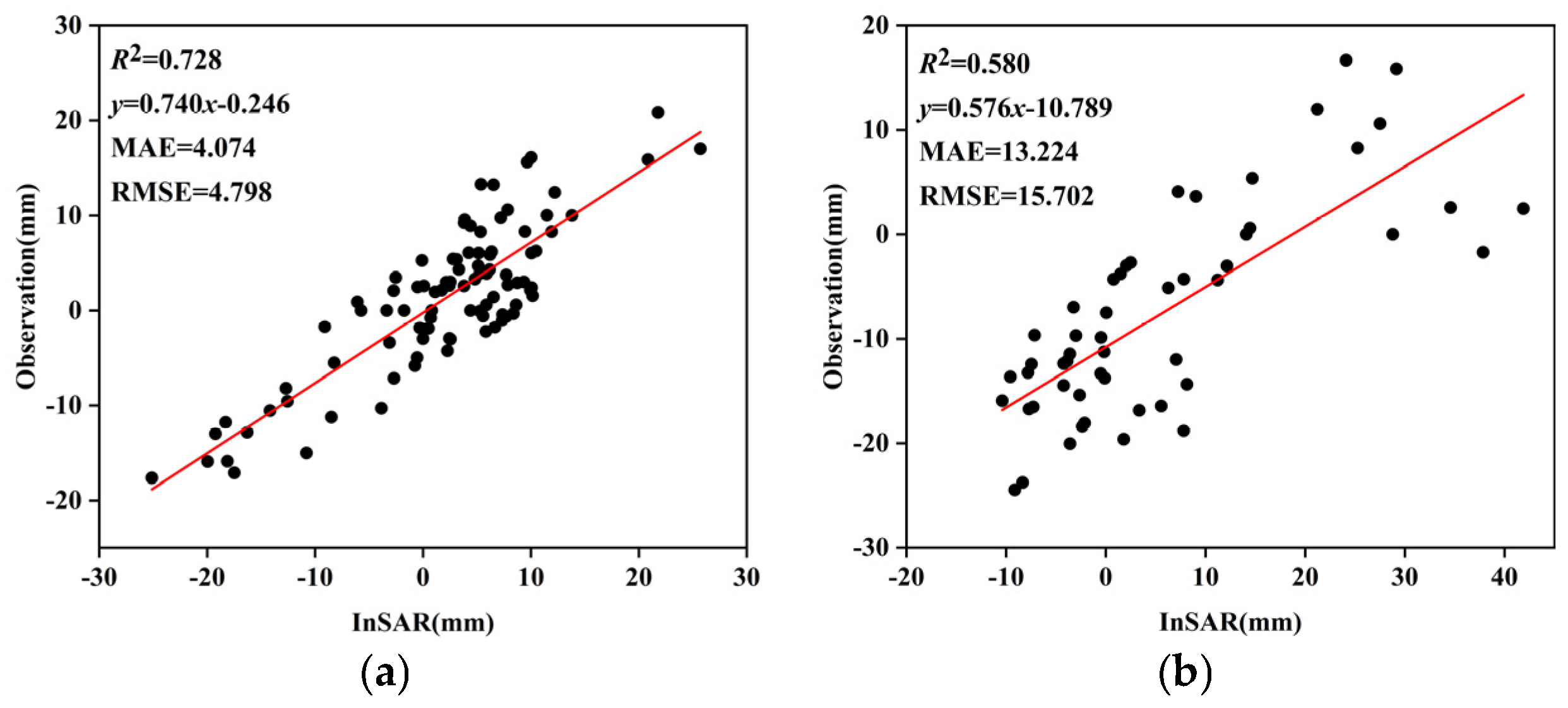
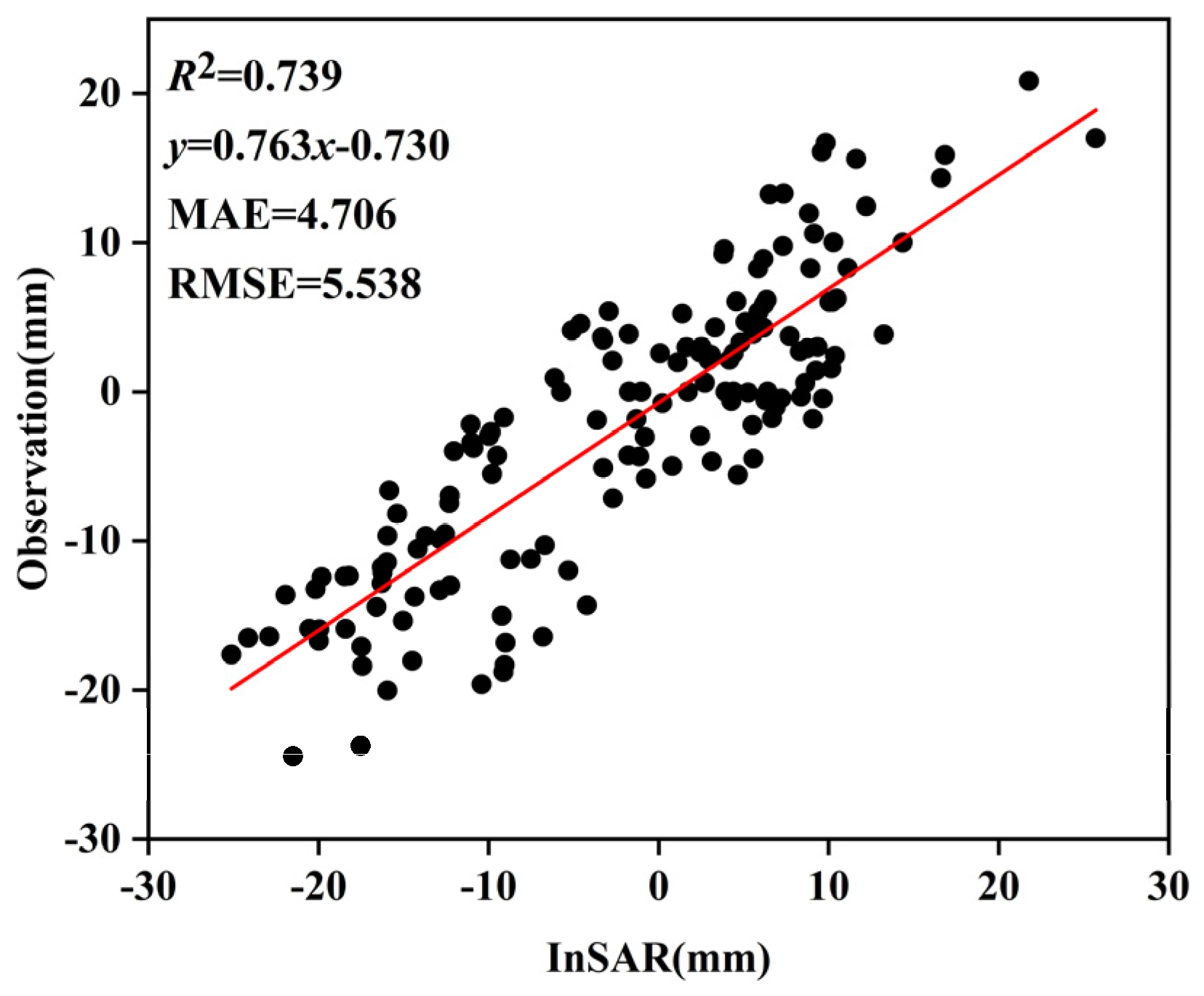
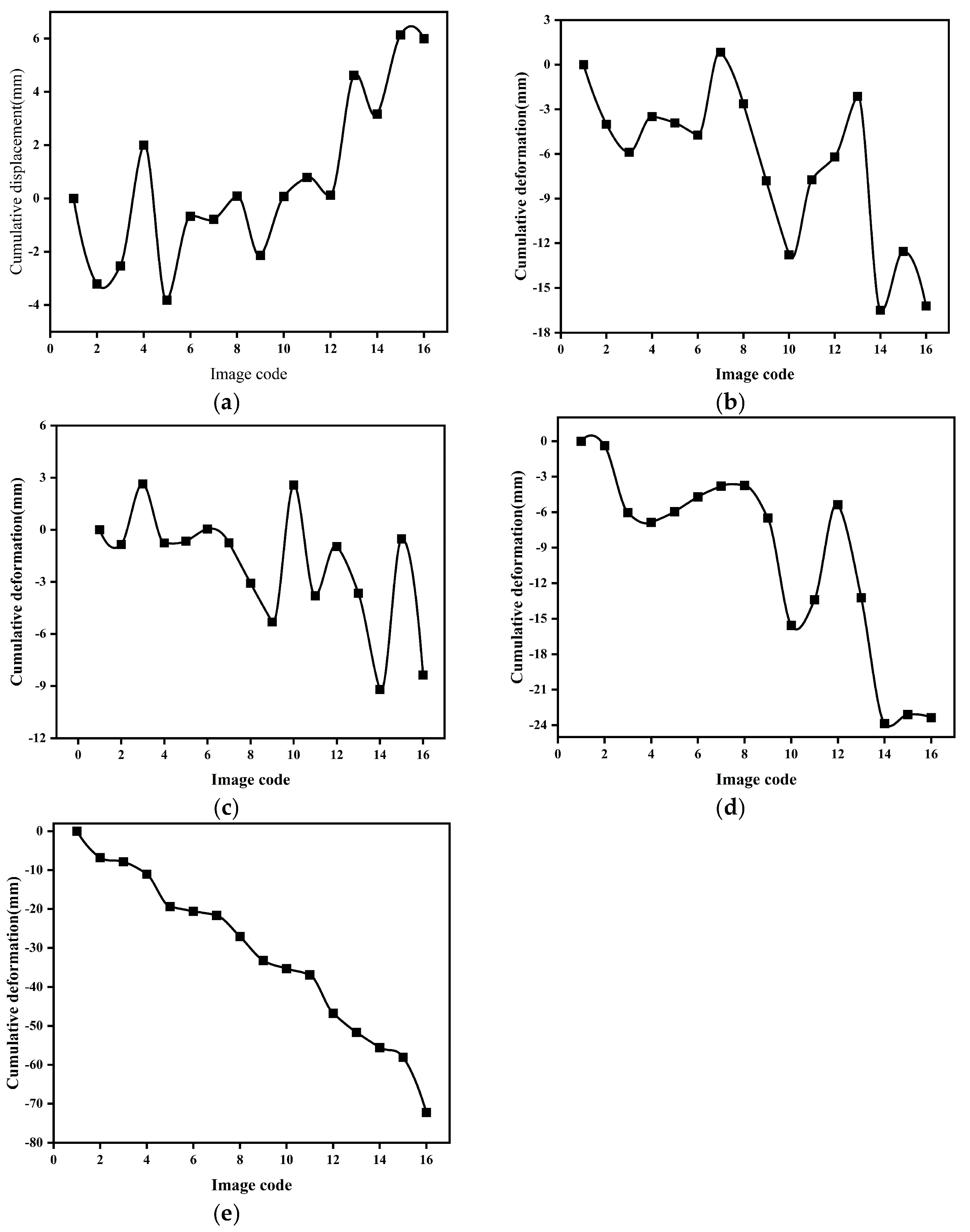
3.1. Verification of the Inter-Orbit InSAR Mosaicking Method
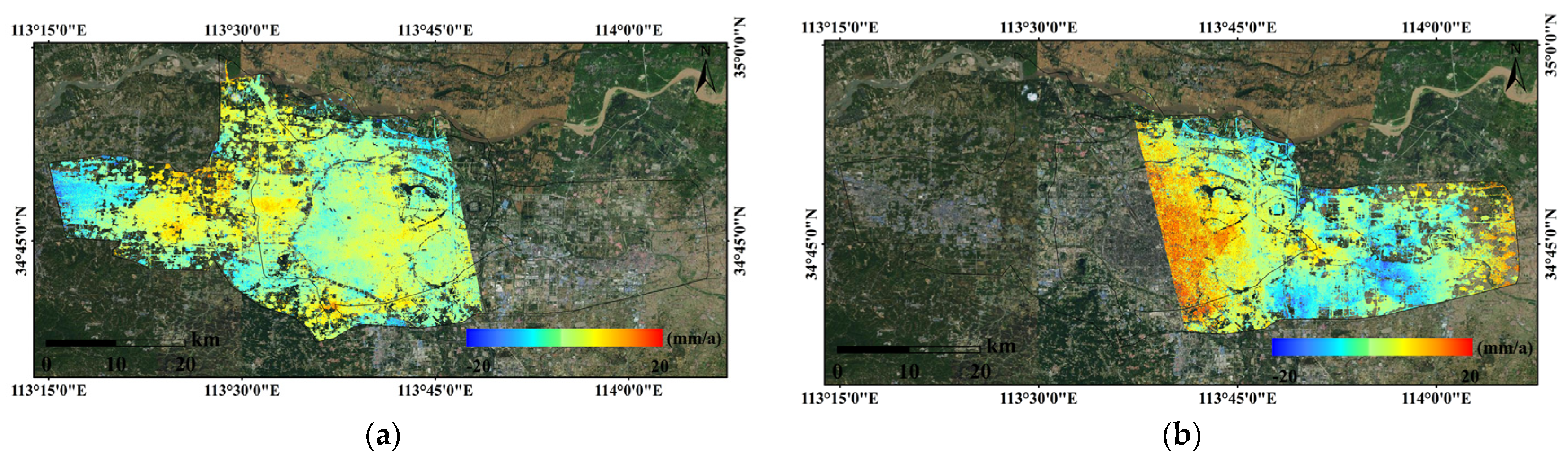
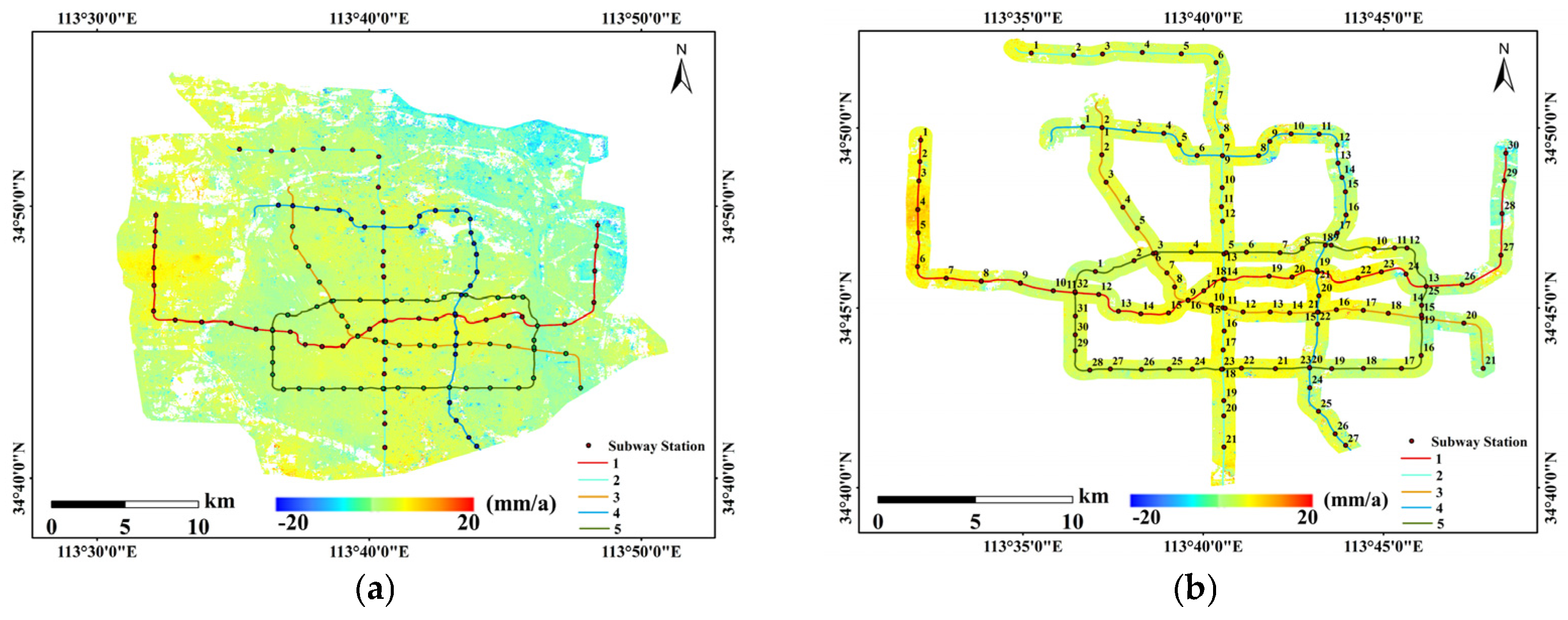
3.2. SBAS-InSAR Deformation Results Analysis
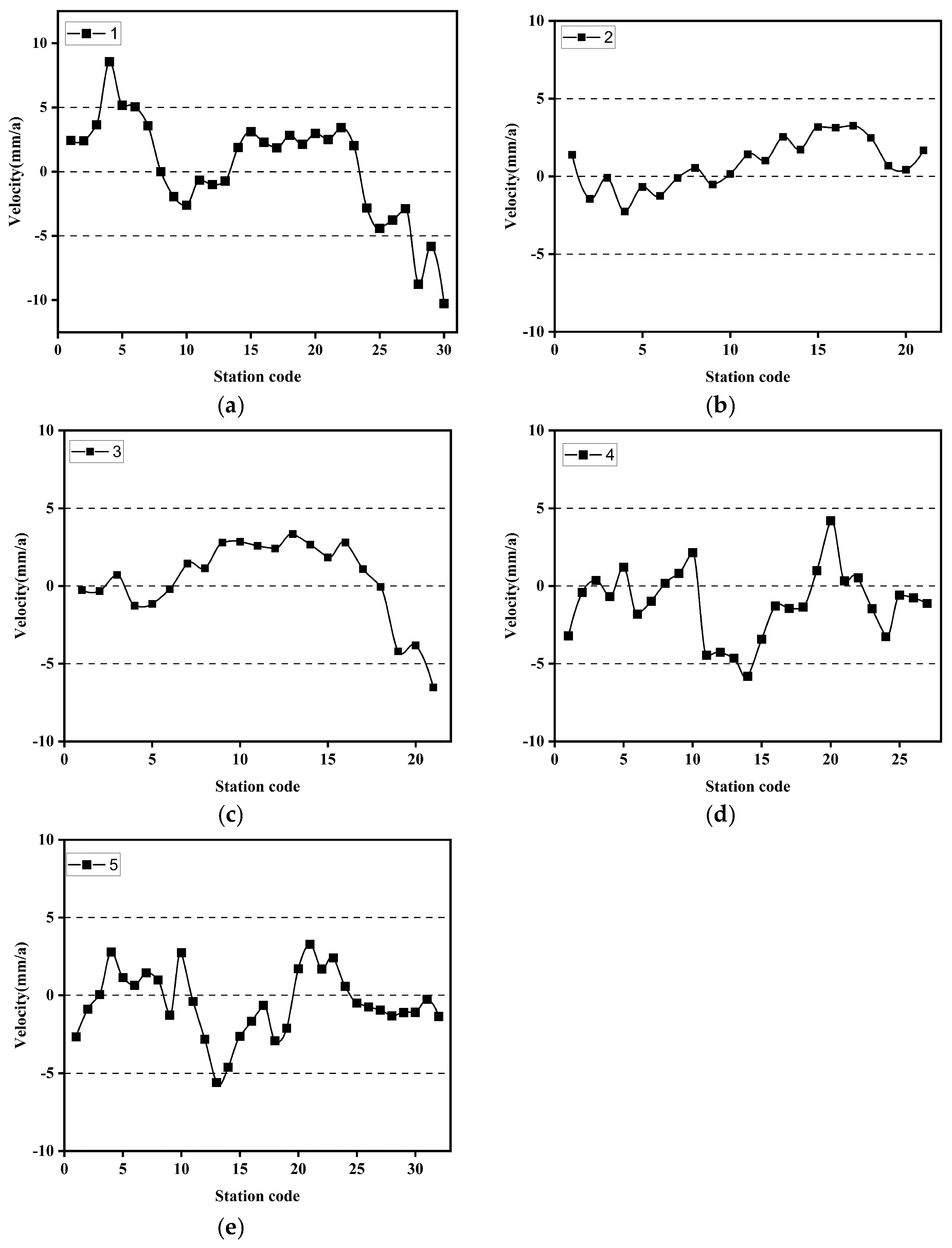
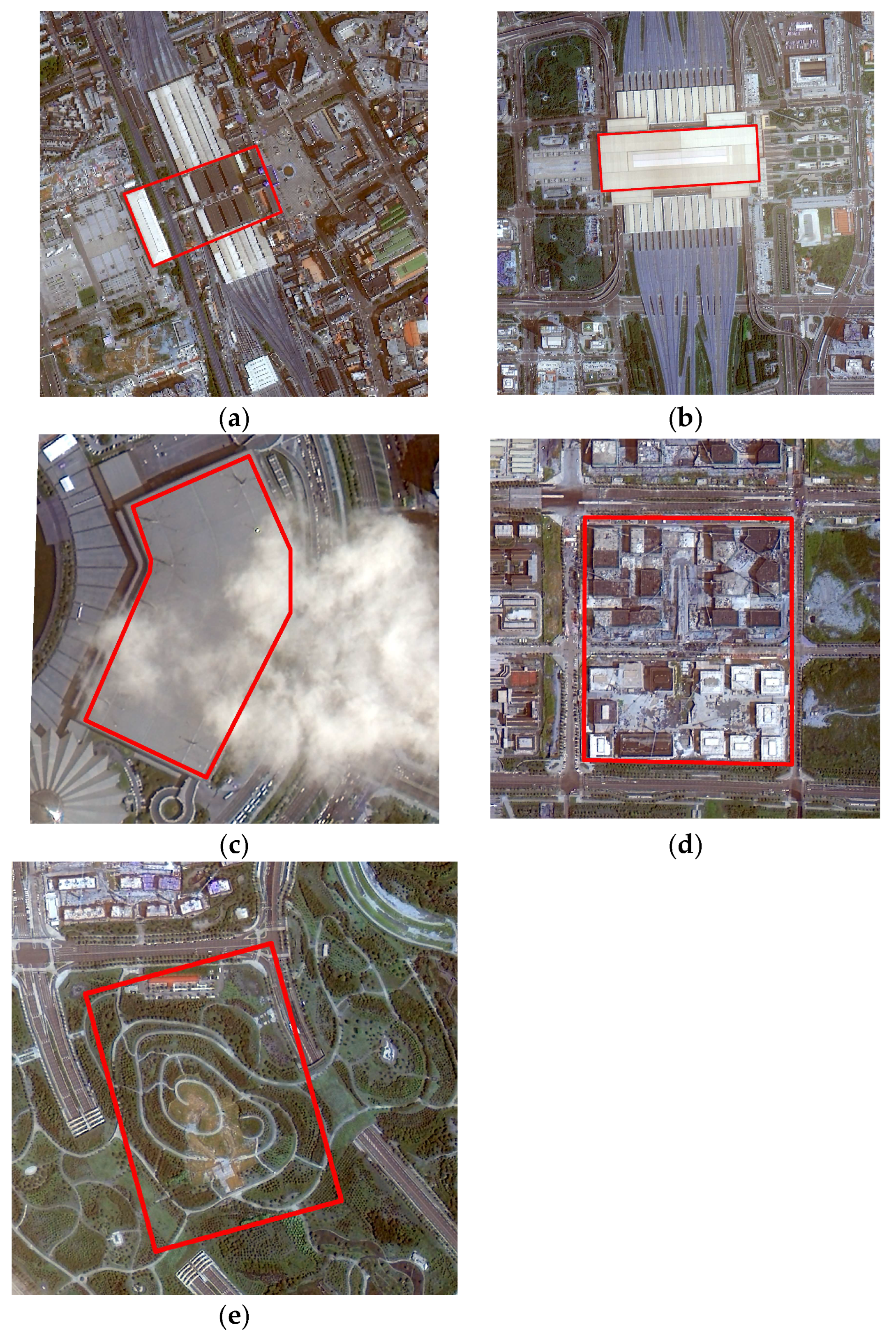
3.3. Monitoring and Analysis of Key Subsurface Deformation Along Subway Lines
4. Discussion
4.1. Deviation Analysis and Correction of Inter-Orbit InSAR Deformation Results
4.2. Spatiotemporal Characteristics of Urban Surface Subsidence
4.3. Attribution Analysis of Subsidence Along Subway Lines
5. Conclusions
Author Contributions
Funding
Institutional Review Board Statement
Informed Consent Statement
Data Availability Statement
Conflicts of Interest
References
- Chen, X.; Tong, Z.; Diao, X.; Tang, Z.; Chen, R.; Li, D. Fine monitoring and prediction of surface deformation along subway lines using MT-InSAR. Sci. Surv. Mapp. 2025, 50, 38–49. [Google Scholar]
- Nilfouroushan, F.; Fryksten, J. Analysis of clay-induced land subsidence in uppsala city using Sentinel-1 SAR data and precise leveling. Remote Sens. 2019, 11, 2764. [Google Scholar]
- Pasternak, G.; Zaczek-Peplinska, J.; Pasternak, K.; Jóźwiak, J.; Pasik, M.; Koda, E.; Vaverková, M.D. Surface monitoring of an MSW landfill based on linear and angular measurements, TLS, and LIDAR UAV. Sensors 2023, 23, 1847. [Google Scholar] [CrossRef]
- Anders, K.; Marx, S.; Boike, J.; Herfort, B.; Wilcox, E.J.; Langer, M.; Marsh, P.; Höfle, B. Multitemporal terrestrial laser scanning point clouds for thaw subsidence observation at Arctic permafrost monitoring sites. Earth Surf. Process. Landf. 2020, 45, 1589–1600. [Google Scholar] [CrossRef]
- Wang, W.; Dang, Y.; Zhang, C.; Yang, Q. Application of CORS network and GNSS technology in ground deformation monitoring: Taking southeast Zhejiang Province as an example. Chin. J. Geol. Hazard Control 2021, 32, 73–77. [Google Scholar]
- Zhou, D.; Zuo, X.; Zhao, Z.; Xi, W.; Ge, C. Prediction of urban land subsidence by SBAS-InSAR and improved BP neural network. Geol. Bull. China 2023, 42, 1774–1783. [Google Scholar]
- Zhang, Q.; Huang, G.; Yang, C. Precision space observation technique for geological hazard monitoring and early warning. Acta Geod. Cartogr. Sin. 2017, 46, 1300–1307. [Google Scholar]
- Li, D.; Zhou, Y.; Ma, H. Principles and applications of interferometry SAR. Sci. Surv. Mapp. 2000, 25, 9–12. [Google Scholar]
- Ferretti, A.; Prati, C. Nonlinear subsidence rate estimation using permanent scatterers in differential SAR interferometry. IEEE Trans. Geosci. Remote Sens. 2000, 38, 2202–2212. [Google Scholar] [CrossRef]
- Tizzani, P.; Berardino, P.; Casu, F.; Euillades, P.; Manzo, M.; Ricciardi, G.P.; Zeni, G.; Lanari, R. Surface deformation of Long Valley caldera and Mono Basin, California, investigated with the SBAS-InSAR approach. Remote Sens. Environ. 2007, 108, 277–289. [Google Scholar] [CrossRef]
- Shan, X.; Ma, J.; Song, X.; Wang, C.; Liu, J.; Zhang, G. Using deformation field obtained by spaceborne D-InSAR technique to research characteristics of source rupture of Zhangbei-Shangyi earthquake. Earthq. Res. China 2002, 18, 119–126. [Google Scholar]
- Qiao, X.; Li, S.; Wang, Q.; You, X.; Du, R. Acquisition of DEM of three gorges area by InSAR. J. Geod. Geodyn. 2003, 23, 122–127. [Google Scholar]
- Ye, Y. Temporal and Spatial Characteristics Analysis and Prediction of Ground Subsidence Along Zhengzhou Metro Based on Time Series InSAR. Master’s Thesis, Zhengzhou University, Zhengzhou, China, 2022. [Google Scholar]
- Qiu, Z.; Yue, J.; Wang, X.; Yue, S.; Liu, B. Research on urban surface subsidence monitoring based on SBAS. Bull. Surv. Mapp. 2016, 7, 25–29. [Google Scholar]
- Wang, Y.; Feng, G.; Li, Z.; Yang, Z.; Wang, B.; Wang, Y.; Du, Y.; Wang, Y.; He, L.; Zhu, J. A multi-frame deformation velocity splicing method for wide-area InSAR measurement based on uncontrolled block adjustment: A case study of long-term deformation monitoring in Guangdong, China. Remote Sens. Environ. 2024, 301, 113929. [Google Scholar] [CrossRef]
- Farina, P.; Colombo, D.; Fumagalli, A.; Marks, F.; Moretti, S. Permanent scatterers for landslide investigations: Outcomes from the ESA-SLAM project. Eng. Geol. 2006, 88, 200–217. [Google Scholar] [CrossRef]
- Heleno, S.I.N.; Oliveira, L.G.S.; Henriques, M.J.; Falcão, A.P.; Lima, J.N.P.; Cooksley, G.; Ferretti, A.; Fonseca, A.M.; Lobo-Ferreira, J.P.; Fonseca, J.F.B.D. Persistent scatterers interferometry detects and measures ground subsidence in Lisbon. Remote Sens. Environ. 2011, 115, 2152–2167. [Google Scholar] [CrossRef]
- Kim, J.; Lu, Z.; Jia, Y.; Shum, C.K. Ground subsidence in Tucson, Arizona, monitored by time-series analysis using multi-sensor InSAR datasets from 1993 to 2011. ISPRS J. Photogramm. Remote Sens. 2015, 107, 126–141. [Google Scholar] [CrossRef]
- Kulsoom, I.; Hua, W.; Hussain, S.; Chen, Q.; Khan, G.; Dai, S. SBAS-InSAR based validated landslide susceptibility mapping along the Karakoram Highway: A case study of Gilgit-Baltistan, Pakistan. Sci. Rep. 2023, 13, 3344. [Google Scholar] [CrossRef]
- Hou, A.; Zhang, J.; Liu, B.; Luo, Y.; Liu, G. Comparative study on monitoring surface subsidence with PS-InSAR and SBAS-InSAR. J. Geod. Geodyn. 2012, 32, 125–128. [Google Scholar]
- Sun, X.; Lu, X.; Wen, X.; Zhen, Y.; Wang, L. Monitoring of ground subsidence in Chengdu Plain using SBAS-InSAR. Remote Sens. Land Resour. 2016, 28, 123–129. [Google Scholar]
- Zhou, Q.; Jiang, Y.; Lv, P.; Wang, D.; Zeng, R. Multi-dimensional deformation inversion of landslides using combined sentinel-1A ascending and descending orbit data. Prog. Geophys. 2024, 39, 1427–1439. [Google Scholar]
- Xiao, R.; Wang, X.; Sun, J.; Li, T.; Tian, X.; He, X. Comparisons of differential interferometry of Chinese SAR satellites in ground deformation monitoring. Geomat. Inf. Sci. Wuhan Univ. 2025, 50, 1517–1526. [Google Scholar]
- Xiong, S.; Zeng, Q.; Jiao, J.; Zhang, X. Research on connecting PS-InSAR results from adjacent tracks for land subsidence monitoring. J. Geo-Inf. Sci. 2014, 16, 797–805. [Google Scholar]
- Chaussard, E.; Burgmann, R.; Fattahi, H.; Johnson, C.W.; Johanson, I. Interseismic coupling and refined earthquake potential on the Hayward-Calaveras fault zone. J. Geophys. Res. Solid Earth 2015, 120, 8570–8590. [Google Scholar] [CrossRef]
- Wang, H.; Wright, T.; Liu-Zeng, J.; Peng, L. Strain rate distribution in south-central Tibet from two-decades of InSAR and GPS. Geophys. Res. Lett. 2019, 46, 5170–5179. [Google Scholar] [CrossRef]
- Weiss, J.; Walters, R.; Morishita, Y.; Wright, T.J.; Lazecky, M.; Wang, H.; Hussain, E.; Hooper, A.J.; Elliott, J.R.; Rollins, C.; et al. High-resolution surface velocities and strain for Anatolia from Sentinel-1 InSAR and GNSS data. Geophys. Res. Lett. 2020, 47, e2020GL087376. [Google Scholar] [CrossRef]
- Hua, J.; Gong, W.; Shan, X.; Wang, Z.; Ji, L.; Liu, C.; Li, Y. Research on integrating interseismic deformation rate fields of multi-track InSAR. Seismol. Geol. 2022, 44, 1172. [Google Scholar]
- Yang, M.; Liao, M.; Chang, L.; Hanssen, R.F. Interpretation of multi-epoch InSAR deformation for urban scenes: A problem analysis and literature review. Geomat. Inf. Sci. Wuhan Univ. 2023, 48, 1643–1660. [Google Scholar]
- Li, D.; Liao, M.; Wang, Y. Progress of permanent scatterer interferometry. Geomat. Inf. Sci. Wuhan Univ. 2004, 29, 664–668. [Google Scholar]
- Zhou, C.; Lan, H.; Burgmann, R.; Warner, T.; Clague, J.; Li, L.; Wu, Y.; Zhao, X.; Zhang, Y.; Yao, J. Application of an improved multi-temporal InSAR method and forward geophysical model to document subsidence and rebound of the Chinese Loess Plateau following land reclamation in the Yan’an New District. Remote Sens. Environ. 2022, 279, 113102. [Google Scholar] [CrossRef]
- Wang, Y.; Feng, G.; Li, Z.; Xu, W.; Wang, H.; Hu, J.; Liu, S.; He, L. Estimating the long-term deformation and permanent loss of aquifer in the southern Junggar Basin, China, using InSAR. J. Hydrol. 2022, 614, 128604. [Google Scholar] [CrossRef]
- Wang, G.; Li, P.; Li, Z.; Liu, J.; Zhang, Y.; Wang, H. InSAR and machine learning reveal new understanding of coastal subsidence risk in the Yellow River Delta, China. Sci. Total Environ. 2024, 915, 170203. [Google Scholar] [CrossRef] [PubMed]
- Wang, Z.; Balz, T.; Zhang, L.; Perissin, D.; Liao, M. Using TSX/TDX pursuit monostatic SAR stacks for PS-InSAR analysis in urban areas. Remote Sens. 2018, 11, 26. [Google Scholar] [CrossRef]
- Liu, P.; Li, Z.; Wang, C.; Chen, K.; Chen, X. Phase unmixing of TerraSAR-X staring spotlight interferograms in building scale for PS height and deformation. ISPRS J. Photogramm. Remote Sens. 2021, 180, 14–28. [Google Scholar] [CrossRef]
- Ma, P.; Zheng, Y.; Zhang, Z.; Wu, Z.; Yu, C. Building risk monitoring and prediction using integrated multi-temporal InSAR and numerical modeling techniques. Int. J. Appl. Earth Obs. Geoinf. 2022, 114, 103076. [Google Scholar] [CrossRef]
- Berardino, P.; Fornaro, G.; Lanari, R.; Sansosti, E. A new algorithm for surface deformation monitoring based on small baseline differential SAR Interferograms. IEEE Trans. Geosci. Remote Sens. 2002, 40, 2375–2383. [Google Scholar] [CrossRef]
- Zhou, H.; Zhou, D.; Yi, C.; Chang, M. Monitoring and accuracy verification analysis of Tianjin’s land subsidence based on RadarSat-2 imagery. Bull. Surv. Mapp. 2022, S2, 135–139. [Google Scholar]
- Zhan, Y.; Zhu, Y.; Wang, Y.; Song, K. Land subsidence monitoring of Jiangsu coastal areas with high resolution time series InSAR. Sci. Surv. Mapp. 2022, 47, 69–76. [Google Scholar]
- Huang, L.; Geng, Y.; Leng, X.; Li, C.; Li, X. Analysis and forecast of ground subsidence along the zhengzhou metro based on SBAS-InSAR. Henan Sci. 2025, 43, 1611–1617. [Google Scholar]
- Li, C.; Ding, L.; Guo, Z.; Wang, Z.; Wei, L.; Zheng, Y.; Cui, X.; Wang, J. Spatiotemporal evolution of surface deformation based on MT-InSAR and mechanism analysis along Zhengzhou Metro, China. Tunn. Undergr. Space Technol. 2025, 156, 106182. [Google Scholar] [CrossRef]
- Wang, B.; Zhu, L.; Pan, D.; Guo, L.; Peng, P. Research on temporal and spatial evolution law of land subsidence in Zhengzhou. Remote Sens. Land Resour. 2020, 32, 143–148. [Google Scholar]
- Wang, B.; Li, F.; Pan, D.; Jiao, X.; Cheng, Y.; Li, H.; Yang, H. Application of PS-InSAR technology in land subsidence investigation of Zhengzhou. Sci. Surv. Mapp. 2013, 38, 43–45. [Google Scholar]



| No. | Image 1 | Image 2 | No. | Image 1 | Image 2 |
|---|---|---|---|---|---|
| 1 | 20220119 | 20220202 | 9 | 20230207 | 20230221 |
| 2 | 20220308 | 20220322 | 10 | 20230514 | 20230621 |
| 3 | 20220612 | 20220602 | 11 | 20230818 | 20230808 |
| 4 | 20220730 | 20220720 | 12 | 20231029 | 20231019 |
| 5 | 20220823 | 20220906 | 13 | 20240109 | 20240123 |
| 6 | 20221010 | 20220930 | 14 | 20240414 | 20240428 |
| 7 | 20221103 | 20221024 | 15 | 20240625 | 20240709 |
| 8 | 20221221 | 20221211 | 16 | 20240929 | 20241013 |
| No. | Correction Value (mm) | No. | Correction Value (mm) |
|---|---|---|---|
| 1 | 0 | 9 | −4.77 |
| 2 | −3.65 | 10 | −27.44 |
| 3 | −13.89 | 11 | −15.18 |
| 4 | −10.56 | 12 | −7.07 |
| 5 | −10.69 | 13 | −1.26 |
| 6 | −7.05 | 14 | −22.63 |
| 7 | −3.78 | 15 | −22 |
| 8 | 1.65 | 16 | −17.13 |
| No. | Range of Subsidence Rates (mm/a) | Proportion |
|---|---|---|
| 1 | 15~20 | 0.11% |
| 2 | 10~15 | 1.21% |
| 3 | 5~10 | 7.64% |
| 4 | 0~5 | 28.64% |
| 5 | 0~−5 | 30.33% |
| 6 | −10~−5 | 19.80% |
| 7 | −15~−10 | 9.50% |
| 8 | −20~−10 | 2.77% |
| No. | Range of Subsidence Amounts (mm) | Proportion |
|---|---|---|
| 1 | 50~40 | 0.44% |
| 2 | 40~30 | 0.76% |
| 3 | 30~20 | 2.94% |
| 4 | 20~10 | 9.92% |
| 5 | 10~0 | 19.49% |
| 6 | 0~−10 | 23.00% |
| 7 | −10~−20 | 18.72% |
| 8 | −20~−30 | 13.12% |
| 9 | −30~−40 | 7.21% |
| 10 | −40~−50 | 2.96% |
| 11 | −50~−100 | 1.42% |
| 12 | −100~−150 | 0.02% |
Disclaimer/Publisher’s Note: The statements, opinions and data contained in all publications are solely those of the individual author(s) and contributor(s) and not of MDPI and/or the editor(s). MDPI and/or the editor(s) disclaim responsibility for any injury to people or property resulting from any ideas, methods, instructions or products referred to in the content. |
© 2026 by the authors. Licensee MDPI, Basel, Switzerland. This article is an open access article distributed under the terms and conditions of the Creative Commons Attribution (CC BY) license.
Share and Cite
Cai, G.; Lu, X.; Lu, Y.; Lou, Z.; Huang, B.; Lu, Y.; Li, S.; Liu, B. Method for Monitoring the Safety of Urban Subway Infrastructure Along Subway Lines by Fusing Inter-Track InSAR Data. Sensors 2026, 26, 454. https://doi.org/10.3390/s26020454
Cai G, Lu X, Lu Y, Lou Z, Huang B, Lu Y, Li S, Liu B. Method for Monitoring the Safety of Urban Subway Infrastructure Along Subway Lines by Fusing Inter-Track InSAR Data. Sensors. 2026; 26(2):454. https://doi.org/10.3390/s26020454
Chicago/Turabian StyleCai, Guosheng, Xiaoping Lu, Yao Lu, Zhengfang Lou, Baoquan Huang, Yaoyu Lu, Siyi Li, and Bing Liu. 2026. "Method for Monitoring the Safety of Urban Subway Infrastructure Along Subway Lines by Fusing Inter-Track InSAR Data" Sensors 26, no. 2: 454. https://doi.org/10.3390/s26020454
APA StyleCai, G., Lu, X., Lu, Y., Lou, Z., Huang, B., Lu, Y., Li, S., & Liu, B. (2026). Method for Monitoring the Safety of Urban Subway Infrastructure Along Subway Lines by Fusing Inter-Track InSAR Data. Sensors, 26(2), 454. https://doi.org/10.3390/s26020454