Analysis of Short-Term Subjective Well-Being/Comfort and Its Correlation to Different EEG Metrics

Highlights
- Relative power of EEG sensors is related to short-term SWB/comfort.
- The participants could not be grouped into consistent subgroups with similar correlation between their EEG data and their reported short-term SWB/comfort levels.
- The reported linear correlation between different EEG relative powers and SWB/comfort also holds when SWB is changed on a 30 s scale and when changed via environmental conditions.
- While our findings are significant, they vary between individual participants, which cannot be grouped into consistent subgroups, at least not with the methods we used.
Abstract
1. Introduction
2. Materials and Methods
2.1. Experiment
2.2. EEG Preprocessing
2.3. Relative Power
2.3.1. k-Nearest Neighbors (k-NN)
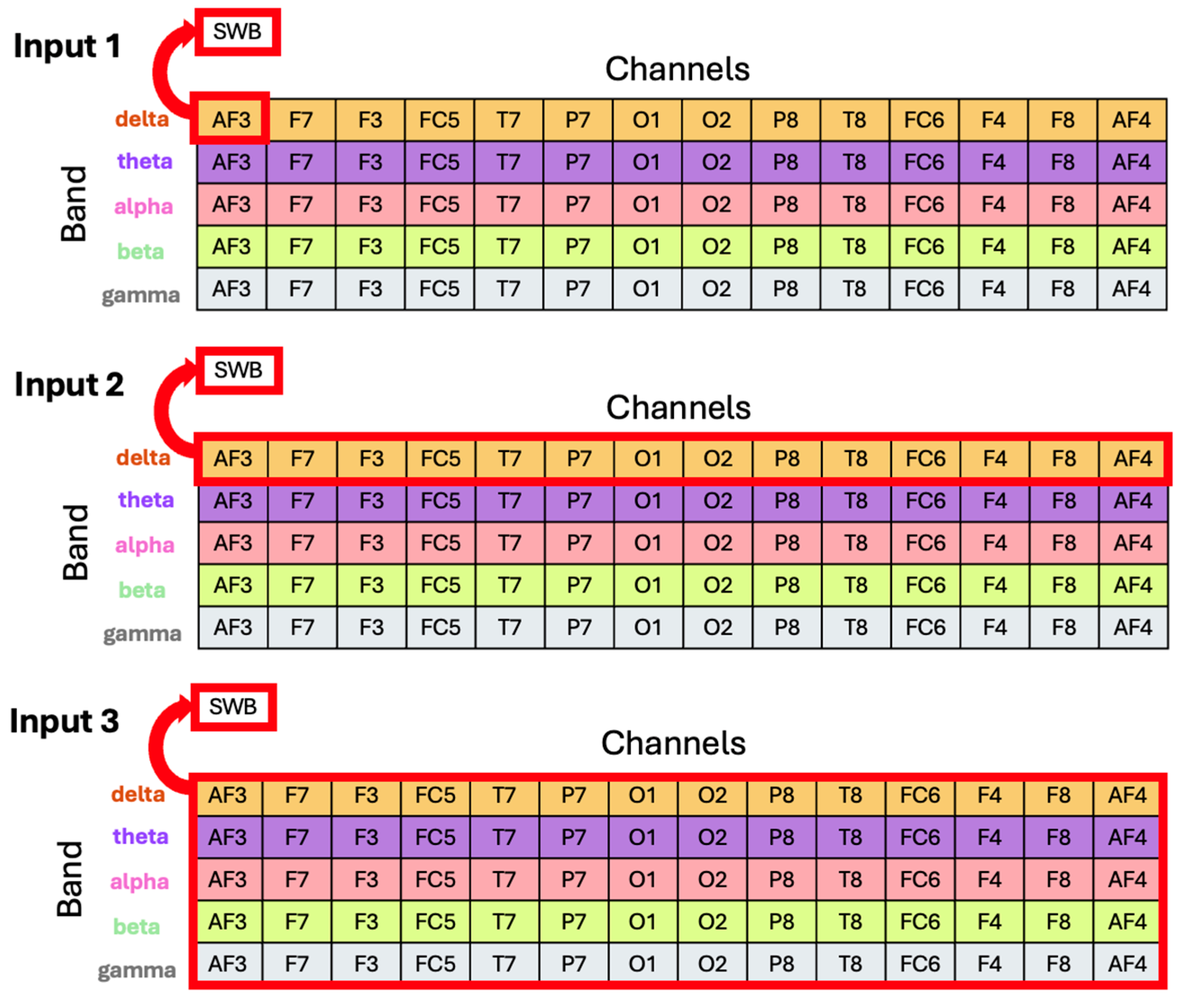
- Input 1: Relative power of a specific frequency band on a specific channel, i.e., 1 relative power value labeled with 1 SWB value.
- Input 2: Relative powers of a specific frequency band at each channel, i.e., 14 relative power values labeled with 1 SWB value.
- Input 3: Relative powers of all frequency bands at each channel, i.e., 70 relative power values labeled with 1 SWB value.
2.3.2. Linear Regression
2.4. Time Series
- Input 1: Time series filtered into a specific frequency band on a specific channel, i.e., 1 time series labeled with 1 SWB value.
- Input 2: Time series filtered into a specific frequency band at each channel, i.e., 14 time series labeled with 1 SWB value.
- Input 3: Time series filtered into all specific frequency bands at all channels, i.e., 70 time series labeled with 1 SWB value.
2.5. Clustering
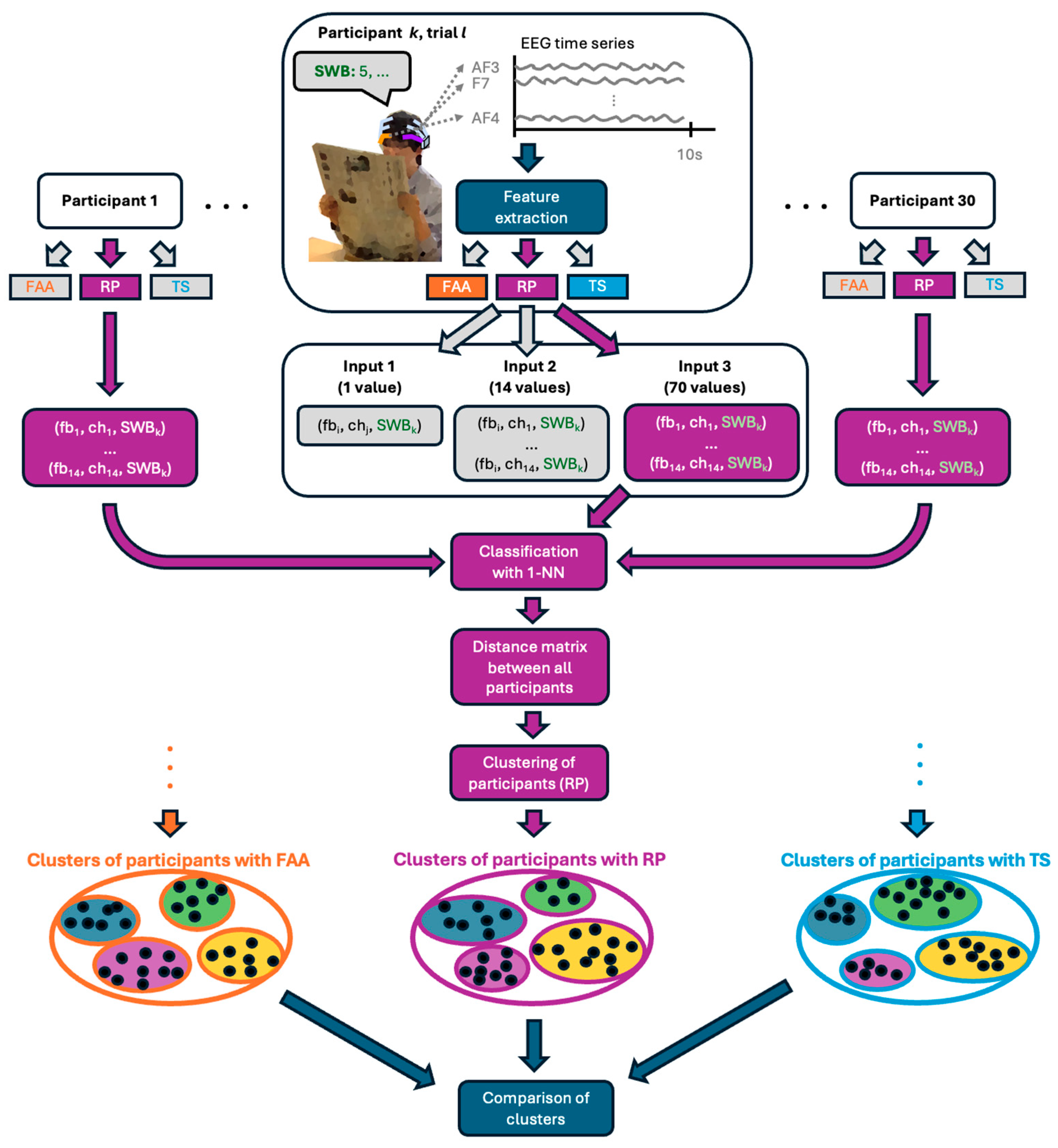
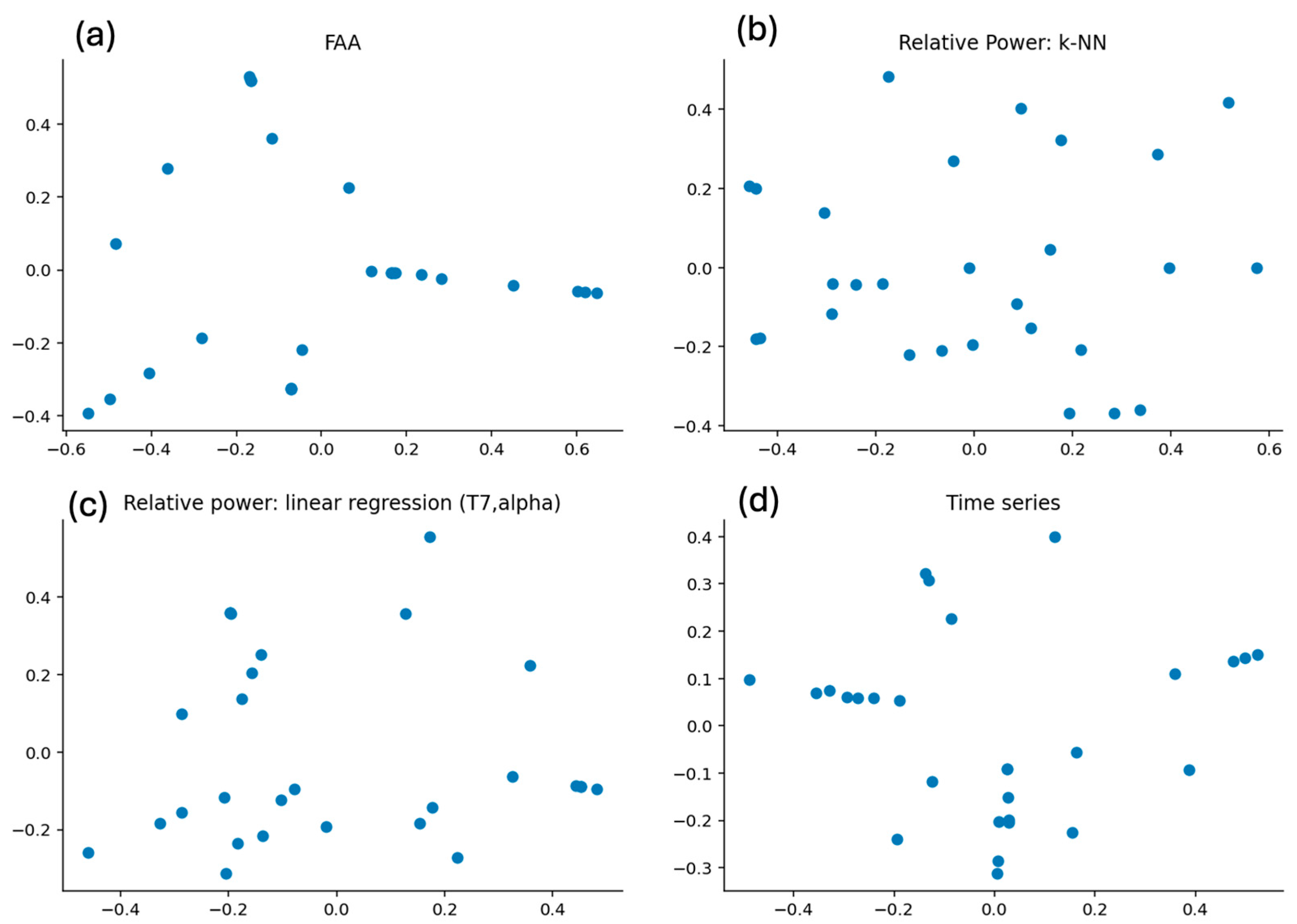
- Frontal alpha asymmetry (FAA) (see [9]);
- Relative power (see Section 2.3);
- EEG time series (see Section 2.4).
3. Results
3.1. Relative Power
3.1.1. Relative Power and k-NN
Relative Power and k-NN: Input 1
Relative Power and k-NN: Input 2
Relative Power and k-NN: Input 3
3.1.2. Linear Regression of Relative Power and Short-Term SWB
3.2. Time Series
- Time Series and k-NN: Input 1
- Time Series and k-NN: Input 2
- Time Series and k-NN: Input 3
3.3. Clustering
4. Discussion
4.1. Relative Power
4.1.1. Relative Power and k-NN
4.1.2. Linear Regression
4.2. Time Series
4.3. Clustering
5. Conclusions
Supplementary Materials
Author Contributions
Funding
Institutional Review Board Statement
Informed Consent Statement
Data Availability Statement
Acknowledgments
Conflicts of Interest
References
- Diener, E.; Suh, E.; Lucas, R.; Smith, H. Subjective Well-Being: Three Decades of Progress. Psychol. Bull. 1999, 125, 276–302. [Google Scholar] [CrossRef]
- Lyubomirsky, S.; Lepper, H.S. A Measure of Subjective Happiness: Preliminary Reliability and Construct Validation. Soc. Indic. Res. 1999, 46, 137–155. [Google Scholar] [CrossRef]
- Ryff, C.D. Happiness Is Everything, or Is It? Explorations on the Meaning of Psychological Well-Being. J. Personal. Soc. Psychol. 1989, 57, 1069–1081. [Google Scholar] [CrossRef]
- Frisch, M.B.; Cornell, J.; Villanueva, M.; Retzlaff, P.J. Clinical Validation of the Quality of Life Inventory. A Measure of Life Satisfaction for Use in Treatment Planning and Outcome Assessment. Psychol. Assess. 1992, 4, 92–101. [Google Scholar] [CrossRef]
- Vink, P.; Hallbeck, S. Editorial: Comfort and Discomfort Studies Demonstrate the Need for a New Model. Appl. Ergon. 2012, 43, 271–276. [Google Scholar] [CrossRef]
- ANSI/ASHRAE Standard 55; Thermal Environmental Conditions for Human Occupancy. ASHRAE: Peachtree Corners, GA, USA, 2017.
- Urry, H.L.; Nitschke, J.B.; Dolski, I.; Jackson, D.C.; Dalton, K.M.; Mueller, C.J.; Rosenkranz, M.A.; Ryff, C.D.; Singer, B.H.; Davidson, R.J. Making a Life Worth Living: Neural Correlates of Well-Being. Psychol. Sci. 2004, 15, 367–372. [Google Scholar] [CrossRef]
- Xu, Y.-Y.; Feng, Z.-Q.; Xie, Y.-J.; Zhang, J.; Peng, S.-H.; Yu, Y.-J.; Li, M. Frontal Alpha EEG Asymmetry Before and After Positive Psychological Interventions for Medical Students. Front. Psychiatry 2018, 9, 432. [Google Scholar] [CrossRef]
- Wutzl, B.; Leibnitz, K.; Kominami, D.; Ohsita, Y.; Kaihotsu, M.; Murata, M. Analysis of the Correlation between Frontal Alpha Asymmetry of Electroencephalography and Short-Term Subjective Well-Being Changes. Sensors 2023, 23, 7006. [Google Scholar] [CrossRef]
- Wutzl, B.; Leibnitz, K.; Murata, M. An Analysis of the Correlation between the Asymmetry of Different EEG-Sensor Locations in Diverse Frequency Bands and Short-Term Subjective Well-Being Changes. Brain Sci. 2024, 14, 267. [Google Scholar] [CrossRef]
- Shi, J.; Zhang, N.; Liu, C.; Li, J.; Sun, Y.; Gao, W. A Review of Applications of Electroencephalogram in Thermal Environment: Comfort, Performance, and Sleep Quality. J. Build. Eng. 2024, 84, 108646. [Google Scholar] [CrossRef]
- Yao, Y.; Lian, Z.; Liu, W.; Shen, Q. Experimental Study on Physiological Responses and Thermal Comfort under Various Ambient Temperatures. Physiol. Behav. 2008, 93, 310–321. [Google Scholar] [CrossRef] [PubMed]
- Yao, Y.; Lian, Z.; Liu, W.; Jiang, C.; Liu, Y.; Lu, H. Heart Rate Variation and Electroencephalograph—The Potential Physiological Factors for Thermal Comfort Study Abstract. Indoor Air 2009, 19, 93–101. [Google Scholar] [CrossRef] [PubMed]
- Son, Y.J.; Chun, C. Research on Electroencephalogram to Measure Thermal Pleasure in Thermal Alliesthesia in Temperature Step-Change Environment. Indoor Air 2018, 28, 916–923. [Google Scholar] [CrossRef] [PubMed]
- Zhang, X.; Hu, S.; Song, P.; Ma, H.; Liu, R.; Lu, M.; Liu, G.; Liu, B.; Tong, L. Feature and Relationship between Electroencephalogram Power and Salivary S-IgE Concentration in Healthy Adults in Different Indoor Temperatures. Build. Environ. 2022, 210, 108688. [Google Scholar] [CrossRef]
- Guan, H.; Hu, S.; Lu, M.; He, M.; Zhang, X.; Liu, G. Analysis of Human Electroencephalogram Features in Different Indoor Environments. Build. Environ. 2020, 186, 107328. [Google Scholar] [CrossRef]
- Ma, X.; Song, L.; Hong, B.; Li, Y.; Li, Y. Relationships between EEG and Thermal Comfort of Elderly Adults in Outdoor Open Spaces. Build. Environ. 2023, 235, 110212. [Google Scholar] [CrossRef]
- Johnstone, J.; Gunkelman, J.; Lunt, J. Clinical Database Development: Characterization of EEG Phenotypes. Clin. EEG Neurosci. 2005, 36, 99–107. [Google Scholar] [CrossRef]
- Nentwich, M.; Ai, L.; Madsen, J.; Telesford, Q.K.; Haufe, S.; Milham, M.P.; Parra, L.C. Functional Connectivity of EEG Is Subject-Specific, Associated with Phenotype, and Different from fMRI. Neuroimage 2020, 218, 117001. [Google Scholar] [CrossRef]
- Peper, F.; Leibnitz, K.; Tanaka, C.; Honda, K.; Hasegawa, M.; Theofilis, K.; Li, A.; Wakamiya, N. High-Density Resource-Restricted Pulse-Based IoT Networks. IEEE Trans. Green Commun. Netw. 2021, 5, 1856–1868. [Google Scholar] [CrossRef]
- MATLAB, MATLAB Version: 9.12.0.1884302 (R2022a); The MathWorks Inc.: Natick, MA, USA, 2022.
- Gabard-Durnam, L.J.; Mendez Leal, A.S.; Wilkinson, C.L.; Levin, A.R. The Harvard Automated Processing Pipeline for Electroencephalography (HAPPE): Standardized Processing Software for Developmental and High-Artifact Data. Front. Neurosci. 2018, 12, 97. [Google Scholar] [CrossRef]
- Delorme, A.; Makeig, S. EEGLAB: An Open Source Toolbox for Analysis of Single-Trial EEG Dynamics Including Independent Component Analysis. J. Neurosci. Methods 2004, 134, 9–21. [Google Scholar] [CrossRef] [PubMed]
- Winkler, I.; Haufe, S.; Tangermann, M. Automatic Classification of Artifactual ICA-Components for Artifact Removal in EEG Signals. Behav. Brain Funct. 2011, 7, 30. [Google Scholar] [CrossRef] [PubMed]
- Winkler, I.; Brandl, S.; Horn, F.; Waldburger, E.; Allefeld, C.; Tangermann, M. Robust Artifactual Independent Component Classification for BCI Practitioners. J. Neural Eng. 2014, 11, 035013. [Google Scholar] [CrossRef] [PubMed]
- Cover, T.; Hart, P. Nearest Neighbor Pattern Classification. IEEE Trans. Inf. Theory 1967, 13, 21–27. [Google Scholar] [CrossRef]
- Lachenbruch, P.A.; Mickey, M.R. Estimation of Error Rates in Discriminant Analysis. Technometrics 1968, 10, 1–11. [Google Scholar] [CrossRef]
- Virtanen, P.; Gommers, R.; Oliphant, T.E.; Haberland, M.; Reddy, T.; Cournapeau, D.; Burovski, E.; Peterson, P.; Weckesser, W.; Bright, J.; et al. SciPy 1.0: Fundamental Algorithms for Scientific Computing in Python. Nat. Methods 2020, 17, 261–272. [Google Scholar] [CrossRef]
- Chawla, N.V.; Bowyer, K.W.; Hall, L.O.; Kegelmeyer, W.P. SMOTE: Synthetic Minority Over-Sampling Technique. J. Artif. Intell. Res. 2002, 16, 321–357. [Google Scholar] [CrossRef]
- Lemaître, G.; Nogueira, F.; Aridas, C.K. Imbalanced-Learn: A Python Toolbox to Tackle the Curse of Imbalanced Datasets in Machine Learning. J. Mach. Learn. Res. 2016, 15, 1–5. [Google Scholar]
- Python, Python 3.9.15; Python Software Foundation: Wilmington, DE, USA, 2022.
- Pedregosa, F.; Varoquaux, G.; Gramfort, A.; Michel, V.; Thirion, B.; Grisel, O.; Blondel, M.; Prettenhofer, P.; Weiss, R.; Dubourg, V.; et al. Scikit-Learn: Machine Learning in Python. J. Mach. Learn. Res. 2011, 12, 2825–2830. [Google Scholar]
- Seabold, S.; Perktold, J. Statsmodels: Econometric and Statistical Modeling with Python. In Proceedings of the 9th Python in Science Conference, Austin, TX, USA, 28 June–3 July 2010. [Google Scholar]
- Löning, M.; Bagnall, A.; Ganesh, S.; Kazakov, V.; Lines, J.; Király, F.J. Sktime: A Unified Interface for Machine Learning with Time Series. arXiv 2019, arXiv:1909.07872. [Google Scholar] [CrossRef]
- Tenenbaum, J.B.; de Silva, V.; Langford, J.C. A Global Geometric Framework for Nonlinear Dimensionality Reduction. Science 2000, 290, 2319–2323. [Google Scholar] [CrossRef]
- Rousseeuw, P.J. Silhouettes: A Graphical Aid to the Interpretation and Validation of Cluster Analysis. J. Comput. Appl. Math. 1987, 20, 53–65. [Google Scholar] [CrossRef]
- Hubert, L.; Arabie, P. Comparing Partitions. J. Classif. 1985, 2, 193–218. [Google Scholar] [CrossRef]
- Chacón, J.E.; Rastrojo, A.I. Minimum Adjusted Rand Index for Two Clusterings of a given Size. Adv. Data Anal. Classif. 2023, 17, 125–133. [Google Scholar] [CrossRef]



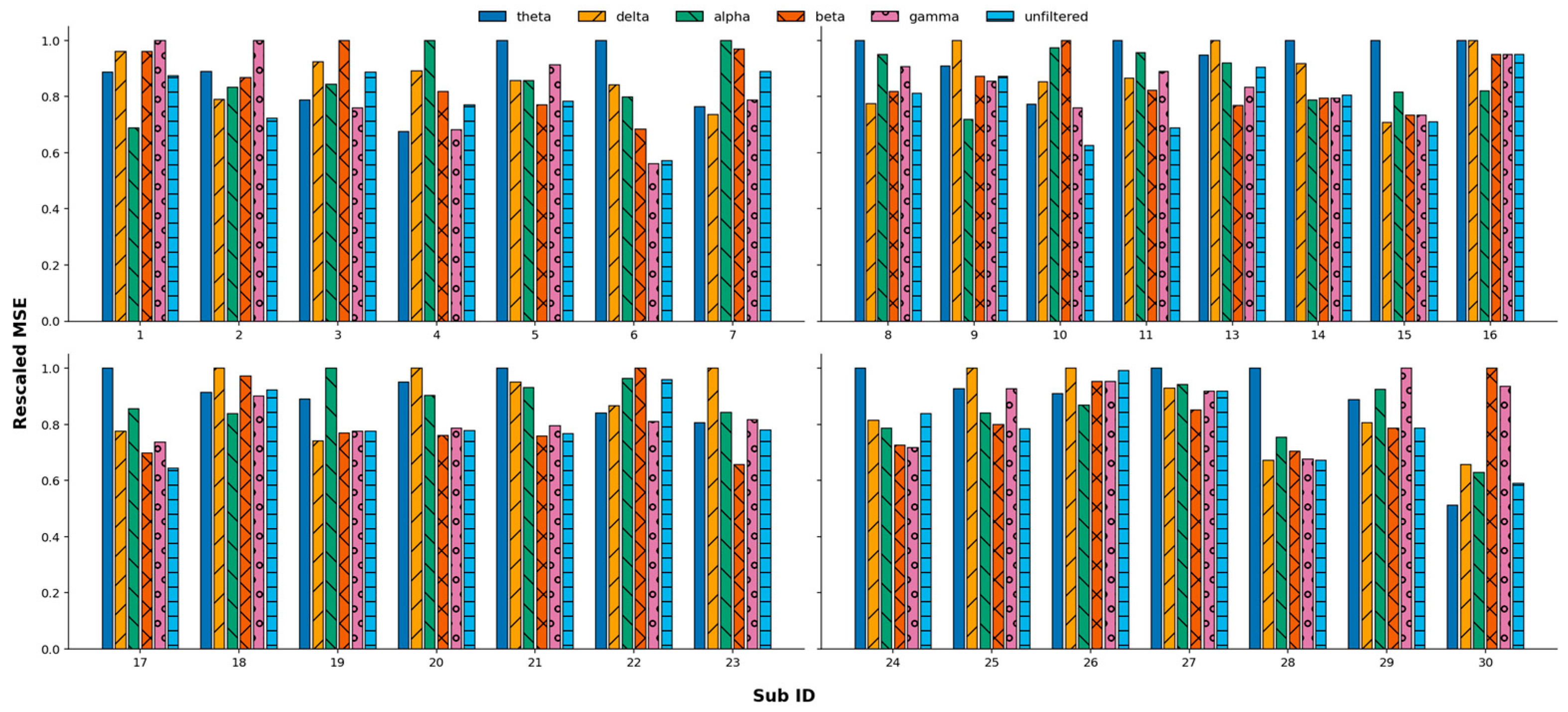
| Sub ID | Band | MSE | Sub ID | Band | MSE | Sub ID | Band | MSE |
|---|---|---|---|---|---|---|---|---|
| 1 | gamma | 0.64 | 11 | theta | 0.30 | 21 | beta | 0.72 |
| 2 | gamma | 1.64 | 13 | gamma | 6.66 | 22 | delta | 2.01 |
| 3 | theta | 1.91 | 14 | gamma | 0.82 | 23 | theta | 1.15 |
| 4 | gamma | 0.88 | 15 | alpha | 5.33 | 24 | beta | 4.04 |
| 5 | alpha | 1.37 | 16 | gamma | 0.77 | 25 | gamma | 2.51 |
| 6 | gamma | 6.15 | 17 | gamma | 0.45 | 26 | gamma | 0.81 |
| 7 | gamma | 0.98 | 18 | beta | 1.77 | 27 | gamma | 2.94 |
| 8 | beta | 1.13 | 19 | gamma | 0.21 | 28 | gamma | 2.01 |
| 9 | delta | 1.01 | 20 | gamma | 2.18 | 29 | alpha | 0.77 |
| 10 | gamma | 0.34 | 30 | beta | 2.28 |
| Sub ID | Input Nr. | Sub ID | Input Nr. | Sub ID | Input Nr. |
|---|---|---|---|---|---|
| 1 | 2 (gamma) | 11 | 1 (theta/FC6), 3 | 21 | 2 (beta) |
| 2 | 3 | 13 | 1 (beta/O2) | 22 | 3 |
| 3 | 3 | 14 | 2 (gamma) | 23 | 2 (theta) |
| 4 | 2 (gamma) | 15 | 1 (theta/P7) | 24 | 1 (delta/F7) |
| 5 | 3 | 16 | 3 | 25 | 2 (gamma) |
| 6 | 3 | 17 | 2 (gamma) | 26 | 2 (gamma) |
| 7 | 2 (gamma) | 18 | 2 (beta) | 27 | 2 (gamma) |
| 8 | 1 (beta/AF4) | 19 | 2 (gamma) | 28 | 3 |
| 9 | 1 (gamma/F7) | 20 | 1 (beta/T7) | 29 | 2 (alpha) |
| 10 | 2 (gamma) | 30 | 3 |
| Band | Channel | k-Mean | Std | Cohen’s d | p-Value | p-Corr | CI_Low | CI_High |
|---|---|---|---|---|---|---|---|---|
| delta | AF3 | −3.816 | 6.625 | −0.565 | 0.0069 | 0.2053 | −6.487 | −1.145 |
| F7 | −2.838 | 5.506 | −0.506 | 0.0142 | 0.2053 | −5.057 | −0.618 | |
| alpha | T7 | −5.772 | 9.996 | −0.567 | 0.0067 | 0.2053 | −9.802 | −1.743 |
| T8 | −4.315 | 9.243 | −0.458 | 0.0249 | 0.2181 | −8.041 | −0.588 | |
| beta | F7 | 4.192 | 9.302 | 0.442 | 0.0299 | 0.2323 | 0.442 | 7.942 |
| FC5 | 4.279 | 8.607 | 0.488 | 0.0176 | 0.2053 | 0.809 | 7.748 | |
| gamma | AF3 | 6.959 | 14.878 | 0.459 | 0.0247 | 0.2181 | 0.961 | 12.956 |
| F7 | 6.418 | 12.168 | 0.518 | 0.0123 | 0.2053 | 1.513 | 11.323 | |
| FC5 | 4.981 | 9.947 | 0.491 | 0.0169 | 0.2053 | 0.971 | 8.990 | |
| T7 | 4.079 | 9.786 | 0.409 | 0.0432 | 0.3026 | 0.134 | 8.023 |
| Sub ID | Band | MSE | Sub ID | Band | MSE | Sub ID | Band | MSE |
|---|---|---|---|---|---|---|---|---|
| 1 | alpha | 1.31 | 11 | non | 0.32 | 21 | alpha | 2.66 |
| 2 | alpha | 3.18 | 13 | gamma | 8.99 | 22 | gamma | 2.87 |
| 3 | alpha | 2.04 | 14 | non/beta/ gamma | 1.56 | 23 | beta | 2.05 |
| 4 | delta | 1.33 | 24 | beta | 3.40 | |||
| 5 | gamma | 1.20 | 15 | gamma | 12.87 | 25 | non | 2.67 |
| 6 | theta | 10.80 | 16 | alpha | 0.85 | 26 | delta | 2.31 |
| 7 | non | 2.26 | 17 | non | 0.59 | 27 | non | 9.11 |
| 8 | non | 1.28 | 18 | theta | 3.61 | 28 | delta | 6.96 |
| 9 | alpha | 0.93 | 19 | gamma | 3.69 | 29 | beta | 0.97 |
| 10 | theta | 0.59 | 20 | alpha | 2.33 | 30 | delta | 6.66 |
| Clusters | FAA_RP | FAA_TS | RP_TS | FAA_T7 | RP_T7 | TS_T7 |
|---|---|---|---|---|---|---|
| 2 | −0.047 | 0.603 | −0.017 | 0.221 | −0.017 | 0.153 |
| 3 | 0.020 | 0.222 | 0.016 | 0.106 | 0.036 | −0.007 |
| 4 | 0.070 | 0.070 | 0.039 | 0.420 | 0.062 | 0.049 |
| 5 | 0.020 | 0.083 | −0.001 | 0.215 | 0.002 | 0.012 |
| 6 | −0.022 | 0.135 | −0.010 | 0.248 | 0.019 | −0.028 |
Disclaimer/Publisher’s Note: The statements, opinions and data contained in all publications are solely those of the individual author(s) and contributor(s) and not of MDPI and/or the editor(s). MDPI and/or the editor(s) disclaim responsibility for any injury to people or property resulting from any ideas, methods, instructions or products referred to in the content. |
© 2026 by the authors. Licensee MDPI, Basel, Switzerland. This article is an open access article distributed under the terms and conditions of the Creative Commons Attribution (CC BY) license.
Share and Cite
Wutzl, B.; Leibnitz, K.; Ohsita, Y.; Murata, M. Analysis of Short-Term Subjective Well-Being/Comfort and Its Correlation to Different EEG Metrics. Sensors 2026, 26, 446. https://doi.org/10.3390/s26020446
Wutzl B, Leibnitz K, Ohsita Y, Murata M. Analysis of Short-Term Subjective Well-Being/Comfort and Its Correlation to Different EEG Metrics. Sensors. 2026; 26(2):446. https://doi.org/10.3390/s26020446
Chicago/Turabian StyleWutzl, Betty, Kenji Leibnitz, Yuichi Ohsita, and Masayuki Murata. 2026. "Analysis of Short-Term Subjective Well-Being/Comfort and Its Correlation to Different EEG Metrics" Sensors 26, no. 2: 446. https://doi.org/10.3390/s26020446
APA StyleWutzl, B., Leibnitz, K., Ohsita, Y., & Murata, M. (2026). Analysis of Short-Term Subjective Well-Being/Comfort and Its Correlation to Different EEG Metrics. Sensors, 26(2), 446. https://doi.org/10.3390/s26020446