Article

An Intelligent Acoustic Emission System for Active Anomaly Identification and Traffic Control of a Highway Viaduct †

by
Aleksandra Krampikowska
* and
Grzegorz Świt
Department of Strength of Materials and Structural Diagnostics, Faculties Civil Engineering and Architecture, Kielce University of Technology, Al. Tysiąclecia Państwa Polskiego 7, 25-314 Kielce, Poland
*
Author to whom correspondence should be addressed.
This paper is an extended version of our paper published in Krampikowska, A.; Swit, G. Acoustic emission-based decision support for bridge safety in smart cities. In Proceedings of the 15th International Workshop on Structural Health Monitoring (SHM 2025), Stanford, CA, USA, 9–11 September 2025; Abstract No. 67, pp. 569–577.
Sensors 2026, 26(18), 5908; https://doi.org/10.3390/s26185908 (registering DOI)
Submission received: 27 July 2026 / Revised: 4 September 2026 / Accepted: 16 September 2026 / Published: 18 September 2026
(This article belongs to the Section Fault Diagnosis & Sensors)

Abstract

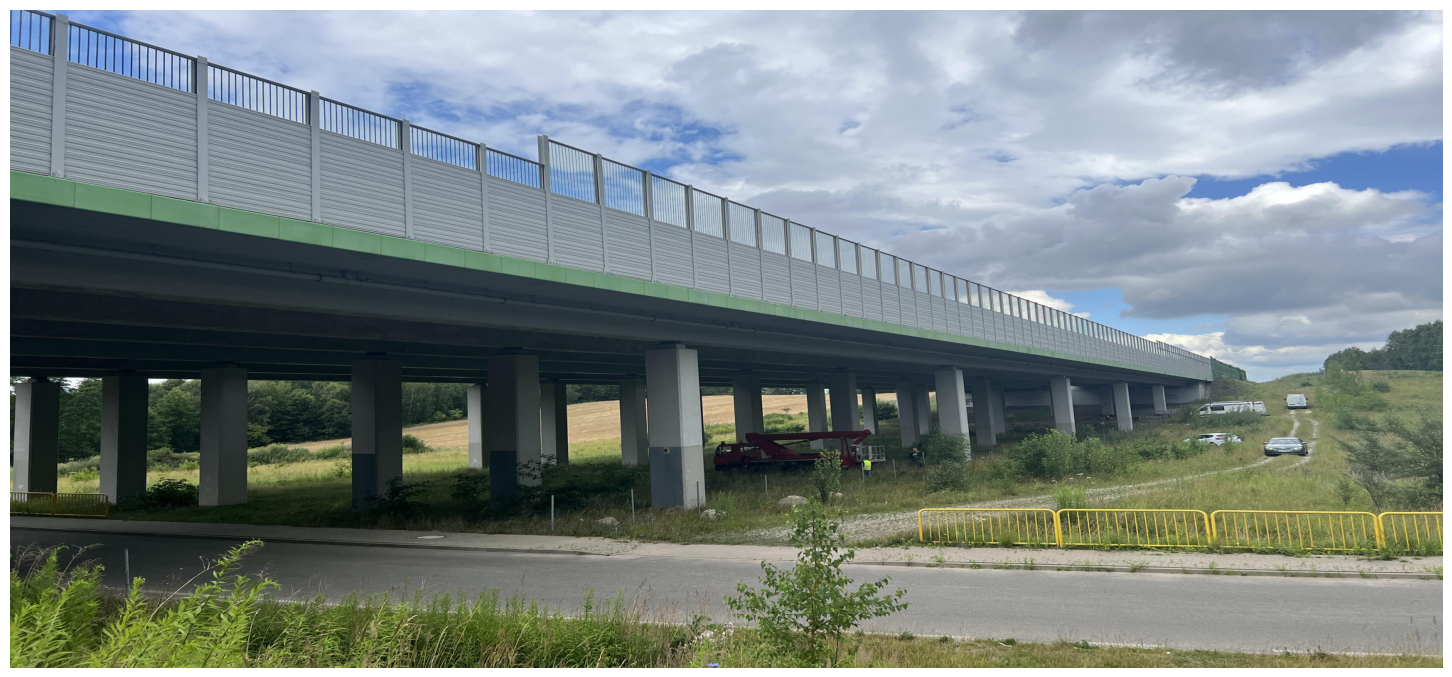
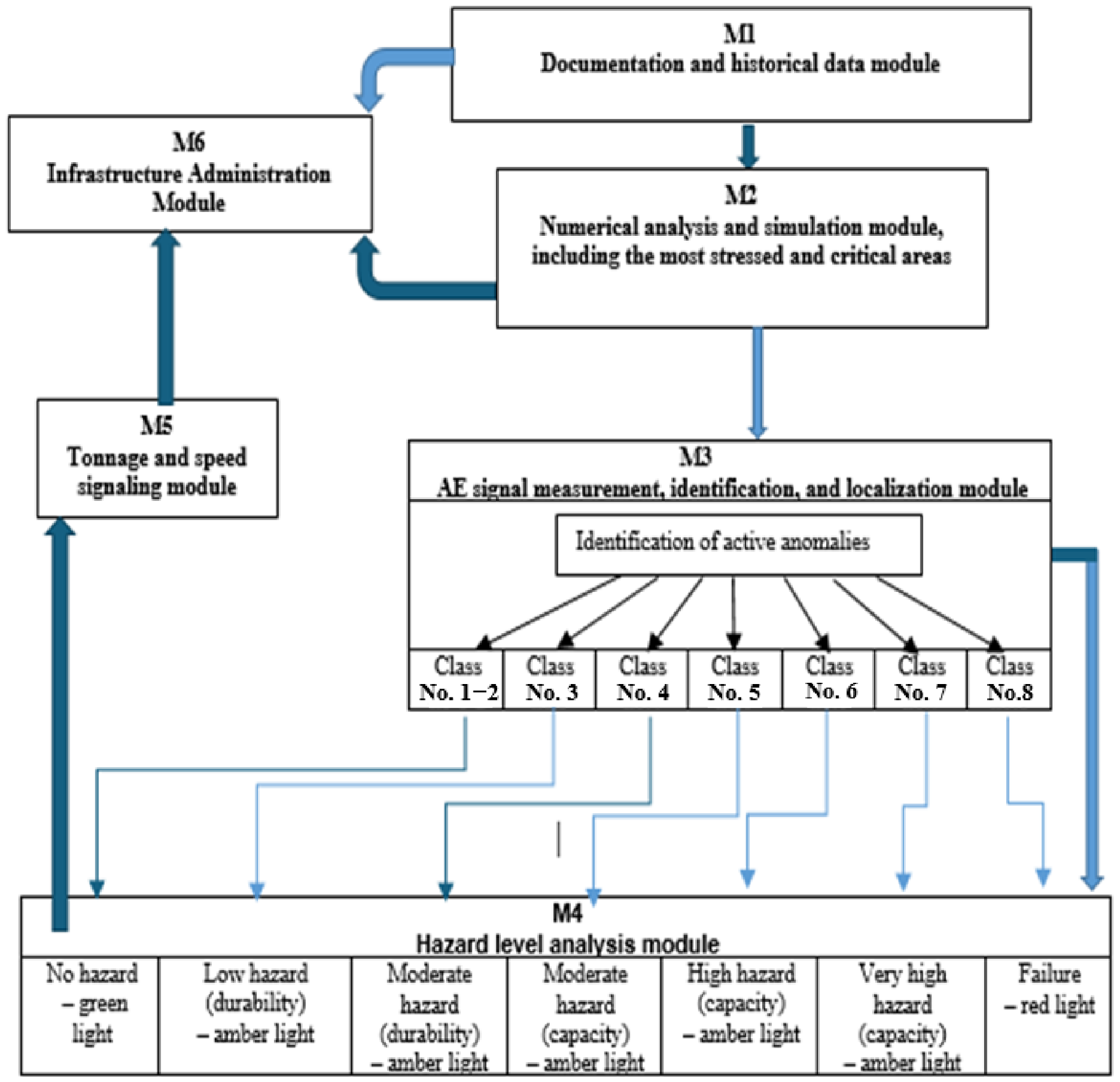
This paper presents a significant evolution of the Identification of Active Anomalies (IAA) system, moving beyond previous descriptive frameworks by integrating an advanced machine learning pipeline for automated, real-time Structural Health Monitoring (SHM). Utilizing acoustic emission (AE), the upgraded IAA framework combines signal clustering, image recognition, and machine learning to monitor the structural condition of a highway overpass located near a major urban agglomeration. The monitoring results provide a reliable foundation for assessing structural health and implementing automated traffic control, which is essential to ensure safe operations. Unlike baseline implementations, this intelligent system extracts multi-parametric features using Principal Component Analysis (PCA) and transforms temporal wave streams into Continuous Wavelet Transform (CWT) scalograms. These visual representations are processed by a custom 14-layer Deep Convolutional Neural Network (CNN) combined with an unsupervised Self-Organizing Map (SOM) to eliminate operational noise and classify internal failures. AE signals recorded under service loads undergo multi-parametric analysis using pattern recognition techniques and are assigned to specific classes corresponding to active anomalies within the material or structure. Each class is linked to a distinct structural hazard level, ranging from safe operation to a critical loss of structural safety. Corresponding traffic control measures, including vehicle speed and weight restrictions, are dynamically introduced to maintain operational safety. To validate the scalability of the framework, this study synthesizes statistical data across a comprehensive fleet of 180 monitored bridge structures, backed by a predictive ARIMA time-series model that forecasts residual service life. The proposed methodology was experimentally validated on an A2 highway overpass, a vital component of the Łódź transport hub that facilitates north–south and east–west transit in Poland. The IAA system functions as a proactive diagnostic tool for infrastructure management agencies, preventing sudden, unforeseen structural failures. Ultimately, it enables the efficient and safe operation of a Smart City while ensuring that maintenance funds are rationally and optimally allocated.
Keywords: SHM; acoustic emission; destructive processes; durability; pattern recognition; smart city SHM; acoustic emission; destructive processes; durability; pattern recognition; smart city