

A Federated Multi-Agent Communication Framework for Autonomous Cyber Defense in Edge–Cloud IoT Environments

Abstract
1. Introduction
- FMAD, a conceptual federated multi-agent framework, is proposed to enable autonomous cyber defense in edge–cloud IoT environments through intelligent agent collaboration, federated learning, and secure coordination.
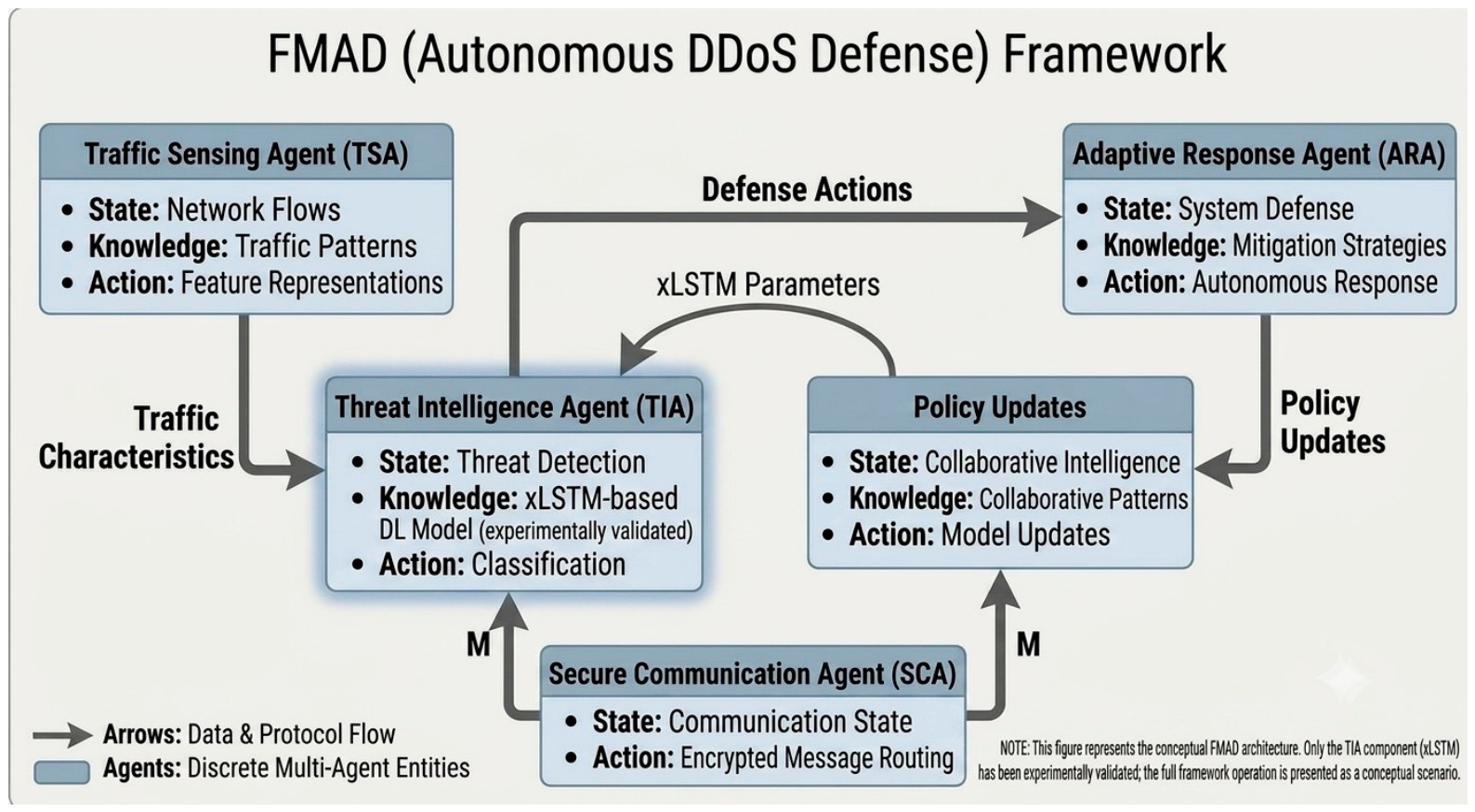
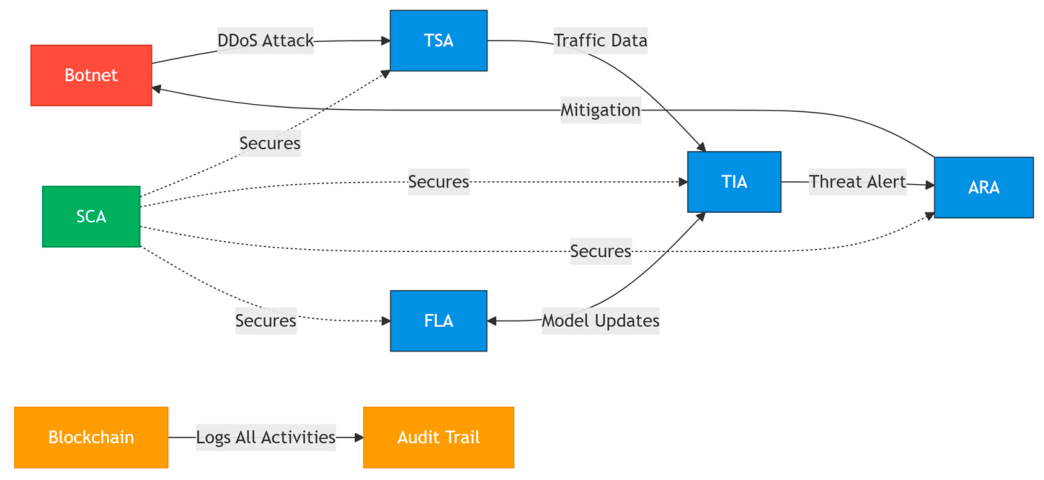
- A conceptual five-agent architecture is introduced to define the functional responsibilities and interactions of the Traffic Sensing Agent, Threat Intelligence Agent, Federated Learning Agent, Secure Communication Agent, and Adaptive Mitigation Agent within a unified cyber defense framework.
- As a proof of concept, the TIA is implemented using an xLSTM-based temporal intrusion detection model trained on the CIC-IoT-2023 dataset, demonstrating the feasibility of intelligent edge-based threat detection within the proposed framework.
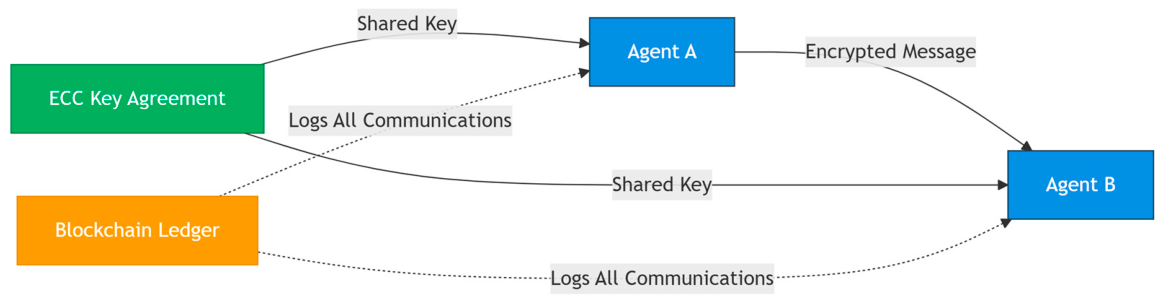
- A design for lightweight and trustworthy inter-agent communication is presented by integrating ECC key agreement, ChaCha20-Poly1305 authenticated encryption, and a permissioned blockchain to **support** confidentiality, integrity, authentication, and traceability of distributed agent interactions.
- The proposed FMAD framework **integrates** federated learning with intelligent multi-agent collaboration as an architectural mechanism for privacy-preserving distributed cyber defense without exchanging raw IoT traffic data.
- Finally, the study distinguishes between the architectural contribution of the FMAD framework and its empirical validation. FMAD is presented as an integrated multi-agent architecture, while the experimental evaluation specifically validates the xLSTM-based TIA for DDoS detection. The remaining agents and federated-learning workflow are analyzed at the architectural, security, and operational-design levels rather than claimed as experimentally validated components.
2. Related Work
3. Theoretical Foundations
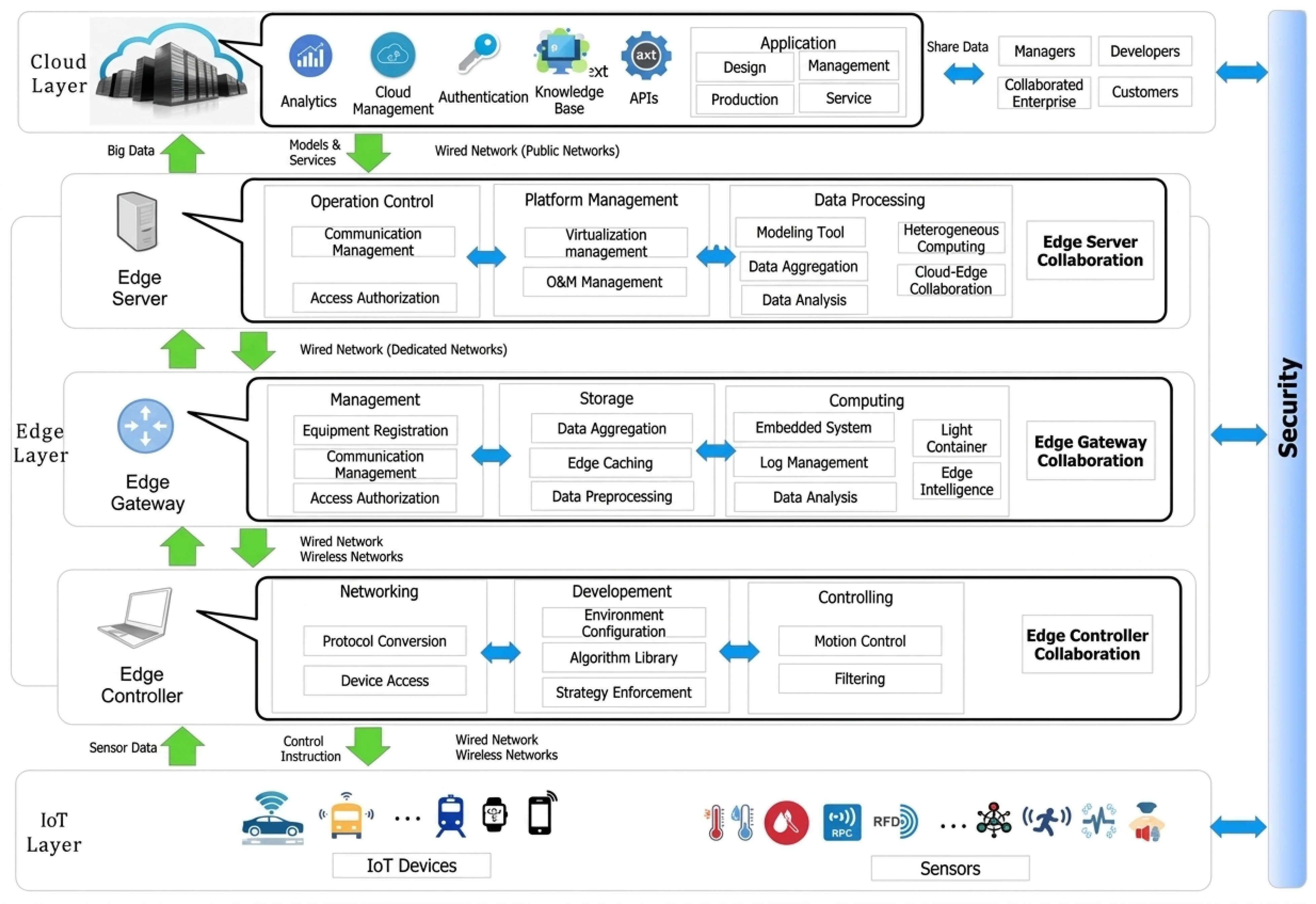
3.1. Edge–Cloud IoT as a Distributed Cyber Defense Environment
3.2. Multi-Agent Systems for Distributed Cyber Defense
4. Proposed FMAD Framework
4.1. Design of the FMAD Architecture
- Traffic Sensing Agent (TSA): Deployed at edge gateways and fog nodes, the TSA performs continuous packet-level traffic acquisition and preprocessing. It extracts flow-based features from raw network traffic, applies data normalization, and prepares structured observations for downstream threat analysis. The TSA maintains local traffic profiles and communicates statistical summaries—rather than raw payloads—to preserve data locality.
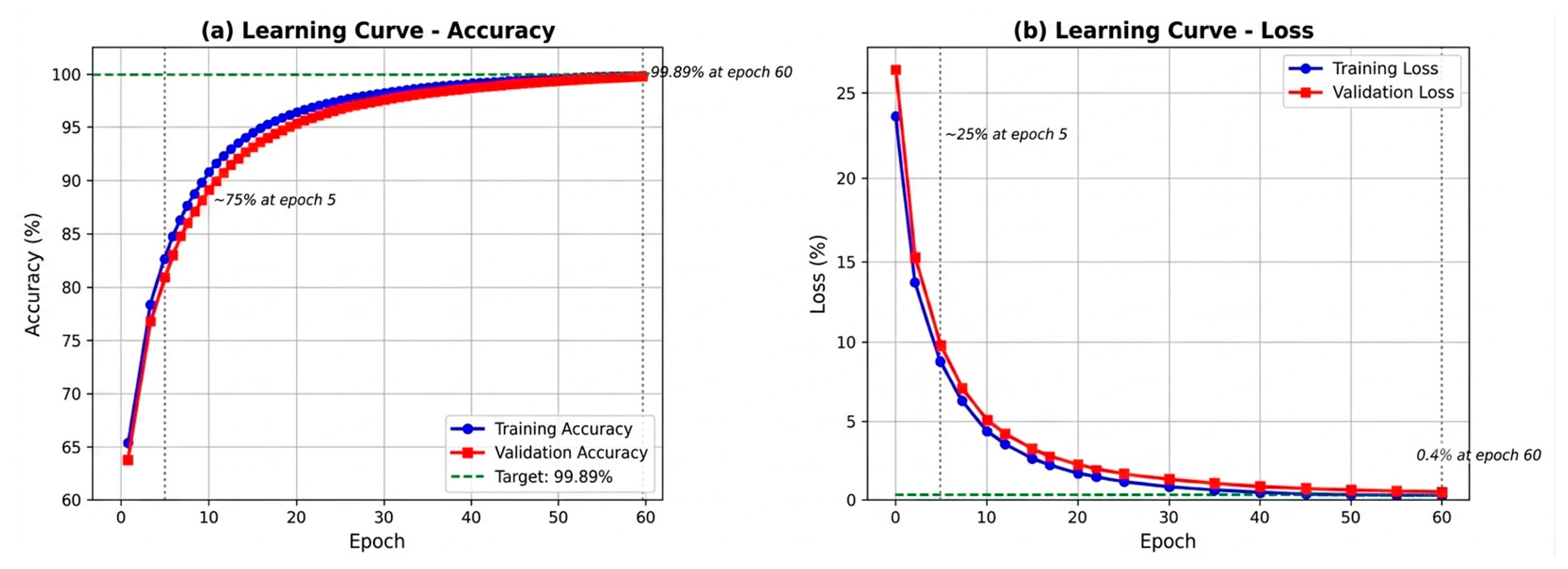
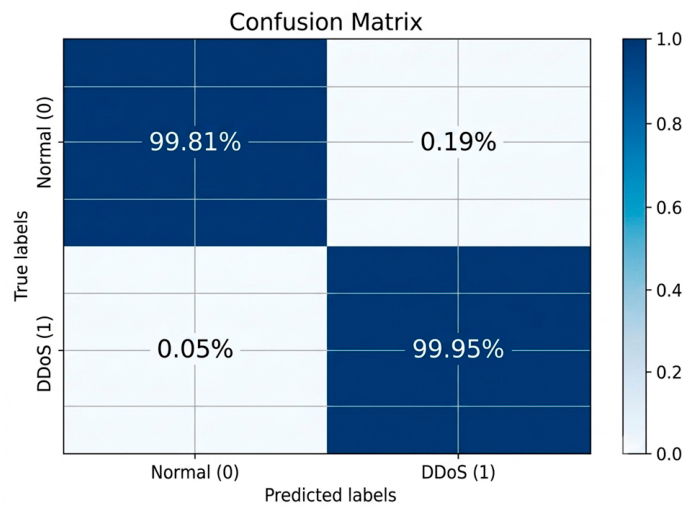
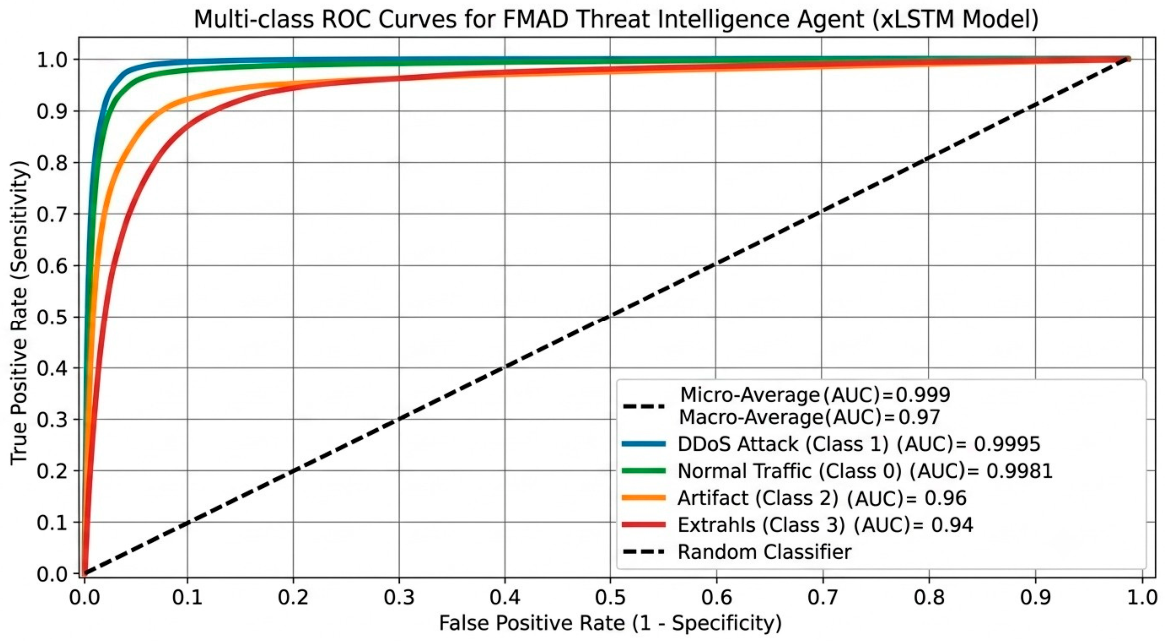
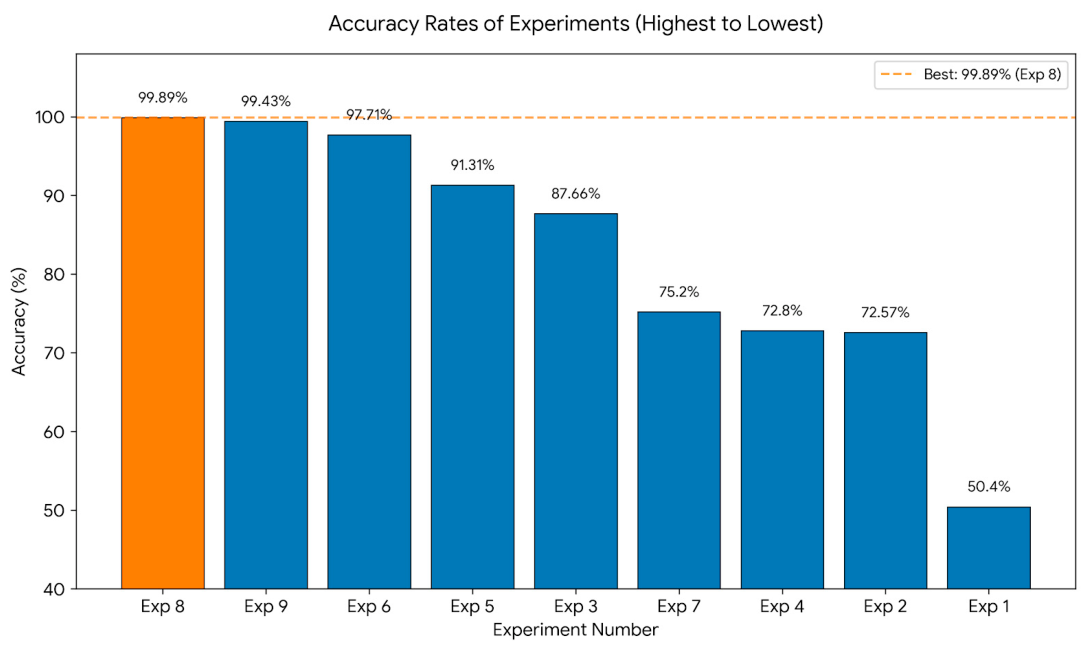
- Threat Intelligence Agent (TIA): The TIA operates at the edge intelligence layer, executing temporal anomaly detection using an xLSTM-based deep learning model developed in this study. It processes preprocessed traffic features to identify DDoS patterns with 99.89% detection accuracy on the CIC-IoT-2023 dataset. The TIA maintains a local detection model and generates threat alerts upon identifying anomalous behavior, forming the cognitive core of the framework’s intrusion detection capability.
- Federated Learning Agent (FLA): The FLA orchestrates collaborative model optimization across distributed edge nodes. Instead of exchanging sensitive network data, each FLA participates in federated aggregation rounds by transmitting encrypted local model updates (gradients or weights) to a central aggregation server. This mechanism enables global model improvement while preserving data privacy and reducing communication overhead—a critical requirement for bandwidth-constrained IoT environments.
- Secure Communication Agent (SCA): The SCA implements lightweight cryptographic protection for all inter-agent interactions. It employs Elliptic Curve Cryptography (ECC) for ephemeral key agreement, ChaCha20-Poly1305 for authenticated encryption providing confidentiality, integrity, and authenticity, and TLS 1.3 for secure channel establishment. The SCA also maintains session keys and manages certificate-based authentication among participating agents.
- Adaptive Mitigation Agent (AMA): The AMA executes defensive countermeasures upon receiving threat intelligence from TIAs. Its responsibilities include traffic filtering, rate limiting, dynamic access control rule updates, and resource reallocation to preserve service availability. The AMA employs predefined mitigation policies while retaining capacity for adaptive response based on evolving attack characteristics.
4.2. Secure Inter-Agent Communication
4.2.1. Security Threat Model and Assumptions
4.2.2. Security Property Analysis
4.3. Federated Learning (FL) for Privacy-Preserving Collaborative Defense
4.4. A Scenario for FMAD Operation
5. Experimental Evaluation
5.1. Experimental Scope and Computing Environment
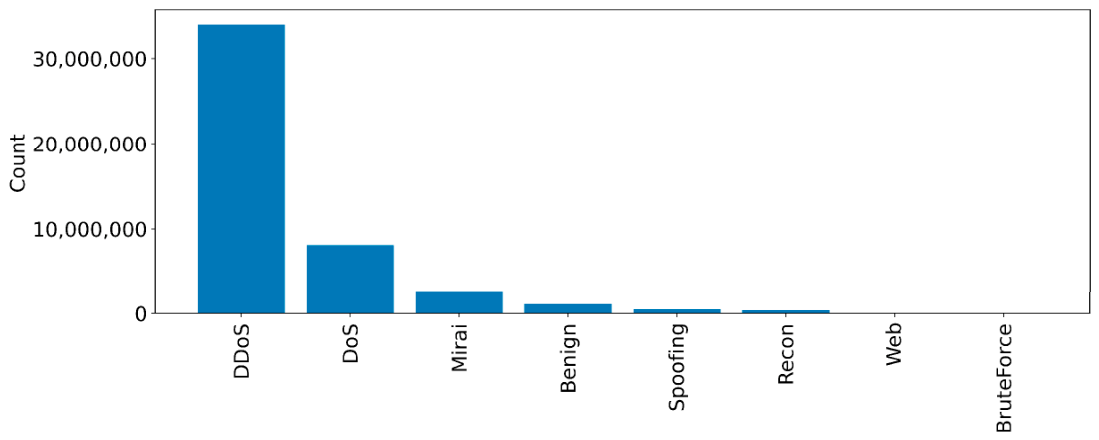
5.2. Dataset Preparation and Experimental Protocol
5.3. Model Configurations and Experimental Results
5.4. Classification Performance Analysis
5.5. ROC-AUC Analysis
5.6. Computational Considerations
5.7. Complexity Considerations
6. Discussion
7. Conclusions
Funding
Institutional Review Board Statement
Informed Consent Statement
Data Availability Statement
Conflicts of Interest
References
- Shi, W.; Cao, J.; Zhang, Q.; Li, Y.; Xu, L. Edge computing: Vision and challenges. IEEE Internet Things J. 2016, 3, 637–646. [Google Scholar] [CrossRef] [Scilit]
- Liu, B.; Luo, Z.; Chen, H.; Li, C. A survey of state-of-the-art on edge computing: Theoretical models, technologies, directions, and development paths. IEEE Access 2022, 10, 54038–54063. [Google Scholar] [CrossRef] [Scilit]
- Gkonis, P.; Giannopoulos, A.; Trakadas, P.; Masip-Bruin, X.; D’Andria, F. A survey on IoT-edge-cloud continuum systems: Status, challenges, use cases, and open issues. Future Internet 2023, 15, 383. [Google Scholar] [CrossRef] [Scilit]
- Varghese, B.; Buyya, R. Next generation cloud computing: New trends and research directions. Future Gener. Comput. Syst. 2018, 79, 849–861. [Google Scholar] [CrossRef] [Scilit]
- Pawlicki, M.; Pawlicka, A.; Kozik, R.; Choraś, M. The survey and meta-analysis of the attacks, transgressions, countermeasures and security aspects common to the Cloud, Edge and IoT. Neurocomputing 2023, 551, 126533. [Google Scholar] [CrossRef] [Scilit]
- Salayma, M. Risk and threat mitigation techniques in internet of things (IoT) environments: A survey. Front. Internet Things 2024, 2, 1306018. [Google Scholar] [CrossRef] [Scilit]
- Kolias, C.; Kambourakis, G.; Stavrou, A.; Voas, J. DDoS in the IoT: Mirai and other botnets. Computer 2017, 50, 80–84. [Google Scholar] [CrossRef] [Scilit]
- Buczak, A.L.; Guven, E. A survey of data mining and machine learning methods for cyber security intrusion detection. IEEE Commun. Surv. Tutor. 2015, 18, 1153–1176. [Google Scholar] [CrossRef] [Scilit]
- Ferrag, M.A.; Maglaras, L.; Moschoyiannis, S.; Janicke, H. Deep learning for cyber security intrusion detection: Approaches, datasets, and comparative study. J. Inf. Secur. Appl. 2020, 50, 102419. [Google Scholar] [CrossRef] [Scilit]
- Sicari, S.; Rizzardi, A.; Grieco, L.A.; Coen-Porisini, A. Security, privacy and trust in Internet of Things: The road ahead. Comput. Netw. 2015, 76, 146–164. [Google Scholar] [CrossRef] [Scilit]
- Fazeldehkordi, E.; Grønli, T.M. A survey of security architectures for edge computing-based IoT. IoT 2022, 3, 332–365. [Google Scholar] [CrossRef] [Scilit]
- Kott, A. Autonomous intelligent cyber-defense agent: Introduction and overview. In Autonomous Intelligent Cyber Defense Agent (AICA) A Comprehensive Guide; Springer International Publishing: Cham, Switzerland, 2023; pp. 1–15. [Google Scholar] [CrossRef] [Scilit]
- Franklin, S.; Graesser, A. Is it an Agent, or just a Program?: A Taxonomy for Autonomous Agents. In Proceedings of the International Workshop on Agent Theories, Architectures, and Languages; Springer: Berlin/Heidelberg, Germany, 1996; pp. 21–35. [Google Scholar] [CrossRef] [Scilit]
- Zhang, D.; Feng, G.; Shi, Y.; Srinivasan, D. Physical safety and cyber security analysis of multi-agent systems: A survey of recent advances. IEEE/CAA J. Autom. Sin. 2021, 8, 319–333. [Google Scholar] [CrossRef] [Scilit]
- Vyas, S.; Mavroudis, V.; Burnap, P. Towards the deployment of realistic autonomous cyber network defence: A systematic review. ACM Comput. Surv. 2025, 58, 1–36. [Google Scholar] [CrossRef] [Scilit]
- McMahan, B.; Moore, E.; Ramage, D.; Hampson, S.; y Arcas, B.A. Communication-efficient learning of deep networks from decentralized data. In Proceedings of the Artificial Intelligence and Statistics; PMLR: New York, NY, USA, 2017; pp. 1273–1282. Available online: https://proceedings.mlr.press/v54/mcmahan17a/mcmahan17a.pdf (accessed on 15 June 2026).
- Yang, Q.; Liu, Y.; Chen, T.; Tong, Y. Federated machine learning: Concept and applications. ACM Trans. Intell. Syst. Technol. (TIST) 2019, 10, 1–19. [Google Scholar] [CrossRef] [Scilit]
- Kong, L.; Tan, J.; Huang, J.; Chen, G.; Wang, S.; Jin, X.; Zeng, P.; Khan, M.; Das, S.K. Edge-computing-driven internet of things: A survey. ACM Comput. Surv. 2022, 55, 1–41. [Google Scholar] [CrossRef] [Scilit]
- Zhu, C.; Dastani, M.; Wang, S. A survey of multi-agent deep reinforcement learning with communication. Auton. Agents Multi-Agent Syst. 2024, 38, 4. [Google Scholar] [CrossRef] [Scilit]
- Zargar, S.T.; Joshi, J.; Tipper, D. A survey of defense mechanisms against distributed denial of service (DDoS) flooding attacks. IEEE Commun. Surv. Tutor. 2013, 15, 2046–2069. [Google Scholar] [CrossRef] [Scilit]
- Wooldridge, M. An Introduction to Multiagent Systems; John Wiley & Sons: Hoboken, NJ, USA, 2009; Available online: https://uranos.ch/research/references/Wooldridge_2001/TLTK.pdf (accessed on 15 June 2026).
- Jennings, N.R. An agent-based approach for building complex software systems. Commun. ACM 2001, 44, 35–41. [Google Scholar] [CrossRef] [Scilit]
- FIPA ACL. Message Structure Specification. 2002. Available online: http://www.fipa.org/specs/fipa00061/ (accessed on 15 June 2026).
- Bellifemine, F.L.; Caire, G.; Greenwood, D. Developing Multi-Agent Systems with JADE; John Wiley & Sons: Hoboken, NJ, USA, 2007; Available online: https://www.mit.bme.hu/data/migrate/oktatas/targyak/8671/Developing-Multi-Agent-Systems-with-JADE.pdf (accessed on 15 June 2026).
- Yin, C.; Zhu, Y.; Fei, J.; He, X. A deep learning approach for intrusion detection using recurrent neural networks. IEEE Access 2017, 5, 21954–21961. [Google Scholar] [CrossRef] [Scilit]
- Vinayakumar, R.; Alazab, M.; Soman, K.P.; Poornachandran, P.; Al-Nemrat, A.; Venkatraman, S. Deep learning approach for intelligent intrusion detection system. IEEE Access 2019, 7, 41525–41550. [Google Scholar] [CrossRef] [Scilit]
- Beck, M.; Pöppel, K.; Spanring, M.; Auer, A.; Prudnikova, O.; Kopp, M.; Klambauer, G.; Brandstetter, J.; Hochreiter, S. xlstm: Extended long short-term memory. Adv. Neural Inf. Process. Syst. 2024, 37, 107547–107603. [Google Scholar] [CrossRef] [Scilit]
- Hankerson, D.; Vanstone, S.; Menezes, A. Guide to Elliptic Curve Cryptography; Springer: New York, NY, USA, 2004. [Google Scholar] [CrossRef] [Scilit]
- Johnson, D.; Menezes, A.; Vanstone, S. The Elliptic Curve Digital Signature Algorithm (ECDSA). Int. J. Inf. Secur. 2016, 1, 36–63. [Google Scholar] [CrossRef] [Scilit]
- Nir, Y.; Langley, A. RFC 8439ChaCha20 and Poly1305 for IETF Protocols; RFC 8439; Internet Engineering Task Force (IETF): Fremont, CA, USA, 2018. [Google Scholar] [CrossRef] [Scilit]
- Christidis, K.; Devetsikiotis, M. Blockchains and smart contracts for the internet of things. IEEE Access 2016, 4, 2292–2303. [Google Scholar] [CrossRef] [Scilit]
- Dorri, A.; Kanhere, S.S.; Jurdak, R. Blockchain in internet of things: Challenges and solutions. arXiv 2016, arXiv:1608.05187. [Google Scholar] [CrossRef] [Scilit]
- Rose, S.; Borchert, O.; Mitchell, S.; Connelly, S. Zero trust architecture. NIST Spec. Publ. 2020, 800, 207. [Google Scholar] [CrossRef] [Scilit]
- Hekmati, A.; Zhang, J.; Sarkar, T.; Jethwa, N.; Grippo, E.; Krishnamachari, B. Correlation-aware neural networks for DDoS attack detection in IoT systems. IEEE/ACM Trans. Netw. 2024, 32, 3929–3944. [Google Scholar] [CrossRef] [Scilit]
- Jakotiya, K.; Shirsath, V.; Inamdar, S. Intrusion detection with machine learning: A two-step federated approach using the CIC IoT 2023 dataset. Comput. Sci. 2025, 26, 6450. [Google Scholar] [CrossRef] [Scilit]
- Jony, A.I.; Arnob, A.K.B. A long short-term memory based approach for detecting cyber attacks in IoT using CIC-IoT2023 dataset. J. Edge Comput. 2024, 3, 28–42. [Google Scholar] [CrossRef] [Scilit]
- Ain, N.U.; Sardaraz, M.; Tahir, M.; Abo Elsoud, M.W.; Alourani, A. Securing IoT networks against DDoS attacks: A hybrid deep learning approach. Sensors 2025, 25, 1346. [Google Scholar] [CrossRef] [Scilit] [PubMed]
- Çekiş, İ.K.; Ayrancı, B.; Salman, F.N.; Özçelik, İ. IP Spoofing Detection Using Deep Learning. Appl. Sci. 2025, 15, 9508. [Google Scholar] [CrossRef] [Scilit]
- Baalia, S.; Boughareb, D.; Kouahla, Z.; Seridi, H. Enhanced intrusion detection in smart grids using extended long short-term memory variants. Int. J. Adv. Intell. Inform. 2025, 11, 734. [Google Scholar] [CrossRef] [Scilit]
- Naim, R.; Gelban, H.; Badawy, A. Hybxlstm: A hybrid xLSTM-XGBoost model for securing O-RAN against backdoor attacks: R. Naim et al. Computing 2025, 107, 205. [Google Scholar] [CrossRef] [Scilit]
- Booker, L.B.; Musman, S.A. A model-based, decision-theoretic perspective on automated cyber response. arXiv 2020, arXiv:2002.08957. [Google Scholar] [CrossRef] [Scilit]





| Reference | Framework Type | Intelligence |
|---|---|---|
| Yin et al. [25] | Deep learning-based IDS | Centralized detection |
| Kott et al. [12] | Autonomous multi-agent defense | No federated learning or secure agent communication |
| McMahan et al. [16] | Federated learning | No intelligent agent coordination |
| Dorri et al. [32] | Blockchain-based trust | No autonomous threat detection |
| This Study | FMAD (conceptual) | Integrated architecture (TIA experimentally validated) |
| Reference | Method | Dataset | Accuracy |
|---|---|---|---|
| Hekmati et al. [34] | Correlation-Aware Neural Networks + LSTM | Real-world IoT (4060 nodes) | 81% |
| Jakotiya et al. [35] | Federated Learning with Neural Networks | CIC-IoT-2023 | 99.84% |
| Jony and Arnob [36] | LSTM | CIC-IoT-2023 | 98.75% |
| Ain et al. [37] | Hybrid CNN-LSTM-Autoencoder | CIC-IoT-2023 | 96.78% |
| Çekiş et al. [38] | xLSTM | Custom IP Spoofing Dataset | ~99.50% |
| Baalia et al. [39] | xLSTM, sLSTM, mLSTM | DNP3 (SCADA) | 99.50%, 99.33%, 99.42% |
| Naim et al. [40] | Hybrid CNN-xLSTM-XGBoost (HybxLSTM) | TON IoT | Near-perfect |
| The Present Study | xLSTM | CIC-IoT-2023 | 99.89% |
| Security Property | FMAD Mechanism | Main Limitation |
|---|---|---|
| Confidentiality | ChaCha20-Poly1305, TLS 1.3 | A compromised endpoint may expose data after decryption. |
| Integrity | Authenticated encryption, cryptographic verification | Cannot prevent malicious content generated by a compromised agent. |
| Authentication | Certificates, digital signatures | Compromised credentials may enable impersonation. |
| Replay Protection | Nonces, timestamps | Depends on correct nonce and timestamp management. |
| Traceability & Accountability | Permissioned blockchain, cryptographic identities | Records actions but does not independently verify that the recorded action was legitimate or correctly executed. |
| Model-Update Protection | Authenticated and encrypted transmission | Does not prevent malicious updates generated by compromised clients. |
| Aggregation Robustness | FedAvg; robust aggregation as an extension | Byzantine-resilient aggregation is not experimentally evaluated. |
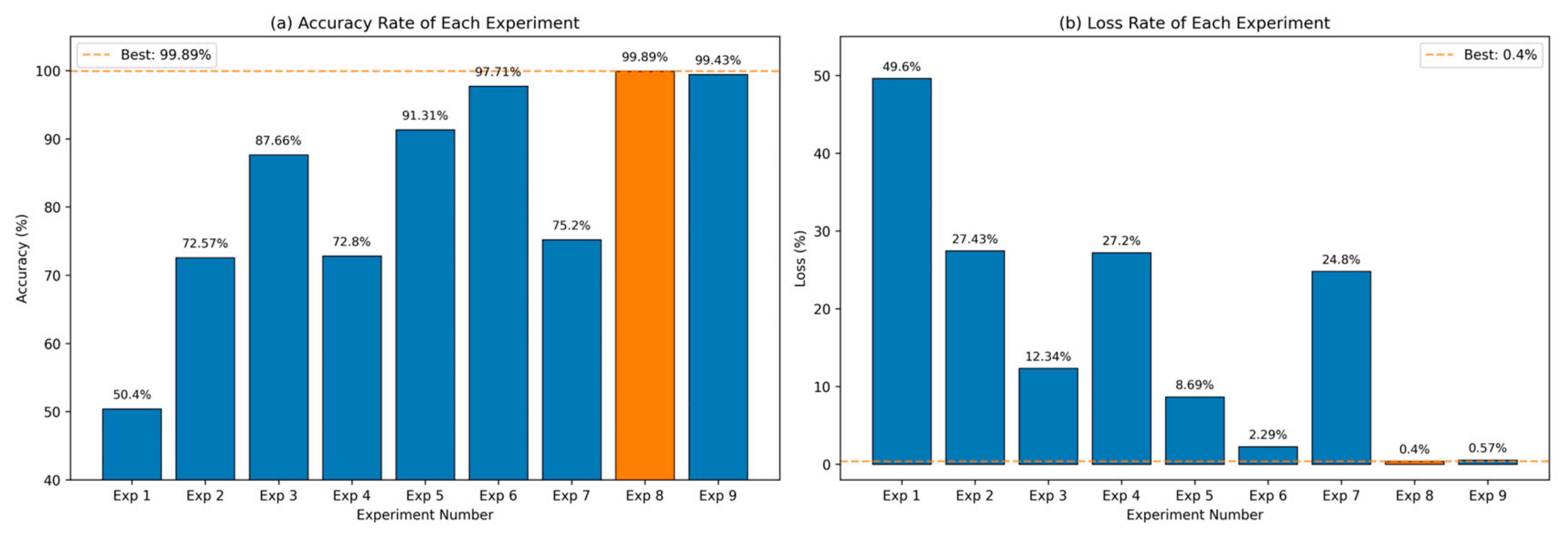
| Experiment | Hidden Layers | Epochs | RMSE | Accuracy (%) | Loss (%) |
|---|---|---|---|---|---|
| 1 | 2 | 5 | 0.494 | 50.40 | 49.6 |
| 2 | 2 | 15 | 0.464 | 72.57 | 27.43 |
| 3 | 2 | 60 | 0.278 | 87.66 | 12.34 |
| 4 | 4 | 5 | 0.454 | 72.80 | 27.2 |
| 5 | 4 | 15 | 0.296 | 91.31 | 8.69 |
| 6 | 4 | 60 | 0.145 | 97.71 | 2.29 |
| 7 | 6 | 5 | 0.457 | 75.20 | 24.8 |
| 8 | 6 | 15 | 0.108 | 99.89 | 0.4 |
| 9 | 6 | 60 | 0.080 | 99.43 | 0.57 |
Disclaimer/Publisher’s Note: The statements, opinions and data contained in all publications are solely those of the individual author(s) and contributor(s) and not of MDPI and/or the editor(s). MDPI and/or the editor(s) disclaim responsibility for any injury to people or property resulting from any ideas, methods, instructions or products referred to in the content. |
© 2026 by the author. Licensee MDPI, Basel, Switzerland. This article is an open access article distributed under the terms and conditions of the Creative Commons Attribution (CC BY) license.
Share and Cite
Aydin, H. A Federated Multi-Agent Communication Framework for Autonomous Cyber Defense in Edge–Cloud IoT Environments. Sensors 2026, 26, 5775. https://doi.org/10.3390/s26185775
Aydin H. A Federated Multi-Agent Communication Framework for Autonomous Cyber Defense in Edge–Cloud IoT Environments. Sensors. 2026; 26(18):5775. https://doi.org/10.3390/s26185775
Chicago/Turabian StyleAydin, Hakan. 2026. "A Federated Multi-Agent Communication Framework for Autonomous Cyber Defense in Edge–Cloud IoT Environments" Sensors 26, no. 18: 5775. https://doi.org/10.3390/s26185775
APA StyleAydin, H. (2026). A Federated Multi-Agent Communication Framework for Autonomous Cyber Defense in Edge–Cloud IoT Environments. Sensors, 26(18), 5775. https://doi.org/10.3390/s26185775