Design, Modeling and Performance Analysis of an Actively Variable Stiffness Pneumatic Flexible Bending Joint
 , ,
, ,
Highlights
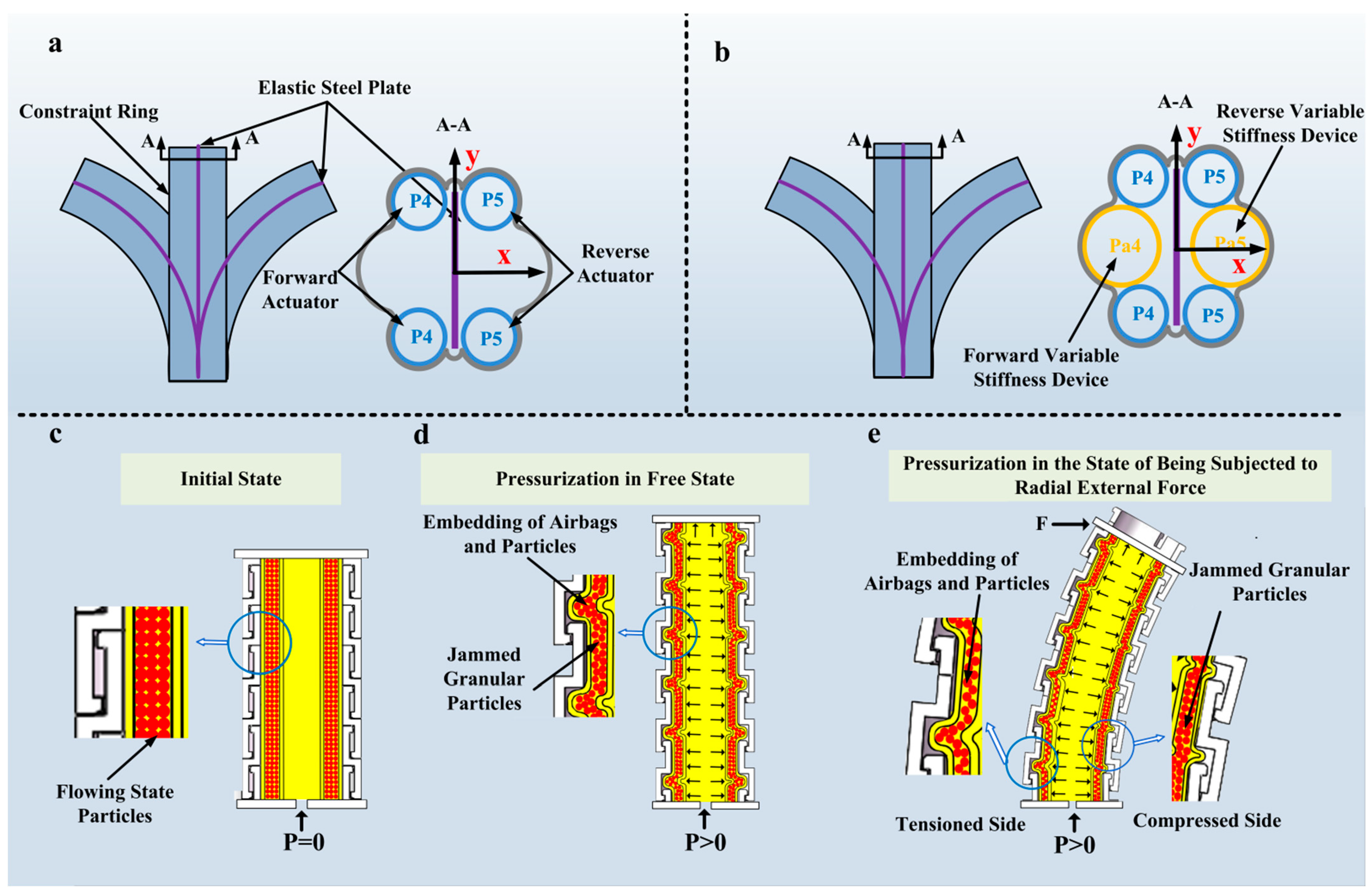
- A positive-pressure double-airbag gap-constrained particle-jamming method is proposed, and a novel actively variable-stiffness pneumatic flexible bending joint is developed.
- Theoretical models of the joint bending angle and tangential stiffness are established and experimentally validated.
- The positive-pressure double-airbag gap-constrained particle-jamming method maintains a relatively uniform particle distribution during joint deformation, while the variable stiffness device enables active continuous stiffness modulation of the joint.
- The validated models quantitatively describe the bending response to actuation pressure and the variation in tangential stiffness with bending angle.
Abstract
1. Introduction
2. Principle and Design
2.1. Working Principle of the Pneumatic Flexible Bending Joint
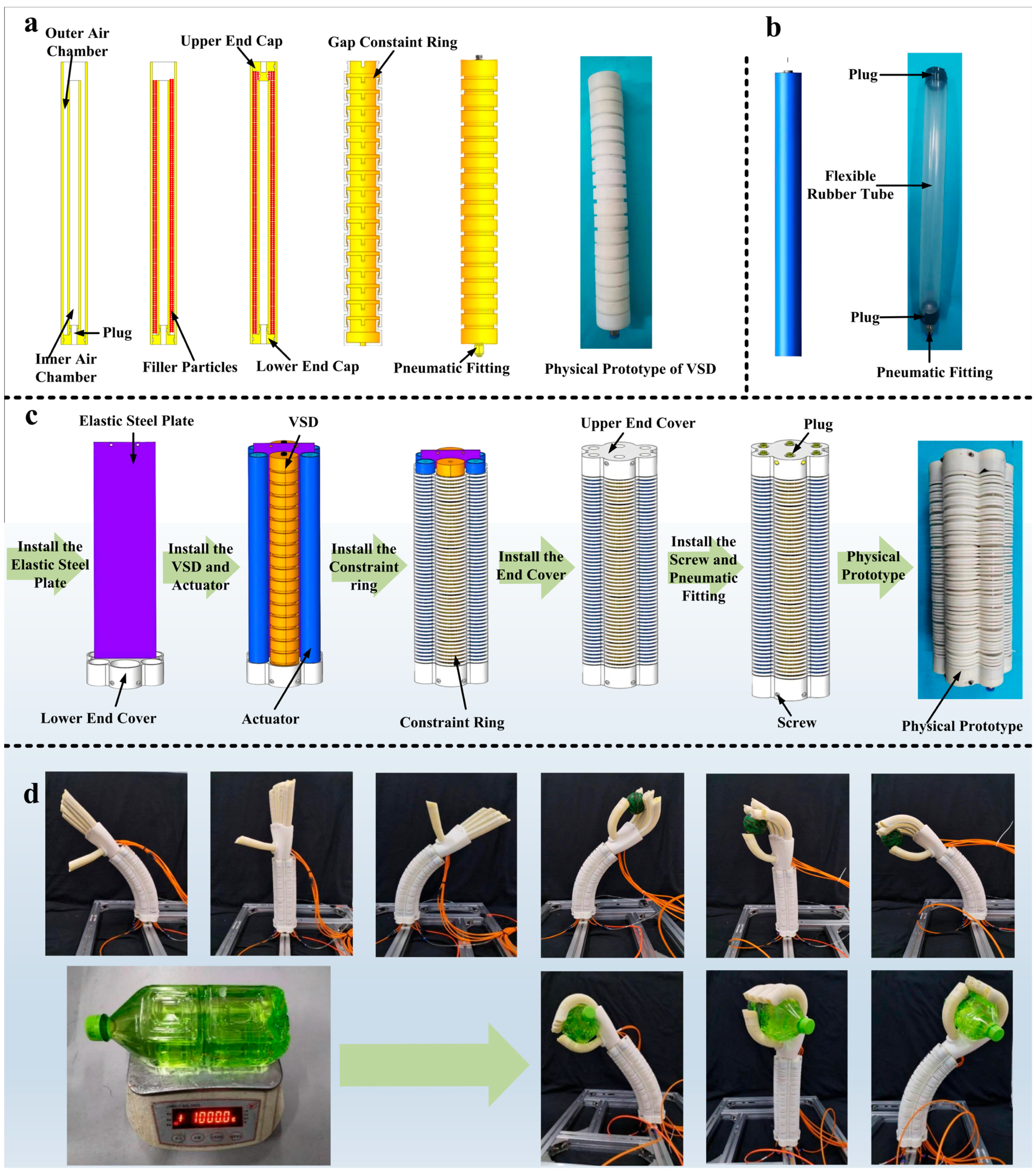
2.2. Design and Development of Flexible Bending Joint
3. Static Modeling and Analysis of the Actively Variable Stiffness Pneumatic Flexible Bending Joint
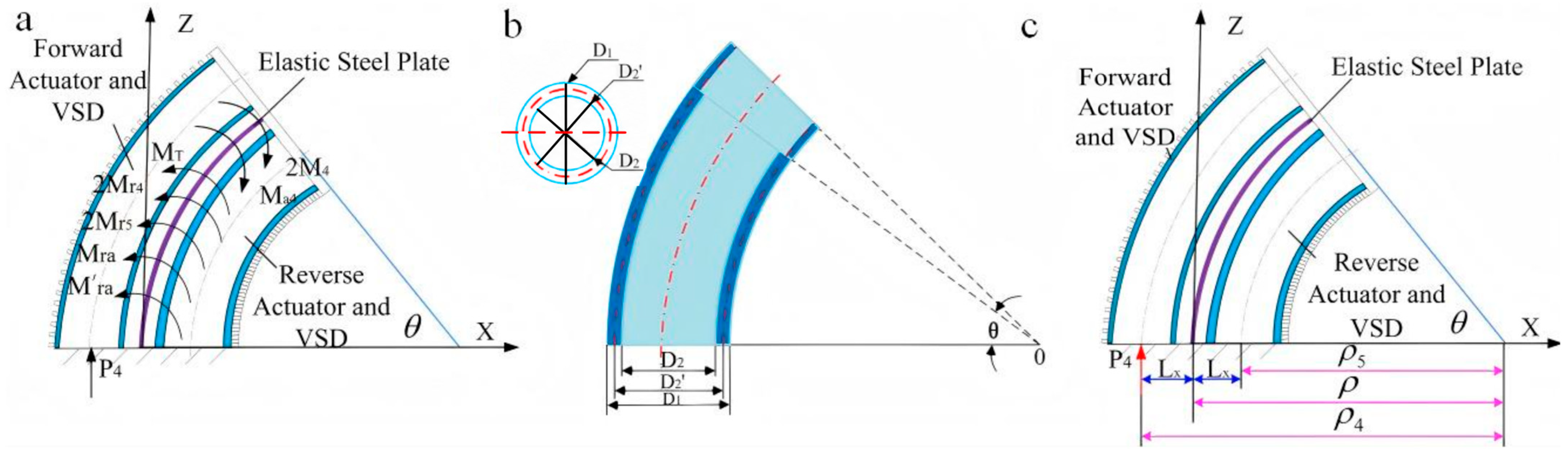
3.1. Theoretical Model of Bending Angle
- (1)
- To simplify the theoretical analysis, the artificial muscle is assumed to undergo uniform axial deformation during joint bending.
- (2)
- The artificial muscles and VSD air chambers are made of isotropic and incompressible rubber; therefore, the volume of their rubber walls remains constant during deformation.
- (3)
- The elastic steel plate is treated as a slender beam whose deformation is dominated by bending. Therefore, its transverse shear deformation is neglected in the theoretical model.
- (4)
- The friction generated by particle squeezing on the actively pressurized side is retained because it is a primary source of stiffness enhancement. When the unpressurized VSD is passively compressed, its elastomeric rubber air chambers undergo passive deformation, and the resulting internal friction is relatively small and therefore neglected. However, the deformation resistance moments of both the inner and outer air chambers are retained.
3.2. Bending Angle Model
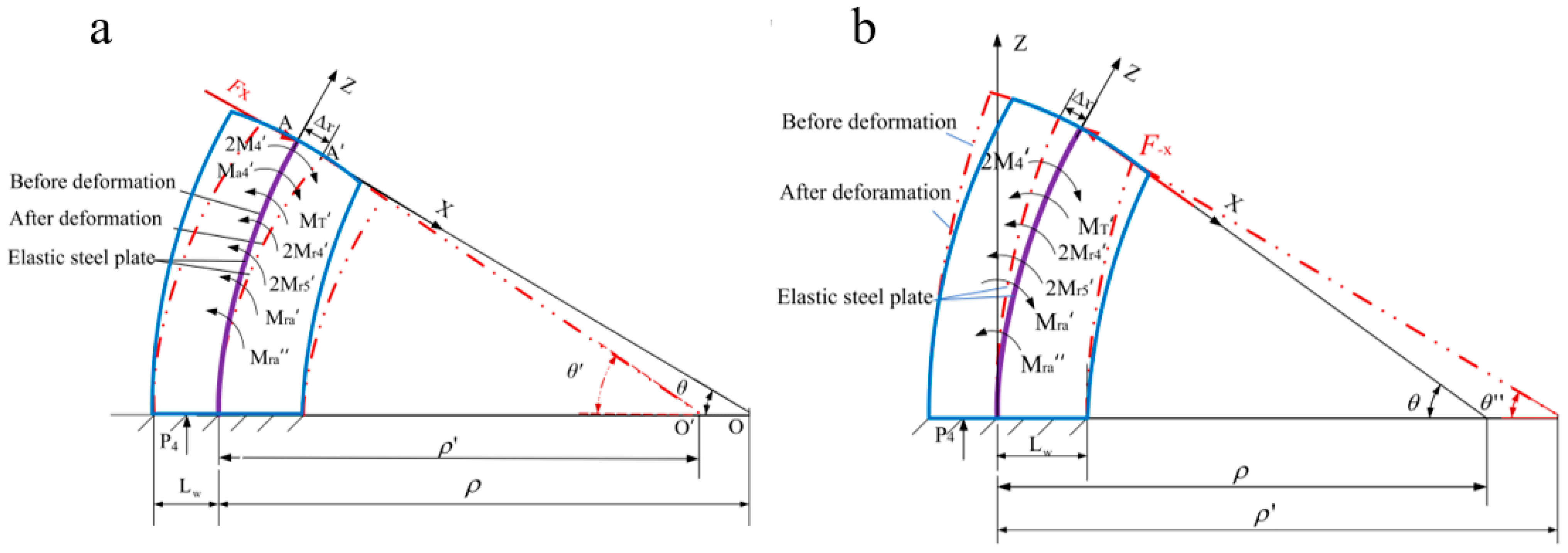
3.3. Tangential Stiffness Along the Bending Direction
3.4. Tangential Stiffness Along the Reverse Bending Direction
4. Experiments of Flexible Bending Joints
4.1. Bending Angle Experiment of Flexible Bending Joint
4.2. Tangential Stiffness Experiment of Flexible Bending Joints
4.3. Discussion
5. Conclusions
- (1)
- A novel actively variable stiffness pneumatic flexible bending joint is developed. While maintaining flexibility and compliance, the joint exhibits enhanced stiffness and pose-retention capability.
- (2)
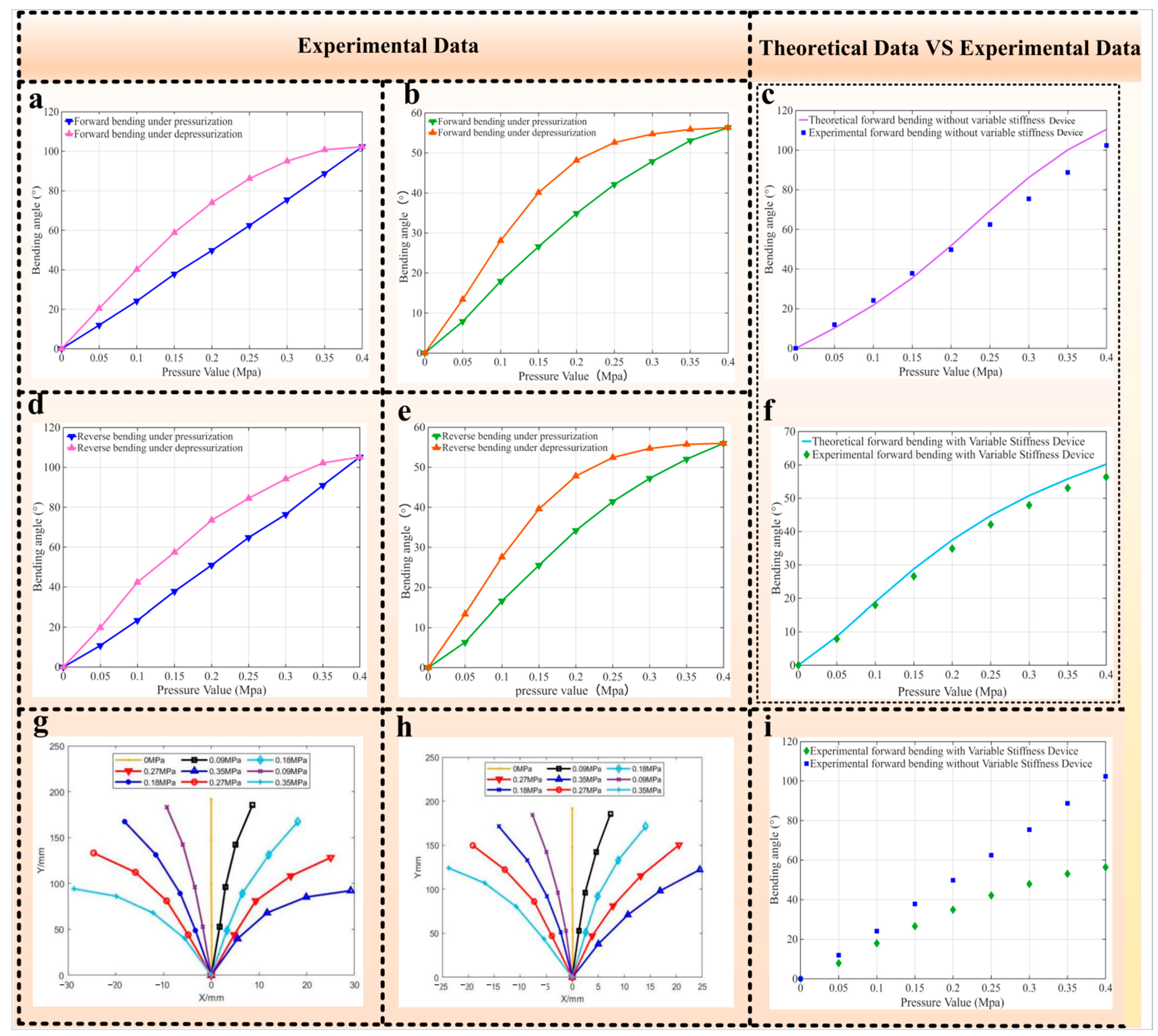
- A theoretical model of the bending angle is established and experimentally verified. The model predictions agree well with the experimental results and capture the nonlinear positive correlation between the joint bending angle and air pressure. At 0.4 MPa, the measured forward bending angles of the flexible joint without and with VSD are 102.32° and 56.35°, respectively. The corresponding MREs are 10.12% and 6.77%, respectively. The reduction in bending angle is attributed to the inherent stiffness of the inactive VSD, which produces an antagonistic effect on joint bending. The bending joint equipped with VSD presents stable overall deformation and a regular motion trajectory.
- (3)
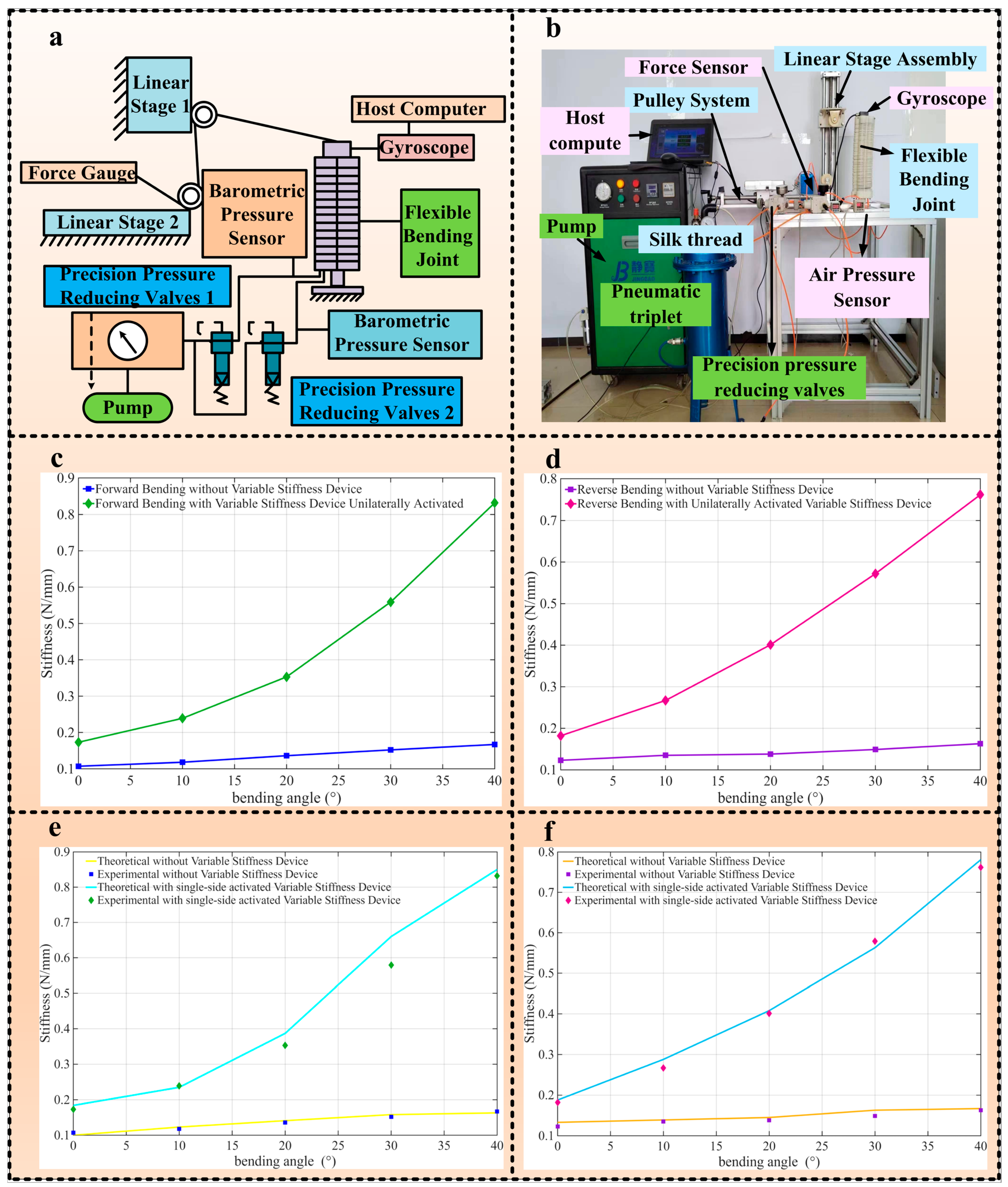
- Without VSD, the joint exhibits relatively low resistance to deformation in the tangential loading direction. Unilateral VSD activation significantly enhances the tangential stiffness under both forward and reverse loading. Under forward loading, the tangential stiffness increases from 0.167 N/mm without VSD to 0.832 N/mm with VSD activation at a bending angle of 40°, while the corresponding values at 0° are 0.107 N/mm and 0.173 N/mm, respectively. Accordingly, the stiffness ratio increases from 1.56 to 4.80. Under reverse loading, VSD activation increases the tangential stiffness from 0.163 N/mm to 0.762 N/mm at 40° and from 0.123 N/mm to 0.182 N/mm at 0°, with the corresponding stiffness ratio increasing from 1.33 to 4.18. At a bending angle of 40°, the tangential stiffness with VSD activation is approximately 4.98 and 4.67 times that without VSD under forward and reverse loading, respectively. These results quantitatively demonstrate the stiffness-regulation capability of the proposed joint.
Author Contributions
Funding
Institutional Review Board Statement
Informed Consent Statement
Data Availability Statement
Conflicts of Interest
References
- Cesário, L.C.; Barbosa, P.; Miguel, P.A.C.; Mendes, G.H.S. Service Robots in Caring for Older Adults: Uncovering the Current Conceptual and Intellectual Structures and Future Research Agenda. Arch. Gerontol. Geriatr. 2025, 131, 105755. [Google Scholar] [CrossRef] [Scilit]
- Lim, W.M.; Jasim, K.M.; Malathi, A. Service Robots in Healthcare: Toward a Healthcare Service Robot Acceptance Model (sRAM). Technol. Soc. 2025, 82, 102932. [Google Scholar] [CrossRef] [Scilit]
- Balcha, H.B.; Rauffet, P.; Wegari, G.M.; Buche, C. A Review on Human–Robot Trust in Home Service Robots. ACM Trans. Hum.-Robot Interact. 2025, 14, 76. [Google Scholar] [CrossRef] [Scilit]
- Jin, T.; Han, X. Robotic Arms in Precision Agriculture: A Comprehensive Review of the Technologies, Applications, Challenges, and Future Prospects. Comput. Electron. Agric. 2024, 221, 108938. [Google Scholar] [CrossRef] [Scilit]
- Pietrantoni, L.; Favilla, M.; Fraboni, F.; Mazzoni, E.; Morandini, S.; Benvenuti, M.; De Angelis, M. Integrating Collaborative Robots in Manufacturing, Logistics, and Agriculture: Expert Perspectives on Technical, Safety, and Human Factors. Front. Robot. AI 2024, 11, 1342130. [Google Scholar] [CrossRef] [Scilit] [PubMed]
- Zhou, S.; Li, Y.; Wang, Q.; Lyu, Z. Integrated Actuation and Sensing: Toward Intelligent Soft Robots. Cyborg Bionic Syst. 2024, 5, 105. [Google Scholar] [CrossRef] [Scilit] [PubMed]
- Khan, S.U.E.; Varghese, R.J.; Kassanos, P.; Farina, D.; Burdet, E. Space Physiology and Technology: Adaptations, Countermeasures, and Opportunities for Wearable Systems. Cyborg Bionic Syst. 2026, 7, 477. [Google Scholar] [CrossRef] [Scilit] [PubMed]
- AboZaid, Y.A.; Aboelrayat, M.T.; Fahim, I.S.; Radwan, A.G. Soft Robotic Grippers: A Review on Technologies, Materials, and Applications. Sens. Actuators A Phys. 2024, 372, 115380. [Google Scholar] [CrossRef] [Scilit]
- Seleem, I.A.; Naeem, M.A.; Takemura, H.; Ishii, H. Tendon-Driven Based Extensible Soft Robot with Variable Stiffness. Robot. Auton. Syst. 2025, 190, 104988. [Google Scholar] [CrossRef] [Scilit]
- Wang, K.; Sun, L.; Liu, Z.; Sun, N.; Zhang, J. Actuators and Variable Stiffness of Flexible Surgical Actuators: A Review. Sens. Actuators A Phys. 2025, 390, 116588. [Google Scholar] [CrossRef] [Scilit]
- Jiang, P.; Ma, T.; Luo, J.; Yang, Y.; Yin, C.; Zhong, Y. A Reconfigurable Soft Helical Actuator with Variable Stiffness Skeleton. Soft Robot. 2025, 12, 68–80. [Google Scholar] [CrossRef] [Scilit] [PubMed]
- Yang, Y.; Wang, P.; Zhu, H.; Xia, K.; Ren, T.; Shen, Y.; Li, Y. A Variable Stiffness Soft Robotic Manipulator Based on Antagonistic Design of Supercoiled Polymer Artificial Muscles and Shape Memory Alloys. Sens. Actuators A Phys. 2024, 366, 114999. [Google Scholar] [CrossRef] [Scilit]
- Park, W.; Lee, D.; Bae, J. A Hybrid Jamming Structure Combining Granules and a Chain Structure for Robotic Applications. Soft Robot. 2022, 9, 669–679. [Google Scholar] [CrossRef] [Scilit] [PubMed]
- Zhang, Z.; Yu, W.; Zhao, J.; Li, Y.; Meng, C.; Guo, S. A Review of Fiber-Shape Rolled Dielectric Elastomer Actuators: A Pivotal Pathway in Advancing Bionic Actuation. Small 2026, 22, e13229. [Google Scholar] [CrossRef] [Scilit] [PubMed]
- Aghajani, S.; Wu, C.; Li, Q.; Fang, J. Additively Manufactured Composite Lattices: A State-of-the-Art Review on Fabrications, Architectures, Constituent Materials, Mechanical Properties, and Future Directions. Thin-Walled Struct. 2024, 197, 111539. [Google Scholar] [CrossRef] [Scilit]
- Guo, H.; Xu, X.; Liu, H.; Zhang, W.; Wang, X.; Liu, Z.; Li, X.; Liu, Y.; Zhao, G.; Zhang, Y.; et al. Innovative Soft Material-Assisted Robot Grasping Devices: From Design Concept to Fabrication and Application Scenarios. J. Field Robot. 2026, 43, 2585–2610. [Google Scholar] [CrossRef] [Scilit]
- Cortes Lizarazo, J.R.; Miranda Pulido, C.E. Discrete Element Method Simulation of Contact Evolution in Granular Jamming Grippers. MATTER Int. J. Sci. Technol. 2025, 2025, 37–38. [Google Scholar] [CrossRef] [Scilit]
- Song, C.; Lee, H.S.; Park, S.; Hwang, D. Stiffening Iron Particles to Modulate Physical Interactions. Nat. Commun. 2025, 16, 10466. [Google Scholar] [CrossRef] [Scilit] [PubMed]
- Hrehova, S.; Hošovský, A.; Husár, J.; Krenický, T. Granular Jamming in Soft Robotics: Simulation Frameworks and Emerging Possibilities—Review. Biomimetics 2026, 11, 193. [Google Scholar] [CrossRef] [Scilit] [PubMed]
- Amend, J.R.; Brown, E.; Rodenberg, N.; Jaeger, H.M.; Lipson, H. A Positive Pressure Universal Gripper Based on the Jamming of Granular Material. IEEE Trans. Robot. 2012, 28, 341–350. [Google Scholar] [CrossRef] [Scilit]
- Liu, T.; Xia, H.; Lee, D.-Y.; Firouzeh, A.; Park, Y.-L.; Cho, K.-J. A Positive Pressure Jamming Based Variable Stiffness Structure and Its Application on Wearable Robots. IEEE Robot. Autom. Lett. 2021, 6, 8078–8085. [Google Scholar] [CrossRef] [Scilit]
- Peng, Y.; Yuan, J.; Hu, Z.; Du, L.; Bao, S.; Magdy, M. A Soft Robotic Gripper with Variable Grasping Force Based on Jamming Phenomenon. In Proceedings of the 2025 IEEE International Conference on Mechatronics and Automation (ICMA), Beijing, China, 3–6 August 2025; pp. 1277–1282. [Google Scholar] [CrossRef] [Scilit]
- Wang, S.; Wang, W. A Stiffness-Tunable Soft Actuator with Adjustable Jamming for Dexterous Manipulation. Soft Robot. 2026, 13, 596–606. [Google Scholar] [CrossRef] [Scilit] [PubMed]
- Caro, F.; Carmichael, M.G. A Review of Mechanisms to Vary the Stiffness of Laminar Jamming Structures and Their Applications in Robotics. Actuators 2024, 13, 64. [Google Scholar] [CrossRef] [Scilit]
- Chen, T.; Yang, X.; Zhang, B.; Li, J.; Pan, J.; Wang, Y. Scale-Inspired Programmable Robotic Structures with Concurrent Shape Morphing and Stiffness Variation. Sci. Robot. 2024, 9, eadl0307. [Google Scholar] [CrossRef] [Scilit] [PubMed]
- Wang, Z.; Shi, X.; Zhang, G.; Wang, W.D. An Origami-Based Anthropomorphic Rotary Robotic Arm. Int. J. Mech. Sci. 2026, 318, 111558. [Google Scholar] [CrossRef] [Scilit]
- Molla, M.H.O.R.; Chen, J.; Xu, C. Advancing Soft Robotics: Recent Progress in Dielectric Elastomer and Fluid Actuators. npj Robot. 2026, 4, 17. [Google Scholar] [CrossRef] [Scilit]
- Cortes, J.; Miranda, C. Design, Control, and Applications of Granular Jamming Grippers in Soft Robotics. Robotics 2025, 14, 132. [Google Scholar] [CrossRef] [Scilit]
- Copaci, D.-S.; Blanco, D.; Martin-Clemente, A.; Moreno, L. Flexible Shape Memory Alloy Actuators for Soft Robotics: Modelling and Control. Int. J. Adv. Robot. Syst. 2020, 17, 1729881419886747. [Google Scholar] [CrossRef] [Scilit]
- Pagliarani, N.; Arleo, L.; Albini, S.; Cianchetti, M. Variable Stiffness Technologies for Soft Robotics: A Comparative Approach for the STIFF-FLOP Manipulator. Actuators 2023, 12, 96. [Google Scholar] [CrossRef] [Scilit]
- Bermeo, J.E.; Castillo-Castañeda, E.; Laribi, M.A. A Soft Variable Stiffness Actuator with a Chain Mail Structure as a Particle Jamming Interface. Actuators 2025, 14, 247. [Google Scholar] [CrossRef] [Scilit]
- Enyan, M.; Bing, Z.; Amu-Darko, J.N.O.; Issaka, E.; Otoo, S.L.; Agyemang, M.F. Advances in Smart Materials Soft Actuators on Mechanisms, Fabrication, Materials, and Multifaceted Applications: A Review. J. Thermoplast. Compos. Mater. 2025, 38, 302–370. [Google Scholar] [CrossRef] [Scilit]
- Gent, A.N. (Ed.) Engineering with Rubber: How to Design Rubber Components, 2nd ed.; Zhang, L.; Tian, M.; Liu, L.; Feng, Y., Translators; Chemical Industry Press: Beijing, China, 2002. (In Chinese) [Google Scholar]
- Hibbeler, R.C. Engineering Mechanics: Statics, 15th ed.; Pearson: Hoboken, NJ, USA, 2021. [Google Scholar]
- Gere, J.M.; Goodno, B.J. Mechanics of Materials, 9th ed.; Cengage Learning: Boston, MA, USA, 2019. [Google Scholar]





| Parameter | Value | Unit |
|---|---|---|
| Joint mass | 1338.8 | g |
| Diameter of Pneumatic artificial muscle constraint ring | Φ25 | mm |
| Diameter of gap constraint ring | Φ35.8 | mm |
| Clearance between constraint rings | 1.6 | mm |
| Thickness of constraint ring | 3 | mm |
| Distance from Pneumatic artificial muscle to neutral layer | 16.89 | mm |
| Distance from VSD to neutral layer | 25.9 | mm |
| Elastic steel plate dimensions | 290.04 × 73.6 × 0.5 | mm |
| Number of constraint rings | 53 | - |
| Pneumatic artificial muscle dimensions | Φ20 × 24 | mm |
| Inner air chamber dimensions of VSD | Φ8 × 12 | mm |
| Outer air chamber dimensions of VSD | Φ20 × 24 | mm |
| Number of gap constraint rings | 16 | - |
| Parameter | Physical Meaning | Value | Unit | Determination Method |
|---|---|---|---|---|
| Effective length of the joint | 290.04 | mm | Measured from the prototype | |
| Initial outer diameter of the artificial muscle | 24 | mm | Component specification | |
| Initial inner diameter of the artificial muscle | 20 | mm | Component specification | |
| Distance from the artificial-muscle axis to the centerline of the elastic steel plate | 16.89 | mm | Determined from the prototype geometry | |
| Width of the elastic steel plate | 73.6 | mm | Measured from the prototype | |
| Thickness of the elastic steel plate | 0.5 | mm | Component specification | |
| Elastic modulus of the artificial-muscle material | 1.042 | MPa | Material test or manufacturer data | |
| Poisson’s ratio of the rubber material | 0.3 | – | Assumed based on material properties | |
| Driving-force correction coefficient of the artificial muscle | 1.52 | – | Identified experimentally | |
| Operating pressure | 0–0.4 | MPa | Experimental operating range |
| Bending Direction | VSD Condition | kt at 0° (N/mm) | kt at 40° (N/mm) | kt(40°)/kt(0°) |
|---|---|---|---|---|
| Forward | Without VSD | 0.107 | 0.167 | 1.56 |
| Forward | Unilateral VSD activation | 0.173 | 0.832 | 4.80 |
| Reverse | Without VSD | 0.123 | 0.163 | 1.33 |
| Reverse | Unilateral VSD activation | 0.182 | 0.762 | 4.18 |
Disclaimer/Publisher’s Note: The statements, opinions and data contained in all publications are solely those of the individual author(s) and contributor(s) and not of MDPI and/or the editor(s). MDPI and/or the editor(s) disclaim responsibility for any injury to people or property resulting from any ideas, methods, instructions or products referred to in the content. |
© 2026 by the authors. Licensee MDPI, Basel, Switzerland. This article is an open access article distributed under the terms and conditions of the Creative Commons Attribution (CC BY) license.
Share and Cite
Wang, X.; Yuan, H.; Wang, P.; Gao, P.; Xing, H.; Han, M.; Peng, H. Design, Modeling and Performance Analysis of an Actively Variable Stiffness Pneumatic Flexible Bending Joint. Sensors 2026, 26, 5200. https://doi.org/10.3390/s26165200
Wang X, Yuan H, Wang P, Gao P, Xing H, Han M, Peng H. Design, Modeling and Performance Analysis of an Actively Variable Stiffness Pneumatic Flexible Bending Joint. Sensors. 2026; 26(16):5200. https://doi.org/10.3390/s26165200
Chicago/Turabian StyleWang, Xia, Haoran Yuan, Pei Wang, Peng Gao, Honghao Xing, Mingyang Han, and He Peng. 2026. "Design, Modeling and Performance Analysis of an Actively Variable Stiffness Pneumatic Flexible Bending Joint" Sensors 26, no. 16: 5200. https://doi.org/10.3390/s26165200
APA StyleWang, X., Yuan, H., Wang, P., Gao, P., Xing, H., Han, M., & Peng, H. (2026). Design, Modeling and Performance Analysis of an Actively Variable Stiffness Pneumatic Flexible Bending Joint. Sensors, 26(16), 5200. https://doi.org/10.3390/s26165200