3.1. Problem Formulation of Radar–Jammer Confrontation
In this paper, the waveform-level confrontation between an intelligent radar and an intelligent jammer is formulated as a two-agent sequential game because both sides possess independent sensing and decision-making capabilities, while their objectives are directly opposed. The radar seeks to maintain target-detection performance by adapting its waveform type and waveform parameters, whereas the jammer attempts to degrade radar performance by adjusting its jamming type and jamming parameters. Since the jammer can change its strategy according to the intercepted radar waveform, it cannot be regarded as a fixed environmental disturbance. Similarly, the radar continuously updates its anti-jamming behavior according to the observed jamming effect. Therefore, modeling both sides as adaptive agents provides a more realistic representation of intelligent radar–jammer confrontation.
Although the radar and jammer operate according to their own local time perspectives at the waveform level, their behavioral changes are strongly coupled. In practice, a change in the radar waveform usually triggers a corresponding adjustment in the jammer strategy, while a change in the jamming behavior further induces the radar to modify its subsequent waveform. Therefore, the interaction is modeled as a sequential decision-making process rather than as two isolated or completely simultaneous decision processes. In each interaction cycle, the radar waveform decision influences the jammer observation and response, and the resulting jamming action further affects the radar echo, detection performance, and next waveform decision. This sequential formulation makes it possible to explicitly describe the causal relationship between jamming and anti-jamming behaviors, and is more suitable for exploring their underlying behavioral logic and strategy evolution over multiple interaction stages.
Let the radar agent and jammer agent be denoted by
and
, respectively. At the
-th decision step, the radar selects a waveform action
, and the jammer selects a jamming action
. The radar action consists of a waveform type and its corresponding parameters, which can be written as
where
denotes the radar waveform type. For the LFM action, the transmit waveform is generated as
where
is the waveform amplitude and
is the fixed pulse width. The instantaneous frequency increases linearly from
to
, so the Actor output
determines the center frequency and
determines the occupied bandwidth. The parameter vector is
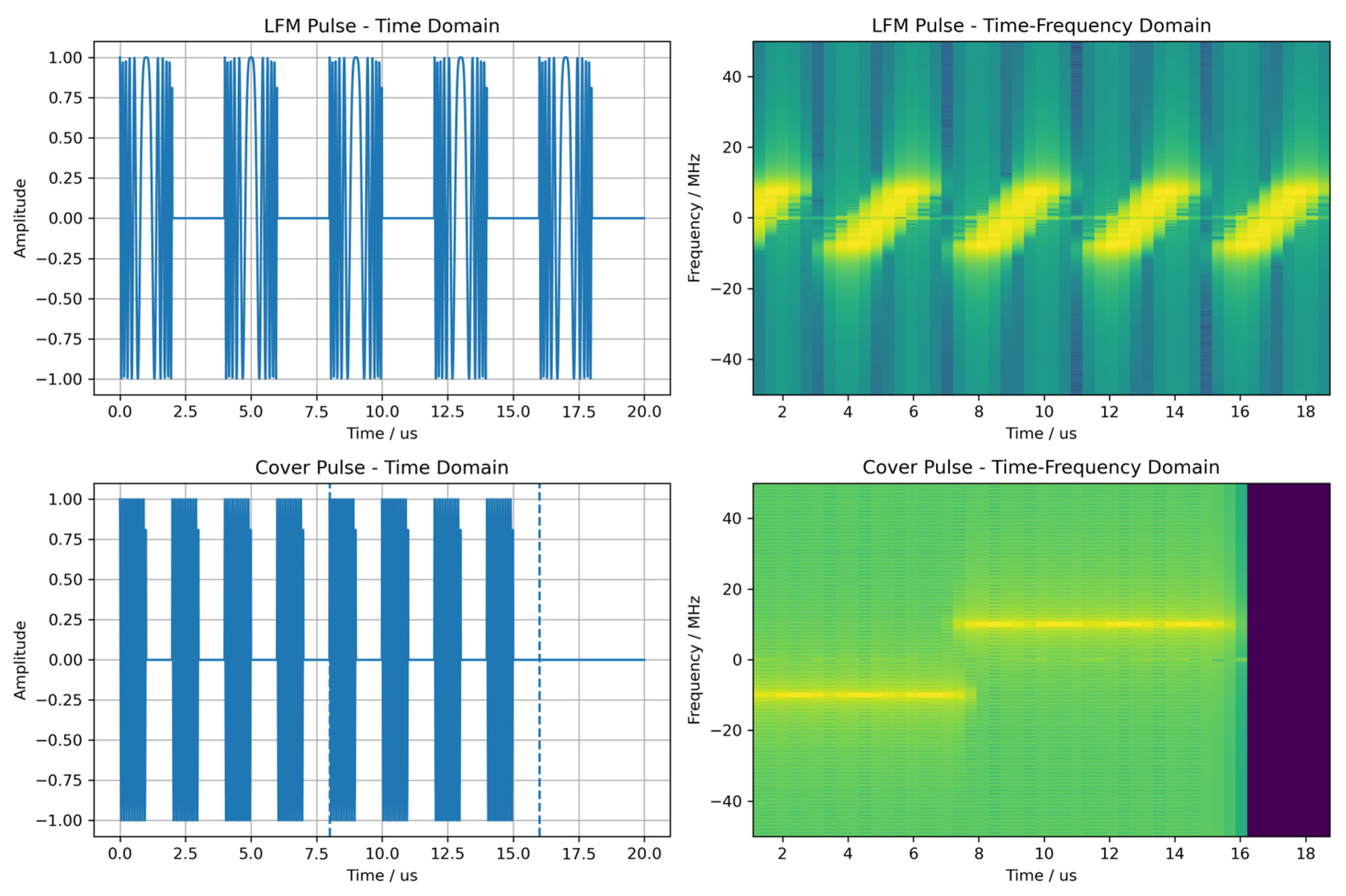
For the cover-pulse action, the transmitted waveform consists of a cover pulse followed by a detection pulse:
where the cover pulse is transmitted first to induce or attract the jammer response, while the subsequent detection pulse is used for target sensing. The four adjustable parameters therefore determine the frequencies and durations of the two pulse segments. The parameter vector is
where
and
denote the carrier frequencies of the cover pulse and the detection pulse, respectively.
and
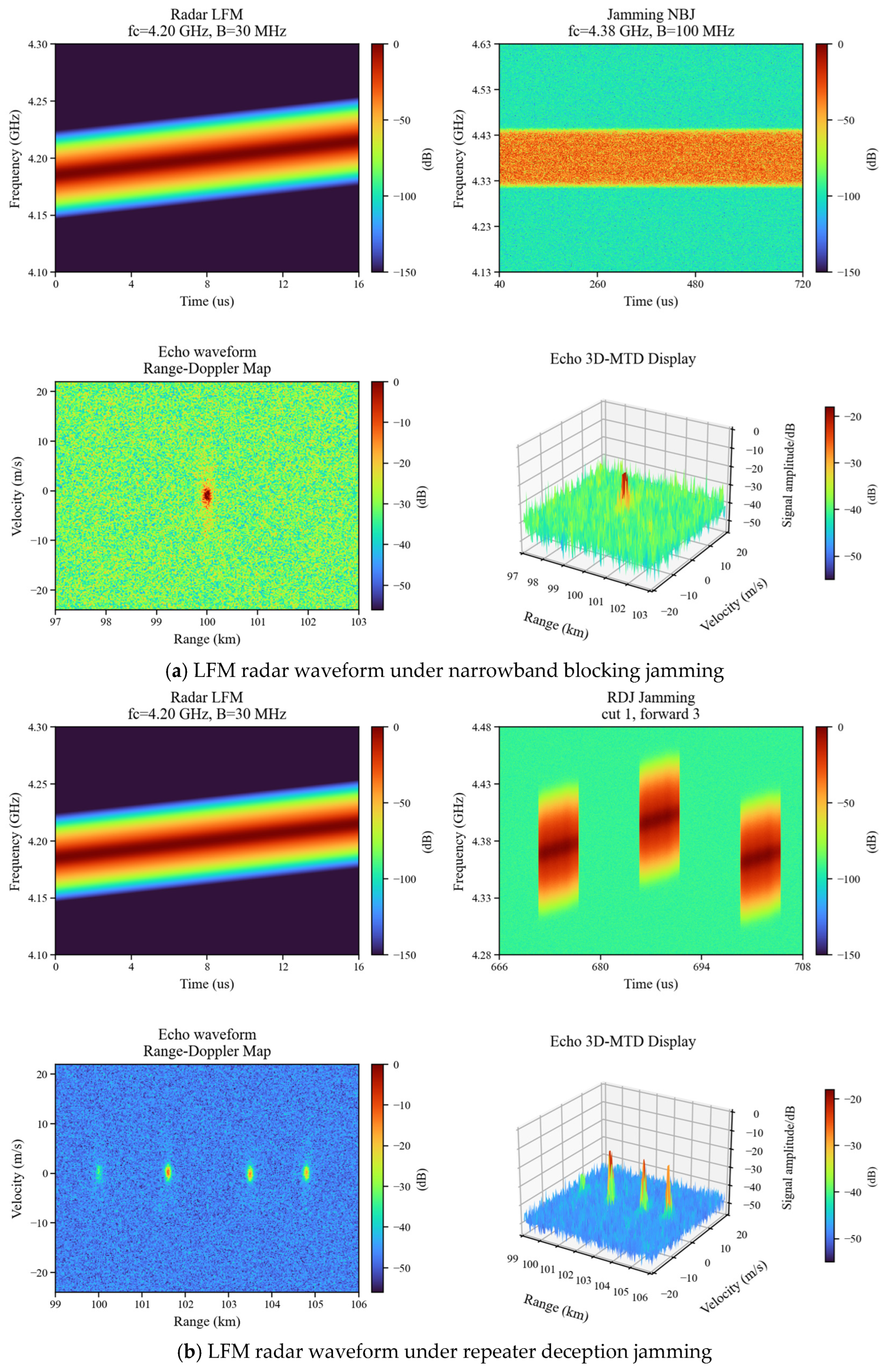
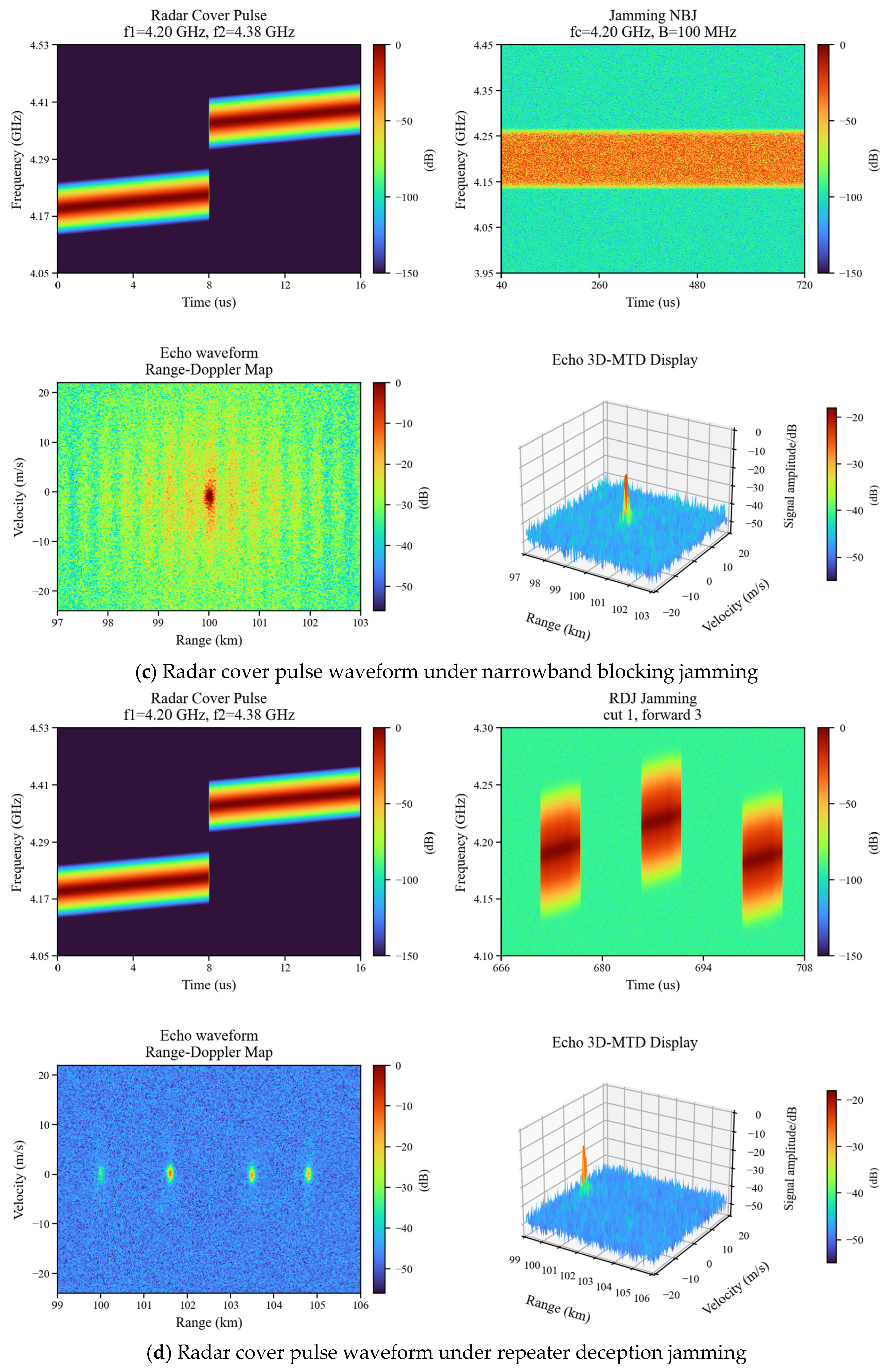
denote the cover-pulse width and the detection-pulse width, respectively. The cover pulse is transmitted to mislead or mask the jammer, while the detection pulse is used for actual radar sensing. The simulation results of time and time frequency domains of radar anti-jamming waveforms are shown in
Figure 2.
The jammer action also consists of a jamming type and its corresponding parameters, which can be written as
where
denotes narrowband blocking jamming, and repeater deception jamming, respectively. For NBJ, the jammer generates band-limited complex noise centered at the selected jamming frequency:
where
denotes a zero-mean complex Gaussian noise sequence filtered to bandwidth
, and
denotes the jamming power. Therefore,
and
control the center frequency and spectral coverage of the suppression jamming. The adjustable parameters are the jamming frequency and bandwidth:
For RDJ, the jammer intercepts the radar waveform and retransmits multiple delayed copies:
where
is the intercepted radar signal,
is the amplitude coefficient of the
-th forwarded copy,
is the forwarding-delay interval and
denotes the time used by the jammer to intercept the radar signal. Increasing
generates more delayed replicas and therefore more false-target echoes. The adjustable parameters are the interception time and the number of forwarding repetitions:
At each decision step, the radar first selects a waveform action and generates the transmit signal
. The jammer then intercepts the radar signal, selects a jamming action, and generates the jamming signal
. The mixed signal received by the radar can be expressed as
where
,
, and
denote the target echo amplitude, delay, and Doppler frequency, respectively, and
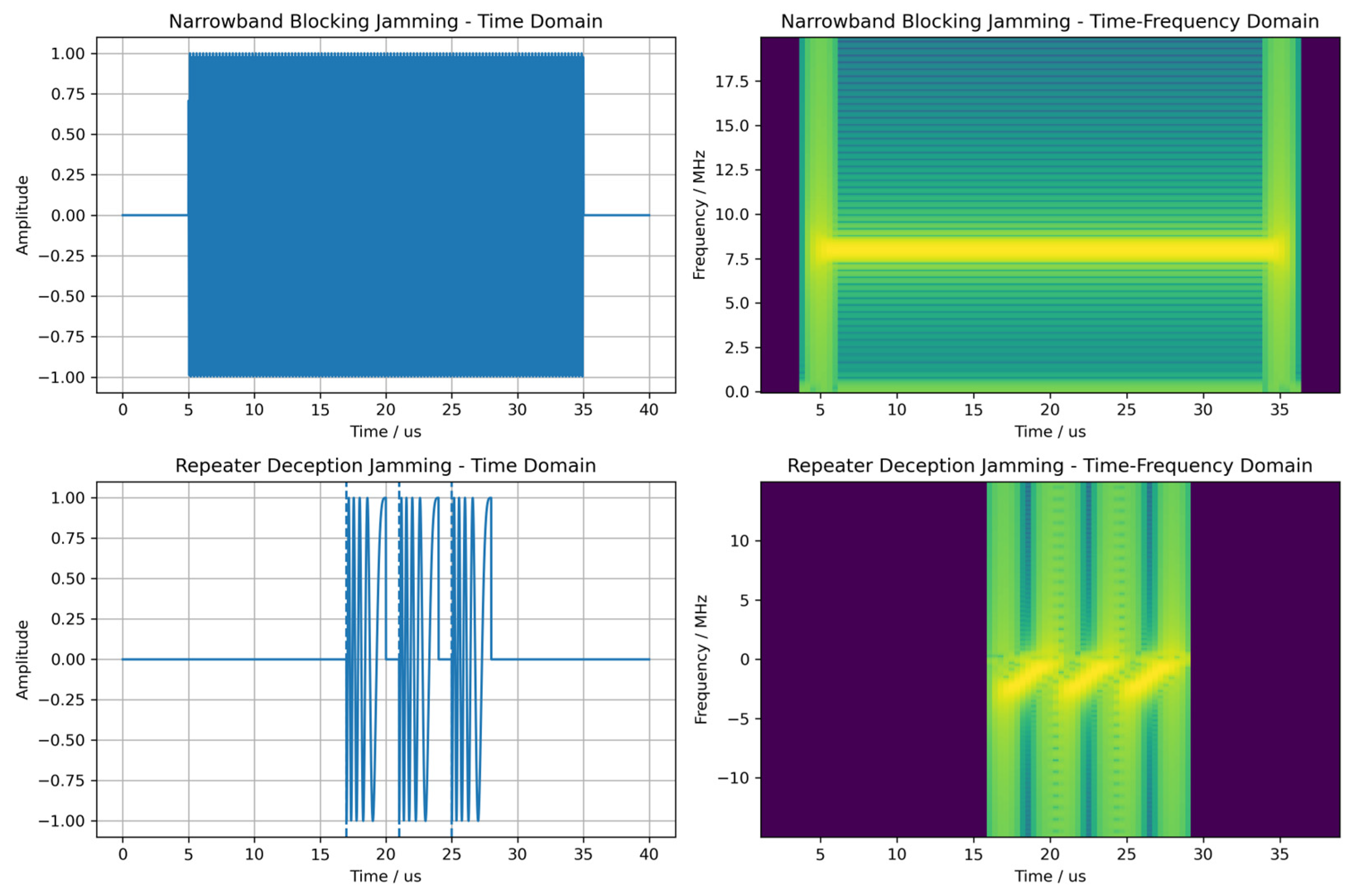
denotes noise. The simulation results of time and time frequency domains of jamming waveforms are shown in
Figure 3.
A competitive reward is used to describe the opposite objectives of the radar and the jammer. Since this paper focuses on radar detection performance under jamming, the normalized detection probability is used as the main reward criterion throughout the experiments. The radar reward is defined as
where
denotes the normalized detection probability of the radar at the
-th decision step. The jammer aims to degrade the radar detection performance; therefore, its reward is defined as the opposite of the radar reward:
This simplified detection-based reward allows the radar–jammer game to be evaluated directly from the perspective of radar sensing performance.
3.2. AlphaZero-Based Dual-Agent Reinforcement Learning Framework
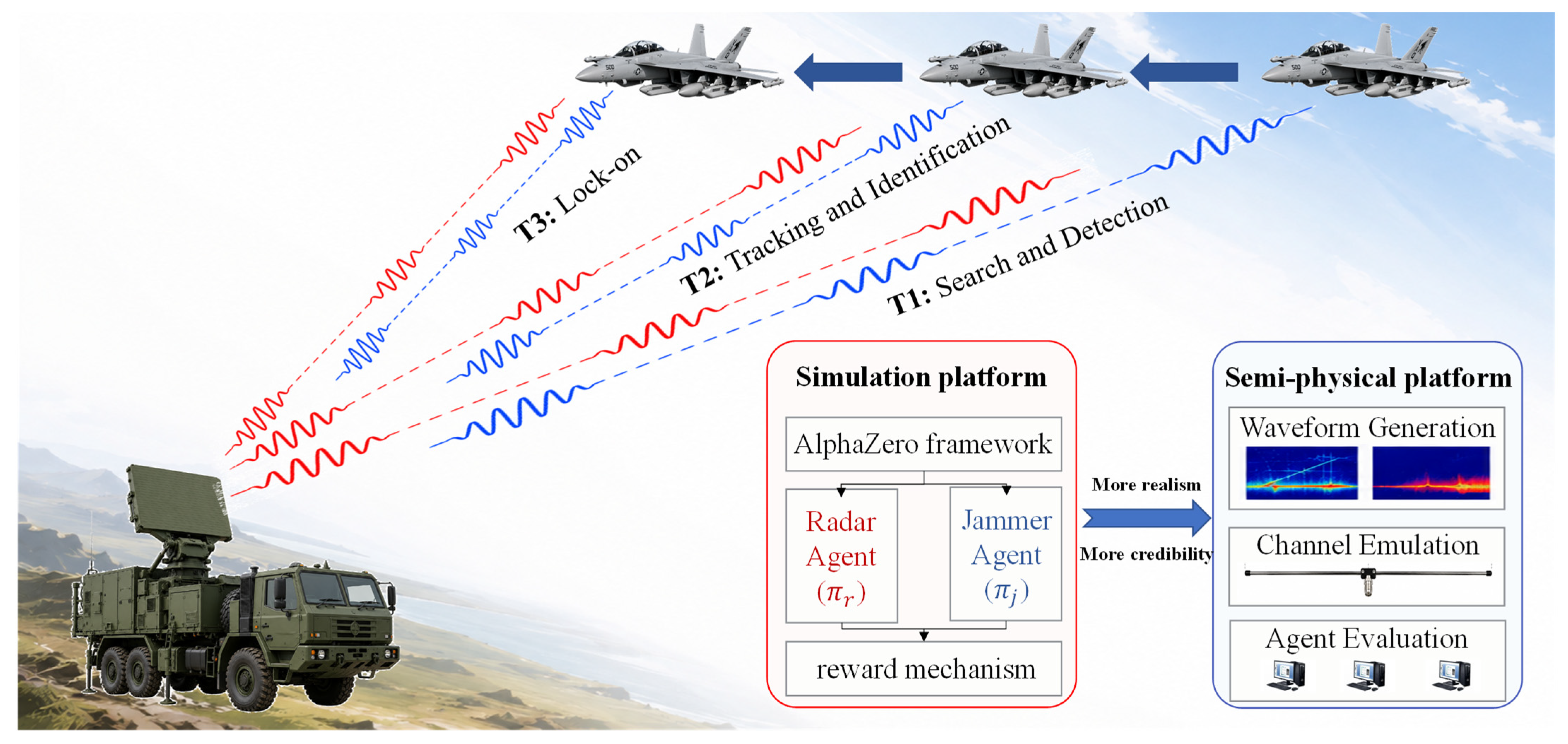
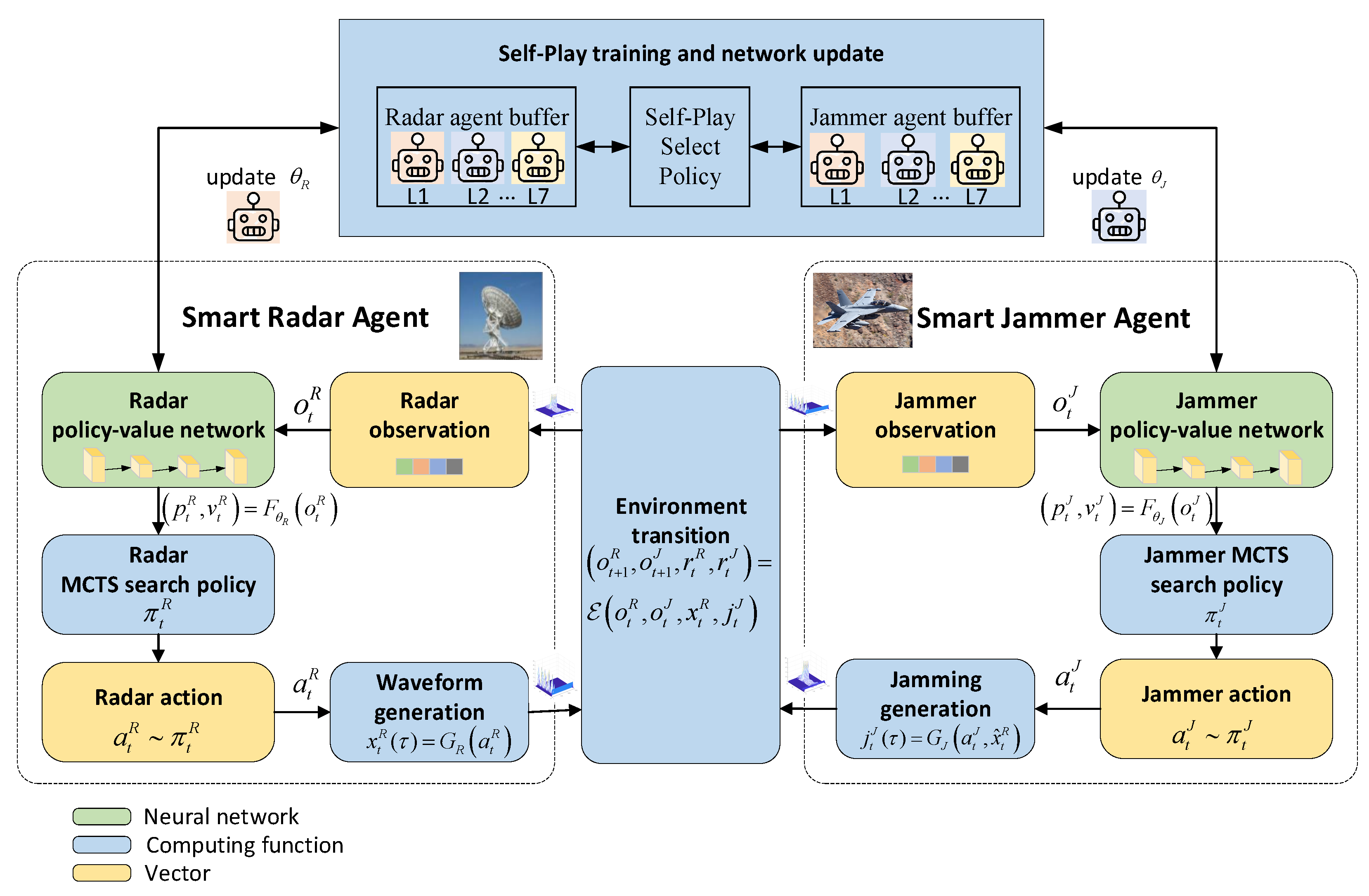
To solve the waveform-level radar–jammer confrontation problem, an AlphaZero-based dual-agent game framework is proposed (
Figure 4). The framework combines policy-value estimation, Monte Carlo tree search (MCTS), and self-play learning. In this framework, both the radar and the jammer are modeled as learning agents.
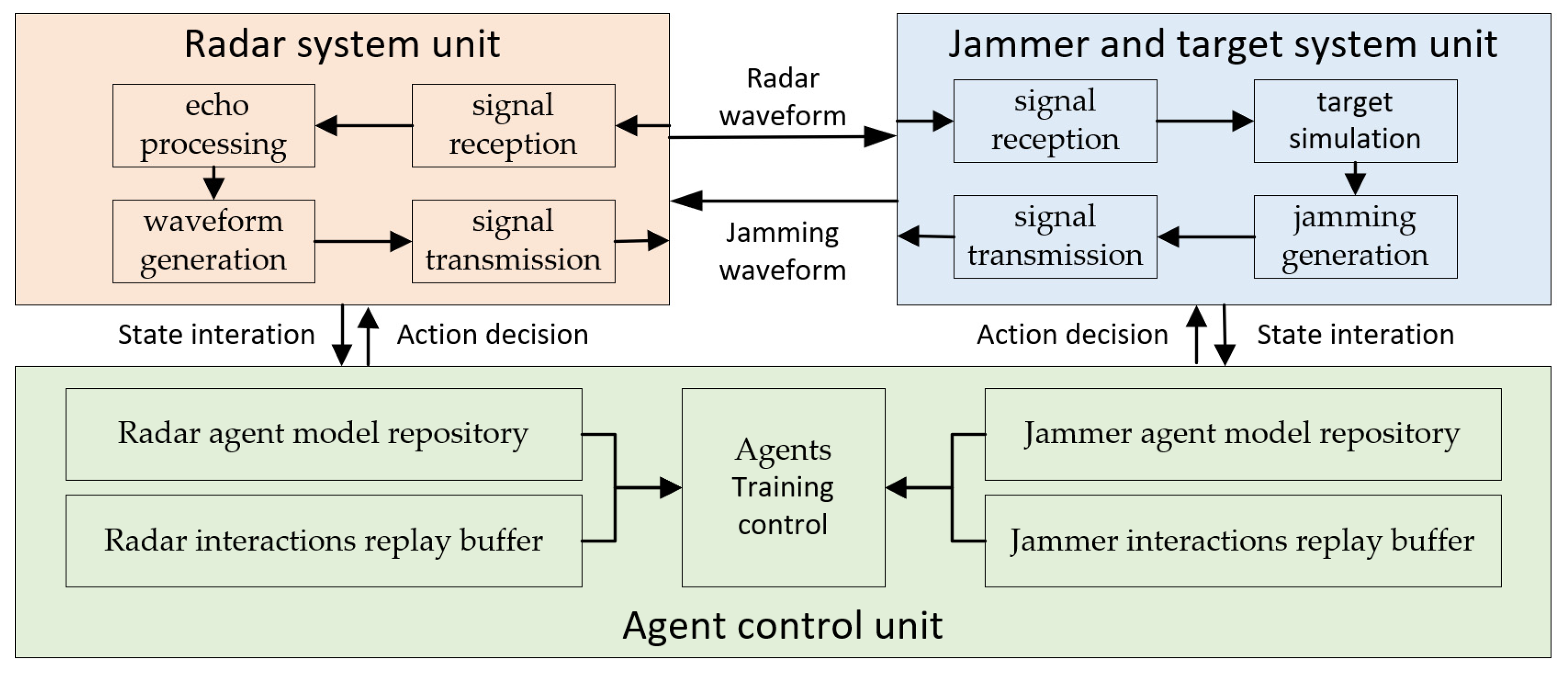
At each decision step, the closed-loop interaction includes five modules: radar decision-making, radar waveform generation, jammer interception and decision-making, jamming signal generation, and radar performance evaluation. First, the radar obtains its observation
from the receiver and historical waveform information. The radar policy-value network outputs
where
is the prior distribution over the radar action space and
is the estimated value. Based on the network output, MCTS generates an improved radar policy
, and the radar action is selected as
The selected action is then converted into a radar transmit waveform by the waveform generation module:
where
denotes the radar waveform generation function.
After radar transmission, the jammer intercepts part of the radar signal and forms its observation:
where
denotes historical jamming information and
represents interception noise and delay. The jammer policy-value network outputs
MCTS is then used to obtain the improved jammer policy
, and the jammer action is selected as
According to the selected jamming type and parameters, the jamming generation module produces
where
is the jamming signal generation function and
is the intercepted radar signal. Finally, the radar receiver obtains the mixed echo, evaluates the sensing performance, and returns the next observations and rewards:
where
denotes the closed-loop radar–jammer interaction environment.
Through this process, the radar decision affects waveform generation, the waveform affects jammer observation and jamming decision, and the jamming signal further affects radar reception and performance evaluation. The evaluated rewards are then used for self-play training. Therefore, the proposed framework enables both agents to improve their strategies through continuous radar–jammer confrontation.
3.3. Self-Play Training Process
The proposed method uses self-play to train the radar and jammer policies. In self-play, the radar and jammer repeatedly compete with each other using their current policies. The interaction data generated during this process are used to update the neural networks of both agents. As training proceeds, the radar learns to avoid or suppress effective jamming actions, while the jammer learns to exploit weaknesses in the radar waveform strategy.
For agent
, the neural network is denoted as
where
is the predicted policy,
is the predicted value, and
denotes the network parameters. The network
is an improved DDPG-based network proposed in our previous work [
23]. During self-play, Monte Carlo tree search is performed based on the current network, producing an improved policy
. At each decision step, the training sample is recorded as
After one episode terminates, the cumulative return of agent
from step
is calculated as
where
is the length of the episode, and
is the discount factor. The final training sample is then written as
All samples generated by self-play are stored in the replay buffer:
The value head is trained using the cumulative self-play return
as the supervised target. Therefore, the value-prediction loss is defined as
The policy head is trained to reproduce the MCTS-enhanced policy
. Its loss is the cross-entropy between
and the network output
:
This term can also be written as
where
is independent of the network parameters. Therefore, minimizing the cross-entropy is equivalent to minimizing the Kullback–Leibler divergence between the MCTS policy and the network policy. In this way, the search result is progressively transferred to the policy network.
Adding
regularization gives the mini-batch objective:
The first term trains long-term outcome prediction, the second distills the MCTS action preference into the policy network, and the third limits excessive parameter growth.
The parameters are updated by gradient descent:
where
is the learning rate. Since the radar and jammer have opposite objectives, their rewards are competitive. In the zero-sum setting, the relationship is
Therefore, the optimization process makes the radar policy evolve toward better anti-jamming performance, while the jammer policy evolves toward stronger interference capability. The self-play process can be expressed as the following iterative optimization problem:
where
denotes the training iteration. In each iteration, the radar policy is optimized against the current jammer policy, and the jammer policy is optimized against the current radar policy. This alternating competitive learning mechanism enables both agents to improve through mutual confrontation.
3.4. Monte Carlo Tree Search
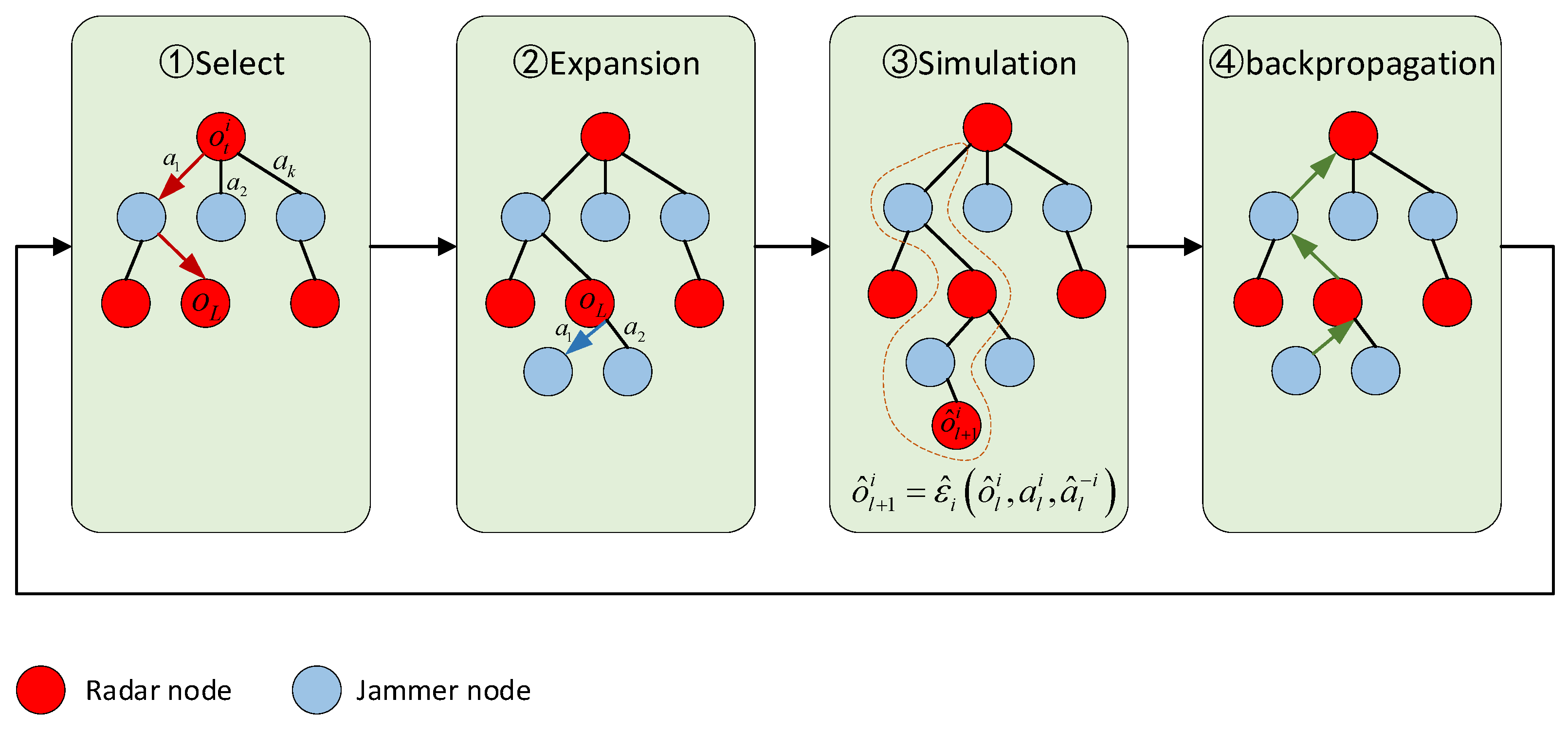
Monte Carlo tree search is used to enhance the decision-making process of both radar and jammer. Compared with directly selecting actions from the neural network policy, MCTS evaluates candidate actions by considering possible future interactions. The computing step of Monte Carlo tree search is shown in
Figure 5.
For agent
, MCTS is performed from the current observation node
. Each edge
in the search tree stores four quantities: the prior probability
, visit count
, accumulated value
, and mean action value
. The mean action value is defined as
At the beginning of the search, the neural network provides the prior probability and value estimate:
The action-selection criterion is constructed by combining an exploitation term and a prior-guided exploration term:
where
The mean value favors actions that have achieved high predicted returns in previous simulations. The exploration bonus is large when the policy prior is high and the edge has been visited only a few times. As increases, the exploration bonus decreases, and the selection becomes increasingly dominated by the accumulated value estimate. Therefore, the PUCT rule first uses the policy network to focus the search on promising waveform actions and then refines their ranking through repeated radar–jammer interaction evaluation.
The proposed action is hybrid, consisting of a discrete waveform or jamming type and the corresponding continuous parameters. The policy head first outputs the probability of each action type using a softmax function. The continuous parameter head outputs normalized values through a hyperbolic tangent function. Each normalized output
is mapped to its physical range according to
To obtain a finite branching set for MCTS, the continuous outputs are quantized according to the hardware-control resolution, and only the candidate actions with the highest policy priors are retained at each node. MCTS is therefore performed over a finite candidate set rather than over the entire continuous action domain.
After an action is selected, the search process uses the radar–jammer interaction model to generate the next observation node. For the radar search tree, a radar action is selected first, and the possible jammer response is estimated using the current jammer policy. For the jammer search tree, a jammer action is selected based on its current observation, and the possible radar response in subsequent steps is estimated using the current radar policy. This opponent-policy-guided simulation can be written as
where
denotes the internal simulation model used by agent
,
is the action selected by the searching agent, and
is the predicted opponent action generated by the opponent policy network. This allows MCTS to estimate the influence of future radar–jammer interactions.
When a leaf node is reached, it is expanded using the neural network:
where
is the leaf observation node and
is the estimated value. The value is then backed up along the selected path. For each visited edge
, the statistics are updated as
After
simulations, the improved policy is obtained from the visit counts:
where
is the temperature parameter. A larger
encourages exploration, while a smaller
makes the policy closer to greedy action selection. During training, actions are sampled from
to maintain exploration. During testing or semi-physical implementation, the action with the largest visit count can be selected:
In the proposed radar–jammer game, MCTS plays two roles. First, it transforms the raw network policy into a search-enhanced policy, improving the quality of waveform and jamming decisions. Second, it provides a better training target for the policy network. By learning from the MCTS-generated policy, the neural network gradually internalizes the search result and improves its decision-making capability.
The complete procedure of the proposed method is summarized in Algorithm 1.
| Algorithm 1 AlphaZero-based dual-agent radar-jammer game control method |
| Require: Radar action space
, jammer action space
, initial network parameters
and
, number of training episodes
, number of MCTS simulations
.
|
| Ensure: Trained radar policy network
and jammer policy network
.
|
| 1: | Initialize the radar network jammer network and replay buffers. |
| 2: | for episode = 1 to N do |
| 3: | Initialize the radar-jammer confrontation environment. |
| 4: | for each decision step do |
| 5: | Obtain incomplete observations and |
| 6: | Use and MCTS with simulations to obtain radar search policy |
| 7: | Use and MCTS with simulations to obtain jammer search policy |
| 8: | Select radar waveform action according to |
| 9: | Select jammer action according to |
| 10: | Execute and in the radar-jammer interaction environment. |
| 11: | Calculate rewards and and update the environment state. |
| 12: | Store observations and search policies. |
| 13: | end for |
| 14: | Calculate final returns and for the radar and jammer. |
| 15: | Store training samples and in replay buffers. |
| 16: | Update and by minimizing their loss functions. |
| 17: | end for |
| 18: | return The trained radar and jammer networks. |