Article

Performance Evaluation, Optical Optimization and Earth-Based Validation of Star Sensors for Ground Detection in Martian Dust Environments

1
School of Astronautics, Harbin Institute of Technology, Harbin 150001, China
2
Shanghai Aerospace Control Technology Institute, Shanghai 201109, China
3
National Key Laboratory of Space Target Awareness, Shanghai 201109, China
4
Shanghai Key Laboratory of Aerospace Intelligent Control Technology, Shanghai 201109, China
5
School of Energy Science and Engineering, Harbin Institute of Technology, Harbin 150001, China
6
Key Laboratory of Aerospace Thermophysics, Ministry of Industry and Information Technology, Harbin 150001, China
*
Author to whom correspondence should be addressed.
Sensors 2026, 26(15), 4686; https://doi.org/10.3390/s26154686
Submission received: 11 May 2026 / Revised: 22 June 2026 / Accepted: 21 July 2026 / Published: 23 July 2026

Abstract

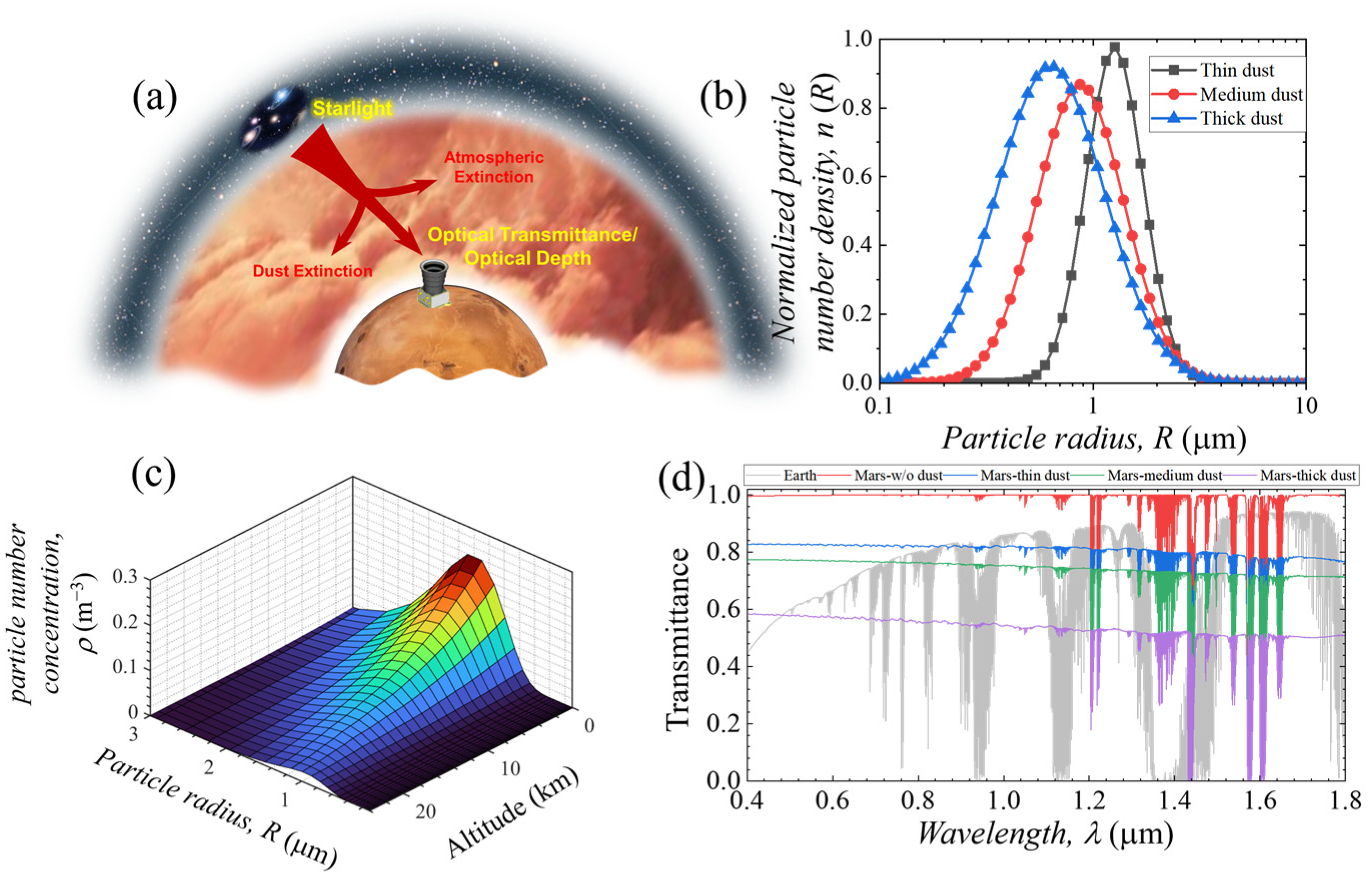
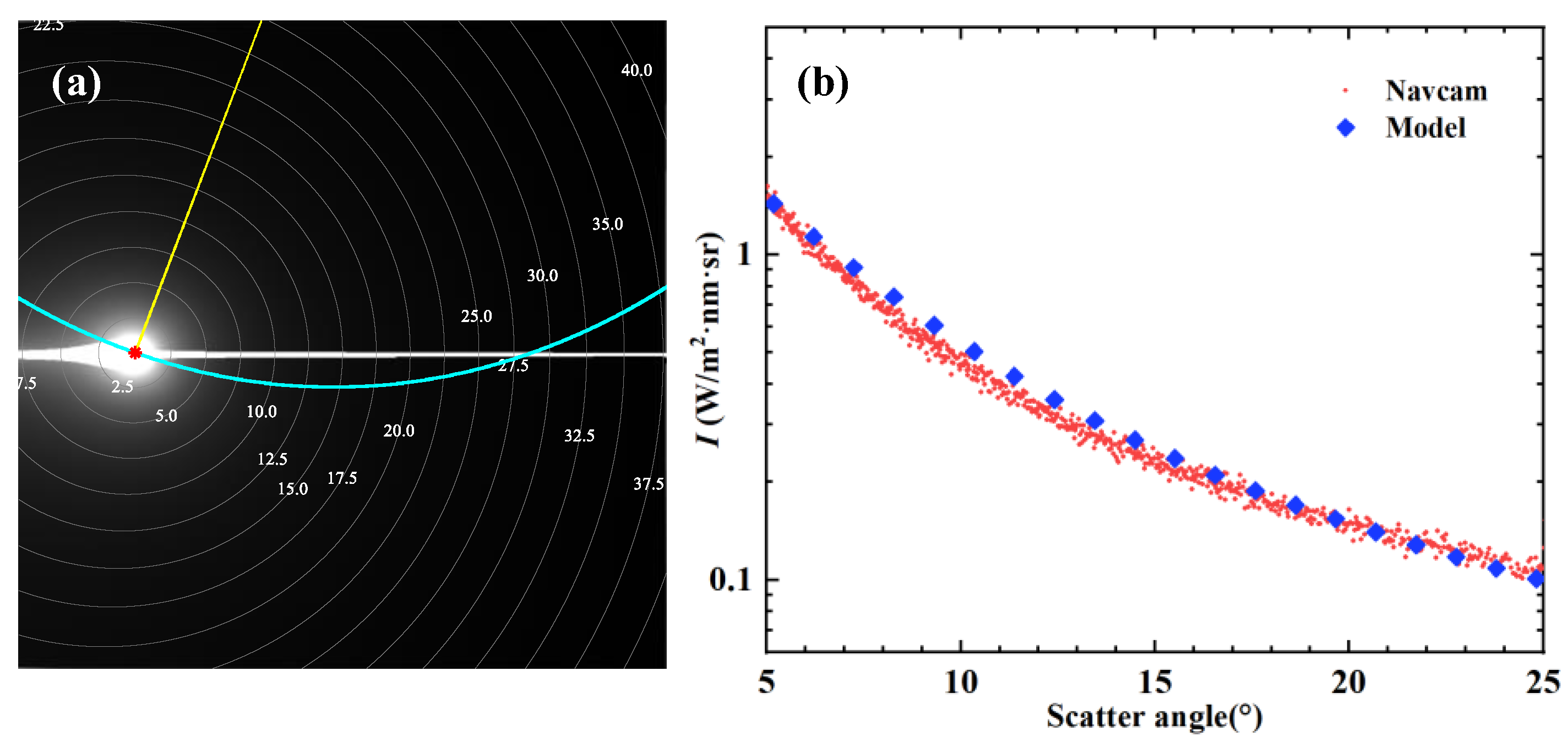
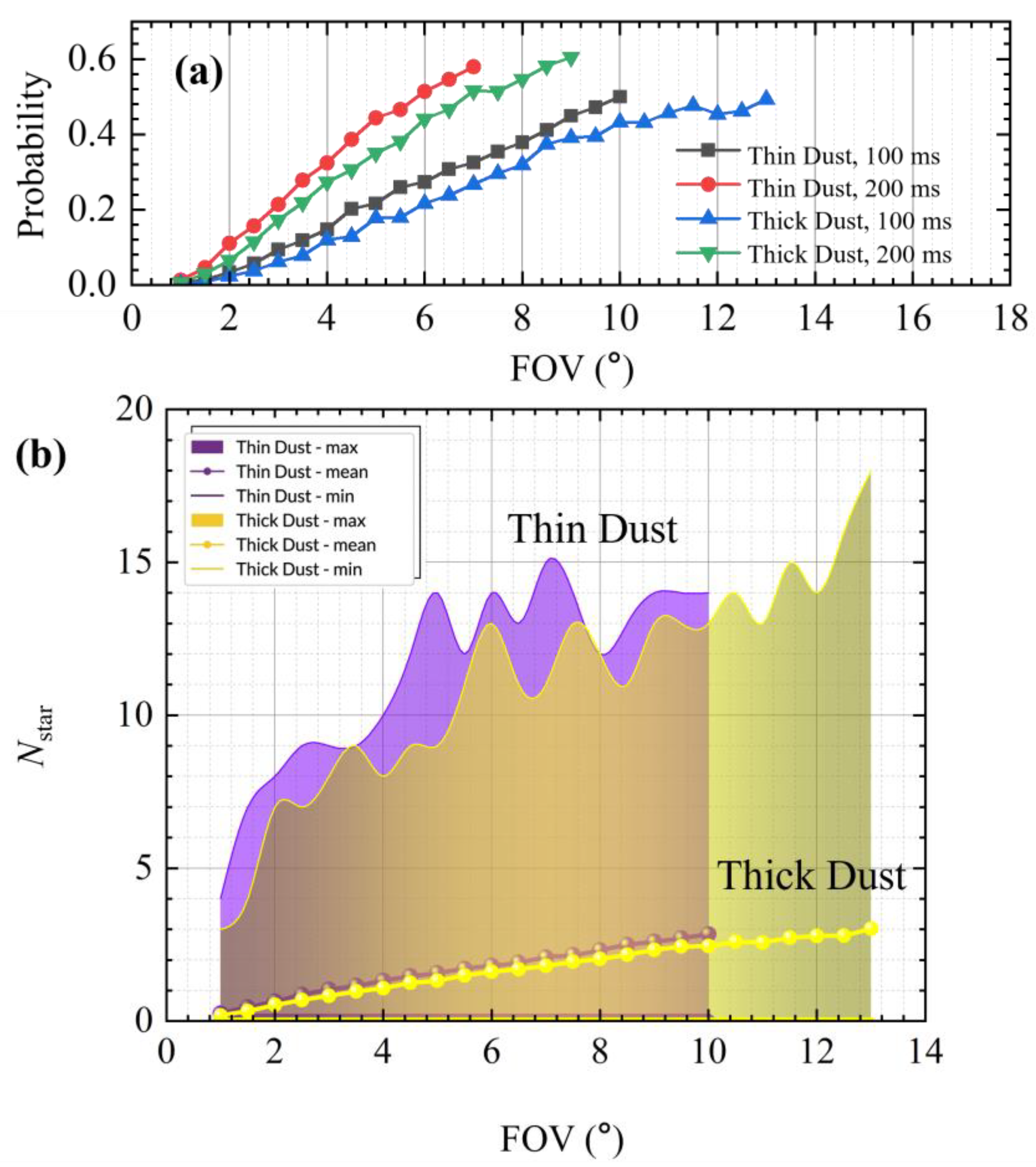
In deep-space exploration and remote sensing, characterizing radiative transfer in complex planetary atmospheres is fundamental for robust target detection and optical navigation. On the Martian surface, intense scattering and attenuation by dust aerosols pose severe environmental interference, challenging star sensors used for high-precision navigation. To address this, this study develops a spectral radiative transfer model based on the Null Collision Monte Carlo Method to characterize the optical background of the dusty Martian atmosphere. Mie scattering theory is employed for dust particles, while gas molecular absorption is modeled via line-by-line integration. The simulated sky radiance is validated against Mars rover Navcam observations, yielding an average relative error of 7.83% between the modeled and observed radiance values across scattering angles greater than 5°. Building on this, an imaging link model evaluates surface-based detection performance, including signal-to-noise ratio, detection success probability, and star count. Optical parameters—aperture, field of view, and integration time—are optimized for nighttime and dawn-dusk modes. Spatio-temporal assessments are conducted globally across Martian years, focusing on the Zhurong landing site and Tianwen-3 candidates. Finally, an Earth-environment equivalence experiment using a 60% transmittance filter verifies the design’s robustness. This work confirms the feasibility of star-sensor-based attitude determination on Mars.
Keywords: radiative transfer; Martian dust; star sensor; performance evaluation; parameter optimization; ground detection radiative transfer; Martian dust; star sensor; performance evaluation; parameter optimization; ground detection