1. Introduction
Vehicles ejecting trash onto roadways is a recurring violation in urban traffic management. The ejected objects—plastic bottles, food wrappers, cigarette butts, and other small debris—create direct safety hazards for following vehicles and motorcyclists, contribute to roadside pollution, and clog drainage systems during rain [
1]. Enforcement is difficult because the offending vehicle is moving, the object is small, and the action itself lasts only a fraction of a second. Most traffic agencies currently rely on roadside cameras with manual video review, which is labor-intensive and rarely catches violations in real time. Automating this perception stage on in-vehicle edge devices would allow potential debris-related events to be flagged and recorded in real time, without requiring constant human attention. Recent advancements in lightweight deep learning models, particularly YOLO-based architectures optimized for edge deployment, offer a promising solution for real-time, high-precision detection of such small and fast-moving waste targets [
2,
3,
4].
Early work on road-debris detection followed classical computer vision pipelines: background subtraction, color thresholding, and hand-crafted shape or texture descriptors [
5,
6]. These methods perform reasonably under fixed-camera setups with clean backgrounds, but they degrade quickly when the camera itself moves, when lighting changes, or when the target shares texture with the road surface. Deep-learning-based detectors have largely replaced these approaches. Two-stage models such as Faster R-CNN [
7] achieve strong accuracy but incur higher inference latency, while single-stage models from the YOLO family [
8,
9] trade a small accuracy margin for substantially faster predictions. For applications that must run in real time on embedded hardware, single-stage detectors are now the default choice.
Several recent works in the YOLO family have targeted small-object detection or lightweight deployment, both of which are directly relevant to vehicle-ejected debris. Liu et al. [
10] integrated dynamic snake convolution and a deformable attention mechanism into YOLOv11n for multi-target detection in river and lake environments, reporting an mAP@0.5 of 83.9%. Gao et al. [
11] replaced the C3K2 modules of YOLO11 with ShuffleNetV1 units and added SPD-Conv to preserve fine-grained features for forest fire detection, cutting parameters by 22.5% with a 0.3-point gain in mAP. For litter detection specifically, the pLitterStreet dataset [
1] provides a benchmark for static roadside litter collected from vehicle-mounted cameras, and the RoLID-11K dataset [
12] extends this to a larger collection of accumulated roadside objects. None of these works, however, addresses vehicle-ejected debris as a distinct task. The existing litter datasets focus on accumulated, weathered objects already settled on the ground, whose appearance and context differ markedly from objects in mid-flight or immediately after impact. Methods designed for those datasets do not necessarily transfer to the ejected-debris case, where the target is typically smaller, more irregular, and more often co-located with hard negatives such as fallen leaves or surface reflections. Recent studies on visual prompting and cooperative perception also provide useful references for road-scene understanding. For example, VRP-SAM introduces visual reference prompts into the Segment Anything framework to improve reference-guided segmentation, and visual in-context learning explores how reference examples can enhance visual recognition and adaptation [
13]. CoopTrack further investigates end-to-end cooperative sequential perception for dynamic scenes [
14]. These methods are relevant because they highlight the importance of reference information, temporal consistency, and cooperative perception in complex visual environments. However, they are not directly designed for lightweight single-frame debris detection on vehicle-mounted edge devices. In contrast, this study focuses on a compact detector that can be quantized to INT8 and deployed on the RDK X5 BPU for real-time vehicle-mounted debris perception. Transformer-based object detectors represent another important direction in recent object detection research. DETR formulates object detection as an end-to-end set prediction problem and introduces transformer encoder-decoder attention to model global object relationships [
15]. Subsequent studies, such as Deformable DETR, Conditional DETR, DAB-DETR, DN-DETR, and DINO, further improve convergence speed, query formulation, multi-scale feature utilization, and detection accuracy [
16]. Recent real-time transformer detectors, such as RT-DETR, also demonstrate the potential of transformer-based detection under real-time constraints [
17]. In addition, recent work on rethinking the multi-scale feature hierarchy in object detection transformers provides useful insights into how feature hierarchy design affects detection performance [
15]. These methods show strong global modeling capability and provide valuable references for multi-scale representation learning. However, they usually rely on attention-based feature interaction, transformer decoding, and more complex memory access patterns, which may increase deployment difficulty on resource-constrained INT8 edge accelerators. In contrast, this work focuses on a lightweight CNN-based detector for vehicle-mounted edge deployment. The proposed channel alignment strategy does not redesign the global feature hierarchy as in transformer-based detectors, but instead provides a simple and hardware-friendly bridge between the MobileNetV4 backbone and the YOLOv8m PANet neck to preserve multi-scale feature compatibility under INT8 deployment constraints.
Beyond task definition and related perception paradigms, a second gap concerns deployment. Most reported lightweight YOLO variants are evaluated on GPU benchmarks rather than on the embedded accelerators they are meant to serve, and quantization is often treated as an afterthought rather than as a co-design factor. For traffic-enforcement applications, however, the model must run on a vehicle-mounted edge device within a constrained power budget. Backbone choice, channel dimensioning, and operator compatibility with the target accelerator all affect the final deployed performance, and these factors are tightly coupled.
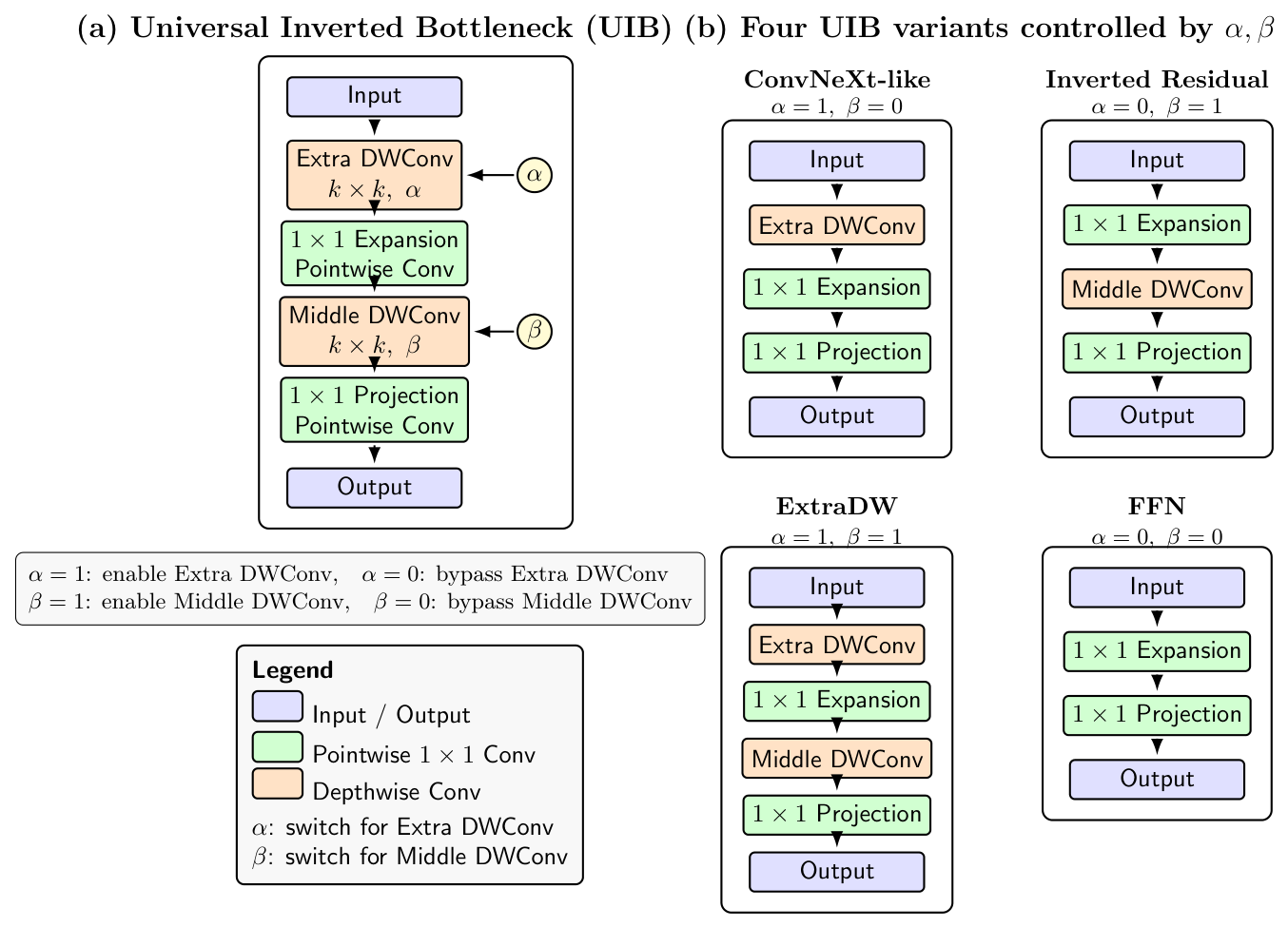
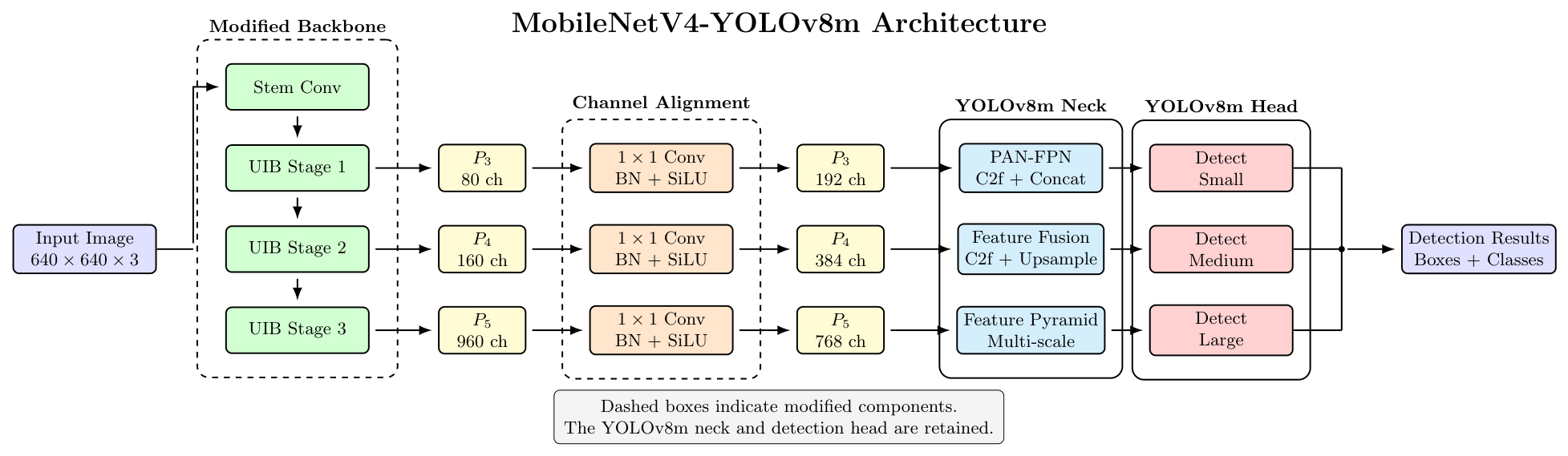
Recent lightweight YOLO variants frequently employ mobile backbones like MobileNet, ShuffleNet, or GhostNet to minimize parameters and computational costs. While effective for general object detection and embedded inference, these approaches typically view backbone replacement merely as a model compression tactic. However, detecting vehicle-ejected debris presents unique challenges: targets are often small and irregular, backgrounds contain complex hard negatives from road surfaces, and the model requires INT8 quantization for deployment on vehicle-mounted BPUs. Consequently, this work goes beyond simple backbone substitution in YOLOv8m. Instead, we integrate the convolutional variant of MobileNetV4 into the standard YOLOv8m PANet neck via scale-specific channel alignment. This design simultaneously addresses small-object multi-scale feature fusion and ensures compatibility with INT8 deployment.
This paper addresses the above gaps from a task-oriented and deployment-oriented perspective. Unlike many MobileNet-based YOLO variants that mainly focus on reducing model size on general detection benchmarks [
18], the proposed framework is designed for vehicle-mounted debris detection, where targets are typically small, irregular, transient, and easily confused with road surface interference. In this setting, simply replacing the YOLOv8m backbone with a lightweight network may reduce computation but can also disturb the multi-scale feature structure required by the PANet neck. Therefore, we propose a hardware-aware MobileNetV4-YOLOv8m integration strategy. The convolutional variant of MobileNetV4 [
19] is adopted to reduce feature-extraction cost and improve INT8 operator compatibility, while a scale-specific Channel Alignment Module is used to bridge the channel mismatch between MobileNetV4 and the YOLOv8m PANet neck. The module is intentionally kept lightweight and convolution-based so that it can preserve multi-scale feature compatibility without introducing attention-based or transformer-style operators that may be less suitable for BPU deployment [
20]. The trained FP32 model is then quantized to INT8 and deployed on the RDK X5 BPU through the Horizon OpenExplorer toolkit, leveraging post-training quantization techniques that are proven essential for maximizing inference efficiency on resource-constrained neural processing units [
21].
The main contributions of this work are summarized as follows:
A rare vehicle-ejected debris dataset containing 4328 annotated image samples was collected from real vehicle-mounted road videos. The dataset covers different illumination conditions, road types, debris appearances, and typical road-surface interference. Hard negative samples, including fallen leaves, water reflections, and lane-marking fragments, were retained to improve the discriminative capability of the detector.
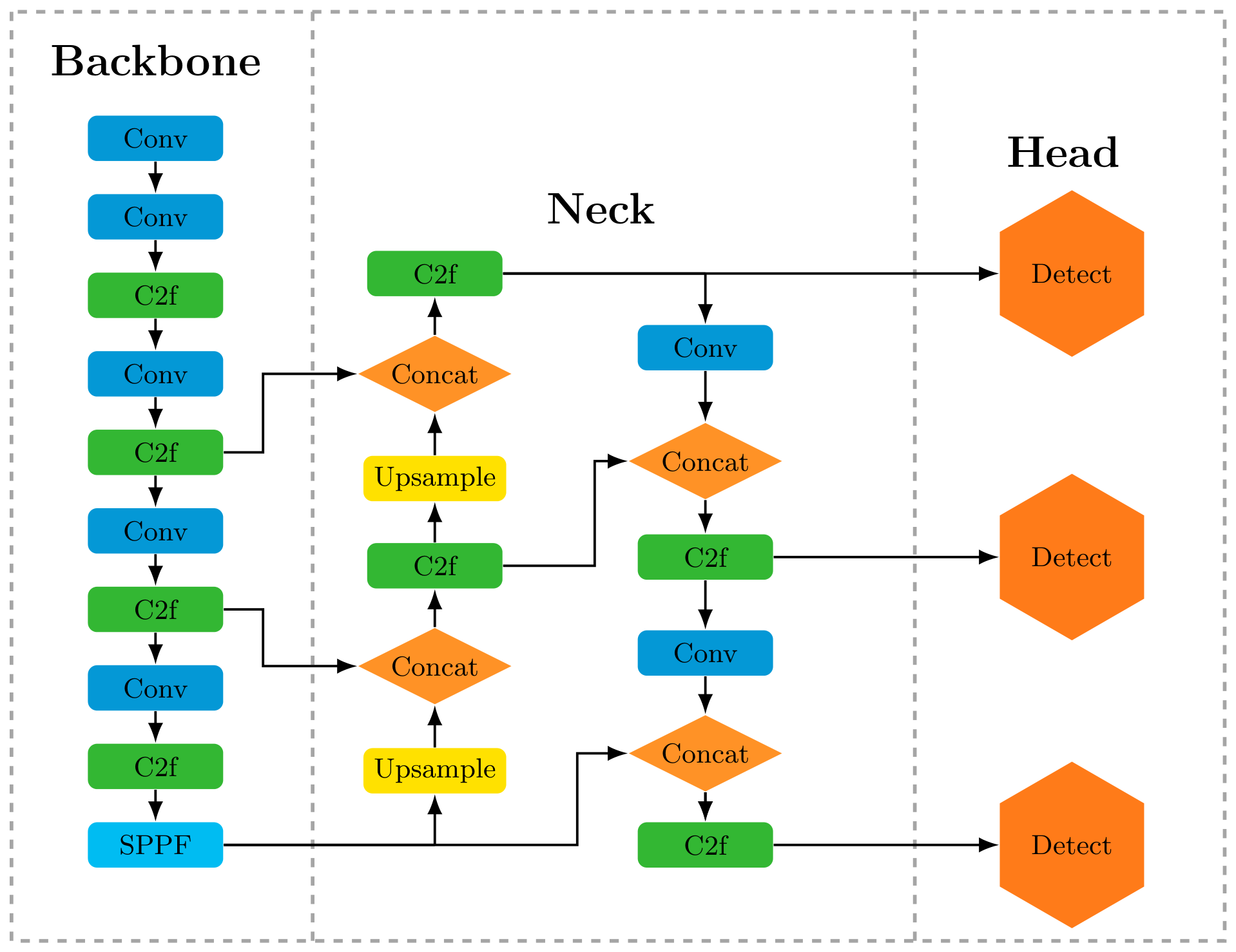
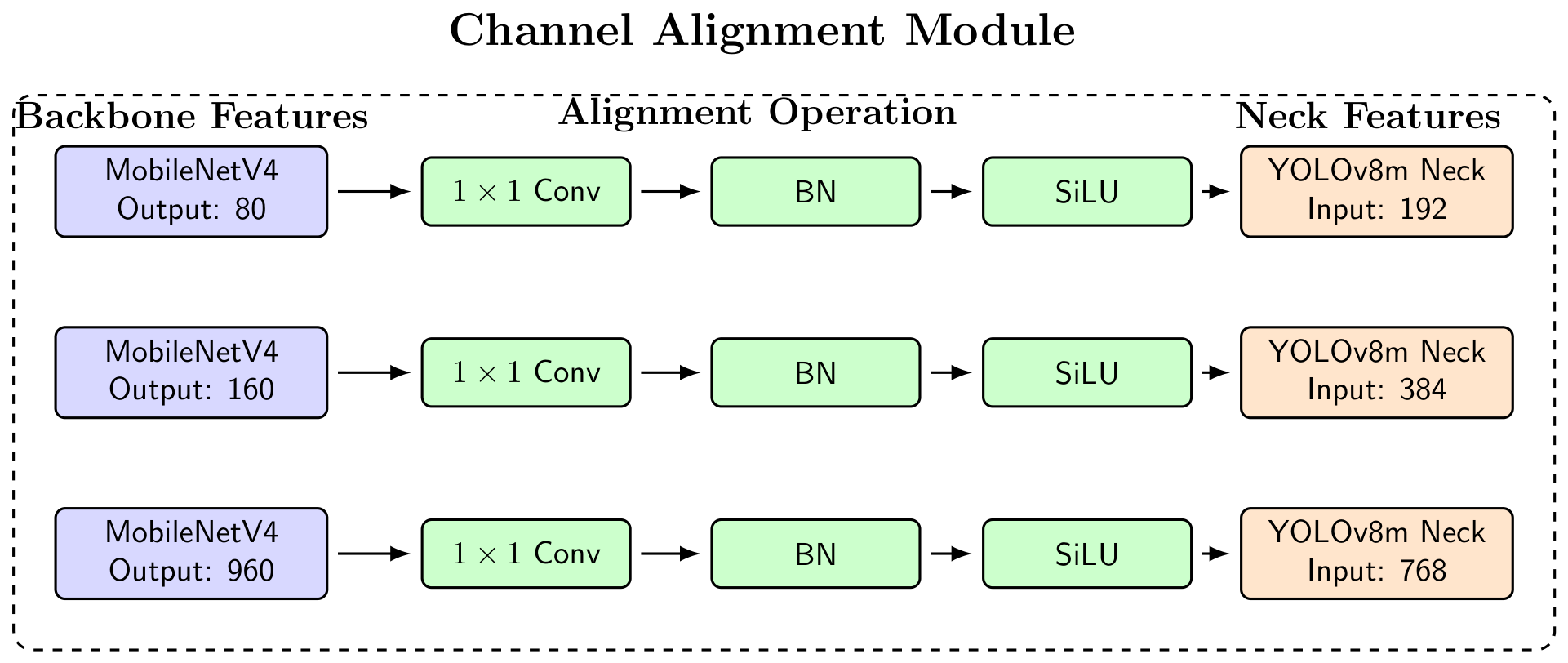
A deployment-oriented MobileNetV4-YOLOv8m integration framework is designed for vehicle-mounted edge sensing. Different from conventional backbone-replacement strategies that mainly pursue model compression, the proposed framework jointly considers small-object feature preservation, heterogeneous feature-channel compatibility, and INT8-friendly BPU deployment. A scale-specific Channel Alignment Module is introduced to project the P3, P4, and P5 outputs of MobileNetV4 into the channel dimensions required by the YOLOv8m PANet neck, enabling the original neck and decoupled detection head to be retained with minimal additional computational cost.
A complete edge deployment pipeline is implemented on the RDK X5 platform. The trained FP32 model is exported to ONNX, quantized to INT8, calibrated, and compiled into a BPU-executable model using the Horizon OpenExplorer toolkit. Experimental results show that the deployed model achieves 112.6 FPS on the RDK X5 BPU with only a small accuracy drop, demonstrating its feasibility for real-time vehicle-mounted traffic enforcement.
The remainder of this paper is organized as follows.
Section 2 describes the proposed network architecture, including the MobileNetV4 backbone, the Channel Alignment Module, and the INT8 deployment pipeline.
Section 3 presents the dataset construction, experimental setup, ablation study, comparison with representative detectors, and qualitative visualization.
Section 4 concludes the paper and outlines limitations and future work.
3. Experiments and Results
3.1. Dataset Construction
An experimental dataset was prepared to evaluate the proposed model under vehicle-mounted road-scene conditions. The dataset was built from 42 real road videos collected by vehicle-mounted cameras (Yahboom Technology Co., Ltd., Shenzhen, China) and supplemented with data augmentation to improve scene diversity. The source videos were recorded under real driving conditions, with a total acquisition duration of approximately 90 min. The original videos were captured from a front-view vehicle-mounted camera at a resolution of 1920 × 1080 and a frame rate of 30 FPS. The recording scenes include urban roads, suburban roads, intersections, straight road segments, and low-light road environments. The original frames include road scenes containing vehicle-ejected debris as well as visually similar interference objects, such as fallen leaves, lane-marking fragments, water reflections, tire marks, and small roadside objects. The data acquisition and annotation settings are summarized in
Table 2.
After frame extraction, manual filtering, annotation, and data augmentation, a total of 4328 image samples were prepared for model training and evaluation. The target objects include plastic bags, paper boxes, beverage bottles, food wrappers, and other irregular debris visible on or near the road surface. Since the main objective of this work is to identify debris-ejection events for traffic enforcement rather than to perform fine-grained waste classification, all debris types were merged into a single class, denoted as “throwing debris”. Although this single-class setting is sufficient for detecting violation-related debris events, different debris appearances may indeed lead to different levels of detection difficulty. For example, deformable objects such as plastic bags or food wrappers may be more easily confused with road reflections or lane-marking fragments, while rigid objects such as bottles and boxes usually have clearer boundaries. Since fine-grained debris-type annotation requires substantially more data collection and labeling effort, category-level analysis is left as an important direction for the next stage of this work, where a larger and more diverse dataset will be constructed to support debris-type-specific evaluation.
The annotation protocol was defined as follows. All visible debris objects on or near the road surface were annotated using tight bounding boxes in YOLO format. For partially occluded objects, only the visible region was annotated. Objects with severe motion blur, extreme occlusion, or unclear boundaries were excluded from the final dataset to avoid ambiguous labels. Hard negative samples, such as fallen leaves, lane-marking fragments, water reflections, tire marks, and small roadside objects, were retained without debris labels to encourage the detector to distinguish true ejected debris from visually similar road-surface interference.
To ensure annotation quality, the initial annotations were manually checked after labeling. Images with missing labels, inaccurate bounding boxes, or ambiguous object boundaries were corrected through a secondary review. In addition, a subset of the annotated images was randomly inspected to further reduce labeling errors. This quality-control process was used to improve annotation consistency before the dataset was divided into training, validation, and test subsets.
To improve robustness under different sensing conditions, augmentation operations such as brightness adjustment, contrast variation, scaling, horizontal flipping, slight blur simulation, and noise perturbation were applied. These operations were used to simulate common variations in vehicle-mounted perception, including illumination changes, camera motion, and low-contrast road backgrounds.
The dataset was split into training, validation, and test sets with a 7:2:1 ratio. To mitigate information leakage from highly similar consecutive frames, all samples from the same video segment were kept within the same subset. The split details are summarized in
Table 3.
Due to privacy concerns involving vehicle-mounted road videos—such as license plates, geographic locations, surrounding vehicles, and pedestrians—the complete raw videos and the full dataset are not publicly available at this stage. However, the dataset, annotation files, and split information can be obtained from the corresponding author upon reasonable request for research purposes, subject to applicable privacy and data-use restrictions.
Since the scale distribution of targets has a direct effect on detector design, the bounding box area of annotated instances was further analyzed. Following the COCO definition, objects with an area smaller than
pixels are categorized as small, those with an area between
and
pixels are categorized as medium, and those with an area larger than
pixels are categorized as large. The results are reported in
Table 4. Small objects account for the majority of annotated instances, indicating that vehicle-ejected debris detection is dominated by small-target localization under typical vehicle-mounted camera geometry.
3.2. Experimental Environment
All training and evaluation experiments were performed under identical hardware and software configurations to ensure a fair comparison. The codebase is built on the Ultralytics YOLOv8 framework with PyTorch (PyTorch v2.8.0 (Meta AI, Menlo Park, CA, USA)) as the backend. Input images are uniformly resized to , and identical data augmentation pipelines are applied across all compared models unless otherwise specified.
Edge deployment was carried out on the RDK X5 platform, which integrates a 10 TOPS INT8 BPU accelerator. The trained FP32 model was first exported to ONNX, then quantized and compiled into a BPU-executable model using the Horizon OpenExplorer toolkit. During edge-side testing, a 2-megapixel high-definition camera was used as the visual input device to capture road-scene video frames. The captured frames were resized to the same input resolution as the training and evaluation setting, namely , and were processed directly on the RDK X5 platform. The deployed INT8 model performed debris-ejection recognition on the BPU with a batch size of 1 to simulate real-time vehicle-mounted inference.
The reported INT8 model FPS was measured on the target RDK X5 platform after model loading and warm-up. Note that FP32 FPS values for comparison were obtained on a training workstation, whereas INT8 FPS was measured on the RDK X5 BPU. Thus, the INT8 deployment results evaluate the real-time feasibility of the proposed model on the target edge accelerator, rather than providing a direct cross-platform speed comparison with FP32 workstation results. The full experimental environment is detailed in
Table 5.
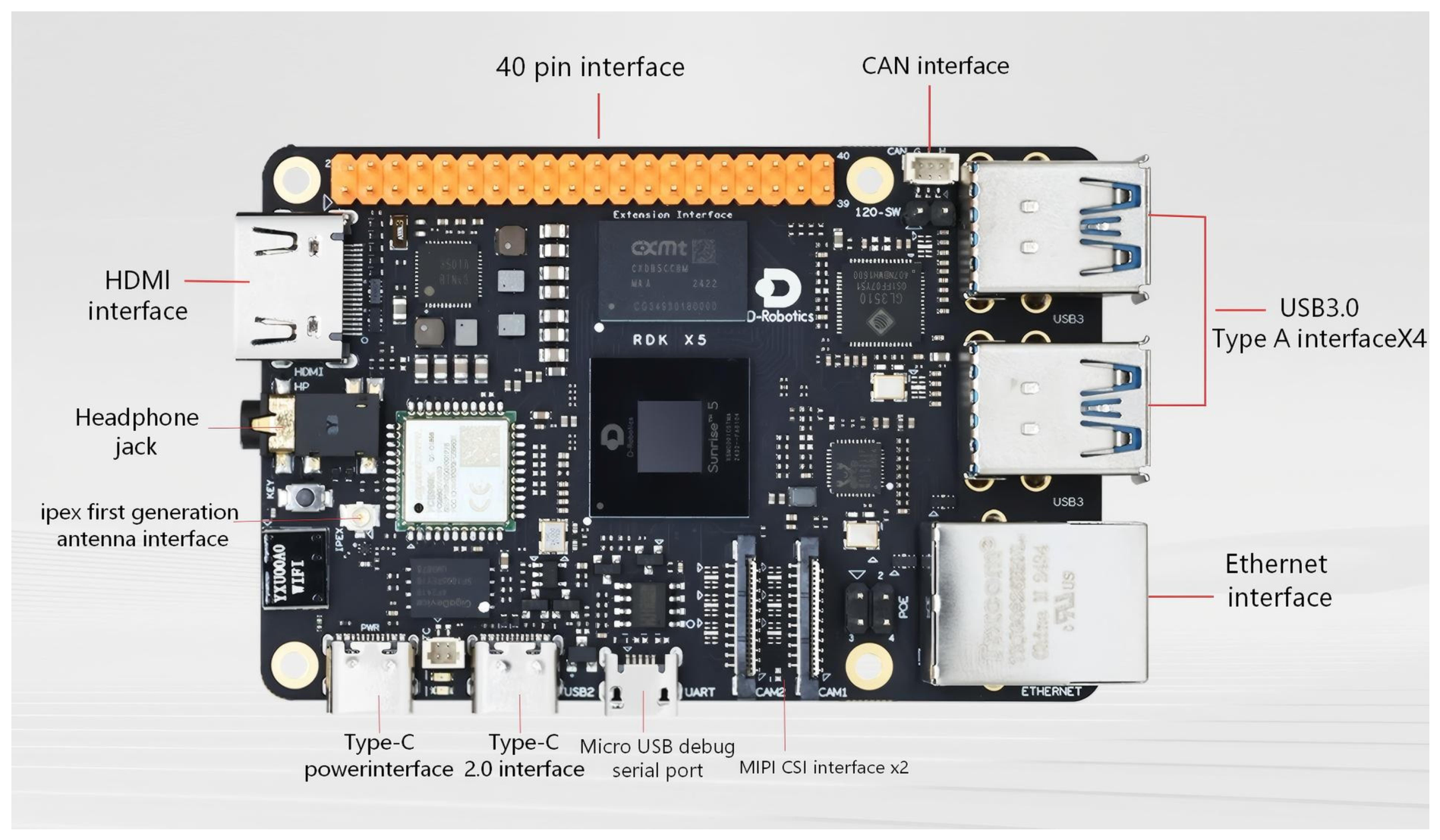
For edge-side deployment, the RDK X5 development board was adopted as the target hardware platform. As shown in
Figure 6, the board provides multiple peripheral interfaces, including USB 3.0 Type-A ports, an Ethernet interface, Type-C power input, MIPI CSI camera interfaces, a CAN interface, and a 40-pin expansion interface. These hardware interfaces support camera input, external communication, and real-time vehicle-mounted sensing, while the onboard BPU enables INT8 acceleration for the proposed lightweight detection model.
The training hyperparameters are summarized in
Table 6. The baseline YOLOv8m and all variants of the proposed model were trained under identical settings to ensure that performance differences mainly resulted from architectural changes rather than hyperparameter tuning.
Loss weights followed the official YOLOv8 defaults and were not tuned, in order to isolate the effect of architectural changes from hyperparameter optimization. The MobileNetV4 backbone was initialized with ImageNet-pretrained weights from the timm library; the Channel Alignment Module and the YOLOv8m neck and head were trained from scratch.
For reproducibility, the dataset split files were fixed after the initial partition and were kept unchanged for all experiments. Unless otherwise specified, the representative training results were obtained using a fixed random seed of 42. To evaluate the robustness of the reported performance against training randomness, repeated experiments were additionally conducted for the YOLOv8m baseline and the proposed MobileNetV4-YOLOv8m model using five random seeds: 0, 1, 42, 2024, and 2026. In these repeated runs, the dataset split, input resolution, training epochs, batch size, optimizer, learning rate, data augmentation strategy, and loss weights were kept unchanged. Only the random seed controlling weight initialization, data shuffling, and stochastic augmentation was varied. During validation, all compared models followed the same non-maximum suppression setting, with an IoU threshold of 0.7 and the default validation confidence threshold of the Ultralytics framework. The results are reported as the mean and standard deviation over repeated runs.
3.3. Evaluation Metrics
Both accuracy and efficiency metrics were used to evaluate model performance. For accuracy, we report precision (P), recall , , and . For efficiency, we report parameter count, GFLOPs, and inference speed in frames per second (FPS).
Precision and recall are defined as:
where
,
, and
denote true positives, false positives, and false negatives, respectively.
Average Precision
is the area under the precision–recall curve, and mean Average Precision
is the mean of AP values across all categories:
where
N is the number of categories. Since this work formulates the task as a single-class detection problem,
, and the AP for the single class is equivalent to
. We report
(IoU threshold = 0.5) for overall detection quality and
(averaged over IoU thresholds from 0.5 to 0.95 with a step of 0.05) for localization precision.
Frames per second is computed as:
where
is the average per-image inference time, measured over the test set under batch size 1 to reflect realistic deployment latency.
To evaluate whether the reported performance difference is robust to training randomness, repeated-seed experiments were further conducted. For these experiments, the dataset split, input resolution, training epochs, batch size, optimizer, learning rate, data augmentation strategy, and loss weights were kept unchanged, while only the random seed was varied. The random seed affects weight initialization, data shuffling, and stochastic data augmentation. For each model, the results are reported as the mean and standard deviation over repeated runs.
For a metric value
obtained from the
j-th run, the mean and standard deviation are calculated as:
where
n denotes the number of repeated runs. The 95% confidence interval of mAP50 is estimated using Student’s
t-distribution:
This statistical reporting is used to assess the stability of the observed performance difference under different training seeds.
3.4. Ablation Study
To evaluate the contribution of each architectural component, an ablation study was first conducted by progressively modifying the YOLOv8m baseline. In addition to the component-wise ablation, three supplementary analyses were performed under the same experimental protocol. Specifically, repeated-seed experiments were conducted to assess the robustness of the observed performance difference to training randomness; different channel adaptation strategies were compared to examine the effectiveness of the proposed Channel Alignment Module (CAM); and several representative lightweight backbones were evaluated to justify the selection of MobileNetV4-conv-medium.
As shown in
Table 7, replacing the original CSPDarknet backbone with MobileNetV4 substantially reduces the model complexity. The number of parameters decreases from 25.9 M to 12.8 M, while the inference speed increases from 42.3 FPS to 72.5 FPS. It should be noted that the “MobileNetV4 backbone + minimal neck-channel adjustment (no CAM)” setting does not mean that the MobileNetV4 features are directly connected to the original YOLOv8m neck without any dimensional modification. Since the output channels of MobileNetV4 at P3, P4, and P5 are different from the input channels expected by the original YOLOv8m PANet neck, this variant was implemented by only adjusting the input-channel dimensions of the corresponding neck layers to make the network runnable. No additional scale-specific Channel Alignment Module, batch normalization, or nonlinear activation was inserted between the backbone and the neck in this setting. Therefore, this variant serves as a minimal runnable baseline for evaluating whether the proposed CAM provides benefits beyond simple architectural compatibility.
Although this minimal adjustment improves computational efficiency, it also leads to a noticeable accuracy degradation, with decreasing from 92.5% to 90.1% and decreasing from 58.1% to 55.2%. This result suggests that simple channel compatibility alone is insufficient to preserve the multi-scale feature representation required by the PANet neck, thereby reducing feature-fusion and localization performance.
After introducing CAM, the proposed MobileNetV4-YOLOv8m model achieves 93.1%
and 58.9%
in the representative run, corresponding to improvements of 0.6 and 0.8 percentage points over the YOLOv8m baseline, respectively. Since the absolute improvement in
is relatively moderate, repeated-seed experiments were further conducted to evaluate whether the observed performance difference remains stable under training randomness. The results are summarized in
Table 8.
As shown in
Table 8, the proposed MobileNetV4-YOLOv8m model maintains a consistent advantage over the YOLOv8m baseline across different random seeds. The mean
increases from
to
, while the mean
increases from
to
. The 95% confidence intervals of
further indicate that the observed improvement is not attributable to a single favorable training run. More importantly, this accuracy level is achieved with a substantially lower computational burden, reducing the parameter count from 25.9 M to 13.1 M and the computational cost from 78.9 GFLOPs to 39.6 GFLOPs. Therefore, the advantage of the proposed framework should be interpreted primarily as an improved accuracy–efficiency trade-off rather than as a large absolute accuracy gain.
After INT8 quantization and deployment on the RDK X5 BPU, the proposed model reaches 112.6 FPS, with only a 0.9-point decrease in compared with its FP32 counterpart. This result indicates that the proposed architecture remains effective after quantization and is suitable for real-time edge inference.
To further examine the role of CAM, several channel adaptation strategies were compared, as summarized in
Table 9. The channel padding/cropping strategy adjusts feature dimensions by zero-padding insufficient channels and truncating excessive channels. Although this operation introduces almost no additional parameters, it lacks learnable feature transformation and may discard useful information. Consequently, its improvement over the minimal channel matching setting is limited.
Compared with padding/cropping, the plain convolution introduces a learnable projection between the MobileNetV4 backbone and the YOLOv8m neck, leading to improved detection performance. Nevertheless, its performance remains lower than that of the proposed CAM. Specifically, CAM improves from 91.8% to 93.1% and from 57.1% to 58.9%, with only a minor increase in parameters and computational cost. This improvement can be attributed to the scale-specific design of CAM, where independent alignment branches are applied to P3, P4, and P5 feature maps, followed by batch normalization and SiLU activation. Therefore, CAM serves not only as a channel-matching operation, but also as a lightweight nonlinear feature adapter between the MobileNetV4 backbone and the YOLOv8m PANet neck.
To further analyze the internal design of CAM, an additional ablation study was conducted by progressively enabling batch normalization, SiLU activation, scale-specific mapping, and different feature scales. The purpose of this experiment is to examine whether the performance gain of CAM comes only from the
convolution, or from the combined effect of normalization, nonlinear activation, and scale-specific feature adaptation. The results are summarized in
Table 10.
As shown in
Table 10, the plain
convolution achieves 91.8%
and 57.1%
, indicating that a learnable channel projection is more effective than simple channel padding or cropping. However, its performance is still lower than that of the full CAM, suggesting that channel projection alone is insufficient to fully adapt the MobileNetV4 features to the YOLOv8m PANet neck. After adding batch normalization,
increases from 91.8% to 92.2%, and
increases from 57.1% to 57.6%. This improvement indicates that BN helps stabilize the channel responses before multi-scale feature fusion. When SiLU activation is further introduced, the performance improves to 92.6%
and 58.0%
, showing that nonlinear feature transformation is also beneficial for feature adaptation.
The scale-related ablation further demonstrates the importance of scale-specific mapping. The non-scale-specific mapping strategy obtains 92.4% and 57.8% , which is lower than the full scale-specific CAM. This result suggests that using the same mapping strategy for P3, P4, and P5 is not optimal, because different feature levels contain different spatial resolutions and semantic information. Among the single-scale variants, P3 alignment achieves the best performance, with 92.5% and 57.9% , while P4-only and P5-only alignment obtain 92.0% and 91.9% , respectively. This indicates that the high-resolution P3 feature map contributes more strongly to small debris localization, whereas P4 and P5 provide complementary middle-level and high-level semantic cues. By jointly aligning P3, P4, and P5 with independent branches, the full CAM achieves the best overall performance, reaching 93.1% and 58.9% . Therefore, the proposed CAM is not simply a plain convolution, but a scale-specific lightweight feature adaptation module that combines learnable projection, normalization, nonlinear activation, and multi-scale feature alignment.
From the perspective of intermediate feature distribution, using only minimal neck-channel adjustment mainly solves the tensor-size compatibility problem, but it does not sufficiently adapt the feature statistics and semantic density of different scales. This mismatch is particularly important for vehicle-ejected debris detection because small debris targets rely heavily on the high-resolution P3 feature map, while road textures, lane markings, shadows, and reflections may introduce strong background interference. The proposed CAM applies independent learnable projections to P3, P4, and P5, and uses batch normalization and SiLU activation to normalize and nonlinearly transform the feature responses before PANet fusion. As a result, the aligned features are more compatible with the feature space expected by the YOLOv8m neck, which helps preserve small-object localization cues while reducing the negative effect of mismatched multi-scale feature distributions. This explains why CAM outperforms direct channel matching, padding/cropping, and plain channel adaptation in
Table 9.
Finally, different lightweight backbones were compared under the same YOLOv8m neck and decoupled detection head to justify the selection of MobileNetV4-conv-medium. For a fair comparison, all lightweight backbones were equipped with CAM to align their multi-scale output features with the PANet neck. The dataset split, input resolution, training configuration, and evaluation metrics were kept identical across all compared models.
As shown in
Table 11, all lightweight backbones reduce the parameter count and improve inference speed compared with the original CSPDarknet-based YOLOv8m baseline. ShuffleNetV2 achieves the highest inference speed among the evaluated lightweight backbones, but its
and
are clearly lower, suggesting that excessive lightweighting may weaken the feature representation required for small and irregular debris targets. GhostNet provides a better balance between compactness and accuracy than ShuffleNetV2, while MobileNetV3-Large further improves detection accuracy.
Among the evaluated lightweight backbones, MobileNetV4-conv-medium obtains the highest of 93.1% and the highest of 58.9%, while reducing the parameter count by nearly half compared with the YOLOv8m baseline. Although it is not the fastest lightweight backbone, it provides the most favorable balance between detection accuracy and computational efficiency in this task. Based on these results, MobileNetV4-conv-medium is selected as the backbone of the proposed framework.
3.5. Comparison with Existing Methods
To further evaluate the effectiveness of the proposed method, we compared it with several representative object detection models, including a two-stage detector, conventional YOLO-series detectors, and recent lightweight real-time detectors. In addition to Faster R-CNN and YOLOv8 variants, YOLOv10s and YOLOv11s/m were included because they represent recent accuracy–efficiency-oriented detectors that are commonly considered for real-time and edge-side object detection. All models were trained and evaluated on the same dataset split with the same input resolution and comparable training settings where applicable. The comparison focuses on practical real-time detectors rather than exhaustively covering all possible object detection paradigms. The comparison results are summarized in
Table 12.
As shown in
Table 12, the proposed MobileNetV4-YOLOv8m achieves competitive detection accuracy among the compared FP32 models, with a representative
of 93.1% and
of 58.9%. Compared with the original YOLOv8m baseline, the proposed model increases
by 0.6 percentage points and
by 0.8 percentage points in the representative run, while reducing the parameter count from 25.9 M to 13.1 M and GFLOPs from 78.9 to 39.6. In addition, the repeated-seed analysis in
Table 8 indicates that this performance difference remains stable under different training seeds. Therefore, the advantage of the proposed model should be interpreted primarily as a more favorable accuracy–efficiency trade-off, rather than as a large absolute accuracy improvement.
Compared with recent lightweight and edge-oriented real-time detectors, such as YOLOv8s, YOLOv10s, YOLOv11s, LEAD-YOLO, and YOLO-TS, the proposed model maintains higher detection accuracy with moderate model complexity. For example, YOLOv10s achieves 91.9% and 57.1% with 8.0 M parameters and 24.5 GFLOPs, while YOLOv11s achieves 91.6% and 56.9% with 9.4 M parameters and 21.5 GFLOPs. LEAD-YOLO obtains 92.1% and 57.4% with 7.9 M parameters and 26.1 GFLOPs, showing good lightweight characteristics and real-time performance. YOLO-TS further improves the accuracy to 92.4% and 57.7% with 10.8 M parameters and 33.5 GFLOPs. Although these lightweight models are more compact or computationally efficient, their detection accuracy is still lower than that of the proposed MobileNetV4-YOLOv8m on the constructed dataset.
YOLOv11m obtains a closer result, with 92.8% and 58.3% , but it requires 20.1 M parameters and 68.0 GFLOPs. In contrast, the proposed MobileNetV4-YOLOv8m achieves higher and while using fewer parameters and substantially lower computational cost than YOLOv11m. This suggests that simply adopting a compact general-purpose detector may not provide the most suitable balance for vehicle-ejected debris detection, where small and irregular road-surface targets require both efficient feature extraction and effective multi-scale feature adaptation.
The INT8 version of the proposed model further evaluates the feasibility of edge-side deployment. After quantization and deployment on the RDK X5 BPU, MobileNetV4-YOLOv8m-INT8 achieves 112.6 FPS while maintaining 92.2% . Compared with its FP32 counterpart, the quantized model shows only a 0.9-point decrease in , indicating that the proposed architecture remains robust after INT8 quantization. Since the FP32 and INT8 FPS values are measured on different hardware platforms, the INT8 result is not used for direct speed ranking with the workstation-based FP32 models, but is reported separately as the deployment performance of the proposed model on the target RDK X5 BPU. Therefore, this result mainly demonstrates the real-time feasibility of the proposed framework on the target edge accelerator, rather than serving as a complete same-hardware INT8 benchmark against all baseline detectors.
Overall, although the comparison does not exhaust all possible object detection frameworks, it covers representative accuracy-oriented, lightweight, and real-time edge-oriented detectors under a unified dataset and training protocol. The comparison indicates that the proposed MobileNetV4-YOLOv8m framework is not merely a smaller version of YOLOv8m. By combining a MobileNetV4 backbone, scale-specific channel alignment, and INT8-oriented edge deployment, the proposed framework provides a practical accuracy–efficiency trade-off for vehicle-ejected debris detection under vehicle-mounted edge-computing constraints.
3.6. Visualization Analysis
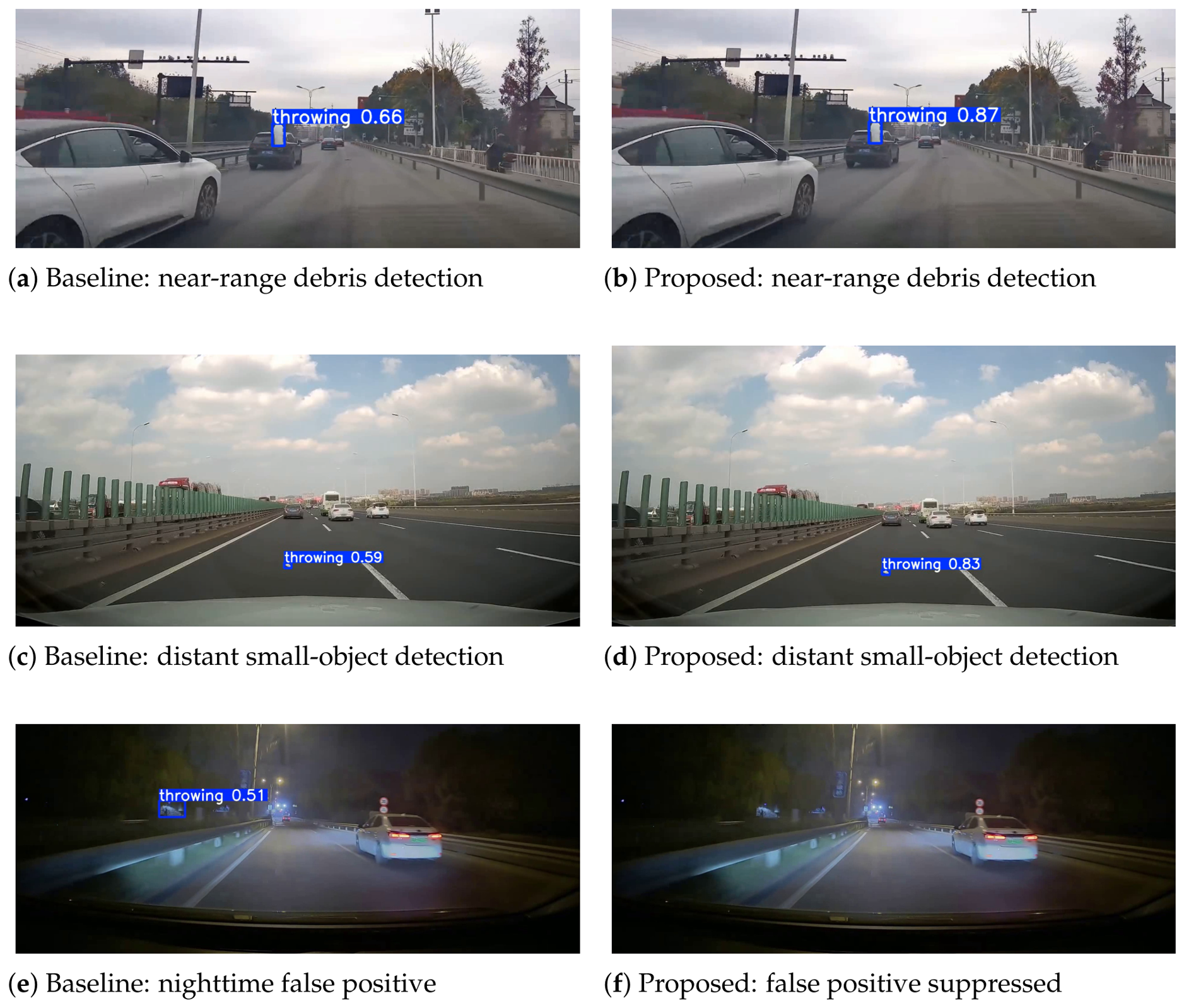
To further evaluate the practical detection behavior of the proposed model, qualitative visualization results are provided in this section. The selected samples are taken from the test set and cover three representative scenarios: near-range debris detection, distant small-object detection, and nighttime reflective-interference detection. For each scenario, the prediction result of the YOLOv8m baseline is shown on the left, while the result of the proposed MobileNetV4-YOLOv8m model is shown on the right.
As shown in
Figure 7, the proposed model maintains stable detection performance under different target distances and illumination conditions. In the near-range debris detection case, both models can localize the target, which indicates that replacing the original backbone with MobileNetV4 does not weaken the basic detection capability of YOLOv8m. In the distant small-object case, the target occupies only a limited region of the road surface, while the proposed model produces a higher-confidence prediction than the baseline. This suggests that the channel alignment module helps preserve useful multi-scale features for small debris detection.
In the nighttime reflective-interference case, the baseline model generates a false positive due to strong reflection and low-light background interference. In contrast, the proposed model suppresses this false detection, showing better robustness under challenging illumination conditions. These qualitative results are consistent with the quantitative results in the ablation study, demonstrating that the proposed MobileNetV4-YOLOv8m model improves detection stability while reducing model complexity.
Several failure modes remain under challenging vehicle-mounted sensing conditions. First, missed detections may occur when debris objects are extremely small, especially when the target occupies only a few pixels after resizing to . Second, low-contrast scenes may reduce the separability between debris and asphalt, particularly under nighttime illumination, shadowed regions, or dark road surfaces. Third, strong specular reflections on wet asphalt or bright lane markings may form local high-response regions that resemble small debris, leading to occasional false positives. These observations indicate that the proposed model is effective under common vehicle-mounted road scenes, but its robustness can still be affected by extremely small target scale, weak object-background contrast, and reflection-induced hard negatives. Addressing these cases will require a larger number of difficult samples and more diverse road-scene data, which will be further investigated in the next stage of this work.
3.7. RDK X5 Deployment Results
To verify the practical feasibility of the proposed framework, the INT8-quantized MobileNetV4-YOLOv8m model was deployed on the RDK X5 edge computing platform for real-time vehicle-mounted inference. A 2-megapixel high-definition camera was used as the visual input device to capture road-scene video frames. The captured frames were resized to 640 × 640 and then fed into the BPU for debris-ejection detection. The deployment pipeline included camera acquisition, image pre-processing, BPU inference, post-processing with non-maximum suppression (NMS), and result visualization.
As shown in
Table 13, the proposed INT8 model achieves an average inference speed of 112.6 FPS on the RDK X5 BPU, corresponding to an average BPU inference latency of approximately 8.9 ms per frame. This result indicates that the proposed model satisfies the real-time requirement of vehicle-mounted edge perception. Compared with the FP32 model evaluated on the training workstation, the INT8 model further improves inference throughput while maintaining a limited accuracy degradation, as reported in
Table 7. Therefore, the proposed model is not only lightweight in terms of parameters and computational cost, but also practically deployable on an embedded edge accelerator.
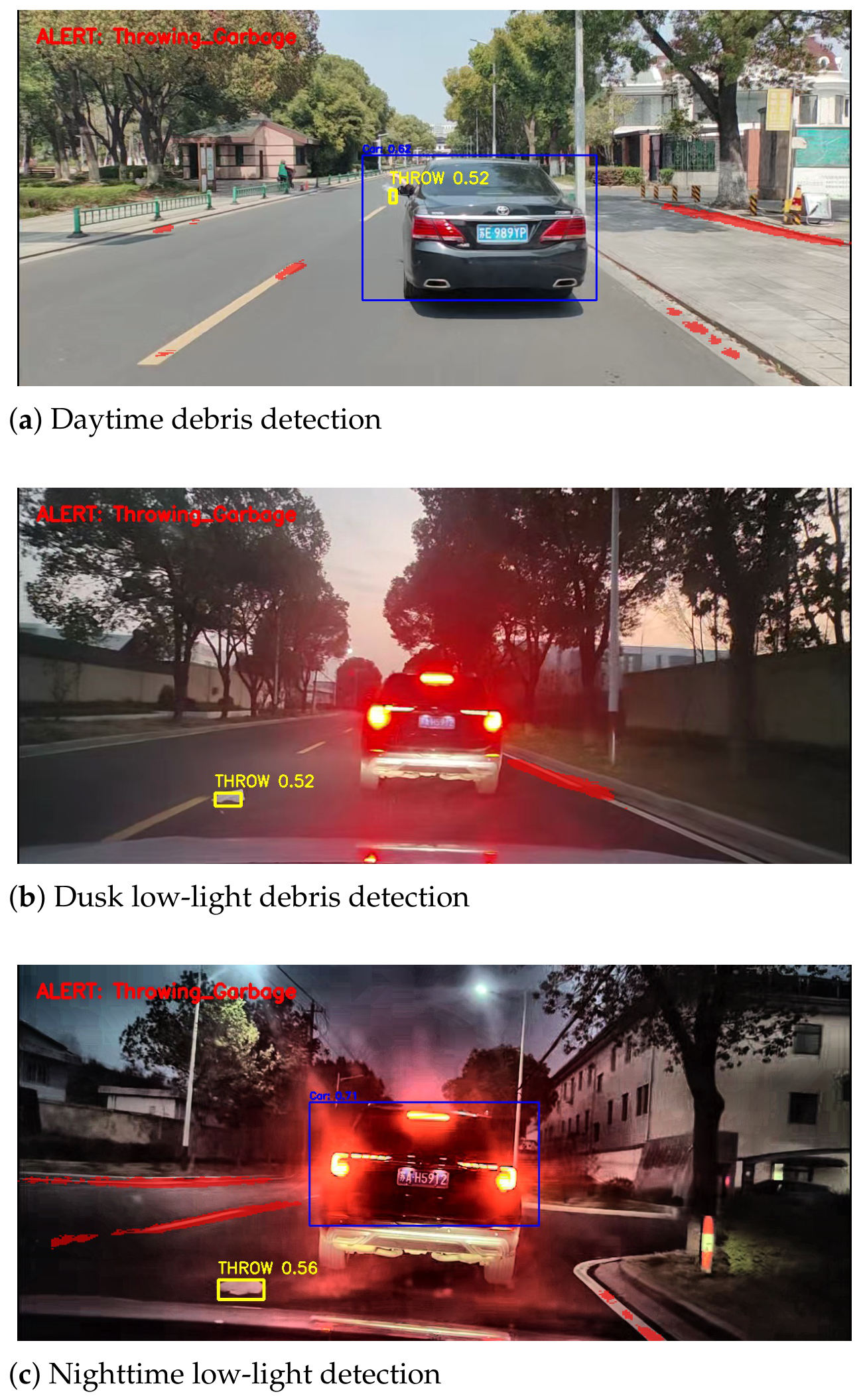
In addition to quantitative runtime evaluation, real-world recognition results were collected under different illumination conditions, including daytime, dusk low-light, and nighttime scenarios. Unlike the offline comparison in
Figure 7, this experiment focuses on the recognition results generated directly by the edge-side platform during real-time inference.
As shown in
Figure 8, the deployed INT8 model can recognize debris-ejection cases from video frames captured by the 2-megapixel high-definition camera under different illumination conditions. In the daytime scenario, the target has relatively clear boundaries and sufficient contrast against the road surface, allowing the model to localize the debris accurately. In the dusk low-light scenario, the model still detects the target despite reduced illumination and weaker object-road contrast. In the nighttime scenario, the image quality is affected by insufficient illumination, strong vehicle-light reflection, and real-time image enhancement or camera-side exposure compensation. Although these factors introduce slight blur and noise, the deployed model still produces a correct detection result.
It should be noted that the nighttime result reflects a practical challenge in vehicle-mounted deployment rather than an offline dataset artifact. In real road environments, camera exposure adjustment, headlight reflection, and low-light enhancement may change the visual appearance of small road-surface objects. The successful detection under this condition suggests that the proposed MobileNetV4-YOLOv8m-INT8 model maintains practical robustness under challenging illumination.
Overall, the RDK X5 deployment experiment demonstrates not only the computational feasibility of the proposed INT8 model, but also its applicability to real-time vehicle-mounted traffic sensing. Combined with the quantitative results in
Table 13 and the ablation results in
Table 7, the edge-side recognition results further verify the practical value of the proposed lightweight detection framework.
4. Conclusions
This paper proposed a lightweight detection framework for vehicle-ejected debris on edge computing platforms. The CSPDarknet backbone of YOLOv8m was replaced by MobileNetV4-conv-medium, and a Channel Alignment Module (CAM) was introduced to bridge the dimensional mismatch between the new backbone and the original PANet neck. The CAM also serves as a learnable projection that reshapes backbone features to fit the downstream representation, which helps recover the accuracy lost from direct backbone replacement. The full model was then quantized to INT8 and deployed on the RDK X5 BPU through the Horizon OpenExplorer pipeline.
An experimental dataset containing 4328 annotated and augmented image samples was prepared from real vehicle-mounted road videos for model training and evaluation, covering urban and suburban traffic, day and night illumination, and a range of debris categories. 67% of the annotated objects fall in the small-object range ( pixels), confirming that this task is dominated by small targets under typical traffic camera geometry. On this dataset, the proposed model reaches 93.1% and 58.9% , while reducing parameters from 25.9 M to 13.1 M (a 49.4% decrease) and GFLOPs from 78.9 to 39.6 (a 49.8% decrease) relative to the YOLOv8m baseline. Inference speed on the laptop GPU improves from 42.3 to 69.8 FPS, and after INT8 quantization the deployed model runs at 112.6 FPS on the RDK X5 BPU at 5W power, with the dropping by only 0.9 points to 92.2%. These results indicate that the proposed framework can deliver both detection accuracy and real-time efficiency suitable for in-vehicle traffic enforcement applications.
However, several limitations remain. The dataset was collected in a limited geographical region and under restricted weather conditions; performance under heavy rain, fog, or snow has not been verified. Detection on extremely small targets (below pixels) and on objects whose color closely matches the road surface is still unreliable. The model is also restricted to a single-class formulation, which is sufficient for violation event recognition but does not distinguish between specific debris categories.
Although a complete event-level error analysis remains future work, the observed false-positive and false-negative cases reveal several typical failure patterns. False positives mainly occur when visually similar road-surface interference, such as lane-marking fragments, fallen leaves, wet asphalt reflections, tire marks, and shadow boundaries, exhibits texture or shape characteristics similar to small debris objects. False negatives mainly occur when debris targets are extremely small, have low contrast with the road surface, are partially occluded, or appear near image boundaries. These cases indicate that the proposed framework is effective under common vehicle-mounted road scenes, but its robustness is still limited under extremely small-target, low-contrast, and strong-reflection conditions.
Future work will focus on incorporating temporal cues across consecutive frames to exploit the motion patterns of ejected debris, expanding the dataset to adverse weather, reflective road surfaces, long-distance small-object cases, and broader geographical coverage, and exploring quantization-aware training in place of the current post-training quantization. In addition, event-level ejection verification, offending-vehicle attribution, temporal consistency modeling, false-accusation risk control, and same-hardware INT8 deployment comparisons with representative baselines such as YOLOv8m-INT8 and YOLOv11m-INT8 on the RDK X5 BPU will be further investigated.