From Sensor-Empowered Ubiquitous Computing to Embodied Intelligence: Architectures, Paradigm Evolution, and Emerging Challenges


Abstract
1. Introduction
1.1. Research Gaps and Research Motivation
1.2. Research Scope and Main Contributions
- To overcome the challenges of integrating sensing technology with emerging communication, computing, and learning paradigms, we have delved deeply into the integration and optimization of these technologies. We focus on the core role of sensors and summarize the key technological breakthroughs that drive the transformation from ubiquitous computing to embodied intelligence.
- To address the need for a comprehensive comparison between sensor-driven systems and embodied intelligence, we analyze the typical application scenarios of both. We highlighted their value in practical applications and compared the differences between the two paradigms in terms of goals, performance requirements, and design constraints.
- To better understand the research challenges encountered during the evolution process, we have identified the main issues. We have put forward the research frontiers for the future of embodied intelligence and provided valuable guidance and reference for subsequent studies.
- Different from prior surveys that separately discuss ubiquitous computing or embodied intelligence in isolation, this review constructs an integrated evolutionary framework linking the two paradigms. By tracing the technical transition path from sensor-enabled pervasive systems to embodied agents, this review provides a holistic cross-domain analytical perspective absent from previous literature.
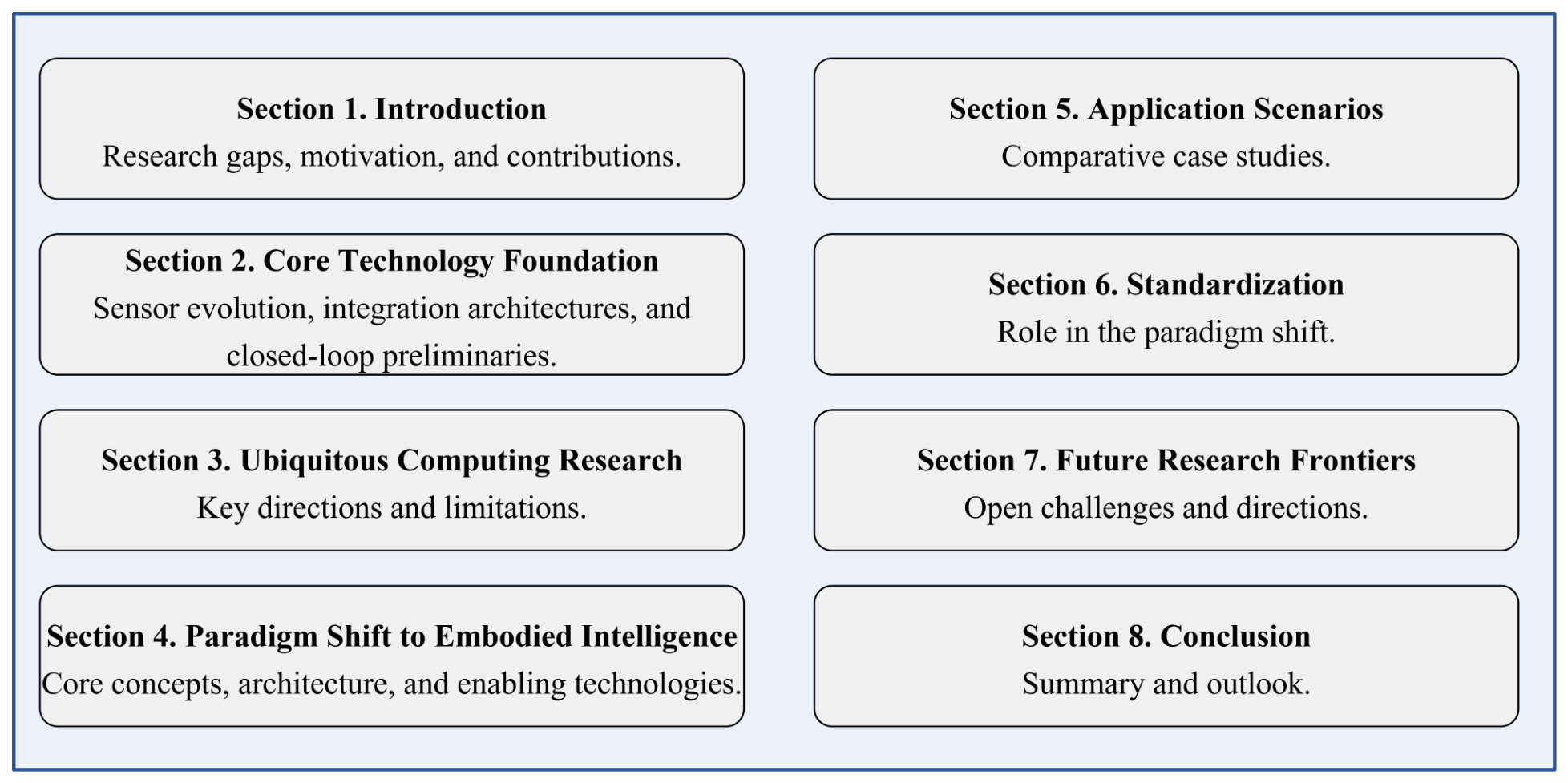
1.3. Review Structure
2. Evolution of Sensor-Empowered Ubiquitous Computing and Preliminaries for Embodied Intelligence
2.1. Evolution of Sensor Technology in Embedded and Ubiquitous Computing
2.2. Sensor Integration Architecture in Embedded and Ubiquitous Computing
2.3. Basic Technologies and Embodied Intelligence Enablers
3. Key Research Directions of Sensor-Enabled Embedded & Ubiquitous Computing
3.1. Integration of Sensor-Driven Systems and Emerging Wireless Technologies
3.2. Design, Analysis, and Optimization of Sensor-Driven Networks
3.3. Sensor Data Analysis and Management
3.4. Safety, Reliability, and Assurance in Sensor-Driven Networks
3.5. Machine Learning Techniques in Embedded and Ubiquitous Computing
3.6. Spectrum Sensing and Sharing in Sensor-Driven Systems
3.7. Applications of Mobile Edge Computing and Fog Computing in Sensor Systems
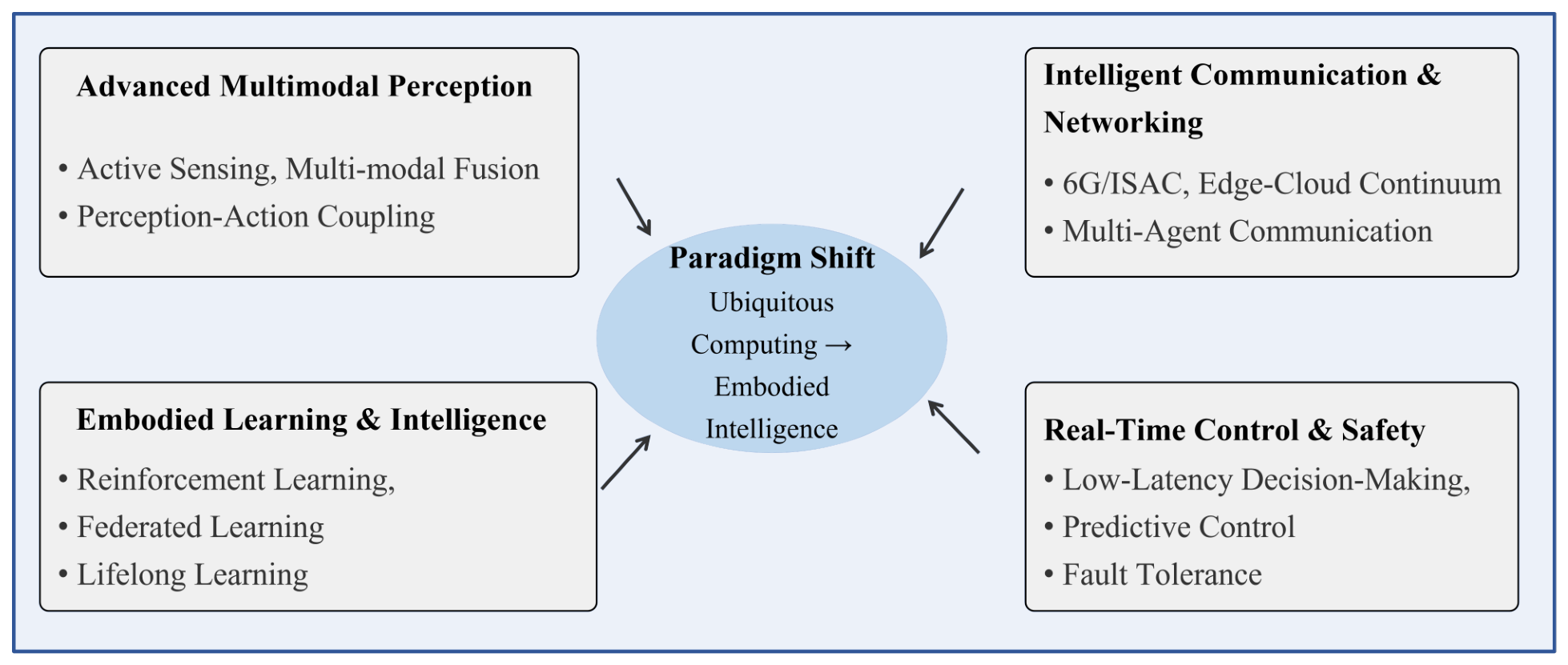
4. Transition from Sensor-Enabled Ubiquitous Computing to Embodied Intelligence: Core Upgrades and Key Technologies
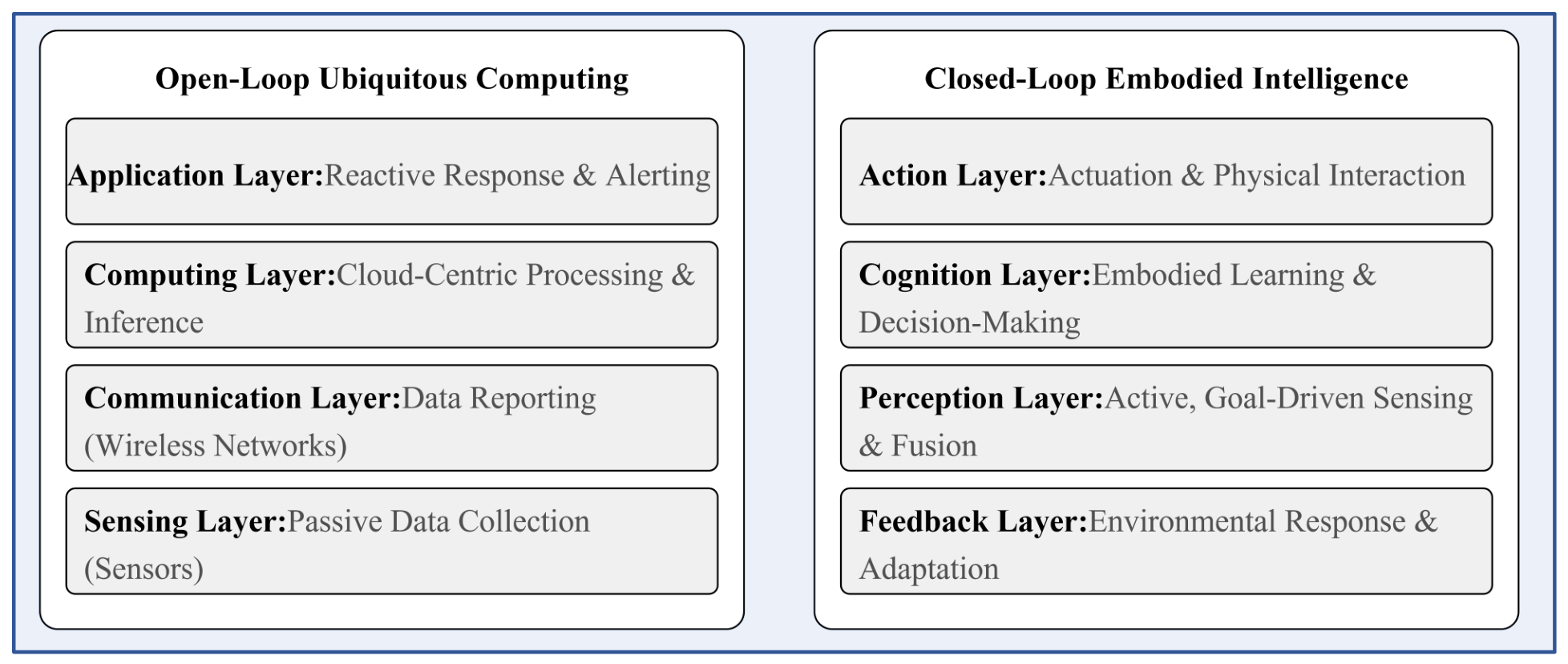
4.1. Core Concepts of EI and Its Relationship with Sensor-Supported Ubiquitous Computing
4.2. Sensor Role Upgrade: From Passive Data Collectors to Goal-Driven Perceptors
4.3. Key Technologies Driving the Transformation
4.3.1. Advanced Communication Technologies
4.3.2. Active Sensing and Multi-Modal Fusion Technologies
4.3.3. Embodied Machine Learning
4.3.4. Real-Time Closed-Loop Control Technology
5. Application Scenarios and Case Studies: Ubiquitous Computing vs. Embodied Intelligence
5.1. Smart Living Environments
5.2. Mobile and Wearable Systems
5.3. Unmanned Aerial Vehicles
6. Standardization: Enablers for the Paradigm Transition
6.1. Key Standardization Areas for the Transition
- Sensor and Actuator Standardization: This field focuses on unifying sensor interface specifications, data acquisition protocols, and actuator control interfaces. The existing ubiquitous computing sensor standards, such as the IEEE 1451 intelligent sensor interface standard and the ISO 11784/11785 RFID sensor standard, mainly target single-mode or static sensing requirements. However, embodied intelligence requires new standards. These standards must support active perception, multi-modal fusion, and tight integration between sensors and actuators. Dynamic perception parameter adjustment, such as adjusting the acquisition frequency and resolution, is of vital importance. Real-time feedback standards between sensors and actuators are also indispensable to achieve a closed-loop “perception-action” process. In addition, we also need updated standards for sensor calibration, accuracy, and energy efficiency. These standards must meet the requirements of mobile embodied agents (such as robots and wearable devices) in dynamic environments. For instance, the authors in [196,197] reviewed the standardization technologies for wireless communication, focusing on reliability, latency, scalability, and energy efficiency.
- Data: With the rapid growth of multi-modal sensing and interactive feedback data in embodied intelligence, there is an urgent need for unified data formats, storage, and processing standards. Traditional ubiquitous computing standards, such as MQTT for lightweight data transmission and JSON for data exchange, cannot meet the dynamic, real-time, and knowledge-driven data requirements in embodied intelligence. New standards must be set. These standards should define a unified format for multi-modal sensor data fusion, interactive feedback data, and world model data. This can achieve data sharing, processing, and knowledge reuse among different embodied agents and systems. Privacy and security standards are equally crucial, especially for sensitive data such as user behavior and environmental perception data. As embodied intelligent systems interact with humans more and more frequently, these standards will play a key role in protecting personal information. The hybrid architecture proposed by [198] aims to reduce energy consumption, enhance interoperability, and increase scalability in 5G systems and sustainable smart cities. In addition, ref. [199] proposed a standard terminal data acquisition and transmission solution. This solution addresses the challenges faced by the multi-functional beacon system in terms of data format, communication protocol, hardware standardization, and information security.
- Communication and Network Standardization: Current wireless communication standards serve distinct design objectives. For example, 5G NR with URLLC is specifically engineered to support ultra-low latency and ultra-high reliability for mission-critical control, whereas LoRaWAN targets low-power, wide-area, and low-data-rate monitoring applications and is not designed for low-latency or high-reliability interactive control. Although 5G NR/URLLC already provides strong low-latency and high-reliability capabilities [200], further extensions and optimizations are required to meet the unique demands of closed-loop embodied intelligence, such as synchronized sensing–action, real-time feedback, and multi-agent coordination. In contrast, LoRaWAN lacks intrinsic support for low-latency deterministic transmission and requires architectural enhancements to enable interactive physical interaction scenarios [201]. Several wireless communication standards underpin the IoT and sensor-driven networks. IEEE 802.15.4 forms the basis for low-rate wireless personal area networks, including ZigBee and Thread [202], while IEEE 802.11ah enables long-range, low-power Wi-Fi connectivity for IoT devices [203]. Wide-area low-power communication is supported by standards such as LoRaWAN, and cellular IoT standards, including NB-IoT and LTE-M, provide broader coverage [204]. To effectively support mobile embodied agents, new standards are needed that address dynamic network topology adjustments, multi-agent communication coordination, and spectrum resource allocation. Moreover, standards for embodied collaborative communication in edge clouds should be developed, including protocols for resource scheduling and mechanisms for knowledge synchronization.
- System and Architecture Standardization: The traditional hierarchical architecture standards for ubiquitous computing cannot meet the requirements of embodied intelligent systems. The new standard must clearly define the core components of the closed loop. It should outline the interaction mechanisms and interface protocols of these components. In addition, we need to establish standards for integrating embodied machine learning models with perception/action modules. These standards are crucial for the system’s functionality.
6.2. Current Progress and Gaps
- The current standards mainly focus on traditional ubiquitous computing. They cannot support the core features of embodied intelligence, such as active perception, closed-loop control, and autonomous learning. For instance, there is currently no unified standard for multi-modal sensor fusion, and no hard real-time standards exist to support closed-loop control feedback between sensors and actuators [205,206]. In this context, hard real-time refers to strictly bounded latency necessary for safety-critical physical interactions, while closed-loop control feedback denotes deterministic bidirectional signaling for perception–action coupling, rather than mere acknowledgments or asynchronous notifications.
- The standardization of embodied intelligence still faces fragmentation issues among different disciplines and application scenarios. There is no comprehensive framework covering the entire transition process. For instance, sensor standards mainly focus on hardware interfaces, while communication standards emphasize data transmission. The lack of coordination between the two hinders the seamless integration of the perception-thinking-action closed loop [207,208].
- The limited participation of industry and academia in the standardization of embodied intelligence has slowed progress in the formulation of new standards. The diversity of different application scenarios makes the standardization process more complicated. Scenarios such as smart homes, industrial robots, and healthcare have diverse demands, involving differences in sensors, communication technologies, and security measures [209].
- Outdated IoT standards fail to support long-term autonomous learning. WSNs are widely used in fields such as medical care, military surveillance, and public security. However, their application is limited by the insufficiency of node computing power and battery technology. The combination of WSN and cloud computing has great potential. However, to unleash this potential, standardized research is still required in architecture, network dynamics, and data management that is tailored for embodied intelligence. Existing standards, such as oneM2M, have established hierarchical architectures [210], common data models, and network abstraction layers for traditional ubiquitous computing and IoT systems. Similarly, standards including OCF, IEEE 1451, and ISO/IEC 30141 provide mature frameworks for device interoperability, data representation, and system integration. Nevertheless, these standards were designed for open-loop sensing and passive data reporting rather than lifelong learning in embodied intelligence. Furthermore, the authors of [211] put forward the vision of digital twins in the intelligent space. However, standardization challenges have hindered the wide adoption of digital twin technology. The studies of [212] also emphasized the lack of standardized knowledge representation and semantic interoperability in the IIoT. The absence of standardization significantly hinders system integration and efficiency.
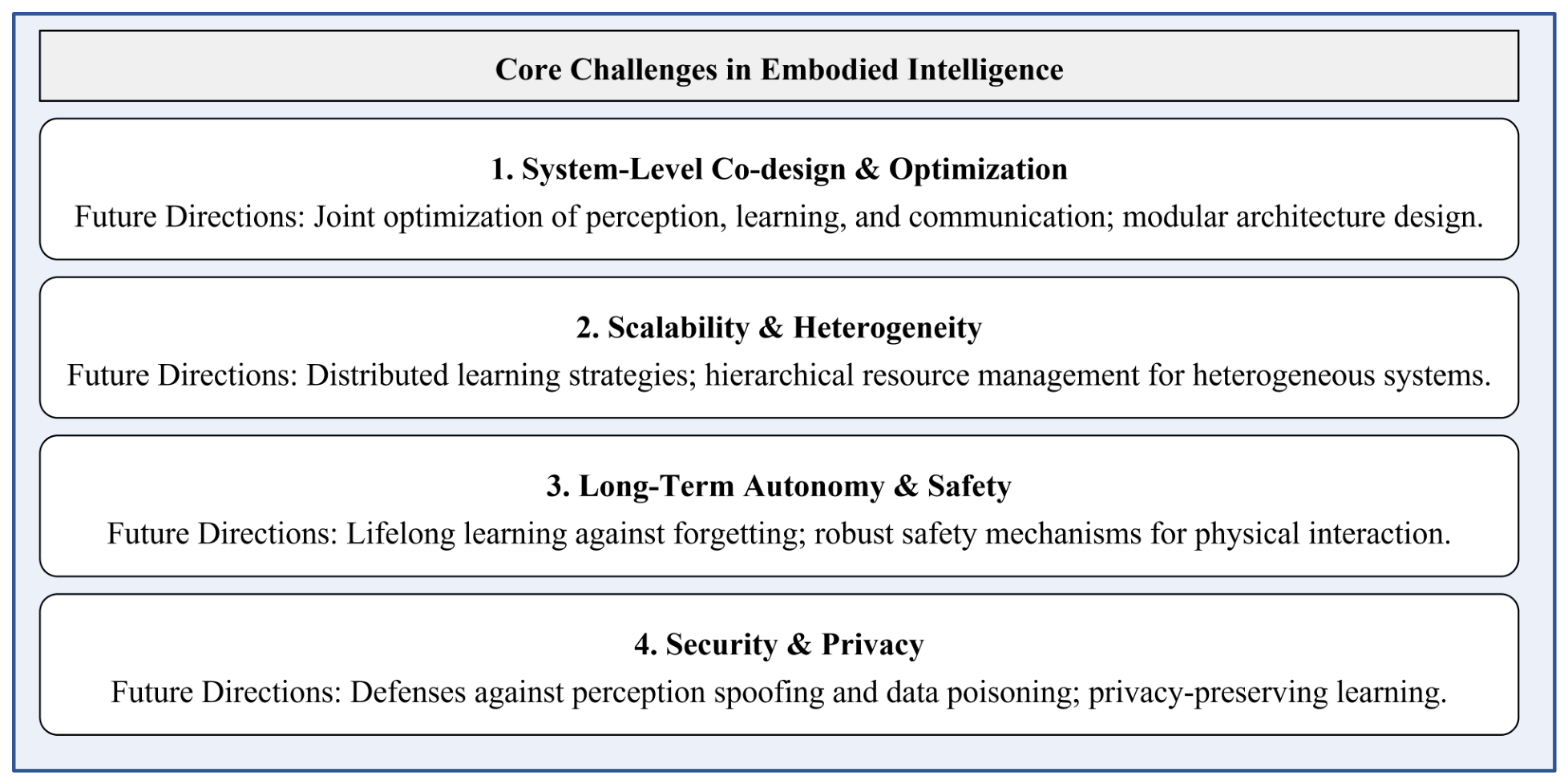
7. Open Challenges and Future Research Directions
7.1. System-Level Co-Design Challenges
- Jointly optimize sensor sampling, communication scheduling, and edge inference within a unified perception-thinking-action closed loop. The goal is to cut end-to-end latency and power usage. Meanwhile, closed-loop stability, real-time response, and sensing precision must be preserved under tight resource limits.
- Build modular, reconfigurable architectures with unified hardware–software interfaces. Heterogeneous sensors, actuators, and learning models can be plugged in directly. No full-system rebuild is required, which greatly boosts scalability and maintainability.
- Develop hybrid simulation-physical test platforms and unified evaluation criteria. Core metrics include latency, energy efficiency, reliability, and safety. The platforms enable fair comparisons of co-design schemes under changing environments and fluctuating network loads.
7.2. Scalability and Heterogeneity
- Develop hierarchical control and dynamic resource scheduling algorithms. These algorithms allocate communication, computing, and sensing resources intelligently. Allocation rules depend on device capacity, task priority, interaction weight, and real-time network states to balance system performance and resource utilization.
- Design distributed robust optimization and online learning schemes. They adapt automatically to node faults, discontinuous connections, sensor bias, environment noise, and topology shifts. The design maintains steady, predictable performance in unstructured, dynamic physical scenes.
- Achieve deterministic, stable control quality. This design copes with system heterogeneity and scalability limits. It lays the foundation for large-scale, reliable deployment and safe physical interaction across diverse devices and scenarios.
7.3. Long-Term Autonomy and Lifelong Learning
- Develop incremental and lifelong learning approaches. They support continuous knowledge accumulation, incremental model updates, and adaptive skill transfer. These methods alleviate catastrophic forgetting in dynamic open environments.
- Design safe constrained exploration for online reinforcement learning. The strategies embed physical limits and risk awareness. They secure stable and safe physical interaction during adaptation and model training.
- Build complete state management and fault recovery mechanisms. Functions include state recording, rollback, auditing, and error restoration. Such tools guarantee traceable decisions and long-term system resilience.
7.4. Security and Privacy in Physical Interaction
- Develop multi-modal consistency verification and anomaly detection modules. They cross-check data from multiple sensors and defend against spoofing, deception, and data tampering attacks.
- Construct robust learning and control frameworks equipped with adversarial defense. The systems maintain safety, constraints, and stability under noise, malicious perturbations, or partial sensing.
- Explore privacy-preserving distributed learning schemes such as federated learning. They protect sensitive sensor data and user information without sacrificing real-time performance or control precision.
- Build a unified evaluation system with quantitative indicators. It comprehensively measures adaptability, robustness, physical safety, and security in various practical scenarios.
8. Conclusions
Author Contributions
Funding
Data Availability Statement
Conflicts of Interest
References
- Krumm, J. Ubiquitous Computing Fundamentals; CRC Press: Boca Raton, FL, USA, 2018. [Google Scholar]
- Coito, T.; Firme, B.; Martins, M.S.; Vieira, S.M.; Figueiredo, J.; Sousa, J.M. Intelligent sensors for real-Time decision-making. Automation 2021, 2, 62–82. [Google Scholar] [CrossRef] [Scilit]
- Chataut, R.; Phoummalayvane, A.; Akl, R. Unleashing the power of IoT: A comprehensive review of IoT applications and future prospects in healthcare, agriculture, smart homes, smart cities, and industry 4.0. Sensors 2023, 23, 7194. [Google Scholar] [CrossRef] [Scilit]
- Nikfarjam, H.; Megdadi, M.; Okour, M.; Pourkamali, S.; Alsaleem, F. Energy efficient integrated MEMS neural network for simultaneous sensing and computing. Commun. Eng. 2023, 2, 19. [Google Scholar] [CrossRef] [Scilit]
- Liu, X.; Shi, Y.; Yu, C.; Gao, C.; Yang, T.; Liang, C.; Shi, Y. Understanding In-Situ Programming for Smart Home Automation. Proc. ACM Interact. Mob. Wearable Ubiquitous Technol. 2023, 7, 1–31. [Google Scholar] [CrossRef] [Scilit]
- John, A.; Nundy, K.K.; Cardiff, B.; John, D. Multimodal multiresolution data fusion using convolutional neural networks for IoT wearable sensing. IEEE Trans. Biomed. Circuits Syst. 2021, 15, 1161–1173. [Google Scholar] [CrossRef] [Scilit] [PubMed]
- Zhang, Y.; Li, M.; Pan, H.; Liu, M.; Zhou, Y. Efficient visual fault detection for freight train via neural architecture search with data volume robustness. IEEE Trans. Ind. Inform. 2024, 20, 11919–11929. [Google Scholar] [CrossRef] [Scilit]
- Wu, N.; Jiang, R.; Wang, X.; Yang, L.; Zhang, K.; Yi, W.; Nallanathan, A. AI-Enhanced Integrated Sensing and Communications: Advancements, Challenges, and Prospects. IEEE Commun. Mag. 2024, 62, 144–150. [Google Scholar] [CrossRef] [Scilit]
- Ren, L.; Dong, J.; Liu, S.; Zhang, L.; Wang, L. Embodied intelligence toward future smart manufacturing in the era of AI foundation model. IEEE/ASME Trans. Mechatron. 2024, 30, 2632–2642. [Google Scholar] [CrossRef] [Scilit]
- Weiser, M.D. Ubiquitous computing. In Proceedings of the ACM Conference on Computer Science, Phoenix, AZ, USA, 8–10 March 1994; pp. 197530–197680. [Google Scholar]
- Dunne, R.; Morris, T.; Harper, S. A Survey of Ambient Intelligence. ACM Comput. Surv. (CSUR) 2021, 54, 1–27. [Google Scholar] [CrossRef] [Scilit]
- Kar, S.K.; Subudhi, B.U.; Mishra, B.K.; Mahapatra, C. A Graph-Aware Attention-Driven Ensemble Model for Robust Anomaly Detection in 6G-Enabled Wireless Sensor Networks. Next-Gener. Comput. Syst. Technol. 2025, 1, 18–32. [Google Scholar] [CrossRef] [Scilit]
- Yusri, N.A.M.; Yogarayan, S.; Razak, S.F.A.; Abdullah, M.F.A.; Azman, A. Development and Evaluation of LPWAN-Based Flood Monitoring and Warning System: Assessing Communication Range, Signal Quality, and Alert Mechanisms. In Proceedings of the International IOT, Electronics and Mechatronics Conference, London, UK, 3–5 April 2024; pp. 63–76. [Google Scholar]
- Mendez-Mendez, J.; Kaelbling, L.P.; Lozano-Pérez, T. Embodied Lifelong Learning for Task and Motion Planning. In Proceedings of the Conference on Robot Learning (CoRL); PMLR: Cambridge, MA, USA, 2023; pp. 2134–2150. [Google Scholar]
- Xie, S.; Yan, Y.; Hong, Y. Stealthy 3D poisoning attack on video recognition models. IEEE Trans. Dependable Secur. Comput. 2022, 20, 1730–1743. [Google Scholar] [CrossRef] [Scilit]
- Ning, C.; Hao, F.; Yang, J. Optimal Fusion Deception Attacks Design and Game Analysis in Multi-Sensor Systems. IEEE Trans. Netw. Sci. Eng. 2025, 12, 3837–3849. [Google Scholar] [CrossRef] [Scilit]
- Tan, J.; Shi, J.; Wu, L.; Chen, B.; Tang, H.; Zhang, C.; Zhang, W.; Wang, S.; Wan, J. Embodied intelligence empowering customized manufacturing: Architecture, opportunities, and challenges. IEEE Access 2025, 13, 92740–92755. [Google Scholar] [CrossRef] [Scilit]
- Harrison, C.; Wiese, J.; Dey, A.K. Achieving Ubiquity: The New Third Wave. IEEE Multimed. 2010, 17, 8–12. [Google Scholar] [CrossRef] [Scilit]
- Xing, Z.; Wang, F.; Qi, W.; Su, H. Integrating flexible wearable sensors and embodied intelligence: Reach the unreachable. In Proceedings of the 2024 IEEE Conference on Telepresence, Pasadena, CA, USA, 16–17 November 2024; pp. 188–191. [Google Scholar]
- Zhang, Y.; Tian, J.; Xiong, Q. A Review of Embodied Intelligence Systems: A Three-Layer Framework Integrating Multimodal Perception, World Modeling, and Structured Strategies. Front. Robot. AI 2025, 12, 1668910. [Google Scholar] [CrossRef] [Scilit] [PubMed]
- Goumopoulos, C. A high precision, wireless temperature measurement system for pervasive computing applications. Sensors 2018, 18, 3445. [Google Scholar] [CrossRef] [Scilit] [PubMed]
- Li, D.; Chen, A.; Zheng, D.; Li, Z.; Na, R.; Cui, F.; Yang, X. Design and optimization of interdigital capacitive humidity sensor with highly sensitive and dynamic response time. Appl. Sci. 2022, 12, 12362. [Google Scholar] [CrossRef] [Scilit]
- Han, Q.; Liu, P.; Zhang, H.; Cai, Z. A wireless sensor network for monitoring environmental quality in the manufacturing industry. IEEE Access 2019, 7, 78108–78119. [Google Scholar] [CrossRef] [Scilit]
- Zhu, J.; Liu, X.; Shi, Q.; He, T.; Sun, Z.; Guo, X.; Liu, W.; Sulaiman, O.B.; Dong, B.; Lee, C. Development trends and perspectives of future sensors and MEMS/NEMS. Micromachines 2019, 11, 7. [Google Scholar] [CrossRef] [Scilit] [PubMed]
- Chircov, C.; Grumezescu, A.M. Microelectromechanical systems (MEMS) for biomedical applications. Micromachines 2022, 13, 164. [Google Scholar] [CrossRef] [Scilit] [PubMed]
- Shah, M.A.; Shah, I.A.; Lee, D.G.; Hur, S. Design approaches of MEMS microphones for enhanced performance. J. Sens. 2019, 2019, 9294528. [Google Scholar] [CrossRef] [Scilit]
- La Rosa, R.; Livreri, P.; Trigona, C.; Di Donato, L.; Sorbello, G. Strategies and techniques for powering wireless sensor nodes through energy harvesting and wireless power transfer. Sensors 2019, 19, 2660. [Google Scholar] [CrossRef] [Scilit] [PubMed]
- Li, Z.; Gao, Z.; Liu, X.; Wang, Z.; Zhou, X.; Liu, L.; Wu, Y.; Feng, W.; Huang, Y. Large Model Enabled Embodied Intelligence for 6G Integrated Perception, Communication, and Computation Network. arXiv 2025, arXiv:2512.15109. [Google Scholar]
- Liu, H.; Guo, D.; Cangelosi, A. Embodied Intelligence: A Synergy of Morphology, Action, Perception and Learning. ACM Comput. Surv. 2025, 57, 1–36. [Google Scholar] [CrossRef] [Scilit]
- Idowu, E. Bridging the Embodiment Gap: Embodied AI for Enhanced Human-Machine Collaboration and Learning in Dynamic Environments. Preprint 2024. [Google Scholar] [CrossRef] [Scilit]
- Qi, Y. Review of Multimodal Data Fusion for Robotics and Embodied Intelligence. In Proceedings of the 2025 2nd International Conference on Electrical Engineering and Intelligent Control (EEIC 2025); Atlantis Press: Paris, France, 2025; pp. 514–529. [Google Scholar]
- Chatterjee, B.; Cao, N.; Raychowdhury, A.; Sen, S. Context-aware intelligence in resource-constrained IoT nodes: Opportunities and challenges. IEEE Des. Test 2019, 36, 7–40. [Google Scholar] [CrossRef] [Scilit]
- Fascista, A. Toward Integrated Large-Scale Environmental Monitoring Using WSN/UAV/Crowdsensing: A Review of Applications, Signal Processing, and Future Perspectives. Sensors 2022, 22, 1824. [Google Scholar] [CrossRef] [Scilit] [PubMed]
- Safa, M.; Naga Raju, M.; Devendrappa, D.M.; Ashwini, A.N. Advances in Ubiquitous Computing: Integrating Location and Activity Sensing for Intelligent Services. J. Wirel. Mob. Netw. Ubiquitous Comput. Dependable Appl. 2025, 16, 609–623. [Google Scholar] [CrossRef] [Scilit]
- Suciu, G.; Hussain, I.; Petrescu, G. Role of ubiquitous computing and mobile WSN technologies and implementation. In Proceedings of the 2020 International Conference on Electrical, Communication, and Computer Engineering (ICECCE), Istanbul, Turkey, 12–13 June 2020; pp. 1–6. [Google Scholar]
- Dhyani, K.; Bhachawat, S.; Prabhu, J.; Kumar, M.S. A novel survey on ubiquitous computing. In Data Intelligence and Cognitive Informatics: Proceedings of ICDICI 2021; Springer: Singapore, 2022; pp. 109–123. [Google Scholar]
- Bayo-Monton, J.L.; Martinez-Millana, A.; Han, W.; Fernandez-Llatas, C.; Sun, Y.; Traver, V. Wearable sensors integrated with Internet of Things for advancing eHealth care. Sensors 2018, 18, 1851. [Google Scholar] [CrossRef] [Scilit] [PubMed]
- Mekruksavanich, S.; Jitpattanakul, A. Biometric user identification based on human activity recognition using wearable sensors: An experiment using deep learning models. Electronics 2021, 10, 308. [Google Scholar] [CrossRef] [Scilit]
- Huang, W.; Zhang, L.; Wu, H.; Min, F.; Song, A. Channel-equalization-HAR: A light-weight convolutional neural network for wearable sensor based human activity recognition. IEEE Trans. Mob. Comput. 2022, 22, 5064–5077. [Google Scholar]
- Shahid, A.R.; Pissinou, N.; Staier, C.; Kwan, R. Sensor-chain: A lightweight scalable blockchain framework for internet of things. In Proceedings of the 2019 International Conference on Internet of Things (iThings) and IEEE Green Computing and Communications (GreenCom) and IEEE Cyber, Physical and Social Computing (CPSCom) and IEEE Smart Data (SmartData), Atlanta, GA, USA, 14–17 July 2019; pp. 1154–1161. [Google Scholar]
- Anandan, R.; Suseendran, G.; Balamurugan, S.; Mishra, A.; Balaganesh, D. Human Communication Technology: Internet-of-Robotic-Things and Ubiquitous Computing; John Wiley & Sons: Hoboken, NJ, USA, 2021. [Google Scholar]
- Rajan, C.; Ahmed, A.S.; Divya, V.; Nagendar, Y.; Mohan, A.; Atheeswaran, A. Real-Time Signal Processing in IoT-Based Embedded Systems Using Hybrid AI-Enhanced Edge Computing. In Proceedings of the 2024 International Conference on Artificial Intelligence and Quantum Computation-Based Sensor Application (ICAIQSA), Nagpur, India, 20–21 December 2024; pp. 1–7. [Google Scholar]
- Daraghmi, Y.A.; Daraghmi, E.Y.; Daraghma, R.; Fouchal, H.; Ayaida, M. Edge–Fog–Cloud Computing Hierarchy for Improving Performance and Security of NB-IoT-Based Health Monitoring Systems. Sensors 2022, 22, 8646. [Google Scholar] [CrossRef] [Scilit] [PubMed]
- Islam, M.M.; Nooruddin, S.; Karray, F.; Muhammad, G. Internet of Things: Device Capabilities, Architectures, Protocols, and Smart Applications in Healthcare Domain. IEEE Internet Things J. 2022, 10, 3611–3641. [Google Scholar] [CrossRef] [Scilit]
- Loquercio, A.; Maqueda, A.I.; Del-Blanco, C.R.; Scaramuzza, D. Dronet: Learning to Fly by Driving. IEEE Robot. Autom. Lett. 2018, 3, 1088–1095. [Google Scholar] [CrossRef] [Scilit]
- Agarwal, S.; Muthukrishnan, R.; Gosrich, W.; Kumar, V.; Ribeiro, A. LPAC: Learnable Perception-Action-Communication Loops with Applications to Coverage Control. IEEE Trans. Robot. 2025, 41, 5986–6005. [Google Scholar] [CrossRef] [Scilit]
- Abdulhussain, S.H.; Mahmmod, B.M.; Alwhelat, A.; Shehada, D.; Shihab, Z.I.; Mohammed, H.J.; Abdulameer, T.H.; Alsabah, M.; Fadel, M.H.; Ali, S.K.; et al. A Comprehensive Review of Sensor Technologies in IoT: Technical Aspects, Challenges, and Future Directions. Computers 2025, 14, 342. [Google Scholar] [CrossRef] [Scilit]
- Karthick, G. Battery-Free Sensor Networks for Sustainable Next-Generation IoT Connectivity; IGI Global: Hershey, PA, USA, 2025. [Google Scholar]
- Pagan, J.; Fallahzadeh, R.; Pedram, M.; Risco-Martin, J.L.; Moya, J.M.; Ayala, J.L.; Ghasemzadeh, H. Toward ultra-low-power remote health monitoring: An optimal and adaptive compressed sensing framework for activity recognition. IEEE Trans. Mob. Comput. 2018, 18, 658–673. [Google Scholar]
- Nurelmadina, N.; Hasan, M.K.; Memon, I.; Saeed, R.A.; Zainol Ariffin, K.A.; Ali, E.S.; Mokhtar, R.A.; Islam, S.; Hossain, E.; Hassan, M.A. A systematic review on cognitive radio in low power wide area network for industrial IoT applications. Sustainability 2021, 13, 338. [Google Scholar] [CrossRef] [Scilit]
- Chen, M.; Miao, Y.; Jian, X.; Wang, X.; Humar, I. Cognitive-LPWAN: Towards intelligent wireless services in hybrid low power wide area networks. IEEE Trans. Green Commun. Netw. 2018, 3, 409–417. [Google Scholar] [CrossRef] [Scilit]
- Ren, X.; Qiu, C.; Wang, X.; Han, Z.; Xu, K.; Yao, H.; Guo, S. AI-Bazaar: A Cloud-Edge Computing Power Trading Framework for Ubiquitous AI Services. IEEE Trans. Cloud Comput. 2023, 11, 2337–2348. [Google Scholar] [CrossRef] [Scilit]
- Li, Z.; Zhong, A. Resource allocation in wireless powered virtualized sensor networks. IEEE Access 2020, 8, 40327–40336. [Google Scholar] [CrossRef] [Scilit]
- Ghanbari, Z.; Jafari Navimipour, N.; Hosseinzadeh, M.; Darwesh, A. Resource allocation mechanisms and approaches on the Internet of Things. Clust. Comput. 2019, 22, 1253–1282. [Google Scholar] [CrossRef] [Scilit]
- Arif, M.; Maya, J.A.; Anandan, N.; Pérez, D.A.; Tonello, A.M.; Zangl, H.; Rinner, B. Resource-efficient ubiquitous sensor networks for smart agriculture: A survey. IEEE Access 2024, 12, 193332–193364. [Google Scholar] [CrossRef] [Scilit]
- Nelufule, N.; Singano, T.; Masango, M. A Comprehensive Exploration of Digital Forensics Investigations in Embedded Systems, Ubiquitous Computing, Fog Computing, and Edge Computing. In Proceedings of the 2024 International Conference on Artificial Intelligence, Big Data, Computing and Data Communication Systems (icABCD), Port Louis, Mauritius, 1–2 August 2024; pp. 1–6. [Google Scholar]
- Boyle, L.; Baumann, N.; Sivasothilingam, P.; Magno, M.; Benini, L. RobotxR1: Enabling Embodied Robotic Intelligence on Large Language Models through Closed-Loop Reinforcement Learning. arXiv 2025, arXiv:2505.03238. [Google Scholar]
- Ahmed, T.; Nuruddin, A.B.; Latif, A.B.; Arnob, S.S.; Rahman, R. A real-time controlled closed loop IoT based home surveillance system for Android using Firebase. In Proceedings of the 2020 6th International Conference on Control, Automation and Robotics (ICCAR), Singapore, 20–23 April 2020; pp. 601–606. [Google Scholar]
- Meng, Y.; Liu, Z.; Li, S.; Sun, T. Multimodal Tactile Feedback System for Ankle and Knee Protection during Physical Exercise: A Ubiquitous Computing Approach. In Proceedings of the Companion of the 2025 ACM International Joint Conference on Pervasive and Ubiquitous Computing, Espoo, Finland, 12–16 October 2025; pp. 751–756. [Google Scholar]
- Gururaj, H.; Natarajan, R.; Almujally, N.A.; Flammini, F.; Krishna, S.; Gupta, S.K. Collaborative energy-efficient routing protocol for sustainable communication in 5G/6G wireless sensor networks. IEEE Open J. Commun. Soc. 2023, 4, 2050–2061. [Google Scholar] [CrossRef] [Scilit]
- Dong, Y.; Yang, Y.; Li, C.; Han, H. Data Fusion Algorithm for Meteorological Equipment Security Based on 5G Base Station Network Security. Trans. Emerg. Telecommun. Technol. 2025, 36, e70278. [Google Scholar] [CrossRef] [Scilit]
- Pasolini, G.; Buratti, C.; Feltrin, L.; Zabini, F.; De Castro, C.; Verdone, R.; Andrisano, O. Smart city pilot projects using LoRa and IEEE802. 15.4 technologies. Sensors 2018, 18, 1118. [Google Scholar] [CrossRef] [Scilit] [PubMed]
- Li, S.; Zhang, N.; Lin, S.; Kong, L.; Katangur, A.; Khan, M.K.; Zhu, G. Joint admission control and resource allocation in edge computing for internet of things. IEEE Netw. 2018, 32, 72–79. [Google Scholar] [CrossRef] [Scilit]
- Grechuta, K.; Ulysse, L.; Ballester, B.R.; Verschure, P.F. Self Beyond the Body: Action-Driven and Task-Relevant Purely Distal Cues Modulate Performance and Body Ownership. Front. Hum. Neurosci. 2019, 13, 91. [Google Scholar] [CrossRef] [Scilit] [PubMed]
- Al-Healy, A.A.; Ali, Q.I. Evaluation metrics and optimization strategies for routing protocols in resource-constrained wireless sensor networks. Int. J. Data Inform. Intell. Comput. 2025, 4, 30–40. [Google Scholar] [CrossRef] [Scilit]
- Otero, C.T.O. Asynchronous Design for Ubiquitous Computing; Cornell University: Ithaca, NY, USA, 2014. [Google Scholar]
- Liu, J.; Liu, X.; Zhang, W. Distributed State Estimation and Fault Tolerant Control of Multi-Agent System. In Proceedings of the 2024 International Annual Conference on Complex Systems and Intelligent Science (CSIS-IAC), Guangzhou, China, 20–22 September 2024; pp. 759–765. [Google Scholar]
- El Shabrawy, K.; Baudeau, G.; Deniaud, T. Public Safety and ad hoc networks: Coverage extension and interoperability. In Proceedings of the 2011 IEEE Eighth International Conference on Mobile Ad-Hoc and Sensor Systems, Valencia, Spain, 17–22 October 2011; pp. 922–928. [Google Scholar]
- Liu, J.; Lee, T. A framework for performance modeling of wireless sensor networks. In Proceedings of the IEEE International Conference on Communications, ICC 2005, Seoul, Republic of Korea, 16–20 May 2005; Volume 2, pp. 1075–1081. [Google Scholar]
- Venkatesan, C.; Thamaraimanalan, T.; Bhuvaneswari, B.; Divya, T.; Esther Rani, P.J.; Sudha, K. Enhanced Network Performance in WSNs through the Improved PSO-MBO Coverage Algorithm. In Proceedings of the 2024 International Conference on Advances in Computing, Communication and Materials (ICACCM), Dehradun, India, 22–23 November 2024; pp. 1–5. [Google Scholar]
- Kumari, N.; Sajwan, M. Energy-Efficient Clustering and Latency-Reliability Trade-Off Optimization in Underwater Wireless Sensor Networks Using a Hybrid Hierarchical Chimp Optimization Algorithm. In Proceedings of the 2025 13th International Conference on Intelligent Embedded, MicroElectronics, Communication and Optical Networks (IEMECON), Jaipur, India, 8–10 December 2025; pp. 1–5. [Google Scholar]
- Shwetha, S.; Riadhusin, R.; Yashaswini, D.; Narsimhachari, J.P.; Chitra, A. Energy-Aware Medium Access Control Protocols with Load Balancing Network for Solar-Powered Wireless Sensor Networks. In Proceedings of the 2025 3rd International Conference on Data Science and Network Security (ICDSNS), Tiptur, India, 25–26 July 2025; pp. 1–6. [Google Scholar]
- Zhang, T.; Huang, B.; Liu, X.; Fan, J.; Li, J.; Yue, Z.; Wang, Y. MCU intelligent upgrades: An overview of AI-enabled low-power technologies. J. Low Power Electron. Appl. 2025, 15, 60. [Google Scholar] [CrossRef] [Scilit]
- Zhou, Z. Scalable Wireless Sensor Network Control Using Multi-Agent Reinforcement Learning. Electronics 2025, 14, 4445. [Google Scholar] [CrossRef] [Scilit]
- Nian, Y.; Liu, H.; Chen, R.; Hou, X.; He, A. Distributed Real-Time Topology Reconfiguration for UAV Swarms via MADDPG. IEEE Open J. Intell. Transp. Syst. 2026, 7, 74–92. [Google Scholar] [CrossRef] [Scilit]
- Kim, M.; Park, H.; Kim, J.; Chang, H.; Na, Y. Scalable Inflatable Origami Robot Modules with Proprioceptive Closed-Loop Shape Control. IEEE Robot. Autom. Lett. 2025, 10, 10346–10353. [Google Scholar] [CrossRef] [Scilit]
- Sreedevi, V.; Kulkarni, V.; Rinku, D.R.; Jyothi, V.; Kanakaprabha, S.; Rao, P.V. Edge Computing for Agricultural Monitoring: A Bandwidth-Efficient IoT Approach for Real-Time Sensor Data Analysis. In Proceedings of the 2025 8th International Conference on Computing Methodologies and Communication (ICCMC), Erode, India, 29–31 July 2025; pp. 361–366. [Google Scholar]
- Liu, X.; Zheng, Y.; Li, Z.; Hu, Y. Multi-sensor Data Privacy Protection with Adaptive Privacy Budget for IoT Systems. In Proceedings of the 2024 IEEE Conference on Communications and Network Security (CNS), Taipei, Taiwan, 30 September–3 October 2024; pp. 1–9. [Google Scholar]
- Ficili, I.; Giacobbe, M.; Tricomi, G.; Puliafito, A. From sensors to data intelligence: Leveraging IoT, cloud, and edge computing with AI. Sensors 2025, 25, 1763. [Google Scholar] [CrossRef] [Scilit] [PubMed]
- Bibri, S.E.; Krogstie, J. Environmentally data-driven smart sustainable cities: Applied innovative solutions for energy efficiency, pollution reduction, and urban metabolism. Energy Inform. 2020, 3, 29. [Google Scholar] [CrossRef] [Scilit]
- Lee, H.; Lee, U. Toward dynamic consent for privacy-aware pervasive health and well-being: A scoping review and research directions. IEEE Pervasive Comput. 2022, 21, 25–32. [Google Scholar] [CrossRef] [Scilit]
- Elgazzar, K.; Khalil, H.; Alghamdi, T.; Badr, A.; Abdelkader, G.; Elewah, A.; Buyya, R. Revisiting the internet of things: New trends, opportunities and grand challenges. Front. Internet Things 2022, 1, 1073780. [Google Scholar] [CrossRef] [Scilit]
- Saleh, A.; Donta, P.K.; Morabito, R.; Motlagh, N.H.; Tarkoma, S.; Loven, L. Follow-me ai: Energy-efficient user interaction with smart environments. IEEE Pervasive Comput. 2025, 24, 32–42. [Google Scholar] [CrossRef] [Scilit]
- Perez, A.J.; Zeadally, S.; Jabeur, N. Security and privacy in ubiquitous sensor networks. J. Inf. Process. Syst. 2018, 14, 286–308. [Google Scholar]
- Mengistu, T.M.; Kim, T.; Lin, J.W. A Survey on Heterogeneity Taxonomy, Security and Privacy Preservation in the Integration of IoT, Wireless Sensor Networks and Federated Learning. Sensors 2024, 24, 968. [Google Scholar] [CrossRef] [Scilit] [PubMed]
- Ahmad, I.; Farzan, R.; Kapadia, A.; Lee, A.J. Tangible privacy: Towards user-centric sensor designs for bystander privacy. Proc. ACM Hum.-Comput. Interact. 2020, 4, 1–28. [Google Scholar] [CrossRef] [Scilit]
- Khan, A.A.; Laghari, A.A.; Shaikh, Z.A.; Dacko-Pikiewicz, Z.; Kot, S. Internet of Things (IoT) security with blockchain technology: A state-of-the-art review. IEEE Access 2022, 10, 122679–122695. [Google Scholar] [CrossRef] [Scilit]
- Baruah, B.; Nigam, S.; Koul, A. Resilient Security Architectures for 6G-Enabled Smart Cities. In Security and Privacy in 6G Communication Technology; Wiley Online Library: Hoboken, NJ, USA, 2025; pp. 221–246. [Google Scholar]
- Li, X.; Li, Y.; Zhang, Y.; Liu, F.; Fang, Y. Fault Diagnosis of Belt Conveyor Based on Support Vector Machine and Grey Wolf Optimization. Math. Probl. Eng. 2020, 2020, 1–10. [Google Scholar] [CrossRef] [Scilit]
- Samweslin, S.; Janani, S.; SG, H.R. Unsupervised Learning of Wearable Sensor Data for Assessing Upper Limb Function. In Proceedings of the 2024 International Conference on Communication, Computing and Energy Efficient Technologies (I3CEET), Gautam Buddha Nagar, India, 20–21 September 2024; pp. 1603–1608. [Google Scholar]
- Ogbodo, C.O.; Rogers, T.J.; Dal Borgo, M.; Wagg, D.J. Adaptive Sensor Steering Strategy Using Deep Reinforcement Learning for Dynamic Data Acquisition in Digital Twins. arXiv 2025, arXiv:2504.10248. [Google Scholar]
- Ketshabetswe, K.L.; Zungeru, A.M.; Mtengi, B.; Lebekwe, C.K.; Prabaharan, S. Data compression algorithms for wireless sensor networks: A review and comparison. IEEE Access 2021, 9, 136872–136891. [Google Scholar] [CrossRef] [Scilit]
- Li, C.; Liang, W.; Zhang, Y.; Wang, Q.; Sun, S.; Zhang, Y. High-Speed Rotating Mechanism Based on Multi-Sensor Data Fusion End Face Displacement Determination Method. AIP Adv. 2024, 14, 075123. [Google Scholar] [CrossRef] [Scilit]
- Gupta, L. Collaborative Edge-Cloud AI for IoT Driven Secure Healthcare System. In Proceedings of the 2023 IEEE International Systems Conference (SysCon), Vancouver, BC, Canada, 17–20 April 2023; pp. 1–8. [Google Scholar]
- Sheeba, R.; Jiji, G.; Raj, T.A.B. WFCM based big sensor data error detection and correction in wireless sensor network. Clust. Comput. 2018, 22, 3191–3200. [Google Scholar] [CrossRef] [Scilit]
- Milojevic, D.; Zardini, G.; Elser, M.; Censi, A.; Frazzoli, E. CODEI: Resource-Efficient Task-Driven Co-Design of Perception and Decision Making for Mobile Robots Applied to Autonomous Vehicles. IEEE Trans. Robot. 2025, 41, 2727–2748. [Google Scholar] [CrossRef] [Scilit]
- Mintuda, R.L.; Layo, D.F.; Candare, R.J.; Porras, R. Comparative Analysis of Deep-Reinforcement Learning-Based Autonomous Mobile Robot for Goal-Driven Mapless Indoor Navigation. In Proceedings of the 2025 9th International Artificial Intelligence and Data Processing Symposium (IDAP), Malatya, Turkey, 6–7 September 2025; pp. 1–8. [Google Scholar]
- Shit, R.C.; Subudhi, S. AI-Powered Anomaly Detection with Blockchain for Real-Time Security and Reliability in Autonomous Vehicles. In Proceedings of the 2025 IEEE Space, Aerospace and Defence Conference (SPACE), Bangalore, India, 21–23 July 2025; pp. 1–6. [Google Scholar]
- Nag, A.; Hassan, M.M.; Das, A.; Sinha, A.; Chand, N.; Kar, A.; Sharma, V.; Alkhayyat, A.H. Exploring the applications and security threats of Internet of Thing in the cloud computing paradigm: A comprehensive study on the cloud of things. Trans. Emerg. Telecommun. Technol. 2023, 35, e4897. [Google Scholar] [CrossRef] [Scilit]
- Al-Muhtadi, J.; Saleem, K.; Al-Rabiaah, S.; Imran, M.; Gawanmeh, A.; Rodrigues, J.J. A lightweight cyber security framework with context-awareness for pervasive computing environments. Sustain. Cities Soc. 2021, 66, 102610. [Google Scholar] [CrossRef] [Scilit]
- Mukherjee, P.; Mukherjee, A. Advanced processing techniques and secure architecture for sensor networks in ubiquitous healthcare systems. In Sensors for Health Monitoring; Academic Press: San Diego, CA, USA, 2019; pp. 3–29. [Google Scholar]
- Braun, J.; Derbel, F. Wireless sensor network for fire detection with network coding to improve security and reliability. Meas. Sens. 2024, 37, 101404. [Google Scholar] [CrossRef] [Scilit]
- Zhang, R.; Liu, G.; Liu, Y.; Zhao, C.; Wang, J.; Xu, Y.; Niyato, D.; Kang, J.; Li, Y.; Mao, S.; et al. Toward Edge General Intelligence with Agentic AI and Agentification: Concepts, Technologies, and Future Directions. IEEE Commun. Surv. Tutor. 2026, 28, 4285–4318. [Google Scholar] [CrossRef] [Scilit]
- Guan, X.; Hu, Y.; xiang Peng, K. Bayesian-Stackelberg-Game-Based Finite-Time Sliding Mode Fault-Tolerant Secure Control for Cyber–Physical Systems Under Jamming Attacks and Multiple Physical Faults. IEEE Trans. Cybern. 2025, 55, 4710–4723. [Google Scholar] [CrossRef] [Scilit] [PubMed]
- Li, S.; Chen, Y.; Chen, L.; Liao, J.; Kuang, C.; Li, K.; Liang, W.; Xiong, N. Post-quantum security: Opportunities and challenges. Sensors 2023, 23, 8744. [Google Scholar] [CrossRef] [Scilit] [PubMed]
- Rao, S.M.; Adinarayana, B.; Vaddikasulu, K.; Dontamsetti, S.P.; Ranganadh, P.S.V. Optimizing Cloud IoT Applications with Machine Learning Driven Hybrid Key Management Protocols for WSN Performance. In Proceedings of the 2024 2nd International Conference on Signal Processing, Communication, Power and Embedded System (SCOPES), Odisha, India, 19–21 December 2024; pp. 1–6. [Google Scholar]
- Pasricha, S. Lightning Talk: Efficient Embedded Machine Learning Deployment on Edge and IoT Devices. In Proceedings of the 2023 60th ACM/IEEE Design Automation Conference (DAC), San Francisco, CA, USA, 9–13 July 2023; pp. 1–2. [Google Scholar]
- Sodhro, A.H.; Zahid, N.; Wang, L.; Pirbhulal, S.; Ouzrout, Y.; Seklouli, A.S.; Neto, A.V.L.; de Macedo, A.R.L.; de Albuquerque, V.H.C. Toward ML-based energy-efficient mechanism for 6G enabled industrial network in box systems. IEEE Trans. Ind. Inform. 2020, 17, 7185–7192. [Google Scholar]
- Chowdhury, S.; Kaur, A.; Prince, P.G.K.; Agarwal, T.; Vashisht, N. Advancements in IoT and Sensor-Enabled Wearable Devices for Healthcare Applications. In Proceedings of the 2025 International Conference on Automation and Computation (AUTOCOM), Dehradun, India, 4–6 March 2025; pp. 500–505. [Google Scholar]
- Li, J.; Wang, Z.; Zhao, Z.; Jin, Y.; Yin, J.; Huang, S.L.; Wang, J. TriboGait: A deep learning enabled triboelectric gait sensor system for human activity recognition and individual identification. In Proceedings of the Adjunct Proceedings of the 2021 ACM International Joint Conference on Pervasive and Ubiquitous Computing and Proceedings of the 2021 ACM International Symposium on Wearable Computers, Virtual, 21–26 September 2021; pp. 643–648. [Google Scholar]
- Chen, A.; Zhang, J.; Zhao, L.; Rhoades, R.D.; Kim, D.Y.; Wu, N.; Liang, J.; Chae, J. Machine-learning enabled wireless wearable sensors to study individuality of respiratory behaviors. Biosens. Bioelectron. 2021, 173, 112799. [Google Scholar] [CrossRef] [Scilit] [PubMed]
- Eshmawi, A.A.; Khayyat, M.; Abdel-Khalek, S.; Mansour, R.F.; Dwivedi, U.; Joshi, K.K.; Gupta, D. Deep learning with metaheuristics based data sensing and encoding scheme for secure cyber physical sensor systems. Clust. Comput. 2023, 26, 2245–2257. [Google Scholar]
- Huang, Y.P.; Basanta, H.; Kuo, H.C.; Chiao, H.T. Sensor-based detection of abnormal events for elderly people using deep belief networks. Int. J. Ad Hoc Ubiquitous Comput. 2020, 33, 36–47. [Google Scholar] [CrossRef] [Scilit]
- Vyas, S.; Gupta, S. WBAN-based remote monitoring system utilising machine learning for healthcare services. Int. J. Syst. Syst. Eng. 2023, 13, 100–108. [Google Scholar] [CrossRef] [Scilit]
- Rui, Q.; Elzner, N.; Zhou, Q.; Wen, Z.; He, Y.; Yang, K.; Chi, T. Lightweight Machine Learning and Embedded Security Engine for Physical-Layer Identification of Wireless IoT Nodes. In Proceedings of the ICC 2024—IEEE International Conference on Communications, Denver, CO, USA, 9–13 June 2024; pp. 2865–2870. [Google Scholar]
- Bakchy, S.C.; Peyal, H.I.; Islam, M.I.; Yeamin, G.K.; Miraz, S.; Abdal, M.N. A lightweight-cnn model for efficient lung cancer detection and grad-cam visualization. In Proceedings of the 2023 International Conference on Information and Communication Technology for Sustainable Development (ICICT4SD), Dhaka, Bangladesh, 21–23 September 2023; pp. 254–258. [Google Scholar]
- Bosse, S. IoT and Edge Computing Using Virtualized Low-Resource Integer Machine Learning with Support for CNN, ANN, and Decision Trees. In Proceedings of the 2023 18th Conference on Computer Science and Intelligence Systems (FedCSIS), Warsaw, Poland, 17–20 September 2023; pp. 367–376. [Google Scholar]
- Dhekane, S.G.; Ploetz, T. Transfer learning in sensor-based human activity recognition: A survey. ACM Comput. Surv. 2025, 57, 1–39. [Google Scholar] [CrossRef] [Scilit]
- Jiang, J.C.; Kantarci, B.; Oktug, S.; Soyata, T. Federated learning in smart city sensing: Challenges and opportunities. Sensors 2020, 20, 6230. [Google Scholar] [CrossRef] [Scilit] [PubMed]
- Ma, X.; Wen, Z.; Hu, T.; Zheng, X. Bridging Embodiment and Learning: A Machine Learning Framework for Next-Generation Embodied Intelligence. In Proceedings of the 2025 7th International Conference on Machine Learning, Big Data and Business Intelligence (MLBDBI), Hangzhou, China, 24–26 October 2025; pp. 68–71. [Google Scholar]
- Zhou, M.; Dong, H.; Song, H.; Zheng, N.; hua Chen, W.; Wang, H. Embodied Intelligence-Based Perception, Decision-Making, and Control for Autonomous Operations of Rail Transportation. IEEE Trans. Intell. Veh. 2025, 10, 5061–5065. [Google Scholar] [CrossRef] [Scilit]
- Fan, H.; Liu, X.; Fuh, J.Y.H.; Lu, W.F.; Li, B. Embodied intelligence in manufacturing: Leveraging large language models for autonomous industrial robotics. J. Intell. Manuf. 2024, 36, 1141–1157. [Google Scholar] [CrossRef] [Scilit]
- Ahmed, I.; Syed, M.A.; Maaruf, M.; Khalid, M. Distributed computing in multi-agent systems: A survey of decentralized machine learning approaches. Computing 2024, 107, 2. [Google Scholar] [CrossRef] [Scilit]
- Shaheen, E.M. Coexistence between 5G wireless sensor communication system and Wi-Fi IEEE802.11n networks. Int. J. Wirel. Mob. Comput. 2020, 19, 382–390. [Google Scholar] [CrossRef] [Scilit]
- Lebese, J.; Olwal, T.O.; Mfupe, L. Real-time Spectrum Occupancy Measurements Based on the Energy Detection Method in Cognitive Radios. In Proceedings of the 2021 IEEE AFRICON, Arusha, Tanzania, 13–15 September 2021; pp. 1–5. [Google Scholar]
- Gao, H.; Shen, H.; Yu, L.; Wang, Y.; Li, R.; Nazir, B. Milling Chatter Detection System Based on Multi-Sensor Signal Fusion. IEEE Sens. J. 2021, 21, 25243–25251. [Google Scholar] [CrossRef] [Scilit]
- Subray, S.; Tschimben, S.; Gifford, K. Towards enhancing spectrum sensing: Signal classification using autoencoders. IEEE Access 2021, 9, 82288–82299. [Google Scholar] [CrossRef] [Scilit]
- Xu, D.; Li, Q. Resource allocation in cognitive wireless powered communication networks with wirelessly powered secondary users and primary users. Sci. China Inf. Sci. 2018, 62, 29303. [Google Scholar] [CrossRef] [Scilit]
- Sunori, S.K.; Jain, S.; Juneja, P. Dynamic Spectrum Allocation in 5G Network using Genetic Algorithm and Particle Swarm Optimization. In Proceedings of the 2024 8th International Conference on I-SMAC (IoT in Social, Mobile, Analytics and Cloud) (I-SMAC), Dharan, Nepal, 3–5 October 2024; pp. 527–533. [Google Scholar]
- Onumanyi, A.J.; Abu-Mahfouz, A.M.; Hancke, G.P. Low power wide area network, cognitive radio and the Internet of Things: Potentials for integration. Sensors 2020, 20, 6837. [Google Scholar] [CrossRef] [Scilit] [PubMed]
- Rajakakarlapudi, R.V. AI-Based Dynamic Spectrum Allocation for Hybrid Satellite-5G Networks. In Proceedings of the 2025 International Conference on Advancements in Smart, Secure and Intelligent Computing (ASSIC), Odisha, India, 16–18 May 2025; pp. 1–6. [Google Scholar]
- Heydarishahreza, N.; Han, T.; Ansari, N. Spectrum Sharing and Interference Management for 6G LEO Satellite-Terrestrial Network Integration. IEEE Commun. Surv. Tutor. 2025, 27, 2794–2825. [Google Scholar] [CrossRef] [Scilit]
- Priyadarshi, R.; Teja, P.R.; Vishwakarma, A.K.; Ranjan, R. Effective Node Deployment in Wireless Sensor Networks Using Reinforcement Learning. In Proceedings of the 2025 IEEE 14th International Conference on Communication Systems and Network Technologies (CSNT), Bhopal, India, 7–9 March 2025; pp. 1113–1118. [Google Scholar]
- Wang, Y.; Yang, C.; Lan, S.; Zhu, L.; Zhang, Y. End-Edge-Cloud Collaborative Computing for Deep Learning: A Comprehensive Survey. IEEE Commun. Surv. Tutor. 2024, 26, 2647–2683. [Google Scholar] [CrossRef] [Scilit]
- Lin, J.; Yu, W.; Zhang, N.; Yang, X.; Zhang, H.; Zhao, W. A survey on internet of things: Architecture, enabling technologies, security and privacy, and applications. IEEE Internet Things J. 2017, 4, 1125–1142. [Google Scholar] [CrossRef] [Scilit]
- Ahmed, S. Evaluating the Role of Edge Computing in Reducing Latency and Enhancing Efficiency in Cloud-Based Data Storage and Access. Int. J. Electr. Electron. Comput. 2025, 10, 661234. [Google Scholar] [CrossRef] [Scilit]
- Liu, Z.; Chen, X.; Wu, H.; Wang, Z.; Chen, X.; Niyato, D.; Huang, K. Integrated sensing and edge AI: Realizing intelligent perception in 6G. IEEE Commun. Surv. Tutor. 2025, 28, 2725–2770. [Google Scholar] [CrossRef] [Scilit]
- Arabelli, R.; Yarlagadda, N.; Anumula, S.K.; Sidhu, K.S.; Garg, D.; Chakravarthi, M.K. IoT-Enabled Smart Sensor Networks for Autonomous Surveillance Systems. In Proceedings of the 2025 International Conference on Smart & Sustainable Technology (INCSST), Chikodi, India, 4–6 July 2025; pp. 1–6. [Google Scholar]
- Maamar, Z.; Baker, T.; Faci, N.; Ugljanin, E.; Khafajiy, M.A.; Burégio, V. Towards a seamless coordination of cloud and fog: Illustration through the internet-of-things. In Proceedings of the 34th ACM/SIGAPP Symposium on Applied Computing, Limassol, Cyprus, 8–12 April 2019; pp. 2008–2015. [Google Scholar]
- Byeon, H.; Alsaadi, M.; Quraishi, A.; Alghamdi, A.; Ahanger, T.A.; Keshta, I.; Xalikovich, P.A.; Soni, M.; Bhatt, M.W. Consumer Technology in Task Offloading and Edge Resource Allocation: AIoT and Edge Computing for Next-Generation Communication. IEEE Trans. Consum. Electron. 2025, 71, 5356–5365. [Google Scholar] [CrossRef] [Scilit]
- Lin, Z.; Chen, C.W.; Chen, J.; Liu, Z. A Hierarchical Fractal Space NSGA-II-Based Cloud–Fog Collaborative Optimization Framework for Latency and Energy-Aware Task Offloading in Smart Manufacturing. Mathematics 2025, 13, 3691. [Google Scholar] [CrossRef] [Scilit]
- Menon, A.R.; Sharma, R.K.; Singh, P.; Wang, C.; Ferreira, A.M.; Novak, M. Think, Act, Learn: A Framework for Autonomous Robotic Agents using Closed-Loop Large Language Models. arXiv 2025, arXiv:2507.19854. [Google Scholar]
- Alam, M.Z.; Jamalipour, A. Multi-Agent DRL-based Hungarian Algorithm (MADRLHA) for Task Offloading in Multi-Access Edge Computing Internet of Vehicles (IoVs). IEEE Trans. Wirel. Commun. 2022, 21, 7641–7652. [Google Scholar] [CrossRef] [Scilit]
- Yuan, Y.; Gao, S.; Zhang, Z.; Wang, W.; Xu, Z.; Liu, Z. Edge-Cloud Collaborative UAV Object Detection: Edge-Embedded Lightweight Algorithm Design and Task Offloading Using Fuzzy Neural Network. IEEE Trans. Cloud Comput. 2024, 12, 306–318. [Google Scholar] [CrossRef] [Scilit]
- Long, Y.; Wei, W.; Huang, T.; Wang, Y.; Dou, Q. Human-in-the-Loop Embodied Intelligence with Interactive Simulation Environment for Surgical Robot Learning. IEEE Robot. Autom. Lett. 2023, 8, 4441–4448. [Google Scholar] [CrossRef] [Scilit]
- Song, H.; Wang, L.; Qiao, X.; Chen, Y.; Sun, D.; Sun, Z. Embodied intelligence for robot manipulation: Development and challenges. Vicinagearth 2025, 2, 8. [Google Scholar] [CrossRef] [Scilit]
- Ray, P.P. Physical AI: Bridging the sim-to-real divide toward embodied, ethical, and autonomous intelligence. Mach. Learn. Comput. Sci. Eng. 2025, 2, 1. [Google Scholar] [CrossRef] [Scilit]
- Gong, Q.; Deng, T. Formation Navigation and Positioning of Quadrotor UAV Based on Multi-Source Information Fusion Improved RRT* Algorithm. In Proceedings of the 2025 5th International Conference on Sensors and Information Technology, Nanjing, China, 21–23 March 2025; pp. 275–279. [Google Scholar]
- Iida, F.; Sirithunge, C.; Maiolino, P.; Hughes, J. Foundations of embodied intelligence for robotic systems. Found. Trends Robot. 2026, 12, 350–425. [Google Scholar]
- Sado, F.; Loo, C.K.; Liew, W.S.; Kerzel, M.; Wermter, S. Explainable goal-driven agents and robots-a comprehensive review. ACM Comput. Surv. 2023, 55, 1–41. [Google Scholar] [CrossRef] [Scilit]
- Oberste, L.; Heinzl, A. User-Centric Explainability in Healthcare: A Knowledge-Level Perspective of Informed Machine Learning. IEEE Trans. Artif. Intell. 2023, 4, 840–857. [Google Scholar] [CrossRef] [Scilit]
- Chen, Z.; Röning, J.; Li, S. World Model Enhanced Embodied Intelligence for Deformable Object Manipulation of Dynamic Targets. In Proceedings of the 2025 IEEE 25th International Symposium on Computational Intelligence and Informatics (CINTI), Budapest, Hungary, 18–20 November 2025; pp. 679–684. [Google Scholar]
- Zheng, C.Y.; Andrikopoulos, G.; Paterson, M.; Berthouze, N.; Nygren, M.O.; Luft, Y.; Balaam, M. Towards robot and technologies that touch well–shaping an experience-driven design paradigm. In Proceedings of the Companion Publication of the 2024 ACM Designing Interactive Systems Conference, Copenhagen, Denmark, 1–5 July 2024; pp. 409–412. [Google Scholar]
- Bigazzi, R.; Landi, F.; Cornia, M.; Cascianelli, S.; Baraldi, L.; Cucchiara, R. Out of the box: Embodied navigation in the real world. In Proceedings of the International Conference on Computer Analysis of Images and Patterns; Springer: Cham, Switzerland, 2021; pp. 47–57. [Google Scholar]
- Hao, T.; Xu, D. Trajectory Imitation with Visual Guidance and Compliance Control for Robotic Bolt Grasping and Assembly. IEEE/ASME Trans. Mechatron. 2025, 30, 4745–4753. [Google Scholar] [CrossRef] [Scilit]
- Mena, F.; Ienco, D.; Dantas, C.F.; Interdonato, R.; Dengel, A. Multi-modal co-learning for Earth observation: Enhancing single-modality models via modality collaboration. Mach. Learn. 2025, 114, 279. [Google Scholar] [CrossRef] [Scilit]
- Latva-Aho, M.; Leppänen, K. Key Drivers and Research Challenges for 6G Ubiquitous Wireless Intelligence; University of Oulu: Oulu, Finland, 2019. [Google Scholar]
- Silva, B.N.; Khan, M.; Han, K. Internet of things: A comprehensive review of enabling technologies, architecture, and challenges. IETE Tech. Rev. 2018, 35, 205–220. [Google Scholar]
- Adil, M.; Khan, M.K.; Ali, A.; Abulkasim, H.; Farouk, A.; Song, H.; Jin, Z. Towards Effective Communication Management in Cooperative Robotic-enabled Healthcare Systems: Open Challenges and Future Research Directions. IEEE Internet Things J. 2025, 13, 3743–3781. [Google Scholar] [CrossRef] [Scilit]
- Banga, A.S.; Alenazi, M.M.; Innab, N.; Alohali, M.; Alhomayani, F.M.; Algarni, M.H.; Saidani, T. Remote cardiac system monitoring using 6G-IoT communication and deep learning. Wirel. Pers. Commun. 2024, 136, 123–142. [Google Scholar] [CrossRef] [Scilit]
- Mineeva, V.; Ateya, A.A.; Volkov, A.; Muthanna, A.; Koucheryavy, A.; Chelloug, S.A.; El-Latif, A.A.A. A novel feature-oriented quality of anything (QoX) framework for end-to-end robotic services in 6G networks. Sci. Rep. 2025, 15, 24945. [Google Scholar] [CrossRef] [Scilit] [PubMed]
- Vachtsevanou, D.; William, J.; dos Santos, M.M.; De Brito, M.; Hübner, J.F.; Mayer, S.; Gomez, A. Embedding autonomous agents into low-power wireless sensor networks. In Proceedings of the International Conference on Practical Applications of Agents and Multi-Agent Systems, Guimaraes, Portugal, 12–14 July 2023; pp. 375–387. [Google Scholar]
- Liu, Y. Multi-source heterogeneous data fusion based on perceptual semantics in narrow-band Internet of Things. Personal. Ubiquitous Comput. 2019, 23, 413–420. [Google Scholar] [CrossRef] [Scilit]
- Bakogeorge, A.; Imtiaz, S.A.; Abu Hantash, N.; Manshaei, R.; Mazalek, A. Embodied machine learning. In Proceedings of the Eighteenth International Conference on Tangible, Embedded, and Embodied Interaction, Cork, Ireland, 11–14 February 2024; pp. 1–12. [Google Scholar]
- Musaddiq, A.; Ali, R.; Kim, S.W.; Kim, D.S. Learning-based resource management for low-power and lossy IoT networks. IEEE Internet Things J. 2022, 9, 16006–16016. [Google Scholar] [CrossRef] [Scilit]
- Liu, M.; Ding, Y.; Ma, X.; Li, W. Research on the Development of Embodied Intelligence Technology. In 2025 IEEE International Conference on Pattern Recognition, Machine Vision and Artificial Intelligence (PRMVAI), Loudi, China, 20–22 June 2025; pp. 1–7. [Google Scholar]
- Tang, J.; Chen, J.; He, J.; Chen, F.; Lv, Z.; Han, G.; Liu, Z.; Yang, H.H.; Li, W. Toward General Industrial Intelligence: A Survey of Large Models as a Service in Industrial IoT. IEEE Commun. Surv. Tutor. 2026, 28, 2054–2086. [Google Scholar] [CrossRef] [Scilit]
- William, P.; Krishnamoorthy, L.N.; Madupati, B.; Bollipalli, P.R.K.; Thummarakoti, S.; Babu, K.T.S. Deep Learning Based Edge Computing Model for IOT Data Analytics with Embedding Intelligence. In Proceedings of the 2025 International Conference on Engineering, Technology & Management (ICETM), Guangzhou, China, 13–14 May 2025; pp. 1–6. [Google Scholar]
- Miao, F. Construction of an Adolescent Spinal Health Intelligent Early Warning and Intervention System under the Proactive Health Model. Acad. J. Sci. Technol. 2024, 12, 29–34. [Google Scholar] [CrossRef] [Scilit]
- Xu, Y.; Bao, R.; Zhang, L.; Wang, J.; Wang, S. Embodied intelligence in RO/RO logistic terminal: Autonomous intelligent transportation robot architecture. Sci. China Inf. Sci. 2025, 68, 150210. [Google Scholar] [CrossRef] [Scilit]
- Kaur, G.; Kaur, A.; Sharma, N.; Singh, M.; Mittal, K. Evolution of AI in Smart Home Systems: A Comprehensive Review. CGC Int. J. Contemp. Technol. Res. 2024, 6, 388–395. [Google Scholar] [CrossRef] [Scilit]
- Somov, A.; Shadrin, D.; Fastovets, I.; Nikitin, A.; Matveev, S.; Hrinchuk, O. Pervasive agriculture: IoT-enabled greenhouse for plant growth control. IEEE Pervasive Comput. 2019, 17, 65–75. [Google Scholar]
- Gardašević, G.; Katzis, K.; Bajić, D.; Berbakov, L. Emerging wireless sensor networks and Internet of Things technologies—Foundations of smart healthcare. Sensors 2020, 20, 3619. [Google Scholar] [CrossRef] [Scilit] [PubMed]
- Javaid, S.; Zeadally, S.; Fahim, H.; He, B. Medical sensors and their integration in wireless body area networks for pervasive healthcare delivery: A review. IEEE Sens. J. 2022, 22, 3860–3877. [Google Scholar] [CrossRef] [Scilit]
- Sinha, A.; Sharma, N.; Kumar, S.; Lande, A.; Iqbal, M.I. AI-Enhanced Living: The Future of Smart Homes. In Proceedings of the 2023 International Conference on Smart Devices (ICSD), Dehradun, India, 2–3 May 2024; pp. 1–5. [Google Scholar]
- Nusrat, M.A.; Paul, S.; Bhushan, B. Practicle Coordination and Aspect of IoT for Smart Cities and Healthcare System. In Proceedings of the 2023 12th International Conference on System Modeling & Advancement in Research Trends (SMART), Moradabad, India, 22–23 December 2023; pp. 280–287. [Google Scholar]
- Siriwardhana, S.M.D.S.; Pivithuru, N.H.A.S.; Welikalage, R.Y.W.; Balasuriya, B.L.I.S. Integrating AI and IoT for Smart Home Energy Management. In Proceedings of the 2025 10th International Conference on Information Technology Research (ICITR), Moratuwa, Sri Lanka, 8–11 December 2025; pp. 1–6. [Google Scholar]
- Rojek, I.; Mikołajewski, D.; Mroziński, A.; Macko, M.; Bednarek, T.; Tyburek, K. Internet of Things Applications for Energy Management in Buildings Using Artificial Intelligence—A Case Study. Energies 2025, 18, 1706. [Google Scholar] [CrossRef] [Scilit]
- Al-Tamimi, A.K.; Hewitt, L.; Cameron, D.; Salem, M.; Moemeni, A. Challenges of Integrating Assistive Technologies and Robots with Embodied Intelligence in the Homes of Older People Living with Frailty. Appl. Sci. 2025, 15, 8415. [Google Scholar] [CrossRef] [Scilit]
- Wang, M.; Luo, S. AI-computing, deep reinforcement learning-based predictive human-robot neuromechanical simulation for wearable robots: M. Wang, S. Luo. Appl. Intell. 2025, 55, 533. [Google Scholar] [CrossRef] [Scilit]
- Chen, H.; Hong, W.L.; Long, Q.; Li, X.; Hou, M.; Zhu, X.; Lin, Z.; Wang, X.; Hou, H.; Zhao, Y.; et al. High-Performance Flexible Pressure Sensor Based on Biomimetic Grasshopper Leg Structure for Wearable Devices and Human-Machine Interaction. IEEE Trans. Electron Devices 2025, 72, 1352–1359. [Google Scholar] [CrossRef] [Scilit]
- Tsai, M.L.; Chen, K.F.; Chen, P.C. Harnessing electronic health records and artificial intelligence for enhanced cardiovascular risk prediction: A comprehensive review. J. Am. Heart Assoc. 2025, 14, e036946. [Google Scholar] [CrossRef] [Scilit] [PubMed]
- Moura, B.B.D.; Machado, M.R.; Mukhopadhyay, T. Wearable Metamaterials with Embodied Intelligence for Programmable Control of Human Limbs Tremor. Adv. Intell. Syst. 2025, 8, e202500307. [Google Scholar] [CrossRef] [Scilit]
- Geng, W.; Yu, F.; Jiao, Y.; Yin, R.; Zhao, Z.; Liu, H. Orbital-Attitude Coupled Sensing Model for Power Optimization of Single-Axis Solar Arrays in Earth-Orbiting Satellites. IEEE Sens. J. 2025, 25, 28493–28502. [Google Scholar] [CrossRef] [Scilit]
- Panigrahi, R.; Padhy, N. A Privacy-Preserving Health Monitoring Framework Using Federated Learning on Wearable Sensor Data. In Proceedings of the 12th International Electronic Conference on Sensors and Applications, Virtual, 12–14 November 2025. [Google Scholar]
- Manzoor, S.I.; Jain, S.; Singh, Y. Privacy-Preserving Federated Learning Framework for IoMT Smart Healthcare Applications. In Proceedings of the 2025 International Conference on Electronics, AI and Computing (EAIC), Jalandhar, India, 5–7 June 2025; pp. 1–8. [Google Scholar]
- Ping, Y.; Liang, T.; Ding, H.; Lei, G.; Wu, J.; Zou, X.; Shi, K.; Shao, R.; Zhang, C.; Zhang, W.; et al. Multimodal Large Language Models-Enabled UAV Swarm: Towards Efficient and Intelligent Autonomous Aerial Systems. IEEE Wirel. Commun. 2025, 33, 89–97. [Google Scholar] [CrossRef] [Scilit]
- Wang, Y. Research on multi-sensor information fusion technology based on driverless vehicle driving platforms. In Proceedings of the 2024 4th International Conference on Artificial Intelligence, Big Data and Algorithms, Zhengzhou, China, 5–7 July 2024. [Google Scholar]
- Liu, H.; Long, Q.; Yi, B.; Jiang, W. A survey of sensors based autonomous unmanned aerial vehicle (UAV) localization techniques. Complex Intell. Syst. 2025, 11, 371. [Google Scholar] [CrossRef] [Scilit]
- Liao, Y.; Yu, G.; Chen, P.; Zhou, B.; Li, H. Integration of decision-making and motion planning for autonomous driving based on double-layer reinforcement learning framework. IEEE Trans. Veh. Technol. 2023, 73, 3142–3158. [Google Scholar]
- Tang, X.; Chen, F.; Wang, F.; Jia, Z. Disaster-Resilient Emergency Communication With Intelligent Air–Ground Cooperation. IEEE Internet Things J. 2024, 11, 5331–5346. [Google Scholar] [CrossRef] [Scilit]
- Zhang, Y.; Wang, J.; Du, G.; Chen, J.; Wang, J.; Li, Q. ISAC-Aided UAV Swarms: From Networked Perception to Capability Evolution. IEEE Commun. Mag. 2024, 62, 60–66. [Google Scholar] [CrossRef] [Scilit]
- Yang, T.; He, D.; Yuan, W.; Liu, H.; Wang, H. ISAC-Enabled Low-Altitude Economy: Game-Theoretic Learning Empowered Techniques and Future Directions. IEEE Internet Things Mag. 2026, 9, 48–54. [Google Scholar] [CrossRef] [Scilit]
- Soorki, M.N.; Aghajari, H.; Ahmadinabi, S.; Babadegani, H.B.; Chaccour, C.; Saad, W. Catch me if you can: Deep meta-RL for search-and-rescue using LoRa UAV networks. IEEE Trans. Mob. Comput. 2024, 24, 763–778. [Google Scholar]
- Rochin, F.R.; Yamazoe, H.; Lee, J.H. Autonomous Coverage Path Planning and Navigation Control System for Search Operations using a UAV. In Proceedings of the 2019 16th International Conference on Ubiquitous Robots (UR), Jeju, Republic of Korea, 24–27 June 2019; pp. 194–199. [Google Scholar]
- Szczepaniuk, H.; Szczepaniuk, E.K. Standardization of IoT ecosystems: Open challenges, current solutions, and future directions. In Internet of Things; CRC Press: Boca Raton, FL, USA, 2022; pp. 23–42. [Google Scholar]
- Zheng, K.; Xu, R.; Mei, J.; Yang, H.; Lei, L.; Wang, X. Ambient IoT toward 6G: Standardization, potentials, and challenges. IEEE Access 2024, 12, 146668–146677. [Google Scholar] [CrossRef] [Scilit]
- Nassra, I.; Capella, J.V. Hybrid big data optimization based energy-efficient and AI-powered green architecture toward smart cities and 5G-IoT applications. J. Electron. Sci. Technol. 2025, 23, 100328. [Google Scholar] [CrossRef] [Scilit]
- Zhang, Z.; Ji, K.; Guo, Y.; Zhu, C.; Wang, C. Standardized research on multifunctional beacon multi-sensor data acquisition and transmission. In Journal of Physics: Conference Series; IOP Publishing: Bristol, UK, 2024; Volume 2879. [Google Scholar]
- Xiao, Y.; Shi, G.; Zhang, P. Toward Agentic AI Networking in 6G: A Generative Foundation Model-as-Agent Approach. IEEE Commun. Mag. 2025, 63, 68–74. [Google Scholar] [CrossRef] [Scilit]
- Orlovs, D.; Rusins, A.; Skrastiņš, V.; Judvaitis, J. LPWAN Technologies for IoT: Real-World Deployment Performance and Practical Comparison. IoT 2025, 6, 77. [Google Scholar] [CrossRef] [Scilit]
- Jha, H.; Kaur, S. A Survey on ZigBee Technology. In Proceedings of the 2023 14th International Conference on Computing Communication and Networking Technologies (ICCCNT), Delhi, India, 6–8 July 2023; pp. 1–5. [Google Scholar]
- Ahmed, N.; De, D.; Barbhuiya, F.A.; Hussain, M.I. MAC Protocols for IEEE 802.11ah-Based Internet of Things: A Survey. IEEE Internet Things J. 2022, 9, 916–938. [Google Scholar] [CrossRef] [Scilit]
- Herglotz, C.; Jabłoński, I.; Karnapke, R.; Shahin, K.; Reichenbach, M. Designing Intelligent Sensor Networks: A Comprehensive Survey of Sensing, Edge AI, and 5G+ Connectivity. IEEE Access 2025, 13, 172306–172325. [Google Scholar] [CrossRef] [Scilit]
- Khandelwal, A.; Weihs, L.; Mottaghi, R.; Kembhavi, A. Simple but effective: Clip embeddings for embodied ai. In Proceedings of the IEEE/CVF Conference on Computer Vision and Pattern Recognition, New Orleans, LA, USA, 19–20 June 2022; pp. 14829–14838. [Google Scholar]
- Driess, D.; Xia, F.; Sajjadi, M.S.M.; Lynch, C.; Chowdhery, A.; Ichter, B.; Wahid, A.; Tompson, J.; Vuong, Q.; Tianhe, Y.; et al. PaLM-E: An Embodied Multimodal Language Model. arXiv 2023, arXiv:2303.03378. [Google Scholar]
- Chen, X.; Wang, X.; Changpinyo, S.; Piergiovanni, A.J.; Padlewski, P.; Salz, D.; Goodman, S.; Grycner, A.; Mustafa, B.; Beyer, L.; et al. PaLI: A Jointly-Scaled Multilingual Language-Image Model. arXiv 2022, arXiv:2209.06794. [Google Scholar]
- Brohan, A.; Chebotar, Y.; Finn, C.; Hausman, K.; Herzog, A.; Ho, D.; Ibarz, J.; Irpan, A.; Jang, E.; Julian, R.; et al. Do as i can, not as i say: Grounding language in robotic affordances. In Proceedings of the Conference on Robot Learning; PMLR: Cambridge, MA, USA, 2023; pp. 287–318. [Google Scholar]
- Shen, B.; Xia, F.; Li, C.; Martín-Martín, R.; Fan, L.; Wang, G.; Perez-D’Arpino, C.; Buch, S.; Srivastava, S.; Tchapmi, L.; et al. iGibson 1.0: A Simulation Environment for Interactive Tasks in Large Realistic Scenes. In Proceedings of the 2021 IEEE/RSJ International Conference on Intelligent Robots and Systems (IROS), Prague, Czech Republic, 27 September–1 October 2021; pp. 7520–7527. [Google Scholar]
- Medjhah, S.; Monteil, T.; Peraldi-Frati, M.A.; Liquori, L. Multi-layered Model for Performance Evaluation of oneM2M-based IoT Solution. In Proceedings of the IFIP International Internet of Things Conference, Nice, France, 6–8 November 2024. [Google Scholar]
- Motlagh, N.H.; Zaidan, M.A.; Lovén, L.; Fung, P.L.; Hänninen, T.; Morabito, R.; Nurmi, P.; Tarkoma, S. Digital twins for smart spaces—beyond IoT analytics. IEEE Internet Things J. 2023, 11, 573–583. [Google Scholar]
- Pal, K. Context-Aware Internet of Things-Based Service-Oriented Architecture for Industrial Applications. In Transforming the Service Sector with New Technology; IGI Global Scientific Publishing: Hershey, PA, USA, 2025; pp. 285–310. [Google Scholar]
- Kim, Y.; Kim, D.; Choi, J.; Park, J.; Oh, N.; Park, D. A survey on integration of large language models with intelligent robots. Intell. Serv. Robot. 2024, 17, 1091–1107. [Google Scholar] [CrossRef] [Scilit]



| Dimensions | Sensor-Driven Ubiquitous Computing (Typical) | Embodied Intelligence Systems (Goal-Oriented) |
|---|---|---|
| Goals | Inference/recognition accuracy, timely alerts [2] | Long-term rewards (task completion, cost, and risk) [9] |
| Decision Loops | Weak loops (reactive) [1] | Strong loops (perception-thinking-action) |
| Learning Modes | Primarily offline training with regular updates [6] | Online/lifelong learning and continuous adaptation [14] |
| Architecture | Layered pipelines, cloud-centric [3] | Closed-loop architectures, multi-agent architectures, edge-cloud collaboration [17] |
| Key Constraints | Data acquisition/transmission energy and coverage [4] | Latency determinism, reliability, security and privacy compliance [16] |
| Failure Consequences | Informational level (false/missed reports) [7] | Physical level (security incidents, mission failure) [15] |
| Key Dimensions | Sensor-Supported Ubiquitous Computing | Embodied Intelligence |
|---|---|---|
| Core Objectives | Perceiving the environment and providing passive responses [1] | Interacting with the environment to achieve goal-driven autonomous adaptation [9,148] |
| System Model | Open loop: perception → reporting → response [9] | Closed loop: perception → thinking → action → feedback → learning [149] |
| Sensor Roles | Passive data collectors, peripheral or core components [29] | Active, goal-driven sensors integrated with the Action module [150] |
| Intelligence Types | Data-driven, task-specific [2] | Knowledge-driven, generalizable autonomous intelligence [151] |
| Interaction Modes | Indirect, human-regulated [3] | Direct, physical world-oriented [120] |
| Learning Capabilities | Static, primarily offline learning [6] | Dynamic, online, lifelong learning [14,152,153] |
| Application Domain | Sensor-Driven Ubiquitous Computing | Embodied Intelligence Systems |
|---|---|---|
| Smart Living Environments | Environmental monitoring, rule-based automation | Autonomous multi-device collaboration, proactive service [167] |
| Mobile and Wearable Systems | Physiological data logging, activity recognition | Personalized health modeling, real-time intervention [168,169] |
| Unmanned Aerial Vehicles | Multi-sensor data fusion, environment perception [170] | Closed-loop control, adaptive navigation, interaction |
| Standard Category | Typical & Standards | Capabilities Supported by Existing & Standards | Unmet Requirements for Embodied Intelligence (Specific Gaps) |
|---|---|---|---|
| Sensor & Actuator | IEEE 1451, ISO 11784/11785 | Static sensor interface, single-mode data collection, offline calibration | 1. No specifications for dynamic adjustment of active sensing parameters; 2. Absence of hard real-time interfaces for sensor-actuator closed-loop feedback; 3. Lack of dynamic calibration rules for mobile sensors in dynamic scenarios. |
| Data & Application | MQTT, JSON, oneM2M, OCF | Lightweight data transmission, static data format, basic device data interoperability | 1. No unified specification for multi-modal fusion and physical interaction data; 2. Deficient standardized representation for world models and lifelong learning knowledge; 3. Missing dynamic data authorization and privacy computing specifications for interactive scenarios. |
| Wireless & Network | 5G NR, LoRaWAN, NB-IoT, IEEE 802.15.4 | Ultra-low latency, ultra-high reliability transmission | 1. No dedicated protocol for sensing-action signal synchronous linkage; 2. Absent standards for multi-agent collaboration and knowledge synchronization. 3. Incapable of hard real-time deterministic transmission for closed-loop control; 4. Lack of dynamic spectrum scheduling for mobile embodied agents. |
| System Architecture | oneM2M, ISO/IEC 30141 | Hierarchical open-loop architecture, open-loop data service | 1. No interface standards for perception-thinking-action-feedback closed-loop architecture; 2. Missing specifications for lifelong learning model iteration and version management; 3. Deficient unified safety, defense and fault tolerance standards for physical interaction systems. |
| Layer | Existing Standards & Core Capabilities | Standard Requirements of Embodied Intelligence | Capability Gap |
|---|---|---|---|
| Device Layer | Passive data collection; static calibration; fixed hardware interfaces | Dynamic active perception; sensor-actuator hard real-time coupling; mobile dynamic calibration | Lack of dynamic parameter adjustment and real-time linkage specifications |
| Data Layer | Open-loop data transmission; static data modeling; basic interoperability | Multi-modal fusion format; world model representation; privacy-preserving collaborative rules | No unified standard for interactive data and knowledge modeling |
| Network Layer | Static spectrum allocation; single-point data transmission; partial low-latency service | Perception-action synchronous transmission; multi-agent communication; deterministic hard real-time | Unable to support dynamic networking and closed-loop signal synchronization |
| System Layer | Hierarchical open-loop architecture; passive reporting logic | Closed-loop interface; lifelong learning iteration; physical safety & multi-agent collaboration | No specifications for closed-loop systems and autonomous learning |
Disclaimer/Publisher’s Note: The statements, opinions and data contained in all publications are solely those of the individual author(s) and contributor(s) and not of MDPI and/or the editor(s). MDPI and/or the editor(s) disclaim responsibility for any injury to people or property resulting from any ideas, methods, instructions or products referred to in the content. |
© 2026 by the authors. Licensee MDPI, Basel, Switzerland. This article is an open access article distributed under the terms and conditions of the Creative Commons Attribution (CC BY) license.
Share and Cite
Jia, A.; Cai, Z.; Liu, X.; Zheng, K.; Liu, J. From Sensor-Empowered Ubiquitous Computing to Embodied Intelligence: Architectures, Paradigm Evolution, and Emerging Challenges. Sensors 2026, 26, 4352. https://doi.org/10.3390/s26144352
Jia A, Cai Z, Liu X, Zheng K, Liu J. From Sensor-Empowered Ubiquitous Computing to Embodied Intelligence: Architectures, Paradigm Evolution, and Emerging Challenges. Sensors. 2026; 26(14):4352. https://doi.org/10.3390/s26144352
Chicago/Turabian StyleJia, Ali, Ziwei Cai, Xiaoyuan Liu, Kechen Zheng, and Jia Liu. 2026. "From Sensor-Empowered Ubiquitous Computing to Embodied Intelligence: Architectures, Paradigm Evolution, and Emerging Challenges" Sensors 26, no. 14: 4352. https://doi.org/10.3390/s26144352
APA StyleJia, A., Cai, Z., Liu, X., Zheng, K., & Liu, J. (2026). From Sensor-Empowered Ubiquitous Computing to Embodied Intelligence: Architectures, Paradigm Evolution, and Emerging Challenges. Sensors, 26(14), 4352. https://doi.org/10.3390/s26144352