Large Language Models in Sensor-Driven Control Systems: Architectures, Challenges, and Opportunities


Abstract
1. Introduction
1.1. Background and Motivation
1.2. Why This Review Is Needed
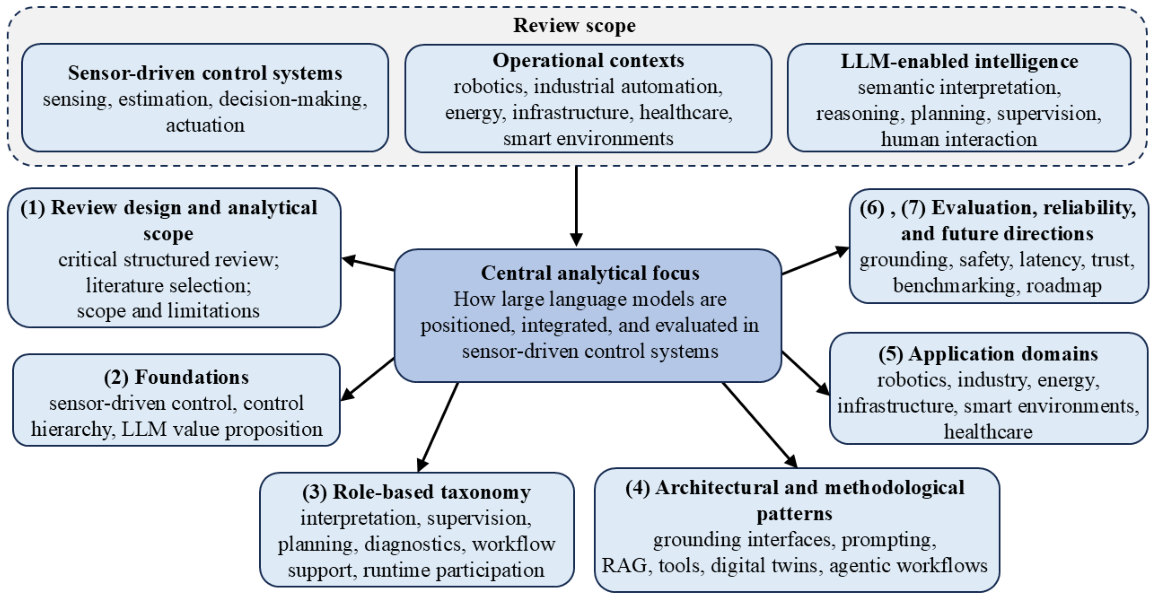
1.3. Review Design and Analytical Scope
1.4. Main Contributions of the Review
2. Foundations: Sensor-Driven Control in the LLM Era
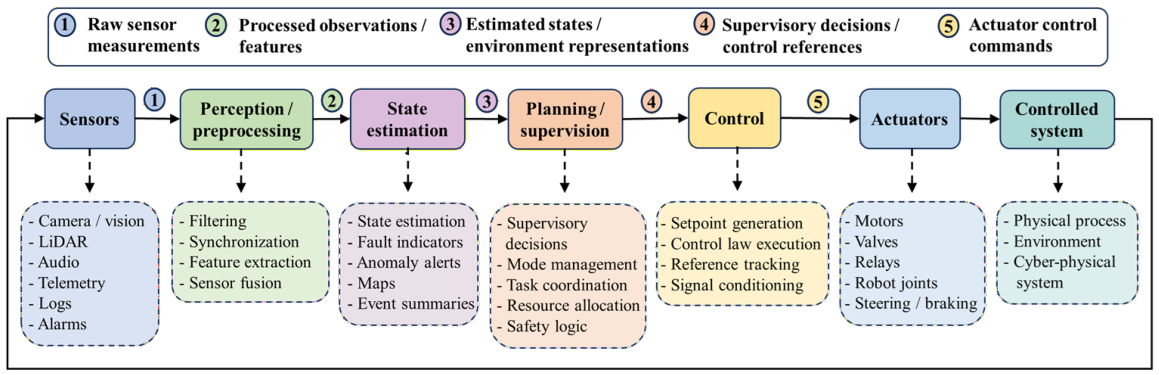
2.1. The Sensing–Estimation–Planning–Control–Actuation Cycle
2.2. Control Hierarchies
2.3. What LLMs Add
2.4. Guiding Perspective
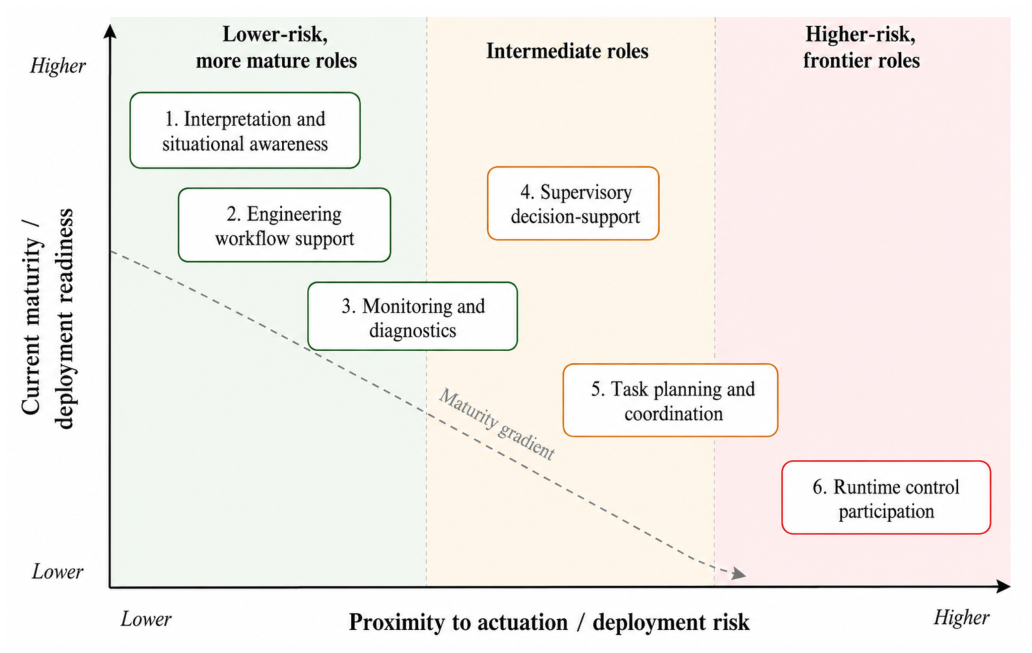
3. A Taxonomy of LLM Roles
- Proximity to actuation—how directly the LLM’s outputs influence physical system behavior;
- Grounding demand—the degree to which outputs must remain tightly linked to sensor data and system state;
- Deployment risk—the potential consequences of errors, hallucinations, latency, or misinterpretation [37].
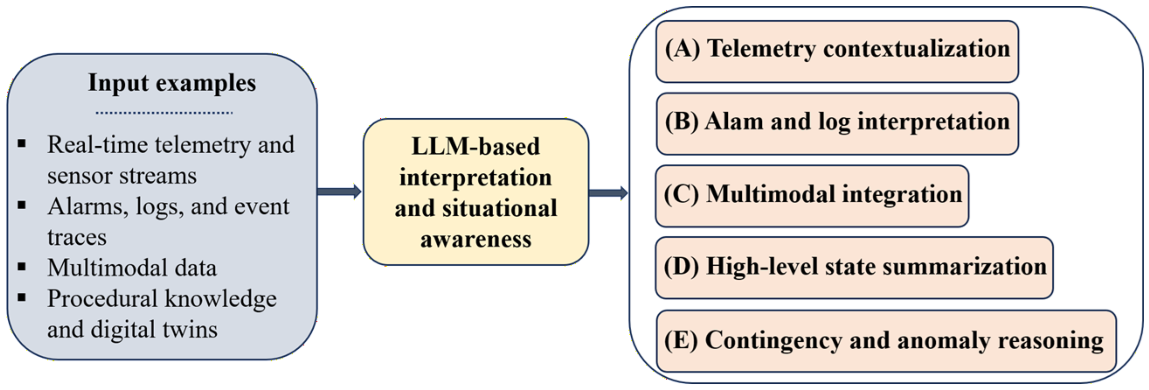
3.1. Interpretation and Situational Awareness
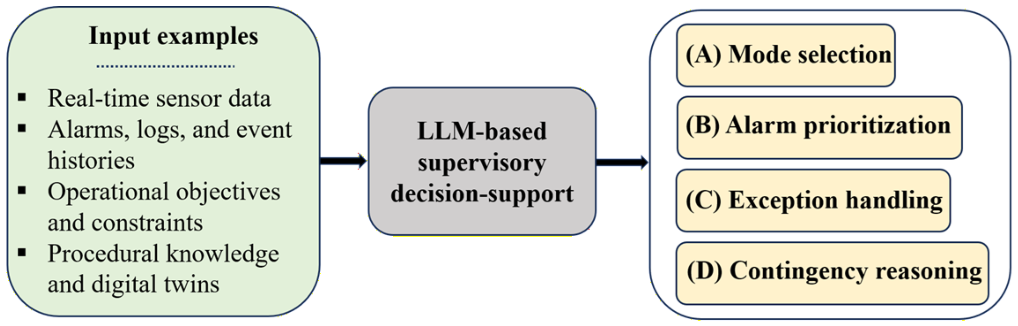
3.2. Supervisory Decision-Support
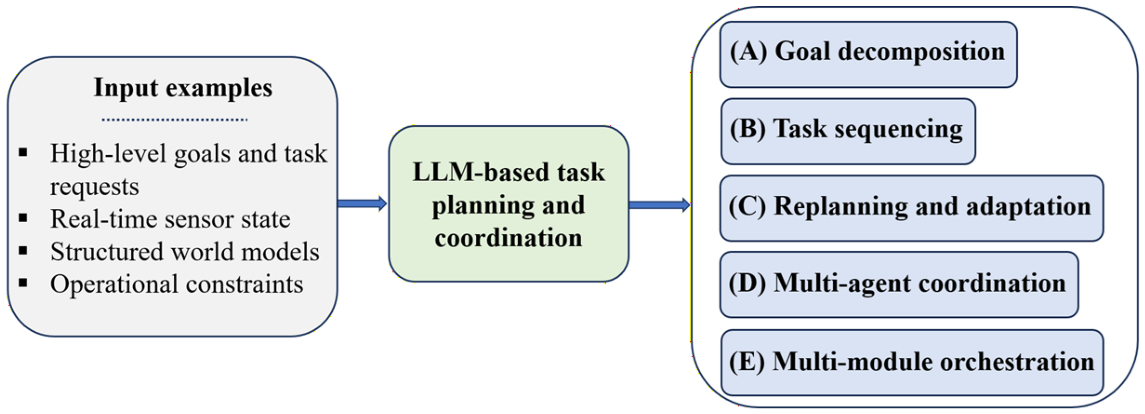
3.3. Task Planning and Coordination
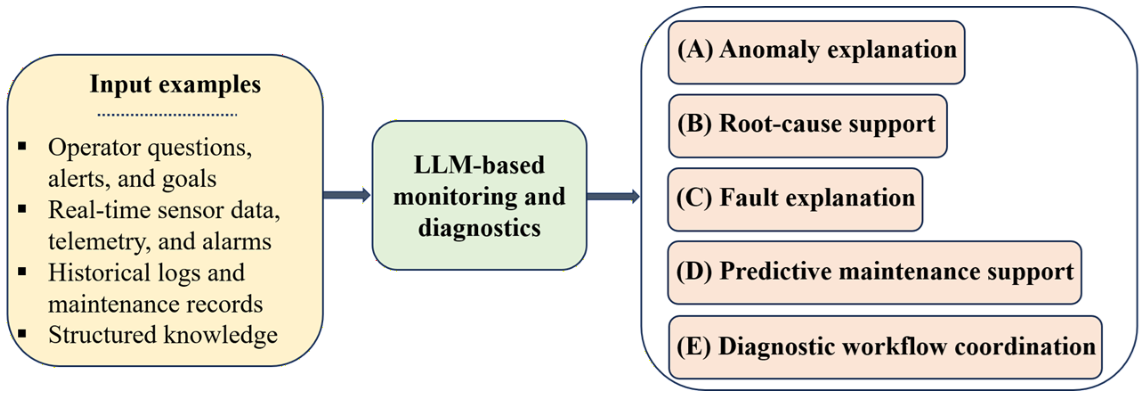
3.4. Monitoring and Diagnostics
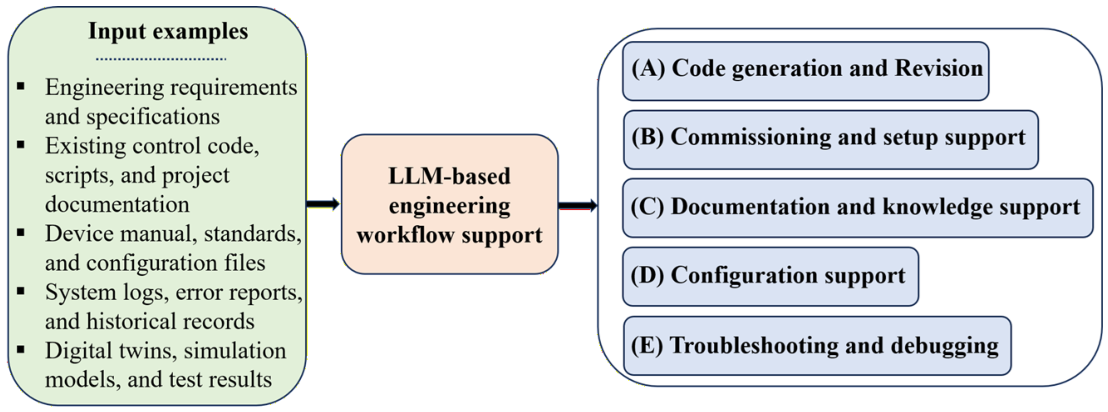
3.5. Engineering Workflow Support
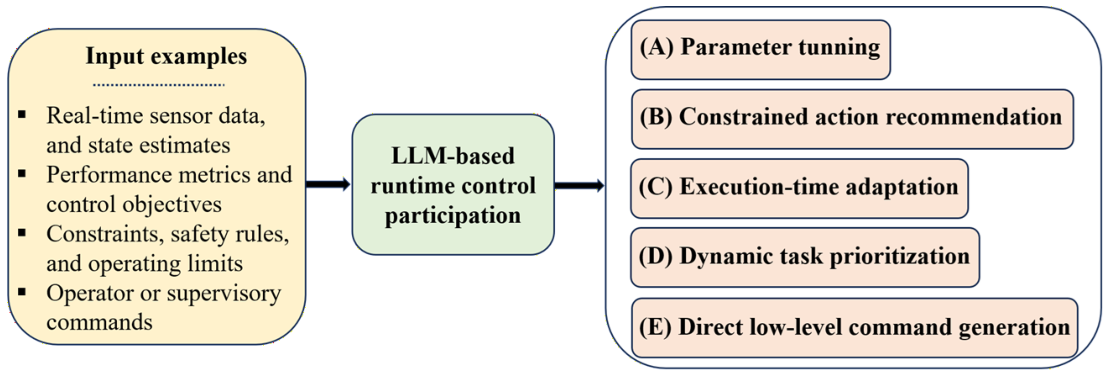
3.6. Runtime Control Participation
3.7. Comparative Synthesis
4. Architectural and Methodological Integration Patterns
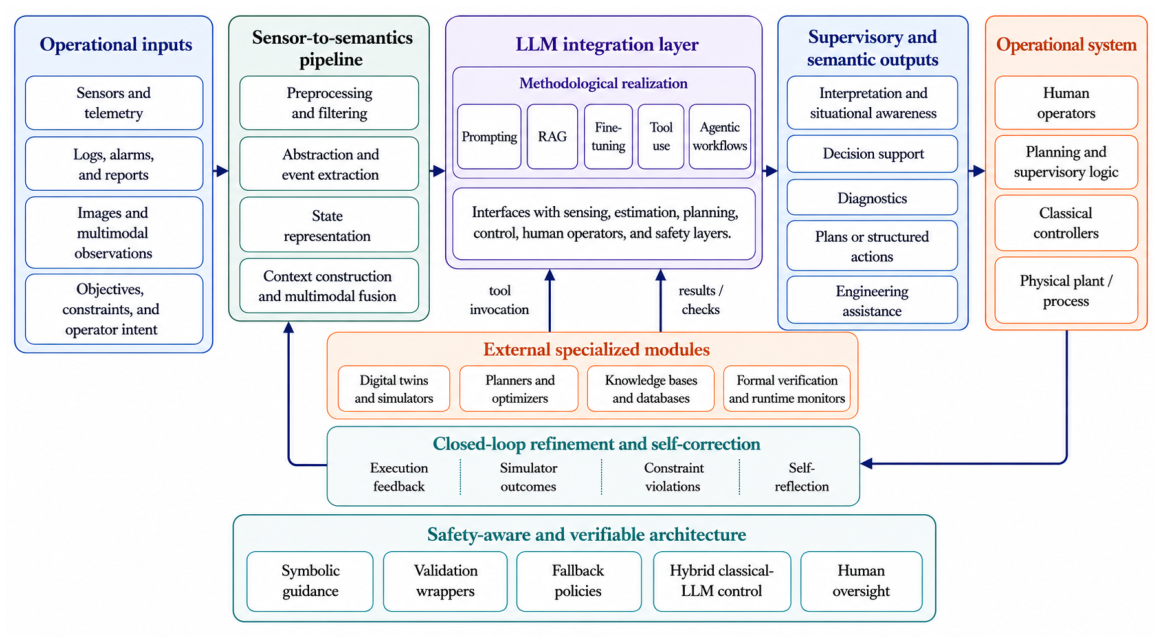
4.1. Architectural Placement
- Sensing layer: LLMs are rarely applied directly to raw sensor streams. Instead, they typically operate downstream of preprocessing, fusion, or abstraction layers, consuming structured representations such as state summaries, scene graphs, alarm groups, or event descriptions [39].
- State estimation and representation: Placement after estimation modules enables the LLM to reason over coherent, higher-level system states, improving interpretability while reducing sensitivity to noisy or incomplete observations [39].
- Control loops: Most credible architectures keep LLMs outside fast inner control loops. Direct insertion into timing-critical loops is generally avoided because these layers require determinism, low latency, numerical reliability, and formal guarantees [37].
- Digital twins and external modules: Positioning the LLM alongside simulators, planners, optimizers, databases, and verification tools enables it to function as an orchestration layer that queries, interprets, and integrates outputs from specialized components [36].
- Human operators and safety layers: In supervisory systems, the LLM often mediates between technical subsystems and human users. Robust designs place safety filters, validation wrappers, fallback policies, and human approval mechanisms between LLM outputs and physical execution [37].
4.2. Interoperability with Legacy Automation and Control Infrastructure
4.3. Sensor-to-Semantics Pipeline
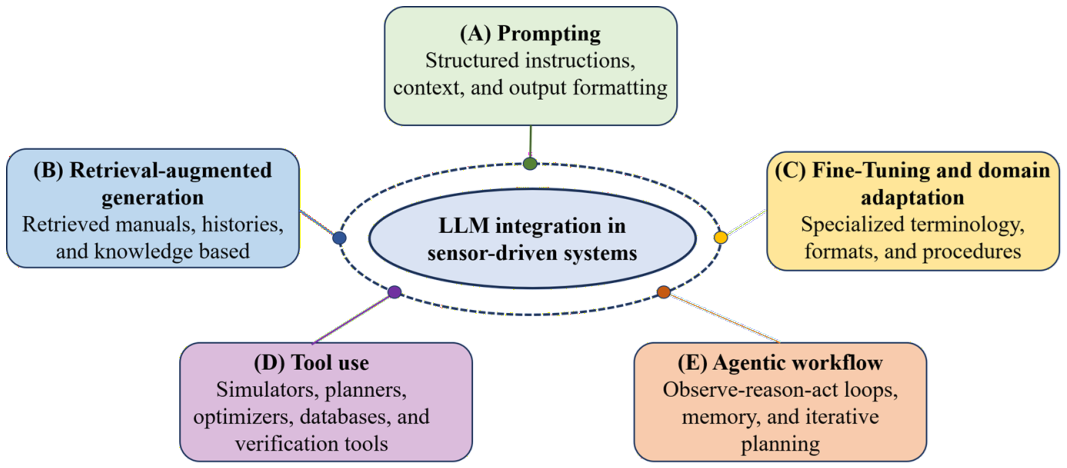
4.4. Methodological Realization
4.5. Tool-Augmented and Hybrid Integration
- Simulators and digital twins: These modules allow candidate actions, plans, or predictions to be evaluated in virtual environments before real-world execution. This improves grounding and reduces operational risk by linking language-based reasoning to plant- or mission-specific models [82].
- Planners and optimization engines: The LLM can formulate problems, decompose goals, and interpret constraints, while feasible plans or optimized solutions are generated by classical planners and solvers. This preserves the strengths of formal methods while using the LLM for semantic flexibility [45].
- Formal verification and runtime monitoring tools: In safety-critical applications, LLM outputs can be checked by rule engines, constraint validators, runtime monitors, or formal verifiers. These components can reject unsafe suggestions, request reformulation, or enforce operational boundaries [37].
4.6. Closed-Loop Refinement and Self-Correction
4.7. Safety-Aware and Verifiable Architectures
5. Representative Application Domains
5.1. Robotics and Embodied AI
5.2. Industrial Automation
5.3. Energy and Infrastructure
5.4. Smart Environments and Healthcare
5.5. Cross-Domain Diagnosis and Monitoring
5.6. Practical Deployment-Oriented Cases
6. Evaluation Frameworks and Reliability Gaps
6.1. Layered Evaluation
6.2. Operational Metrics
6.3. Control-Engineering Implications for Sensor-Driven LLM-Enabled Systems
6.4. Primary Bottlenecks
6.5. Security and Trust
6.6. Benchmarking Needs
7. Future Directions
- Neuro-symbolic and physics-aware integration: Future systems should connect language-based reasoning with symbolic constraints, physics models, control-theoretic principles, and verified decision structures. This is essential for reducing the gap between fluent language outputs and physically valid behavior.
- Grounded and hybrid architectures: LLMs should be embedded within architectures that use structured state representations, digital twins, tool use, safety wrappers, and classical planning or control components. Such designs allow LLMs to provide semantic flexibility while preserving physical reliability and operational constraints.
- Energy-aware edge and local deployment: Practical deployment will require compact, domain-adapted, and energy-efficient models that can operate under the latency, memory, bandwidth, and power constraints of embedded sensors, edge devices, industrial controllers, wearable systems, healthcare monitors, and infrastructure nodes. Future research should investigate quantization, pruning, distillation, retrieval-efficient architectures, adaptive model selection, caching, edge-cloud partitioning, and event-triggered LLM invocation, where the model is activated only when anomalies, uncertainty, operator queries, or supervisory decisions require semantic reasoning. Evaluation should report computational cost, energy use, inference latency, and communication overhead alongside task performance.
- Human-centered autonomy: Future systems should provide traceable reasoning, audit-ready explanations, calibrated uncertainty, and a clear division of authority between LLMs and human operators. These features are necessary for appropriate trust, accountability, and safe supervisory use.
- Evaluation culture: The field needs benchmarks that go beyond language fluency or isolated task success. Evaluation should reflect sensing realism, operational logic, timing constraints, human oversight, safety requirements, and deployment conditions.
8. Conclusions
Author Contributions
Funding
Institutional Review Board Statement
Informed Consent Statement
Data Availability Statement
Acknowledgments
Conflicts of Interest
References
- Rodríguez-Martínez, E.A.; Flores-Fuentes, W.; Achakir, F.; Sergiyenko, O.; Murrieta-Rico, F.N. Vision-based navigation and perception for autonomous robots: Sensors, SLAM, control strategies, and cross-domain applications—A review. Eng 2025, 6, 153. [Google Scholar] [CrossRef]
- Oks, S.J.; Jalowski, M.; Lechner, M.; Mirschberger, S.; Merklein, M.; Vogel-Heuser, B.; Möslein, K.M. Cyber-physical systems in the context of industry 4.0: A review, categorization and outlook. Inf. Syst. Front. 2024, 26, 1731–1772. [Google Scholar]
- Morales, R.; Fernández-Caballero, A.; Somolinos, J.A.; Sira-Ramírez, H. Integration of Sensors in Control and Automation Systems 2020. J. Sens. 2022, 2022, 9765679. [Google Scholar] [CrossRef]
- Ding, D.; Han, Q.L.; Wang, Z.; Ge, X. A survey on model-based distributed control and filtering for industrial cyber-physical systems. IEEE Trans. Ind. Inform. 2019, 15, 2483–2499. [Google Scholar] [CrossRef]
- Naveed, H.; Khan, A.U.; Qiu, S.; Saqib, M.; Anwar, S.; Usman, M.; Akhtar, N.; Barnes, N.; Mian, A. A comprehensive overview of large language models. ACM Trans. Intell. Syst. Technol. 2025, 16, 1–72. [Google Scholar] [CrossRef]
- Chang, Y.; Wang, X.; Wang, J.; Wu, Y.; Yang, L.; Zhu, K.; Chen, H.; Yi, X.; Wang, C.; Wang, Y.; et al. A survey on evaluation of large language models. ACM Trans. Intell. Syst. Technol. 2024, 15, 1–45. [Google Scholar] [CrossRef]
- Guan, S.; Wang, J.; Bian, J.; Zhu, B.; Lou, J.G.; Xiong, H. Evaluating llm-based agents for multi-turn conversations: A survey. ACM Trans. Intell. Syst. Technol. 2026, 17, 1–40. [Google Scholar] [CrossRef]
- Rojas, L.; Hernandez, B.; Garcia, J. A systematic review of intelligent agents, language models, and recurrent neural networks in industrial maintenance: Driving value creation for the mining sector. Int. J. Intell. Syst. 2025, 2025, 9953223. [Google Scholar] [CrossRef]
- Han, X.; Chen, S.; Fu, Z.; Feng, Z.; Fan, L.; An, D.; Wang, C.; Guo, L.; Meng, W.; Zhang, X.; et al. Multimodal fusion and vision-language models: A survey for robot vision. Inf. Fusion 2025, 126, 103652. [Google Scholar]
- Zhang, Z.; Dai, Q.; Bo, X.; Ma, C.; Li, R.; Chen, X.; Zhu, J.; Dong, Z.; Wen, J.R. A survey on the memory mechanism of large language model-based agents. ACM Trans. Inf. Syst. 2025, 43, 1–47. [Google Scholar] [CrossRef]
- Liu, M.; Zhang, L.; Chen, J.; Chen, W.A.; Yang, Z.; Lo, L.J.; Wen, J.; O’Neill, Z. Large language models for building energy applications: Opportunities and challenges. Build. Simul. 2025, 18, 225–234. [Google Scholar] [CrossRef]
- Wang, J.; Shi, E.; Hu, H.; Ma, C.; Liu, Y.; Wang, X.; Yao, Y.; Liu, X.; Ge, B.; Zhang, S. Large Language Models for Robotics: Opportunities, Challenges, and Perspectives. J. Autom. Intell. 2025, 4, 52–64. [Google Scholar] [CrossRef]
- Wang, M.; Niu, Y.; Wang, B.; Zhang, W.; Wang, C. A survey on learning motion planning and control for mobile robots: Toward embodied intelligence. IEEE Trans. Neural Netw. Learn. Syst. 2026, 1–21. [Google Scholar] [CrossRef] [PubMed]
- Gao, C.; Lan, X.; Li, N.; Yuan, Y.; Ding, J.; Zhou, Z.; Xu, F.; Li, Y. Large language models empowered agent-based modeling and simulation: A survey and perspectives. Humanit. Soc. Sci. Commun. 2024, 11, 1–24. [Google Scholar] [CrossRef]
- Qu, C.; Dai, S.; Wei, X.; Cai, H.; Wang, S.; Yin, D.; Xu, J.; Wen, J.R. Tool learning with large language models: A survey. Front. Comput. Sci. 2025, 19, 198343. [Google Scholar] [CrossRef]
- Zhang, C.; Chen, J.; Li, J.; Peng, Y.; Mao, Z. Large language models for human–robot interaction: A review. Biomim. Intell. Robot. 2023, 3, 100131. [Google Scholar] [CrossRef]
- Wang, L.; Ma, C.; Feng, X.; Zhang, Z.; Yang, H.; Zhang, J.; Chen, Z.; Tang, J.; Chen, X.; Lin, Y.; et al. A survey on large language model based autonomous agents. Front. Comput. Sci. 2024, 18, 186345. [Google Scholar] [CrossRef]
- Sun, Y.; Zhang, Q.; Bao, J.; Lu, Y.; Liu, S. Empowering digital twins with large language models for global temporal feature learning. J. Manuf. Syst. 2024, 74, 83–99. [Google Scholar] [CrossRef]
- Wu, D.; Zheng, P.; Zhao, Q.; Zhang, S.; Qi, J.; Hu, J.; Zhu, G.N.; Wang, L. Empowering natural human–robot collaboration through multimodal language models and spatial intelligence: Pathways and perspectives. Robot. Comput.-Integr. Manuf. 2026, 97, 103064. [Google Scholar] [CrossRef]
- Xu, Q.; Wen, G.; Lei, Z.; Gu, S.; Su, Y.; Zhang, Z.; Chen, X. Deep digital twin-powered large vision-language model for multi-scenario industrial fault diagnosis. Adv. Eng. Inform. 2026, 69, 103997. [Google Scholar] [CrossRef]
- Yang, Y.; Yang, Q.; Li, D.; Liu, S.; Jin, B.; Sun, L. Large language model-driven rule synthesis for adaptive home energy management. Cyber-Phys. Energy Syst. 2026, 2, 90–98. [Google Scholar] [CrossRef]
- Senisetty, M.; Kiran, P. Hybrid AI Framework for Smart Grid Energy Management using Large Language Models and Deep Learning Techniques. J. Comput. Appl. Math. 2026, 483, 117395. [Google Scholar] [CrossRef]
- Meng, X.; Liao, H.; Liu, G.; Ma, H.; Cheng, Y.; Wang, X.; Zhao, J.; Dong, Z. Enhancing information sensing of load forecasting in cyber-physical-social systems: An approach with large language model. CSEE J. Power Energy Syst. 2026, 12, 599–608. [Google Scholar]
- Aghzal, M.; Plaku, E.; Stein, G.J.; Yao, Z. A survey on large language models for automated planning. arXiv 2025, arXiv:2502.12435. [Google Scholar]
- Yin, S.; Fu, C.; Zhao, S.; Li, K.; Sun, X.; Xu, T.; Chen, E. A survey on multimodal large language models. Natl. Sci. Rev. 2024, 11, nwae403. [Google Scholar] [CrossRef] [PubMed]
- Sultan, B.; Apvrille, L. TTool-AI: A Large Language Model-Based Assistant for Model Driven Engineering. SN Comput. Sci. 2025, 6, 886. [Google Scholar] [CrossRef]
- Zhou, S.; Xu, Z.; Zhang, M.; Xu, C.; Guo, Y.; Zhan, Z.; Fang, Y.; Ding, S.; Wang, J.; Xu, K.; et al. Large language models for disease diagnosis: A scoping review. Npj Artif. Intell. 2025, 1, 9. [Google Scholar] [CrossRef] [PubMed]
- Agweyu, A.; Mwaniki, P.; Musau, W.; Korom, R.; Isaaka, L.; Wanyama, C.; Kiptinness, S.; Adan, N.; Emmanuel-Fabula, M.; Mateen, B.A. Safety of a large language model-based clinical decision support system in African primary healthcare. Nat. Health 2026, 1, 607–618. [Google Scholar] [CrossRef] [PubMed]
- Li, J.; Li, J.; Yang, G.; Yang, L.; Chi, H.; Yang, L. Applications of large language models and multimodal large models in autonomous driving: A comprehensive review. Drones 2025, 9, 238. [Google Scholar] [CrossRef]
- Kim, Y.; Kim, D.; Choi, J.; Park, J.; Oh, N.; Park, D. A Survey on Integration of Large Language Models with Intelligent Robots. Intell. Serv. Robot. 2024, 17, 1091–1107. [Google Scholar] [CrossRef]
- Liu, J.; Zhuan, X.; Shang, L.; Su, S.; Xie, Q. The hierarchical structure and control signal transmission of microgrid hierarchical control: A review. IET Power Electron. 2025, 18, e70057. [Google Scholar] [CrossRef]
- Schwenzer, M.; Ay, M.; Bergs, T.; Abel, D. Review on model predictive control: An engineering perspective. Int. J. Adv. Manuf. Technol. 2021, 117, 1327–1349. [Google Scholar] [CrossRef]
- Aghaee, F.; Shaker, H.R. RB-LLM Control: An Intelligent Control Framework with Rule-Based Large Language Model Decision-Making. Aerosp. Sci. Technol. 2025, 168, 111259. [Google Scholar]
- Wu, Y.; Tao, Y.; Li, P.; Shi, G.; Sukhatme, G.S.; Kumar, V.; Zhou, L. Hierarchical llms in-the-loop optimization for real-time multi-robot target tracking under unknown hazards. In Proceedings of the 2025 IEEE International Symposium on Multi-Robot and Multi-Agent Systems (MRS); IEEE: New York, NY, USA, 2025; pp. 1–7. [Google Scholar]
- Zeng, F.; Gan, W.; Wang, Y.; Liu, N.; Yu, P.S. Large language models for robotics: A survey. arXiv 2023, arXiv:2311.07226. [Google Scholar]
- Xia, Y.; Jazdi, N.; Weyrich, M. Applying Large Language Models for intelligent industrial automation. ATP Mag. 2024, 66, 62–71. [Google Scholar] [CrossRef]
- Huang, X.; Chen, T.; Bryson, M.; Chaffey, T.; Chen, H.; Choo, K.K.R.; Manchester, I.R. Trust in LLM-controlled Robotics: A Survey of Security Threats, Defenses and Challenges. arXiv 2025, arXiv:2601.02377. [Google Scholar]
- Hou, X.; Wang, W.; Yang, L.; Lin, H.; Feng, J.; Min, H.; Zhao, X. Driveagent: Multi-agent structured reasoning with llm and multimodal sensor fusion for autonomous driving. IEEE Robot. Autom. Lett. 2025, 10, 12189–12196. [Google Scholar] [CrossRef]
- Cui, Y.; Huang, S.; Zhong, J.; Liu, Z.; Wang, Y.; Sun, C.; Li, B.; Wang, X.; Khajepour, A. Drivellm: Charting the path toward full autonomous driving with large language models. IEEE Trans. Intell. Veh. 2023, 9, 1450–1464. [Google Scholar] [CrossRef]
- Christensen, K.A.; Gusev, A.; Tufte, A.G.; Alsos, O.A.; Steinert, M. AI Captain: Conversational mission planning and execution system for autonomous surface vehicles. Ocean Eng. 2025, 338, 121988. [Google Scholar] [CrossRef]
- Gautam, A.; Aryal, M.R.; Deshpande, S.; Padalkar, S.; Nikolaenko, M.; Tang, M.; Anand, S. IIoT-enabled digital twin for legacy and smart factory machines with LLM integration. J. Manuf. Syst. 2025, 80, 511–523. [Google Scholar] [CrossRef]
- Rana, K.; Haviland, J.; Garg, S.; Abou-Chakra, J.; Reid, I.; Sünderhauf, N. SayPlan: Grounding Large Language Models Using 3D Scene Graphs for Scalable Robot Task Planning. In Proceedings of the 7th Conference on Robot Learning (CoRL); PMLR: Cambridge, MA, USA, 2023. [Google Scholar]
- Xu, J.; Zhang, Q.; Zhong, Z.; He, S.; Zhang, C.; Lin, Q.; Pei, D.; He, P.; Zhang, D.; Zhang, Q. Openrca: Can large language models locate the root cause of software failures? In Proceedings of the Thirteenth International Conference on Learning Representations; ICLR: Appleton, WI, USA, 2025. [Google Scholar]
- Tang, J.; Peng, S.; Guo, J.; Song, D.; Gao, D.; Liu, W.; Wang, F. DT and LLM driven intelligent maintenance system for L-DED and DAG-based LLM fault diagnosis evaluation framework. Appl. Soft Comput. 2025, 185, 113942. [Google Scholar] [CrossRef]
- Liu, Z.; Zeng, R.; Wang, D.; Peng, G.; Liu, X.; Liu, Q.; Liu, P.; Wang, W.; Wang, J. Agents4plc: Automating closed-loop plc code generation and verification in industrial control systems using llm-based agents. IEEE Trans. Softw. Eng. 2026, 52, 1672–1687. [Google Scholar] [CrossRef]
- Arif, T.M.; Rahim, M.A. Agentic AI for Real-Time Adaptive PID Control of a Servo Motor. Actuators 2025, 14, 459. [Google Scholar] [CrossRef]
- Zeng, T.; Zhang, Y. Large language model-augmented model predictive control for marine vessels in uncertain marine environments. Ocean Eng. 2026, 346, 123628. [Google Scholar] [CrossRef]
- De la Cruz Cabello, M.; Sales, T.P.; Machado, M.R. AIOps for log anomaly detection in the era of LLMs: A systematic literature review. Intell. Syst. Appl. 2025, 28, 200608. [Google Scholar] [CrossRef]
- Cui, E.; Wang, W.; Li, Z.; Xie, J.; Zou, H.; Deng, H.; Luo, G.; Lu, L.; Zhu, X.; Dai, J. DriveMLM: Aligning multi-modal large language models with behavioral planning states for autonomous driving. Vis. Intell. 2025, 3, 22. [Google Scholar] [CrossRef]
- Wang, J.; Tong, J.; Tan, K.; Vorobeychik, Y.; Kantaros, Y. Conformal temporal logic planning using large language models. In ACM Transactions on Cyber-Physical Systems; Association for Computing Machinery: New York, NY, USA, 2023. [Google Scholar]
- Song, S.; Kang, D.; Park, C.E. Safety-Aware Optimal Control With Language-Guided Online Parameter Adjustment via Large Language Models. IEEE Access 2026, 14, 25551–25563. [Google Scholar] [CrossRef]
- Xia, Y.; Jazdi, N.; Zhang, J.; Shah, C.; Weyrich, M. Control Industrial Automation System with Large Language Model Agents. In Proceedings of the 2025 IEEE 30th International Conference on Emerging Technologies and Factory Automation (ETFA); IEEE: New York, NY, USA, 2025; pp. 1–8. [Google Scholar]
- Mandi, Z.; Jain, S.; Song, S. Roco: Dialectic multi-robot collaboration with large language models. In Proceedings of the 2024 IEEE International Conference on Robotics and Automation (ICRA); IEEE: New York, NY, USA, 2024; pp. 286–299. [Google Scholar]
- Zhang, Z.; Tang, S.; Zhang, Y.; Fu, T.; Wang, Y.; Liu, Y.; Wang, D.; Shao, J.; Wang, L.; Lu, H. Ad-h: Autonomous driving with hierarchical agents. arXiv 2024, arXiv:2406.03474. [Google Scholar]
- Bajestani, M.S.; Mun, D.; Kim, D.B. Human-in-the-loop and large language models in smart manufacturing: Current applications, challenges, and perspectives. J. Manuf. Syst. 2026, 86, 913–941. [Google Scholar] [CrossRef]
- Wang, B.; Zheng, L.; Wang, Y.; Qi, Z. LLM-based multi-agent task planning for human-robot collaborative assembly balancing operator experience and efficiency. J. Manuf. Syst. 2025, 82, 1020–1045. [Google Scholar] [CrossRef]
- Su, X.; Xu, J.; van Kaick, O.; Xu, K.; Hu, R. IMR-LLM: Industrial Multi-Robot Task Planning and Program Generation using Large Language Models. arXiv 2026, arXiv:2603.02669. [Google Scholar]
- Meng, Y.; Chen, F.; Chen, Y.; Fan, C. Audere: Automated strategy decision and realization in robot planning and control via llms. arXiv 2025, arXiv:2504.03015. [Google Scholar]
- Chalvatzaki, G.; Younes, A.; Nandha, D.; Le, A.T.; Ribeiro, L.F.; Gurevych, I. Learning to reason over scene graphs: A case study of fine tuning gpt-2 into a robot language model for grounded task planning. Front. Robot. AI 2023, 10, 1221739. [Google Scholar] [CrossRef] [PubMed]
- Lim, J.; Zhao, J.; Hernandez, E.; Kovalenko, I. Adaptive task planning and coordination in multi-agent manufacturing systems using large language models. Robot. Comput.-Integr. Manuf. 2026, 100, 103245. [Google Scholar] [CrossRef]
- Kannan, S.S.; Venkatesh, V.L.; Min, B.C. Smart-llm: Smart multi-agent robot task planning using large language models. In Proceedings of the 2024 IEEE/RSJ International Conference on Intelligent Robots and Systems (IROS); IEEE: New York, NY, USA, 2024; pp. 12140–12147. [Google Scholar]
- Zhu, Y.; Chen, J.; Zhang, X.; Guo, M.; Li, Z. DEXTER-LLM: Dynamic and Explainable Coordination of Multi-Robot Systems in Unknown Environments via Large Language Models. In Proceedings of the 2025 IEEE/RSJ International Conference on Intelligent Robots and Systems (IROS); IEEE: New York, NY, USA, 2025; pp. 10182–10189. [Google Scholar]
- Yang, T.; Feng, P.; Guo, Q.; Zhang, J.; Zhang, X.; Ning, J.; Wang, X.; Mao, Z. AutoHMA-LLM: Efficient task coordination and execution in heterogeneous multi-agent systems using hybrid large language models. IEEE Trans. Cogn. Commun. Netw. 2025, 11, 987–998. [Google Scholar] [CrossRef]
- Chen, X.; Lei, Y.; Li, Y.; Parkinson, S.; Li, X.; Liu, J.; Lu, F.; Wang, H.; Wang, Z.; Yang, B.; et al. Large models for machine monitoring and fault diagnostics: Opportunities, challenges, and future direction. J. Dyn. Monit. Diagn. 2025, 4, 76–90. [Google Scholar]
- Liu, Y.; Zhou, Y.; Liu, Y.; Xu, Z.; He, Y. Intelligent fault diagnosis for CNC through the integration of large language models and domain knowledge graphs. Engineering 2025, 53, 311–322. [Google Scholar] [CrossRef]
- Lin, L.; Zhang, S.; Fu, S.; Liu, Y. FD-LLM: Large language model for fault diagnosis of complex equipment. Adv. Eng. Inform. 2025, 65, 103208. [Google Scholar] [CrossRef]
- Tran, N.P.; Jaumard, B.; Delgado, O.; Glatard, T.; Premkumar, K.; Ni, K. LLM-Augmented Knowledge Base Construction for Root Cause Analysis. IEEE Access 2026, 14, 16802–16816. [Google Scholar] [CrossRef]
- Ismail, L.; Abdelmoti, A.; Basu, A.; Berini, A.D.E.; Naouss, M. A Systematic Review of Digital Twin-Driven Predictive Maintenance in Industrial Engineering: Taxonomy, Architectural Elements, and Future Research Directions. arXiv 2025, arXiv:2509.24443. [Google Scholar]
- Di Maggio, L.G. Toward Autonomous LLM-Based AI Agents for Predictive Maintenance: State of the Art, Challenges, and Future Perspectives. Appl. Sci. 2025, 15, 11515. [Google Scholar] [CrossRef]
- Chen, W.; Li, G.; Li, M.; Wang, W.; Li, P.; Xue, X.; Zhao, X.; Liu, L. LLM-enabled incremental learning framework for hand exoskeleton control. IEEE Trans. Autom. Sci. Eng. 2024, 22, 2617–2626. [Google Scholar] [CrossRef]
- Men, C.; Han, Y.; Wang, P.; Tao, J.; Huang, C.G. The interpretable reasoning and intelligent decision-making based on event knowledge graph with LLMs in fault diagnosis scenarios. IEEE Trans. Instrum. Meas. 2025, 74, 3520516. [Google Scholar] [CrossRef]
- Young-Hoon, L.; Taemin, N.; Deun-Sol, C.; Won-Tae, K. LLM-Based Adaptive Control Code Generation Framework with Digital Twin-Integrated Verification for Heterogeneous Robot Systems. Appl. Sci. 2026, 16, 3883. [Google Scholar] [CrossRef]
- Yoon, G.; Lee, S.; Sim, J.Y. ModuLoop: Low-Level Code Generation Using Modular Synthesizer and Closed-Loop Debugger for Robotic Control. IEEE Robot. Autom. Lett. 2025, 10, 12812–12819. [Google Scholar] [CrossRef]
- Löwhagen, N.; Schwendener, P.; Netland, T. Can a troubleshooting AI assistant improve task performance in industrial contexts? Int. J. Prod. Res. 2025, 1–22. [Google Scholar] [CrossRef]
- Jeong, Y.; Kober, C.; Fette, M. Integrating Large Language Models and Digital Twins in Manufacturing: Opportunities and Challenges for Production Logistics and Assembly Environments. In Proceedings of the IFIP International Conference on Advances in Production Management Systems; Springer: Cham, Switzerland, 2025; pp. 528–542. [Google Scholar]
- Yan, Z.; Zhou, H.; Pei, J.; Tabassum, H. Hierarchical and collaborative LLM-based control for multi-UAV motion and communication in integrated terrestrial and non-terrestrial networks. arXiv 2025, arXiv:2506.06532. [Google Scholar]
- Kwon, T.; Di Palo, N.; Johns, E. Language models as zero-shot trajectory generators. IEEE Robot. Autom. Lett. 2024, 9, 6728–6735. [Google Scholar] [CrossRef]
- Baumann, N.; Hu, C.; Sivasothilingam, P.; Qin, H.; Xie, L.; Magno, M.; Benini, L. Enhancing autonomous driving systems with on-board deployed large language models. arXiv 2025, arXiv:2504.11514. [Google Scholar]
- González-Potes, A.; Martínez-Castro, D.; Paredes, C.M.; Ochoa-Brust, A.; Mena, L.J.; Martínez-Peláez, R.; Félix, V.G.; Félix-Cuadras, R.A. Hybrid AI and LLM-Enabled Agent-Based Real-Time Decision Support Architecture for Industrial Batch Processes: A Clean-in-Place Case Study. AI 2026, 7, 51. [Google Scholar] [CrossRef]
- Liu, G.; Tang, Y.; Guo, W.; Dang, J. Redesigning Power Grid Dispatching Automation Systems by Integrating LLMs, KGs, and AI Agents. CSEE J. Power Energy Syst. 2025, 11, 2610–2622. [Google Scholar]
- Aghaee, F. Intelligent and Robust Control of UAV Systems with Uncertain Dynamics: From Slung-Load Transport to LLM-Driven Multi-Agent Coordination. Ph.D. Thesis, University of Southern Denmark, Odense, Denmark, 2026. [Google Scholar]
- Ndum, Z.N.; Lim, D.; Ford, J.; Adu, S.; Tao, J.; Hassan, Y.; Liu, Y. Large language model-assisted digital twin for remote monitoring and control of advanced reactors. Prog. Nucl. Energy 2026, 192, 106172. [Google Scholar] [CrossRef]
- Zhang, D.; Zhang, X.; Li, J.; Long, T.; Dai, X.; Fu, Y.; Zhang, J.; Ren, J.; Zhang, Y. LLM-Driven Self-Refinement for Embodied Drone Task Planning. arXiv 2025, arXiv:2508.15501. [Google Scholar]
- Yi, G.; Chu, H.; Wen, S.; Wang, F. Enhancing stability and reliability in LLM-driven robotic manipulation through human skill demonstration and visual tracking. Biomim. Intell. Robot. 2026, 100305. [Google Scholar] [CrossRef]
- Li, J.; Zhao, G. T3 Planner: A Self-Correcting LLM Framework for Robotic Motion Planning with Temporal Logic. arXiv 2025, arXiv:2510.16767. [Google Scholar]
- Golani, R.; Gadkari, B.R. Securing LLM-Integrated Critical Infrastructure: A Technical Framework for Industrial Control Systems and IoT. J. Adv. Artif. Intell. 2025, 2, 1–17. [Google Scholar] [CrossRef]
- Ahn, M.; Brohan, A.; Brown, N.; Chebotar, Y.; Cortes, O.; David, B.; Finn, C.; Fu, C.; Gopalakrishnan, K.; Hausman, K.; et al. Do as I can, not as I say: Grounding language in robotic affordances. arXiv 2022, arXiv:2204.01691. [Google Scholar]
- Zitkovich, B.; Yu, T.; Xu, S.; Xu, P.; Xiao, T.; Xia, F.; Wu, J.; Wohlhart, P.; Welker, S.; Wahid, A.; et al. Rt-2: Vision-language-action models transfer web knowledge to robotic control. In Proceedings of the Conference on Robot Learning; PMLR: Cambridge, MA, USA, 2023; pp. 2165–2183. [Google Scholar]
- Mon-Williams, R.; Li, G.; Long, R.; Du, W.; Lucas, C.G. Embodied large language models enable robots to complete complex tasks in unpredictable environments. Nat. Mach. Intell. 2025, 7, 592–601. [Google Scholar] [CrossRef] [PubMed]
- Liu, Y.; Palmieri, L.; Koch, S.; Georgievski, I.; Aiello, M. Delta: Decomposed efficient long-term robot task planning using large language models. In Proceedings of the 2025 IEEE International Conference on Robotics and Automation (ICRA); IEEE: New York, NY, USA, 2025; pp. 10995–11001. [Google Scholar]
- Huang, W.; Wang, C.; Zhang, R.; Li, Y.; Wu, J.; Fei-Fei, L. Voxposer: Composable 3D value maps for robotic manipulation with language models. arXiv 2023, arXiv:2307.05973. [Google Scholar]
- Li, X.; Zhang, M.; Geng, Y.; Geng, H.; Long, Y.; Shen, Y.; Zhang, R.; Liu, J.; Dong, H. Manipllm: Embodied multimodal large language model for object-centric robotic manipulation. In Proceedings of the IEEE/CVF Conference on Computer Vision and Pattern Recognition; IEEE: New York, NY, USA, 2024; pp. 18061–18070. [Google Scholar]
- Li, Y.; Jiang, P.; Chai, C.; Zhang, X.; Liu, C. A framework for robotic manipulation tasks based on multiple zero shot models. Sci. Rep. 2025, 15, 31141. [Google Scholar] [CrossRef] [PubMed]
- Fakih, M.; Dharmaji, R.; Moghaddas, Y.; Quiros, G.; Ogundare, O.; Al Faruque, M.A. Llm4plc: Harnessing large language models for verifiable programming of plcs in industrial control systems. In Proceedings of the 46th International Conference on Software Engineering: Software Engineering in Practice; Association for Computing Machinery: New York, NY, USA, 2024; pp. 192–203. [Google Scholar]
- Chen, C.; Zhao, K.; Leng, J.; Liu, C.; Fan, J.; Zheng, P. Integrating large language model and digital twins in the context of industry 5.0: Framework, challenges and opportunities. Robot. Comput.-Integr. Manuf. 2025, 94, 102982. [Google Scholar] [CrossRef]
- Fan, H.; Chow, E.; Lu, T.; Fuh, J.Y.H.; Lu, W.F.; Li, B. A unified framework for large language model-guided reinforcement learning in digital twin industrial environments. Robot. Comput.-Integr. Manuf. 2026, 99, 103215. [Google Scholar] [CrossRef]
- Kadri, I.; Selouani, S.A.; Ghribi, M.; Ghali, R.; Mekhoukh, S. LLM-driven agent for speech-enabled control of industrial robots: A case study in snow-crab quality inspection. Results Eng. 2025, 27, 106660. [Google Scholar] [CrossRef]
- Tasneem, O.; Pieters, R. Human–robot collaborative visual inspection with Large Language Models. Robot. Comput.-Integr. Manuf. 2026, 98, 103154. [Google Scholar] [CrossRef]
- Zhang, X.; Cheng, Y.; Gui, X.; Zhao, H.; Zhao, J.; Yan, J. Large language model-enhanced home energy management with dynamic user preference elicitation and hierarchical data-sharing. Appl. Energy 2026, 410, 127540. [Google Scholar] [CrossRef]
- Zaboli, A.; Hong, J.; Ştefanov, A.; Liu, C.C.; Hwang, C.S. Large Language Models for Power System Security: A Novel Multi-Modal Approach for Anomaly Detection in Energy Management Systems. IEEE Access 2025, 13, 203558–203585. [Google Scholar] [CrossRef]
- Xu, Y.; Zhu, S.; Cai, J.; Chen, J.; Li, S. A large language model-based platform for real-time building monitoring and occupant interaction. J. Build. Eng. 2025, 100, 111488. [Google Scholar] [CrossRef]
- Feng, Y.; Hu, G.; Zhang, Z. Gpt4battery: An llm-driven framework for adaptive state of health estimation of raw li-ion batteries. arXiv 2024, arXiv:2402.00068. [Google Scholar]
- Zhang, Y.; Saber, A.M.; Youssef, A.; Kundur, D. Grid-Agent: An LLM-Powered Multi-Agent System for Power Grid Control. arXiv 2025, arXiv:2508.05702. [Google Scholar] [CrossRef]
- Madani, S.; Tavasoli, A.; Khoshtarash Astaneh, Z.; Pineau, P.O. Large Language Models Integration in Smart Grids. Energy Rep. 2025, 14, 1562–1577. [Google Scholar] [CrossRef]
- Choi, S.L.; Jain, R.; Emami, P.; Wadsack, K.; Ding, F.; Sun, H.; Gruchalla, K.; Hong, J.; Zhang, H.; Zhu, X.; et al. eGridGPT: Trustworthy AI in the Control Room; Technical Report NREL/TP-5D00-87440; National Renewable Energy Laboratory (NREL): Golden, CO, USA, 2024.
- Zhu, X.; Li, H. Heating, Ventilation, and Air Conditioning (HVAC) Temperature and Humidity Control Optimization Based on Large Language Models (LLMs). Energies 2025, 18, 1813. [Google Scholar] [CrossRef]
- Kim, Y.; Xu, X.; McDuff, D.; Breazeal, C.; Park, H.W. Health-llm: Large language models for health prediction via wearable sensor data. arXiv 2024, arXiv:2401.06866. [Google Scholar]
- Momand, Z.; Mongkolnam, P.; Chan, J.H.; Charoenkitkarn, N. Integrating Sensor Data with Large Language Models for Enhanced Elderly Care: A Methodological Framework. Sens. Mater. 2025, 37. [Google Scholar] [CrossRef]
- Blavette, L.; Dacunha, S.; Alameda-Pineda, X.; Cattoni, J.; Rigaud, A.S.; Pino, M. Integrating a Large Language Model Into a Socially Assistive Robot in a Hospital Geriatric Unit: Two-Wave Comparative Study on Performance, Engagement, and User Perceptions. JMIR Hum. Factors 2025, 12, e81936. [Google Scholar] [CrossRef] [PubMed]
- Song, Y.; Li, J.; Bian, Y.; Cai, Z. Predicting user behavior in smart spaces with LLM-enhanced logs and personalized prompts. Proc. Aaai Conf. Artif. Intell. 2025, 39, 764–772. [Google Scholar] [CrossRef]
- QAID, H.A.A.; Zhang, B.; Su, S.; Li, D.; Ng, S.K.; Li, W. Large Language Models for Explainable Fault Diagnosis of Machines. SSRN 2026, 5404598. [Google Scholar] [CrossRef]
- Li, Y.; Cheng, G.; Zhao, J.; Liu, Y. In-context learning enhanced large language model for robust distribution system state estimation. Appl. Energy 2026, 407, 127344. [Google Scholar] [CrossRef]
- Li, M.; Zhao, S.; Wang, Q.; Wang, K.; Zhou, Y.; Srivastava, S.; Gokmen, C.; Lee, T.; Li, L.E.; Zhang, R.; et al. Embodied agent interface: Benchmarking llms for embodied decision making. Adv. Neural Inf. Process. Syst. 2024, 37, 100428–100534. [Google Scholar] [CrossRef]
- Downs, J.J.; Vogel, E.F. A plant-wide industrial process control problem. Comput. Chem. Eng. 1993, 17, 245–255. [Google Scholar] [CrossRef]
- Mathur, A.P.; Tippenhauer, N.O. SWaT: A water treatment testbed for research and training on ICS security. In Proceedings of the 2016 International Workshop on Cyber-Physical Systems for Smart Water Networks (CySWater); IEEE: New York, NY, USA, 2016; pp. 31–36. [Google Scholar]
- Saxena, A.; Goebel, K.; Simon, D.; Eklund, N. Damage propagation modeling for aircraft engine run-to-failure simulation. In Proceedings of the 2008 International Conference on Prognostics and Health Management; IEEE: New York, NY, USA, 2008; pp. 1–9. [Google Scholar]
- Caesar, H.; Bankiti, V.; Lang, A.H.; Vora, S.; Liong, V.E.; Xu, Q.; Krishnan, A.; Pan, Y.; Baldan, G.; Beijbom, O. Nuscenes: A multimodal dataset for autonomous driving. In Proceedings of the IEEE/CVF Conference on Computer Vision and Pattern Recognition; IEEE: New York, NY, USA, 2020; pp. 11621–11631. [Google Scholar]
- Dosovitskiy, A.; Ros, G.; Codevilla, F.; Lopez, A.; Koltun, V. CARLA: An open urban driving simulator. In Proceedings of the Conference on Robot Learning; PMLR: Cambridge, MA, USA, 2017; pp. 1–16. [Google Scholar]



| Focus [Ref.] | Quant. Scope | Sensor-Driven | Role Taxonomy | Architecture | Methods | Domains | Eval./Trust |
|---|---|---|---|---|---|---|---|
| Autonomous driving [29] | 164 refs.; 31 rep. AD studies | ✓ | ∆ | ∆ | ✓ | ∆ | ∆ |
| Industrial maintenance [8] | 140 assessed; 95 synthesized | ∆ | ∆ | ∆ | ∆ | ∆ | ✓ |
| Robot vision [9] | 338 refs.; 5 robot-vision tasks | ∆ | ∆ | ∆ | ✓ | ∆ | ∆ |
| LLM-based agents [10] | 234 refs.; 35 memory models | × | ∆ | ∆ | ✓ | ∆ | ∆ |
| Building energy [11] | 54 refs.; 6 applications | ∆ | ∆ | ∆ | ✓ | ∆ | ✓ |
| Embodied intelligence [12] | 105 refs.; 9 datasets tested | ∆ | ∆ | ∆ | ∆ | ∆ | ∆ |
| Mobile robotics [13] | 209 refs.; 5 architectures | ∆ | ∆ | ✓ | ✓ | ∆ | ∆ |
| Human–robot interaction [16] | 122 refs.; 3 HRI modes | ∆ | ∆ | ∆ | ∆ | ∆ | ∆ |
| Intelligent robotics [30] | 170 refs.; 4 robot components | ∆ | ∆ | ✓ | ✓ | ∆ | ∆ |
| Sensor-driven control (This study) | 259 identified; 118 retained | ✓ | ✓ | ✓ | ✓ | ✓ | ✓ |
| Classification Dimension | Category | No. |
|---|---|---|
| Publication year | Up to 2022: foundational sensor, control, benchmark, and background literature | 9 |
| 2023 | 8 | |
| 2024 | 19 | |
| 2025 | 57 | |
| 2026 | 25 | |
| Application domain | Robotics, autonomous systems, and embodied AI | 40 |
| Industrial automation, CPS, digital twins, and fault diagnosis | 31 | |
| Energy, buildings, infrastructure, and IoT | 18 | |
| Healthcare, wearable, and assistive systems | 6 | |
| General LLM/agent, evaluation, and security frameworks | 15 | |
| Classical sensor/control background and benchmark resources | 8 | |
| Type of contribution | Review or perspective paper | 33 |
| Conceptual or architectural framework | 16 | |
| Methodological or algorithmic contribution | 34 | |
| Application case study or deployed-system study | 22 | |
| Experimental or simulation-based demonstration | 5 | |
| Evaluation, safety, security, or trustworthiness study | 8 |
| Function | Supporting Modules/Interfaces | Main Strengths | Main Limitations |
|---|---|---|---|
| Goal decomposition | Scene graphs, symbolic models, digital twins, knowledge graphs [42,52] | Enhances interpretability and bridges human intent to operational tasks | May produce incomplete or infeasible subgoals without strong grounding |
| Task sequencing | Task planners, process trees, rule engines, workflow managers, automation pyramids [52] | Handles symbolic, procedural, and contextual instructions effectively | Limited guarantees on optimality, timing, and resource efficiency |
| Replanning and adaptation | Digital twins, runtime monitors, simulators, motion-failure reasoning [55] | Enables semantic adaptation in dynamic operational environments | Sensitive to state quality; prone to error propagation or hallucinations |
| Multi-agent coordination | Communication protocols, shared memory, multi-agent planners, process trees [61] | Facilitates distributed reasoning across coordinated subsystems | Risk of latency, inconsistency, or coordination ambiguity |
| Multi-module orchestration | APIs, function calling, digital twins, verification layers, automation pyramids [52,55] | Enables complex tool-mediated workflows in cyber–physical systems | Heavily dependent on interface reliability and external module performance |
| Function | Supporting Inputs/Modules | Main Strengths | Main Limitations |
|---|---|---|---|
| Anomaly contextualization | Sensor streams, alarms, logs, event histories, knowledge graphs [10] | Improves interpretability and helps distinguish critical faults from transients | Sensitive to input quality; may produce unsupported explanations |
| Root-cause support | Telemetry trends, maintenance history, procedural knowledge, digital twins [43,65,66] | Organizes complex evidence and supports operator-facing reasoning | Cannot guarantee causal accuracy without strong verification |
| Fault explanation | Fault alerts, inspection reports, manuals, operator notes [65] | Enhances human understanding in complex scenarios | Risk of oversimplification or omission of uncertainty |
| Predictive maintenance support | Condition monitoring, failure histories, schedules, spare parts, risk models, digital twins [44,68,69] | Provides integrative reasoning across dispersed maintenance workflows | Heavily dependent on data completeness and quality |
| Diagnostic workflow coordination | Monitoring platforms, digital twins, tool APIs, verification layers [63] | Supports structured hybrid troubleshooting workflows | Performance strongly tied to external module reliability |
| Engineering Function | Supporting Inputs/Interfaces | Main Strengths | Main Limitations |
|---|---|---|---|
| Code generation and revision | Generates and revises control logic, Specifications, existing codebases, APIs, PLC tools, verification environments [45,72,73] | Significantly accelerates development and reduces manual coding effort | May produce incorrect, incomplete, or unsafe code without rigorous verification |
| Commissioning and setup support | Device manuals, wiring diagrams, configuration templates, engineering notes, digital twins [36,74] | Improves efficiency and reduces errors during complex system integration | Configuration errors remain possible if outputs are not thoroughly validated |
| Documentation and knowledge support | Technical documentation, standards, maintenance records, digital twin data, knowledge bases [44,75] | Makes large volumes of engineering knowledge more accessible | Risk of missing critical details or generating overly confident summaries |
| Configuration support | Configuration files, interface definitions, system architecture descriptions [36] | Facilitates integration of heterogeneous subsystems | Correctness still depends heavily on human review and testing |
| Troubleshooting and debugging | System logs, error traces, troubleshooting guides, maintenance history [10,74] | Supports faster and more structured problem diagnosis | May suggest plausible but unverified solutions without strong grounding |
| Runtime Role | Main Advantage | Main Risks | Required Safeguards |
|---|---|---|---|
| Parameter tuning | Enables adaptive adjustment of controller settings in response to changing performance or operating conditions | Poor tuning, instability, performance degradation, or violation of operating limits | Bounded parameter ranges, simulation testing, controller validation, expert approval, and rollback mechanisms |
| Constrained action recommendation | Supports flexible operational decisions while keeping actions within a predefined safe envelope | Unsafe recommendations, constraint violations, hallucinated justifications, or inappropriate actions under uncertainty | Safety filters, rule-based constraints, optimization checks, runtime monitors, and human or supervisory approval |
| Execution-time replanning | Improves resilience by adapting plans when faults, anomalies, or environmental changes occur | Infeasible plans, delayed responses, inconsistent task priorities, or unsafe recovery actions | Planner verification, digital-twin testing, feasibility checks, fallback policies, and state-consistency validation |
| Dynamic task prioritization | Helps allocate attention and resources to the most urgent operational tasks or events | Misprioritization of critical events, delayed mitigation, or conflict with safety procedures | Priority rules, alarm-management logic, operator confirmation, and audit trails |
| Direct low-level command generation | Offers maximum autonomy and fast semantic-to-action translation in experimental settings | Highest risk: instability, unsafe motion, latency effects, and lack of formal guarantees | Safety shields, formal verification, certified controllers, strict isolation from unrestricted LLM output and emergency stop mechanisms |
| Pattern | Main Purpose | Typical Components | Main Benefit | Main Challenge |
|---|---|---|---|---|
| Architectural placement | Define where the LLM sits in the system stack | Interfaces with sensing, estimation, planning, control, operators, and safety layers | Clarifies role and system influence | Strongly affects risk and validation burden |
| Legacy-system interoperability | Integrate LLMs with existing automation infrastructure | PLCs, SCADA, DCS, BMS, HMIs, historians, middleware, industrial protocols | Enables practical deployment without replacing certified control layers | Requires semantic grounding, access control, latency management, cybersecurity, and auditability |
| Sensor-to-semantics pipeline | Transform raw sensing into LLM-usable context | State summaries, logs, multimodal abstractions, retrieved context | Improves grounding and interpretability | Poor representations degrade reasoning quality |
| Methodological realization | Implement LLM capability in practice | Prompting, RAG, fine-tuning, tool use, agentic workflows | Enables flexible task realization | Requires trade-offs among simplicity, cost, and robustness |
| Tool-augmented and hybrid integration | Combine LLMs with specialized external modules | Simulators, planners, optimizers, digital twins, verification tools | Preserves formal computation and domain grounding | Increases integration complexity and interface dependence |
| Closed-loop refinement and self-correction | Improve outputs iteratively using feedback | Execution feedback, simulator results, verifier outputs, self-revision | Increases reliability beyond one-shot generation | Adds latency and monitoring complexity |
| Safety-aware and verifiable architectures | Constrain LLM influence for trustworthy deployment | Symbolic guidance, validation wrappers, fallback policies, hybrid classical–LLM control | Supports bounded and accountable operation | Requires careful architectural design and enforcement |
| Ref. | Application Focus | Role of the LLM | Sensor/Multimodal Grounding | Main Contribution |
|---|---|---|---|---|
| [87] | Task execution and embodied decision-making | Translates language goals into feasible robot skill sequences | Robot affordances, skill-value functions, and environmental state | Demonstrates that language reasoning can be constrained by robotic feasibility |
| [90] | Long-horizon task planning | Decomposes high-level goals into executable subtasks | Task state and planning context | Improves long-horizon planning through LLM-guided decomposition |
| [89] | Long-horizon embodied execution | Supports adaptive task reasoning under changing conditions | Embodied observations and environmental feedback | Shows extended task completion in dynamic real-world settings |
| [91] | Robotic manipulation | Interprets instructions and reasons over 3D value maps | Vision-based scene understanding and spatial value representations | Connects free-form language to closed-loop manipulation |
| [92] | Object-centric manipulation | Provides multimodal reasoning for manipulation tasks | Embodied multimodal observations and object-centric representations | Extends multimodal LLM use toward fine-grained manipulation |
| [93] | Zero-shot robotic manipulation | Coordinates pretrained models for flexible manipulation | Multimodal robotic observations and manipulation context | Demonstrates a practical zero-shot manipulation framework |
| [88] | Vision-language-action control | Converts observations and language into action-relevant representations | Visual observations and robot-action data | Transfers large-scale vision-language knowledge to robotic action tasks |
| Domain | Credible LLM Roles | Main Integration Pattern | Key Constraint |
|---|---|---|---|
| Robotics and embodied AI | Task interpretation, planning support, scene understanding, manipulation assistance | Hybrid integration with perception modules, planners, affordance models, and controllers | Physical grounding, real-time execution, and safety |
| Industrial automation | Engineering support, monitoring, maintenance assistance, supervisory reasoning | LLM coupled with digital twins, plant databases, PLC tools, and supervisory systems | Determinism, validation, and industrial safety requirements |
| Energy and infrastructure | State interpretation, grid supervision, infrastructure monitoring, decision support | LLM coupled with monitoring platforms, optimization tools, digital twins, and databases | Reliability, service continuity, and protection constraints |
| Smart environments and healthcare | Assistive interaction, preference interpretation, context-aware support, explanation | Human-facing LLM layer connected to validated sensing and supervisory systems | Privacy, ethics, clinical safety, and human accountability |
| Cross-domain diagnosis and monitoring | Fault explanation, anomaly contextualization, predictive maintenance, evidence synthesis | LLM integrated with diagnostic engines, maintenance databases, and digital twins | Evidence traceability and separation from final operational judgment |
| Application Domain | Studies | LLM Role | Sensor/Data Sources | Autonomy Level | Evaluation Criteria |
|---|---|---|---|---|---|
| Autonomous driving and mobile autonomy | [38,39,49] | Scene interpretation, multimodal reasoning, behavior planning, and driving-decision support | Camera, LiDAR, radar, vehicle states, and driving scenes | Supervisory or planning-level support | Scene understanding, planning quality, safety compliance, decision consistency, and task success |
| Marine and autonomous vessel systems | [40,47] | Mission planning, language-guided control support, and MPC-related decision assistance | Navigation data, vessel states, mission goals, and environmental observations | Supervisory or constrained runtime support | Tracking performance, constraint satisfaction, robustness, safety, and mission completion |
| Industrial automation and PLC/control systems | [45,52,94] | Control-code assistance, PLC programming, automation-task reasoning, and verification support | PLC variables, SCADA data, process states, alarms, logs, and specifications | Engineering support or bounded supervisory control | Code correctness, verification results, safety-rule compliance, task success, and execution reliability |
| Smart manufacturing and digital twins | [41,55,96] | Digital-twin interaction, production support, task coordination, and decision assistance | Machine data, digital-twin states, production logs, maintenance records, and operator inputs | Human-in-the-loop or supervisory support | Operational usefulness, coordination quality, response time, productivity, and human acceptance |
| Fault diagnosis and predictive maintenance | [44,66,71,111] | Fault interpretation, root-cause reasoning, maintenance recommendation, and explanation generation | Sensor measurements, event logs, fault records, equipment states, and knowledge graphs | Advisory or decision-support level | Diagnostic accuracy, explanation quality, evidence grounding, robustness, and maintenance usefulness |
| Robotics and manipulation | [73,77,98] | Trajectory-level reasoning, task execution support, visual inspection, and control-code generation | Vision inputs, robot states, end-effector trajectories, task instructions, and inspection images | Experimental runtime or constrained supervisory support | Task success, trajectory feasibility, execution safety, perception accuracy, and recovery behavior |
| Energy systems and smart grids | [80,103,104,112] | Grid monitoring, state-estimation support, dispatch assistance, and multi-agent decision support | SCADA data, grid measurements, smart-meter data, load forecasts, and power-system states | Advisory or supervisory support | Estimation error, robustness to bad data, dispatch quality, security, and operator usefulness |
| Buildings and home energy management | [11,99,101,106] | Occupant interaction, monitoring, energy-management rule synthesis, and HVAC decision support | Temperature, humidity, occupancy, BMS data, energy use, and user preferences | Advisory or supervisory automation | Energy efficiency, comfort, response time, user satisfaction, and rule validity |
| Healthcare, wearable, and assistive systems | [28,107,108,109] | Health prediction, elderly-care support, clinical decision support, and assistive interaction | Wearable signals, patient records, clinical notes, robot-interaction data, and monitoring data | Human-in-the-loop decision support | Prediction quality, safety, clinical usefulness, user engagement, and trust calibration |
| Multi-robot and multi-agent systems | [34,53,61,76] | Task allocation, collaborative planning, target tracking, and multi-agent coordination | Robot states, target observations, communication data, maps, and mission instructions | Supervisory or bounded multi-agent coordination | Mission success, tracking performance, coordination quality, latency, and safety compliance |
| Metric | Evaluation Focus | Typical Evidence | Main Risk If Neglected |
|---|---|---|---|
| Grounding | Fidelity to sensor-derived evidence and system state | Sensor logs, alarms, state estimates, retrieved records, digital-twin outputs | Hallucinated or unsupported interpretations |
| Robustness | Performance under noisy, incomplete, delayed, or contradictory inputs | Perturbed sensor data, missing values, degraded scenarios | Fragile behavior under real operating conditions |
| Latency | Timeliness relative to operational decision cycles | Response time, tool-call time, simulation or retrieval delay | Outputs arrive too late to support action |
| Explainability | Clarity and inspectability of reasoning and recommendations | Rationales, evidence links, uncertainty statements | Users cannot judge whether to trust the output |
| Safety | Compliance with constraints and avoidance of unsafe recommendations | Rule checks, safety filters, validation wrappers | Plausible but unsafe operational advice |
| Reliability | Stability and consistency across repeated use | Repeated trials, similar scenarios, long-duration operation | Inconsistent outputs under similar conditions |
| Supervisory usefulness | Practical contribution to monitoring, diagnosis, planning, or decision support | Operator studies, workflow outcomes, task performance | Technically correct outputs that do not improve operations |
Disclaimer/Publisher’s Note: The statements, opinions and data contained in all publications are solely those of the individual author(s) and contributor(s) and not of MDPI and/or the editor(s). MDPI and/or the editor(s) disclaim responsibility for any injury to people or property resulting from any ideas, methods, instructions or products referred to in the content. |
© 2026 by the authors. Licensee MDPI, Basel, Switzerland. This article is an open access article distributed under the terms and conditions of the Creative Commons Attribution (CC BY) license.
Share and Cite
Aghaee, F.; Shaker, H.R. Large Language Models in Sensor-Driven Control Systems: Architectures, Challenges, and Opportunities. Sensors 2026, 26, 4350. https://doi.org/10.3390/s26144350
Aghaee F, Shaker HR. Large Language Models in Sensor-Driven Control Systems: Architectures, Challenges, and Opportunities. Sensors. 2026; 26(14):4350. https://doi.org/10.3390/s26144350
Chicago/Turabian StyleAghaee, Fateme, and Hamid Reza Shaker. 2026. "Large Language Models in Sensor-Driven Control Systems: Architectures, Challenges, and Opportunities" Sensors 26, no. 14: 4350. https://doi.org/10.3390/s26144350
APA StyleAghaee, F., & Shaker, H. R. (2026). Large Language Models in Sensor-Driven Control Systems: Architectures, Challenges, and Opportunities. Sensors, 26(14), 4350. https://doi.org/10.3390/s26144350