

Mobgap: A State-of-the-Art Python Framework for Reproducible Estimation and Algorithm Validation of Digital Mobility Outcomes from a Single Wearable Device

 , , ,
, , ,  , , , , ,
  , ,
, ,  , , , ,
  add
Show full author list
add
Show full author list
Abstract
1. Introduction
- (i)
- Describe the mobgap library ecosystem, including the data formats and structures required to run the pipeline and how to interpret its outputs;
- (ii)
- Detail how new algorithms can be integrated into the pipeline and benchmarked against existing implementations in a reproducible way, lowering the barrier for researchers seeking to validate or compare novel approaches on standardised datasets;
- (iii)
- Validate the performance of the mobgap pipeline against a gold-standard reference system across multiple clinical cohorts under real-world conditions and compare to the original Mobilise-D MATLAB implementation, establishing the largest reproducible benchmark and performance baseline for lower-back-worn IMUs;
- (iv)
- Provide practical guidance on how to use and report mobgap outputs appropriately in research and clinical contexts, including recommended reporting precision for aggregated DMOs.
2. Materials and Methods
2.1. Validation Dataset
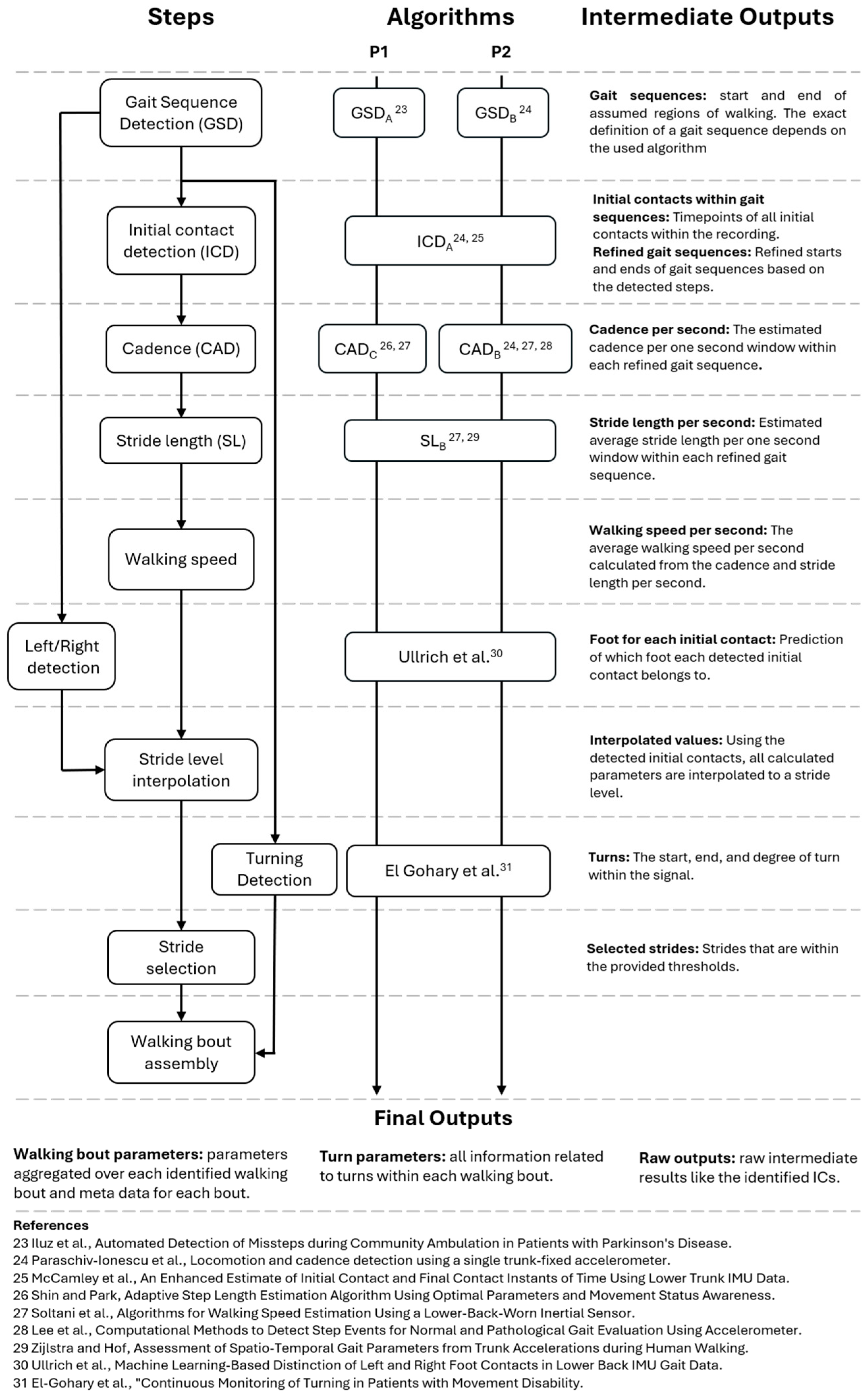
2.2. Overview over the Mobgap Ecosystem
2.3. Data Standardisation
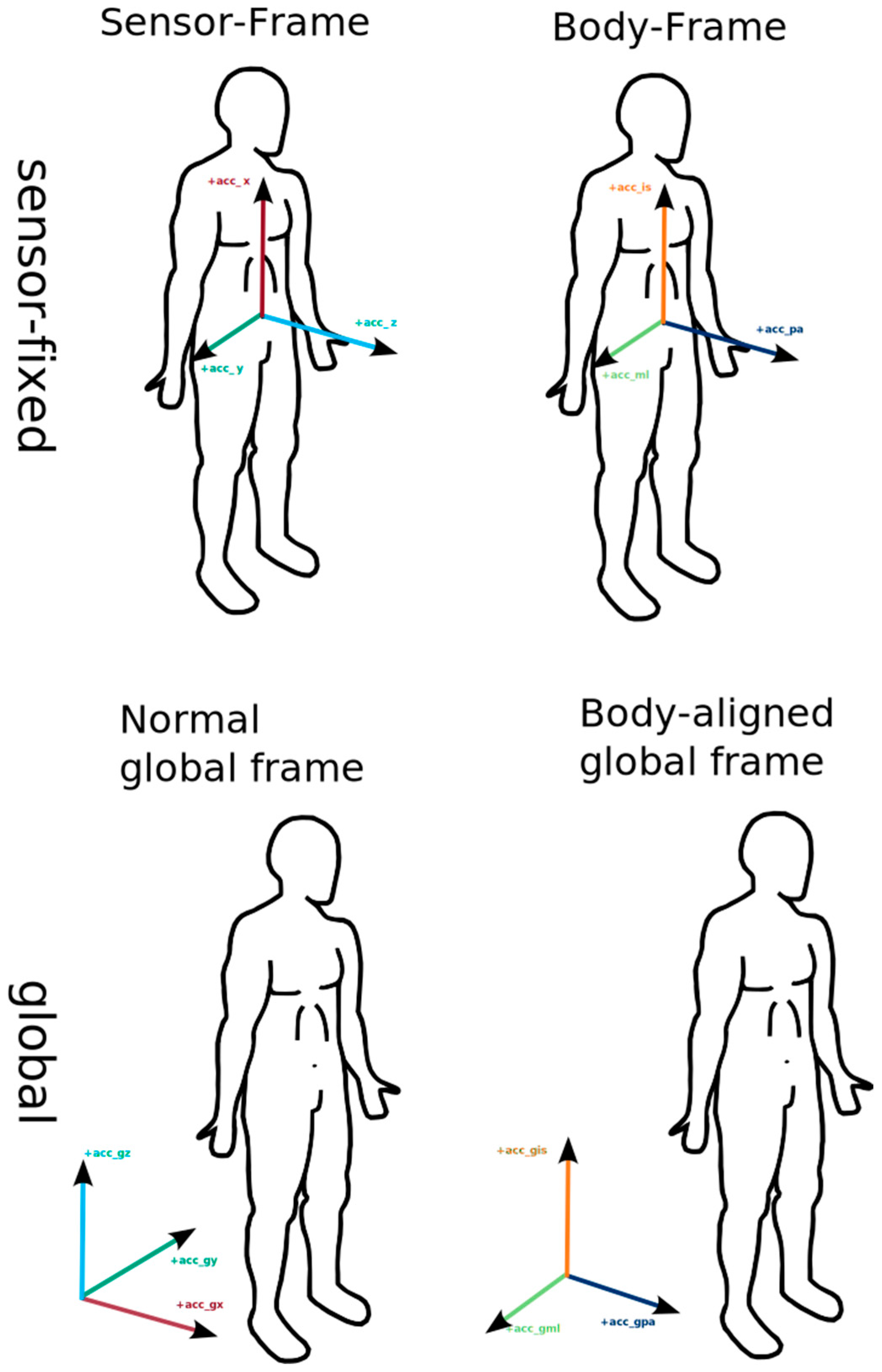
- Sensor coordinate system
- ○
- The unit coordinate system is defined by the physical axes of the IMU sensors aligned with the unit IMU casing. By convention, the x-axis points upward relative to the participant’s body, the y-axis to the right and the z-axis points approximately anteriorly. Raw accelerometer and gyroscope signals are provided in this frame.
- World (global) system
- ○
- The world system has the vertical axis coinciding with the gravity direction and is used to describe global orientation, such as estimating walking direction, vertical displacement, or accumulated trajectory.
2.4. Extending Mobgap
2.5. Benchmarking
2.6. Analysis Examples
2.6.1. Example #1. Block-by-Block Evaluation Approach
2.6.2. Example #2. Full Pipeline Validation
2.6.3. Example #3. Reporting of Results/Aggregations
3. Results
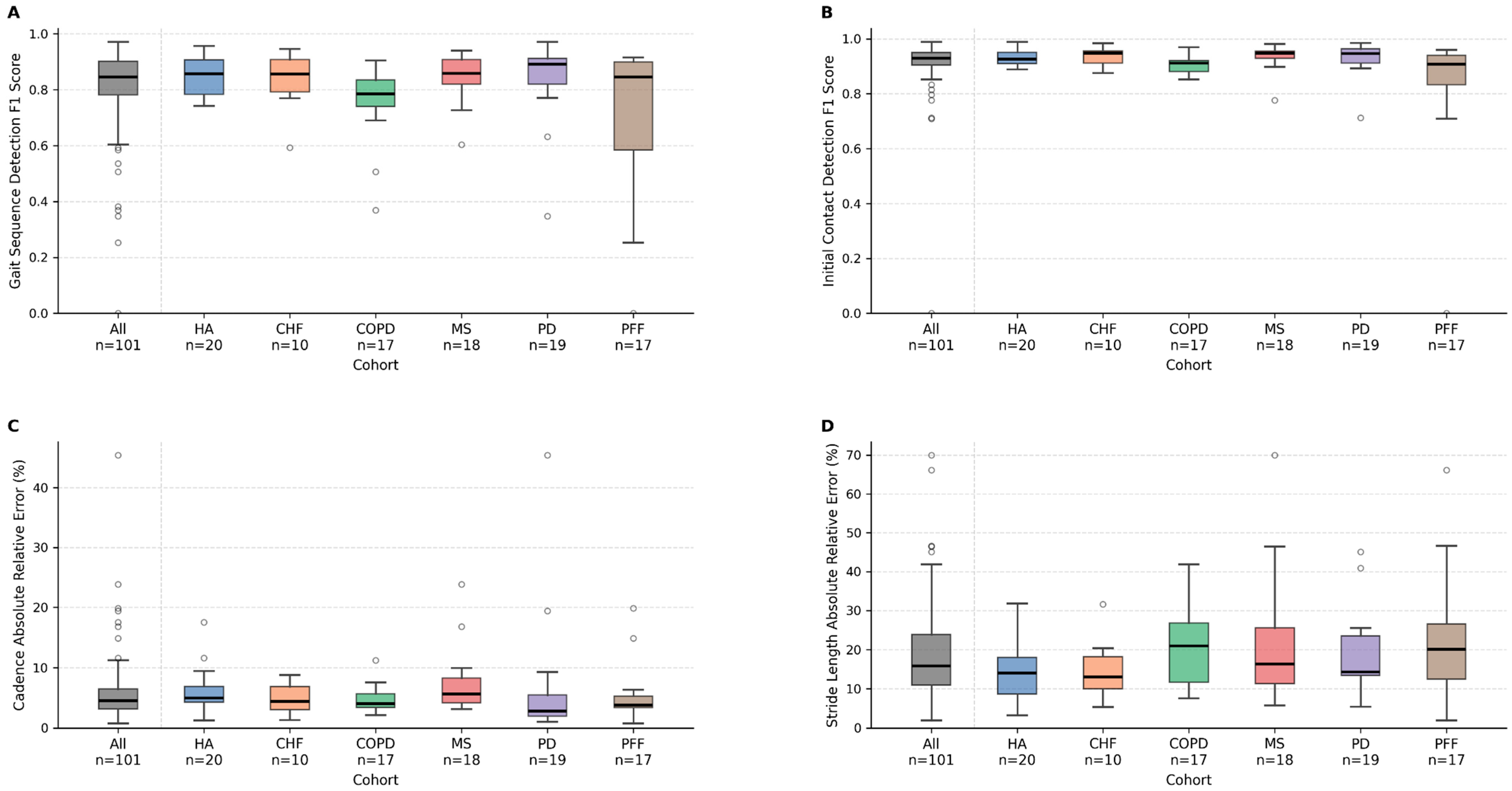
3.1. Example #1. Block-by-Block Evaluation Approach
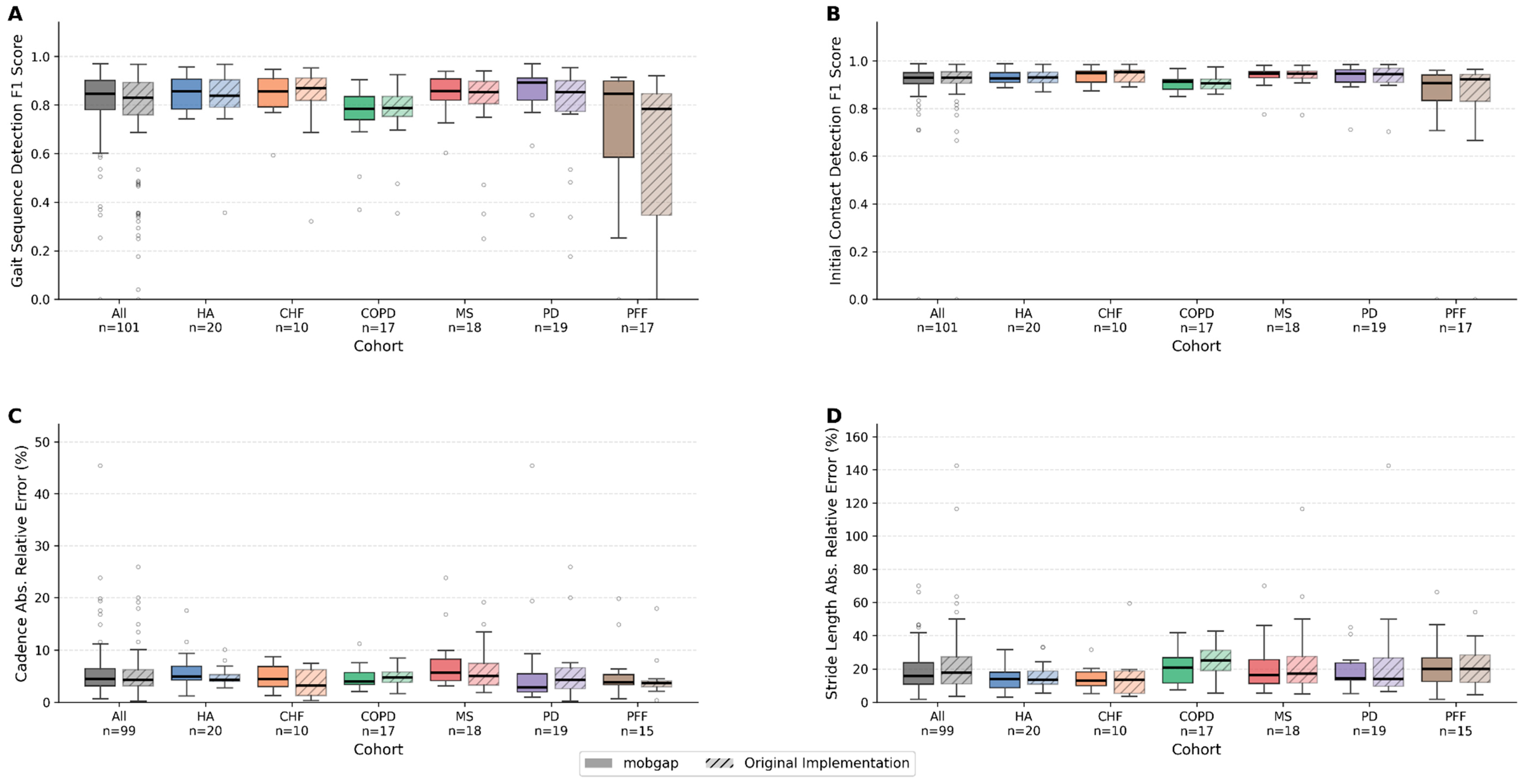
3.2. Example #2. Full Pipeline Validation
3.3. Example #3. Aggregation of Mobgap Outputs
3.3.1. Stride-Level Output
3.3.2. Walking Bout Assembly
3.3.3. Recording-Level Aggregation
3.4. Example 4. Recommended Reporting Precision for Aggregated DMOs
4. Discussion
Supplementary Materials
Author Contributions
Funding
Institutional Review Board Statement
Informed Consent Statement
Data Availability Statement
Acknowledgments
Conflicts of Interest
References
- Viceconti, M.; Tome, M.; Dartee, W.; Knezevic, I.; Hernandez Penna, S.; Mazzà, C.; Caulfield, B.; Garcia-Aymerich, J.; Becker, C.; Maetzler, W.; et al. On the use of wearable sensors as mobility biomarkers in the marketing authorization of new drugs: A regulatory perspective. Front. Med. 2022, 9, 996903. [Google Scholar] [CrossRef]
- Warmerdam, E.; Hausdorff, J.M.; Atrsaei, A.; Zhou, Y.; Maetzler, W. Long-term unsupervised mobility assessment in movement disorders. Lancet Neurol. 2020, 19, 462–470. [Google Scholar] [CrossRef] [PubMed]
- Hillel, I.; Gazit, E.; Nieuwboer, A.; Avanzino, L.; Rochester, L.; Cereatti, A.; Croce, U.D.; Rikkert, M.O.; Bloem, B.R.; Pelosin, E.; et al. Is every-day walking in older adults more analogous to dual-task walking or to usual walking? Elucidating the gaps between gait performance in the lab and during 24/7 monitoring. Eur. Rev. Aging Phys. Act. 2019, 16, 6. [Google Scholar] [PubMed]
- Polhemus, A.; Ortiz, L.D.; Brittain, G.; Chynkiamis, N.; Salis, F.; Gaßner, H.; Gross, M.; Kirk, C.; Rossanigo, R.; Taraldsen, K.; et al. Walking on common ground: A cross-disciplinary scoping review on the clinical utility of digital mobility outcomes. npj Digit. Med. 2021, 4, 149. [Google Scholar] [CrossRef] [PubMed]
- Rochester, L.; Mazza, C.; Mueller, A.; Caulfield, B.; McCarthy, M.; Becker, C.; Miller, R.; Piraino, P.; Viceconti, M.; Dartee, W.P.; et al. A Roadmap to Inform Development, Validation and Approval of Digital Mobility Outcomes: The Mobilise-D Approach. Digit. Biomark. 2020, 4, 13–27. [Google Scholar] [CrossRef] [PubMed]
- Mazzà, C.; Alcock, L.; Aminian, K.; Becker, C.; Bertuletti, S.; Bonci, T.; Brown, P.; Brozgol, M.; Buckley, E.; Carsin, A.-E.; et al. Technical validation of real-world monitoring of gait: A multicentric observational study. BMJ Open 2021, 11, e050785. [Google Scholar] [CrossRef] [PubMed]
- Micó-Amigo, M.E.; Bonci, T.; Paraschiv-Ionescu, A.; Ullrich, M.; Kirk, C.; Soltani, A.; Küderle, A.; Gazit, E.; Salis, F.; Alcock, L.; et al. Assessing real-world gait with digital technology? Validation, insights and recommendations from the Mobilise-D consortium. J. Neuroeng. Rehabil. 2023, 20, 78, Correction in J. Neuroeng. Rehabil. 2024, 21, 71. https://doi.org/10.1186/s12984-024-01361-6. [Google Scholar] [PubMed]
- Scott, K.; Bonci, T.; Salis, F.; Alcock, L.; Buckley, E.; Gazit, E.; Hansen, C.; Schwickert, L.; Aminian, K.; Bertuletti, S.; et al. Design and validation of a multi-task, multi-context protocol for real-world gait simulation. J. Neuroeng. Rehabil. 2022, 19, 141. [Google Scholar] [CrossRef] [PubMed]
- Kirk, C.; Küderle, A.; Micó-Amigo, M.E.; Bonci, T.; Paraschiv-Ionescu, A.; Ullrich, M.; Soltani, A.; Gazit, E.; Salis, F.; Alcock, L.; et al. Mobilise-D insights to estimate real-world walking speed in multiple conditions with a wearable device. Sci. Rep. 2024, 14, 1754, Correction in Sci. Rep. 2024, 14, 28878. https://doi.org/10.1038/s41598-024-79454-4. [Google Scholar] [PubMed]
- Salis, F.; Bertuletti, S.; Bonci, T.; Caruso, M.; Scott, K.; Alcock, L.; Buckley, E.; Gazit, E.; Hansen, C.; Schwickert, L.; et al. A multi-sensor wearable system for the assessment of diseased gait in real-world conditions. Front. Bioeng. Biotechnol. 2023, 11, 1143248. [Google Scholar] [CrossRef] [PubMed]
- Singleton, D. mobilise-d/Mobilise-D-TVS-Recommended-Algorithms: Mobilise-D Technical Validation Study Recommended Algorithms. Zenodo 2023. Epub ahead of print. [Google Scholar] [CrossRef]
- Docker. 2026. Available online: https://www.docker.com/ (accessed on 20 January 2026).
- Czech, M.D.; Patel, S. GaitPy: An Open-Source Python Package for Gait Analysis Using an Accelerometer on the Lower Back. J. Open Source Softw. 2019, 4, 1778. [Google Scholar]
- Adamowicz, L.; Christakis, Y.; Czech, M.D.; Adamusiak, T. SciKit Digital Health: Python Package for Streamlined Wearable Inertial Sensor Data Processing. JMIR Mhealth Uhealth 2022, 10, e36762. [Google Scholar] [CrossRef] [PubMed]
- Küderle, A.; Ullrich, M.; Roth, N.; Ollenschläger, M.; Ibrahim, A.A.; Moradi, H.; Richer, R.; Seifer, A.-K.; Zürl, M.; Sîmpetru, R.C.; et al. Gaitmap—An Open Ecosystem for IMU-Based Human Gait Analysis and Algorithm Benchmarking. IEEE Open J. Eng. Med. Biol. 2024, 5, 163–172. [Google Scholar] [PubMed]
- Küderle, A.; Tasca, P.; Bicer, M.; Kirk, C.; Megaritis, D.; Hinchliffe, C.; Stihi, A.; Muecke, A.; Babar, Z.; Kluge, F.; et al. MobGap. 2026. Available online: https://github.com/mobilise-d/mobgap/ (accessed on 14 April 2026).
- Tasca, P.; Küderle, A.; Kirk, C.; Hinchcliffe, C.; Megaritis, D.; Stihi, A.; Caulfield, B.; Rochester, L.; Cereatti, A. From development to deployment: Introducing MobGap, the open-source tool for mobility assessment with wearable devices by Mobilise-D. Gait Posture 2024, 114, S42. [Google Scholar] [CrossRef]
- Del Din, S. Mobilise-D Technical Validation Study (TVS) dataset. Zenodo 2025. Epub ahead of print. [Google Scholar] [CrossRef]
- Bakker, J.P.; Barge, R.; Centra, J.; Cobb, B.; Cota, C.; Guo, C.C.; Hartog, B.; Horowicz-Mehler, N.; Izmailova, E.S.; Manyakov, N.V.; et al. V3+ extends the V3 framework to ensure user-centricity and scalability of sensor-based digital health technologies. npj Digit. Med. 2025, 8, 51. [Google Scholar] [CrossRef] [PubMed]
- Goldsack, J.C.; Coravos, A.; Bakker, J.P.; Bent, B.; Dowling, A.V.; Fitzer-Attas, C.; Godfrey, A.; Godino, J.G.; Gujar, N.; Izmailova, E.; et al. Verification, analytical validation, and clinical validation (V3): The foundation of determining fit-for-purpose for Biometric Monitoring Technologies (BioMeTs). npj Digit. Med. 2020, 3, 55. [Google Scholar] [PubMed]
- Del Din, S.; Kirk, C.; Tasca, P.; Scott, K.; Küderle, A.; Alcock, L.; Paraschiv-Ionescu, A.; Keogh, A.; Mueller, A.; Mazzà, C.; et al. Mobilise-D Technical Implementation Manual: How to validate and measure digital mobility outcomes from a wearable device. Zenodo 2025. Epub ahead of print. [Google Scholar] [CrossRef]
- Bertuletti, S.; Della Croce, U.; Cereatti, A. A wearable solution for accurate step detection based on the direct measurement of the inter-foot distance. J. Biomech. 2019, 84, 274–277. [Google Scholar] [CrossRef] [PubMed]
- Iluz, T.; Gazit, E.; Herman, T.; Sprecher, E.; Brozgol, M.; Giladi, N.; Mirelman, A.; Hausdorff, J.M. Automated detection of missteps during community ambulation in patients with Parkinson’s disease: A new approach for quantifying fall risk in the community setting. J. Neuroeng. Rehabil. 2014, 11, 48. [Google Scholar] [CrossRef] [PubMed]
- Paraschiv-Ionescu, A.; Newman, C.J.; Carcreff, L.; Gerber, C.N.; Armand, S.; Aminian, K. Locomotion and cadence detection using a single trunk-fixed accelerometer: Validity for children with cerebral palsy in daily life-like conditions. J. Neuroeng. Rehabil. 2019, 16, 14. [Google Scholar] [CrossRef] [PubMed]
- McCamley, J.; Donati, M.; Grimpampi, E.; Mazzà, C. An enhanced estimate of initial contact and final contact instants of time using lower trunk inertial sensor data. Gait Posture 2012, 36, 316–318. [Google Scholar] [CrossRef] [PubMed]
- Shin, S.H.; Park, C.G. Adaptive step length estimation algorithm using optimal parameters and movement status awareness. Med. Eng. Phys. 2011, 33, 1064–1071. [Google Scholar] [CrossRef] [PubMed]
- Soltani, A.; Aminian, K.; Mazza, C.; Cereatti, A.; Palmerini, L.; Bonci, T.; Paraschiv-Ionescu, A. Algorithms for Walking Speed Estimation Using a Lower-Back-Worn Inertial Sensor: A Cross-Validation on Speed Ranges. IEEE Trans. Neural Syst. Rehabil. Eng. 2021, 29, 1955–1964. [Google Scholar] [PubMed]
- Lee, H.-K.; You, J.; Cho, S.-P.; Hwang, S.-J.; Lee, D.-R.; Kim, Y.-H.; Lee, K.-J. Computational methods to detect step events for normal and pathological gait evaluation using accelerometer. Electron. Lett. 2010, 46, 1185–1187. [Google Scholar] [CrossRef]
- Zijlstra, W.; Hof, A.L. Assessment of spatio-temporal gait parameters from trunk accelerations during human walking. Gait Posture 2003, 18, 1–10. [Google Scholar] [CrossRef] [PubMed]
- Ullrich, M.; Kuderle, A.; Reggi, L.; Cereatti, A.; Eskofier, B.M.; Kluge, F. Machine learning-based distinction of left and right foot contacts in lower back inertial sensor gait data. In Proceedings of the 2021 43rd Annual International Conference of the IEEE Engineering in Medicine Biology Society (EMBC), Guadalajara, Mexico, 1–5 November 2021; pp. 5958–5961. [Google Scholar]
- El-Gohary, M.; Pearson, S.; McNames, J.; Mancini, M.; Horak, F.; Mellone, S.; Chiari, L. Continuous Monitoring of Turning in Patients with Movement Disability. Sensors 2013, 14, 356–369. [Google Scholar] [CrossRef] [PubMed]
- ISO 8601-1:2019; Date and Time—Representations for Information Interchange—Part 1: Basic Rules. International Organization for Standardization: Geneva, Switzerland, 2019.
- Team T Pandas Development. pandas-dev/pandas: Pandas. Zenodo 2026. Epub ahead of print. [Google Scholar] [CrossRef]
- Cereatti, A.; Gurchiek, R.; Mündermann, A.; Fantozzi, S.; Horak, F.; Delp, S.; Aminian, K. ISB recommendations on the definition, estimation, and reporting of joint kinematics in human motion analysis applications using wearable inertial measurement technology. J. Biomech. 2024, 173, 112225. [Google Scholar] [CrossRef] [PubMed]
- Küderle, A.; Richer, R.; Sîmpetru, R.C.; Eskofier, B.M. tpcp: Tiny Pipelines for Complex Problems—A set of framework independent helpers for algorithms development and evaluation. J. Open Source Softw. 2023, 8, 4953. [Google Scholar] [CrossRef]
- Mikolaizak, A.S.; Rochester, L.; Maetzler, W.; Sharrack, B.; Demeyer, H.; Mazzà, C.; Caulfield, B.; Garcia-Aymerich, J.; Vereijken, B.; Arnera, V.; et al. Connecting real-world digital mobility assessment to clinical outcomes for regulatory and clinical endorsement–the Mobilise-D study protocol. PLoS ONE 2022, 17, e0269615. [Google Scholar] [PubMed]
- JCGM 100:2008; Evaluation of Measurement Data—Guide to the Expression of Uncertainty in Measurement (GUM). Bureau International des Poids et Mesures: Geneva, Switzerland, 2008; Volume 50, p. 134.
- Kluge, F.; Din, S.D.; Cereatti, A.; Hansen, C.; Gaßner, H.; Hansen, C.; Helbostad, J.L.; Klucken, J.; Küderle, A.; Müller, A.; et al. Consensus based framework for digital mobility monitoring. PLoS ONE 2021, 16, e0256541. [Google Scholar] [CrossRef] [PubMed]
- Bonci, T.; Keogh, A.; Del Din, S.; Scott, K.; Mazzà, C.; on behalf of the Mobilise-D consortium. An Objective Methodology for the Selection of a Device for Continuous Mobility Assessment. Sensors 2020, 20, 6509. [Google Scholar] [CrossRef] [PubMed]
- Abedinifar, M.; Welzel, J.; Hansen, C.; Maetzler, W.; Romijnders, R. KielMAT: Kiel Motion Analysis Toolbox—An Open-Source Python Toolbox for Analyzing Neurological Motion Data from Various Recording Modalities. J. Open Source Softw. 2024, 9, 6842. [Google Scholar] [CrossRef]
- Ben Mansour, K.; Rezzoug, N.; Gorce, P. Foot side detection from lower lumbar spine acceleration. Gait Posture 2015, 42, 386–389. [Google Scholar] [CrossRef] [PubMed]
- Kluge, F.; Brand, Y.E.; Micó-Amigo, M.E.; Bertuletti, S.; D’Ascanio, I.; Gazit, E.; Bonci, T.; Kirk, C.; Küderle, A.; Palmerini, L.; et al. Real-World Gait Detection Using a Wrist-Worn Inertial Sensor: Validation Study. JMIR Form. Res. 2024, 8, e50035. [Google Scholar] [PubMed]
- Zijlstra, A.; Zijlstra, W. Trunk-acceleration based assessment of gait parameters in older persons: A comparison of reliability and validity of four inverted pendulum based estimations. Gait Posture 2013, 38, 940–944. [Google Scholar] [CrossRef] [PubMed]



| visit_type | T1 | ||||
| participant_id | 12345 | ||||
| measurement_date | 01/01/2023 | ||||
| wb_id | 0 | 1 | 2 | 3 | 4 |
| duration_s | 4.74702 | 5.1315 | 8.52727 | 16.24554 | 6.09907 |
| n_raw_initial_contacts | 8 | 7 | 12 | 27 | 8 |
| cadence_spm | 99.82188 | 101.16429 | 86.53527 | 91.49977 | 93.69895 |
| walking_speed_mps | 1.16079 | 2.57881 | 1.60044 | 0.95558 | 2.3323 |
| stride_length_m | 2.51885 | 1.57243 | 1.66305 | 0.88961 | 1.95969 |
| stride_duration_s | 1.58675 | 1.46537 | 2.56092 | 3.14549 | 2.35295 |
| n_turns | 0 | 0 | 2 | 1 | 0 |
| Variable | Value |
|---|---|
| participant_id | 12345 |
| wb_all__count | 2378 |
| total_walking_duration_min | 632.05 |
| wb_all__n_raw_initial_contacts__sum | 59320 |
| wb_all__n_turns__sum | 3012 |
| wb_all__duration_s__avg | 8.859 |
| wb_all__duration_s__p90 | 26.927 |
| wb_all__duration_s__var | 2.275 |
| wb_all__cadence_spm__avg | 94.673 |
| wb_all__stride_duration_s__avg | 2.213 |
| wb_all__cadence_spm__var | 0.127 |
| wb_all__stride_duration_s__var | 0.261 |
| wb_10_30__count | 844 |
| wb_10_30__walking_speed_mps__avg | 1.497 |
| wb_10_30__stride_length_m__avg | 1.865 |
| wb_10__count | 1029 |
| wb_10__walking_speed_mps__p90 | 2.096 |
| wb_30__count | 185 |
| wb_30__walking_speed_mps__avg | 1.619 |
| wb_30__stride_length_m__avg | 1.975 |
| wb_30__cadence_spm__avg | 102.81 |
| wb_30__stride_duration_s__avg | 2.101 |
| wb_30__walking_speed_mps__p90 | 2.128 |
| wb_30__cadence_spm__p90 | 115.18 |
| wb_30__walking_speed_mps__var | 0.241 |
| wb_30__stride_length_m__var | 0.252 |
| wb_60__count | 62 |
| Maximal Decimals | Recommended Decimals | |
|---|---|---|
| Walking activity—Amount | ||
| Walking duration (min/day) | 3 | 0 |
| WB step count (#/day) | - | 0 |
| Walking activity—Pattern | ||
| Number of WBs (#/day) | - | 0 |
| Number of WBs >10 s (#/day) | - | 0 |
| Number of WBs >30 s (#/day) | - | 0 |
| Number of WBs >60 s (#/day) | - | 0 |
| WB duration (s) | 1 | 1 |
| P90 WB duration (s) | 1 | 1 |
| WB duration bout-to-bout variability (%) | - | 0 |
| Gait—Pace | ||
| Walking speed in shorter (>10 s–≤30 s) WBs (m/s) | 2 | 2 |
| Walking speed in longer (>30 s) WBs (m/s) | 2 | 2 |
| P90 walking speed in WBs >10 s (m/s) | 2 | 2 |
| P90 walking speed in longer (>30 s) WBs (m/s) | 2 | 2 |
| Stride length in shorter (>10 s–≤30 s) WBs (cm) | 0 | 0 |
| Stride length in longer (>30 s) WBs (cm) | 0 | 0 |
| Gait—Rhythm | ||
| Cadence in all WBs (steps/min) | 1 | 0 |
| Cadence in longer (>30 s) WBs (steps/min) | 1 | 0 |
| P90 cadence in longer (>30 s) WBs (steps/min) | 1 | 0 |
| Stride duration in all WBs (s) | 3 | 2 |
| Stride duration in longer (>30 s) WB (s) | 3 | 2 |
| Gait—Bout-to-bout variability | ||
| Walking speed bout-to-b variability between longer (>30 s) WBs (%) | - | 0 |
| Stride length bout-to-b variability between longer (>30 s) WBs (%) | - | 0 |
| Cadence bout-to-b variability (%) | - | 0 |
| Stride duration bout-to-b variability (%) | - | 0 |
| Feature | mobgap [16] | SKDH [14] | GaitPy | Gaitmap [15] | KielMAT [40] |
|---|---|---|---|---|---|
| Sensor placement | Lower back | Lower back/chest | Lower back | Foot-worn | Lower back/multiple |
| Language | Python | Python | Python | Python | Python |
| Maintenance status | Active | Active | Discontinued † | Active | Active |
| DMOs estimated | Total walking duration, WB count stratified by duration threshold, step count, walking speed, stride length, cadence, stride duration, IC timing, turns; aligned to Mobilise-D consensus definitions via MobilisedAggregator | Gait events, temporal parameters, activity, sleep | Gait events, temporal parameters | Stride parameters, gait events, trajectory | GSD, ICD, sit-to-stand, turns, physical activity |
| Full pipeline (GSD → walking speed) | Yes | No ‡ | No | No (foot-worn context) | No |
| External validation | Extensive (Mobilise-D TVS; 6 cohorts, real-world and lab) | Limited (internal only, not published in full) | Limited (single cohort, lab-based) | Moderate (multiple foot-worn datasets) | Moderate (Mobilise-D and KeepControl datasets) |
| Extensibility/algorithm substitution | Yes (dependency injection via tpcp) | Partial (BaseProcess subclassing) | No | Yes (tpcp) | Partial |
| Reproducible benchmarking framework | Yes (end-to-end, standardised metrics) | No | No | Yes (gaitmap challenges/bench, foot-worn context) | No |
| ML/trainable algorithm support | Yes (cross-validation via tpcp) | Partial (LightGBM classifier integrated) | No | Yes (tpcp) | Partial |
| Regulatory alignment (V3+/COA) | Yes (Mobilise-D V3+ framework) | No | No | No | No |
| Target use case | Clinical trials, real-world DMO estimation, algorithm benchmarking | Research, multi-modal daily-life monitoring | Research, clinical gait characterisation | Research, biomechanical gait analysis (foot-worn) | Research, neurological motion analysis |
Disclaimer/Publisher’s Note: The statements, opinions and data contained in all publications are solely those of the individual author(s) and contributor(s) and not of MDPI and/or the editor(s). MDPI and/or the editor(s) disclaim responsibility for any injury to people or property resulting from any ideas, methods, instructions or products referred to in the content. |
© 2026 by the authors. Licensee MDPI, Basel, Switzerland. This article is an open access article distributed under the terms and conditions of the Creative Commons Attribution (CC BY) license.
Share and Cite
Kirk, C.; Kuederle, A.; Tasca, P.; Bicer, M.; Megaritis, D.; Gazit, E.; Bonci, T.; Ionescu, A.; Hinchliffe, C.; Stihi, A.; et al. Mobgap: A State-of-the-Art Python Framework for Reproducible Estimation and Algorithm Validation of Digital Mobility Outcomes from a Single Wearable Device. Sensors 2026, 26, 4294. https://doi.org/10.3390/s26134294
Kirk C, Kuederle A, Tasca P, Bicer M, Megaritis D, Gazit E, Bonci T, Ionescu A, Hinchliffe C, Stihi A, et al. Mobgap: A State-of-the-Art Python Framework for Reproducible Estimation and Algorithm Validation of Digital Mobility Outcomes from a Single Wearable Device. Sensors. 2026; 26(13):4294. https://doi.org/10.3390/s26134294
Chicago/Turabian StyleKirk, Cameron, Arne Kuederle, Paolo Tasca, Metin Bicer, Dimitrios Megaritis, Eran Gazit, Tecla Bonci, Anisora Ionescu, Chloe Hinchliffe, Alexandru Stihi, and et al. 2026. "Mobgap: A State-of-the-Art Python Framework for Reproducible Estimation and Algorithm Validation of Digital Mobility Outcomes from a Single Wearable Device" Sensors 26, no. 13: 4294. https://doi.org/10.3390/s26134294
APA StyleKirk, C., Kuederle, A., Tasca, P., Bicer, M., Megaritis, D., Gazit, E., Bonci, T., Ionescu, A., Hinchliffe, C., Stihi, A., Muecke, A., Babar, Z., Vogiatzis, I., Eskofier, B., Mazzà, C., Cereatti, A., Mueller, A., Rooks, D., Caulfield, B., ... Del Din, S. (2026). Mobgap: A State-of-the-Art Python Framework for Reproducible Estimation and Algorithm Validation of Digital Mobility Outcomes from a Single Wearable Device. Sensors, 26(13), 4294. https://doi.org/10.3390/s26134294