Article

Influence of Measuring Circuit Parameters on the Characteristics of MIS-Capacitor Hydrogen Sensors


Micro- and Nanoelectronics Department, National Research Nuclear University MEPhI (Moscow Engineering Physics Institute), 115409 Moscow, Russia
*
Author to whom correspondence should be addressed.
Sensors 2026, 26(13), 4209; https://doi.org/10.3390/s26134209
Submission received: 20 April 2026 / Revised: 24 June 2026 / Accepted: 29 June 2026 / Published: 3 July 2026
(This article belongs to the Section Physical Sensors)

Abstract

Using electrophysical models of MIS-capacitor gas-sensing elements, the influence of measuring circuit parameters on the metrological characteristics of hydrogen sensors was investigated. Recommendations for selecting optimal measurement circuit modes are provided, both in general and using sensor elements with a Pd-Ta2O5-SiO2-nSi structure as an example. This article presents the results of an analysis and comparative study of three methods for measuring the capacitance of MISC sensors: (a) the AC bridge with a balance indicator (ACB + BI), (b) the divider method (DM), and (c) the bridge method (BM). The advantages and disadvantages of each method for practical implementation in gas analytical instruments are discussed. Furthermore, experimental data on the long-term stability of MISC sensor characteristics are provided, including the sensor response to hydrogen and the zero-point drift.

1. Introduction

Hydrogen sensors are widely employed in devices and systems designed for monitoring environmental conditions and ensuring explosion safety across various industrial and civil facilities [1,2]. The development of microelectronic sensors and gas analysis systems based on micro- and nano-technologies is regarded as a promising approach for creating compact means of measuring gas concentrations [3]. A critical requirement for such devices is the technological, thermal, and electromagnetic compatibility of their constituent elements, including sensors as well as primary and secondary transducers. Among solid-state gas-sensitive transducers, capacitors and field-effect transistors with a metal-insulator-semiconductor structure (MISC and MISFET) exhibit excellent compatibility with integrated circuit elements [4].
Gas concentration sensors based on MIS-structures have been extensively studied by numerous research groups [5,6,7]. A significant contribution to the development of such sensors has been made by researchers from Linköping University [8,9,10]. Objectively, this sensor type has not yet gained widespread adoption, as its operational range is primarily limited to low H2 concentrations, from hundreds of ppb to 1–2% vol. This range is currently in lower demand compared to the explosive range. Nevertheless, the tasks of early diagnostics for critical events involving trace hydrogen are becoming increasingly relevant, including breath analysis [11,12], early detection of technical equipment malfunctions [13,14] and fire precursors [15,16,17], as well as mineral exploration [18,19], etc. The main advantages of the proposed sensor type are the long-term stability of the sensitive elements’ characteristics and the high reproducibility of their fabrication process, which is compatible with integrated circuit (IC) technology. The development of artificial intelligence (AI) and the resolution of the selectivity problem may ultimately facilitate the broader adoption and practical application of such sensors [20,21,22].
At the National Research Nuclear University MEPhI, sensor elements based on MISC and MISFET with Pd and Pt gates have been developed. These sensors are designed for the detection of hydrogen-containing gases (H2 [23], NH3 [24], H2S [25]) and are based on multilayer structures such as SiO2-Si, Si3N4-SiO2-Si, and Ta2O5-SiO2-Si [3,25,26]. Experimental studies have demonstrated that hydrogen sensors utilizing a sensitive element with a Pd-Ta2O5-SiO2-Si structure on a silicon MOS crystal exhibit superior performance characteristic. Furthermore, the influence of various factors on the metrological and operational properties of these sensors has been investigated. It has been shown that these characteristics are dependent on design and technological parameters, chip temperature, operating time, and environmental conditions [23,24,27,28].
The aim of this study is to evaluate the influence of the electrical operating modes of measurement circuits on the performance characteristics of MISC-based hydrogen sensors. The investigation is conducted in a general context and illustrated by a specific example of a sensor utilizing a Pd-Ta2O5-SiO2-nSi structure. For the interpretation of the obtained experimental data, updated physical models and equivalent circuit diagrams were employed. These models take into account the influence of various external and internal factors. It is anticipated that the proposed models and gas concentration measurement techniques will serve as a foundation for predicting the performance of sensors with more complex circuit topologies, including those incorporating one or multiple MISC elements.

2. Initial Data and Performance Models of MISC Hydrogen Sensors

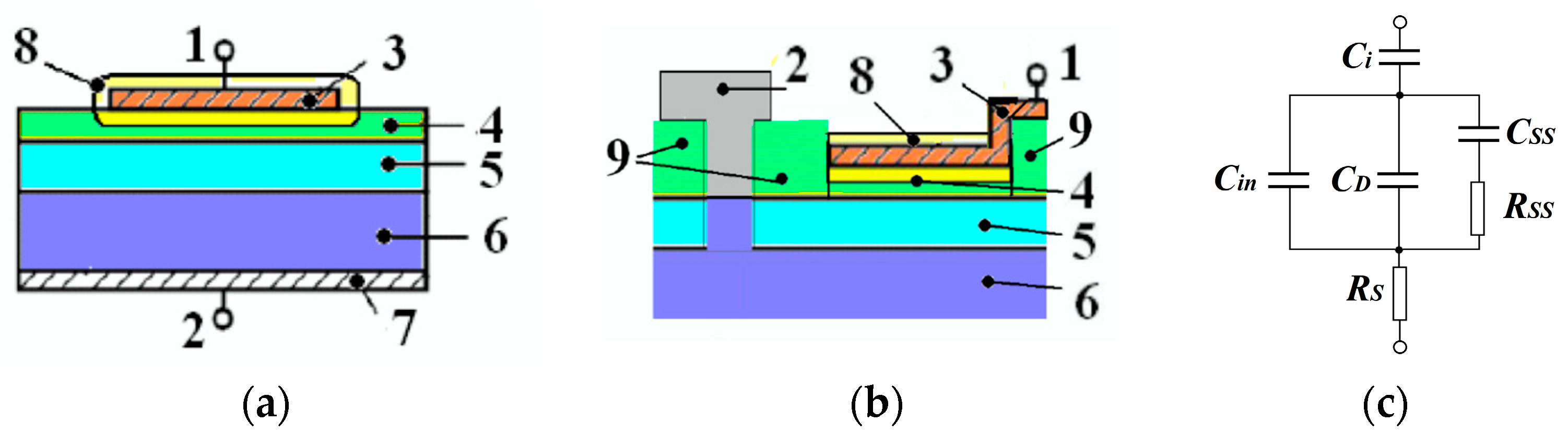
Hydrogen sensors can be implemented with either a vertical or planar structure of the sensing element. Simplified schematic diagrams illustrating the structure of the MISC sensing element in the cross-section view of the device and its equivalent electrical circuit are presented in Figure 1. The maximum sensitivity of sensors based on MISC structures is observed at elevated temperatures of active region 8 (380–500 K) (see Figure 1a,b). The heating and stabilization of the operating temperature are provided by integrated heating and temperature-sensitive elements within the sensor design [24]. Furthermore, it should be noted that the electronic circuits employed for measuring gas concentration and maintaining temperature stability have a significant impact on the metrological characteristics of the sensor [29].
In the equivalent circuit shown in Figure 1c, the capacitors correspond to the following capacitances:
  • Ci of the thin dielectric film;
  • Cin of the inversion layer;
  • CD of the space-charge region (depletion layer);
  • Css effective capacitance of the surface states at the dielectric–semiconductor interface.
The resistors Rs and Rss represent the total resistance of semiconductor regions 5 and 6 and the resistance that determines the switching time (τss = CssRss) of the surface-state charges with density Qss, respectively.
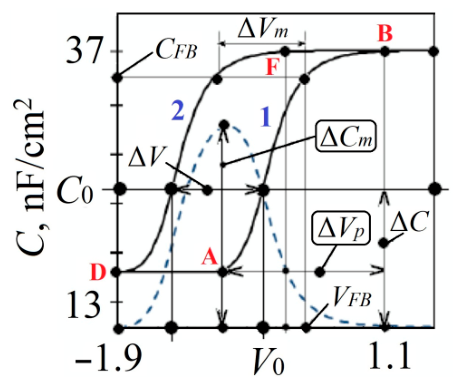
Studies have shown that the general operating principle of hydrogen-sensitive MISC sensors is independent of their structural type and manufacturing technology. Hydrogen exposure induces physicochemical reactions at the various interfaces of the working electrode: at the gas/metal and metal/dielectric boundaries, as well as within the bulk of the metal and dielectric. These processes depend on the gas concentration N and lead to changes in the work function difference potential φms and the effective charge density in the dielectric, Qte. As a result, the capacitance-voltage (CV) characteristic (the dependence of capacitance C on voltage V) shifts along the voltage (V) axis parallel to its original position, as illustrated in Figure 2.
We examined the quantitative changes in the CV parameters of MISCs based on n-type silicon as a function of various factors. Subsequently, for the operating voltage V = V12 < 0, the capacitance C can be represented, in the general case, as a function of the surface potential φs using Equations (1) and (2):
V(φs) = φms − [Qte + Qss(φs) + Qs(φs)]/Ci + φs = V0(φs) − ΔV(N)
C(φs) = Ci[Cin(φs) + CD(φs) + Css(φs)]/[Ci + Cin(φs) + CD(φs) + Css(φs)]
where, in the inversion region (φs > φs0), the effective charge density Qs(φs) in n-Si is calculated as
Qss) = Qd(φs) + Qin(φs) ≈ a·Ci{φs + φT exp[(φs − 2φs0)/φT]}1/2
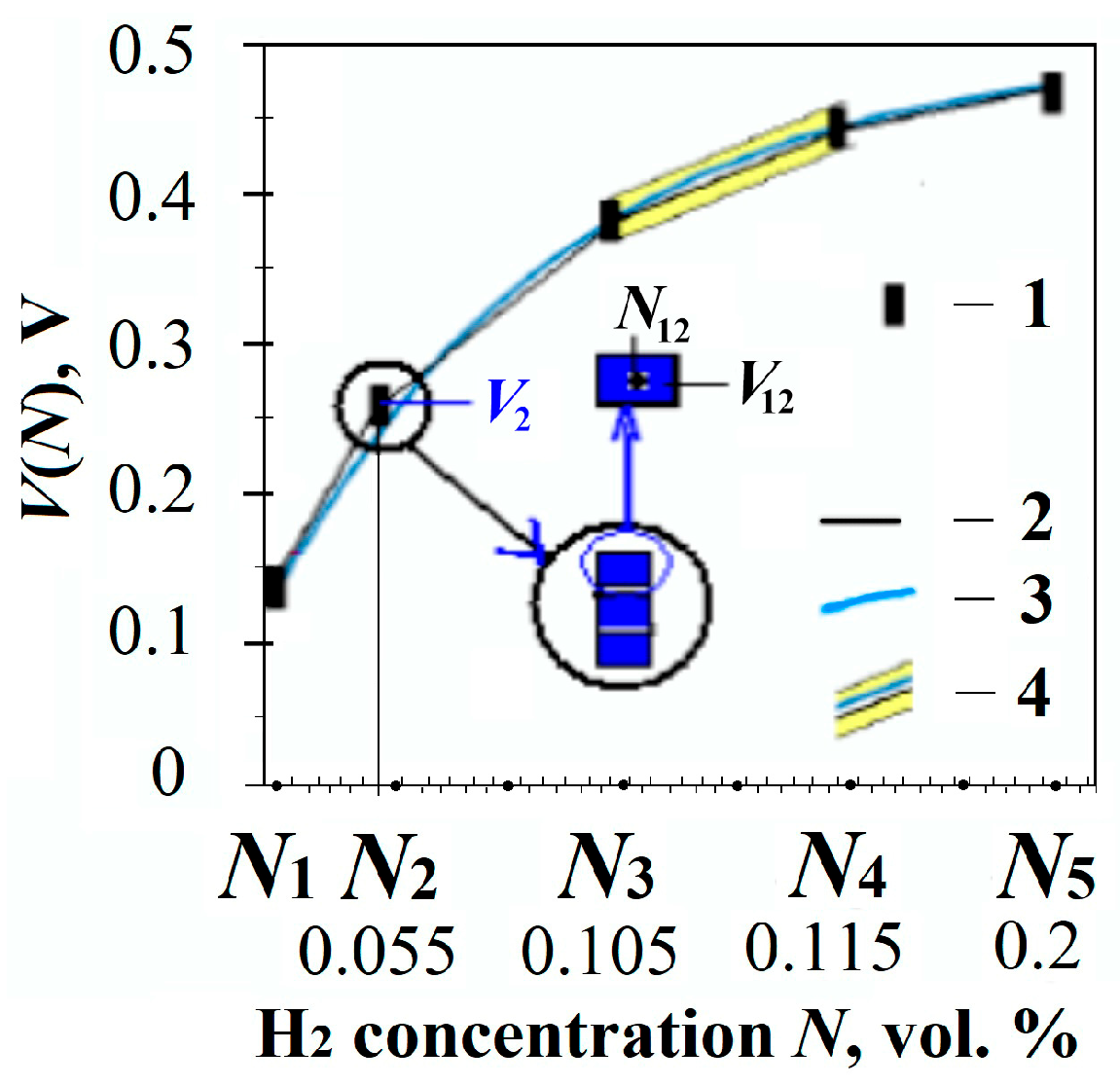
The transfer function models V(N) are defined as approximations of the averaged experimental dependences Vki(Nki), based on the data of m complete i-th responses, each measured n times, where k = 1, 2, …, n and i = 1, 2, …, m [28]. Typically, to determine the transfer function for a specific sensor series, m complete responses are obtained from a sample of n sensor units (here, indices k and i denote the ordinal numbers of the sensor samples and responses, respectively). If the absolute errors of the measuring instruments are ΔNki and ΔVki, then the true values of each (ki)-th measurement are located on the V(N) graph within a rectangular field with sides 2ΔNki and 2ΔVki, centered at the point (Nki, Vki), as shown in Figure 3.
The sensitivity of the CV characteristic to hydrogen and external factors {zj} acting on the MISC (background gases, temperature, radiation) is manifested provided that the overlap coefficient KC = CB/CA > 1 (Figure 2) and the slope gC = dC/dV exceeds the ratio of the measurement errors, i.e., gC > ΔCCVV, where ΔCC and ΔVV are the absolute errors of capacitance and voltage measurement, respectively. The dependence V(N, Ci) determines the hydrogen sensitivity of the MISC, which is quantified by the voltage sensitivity coefficient SV = dV/dN. To mitigate the influence of the stray capacitances Css and Cin in MISC sensors, the operating region is selected based on high-frequency CV characteristics (f > 50 kHz) in the depletion and weak inversion modes, where the surface potential is constrained to the interval |φs| ∈ (0: 2φs0]. Consequently, the dependencies |V0(φs)|, ΔV(N) and C(φs) are represented as
|V0(φs)| = φs + a{φs + φT·exp[(φs − 2φs0)/φT)]}1/2 + b(φs0φs) + φms0Qte0/Ci
ΔV(N, Ci) = Δφms(N) − ΔQte(N)/Ci
C(φs) = CiCD(φs)/[Ci + CD(φs)] = Ci/[1 + FC(V)]
FC(φs) = 2{φs + φT·exp[(φs − 2φs0)/φT]}1/2/{a + a·exp[(φs − 2φs0)/φT]}
where φs ≡ |φs|, Ci = Cmax = ε0ε/d, a = [2ε0εsqND]1/2/Ci and b = qNss/(φbgCi) are the design and technological parameters, generally designated as {pk}. Electrophysical models (3)–(6) were used for the quantitative analysis of the MISC sensors’ characteristics with the Pd-Ta2O5-SiO2-nSi structure, the parameters of which are presented in Table 1. Accurate modeling of the CV characteristics is possible only by numerical methods. By specifying the values of the surface potential φs, one can calculate Vs) using Equation (3), determine the corresponding values of the inverse function φs(V), and, by substituting these into Equations (5) and (6), obtain the dependences C[φs(V)]. The potential φms0, the capacitance Ci, and the dependence FC(φs) can be calculated theoretically, whereas the dependence ΔV(N) and the charges Qte0 and Qss0 are determined experimentally.
The electrophysical models of hydrogen sensitivity proposed in the first part of the article in general form can serve as a basis for the development of “more complex designs” (for example, sensors with several MISC elements) and can be integrated into computer-aided design systems. For example, a sub-circuit schematic of model implementation using a VCVS (voltage-controlled voltage source φs) that connects in series with the gate VG of the standard MIS-structure done in a Verilog-A-model [30].

3. Results

In addition to the conversion function V(N) and the differential sensitivity SV = dV/dN, the main metrological characteristics of the MISC include the following:
  • Sensitivity: Si = ΔVi/ΔNi
  • Sensitivity Threshold: N0 = ΔVV/SVm
  • Measurement Range: ΔNm ∈ [N0; Nm]
  • Absolute Error Δ(N) and Relative Error δN = 100% × Δ(N)/N
  • Operating Conversion Range: ΔN12 ∈ [N1; N2] for a given maximum error δNm
  • Response Speed (Bandwidth): determined by the rise (τ0.9) and fall (τ0.1) times of the voltage Vi(t) in response to a concentration pulse Ni
For the studied MISC, in the concentration range from a few ppm to 1 vol.%, the dependencies of the response signal ΔV(N) and sensitivity SV(N) can be approximated as follows [25]:
ΔV(N) = ΔVm [1 − exp(−kN N)] and SV = kN ΔVm exp(−kN N)
where ΔVm = ΔQtem/Ci − Δφmsm. The values of the parameters ΔVm, ΔQtem, Ci, Δφmsm, and kN were determined experimentally to be (0.5 ± 0.02) V, (14.4 ± 0.5) nC/cm2, (37 ± 1) nF/cm2, −(0.11 ± 0.005) V, and (8.0 ± 0.3) (%)−1, respectively.
NV) = (1/kN) ln[ΔVm/(ΔVm − ΔV)] = 0.125 ln[1/(1 − 2ΔV)]
In electrophysical models (1)–(6), capacitance and charge values are represented as specific values (per unit area), which does not affect the qualitative analysis of the CV characteristics. Models (3)–(8), parameters {pk}, and capacitance/voltage measurement errors are key quantities for the quantitative assessment of the influence of circuit electrical modes on the metrological characteristics of MISCs.
Two approaches can be used to determine the N concentration based on the leftward shift of the CV characteristic by ΔV(N) (Figure 2, Table 2):
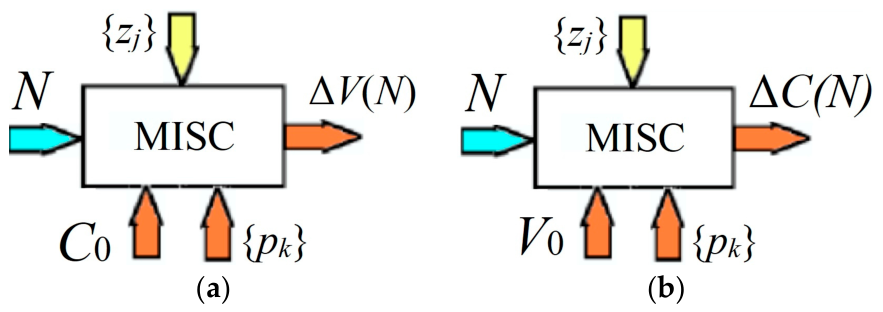
  • Measure ΔV at a constant capacitance C0 ∈ [Cmin + ΔCC; Cmax − ΔCC] using scheme 1 (Figure 4a);
  • Measure ΔC at a constant voltage V0 ∈ [VA;VB) (Figure 2) using scheme 2 (Figure 4b).
At T = 400 K, the average parameter values are Qte0 ≈ 20 nC/cm2, Nss≈ 1011 cm−2, a = 1.11 V1/2 and b = 0.43. According to the data in Figure 3, the real concentration values are expressed as Nip = Ni ± ΔNi. Assuming that the instrumental error ΔNki is constant for all samples and equal to ΔNN, the absolute error ΔNi is determined as
ΔNi = ΔNN + ΔVi/│Si
Of practical interest is the relative error
δN(N) = 100%·{[ΔNN·│Sd│ + Δ(V)]/(N·│Sd│)}
where Δ(V) denotes the total absolute error, which may be a function of the parameter N. This value comprises the instrumental error ΔVV, errors induced by external influencing factors ΔVZ, and the spread of circuit parameters ΔVep. The minimum attainable value of Δ(V) is defined by the ΔVV.
According to Equation (7), the intrinsic differential sensitivity to hydrogen, SV, is a function of the parameters ΔQtem, Ci, Δφmsm and kN. These parameters are, in turn, determined by the initial characteristics of the MISC, namely the sets {zj} and {pk}. Notably, the value of SV is independent of the electrical operating modes of the measuring circuit.
In circuit 1, an increase in the parameter N at a fixed value of C0 causes the operating point (C0, V0) to shift leftward. This shift occurs from the initial range │V0│ ∈ (VA; VB) by a magnitude ΔV ∈ (0 V; 0.5 V) (see Figure 2). For instance, at C0 = 26 nF/cm2, the operating voltage is │V0│ = 0.4 V. Furthermore, an increase in C0 leads to a decrease in │V0│ and a corresponding increase in the relative sensitivity of the circuit. The sensitivity S1 lies within the following range: S1 ∈ [3e−8N, 20e−8N] vol−1%. The instrumental error of the circuit, Δ(V), is either constant or, in the presence of a relative voltage measurement error δV, exhibits a dependence on N according to the following expression:
Δ(V) = 0.01·δV{V0 + 0.5[1 − exp(−8N)]}
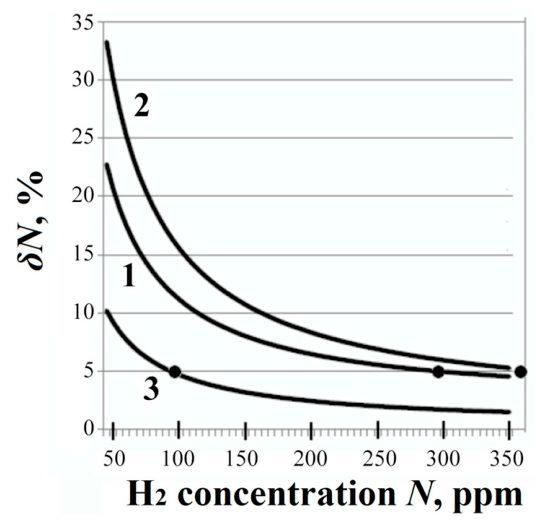
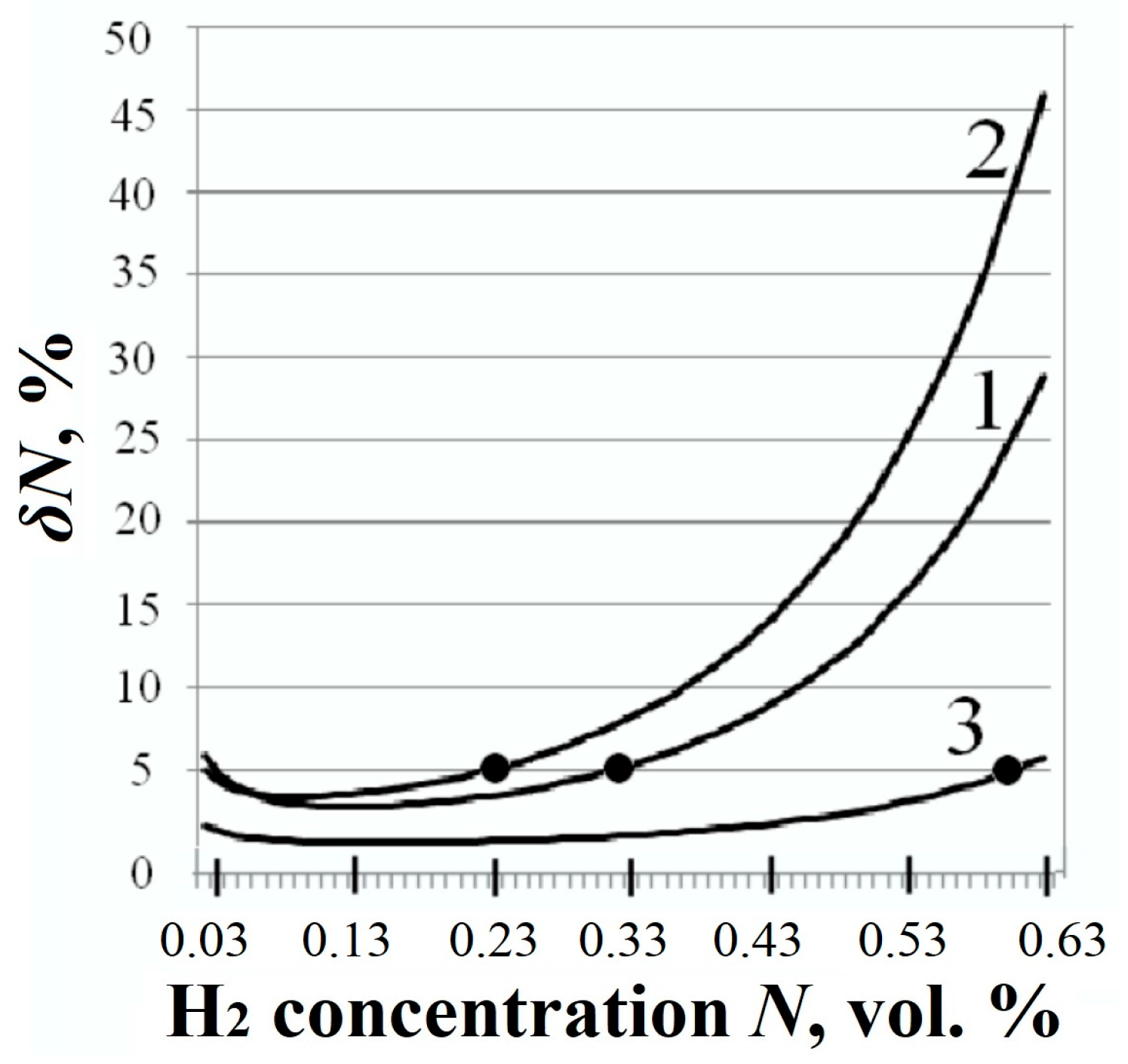
If the instrumental error is ΔVV = 1 mV, the sensitivity threshold is N0 = 2.5 ppm. The maximum measurement range is defined as ΔNm ∈ [2.5 ppm;1.55 vol.%]. For hydrogen in air, the conversion factor is approximately 1 vol.% ≈ 104 ppm. The working conversion range ΔN12 ∈ [N1; N2] for a specified maximum error δNm is determined from the functional dependence δN(N), as illustrated in Figure 5 and Figure 6.
In circuit 2, an increase in N causes the operating point (C0, V0) to shift upward by ΔC ∈ (0;ΔCm) at a constant │V0│ ∈ (VD;VB). The maximum shift ΔCm is reached at │V0│= VA (see Figure 2). The value of ΔCm depends on the “swing” of the operating region of the CV characteristic, defined as ΔVp = (VBVA) ≈ 2.5 V, and on ΔVm = 0.5 V. For the MISC under consideration, where ΔVm < ΔVp, the maximum value is ΔCm ≈ 4 nF/cm2 at VA = −1.4 V. Conversely, for sensors with ΔVm > ΔVp, the value of ΔCm = (CiCmin) ≈ 22 nF/cm2 and is determined by the initial parameters {pk}.
For circuit 2, the optimal initial coordinates of the operating point are V0 = −1.4 V and C0 = Cmin + ΔCC = 15.15 nF/cm2.
With an increase in the magnitude of │V0│, both the capacitance C0 and the slope gC decrease, while the relative sensitivity of the S2 circuit increases, reaching a maximum value of S2max= 0.27gC·exp(−8N) vol−1%. This increase does not exceed the relative sensitivity S1 within the operating range of the CV characteristics, as gC < C0/V0 holds true. The error of the measuring circuit, ΔCC, is either constant or depends on δC according to the relation ΔCC = 0.01δC·C0. The error Δ(V), as defined by Equation (10), is given by Δ(V) = ΔC/gC and depends on the parameter N. This error influences the conversion limits of the MISC sensor.
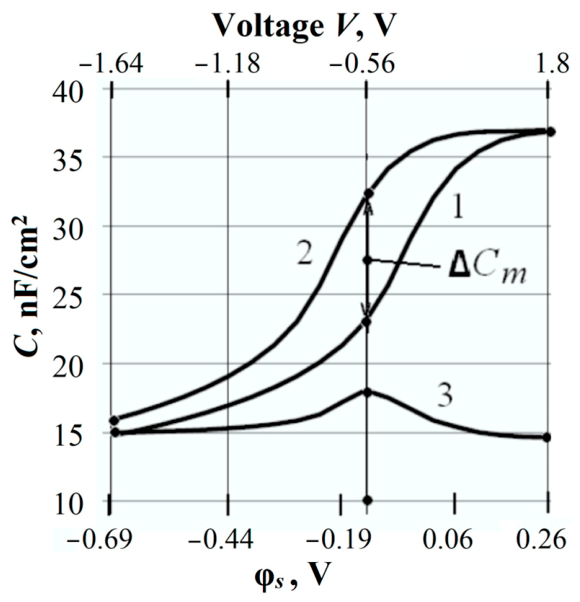
Each value of φs corresponds to a capacitance difference ΔC(φs) = C2(φs) − C1(φs), which is equal to the integral ∫SCdφs (see Figure 7). This difference defines the capacitive sensitivity SC = d(ΔC)/dφs and the slope gC = SC(dφs/dV). The dependences SC(φs) and gC(φs) are determined by the initial parameter set {pk}. The minimum, average, and maximum values of the capacitive sensitivity are SC0 = 3 nF/(V·cm2), SC ≈ 24 nF/(V·cm2), and SCm ≈ 70 nF/(V·cm2), respectively.
Analysis of the obtained data reveals that the metrological characteristics of the specific type of MISC sensor are influenced by its intrinsic hydrogen sensitivity SV(N) and the errors associated with the measurement circuitry. During modeling, the analytical function SV(N) is determined by approximating the averaged experimental dependences ΔV(N), while taking into account the uncertainties of the model parameters.
The boundaries of the MISC conversion range depend on the following:
  • The chosen approach to determining the N concentration based on the ΔV(N) shifts in the CV characteristic;
  • The initial coordinates of the operating point (C0, V0);
  • The instrumental errors of the measuring circuits and the error of Δ(V).
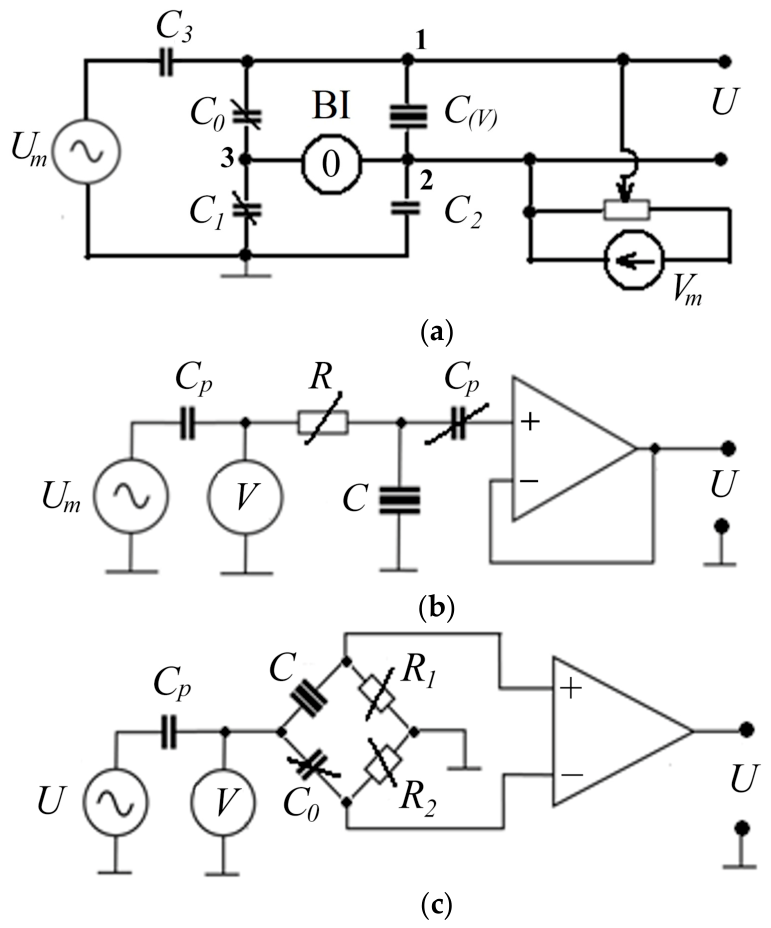
In practice, experimental or production-scale devices with specified metrological characteristics are employed to measure capacitance and CV characteristics. These instruments operate on various physical principles (Figure 8) [31]. For preliminary studies of MISC sensors under development, when their characteristics are still unknown, AC bridge circuits equipped with a balance indicator (ACB + BI) are utilized, as illustrated in Figure 8a. The wide ΔV measurement range is the main advantage of this circuit. However, the complexity of the circuit structure and calibration, as well as the stringent requirements for the ND offset adjustment, limit its applicability in practical hydrogen sensors.
Common methods for measuring capacitance include the divider method (DM) and the bridge method (BM) (Figure 8b,c). In all cases, the measured capacitance values are not specific (i.e., normalized) but absolute values, which depend on the working electrode area (for the MISC under study, Ci = 370 pF).
A circuit based on the DM is recommended for measuring gas concentrations at the maximum allowable concentration (MAC) level in residential and occupational areas. While a BM circuit provides the maximum sensitivity for the MISC sensor, it inherently limits the measurable concentration range. It should be noted that an increase in the range of measurable capacitances and concentrations leads to a reduction in sensitivity. In this regard, the DM occupies an intermediate position, offering a balanced trade-off between sensitivity and the measurement range.
The boundary values of the conversion ranges of the MISC hydrogen sensor for various circuit configurations and error margins are exemplified in Table 3.
The selection of circuit design, the method for evaluating hydrogen sensitivity, and the optimal electrical conditions indirectly influence the metrological and operational characteristics of MISC hydrogen sensors. This influence is mediated by instrumental and statistical errors inherent in the measurement of CV characteristics. Consequently, a reduction in these errors leads to an expansion of the sensor’s conversion range.

4. Experimental Validation

Tests of electronic boards, fabricated using various capacitance measurement techniques, were conducted with the same MISC hydrogen sensor operating at a temperature of 100 °C (370 K). The relevant settings and characteristics of the boards are presented in Table 4. The experimental MISC sensor was fabricated using a well-established technology, which is described in greater detail in our previous publications [32].
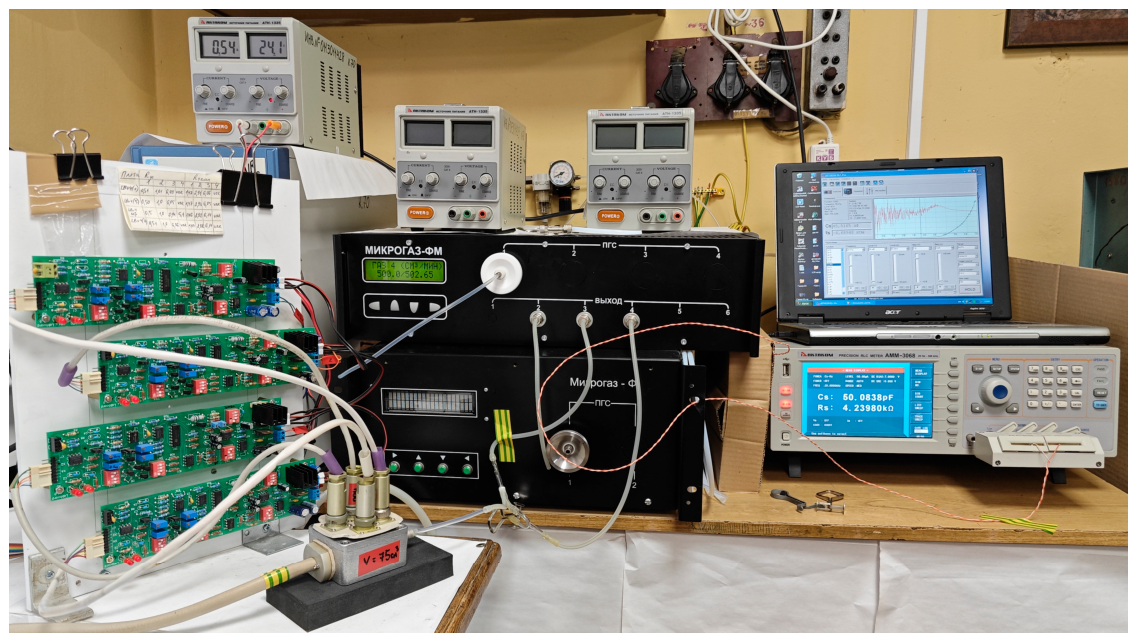
To investigate hydrogen sensitivity, a dynamic gas mixing setup was employed, utilizing cylinders containing air and a test gas mixture of air + H2 (0.1 vol%). After mixing, the resulting gas mixture was supplied to the chamber of the MISC sensor, which had a volume not exceeding 0.1 L. A photograph of the experimental setup is presented in Figure 9. Cylinders with hydrogen (JSC MGPZ, Moscow, Russia) were diluted with clean air using a Mikrogaz generator-diluent (JSC Intera, Kirovo-Chepetsk, Russia)
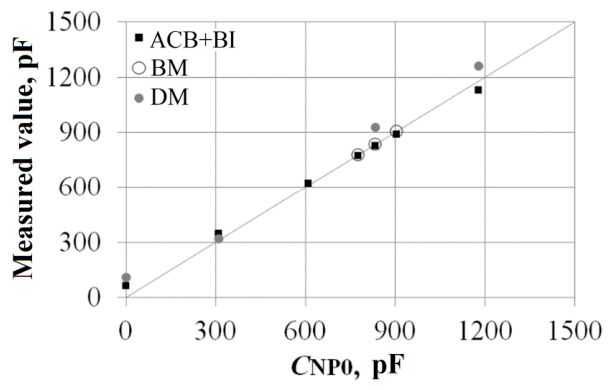
The accuracy of setting and maintaining the V0 values on the boards was no worse than ±0.1 mV. For the operating temperature of the MISC sensor, the accuracy was no worse than ±0.1 °C. Additionally, prior to testing with the MISC sensor, the accuracy of capacitance measurements performed by the electronic boards was verified. For this purpose, temperature-stable NP0 ceramic capacitors (±30 ppm/°C) were used, and their capacitance was monitored with an AMM-1130 multimeter (Aktakom Ltd., Moscow, Russia) (±1%). The results are presented in Figure 10.
As shown in Table 4, the capacitance measurement range of the BM circuit is significantly narrower compared to the ACB + BI and DM circuits and is determined by the reference capacitance C0 (see Figure 2). Consequently, while the BM circuit enables high-accuracy measurement of the MISC sensor capacitance, this is achievable only within a limited range of ΔC = 130 pF, which substantially restricts its practical applicability. It is worth noting (see Figure 10) that the measurement error for the ACB + BI and DM circuit boards also depends on the measurement range. The highest accuracy for the DM circuit board is attained when calibrating the operating capacitance within a range not exceeding 1500 pF; beyond this limit, the error increases by 8% for every additional 1000 pF.
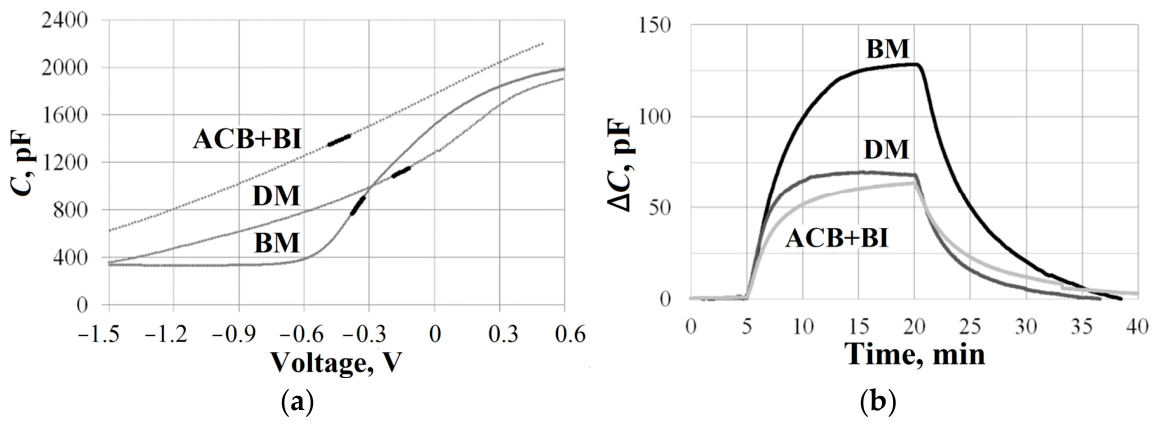
The CV characteristics of the control MISC sensor, measured using the electronic boards, are presented in Figure 11a. Note that the sensor’s CV characteristics were measured in clean air and under 5 ppm hydrogen over the entire bias voltage range. The sections are highlighted in bold for clarity to avoid cluttering the graph while clearly indicating the position of the operating point (V0) and the magnitude of the gas-induced shift (ΔV).
Due to differences in the measurement signal parameters implemented in the electronic boards, the shape of the CV curve for the same sensor varies depending on the measurement scheme. The operating points for each case were selected according to the method described above (see Figure 2), after which the dynamic characteristics of the MISC sensor were investigated in response to a hydrogen concentration of 5 ppm. The results are represented in Figure 11b and Table 5. Note that the greater capacitive response of the sensor, observed during measurements on the electronic board using the BM, is attributed to the steeper slope of its CV characteristic (∆C/∆V). Consequently, the magnitude of the capacitance change (∆C = 128 pF) under 5 ppm H2 is twice as large as that obtained with the other two methods, while exhibiting a significantly smaller shift in the bias voltage (∆V = −50 mV).
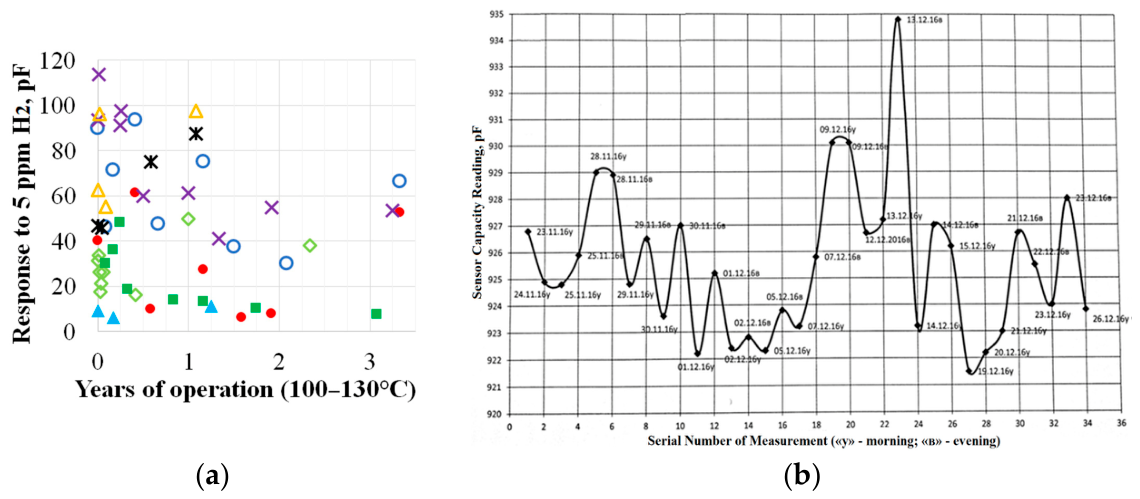
Influence of measuring circuit parameters on the characteristics of MIS-capacitor hydrogen sensors also must be compared with the accuracy of the sensors’ response to hydrogen concentration during its lifetime, particularly noting the gas sensor characteristics that are of practical importance for implementation. These include long-term stability of characteristics, as well as the influence of interfering factors, such as humidity and background gases, to which the sensors may exhibit cross-sensitivity. Experimental data on the long-term stability of sensitivity, obtained using the BM capacitance measurement method, are presented in Figure 12.
The experiment involved the continuous operation of a batch of eight hydrogen sensors for over three years at a temperature of 100–130 °C, with periodic verification of their operating parameters, specifically hydrogen sensitivity. Hydrogen measurements were conducted in static mode. A 0.5% vol. H2 Standard Gas Mixture was injected into a sealed 1 L container filled with room air using a 1 cm3 medical syringe. This resulted in a test H2 concentration of 5 ppm. As shown in Figure 12a, the sensitivity of the majority of sensors exhibited a slight decrease relative to the initial level, typically stabilizing within the first six months of operation. Observations of the zero-reading drift (Figure 12b) revealed periodic fluctuations on a monthly scale, likely attributable to gradual changes in environmental parameters. As can be seen, the fluctuations in sensor readings did not exceed 10–20 pF, which, according to the sensor’s preliminary calibration, is equivalent to a nominal change in ambient hydrogen concentration of no more than ±1 ppm.
The issues of humidity influence, its compensation algorithms, and cross-sensitivity have been studied in detail and described in our previous work [32,33].

5. Conclusions

This paper presents an analysis of the methods and tools for evaluating the metrological performance of MISC sensor devices. This study is based on electrophysical models of the electrical characteristics of metal-insulator-semiconductor capacitive sensors. As a case study, this paper examines hydrogen sensors with a Pd-Ta2O5-SiO2-nSi structure. Furthermore, recommendations are provided for the selection of optimal circuit configurations to determine the operating characteristics of sensors for detecting hydrogen-containing gas concentrations.
The bridge capacitance measurement circuit has been demonstrated to be well-suited for laboratory applications where high accuracy and sensitivity are of paramount importance. For the determination of gas concentrations at the MAC level in residential and occupational environments, a circuit based on the divider method is recommended. While the bridge circuit provides maximum sensitivity for the MISC sensor, it inherently limits the measurable range of gas concentrations. An increase in the range of measurable capacitances and corresponding concentrations results in a reduction in sensitivity. The divider method offers a compromise, occupying an intermediate position in terms of both sensitivity and measurement range.
The proposed models and methodology for studying the characteristics of MISC-based hydrogen sensors can serve as a foundation for the mathematical support required in the design of gas analyzers utilizing various types of MISCs. This includes the development of more complex designs and the prediction of their performance. Furthermore, engineering-physical models, parameterized with specific numerical values for given MISC structures, can be integrated into computer-aided design (CAD) systems for integrated gas concentration sensors.

Author Contributions

Conceptualization, B.P. and N.S.; methodology, M.E.; software, K.O.; validation, M.E. and K.O.; formal analysis, N.S.; investigation, M.E.; resources, K.O.; data curation, M.E.; writing—original draft preparation, B.P. and N.S.; writing—review and editing, M.E.; visualization, B.P.; supervision, N.S.; project administration, K.O.; funding acquisition, K.O. All authors have read and agreed to the published version of the manuscript.

Funding

This work was supported by the Russian Science Foundation, Grant No. 24-79-10278 (31 July 2024).

Institutional Review Board Statement

Not applicable.

Informed Consent Statement

Not applicable.

Data Availability Statement

The original contributions presented in this study are included in the article. Further inquiries can be directed to the corresponding author.

Conflicts of Interest

The authors declare no conflicts of interest. The funders had no role in the design of the study; in the collection, analyses, or interpretation of data; in the writing of the manuscript; or in the decision to publish the results.

References

  1. Buttner, W.J.; Post, M.B.; Burgess, R.; Rivkin, C. An overview of hydrogen safety sensors and requirements. Int. J. Hydrogen Energy 2011, 36, 2462–2470. [Google Scholar] [CrossRef]
  2. Hübert, T.; Boon-Brett, L.; Black, G.; Banach, U. Hydrogen sensors—A review. Sens. Actuators B Chem. 2011, 157, 329–352. [Google Scholar] [CrossRef]
  3. Di Bartolomeo, A. Advanced Field-Effect Sensors. Sensors 2023, 23, 4554. [Google Scholar] [CrossRef] [PubMed]
  4. Sahoo, T.; Kale, P. Work Function-Based Metal–Oxide–Semiconductor Hydrogen Sensor and Its Functionality: A Review. Adv. Mater. Interfaces 2021, 8, 2100649. [Google Scholar] [CrossRef]
  5. Gu, H.; Wang, Z.; Hu, Y. Hydrogen gas sensors based on semiconductor oxide nanostructures. Sensors 2012, 12, 5517–5550. [Google Scholar] [CrossRef] [PubMed]
  6. Sola-Penafiel, N.; Lopez-Rodriguez, G.; Sindreu-Cladera, P.; Navarrete, E.; Llobet, E.; Ramos-Castro, J.; Martin, I.; Manyosa, X.; Bermejo, S.; Dominguez-Pumar, M. Accelerating hydrogen sensing with Pd-MOS capacitors using active controls of trapped charge. Sens. Actuators B Chem. 2025, 426, 136959. [Google Scholar] [CrossRef]
  7. Hubert, T.; Boon-Brett, L.; Palmisano, V.; Bader, M.A. Developments in gas sensor technology for hydrogen safety. Int. J. Hydrogen Energy 2014, 39, 20474–20483. [Google Scholar] [CrossRef]
  8. Lundström, I.; Svensson, C.; Spetz, A.; Sundgren, H.; Winquist, F. From hydrogen sensors to olfactory images-twenty years with catalytic field effect devices. Sens. Actuators B Chem. 1993, 13, 16–23. [Google Scholar] [CrossRef]
  9. Lundström, I.; Sundgren, H.; Winquist, F.; Eriksson, M.; Krants-Rülcker, C.; Lloyd-Spets, A. Twenty-five years of field effect gas sensor research in Linköping. Sens. Actuators B Chem. 2007, 121, 247–262. [Google Scholar] [CrossRef]
  10. Lundström, I.; Shivaraman, S.; Svensson, C.; Lundkvist, L. A hydrogen-sensitive MOS field-effect transistor. Appl. Phys. Lett. 1975, 26, 55–57. [Google Scholar] [CrossRef]
  11. Medvedev, O.S.; Stavrovskii, D.B.; Bondarenko, G.N.; Litvinov, A.V.; Etrekova, M.O.; Karabinenko, A.A.; Kilimnik, V.A.; Ponurovskii, Y.Y. Analysis of the kinetics of the gut microbiota produced hydrogen and methane by the test with H2- and CH4-rich water probe. In Proceedings of the Conference “Physics of Aqueous Solutions”, Moscow, Russia, 18–20 November 2024; Volume VII, p. 24. [Google Scholar] [CrossRef]
  12. Däbritz, J.; Mühlbauer, M.; Domagk, D.; Voos, N.; Henneböhl, G.; Siemer, M.L.; Foell, D. Significance of hydrogen breath tests in children with suspectedcarbohydrate malabsorption. BMC Pediatr. 2014, 14, 59. [Google Scholar] [CrossRef] [PubMed]
  13. Bustamante, S.; Manana, M.; Arroyo, A.; Castro, P.; Laso, A.; Martinez, R. Dissolved gas analysis equipment for online monitoring of transformer oil: A review. Sensors 2019, 19, 4057. [Google Scholar] [CrossRef] [PubMed]
  14. Bakar, N.; Abu-Siada, A.; Islam, S. A review of dissolved gas analysis measurement and interpretation techniques. IEEE Electr. Insul. Mag. 2014, 30, 39. [Google Scholar] [CrossRef]
  15. Filipchuk, D.V.; Litvinov, A.V.; Etrekova, M.O.; Nozdrya, D.A. Investigation of the sensitivity of MIS-sensor to thermal decomposition products of cables insulation. J. Phys. Conf. Ser. 2017, 941, 012061. [Google Scholar] [CrossRef]
  16. Tian, L.; Wang, R.; Liu, X.; Xiao, Q.; Wang, Q.; Wu, Z.; Xiang, H.; Bao, J.; Cao, Z. Thermal decomposition experiment analysis and research on high-voltage cable PVC sheath at different temperatures. Discov. Appl. Sci. 2026, 8, 370. [Google Scholar] [CrossRef]
  17. Liu, Y.; Furuno, S.; Akagawa, S.; Yatabe, R.; Onodera, T.; Fujiwara, N.; Takeda, H.; Uchida, S.; Toko, K. Odor Recognition of Thermal Decomposition Products of Electric Cables Using Odor Sensing Arrays. Chemosensors 2021, 9, 261. [Google Scholar] [CrossRef]
  18. Tari, G.C. Chapter 3 Natural hydrogen exploration: Some similarities and differences with oil and gas exploration. In Natural Hydrogen Systems: Properties, Occurrences, Generation Mechanisms, Exploration, Storage and Transportation; Rezaee, R., Evans, B.J., Eds.; De Gruyter: Berlin, Germany, 2025; pp. 75–104. [Google Scholar] [CrossRef]
  19. Zgonnik, V.; Beaumont, V.; Larin, N.; Pillot, D.; Deville, E. Diffused flow of molecular hydrogen through the Western Hajar mountains, Northern Oman. Arab. J. Geosci. 2019, 12, 71. [Google Scholar] [CrossRef]
  20. Saini, J.; Dutta, M.; Marques, G. Machine Learning for Indoor Air Quality Assessment: A Systematic Review and Analysis. Environ. Model. Assess. 2025, 30, 417–434. [Google Scholar] [CrossRef]
  21. Konduru, T.; Rains, G.C.; Li, C. A customized metal oxide semiconductor-based gas sensor array for onion quality evaluation: System development and characterization. Sensors 2015, 15, 1252–1273. [Google Scholar] [CrossRef] [PubMed]
  22. Hong, H.-K.; Kwon, C.H.; Kim, S.-R.; Yun, D.H.; Lee, K.; Sung, Y.K. Portable electronic nose system with gas sensor array and artificial neural network. Sens. Actuators B Chem. 2000, 66, 49–52. [Google Scholar] [CrossRef]
  23. Nikolaev, I.N.; Litvinov, A.V.; Khalfin, T.M. Automatic gas analyzers for hydrogen in the volumetric concentration range 10−6-1.0%. Meas. Tech. 2004, 47, 725–728. [Google Scholar] [CrossRef]
  24. Nozdrya, D.A.; Litvinov, A.V.; Nikolaev, I.N. A portable ammonia gas analyzer in the 0.02–104 ppm range based on an MOS sensor. Meas. Tech. 2007, 50, 690–693. [Google Scholar] [CrossRef]
  25. Litvinov, A.V.; Unichenko, P.O.; Nikolaev, I.N. A method of measuring the concentrations of hydrogen sulfide and ethyl mercaptan in their mixture in air. Meas. Tech. 2007, 50, 548–550. [Google Scholar] [CrossRef]
  26. Kalinina, L.N.; Litvinov, A.V.; Nikolaev, I.N. MIS-sensors with different metal and insulator layers. Autom. Remote Control 2013, 74, 295–300. [Google Scholar] [CrossRef]
  27. Podlepetsky, B.; Samotaev, N.; Etrekova, M.; Litvinov, A. Structure and Technological Parameters’ Effect on MISFET-Based Hydrogen Sensors’ Characteristics. Sensors 2023, 23, 3273. [Google Scholar] [CrossRef] [PubMed]
  28. Podlepetsky, B.; Samotaev, N.; Nikiforova, M.; Kovalenko, A. Performance degradations of MISFET-based hydrogen sensors with Pd-Ta2O5-SiO2-Si structure at long-time operation. Sensors 2019, 19, 1855. [Google Scholar] [CrossRef] [PubMed]
  29. Podlepetsky, B.; Kovalenko, A.; Samotaev, N. Influence of electrical modes on performance of MISFET hydrogen sensors. Sens. Actuators B Chem. 2017, 248, 1017–1022. [Google Scholar] [CrossRef]
  30. Esqueda, I.S.; Barnaby, H.J.; King, M.P. Compact Modeling of Total Ionizing Dose and Aging Effects in MOS Technologies. IEEE Trans. Nucl. Sci. 2015, 62, 1505. [Google Scholar] [CrossRef]
  31. Shumskiy, I.A. Semiconductor C-V characteristic measurement—Choosing up-to-date low-cost solution. Test Meas. Instrum. Syst. 2017, 2, 10–16. (In Russian) [Google Scholar]
  32. Bolodurin, B.A.; Mikhailov, A.A.; Filipchuk, D.V.; Etrekova, M.O.; Korchak, V.Y.; Pomazan, Y.V.; Litvinov, A.V.; Nozdrya, D.A. Comprehensive Research on the Response of MIS Sensors of Pd-SiO2-Si and Pd-Ta2O5-SiO2-Si Structures to Various Gases in Air. Russ. J. Gen. Chem. 2018, 88, 2732–2739. [Google Scholar] [CrossRef]
  33. Samotaev, N.; Litvinov, A.; Etrekova, M.; Oblov, K.; Filipchuk, D.; Mikhailov, A. Prototype of nitro compound vapor and trace detector based on a capacitive MIS Sensor. Sensors 2020, 20, 1514. [Google Scholar] [CrossRef] [PubMed]
Figure 1. Vertical (a) and planar (b) schematic diagrams of MISC structures: 1 and 2 terminals of working electrode 3 and ohmic contact 7 (a) or region 6 (b); 4 and 9 thin and thick dielectric films; 5 and 6 high-resistance and low-resistance regions of n- or p-type semiconductor; 8 gas-sensitive active regions. (c) Equivalent electrical circuit.
Sensors 26 04209 g001
Figure 2. Examples of high-frequency CV characteristics of the MISC structure are shown before (curve 1) and after (curve 2) exposure to hydrogen. The dashed line illustrates the capacitance change, ΔC, resulting from a CV characteristic shift of ΔV within the voltage range ΔVm. The maximum capacitance change, ΔCm, is indicated for the operating voltage VA.
Sensors 26 04209 g002
Figure 3. The formation of the experimental dependence V(N) (data points 1 and connecting lines 2) and the approximated dependence (curve 3), along with a fragment of the error band (4). The number 1 indicates the range of amplitudes for m = 5 responses, corresponding to their n = 3 measurements.
Sensors 26 04209 g003
Figure 4. Two options for determining the concentration N based on the shift of the CV characteristic: (a) measuring the voltage shift ΔV at a constant capacitance (using scheme 1); (b) measuring the capacitance shift ΔC at a constant voltage (using scheme 2).
Sensors 26 04209 g004
Figure 5. The dependence of the δN(N) on the average concentration N. Curves 1, 2, and 3 correspond to the following error conditions: δV = 1%, Δ(V) = 5 mV, and Δ(V) = 1 mV. The absolute error is ΔNN = 2 ppm. The dots mark the upper limits of the operating ranges for δNm = 5%.
Sensors 26 04209 g005
Figure 6. The dependences of the δN(N) on the high concentration values. For notation, see the caption of Figure 5.
Sensors 26 04209 g006
Figure 7. Dependences of C(φs) before (1) and after (2) exposure to H2. Curve (3) represents C(φs) = Cmin + ∫SCdφs.
Sensors 26 04209 g007
Figure 8. Circuit diagrams: (a) AC bridge with balance indicator (ACB + BI),AC/DC sources (Um, Vm), MISC capacitor C(V), and calibration capacitors (C0, C1); (b) divider method (DM); (c) bridge method (BM).
Sensors 26 04209 g008
Figure 9. Experimental setup for evaluating the hydrogen sensitivity of MISC sensors.
Sensors 26 04209 g009
Figure 10. Verification of capacitance measurement accuracy on electronic boards.
Sensors 26 04209 g010
Figure 11. Analysis of the output signals of the MISC sensor using different capacitance measurement methods: (a) CV characteristics, with the section corresponding to the shift under 5 ppm hydrogen highlighted in bold; (b) dynamic response to 5 ppm hydrogen.
Sensors 26 04209 g011
Figure 12. (a) Long-term stability of MISC sensors response to 5 ppm H2 at 100 °C. Different symbols in the figure body correspond to the dynamics of sensor sensitivity (relative to the initial level) for various MISC sensor samples fabricated using PLD technology but differing in dielectric material during long-term operation in ambient air for approximately 8–10 hours a day, 5 days a week. (b) Zero-reading drift over a 1-month observation period.
Sensors 26 04209 g012
Table 1. Parameters of the MISC with a Pd-Ta2O5-SiO2-nSi structure and the models used.
DesignationsParametersAverage Values
ε1, ε2 and εsrelative permittivity of Ta2O5, SiO2 and Si25, 4 and 12
NDdonor concentration in Si5 × 1015 cm−3
d1 and d2thickness of Ta2O5 and SiO290 nm and 80 nm
ε0relative permittivity of vacuum8.85 × 10−12 F/m
kBoltzmann constant1.38 × 10−23 J/K
qelectron charge1.6 × 10−19 C
dthickness of thin dielectric (d1 + d2)170 nm
seeffective area of the working electrode0.01 cm2
εeffective permittivity (dε1ε2)/(ε1d2 + ε2d1)7.2
Cispecific capacitance of a thin dielectric (ε0ε)/d37 nF/cm2
acharge parameter in Si [(2q·ε0εsND)1/2/Ci]1.1 V1/2
bcharge parameter Qss at Nss = 1012 cm−2 [qNss/(φbgCi)]0.43
φmswork function difference potential between Pd and Siφms0 = 85 mV
TMISC chip temperature400 K
φTthermal potential (kT/q) at 400 K33 mV
φgbband gap potential in Si1.08 V
φs0donor level potential [φTln(ND/ni)]0.34 V
φssurface potential [φ(SiO2-Si) − φF](0.05…0.8) V
Qte and Qsscharge density in the dielectric and at the SiO2-Si interface(2…100) nC/cm2
Nssdensity of surface states at the boundary SiO2-Si(1011…1013) cm−2
Table 2. Approaches to determining the concentration N based on the shifts of the CV characteristic.
Scheme #Control ParametersOutput ValuesRelative Sensitivities
1C0 ∈ (Cmin + Δ(C);
Cmax − Δ(C))
ΔV(N) = ΔVm [1 − exp(−kN N)]S1 = kNΔVm exp(−kN N)/V0
2V0 ∈ [VA; VB)ΔC(N) = C(V0 − ΔV(N)) − C(V0)S2 = gC kNΔVm ×
exp(−kN N)/C0
Table 3. Boundaries of the MISC sensor conversion range for various measurement errors.
Δ(V)N0,
ppm
N1,
ppm
N2,
ppm
Nm,
ppm
δNmin,
%
0.01·│V(N)│9295230074003.17
5 mV140355315081002.72
1 mV4.595600010,4500.54
0.6 mV (ΔCC = 1 pF)2.565820013,3000.43
Table 4. Configuration parameters and performance characteristics of the electronic boards.
Comparison ParametersCapacitance Measurement Method
ACB + BIDMBM
F, kHz82018
A, mV15001000200
intrinsic noise of the electronic board *, ±pF0.050.10.13
noise of the readout circuitry Cnoise, ±pF0.150.20.26
measurement range,
pF (±δ, %)
C0 ± 50 (±1)
400…1200 (±5)
300…5000 (±11)
500…2000 (±1)
300…5000 (±30)
C0 ± 65 (±1)
* Values obtained using NP0 capacitors.
Table 5. MISC sensor hydrogen sensitivity data.
Comparison ParametersCapacitance Measurement Method
ACB + BIDMBM
operating point coordinate V0, mV−500−200−400
CV characteristic shift of ΔV, mV−74−70−50
capacitance change ∆C, pF6470128
hydrogen sensitivity SC(N), pF/ppm12.81425.6
response speed τ0.9; τ0.1; τfull, min9; 14; 256; 9; 208; 11; 30
calculated value of the detection limit NLOD_H2, ppb354330.5
Designations: τfull—characteristic time for the sensor readings to return to their original values after removal of hydrogen exposure; NLOD_H2 = (3∙Cnoise)/SC (see Table 4).
Disclaimer/Publisher’s Note: The statements, opinions and data contained in all publications are solely those of the individual author(s) and contributor(s) and not of MDPI and/or the editor(s). MDPI and/or the editor(s) disclaim responsibility for any injury to people or property resulting from any ideas, methods, instructions or products referred to in the content.