A Review of Key Technologies in Gravity Matching Navigation


Abstract
1. Research Background and Significance
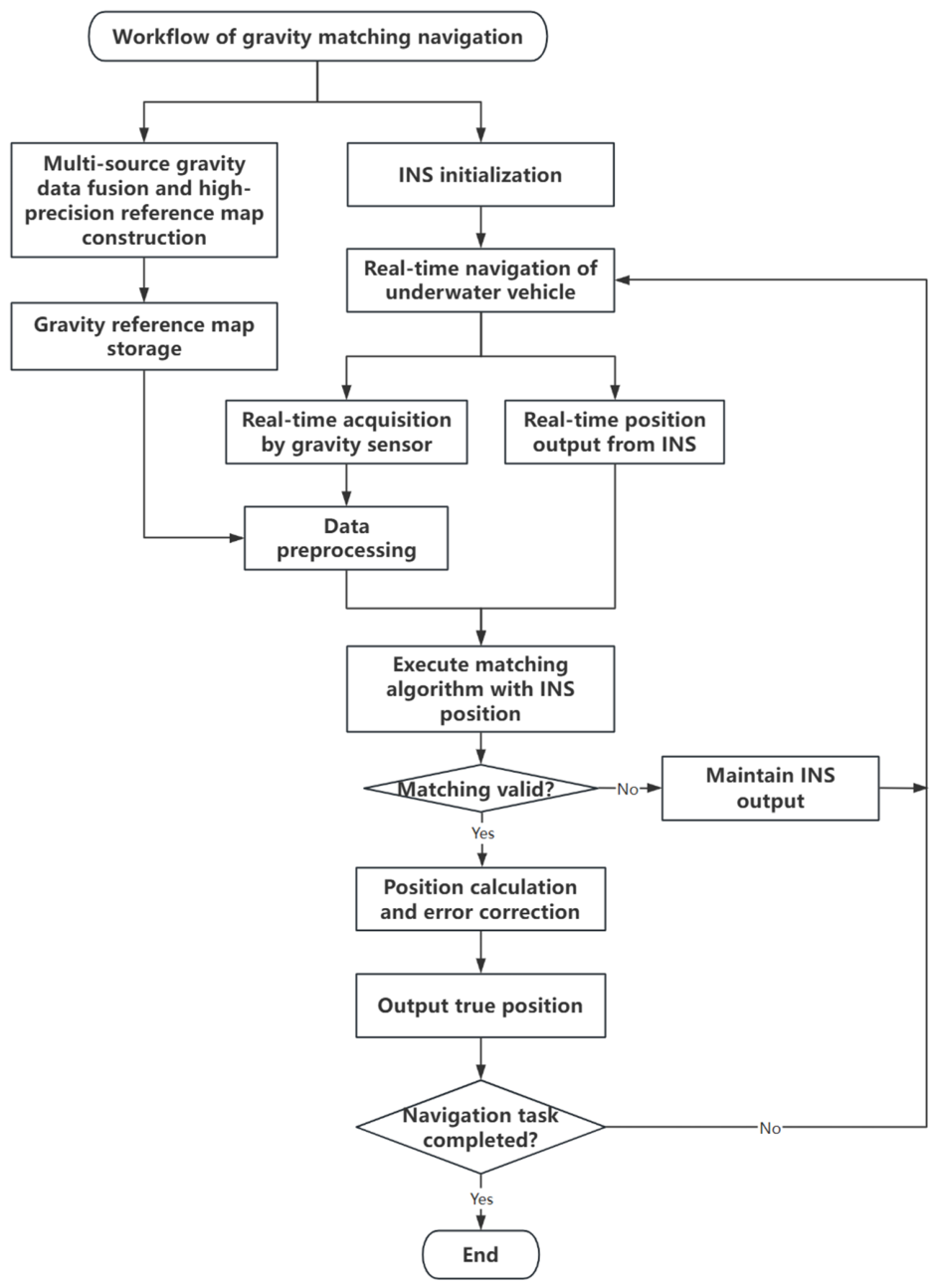
2. Research Status of Key Technologies for Gravity Matching Navigation
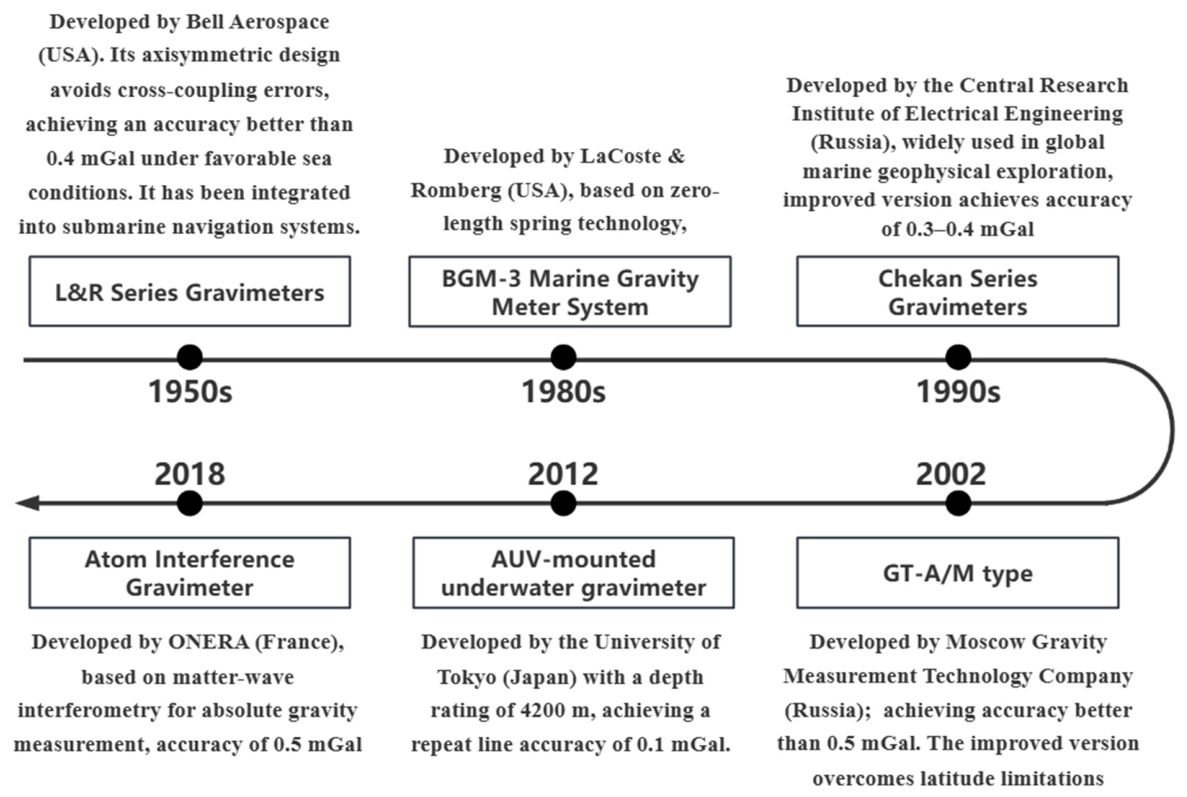
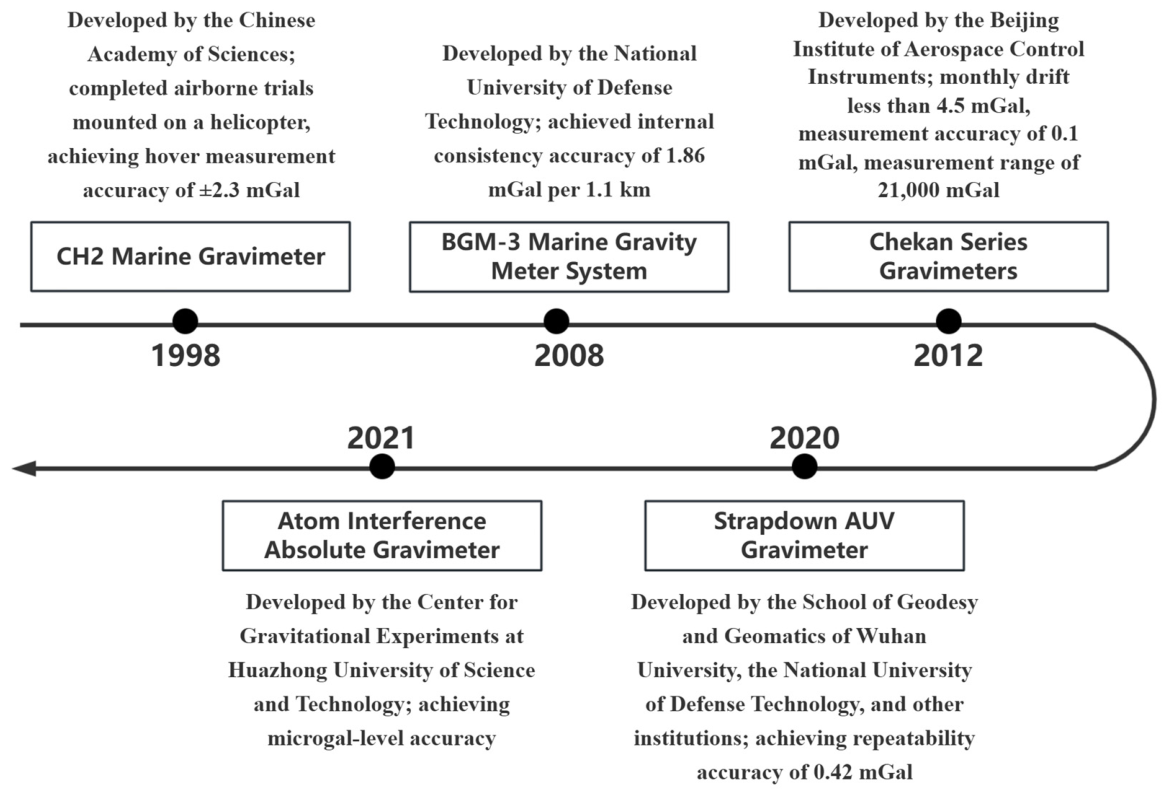
2.1. Underwater Navigation Technologies
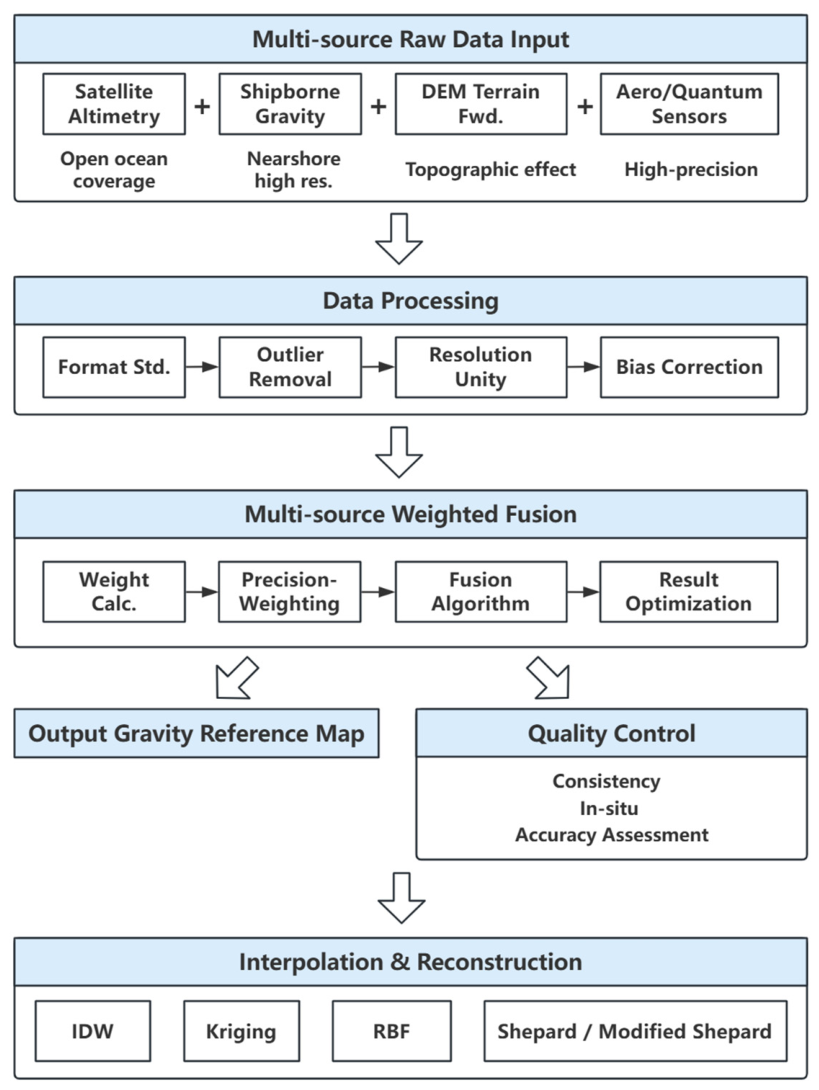
2.2. Gravity Reference Map Construction and Data Processing
2.3. Gravity Suitable Area Selection and Evaluation
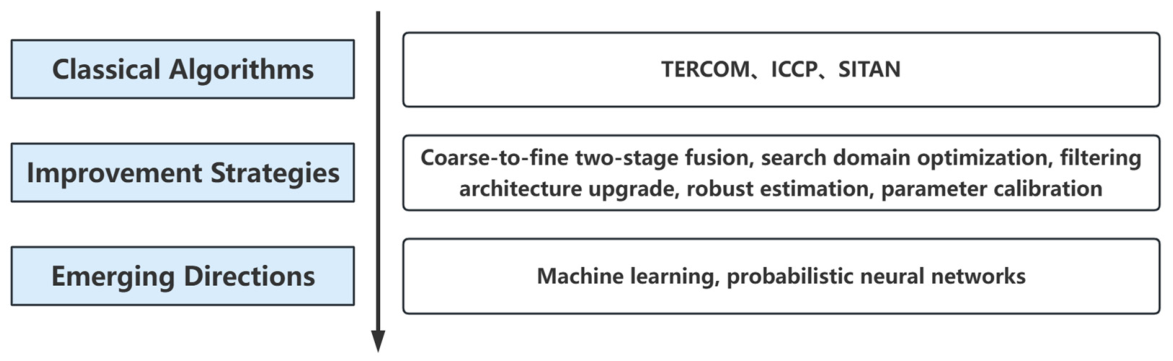
2.4. Gravity Matching Algorithm Optimization
2.5. Gravity–Inertial Integrated Navigation
2.6. Path Planning and Trajectory Optimization
3. Literature Review and Commentary
- Hardware: Insufficient engineering maturity and miniaturization of high-end equipment
- Algorithms: Poor robustness and environmental adaptability in extreme marine conditions
- Validation: Limited real-world marine measurements for most proposed schemes
- System Integration: Weak dynamic coordination and adaptive coupling among sub-systems.
- Hardware Advancement: Closing existing hardware gaps
- Error Mechanisms: Deepening the understanding of error coupling
- Algorithm Development: Creating cross-domain intelligent adaptive algorithms
- Validation: Strengthening multi-condition real-world validation.
Funding
Institutional Review Board Statement
Informed Consent Statement
Data Availability Statement
Conflicts of Interest
References
- Huang, M.T.; Ouyang, Y.Z.; Bian, S.F.; Li, S.S.; Li, M.C.; Lu, X.P.; Wang, W.P.; Dong, C.; Tang, M.Q.; Hong, L.D.; et al. Analysis and reflection on the development of underwater gravity-aided inertial navigation technology in the U.S. and Russia. Geomat. Inf. Sci. Wuhan Univ. 2024, 49, 1977–1991. [Google Scholar] [CrossRef]
- Xiu, R.; Guo, G.; Xue, Z.B.; Li, D.M.; Li, H.B. Technical status and new applications of air-sea gravimeters. Navig. Control 2019, 18, 35–43. [Google Scholar]
- Pan, G.W.; Cao, J.L.; Wu, M.P.; Tie, J.B. Progress in underwater gravity measurement technology. Bull. Surv. Mapp. 2019, 1–5. [Google Scholar] [CrossRef]
- Bidel, Y.; Zahzam, N.; Blanchard, C.; Bonnin, A.; Cadoret, M.; Bresson, A.; Rouxel, D.; Lequentrec-Lalancette, M.F. Absolute marine gravimetry with matter-wave interferometry. Nat. Commun. 2018, 9, 627. [Google Scholar] [CrossRef] [PubMed]
- Miao, Q.L.; Ma, T.; Ma, D.; Fan, J.J.; Zhang, W.J. A review of underwater geophysical field aided navigation technology. Digit. Ocean Underw. Warf. 2025, 8, 220–231. [Google Scholar] [CrossRef]
- Wan, F.B.; Kuang, W.J.; Zhong, Y.Y.; Xu, F.F.; Hu, Q.Q. Research prospects of underwater gravity-aided navigation based on atom interferometry. Chin. J. Sci. Instrum. 2023, 44, 41–54. [Google Scholar] [CrossRef]
- Li, X.Y.; Zhang, Z.L.; Zhou, Z.F.; Wu, P.F.; Chang, Z.J.; Hao, S.W. Research on the Temperature Effect and Postprocessing Compensation Methods of Zero-Length Spring Relative Gravimeter. IEEE Sens. J. 2024, 24, 30192–30203. [Google Scholar] [CrossRef]
- Li, X.Y.; Zhang, Z.L.; Zhou, Z.F.; Chang, Z.J.; Duan, H. Vibration Compensation of Zero-Length Spring Gravimeter Based on Improved ADMM. IEEE Geosci. Remote Sens. Lett. 2025, 22, 7502305. [Google Scholar] [CrossRef]
- Han, Y.R. Research on Gravity Matching Algorithm for Underwater Navigation. Master’s Thesis, Beijing Institute of Technology, Beijing, China, 2017. [Google Scholar]
- Li, X.Y.; Zhang, Z.L.; Zhou, Z.F.; Chang, Z.J.; Zhao, Z.Q. Vehicle gravity anomaly measurement methods based on SINS/odometer/altimeter. J. Beijing Univ. Aeronaut. Astronaut. 2024, 50, 3162–3171. [Google Scholar] [CrossRef]
- Peng, F.Q. Marine Gravity Aided Navigation Methods and Applications. Ph.D. Thesis, PLA Information Engineering University, Zhengzhou, China, 2009. [Google Scholar]
- Wu, R.Y.; Li, D.M.; Li, H.B.; Guo, Z.W. Application research of gravity interpolation reconstruction in gravity matching navigation. Navig. Position. Timing 2024, 11, 91–101. [Google Scholar] [CrossRef]
- Wu, T.Q.; Huang, M.T.; Lu, X.P.; Jin, J.H. Gravity map generation technology for gravity field matching navigation. J. Chin. Inert. Technol. 2007, 438–441. [Google Scholar] [CrossRef]
- Wang, T. Frontiers and Progress in Gravity Interpolation Reconstruction. China New Technol. Prod. 2021, 3, 10–12. [Google Scholar]
- Tan, B.; Lin, C.; Lu, X. A multi-source gravity anomaly fusion method. Ship Electron. Eng. 2021, 41, 66–70+140. [Google Scholar]
- Wang, W.J. Research on Underwater Navigation and Positioning Methods Based on Gravity and Environmental Features. Ph.D. Thesis, Harbin Engineering University, Harbin, China, 2009. [Google Scholar]
- Bian, S.F.; Li, Z.Q.; Zhang, T.; Li, H.P.; Li, J.S.; Ji, B. Progress in Earth’s gravity field research and its role in inertial navigation systems. Navig. Position. Timing 2025, 12, 1–15. [Google Scholar] [CrossRef]
- Hao, S.W.; Zhou, Z.F.; Zhang, Z.L.; Meng, Z.H.; Chang, Z.J. Analysis of the inertial navigation system positioning error caused by deflection of the vertical. Chin. J. Sci. Instrum. 2023, 44, 74–84. [Google Scholar] [CrossRef]
- Hao, S.W.; Zhou, Z.F.; Zhang, Z.L.; Zhao, J.Y.; Chang, Z.J.; Li, X.Y. DOV Relative Estimation Method Based on Double Alignment: Level Alignment. IEEE Trans. Instrum. Meas. 2025, 74, 9545511. [Google Scholar] [CrossRef]
- Kuang, W.J.; Wan, F.B.; Zhong, Y.Y.; Hu, Q.Q.; Xu, F.F. Simulation analysis and evaluation of underwater matching navigation based on quantum gravity detection technology. Intell. Secur. 2023, 2, 68–80. [Google Scholar] [CrossRef]
- Xu, C.; Liao, S.K. Spatial resolution synchronization technology for gravity/inertial matching navigation. Opt. Optoelectron. Technol. 2023, 21, 138–144. [Google Scholar] [CrossRef]
- Zong, J.W.; Cai, P.; Zhai, G.J.; Zhu, H.R.; Chen, C.; Pan, R.C. Optimized A algorithm route planning integrating gravity information. Syst. Eng. Electron. 2025, 47, 1327–1334. [Google Scholar]
- Zhou, X.C.; Zheng, W.; Li, Z.W.; Wu, P.L.; Sun, Y.J. Enhancing path planning efficiency for underwater gravity matching navigation with a novel three-dimensional along-path obstacle profiling algorithm. Remote Sens. 2023, 15, 5579. [Google Scholar] [CrossRef]
- Li, X.Y.; Zhou, Z.F.; Zhang, Z.L.; Chang, Z.J.; Hao, S.W. Research on data processing technology for repeated survey lines in aerial gravity measurement. Aeronaut. Sci. Technol. 2023, 34, 77–83. [Google Scholar] [CrossRef]
- Zhang, J.B.; Xiao, Y.; Chen, K.N. Multi-attribute decision-making and improved A algorithm for gravity matching navigation trajectory planning. Sci. Surv. Mapp. 2023, 48, 38–48. [Google Scholar] [CrossRef]
- Gong, J.; Zhang, C.M.; Zhou, X.G.; Li, X.P.; Fu, J.L. A gravity suitable area selection method based on factor analysis. J. Chin. Inert. Technol. 2019, 27, 732–737. [Google Scholar] [CrossRef]
- Li, Z.W.; Zheng, W.; Fang, J.; Wu, F. Optimizing suitable areas for underwater gravity matching navigation based on a novel principal component weighted average normalization method. Chin. J. Geophys. 2019, 62, 3269–3278. [Google Scholar]
- Chen, K.N.; Xiao, Y.; Zhang, J.B.; Cao, J.; Wang, Y.K.; Hong, X.D. Comparative study of suitability evaluation methods for underwater gravity matching navigation. J. Geod. Geodyn. 2024, 44, 737–743. [Google Scholar] [CrossRef]
- Mao, G.C.; Wu, L.; Xi, M.H.; Liu, S.; Xiong, C.L.; Bao, L.F.; Wang, Y. Suitable area selection algorithm for gravity matching navigation based on deep perception model of gravity field. Geomat. Inf. Sci. Wuhan Univ. 2024, 49, 2122–2135+2144. [Google Scholar] [CrossRef]
- Xu, C.L.; Huang, Y.L.; Wang, Z.; Zhang, S.Q.; Ren, J.; Zhang, Y.G. Directional suitable area selection method for gravity field based on Haar wavelet transform. J. Chin. Inert. Technol. 2024, 32, 907–917. [Google Scholar] [CrossRef]
- Zhao, X.; Zheng, W.; Xu, K.K.; Zhang, H.B. Optimizing the matching area for underwater gravity matching navigation based on a new gravity field feature parameters selection method. Remote Sens. 2024, 16, 2202. [Google Scholar] [CrossRef]
- Ma, Y.Y.; Ouyang, Y.Z.; Qu, Z.H.; Lu, X.P.; Wu, T.Q.; Deng, K.L. Gravity aided navigation area selection method based on fuzzy decision theory. Hydrogr. Surv. Chart. 2016, 36, 7–10. [Google Scholar]
- Zhang, Y.G.; Zhang, S.; Li, N.; Zhang, S.Q.; Na, L.X. Gravity suitable area selection algorithm based on deep feature exploration. J. Chin. Inert. Technol. 2025, 33, 546–558. [Google Scholar] [CrossRef]
- Wang, S.Q.; Zheng, W.; Li, Z.W. Optimizing matching area for underwater gravity-aided inertial navigation based on the convolution slop parameter-support vector machine combined method. Remote Sens. 2021, 13, 3940. [Google Scholar] [CrossRef]
- Xi, M.H.; Wu, L.; Li, Q.Q.; Mao, G.C.; Wu, P.F.; Ji, B.; Bao, L.F.; Wang, Y. Matching area selection for arctic gravity matching navigation based on adaptive all-field extended extremum algorithm. IET Radar Sonar Navig. 2024, 18, 1307–1317. [Google Scholar] [CrossRef]
- Liu, S.; Wu, L.; Li, Q.Q.; Bao, L.F.; Wang, Y. Gravity matching navigation algorithm based on spatial-frequency multidimensional feature fusion. IEEE Trans. Instrum. Meas. 2025, 74, 8511212. [Google Scholar] [CrossRef]
- Li, T.J.; Wang, B.; Deng, Z.H.; Fu, M.Y. Genetic algorithm-based weighted comprehensive image matching algorithm for underwater gravity gradient-aided navigation. IEEE J. Ocean. Eng. 2024, 49, 1647–1656. [Google Scholar] [CrossRef]
- Xi, M.H.; Wu, L.; Li, Q.Q.; Bao, L.F.; Sun, H.P. Feature extraction and suitability analysis of gravity reference maps for gravity matching navigation. Geomat. Inf. Sci. Wuhan Univ. 2025, 50, 53–62. [Google Scholar] [CrossRef]
- Zou, J.S.; Cai, T.J.; Zhao, S. Gravity-aided navigation underwater positioning confidence study based on Bayesian estimation of the interquartile range method. Remote Sens. 2025, 17, 2137. [Google Scholar] [CrossRef]
- Wang, B.; Cai, T.J.; Fang, K. The quantification method of matching capability of areas in gravity-aided inertial navigation. IEEE Sens. J. 2022, 22, 20958–20967. [Google Scholar] [CrossRef]
- Wang, H.B.; Wu, L.; Chai, H.; Xiao, Y.F.; Hsu, H.; Wang, Y. Characteristics of marine gravity anomaly reference maps and accuracy analysis of gravity matching-aided navigation. Sensors 2017, 17, 1851. [Google Scholar] [CrossRef] [PubMed]
- Zou, J.S.; Xiao, Y.; Sun, A.B.; Wei, J.C.; Meng, N.; Shang, A.X. Joint Gravity Matching Navigation Using TERCOM and ICCP. Navig. Position. Timing. 2021, 8, 115–124. [Google Scholar]
- Ouyang, M.D.; Sun, Y.X.; Kuang, Y.C.; Fan, H.P.; Wang, H. Underwater gravity matching navigation method using robust estimation SITAN algorithm. J. Chin. Inert. Technol. 2021, 29, 214–220. [Google Scholar] [CrossRef]
- Zhang, J.B.; Xiao, Y.; Chen, K.N.; Cao, J.; Hong, X.D.; Wang, Y.K. A gravity-aided inertial navigation algorithm combining coarse and fine matching. Chin. J. Geophys. 2025, 68, 788–801. [Google Scholar]
- Wu, R.Y.; Wang, Y.; Sun, Y. An affine transformation two-step TERCOM gravity matching algorithm. Navig. Control 2023, 22, 44–53. [Google Scholar] [CrossRef]
- Li, Z.W.; Zheng, W.; Wu, F.; Fang, J. Improving matching efficiency of underwater vehicle gravity matching navigation based on a novel hierarchical neighborhood threshold search method. Chin. J. Geophys. 2019, 62, 2405–2416. [Google Scholar]
- Gao, S.P.; Cai, T.J. A cascade gravity matching algorithm with large initial position error. IEEE Sens. J. 2023, 23, 25804–25812. [Google Scholar] [CrossRef]
- Xiao, Y.; Zhang, J.B.; Chen, K.N.; Sun, W.X.; Hong, X.D.; Cao, J. Underwater gravity matching navigation algorithm based on gravity lighthouse navigation. J. Chin. Inert. Technol. 2025, 33, 663–671. [Google Scholar] [CrossRef]
- Ding, J.C.; Du, X.Y.; Yang, C.Z.; Zhao, Y. A joint robust gravity matching positioning method based on hybrid sparse ICCP. J. Chin. Inert. Technol. 2024, 32, 153–162. [Google Scholar] [CrossRef]
- Zhu, T.G.; Qin, F.J.; Li, A.; Li, K.L.; Yan, J.J.; Qian, L.Y. The novel gravity-matching algorithm based on modified adaptive transformed cubature quaternion estimation for underwater navigation. J. Mar. Sci. Eng. 2025, 13, 1150. [Google Scholar] [CrossRef]
- Fu, L.W.; Zhao, D.M.; Fan, D.; Fu, L. SITAN algorithm for underwater gravity matching navigation based on robust adaptive CKF. Hydrogr. Surv. Chart. 2024, 44, 5–8, 26. [Google Scholar]
- Cai, T.J.; Lu, Z.Q.; Gao, S.P. Point mass filter gravity matching method based on simulated annealing resampling. Opt. Optoelectron. Technol. 2024, 22, 1–7. [Google Scholar] [CrossRef]
- Gao, S.P.; Cai, T.J. Parallel multiple methods with adaptative decision making for gravity-aided navigation. J. Mar. Sci. Eng. 2023, 11, 1624. [Google Scholar] [CrossRef]
- Fu, L.W.; Zhao, D.M.; Fu, L.; Liu, C.Q.; Xie, X.H.; Gong, Z.P. Research on nonlinear filtering algorithms for underwater gravity matching navigation. Geomat. Spat. Inf. Technol. 2024, 47, 42–46, 49. [Google Scholar]
- Liu, H.; Wu, L.; Bao, L.F.; Li, Q.Q.; Zhang, P.P.; Wang, Y. Gravity matching navigation algorithm based on multiscale search and Hadamard transformed difference. ISA Trans. 2021, 128, 409–422. [Google Scholar] [CrossRef] [PubMed]
- Wu, T.Q.; Ouyang, Y.Z.; Lu, X.P.; Huang, M.T.; Ma, F.C. Influence mode analysis of gravity matching navigation. J. Chin. Inert. Technol. 2011, 19, 559–564. [Google Scholar] [CrossRef]
- Zhao, S.J.; Zheng, W.; Li, Z.W.; Zhu, H.Z.; Xu, A.G. Improving matching efficiency and out-of-domain positioning reliability of underwater gravity matching navigation based on a novel domain-center adaptive-transfer matching method. IEEE Trans. Instrum. Meas. 2023, 72, 1001811. [Google Scholar] [CrossRef]
- Zhao, S.J.; Dou, Z.Y.; Zhu, H.Z.; Zheng, W.; Shen, Y.F. ID2TM: A novel iterative double-cross domain-center transfer-matching method for underwater gravity-aided navigation. IEEE Internet Things J. 2025, 12, 15415–15423. [Google Scholar] [CrossRef]
- Zhao, S.J.; Zheng, W.; Li, Z.W.; Zhu, H.Z.; Xu, A.G. A novel cross-line adaptive domain matching algorithm for underwater gravity aided navigation. IEEE Geosci. Remote Sens. Lett. 2024, 21, 7503605. [Google Scholar] [CrossRef]
- Zhao, S.J.; Dou, Z.Y.; Zhu, H.Z.; Zheng, W.; Shen, Y.F. Gravity-aided navigation of underwater vehicles via alternating line small-domain matching method. IEEE Trans. Instrum. Meas. 2025, 74, 3002609. [Google Scholar] [CrossRef]
- Zhao, S.J.; Zheng, W.; Li, Z.W.; Zhu, H.Z.; Xu, A.G. Improving the out-of-domain matching reliability and positioning accuracy of underwater gravity matching navigation based on a novel cyclic boundary semisquare-domain researching method. IEEE Sens. J. 2023, 23, 10758–10766. [Google Scholar] [CrossRef]
- Gao, W.; Zhao, B.; Zhou, G.T. Gravity matching method based on constrained artificial bee colony algorithm and average Hausdorff distance. J. Transduct. Technol. 2014, 27, 74–78. [Google Scholar]
- Mao, N.; Li, A.; Xu, J.N.; Qin, F.J.; Li, J.S. A 2D gravity matching method based on Earth-axis projection. J. Chin. Inert. Technol. 2022, 30, 783–790. [Google Scholar] [CrossRef]
- Ma, Z.X.; Wang, B. An improved vector matching algorithm for underwater gravity aided navigation. In Proceedings of the 2019 Chinese Automation Congress (CAC), Hangzhou, China, 22–24 November 2019; pp. 1715–1719. [Google Scholar] [CrossRef]
- Wang, B.; Ma, Z.X. Full-line matching algorithm for gravity anomaly difference based on point mass filtering. Navig. Control. 2024, 23, 38–47+24. [Google Scholar]
- Li, Z.W.; Zheng, W.; Wu, F. Improving the reliability of underwater gravity matching navigation based on a priori recursive iterative least squares mismatching correction method. IEEE Access 2020, 8, 8648–8657. [Google Scholar] [CrossRef]
- Wu, L.; Wang, H.B.; Chai, H.; Zhang, L.; Hsu, H.; Wang, Y. Performance evaluation and analysis for gravity matching aided navigation. Sensors 2017, 17, 769. [Google Scholar] [CrossRef] [PubMed]
- Gao, S.P.; Cai, T.J.; Fang, K. Gravity-matching algorithm based on K-nearest neighbor. Sensors 2022, 22, 4454. [Google Scholar] [CrossRef] [PubMed]
- Zou, J.S.; Xiao, Y.; Meng, N.; Wei, J.C.; Sun, A.B.; Ai, S.X. A gravity matching navigation algorithm based on constraints. Geomat. Inf. Sci. Wuhan Univ. 2020, 45, 1570–1577+1632. [Google Scholar] [CrossRef]
- Huang, Y.; Li, S.S.; Fan, D.; Tan, X.L.; Feng, J.K.; Lv, M.H. A CEP-based adaptive parallel EKF matching algorithm for gravity. Chin. J. Geophys. 2024, 67, 50–62. [Google Scholar]
- Huang, Y.; Li, S.S.; Li, X.X.; Song, X.G.; Fan, D.; Wan, H.F. A gravity matching navigation algorithm combining local gravity field spherical cap harmonic modeling and federated filtering. Acta Geod. Cartogr. Sin. 2023, 52, 1844–1857. [Google Scholar]
- Geng, H.; Wang, Z.; Alsaadi, F.E.; Alharbi, K.H.; Cheng, Y. Federated Tobit Kalman Filtering Fusion With Dead-Zone-Like Censoring and Dynamical Bias Under the Round-Robin Protocol. IEEE Trans. Signal Inf. Process. Netw. 2025, 7, 1–16. [Google Scholar] [CrossRef]
- Li, X.P.; Zhou, X.G.; Gong, J. Modeling and experimental verification of influence mechanisms of gravity matching navigation elements. J. Chin. Inert. Technol. 2021, 29, 777–781+787. [Google Scholar] [CrossRef]
- Li, S.S. Research on Theories and Methods of Underwater Gravity-Aided Inertial Navigation. Ph.D. Thesis, PLA Information Engineering University, Zhengzhou, China, 2010. [Google Scholar]
- Zou, J.S.; Xiao, Y.; Sun, A.B.; Wei, J.C.; Meng, N.; Ai, S.X. Research on the relationship between gravity anomaly characteristics and matching navigation algorithms. Sci. Surv. Mapp. 2020, 45, 33–40. [Google Scholar] [CrossRef]
- Li, X.P.; Chen, S.Q.; Zhou, X.G.; Gong, J.; Wang, J.X. Real-time correction gravity matching algorithm during navigation. J. Chin. Inert. Technol. 2023, 31, 352–358. [Google Scholar] [CrossRef]
- Liu, H.; Wu, L.; Liu, S.; Xi, M.H.; Xiong, C.L.; Bao, L.F. A flexible INS correction method based on continuous and sparse gravity matching positions. IEEE Trans. Instrum. Meas. 2025, 74, 9512513. [Google Scholar] [CrossRef]
- Xu, X.P.; Cai, T.J.; Ni, J.S. A dynamic sequence gravity matching algorithm. Piezoelectr. Acoustoopt. 2023, 45, 209–212. [Google Scholar]
- Mao, N.; Li, A.; Xu, J.N.; Qin, F.J. A multi-resolution sequence method with strong constraints for marine gravity matching navigation. J. Mar. Sci. Eng. 2025, 13, 542. [Google Scholar] [CrossRef]
- Sun, W.X.; Xiao, Y.; Zhang, J.B.; Chen, K.N. A new path planning algorithm for gravity matching navigation: Particle swarm optimization-grey wolf optimizer. J. Geod. Geodyn. 2025, 45, 922–928+936. [Google Scholar] [CrossRef]
- Xia, B.; Cai, T.J. Gravity matching area selection algorithm based on SPSS. J. Chin. Inert. Technol. 2010, 18, 81–84. [Google Scholar] [CrossRef]
- Geng, M.M.; Xiao, Y.; Sun, W.X.; Wang, H.; Guan, H.K. Application of A-guided improved elite ant colony algorithm in path planning for underwater gravity matching navigation. Geomat. Inf. Sci. Wuhan Univ. 2026; in press. [CrossRef]





| Navigation Category | Advantages | Disadvantages | Position Accuracy | Engineering Maturity |
|---|---|---|---|---|
| Inertial Navigation | Strong autonomy, short-term accurate | Errors accumulate | 0.1–1 n mile/24 h (Navigation-grade) | Operational application |
| Acoustic Navigation | High accuracy with baseline systems | Poor concealment, high cost, externally dependent | LBL: Sub-meter to meter-level, USBL: 0.1–1% of slant range | Operational application |
| Satellite Navigation | High accuracy | Water-blocked signals | Meter-level (on the surface) | Operational application |
| Terrain Navigation | Passive, strong concealment | Limited by flat terrain | Hectometer-level (in featured terrain) | Sea trial |
| Geomagnetic Navigation | Passive, strong concealment | Magnetic interference, map update needed | Sub-hectometer-level (in magnetic anomaly areas) | Primarily simulation, lake trial |
| Gravity Matching Navigation | Passive, concealable, broad coverage depth-unconstrained, interference-resistant | High hardware demand, poor dynamic adaptation, initial error sensitive | Hectometer-level (in gravity-favorable areas) Kilometer-level or higher (in weakly featured areas) | U.S./Russia: operational, China: simulation and lake trial |
| Algorithm | Basic Principle | Advantages | Disadvantages | Interpolation Accuracy |
|---|---|---|---|---|
| Shepard Method | Inverse distance weighted average | Simple, low computational complexity, easy to implement | Bullseye effect, poor smoothing | Low |
| Kriging Method | Variogram-based optimal unbiased estimation | Rigorous, provides error estimate, smooth results | Complex modeling, high computational cost, requires prior knowledge | Highest (improved version: average error < 0.05 mGal) [14] |
| RBF Method | Fits points using RBF | Adapts to irregular data | Accuracy degrades under dramatic variations, parameter-sensitive, high cost for large samples | Relatively high |
| Improved Shepard Algorithm | Shepard with local quadratic correction | Balances global & local features, medium computational complexity | Requires parameter adjustment, unstable under extreme terrain | Higher than Shepard, close to Kriging |
| Comprehensive Shepard Algorithm | Trend fitting with Shepard compensation | Combines two algorithms, avoids single-algorithm flaws | Complex procedure, model-dependent multi-source compatibility | High, comparable to Kriging |
| Stage | Core Idea | Key Methods | Engineering Maturity |
|---|---|---|---|
| Single-Feature Evaluation | Single indicators | Sliding-window smoothing, thresholding | High (early systems, simple to implement) |
| Multi-Feature Fusion | Integrate multiple features | PCA, factor analysis, buffer analysis | Medium (mature theory, gradual application) |
| Intelligent Algorithm | Machine learning replaces manual thresholds | SVM, fuzzy decision, ELM, RF, GMM | Medium–Low (primarily simulation) |
| Scenario Customization | Dynamic adaptation for special sea areas | Polar model, deep-sea spatial-frequency method | Low (insufficient research) |
| Algorithm | TERCOM | ICCP | SITAN |
|---|---|---|---|
| Tolerance to initial error | Insensitive | Moderate (large errors prone to local optima) | Sensitive (prone to filter divergence) |
| Real-time performance | Poor (batch processing latency) | Moderate (time-consuming iteration) | Good (real-time filtering) |
| Computational complexity | Moderate (global search) | High (iterative coordinate transformation) | Moderate (filtering and linearization) |
| Resistance to environmental interference | Weak (requires prominent features) | Moderate (effective in specific correlation areas) | Linearization bias under dramatic gravity field variations |
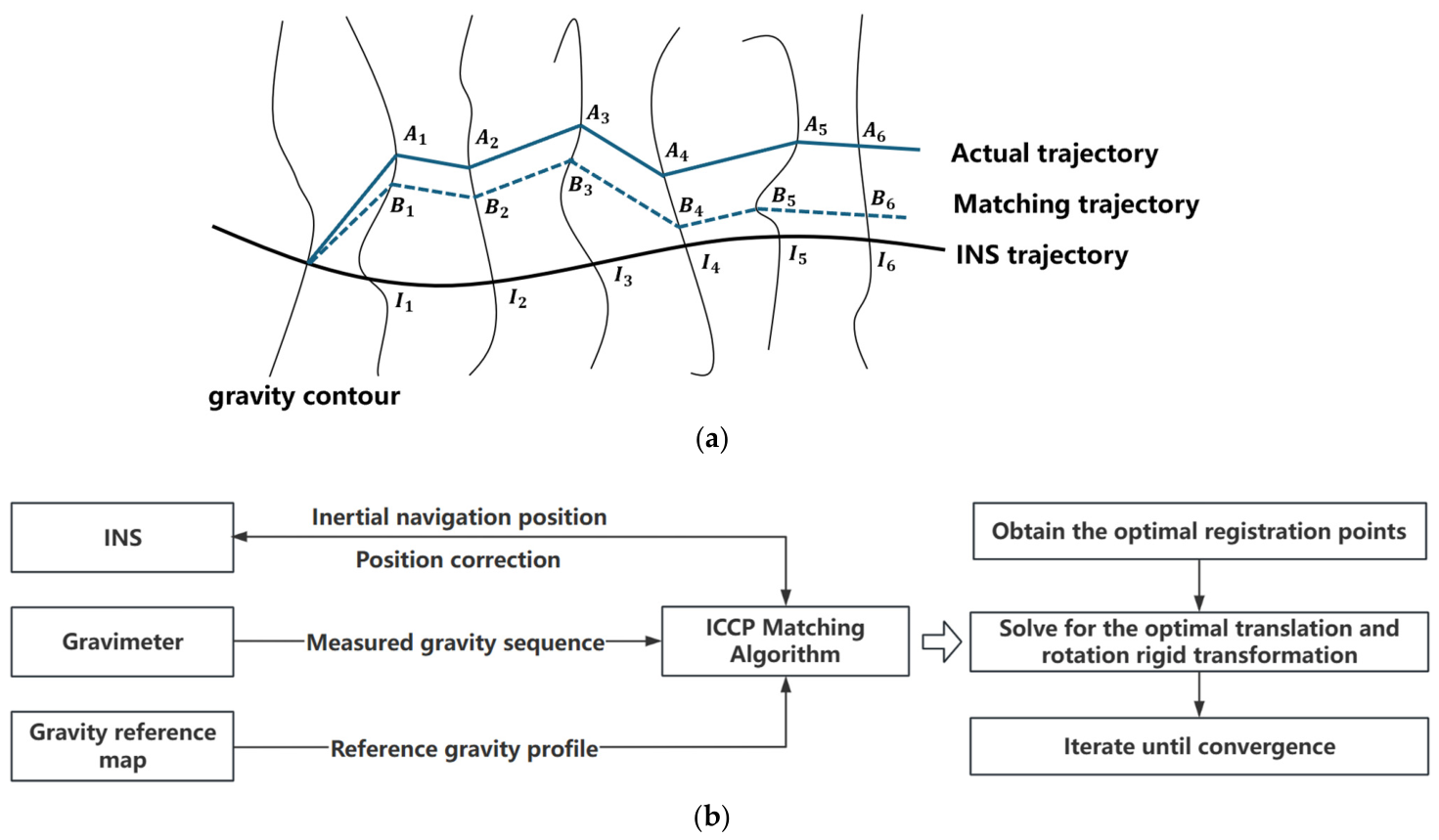
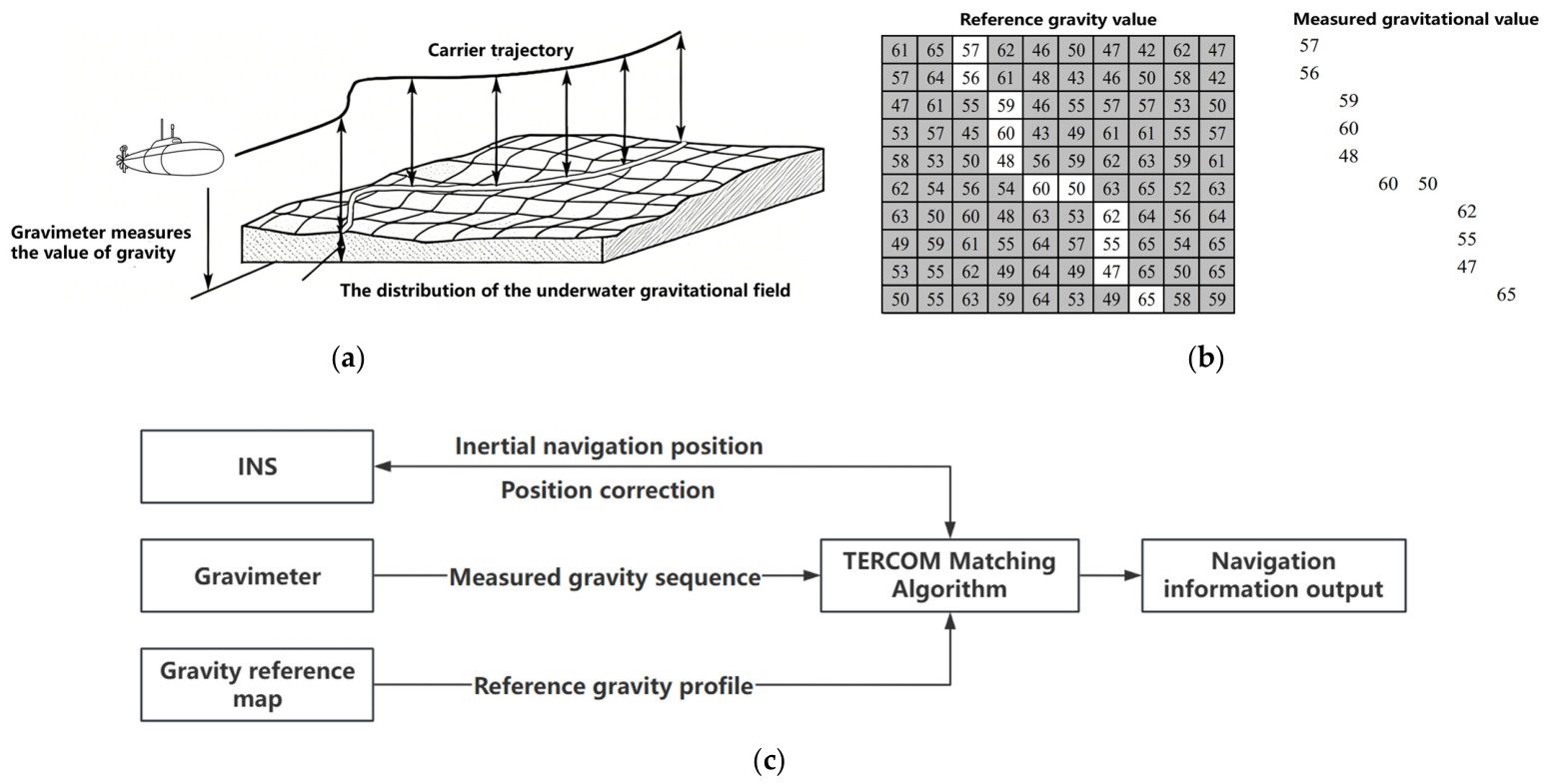
| Positioning Accuracy | Coarse matching of <2000 m refined to <700 m with ICCP fine matching [42] | 100–1700 m [42] | General SITAN achieves 3700–5600 m, refined to <2000 m with robust estimation [43] |
| Applicable scenarios | Coarse matching under large initial errors | Moderate errors, iterative fine matching | Requires small initial errors, real-time continuous correction |
Disclaimer/Publisher’s Note: The statements, opinions and data contained in all publications are solely those of the individual author(s) and contributor(s) and not of MDPI and/or the editor(s). MDPI and/or the editor(s) disclaim responsibility for any injury to people or property resulting from any ideas, methods, instructions or products referred to in the content. |
© 2026 by the authors. Licensee MDPI, Basel, Switzerland. This article is an open access article distributed under the terms and conditions of the Creative Commons Attribution (CC BY) license.
Share and Cite
Zhao, J.; Zhou, Z.; Zhang, Z. A Review of Key Technologies in Gravity Matching Navigation. Sensors 2026, 26, 4208. https://doi.org/10.3390/s26134208
Zhao J, Zhou Z, Zhang Z. A Review of Key Technologies in Gravity Matching Navigation. Sensors. 2026; 26(13):4208. https://doi.org/10.3390/s26134208
Chicago/Turabian StyleZhao, Jinqi, Zhaofa Zhou, and Zhili Zhang. 2026. "A Review of Key Technologies in Gravity Matching Navigation" Sensors 26, no. 13: 4208. https://doi.org/10.3390/s26134208
APA StyleZhao, J., Zhou, Z., & Zhang, Z. (2026). A Review of Key Technologies in Gravity Matching Navigation. Sensors, 26(13), 4208. https://doi.org/10.3390/s26134208