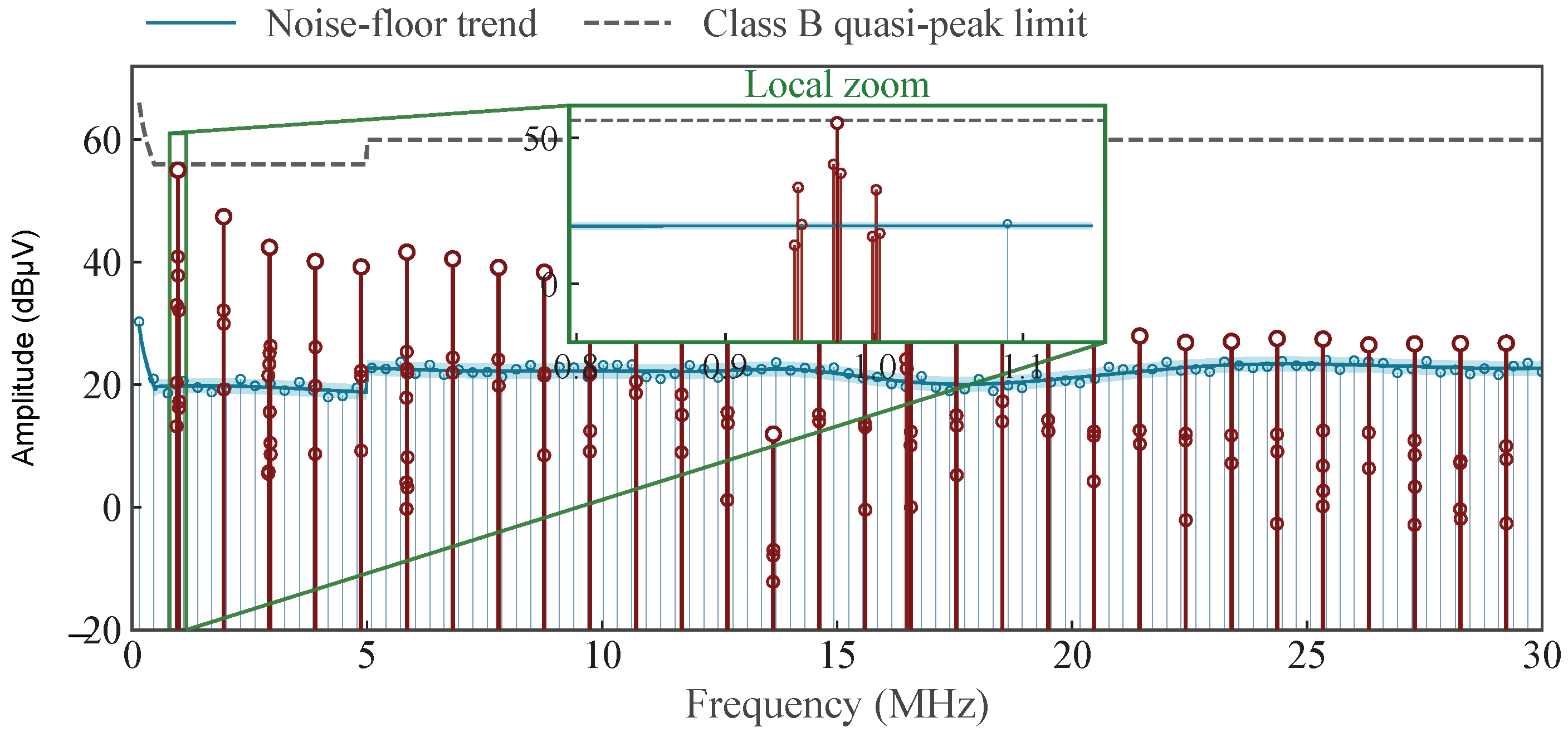
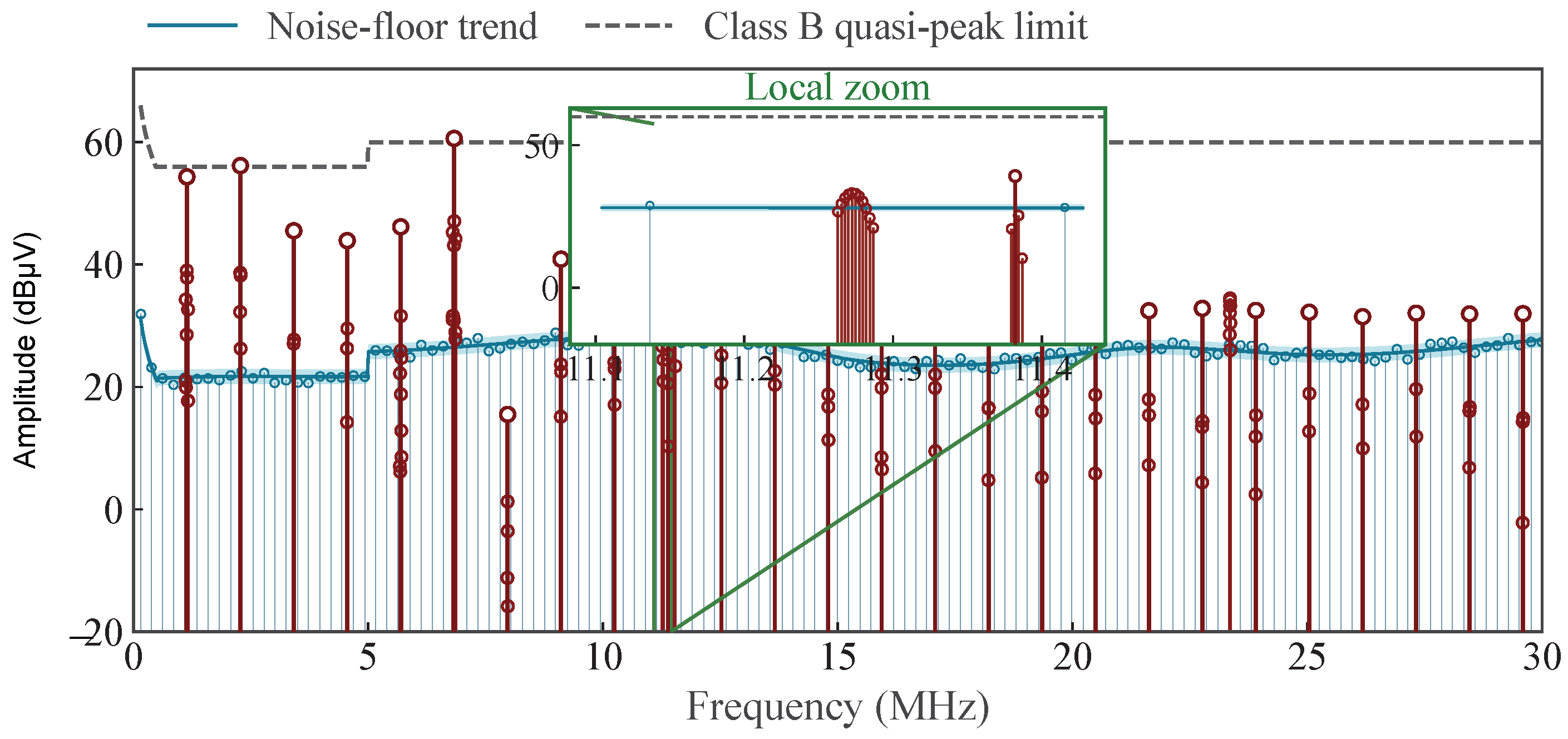
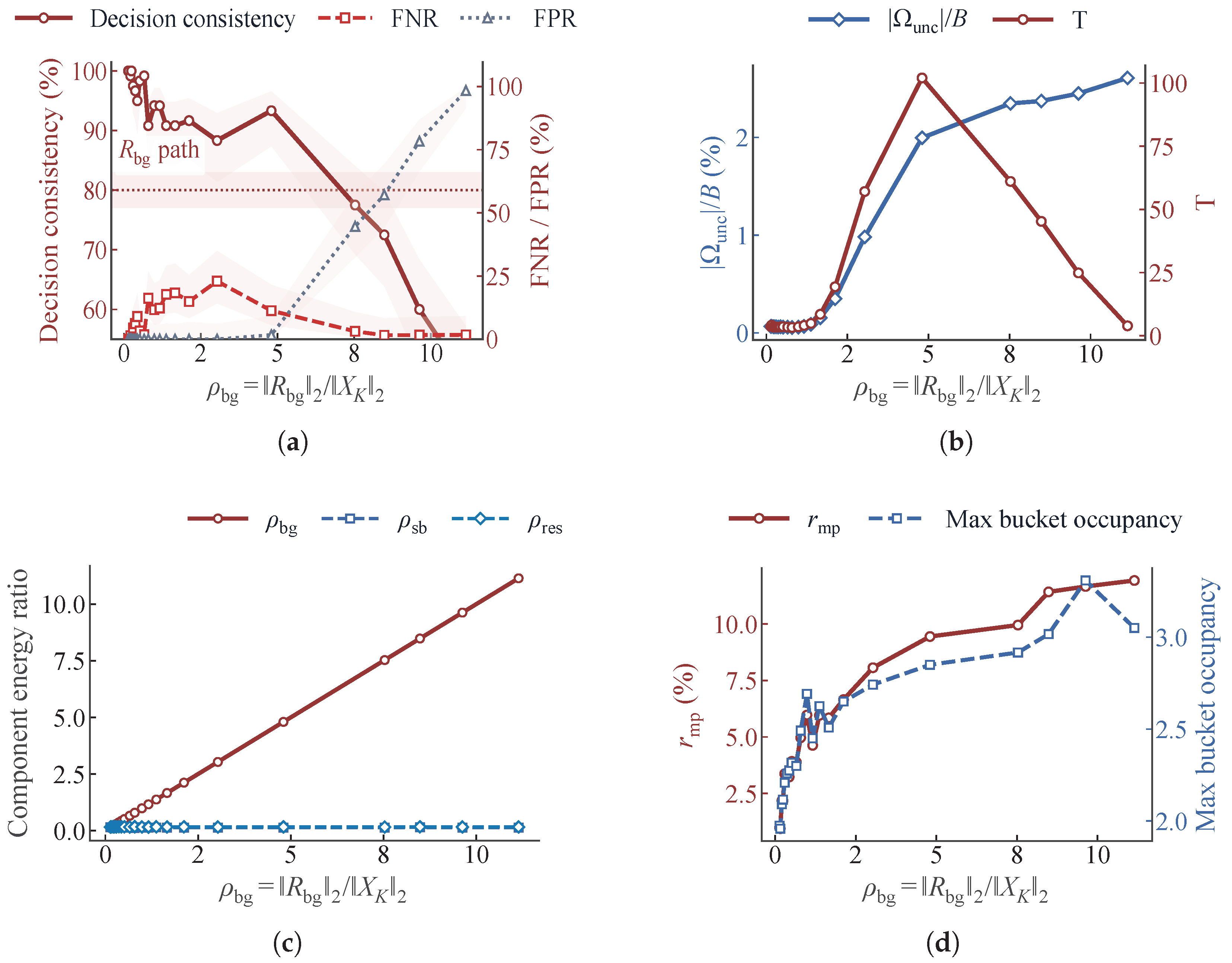
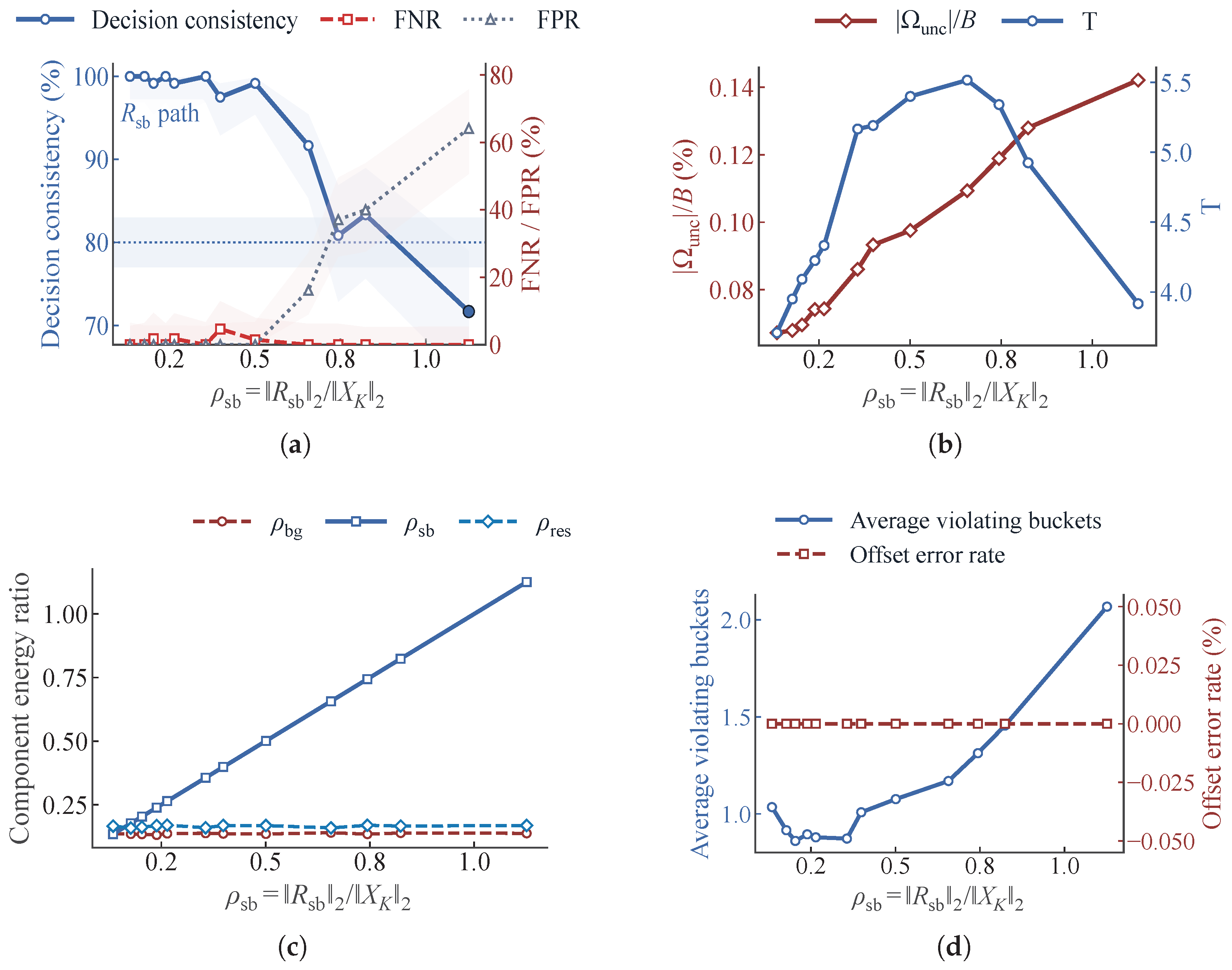
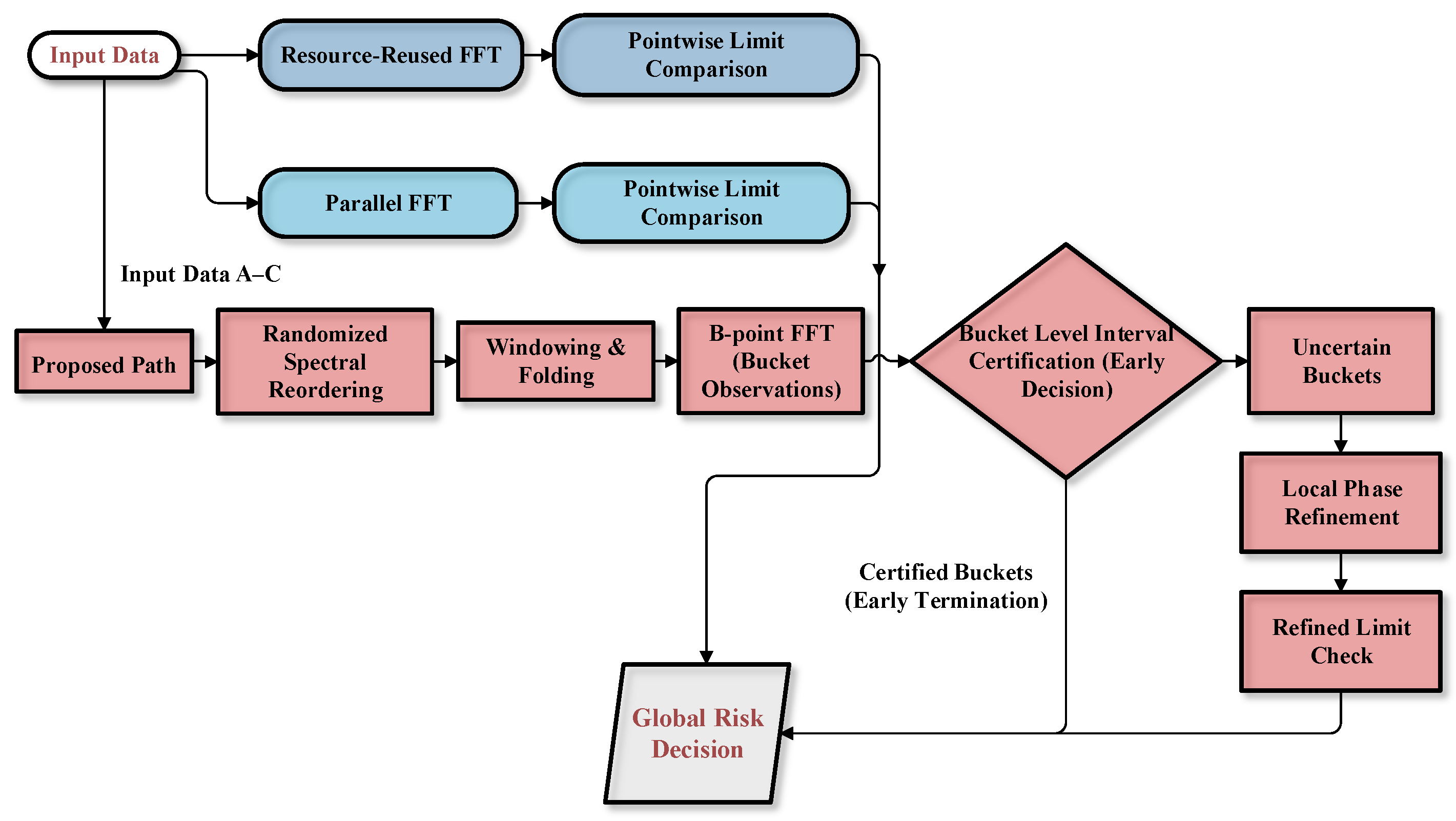
A Limit-Aware Sparse Frequency-Domain Decision Engine for EMI Risk Feedback in Resource-Constrained Systems


Abstract
1. Introduction
1.1. Research Background and Problem Statement
1.2. International Research Status and Motivation
2. Limit-Aware Decision Modeling for Internal EMI Risk Feedback
2.1. Reference Limit Mapping for Internal EMI Risk Decision
2.2. Task Redefinition and Construction of a Frequency-Domain Exceedance Indicator
3. Proposed Limit-Aware Sparse Frequency-Domain Analysis Method for Feedback Generation
3.1. Randomized Spectral Reordering and Flat-Window Bucket Observations
3.2. Construction of Bucket-Level Amplitude Envelopes and Local Limit Envelopes
3.3. Bucket-Level Risk Certification for Limit-Aware Decisions
3.4. Local Refinement for Uncertain Buckets
3.5. Sequential Verification Strategy for Worst Exceedance Evidence
3.6. Method Summary
| Algorithm 1 Proposed limit-aware selective decision method |
| procedure HashToBins() Compute . Compute . Compute . Compute the B-point DFT of and obtain . return Y end procedure procedure PhaseRefine() , . . . . return end procedure procedure LimitAwareEMICheck() Assume . . , , . , . , . Compute . for do . if then continue end if . . . . if then return risk-positive else if then continue else . end if end for if then return risk-negative end if Let . . for do . end for Sort in ascending order of and obtain . for to do . . if then return risk-positive end if end for return risk-negative end procedure |
4. Validation and Engineering Applicability Analysis
4.1. Monte Carlo Consistency Verification Against the Full-Spectrum Baseline
4.1.1. Experimental Design
4.1.2. Results and Analysis
4.2. Performance Degradation Outside the Applicable Conditions
4.2.1. Experimental Design
4.2.2. Result Analysis
4.3. Applicable Range and Engineering Boundary
5. Discussion and Performance Evaluation
5.1. Effectiveness of the Sequential Verification Strategy
5.1.1. Modeling of Ordering Strategies and Worst-Case Construction
5.1.2. Effect of Ordering Strategies on Sequential Verification Efficiency
5.2. RTL-Level Hardware Implementation, PPA Evaluation, and EMI Risk Feedback Interface
5.2.1. Experimental Design and Functional Verification
5.2.2. PPA Comparison Analysis
5.2.3. Time-Scale Compatibility with a Slow EMI Risk-Feedback Loop
Closed-Loop Interface and Response-Time Interpretation
6. Conclusions
Author Contributions
Funding
Institutional Review Board Statement
Informed Consent Statement
Data Availability Statement
Conflicts of Interest
References
- Hu, J.; Xu, X.; Cao, D.; Liu, G. Analysis and optimization of electromagnetic compatibility for electric vehicles. IEEE Electromagn. Compat. Mag. 2019, 8, 60–65. [Google Scholar] [CrossRef]
- Yuan, L.; Yang, G.; Li, B.; Liu, S.; Wei, C.; Yang, Y.; Liang, Z. EMI challenges in modern power electronic-based converters. Front. Electron. 2023, 4, 1274258. [Google Scholar] [CrossRef]
- Alon, E.; Stojanović, V.; Horowitz, M.A. Circuits and techniques for high-resolution measurement of on-chip power supply noise. IEEE J. Solid-State Circuits 2005, 40, 820–828. [Google Scholar] [CrossRef]
- Chen, Y.; Yuan, Q.; Liu, M. A closed-loop EMI regulated GaN power converter with in situ EMI sensing and global excess-spectrum modulation. IEEE J. Solid-State Circuits 2025, 60, 883–893. [Google Scholar] [CrossRef]
- Wu, C.; Low, M. FFT-based simultaneous calculations of very long signal multi-resolution spectra for ultra-wideband digital radio frequency receiver and other digital sensor applications. Sensors 2024, 24, 1207. [Google Scholar] [CrossRef] [PubMed]
- Duhamel, P.; Hollmann, H. “Split radix” FFT algorithm. Electron. Lett. 1984, 20, 14–16. [Google Scholar] [CrossRef]
- Sreenivas, T.V.; Rao, P.V.S. FFT algorithm for both input and output pruning. IEEE Trans. Acoust. Speech Signal Process. 1979, ASSP-27, 291–292. [Google Scholar] [CrossRef]
- Frigo, M.; Johnson, S.G. The design and implementation of FFTW3. Proc. IEEE 2005, 93, 216–231. [Google Scholar] [CrossRef]
- Markel, J.D. FFT pruning. IEEE Trans. Audio Electroacoust. 1971, 19, 305–311. [Google Scholar] [CrossRef]
- Franchetti, F.; Püschel, M. Generating high performance pruned FFT implementations. In Proceedings of the IEEE International Conference on Acoustics, Speech and Signal Processing, Taipei, Taiwan, 19–24 April 2009; pp. 549–552. [Google Scholar] [CrossRef]
- Püschel, M.; Moura, J.M.F.; Johnson, J.; Padua, D.; Veloso, M.; Singer, B.W.; Xiong, J.; Franchetti, F.; Gačić, A.; Voronenko, Y.; et al. SPIRAL: Code generation for DSP transforms. Proc. IEEE 2005, 93, 232–275. [Google Scholar] [CrossRef]
- Huang, N.E.; Shen, Z.; Long, S.R.; Wu, M.C.; Shih, H.H.; Zheng, Q.; Yen, N.-C.; Tung, C.C.; Liu, H.H. The empirical mode decomposition and the Hilbert spectrum for nonlinear and non-stationary time series analysis. Proc. R. Soc. Lond. A 1998, 454, 903–995. [Google Scholar] [CrossRef]
- Azpúrua, M.A.; Pous, M.; Silva, F. Decomposition of electromagnetic interferences in the time-domain. IEEE Trans. Electromagn. Compat. 2016, 58, 385–392. [Google Scholar] [CrossRef]
- Antonini, G.; Orlandi, A. Wavelet packet-based EMI signal processing and source identification. IEEE Trans. Electromagn. Compat. 2001, 43, 140–148. [Google Scholar] [CrossRef]
- Ma, X.L.; Thomas, D.W.P.; Christopoulos, C. The identification of electromagnetic interferences source using wavelet packet analysis. In Proceedings of the 2007 International Conference on Wavelet Analysis and Pattern Recognition, Beijing, China, 2–4 November 2007; pp. 73–77. [Google Scholar] [CrossRef]
- Gong, W.-R.; Li, H.-Y.; Zhao, D. A denoising method based on analysis K-SVD and disagreement segment and its application on EMI signal. In Proceedings of the 3rd International Conference on Wireless Communication and Sensor Network (WCSN 2016), Wuhan, China, 10–11 December 2016; pp. 349–353. [Google Scholar] [CrossRef][Green Version]
- Elad, M.; Aharon, M. Image denoising via sparse and redundant representations over learned dictionaries. IEEE Trans. Image Process. 2006, 15, 3736–3745. [Google Scholar] [CrossRef] [PubMed]
- Gade, S.P.; Bodapatala, S. Detection of EMI by using ASTFA and wavelet transform. Int. J. Adv. Sci. Res. Eng. Trends 2021, 5, 748–752. [Google Scholar]
- Hou, T.Y.; Shi, Z. Adaptive data analysis via sparse time-frequency representation. Adv. Adapt. Data Anal. 2011, 3, 1–28. [Google Scholar] [CrossRef]
- Daubechies, I.; Lu, J.; Wu, H.-T. Synchrosqueezed wavelet transforms: An empirical mode decomposition-like tool. Appl. Comput. Harmon. Anal. 2011, 30, 243–261. [Google Scholar] [CrossRef]
- Orlandi, A.; Paul, C.R. Identification of EMI noise sources through the use of Fourier and wavelet transforms. In Proceedings of the IEEE International Symposium on Electromagnetic Compatibility, Boston, MA, USA, 18–22 August 2003; pp. 397–402. [Google Scholar] [CrossRef]
- Oyarzun, J.; Aizpuru, I.; Baraia-Etxaburu, I. Time-frequency analysis of experimental measurements for the determination of EMI noise generators in power converters. Electronics 2022, 11, 3898. [Google Scholar] [CrossRef]
- Hassanieh, H.; Indyk, P.; Katabi, D.; Price, E. Simple and practical algorithm for sparse Fourier transform. In Proceedings of the Twenty-Third Annual ACM-SIAM Symposium on Discrete Algorithms, Kyoto, Japan, 17–19 January 2012; pp. 1183–1194. [Google Scholar] [CrossRef]
- Hassanieh, H.; Indyk, P.; Katabi, D.; Price, E. Nearly optimal sparse Fourier transform. In Proceedings of the 44th Annual ACM Symposium on Theory of Computing, New York, NY, USA, 19–22 May 2012; pp. 563–578. [Google Scholar] [CrossRef]
- Schumacher, J.; Püschel, M. High-performance sparse fast Fourier transforms. In Proceedings of the IEEE International Conference on Acoustics, Speech and Signal Processing, Vancouver, BC, Canada, 26–31 May 2013; pp. 5534–5538. [Google Scholar] [CrossRef]
- Agarwal, S.; Püschel, M.; Mohan, S.; Gurumurthi, S. High-throughput implementation of a million-point sparse Fourier transform. In Proceedings of the 24th International Conference on Field Programmable Logic and Applications, Munich, Germany, 2–4 September 2014; pp. 1–6. [Google Scholar] [CrossRef]
- Li, B.; Hou, X.; Jiang, Z.; Chen, J. Two efficient sparse Fourier algorithms using the matrix pencil method. Electronics 2022, 11, 2291. [Google Scholar] [CrossRef]
- Iwen, M.A.; Gilbert, A.C.; Strauss, M.J. Empirical evaluation of a sub-linear time sparse DFT algorithm. Commun. Math. Sci. 2007, 5, 981–998. [Google Scholar] [CrossRef]
- Gilbert, A.C.; Muthukrishnan, S.; Strauss, M.J. Improved time bounds for near-optimal sparse Fourier representations. In Proceedings of Wavelets XI; Papadakis, M., Laine, A.F., Unser, M.A., Eds.; SPIE: San Diego, CA, USA, 2005; Volume 5914, p. 59141A. [Google Scholar] [CrossRef]
- CISPR 16-1-1:2019; Specification for Radio Disturbance and Immunity Measuring Apparatus and Methods—Part 1-1: Radio Disturbance and Immunity Measuring Apparatus—Measuring Apparatus. International Electrotechnical Commission: Geneva, Switzerland, 2019.
- BS EN 55032:2015+A1:2020; Electromagnetic Compatibility of Multimedia Equipment—Emission Requirements. British Standards Institution: London, UK, 2020.
- Berend, D.; Brafman, R.; Cohen, S.; Shimony, S.E.; Zucker, S. Optimal ordering of independent tests with precedence constraints. Discret. Appl. Math. 2014, 162, 115–127. [Google Scholar] [CrossRef]
- Wu, X.; Gao, X.; Wang, J.; Li, Z.; Du, S.; Gao, S.; Li, F.; Du, J.; Shchurov, N.I.; Zhang, X. Advances in modeling and suppression methods of EMI in power electronic converters of third-generation semiconductor devices. Electronics 2023, 12, 2348. [Google Scholar] [CrossRef]
- Lin, F.; Chen, D.Y. Reduction of power supply EMI emission by switching frequency modulation. IEEE Trans. Power Electron. 1994, 9, 132–137. [Google Scholar] [CrossRef]
- Tse, K.K.; Chung, H.S.-H.; Hui, S.Y.R.; So, H.C. Analysis and spectral characteristics of a spread-spectrum technique for conducted EMI suppression. IEEE Trans. Power Electron. 2000, 15, 399–410. [Google Scholar] [CrossRef]
- Sacks, J.; Welch, W.J.; Mitchell, T.J.; Wynn, H.P. Design and analysis of computer experiments. Stat. Sci. 1989, 4, 409–423. [Google Scholar] [CrossRef]
- Cao, Y.; Su, J.; Yan, Y.; Lin, Z.; Shi, T. Secondary frequency modulation strategy for SiC inverters based on periodic spread spectrum modulation. Sensors 2025, 25, 1269. [Google Scholar] [CrossRef] [PubMed]
- Eilers, P.H.C.; Boelens, H.F.M. Baseline Correction with Asymmetric Least Squares Smoothing; Leiden University Medical Centre: Leiden, The Netherlands, 2005. [Google Scholar]
- AMD Xilinx. Fast Fourier Transform v9.1 LogiCORE IP Product Guide (PG109); Advanced Micro Devices, Inc.: Santa Clara, CA, USA, 2022; Available online: https://docs.amd.com/r/en-US/pg109-xfft (accessed on 14 May 2026).
- Marinissen, E.J.; Prince, B.; Keltel-Schulz, D.; Zorian, Y. Challenges in embedded memory design and test. In Proceedings of the Design, Automation and Test in Europe Conference and Exhibition (DATE), Munich, Germany, 7–11 March 2005; pp. 722–727. [Google Scholar] [CrossRef]



| Frequency Range | Limits (dBV) (Quasi-Peak) |
|---|---|
| MHz | |
| 0.15 to 0.50 | 66 to 56 |
| 0.50 to 5 | 56 |
| 5 to 30 | 60 |
| Method | Mean | Median | 90th pct | |
|---|---|---|---|---|
| LB | 18.45 | 20.00 | 36.00 | 30.1% |
| MID | 23.98 | 25.00 | 54.00 | 43.0% |
| UB | 24.40 | 26.00 | 55.00 | 43.1% |
| 18.53 | 4.00 | 54.00 | 59.3% | |
| Random | 21.05 | 19.00 | 41.00 | 16.6% |
| Dataset | Decision | Gray-Zone Buckets | Refined Buckets | Cycles |
|---|---|---|---|---|
| A | risk-negative | 0 | 0 | 491,538 |
| B | risk-positive | 35 | 27 | 654,845 |
| C | risk-negative | 41 | 41 | 663,063 |
| Metric | Resource-Reused FFT | Highly Parallel FFT | Proposed Implementation |
|---|---|---|---|
| BRAM | 352 | 704 | 17 |
| FF | 282 | 585 | 1500 |
| LUT | 1511 | 4211 | 2670 |
| DSP | 8 | 8 | 32 |
| /W | 0.200 | 0.542 | 0.092 |
| WNS/ns | 1.728 | 0.849 | 3.033 |
| Implementation | Cycles | Latency/ms | /mJ |
|---|---|---|---|
| Proposed-A | 491,538 | 4.915 | 0.452 |
| Proposed-B | 654,845 | 6.548 | 0.602 |
| Proposed-C | 663,063 | 6.631 | 0.610 |
| Proposed-Mean | 603,149 | 6.031 | 0.555 |
| Resource-reused FFT | 12,845,058 | 128.451 | 25.690 |
| Highly parallel FFT | 3,407,892 | 34.079 | 18.470 |
Disclaimer/Publisher’s Note: The statements, opinions and data contained in all publications are solely those of the individual author(s) and contributor(s) and not of MDPI and/or the editor(s). MDPI and/or the editor(s) disclaim responsibility for any injury to people or property resulting from any ideas, methods, instructions or products referred to in the content. |
© 2026 by the authors. Licensee MDPI, Basel, Switzerland. This article is an open access article distributed under the terms and conditions of the Creative Commons Attribution (CC BY) license.
Share and Cite
Hu, J.; Luo, W.; Xiao, K.; Chen, Y. A Limit-Aware Sparse Frequency-Domain Decision Engine for EMI Risk Feedback in Resource-Constrained Systems. Sensors 2026, 26, 4197. https://doi.org/10.3390/s26134197
Hu J, Luo W, Xiao K, Chen Y. A Limit-Aware Sparse Frequency-Domain Decision Engine for EMI Risk Feedback in Resource-Constrained Systems. Sensors. 2026; 26(13):4197. https://doi.org/10.3390/s26134197
Chicago/Turabian StyleHu, Jiaxuan, Weiqi Luo, Kaiwen Xiao, and Yingping Chen. 2026. "A Limit-Aware Sparse Frequency-Domain Decision Engine for EMI Risk Feedback in Resource-Constrained Systems" Sensors 26, no. 13: 4197. https://doi.org/10.3390/s26134197
APA StyleHu, J., Luo, W., Xiao, K., & Chen, Y. (2026). A Limit-Aware Sparse Frequency-Domain Decision Engine for EMI Risk Feedback in Resource-Constrained Systems. Sensors, 26(13), 4197. https://doi.org/10.3390/s26134197