

How Mountain Park Spatial Environments Affect Physiological and Psychological Perceptions of Young Adults Based on Real Time Sensor Monitoring




Abstract
1. Introduction
2. Methods
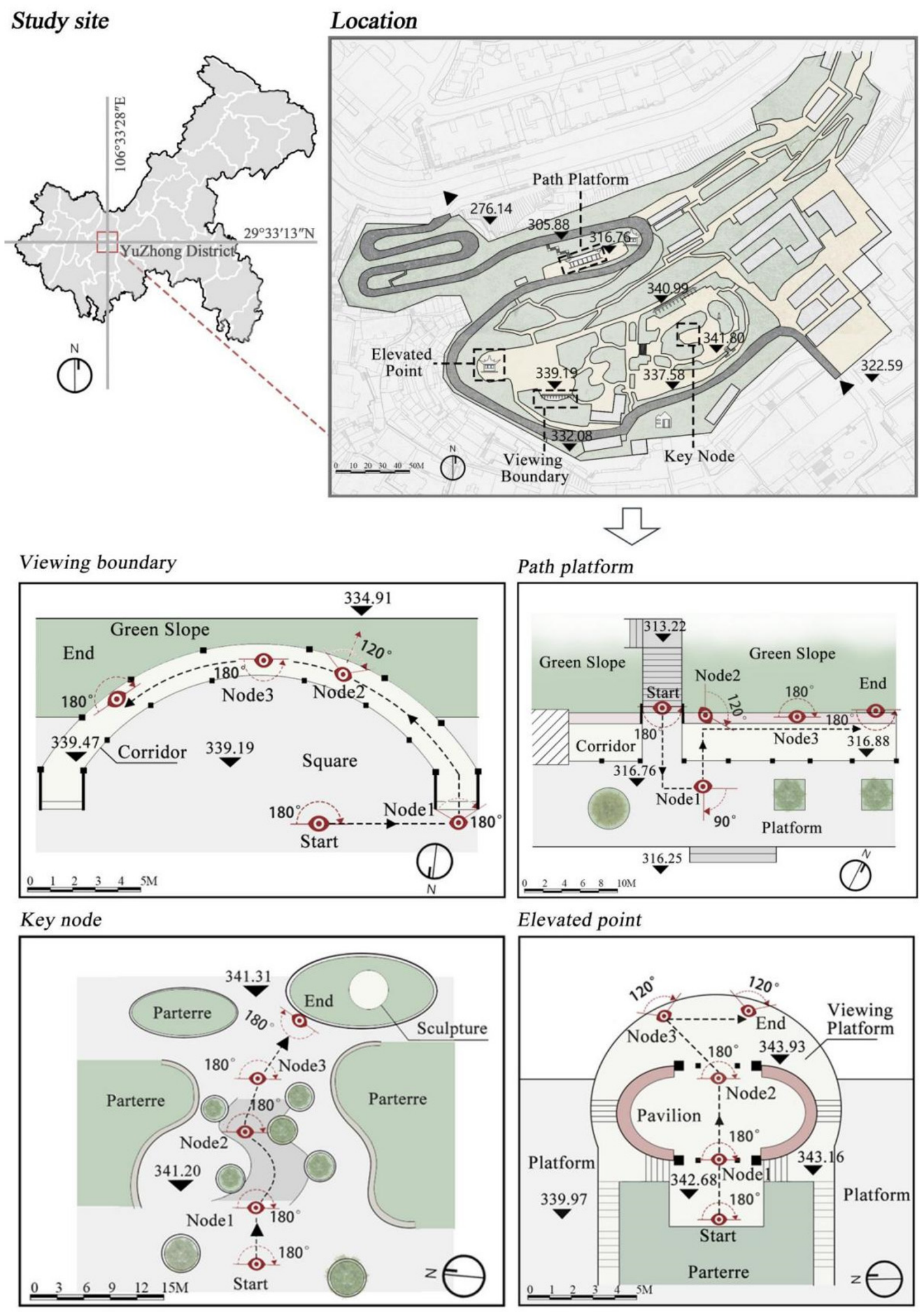
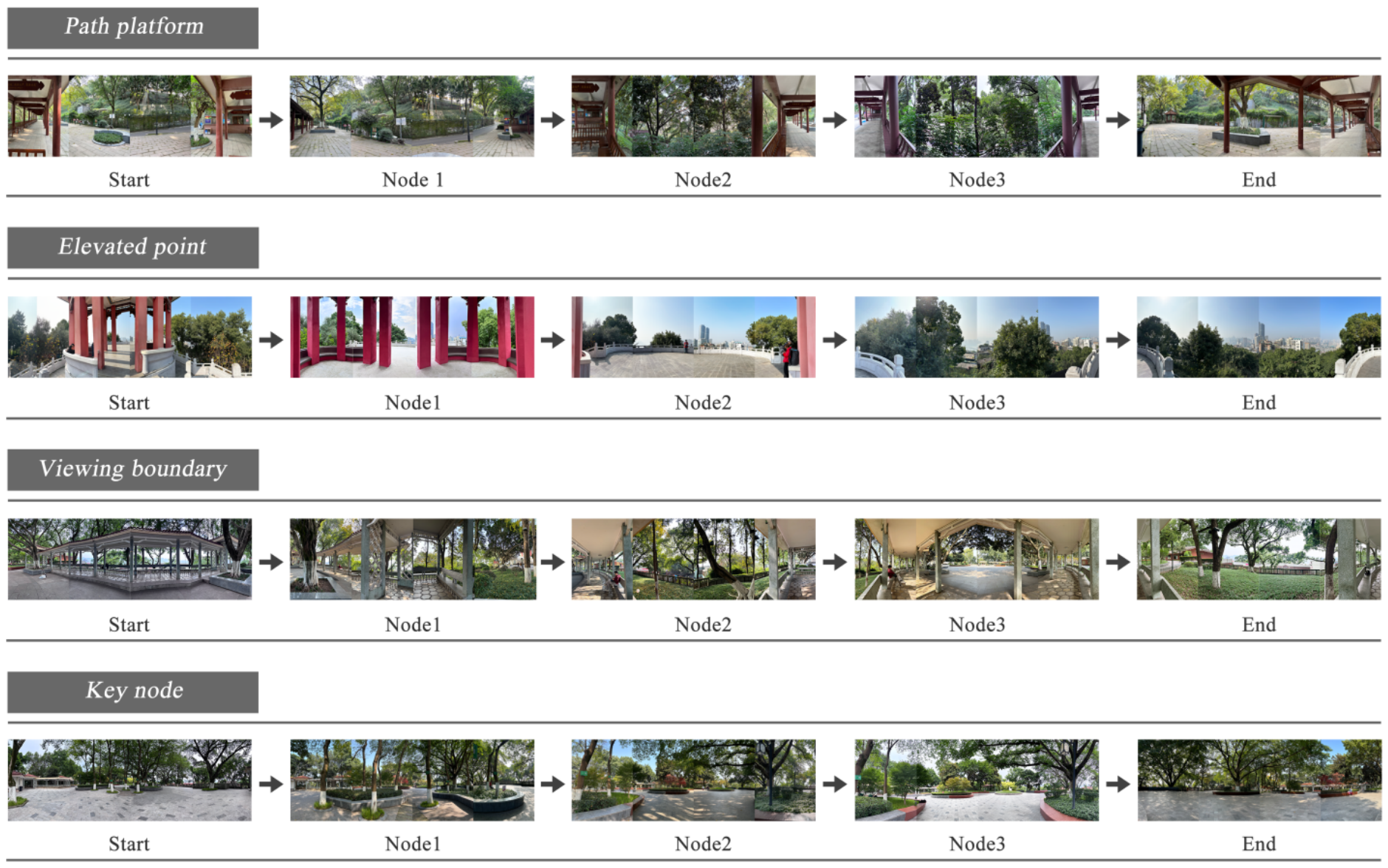
2.1. Study Area
2.2. Participants
2.3. Spatial Exposure Data
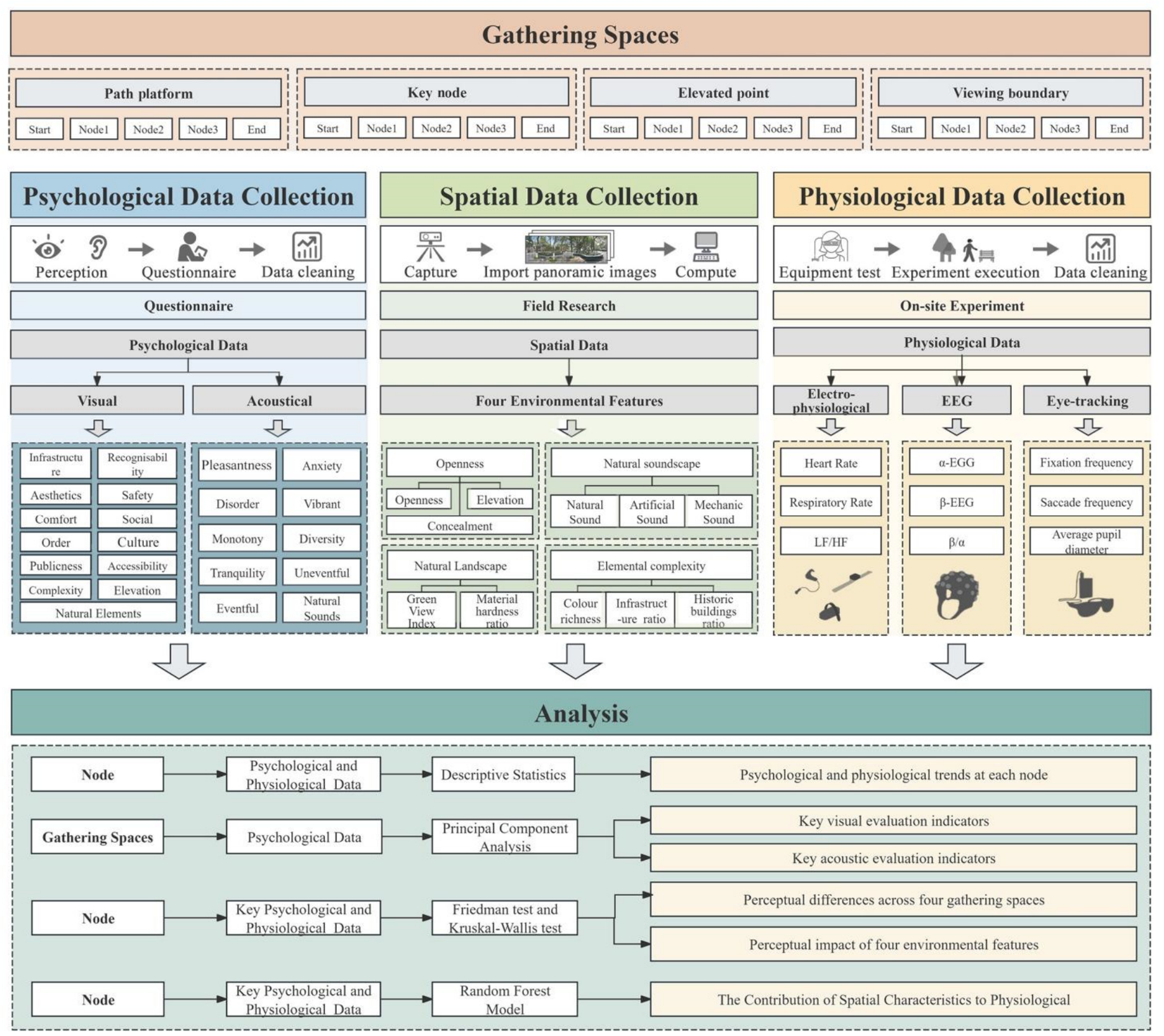
2.4. Physiological and Psychological Data Processing
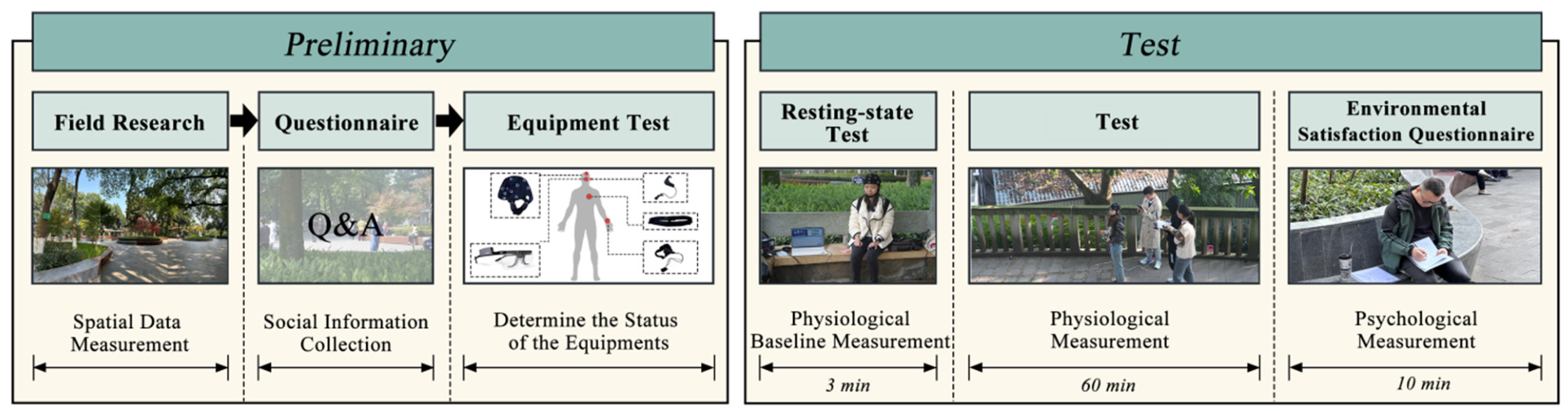
2.5. Procedure
2.6. Data Analysis
3. Results
3.1. Descriptive Statistics
3.2. Psychological Perception Evaluation Based on PCA
3.3. Psychological and Physiological Differences in Perception
3.3.1. Differences in Psychological and Physiological Indicators
3.3.2. Effects of the Four Spatial Typological Features on Physiological and Psychological Indicators
3.4. Impact of Spatial Elements on Physiological Perception
3.4.1. Random Forest Model
3.4.2. Contribution of Spatial Characteristics to Physiological Indicators
4. Discussion
4.1. Changes and Differences in Psychological and Physiological Indicators
4.2. Key Indicator Differences in Mountain Characteristics Among Four Types of Gathering Spaces
4.3. Differences in Psychological Perceptions and Physiological Responses of the Four Typical Environmental Characteristics
4.4. Impact of Visual and Acoustic Environmental Indicators on Physiological Perception
4.5. Design Implications
4.6. Limitations
5. Conclusions
- (1)
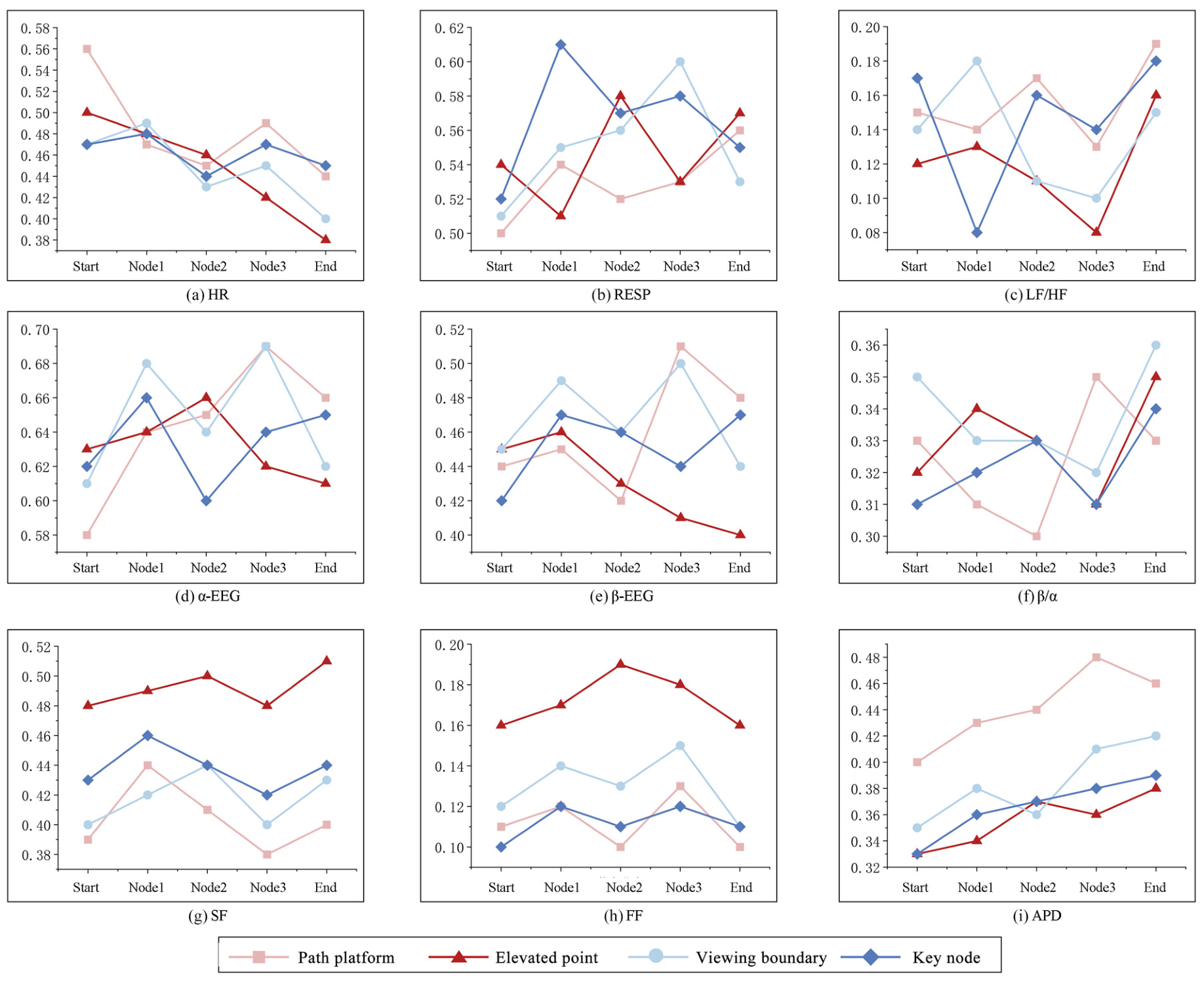
- There were significant differences in the trends of young adults’ psychological perceptions and physiological responses in different gathering spaces. The elevated point provides superior stress recovery benefits owing to its high openness and natural soundscape. In comparison, the psychological comfort experienced by participants in the path platform, which is primarily characterized by hard landscape features, is relatively lower.
- (2)
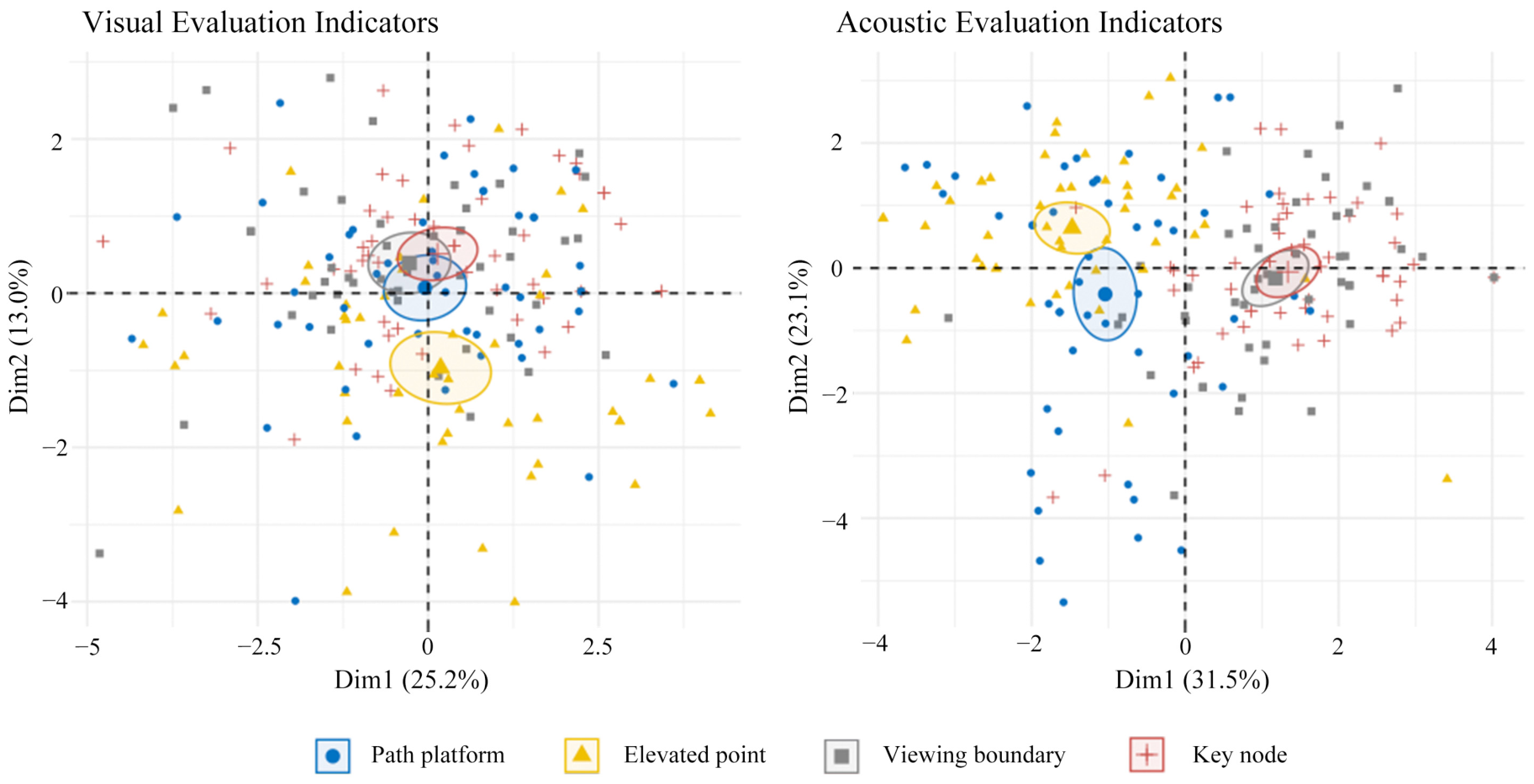
- Indicators reflecting the characteristics of mountainous spaces are key indicators of psychological perception, and terrain-driven spatial characteristics can significantly affect the psychological perception of the young adults.
- (3)
- As hypothesized in H3, there were significant differences in psychological perceptions and physiological responses among the four types of gathering spaces. Elemental complexity can effectively attract the attention of young adults, enhance their perception of ‘vibrant’, and elicit positive perceptual feedback.
- (4)
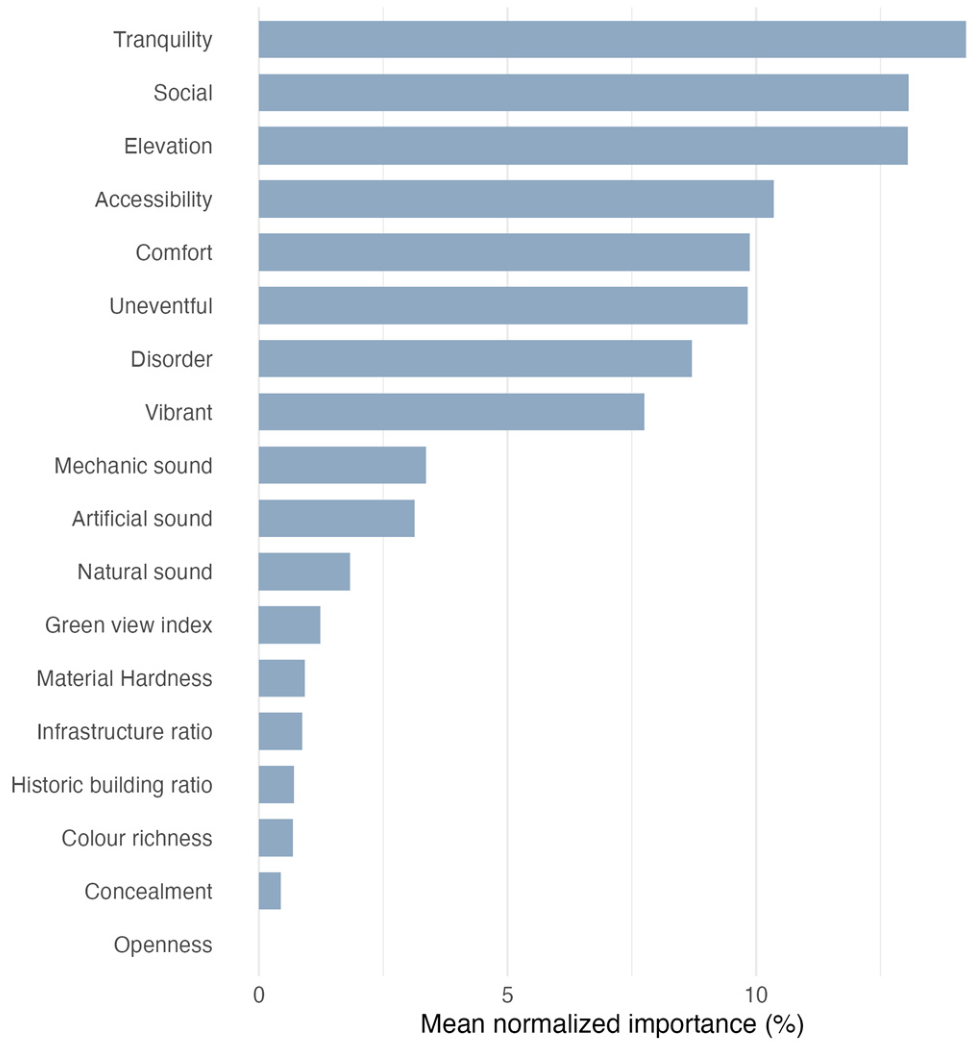
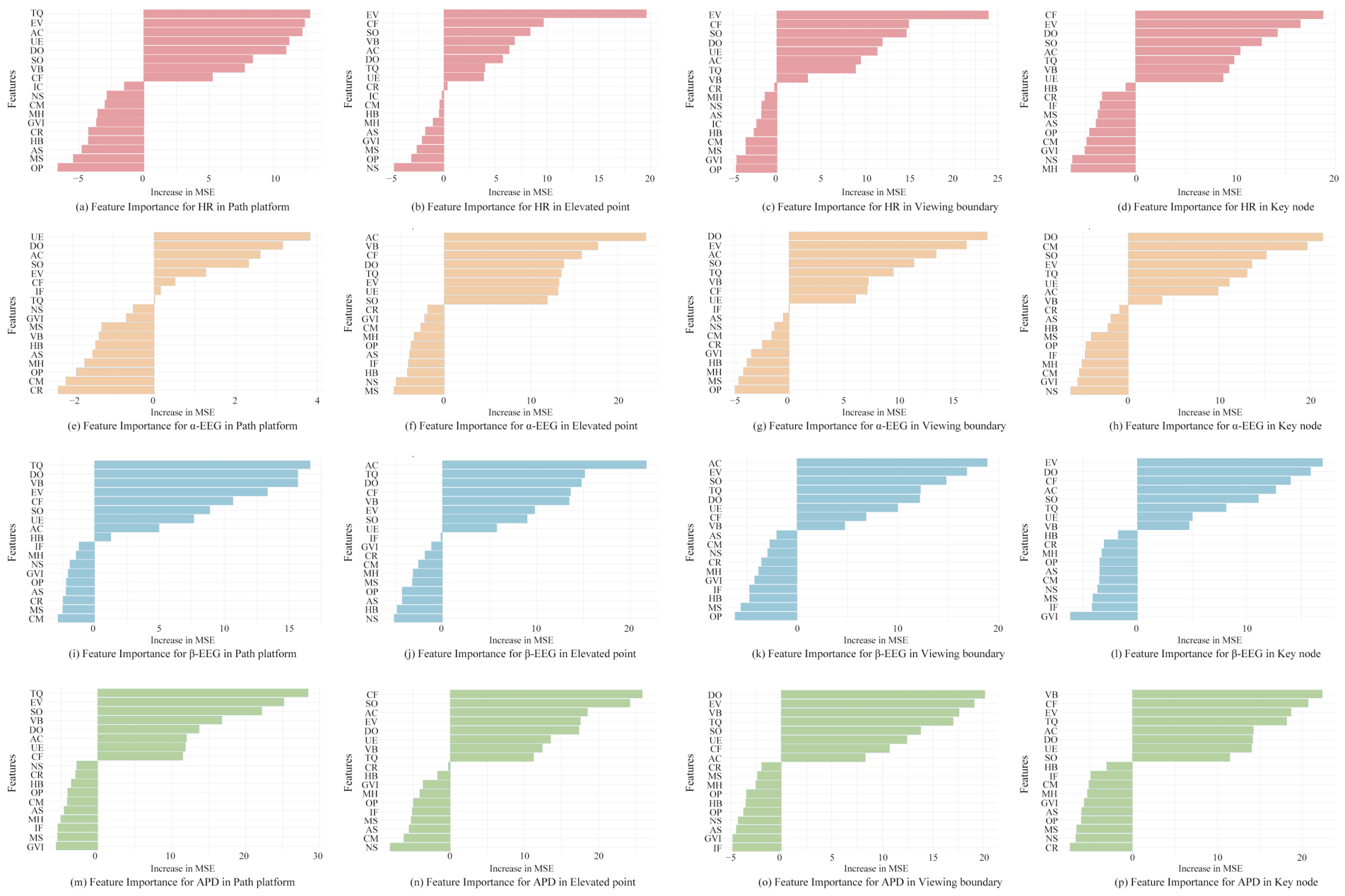
- The synergistic effect of audiovisual environments can enhance the restorative benefits of these spatial elements to some extent; interaction analysis quantitatively demonstrates that the interaction between the green view index and natural sound factors exerts a significant effect on the β-EEG indicator. Furthermore, as hypothesized in H4, natural elements alleviated participants’ stress perceptions. However, similarly, as exemplified by the poor accessibility in the Elevated Point, it can also offset landscape advantages to some extent; therefore, appropriate multisensory integration strategies should be implemented in conjunction with mountainous terrain.
Supplementary Materials
Author Contributions
Funding
Data Availability Statement
Conflicts of Interest
References
- Sayers, J. The world health report 2001—Mental health: New understanding, new hope. Bull. World Health Organ. 2001, 79, 1085. [Google Scholar]
- Zhang, S.; Zhao, X.; Zeng, Z. The Influence of Audio-Visual Interactions on Psychological Responses of Young People in Urban Green Areas: A Case Study in Two Parks in China. Int. J. Environ. Res. Public Health 2019, 16, 1845. [Google Scholar] [CrossRef] [PubMed]
- Jia, R.; Ayling, K.; Chalder, T.; Massey, A.; Broadbent, E.; Morling, J.R.; Coupland, C.; Vedhara, K. Young people, mental health and COVID-19 infection: The canaries we put in the coal mine. Public Health 2020, 189, 158–161. [Google Scholar] [CrossRef] [PubMed]
- Tillmann, S.; Tobin, D.; Avison, W.; Gilliland, J. Mental health benefits of interactions with nature in children and teenagers: A systematic review. J. Epidemiol. Community Health 2018, 72, 958–966. [Google Scholar] [CrossRef] [PubMed]
- Deng, L.; Hao, L.; Ma, J.; Zhuo, H.; Sun, L.; Jiang, M.; Zhu, C.; Li, X. Effects of integration between visual stimuli and auditory stimuli on restorative potential and aesthetic preference in urban green spaces. Urban For. Urban Green. 2020, 53, 126702. [Google Scholar] [CrossRef]
- Chen, J.; Van den Bosch, C.C.K.; Lin, C.; Liu, F.; Huang, Y.; Huang, Q.; Wang, M.; Zhou, Q.; Dong, J. Effects of personality, health and mood on satisfaction and quality perception of urban mountain parks. Urban For. Urban Green. 2021, 63, 127210. [Google Scholar] [CrossRef]
- Gehl, J.; Svarre, B. Public space and public life surveys. In How to Study Public Life; Island Press: Washington, DC, USA, 2013; pp. 45–68. [Google Scholar]
- Liu, Z.; Xiu, C.; Song, W. Landscape-Based Assessment of Urban Resilience and Its Evolution: A Case Study of the Central City of Shenyang. Sustainability 2019, 11, 2964. [Google Scholar] [CrossRef]
- Thomson, R.M.; Katikireddi, S.V. Mental health and the jilted generation: Using age-period-cohort analysis to assess differential trends in young people’s mental health following the great recession and austerity in England. Soc. Sci. Med. 2018, 214, 133–143. [Google Scholar] [CrossRef] [PubMed]
- Veitch, J.; Carver, A.; Abbott, G.; Giles-Corti, B.; Timperio, A.; Salmon, J. How active are people in metro-politan parks? An observational study of park visitation in Australia. BMC Public Health 2015, 15, 610. [Google Scholar] [CrossRef] [PubMed]
- Sang, Å.O.; Knez, I.; Gunnarsson, B.; Hedblom, M. The effects of naturalness, gender, and age on how urban green space is perceived and used. Urban For. Urban Green. 2016, 18, 268–276. [Google Scholar] [CrossRef]
- Taczanowska, K.; Tansil, D.; Wilfer, J.; Jiricka-Pürrer, A. The impact of age on people’s use and perception of urban green spaces and their effect on personal health and wellbeing during the COVID-19 pandemic—A case study of the metropolitan area of Vienna, Austria. Cities 2024, 147, 104798. [Google Scholar] [CrossRef]
- Kaplan, S. The restorative benefits of nature: Toward an integrative framework. J. Environ. Psychol. 1995, 15, 169–182. [Google Scholar] [CrossRef]
- Li, H.; Xie, H.; Woodward, G. Soundscape components, perceptions, and EEG reactions in typical mountainous urban parks. Urban For. Urban Green. 2021, 64, 127269. [Google Scholar] [CrossRef]
- Ruotolo, F.; Rapuano, M.; Masullo, M.; Maffei, L.; Ruggiero, G.; Iachini, T. Well-being and multisensory urban parks at different ages: The role of interoception and audiovisual perception. J. Environ. Psychol. 2024, 93, 102219. [Google Scholar] [CrossRef]
- Jeon, J.Y.; Hong, J.Y. Classification of urban park soundscapes through perceptions of the acoustical environments. Landsc. Urban Plan. 2015, 141, 100–111. [Google Scholar] [CrossRef]
- Zhang, L.; Liu, S.; Liu, S. Mechanisms Underlying the Effects of Landscape Features of Urban Community Parks on Health-Related Feelings of Users. Int. J. Environ. Res. Public Health 2021, 18, 7888. [Google Scholar] [CrossRef] [PubMed]
- Bille, M.; Sørensen, T.F. Atmospheric architecture: Elements, processes and practices. In Senses and Sensation: Critical and Primary Sources; Howes, D., Ed.; Bloomsbury Academic: Camden, London, 2018; Volume 4, pp. 137–154. [Google Scholar]
- Gao, M.; Zhu, X. Reclaiming winter: How visual, thermal, and acoustic comfort shape psychological resto-ration in severe cold urban parks. Build. Environ. 2025, 271, 112597. [Google Scholar] [CrossRef]
- Carles, J.L.; Barrio, I.L.; De Lucio, J.V. Sound influence on landscape values. Landsc. Urban Plan. 1999, 43, 191–200. [Google Scholar] [CrossRef]
- Liu, Y.; Hu, M.; Zhao, B. Audio-visual interactive evaluation of the forest landscape based on eye-tracking experiments. Urban For. Urban Green. 2019, 46, 126476. [Google Scholar] [CrossRef]
- Chen, C.; Meurk, C.D.; Cheng, H.; Lv, M.; Chen, R.; Wu, S. Incorporating local ecological knowledge into urban riparian restoration in a mountainous region of southwest China. Urban For. Urban Green. 2016, 20, 140–151. [Google Scholar] [CrossRef]
- Xie, H.; Li, H.; Liu, C.; Li, M.; Zou, J. Noise exposure of residential areas along LRT lines in a mountainous city. Sci. Total Environ. 2016, 568, 1283–1294. [Google Scholar] [CrossRef] [PubMed]
- Li, C.; Yuan, Y.; Sun, C.; Sun, M. The Perceived Restorative Quality of Viewing Various Types of Urban and Rural Scenes: Based on Psychological and Physiological Responses. Sustainability 2022, 14, 3799. [Google Scholar] [CrossRef]
- Zeng, C.; Lin, W.; Chen, Q. Psychophysiological Responses of College Students to Audio-Visual Forest Trail Landscapes. J. Urban Health 2023, 100, 711–724. [Google Scholar] [CrossRef] [PubMed]
- Liu, L.; Qu, H.; Ma, Y.; Wang, K.; Qu, H. Restorative benefits of urban green space: Physiological, psycho-logical restoration and eye movement analysis. J. Environ. Manag. 2022, 301, 113930. [Google Scholar] [CrossRef] [PubMed]
- Li, Z.; Kang, J. Sensitivity analysis of changes in human physiological indicators observed in soundscapes. Landsc. Urban Plan. 2019, 190, 103593. [Google Scholar] [CrossRef]
- Jeon, J.Y.; Jo, H.I.; Lee, K. Psycho-physiological restoration with audio-visual interactions through virtual reality simulations of soundscape and landscape experiences in urban, waterfront, and green environments. Sustain. Cities Soc. 2023, 99, 104929. [Google Scholar] [CrossRef]
- Huang, Q.; Yang, M.; Jane, H.; Li, S.; Bauer, N.M. Trees, grass, or concrete? The effects of different types of environments on stress reduction. Landsc. Urban Plan. 2020, 193, 103654. [Google Scholar] [CrossRef]
- Li, F.; Zhang, Z.; Xu, L.; Yin, J. The effects of professional design training on urban public space perception: A virtual reality study with physiological and psychological measurements. Cities 2025, 158, 105654. [Google Scholar] [CrossRef]
- Chen, Z.; Sheng, Y.; Luo, D.; Huang, Y.; Huang, J.; Zhu, Z.; Yao, X.; Fu, W.; Dong, J.; Lan, Y. Landscape characteristics in mountain parks across different urban gradients and their relationship with public response. Forests 2023, 14, 2406. [Google Scholar] [CrossRef]
- Arnett, J.J. Emerging adulthood: A theory of development from the late teens through the twenties. Am. Psychol. 2000, 55, 469–480. [Google Scholar] [CrossRef]
- Karimi, A.; Sanaieian, H.; Farhadi, H.; Norouzian-Maleki, S. Evaluation of the thermal indices and thermal comfort improvement by different vegetation species and materials in a medium-sized urban park. Energy Rep. 2020, 6, 1670–1684. [Google Scholar] [CrossRef]
- Mohammad, P.; Aghlmand, S.; Fadaei, A.; Gachkar, S.; Gachkar, D.; Karimi, A. Evaluating the role of the albedo of material and vegetation scenarios along the urban street canyon for improving pedestrian thermal comfort outdoors. Urban Clim. 2021, 40, 100993. [Google Scholar] [CrossRef]
- Narimani, N.; Karimi, A.; Brown, R.D. Effects of street orientation and tree species thermal comfort within urban canyons in a hot, dry climate. Ecol. Inform. 2022, 69, 101671. [Google Scholar] [CrossRef]
- Ulrich, R.S. Aesthetic and Affective Response to Natural Environment. In Behavior and the Natural Environment; Springer: Boston, MA, USA, 1983; pp. 85–125. [Google Scholar] [CrossRef]
- Kaplan, R.; Kaplan, S. The Experience of Nature: A Psychological Perspective; Cambridge University Press: New York, NY, USA, 1989. [Google Scholar]
- Morita, E.; Fukuda, S.; Nagano, J.; Hamajima, N.; Yamamoto, H.; Iwai, Y.; Nakashima, T.; Ohira, H.; Shirakawa, T. Psychological effects of forest environments on healthy adults: Shinrin-yoku (forest-air bathing, walking) as a possible method of stress reduction. Public Health 2007, 121, 54–63. [Google Scholar] [CrossRef]
- Gong, C.; Yang, X.; Hu, C.; Gao, X. Spatial Perception Differences in Mountain City Park for Youth Experience: A Case Study of Parks in Yuzhong District, Chongqing. Sustainability 2025, 17, 5581. [Google Scholar] [CrossRef]
- Jiang, B.; Xu, W.; Ji, W.; Kim, G.; Pryor, M.; Sullivan, W.C. Impacts of nature and built acoustic-visual en-vironments on human’s multidimensional mood states: A cross-continent experiment. J. Environ. Psychol. 2021, 77, 101659. [Google Scholar] [CrossRef]
- Dupont, L.; Antrop, M.; Eetvelde, V.V. Does landscape related expertise influence the visual perception of landscape photographs? implications for participatory landscape planning and management. Landsc. Urban Plan. 2015, 141, 68–77. [Google Scholar] [CrossRef]
- Yao, T.; Lin, W.; Bao, Z.; Zeng, C. Natural or balanced? the physiological and psychological benefits of window views with different proportions of sky, green space, and buildings. Sustain. Cities Soc. 2024, 104, 105293. [Google Scholar] [CrossRef]
- Cai, M.; Xiang, L.; Ng, E. How does the visual environment influence pedestrian physiological stress? Evi-dence from high-density cities using ambulatory technology and spatial machine learning. Sustain. Cities Soc. 2023, 96, 104695. [Google Scholar] [CrossRef]
- Spence, C. Senses of place: Architectural design for the multisensory mind. Cogn. Res. Princ. Implic. 2020, 5, 46. [Google Scholar] [CrossRef] [PubMed]
- Perugini, M.; Gallucci, M.; Costantini, G. A practical primer to power analysis for simple experimental designs. Int. Rev. Soc. Psychol. 2018, 31, 20. [Google Scholar] [CrossRef]
- Zhang, R.; Zhu, L.; Yang, X.; Han, R.; Zhang, Y.; Kang, J. The effects of interaction with audiovisual elements on perceived restoration in urban parks in freezing weather. Urban For. Urban Green. 2024, 96, 128337. [Google Scholar] [CrossRef]
- Li, J.; Huang, Z.; Zhu, Z.; Ding, G. Coexistence Perspectives: Exploring the impact of landscape features on aesthetic and recreational values in urban parks. Ecol. Indic. 2024, 162, 112043. [Google Scholar] [CrossRef]
- Li, X.; Li, L.; Wang, X.; Lin, Q.; Wu, D.; Dong, Y.; Han, S. Visual quality evaluation model of an urban river landscape based on random forest. Ecol. Indic. 2021, 133, 108381. [Google Scholar] [CrossRef]
- Grahn, P.; Stigsdotter, U.K. The relation between perceived sensory dimensions of urban green space and stress restoration. Landsc. Urban Plan. 2010, 94, 264–275. [Google Scholar] [CrossRef]
- ISO/TS 12913-2:2018; International Organization for Standardization. Acoustics—Soundscape—Part 2: Data Collection and Re-Porting Requirements. BSI Standards Publication: Geneva, Switzerland, 2018. Available online: https://www.iso.org/standard/75267.html (accessed on 2 June 2026).
- Hotelling, H. The most predictable criterion. J. Educ. Psychol. 1935, 26, 139–142. [Google Scholar] [CrossRef]
- Singh, D.; Singh, B. Investigating the impact of data normalization on classification performance. Appl. Soft Comput. 2020, 97, 105524. [Google Scholar] [CrossRef]
- Park, S.H.; Lee, P.J.; Jung, T.; Swenson, A. Effects of the aural and visual experience on psycho-physiological recovery in urban and rural environments. Appl. Acoust. 2020, 169, 107486. [Google Scholar] [CrossRef]
- Nilsson, K.; Sangster, M.; Konijnendijk, C.C. Forests, Trees and Human Health and Well-being: Introduction. In Forests, Trees and Human Health; Nilsson, K., Ed.; Springer: Dordrecht, The Netherlands, 2011. [Google Scholar] [CrossRef]
- Khalifa, S.I.; Shafik, Z.; Shehayeb, D. Young people’s preferences in public spaces. Int. J. Archit. Res. 2022, 18, 41–57. [Google Scholar] [CrossRef]
- Berman, M.G.; Stier, A.J.; Akcelik, G.N. Environmental neuroscience. Am. Psychol. 2019, 74, 1039–1052. [Google Scholar] [CrossRef] [PubMed]
- Hedblom, M.; Gunnarsson, B.; Iravani, B.; Knez, I.; Schaefer, M.; Thorsson, P.; Lundström, J.N. Reduction of physiological stress by urban green space in a multisensory virtual experiment. Sci. Rep. 2019, 9, 10113. [Google Scholar] [CrossRef] [PubMed]
- Jeon, J.Y.; Jo, H.I. Effects of audio-visual interactions on soundscape and landscape perception and their influence on satisfaction with the urban environment. Build. Environ. 2020, 169, 106544. [Google Scholar] [CrossRef]
- Bates, S.L.; Wolbers, T. How cognitive aging affects multisensory integration of navigational cues. Neuro-Biol. Aging 2014, 35, 2761–2769. [Google Scholar] [CrossRef] [PubMed]
- Kaplan, S. A model of person-environment compatibility. Environ. Behav. 1983, 15, 22. [Google Scholar] [CrossRef]
- Liu, B.; Lian, Z.; Brown, R.D. Effect of Landscape Microclimates on Thermal Comfort and Physiological Wellbeing. Sustainability 2019, 11, 5387. [Google Scholar] [CrossRef]
- Chen, Y.; Qiao, X.; Zhang, W.; Meng, H.; Gao, Y.; Zhang, T. The Influence of Forest Landscape Spaces on Physical and Mental Restoration and Preferences of young adults of Different Genders. Forests 2023, 14, 37. [Google Scholar] [CrossRef]
- White, M.P.; Elliott, L.R.; Grellier, J.; Economou, T.; Bell, S.; Bratman, G.N.; Cirach, M.; Gascon, M.; Lima, M.L.; Lõhmus, M.; et al. Associations between Green/Blue Spaces and Mental Health. Sci. Rep. 2021, 12, 5678. [Google Scholar] [CrossRef] [PubMed]
- Wu, Y.; Liu, Q.; Hang, T.; Yang, Y.; Wang, Y.; Cao, L. Integrating restorative perception into urban street planning: A framework using street view images, deep learning, and space syntax. Cities 2024, 147, 104791. [Google Scholar] [CrossRef]
- Gao, M.; Zhu, X. Seeking comfort in the urban heat: Unraveling the effects of thermal-acoustic environments on psychological restoration in urban greenways. Build. Environ. 2025, 282, 113269. [Google Scholar] [CrossRef]
- Kemperman, A.D.; Timmermans, H.J. Heterogeneity in urban park use of aging visitors: A latent class analysis. Leis. Sci. 2006, 28, 57–71. [Google Scholar] [CrossRef]
- Li, H.; Wang, Y.; Chen, F.P. Evaluation of tourist survey of soundscape in meiling national forest park. Sci. Silvae Sin. 2018, 54, 9–15. [Google Scholar]
- Suberry, A.; Bodner, E. Intergenerational Synchrony and Its Effect on Bonding and Group Closeness among Young and Older Adults. Behav. Sci. 2024, 14, 607. [Google Scholar] [CrossRef] [PubMed]



| Type | Visual Environmental Features | Acoustic Environmental Features | Elevation | Illustration |
|---|---|---|---|---|
| Path platform | Dual function of rapid passage and resting; rich in colour; dominant feature is hard paving | The acoustic environment is dominated by anthropogenic sounds such as human conversation. | 316.86 m |  |
| Elevated point | Dual value of elevated view and historical culture; highest degree of openness | The acoustic environment is dominated by natural sounds such as birdsong. | 343.93 m |  |
| Viewing boundary | Highly representative of mountainous settings; cohesive social space; relatively high openness; diverse in colour and material | The acoustic environment is composed primarily of both anthropogenic and natural sounds. | 339.19 m |  |
| Key node | Representative space combining social and natural functions; diverse activity types; high openness and green view index | The acoustic environment is diverse, comprising anthropogenic, natural, and mechanical sounds. | 340.98 m |  |
| Typical Environmental Feature | Definition | Included Spatial Indicators |
|---|---|---|
| Openness | Reflects the degree of spatial exposure and vertical topography | Openness |
| Elevation | ||
| Concealment | ||
| Natural soundscape | Characterizes the composition of auditory environments with natural dominance | Natural sound |
| Artificial sound | ||
| Mechanic sound | ||
| Natural landscape | Characterizes natural elements and material softness in visual environments | Green view index |
| Material hardness ratio | ||
| Element complexity | Measures visual diversity and built-environment layers | Colour richness |
| Infrastructure ratio | ||
| Historic buildings ratio |
| Aesthetics | Safety | Comfort | Natural Elements | Elevation | Accessibility | Social | Infrastructure | Publicness | Complexity | Order | Culture | Recognisability | ||
|---|---|---|---|---|---|---|---|---|---|---|---|---|---|---|
| Path platform | M | 1.27 | 0.94 | 1.39 | 0.57 | 0.16 | 0.94 | 1.22 | 0.78 | 1.37 | 1.51 | 1.27 | 1.20 | 0.82 |
| SD | 0.95 | 1.30 | 0.91 | 1.40 | 1.83 | 1.27 | 1.09 | 1.25 | 1.13 | 0.94 | 0.91 | 0.79 | 1.48 | |
| Elevated point | M | 1.90 | 1.37 | 1.63 | 0.37 | 0.71 | 0.59 | 1.22 | 0.02 | 0.90 | 1.41 | 1.33 | 1.37 | 0.96 |
| SD | 0.98 | 1.17 | 1.09 | 1.52 | 1.67 | 1.14 | 1.34 | 1.03 | 1.45 | 1.21 | 1.28 | 1.20 | 1.63 | |
| Viewing boundary | M | 1.29 | 1.10 | 1.22 | 0.31 | −0.18 | 1.04 | 1.04 | 0.86 | 1.47 | 1.31 | 1.04 | 0.49 | 1.29 |
| SD | 0.94 | 0.98 | 0.90 | 1.49 | 1.67 | 1.12 | 1.10 | 1.08 | 1.26 | 1.16 | 1.10 | 1.61 | 1.19 | |
| Key node | M | 1.47 | 1.49 | 1.20 | 0.92 | −0.47 | 1.27 | 1.22 | 0.88 | 1.71 | 1.02 | 1.35 | 0.51 | 1.14 |
| SD | 0.79 | 0.82 | 0.96 | 1.38 | 1.85 | 1.08 | 1.12 | 1.33 | 0.94 | 0.99 | 0.69 | 1.50 | 1.17 |
| Pleasantness | Anxiety | Tranquility | Disorder | Vibrant | Monotony | Eventful | Uneventful | Natural Sounds | Diversity | ||
|---|---|---|---|---|---|---|---|---|---|---|---|
| Path platform | M | 0.84 | 0.59 | −0.29 | −0.47 | −0.20 | 0.92 | −0.69 | 0.45 | −0.61 | −0.27 |
| SD | 1.52 | 1.43 | 1.40 | 1.71 | 1.14 | 1.13 | 1.10 | 1.12 | 1.15 | 1.66 | |
| Elevated point | M | 1.55 | 1.31 | −0.90 | 0.43 | −0.82 | 0.84 | −0.71 | 0.35 | −0.31 | 0.10 |
| SD | 1.04 | 1.04 | 1.14 | 1.17 | 1.03 | 1.03 | 1.08 | 1.15 | 1.25 | 1.48 | |
| Viewing boundary | M | 0.82 | −0.80 | 0.16 | −0.47 | 0.88 | −0.76 | 0.49 | −0.27 | 0.24 | 0.78 |
| SD | 1.01 | 1.22 | 1.50 | 1.31 | 1.09 | 0.99 | 1.19 | 1.34 | 1.36 | 1.46 | |
| Key node | M | 0.90 | −0.80 | 0.00 | −0.55 | 1.12 | −0.86 | 0.49 | −0.51 | 0.18 | 0.88 |
| SD | 0.96 | 1.08 | 1.54 | 1.29 | 0.86 | 1.08 | 1.19 | 1.29 | 1.70 | 1.13 |
| Evaluation Item | Component | ||||
|---|---|---|---|---|---|
| 1 (25.22%) | 2 (12.96%) | 3 (9.66%) | 4 (8.45%) | 5 (7.45%) | |
| Comfort | 0.719 | - | - | - | - |
| Social | 0.652 | - | - | - | - |
| Aesthetics | 0.585 | - | - | - | - |
| Order | 0.533 | - | - | - | - |
| Culture | 0.529 | - | - | - | - |
| Elevation | - | −0.651 | - | - | - |
| Accessibility | - | 0.650 | - | - | - |
| Complexity | - | 0.481 | - | - | - |
| Safety | - | - | 0.448 | - | - |
| Infrastructure | - | - | 0.453 | - | - |
| Publicness | - | - | - | 0.453 | - |
| Recognisability | - | - | - | 0.325 | - |
| Natural Elements | - | - | - | - | 0.620 |
| Evaluation Item | Component | ||||
|---|---|---|---|---|---|
| 1 (31.45%) | 2 (23.12%) | 3 (13.24%) | 4 (7.61%) | 5 (6.51%) | |
| Uneventful | 0.794 | - | - | - | - |
| Vibrant | 0.671 | - | - | - | - |
| Monotony | −0.622 | - | - | - | - |
| Disorder | - | 0.818 | - | - | - |
| Anxiety | - | 0.693 | - | - | - |
| Tranquility | - | −0.727 | - | - | - |
| Pleasantness | - | - | 0.977 | - | - |
| Diversity | - | - | 0.329 | - | - |
| Natural Sounds | - | - | - | 0.805 | - |
| Eventful | - | - | - | - | 0.693 |
| Indicator | Chi-Square | p-Value | Effect Size (Kendall’s W) | |
|---|---|---|---|---|
| Psychological | Comfort | 8.873 | 0.031 | 0.062 |
| Accessibility | 12.851 | 0.005 | 0.089 | |
| Tranquility | 13.271 | 0.004 | 0.092 | |
| Uneventful | 37.457 | 0.000 | 0.260 | |
| Disorder | 17.398 | 0.005 | 0.121 | |
| Social | 0.576 | 0.902 | 0.004 | |
| Vibrant | 65.963 | 0.000 | 0.458 | |
| Elevation | 14.642 | 0.002 | 0.102 | |
| Physiological | HR | 0.976 | 0.807 | 0.007 |
| α-EEG | 17.096 | 0.001 | 0.119 | |
| β-EEG | 9.759 | 0.021 | 0.068 | |
| APD | 9.375 | 0.000 | 0.065 | |
| Openness | Natural Soundscape | Natural Visual Landscape | Elemental Complexity | |
|---|---|---|---|---|
| Path platform | 2 | 3 | 2 | 3 |
| Elevated point | 3 | 2 | 1 | 1 |
| Viewing boundary | 1 | 2 | 3 | 1 |
| Key node | 2 | 1 | 2 | 2 |
Disclaimer/Publisher’s Note: The statements, opinions and data contained in all publications are solely those of the individual author(s) and contributor(s) and not of MDPI and/or the editor(s). MDPI and/or the editor(s) disclaim responsibility for any injury to people or property resulting from any ideas, methods, instructions or products referred to in the content. |
© 2026 by the authors. Licensee MDPI, Basel, Switzerland. This article is an open access article distributed under the terms and conditions of the Creative Commons Attribution (CC BY) license.
Share and Cite
Yang, X.; Hu, C.; Gong, C. How Mountain Park Spatial Environments Affect Physiological and Psychological Perceptions of Young Adults Based on Real Time Sensor Monitoring. Sensors 2026, 26, 4177. https://doi.org/10.3390/s26134177
Yang X, Hu C, Gong C. How Mountain Park Spatial Environments Affect Physiological and Psychological Perceptions of Young Adults Based on Real Time Sensor Monitoring. Sensors. 2026; 26(13):4177. https://doi.org/10.3390/s26134177
Chicago/Turabian StyleYang, Xinyu, Changjuan Hu, and Cong Gong. 2026. "How Mountain Park Spatial Environments Affect Physiological and Psychological Perceptions of Young Adults Based on Real Time Sensor Monitoring" Sensors 26, no. 13: 4177. https://doi.org/10.3390/s26134177
APA StyleYang, X., Hu, C., & Gong, C. (2026). How Mountain Park Spatial Environments Affect Physiological and Psychological Perceptions of Young Adults Based on Real Time Sensor Monitoring. Sensors, 26(13), 4177. https://doi.org/10.3390/s26134177