Three-Dimensional Modeling and Performance Analysis of Dynamic mmWave V2I Networks Based on Stochastic Geometry †


Abstract
1. Introduction
1.1. Related Works and Motivations
1.2. Contributions
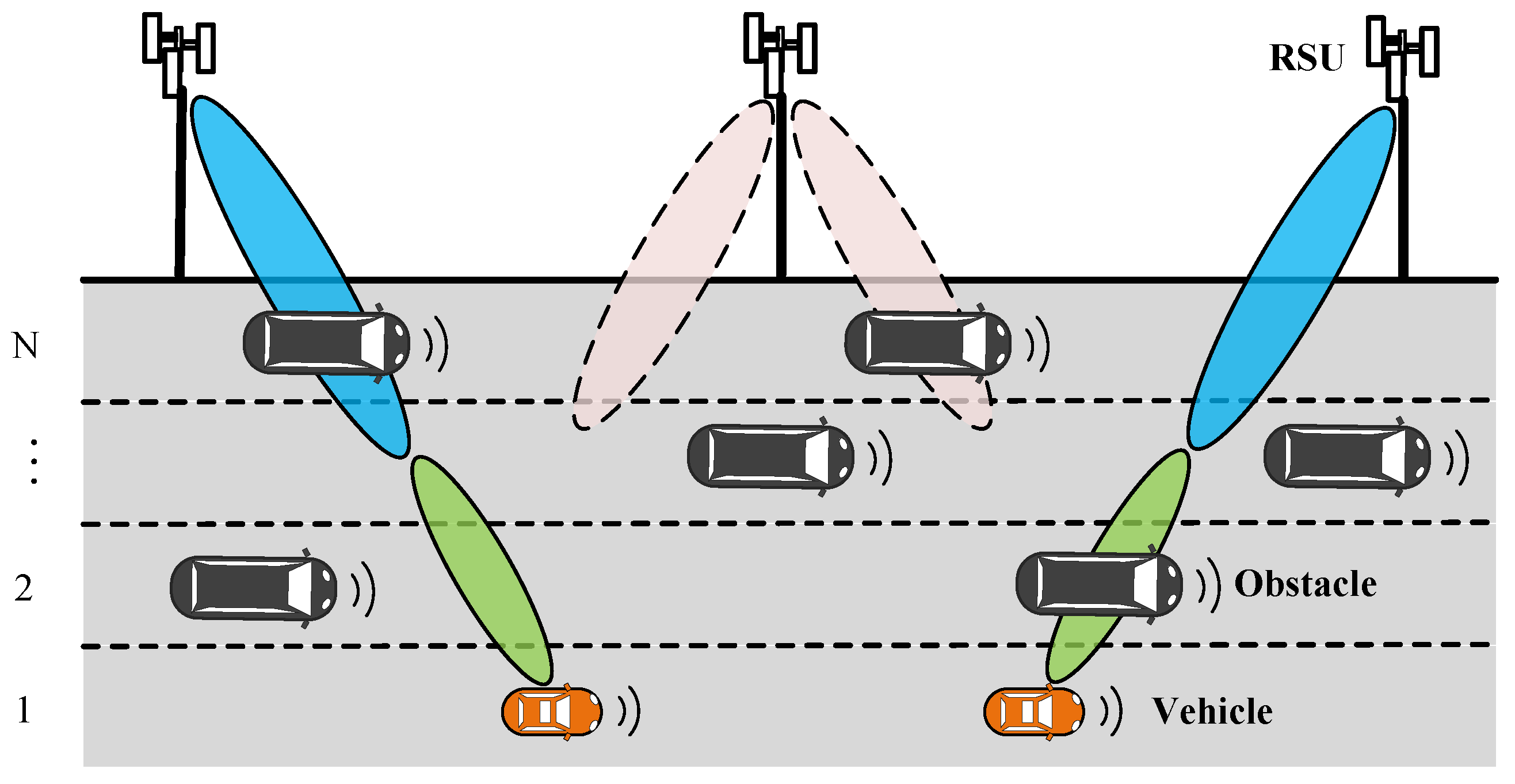
- A 3D mmWave V2I system model accounting for blockage, antenna, and channel models is constructed in a unidirectional multi-lane highway environment. To track the rapid mobility of vehicles and maintain the high quality of mmWave V2I connections, we adopt the periodic beam alignment scheme proposed by the 3GPP [17,30] to correct beam misalignment periodically after the initial beam acquisition.
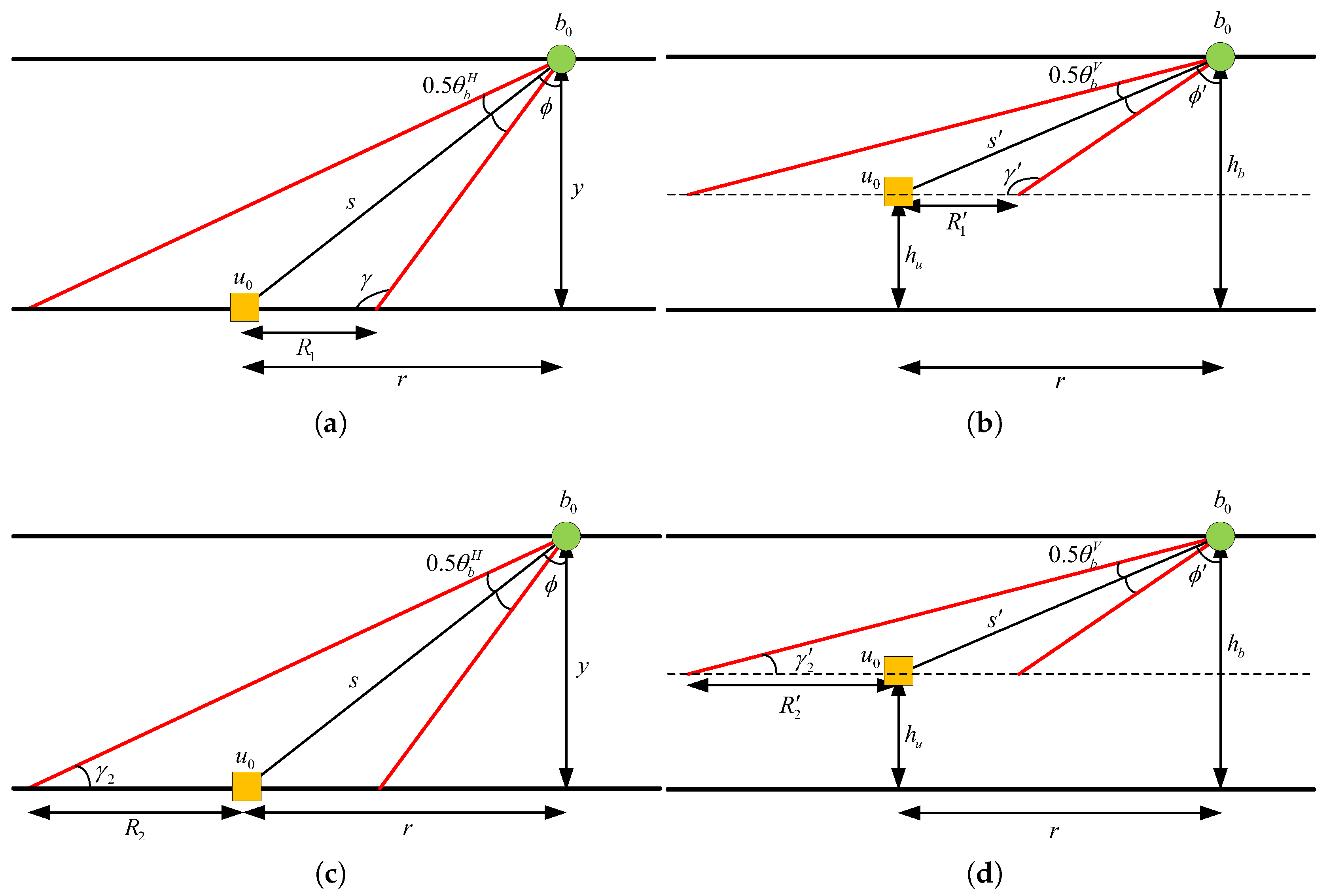
- An analytical and tractable framework is established based on SG to compute the coverage probability, connectivity probability, and effective throughput. In particular, the impact of high vehicular mobility and 3D beamforming is addressed by exploiting the geometric relationships between transceivers to analyze the horizontal and vertical beam sojourn probabilities and times. Moreover, simplified analytical results of the coverage and connectivity performance under 2D beamforming are also obtained, including closed-form expressions in special cases.
- Extensive simulations are conducted to demonstrate the proposed analysis methods. The simulation results indicate that an optimal RSU density that maximizes the spectral efficiency exists, which decreases as vehicle speed increases. Moreover, disregarding the effects of vertical beams leads to inaccurate evaluations of coverage and connectivity performance, particularly in scenarios with frequent beam alignment. More importantly, the negative impact of high vehicular mobility on the connectivity performance of mmWave V2I networks can be mitigated by appropriately setting the RSU density, beam alignment period, and beamwidth.
2. System Model
2.1. Network Model
2.2. Channel and Blockage Models
2.3. Three-Dimensional Beamforming
2.4. Transmission Signal
3. Performance Analysis
3.1. LOS Probability
3.2. Coverage Probability
3.3. Connectivity Probability
- The SINR received at is larger than T at the beginning of the beam alignment period;
- stays in the transmit beam range of during the entire beam alignment period, i.e., it maintains beam alignment.
3.4. Effective Throughput
3.5. Analysis Under 2D Beamforming
4. Numerical Results and Discussion
4.1. Validation of Results
4.2. Numerical Results for
4.3. Numerical Results for
4.4. Numerical Results for Q
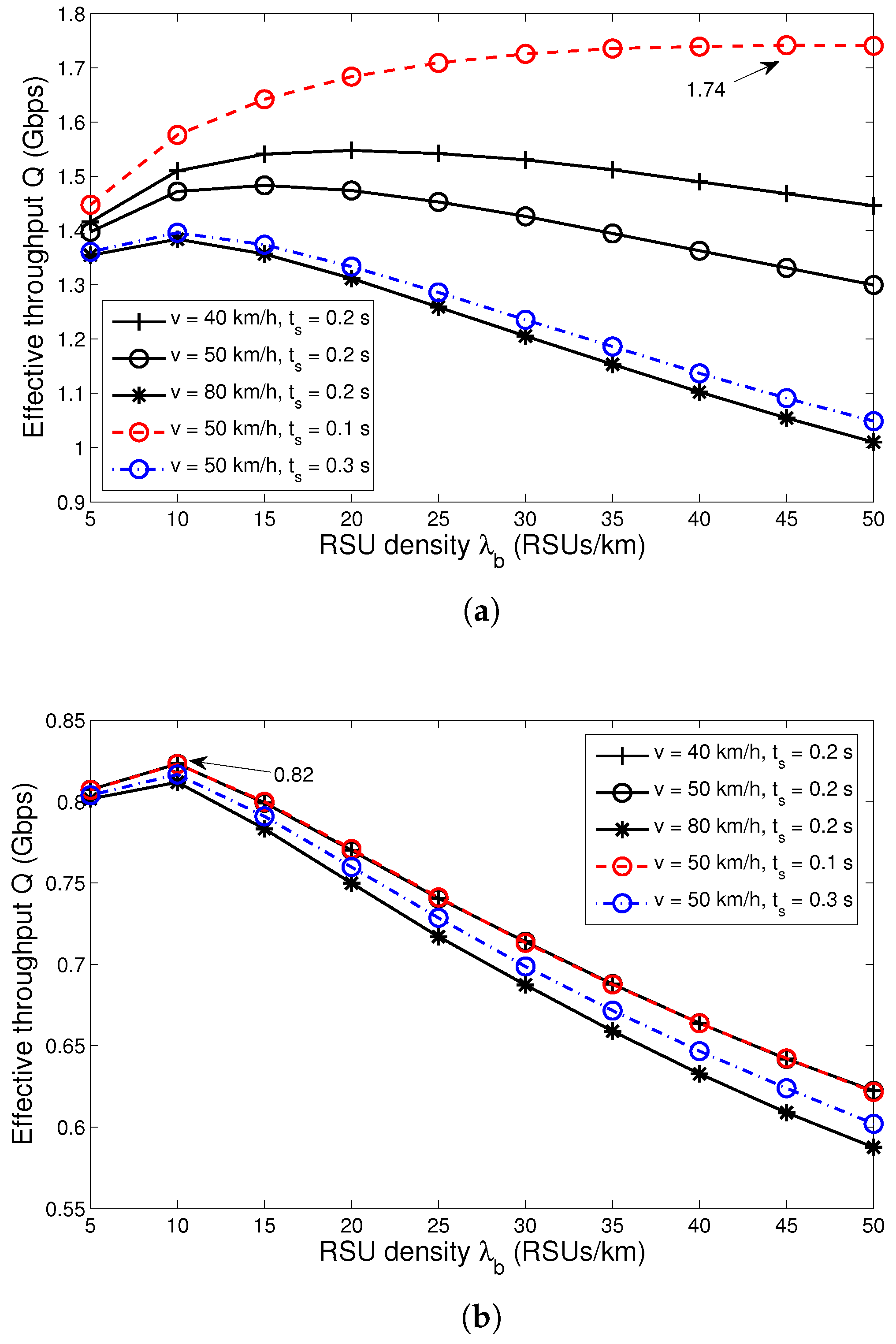
- Q first increases and then decreases when reaching the peak value as becomes larger, as seen in both subfigures. The reason is that the transmission distance between and shrinks as grows, and the target signal strength is enhanced; however, increasing also causes more co-channel interference and a smaller t since the beam coverage range is reduced. When is small, the former is the predominant factor, and Q increases with ; when is large, the latter is the predominant factor, and Q decreases with increased . Additionally, the optimal value of for maximizing Q, decreases with increasing v or , as shown in Figure 8a. This is because even in cases of sparse RSU deployment, a high vehicle speed or large beam alignment period would result in longer outage times, thereby degrading the value of and exacerbating the downward trajectory of Q. These phenomena suggest that an optimal RSU density that maximizes the spectral efficiency exists in 3D mmWave V2I networks, and it decreases as vehicle speed increases and the beam alignment period lengthens.
- The results for Q under 2D beamforming are lower than those under 3D beamforming, and the corresponding performance gaps widen as increases or as v and decrease. This is because disregarding the vertical beam results in decreased antenna gain and increased interference due to the larger beam coverage range, leading to underestimation of the performance of Q. The impact of simplified 2D beamforming becomes increasingly significant as increases or as v and decrease. When km/h and s, it is evident that the peak value of Q has degraded to half of that observed under 3D beamforming. These findings suggest that disregarding the vertical beam can lead to substantial underestimation of the transmission capacity, particularly in scenarios with dense RSU deployment and slow vehicles.
5. Conclusions
- An optimal RSU density that maximizes spectral efficiency exists, which should be set lower in higher-mobility scenarios;
- Disregarding the effect of the vertical beam of a 3D antenna array can lead to inaccurate evaluations of coverage and connectivity performance;
- The negative influence of high vehicular mobility on connectivity performance could be mitigated by appropriately setting the beam alignment period, RSU density, and horizontal and vertical beamwidths.
Author Contributions
Funding
Institutional Review Board Statement
Informed Consent Statement
Data Availability Statement
Conflicts of Interest
Appendix A. Proof of Theorem 1

References
- Clancy, J.; Mullins, D.; Deegan, B.; Horgan, J.; Ward, E.; Eising, C.; Denny, P.; Jones, E.; Glavin, M. Wireless Access for V2X Communications: Research, Challenges and Opportunities. IEEE Commun. Surv. Tutor. 2024, 26, 2082–2119. [Google Scholar] [CrossRef]
- Song, Y.; Xiao, Y.; Liu, J. Enabling Adaptive Optimization of Energy Efficiency and Quality of Service in NR-V2X Communications via Multiagent Deep Reinforcement Learning. IEEE Internet Things J. 2025, 12, 4022–4037. [Google Scholar] [CrossRef]
- Deng, H.; Li, H.; Tian, Z.; Tian, J.; Du, W. Precise Time Synchronization in Packet Networks Using Deep Learning for Future Intelligent Transportation. Sensors 2026, 26, 2758. [Google Scholar] [CrossRef] [PubMed]
- Chen, R.; Sun, S.; Liu, Y.; Hu, X.; Hui, Y.; Cheng, N. Proactive Effects of C-V2X-Based Vehicle-Infrastructure Cooperation on the Stability of Heterogeneous Traffic Flow. IEEE Internet Things J. 2024, 11, 9184–9197. [Google Scholar] [CrossRef]
- Aoki, S.; Yonezawa, T.; Kawaguchi, N.; Steenkiste, P.; Rajkumar, R. Time-Sensitive Cooperative Perception for Real-Time Data Sharing over Vehicular Communications: Overview, Challenges, and Future Directions. IEEE Internet Things Mag. 2022, 5, 108–113. [Google Scholar] [CrossRef]
- Yang, Q.; Fu, S.; Wang, H.; Fang, H. Machine-Learning-Enabled Cooperative Perception for Connected Autonomous Vehicles: Challenges and Opportunities. IEEE Netw. 2021, 35, 96–101. [Google Scholar] [CrossRef]
- Lucas-Estan, M.; Coll-Perales, B.; Shimizu, T.; Gozalvez, J.; Higuchi, T.; Avedisov, S.; Altintas, O.; Sepulcre, M. Direct-V2X Support with 5G Network-Based Communications: Performance, Challenges and Solutions. IEEE Netw. 2023, 37, 200–207. [Google Scholar] [CrossRef]
- Noor-A-Rahim, M.; Liu, Z.; Lee, H.; Khyam, M.O.; He, J.; Pesch, D.; Moessner, K.; Saad, W.; Poor, H.V. 6G for Vehicle-to-Everything (V2X) Communications: Enabling Technologies, Challenges, and Opportunities. Proc. IEEE 2022, 110, 712–734. [Google Scholar] [CrossRef]
- Saad, M.M.; Khan, M.T.R.; Shah, S.H.A.; Kim, D. Advancements in Vehicular Communication Technologies: C-V2X and NR-V2X Comparison. IEEE Commun. Mag. 2021, 59, 107–113. [Google Scholar] [CrossRef]
- Tan, J.; Luan, T.H.; Guan, W.; Wang, Y.; Peng, H.; Zhang, Y.; Zhao, D.; Lu, N. Beam Alignment in mmWave V2X Communications: A Survey. IEEE Commun. Surv. Tutor. 2024, 26, 1676–1709. [Google Scholar] [CrossRef]
- 3GPP. Study on NR Vehicle-to-Everything (V2X). In Technical Report TR 38.885 v16.0.0; 3rd Generation Partnership Project (3GPP): Sophia Antipolis, France, 2019. [Google Scholar]
- Mollah, M.B.; Wang, H.; Karim, M.A.; Fang, H. mmWave Enabled Connected Autonomous Vehicles: A Use Case With V2V Cooperative Perception. IEEE Netw. 2024, 38, 485–492. [Google Scholar] [CrossRef]
- Saluja, D.; Singh, R.; Saluja, N.; Kumar, S. Connectivity Improvement of Hybrid Millimeter Wave and Microwave Vehicular Networks. IEEE Trans. Intell. Transp. Syst. 2023, 24, 1456–1464. [Google Scholar] [CrossRef]
- Li, J.; Niu, Y.; Wu, H.; Ai, B.; Chen, S.; Feng, Z.; Zhong, Z.; Wang, N. Mobility Support for Millimeter Wave Communications: Opportunities and Challenges. IEEE Commun. Surv. Tutor. 2022, 24, 1816–1842. [Google Scholar] [CrossRef]
- Kose, A.; Lee, H.; Foh, C.; Dianati, M. Beam-Based Mobility Management in 5G Millimetre Wave V2X Communications: A Survey and Outlook. IEEE Open J. Intell. Transp. Syst. 2021, 2, 347–363. [Google Scholar] [CrossRef]
- Zhong, W. Image-Based Beam Tracking With Deep Learning for mmWave V2I Communication Systems. IEEE Trans. Intell. Transp. Syst. 2024, 25, 19110–19116. [Google Scholar] [CrossRef]
- Ding, H.; Shin, K.G. Context-Aware Beam Tracking for 5G mmWave V2I Communications. IEEE Trans. Mob. Comput. 2023, 22, 3257–3269. [Google Scholar] [CrossRef]
- Kim, J.; Chung, H.; Kim, I.; Noh, G. Integration of 5G mmWave-Enabled V2I and V2V: Experimental Evaluation. IEEE Commun. Mag. 2024, 62, 104–110. [Google Scholar] [CrossRef]
- Zhao, Y.; Zhang, X.; Gao, X.; Yang, K.; Xiong, Z.; Han, Z. LSTM-Based Predictive mmWave Beam Tracking via Sub-6 GHz Channels for V2I Communications. IEEE Trans. Commun. 2024, 72, 6254–6270. [Google Scholar] [CrossRef]
- Tassi, A.; Egan, M.; Piechocki, R.J.; Nix, A. Modeling and Design of Millimeter-Wave Networks for Highway Vehicular Communication. IEEE Trans. Veh. Technol. 2017, 66, 10676–10691. [Google Scholar] [CrossRef]
- Wang, Y.; Venugopal, K.; Molisch, A.F.; Heath, R.W. MmWave Vehicle-to-Infrastructure Communication: Analysis of Urban Microcellular Networks. IEEE Trans. Veh. Technol. 2018, 67, 7086–7100. [Google Scholar] [CrossRef]
- Yi, W.; Liu, Y.; Deng, Y.; Nallanathan, A.; Heath, R.W. Modeling and Analysis of MmWave V2X Networks With Vehicular Platoon Systems. IEEE J. Sel. Areas Commun. 2019, 37, 2851–2866. [Google Scholar] [CrossRef]
- Wu, P.; Li, X.; Zheng, H.; Wang, K.; Qin, J.; Tang, M. 3D Modeling and Analysis of Cooperative Perception-Oriented Millimeter-Wave V2I Networks With Information Value-Based Relay. IEEE Trans. Veh. Technol. 2023, 72, 10505–10520. [Google Scholar] [CrossRef]
- Choi, C.S.; Baccelli, F. A Stochastic Geometry Model for Spatially Correlated Blockage in Vehicular Networks. IEEE Internet Things J. 2022, 9, 19881–19889. [Google Scholar] [CrossRef]
- Choi, C.S.; Kim, J.; Choi, J. Stochastic Geometry Analysis of RIS-Assisted Cellular Networks with Reflective Intelligent Surfaces on Roads. IEEE Trans. Commun. 2025, 73, 859–873. [Google Scholar] [CrossRef]
- Giordani, M.; Rebato, M.; Zanella, A.; Zorzi, M. Coverage and Connectivity Analysis of Millimeter Wave Vehicular Networks. Ad Hoc Netw. 2018, 80, 158–171. [Google Scholar] [CrossRef]
- Bafqi, S.F.; Yazdi, Z.Z.; Asadi, A. Analytical Framework for Mmwave-Enabled V2X Caching. IEEE Trans. Veh. Technol. 2021, 70, 585–599. [Google Scholar] [CrossRef]
- Aghashahi, S.; Aghashahi, S.; Zeinalpour-Yazdi, Z.; Tadaion, A.; Asadi, A. Stochastic Modeling of Beam Management in mmWave Vehicular Networks. IEEE Trans. Mob. Comput. 2023, 22, 3665–3676. [Google Scholar] [CrossRef]
- Shafie, A.; Yang, N.; Durrani, S.; Zhou, X.; Han, C.; Juntti, M. Coverage Analysis for 3D Terahertz Communication Systems. IEEE J. Sel. Areas Commun. 2021, 39, 1817–1832. [Google Scholar] [CrossRef]
- Huawei, HiSilicon. UL/DL beam management for latency/overhead reduction, 2019. In Proceedings of the 3GPP TSG RAN WG1 Meeting R1-1903974, Xi’an, China, 1–12 April 2019. [Google Scholar]
- Yan, D.; Guan, K.; He, D.; Ai, B.; Li, Z.; Kim, J.; Chung, H.; Zhong, Z. Channel Characterization for Vehicle-to-Infrastructure Communications in Millimeter-Wave Band. IEEE Access 2020, 8, 42325–42341. [Google Scholar] [CrossRef]
- Jameel, F.; Wyne, S.; Nawaz, S.J.; Chang, Z. Propagation Channels for mmWave Vehicular Communications: State-of-the-art and Future Research Directions. IEEE Wirel. Commun. 2019, 26, 144–150. [Google Scholar] [CrossRef]
- Kovalchukov, R.; Moltchanov, D.; Samuylov, A.; Ometov, A.; Andreev, S.; Koucheryavy, Y.; Samouylov, K. Evaluating SIR in 3D Millimeter-Wave Deployments: Direct Modeling and Feasible Approximations. IEEE Trans. Wirel. Commun. 2019, 18, 879–896. [Google Scholar]
- Wang, Y.; Venugopal, K.; Molisch, A.F.; Heath, R.W. Blockage and Coverage Analysis with MmWave Cross Street BSs Near Urban Intersections. In Proceedings of the IEEE International Conference on Communications (ICC), Paris, France, 21–25 May 2017; pp. 1–6. [Google Scholar]
- Wu, S.; Atat, R.; Mastronarde, N.; Liu, L. Improving the Coverage and Spectral Efficiency of Millimeter-Wave Cellular Networks Using Device-to-Device Relays. IEEE Trans. Commun. 2018, 66, 2251–2265. [Google Scholar] [CrossRef]
- Weber, S.; Andrews, J.G.; Jindal, N. An Overview of the Transmission Capacity of Wireless Networks. IEEE Trans. Commun. 2010, 58, 3593–3604. [Google Scholar] [CrossRef]
- Zheng, H.; Wu, P.; Cao, L. Throughput Analysis for Dynamic Millimeter-Wave V2I Networks with 3D Beamforming. In Proceedings of the IEEE International Conference on Communications (ICC), Seoul, Republic of Korea, 16–20 May 2022; pp. 1–6. [Google Scholar]
- 3GPP. Study on evaluation methodology of new Vehicle-to-Everything (V2X) use cases for LTE and NR. In Technical Report TR 37.885 v15.3.0; 3rd Generation Partnership Project (3GPP): Sophia Antipolis, France, 2019. [Google Scholar]
- 3GPP. Study on channel model for frequencies from 0.5 to 100 GHz. In Technical Report TR 38.901 v16.1.0; 3rd Generation Partnership Project (3GPP): Sophia Antipolis, France, 2019. [Google Scholar]
- Arif, M.; Kim, W. Clustered Jamming in U-V2X Communications with 3D Antenna Beam-width Fluctuations. Comput. Commun. 2024, 216, 209–228. [Google Scholar] [CrossRef]
- Wiseman, Y.; Grinberg, I. Circumspectly Crash of Autonomous Vehicles. In Proceedings of the 2016 IEEE International Conference on Electro Information Technology (EIT), Grand Forks, ND, USA, 19–21 May 2016; pp. 387–392. [Google Scholar]



| Notation | Value |
|---|---|
| , , | 20 vehicles/km, 10 obstacles/km, 10 RSUs/km |
| , , | 1.6 m, 3.5 m, 10 m |
| , | 12 m, 2.6 m |
| , | 2.2, |
| , , , | 15, 30, 15, 36 |
| P, | 27 dBm, dBm |
| , B | 28 GHz, 100 MHz |
| , v | 0.2 s, 80 km/h |
Disclaimer/Publisher’s Note: The statements, opinions and data contained in all publications are solely those of the individual author(s) and contributor(s) and not of MDPI and/or the editor(s). MDPI and/or the editor(s) disclaim responsibility for any injury to people or property resulting from any ideas, methods, instructions or products referred to in the content. |
© 2026 by the authors. Licensee MDPI, Basel, Switzerland. This article is an open access article distributed under the terms and conditions of the Creative Commons Attribution (CC BY) license.
Share and Cite
Zheng, H.; Yang, H.; Wu, P. Three-Dimensional Modeling and Performance Analysis of Dynamic mmWave V2I Networks Based on Stochastic Geometry. Sensors 2026, 26, 3963. https://doi.org/10.3390/s26123963
Zheng H, Yang H, Wu P. Three-Dimensional Modeling and Performance Analysis of Dynamic mmWave V2I Networks Based on Stochastic Geometry. Sensors. 2026; 26(12):3963. https://doi.org/10.3390/s26123963
Chicago/Turabian StyleZheng, Hui, Haocheng Yang, and Peng Wu. 2026. "Three-Dimensional Modeling and Performance Analysis of Dynamic mmWave V2I Networks Based on Stochastic Geometry" Sensors 26, no. 12: 3963. https://doi.org/10.3390/s26123963
APA StyleZheng, H., Yang, H., & Wu, P. (2026). Three-Dimensional Modeling and Performance Analysis of Dynamic mmWave V2I Networks Based on Stochastic Geometry. Sensors, 26(12), 3963. https://doi.org/10.3390/s26123963