Behavioral Modeling of Dynamic Nonlinear Distortions in 5G Wireless Transmitters Using Cascaded Augmented Real-Valued Neural Networks

Highlights
- Dynamic nonlinear distortions in 5G wireless transmitters can be accurately modeled using a cascade made of two specialized neural networks.
- Using cascaded neural networks for the behavioral modeling of dynamic distortions in 5G wireless infrastructure can lead to reduced overall complexity without loss of accuracy.
- The proposed model and the reported results show that instead of building a massive complex neural network to handle the entire dynamic nonlinear behavior, it is more effective to use dedicated models with fewer coefficients.
- By significantly reducing the number of parameters while maintaining the model’s accuracy, the proposed architecture can contribute to the adoption of neural networks in field deployed systems with resource constrained hardware.
Abstract
1. Introduction
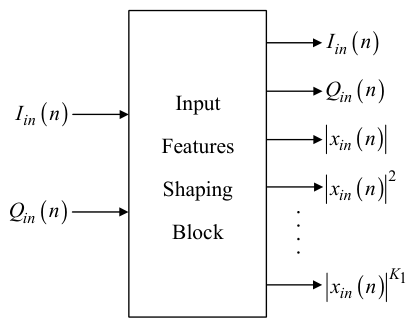
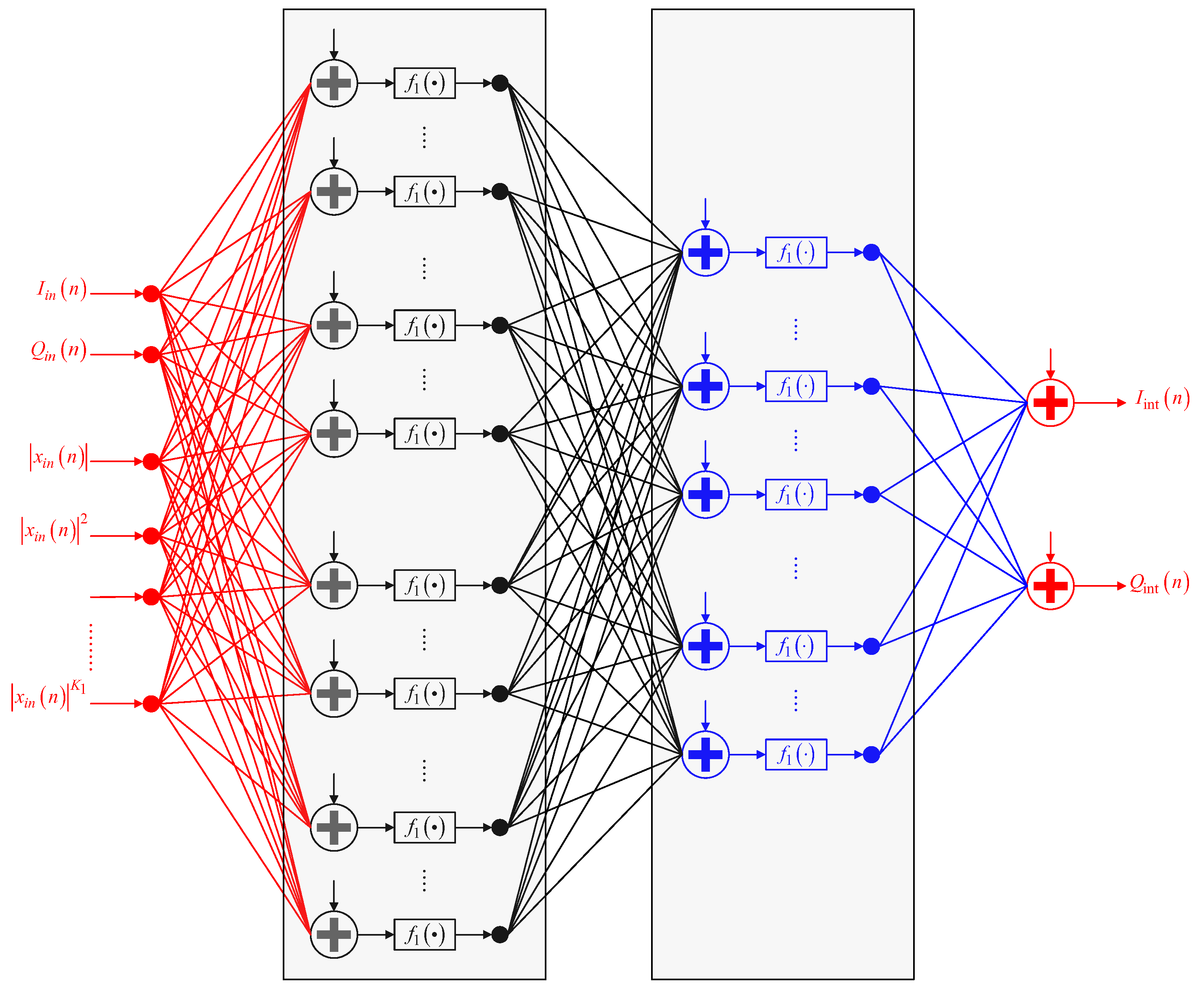
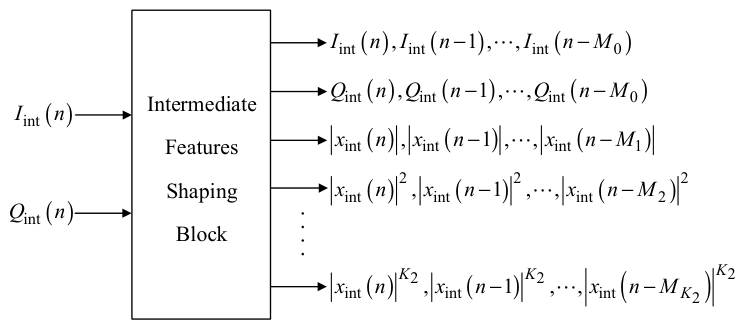
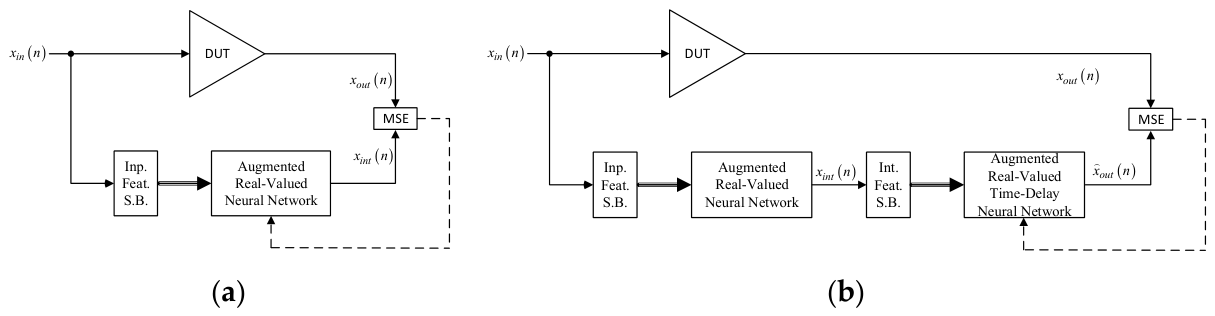
2. Cascaded Augmented Real-Valued Neural Networks
2.1. Model Structure
2.2. Model Identification
2.3. Training Protocol
| Algorithm 1. Two-Stage Identification of the CAR-VANN Model | |
| Input: : measured PA input and output signals for N samples. | |
| 1: | Chosen Box 1 (ARVNN) hyperparameters: |
| : nonlinearity order; : number of hidden layers; : number of neurons per layer; : activation function. | |
| 2: | Chosen Box 2 (ARVTDNN) hyperparameters: |
| : nonlinearity order; : memory depths; : number of hidden layers; : number of neurons per layer; : activation function. | |
| 3: | Training settings |
| : learning rate; : training epochs. | |
| Output: optimal weights and biased of the ARVNN; : optimal weights and biased of the ARVTDNN. | |
| 4: | into 60% training, 20% validation, and 20% testing sets. |
| 5: | (Equation (1)). |
| 6: | , chosen box 1 parameters, , ). |
| 7: | |
| 8: | (Equation (2)). |
| 9: | , chosen box 2 parameters, , ). |
| 10: | of the full cascade on the test set. |
| 11: | |
3. Performance Assessment and Validation
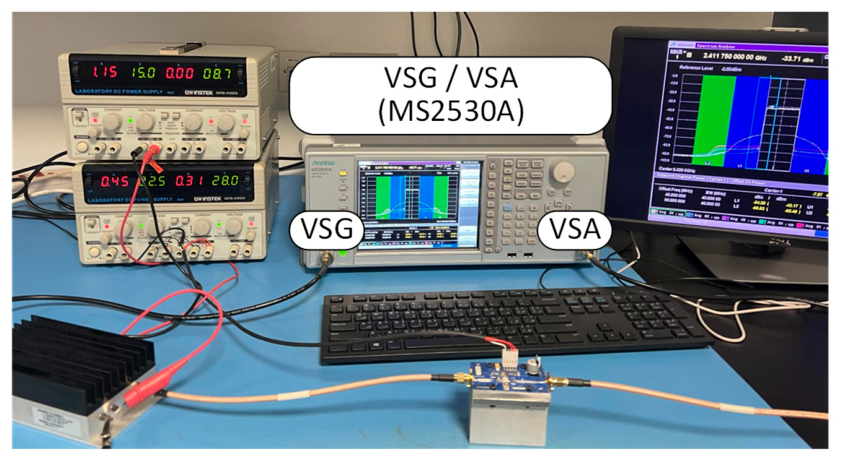
3.1. Experimental Setup and Benchmark Model
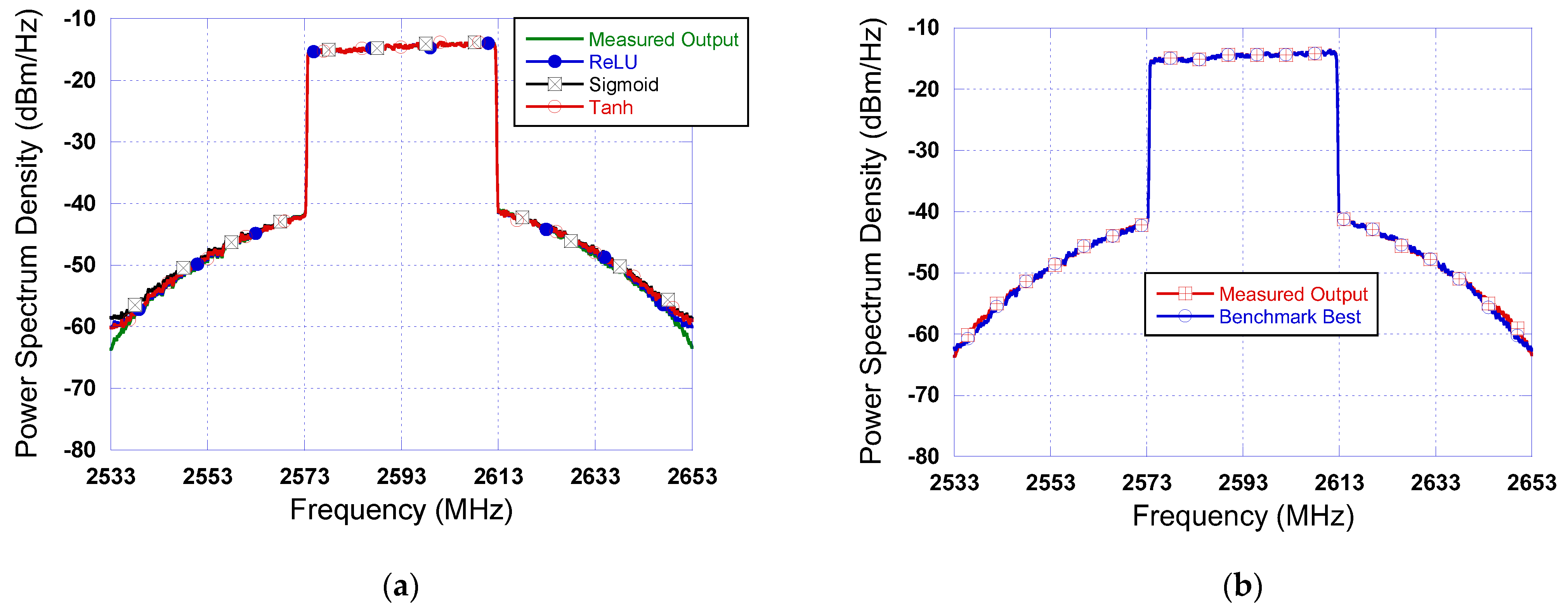
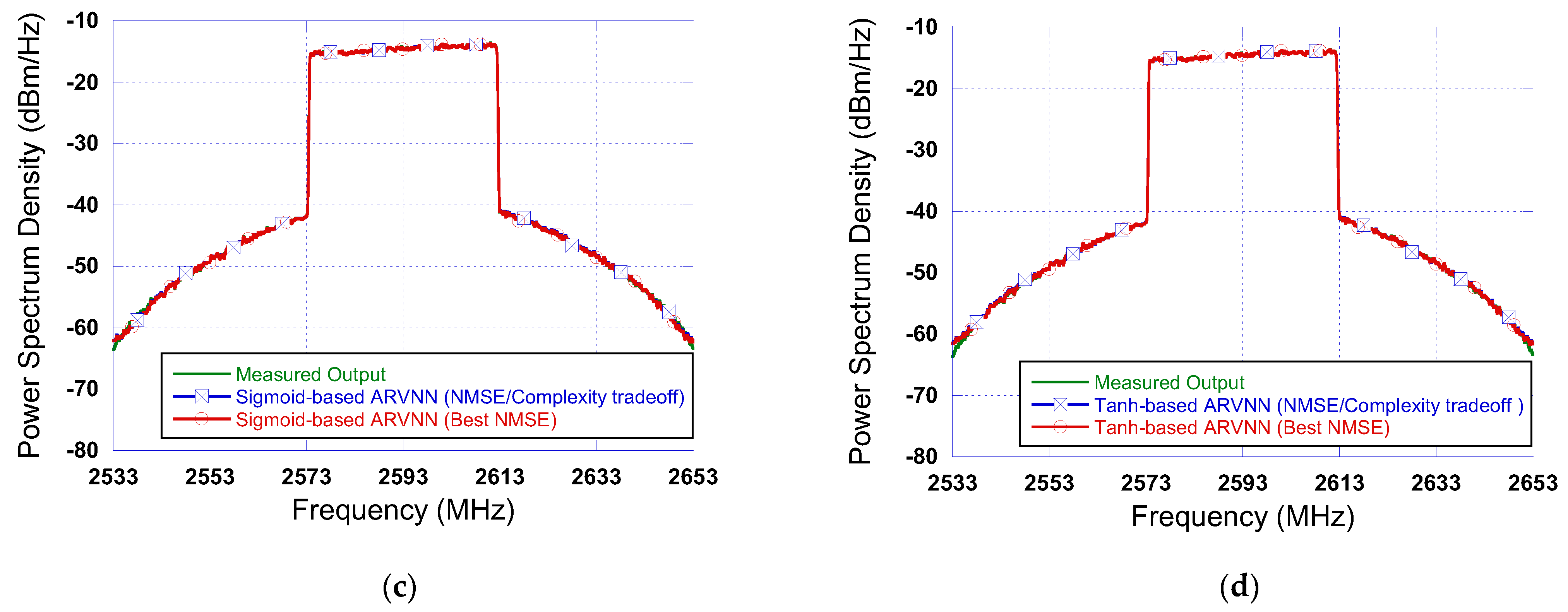
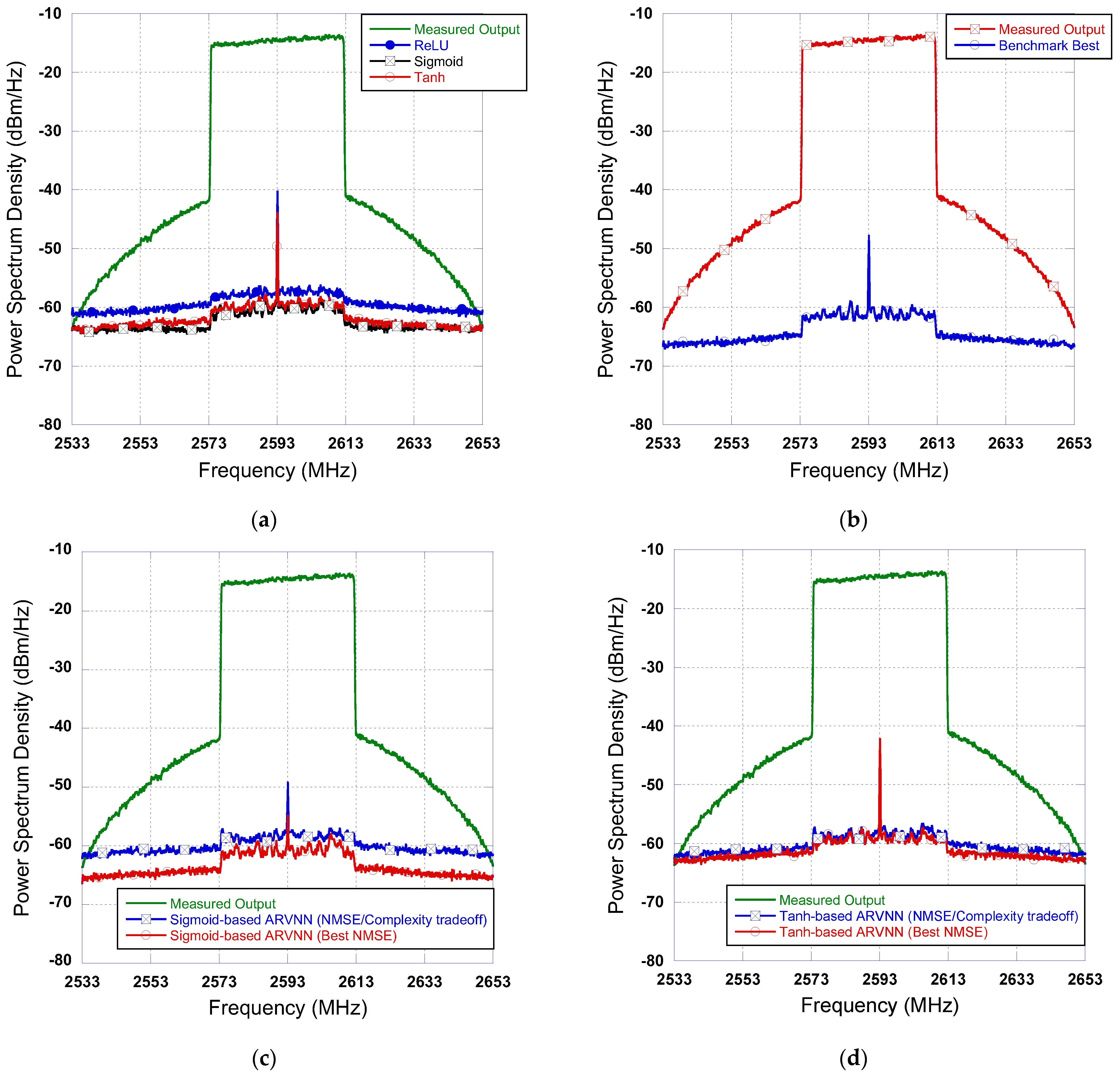
3.2. CAR-VANN Model Validation
4. Conclusions
Author Contributions
Funding
Data Availability Statement
Conflicts of Interest
References
- Ghannouchi, F.; Hammi, O.; Helaoui, M. Behavioral Modeling and Predistortion of Wideband Wireless Transmitters; John Wiley & Sons: Chichester, UK, 2015. [Google Scholar]
- Morgan, D.R.; Ma, Z.; Kim, J.; Zierdt, M.G.; Pastalan, J. A Generalized Memory Polynomial Model for Digital Predistortion of RF Power Amplifiers. IEEE Trans. Signal Process. 2006, 54, 3852–3860. [Google Scholar] [CrossRef]
- Barry, A.; Li, W.; Becerra, J.A.; Gilabert, P.L. Comparison of Feature Selection Techniques for Power Amplifier Behavioral Modeling and Digital Predistortion Linearization. Sensors 2021, 21, 5772. [Google Scholar] [CrossRef] [PubMed]
- Hemsi, C.S.; Panazio, C.M. Sparse Flexible Reduced-Volterra Model for Power Amplifier Digital Pre-Distortion. IEEE Access 2022, 10, 121970–121984. [Google Scholar] [CrossRef]
- Crespo-Cadenas, C.; Madero-Ayora, M.J.; Becerra, J.A.; Cruces, S. A Sparse-Bayesian Approach for the Design of Robust Digital Predistorters Under Power-Varying Operation. IEEE Trans. Microw. Theory Tech. 2022, 70, 4218–4230. [Google Scholar] [CrossRef]
- Pedrosa, C.; Pham, D.-K.G.; Rashev, P.; Almairac, P.; Nanan, J.-C.; Desgreys, P. Discontinuity Characterization and Low-Complexity Smoothing in RF-PA Polynomial Piecewise Modeling. Sensors 2025, 25, 6593. [Google Scholar] [CrossRef] [PubMed]
- Langborn, B.; Fager, C.; Hou, R.; Eriksson, T. Concurrent Multi-Beam Digital Predistortion Using FFT Beamforming and Virtual Arrays. Sensors 2026, 26, 2400. [Google Scholar] [CrossRef] [PubMed]
- Shahghasi, A.; Montoro, G.; Gilabert, P.L. Digital Self-Interference Cancellation Strategies for In-Band Full-Duplex: Methods and Comparisons. Sensors 2025, 25, 6835. [Google Scholar] [CrossRef] [PubMed]
- Liu, T.; Boumaiza, S.; Ghannouchi, F.M. Augmented Hammerstein Predistorter for Linearization of Broad-band Wireless Transmitters. IEEE Trans. Microw. Theory Tech. 2006, 54, 1340–1349. [Google Scholar] [CrossRef]
- Gilabert, P.; Montoro, G.; Bertran, E. On the Wiener Hammerstein Models for Power Amplifiers Predistortion. In Proceedings of the IEEE Asia Pacific Microwave Conference, Suzhou, China, 4–7 December 2005. [Google Scholar] [CrossRef]
- Hammi, O.; Ghannouchi, F.M. Twin Nonlinear Two-Box Models for Power Amplifiers and Transmitters Exhibiting Memory Effects with Application to Digital Predistortion. IEEE Microw. Wirel. Compon. Lett. 2009, 19, 530–532. [Google Scholar] [CrossRef]
- Wu, J.; He, S.; Peng, J.; Li, C.; You, F. Power Scalable Behavioral Model in Digital Predistrotion for Power Amplifiers. In Proceedings of the IEEE Asia Pacific Microwave Conference, Hong Kong, China, 8–11 December 2020. [Google Scholar] [CrossRef]
- Hammi, O.; Kwan, A.; Bensmida, S.; Morris, K.A.; Ghannouchi, F.M. A Digital Predistortion System with Extended Correction Bandwidth with Application to LTE-A Nonlinear Power Amplifiers. IEEE Trans. Circuits Syst. I Reg. Pap. 2014, 61, 3487–3495. [Google Scholar] [CrossRef]
- Abdelnaby, M.; Alnajjar, R.; Bensmida, S.; Hammi, O. Reduced Complexity Sequential Digital Predistortion Technique for 5G Applications. Smart Cities 2024, 7, 772–785. [Google Scholar] [CrossRef]
- Spano, C.; Badini, D.; Cazzella, L.; Matteucci, M. Local and Remote Digital Pre-Distortion for 5G Power Amplifiers with Safe Deep Reinforcement Learning. Sensors 2025, 25, 6102. [Google Scholar] [CrossRef] [PubMed]
- Wu, H.; Chen, W.; Liu, X.; Feng, Z.; Ghannouchi, F.M. A Uniform Neural Network Digital Predistortion Model of RF Power Amplifiers for Scalable Applications. IEEE Trans. Microw. Theory Tech. 2022, 70, 4885–4899. [Google Scholar] [CrossRef]
- Rawat, M.; Rawat, K.; Ghannouchi, F.M. Adaptive Digital Predistortion of Wireless Power Amplifiers/Transmitters using Dynamic Real-Valued Focused Time-Delay Line Neural Networks. IEEE Trans. Microw. Theory Tech. 2010, 58, 95–104. [Google Scholar] [CrossRef]
- Rosołowski, D.W.; Jędrzejewski, K. Experimental Evaluation of PA Digital Predistortion Based on Simple Feedforward Neural Network. In Proceedings of the 2020 23rd International Microwave and Radar Conference, Warsaw, Poland, 5–8 October 2020. [Google Scholar] [CrossRef]
- Wang, D.; Aziz, M.; Helaoui, M.; Ghannouchi, F.M. Augmented Real-Valued Time-Delay Neural Network for Compensation of Distortions and Impairments in Wireless Transmitters. IEEE Trans. Neural Netw. Learn. Syst. 2019, 30, 242–254. [Google Scholar] [CrossRef] [PubMed]
- Hu, X.; Liu, Z.; Yu, X.; Zhao, Y.; Chen, W.; Hu, B.; Du, X.; Li, X.; Helaoui, M.; Wang, W.; et al. Convolutional Neural Network for Behavioral Modeling and Predistortion of Wideband Power Amplifiers. IEEE Trans. Neural Netw. Learn. Syst. 2022, 33, 3923–3937. [Google Scholar] [CrossRef] [PubMed]
- Jaraut, P.; Abdelhafiz, A.; Chenini, H.; Hu, X.; Helaoui, M.; Rawat, M.; Chen, W.; Boulejfen, N.; Ghannouchi, F.M. Augmented Convolutional Neural Network for Behavioral Modeling and Digital Predistortion of Concurrent Multiband Power Amplifiers. IEEE Trans. Microw. Theory Tech. 2021, 69, 4142–4156. [Google Scholar] [CrossRef]
- Jaraut, P.; Dhar, S.; Helaoui, M.; Boulejfen, N.; Rawat, M.; Chen, W.; Rawat, K.; Outaleb, N.; Ghannouchi, F.M. Behavioral Modeling and Digital Predistortion of Mismatched Wireless Transmitters using Convolution Neural Networks. IEEE Trans. Circuits Syst. II Express Briefs 2023, 70, 336–340. [Google Scholar] [CrossRef]
- Ali, A.; Hammi, O. Bandwidth, Power and Carrier Configuration Resilient Neural Networks Digital Predistorter. IEEE Access 2023, 11, 63126–63135. [Google Scholar] [CrossRef]
- Sun, J.; Shi, W.; Yang, Z.; Yang, J.; Gui, G. Behavioral Modeling and Linearization of Wideband RF Power Amplifiers using BiLSTM Networks for 5G Wireless Systems. IEEE Trans. Veh. Technol. 2019, 68, 10348–10356. [Google Scholar] [CrossRef]
- Fischer-Buhner, A.; Anttila, L.; Dev Gomony, M.; Valkama, M. Recursive Neural Network with Phase-Normalization for Modeling and Linearization of RF Power Amplifiers. IEEE Microw. Wirel. Technol. Lett. 2024, 34, 809–812. [Google Scholar] [CrossRef]
- Liu, M.; Yang, X.; Gao, J.; Cao, S.; Liao, G.; Hou, G.; Gao, D. Neural Network-Assisted DPD of Wideband PA Nonlinearity for Sub-Nyquist Sampling Systems. Sensors 2025, 25, 1106. [Google Scholar] [CrossRef] [PubMed]
- Alnajjar, R.; Hammi, O. A Look-up Table Assisted BiLSTM Neural Network Based Digital Predistorter for Wireless Communication Infrastructure. Sensors 2025, 25, 4099. [Google Scholar] [CrossRef]





| Neural Network | Variable | Definition |
|---|---|---|
| First Neural Network (Augmented Real-Valued Neural Network) | Input signal | |
| Nonlinearity order for the input features vector | ||
| Number of hidden layers | ||
| Number of neurons in the ith layer | ||
| Total number of weights and biases | ||
| Second Neural Network (Augmented Real-Valued Time-Delay Neural Network) | Input signal | |
| Nonlinearity order for the input features vector | ||
| Number of hidden layers | ||
| Memory depth associated with and | ||
| Memory depth associated with | ||
| Number of neurons in the ith layer | ||
| Total number of weights and biases |
| Parameter | Value |
|---|---|
| Optimizer | Adam |
| Learning rate | 2 × 10⁻³ |
| Training loss function | Mean Squared Error |
| Dataset split | 60% train/20% validation/20% test |
| Input/output normalization | Maximum Absolute |
| Batch size | 256 |
| Training epochs | 200 |
| Early stopping criterion | None |
| Random seed | Not Fixed |
| Parameter | Values/Sweep Ranges |
|---|---|
| Activation function | ReLU, Sigmoid, Tanh |
| Number of hidden layers | 1, 2, 3, 4 |
| Neurons per hidden layer | 5, 10, 15, 20, 25, 30, 35, 40 |
| Activation Function | NMSE | Number of Hidden Layers | Number of Neurons per Hidden Layer | Complexity |
|---|---|---|---|---|
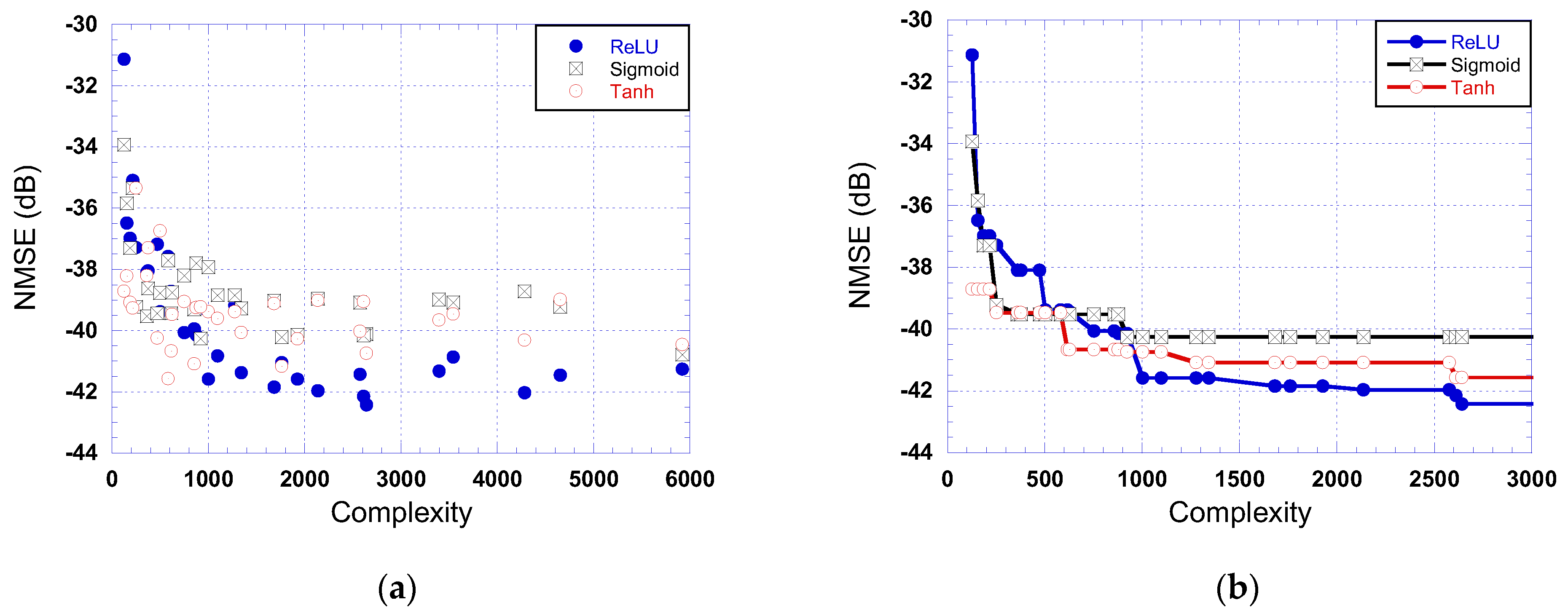
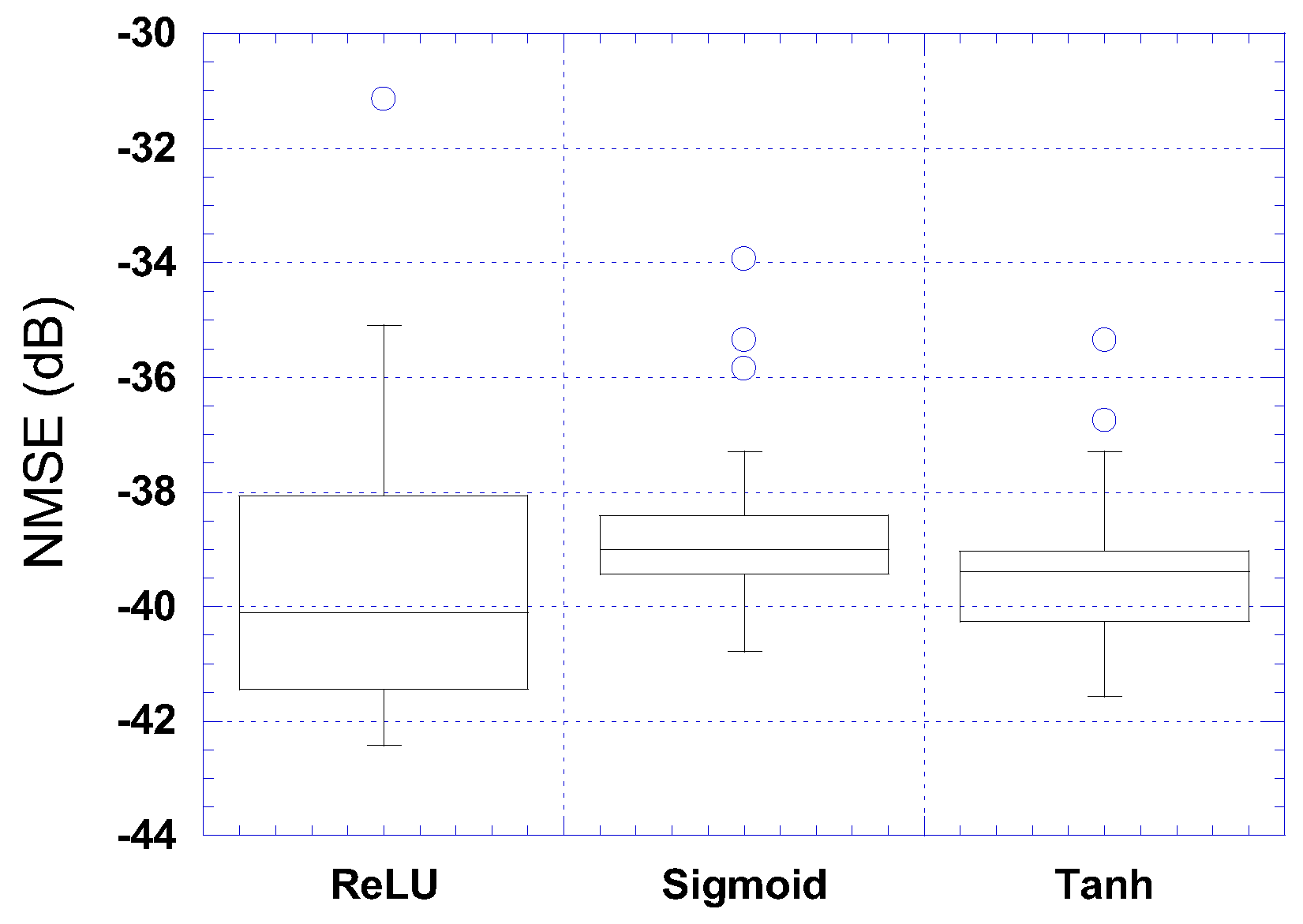
| ReLU | 1 | 30 | 752 | |
| Sigmoid | 2 | 20, 20 | 922 | |
| Tanh | 2 | 15, 15 | 617 |
| Activation Function | NMSE | Number of Hidden Layers | Number of Neurons per Layer | Complexity |
|---|---|---|---|---|
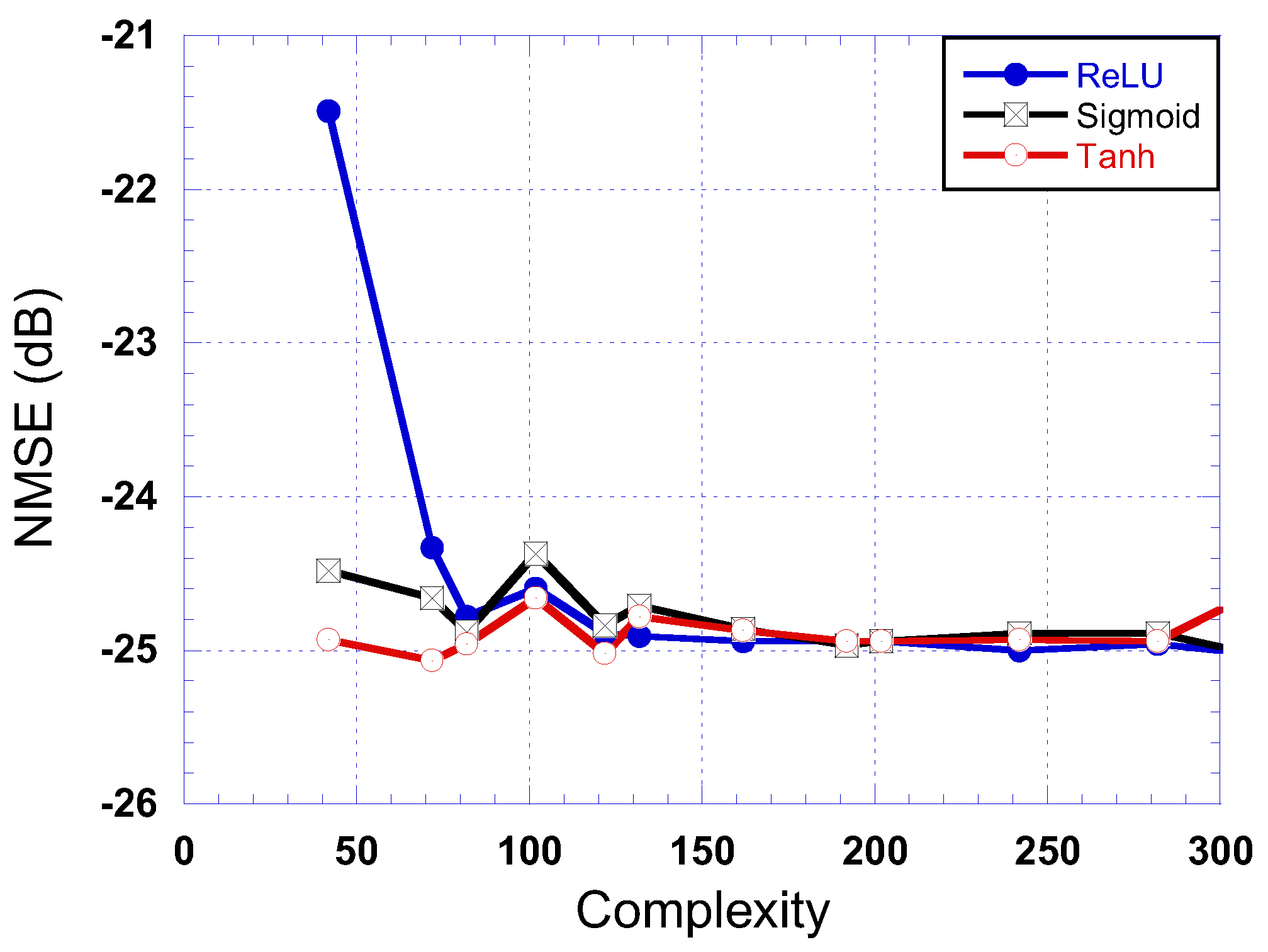
| ReLU | 1 | 10 | 82 | |
| Sigmoid | 1 | 5 | 42 | |
| Tanh | 1 | 5 | 42 |
| Parameter | Benchmark | Proposed | Proposed | Proposed |
|---|---|---|---|---|
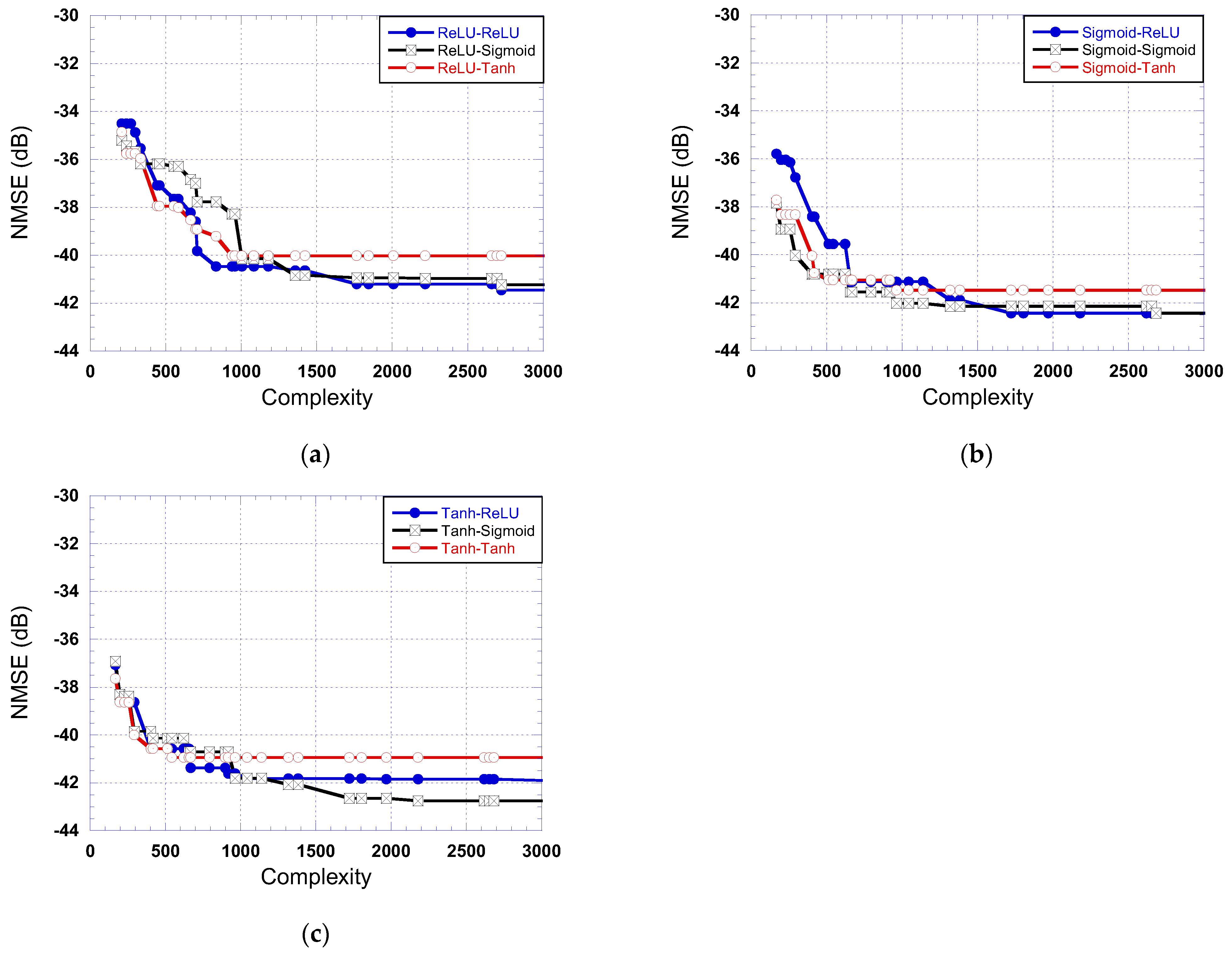
| Activation Function #1 | Tanh | ReLU | Sigmoid | Tanh |
| Activation Function #2 | ReLU | Sigmoid | Tanh | |
| NMSE | ||||
| Number of Layers | 2 | 1 | 1 | 1 |
| Number of Neurons | 15 | 30 | 10 | 10 |
| Complexity | 617 | 834 | 294 | 294 |
| Relative Complexity | 100% | 135.2% | 47.6% | 47.6% |
| Parameter | Benchmark | Proposed | Proposed | Proposed |
|---|---|---|---|---|
| Activation Function #1 | ReLU | ReLU | Sigmoid | Tanh |
| Activation Function #2 | ReLU | ReLU | Sigmoid | |
| NMSE | ||||
| Number of Layers | 2 | 2 | 2 | 2 |
| Number of Neurons | 40 | 40 | 30 | 30 |
| Complexity | 2642 | 2724 | 1724 | 1724 |
| Relative Complexity | 100% | 103.1% | 65.3% | 65.3% |
| Model | Trace | NMSE (dB) | ACEPR_U (dB) | ACEPR_L (dB) |
|---|---|---|---|---|
| Benchmark | Figure 12a—ReLU | |||
| Benchmark | Figure 12a—Sigmoid | |||
| Benchmark | Figure 12a—Tanh | |||
| Benchmark | Figure 12b—Benchmark Best | |||
| Proposed | Figure 12c—NMSE/Complexity Tradeoff | |||
| Proposed | Figure 12c—Best NMSE | |||
| Proposed | Figure 12d—NMSE/Complexity Tradeoff | |||
| Proposed | Figure 12d—Best NMSE |
Disclaimer/Publisher’s Note: The statements, opinions and data contained in all publications are solely those of the individual author(s) and contributor(s) and not of MDPI and/or the editor(s). MDPI and/or the editor(s) disclaim responsibility for any injury to people or property resulting from any ideas, methods, instructions or products referred to in the content. |
© 2026 by the authors. Licensee MDPI, Basel, Switzerland. This article is an open access article distributed under the terms and conditions of the Creative Commons Attribution (CC BY) license.
Share and Cite
Bankole, S.; Alnajjar, R.; Ahmed, M.; Bensmida, S.; Hammi, O. Behavioral Modeling of Dynamic Nonlinear Distortions in 5G Wireless Transmitters Using Cascaded Augmented Real-Valued Neural Networks. Sensors 2026, 26, 3832. https://doi.org/10.3390/s26123832
Bankole S, Alnajjar R, Ahmed M, Bensmida S, Hammi O. Behavioral Modeling of Dynamic Nonlinear Distortions in 5G Wireless Transmitters Using Cascaded Augmented Real-Valued Neural Networks. Sensors. 2026; 26(12):3832. https://doi.org/10.3390/s26123832
Chicago/Turabian StyleBankole, Sharafa, Reem Alnajjar, Majid Ahmed, Souheil Bensmida, and Oualid Hammi. 2026. "Behavioral Modeling of Dynamic Nonlinear Distortions in 5G Wireless Transmitters Using Cascaded Augmented Real-Valued Neural Networks" Sensors 26, no. 12: 3832. https://doi.org/10.3390/s26123832
APA StyleBankole, S., Alnajjar, R., Ahmed, M., Bensmida, S., & Hammi, O. (2026). Behavioral Modeling of Dynamic Nonlinear Distortions in 5G Wireless Transmitters Using Cascaded Augmented Real-Valued Neural Networks. Sensors, 26(12), 3832. https://doi.org/10.3390/s26123832