Article

RGB-D Mirror Segmentation with Reliability-Guided Residual Correction
School of Computing, Gachon University, Seongnam-si 13120, Republic of Korea
*
Author to whom correspondence should be addressed.
Sensors 2026, 26(12), 3739; https://doi.org/10.3390/s26123739
Submission received: 29 April 2026 / Revised: 5 June 2026 / Accepted: 9 June 2026 / Published: 11 June 2026

Abstract

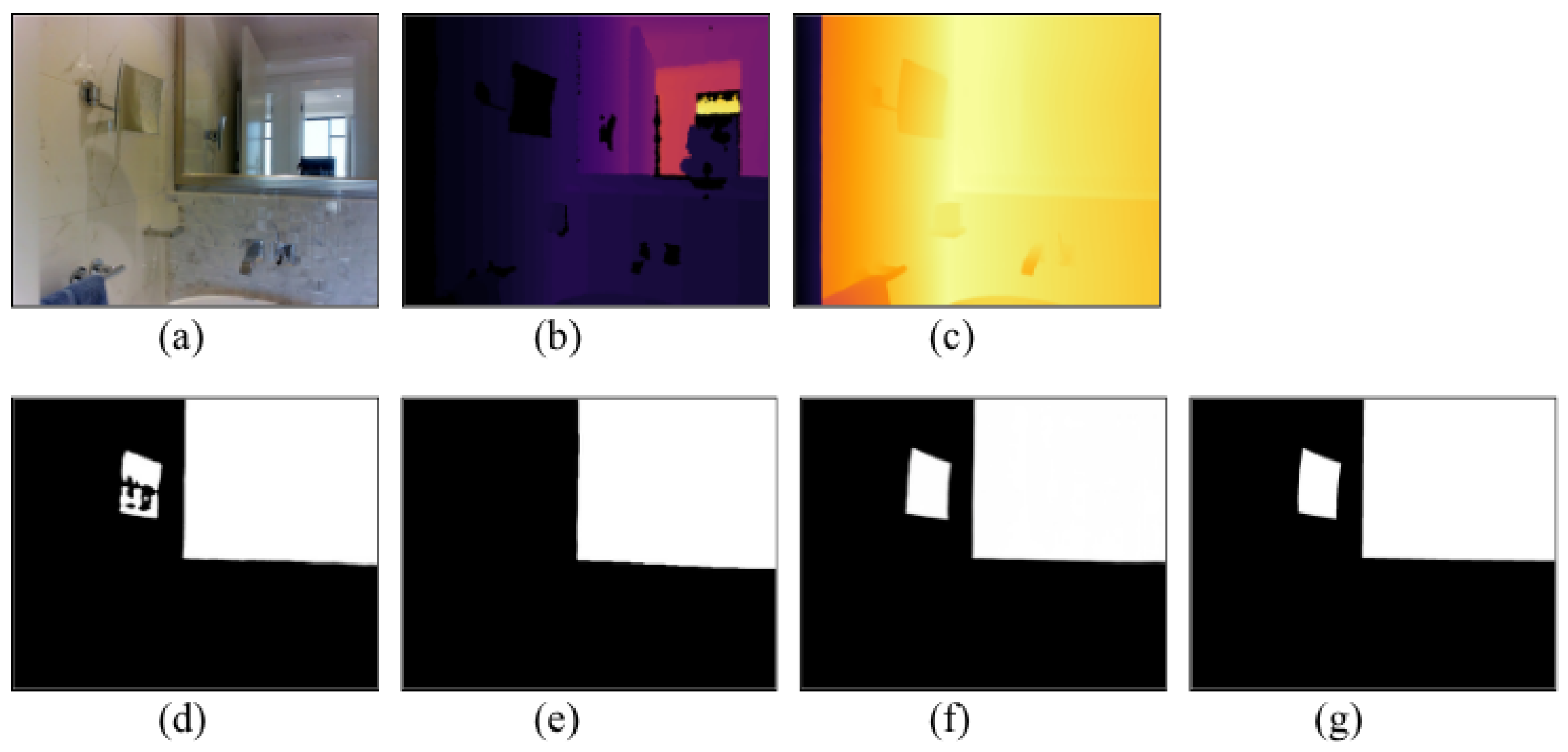
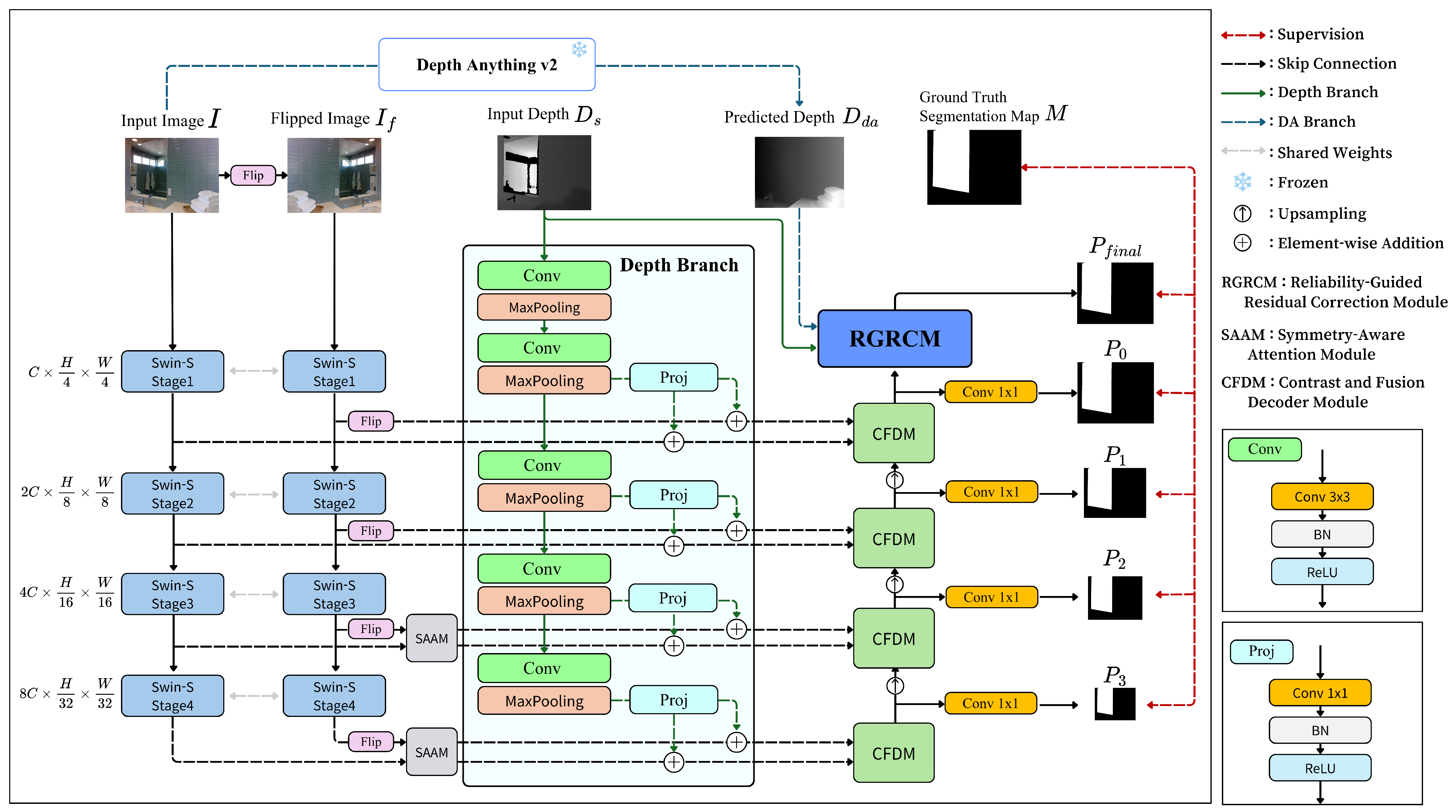
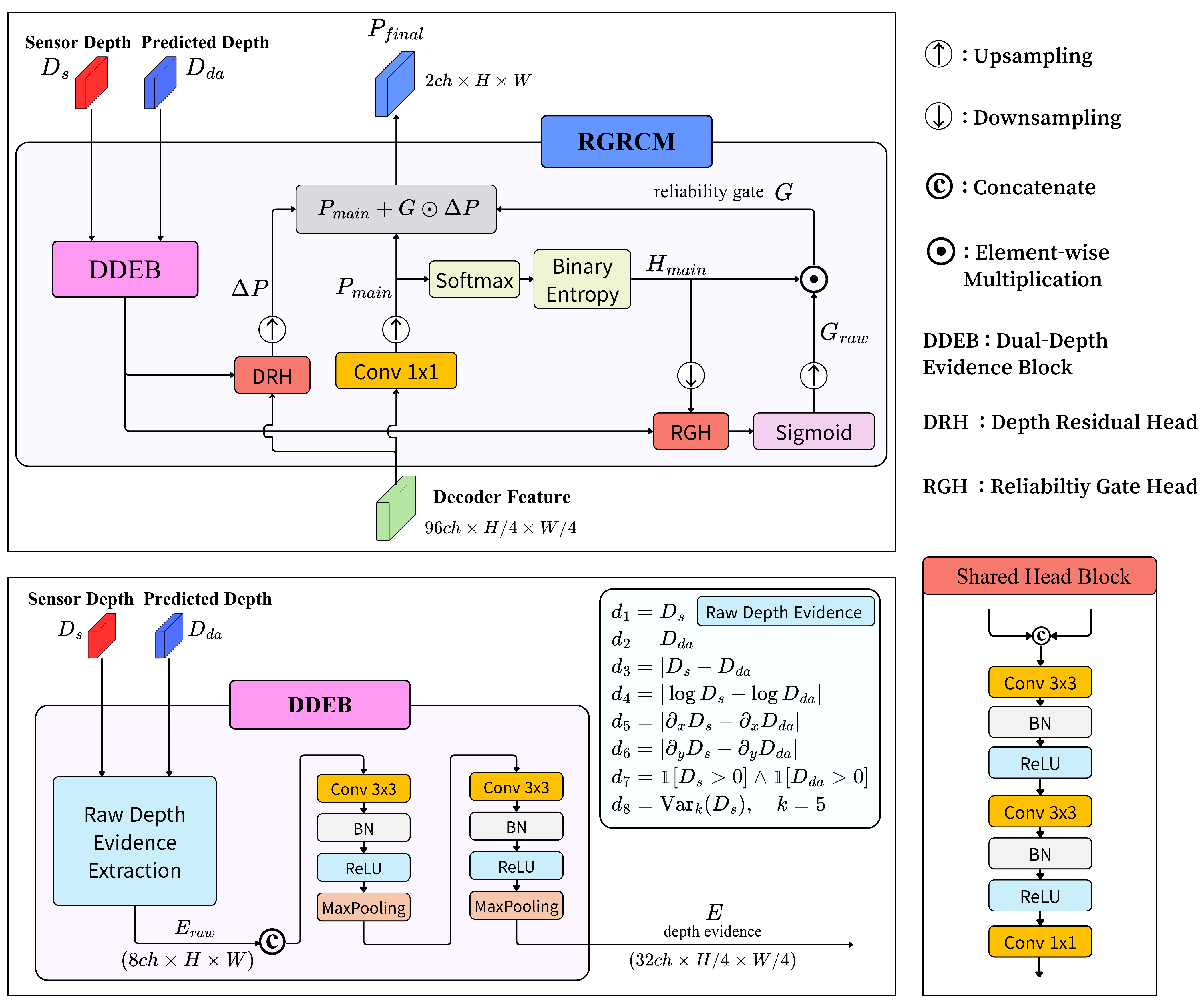
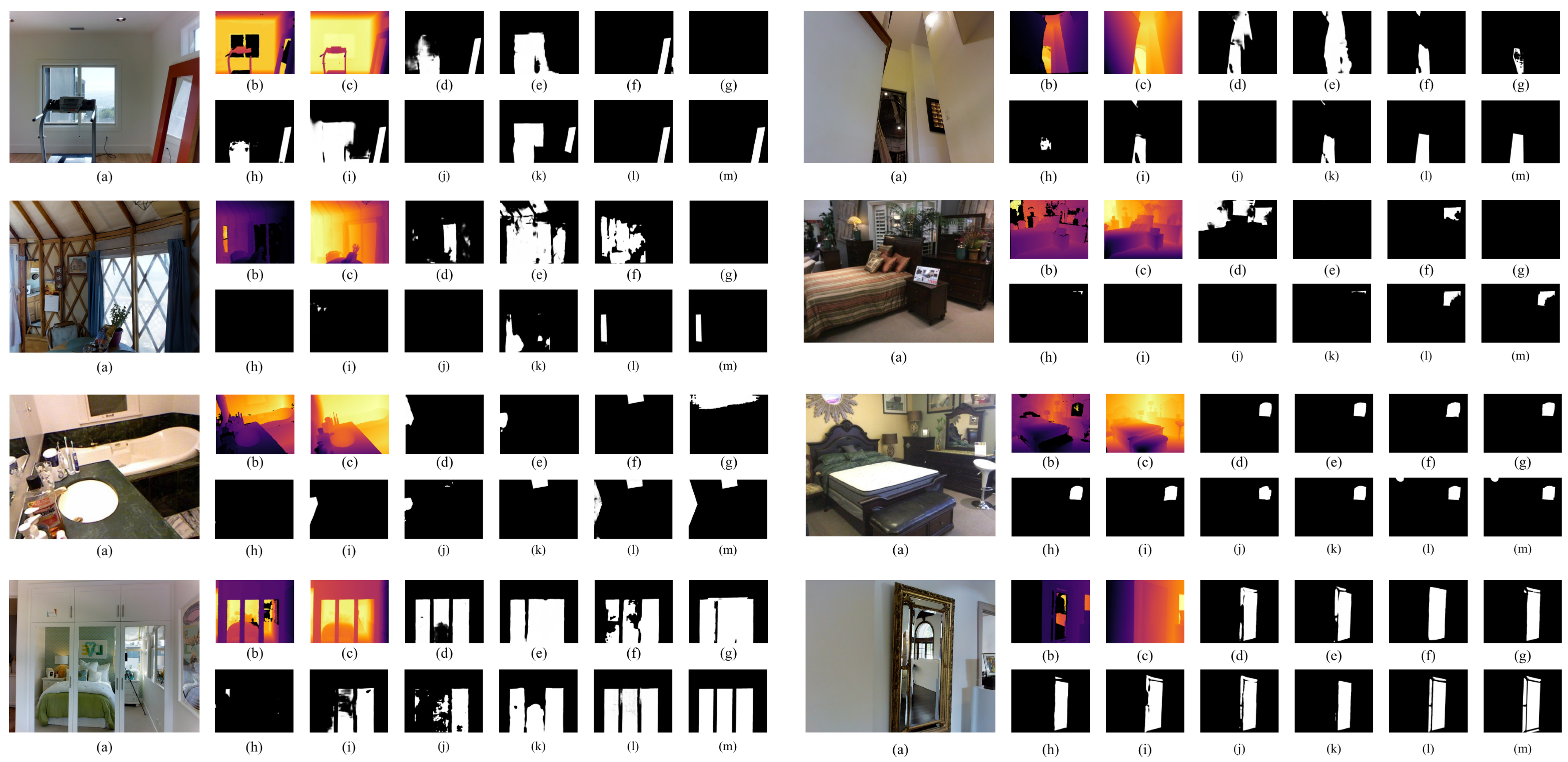
Mirror segmentation remains challenging because mirror regions often share appearance with the reflected scene, while sensor depth around mirrors is frequently missing, noisy, or geometrically inconsistent. Although recent RGB-based methods have achieved strong results by exploiting contextual and symmetry-aware cues, their ability to use geometric information reliably is still limited. In this paper, we propose a reliable RGB-D mirror segmentation framework built upon SATNet. Specifically, we extend the symmetry-aware baseline with a dedicated depth branch that injects hierarchical sensor-depth features into the multi-scale decoder, and we introduce a Reliability-Guided Residual Correction Module (RGRCM) for final prediction refinement. Instead of treating predicted depth as an independent modality branch, RGRCM internally constructs dual-depth evidence from sensor depth and monocular depth estimated by a pretrained Depth Anything v2 model, encoding raw depth observations, cross-depth discrepancies, validity cues, and local depth instability. The resulting evidence is used to guide uncertainty-aware residual correction only in regions where depth-driven refinement is likely to be beneficial. Experiments on the RGBD-Mirror benchmark show that the proposed method achieves 83.57 IoU, 0.899 Fβ, 0.026 MAE, and 6.26 BER, outperforming existing RGB and RGB-D mirror segmentation methods.

Keywords: mirror segmentation; RGB-D segmentation; dual-depth cues; deep learning mirror segmentation; RGB-D segmentation; dual-depth cues; deep learning