A Curriculum Approach to Reduce the Dynamics-Related Reality Gap in Autonomous Driving Decision-Making
 , , ,
, , ,  , and
, and
Abstract
1. Introduction
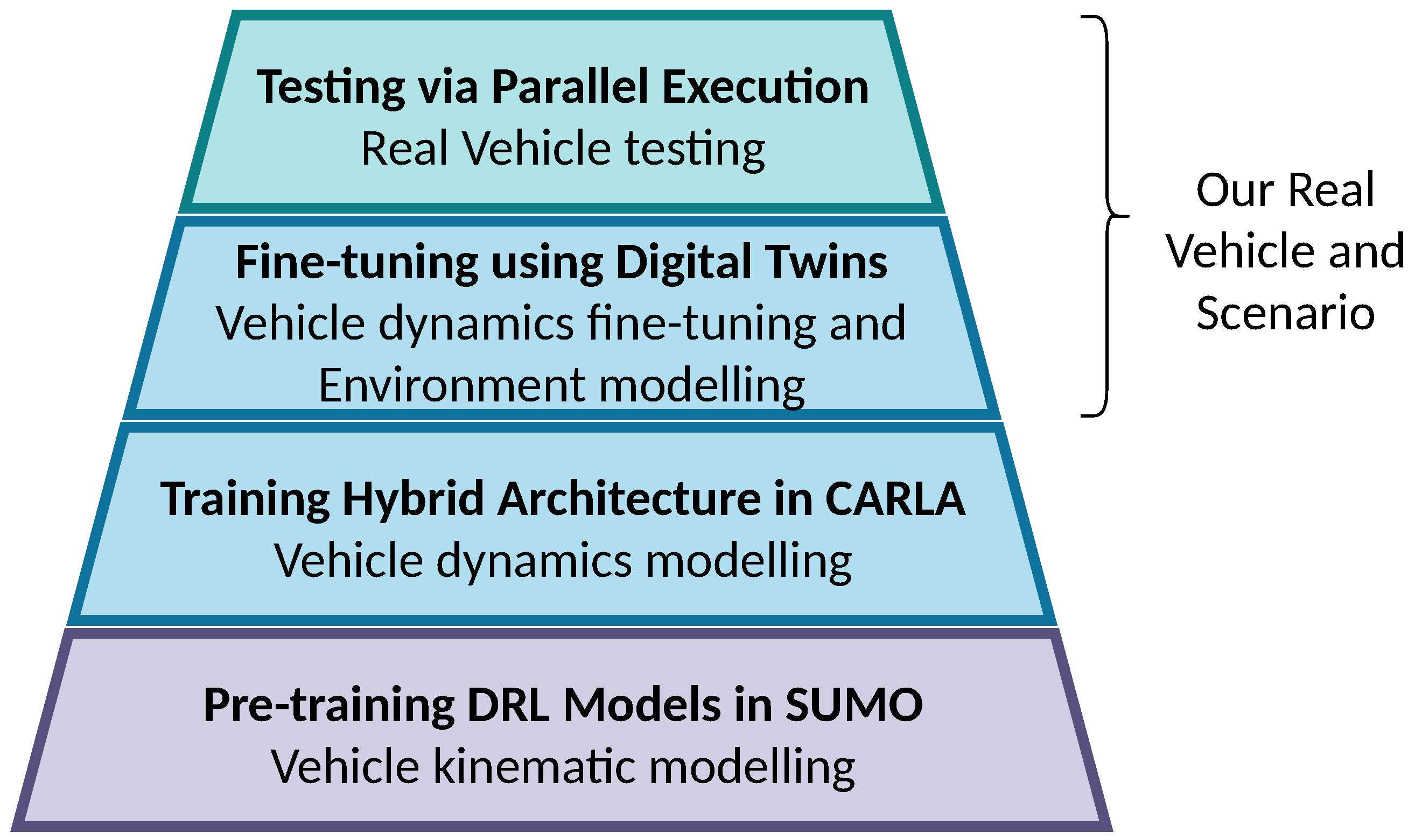
- A structured methodological pipeline for DM design that integrates curriculum learning, DT, and PE into a unified sim-to-real transfer process, with emphasis on the sequencing, integration, and empirical validation of the different stages;
- Empirical validation of the sim-to-real transfer pipeline, demonstrating that policies trained via the proposed curriculum maintain consistent performance when deployed on a real vehicle in a controlled merge scenario, with remaining urban scenarios evaluated in simulation and planned for future real-world validation;
- A comparative evaluation of representative DRL algorithms (DQN, A2C, TRPO, and PPO) within the SMARTS framework, aimed at selecting a suitable tactical policy for the proposed sim-to-real pipeline, providing an engineering benchmark of existing algorithms to identify the most suitable candidates for this specific sim-to-real pipeline;
- Development of a PE system capable of synchronizing real-world vehicle states with a DT in real-time, facilitating the safe testing of AVs against adversarial traffic without physical risk.
2. Related Works
3. Background
3.1. POMDP Formulation
3.2. Deep Reinforcement Learning
3.3. Deep Reinforcement Learning Algorithms
4. Curriculum Methodology
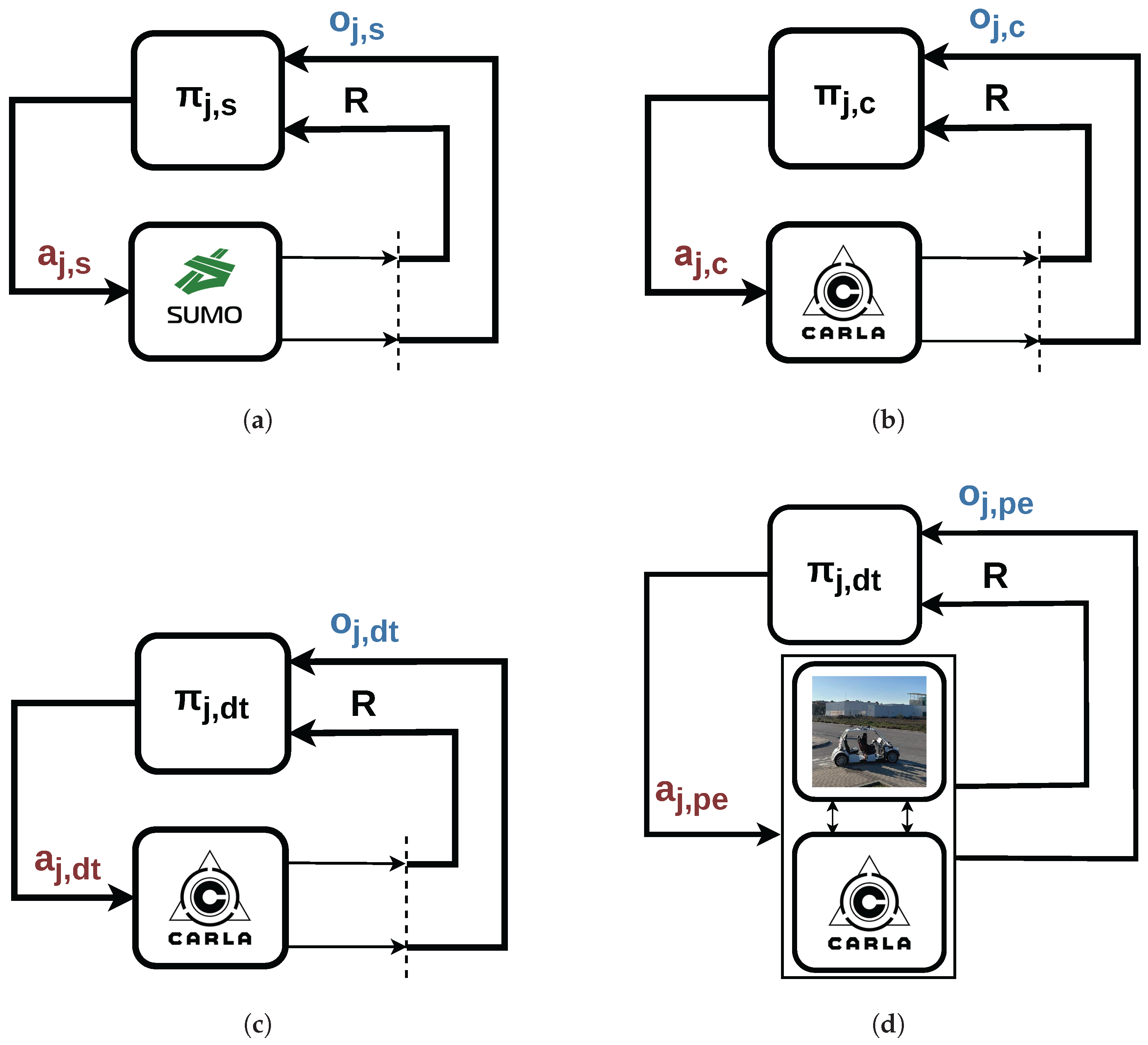
4.1. Pre-Training in SUMO
4.2. Training in CARLA
4.3. Fine-Tuning Using a Digital Twin
4.4. Parallel Execution
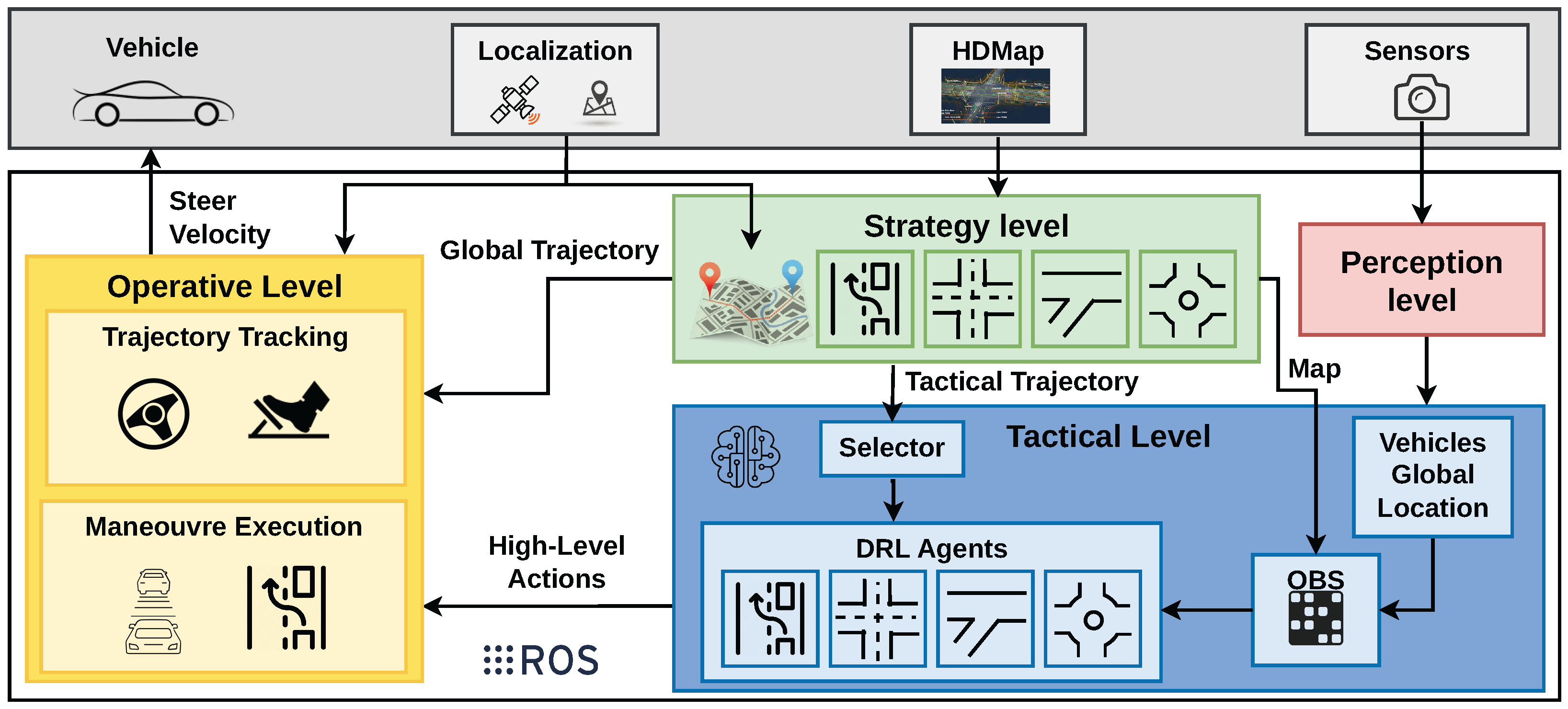
5. Our Architecture
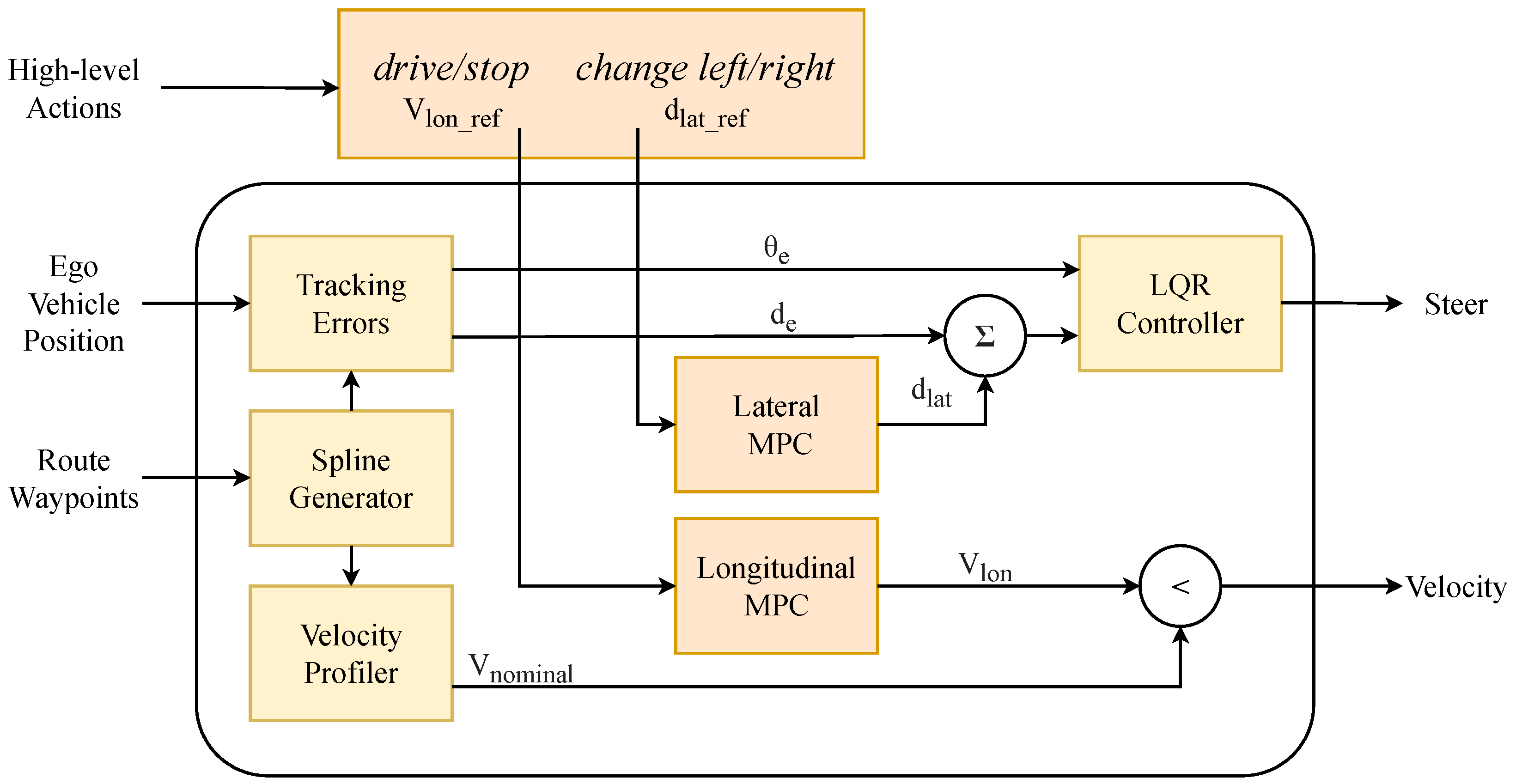
5.1. Operative Execution of Tactical Actions
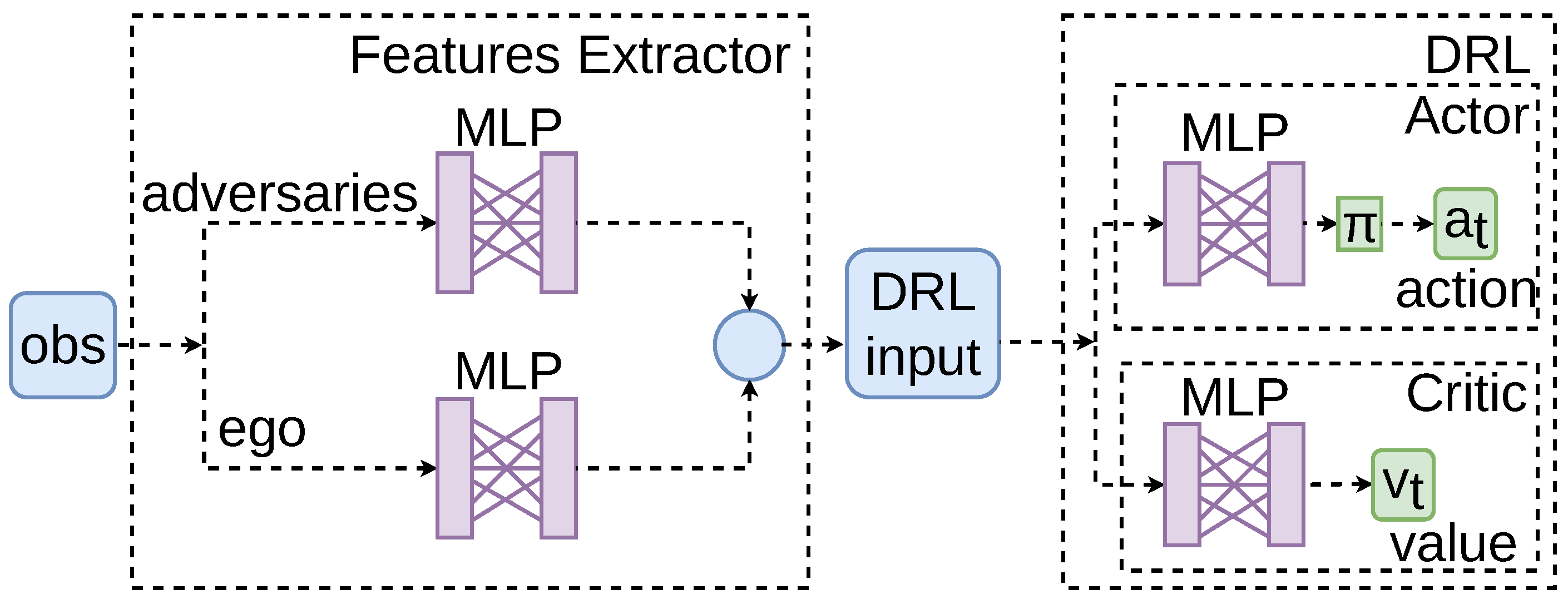
5.2. Deep Reinforcement Learning Architecture
5.3. POMDP Modelling for Urban Scenarios
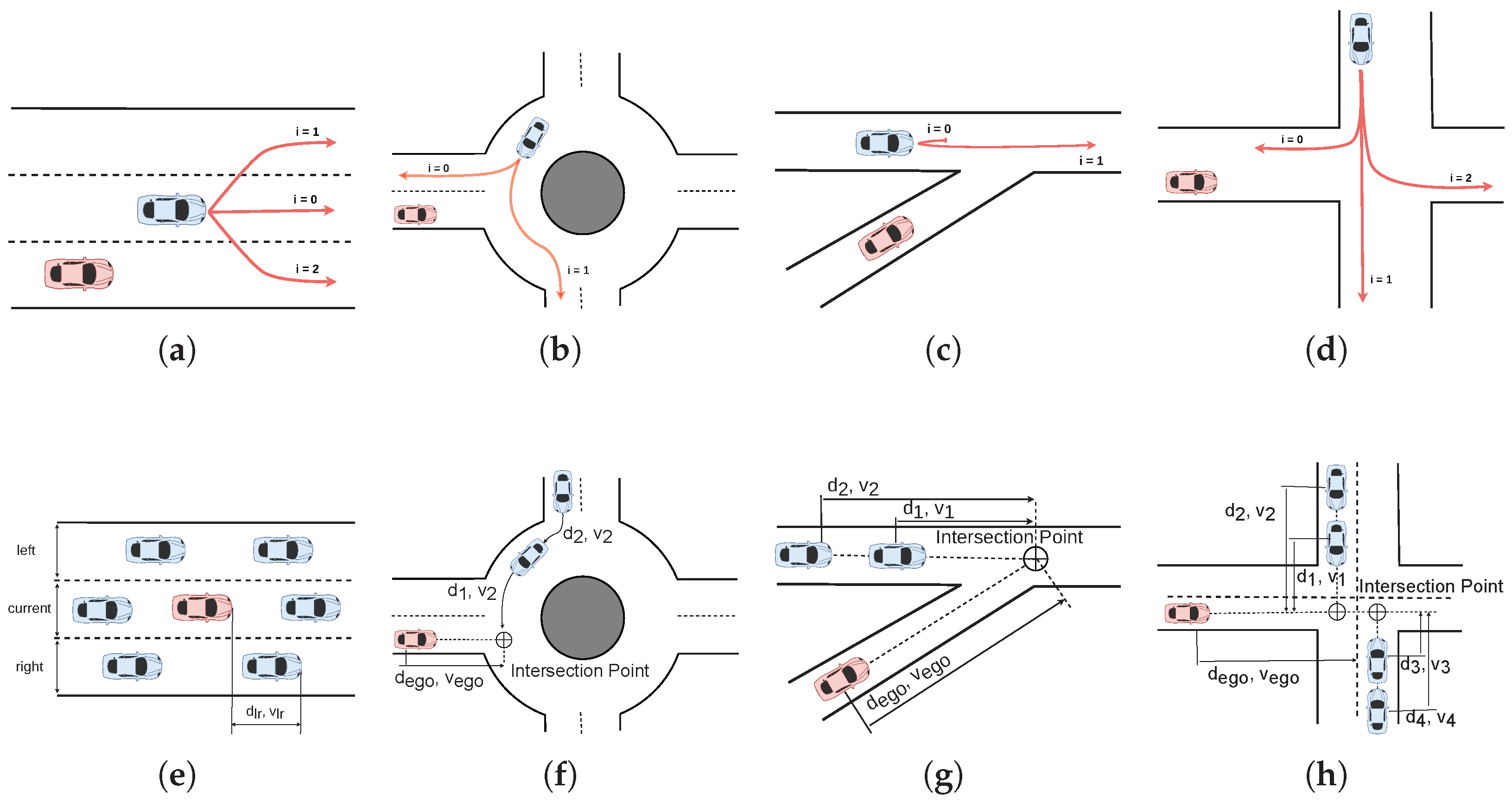
5.3.1. State Space
5.3.2. Observation Space
5.3.3. Action Space
5.3.4. Reward Function
5.4. Parallel Execution Implementation
6. Experiments
6.1. Results in SUMO
- Success Rate (%):
- Average Episode Time (s):
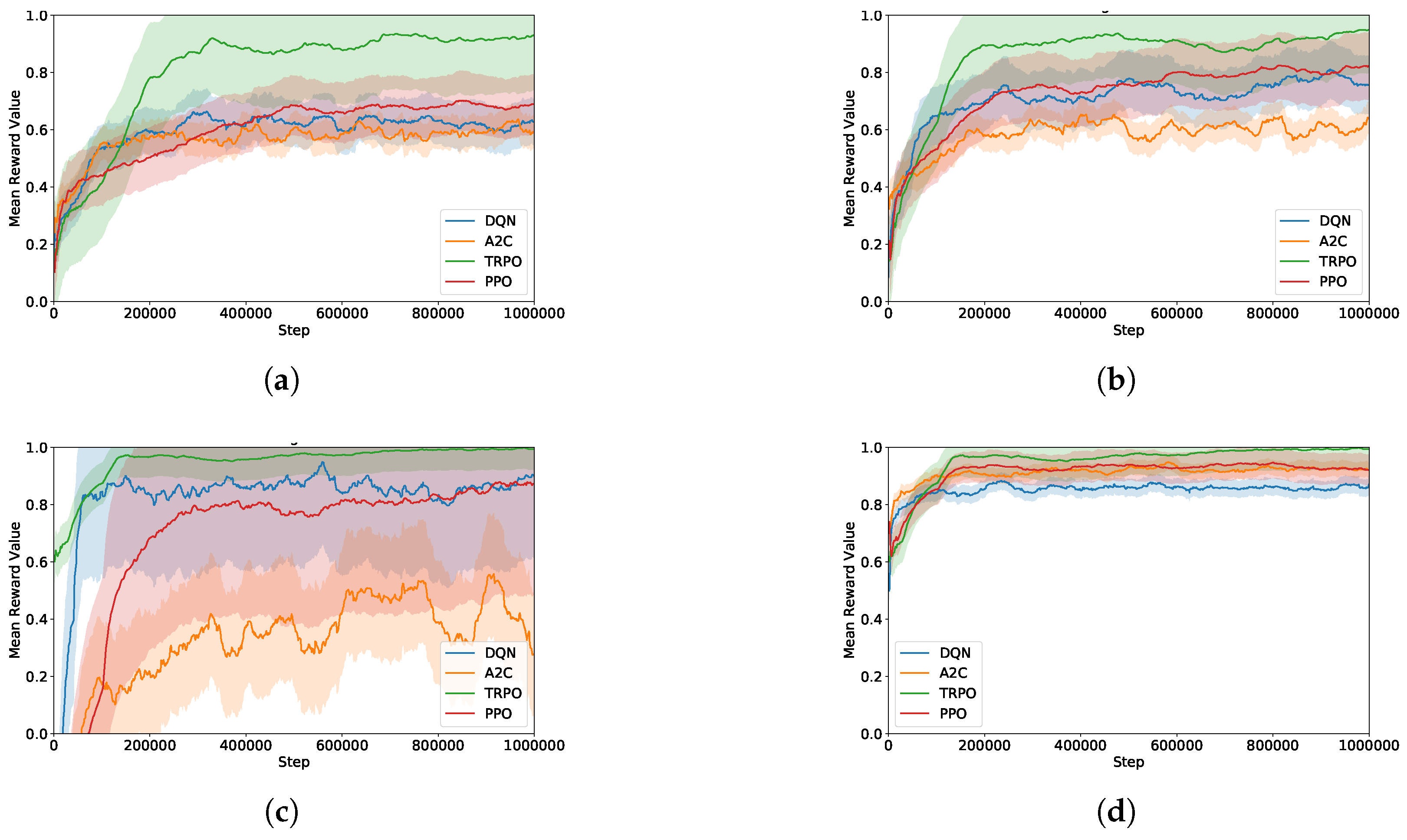
6.1.1. Comparison of DRL Methods
6.1.2. Global SOTA Comparison
6.2. Results in CARLA
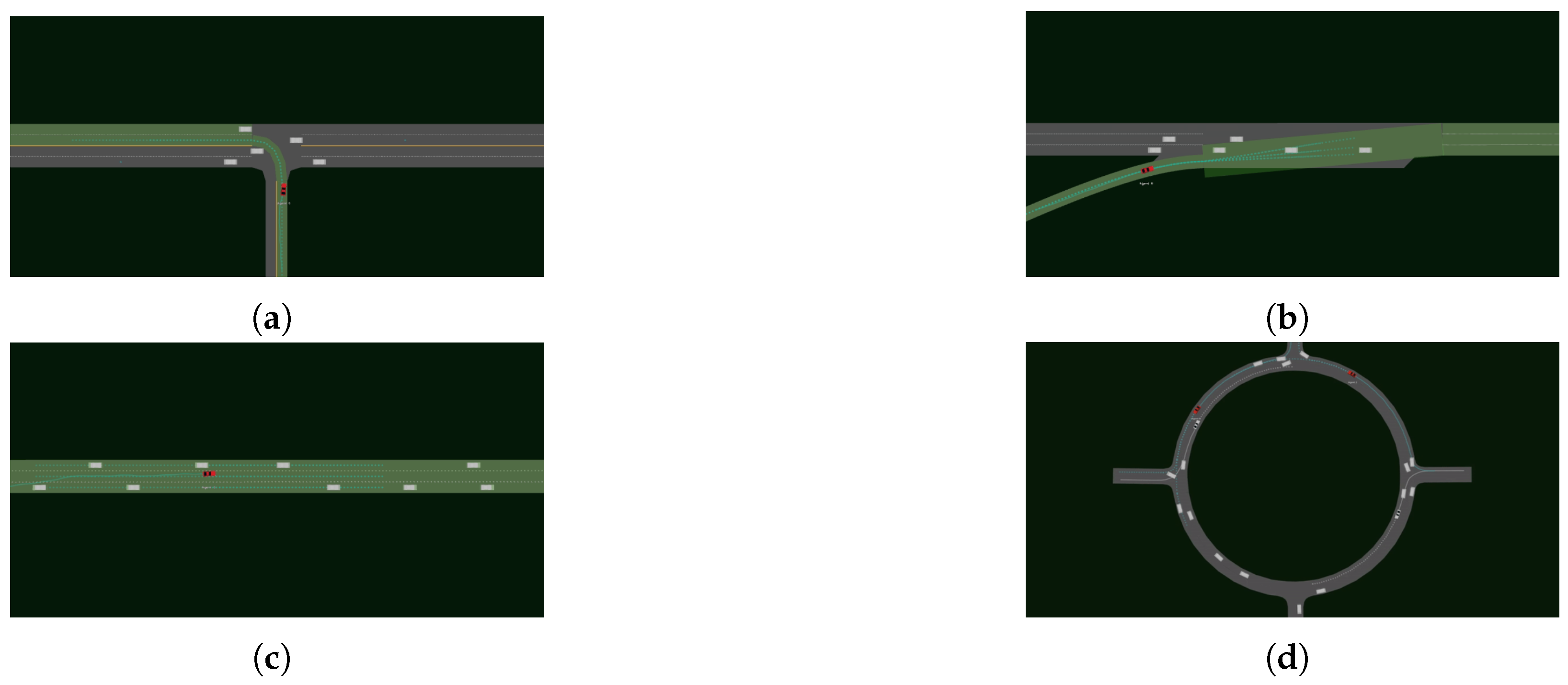
6.2.1. Urban Scenarios for Reinforcement Learning
6.2.2. Digital Twins
6.3. Parallel Execution
6.4. Ablation Study and Contribution of Each Curriculum Stage
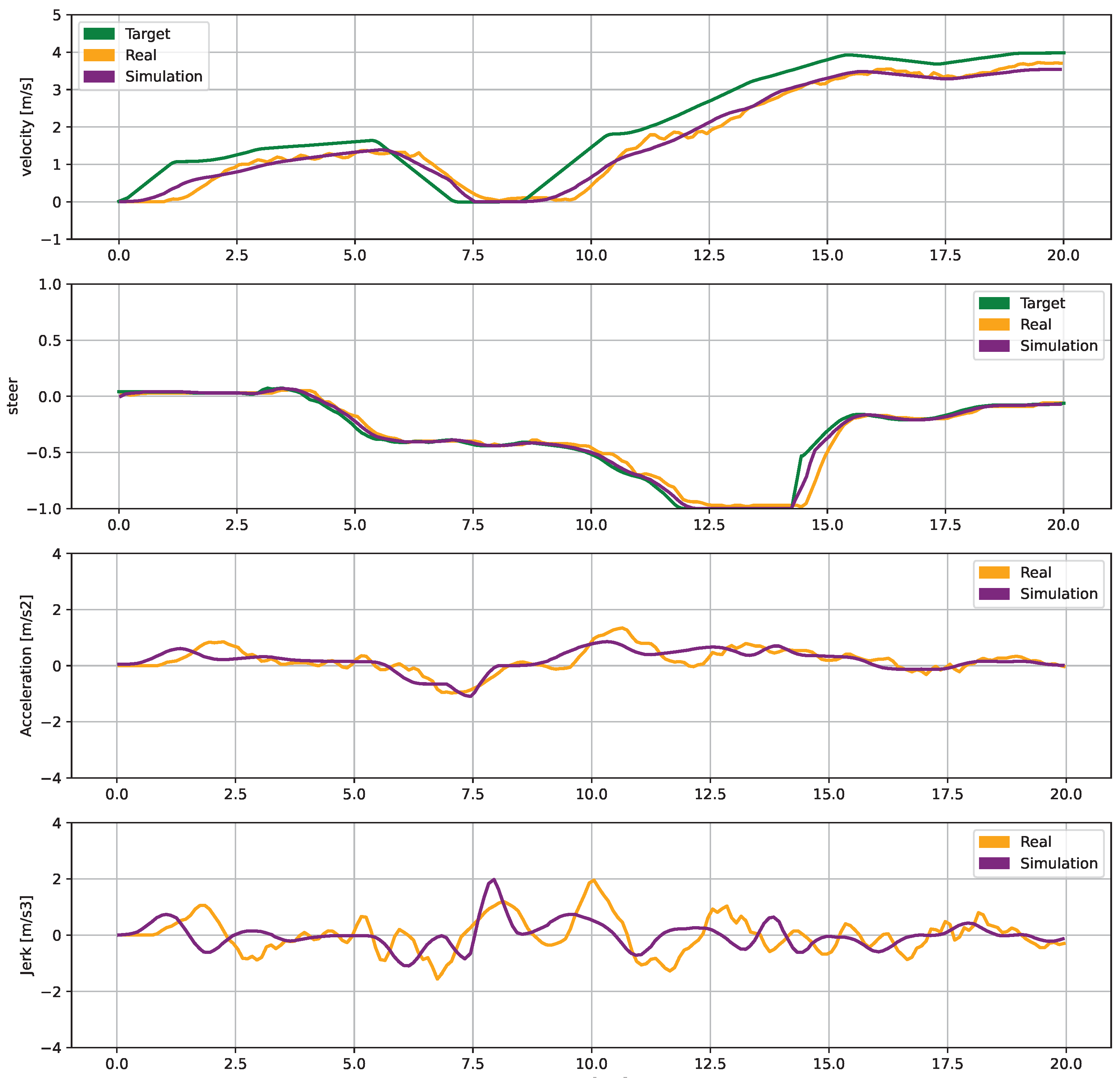
- Mean Normalized Cross-Correlation (MNCC) [47]: To assess the similarity between control signals from simulation and the real world, we compute the MNCC for velocity, steering, acceleration, and jerk.
- Decision Consistency (%): This metric measures the alignment of high-level decisions between simulation and reality throughout the episode. It is defined as follows:where is the number of high-level actions that match between simulated and real executions and is the total number of decisions.
- Success Rate (%): This metric captures the percentage of successful episodes over the total number of test episodes, as presented in Section 6.1.
- Training Time (h): We define the total training time as the sum of hours required to reach convergence across all phases in a configuration.
6.5. Comparison with State-of-the-Art Frameworks
7. Conclusions and Future Works
Author Contributions
Funding
Data Availability Statement
Conflicts of Interest
References
- Kadian, A.; Truong, J.; Gokaslan, A.; Clegg, A.; Wijmans, E.; Lee, S.; Savva, M.; Chernova, S.; Batra, D. Sim2real predictivity: Does evaluation in simulation predict real-world performance? IEEE Robot. Autom. Lett. 2020, 5, 6670–6677. [Google Scholar] [CrossRef]
- Hu, X.; Li, S.; Huang, T.; Tang, B.; Huai, R.; Chen, L. How Simulation Helps Autonomous Driving: A Survey of Sim2real, Digital Twins, and Parallel Intelligence. arXiv 2023, arXiv:2305.01263. [Google Scholar] [CrossRef]
- Behrisch, M.; Bieker, L.; Erdmann, J.; Krajzewicz, D. SUMO—Simulation of Urban MObility: An overview. In Proceedings of the in SIMUL 2011, the Third International Conference on Advances in System Simulation; ThinkMind: Wilmington, DE, USA, 2011; pp. 63–68. [Google Scholar]
- Dosovitskiy, A.; Ros, G.; Codevilla, F.; Lopez, A.; Koltun, V. CARLA: An Open Urban Driving Simulator. arXiv 2017, arXiv:1711.03938. [Google Scholar] [CrossRef]
- Gutiérrez-Moreno, R.; Barea, R.; López-Guillén, E.; Arango, F.; Revenga, P.; Bergasa, L.M. Decision Making for Autonomous Driving Stack: Shortening the Gap from Simulation to Real-World Implementations. In Proceedings of the 2024 IEEE Intelligent Vehicles Symposium (IV); IEEE: Piscataway, NJ, USA, 2024; pp. 3107–3113. [Google Scholar] [CrossRef]
- Nilsson, J.; Brännström, M.; Coelingh, E.; Fredriksson, J. Lane Change Maneuvers for Automated Vehicles. IEEE Trans. Intell. Transp. Syst. 2017, 18, 1087–1096. [Google Scholar] [CrossRef]
- Akopov, A.S.; Beklaryan, L.A.; Thakur, M. Improvement of Maneuverability Within a Multiagent Fuzzy Transportation System with the Use of Parallel Biobjective Real-Coded Genetic Algorithm. IEEE Trans. Intell. Transp. Syst. 2022, 23, 12648–12664. [Google Scholar] [CrossRef]
- Wang, P.; Gao, S.; Li, L.; Cheng, S.; Zhao, H. Research on driving behavior decision making system of autonomous driving vehicle based on benefit evaluation model. Arch. Transp. 2020, 53, 21–36. [Google Scholar] [CrossRef]
- Vallon, C.; Ercan, Z.; Carvalho, A.; Borrelli, F. A machine learning approach for personalized autonomous lane change initiation and control. In Proceedings of the 2017 IEEE Intelligent Vehicles Symposium (IV); IEEE: Piscataway, NJ, USA, 2017; pp. 1590–1595. [Google Scholar] [CrossRef]
- Kendall, A.; Hawke, J.; Janz, D.; Mazur, P.; Reda, D.; Allen, J.; Lam, V.; Bewley, A.; Shah, A. Learning to Drive in a Day. arXiv 2018, arXiv:1807.00412. [Google Scholar] [CrossRef]
- Sutton, R.S.; Barto, A.G. Reinforcement Learning: An introduction; MIT Press: Cambridge, UK, 1998; Volume 1. [Google Scholar]
- Mirchevska, B.; Pek, C.; Werling, M.; Althoff, M.; Boedecker, J. High-level Decision Making for Safe and Reasonable Autonomous Lane Changing using Reinforcement Learning. In Proceedings of the 2018 21st International Conference on Intelligent Transportation Systems (ITSC); IEEE: Piscataway, NJ, USA, 2018; pp. 2156–2162. [Google Scholar] [CrossRef]
- Zhang, Z.; Liniger, A.; Dai, D.; Yu, F.; Gool, L.V. End-to-End Urban Driving by Imitating a Reinforcement Learning Coach. arXiv 2021, arXiv:2108.08265. [Google Scholar] [CrossRef]
- Kostrikov, I.; Yarats, D.; Fergus, R. Image Augmentation Is All You Need: Regularizing Deep Reinforcement Learning from Pixels. arXiv 2021, arXiv:2004.13649. [Google Scholar] [CrossRef]
- Moghadam, M.; Elkaim, G.H. A Hierarchical Architecture for Sequential Decision-Making in Autonomous Driving using Deep Reinforcement Learning. arXiv 2019, arXiv:1906.08464. [Google Scholar] [CrossRef]
- Kamran, D.; Lopez, C.F.; Lauer, M.; Stiller, C. Risk-Aware High-level Decisions for Automated Driving at Occluded Intersections with Reinforcement Learning. arXiv 2020, arXiv:2004.04450. [Google Scholar] [CrossRef]
- Tram, T.; Batkovic, I.; Ali, M.; Sjöberg, J. Learning When to Drive in Intersections by Combining Reinforcement Learning and Model Predictive Control. In Proceedings of the 2019 IEEE Intelligent Transportation Systems Conference (ITSC); IEEE: Piscataway, NJ, USA, 2019; pp. 3263–3268. [Google Scholar] [CrossRef]
- Alizadeh, A.; Moghadam, M.; Bicer, Y.; Ure, N.K.; Yavas, M.U.; Kurtulus, C. Automated Lane Change Decision Making using Deep Reinforcement Learning in Dynamic and Uncertain Highway Environment. arXiv 2019, arXiv:1909.11538. [Google Scholar] [CrossRef]
- Qiao, Z.; Muelling, K.; Dolan, J.M.; Palanisamy, P.; Mudalige, P. Automatically Generated Curriculum based Reinforcement Learning for Autonomous Vehicles in Urban Environment. In Proceedings of the 2018 IEEE Intelligent Vehicles Symposium (IV); IEEE: Piscataway, NJ, USA, 2018; pp. 1233–1238. [Google Scholar] [CrossRef]
- Tram, T.; Jansson, A.; Grönberg, R.; Ali, M.; Sjöberg, J. Learning Negotiating Behavior Between Cars in Intersections using Deep Q-Learning. arXiv 2018, arXiv:1810.10469. [Google Scholar] [CrossRef]
- Liu, H.; Huang, Z.; Mo, X.; Lv, C. Augmenting Reinforcement Learning with Transformer-based Scene Representation Learning for Decision-making of Autonomous Driving. arXiv 2023, arXiv:2208.12263. [Google Scholar] [CrossRef]
- Seong, H.; Jung, C.; Lee, S.; Shim, D.H. Learning to Drive at Unsignalized Intersections using Attention-based Deep Reinforcement Learning. In Proceedings of the 2021 IEEE International Intelligent Transportation Systems Conference (ITSC); IEEE: Piscataway, NJ, USA, 2021; pp. 559–566. [Google Scholar] [CrossRef]
- Aksjonov, A.; Kyrki, V. A Safety-Critical Decision Making and Control Framework Combining Machine Learning and Rule-based Algorithms. arXiv 2022, arXiv:2201.12819. [Google Scholar] [CrossRef]
- Liu, Y.; Sun, B.; Tian, Y.; Wang, X.; Zhu, Y.; Huai, R.; Shen, Y. Software-Defined Active LiDARs for Autonomous Driving: A Parallel Intelligence-Based Adaptive Model. IEEE Trans. Intell. Veh. 2023, 8, 4047–4056. [Google Scholar] [CrossRef]
- Wang, X.; Chen, Y.; Zhu, W. A Survey on Curriculum Learning. IEEE Trans. Pattern Anal. Mach. Intell. 2022, 44, 4555–4576. [Google Scholar] [CrossRef] [PubMed]
- Song, Y.; Lin, H.; Kaufmann, E.; Duerr, P.A.; Scaramuzza, D. Autonomous Overtaking in Gran Turismo Sport Using Curriculum Reinforcement Learning. In Proceedings of the 2021 IEEE International Conference on Robotics and Automation (ICRA); IEEE: Piscataway, NJ, USA, 2021; pp. 9403–9409. [Google Scholar]
- Akhauri, S.; Zheng, L.; Lin, M.C. Enhanced Transfer Learning for Autonomous Driving with Systematic Accident Simulation. In Proceedings of the 2020 IEEE/RSJ International Conference on Intelligent Robots and Systems (IROS); IEEE: Piscataway, NJ, USA, 2020; pp. 5986–5993. [Google Scholar]
- Sharma, S.; Ball, J.E.; Tang, B.; Carruth, D.W.; Doude, M.; Islam, M.A. Semantic Segmentation with Transfer Learning for Off-Road Autonomous Driving. Sensors 2019, 19, 2577. [Google Scholar] [CrossRef]
- Niaz, A.; Shoukat, M.U.; Jia, Y.; Khan, S.; Niaz, F.; Raza, M.U. Autonomous Driving Test Method Based on Digital Twin: A Survey. In Proceedings of the 2021 International Conference on Computing, Electronic and Electrical Engineering (ICE Cube); IEEE: Piscataway, NJ, USA, 2021; pp. 1–7. [Google Scholar] [CrossRef]
- Voogd, K.; Allamaa, J.P.; Alonso-Mora, J.; Duy Son, T. Reinforcement Learning from Simulation to Real World Autonomous Driving using Digital Twin. IFAC-PapersOnLine 2023, 56, 1510–1515. [Google Scholar] [CrossRef]
- Wu, J.; Huang, Z.; Hang, P.; Huang, C.; De Boer, N.; Lv, C. Digital Twin-enabled Reinforcement Learning for End-to-end Autonomous Driving. In Proceedings of the 2021 IEEE 1st International Conference on Digital Twins and Parallel Intelligence (DTPI); IEEE: Piscataway, NJ, USA, 2021; pp. 62–65. [Google Scholar] [CrossRef]
- Liu, T.; Wang, X.; Xing, Y.; Gao, Y.; Tian, B.; Chen, L. Research on digital quadruplets in cyber-physical-social space-based parallel driving. Chin. J. Intell. Sci. Technol. 2019, 1, 40–51. [Google Scholar]
- Wang, F.Y.; Zheng, N.N.; Cao, D.; Martinez, C.M.; Li, L.; Liu, T. Parallel driving in CPSS: A unified approach for transport automation and vehicle intelligence. IEEE/CAA J. Autom. Sin. 2017, 4, 577–587. [Google Scholar] [CrossRef]
- Mnih, V.; Kavukcuoglu, K.; Silver, D.; Graves, A.; Antonoglou, I.; Wierstra, D.; Riedmiller, M. Playing Atari with Deep Reinforcement Learning. arXiv 2013, arXiv:1312.5602. [Google Scholar] [CrossRef]
- Mnih, V.; Badia, A.P.; Mirza, M.; Graves, A.; Lillicrap, T.P.; Harley, T.; Silver, D.; Kavukcuoglu, K. Asynchronous Methods for Deep Reinforcement Learning. arXiv 2016, arXiv:1602.01783. [Google Scholar] [CrossRef]
- Schulman, J.; Levine, S.; Abbeel, P.; Jordan, M.; Moritz, P. Trust Region Policy Optimization. In Proceedings of the 32nd International Conference on Machine Learning, Lille, France, 7–9 July 2015; Bach, F., Blei, D., Eds.; PMLR: Lille, France, 2015; Volume 37, pp. 1889–1897. [Google Scholar]
- Schulman, J.; Wolski, F.; Dhariwal, P.; Radford, A.; Klimov, O. Proximal Policy Optimization Algorithms. arXiv 2017, arXiv:1707.06347. [Google Scholar] [CrossRef]
- Gutiérrez-Moreno, R.; Barea, R.; López-Guillén, E.; Araluce, J.; Bergasa, L.M. Reinforcement Learning-Based Autonomous Driving at Intersections in CARLA Simulator. Sensors 2022, 22, 8373. [Google Scholar] [CrossRef] [PubMed]
- Gutiérrez-Moreno, R.; Barea, R.; López-Guillén, E.; Arango, F.; Sánchez-García, F.; Bergasa, L.M. Enhancing Autonomous Driving in Urban Scenarios: A Hybrid Approach with Reinforcement Learning and Classical Control (IN SUBMISSION). Sensors 2024, 25, 117. [Google Scholar] [CrossRef]
- Diaz-Diaz, A.; Ocaña, M.; Llamazares, A.; Gómez-Huélamo, C.; Revenga, P.; Bergasa, L.M. HD maps: Exploiting OpenDRIVE potential for Path Planning and Map Monitoring. In Proceedings of the 2022 IEEE Intelligent Vehicles Symposium (IV); IEEE: Piscataway, NJ, USA, 2022. [Google Scholar]
- Gutiérrez, R.; López-Guillén, E.; Bergasa, L.M.; Barea, R.; Pérez, Ó.; Gómez-Huélamo, C.; Arango, F.; del Egido, J.; López-Fernández, J. A Waypoint Tracking Controller for Autonomous Road Vehicles Using ROS Framework. Sensors 2020, 20, 4062. [Google Scholar] [CrossRef] [PubMed]
- Abdeselam, N.; Gutiérrez-Moreno, R.; López-Guillén, E.; Barea, R.; Montiel-Marín, S.; Bergasa, L.M. Hybrid MPC and Spline-based Controller for Lane Change Maneuvers in Autonomous Vehicles. In Proceedings of the 2023 IEEE International Conference on Intelligent Transportation Systems (ITSC); IEEE: Piscataway, NJ, USA, 2023; pp. 1–6. [Google Scholar]
- Arango, J.F.; Bergasa, L.M.; Revenga, P.A.; Barea, R.; López-Guillén, E.; Gómez-Huélamo, C.; Araluce, J.; Gutiérrez, R. Drive-By-Wire Development Process Based on ROS for an Autonomous Electric Vehicle. Sensors 2020, 20, 6121. [Google Scholar] [CrossRef] [PubMed]
- Rasouli, A.; Goebel, R.; Taylor, M.E.; Kotseruba, I.; Alizadeh, S.; Yang, T.; Alban, M.; Shkurti, F.; Zhuang, Y.; Scibior, A.; et al. NeurIPS 2022 Competition: Driving SMARTS. arXiv 2022. [Google Scholar] [CrossRef]
- Huang, Z.; Wu, J.; Lv, C. Efficient Deep Reinforcement Learning with Imitative Expert Priors for Autonomous Driving. IEEE Trans. Neural Networks Learn. Syst. 2023, 34, 7391–7403. [Google Scholar] [CrossRef]
- MathWorks. RoadRunner, Software for Autonomous Vehicle Simulation. 2021. Available online: https://www.mathworks.com/products/roadrunner.html (accessed on 7 June 2026).
- Garcia Daza, I.; Izquierdo, R.; Martinez, L.M.; Benderius, O.; Fernández-Llorca, D. Sim-to-real transfer and reality gap modeling in model predictive control for autonomous driving. Appl. Intell. 2022, 53, 12719–12735. [Google Scholar] [CrossRef]
- Codevilla, F.; Müller, M.; López, A.; Koltun, V.; Dosovitskiy, A. End-to-End Driving Via Conditional Imitation Learning. In Proceedings of the 2018 IEEE International Conference on Robotics and Automation (ICRA); IEEE: Piscataway, NJ, USA, 2018; pp. 4693–4700. [Google Scholar]
- Prakash, A.; Chitta, K.; Geiger, A. Multi-modal fusion transformer for end-to-end autonomous driving. In Proceedings of the IEEE/CVF Conference on Computer Vision and Pattern Recognition; IEEE: Piscataway, NJ, USA, 2021; pp. 7077–7087. [Google Scholar]
- Kendall, A.; Hawke, J.; Janz, D.; Mazur, P.; Reda, D.; Allen, J.M.; Lam, V.D.; Bewley, A.; Shah, A. Learning to drive in a day. In Proceedings of the 2019 International Conference on Robotics and Automation (ICRA); IEEE: Piscataway, NJ, USA, 2019; pp. 8248–8254. [Google Scholar]
- Liang, X.; Wang, T.; Yang, L.; Xing, E. Cirl: Controllable imitative reinforcement learning for vision-based self-driving. In Proceedings of the European Conference on Computer Vision (ECCV); Springer: Cham, Switzerland, 2018; pp. 584–599. [Google Scholar]
- Shalev-Shwartz, S.; Shammah, S.; Shashua, A. On a formal model of safe and scalable self-driving cars. arXiv 2017, arXiv:1708.06374. [Google Scholar]
- Hubmann, C.; Becker, M.; Althoff, D.; Lenz, D.; Stiller, C. Decision making for autonomous driving considering interaction and uncertain prediction of surrounding vehicles. In Proceedings of the 2017 IEEE Intelligent Vehicles Symposium (IV); IEEE: Piscataway, NJ, USA, 2017; pp. 1671–1678. [Google Scholar]



| Scenario | Comparison of DRL Methods | Global SOTA Comparison | ||||||||||
|---|---|---|---|---|---|---|---|---|---|---|---|---|
| DQN | A2C | TRPO | PPO | [21] | [45] | |||||||
| sr ↑ | at ↓ | sr ↑ | at ↓ | sr ↑ | at ↓ | sr ↑ | at ↓ | sr ↑ | at ↓ | sr ↑ | at ↓ | |
| Unprotected left turn | 88.5 | 11.13 | 94.6 | 11.76 | 95.3 | 12.22 | 93.3 | 12.81 | 94.0 | 12.50 | 96.0 | 14.26 |
| Three-lane merge | 82.1 | 5.81 | 82.8 | 5.61 | 98.4 | 21.9 | 86.7 | 7.18 | 96.0 | 28.60 | - | - |
| Three-lane road | 83.4 | 17.12 | 81.2 | 16.32 | 93.6 | 24.34 | 88.3 | 17.92 | - | - | - | - |
| Roundabout | 81.5 | 16.12 | 89.9 | 13.97 | 91.7 | 37.47 | 90.1 | 12.45 | 76.0 | 56.60 | 84.0 | 36.62 |
| Metric | Lane Change | Roundabout | Merge | Crossroad | ||||
|---|---|---|---|---|---|---|---|---|
| Ours | Autopilot | Ours | Autopilot | Ours | Autopilot | Ours | Autopilot | |
| sr [%] ↑ | 91.20 | 100 | 95.10 | 100 | 96.40 | 100 | 87.90 | 100 |
| 95th Jerk (m/s3) ↓ | 1.58 ± 0.32 | 9.12 ± 2.15 | 1.73 ± 0.35 | 5.93 ± 1.84 | 2.67 ± 0.51 | 3.63 ± 0.95 | 1.83 ± 0.42 | 14.6 ± 3.20 |
| Max Jerk (m/s3) ↓ | 5.64 ± 1.12 | 13.56 ± 3.50 | 2.20 ± 0.55 | 12.16 ± 2.90 | 3.83 ± 0.82 | 9.98 ± 2.45 | 2.16 ± 0.48 | 22.8 ± 4.10 |
| 95th Accel. (m/s2) ↓ | 1.53 ± 0.15 | 3.65 ± 0.55 | 1.61 ± 0.18 | 2.67 ± 0.42 | 2.53 ± 0.22 | 2.51 ± 0.38 | 1.55 ± 0.14 | 3.88 ± 0.61 |
| Time (s) ↓ | 68.94 ± 4.25 | 128.56 ± 8.40 | 20.32 ± 1.85 | 30.23 ± 3.15 | 25.83 ± 2.10 | 34.16 ± 4.20 | 23.14 ± 1.95 | 38.84 ± 5.10 |
| Speed (m/s) ↑ | 9.05 ± 0.85 | 3.61 ± 0.45 | 5.83 ± 0.62 | 5.45 ± 0.70 | 2.45 ± 0.35 | 1.92 ± 0.28 | 4.26 ± 0.48 | 0.89 ± 0.15 |
| Metric | Merge DT Scenario | |
|---|---|---|
| General | Digital Twin | |
| sr [%] ↑ | 88.30 | 91.80 |
| 95th Jerk (m/s3) ↓ | 3.58 ± 0.45 | 3.09 ± 0.38 |
| Max Jerk (m/s3) ↓ | 3.64 ± 0.52 | 3.12 ± 0.41 |
| 95th Acceleration (m/s2) ↓ | 3.53 ± 0.35 | 2.44 ± 0.22 |
| Time (s) ↓ | 20.33 ± 2.10 | 19.98 ± 1.85 |
| Speed (in m/s) ↑ | 2.34 ± 0.30 | 2.85 ± 0.25 |
| Metric | Low Traffic Flow | Mixed Traffic Flow | High Traffic Flow | |||
|---|---|---|---|---|---|---|
| Simulation (DT) | Real (PE) | Simulation (DT) | Real (PE) | Simulation (DT) | Real (PE) | |
| sr [%] ↑ | 100 | 100 | 98.0 | 95.0 | 99.0 | 98.0 |
| 95th Jerk (m/s3) ↓ | 1.34 ± 0.12 | 1.78 ± 0.21 | 1.73 ± 0.25 | 1.98 ± 0.32 | 1.36 ± 0.15 | 1.43 ± 0.22 |
| Max Jerk (m/s3) ↓ | 1.96 ± 0.20 | 2.01 ± 0.28 | 2.02 ± 0.31 | 2.43 ± 0.45 | 2.05 ± 0.28 | 2.08 ± 0.35 |
| 95th Acceleration (m/s2) ↓ | 0.98 ± 0.08 | 1.54 ± 0.15 | 1.52 ± 0.18 | 1.86 ± 0.24 | 1.11 ± 0.12 | 1.32 ± 0.19 |
| Time (s) ↓ | 19.18 ± 1.10 | 19.99 ± 1.55 | 35.76 ± 4.20 | 39.23 ± 5.10 | 53.76 ± 6.50 | 55.82 ± 7.20 |
| Speed (m/s) ↑ | 4.97 ± 0.35 | 4.06 ± 0.42 | 2.36 ± 0.55 | 2.11 ± 0.60 | 1.19 ± 0.15 | 1.08 ± 0.18 |
| Metric | Training SUMO | Training CARLA | Fine-Tuning CARLA | From Scratch |
|---|---|---|---|---|
| sr [%] | 75.60 | 88.30 | 91.80 | 94.60 |
| at (s) | 21.53 | 20.33 | 19.98 | 19.96 |
| ec | 1 M | 1 M + 10 K | 1 M + 15 K | 1 M |
| tt (h) | 5 | 21.5 | 24.75 | 1650 |
| Phase | Velocity MNCC ↑ | Steering MNCC ↑ | Acceleration MNCC ↑ | Jerk MNCC ↑ | Decision Consistency (%) ↑ | Success Rate (%) ↑ | Training Time (h) ↓ |
|---|---|---|---|---|---|---|---|
| SUMO Only | 0.765 | 0.782 | 0.643 | 0.514 | 67.5 | 20 | 5 |
| CARLA Only | 0.774 | 0.789 | 0.671 | 0.555 | 69.5 | 35 | 1650 |
| SUMO + CARLA | 0.747 | 0.790 | 0.685 | 0.579 | 70.3 | 40 | 21.5 |
| CARLA + DT | 0.977 | 0.981 | 0.927 | 0.873 | 94.6 | 95 | 1666.5 |
| SUMO + CARLA + DT | 0.978 | 0.988 | 0.930 | 0.879 | 94.8 | 100 | 24.75 |
| Paradigm | Reference | Scenario | Sim-to-Real Strategy | Training Source | Real-World Execution |
|---|---|---|---|---|---|
| End-to-End IL | CIL [48] | Urban Navigation | Data Augmentation | Offline Expert Data | Yes (1/5 Scale Truck) |
| TransFuser [49] | Complex Urban | Visual Perturbations | Offline Expert Data | None (CARLA Leaderboard) | |
| Direct RL | Wayve [50] | Lane Following | Domain Randomization | Real-World Driving | Yes (Automated Vehicle) |
| CIRL [51] | Urban Navigation | Feature Control | High-Fidelity Simulators | None (Simulation) | |
| Rule-Based | RSS [52] | Safety Critical | Parameter Tuning | Manual Design | None (Formal Model) |
| Hubmann [53] | Intersections | Model Calibration | Hand-crafted Rules | None (Simulation) | |
| Ours | Proposed | Intersections | Digital Twin | Curriculum | Yes (Automated Vehicle) |
Disclaimer/Publisher’s Note: The statements, opinions and data contained in all publications are solely those of the individual author(s) and contributor(s) and not of MDPI and/or the editor(s). MDPI and/or the editor(s) disclaim responsibility for any injury to people or property resulting from any ideas, methods, instructions or products referred to in the content. |
© 2026 by the authors. Licensee MDPI, Basel, Switzerland. This article is an open access article distributed under the terms and conditions of the Creative Commons Attribution (CC BY) license.
Share and Cite
Gutiérrez-Moreno, R.; Barea, R.; López-Guillén, E.; Arango, F.; Sánchez-García, F.; Bergasa, L.M. A Curriculum Approach to Reduce the Dynamics-Related Reality Gap in Autonomous Driving Decision-Making. Sensors 2026, 26, 3734. https://doi.org/10.3390/s26123734
Gutiérrez-Moreno R, Barea R, López-Guillén E, Arango F, Sánchez-García F, Bergasa LM. A Curriculum Approach to Reduce the Dynamics-Related Reality Gap in Autonomous Driving Decision-Making. Sensors. 2026; 26(12):3734. https://doi.org/10.3390/s26123734
Chicago/Turabian StyleGutiérrez-Moreno, Rodrigo, Rafael Barea, Elena López-Guillén, Felipe Arango, Fabio Sánchez-García, and Luis M. Bergasa. 2026. "A Curriculum Approach to Reduce the Dynamics-Related Reality Gap in Autonomous Driving Decision-Making" Sensors 26, no. 12: 3734. https://doi.org/10.3390/s26123734
APA StyleGutiérrez-Moreno, R., Barea, R., López-Guillén, E., Arango, F., Sánchez-García, F., & Bergasa, L. M. (2026). A Curriculum Approach to Reduce the Dynamics-Related Reality Gap in Autonomous Driving Decision-Making. Sensors, 26(12), 3734. https://doi.org/10.3390/s26123734