Dynamic Occlusion–Predictive Neural Network for Robust Roadside Multi-Vehicle Tracking



Highlights
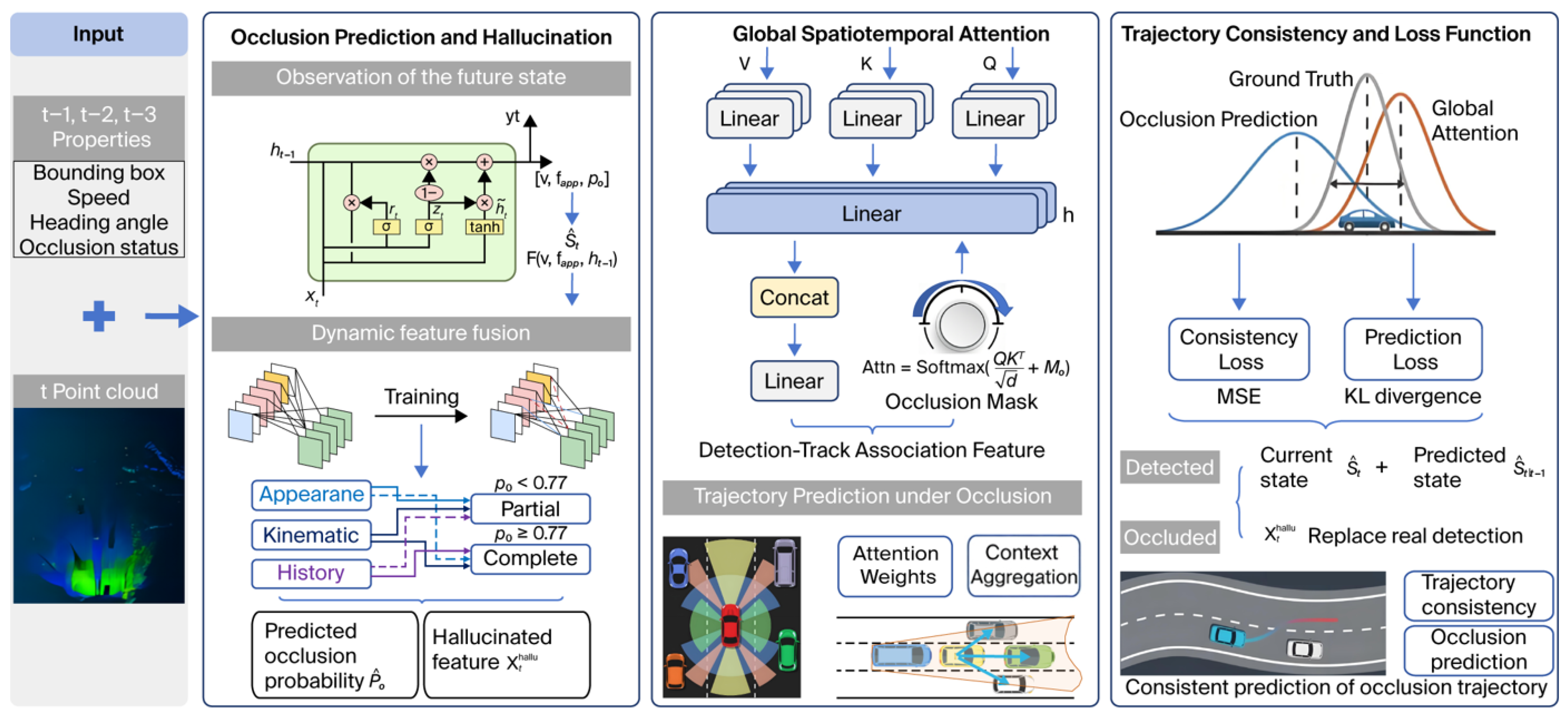
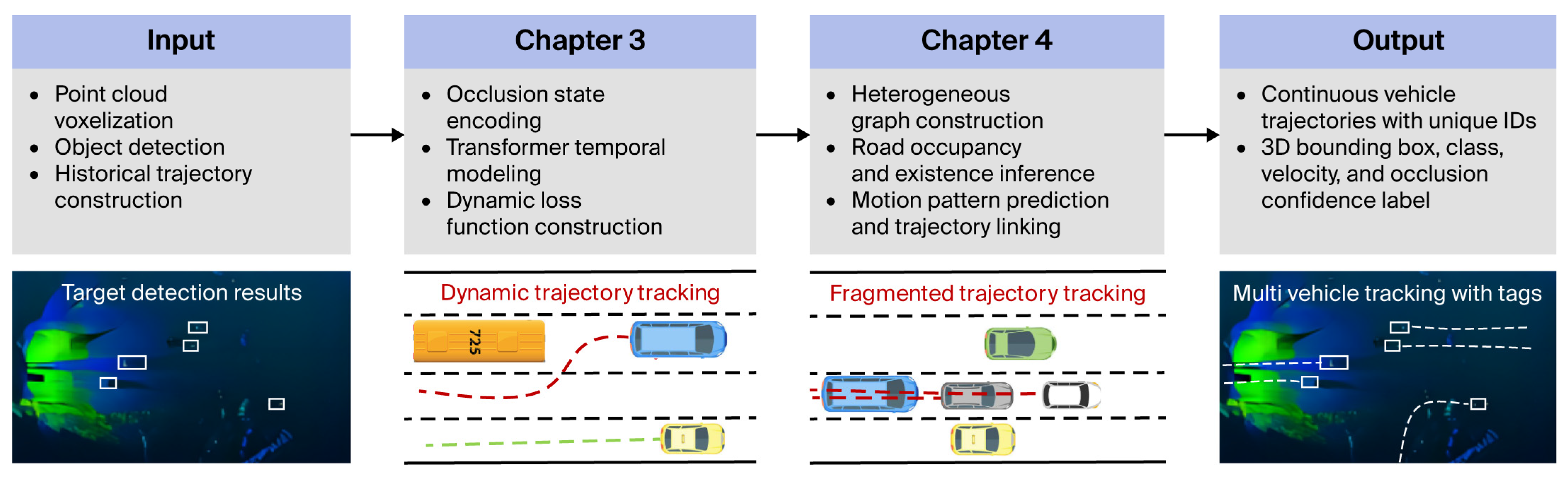
- Dynamic Occlusion State Prediction via Transformer: We propose a Transformer-based framework that explicitly forecasts the future occlusion ratio of targets by modeling historical trends. By integrating this prediction as a dynamic weighting factor into the loss function, our model adaptively learns to mitigate the impact of varying occlusion severities, significantly enhancing tracking stability during continuous state changes.
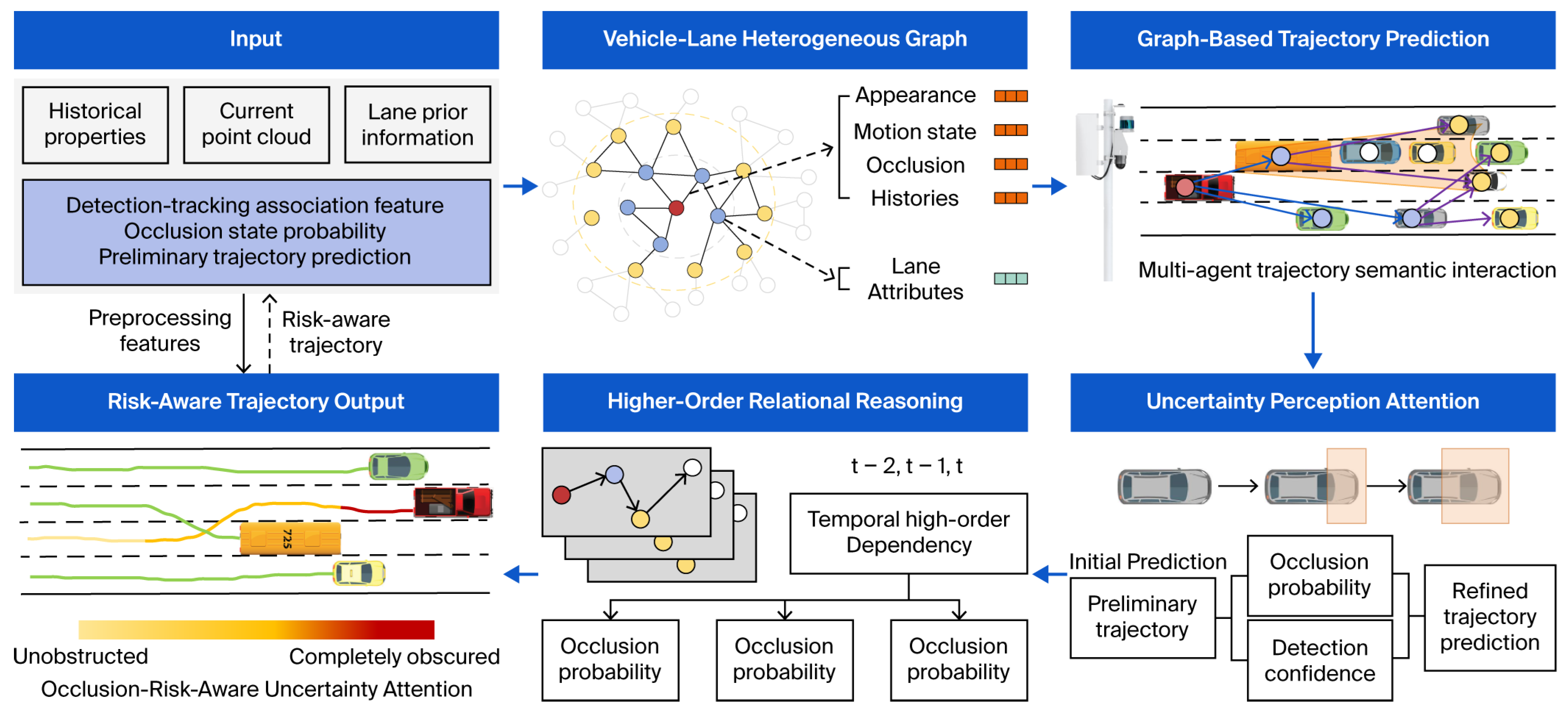
- Physical-Constraint Reasoning via GNN: We develop a GNN-based module that leverages road occupancy and neighboring vehicle poses to infer the existence and motion patterns of targets within occluded regions. This module constructs a heterogeneous graph to determine scene physics, effectively linking fragmented trajectories by generating “virtual perception” states for invisible targets.
- Implication of Dynamic Occlusion State Prediction: Introducing predicted occlusion states into the optimization objective shifts the paradigm from passive reaction to proactive anticipation. This implies that explicitly modeling the dynamics of visibility is crucial for robust tracking, as it allows the system to maintain trajectory continuity even when targets undergo rapid and severe transitions between visible and occluded states.
- Implication of Physical-Constraint Reasoning: Inferring target existence through road occupancy and neighbor interactions demonstrates that scene priors can effectively substitute for missing sensory data. This creates a “reasoning-based tracking” capability that overcomes the physical limitations of roadside sensors, ensuring high-precision association and minimizing ID switches even in fully occluded or “blind” spots.
Abstract
1. Introduction
- (1)
- Dynamic Occlusion State Prediction via Transformer with Feedback-Driven Loss Optimization: We propose a novel Transformer-based framework that explicitly models the temporal evolution of occlusion. Unlike standard tracking methods that treat occlusion as a static label, our approach forecasts the future occlusion ratio by analyzing historical trends across frames. Crucially, we introduce a mechanism where this predicted state is fed back into the tracking framework as a dynamic weighting factor within the loss function. This allows the model to adaptively adjust the penalty for prediction errors based on the predicted severity of occlusion, significantly enhancing the network’s robustness against targets undergoing continuous and dynamic state changes.
- (2)
- Scene-Aware Virtual Perception via GNN for Existence Inference and Trajectory Linking: Building upon the predicted occlusion states, we develop a Graph Neural Network (GNN) module designed for reasoning under uncertainty. This module constructs a heterogeneous graph incorporating road occupancy and neighboring vehicle poses to explicitly infer the existence of targets within occluded regions. By analyzing these physical constraints, the model predicts the latent motion patterns of invisible targets and generates “virtual features” to bridge trajectory gaps. This approach effectively transforms the tracking problem from simple feature matching to physics-constrained inference, ensuring continuous trajectory linking and minimizing ID switches even when targets are completely obscured.
- (3)
- State-of-the-Art Performance on Benchmark Datasets: We conduct extensive evaluations using the large-scale DAIR-V2X dataset and a self-collected complex urban dataset. The quantitative results demonstrate that our method achieves a MOTA of 92.6% on DAIR-V2X and 80.6% on the self-collected complex dataset, outperforming current state-of-the-art methods. Notably, our approach reduces identity switches (IDSs) by 37% and trajectory fragmentation (FRAG) by 25% compared with the second-best method (AGO-Net), validating the superior robustness of our temporal–spatial fusion architecture in maintaining track continuity.
2. Related Work on Occlusion-Aware Tracking Methods
2.1. 3D Multi-Object Tracking Paradigms
2.2. Occlusion-Aware Tracking Methods
3. Dynamic Occlusion State Prediction via Spatiotemporal Transformer
3.1. Problem Formulation and Occlusion State Encoding
3.1.1. Occlusion State Transition
3.1.2. Semi-Supervised Learning with Inertia Regularization
3.1.3. Temporal Feature Hallucination via Visible Feature Bank
3.2. Global Temporal Modeling with Occlusion-Aware Attention
3.2.1. Unified Spatiotemporal Embedding
3.2.2. Occlusion-Aware Self-Attention
3.2.3. Global Trajectory Association
3.3. Dynamic Loss Construction for Trajectory Stability
3.3.1. Occlusion-Aware Prediction Loss
3.3.2. Multi-Modal Association Metric
3.3.3. Global Trajectory Optimization
4. Physical-Constraint Graph Reasoning for Interaction Modeling
4.1. Heterogeneous Graph Construction with Multi-Source Constraints
4.1.1. Node Definition and Feature Initialization
4.1.2. Edge Construction with Physical Thresholds
4.1.3. Edge Feature Encoding
4.2. Social–Geometric Message Passing Mechanism
4.2.1. Social Interaction via Relative Dynamic Encoding
4.2.2. Geometric Constraint via Topological Projection
4.2.3. Gated Fusion and Residual Update
4.3. Uncertainty-Aware Existence Inference and Association
4.3.1. Existence Inference with Geometric Uncertainty
4.3.2. Geometrically Augmented Motion Consistency
4.3.3. Multi-Modal Affinity Fusion
5. Experimental Evaluation for Roadside MOT
5.1. Experimental Design
5.1.1. DAIR-V2X Dataset
5.1.2. Self-Collected Dataset
5.1.3. Vehicle Target Occlusion Status Annotation
5.1.4. Experimental Environment
5.1.5. Training Settings
5.2. Result Analysis
5.2.1. Experimental Setup and Fairness Protocols
- (1)
- Standard Comparison: Methods utilize their original detectors as described in their respective papers. This reflects real-world performance where different methods leverage different sensing capabilities.
- (2)
- Unified Detector Comparison: To isolate the effectiveness of the tracking algorithms from the detection quality, we forced all methods to use PointPillars as the sole detector on the DAIR-V2X dataset.
5.2.2. Qualitative Analysis
5.2.3. Quantitative Analysis
- (1)
- Ablation Study (Table 1): Starting from the PointPillars baseline (MOTA: 78.41%), the incremental addition of modules validates our design. The Dynamic Occlusion Model and Temporal Transformer improve MOTA to 84.12% by addressing short-term and long-term occlusions, respectively. The final integration of the Geometric Graph Neural Network (GNN) boosts MOTA to 92.61% and MOTP to 90.52%, confirming that modeling geometric interactions is critical for resolving dense traffic ambiguities.
- (2)
- Comparison on DAIR-V2X (Table 2 and Table 3): In the standard setting (Table 2), our method outperforms the state-of-the-art AGO-Net by ~5.1% in MOTA (92.6% vs. 87.5%), with a significant reduction in Identity Switches (IDS) and Fragmentation (FRAG). More importantly, Table 3 shows results under the same detector (PointPillars). Here, the performance gap widens. While AGO-Net drops to 84.6% MOTA, our method maintains a high performance of 92.6%. This indicates that our tracking framework is more robust and less dependent on high-quality detections compared with competitors, effectively correcting detection errors through geometric reasoning.
- (3)
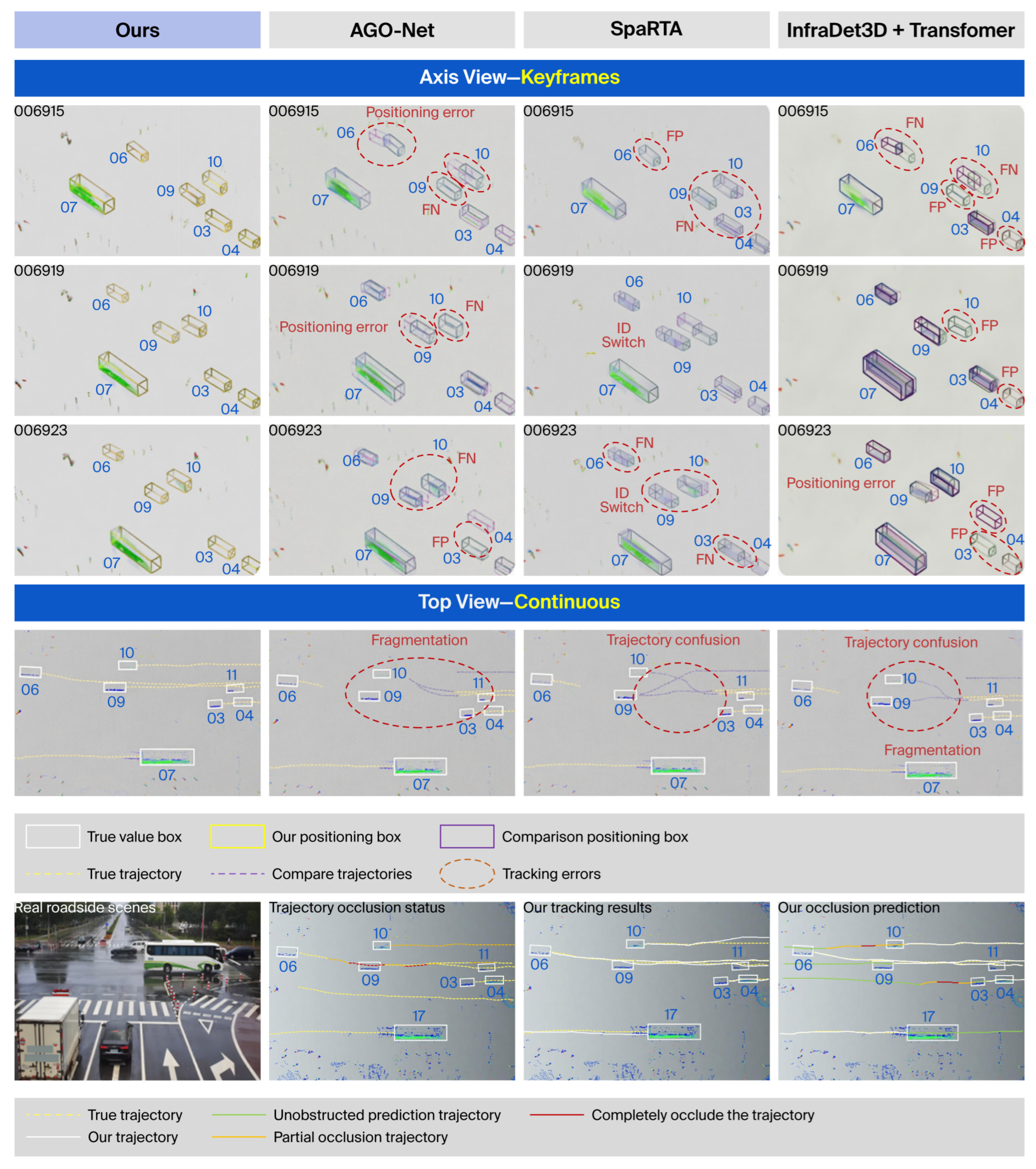
- Performance on Complex Scenarios (Table 4): Table 4 presents results on a more challenging dataset (characterized by severe occlusion and complex urban layouts). While all methods show a performance drop compared with Table 2, our method demonstrates superior robustness, maintaining a MOTA of 80.6%, significantly outperforming the second-best method, AGO-Net (76.4%). The gap in IDS and FRAG metrics is particularly notable, proving the efficacy of our occlusion prediction module in unstructured environments (Figure 4).

| PointPillar | Section 3.1 | Section 3.2 | Section 3.3 | Section 4.1 | Section 4.2 | Section 4.3 | Recall | MOTA | MOTP |
|---|---|---|---|---|---|---|---|---|---|
| √ | 83.52% | 78.41% | 80.16% | ||||||
| √ | √ | 85.11% | 80.94% | 81.04% | |||||
| √ | √ | √ | 87.45% | 84.12% | 82.30% | ||||
| √ | √ | √ | √ | 88.62% | 85.68% | 83.45% | |||
| √ | √ | √ | √ | √ | 90.15% | 89.25% | 86.83% | ||
| √ | √ | √ | √ | √ | √ | 90.92% | 91.83% | 89.12% | |
| √ | √ | √ | √ | √ | √ | √ | 91.43% | 92.61% | 90.52% |
| Methods | MT | ML | FP | FN | IDS | FRAG | Recall | MOTA | MOTP |
|---|---|---|---|---|---|---|---|---|---|
| AIR-THU [33] | 59.8% | 19.3% | 1247 | 3298 | 439 | 674 | 71.8% | 72.3% | 82.3% |
| Point Pillars + KF [34] | 60.9% | 16.2% | 1112 | 3022 | 386 | 562 | 76.4% | 74.6% | 83.5% |
| Detection Transformer [35] | 66.7% | 13.0% | 978 | 2764 | 335 | 441 | 78.2% | 77.9% | 84.2% |
| PillarGrid [36] | 67.4% | 12.7% | 889 | 2689 | 264 | 409 | 80.5% | 80.3% | 85.1% |
| InfraDet3D + Transformer [37] | 73.6% | 10.8% | 748 | 2451 | 193 | 335 | 83.4% | 84.6% | 86.4% |
| SpaRTA [38] | 78.2% | 8.6% | 621 | 2083 | 146 | 264 | 85.9% | 87.2% | 87.8% |
| AGO-Net [39] | 79.8% | 6.4% | 509 | 1864 | 87 | 183 | 88.1% | 87.5% | 88.9% |
| Our method | 84.2% | 4.1% | 386 | 1613 | 54 | 84 | 91.4% | 92.6% | 90.5% |
| Methods | MT | ML | FP | FN | IDS | FRAG | Recall | MOTA | MOTP |
|---|---|---|---|---|---|---|---|---|---|
| AIR-THU [33] | 55.1% | 22.3% | 1397 | 3609 | 507 | 739 | 70.4% | 68.2% | 79.3% |
| Point Pillars + KF [34] | 60.9% | 16.2% | 1112 | 3022 | 386 | 562 | 76.4% | 74.6% | 83.5% |
| Detection Transformer [35] | 62.2% | 15.6% | 1037 | 2826 | 358 | 507 | 77.1% | 76.3% | 84.1% |
| PillarGrid [36] | 63.5% | 14.1% | 976 | 2715 | 314 | 483 | 78.9% | 77.9% | 84.7% |
| InfraDet3D + Transformer [37] | 65.7% | 13.4% | 911 | 2758 | 265 | 430 | 79.6% | 79.2% | 85.5% |
| SpaRTA [38] | 68.0% | 11.2% | 746 | 2501 | 202 | 344 | 81.4% | 82.4% | 87.3% |
| AGO-Net [39] | 70.4% | 9.5% | 638 | 2369 | 159 | 308 | 83.2% | 84.6% | 88.6% |
| Our method | 84.2% | 4.1% | 386 | 1613 | 54 | 84 | 91.4% | 92.6% | 90.5% |
| Methods | MT | ML | FP | FN | IDS | FRAG | Recall | MOTA | MOTP |
|---|---|---|---|---|---|---|---|---|---|
| AIR-THU [33] | 41.5% | 35.2% | 867 | 2368 | 644 | 963 | 62.5% | 56.8% | 79.2% |
| Point Pillars + KF [34] | 47.1% | 32.8% | 625 | 1952 | 612 | 848 | 64.2% | 61.3% | 80.5% |
| Detection Transformer [35] | 52.3% | 24.5% | 403 | 1739 | 582 | 707 | 68.5% | 64.1% | 81.8% |
| PillarGrid [36] | 54.8% | 22.1% | 251 | 1154 | 446 | 625 | 71.2% | 67.5% | 82.6% |
| InfraDet3D + Transformer [37] | 58.2% | 18.5% | 123 | 816 | 381 | 538 | 73.6% | 70.8% | 83.4% |
| SpaRTA [38] | 61.5% | 16.2% | 98 | 558 | 359 | 454 | 77.3% | 75.6% | 84.1% |
| AGO-Net [39] | 65.8% | 10.8% | 85 | 363 | 267 | 363 | 79.8% | 76.4% | 84.9% |
| Our method | 71.2% | 8.5% | 72 | 187 | 145 | 232 | 83.5% | 80.6% | 85.8% |
5.2.4. Computational Complexity and Real-Time Performance
- (1)
- Inference Speed: Our method operates at approximately 28 FPS (AGO-Net~32 FPS) on a single NVIDIA RTX 3090, satisfying real-time requirements.
- (2)
- Complexity Analysis: While our method is slightly slower than lightweight association methods (e.g., SORT/DeepSORT), it remains competitive with other transformer-based approaches. The primary computational overhead comes from the Graph Neural Network (GNN) module, which incurs a memory footprint of 1.8× that of DeepSORT due to heterogeneous graph construction (1.2 GB vs. 0.67 GB on DAIR-V2X). The Transformer-based occlusion predictor contributes an additional 0.3 GB from temporal context caching, yet remains within the budget of typical roadside edge devices.
- (3)
- Scalability: As shown in our analysis, the inference time scales linearly with the number of detected objects. In extremely high-density scenarios (e.g., >50 objects), the frame rate drops to roughly 22 FPS. Although this is marginally lower than some detection-centric methods that ignore complex interactions, the trade-off is justified by the significant gain in tracking stability (lower IDS) and safety-critical accuracy in occluded scenarios.
6. Conclusions
Author Contributions
Funding
Data Availability Statement
Conflicts of Interest
Abbreviations
| DAIR-V2X | Dataset for Algorithm Innovation and Research on Vehicle–Infrastructure Cooperation |
| GNN | Graph Neural Network |
| MOT | Multi-Object Tracking |
| CNNs | Convolutional Neural Networks |
| KF | Kalman Filter |
| SMC | Sequential Monte Carlo |
| LSTM | Long Short-Term Memory |
| IoU | Intersection Over Union |
| EdgeConv | Edge Convolution |
| GCNs | Graph Convolutional Networks |
| MLP | Multilayer Perceptron |
| ReLU | Rectified Linear Unit |
References
- Xia, B.; Zhou, J.; Kong, F.; You, Y.; Yang, J.; Lin, L. Enhancing 3D object detection through multi-modal fusion for cooperative perception. Alex. Eng. J. 2024, 104, 46–55. [Google Scholar] [CrossRef] [Scilit]
- Bai, Z.; Wu, G.; Qi, X.; Liu, Y.; Oguchi, K.; Barth, M.J. Infrastructure-based object detection and tracking for cooperative driving automation: A survey. In 2022 IEEE Intelligent Vehicles Symposium (IV); IEEE: New York, NY, USA, 2022; pp. 1366–1373. [Google Scholar]
- Li, K.; Dai, Z.; Zuo, C.; Wang, X.; Cui, H.; Song, H.; Cui, M. Scene adaptation in adverse conditions: A multi-sensor fusion framework for roadside traffic perception. J. Intell. Transp. Syst. 2025, 29, 698–718. [Google Scholar] [CrossRef] [Scilit]
- Ma, Y.; Zhang, H.; Du, C.; Wang, Z.; Tian, Y.; Yao, X.; Cheng, Z.; Fan, S.; Wu, J. Tracking Multiple Vehicles with a Flexible Life Cycle Strategy Based on Roadside LiDAR Sensors. J. Transp. Eng. Part A Syst. 2024, 150, 04024010. [Google Scholar] [CrossRef] [Scilit]
- Lu, H.; Luo, E.; Feng, Y.; Wang, Y. Video-based person re-identification with complementary local and global features using a graph transformer. Math. Biosci. Eng. 2024, 21, 6694–6709. [Google Scholar] [CrossRef] [Scilit]
- Hu, Y.; Niu, A.; Sun, J.; Zhu, Y.; Yan, Q.; Dong, W.; Woźniak, M.; Zhang, Y. Dynamic Center Point Learning for Multiple Object Tracking Under Severe Occlusions. Knowl.-Based Syst. 2024, 300, 112130. [Google Scholar] [CrossRef] [Scilit]
- Van Ma, L.; Nguyen, T.T.D.; Vo, B.N.; Jang, H.; Jeon, M. Track Initialization and Re-Identification for 3D Multi-View Multi-Object Tracking. Inf. Fusion 2024, 111, 102496. [Google Scholar]
- Guan, F.; Xu, H.; Tian, Y. Evaluation of Roadside LiDAR-Based and Vision-Based Multi-Model All-Traffic Trajectory Data. Sensors 2023, 23, 5377. [Google Scholar] [CrossRef] [Scilit] [PubMed]
- Feng, D.; Liu, H.; Liu, Z. Lightweight 3D Multi-Object Tracking via Collaborative Camera and LiDAR Sensors. Sensors 2025, 25, 7351. [Google Scholar] [CrossRef] [Scilit]
- Cho, M.; Kim, E. 3D LiDAR Multi-Object Tracking with Short-Term and Long-Term Multi-Level Associations. Remote Sens. 2023, 15, 5486. [Google Scholar] [CrossRef] [Scilit]
- Ong, J.; Vo, B.T.; Vo, B.N.; Kim, D.Y.; Nordholm, S. A Bayesian Filter for Multi-View 3D Multi-Object Tracking with Occlusion Handling. IEEE Trans. Pattern Anal. Mach. Intell. 2020, 44, 2246–2263. [Google Scholar] [CrossRef] [Scilit]
- Mehrfard, A.; Duraisamy, B.; Haag, S.; Geiss, F.; Mählisch, M. Adaptive Learned State Estimation based on KalmanNet. arXiv 2026, arXiv:2604.02441. [Google Scholar] [CrossRef] [Scilit]
- Pang, Z.; Li, Z.; Wang, N. Simpletrack: Understanding and rethinking 3d multi-object tracking. In European Conference on Computer Vision; Springer: Cham, Switzerland, 2022; pp. 680–696. [Google Scholar]
- Al-Selwi, S.M.; Hassan, M.F.; Abdulkadir, S.J.; Muneer, A. LSTM inefficiency in long-term dependencies regression problems. J. Adv. Res. Appl. Sci. Eng. Technol. 2023, 30, 16–31. [Google Scholar] [CrossRef] [Scilit]
- Jian, Y.; Zhuang, C.; He, W.; Du, K.; Lu, Y.; Wang, H. Spatio-temporal correlation learning for multiple object tracking. In 2024 IEEE International Conference on Acoustics, Speech and Signal Processing (ICASSP); IEEE: New York, NY, USA, 2024; pp. 6170–6174. [Google Scholar]
- Weng, X.; Wang, J.; Held, D.; Kitani, K. 3d multi-object tracking: A baseline and new evaluation metrics. In RSJ International Conference on Intelligent Robots and Systems (IROS); IEEE: New York, NY, USA, 2020; pp. 10359–10366. [Google Scholar]
- Sun, S.; Shi, C.; Wang, C.; Zhou, Q.; Sun, R.; Xiao, B.; Ding, Y.; Xi, G. Intra-Frame Graph Structure and Inter-Frame Bipartite Graph Matching with ReID-Based Occlusion Resilience for Point Cloud Multi-Object Tracking. Electronics 2024, 13, 2968. [Google Scholar]
- Urdiales, J.; Martín, D.; Armingol, J.M. An improved deep learning architecture for multi-object tracking systems. Integr. Comput.-Aid. Eng. 2023, 30, 121–134. [Google Scholar]
- Adžemović, M.; Tadić, P.; Petrović, A.; Nikolić, M. Beyond Kalman filters: Deep learning-based filters for improved object tracking. Mach. Vis. Appl. 2025, 36, 20. [Google Scholar] [CrossRef] [Scilit]
- Yan, Y.; Mao, Y.; Li, B. SECOND: Sparsely Embedded Convolutional Detection. Sensors 2018, 18, 3337. [Google Scholar] [CrossRef] [Scilit] [PubMed]
- Jiménez-Bravo, D.M.; Murciego, Á.L.; Mendes, A.S.; San Blás, H.S.; Bajo, J. Multi-object tracking in traffic environments: A systematic literature review. Neurocomputing 2022, 494, 43–55. [Google Scholar] [CrossRef] [Scilit]
- Younis, A.; Sudderth, E. Differentiable and stable long-range tracking of multiple posterior modes. Adv. Neural Inf. Process. Syst. 2023, 36, 42799–42829. [Google Scholar]
- Chen, K.; Zhao, C.; Ji, Y.; Wang, C.; Du, Y. Uncertainty-aware multi-vehicle detection and tracking using roadside 3D point clouds. In IEEE Transactions on Intelligent Transportation Systems; IEEE: New York, NY, USA, 2025. [Google Scholar]
- Wang, Y.; Kitani, K.; Weng, X. Joint object detection and multi-object tracking with graph neural networks. In 2021 IEEE International Conference on Robotics and Automation (ICRA); IEEE: New York, NY, USA, 2021; pp. 13708–13715. [Google Scholar]
- Ding, Y.; Ling, Y.; Zhang, B.; Li, J.; Guo, L.; Yang, Z. SimpleTrackV2: Rethinking the Timing Characteristics for Multi-Object Tracking. Appl. Sci. 2024, 24, 6015. [Google Scholar]
- Willes, J.; Reading, C.; Waslander, S.L. Intertrack: Interaction transformer for 3d multi-object tracking. In 2023 20th Conference on Robots and Vision (CRV); IEEE: New York, NY, USA, 2023; pp. 73–80. [Google Scholar]
- Halawa, M.; Hellwich, O.; Bideau, P. Action-based contrastive learning for trajectory prediction. In European Conference on Computer Vision; Springer: Cham, Switzerland, 2022; pp. 143–159. [Google Scholar]
- Li, L.L.; Yang, B.; Liang, M.; Zeng, W.; Ren, M.; Segal, S.; Urtasun, R. End-to-end contextual perception and prediction with interaction transformer. In 2020 IEEE/RSJ International Conference on Intelligent Robots and Systems (IROS); IEEE: New York, NY, USA, 2020; pp. 5784–5791. [Google Scholar]
- Zhang, X.; Fan, Z.; Shen, Y.; Li, Y.; An, Y.; Tan, X. MAEMOT: Pretrained MAE-based antiocclusion 3-D multiobject tracking for autonomous driving. IEEE Trans. Neural Netw. Learn. Syst. 2024, 36, 10721–10735. [Google Scholar]
- Hu, C.; Zhou, Z.; Yue, Z.; Yuan, C.; Sun, L. Graph Convolution Network Combining Spatiotemporal Self-Attention and Mutual Information for Pedestrian-Trajectory Prediction. Transp. Res. Rec. 2025, 2679, 1694–1711. [Google Scholar] [CrossRef] [Scilit]
- Peng, D.; Lei, Y.; Hayat, M.; Guo, Y.; Li, W. Semantic-aware domain generalized segmentation. In Proceedings of the IEEE/CVF Conference on Computer Vision and Pattern Recognition; IEEE: New York, NY, USA, 2022; pp. 2594–2605. [Google Scholar]
- Rehman, A.; Shahid, H.; Masini, B.M.; Di Marco, P.; Munawar, F. O-RAN-Enabled Adaptive Relaying for Robust V2X Communication in Urban NLOS Scenarios. IEEE Access 2025, 13, 200946–200956. [Google Scholar] [CrossRef] [Scilit]
- Yu, H.; Luo, Y.; Shu, M.; Huo, Y.; Yang, Z.; Shi, Y.; Guo, Z.; Li, H.; Hu, X.; Yuan, J.; et al. Dair-v2x: A large-scale dataset for vehicle-infrastructure cooperative 3d object detection. In Proceedings of the IEEE/CVF Conference on Computer Vision and Pattern Recognition; IEEE: New York, NY, USA, 2022; pp. 21361–21370. [Google Scholar]
- Kong, W.; Du, Y.; He, L.; Li, Z. Improved 3D object detection based on pointpillars. Electronics 2024, 13, 2915. [Google Scholar] [CrossRef] [Scilit]
- Carion, N.; Massa, F.; Synnaeve, G.; Usunier, N.; Kirillov, A.; Zagoruyko, S. End-to-end object detection with transformers. In Proceedings of the European Conference on Computer Vision; Springer: Cham, Switzerland, 2020; pp. 213–229. [Google Scholar]
- Bai, Z.; Wu, G.; Barth, M.J.; Liu, Y.; Sisbot, E.A.; Oguchi, K. Pillargrid: Deep learning-based cooperative perception for 3d object detection from onboard-roadside lidar. In Proceedings of the 2022 IEEE 25th International Conference on Intelligent Transportation Systems (ITSC); IEEE: New York, NY, USA, 2022; pp. 1743–1749. [Google Scholar]
- Zimmer, W.; Birkner, J.; Brucker, M.; Nguyen, H.T.; Petrovski, S.; Wang, B.; Knoll, A.C. Infradet3d: Multi-modal 3d object detection based on roadside infrastructure camera and lidar sensors. In Proceedings of the 2023 IEEE Intelligent Vehicles Symposium (IV); IEEE: New York, NY, USA, 2023; pp. 1–8. [Google Scholar]
- Cavagna, A.; Melillo, S.; Parisi, L.; Ricci-Tersenghi, F. Sparta tracking across occlusions via partitioning of 3d clouds of points. IEEE Trans. Pattern Anal. Mach. Intell. 2019, 43, 1394–1403. [Google Scholar] [CrossRef] [Scilit]
- Du, L.; Ye, X.; Tan, X.; Johns, E.; Chen, B.; Ding, E.; Feng, J. Ago-net: Association-guided 3d point cloud object detection network. IEEE Trans. Pattern Anal. Mach. Intell. 2021, 44, 8097–8109. [Google Scholar] [CrossRef] [Scilit]


Disclaimer/Publisher’s Note: The statements, opinions and data contained in all publications are solely those of the individual author(s) and contributor(s) and not of MDPI and/or the editor(s). MDPI and/or the editor(s) disclaim responsibility for any injury to people or property resulting from any ideas, methods, instructions or products referred to in the content. |
© 2026 by the authors. Licensee MDPI, Basel, Switzerland. This article is an open access article distributed under the terms and conditions of the Creative Commons Attribution (CC BY) license.
Share and Cite
Wang, S.; Wang, Y.; Wang, B.; Wei, C.; Liu, H. Dynamic Occlusion–Predictive Neural Network for Robust Roadside Multi-Vehicle Tracking. Sensors 2026, 26, 3529. https://doi.org/10.3390/s26113529
Wang S, Wang Y, Wang B, Wei C, Liu H. Dynamic Occlusion–Predictive Neural Network for Robust Roadside Multi-Vehicle Tracking. Sensors. 2026; 26(11):3529. https://doi.org/10.3390/s26113529
Chicago/Turabian StyleWang, Shuai, Yafei Wang, Bowen Wang, Chongfeng Wei, and Hao Liu. 2026. "Dynamic Occlusion–Predictive Neural Network for Robust Roadside Multi-Vehicle Tracking" Sensors 26, no. 11: 3529. https://doi.org/10.3390/s26113529
APA StyleWang, S., Wang, Y., Wang, B., Wei, C., & Liu, H. (2026). Dynamic Occlusion–Predictive Neural Network for Robust Roadside Multi-Vehicle Tracking. Sensors, 26(11), 3529. https://doi.org/10.3390/s26113529