Integrated PM–MOX–Thermal Sensing for Monitoring Bioaerosol Dynamics in Controlled Indoor Environments
 , , , , and
Abstract
1. Introduction
- Develops a modular open-source multisensor prototype that integrates PM, MOX and thermodynamic sensors into a compact low-cost platform designed for real-time monitoring of environmental features associated with airborne fungal spore presence under controlled and semi-controlled conditions.
- Designs the overall system architecture of the multisensor platform, defining the hardware integration strategy, sensor configuration, data acquisition pipeline and communication framework.
- Implements a controlled environmental-chamber protocol to generate reproducible bioaerosol dispersion events using Penicillium chrysogenum as the biological target, a species widely documented in indoor heritage environments.
- Establishes robust biological ground-truth data through volumetric impaction sampling, generating a high-quality accurately labeled dataset of fungal spore presence levels (CFU/m3) that supports validation, statistical inference and performance assessment supported by ML tools.
- Applies rigorous statistical methodologies to quantify detection performance across physical and chemical sensing domains and to identify the specific variables that constitute the most informative indirect markers of airborne fungal spore presence.
2. Methods
2.1. Microorganism Inoculation Protocol
2.2. Prototype
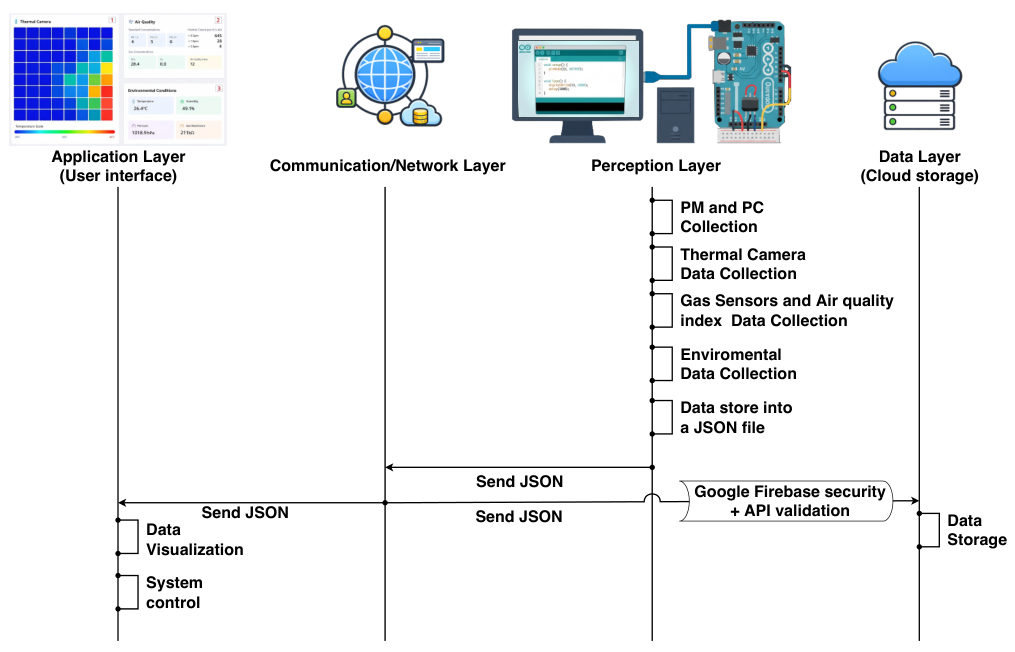
2.2.1. Perception Layer/Hardware
The Box (Acrylic Chamber) and Sensors’ Positions
2.2.2. Communication/Network Layer
2.2.3. Application Layer (Front End)
2.2.4. Data Layer
2.3. Prototype Validation
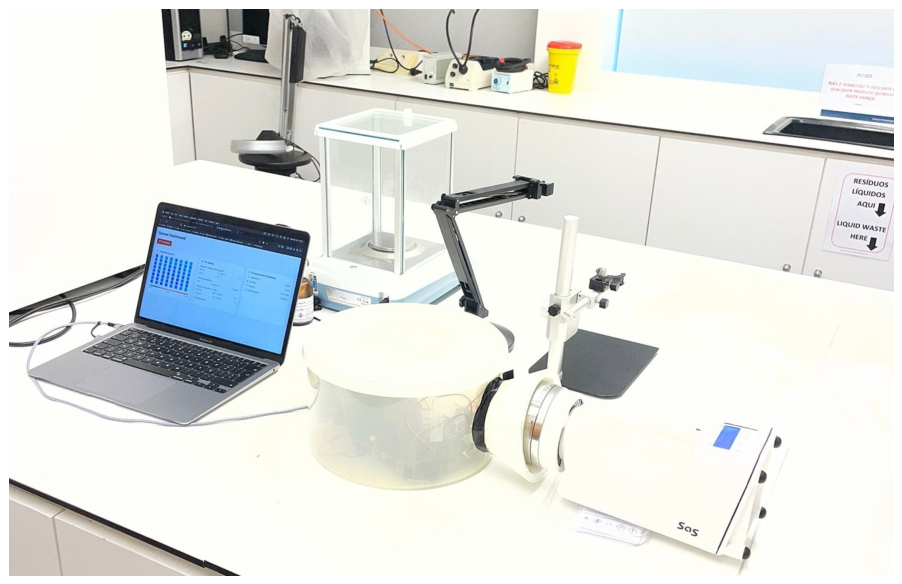
- Experimental Setup and Aerosolization: All experiments were conducted within a sealed acrylic chamber housing the sensor array, data acquisition unit and low-power ventilators. The ventilators were activated during measurements to generate homogeneous airflow and promote spore suspension, simulating indoor air disturbances. A 3D-printed PLA support structure guided aerosolized particles toward a Petri dish positioned within a Surface Air System (SAS) sampler, VWR International, USA. Active aerosolization was achieved by operating internal fans during data acquisition, inducing turbulent airflow that detached and suspended fungal conidia from culture plates. Concurrently, bioaerosols were quantified by optical PM sensors and physically collected via inertial impaction using the SAS sampler (total sampled volume: 1 m3). The experimental validation setup is illustrated in Figure 4.
- Sample Collection and Synchronization: After each SAS sampling cycle, the inoculated Petri dishes were aseptically retrieved and incubated under predefined culture conditions. Following incubation, colony-forming units (CFUs) were enumerated and normalized to the sampled air volume, with results expressed as CFU/m3. These values represent an estimate of the concentration of culturable airborne fungal spores at each sampling point [37]. Each sample was uniquely labeled to ensure full traceability and synchronization with the corresponding sensor data (i.e., recorded start and end times of the SAS acquisition interval). Since each SAS sample provides a CFU value integrated over the entire time required to collect 1 m3 of air, all high-frequency sensor measurements (2-second resolution) within the corresponding sampling interval were initially extracted. A data preprocessing step was then applied, including (i) removal of the initial sensor stabilization period, (ii) exclusion of non-physical or invalid readings, and (iii) elimination of sporadic artifacts and outliers. Consequently, N denotes the number of valid 2-second sensor observations retained after preprocessing rather than the total number of raw measurements within the sampling interval. Table 2 summarizes the sampling collections for each microbial class.
3. Results
3.1. The Prototype Architecture
3.2. Biological Ground-Truth Validation
3.3. Prototype Hardware Validation via Statistical Tests
3.4. Prototype Hardware Validation via Machine Learning Tools
- Precision (%) (also referred to as the positive predictive value), which measures the proportion of correctly predicted positive samples among all samples predicted as positive [44]:
- Recall (%) (also known as sensitivity or true positive rate), which corresponds to the proportion of correctly predicted positive samples relative to the total number of actual positive samples [44]:
- F1-score, which is defined as the harmonic mean of precision and recall, providing a balanced measure of classification performance [45]:
- Area under the receiver operating characteristic curve (AUC), which evaluates the model’s ability to discriminate between classes by summarizing the trade-off between the true positive rate and the false positive rate across different decision thresholds. AUC values range from 0 to 1, where 1 indicates perfect discrimination and 0.5 corresponds to random classification [46].
4. Discussion
4.1. Statistical Tests for Sensor Validation
4.2. Machine Learning Sensor Validation
5. Conclusions
Author Contributions
Funding
Institutional Review Board Statement
Informed Consent Statement
Data Availability Statement
Acknowledgments
Conflicts of Interest
References
- Burnett, R. Global estimates of mortality associated with air pollution: Systematic review and meta-regression. Proc. Natl. Acad. Sci. USA 2018, 115, 9592–9597. [Google Scholar] [CrossRef]
- Landrigan, P.J. The Lancet Commission on pollution and health. Lancet 2018, 391, 462–512. [Google Scholar] [CrossRef]
- Cohen, A.J.; Brauer, M.; Burnett, R. Estimates and 25-year trends of the global burden of disease attributable to ambient air pollution. Lancet 2017, 389, 1907–1918. [Google Scholar] [CrossRef]
- Marques, G.; Pitarma, R. Indoor Air Quality Monitoring Systems Based on Internet of Things: A Systematic Review. Int. J. Environ. Res. Public Health 2019, 17, 4942. [Google Scholar] [CrossRef]
- Amaral, S.; De Carvalho, J.; Costa, M.; Pinheiro, C. An Overview of Particulate Matter Measurement Instruments. Atmosphere 2015, 6, 1327–1345. [Google Scholar] [CrossRef]
- Lowther, S.D.; Jones, K.C.; Wang, X.; Whyatt, J.D.; Wild, O.; Booker, D. Particulate Matter Measurement Indoors: A Review of Metrics, Sensors, Needs, and Applications. Environ. Sci. Technol. 2019, 53, 11644–11656. [Google Scholar] [CrossRef]
- Epping, R.; Koch, M. On-Site Detection of Volatile Organic Compounds (VOCs). Molecules 2023, 28, 1598. [Google Scholar] [CrossRef] [PubMed]
- Patil, H.D.; Patil1, C.B.; Patil, V.V.; Patil, P.S.; Pawar, A.R. A Brief Review on Gas Chromatography. Asian J. Pharm. Anal. 2023, 13, 47–52. [Google Scholar] [CrossRef]
- Maštovská, K.; Lehotay, S.J. Practical approaches to fast gas chromatography–mass spectrometry. J. Chromatogr. A 2003, 1000, 153–180. [Google Scholar] [CrossRef]
- Rodrigues, P.M.; Freitas, D.R.; Gabriel, J. Portable Interface and Local Service Manager. Procedia Comput. Sci. 2014, 27, 67–73. [Google Scholar] [CrossRef][Green Version]
- Douwes, J.; Thorne, P.; Pearce, N.; Heederik, D. Bioaerosol health effects and exposure assessment: Progress and prospects. Ann. Occup. Hyg. 2003, 47, 187–200. [Google Scholar] [CrossRef]
- Brown, G.D.; Denning, D.W. Hidden killers: Human fungal infections. Sci. Transl. Med. 2012, 4, 165rv13. [Google Scholar] [CrossRef]
- Vallabhaneni, S.; Mody, R.K.; Walker, T.; Chiller, T. The Global Burden of Fungal Diseases. Infect. Dis. Clin. North Am. 2016, 30, 1–11. [Google Scholar] [CrossRef]
- Chawla, H.; Anand, P.; Garg, K.; Bhagat, N.; Varmani, S.G.; Bansal, T.; McBain, A.J.; Marwah, R.G. A comprehensive review of microbial contamination in the indoor environment: Sources, sampling, health risks, and mitigation strategies. Front. Public Health 2023, 11, 1285393. [Google Scholar] [CrossRef]
- Adams, R.I.; Bateman, A.C.; Bik, H.M.; Meadow, J.F. Microbiota of the indoor environment: A meta-analysis. Microbiome 2015, 3, 49. [Google Scholar] [CrossRef]
- Karbowska-Berent, J.; Górny, R.L.; Strzelczyk, A.B.; Wlazło, A. Airborne and dust borne microorganisms in selected Polish libraries and archives. Aerobiologia 2011, 27, 187–194. [Google Scholar] [CrossRef]
- Sequeira, S.O.; Cabrita, E.J.; Macedo, M.F. Fungal biodeterioration of paper: How are paper and book conservators dealing with it? An international survey. Restaur. Int. J. Preserv. Libr. Arch. Mater. 2014, 35, 181–199. [Google Scholar] [CrossRef]
- Barbosa, K.; Ferreira, T.; Moreira, P.; Vieira, E. Monitorização de gases poluentes em microclimas de museus: Estratégia relevante para a conservação preventiva. Conserv. PatrimóNio 2021, 38, 22–34. [Google Scholar] [CrossRef]
- Gupta, S.K.; Singh, B. Instruments for Monitoring Air Pollution and Air Quality. In Handbook of Metrology and Applications; Springer Nature: Singapore, 2023; pp. 1657–1705. [Google Scholar] [CrossRef]
- Giechaskiel, B.; Schiefer, E.; Schindler, W.; Axmann, H.; Dardiotis, C. Overview of Soot Emission Measurements Instrumentation: From Smoke and Filter Mass to Particle Number. Sae Int. J. Engines 2013, 6, 10–22. [Google Scholar] [CrossRef]
- Morawska, L.; Thai, P.K.; Liu, X. Applications of low-cost sensing technologies for air quality monitoring and exposure assessment: How far have they gone? Environ. Int. 2018, 116, 286–299. [Google Scholar] [CrossRef] [PubMed]
- Seesaard, T.; Kamjornkittikoon, K.; Wongchoosuk, C. A comprehensive review on advancements in sensors for air pollution applications. Sci. Total Environ. 2024, 951, 175696. [Google Scholar] [CrossRef] [PubMed]
- Saini, J.; Dutta, M.; Marques, G. Innovations in air quality monitoring: Sensors, IoT and future research. Sensors 2025, 25, 2070. [Google Scholar] [CrossRef]
- Martinez-Bracero, M.; Markey, E.; Clancy, J.H.; McGillicuddy, E.J.; Sewell, G.; O’Connor, D.J. Airborne Fungal Spore Review, New Advances and Automatisation. Atmosphere 2022, 13, 308. [Google Scholar] [CrossRef]
- Arduino Nicla Sense Env (ABX00089) Datasheet. Available online: https://docs.arduino.cc/resources/datasheets/ABX00089-datasheet.pdf (accessed on 20 April 2026).
- Suchorab, Z.; Frąc, M.; Guz, L.; Oszust, K.; Łagód, G.; Gryta, A.; Bilińska-Wielgus, N.; Czerwiński, J. A method for early detection and identification of fungal contamination of building materials using e-nose. PLoS ONE 2019, 14, e0215179. [Google Scholar] [CrossRef] [PubMed]
- Łagód, G.; Piłat-Rożek, M.; Majerek, D.; Łazuka, E.; Suchorab, Z.; Guz, L.; Kočí, V.; Černý, R. Application of Dimensionality Reduction and Machine Learning Methods for the Interpretation of Gas Sensor Array Readouts from Mold-Threatened Buildings. Appl. Sci. 2023, 13, 8588. [Google Scholar] [CrossRef]
- Borowik, P.; Adamowicz, L.; Tarakowski, R.; Wacławik, P.; Oszako, T.; Ślusarski, S.; Tkaczyk, M. Development of a Low-Cost Electronic Nose for Detection of Pathogenic Fungi and Applying It to Fusarium oxysporum and Rhizoctonia solani. Sensors 2021, 21, 5868. [Google Scholar] [CrossRef]
- Choi, Y.; Kang, B.; Kim, D. Effective detection of indoor fungal contamination through the identification of volatile organic compounds using mass spectrometry and machine learning. Environ. Pollut. 2024, 363, 125195. [Google Scholar] [CrossRef]
- Liu, Y.; Babusci, E.; Gunsch, C.K.; Chen, B. Scensory: Real-Time Robotic Olfactory Perception for Joint Identification and Source Localization. arXiv 2025, arXiv:2509.19318. [Google Scholar] [CrossRef]
- Nevalainen, A.; Täubel, M.; Hyvärinen, A. Indoor fungi: Companions and contaminants. Indoor Air 2015, 25, 125–156. [Google Scholar] [CrossRef]
- Paulussen, C.; Hallsworth, J.E.; Álvarez Pérez, S.; Nierman, W.C.; Hamill, P.G.; Blain, D.; Rediers, H.; Lievens, B. Ecology of aspergillosis: Insights into the pathogenic potency of Aspergillus Fumigatus Some Other Aspergillus Species. Microb. Biotechnol. 2017, 10, 296–322. [Google Scholar] [CrossRef]
- Viljoen, M.; Claassen, N. Pathophysiological aspects of exposure to dampness-associated indoor mould and mycotoxins: A mini-overview. J. Hazard. Mater. Adv. 2023, 9, 100228. [Google Scholar] [CrossRef]
- PMSA003I Series Data Manual: Digital Universal Particle Concentration Sensor, 2018. Version 2.6. Available online: https://cdn-shop.adafruit.com/product-files/4632/4505_PMSA003I_series_data_manual_English_V2.6.pdf (accessed on 20 April 2026).
- AMG8833 Datasheet: Infrared Array Sensor Grid-EYE. Available online: https://industrial.panasonic.com/ww/products/pt/grid-eye/models/AMG8833 (accessed on 20 April 2026).
- BME680 Datasheet: Low Power Gas, Pressure, Temperature & Humidity Sensor. Available online: https://www.bosch-sensortec.com/media/boschsensortec/downloads/datasheets/bst-bme680-ds001.pdf (accessed on 20 April 2026).
- Lindsley, W.; Green, B.; Blachere, F.; Martin, S.; Law, B.; Jensen, P.; Schafer, M. Sampling and characterization of bioaerosols. In NIOSH Manual of Analytical Methods (NMAM), 5th ed.; Andrews, R., O’Connor, P.F., Eds.; National Institute for Occupational Safety and Health: Washington, DC, USA, 2017; pp. BA1–BA115. [Google Scholar]
- Barbosa, M.I.; Roxo, H.; Ribeiro, P.; Menezes, J.; Vieira, E.; Moreira, P.; Rodrigues, P.M. Multisensor Fungal Spore Detection Code, 2026. Available online: https://github.com/MInesBarbosaa/multisensorPrototype (accessed on 31 March 2026).
- Pedregosa, F.; Varoquaux, G.; Gramfort, A.; Michel, V.; Thirion, B.; Grisel, O.; Blondel, M.; Prettenhofer, P.; Weiss, R.; Dubourg, V.; et al. Scikit-learn: Machine Learning in Python. J. Mach. Learn. Res. 2011, 12, 2825–2830. [Google Scholar]
- Barbosa, M.I.; Teixeira, A.M.; Sousa, M.L.; Ribeiro, P.; Sousa, C.; Rodrigues, P.M. FTIR-Based Machine Learning Identification of Virgin and Recycled Polyester for Textile Recycling in Industry 4.0. Processes 2026, 14, 964. [Google Scholar] [CrossRef]
- Ribeiro, P.; Barbosa, M.I.; Sousa, C.; Rodrigues, P.M. Near-Infrared Spectroscopy Machine-Learning Spectral Analysis Tool for Blueberries (Vaccinium corymbosum) Cultivar Discrimination. Foods 2025, 14, 1428. [Google Scholar] [CrossRef] [PubMed]
- Sammut, C.; Webb, G.I. Accuracy. In Encyclopedia of Machine Learning and Data Mining; Springer: Boston, MA, USA, 2017; p. 8. [Google Scholar] [CrossRef]
- Doğan, O. Data Linkage Methods for Big Data Management in Industry 4.0. In Optimizing Big Data Management and Industrial Systems With Intelligent Techniques; IGI Global: Hershey, PA, USA, 2019; pp. 108–127. [Google Scholar] [CrossRef]
- Ting, K.M. Precision and Recall. In Encyclopedia of Machine Learning and Data Mining; Springer: Bsoton, MA, USA, 2017; pp. 990–991. [Google Scholar] [CrossRef]
- Goutte, C.; Gaussier, E. A Probabilistic Interpretation of Precision, Recall and F-Score, with Implication for Evaluation. In Advances in Information Retrieval; Springer: Berlin/ Heidelberg, Germany, 2005; pp. 345–359. [Google Scholar] [CrossRef]
- Nahm, F. Receiver operating characteristic curve: Overview and practical use for clinicians. Korean J. Anesthesiol. 2022, 75, 25–36. [Google Scholar] [CrossRef] [PubMed]



| Sensor | Measured Variable(s) | Detection and Sensitivity Characteristics | Resolution/Output and Performance | Minimum Limit of Detection |
|---|---|---|---|---|
| PMSA003I (Plantower) [34] | PM1.0, PM2.5, PM10.0 | Laser scattering optical sensor. Detects particles ≥0.3 µm (50% CE; ≥0.5 µm at ∼98% CE). Sample volume ≈0.1 L. | 1 µg·m−3 step. Max. RE ±10% (100–500 µg·m−3) or ±10 µg·m−3 (0–100 µg·m−3). RT: <1 s (single), ≤10 s (stabilized). | Particle diameter: 0.3 µm |
| AMG8833 (Panasonic Grid-EYE) [35] | IR (8 × 8) | Thermal microbolometer array. HGM, FOV 60°. NETD ≈0.05 K @1 Hz (0.16 K @10 Hz). | 12-bit output (0.25 K LSB). AA ±2.5 K (0–80 °C). FR: 1 or 10 Hz. | Temperature difference: 0.05 K |
| BME680 (Bosch) [36] | T, RH, P, IAQ, eCO2 | 4-in-1 sensor: MOX gas sensor + T/RH/P. VOC-sensitive (ppb–ppm). Algorithm-based IAQ output (BSEC). | T: ±1.0 °C; RH: ±3%; P: ±1 hPa. Gas: IAQ (0–500), eCO2/TVOC (algorithm-derived, relative). | Gas resistance change: 0.05% |
| Nicla Sense Env [25] | T, RH, O3, TVOC, eCO2, NO2 | HS4001 (T/RH) + ZMOD4410 (IAQ) + ZMOD4510 (outdoor AQ). MOX sensors with onboard ML processing. | T: ±0.2 °C; RH: ±1.5% (typ.). Gas: AQ indices and estimated concentrations (firmware-derived, no absolute accuracy). | Temperature: −40 °C; NO2 and O3: 20 ppb; TVOC: 1 µg/m3 |
| Class | Date | Start Time | End Time | N |
|---|---|---|---|---|
| 1st culture | 22/09/2025 | 7:58 | 8:16 | 420 |
| 2nd culture | 14/10/2025 | 10:58 | 11:43 | 549 |
| 3rd culture | 22/10/2025 | 10:50 | 11:16 | 513 |
| control | 22/10/2025 | 11:22 | 11:43 | 507 |
| Experimental Phase | Sample A | Sample B | Sample C | Sample D | Mean () |
|---|---|---|---|---|---|
| Control | 11 | 5 | 4 | 5 | 6.25 |
| Assay 1 (1st Culture) | 111 | 104 | 109 | 118 | 110.50 |
| Assay 2 (2nd Culture) | 173 | 163 | 150 | 175 | 165.25 |
| Assay 3 (3rd Culture) | 127 | 130 | 134 | 132 | 130.75 |
| Variable | H | p | Stars | |
|---|---|---|---|---|
| AQI | 1070.5245 | 231.04 | **** | |
| Gas Resistance | 1533.6529 | < | >300 | **** |
| Humidity | 1641.5978 | < | >300 | **** |
| NO2 | 415.0858 | 88.92 | **** | |
| O3 | 839.1474 | 180.85 | **** | |
| PC>0.3 | 1573.3739 | < | >300 | **** |
| PC>0.5 | 1573.6878 | < | >300 | **** |
| PC>1.0 | 1535.2706 | < | >300 | **** |
| PC>2.5 | 772.2167 | 166.34 | **** | |
| PC>5.0 | 521.7458 | 112.03 | **** | |
| PM1.0 | 1671.9412 | < | >300 | **** |
| PM2.5 | 1630.0934 | < | >300 | **** |
| PM10.0 | 1640.2105 | < | >300 | **** |
| Pressure | 1716.2255 | < | >300 | **** |
| Temperature | 1364.3607 | 294.80 | **** |
| Variable | Comparison | U | p | dmedian | q | Dir | Stars | ||
|---|---|---|---|---|---|---|---|---|---|
| AQI | 1st culture vs. 3rd culture | 215,460 | 17 | −1 | 155.7396 | ↑ | **** | ||
| AQI | 1st culture vs. 2 culture | 225,669 | 16 | −0.9574 | 145.9786 | ↑ | **** | ||
| AQI | 1st culture vs. control | 206,554.5 | 11 | −0.9400 | 134.4238 | ↑ | **** | ||
| AQI | 3rd culture vs. control | 65,872 | −6 | 0.4935 | 44.6457 | ↓ | **** | ||
| AQI | 2nd culture vs. 3rd culture | 168,794 | 1 | −0.1987 | 8.5227 | ↑ | **** | ||
| AQI | 2nd culture vs. control | 113,499 | −5 | 0.1845 | 6.9741 | ↓ | **** | ||
| Gas Resistance | 2nd culture vs. control | 278,343 | 90,000 | −1 | 173.1013 | ↑ | **** | ||
| Gas Resistance | 1st culture vs. 2 culture | 680.5 | −47,300 | 0.9941 | 154.5666 | ↓ | **** | ||
| Gas Resistance | 1st culture vs. control | 212,595 | 42,700 | −0.9968 | 150.0386 | ↑ | **** | ||
| Gas Resistance | 3rd culture vs. control | 250,394.5 | 48,700 | −0.9254 | 143.6343 | ↑ | **** | ||
| Gas Resistance | 2nd culture vs. 3rd culture | 245,668 | 41,300 | −0.7446 | 97.1094 | ↑ | **** | ||
| Gas Resistance | 1st culture vs. 3rd culture | 76,854.5 | −6000 | 0.2866 | 13.3270 | ↓ | **** | ||
| Humidity | 2nd culture vs. 3rd culture | 0 | −17.9 | 1 | 174.3293 | ↓ | **** | ||
| Humidity | 2nd culture vs. control | 0 | −15 | 1 | 173.2929 | ↓ | **** | ||
| Humidity | 1st culture vs. 3rd culture | 0 | −17.3 | 1 | 151.9462 | ↓ | **** | ||
| Humidity | 1st culture vs. control | 0 | −14.4 | 1 | 151.1668 | ↓ | **** | ||
| Humidity | 3rd culture vs. control | 242,732 | 2.9 | −0.8665 | 126.2119 | ↑ | **** | ||
| Humidity | 1st culture vs. 2nd culture | 116,819.5 | 0.7230 | 0.6 | −0.0133 | 0.7311 | 0.1409 | ↑ | |
| NO2 | 1st culture vs. 2nd culture | 201,329 | 21.25 | −0.7463 | 87.9841 | ↑ | **** | ||
| NO2 | 2nd culture vs. control | 68,526 | −30.3 | 0.5076 | 46.2341 | ↓ | **** | ||
| NO2 | 3rd culture vs. control | 71,429.5 | −32.9 | 0.4507 | 36.3431 | ↓ | **** | ||
| NO2 | 1st culture vs. control | 69,722.5 | −9.05 | 0.3451 | 18.9183 | ↓ | **** | ||
| NO2 | 1st culture vs. 3rd culture | 140,093 | 23.85 | −0.3004 | 14.7740 | ↑ | **** | ||
| NO2 | 2nd culture vs. 3rd culture | 127,259 | 0.0055 | 2.6 | 0.0963 | 0.0058 | 2.2580 | ↑ | ** |
| O3 | 1st culture vs. 2nd culture | 189,405 | 0.1 | −0.6429 | 104.3825 | ↑ | **** | ||
| O3 | 1st culture vs. control | 174,915 | 0.1 | −0.6429 | 97.8572 | ↑ | **** | ||
| O3 | 1st culture vs. 3rd culture | 161,731 | 0.1 | −0.5013 | 49.5506 | ↑ | **** | ||
| O3 | 2nd culture vs. 3rd culture | 108,976.5 | 0 | 0.2261 | 31.4058 | ↓ | **** | ||
| O3 | 3rd culture vs. control | 159,451.5 | 0 | −0.2261 | 29.2174 | ↓ | **** | ||
| O3 | 2nd culture vs. control | 139,171.5 | 1 | 0 | 0 | 1 | 0 | ↓ | |
| PC>0.3 | 2nd culture vs. 3rd culture | 277,020 | 3843 | −0.9672 | 163.0004 | ↑ | **** | ||
| PC>0.3 | 2nd culture vs. control | 273,802.5 | 3819 | −0.9674 | 162.0706 | ↑ | **** | ||
| PC>0.3 | 1st culture vs. 3rd culture | 303 | −438 | 0.9972 | 150.9638 | ↓ | **** | ||
| PC>0.3 | 1st culture vs. 2nd culture | 3780 | −4281 | 0.9672 | 146.3866 | ↓ | **** | ||
| PC>0.3 | 1st culture vs. control | 2370.5 | −462 | 0.9777 | 144.4187 | ↓ | **** | ||
| PC>0.3 | 3rd culture vs. control | 114,975 | 0.0014 | −24 | 0.1159 | 0.0015 | 2.8675 | ↓ | ** |
| PC>0.5 | 2nd culture vs. 3rd culture | 277,020 | 1137 | −0.9672 | 163.0017 | ↑ | **** | ||
| PC>0.5 | 2nd culture vs. control | 273,802.5 | 1130 | −0.9674 | 162.0719 | ↑ | **** | ||
| PC>0.5 | 1st culture vs. 3rd culture | 190 | −137 | 0.9982 | 151.2833 | ↓ | **** | ||
| PC>0.5 | 1st culture vs. 2nd culture | 3780 | −1274 | 0.9672 | 146.3889 | ↓ | **** | ||
| PC>0.5 | 1st culture vs. control | 2316 | −144 | 0.9782 | 144.5729 | ↓ | **** | ||
| PC>0.5 | 3rd culture vs. control | 116,285.5 | 0.0034 | −7 | 0.1058 | 0.0037 | 2.4631 | ↓ | ** |
| PC>1.0 | 2nd culture vs. 3rd culture | 277,020 | 172 | −0.9672 | 163.0481 | ↑ | **** | ||
| PC>1.0 | 2nd culture vs. control | 273,802.5 | 168 | −0.9674 | 162.1107 | ↑ | **** | ||
| PC>1.0 | 1st culture vs. 2nd culture | 3739.5 | −206 | 0.9676 | 146.6628 | ↓ | **** | ||
| PC>1.0 | 1st culture vs. 3rd culture | 5678.5 | −34 | 0.9473 | 136.5813 | ↓ | **** | ||
| PC>1.0 | 1st culture vs. control | 6561 | −38 | 0.9384 | 133.3346 | ↓ | **** | ||
| PC>1.0 | 3rd culture vs. control | 112,145 | 0.0001 | −4 | 0.1376 | 0.0002 | 3.8541 | ↓ | *** |
| PC>2.5 | 1st culture vs. 2nd culture | 15,697.5 | −10 | 0.8638 | 118.9640 | ↓ | **** | ||
| PC>2.5 | 1st culture vs. control | 20,626.5 | −6 | 0.8063 | 101.1913 | ↓ | **** | ||
| PC>2.5 | 1st culture vs. 3rd culture | 24,768.5 | −6 | 0.7701 | 92.9177 | ↓ | **** | ||
| PC>2.5 | 2nd culture vs. 3rd culture | 195,579 | 4 | −0.3889 | 27.5176 | ↑ | **** | ||
| PC>2.5 | 2nd culture vs. control | 189,212 | 4 | −0.3596 | 23.5225 | ↑ | **** | ||
| PC>2.5 | 3rd culture vs. control | 126,252 | 0.4158 | 0 | 0.0292 | 0.4252 | 0.3811 | ↓ | |
| PC>5.0 | 1st culture vs. control | 28,074 | −4 | 0.7363 | 87.4130 | ↓ | **** | ||
| PC>5.0 | 1 culture vs. 3rd culture | 29,845 | −4 | 0.7230 | 84.5202 | ↓ | **** | ||
| PC>5.0 | 1 culture vs. 2 culture | 55,001 | −4 | 0.5229 | 47.3890 | ↓ | **** | ||
| PC>5.0 | 2 culture vs. 3rd culture | 101,845 | 0 | 0.2768 | 14.8417 | ↓ | **** | ||
| PC>5.0 | 2 culture vs. control | 104,142.5 | 0 | 0.2517 | 12.4353 | ↓ | **** | ||
| PC>5.0 | 3rd culture vs. control | 135,608 | 0.2256 | 0 | −0.0428 | 0.2334 | 0.6467 | ↓ | |
| PM1.0 | 2nd culture vs. 3rd culture | 281,637 | 28 | −1 | 176.0299 | ↑ | **** | ||
| PM1.0 | 2nd culture vs. control | 278,333.5 | 28 | −0.9999 | 174.7734 | ↑ | **** | ||
| PM1.0 | 1st culture vs. 2nd culture | 0 | −32 | 1 | 158.7722 | ↓ | **** | ||
| PM1.0 | 1st culture vs. 3rd culture | 1391.5 | −4 | 0.9871 | 152.0609 | ↓ | **** | ||
| PM1.0 | 1st culture vs. control | 1015.5 | −4 | 0.9905 | 152.0474 | ↓ | **** | ||
| PM1.0 | 3rd culture vs. control | 112,169 | 0 | 0.1375 | 4.0909 | ↓ | **** | ||
| PM2.5 | 2nd culture vs. 3rd culture | 281,637 | 38 | −1 | 174.9538 | ↑ | **** | ||
| PM2.5 | 2nd culture vs. control | 278,342 | 37 | −0.1000 | 173.6502 | ↑ | **** | ||
| PM2.5 | 1st culture vs. 2nd culture | 0 | −42 | 1 | 157.8834 | ↓ | **** | ||
| PM2.5 | 1st culture vs. control | 4720 | −5 | 0.9557 | 139.9354 | ↓ | **** | ||
| PM2.5 | 1st culture vs. 3rd culture | 5280 | −4 | 0.9510 | 139.6010 | ↓ | **** | ||
| PM2.5 | 3rd culture vs. control | 108,301.5 | −1 | 0.1672 | 5.5432 | ↓ | **** | ||
| PM10.0 | 2nd culture vs. 3rd culture | 281,627.5 | 36 | −0.9999 | 174.3880 | ↑ | **** | ||
| PM10.0 | 2nd culture vs. control | 278,329.5 | 36 | −0.9999 | 173.3528 | ↑ | **** | ||
| PM10.0 | 1st culture vs. 2nd culture | 0 | −44 | 1 | 157.1054 | ↓ | **** | ||
| PM10.0 | 1st culture vs. control | 2220 | −8 | 0.9791 | 145.7098 | ↓ | **** | ||
| PM10.0 | 1st culture vs. 3rd culture | 3131 | −8 | 0.9709 | 144.0205 | ↓ | **** | ||
| PM10.0 | 3rd culture vs. control | 120,722 | 0 | 0.0717 | 1.3319 | ↓ | * | ||
| Pressure | 2nd culture vs. control | 278,343 | 230 | −1 | 180.3797 | ↑ | **** | ||
| Pressure | 2nd culture vs. 3rd culture | 281,637 | 220 | −1 | 178.9552 | ↑ | **** | ||
| Pressure | 1st culture vs. control | 212,940 | 720 | −1 | 174.5895 | ↑ | **** | ||
| Pressure | 1st culture vs. 2nd culture | 230,580 | 490 | −1 | 172.9069 | ↑ | **** | ||
| Pressure | 1st culture vs. 3rd culture | 215,460 | 710 | −1 | 171.2500 | ↑ | **** | ||
| Pressure | 3rd culture vs. control | 145,568 | 10 | −0.1194 | 3.4646 | ↑ | *** | ||
| Temperature | 2nd culture vs. control | 278,343 | 1.5 | −1 | 174.2500 | ↑ | **** | ||
| Temperature | 2nd culture vs. 3rd culture | 278,833.5 | 2.3 | −0.9801 | 168.5419 | ↑ | **** | ||
| Temperature | 1st culture vs. 2nd culture | 7826 | −2.5 | 0.9321 | 136.8097 | ↓ | **** | ||
| Temperature | 3rd culture vs. control | 35,739.5 | −0.8 | 0.7252 | 89.4860 | ↓ | **** | ||
| Temperature | 1st culture vs. control | 41,651 | −1 | 0.6088 | 57.0443 | ↓ | **** | ||
| Temperature | 1st culture vs. 3rd culture | 71,330.5 | −0.2 | 0.3379 | 18.4292 | ↓ | **** |
| Classifier (Scikit-Learn Class) | Hyperparameters |
|---|---|
| Extra Trees Classifier (ExTrees) | (n_estimators = 100, criterion = “gini”, max_depth = none, min_samples_split = 2, random_state = 42) + default |
| Support vector machine (SVM) | (kernel = “rbf”, C = 1.0, = “scale”, probability = false) + default |
| Stochastic gradient descent (SGD) | (loss = “hinge”, penalty = “l2”, alpha = 0.0001, max_iter = 1000, tol = 1e-3) + default |
| Comparison | Classifier | # Features | Features Selected | Accuracy (%) | AUC | F1-Score | Precision (%) | Recall (%) |
|---|---|---|---|---|---|---|---|---|
| control vs. 1st culture | ExTrees | 1 | P | 100.0 ± 0.0 | 1.00 ± 0.00 | 1.00 ± 0.00 | 100.0 ± 0.00 | 100.0 ± 0.00 |
| SVM | 1 | P | 100.0 ± 0.0 | 1.00 ± 0.00 | 1.00 ± 0.00 | 100.0 ± 0.0 | 100.0 ± 0.0 | |
| SGD | 1 | P | 100.0 ± 0.0 | 1.00 ± 0.0 | 1.00 ± 0.00 | 100.0 ± 0.0 | 100.0 ± 0.0 | |
| control vs. 2nd culture | ExTrees | 2 | P, PC>2.5 | 100.0 ± 0.0 | 1.00 ± 0.0 | 1.0 ± 0.0 | 100.0 ± 0.0 | 100.0 ± 0.0 |
| SVM | 4 | P, PC>2.5, PC>5.0, PM>1.0 | 100.0 ± 0.0 | 1.0 ± 0.0 | 1.0 ± 0.0 | 100.0 ± 0.0 | 100.0 ± 0.0 | |
| SGD | 1 | P | 100.0 ± 0.0 | 1.0 ± 0.0 | 1.0 ± 0.0 | 100.0 ± 0.0 | 100.0 ± 0.0 | |
| control vs. 3rd culture | ExTrees | 5 | H, GR, T, AQI, O3 | 100.0 ± 0.0 | 1.0 ± 0.0 | 1.0 ± 0.0 | 100.0 ± 0.0 | 100.0 ± 0.0 |
| SVM | 6 | H, GR, T, AQI, O3, NO2 | 100.0 ± 0.0 | 1.0 ± 0.0 | 1.0 ± 0.0 | 100.0 ± 0.0 | 100.0 ± 0.0 | |
| SGD | 6 | H, GR, T, AQI, O3, NO2 | 99.97 ± 0.12 | 0.9997 ± 0.0012 | 0.9994 ± 0.0023 | 99.97 ± 0.12 | 100.0 ± 0.0 | |
| 1st culture vs. 2nd culture | ExTrees | 1 | P | 100.0 ± 0.0 | 1.0 ± 0.0 | 1.0 ± 0.0 | 100.0 ± 0.0 | 100.0 ± 0.0 |
| SVM | 1 | P | 100.0 ± 0.0 | 1.0 ± 0.0 | 1.0 ± 0.0 | 100.0 ± 0.0 | 100.0 ± 0.0 | |
| SGD | 9 | All except H, PC>1.0, PC>2.5, NO2, O3, PM2.5 | 100.0 ± 0.0 | 1.0 ± 0.0 | 1.0 ± 0.0 | 100.0 ± 0.0 | 100.0 ± 0.0 | |
| 1st culture vs. 3rd culture | ExTrees | 1 | P | 100.0 ± 0.0 | 1.0 ± 0.0 | 1.0 ± 0.0 | 100.0 ± 0.0 | 100.0 ± 0.0 |
| SVM | 1 | P | 100.0 ± 0.0 | 1.0 ± 0.0 | 1.0 ± 0.0 | 100.0 ± 0.0 | 100.0 ± 0.0 | |
| SGD | 1 | P | 100.0 ± 0.0 | 1.0 ± 0.0 | 1.0 ± 0.0 | 100.0 ± 0.0 | 100.0 ± 0.0 | |
| 2nd culture vs. 3rd culture | ExTrees | 1 | P | 100.0 ± 0.0 | 1.0 ± 0.0 | 1.0 ± 0.0 | 100.0 ± 0.0 | 100.0 ± 0.0 |
| SVM | 1 | P | 100.0 ± 0.0 | 1.0 ± 0.0 | 1.0 ± 0.0 | 100.0 ± 0.0 | 100.0 ± 0.0 | |
| SGD | 2 | P, PC>5.0 | 100.0 ± 0.0 | 1.00 ± 0.0 | 1.0 ± 0.0 | 100.0 ± 0.0 | 100.0 ± 0.0 | |
| All vs. All | ExTrees | 11 | All except PM2.5, PC>1.0, PC>2.5, NO2 | 100.0 ± 0.0 | 1.0 ± 0.0 | 1.0 ± 0.0 | 100.0 ± 0.0 | 100.0 ± 0.0 |
| SVM | 14 | All except PM2.5 | 99.98 ± 0.09 | 0.9994 ± 0.0027 | 0.9998 ± 0.0009 | 99.98 ± 0.08 | 99.98 ± 0.09 | |
| SGD | 14 | All except PM2.5 | 99.96 ± 0.12 | 0.9987 ± 0.0038 | 0.9996 ± 0.0012 | 99.96 ± 0.12 | 99.96 ± 0.12 |
Disclaimer/Publisher’s Note: The statements, opinions and data contained in all publications are solely those of the individual author(s) and contributor(s) and not of MDPI and/or the editor(s). MDPI and/or the editor(s) disclaim responsibility for any injury to people or property resulting from any ideas, methods, instructions or products referred to in the content. |
© 2026 by the authors. Licensee MDPI, Basel, Switzerland. This article is an open access article distributed under the terms and conditions of the Creative Commons Attribution (CC BY) license.
Share and Cite
Barbosa, M.I.; Roxo, H.; Ribeiro, P.; Menezes, J.; Vieira, E.; Moreira, P.; Rodrigues, P.M. Integrated PM–MOX–Thermal Sensing for Monitoring Bioaerosol Dynamics in Controlled Indoor Environments. Sensors 2026, 26, 3521. https://doi.org/10.3390/s26113521
Barbosa MI, Roxo H, Ribeiro P, Menezes J, Vieira E, Moreira P, Rodrigues PM. Integrated PM–MOX–Thermal Sensing for Monitoring Bioaerosol Dynamics in Controlled Indoor Environments. Sensors. 2026; 26(11):3521. https://doi.org/10.3390/s26113521
Chicago/Turabian StyleBarbosa, Maria Inês, Hugo Roxo, Pedro Ribeiro, José Menezes, Eduarda Vieira, Patrícia Moreira, and Pedro Miguel Rodrigues. 2026. "Integrated PM–MOX–Thermal Sensing for Monitoring Bioaerosol Dynamics in Controlled Indoor Environments" Sensors 26, no. 11: 3521. https://doi.org/10.3390/s26113521
APA StyleBarbosa, M. I., Roxo, H., Ribeiro, P., Menezes, J., Vieira, E., Moreira, P., & Rodrigues, P. M. (2026). Integrated PM–MOX–Thermal Sensing for Monitoring Bioaerosol Dynamics in Controlled Indoor Environments. Sensors, 26(11), 3521. https://doi.org/10.3390/s26113521