Article

Au-Decorated WS2/SnO2 Heterostructures for Enhanced Room-Temperature NO2 Sensing

1
Department of Nano & Advanced Materials Science and Engineering, Kyungpook National University, Sangju 37224, Republic of Korea
2
Department of Materials Science and Engineering, Inha University, Incheon 22212, Republic of Korea
*
Author to whom correspondence should be addressed.
Sensors 2026, 26(11), 3504; https://doi.org/10.3390/s26113504
Submission received: 14 May 2026 / Revised: 28 May 2026 / Accepted: 29 May 2026 / Published: 2 June 2026
(This article belongs to the Special Issue Advanced Sensors for Gas Monitoring: 2nd Edition)

Highlights

What are the main findings?
  • Optimized Au-decorated WS2/SnO2 heterostructures exhibited a high response of 11.7 toward 1000 ppb NO2 with an estimated LOD of ~40 ppb at room temperature.
  • UV-assisted Au nanoparticle engineering significantly improved the sensing response and selectivity of the optimized 15Au-SW5 sensor.
What are the implications of the main findings?
  • Synergistic interfacial effects and Au-induced surface modulation contribute to enhanced room-temperature NO2 sensing behavior.
  • The interface and surface engineering provide a practical strategy for developing low-power, high-performance gas sensors.

Abstract

Nitrogen dioxide (NO2) is a highly toxic oxidizing gas; therefore, the development of highly reliable room-temperature (RT) gas sensors with low power consumption is important for practical applications. Herein, WS2 nanosheet (NS)–SnO2 nanowire (NW) nanocomposites were synthesized and subsequently decorated with Au nanoparticles (NPs) using a UV irradiation method. The SnO2 content (1, 5, and 10 wt%) and UV irradiation time (1, 15, and 30 s) were systematically optimized to improve sensing performance. Among the prepared samples, the composite containing 5 wt% SnO2 (SW5) exhibited the highest response among the Au-free sensors, while the 15 s UV-treated sample (15Au-SW5) showed a significantly enhanced response of 11.7 toward NO2 at RT. The optimized sensor demonstrated reliable ppb-level detection, with an estimated experimental limit of detection of ~40 ppb and good selectivity, repeatability, and long-term stability. The improved performance is considered to be associated with the combined effects of WS2–SnO2 heterojunctions and Au-induced surface modulation, which may facilitate charge transfer and increase the density of reactive sites. This study highlights that the integration of 2D/1D heterostructures with controlled noble metal decoration is an effective approach for achieving high-performance RT gas sensors.

1. Introduction

NO2 is a highly toxic oxidizing gas that is widely generated from combustion processes in vehicles, industrial facilities, and power plants [1,2]. Exposure to NO2 has been associated with severe respiratory diseases, including asthma and lung damage, and long-term exposure can increase the risk of lung cancer [3,4,5,6,7]. Thus, the threshold limit value (TLV) for NO2 is set to 3 ppm. Exposure to NO2 even at sub-ppm to ppm levels can adversely affect human respiratory systems and environmental safety, emphasizing the need for highly sensitive NO2 detection technologies. In addition, the gas-phase and surface reactions of NO2 can be influenced by operating temperature. At elevated temperatures, NO2 may partially dissociate into NO and O2, which can complicate accurate NO2 monitoring in high-temperature sensing systems. Therefore, RT-operated NO2 sensors are advantageous for minimizing the influence of thermal dissociation during sensing measurements.
Moreover, it leads to the formation of ozone and acid rain [8]. Furthermore, it is a biomarker for some lung diseases [9]. Thus, realization of sensitive and selective NO2 gas sensors with low energy consumption operating at RT is highly important for safety and environmental monitoring.
Resistive gas sensors such as SnO2 have high sensitivity, fast dynamics, good stability, and low cost [10,11]. Nonetheless, they often should work at high temperatures, leading to large power consumption, and also have weak selectivity to gases in pristine form [12]. To address these shortages, alternative materials and composite structures have been studied to develop high-performance RT gas sensors [13].
Beyond classical metal oxides, two-dimensional (2D) semiconductors such as transition metal dichalcogenides (TMDs) have a high potential for sensing applications thanks to their large surface area, tunable band gaps, high mechanical flexibility, and high conductivity [14,15]. They have a layered structure with the formula of MX2 in which M stands for a transition metal and X represent a chalcogen element [16,17,18]. Among TMDs, WS2 has many chemically active sites, a high mobility of charge carriers, and ease of synthesis [19,20]. Nevertheless, pristine WS2 often shows weak sensing performance. In this regard, composites between WS2 and metal oxides are an effective strategy to improve sensing capacity.
Recently, various heterostructure-based RT NO2 gas sensors have been investigated to improve sensing capability through interface engineering and surface modulation. For example, WS2/SnO2 heterostructures exhibited enhanced RT NO2 sensing characteristics, owing to synergistic interfacial charge modulation effects [21]. In addition, vertically aligned MoSe2–WS2 heterojunctions [22], WS2/ZnS heterostructures [23], and Fe/Ni co-doped WS2 structures [24] have demonstrated improved NO2 sensing performance at RT through enhanced adsorption behavior and interfacial charge transfer. Recent theoretical studies on MoS2–WS2 heterostructures have also highlighted the importance of interfacial charge redistribution and heterojunction engineering for gas sensing applications [25]. These studies suggest that rational interface engineering is an effective strategy for improving RT NO2 sensing performance.
In this context, one-dimensional (1D) SnO2 NWs with high stability and excellent charge transfer can be combined with 2D WS2 for sensing applications. Creation of WS2/SnO2 nanocomposites can induce interfacial charge flow and modulation of the electron depletion layer (EDL), leading to enhanced gas response at low operating temperatures [26]. In addition, previous studies have reported that WS2/SnO2 heterostructures exhibit enhanced room-temperature gas sensing behavior owing to synergistic interfacial interactions and improved charge modulation characteristics [21].
Furthermore, the decoration of noble metal NPs, such as Au, is a good strategy to improve sensing capabilities through the possible formation of Schottky-like junctions at the metal–semiconductor interface, which may modulate charge transport behavior. In addition, Au NPs with high catalytic activity are believed to facilitate oxygen adsorption and activation, thereby increasing the density of reactive oxygen species [27,28,29]. Thus, Au decoration is an effective strategy to boost sensitivity and selectivity of gas sensors [30].
However, despite the extensive development of RT NO2 sensors, systematic optimization of WS2/SnO2 heterostructure composition and UV-assisted Au NP engineering for ppb-level NO2 detection remains limited. In particular, the influence of Au NP size and density controlled by UV irradiation time on the sensing behavior of WS2/SnO2 heterostructures has rarely been investigated. Furthermore, systematic studies on the impact of the heterostructure composition and size of Au NPs on sensing performance are still lacking. Herein, initially WS2 NS–SnO2 NW formed 2D/1D heterostructures followed by Au NP decoration using a UV reduction route. The SnO2 content (1, 5, and 10 wt%) and the UV irradiation time (1, 15, and 30 s) were systematically optimized to enhance sensing performance. The optimized sample exhibited significantly improved NO2 sensing characteristics at RT compared to pristine and composite materials. The sensing mechanism is discussed in terms of heterojunction-induced charge modulation and Au-related surface effects, providing insight into the design of high-performance RT gas sensors. For clarity, WS2/SnO2 composites containing x wt% SnO2 are denoted as SWx (x = 1, 5, and 10). Au-decorated samples are denoted as tAu–SW5, where t represents the UV irradiation time (1, 15, and 30 s).

2. Materials and Methods

2.1. Preparation of SnO2 NWs and SnO2 NW/WS2 NS Composites

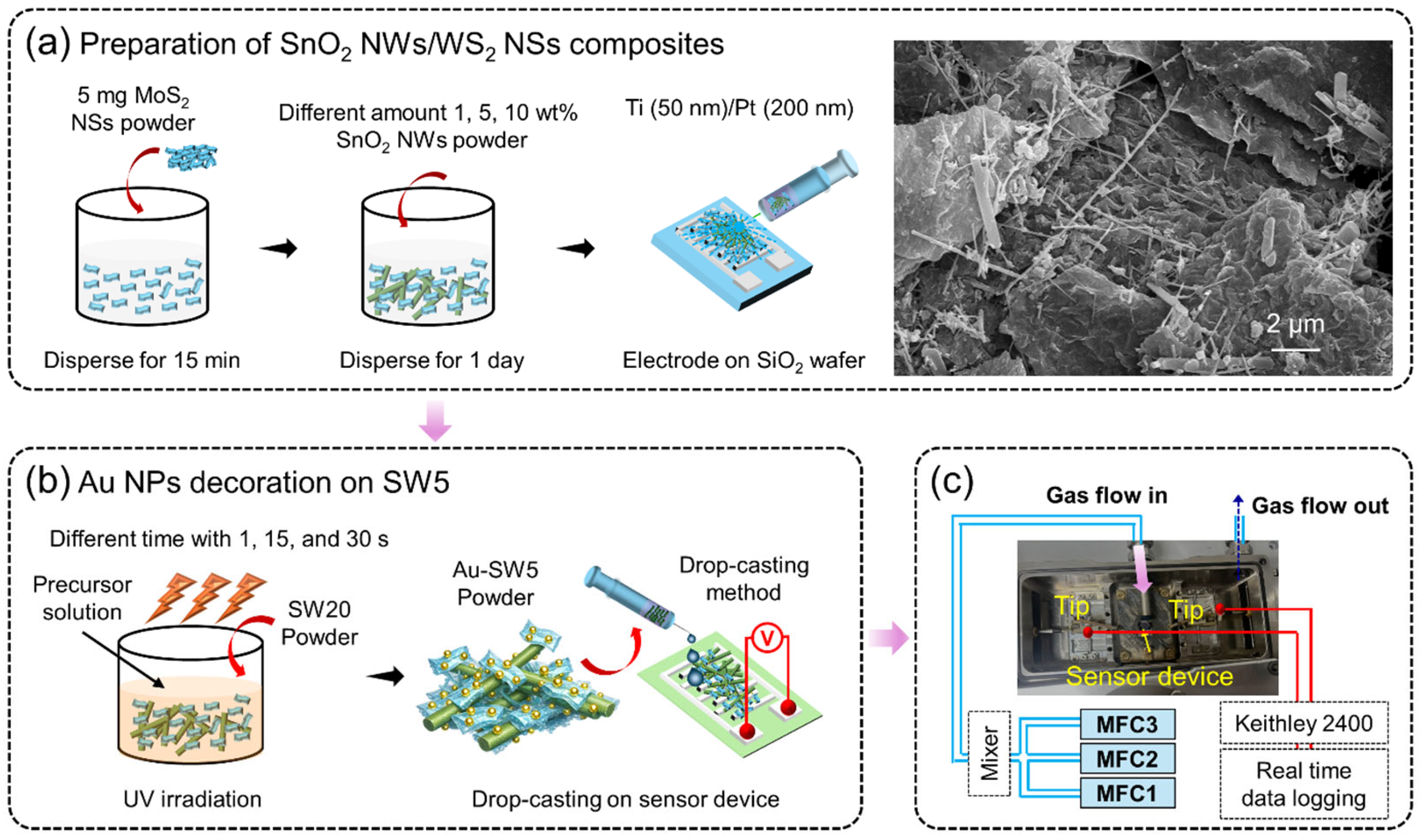
SnO2 NWs were synthesized using a vapor–liquid–solid growth process. A thin Au layer (3 nm) was first deposited onto a Si substrate, which was then placed in a quartz tube furnace together with high-purity Sn powder (99.9%, Sigma-Aldrich Co., Ltd., St. Louis, MO, USA). The growth was carried out at 900 °C for 5 min under a mixed gas flow of N2 (300 sccm) and O2 (10 sccm). After the growth process, the obtained SnO2 NWs were collected from the substrate and stored for further use. The synthesized NWs exhibited an average diameter of approximately 50 nm and lengths on the order of tens of micrometers, as schematically illustrated in Figure 1a. For the preparation of WS2/SnO2 composites, WS2 NS powder (5 mg, ACS Material Co., Ltd., Pasadena, CA, USA) was initially dispersed in 2-propanol and sonicated to ensure a homogeneous suspension. Subsequently, different amounts of SnO2 NWs (1, 5, and 10 wt%) were added to the solution and mixed thoroughly to form composite suspensions. The prepared mixtures were then drop-cast onto substrates and dried at 80 °C to obtain SWx samples, following the process shown in Figure 1a.

2.2. Preparation of Au-Decorated WS2–SnO2 Nanocomposites

For Au NP decoration, 0.248 mM of HAuCl6·H2O (KOJIMA chemicals Co., Ltd., Saitama, Japan) was dissolved in 2-propanol. The SnO2 NW/WS2 NS composites were immersed into the precursor solution and exposed to UV irradiation using a halogen lamp (0.11 mW/cm2 and λ = 360 nm) for 1, 15, and 30 s. During UV exposure, Au ions were reduced and decorated onto the surface of the composites (Figure 1b). Subsequently, the samples were annealed at 500 °C for 30 min under N2 atmosphere to improve the crystallinity and interfacial contact between the Au NPs and the WS2/SnO2 heterostructures. As the UV irradiation time increased, the size and surface coverage of Au NPs increased, as confirmed by TEM observations.

2.3. Characterizations

The crystalline structure of the samples was analyzed by X-ray diffraction (XRD, Bruker D8 Advance, Billerica, MA, USA) using CuKα1 radiation (λ = 1.5406 Å). The morphology and microstructural features were examined by field-emission scanning electron microscopy (FE-SEM, Hitachi S-4200, Tokyo, Japan) and transmission electron microscopy (TEM, JEOL, Tokyo, Japan). The surface chemical composition and elemental states were investigated using X-ray photoelectron spectroscopy (XPS, K-Alpha, Thermo Scientific, Waltham, MA, USA). In addition, ultraviolet photoelectron spectroscopy (UPS, Thermo Fisher Scientific, Theta probe, Waltham, MA, USA) measurements were carried out under ultra-high vacuum conditions (<10−10 Torr) with a He I (21.22 eV) excitation source to determine the work function values of the materials.

2.4. Gas Sensing Tests

Gas sensing measurements were performed using sensor devices fabricated on substrates with interdigitated electrodes composed of Ti (50 nm) and Au (200 nm) layers. The electrical characteristics of the sensors were monitored using a source meter (Keithley 2400, Cleveland, OH, USA) connected to a computer for real-time data acquisition. The sensors were placed inside a sealed gas chamber with a volume of 517.5 cm3, and the overall measurement setup, including gas flow control and electrical monitoring, is illustrated in Figure 1c. The temperature of the system was controlled using a heater located on the backplate. Target gases were introduced into the chamber through mass flow controllers (MFCs), allowing precise control of gas concentration. All gases were balanced with high-purity dry air (99.999%), which was also used for dilution. For example, a certified gas cylinder containing 10 ppm ethanol was diluted with dry air at a ratio of 1:9 to obtain a concentration of 1 ppm. The total gas flow rate was maintained at 500 sccm throughout the measurements. The sensor response was defined based on the resistance change upon gas exposure. For oxidizing gases such as NO2, the response was defined as the ratio of resistance in gas (Rg) to that in air (Ra), while for reducing gases, the inverse definition (Ra/Rg) was used. This response definition is commonly used for resistive gas sensors toward oxidizing gases and enables straightforward comparison with previously reported NO2 sensing studies. The dynamic resistance was continuously recorded during alternating exposure to the target gas and air. The response and recovery times were defined as the time required to reach 90% of the final resistance change upon NO2 exposure and stoppage, respectively. To evaluate the influence of humidity, humid air was generated by passing dry air through a bubbler system and subsequently mixing it with the target gas using MFCs. The relative humidity (RH) was controlled by adjusting the ratio between dry and humid air, and measurements were conducted under different RH levels ranging from 30% to 90% at room temperature. The humidity values were monitored at 25 °C.

3. Results and Discussion

3.1. Characterization Studies

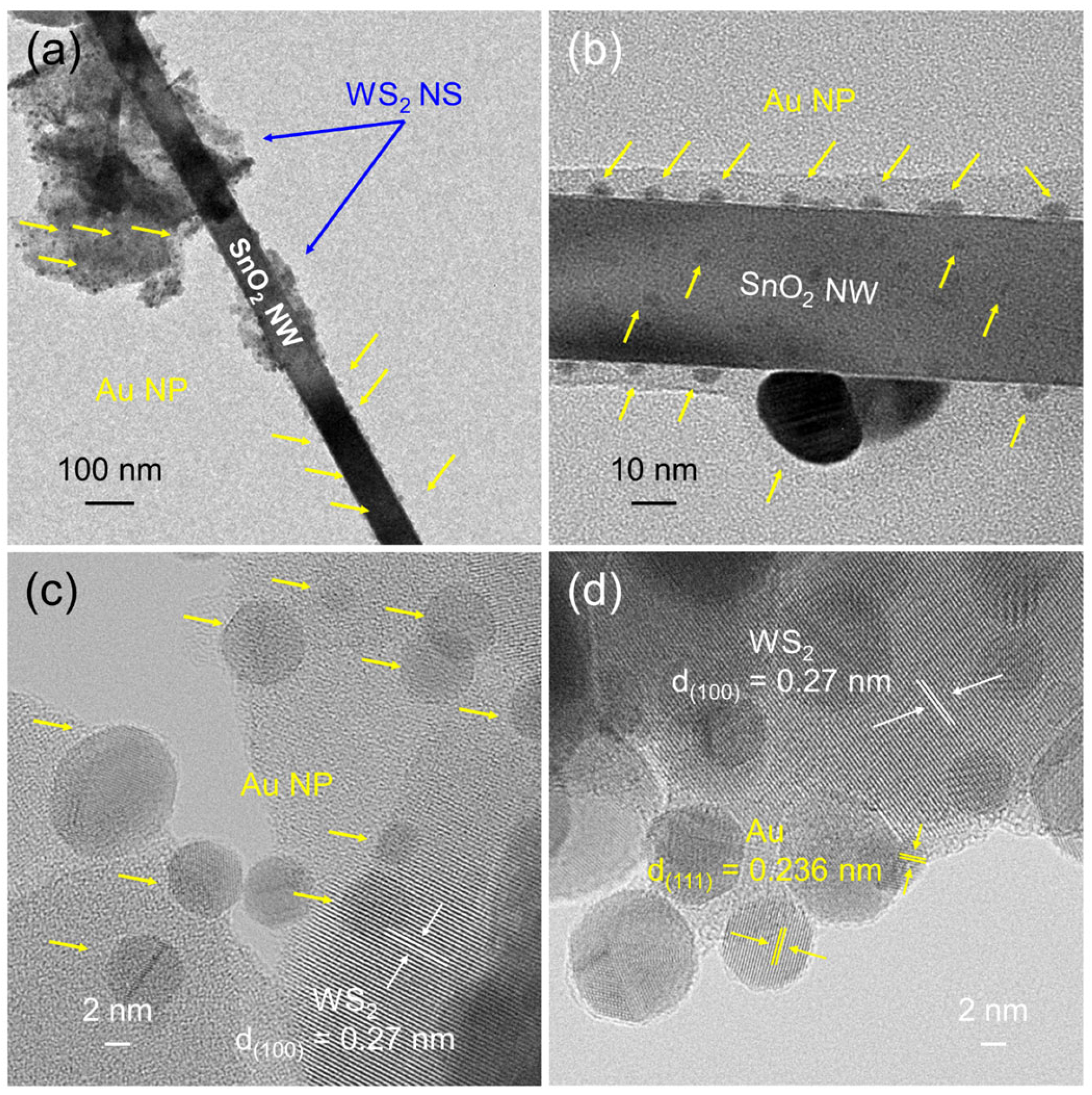
Based on the TEM image of SW5 nanocomposite presented in Figure 2a, the nanocomposite formed an interconnected network composed of 1D SnO2 NWs intertwined with 2D WS2 NSs, which provided efficient charge flow pathways along the NWs while maintaining significant amounts of surface active sites from the NSs. In addition, Figure 2b demonstrates the formation of Au NPs on the surface of the composite, confirming successful decoration of Au NPs. High-resolution TEM images (Figure 2c,d) provide insight into the crystalline nature of the synthesized materials, where lattice fringes with interplanar spacings of 0.27 nm and 0.236 nm are related to the (100) plane of WS2 and the (111) plane of Au, respectively. Thus, the coexistence of the WS2, SnO2, and Au components within the synthesized material was demonstrated.
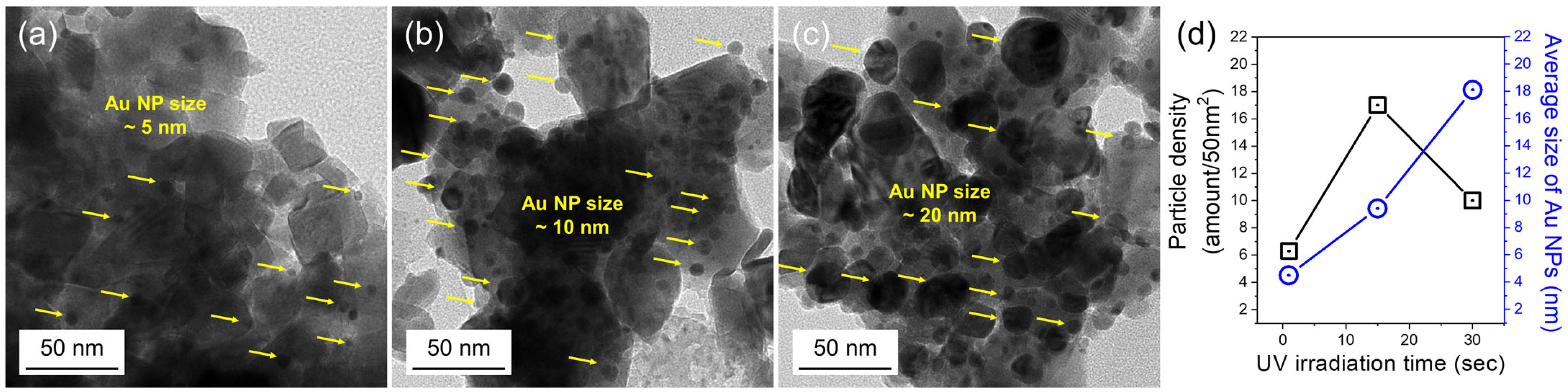
The effect of UV irradiation time on Au NP formation was further analyzed using TEM images, as shown in Figure 3a–c. With increasing UV irradiation time from 1 to 30 s, the average Au NP size increased from 4.5 to 18.1 nm. In contrast, the particle density increased from 6.3 to 17 within a 50 nm × 50 nm area when the irradiation time increased from 1 to 15 s, but decreased to 10 after the 30 s irradiation (Figure 3d). This decrease in particle density at prolonged irradiation time is attributed to particle growth and coalescence. Therefore, the 15 s irradiation condition provided the most balanced Au NP size and density, which is favorable for enhancing catalytic activity and interfacial modulation.
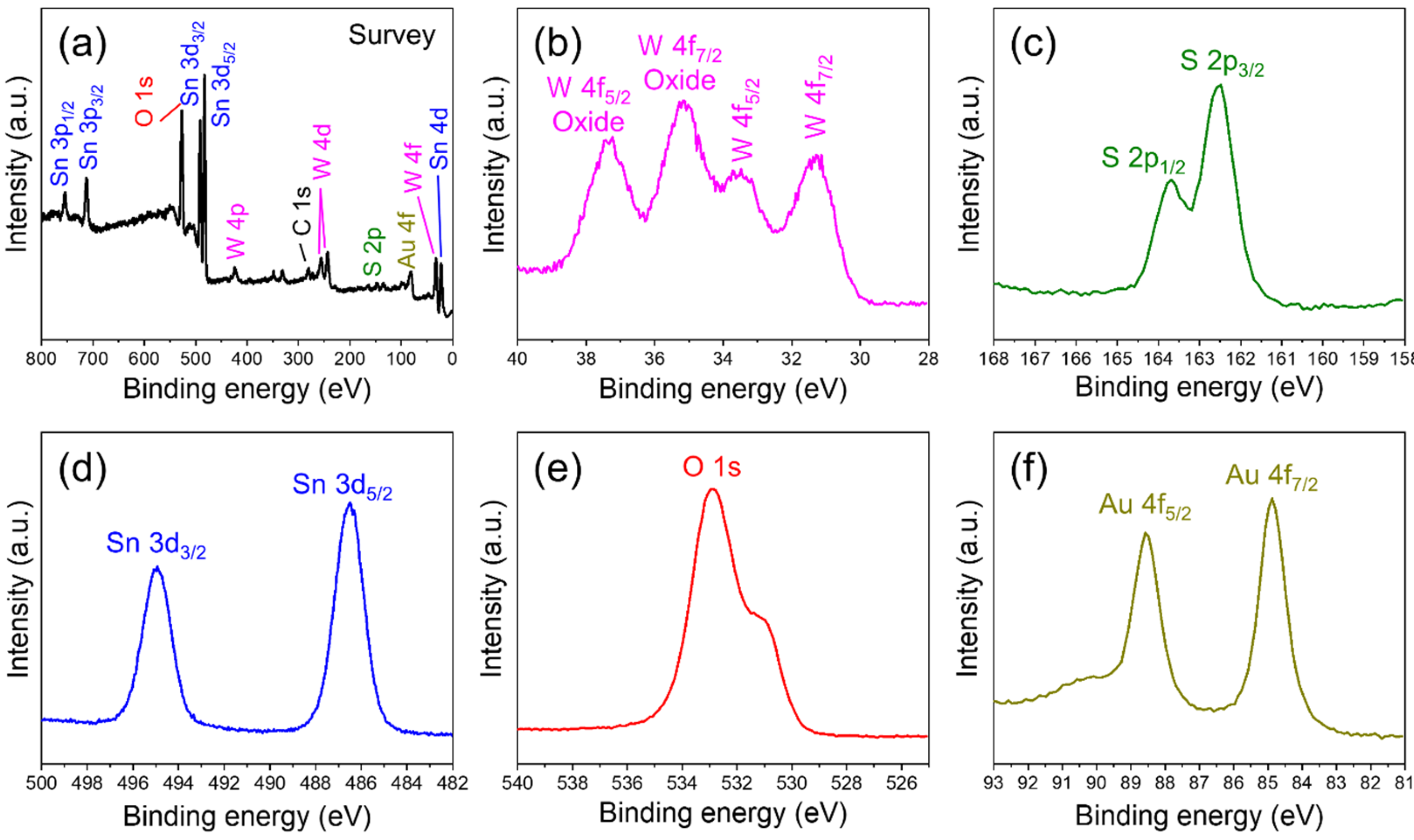
The chemical composition and surface states of the optimized sample were analyzed using X-ray photoelectron spectroscopy, as shown in Figure 4. The survey spectrum confirms the presence of W, S, Sn, O, and Au elements, indicating the successful formation of the 15Au-SW5 sample (Figure 4a). The peaks related to Sn, O, W, S, Au, and C (from ambient) were detected, showing high purity of the synthesized sample. Figure 4b offers the W 4f XPS core-level showing the peaks related to W 4f5/2 and W 4f7/2 belong to WO3 which is formed due to negligible oxidation of the WS2 surface in air atmosphere along with two peaks related to W 4f5/2 and W 4f7/2 that belong to the W4+ ion in WS2 [31]. Figure 4c presents the S 2p core-level region showing two main peak of S 2p3/2 and S 2p1/2, which belong to the S2− in WS2. Figure 4d offers the Sn 3d core-level region with two main peaks of Sn 3d3/2 and Sn 3d5/2, which belong to the Sn4+ in SnO2 [32]. Figure 4e gives the O 1s core-level region. It can be related to the presence of the oxygen ion in SnO2. Figure 4f presents the Au 4f core-level region with two peaks of Au 4f5/2 and Au 4f7/2 the belong to metallic Au. Thus, no impurity elements were identified in the synthesized samples.
All in all, the structural and chemical analyses approved the successful synthesis of Au-decorated WS2/SnO2 heterostructures. The combination of 1D NWs and 2D NSs, along with Au NPs, provides an appropriate platform for enhancing gas sensing output, which is discussed in the following sections.

3.2. Gas Sensing Studies

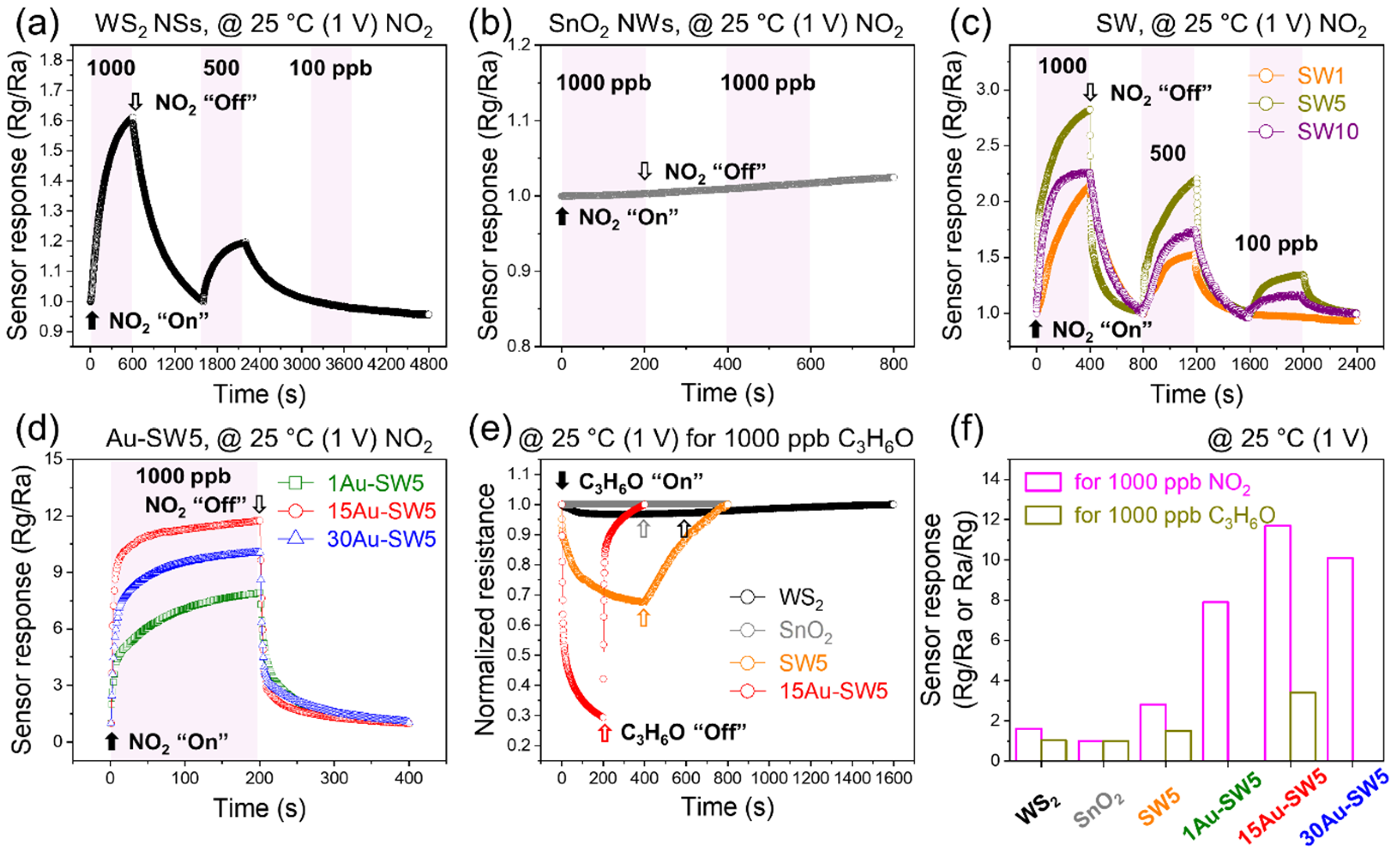
The ppb NO2 sensing performance of the fabricated sensors was systematically explored, as shown in Figure 5. As presented in Figure 5a, the pristine WS2 sensor exhibited a very weak response to NO2, with negligible response at 100 ppb and only a slight increase at higher concentrations. The resistance increased in NO2 atmosphere, implying n-type sensing behavior of the sensor. In contrast, the pristine SnO2 NW sensor (Figure 5b) showed almost no response toward 1000 ppb NO2, due to insufficient activation of surface reactions. Next, WS2/SnO2 nanocomposites with different amounts of SnO2 were explored (Figure 5c). All composite sensors (SW1, SW5, and SW10) exhibited improved responses compared to the pristine materials, suggesting the beneficial effect of the heterostructure formation. Among them, the SW5 sensor showed the highest response, with values of 2.1, 2.8, and 2.2 toward 1000 ppb NO2 for SW1, SW5, and SW10, respectively. This suggests that an appropriate SnO2 content is beneficial for effective interfacial charge modulation at the WS2–SnO2 interface, while excessive SnO2 content may reduce the contribution of WS2 active sites. Further improvement was achieved by decorating Au NPs on the SW5 composite (Figure 5d). The sensing response strongly depended on the UV irradiation time used for Au NP formation. Among the tested samples, the 15Au-SW5 sensor exhibited the highest response, reaching approximately 11.7 toward 1000 ppb NO2, which is more than four times higher than that of the Au-free SW5 sensor. In contrast, the 1Au–SW5 and 30Au–SW5 sensors showed lower responses, indicating that both insufficient and excessive Au loading are unfavorable. This behavior can be attributed to the balance between catalytic activity and effective Schottky junction formation, which is optimized at an intermediate Au NP size and density. The selectivity of the sensors was evaluated by comparing their responses to NO2 and acetone (Figure 5e,f). While all sensors showed some response to acetone, the 15Au-SW5 sensor exhibited a significantly higher response to NO2, demonstrating preferential sensitivity toward oxidizing gases under the present conditions. The response and recovery times of the optimized 15Au-SW5 sensor toward 1000 ppb NO2 gas were estimated to be 37 and 28 s, respectively. The relatively fast sensing dynamics are associated with the enhanced surface reactions and interfacial charge modulation induced by the WS2/SnO2 heterostructure and Au NP decoration.
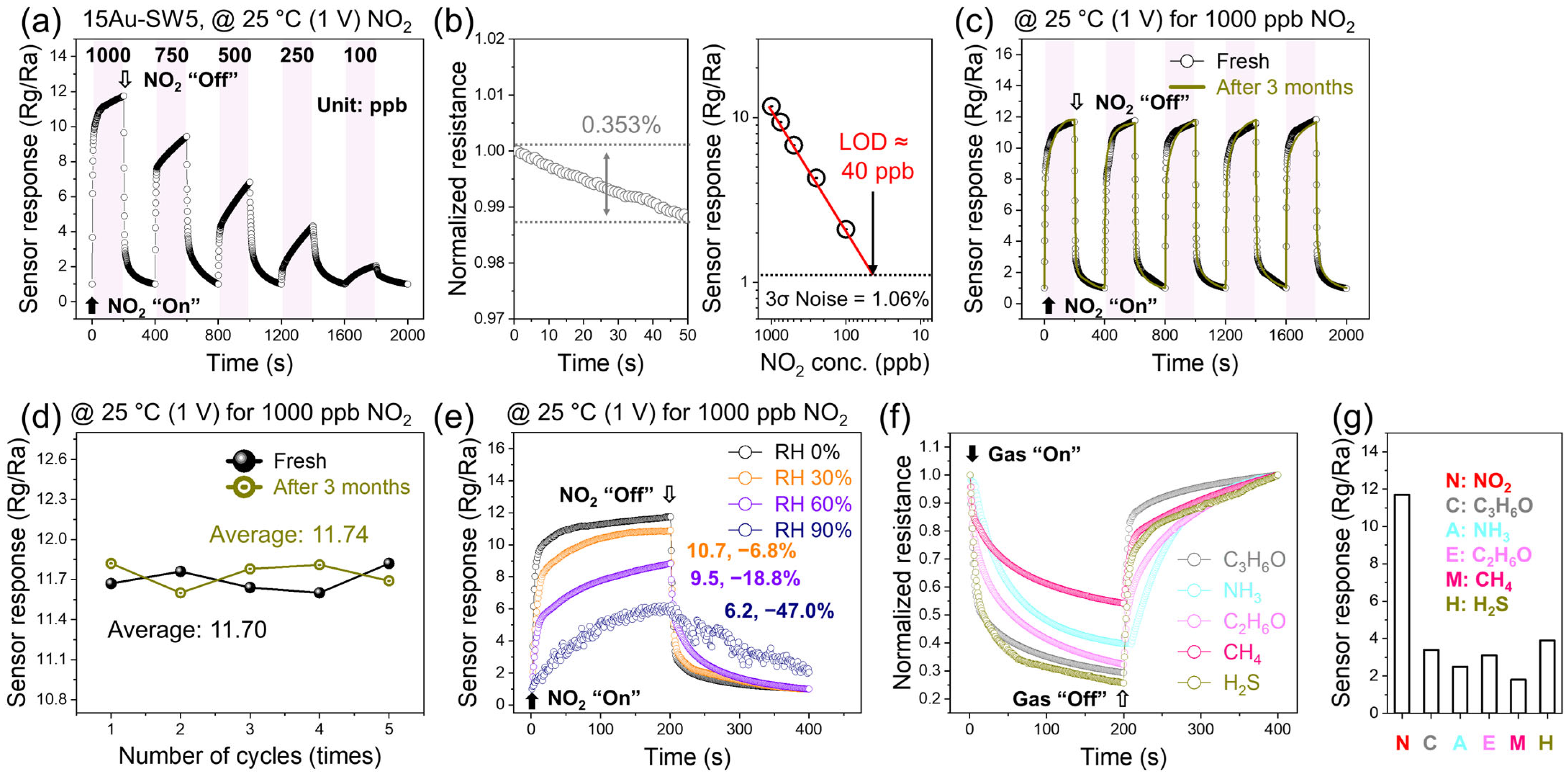
The sensing features of the optimized 15Au-SW5 sensor are indicated in Figure 6. As shown in Figure 6a, the sensor manifested reversible resistance changes when exposed to different ppb levels of NO2 at RT. The response values were 2.1, 4.3, 6.8, 9.4, and 11.7 for 100, 250, 500, 750, and 1000 ppb NO2, respectively, showing a monotonic increase with concentration. The corresponding calibration curve is linear in the measured range (Figure 6b). Experimentally, the sensor revealed a limit of detection (LOD) of 40 ppb with a response of 1.1, while theoretical LOD was calculated to be ~1 ppb. The baseline noise, signal stability, and the limited resolution of low-concentration measurements attributes to difference between the experimental and theoretical LOD values. The repeatability and long-term stability of the 15Au-SW5 sensor were also investigated. As shown in Figure 6c,d, the sensor exhibited consistent responses over sequential cycles, with average response values of 11.70 and 11.74 for fresh and preserved sensors, respectively, indicating excellent stability along with repeatability.
The effect of humidity was explored by monitoring the sensing response under different RH conditions (Figure 6e). The response values decreased 6.8%, 18.8%, and 47% relative to dry condition, at RH levels of 30, 60, and 90%. Thus, the sensing response gradually decreased with increasing RH, indicating competitive adsorption between H2O molecules and NO2 molecules on active sensing sites. Nevertheless, distinguishable sensing behavior was maintained even under high humidity conditions. Under humid conditions, adsorbed H2O molecules may occupy active adsorption sites and interfere with the adsorption of NO2 molecules and reactive oxygen species on the sensor surface. As a result, interfacial charge transfer associated with NO2 sensing can be partially suppressed, leading to reduced sensing response at high RH conditions. Finally, the selectivity of the optimized sensor was investigated towards various gases namely, NO2, acetone, ethanol, ammonia, methane, and hydrogen sulfide (Figure 6f). The response values were 11.7, 3.4, 2.5, 3.1, 1.8, and 3.9, respectively, demonstrating good selectivity of the gas sensor towards NO2 gas (Figure 6g).
A comparison of the sensing performance with previously reported RT NO2 gas sensors is summarized in Table 1, demonstrating the competitive sensing characteristics of the present 15Au-SW5 sensor.

3.3. Gas Sensing Mechanism

The sensing mechanism of gas sensors in this work can be explained using surface adsorption reactions, heterojunction effects, and an Au catalytic effect.
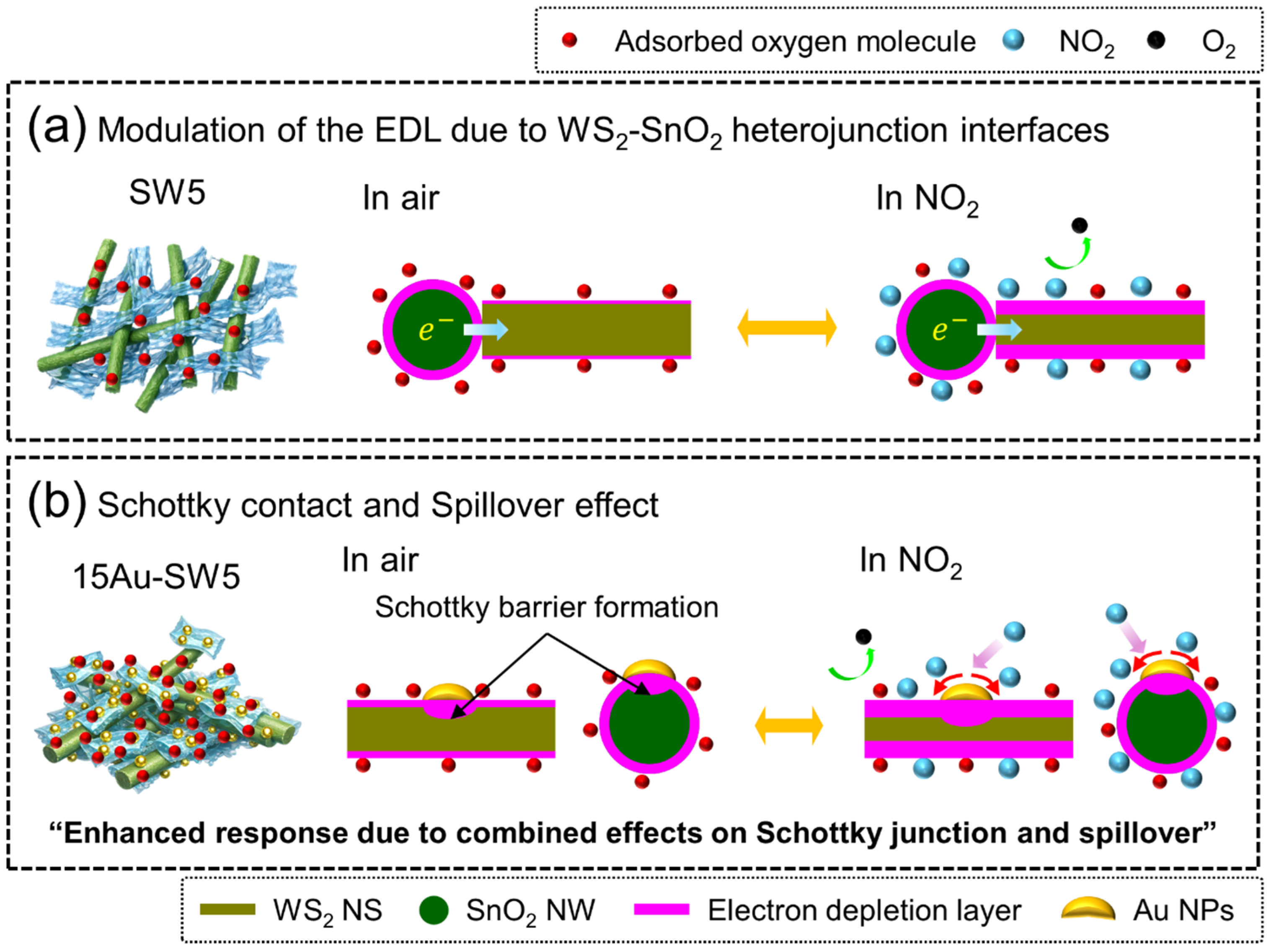
Initially, in air, oxygen molecules capture the electrons from the sensor’s surface, forming ionized oxygen species. This leads to the formation of an electron depletion layer (EDL) with low amount of electrons relative to the core region. At RT, adsorbed oxygen species are mainly present in molecular or weakly ionized forms. In the presence of NO2 gas, additional electrons are extracted from the sensor surface, leading to expansion of the electron depletion layer and an increase in sensor resistance. However, in pristine sensors, the number of resistance modulation sources were limited, eventually leading to a low response.
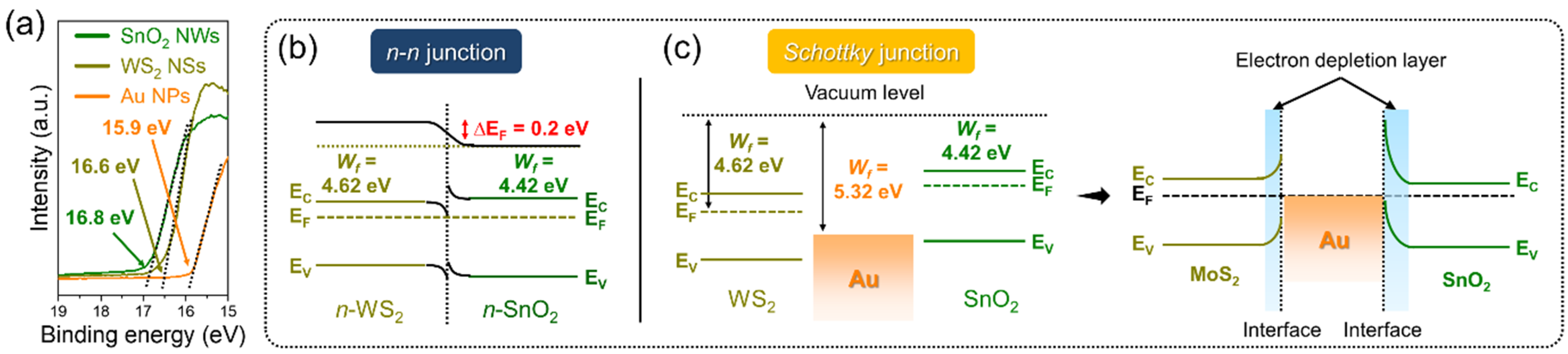
In WS2/SnO2 nanocomposite sensors, the formation of nn heterojunctions should be considered. Based on the UPS results (Figure 7a), the work function values of WS2 and SnO2 were estimated to be 4.62 eV and 4.42 eV, respectively. Thus, in intimate contact between the two materials, electrons transfer from SnO2 to WS2 to equate the Fermi levels, resulting in band bending at the interface and potential barriers for the flow of electrons (Figure 7b). Upon exposure to NO2 and further extraction of electrons, the height of potential barriers increased, leading to remarkable resistance, contributing to a large response. This explains the improved sensing performance observed for nanocomposite sensors.
For Au-decorated samples, additional effects contribute to the sensing enhancement (Figure 8). First, Au NPs act as catalytic sites that facilitate the adsorption and activation of oxygen molecules. The activated oxygen species can migrate onto the surface of WS2 and SnO2 through a spillover process, increasing the density of reactive sites. Second, due to the higher work function of Au (5.32 eV), electrons transfer from the semiconductor materials to the Au NPs, resulting in the formation of Schottky barriers at the Au–WS2 and Au–SnO2 interfaces. These barriers introduce additional depletion regions and increase the sensitivity of the sensor to changes in surface charge.
When NO2 gas is introduced, the combined effects of heterojunction modulation and Au-induced Schottky barriers lead to a more pronounced expansion of the depletion region and a larger change in resistance. The sensing performance therefore depends on the amount and size of Au NPs. At low Au loading, the number of catalytic sites and Schottky junctions is insufficient. In contrast, excessive Au loading leads to particle aggregation, which reduces the effective surface area and the number of active junctions. As a result, an optimal condition is achieved for the 15Au-SW5 sensor, where both catalytic activity and interfacial charge modulation are maximized.
Overall, the enhanced sensing performance of the optimized sensor can be attributed to the synergistic effects of WS2–SnO2 heterojunctions and Au-induced surface modulation, which together enable efficient charge transfer and amplified resistance variation upon NO2 exposure.

4. Conclusions

WS2 NSs were hybridized with SnO2 NWs and further decorated with Au NPs via controlled UV irradiation to achieve enhanced NO2 sensing at RT. The systematic tuning the amount of SnO2 and Au NP characteristics strongly affected the sensing performance. Among the fabricated sensors, the optimized 15Au-SW5 sensor exhibited a high response of 11.7 toward 1000 ppb NO2 with an estimated experimental LOD of ~40 ppb, along with good selectivity and long-term stability, demonstrating its potential for practical NO2 sensing applications. The enhanced sensing behavior was related to the formation of WS2–SnO2 heterojunctions, Au-induced interfacial modulation, and the catalytic surface reactions of the Au NPs. These results suggest that simultaneous optimization of heterostructure composition and Au NP characteristics is an effective strategy for achieving highly sensitive ppb-level NO2 sensing at RT.

Author Contributions

Formal analysis, investigation, data curation, writing—original draft preparation, and writing—review and editing, M.S.C.; conceptualization, methodology, validation, formal analysis, investigation, data curation, writing—original draft preparation, writing—review and editing, supervision, and funding acquisition, J.-H.K. All authors have read and agreed to the published version of the manuscript.

Funding

This work was supported by an INHA UNIVERSITY Research Grant.

Institutional Review Board Statement

Not applicable.

Informed Consent Statement

Not applicable.

Data Availability Statement

Data will be made available on request.

Conflicts of Interest

The authors declare no conflicts of interest. The funders had no role in the design of the study; in the collection, analyses, or interpretation of data; in the writing of the manuscript; or in the decision to publish the results.

References

  1. Brunekreef, B.; Holgate, S.T. Air Pollution and Health. Lancet 2002, 360, 1233–1242. [Google Scholar] [CrossRef]
  2. Ogen, Y. Assessing Nitrogen Dioxide (NO2) Levels as a Contributing Factor to Coronavirus (COVID-19) Fatality. Sci. Total Environ. 2020, 726, 138605. [Google Scholar] [CrossRef] [PubMed]
  3. Chauhan, A.; Inskip, H.M.; Linaker, C.H.; Smith, S.; Schreiber, J.; Johnston, S.L.; Holgate, S.T. Personal Exposure to Nitrogen Dioxide (NO2) and the Severity of Virus-Induced Asthma in Children. Lancet 2003, 361, 1939–1944. [Google Scholar] [CrossRef]
  4. Lu, C.; Wang, F.; Liu, Q.; Deng, M.; Yang, X.; Ma, P. Effect of NO2 Exposure on Airway Inflammation and Oxidative Stress in Asthmatic Mice. J. Hazard. Mater. 2023, 457, 131787. [Google Scholar] [CrossRef] [PubMed]
  5. Fu, Y.; Zhang, W.; Li, Y.; Li, H.; Deng, F.; Ma, Q. Association and Interaction of O3 and NO2 with Emergency Room Visits for Respiratory Diseases in Beijing, China. BMC Public Health 2022, 22, 2265. [Google Scholar] [CrossRef] [PubMed]
  6. Hesterberg, T.W.; Bunn, W.B.; McClellan, R.O.; Hamade, A.K.; Long, C.M.; Valberg, P.A. Critical Review of the Human Data on Short-Term Nitrogen Dioxide (NO2) Exposures. Crit. Rev. Toxicol. 2009, 39, 743–781. [Google Scholar] [CrossRef]
  7. Hamra, G.B.; Laden, F.; Cohen, A.J.; Raaschou-Nielsen, O.; Brauer, M.; Loomis, D. Lung Cancer and Exposure to Nitrogen Dioxide and Traffic. Environ. Health Perspect. 2015, 123, 1107–1112. [Google Scholar] [CrossRef]
  8. Xie, S.; Zhu, X.; Mounaïm-Rousselle, C.; Zhang, H. Reframing NOx in Ammonia Combustion: From Pollutants to Reactive Oxidizers and Their Emerging Roles. Chin. J. Aeronaut. 2026, 104208, in press. [Google Scholar] [CrossRef]
  9. Mokrushin, A.S.; Gorban, Y.M.; Averin, A.A.; Gorobtsov, P.Y.; Simonenko, N.P.; Lebedinskii, Y.Y.; Simonenko, E.P.; Kuznetsov, N.T. Obtaining of ZnO/Fe2O3 Thin Nanostructured Films by AACVD for Detection of Ppb-Concentrations of NO2 as a Biomarker of Lung Infections. Biosensors 2023, 13, 445. [Google Scholar] [CrossRef]
  10. Chai, H.; Zheng, Z.; Liu, K.; Xu, J.; Wu, K.; Luo, Y.; Liao, H.; Debliquy, M.; Zhang, C. Stability of Metal Oxide Semiconductor Gas Sensors: A Review. IEEE Sens. J. 2022, 22, 5470–5481. [Google Scholar] [CrossRef]
  11. Comini, E. Metal Oxides Nanowires Chemical/Gas Sensors: Recent Advances. Mater. Today Adv. 2020, 7, 100099. [Google Scholar] [CrossRef]
  12. Ou, L.-X.; Liu, M.-Y.; Zhu, L.-Y.; Zhang, D.W.; Lu, H.-L. Recent Progress on Flexible Room-Temperature Gas Sensors Based on Metal Oxide Semiconductor. Nano-Micro Lett. 2022, 14, 206. [Google Scholar] [CrossRef]
  13. Bhardwaj, R.; Pumera, M. Surface-Engineered 2D Nanomaterials in Gas Sensors: Advancement and Challenges. Small 2025, 21, 2410360. [Google Scholar] [CrossRef]
  14. Guang, Q.; Huang, B.; Yu, J.; Bonyani, M.; Moaddeli, M.; Kanani, M.; Mirzaei, A.; Kim, H.W.; Kim, S.S.; Li, X. PtS-Decorated WS2 Microflakes Based Sensors for Selective Ammonia Detection at Room Temperature. Sens. Actuators B 2023, 394, 134399. [Google Scholar] [CrossRef]
  15. Pawar, K.K.; Kumar, A.; Mirzaei, A.; Kumar, M.; Kim, H.W.; Kim, S.S. 2D Nanomaterials for Realization of Flexible and Wearable Gas Sensors: A Review. Chemosphere 2024, 352, 141234. [Google Scholar] [CrossRef]
  16. Patrick, D.S.; Bharathi, P.; Kamalakannan, S.; Archana, J.; Navaneethan, M.; Mohan, M.K. Confined Oxidation of 2D WS2 Nanosheets Forming WO3/WS2 Nanocomposites for Room Temperature NO2 Gas Sensing Application. Appl. Surf. Sci. 2024, 642, 158554. [Google Scholar] [CrossRef]
  17. Mirzaei, A.; Alizadeh, M.; Ansari, H.R.; Moayedi, M.; Kordrostami, Z.; Safaeian, H.; Lee, M.H.; Kim, T.; Kim, J.; Kim, H.W.; et al. Resistive Gas Sensors Based on 2D WS2, WSe2, MoS2, and MoSe2: A Review. Nanotechnology 2024, 35, 332002. [Google Scholar] [CrossRef]
  18. Kumar, S.; Mirzaei, A.; Kumar, A.; Lee, M.H.; Ghahremani, Z.; Kim, T.-U.; Kim, J.-Y.; Kwoka, M.; Kumar, M.; Kim, S.S.; et al. Nanoparticles Anchored Strategy to Develop 2D MoS2 and MoSe2 Based Gas Sensors. Coord. Chem. Rev. 2024, 503, 215657. [Google Scholar] [CrossRef]
  19. Gorthala, G.; Ghosh, R. Atomically Thin-Layered WS2 Based Resistive Sensors for Detection of CO and NO2 at Room Temperature. Nanotechnology 2024, 35, 405501. [Google Scholar] [CrossRef]
  20. Kundu, S.; Gorthala, G.; Ghosh, R. Room Temperature Detection of H2S by WS2 Based Sensors. Sens. Actuators B 2024, 416, 136018. [Google Scholar] [CrossRef]
  21. Xia, Y.; Xu, L.; He, S.; Li, X.; Chen, X.; Song, H.; Zhang, H. UV-Activated WS2/SnO2 2D/0D Heterostructures for Fast and Reversible NO2 Gas Sensing at Room Temperature. Sens. Actuators B 2022, 364, 131903. [Google Scholar] [CrossRef]
  22. Kodan, S.; Arora, N.; Gautam, A.; Sanger, A.; Arora, A.; Malik, V.K.; Chandra, R. Vertically Aligned MoSe2–WS2 Nanoworms Heterojunction toward Room-Temperature NO2 Gas Sensors. Sens. Actuators B 2024, 407, 135481. [Google Scholar] [CrossRef]
  23. Han, Y.; Liu, Y.; Su, C.; Wang, S.; Li, H.; Zeng, M.; Hu, N.; Su, Y.; Zhou, Z.; Wei, H.; et al. Interface Engineered WS2/ZnS Heterostructures for Sensitive and Reversible NO2 Room Temperature Sensing. Sens. Actuators B 2019, 296, 126666. [Google Scholar] [CrossRef]
  24. Yang, Y.; An, B.; Wu, Z.; Wang, Y.; Li, R.; Wang, P.; Zhang, T.; Han, R.; Xie, E. Room Temperature Ppb Level-NO2 Sensor Based on Fe -ni Co-Catalyst Modification. Appl. Surf. Sci. 2024, 675, 160978. [Google Scholar] [CrossRef]
  25. Wu, H.; Zhang, G.; Cui, H.; Deng, X. Atomic-Level Sensing Mechanism of Rh-Doped MoS2–WS2 Heterojunction Towards Dissolved H2, C2H2, and C2H4 in Transformer Oil: A First-Principles Study. Colloids Surf. A 2026, 738, 140006. [Google Scholar] [CrossRef]
  26. Kim, J.-H.; Sakaguchi, I.; Hishita, S.; Suzuki, T.T.; Saito, N. Au-Decorated 1D SnO2 Nanowire/2D WS2 Nanosheet Composite for CO Gas Sensing at Room Temperature in Self-Heating Mode. Chemosensors 2022, 10, 132. [Google Scholar] [CrossRef]
  27. Korotcenkov, G.; Brinzari, V.; Cho, B.K. Conductometric Gas Sensors Based on Metal Oxides Modified with Gold Nanoparticles: A Review. Microchim. Acta 2016, 183, 1033–1054. [Google Scholar] [CrossRef]
  28. George, G.; Raghav, G.R.; Thomas, N.R.; Ede, S.R.; Shivamurthy, B.; Nair, A.K.; Senthil, T. Gold Nanoparticles-Based Gas Sensors: A Comprehensive Review. Crit. Rev. Anal. Chem. 2025, 55, 1–39. [Google Scholar] [CrossRef]
  29. Kim, J.-H.; Mirzaei, A.; Kim, H.W.; Kim, S.S. Realization of Au-Decorated WS2 Nanosheets as Gas Sensors. Sens. Actuators B 2019, 296, 126659. [Google Scholar] [CrossRef]
  30. Kim, J.-H.; Kim, J.-Y.; Mirzaei, A.; Kim, H.W.; Kim, S.S. Synergistic Effects of SnO2 and Au on WS2 Nanosheets. Sens. Actuators B 2021, 332, 129493. [Google Scholar] [CrossRef]
  31. Park, H.; Kim, J.; Ahn, S.; Mirzaei, A.; Kim, J.-H.; Park, C. CuO Nanoparticles-Decorated WS2–WO3 Heterojunctions for H2S Gas Sensor. Sens. Actuators B 2025, 427, 137167. [Google Scholar] [CrossRef]
  32. Marimuthu, G.; Saravanakumar, K.; Jeyadheepan, K.; Mahalakshmi, K. Achieving Self-Powered Photoresponse in SnO2 Nanostructure Array UV Photodetector. J. Photochem. Photobiol. A 2022, 428, 113860. [Google Scholar] [CrossRef]
  33. Ren, W.; Luan, J.; Yin, L.; Chen, H.; Wang, C.; Zhang, P.; Cui, G.; Lv, L. Ultrasensitive Room-Temperature NO2 Gas Sensor Based on MXene–Cu2O Composites. ACS Sens. 2025, 10, 3579–3588. [Google Scholar] [CrossRef]
  34. Ge, C.; Ni, M.; Liu, S.; Hussain, S.; Qiao, G.; Liu, J.; Liu, G. A Room-Temperature NO2 Gas Sensor Based on Zn2+ doped Cu2O/CuO Composites with Ultra-High Response. Ceram. Int. 2025, 51, 2194–2203. [Google Scholar] [CrossRef]
  35. Abimaheshwari, R.; Murugadass, T.; Abinaya, R.; Navaneethan, M.; Harish, S. Fabrication of SnS2/Si Heterostructure for Ultra-High Selective and Rapid Room Temperature NO2 Gas Detection with Enhanced Carrier Mobility. Sens. Actuators B 2025, 428, 137165. [Google Scholar] [CrossRef]
  36. Shakya, P.; Khan, M.S.; Kumar, S.; Jhankal, D.; Verma, N.; Sachdev, K. Understanding the Gas Sensing Mechanism of MoSe2 Nanoroses and rGO Composite-Based Chemiresistive Sensors for Room Temperature NO2 Detection. Chem. Eng. J. 2025, 503, 158178. [Google Scholar] [CrossRef]
Figure 1. Schematic illustration of (a) preparation of WS2 NS/SnO2 NW composites (SWx), (b) Au NP decoration via UV irradiation, and (c) the gas sensing measurement system. The inset in (a) shows an SEM image of the SW5 sample.
Sensors 26 03504 g001
Figure 2. (a) TEM image of 15Au-SW5 showing the hybrid structure composed of WS2 NSs and SnO2 NWs, (b) enlarged TEM image showing Au NP distribution, and (c,d) HRTEM images displaying lattice fringes corresponding to WS2 and Au.
Sensors 26 03504 g002
Figure 3. TEM images of Au-decorated SW5 samples prepared with different UV irradiation times: (a) 1 s, (b) 15 s, and (c) 30 s. (d) Variations of Au NP density and average Au NP size as a function of UV irradiation time.
Sensors 26 03504 g003
Figure 4. (a) XPS survey spectrum of 15Au-SW5, and high-resolution spectra of (b) W, (c) S, (d) Sn, (e) O, and (f) Au, confirming the chemical states of the WS2, SnO2, and Au NPs.
Sensors 26 03504 g004
Figure 5. Dynamic sensing responses to NO2 at room temperature for (a) pristine WS2 NSs, (b) pristine SnO2 NWs, (c) SW1, SW5, and SW10 composites, and (d) Au-decorated SW5 samples (1Au–SW5, 15Au-SW5, and 30Au–SW5). (e) Dynamic responses to acetone and (f) comparison of responses to NO2 and acetone.
Sensors 26 03504 g005
Figure 6. Gas sensing characteristics of the optimized 15Au-SW5 sensor (a) Dynamic sensing transients toward 100–1000 ppb NO2 gas at RT. (b) Baseline noise analysis and estimated LOD. (c) Dynamic sensing curves toward 1000 ppb NO2 in fresh state and after 3 months. (d) Long-term stability toward 1000 ppb NO2 after 3 months. (e) Sensing characteristics toward 1000 ppb NO2 under different RH conditions. (f) Normalized sensing transients toward 1000 ppb of different gases. (g) Corresponding selectivity histogram.
Sensors 26 03504 g006
Figure 7. (a) UPS spectra and (b) energy band alignment of WS2, SnO2, and Au, and (c) schematic illustration of nn heterojunction formation between WS2 NSs and SnO2 NWs.
Sensors 26 03504 g007
Figure 8. Schematic illustration of the NO2 sensing mechanism: (a) WS2/SnO2 heterostructure showing modulation of the electron depletion layer and (b) Au-decorated system highlighting Schottky barrier formation and spillover-assisted surface reactions.
Sensors 26 03504 g008
Table 1. Comparison of RT NO2 sensing performance of recently reported heterostructure-based gas sensors.
Sensing MaterialConc. (ppm)Response (Rg/Ra or Ra/Rg)LOD (ppb)τResRec (s)StabilityRef.
15Au-SW5111.74037/2890 daysThis work
2D/0D WS2/SnO2 (UV light)104509/830 days[21]
MoSe2-WS2 nanoworms0.0559.6% 15069/6660 days[22]
MXene–Cu2O composite0.56.071055/3530 days[33]
Zn-doped Cu2O/CuO1030.3235/4730 days[34]
SnS2/Si heterostructure40671% 117133/40230 days[35]
MoSe2 nanoroses and rGO composite438% 1100110/12860 days[36]
1 Note: R(%) = [ΔR/Ra] × 100.
Disclaimer/Publisher’s Note: The statements, opinions and data contained in all publications are solely those of the individual author(s) and contributor(s) and not of MDPI and/or the editor(s). MDPI and/or the editor(s) disclaim responsibility for any injury to people or property resulting from any ideas, methods, instructions or products referred to in the content.