1. Introduction
Cardiovascular disease (CVD) is a major global cause of death and places a significant burden on healthcare systems. Early identification of individuals at risk is crucial, as timely awareness can encourage preventive actions such as lifestyle changes and medical consultation, potentially reducing severe outcomes. With the growth of wearable devices, remote monitoring platforms, and digital health infrastructures, large-scale physiological, behavioral, and lifestyle data can now be collected to support such early risk detection. When these data are effectively translated into reliable risk estimates, they enable proactive and population-scale cardiovascular health management. However, traditional clinical risk models are often limited by linear assumptions and predefined features, which restrict their ability to capture complex patterns. This has led to increasing interest in AI-based approaches that can model nonlinear relationships across diverse health signals and improve early risk prediction.
Over the past decade, numerous studies have applied machine learning (ML) and deep learning (DL) techniques for heart disease and coronary heart disease (CHD) risk estimation using models such as logistic regression, random forests, support vector machines, gradient boosting, and neural networks [
1,
2,
3,
4]. These approaches demonstrate strong predictive performance and can be interpreted as decision layers operating on aggregated health-related data. However, much of the early literature relies on small, highly curated clinical datasets, particularly the Cleveland Heart Disease dataset, leading to inflated performance estimates and limited generalizability [
5,
6]. Consequently, recent research has shifted toward population-scale datasets, including national health surveys and biobanks, which better capture the heterogeneity, noise, and variability present in real-world health-monitoring systems [
7,
8,
9]. Several studies have demonstrated the feasibility of applying ML-based approaches to Behavioral Risk Factor Surveillance System (BRFSS) data for cardiovascular risk estimation [
1,
7,
10]. However, achieving reliable and clinically meaningful performance on such population-scale datasets remains challenging due to severe class imbalance, noisy signal distributions, and evaluation complexity.
A critical limitation of prior work is the reliance on small, highly curated datasets such as the UCI Heart Disease dataset (~300 samples), where reported accuracies often exceed 80–90%. However, such metrics can be misleading under class imbalance. In contrast, on population-scale datasets such as BRFSS-2024 (N > 450,000), models achieving over 90% accuracy may still exhibit recall as low as 0.10–0.15, indicating failure to detect the majority of true positive cases. This discrepancy highlights the extent of performance inflation in small-scale studies and underscores the need for evaluation under realistic, large-scale conditions.
1.1. Challenges
Despite the growing body of research, existing approaches exhibit two broad categories of limitations: (i) methodological challenges related to model design and data characteristics, and (ii) evaluation challenges arising from improper validation protocols and metric selection. Distinguishing between these categories is essential for isolating the sources of performance limitations and avoiding conflation between model design weaknesses and evaluation-induced performance inflation in population-scale settings.
Firstly, severe class imbalance is inherent in population-level datasets, where disease prevalence is typically below 10%. In many studies, accuracy is still emphasized as a primary evaluation metric, despite extensive evidence that accuracy can be misleading in imbalanced scenarios [
5,
11]. Real-world screening studies have demonstrated that models achieving high overall accuracy may fail to identify the majority of true disease cases, resulting in extremely low sensitivity and poor Matthews correlation coefficients (MCC) [
11]. Such behavior corresponds to a failure of the decision layer to reliably detect rare but critical events, making these models unsuitable for screening and early detection.
These challenges primarily arise from limitations in model design, feature representation, and learning objectives, which collectively affect the stability, consistency, and reliability of predictions across different population cohorts.
Second, instability in feature selection is rarely addressed. Many studies rely on a single feature selection technique, often based on model-specific importance scores or simple statistical filters, leading to feature sets that vary significantly across folds or datasets [
12,
13,
14]. Such instability reduces interpretability and complicates deployment, as selected health signals may not generalize across sensing contexts or population cohorts.
Third, precision–recall trade-offs are rarely modeled explicitly. Most existing approaches optimize a single loss function and attempt to balance false positives and false negatives through threshold tuning or class weighting [
2,
7,
13]. However, in large-scale screening and monitoring scenarios, these errors carry asymmetric clinical and operational costs, and implicit trade-offs offer limited control over decision behavior.
Finally, although explainable artificial intelligence (XAI) techniques such as SHAP and LIME are increasingly adopted [
11,
12,
14,
15,
16], they are often applied post hoc and in isolation from the model development and evaluation pipeline. Explanations are typically generated for a single fitted model without considering cross-validation stability, feature selection variability, or interaction with decision rules. As a result, such explanations provide limited insight into the robustness, consistency, and reliability of model-driven decisions in population-scale deployment settings.
Several evaluation challenges are also evident in the existing literature. Data leakage and weak evaluation protocols remain pervasive in the literature. Preprocessing steps such as imputation, feature selection, scaling, and oversampling are often applied prior to data splitting or cross-validation, allowing information from validation sets to influence training [
2,
6]. This issue is particularly pronounced in high-dimensional survey datasets such as BRFSS, where subtle leakage can substantially inflate reported performance and lead to fragile models that fail to generalize to unseen populations. This leads to overly optimistic performance estimates that do not reflect true generalization capability in real-world deployment scenarios, thereby limiting practical applicability.
1.2. Research Gaps
The challenges outlined above reveal several research gaps that motivate the present study. First, despite recent progress, existing studies exhibit several recurring limitations, including inconsistent validation protocols, limited calibration analysis, and insufficient reporting of leakage-safe preprocessing, as summarized in
Table 1. Although individual studies address imbalance handling [
13], ensemble learning [
16], or interpretability [
12], few provide unified frameworks that are auditable, reproducible, and suitable for population-scale deployment [
5,
6].
Second, while several studies explore different aspects of signal relevance, these perspectives are often applied independently rather than within a unified framework, potentially limiting robustness and interpretability under noisy and heterogeneous data conditions [
12,
14,
17]. Consequently, the absence of multi-view signal fusion constrains transparent integration of complementary information across diverse health indicators.
Third, prior work seldom separates sensitivity-oriented and specificity-oriented objectives at the architectural level. Instead, most methods implicitly balance false negatives and false positives through loss weighting or threshold adjustment [
7,
11]. Such strategies provide limited control over model behavior in large-scale screening contexts where asymmetric costs are associated with missed detections and excessive false alarms.
Fourth, although transformer-based architectures have demonstrated strong performance on tabular data, their application to large, imbalanced health survey datasets remains limited. Few studies combine transformer models with controlled signal fusion mechanisms and leakage-safe evaluation protocols that reflect real-world deployment constraints [
3,
16,
18].
Finally, there is insufficient emphasis on auditability and reproducible evaluation artifacts within AI-enabled frameworks. Practices such as reporting out-of-fold predictions, pooled confusion matrices, and fold-level performance summaries are rarely adopted [
6,
11], limiting transparent assessment and clinical trust.
Table 1.
Summary of representative machine learning and deep learning approaches for heart disease risk prediction, highlighting dataset scale, standardized validation protocols, imbalance-handling strategies, calibration reporting, and leakage-safety considerations.
Table 1.
Summary of representative machine learning and deep learning approaches for heart disease risk prediction, highlighting dataset scale, standardized validation protocols, imbalance-handling strategies, calibration reporting, and leakage-safety considerations.
| Study | Dataset Scale | Validation Protocol | Imbalance Handling | Calibration | Leakage-Safe? |
|---|
| Sharma et al. (2023) [1] | BRFSS-2015 ( 253k) | Cross-validation (with hyperparameter tuning; details unclear) | Cluster-based balancing | Not reported (no probability calibration) | Unclear |
| Tompra et al. (2024) [2] | BRFSS-2021 (308,854) | Hold-out (single split) | SMOTE, ADASYN, SMOTE-Tomek, SMOTE-ENN | Not reported (no probability calibration) | Likely not |
| Sikder & Uddin Aksir (2025) [19] | BRFSS ( 308k) | Cross-validation (with hyperparameter tuning) | SMOTE | Not reported (no probability calibration) | Likely not |
| Deng et al. (2025) [20] | BRFSS + Framingham + Z-Alizadeh Sani | Hold-out (single split) | Not specified | Not reported (no probability calibration) | Unclear |
| Banerjee et al. (2025) [5] | Multiple datasets (Review) | Not applicable | Varies across studies | Varies across studies (calibration rarely reported) | Not applicable |
| Dogiparthi et al. (2021) [6] | Multiple datasets (Survey) | Not applicable | Varies across studies | Not reported (no calibration analysis) | Not applicable |
| Subramani et al. (2023) [12] | UCI Heart (918 samples) | Hold-out (single split) | None reported | Not reported (no probability calibration) | Likely not |
| Bharti et al. (2021) [3] | UCI Heart (303 samples) | Hold-out (single split) | Isolation Forest (outlier handling only) | Not reported (no probability calibration) | Likely not |
| Li (2024) [4] | UCI Heart (303 samples) | Hold-out (single split) | None reported | Not reported (no probability calibration) | Likely not |
| Dritsas & Trigka (2024) [15] | Clinical dataset (size unclear) | Hold-out (single split) | Not specified | Not reported (no probability calibration) | Unclear |
| El-Sofany et al. (2024) [13] | Private + public datasets | Cross-validation | SMOTE | Not reported (no probability calibration) | Unclear |
| Ganie et al. (2025) [16] | Multiple datasets (incl. UCI) | Cross-validation (10-fold) | Not clearly specified | Not reported (no probability calibration) | Unclear |
| Ashika & Grace (2025) [14] | Likely UCI Heart | Cross-validation (with hyperparameter tuning) | RST feature selection | Not reported (no probability calibration) | Unclear |
| Iacobescu et al. (2024) [7] | BRFSS-2021 (308,854) | Hold-out + hyperparameter tuning | SMOTE-ENN | Not reported (no probability calibration) | Likely not |
| Cheng et al. (2024) [8] | Taiwan Biobank (8495 matched) | Hold-out (single split) | Propensity score matching | Not reported (no probability calibration) | Unclear |
| Cui et al. (2025) [9] | NHANES (29,400) | Unspecified validation | None reported (RFE used) | Not reported (no probability calibration) | Likely not |
| Başar et al. (2025) [11] | Clinical dataset (13,981) | Cross-validation (10-fold) | Not specified (PCA used) | Not reported (no probability calibration) | Unclear |
1.3. Contributions
To address these gaps, this study proposes a two-phase, leakage-safe AI-enabled framework for population-scale cardiovascular risk assessment using BRFSS-2024, treated as a large-scale health dataset. The main contributions are summarized as follows:
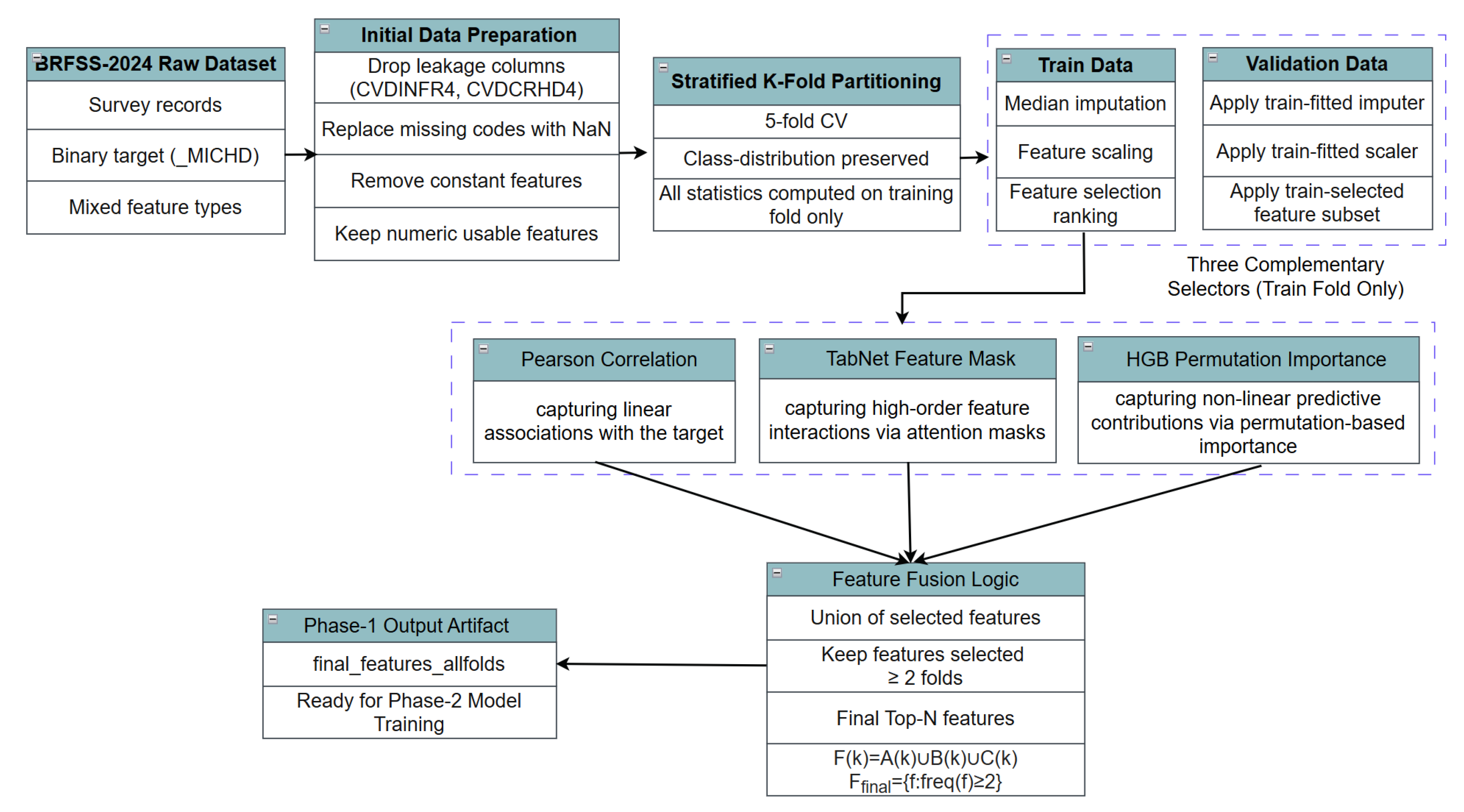
Leakage-safe multi-selector feature fusion framework: A Phase 1 pipeline selects health signals in a fold-wise, leakage-controlled manner using three complementary relevance estimators: linear correlation analysis, deep mask-based attribution, and permutation importance. These views are fused to improve robustness, signal stability, and reproducibility.
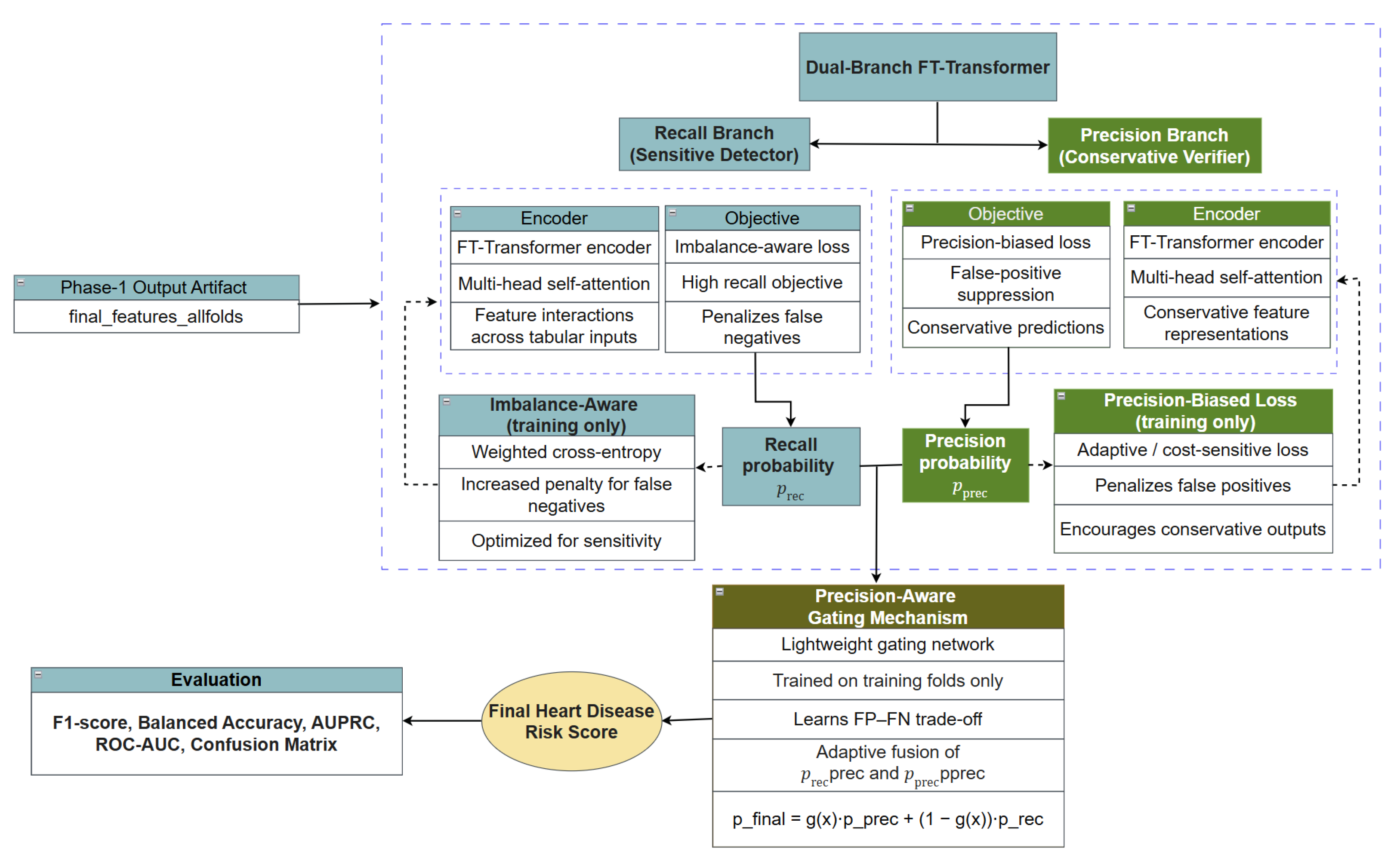
Dual-branch FT-Transformer architecture for asymmetric risk modeling: A Phase 2 decision layer based on an FT-Transformer backbone is decomposed into a sensitivity-oriented (recall-focused) branch and a specificity-oriented (precision-focused) branch, reflecting asymmetric costs of missed detections and false alarms in screening applications.
Precision-biased gated fusion with rule-based controls: A lightweight gating mechanism adaptively combines the outputs of the two branches and incorporates explicit veto and rescue rules to suppress false positives while preserving high-confidence detections.
Rigorous leakage-safe evaluation and auditability: A deployment-oriented evaluation protocol based on stratified cross-validation and out-of-fold probability aggregation produces pooled confusion matrices and fold-level performance summaries, enabling transparent and reproducible assessment.
Unlike prior work that primarily focuses on architectural modifications in tabular models, this study adopts a system-level perspective. The FT-Transformer backbone is used without structural modification, and the contribution lies in redesigning the learning pipeline through objective decomposition, decision-level fusion, and leakage-safe integration. This positions the proposed framework as a deployment-oriented solution rather than an architectural variant. Together, these contributions establish a reliability-focused AI framework for cardiovascular risk prediction under severe class imbalance in population-scale health datasets.
2. Related Work
The application of ML and DL techniques to cardiovascular disease and coronary heart disease risk assessment has been extensively investigated, driven by the increasing availability of digital health data derived from clinical records, biobanks, wearable devices, and large-scale public health-monitoring infrastructures. Early research predominantly relied on small curated clinical datasets, most notably the Cleveland Heart Disease dataset, while more recent studies have shifted toward population-scale resources such as BRFSS, NHANES, and national biobanks. Although these studies demonstrate the potential of data-driven approaches for cardiovascular risk prediction, the literature remains fragmented with respect to dataset scale, evaluation rigor, handling of class imbalance, interpretability, and pipeline reproducibility.
Existing tabular learning approaches can be broadly categorized into three groups: (i) architectural methods (e.g., TabNet, FT-Transformer), (ii) procedural enhancements (e.g., data augmentation, imbalance handling, regularization), and (iii) system-level frameworks that redesign the full learning and decision pipeline.
Architectural approaches improve representation learning but typically optimize a single objective and rely on threshold tuning for decision control. In contrast, the proposed approach focuses on system-level design by explicitly decomposing prediction objectives and introducing controlled decision fusion under a leakage-safe pipeline.
A substantial body of work focuses on classical ML and ensemble-based methods for heart disease risk estimation. Studies such as [
1,
2] compare multiple algorithms, including logistic regression, random forest, support vector machines, and gradient boosting, and consistently report superior performance for ensemble and tree-based models relative to linear baselines. These findings highlight the ability of nonlinear learners to capture complex interactions among heterogeneous demographic, behavioral, and clinical variables. However, most studies rely on simple train–test splits and often apply preprocessing or imbalance correction globally, raising concerns regarding information leakage and optimistic performance estimates when such models are deployed in real-world pipelines.
Imbalance handling represents a recurring challenge in cardiovascular risk prediction. Numerous studies employ synthetic oversampling techniques such as SMOTE to improve minority-class detection, often reporting gains in recall and F1-score [
2,
13]. Nevertheless, imbalance correction is frequently performed outside cross-validation folds, and evaluation protocols commonly emphasize accuracy-centric metrics. Recent investigations have demonstrated that these practices can lead to misleading conclusions, particularly in highly skewed clinical and survey datasets [
7,
11]. Although the importance of imbalance-aware metrics such as Matthews correlation coefficient (MCC) and area under the precision–recall curve (AUPRC) is increasingly acknowledged, their systematic adoption in cardiovascular risk studies remains limited.
Deep learning approaches have also been explored, particularly multilayer perceptrons, convolutional neural networks, and recurrent architectures. Studies using UCI-style datasets report high classification accuracy for hybrid and deep architectures [
3,
15]; however, these results are often obtained on very small datasets, restricting generalizability. Comparative analyses between DL and classical ML approaches indicate that deep models are highly sensitive to dataset scale, preprocessing strategies, and hyperparameter selection, and they frequently underperform well-optimized tree-based ensembles on structured health datasets [
4,
11]. These findings suggest that increased model capacity alone does not guarantee robust performance in population-scale cardiovascular risk prediction.
Explainable artificial intelligence (XAI) has emerged as an important component of recent cardiovascular risk modeling research. Several studies integrate SHAP or LIME to identify influential risk factors and improve interpretability of model predictions [
11,
12,
13,
14,
15,
16]. While these techniques enhance transparency, interpretability analyses are frequently conducted on a single fitted model rather than aggregated across validation folds, limiting explanation stability. Moreover, XAI methods are often applied post hoc without addressing upstream pipeline issues such as leakage-safe preprocessing, probability calibration, or interaction with decision rules, reducing their practical reliability in real-world decision systems.
Beyond individual modeling efforts, several surveys and systematic reviews provide broader perspectives on the state of AI-driven cardiovascular risk prediction. Comprehensive reviews in [
5,
6] reveal heavy reliance on small legacy datasets, inconsistent evaluation protocols, and widespread inflation of accuracy metrics. These reviews emphasize the lack of external validation, poor generalization, and insufficient consideration of real-world deployment constraints. Consequently, a gap persists between high reported performance in academic studies and clinically meaningful reliability when these models are applied to large-scale health datasets.
Ensemble and hybrid modeling frameworks have received increasing attention as a strategy to improve robustness and predictive stability. Advanced stacking and voting strategies have been shown to reduce model variance and improve performance across datasets [
12,
14,
16]. Some studies further incorporate multi-criteria decision-making techniques to rank models across multiple performance metrics [
14]. Although these approaches increase methodological sophistication, they remain largely validated on small or medium-sized datasets and frequently lack strict fold-wise preprocessing, calibration analysis, and leakage control.
Large-scale population-based datasets provide a more realistic testbed for cardiovascular risk modeling. Studies using BRFSS [
7], Taiwan Biobank [
8], and NHANES [
9] demonstrate that performance metrics often decrease substantially compared to UCI-style benchmarks, revealing challenges associated with real-world heterogeneity, noise, and severe class imbalance. For example, [
7] reports very high accuracy on BRFSS following aggressive preprocessing and SMOTE–ENN; however, leakage-safe validation and calibration analyses are not provided. Similarly, studies in [
8,
9] show that gradient boosting and support vector machine models generalize better on large cohorts but still rely on single-split evaluation strategies and self-reported outcomes. To systematically analyze these limitations,
Table 1 provides a structured comparison of representative studies across four explicitly defined evaluation dimensions: (i) validation protocol, categorized as cross-validation, hold-out, or unspecified; (ii) imbalance-handling strategy; (iii) calibration reporting, indicating whether probability calibration methods such as Platt scaling or isotonic regression are applied; and (iv) leakage safety, reflecting whether preprocessing and evaluation are performed in a fold-wise, training-only manner. This standardized categorization ensures consistent and interpretable comparison across heterogeneous studies.
Critical Analysis of Existing Methods
While prior studies demonstrate promising predictive performance, a closer examination reveals several systematic limitations that persist across the literature.
First, validation protocols are frequently insufficiently specified or not leakage-safe. Many studies rely on single train–test splits or apply preprocessing steps such as imputation, feature selection, or oversampling before cross-validation, leading to optimistic performance estimates and reduced generalizability.
Second, imbalance-handling strategies are often applied heuristically, with techniques such as SMOTE or class weighting used without consistent integration into the evaluation pipeline. This results in unstable precision–recall behavior and limited control over clinically critical error types.
Third, most existing approaches optimize a single objective function, implicitly balancing false positives and false negatives through threshold tuning. Such formulations do not provide explicit control over asymmetric error costs, which is essential in large-scale screening scenarios.
Finally, reproducibility remains limited, as many studies do not report fold-wise results, calibration analysis, or out-of-fold predictions. This restricts transparent comparison and reduces confidence in reported performance.
These observations indicate that the primary limitations of existing work are not only architectural but also procedural and evaluation-related, motivating the need for a unified, leakage-safe, and decision-aware framework.
The comparison in
Table 1 reveals several consistent patterns. Most studies rely on either single-split evaluation or cross-validation without explicit leakage control. Imbalance-handling techniques are frequently applied, but often outside fold-wise pipelines, raising concerns about evaluation validity. Calibration is rarely reported, and reproducibility artifacts such as out-of-fold predictions are largely absent.
These findings suggest that improvements reported in prior work may partially reflect evaluation artifacts rather than genuine model generalization, further emphasizing the importance of leakage-safe and audit-oriented experimental design.
Recent work has begun to extend beyond pure prediction toward robustness, calibration, and causal reasoning. Study [
9] integrates calibration curves, decision-curve analysis, and Mendelian randomization to distinguish predictive from causal signals. However, such approaches remain uncommon and are not yet integrated into unified, leakage-safe pipelines applicable to large-scale population datasets.
An important insight from real-world clinical studies is the failure of accuracy as a primary evaluation metric under severe class imbalance. The ANN-based study in [
11], using nearly 14,000 hospital records, demonstrates that a model can achieve over 80% accuracy while missing most true disease cases, resulting in extremely low sensitivity and MCC. Only after applying imbalance correction does performance become clinically meaningful. This finding underscores the necessity of imbalance-aware evaluation, careful metric selection, and transparent reporting.
In summary, existing literature demonstrates that ML and DL methods can support cardiovascular risk prediction; however, progress remains constrained by over-reliance on small datasets, inconsistent evaluation protocols, insufficient leakage control, and limited attention to calibration, robustness, and explainability. These limitations motivate the development of unified, leakage-safe AI-enabled architectures capable of leveraging large-scale population datasets while providing transparent and reliable evaluation.
To explicitly position the proposed framework relative to state-of-the-art tabular models, a structured comparison is provided in
Table 2.
As shown in
Table 2, existing tabular models operate under single-objective optimization and implicit error trade-offs, whereas the proposed framework introduces explicit objective decomposition and decision-level control under a leakage-safe design. A common source of performance inflation in prior studies is the presence of data leakage introduced through improper preprocessing. For example, applying imputation or feature selection on the full dataset prior to train–test splitting allows information from validation samples to influence model training. Similarly, performing oversampling before cross-validation can introduce duplicate or correlated samples across folds. These practices lead to overly optimistic performance estimates and reduce the reliability and reproducibility of reported results.
While existing literature demonstrates the potential of machine learning and deep learning for cardiovascular risk prediction, it remains limited by inconsistent validation practices, weak leakage control, and lack of explicit decision-level modeling. These limitations motivate the development of a structured, leakage-safe, and decision-aware framework that addresses both methodological and evaluation challenges.
Recent advances in AI-driven cardiovascular risk prediction further validate the relevance and positioning of the proposed framework. A growing body of literature demonstrates that modern prediction systems increasingly rely on hybrid and deep learning architectures to capture complex, non-linear relationships in large-scale health datasets. For example, recent studies in applied artificial intelligence and computational medicine highlight the effectiveness of ensemble and transformer-based models in improving predictive performance and robustness across heterogeneous clinical data sources [
21,
22,
23]. At the same time, research in statistical signal processing and biomedical analytics emphasizes the critical importance of addressing class imbalance, feature heterogeneity, and calibration to ensure reliable decision-making in high-risk screening applications [
24,
25,
26].
Moreover, recent IoMT-based medical decision-making frameworks and signal-driven diagnostic models, including hybrid learning approaches on IoMT platforms and methods that fuse handcrafted and deep features from physiological signals such as heart sounds, demonstrate the effectiveness of AI in sensor-rich and multimodal healthcare environments [
27,
28,
29].
Beyond model design, several recent works have shifted focus toward real-world healthcare integration, including population-scale analytics, public health monitoring, and IoMT-enabled systems [
30,
31,
32]. These studies underline that practical deployment environments are characterized by noisy, incomplete, and non-temporal data streams, where robustness, scalability, and interpretability are essential. In parallel, systems-oriented research highlights the need for computationally efficient and deployment-aware architectures capable of operating under distributed and resource-constrained conditions [
27,
32].
Collectively, these findings indicate a clear transition from purely accuracy-driven models toward balanced, reliable, and deployment-conscious AI systems in healthcare. In this context, the proposed two-phase, leakage-safe framework directly addresses several of the limitations identified in prior work by ensuring strict evaluation rigor, mitigating imbalance effects through architectural design, and enabling controlled trade-offs between false positives and false negatives. This positions the framework as a practical and methodologically robust solution for large-scale cardiovascular risk screening.
3. Dataset Description and Preprocessing
This study uses the Behavioral Risk Factor Surveillance System (BRFSS) 2024 public-use dataset, released by the Centers for Disease Control and Prevention [
10]. BRFSS is one of the largest ongoing health surveys worldwide, collecting self-reported information on health conditions, risk behaviors, and preventive practices from adults across the United States. This dataset is a large-scale, survey-based dataset that collects self-reported information on health conditions, lifestyle behaviours, and risk factors from a broad population. Unlike traditional sensor-based data, which capture physiological signals in real time, BRFSS relies on structured questionnaires to gather behavioural and demographic indicators associated with cardiovascular risk. Despite being survey-driven, the dataset provides rich, population-level insights that are highly relevant for predictive modelling. In this context, BRFSS can be viewed as a complementary data source to sensor-based systems, where behavioural patterns act as indirect indicators of underlying health conditions. Integrating such survey-based data into AI models supports early risk estimation and large-scale screening, especially in scenarios where continuous sensor monitoring is not feasible.
In this study, the term “health sensing” is used in a broad population-monitoring context to refer to structured health indicators collected through large-scale surveillance systems rather than direct physiological sensor streams. Specifically, BRFSS variables represent three complementary categories of proxy sensing signals: (i) demographic indicators (e.g., age group encodings and socioeconomic attributes), (ii) behavioural risk indicators (e.g., smoking status, physical activity, alcohol consumption, and body-mass-related measures), and (iii) self-reported clinical-condition indicators (e.g., hypertension, diabetes, and prior cardiovascular conditions excluding leakage-prone outcome variables). These variables function as indirect but population-scale observable markers of cardiovascular risk and therefore provide a structured sensing layer suitable for large-scale screening-oriented prediction tasks.
The objective of this work is to estimate population-level cardiovascular risk using routinely collected health indicators that reflect demographic characteristics, behavioral patterns, and clinical conditions. The target variable used is _MICHD, which indicates whether a respondent has been diagnosed with coronary heart disease or myocardial infarction. Following established BRFSS conventions, the original encoding is mapped to a binary classification task, where positive cases correspond to individuals identified as being at elevated cardiovascular risk. Because is self-reported rather than clinically adjudicated or longitudinal, this task should be interpreted as population-level proxy classification rather than direct clinical risk prediction.
After the removal of invalid labels and outcome-proximal, leakage-prone variables (e.g., CVDINFR4 and CVDCRHD4), and restricting the analysis to numeric features, the final modeling dataset contains 452,464 respondents. Among these, 42,338 are positive cases and 410,126 are negative cases, corresponding to a prevalence of 9.36%. The resulting class imbalance ratio (negative-to-positive) is approximately 9.69:1, reflecting a realistic population-level cardiovascular screening scenario.
The key characteristics of the resulting modeling dataset are summarized in
Table 3. Despite the large sample size, the dataset exhibits substantial missingness and pronounced class imbalance, which are characteristic challenges of real-world population health data. These properties motivate the adoption of a leakage-safe preprocessing pipeline and imbalance-aware modeling strategy.
3.1. Feature Space and Variable Scope
The original BRFSS dataset contains a heterogeneous mix of numeric, categorical, and survey-encoded variables. In this study, only numeric variables are retained. This decision is motivated by two key considerations. First, numeric representations avoid ambiguity introduced by survey-specific categorical encodings and reduce preprocessing variability. Second, the FT-Transformer architecture employed in Phase 2 directly operates on continuous feature tokens, enabling stable representation learning without reliance on high-dimensional encoding schemes.
To further justify this design choice, an additional leakage-safe ablation study was conducted to compare the numeric-only representation with a mixed representation incorporating one-hot encoded categorical variables. As shown in Table 6, incorporating categorical features increased the dimensionality dramatically (from 283 to over 40,000 features) without improving predictive performance. In fact, slight performance degradation was observed in F1-score and AUPRC, while computational cost increased substantially due to the exponential growth in feature dimensionality.
These results indicate that the numeric-only representation provides a more efficient, stable, and scalable feature space under leakage-safe evaluation, supporting its use in the proposed framework.
Prior to feature selection, all variables undergo an initial sanitization process. Variables with no numeric content are discarded, columns containing only missing values are removed, and constant or near-constant variables with no information content are excluded. This results in a clean numeric feature space that is subsequently refined through the leakage-safe feature fusion process described in
Section 4.
3.2. Handling of Missing Values
The BRFSS 2024 dataset encodes non-substantive responses (e.g., “Don’t know”, “Refused”, or missing) using standardized numeric placeholders defined in the official CDC codebook. These placeholders follow a length-consistent convention depending on variable format (e.g., 7/9 for single-digit variables, 77/99 for two-digit variables, and 777/999 for three-digit variables). Treating these codes as valid numerical inputs would introduce systematic bias and distort statistical distributions, model gradients, and feature selection procedures.
Accordingly, all BRFSS-defined non-substantive codes were identified based on the official variable documentation and explicitly mapped to NaN prior to any preprocessing, feature selection, or model training. This conversion was performed as a schema-driven preprocessing step based solely on predefined BRFSS coding conventions, independent of the observed data distribution. All subsequent data-dependent operations, including imputation, scaling, and feature selection, were conducted strictly within training folds to preserve leakage safety.
By separating placeholder removal from fold-wise imputation, the proposed pipeline ensures that missingness is handled transparently and does not implicitly influence downstream statistical or model-based computations.
To further validate the choice of imputation strategy under high missingness, an additional leakage-safe ablation study was conducted comparing median imputation, mean imputation, and median imputation augmented with missingness indicators. All imputers were fitted exclusively on training folds and applied to validation folds to preserve strict leakage safety. The results show that all strategies yield nearly identical performance across F1-score, Recall, AUPRC, and AUROC, with differences falling within statistical variance. The inclusion of missingness indicators does not provide consistent performance gains. These findings indicate that median imputation provides a robust and sufficient representation for this dataset despite the high missingness level.
3.3. Leakage Prevention and Data Cleaning
To prevent label leakage, variables that directly encode prior cardiovascular diagnoses are removed before any modeling or feature selection is performed. In particular, the following outcome-proximal variables are excluded when present:
These variables are strongly correlated with the target outcome and would artificially inflate predictive performance if retained.
After leakage removal, the dataset is further cleaned by removing columns that are entirely missing and constant features with no predictive value. This ensures that all retained variables contribute meaningful variability.
3.4. Leakage-Safe Preprocessing Protocol
All preprocessing steps in this study follow a strict leakage-safe protocol. No global statistics are computed using the full dataset. Instead, median imputation is fitted only on the training portion of each cross-validation fold and applied to the corresponding validation partition.
Feature scaling, using StandardScaler by default and RobustScaler as an optional variant, is likewise fitted exclusively on training folds. Feature selection, when applied, is also performed strictly within training folds, and the resulting selections are then applied to the corresponding validation partitions without re-estimation. This fold-wise preprocessing design is critical in medical risk prediction settings, where even minor leakage can lead to misleading performance estimates. By isolating all data-driven transformations within training folds, the reported results reflect genuine generalization performance.
3.5. Relationship to Phase 1 Feature Selection
It is important to emphasize that no feature selection is performed in this section.
Section 3 defines the raw, leakage-safe input space. Feature selection and fusion are carried out exclusively in Phase 1 of the proposed methodology (
Section 4), where all selection decisions are performed in a fold-wise, leakage-controlled manner and cached for reuse.
5. Experimental Results
This section presents the experimental evaluation of the proposed framework, focusing on its predictive performance, robustness, and ability to manage precision–recall trade-offs under realistic conditions. The results are analysed in comparison with representative baseline models to highlight the effectiveness of the proposed approach in handling class imbalance and reducing clinically critical errors. Particular emphasis is placed on leakage-safe evaluation, consistent model behaviour across folds, and performance at decision thresholds relevant to real-world deployment.
5.1. Experimental Setup and Evaluation Protocol
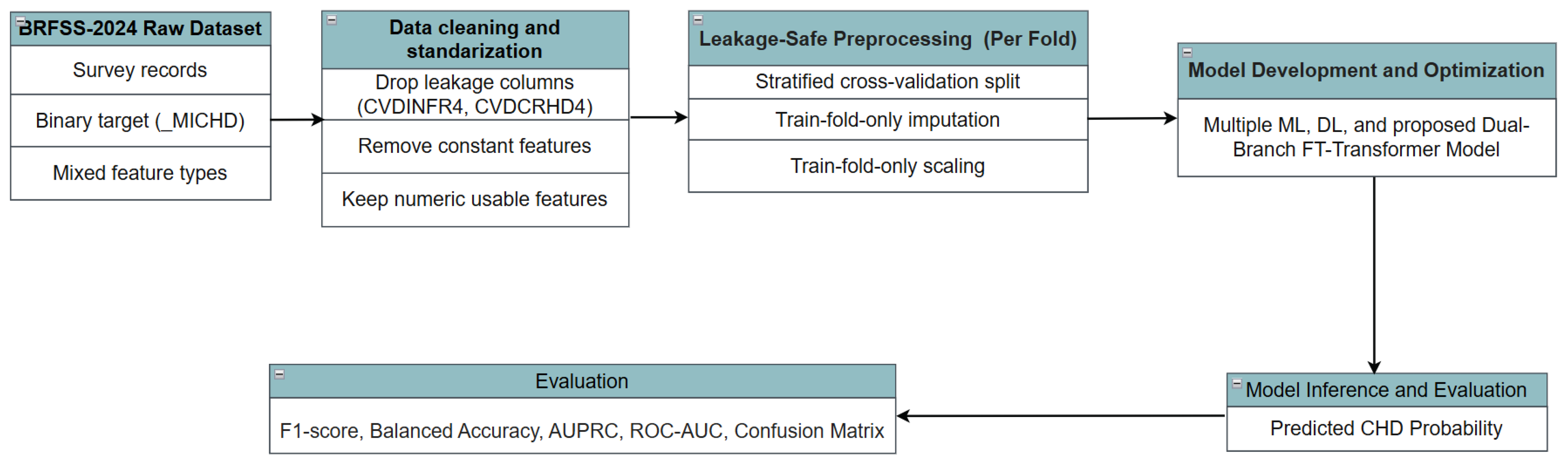
All experiments were conducted under a strictly leakage-safe and reproducible protocol using stratified k-fold cross-validation to preserve class distribution. Within each fold, data were split into training and validation subsets, and all preprocessing, feature handling, and model optimization steps were performed exclusively on the training data.
To prevent information leakage, preprocessing steps—including missing value imputation, feature scaling, feature selection (where applicable), probability calibration, and threshold optimization—were recomputed independently within each fold. Out-of-fold (OOF) predictions were aggregated to compute final evaluation metrics, providing an unbiased estimate of generalization performance. This protocol explicitly avoids common leakage-prone practices such as global imputation, pre-cross-validation feature selection, and oversampling before fold separation.
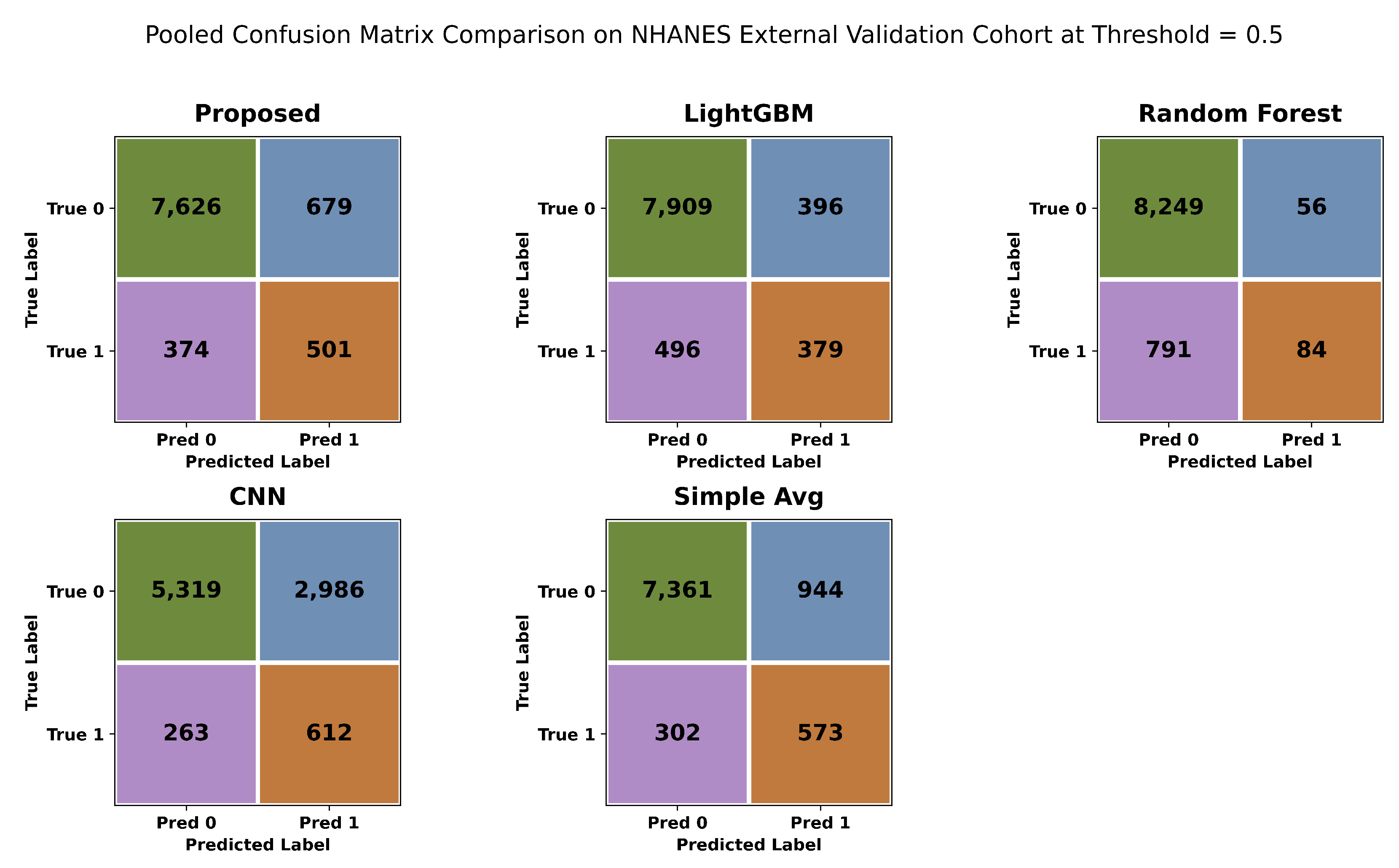
To further assess cross-cohort robustness, an independent external validation study was additionally conducted using the NHANES 2017–March 2020 pre-pandemic cohort, as detailed in
Section 6.11. While BRFSS-2024 served as the primary development cohort, NHANES provides a heterogeneous external evaluation setting with substantially different feature composition, including laboratory biomarkers, examination variables, and clinically oriented health indicators. To ensure methodological consistency, the complete leakage-safe pipeline, including Phase 1 feature selection and Phase 2 modeling, was re-executed independently within the NHANES cohort.
5.2. Evaluation Metrics and Clinical Relevance
Model performance was assessed using a comprehensive set of evaluation metrics designed to capture both overall discrimination ability and clinically meaningful error behavior. Specifically, we report Accuracy (ACC), Balanced Accuracy (BalACC), Precision, Recall (Sensitivity), F1-score, Area Under the Receiver Operating Characteristic Curve (AUROC), and Area Under the Precision–Recall Curve (AUPRC). Balanced accuracy is included to reflect performance on both classes under severe class imbalance.
Although accuracy is commonly reported in the literature, it is known to be misleading in imbalanced classification scenarios. Therefore, primary emphasis is placed on recall, F1-score, and AUPRC, which better reflect the model’s ability to identify high-risk individuals while maintaining reasonable false-positive rates.
To provide a transparent and comprehensive evaluation, results are reported at both a fixed decision threshold of and an F1-oriented operating analysis derived from validation data only. This dual-threshold perspective enables comparison between a conservative default operating point and threshold-sensitive behavior under imbalanced decision settings.
5.3. Baseline Models and Comparative Performance
A diverse set of baseline models was evaluated to establish strong reference points. These include classical statistical models, traditional machine learning classifiers, and deep learning architectures such as Logistic Regression, Support Vector Machine, k-Nearest Neighbors, Naïve Bayes, Decision Tree, Random Forest, and gradient boosting-based models including LightGBM, XGBoost, and CatBoost. Neural network baselines including AE+LR, 1D-CNN, LSTM, and GRU were also included.
The baseline models and their principal hyperparameter settings are summarized in
Table 4.
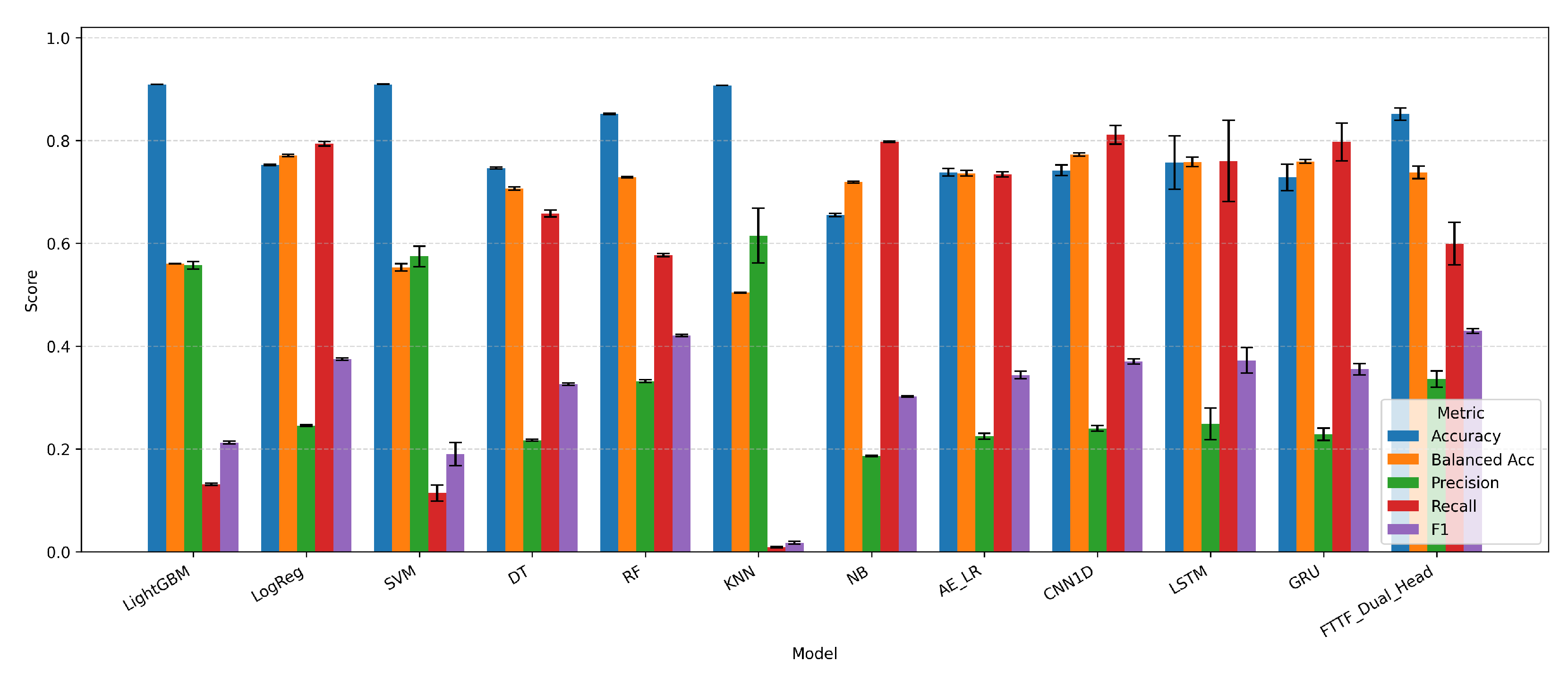
All baseline models were trained using the same cross-validation splits, preprocessing pipeline, and feature inputs, ensuring that performance differences arise primarily from model design rather than experimental inconsistencies. Across baselines, ensemble tree-based methods generally outperform linear and distance-based classifiers in terms of AUROC and AUPRC. However, these gains are often accompanied by a strong bias toward the majority class, resulting in low recall and suboptimal F1-scores. Deep neural models, while capable of modeling non-linear patterns, exhibit higher variance and sensitivity to hyperparameter choices, particularly under limited positive samples.
5.4. Performance of the Proposed Dual-Branch FT-Transformer
The proposed Dual-Branch FT-Transformer with gated fusion achieves competitive F1-level performance among the evaluated baselines and demonstrates a more favorable precision–recall balance under severe class imbalance. Although certain tree-based baselines achieve higher AUROC values, their performance at the fixed operational threshold of reveals substantial recall degradation or unstable precision–recall trade-offs. In contrast, the proposed architecture is explicitly designed to regulate the distribution of errors at clinically meaningful decision points, leading to improved F1 behavior and more balanced sensitivity–specificity performance.
In addition, a feature representation ablation study (
Table 5) confirms that incorporating one-hot encoded categorical variables does not improve performance and significantly increases feature dimensionality, reinforcing the effectiveness of the numeric-only design.
Table 6 summarizes the comparative results across all evaluated models on BRFSS-2024.
It is important to note that AUROC reflects ranking performance across all possible thresholds and does not directly capture operational behavior at clinically relevant decision points. In highly imbalanced screening settings, a model may achieve high AUROC while still producing undesirable recall or precision characteristics at fixed thresholds. Therefore, this study prioritizes F1-score, recall, and balanced accuracy as primary decision-oriented metrics. The proposed architecture is optimized to improve practical screening behavior rather than maximizing rank-based discrimination alone.
Unlike single-head architectures that operate at a fixed precision–recall trade-off, the proposed model dynamically combines outputs from a recall-oriented branch trained to minimize false negatives and a precision-oriented branch trained to suppress false positives. A lightweight gating network adaptively weights these branches on a per-sample basis, enabling context-dependent decision behavior and a more favorable balance between sensitivity and specificity.
Figure 4 provides a visual comparison of model performance across evaluation metrics.
All p-values are greater than 0.05, indicating that the differences between the proposed model and simple average fusion are not statistically significant across all evaluated metrics.
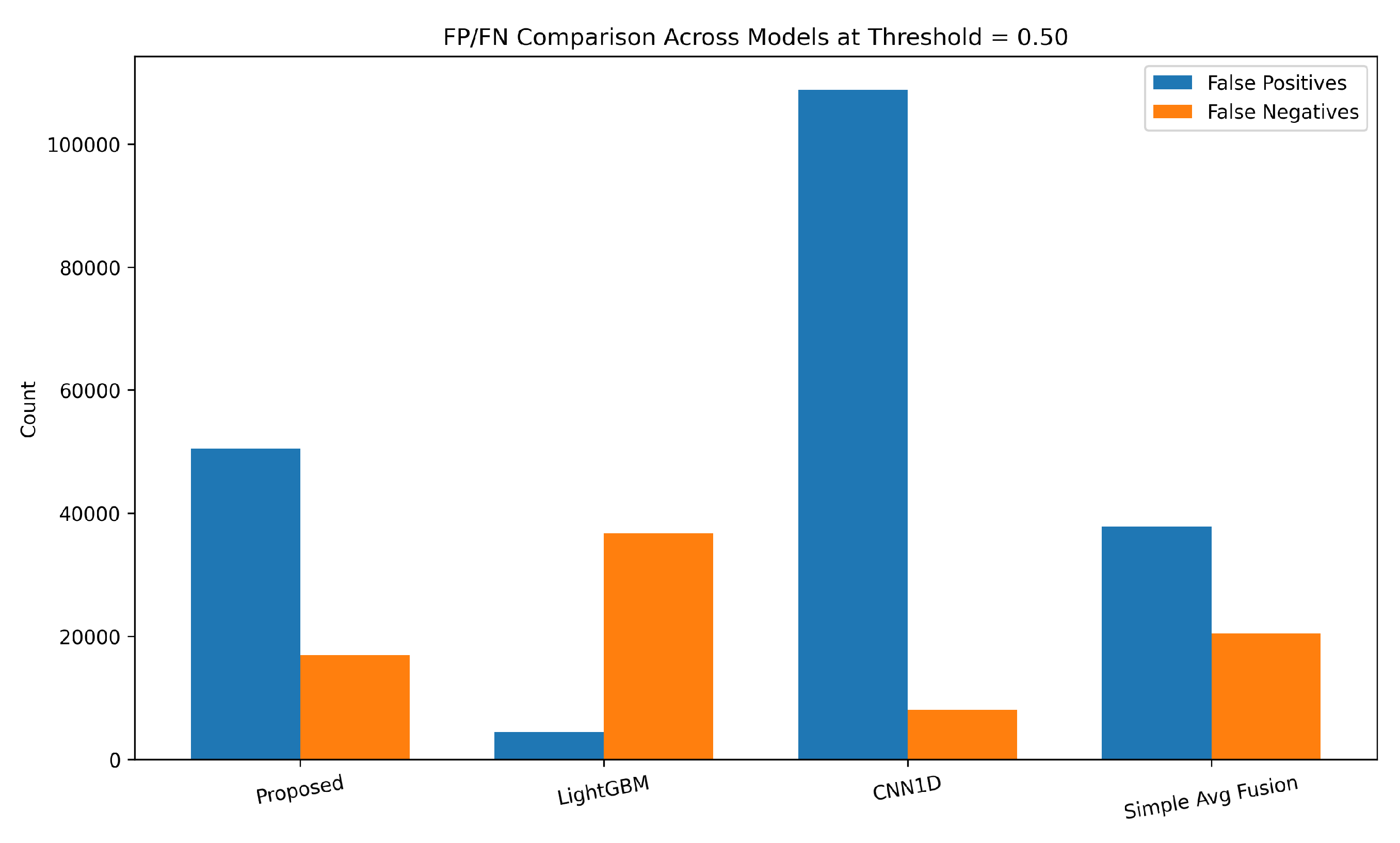
To further analyze model behavior beyond aggregate metrics, we present a comparison of false positives (FP) and false negatives (FN) at a fixed threshold of 0.50 in
Figure 5. While the statistical analysis in
Table 7 indicates no significant difference in F1-score between the proposed model and simple average fusion, clear differences emerge in error distribution.
LightGBM exhibits a conservative operating regime with low FP but a high number of FN, whereas CNN1D demonstrates a recall-dominant behavior with low FN but excessive FP. Simple average fusion achieves a balanced outcome but lacks explicit control over the trade-off.
In contrast, the proposed framework consistently operates in an intermediate and controlled region, reducing FN relative to conservative baselines while avoiding the excessive FP rates of recall-dominant models. This demonstrates that the contribution of the proposed architecture lies in regulating the error trade-off rather than maximizing a single scalar metric.
5.5. Confusion Matrix and Error Distribution Analysis
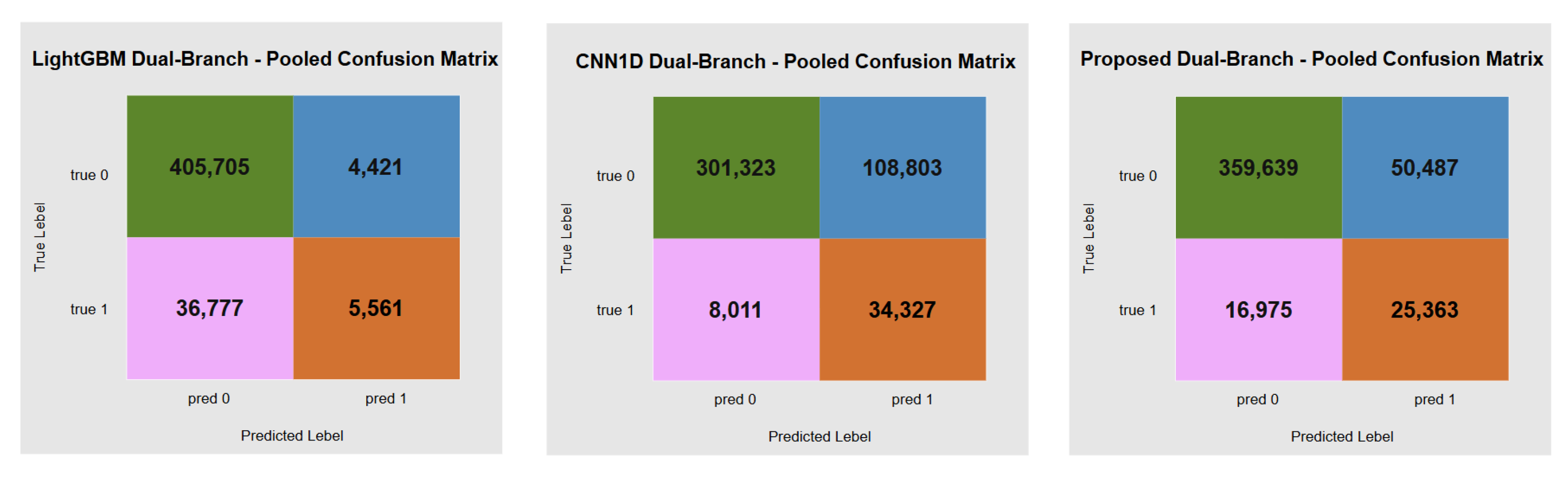
While aggregate metrics summarize discrimination performance, they do not reveal how classification errors are distributed across clinically critical classes. In population-scale cardiovascular screening, false negatives (missed high-risk individuals) and false positives (unnecessary follow-up examinations) carry asymmetric clinical and economic consequences. Therefore, pooled confusion matrices were computed at the operational threshold of
and are presented jointly in
Figure 6 for direct side-by-side comparison.
As shown in
Table 8, the proposed model achieves a more balanced error distribution compared to both conservative (LightGBM) and recall-dominant (CNN1D) baselines, supporting its suitability for controlled screening scenarios.
5.5.1. LightGBM Baseline
As shown in the left panel of
Figure 6, the LightGBM baseline produces extremely low false positives (4421) but a very high number of false negatives (36,777). This indicates a strongly conservative decision boundary biased toward negative predictions. Although such behavior preserves overall accuracy under severe class imbalance, it significantly compromises disease detection capability. For large-scale screening, the elevated missed-case rate is clinically undesirable.
5.5.2. CNN1D Dual-Branch Baseline
The middle panel of
Figure 6 shows that the CNN1D dual-branch model substantially reduces false negatives (8011), demonstrating improved sensitivity. However, this improvement is accompanied by a dramatic increase in false positives (108,803). This recall-dominant operating regime reflects an aggressive positive classification strategy. While effective for identifying high-risk individuals, the excessive false-alarm burden would place considerable strain on healthcare resources in real-world deployment.
5.5.3. Proposed Dual-Branch FT-Transformer with Precision-Biased Gating
The right panel of
Figure 6 demonstrates a more balanced error distribution achieved by the proposed architecture. Compared to LightGBM, false negatives are reduced by more than 50% (from 36,777 to 16,975), substantially improving case detection. Simultaneously, false positives are controlled at 50,487—less than half of those produced by the CNN1D baseline.
This intermediate operating regime confirms that the learned gating mechanism effectively mediates between recall-oriented and precision-oriented representations. Rather than collapsing toward a conservative (precision-heavy) or aggressive (recall-heavy) boundary, the model dynamically integrates both objectives. The precision-biased fusion, together with the veto–rescue constraints, regulates predictions at the instance level, yielding a clinically more viable trade-off between missed detections and unnecessary follow-ups.
The comparative confusion matrix analysis confirms that LightGBM implicitly favors precision at the expense of sensitivity, CNN1D favors recall at the expense of precision, and the proposed dual-branch architecture explicitly balances both objectives to achieve a more clinically meaningful error profile.
5.6. Multi-Model Confusion Matrix Comparison at Fixed Threshold
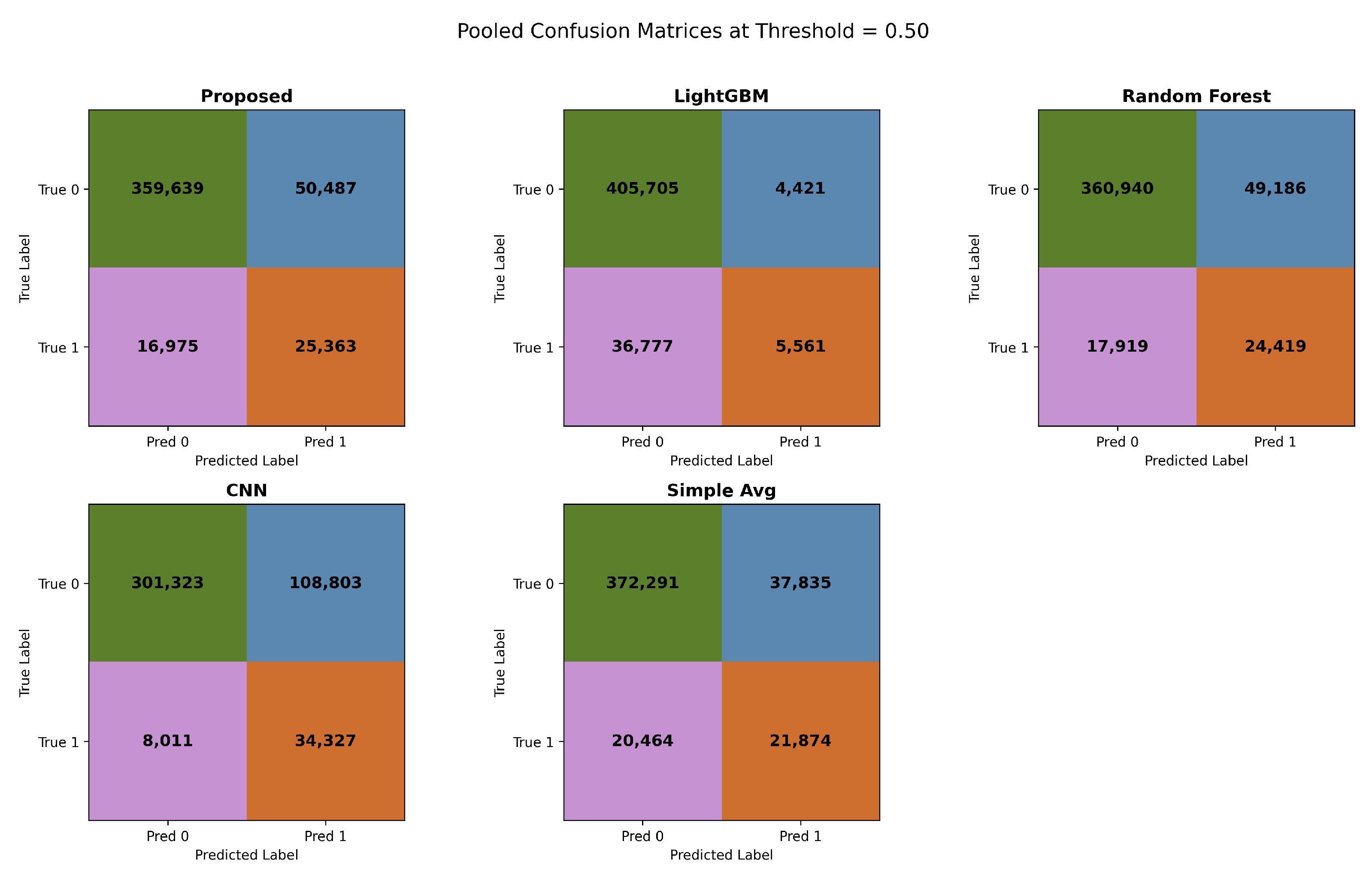
To provide a fair and consistent comparison of model behavior, we analyze the pooled confusion matrices of all major models under a unified decision threshold of 0.50. This ensures that performance differences arise from intrinsic model characteristics rather than threshold tuning.
The comparison includes the proposed framework, LightGBM, Random Forest, the CNN-based baseline, and simple average fusion. This expanded evaluation enables a direct examination of error profiles, particularly the trade-off between false positives (FP) and false negatives (FN), which is critical in medical risk prediction.
The comparison reveals clear and distinct behavioral characteristics across models, as shown in
Table 9. LightGBM exhibits a highly conservative profile, achieving the lowest number of false positives (4421) but at the cost of substantially higher false negatives (36,777), indicating poor sensitivity. In contrast, the CNN baseline demonstrates a strongly recall-oriented behavior, reducing false negatives to 8011 but producing an excessive number of false positives (108,803), which may lead to an impractical false alarm rate in deployment.
Random Forest and simple average fusion provide intermediate trade-offs; however, neither offers consistent control over the balance between false positives and false negatives. The proposed framework achieves a more balanced error profile, reducing false negatives significantly compared to LightGBM (16,975 vs. 36,777) while avoiding the excessive false positives observed in the CNN baseline.
Although simple average fusion achieves a comparable F1-score, its behavior remains less structured, relying on passive aggregation rather than explicit control of decision trade-offs, as illustrated in
Figure 7. In contrast, the proposed model maintains a more controlled and stable balance between sensitivity and specificity, aligning with its architectural design.
This balanced behavior is particularly desirable in screening scenarios, where both missed detections (FN) and false alarms (FP) carry important clinical consequences.
5.7. Ablation Study and Component Contribution Analysis
To validate the architectural design of the proposed Dual-Branch FT-Transformer, an ablation study was performed to quantify the contribution of each major component of the model. The analysis evaluates four configurations: (i) recall-oriented branch only, (ii) precision-oriented branch only, (iii) simple average fusion of the two branches, and (iv) the final gated fusion model with veto and rescue constraints. The objective of this experiment is to verify that the proposed specialization–fusion strategy is necessary for stable operation under severe class imbalance and to determine whether the gating mechanism improves the practical error profile of the model.
The quantitative results of the ablation study are summarized in
Table 10.
The recall-only branch achieves the highest sensitivity (0.804), confirming its role as a highly sensitive detector suitable for minimizing missed positive cases. However, this behavior produces an extremely large number of false positives (103,572), resulting in low precision (0.247) and limiting its usefulness in real-world population-scale screening scenarios. In contrast, the precision-only branch substantially reduces false positives (16,422) and achieves the highest precision (0.452), but suffers from low recall (0.320), producing a large number of false negatives (28,780). These results demonstrate that the two branches learn complementary decision behaviors, with the recall head prioritizing sensitivity and the precision head prioritizing specificity.
Simple average fusion of the two branches yields the highest raw F1-score (0.431), indicating that combining specialized predictors significantly improves the balance between false positives and false negatives compared with either branch alone. This confirms that dual-branch specialization provides useful diversity that can be exploited through fusion to improve overall discrimination.
The final gated fusion model introduces a lightweight GateNet together with veto and rescue rules designed to stabilize the precision–recall trade-off. Although the gated model produces a marginally lower F1-score (0.430) than simple averaging (0.431), it yields a more controlled error profile, with fewer false positives than simple averaging while maintaining comparable recall. This behavior is consistent with the design objective of the proposed architecture. In large-scale cardiovascular screening, excessive false positives can increase clinical workload, while missed cases may delay diagnosis and treatment. This improvement is reflected in the reduced false-positive count compared to simple averaging, demonstrating the effectiveness of the gating mechanism in controlling unnecessary alerts. Furthermore, qualitative analysis indicates that removing the veto and rescue rules leads to increased variability in decision outcomes across validation folds, indicating reduced stability in prediction behavior.
These results indicate that simple averaging maximizes raw F1 performance, whereas GateNet-based fusion provides improved robustness and better alignment with deployment requirements under severe class imbalance. Therefore, the gated fusion model is selected as the final architecture, as it offers the most stable and operationally appropriate trade-off between false positives and false negatives. This architectural choice is further supported by the independent NHANES cohort evaluation (
Section 6.11), where the proposed GateNet-based framework demonstrated stronger cross-cohort robustness than simple average fusion under the same leakage-safe re-training protocol, achieving improved precision, F1-score, AUROC, and AUPRC while simultaneously reducing false positives. These findings suggest that the gated fusion strategy may better preserve balanced predictive behaviour under varying cohort characteristics beyond the original BRFSS-2024 dataset.
Overall, the ablation results provide empirical justification for the proposed design: (i) single-objective models are unstable under class imbalance, (ii) dual-branch specialization improves discrimination, (iii) fusion is necessary to balance error types, and (iv) rule-constrained gated fusion yields the most operationally robust behavior. These findings support the use of the final architecture for deployment-oriented, population-scale cardiovascular risk prediction.
5.8. Imputation Strategy Ablation
To assess whether more complex imputation strategies improve performance under high missingness, we conducted a leakage-safe ablation study comparing median imputation (baseline), mean imputation, and median imputation with missingness indicators. All preprocessing steps were performed strictly within each training fold.
Table 11 summarizes the results. The findings indicate that all imputation strategies achieve nearly identical performance across F1-score, Recall, AUPRC, and AUROC. No statistically meaningful improvement is observed when using mean imputation or when augmenting features with missingness indicators.
These results suggest that simple median imputation is sufficient for this large-scale dataset, and that more complex imputation strategies do not provide additional predictive benefit while increasing feature dimensionality and preprocessing complexity.
5.9. Threshold Sensitivity and Operating Point Analysis
Although all primary evaluations use a fixed decision threshold of , threshold selection directly influences the trade-off between precision and recall in imbalanced medical classification tasks. To assess the robustness of the proposed model, a threshold sensitivity analysis was conducted using out-of-fold predicted probabilities.
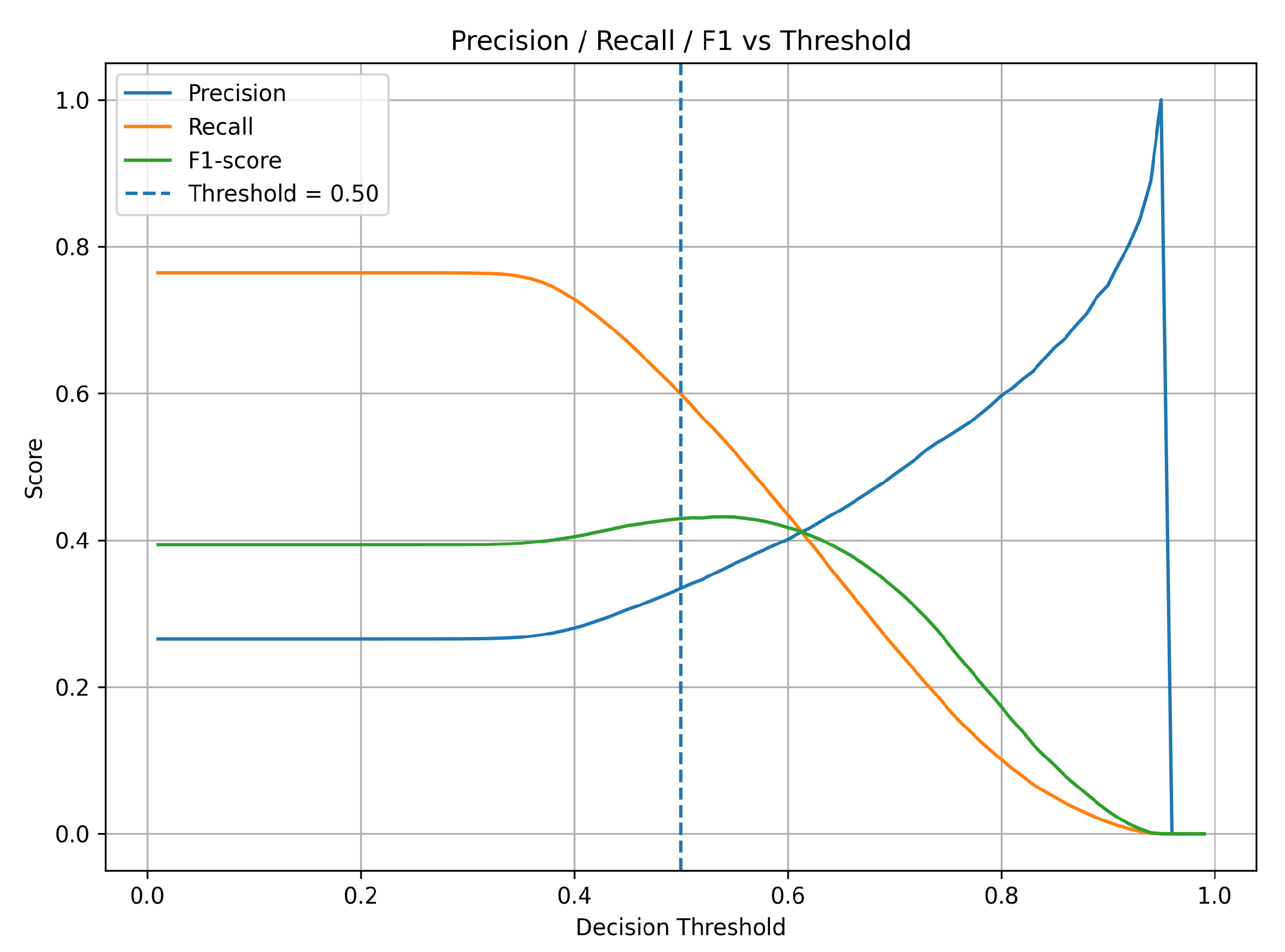
Figure 8 shows precision, recall, and F1-score as functions of the decision threshold.
Recall decreases and precision increases monotonically as the threshold becomes more restrictive. The F1-score exhibits a clear maximum near the mid-range (approximately –). Notably, the selected threshold of lies close to this optimal region, indicating that the adopted operating point is both statistically justified and stable.
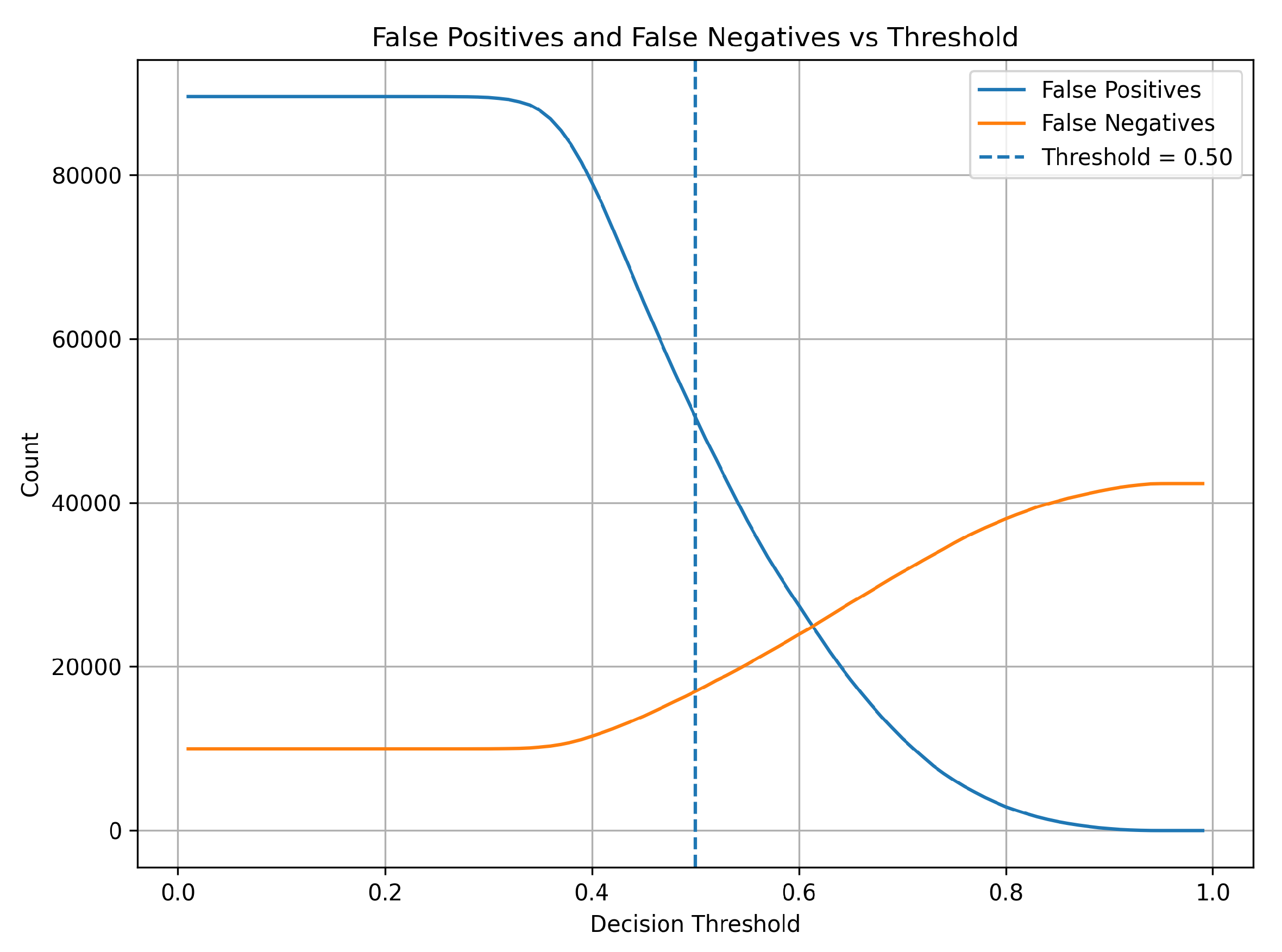
Figure 9 presents the corresponding variation in false positive (FP) and false negative (FN) counts.
As expected, increasing the threshold reduces false positives while increasing false negatives. The operating point at avoids extreme precision-dominant or recall-dominant behavior and maintains a balanced error profile consistent with the design objective of the dual-branch gated architecture.
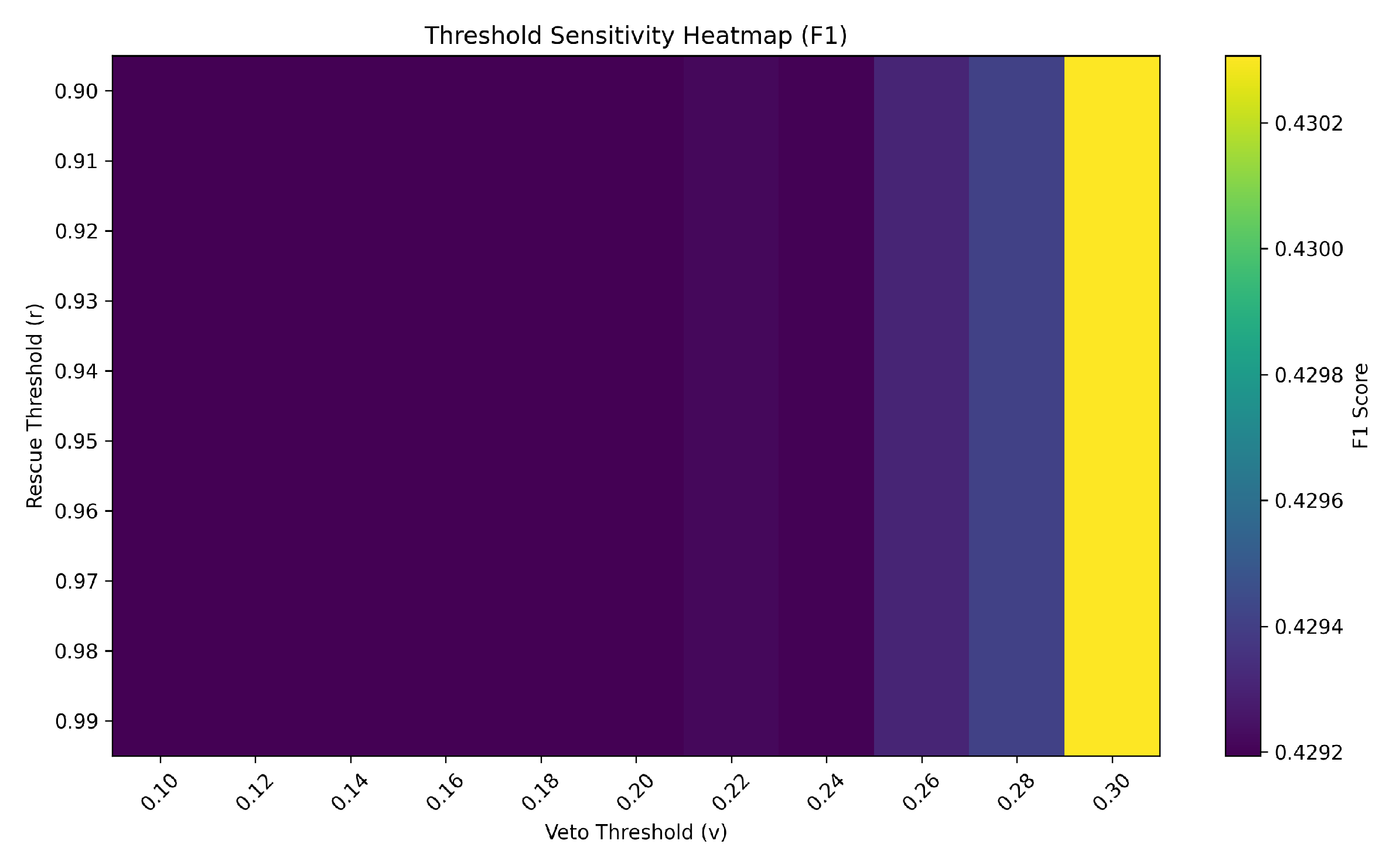
To further evaluate the robustness of the decision-level mechanism, we extend the analysis beyond a single global threshold and examine the sensitivity of the veto (
v) and rescue (
r) parameters governing the rule-based overrides.
Figure 10 presents a heatmap of the F1-score across a grid of
combinations, where
and
, under the same leakage-safe cross-validation protocol.
The heatmap reveals a broad region of near-constant performance, with only marginal variation in F1-score across the explored parameter space. Increasing the veto threshold results in a gradual reduction in false positives, accompanied by a controlled decrease in recall, while variations in the rescue threshold within the high-confidence region have minimal impact on overall performance.
Importantly, the absence of a sharp optimum indicates that the proposed framework operates in a stable regime and does not depend on finely tuned threshold values. This behavior confirms that the gating and rule-based mechanism generalizes reliably across parameter configurations, supporting its applicability in real-world deployment scenarios where operating conditions may vary.
Overall, the proposed model demonstrates smooth and stable behavior across both global decision thresholds and internal rule-based parameters. The F1-score does not exhibit sharp fluctuations, indicating reduced sensitivity to precise parameter selection.
This stability is consistent with the design objective of the dual-branch gated architecture, which explicitly regulates the balance between precision-oriented and recall-oriented predictions at the model level rather than through post hoc threshold adjustment. Consequently, the selected operating point at , together with , represents a robust and practically reliable configuration.
5.10. Calibration Analysis (Brier Score and Expected Calibration Error)
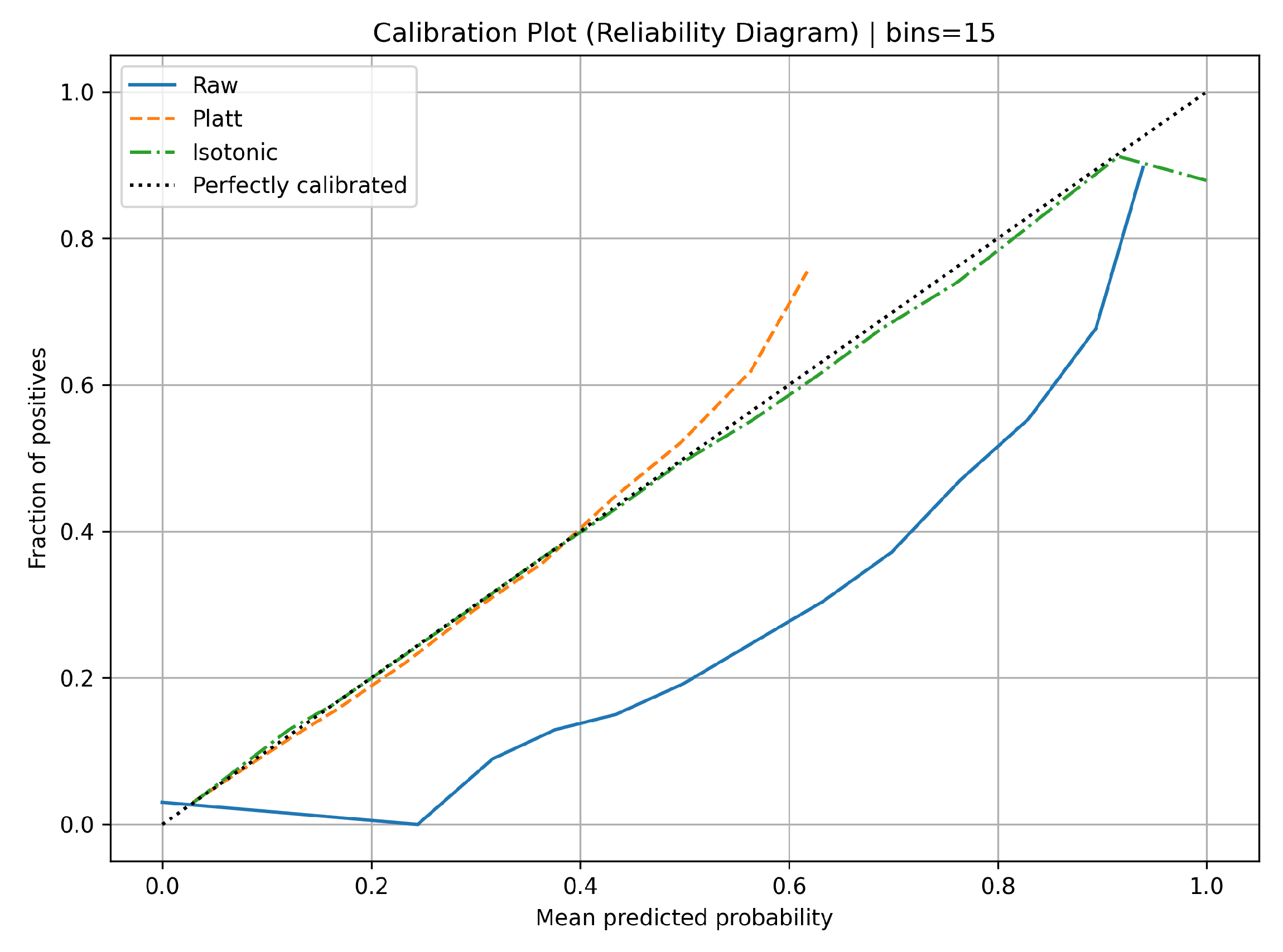
Beyond discrimination performance, probability calibration is essential in medical risk prediction, where predicted scores may be interpreted as estimated event probabilities. To assess calibration quality, a reliability diagram was generated using out-of-fold predictions. In addition, the Brier score and Expected Calibration Error (ECE) were computed to quantify probabilistic accuracy.
Figure 11 presents the reliability diagram for the raw model probabilities and two post-hoc calibration methods: Platt scaling and isotonic regression.
The raw model exhibits noticeable miscalibration in the mid-probability range, where predicted risks tend to overestimate the observed event frequency. Both Platt scaling and isotonic regression substantially improve alignment with the diagonal reference line, indicating enhanced probabilistic reliability.
Table 12 reports the corresponding Brier score and ECE values.
Both calibration approaches reduce Brier score and ECE relative to the raw model, with isotonic regression achieving the strongest overall calibration performance. Importantly, these improvements are obtained without altering the core feature representation or the underlying discriminative model.
Overall, the experimental results show that the proposed Dual-Branch FT-Transformer provides strong F1-oriented performance, a balanced precision–recall trade-off, stable threshold behavior, and reliable post-hoc probability calibration under severe class imbalance. These findings support the suitability of the framework for deployment-oriented, population-scale cardiovascular risk prediction.
6. Discussion
This section provides an in-depth interpretation of the experimental findings, examines the architectural and methodological implications of the proposed approach, and contextualizes the results within the broader landscape of machine learning for cardiovascular risk prediction under extreme class imbalance. Furthermore, empirical analysis confirmed that expanding the feature space with one-hot encoded categorical variables does not yield performance improvements, highlighting the importance of efficient feature representation in large-scale tabular learning.
Although the dataset exhibits substantial missingness, additional ablation experiments confirm that simple median imputation remains sufficient, with no significant performance gains observed from more complex imputation strategies.
6.1. Revisiting the Core Objective: Precision–Recall Tension in Medical Risk Prediction
Cardiovascular disease risk prediction inherently involves a fundamental tension between sensitivity and specificity. In population-scale screening datasets such as BRFSS-2024, where disease prevalence is low, models that maximize overall accuracy or AUROC often fail to detect a meaningful fraction of true positive cases. Conversely, models optimized aggressively for recall tend to produce an impractically high false-positive rate.
The experimental results indicate that this trade-off cannot be reliably resolved through single-objective optimization, threshold tuning, or post-hoc calibration alone. Instead, the findings suggest that architectural separation of competing objectives provides a more effective and principled solution. This insight underpins the motivation for the proposed dual-branch FT-Transformer architecture and helps explain its observed performance.
6.2. Architectural Decomposition as a Solution to Objective Conflict
The dual-branch design explicitly decomposes the prediction task into two complementary but conflicting objectives: sensitivity-oriented detection and precision-oriented verification. This separation allows each branch to learn a distinct decision surface that would otherwise be suppressed or distorted in a single unified model.
The recall-oriented branch, trained with strong positive class weighting, prioritizes capturing subtle and heterogeneous risk patterns associated with cardiovascular disease. This branch effectively acts as a screening detector, casting a wide net to minimize false negatives. The precision-oriented branch, by contrast, is trained with asymmetric penalties that heavily discourage false positives, leading to a more conservative decision boundary.
Crucially, the gating mechanism does not simply average or select between these branches in a static manner. Instead, it learns a context-dependent fusion strategy, enabling instance-level adaptation. This dynamic behavior helps explain why the proposed model achieves strong F1-score performance and balanced accuracy compared to individual branches and conventional ensemble approaches.
From a theoretical perspective, this design is related to multi-objective learning and mixture-of-experts frameworks, where specialized components are used to capture different aspects of the prediction task. The gating mechanism further enables instance-level adaptation, allowing for dynamic resolution of conflicting objectives.
6.3. Why Gated Fusion Outperforms Static Ensembling
Traditional ensemble methods, including probability averaging, majority voting, and fixed-weight stacking, assume that base learners contribute equally across the input space. However, the experimental evidence suggests that the reliability of recall-oriented and precision-oriented predictions varies across samples.
The learned gate models this variability by assigning greater influence to the precision branch when predictions are ambiguous or prone to false positives, and favoring the recall branch when sensitivity is critical. This adaptive fusion is particularly valuable in highly imbalanced settings, where a small subset of samples disproportionately influences clinical outcomes.
As a result, the gating mechanism functions not merely as a combination layer but as a decision arbitration module, enabling nuanced trade-offs that cannot be achieved through threshold adjustment alone.
6.4. External Validation and Generalization Considerations
Although the proposed framework was primarily developed using BRFSS-2024, an additional independent cohort evaluation was conducted using NHANES under the same leakage-safe re-training protocol to assess cross-cohort robustness. The results suggest that the proposed framework can maintain competitive and balanced performance under substantially different feature compositions and population-health settings. However, this evaluation should be interpreted as independent cohort validation with re-training rather than direct BRFSS-to-NHANES transfer without adaptation.
Direct cross-dataset transfer remains challenging in this context due to substantial differences in feature composition, variable definitions, and population characteristics across health datasets. Future work will focus on more rigorous cross-dataset transfer settings using harmonized feature spaces, overlapping variable subsets, and external longitudinal or clinically adjudicated cohorts to further assess robustness and generalizability.
6.5. Insights from Comparison with Strong Baselines
Tree-based boosting models such as LightGBM, XGBoost, and CatBoost remain strong performers on tabular data, particularly in terms of AUROC. However, the results indicate that these models often struggle to maintain high recall without a substantial loss in precision when evaluated at clinically meaningful operating points.
In contrast, the FT-Transformer architecture, when augmented with dual-branch specialization and gated fusion, demonstrates improved robustness across imbalance-aware metrics. This suggests that attention-based tabular models are particularly well-suited to multi-objective architectures, where different prediction heads can specialize without interfering with shared representation learning.
6.6. Role of Leakage-Safe Evaluation in Interpreting Performance Gains
A critical methodological aspect of this study is the use of a strictly leakage-safe evaluation pipeline, including fold-wise preprocessing, feature handling, calibration, and threshold selection. The persistence of performance improvements under this protocol reinforces the validity of the proposed approach.
In many prior studies, reported gains can be attributed to optimistic evaluation practices such as global normalization or feature selection outside the cross-validation loop. By avoiding such pitfalls, this study ensures that the observed improvements reflect genuine generalization rather than experimental artifacts.
This strengthens the case for the proposed architecture as a practically relevant solution rather than a benchmark-only model.
6.7. Practical and Clinical Implications
From a screening-oriented perspective, the proposed model shows potential relevance for population-scale cardiovascular risk assessment. High recall may reduce the risk of missed cases, which is important in early detection settings, while precision control may help reduce unnecessary follow-up burden. The modular design of the architecture also provides flexibility in operational behavior, allowing different operating points to be emphasized depending on whether sensitivity or specificity is prioritized. However, further validation on independent clinical and population cohorts is required before drawing strong conclusions about real-world deployment.
To further understand how the model identifies clinically meaningful predictors, we next examine the statistical characteristics of the most influential variables highlighted by the model.
6.8. Statistical Analysis of Baseline Feature Differences
To further examine whether the most influential model-derived variables also exhibit meaningful class-level separation, a baseline statistical analysis was performed on the top 20 features identified by SHAP from the final trained model. These variables were drawn from the stable feature pool produced by the Phase 1 leakage-safe feature fusion pipeline and were selected according to their SHAP importance scores computed from the final trained system.
As the selected BRFSS variables are originally survey-coded categorical or ordinal indicators, represented numerically in the modeling pipeline, group differences between respondents with heart disease and those without heart disease were evaluated using the chi-square test of independence. When contingency tables contained sparse cells in a setting, Fisher’s exact test was used instead. Effect sizes were quantified using Cramér’s V, interpreted as small (), medium (), and large () associations.
Because multiple variables were tested simultaneously, raw p-values were adjusted using the Benjamini–Hochberg False Discovery Rate (FDR) procedure, and statistical significance was determined at an adjusted threshold of .
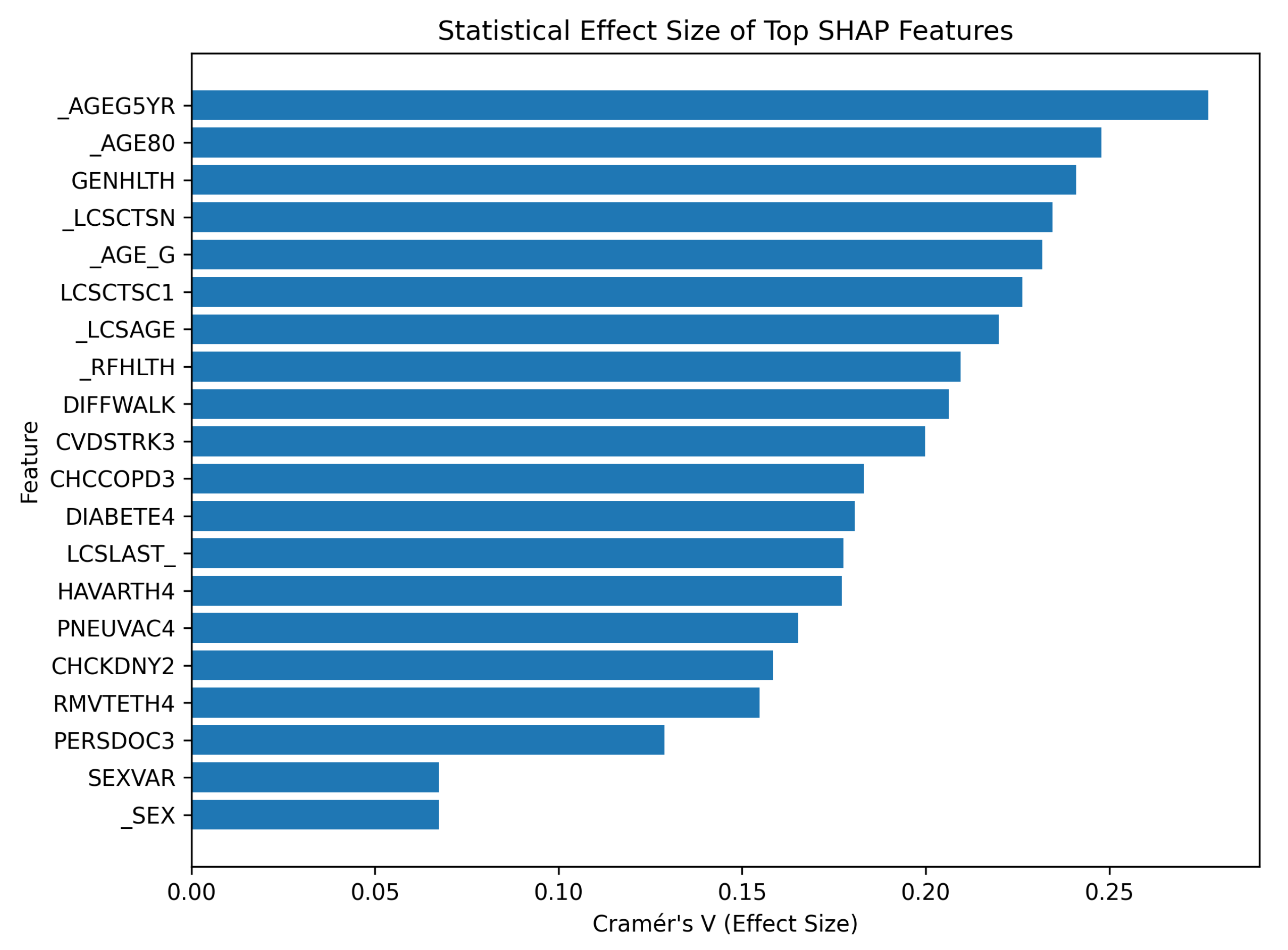
Table 13 summarizes the baseline statistical differences for the 20 most influential SHAP-ranked features. All variables remained statistically significant after FDR correction, with most showing medium-sized effect strengths. The strongest group-level differences were observed for age-related variables (
_AGEG5YR,
_AGE80,
_AGE_G), self-reported general health (
GENHLTH), lung-cancer screening indicators (
_LCSCTSN,
LCSCTSC1,
_LCSAGE), risk-health status (
_RFHLTH), mobility limitation (
DIFFWALK), prior stroke (
CVDSTRK3), chronic obstructive pulmonary disease (
CHCCOPD3), and diabetes status (
DIABETE4). In contrast, sex-related indicators (
SEXVAR,
_SEX) remained statistically significant but showed smaller effect sizes.
Figure 12 provides a visual comparison of the effect sizes for the same variables. Age-related indicators, general health status, chronic disease history, and mobility limitation produce the strongest group-level differences, whereas demographic attributes such as sex show smaller but still statistically significant associations. The consistency between the tabulated results and the effect-size visualization further supports the reliability of the identified predictors.
6.9. Interpretability and Decision Transparency
Interpretability was evaluated using SHAP to quantify feature-level contributions to the final fused probability output of the dual-branch gated FT-Transformer. Explanations were computed on the leakage-safe final model using the out-of-fold prediction pipeline, ensuring that feature attributions reflect the full dual-branch architecture, including the recall head, precision head, and the gated fusion mechanism.
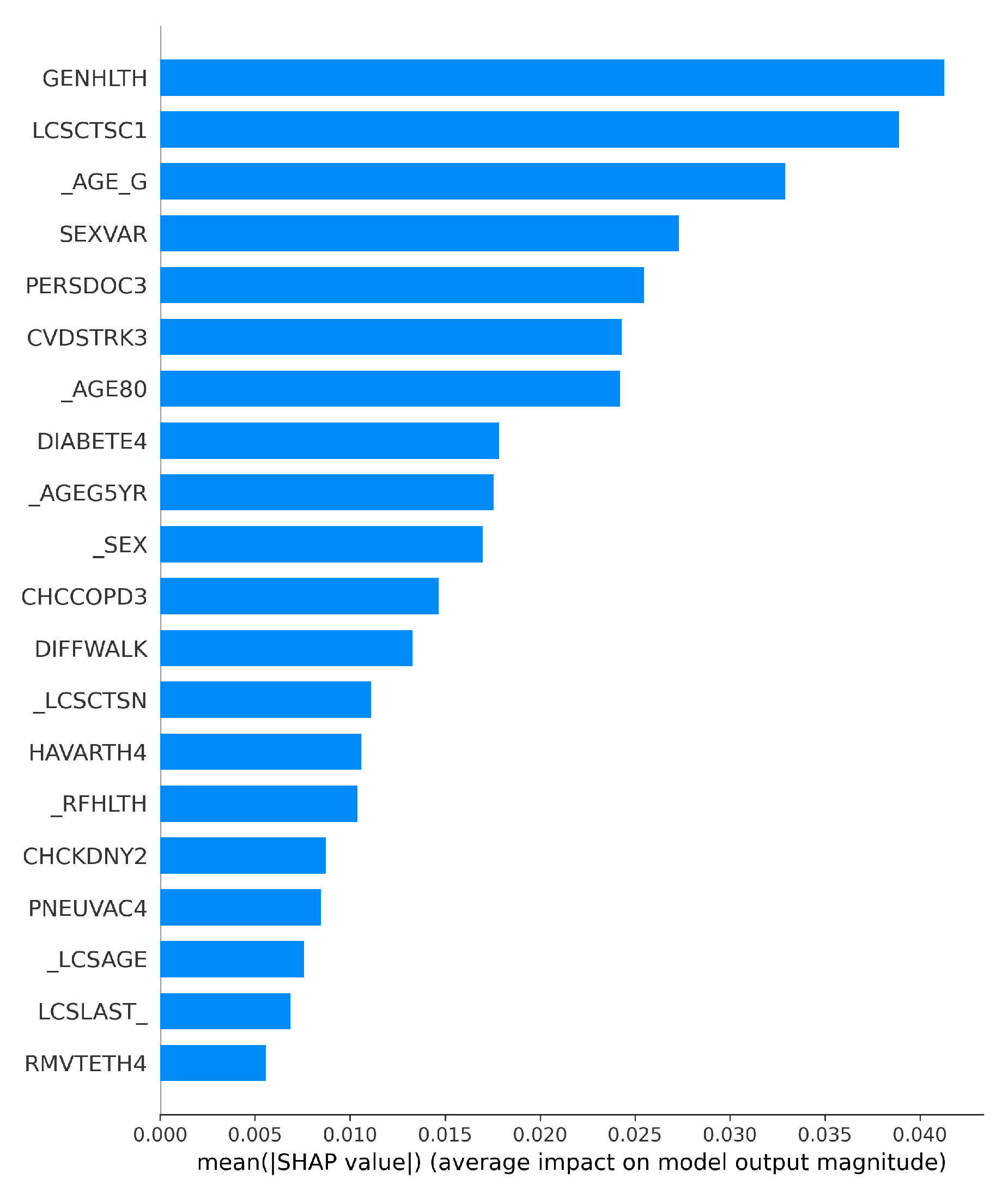
Figure 13 summarizes global feature importance using mean absolute SHAP values for the final fused prediction output.
The global SHAP summary (
Figure 13) indicates that general health status (GENHLTH), cardiovascular screening indicators (LCSCTSC1), age-related variables, and sex-related attributes are among the most influential predictors. Chronic disease indicators such as previous stroke, diabetes, and chronic obstructive pulmonary disease (COPD) also contribute strongly to the prediction outcome. These findings align with well-established cardiovascular risk factors reported in epidemiological studies, supporting the clinical plausibility of the learned model representations.
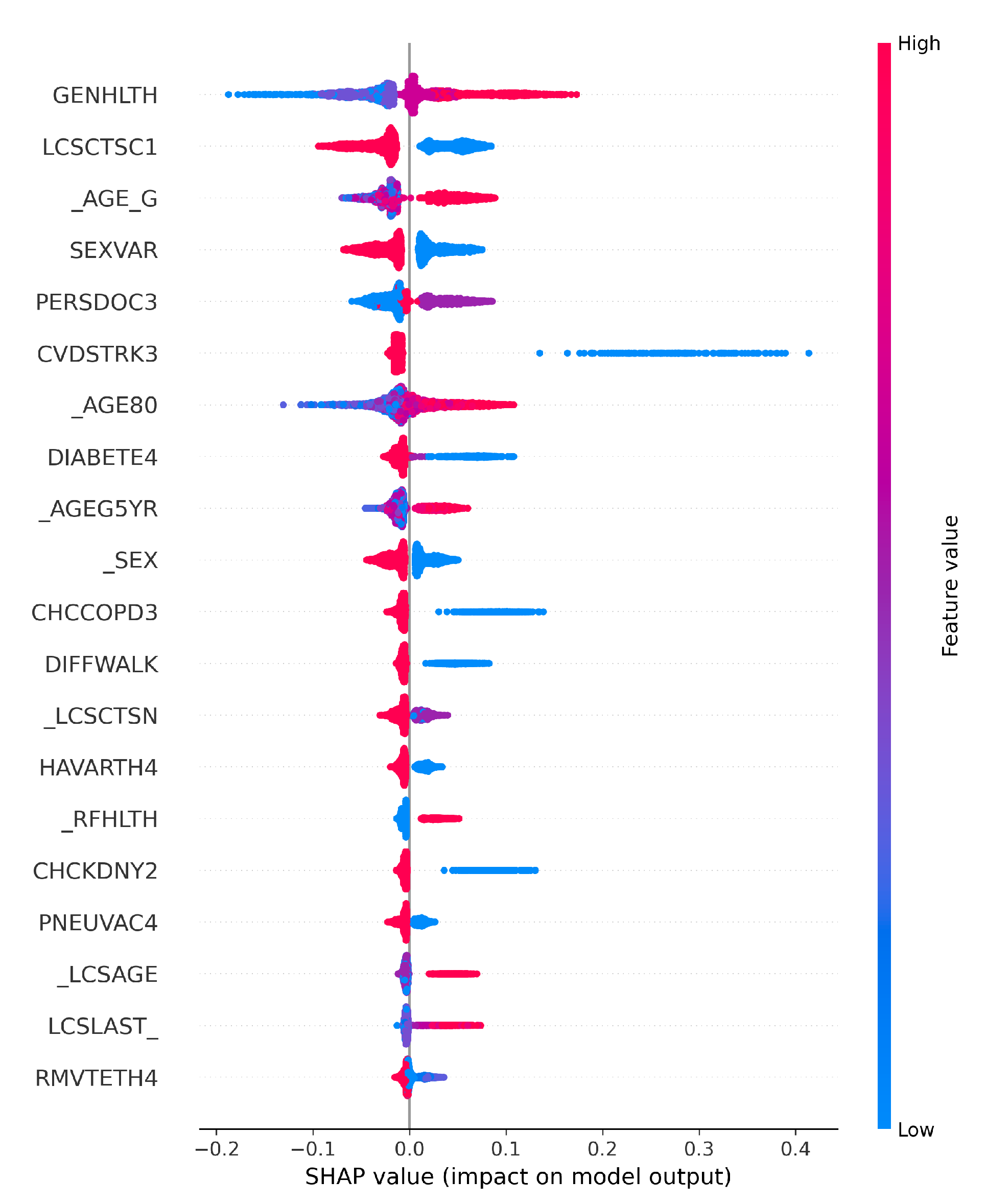
Figure 14 provides a SHAP beeswarm visualization highlighting feature-level directionality and instance-level variability in contributions to the final fused prediction.
The SHAP beeswarm plot (
Figure 14) further reveals directional behavior of the predictors. Poor general health status and a positive history of stroke or diabetes consistently push predictions toward higher CHD risk, while younger age categories tend to contribute negatively to the predicted risk. The distribution of SHAP values highlights instance-level variability, reflecting the adaptive behavior of the gated fusion mechanism rather than rigid global decision rules.
Beyond feature-level attribution, the dual-branch architecture introduces structural interpretability by explicitly separating sensitivity-oriented (recall-focused) and specificity-oriented (precision-focused) decision pathways. This decomposition enables analysis of whether individual predictions are driven more strongly by detection-oriented or verification-oriented reasoning.
Furthermore, the gating mechanism provides additional insight into decision behavior by dynamically weighting the contributions of the two branches at the instance level, allowing for partial tracing of how conflicting objectives are resolved for each sample.
Qualitative evidence from the ablation study further supports this interpretation: removing the veto and rescue rules increases variability in decision outcomes across validation folds, indicating reduced stability. This observation highlights the role of rule-based constraints in enforcing consistent and interpretable decision behavior within the overall architecture.
6.10. Joint Interpretation of Statistical Effects and SHAP-Based Feature Importance
To better understand how the proposed model utilizes the available predictors, we compared the univariate statistical group differences with the feature importance scores obtained from the SHAP analysis of the final trained model. Although both analyses examine the relationship between input variables and heart disease status, they reflect fundamentally different analytical perspectives.
The statistical tests quantify marginal differences between the heart disease and non–heart disease groups for each feature independently using contingency analysis and effect-size estimation. In contrast, SHAP values are derived from the fully trained model and capture the multivariate and nonlinear contributions of each feature within the complete prediction pipeline. Consequently, agreement between the two analyses suggests that the model relies on clinically meaningful variables, whereas discrepancies indicate that the model is learning interaction patterns that cannot be detected using univariate statistical analysis alone.
A strong degree of overlap is observed between the two rankings. Several variables with large statistical effect sizes, including _AGEG5YR, _AGE80, GENHLTH, _LCSCTSN, _AGE_G, DIFFWALK, CVDSTRK3, CHCCOPD3, and DIABETE4, also appear among the highest-ranked features in the SHAP analysis. These variables correspond to well-established cardiovascular risk factors, including age, general health condition, mobility limitation, chronic disease history, and metabolic disorders. The agreement between statistical significance and model attribution therefore supports the clinical plausibility of the learned decision patterns.
However, the ranking produced by SHAP is not identical to the ranking obtained from statistical tests. Some variables with strong univariate group differences appear lower in the SHAP importance list, while other variables with moderate statistical effects receive higher importance in the model. This behavior is expected because the proposed Dual-Branch FT-Transformer learns complex nonlinear relationships and feature interactions. When multiple variables encode similar clinical information, the model may rely more heavily on the most informative combination rather than on the variable with the largest individual group difference.
For instance, several age-related variables (_AGEG5YR, _AGE80, and _AGE_G) show strong statistical effects, but their predictive contributions are partially redundant. The attention-based architecture can compress correlated signals and distribute importance across related predictors. Similarly, variables related to lung screening, chronic conditions, and healthcare access demonstrate moderate statistical effects but receive higher SHAP importance because they interact with other predictors within the model.
Overall, this comparison demonstrates that the proposed model preserves the dominant clinical risk patterns present in the dataset while simultaneously capturing higher-order relationships that are not observable through univariate statistical analysis. The consistency between statistical testing and model-based attribution strengthens confidence in both the interpretability and the predictive validity of the proposed approach.
6.11. External Cohort Validation on NHANES
To further evaluate the robustness and cross-cohort applicability of the proposed framework, an additional external validation study was conducted using the National Health and Nutrition Examination Survey (NHANES) 2017–March 2020 pre-pandemic dataset [
33]. Unlike BRFSS-2024, which primarily contains large-scale behavioral and self-reported surveillance attributes, NHANES provides a substantially different population-health ecosystem that combines demographic information, clinical questionnaires, examination measurements, laboratory biomarkers, metabolic indicators, and lifestyle-related variables. This heterogeneous structure provides a clinically enriched evaluation setting for assessing whether the proposed dual-branch framework remains effective beyond the original BRFSS-2024 cohort.
Multiple NHANES modules were merged using the participant identifier (
SEQN), including demographic, blood pressure, diabetes, smoking, physical activity, body measurement, complete blood count, glucose, lipid profile, insulin, inflammation, and medical-condition questionnaire components. The resulting dataset construction and filtering process is summarized in
Table 14. After module merging, the initial NHANES dataset contained 15,560 participants and 282 variables. To reduce excessive sparsity while retaining clinically meaningful heterogeneity, variables with more than 70% missingness were removed. Target-construction variables, administrative identifiers, all-NaN variables, and constant variables were then excluded before model development. After target construction and filtering, the final external validation cohort consisted of 9180 participants, with a positive cardiovascular disease prevalence of 9.53%, making it a highly imbalanced dataset.
A binary cardiovascular disease target (
CVD_TARGET) was constructed using clinically related cardiovascular-history variables corresponding to congestive heart failure, coronary heart disease, angina, and heart attack. Participants were labeled as positive if any of these cardiovascular conditions were present. To prevent target leakage, all target-construction variables were removed before feature selection and model training. In addition,
SEQN was removed as an administrative identifier, and all-NaN and constant variables were excluded. This produced 163 usable candidate features before Phase 1 feature selection, as reported in
Table 14.
Importantly, NHANES differs substantially from BRFSS-2024 in both feature composition and data-generation characteristics. While BRFSS primarily relies on large-scale telephone-based behavioral surveillance attributes, NHANES integrates laboratory biomarkers, examination measurements, and clinically oriented health indicators collected under controlled assessment protocols. Consequently, the competitive performance observed on NHANES suggests that the proposed framework can retain balanced predictive behaviour under substantially different feature distributions and clinical variable interactions, rather than relying solely on BRFSS-specific statistical patterns. However, this should be interpreted as evidence of cross-cohort robustness under a leakage-safe re-training protocol rather than direct cross-dataset transfer without adaptation.
The same Phase 1 multi-selector feature fusion strategy used in the BRFSS-2024 experiments was preserved for NHANES. Specifically, Pearson correlation filtering, TabNet mask importance, and HistGradientBoosting permutation importance were jointly applied under a leakage-safe stratified 5-fold protocol. All preprocessing operations, including median imputation, scaling, and feature selection, were fitted only on training folds. This process selected 141 features for Phase 2 modeling, as shown in
Table 14. The identical dual-branch FT-Transformer architecture and GateNet-based adaptive fusion strategy were then evaluated against LightGBM, Random Forest, CNN, and simple average fusion.
The external validation results are presented in
Table 15, while the pooled confusion matrix comparison is illustrated in
Figure 15. The proposed framework achieved the highest overall F1-score (0.4876) and highest AUPRC (0.4677) among all evaluated models while maintaining a balanced precision–recall trade-off under the independent NHANES cohort. Although simple average fusion achieved slightly higher balanced accuracy and recall, it produced substantially more false positives (944) than the proposed framework (679), resulting in a less stable operating profile under imbalanced screening conditions.
The pooled confusion matrices further highlight the different operating behaviors of the comparison models. Random Forest achieved very low false positives but produced a large number of false negatives due to extremely low recall, whereas CNN achieved high recall at the cost of substantial false-positive escalation. In contrast, the proposed framework maintained a more balanced false-positive/false-negative trade-off while preserving the strongest overall F1-score across models.
From a healthcare-screening perspective, these results suggest that the proposed dual-branch gated architecture provides improved stability under severe class imbalance by adaptively regulating precision-oriented and recall-oriented behaviours. Importantly, despite substantial differences in feature composition and data-generation characteristics between NHANES and BRFSS-2024, the proposed framework consistently maintained competitive and balanced operating behaviour across both cohorts, suggesting potential robustness across differing population-health datasets while warranting further external validation on additional cohorts.
6.12. Limitations and Directions for Future Work
Despite its strengths, the proposed approach has several limitations. As summarized in
Table 16, the increased architectural complexity introduces additional training overhead and greater sensitivity to hyperparameter choices. Future work could explore more parameter-efficient gating mechanisms or partial weight sharing between branches to reduce computational cost while preserving the benefits of architectural decomposition.
Although the proposed framework introduces additional architectural components compared to conventional single-model approaches, the design is intentionally modular. The FT-Transformer backbone accounts for the primary computational cost, while the GateNet component remains lightweight, consisting of a single hidden layer with 16 units. The veto and rescue rules introduce negligible computational overhead, and Phase 1 feature selection is performed offline in a fold-wise manner. Future work will explore parameter-efficient variants and model compression techniques for resource-constrained environments.
Although this study primarily focuses on the BRFSS-2024 dataset, an additional independent cohort evaluation was conducted using NHANES under the same leakage-safe re-training protocol to assess cross-cohort robustness. While this provides encouraging evidence of model stability across substantially different population-health datasets, the evaluation should be interpreted as independent cohort validation with re-training rather than direct cross-dataset transfer without adaptation. Therefore, further validation on additional external, longitudinal, and clinically adjudicated cohorts would strengthen confidence in the broader applicability of the proposed framework. Integrating richer multimodal health data sources, including physiological signals, electronic health records, or wearable sensor measurements, may further improve predictive capability and real-world clinical utility.
Finally, although calibration techniques were applied to improve probability estimates, uncertainty quantification remains an open challenge. Incorporating probabilistic modeling, Bayesian approaches, or confidence-aware decision rules could further enhance reliability and trustworthiness in clinical deployment scenarios.
6.13. Broader Implications for Imbalanced Medical ML
Beyond cardiovascular risk prediction, the findings of this study have broader implications for machine learning applications in healthcare. Many medical prediction tasks involve asymmetric error costs and severe class imbalance, where traditional single-objective optimization is often insufficient.
The results suggest that architectural decomposition of competing objectives, combined with adaptive fusion mechanisms, represents a promising direction for future research. Rather than relying solely on increasingly complex loss functions, explicitly modeling competing objectives at the architectural level may provide greater flexibility, interpretability, and performance in imbalanced medical prediction tasks.