1. Introduction
Soil water content is a critical parameter in agriculture and environmental management, directly impacting plant growth, irrigation needs, and ecological processes. Moisture of porous materials is also a key variable in many other applications such as hydrology, geotechnical engineering, food engineering and building materials. Thus, accurate measurements of water content are very important for a wide range of applications.
Many techniques for water content measurements have been developed covering many different scales. Traditional techniques for water content measurements are, however, either labour intensive (e.g., gravimetric sampling) or require advanced and expensive equipment, e.g., time domain reflectometry (TDR) or frequency domain reflectometry (FDR). Until recently, systems of automated measurement equipment have been restricted to researchers or other users with a lot of resources. The limitations of traditional techniques have led to the development of low-cost sensors [
1]. During the last decades, several capacitive and resistive sensors have been developed. These offer lower cost and consume less energy compared to, e.g., TDR or FDR sensors, but the trade-off is that they have lower accuracy and precision [
2,
3]. These low-cost sensors can be controlled by microcontrollers and have shown great potential for use in smart systems or Internet of Things (IoT) applications [
4]. Some examples of such applications have been discussed by Bhavsar et al. [
5], who presented a comprehensive review of smart drip and sprinkler irrigation systems. A system with low-cost capacitance sensors controlling RGB LED lights to indicate when irrigation was needed was designed by Pitoro et al. [
6]. The current frontier lies in integrating capacitive sensors into IoT platforms for real-time data collection and decision support.
Most applications of low-cost capacitance sensors have been used in controlled environments in the laboratory or greenhouse. There are relatively few examples of published studies of field applications. Some examples of field applications can be found in Schwamback et al. [
3], who measured soil water content under experimental plots of different land use in Itirapina, Brazil, and Adla et al. [
7] who measured soil water content in an experimental wheat farm in Kanpur, India. Due to the limited number of field studies, there is a general lack of data from field applications needed for assessing the accuracy and precision of low-cost capacitance sensors in farm-scale applications.
When sensors are installed in the field, the common procedure is to first calibrate the sensors in the laboratory using repacked or undisturbed soil samples that are wetted or dried to known water contents. This laboratory calibration is then used in the field to convert sensor readings to water content. Rudnick et al. [
8] tested three water content capacitance-based measurement techniques in a field study and compared performance to water content measurements using a neutron gauge. They concluded that field calibrations were better than the manufacturer’s laboratory-based calibration for all sensors. Singh et al. [
9] evaluated in a field study eight water content sensors in reference to a neutron moisture meter. They concluded that calibrating against reference measurements, performance improved substantially beyond laboratory-based factory calibrations, with root mean square errors ranging from 0.039 to 0.157 m
3/m
3 for factory calibration to below 0.025 m
3/m
3 for all sensors using calibration against the reference method. Adla et al. [
7] used low-cost capacitance sensors to improve the AquaCrop model performance. They concluded that calibrating the sensor in field conditions against a secondary standard sensor gave lower errors compared to laboratory calibration.
As presented by the studies mentioned above, calibrating low-cost sensors to a reference method improves field performance compared to laboratory calibration. On the other hand, calibrating against a reference method is labour intensive and, of course, requires a reference method to compare with. Thus, the lack of a simple and effective way of calibrating low-cost capacitance sensors for field use is limiting the use of these sensors in farm-scale environments.
The objective of this study was to evaluate the field performance of low-cost capacitive (LCC) sensors when calibrated in the laboratory and to assess practical calibration strategies suitable for field application. To this end, laboratory calibrations were conducted on eight different soil types. Two laboratory calibration methods and two field calibration methods were evaluated in four field experiments in different soil types and environments.
3. Results
3.1. Laboratory Calibration
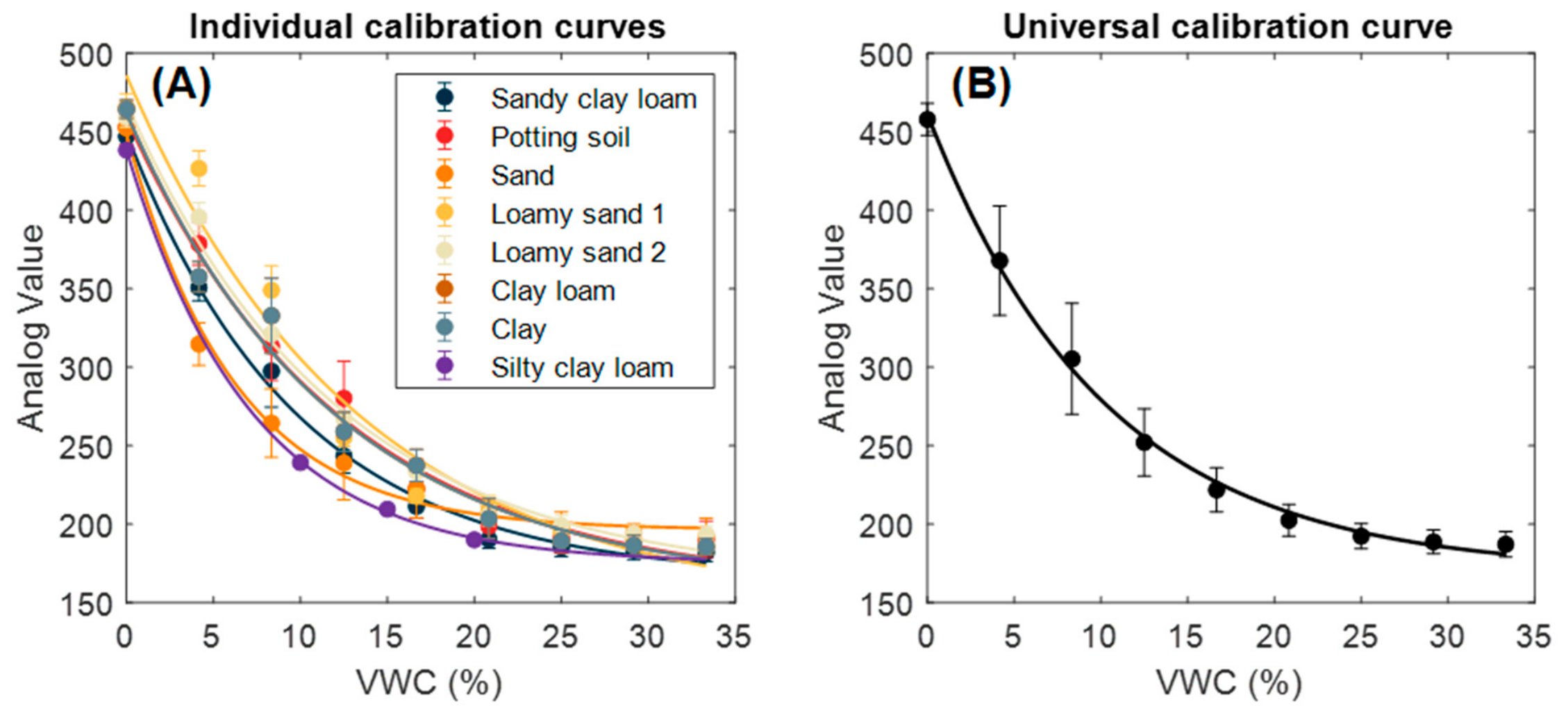
Figure 3A shows the individual calibration curves for the different soils. Each data point represents the mean analogue output value of five replicate measurements of four individual sensors. The error bars indicate the standard deviation of these measurements. The analogue output decreases nonlinearly with increasing VWC, and the response for all soils follows a similar exponential trend despite minor differences in slope and curvature between soil types. The high degree of similarity between soils justifies combining the data into a single universal calibration curve (
Figure 3B), which forms the basis for the UCL approach.
During calibration, we found a clear detection limit of the sensors. In dry soils, analogue sensor output values typically approached 450–480 for dry soil, while for wet conditions, the probes did not register values below approximately 182–190 depending on soil type. This lower threshold indicates that the sensors are unable to fully resolve additional increases in soil VWC once this limit is reached. As a result, sensor sensitivity decreases at higher VWCs (i.e., above ~25%), which constrains the reliable measurement range of the probes in wetter soils.
The coefficient of determination (R
2) and root mean square error (RMSE) of the calibration methods employed for the laboratory data, i.e., SSCL and UCL, are presented in
Table 3 along with the best fit parameters of the SSCL (Equation (2)). The performance of the LCC sensor in terms of R
2 and RMSE was similar to previously published results for similar sensors, although direct comparison of RMSE values should be done with caution due to different experimental procedures and range in VWC. The range in published RMSE is rather large, 0.009 to 0.078 m
3/m
3 [
3,
11,
13,
14,
17], but many of these studies report RMSEs of <0.04 m
3/m
3.
.
With all measurements combined, a universal calibration curve was derived with best-fit parameters a = 170.7, b = 296.8, and c = 0.1. The UCL method resulted in an RMSE of 0.028 m3/m3 and an R2 of 0.93, indicating good overall agreement across soils.
The precision of the sensors was evaluated by calculating the standard deviation of the VWC estimation. The standard deviation was determined both for the five replicate measurements at each VWC for each of the four sensors in every soil type, and for all measurements from the four sensors combined. For each soil type, the average standard deviation was calculated as the mean of the standard deviations obtained at each VWC, for both individual sensor data and the pooled dataset. The results are presented in
Table 4. Overall, the findings indicate low sensor-to-sensor variability, and in the present study there was no need for individual calibration of each sensor. The higher standard deviation for the pooled data reflects variability introduced when measurements from several sensors and water contents are combined and should therefore not be interpreted solely as sensor-to-sensor variability. In addition, small local differences in soil packing and soil conditions around each sensor may also have contributed to the pooled variability. Comparable standard deviation values for combined data were reported by Chereches et al. [
18], who evaluated 28 sensors of the same type used in this study.
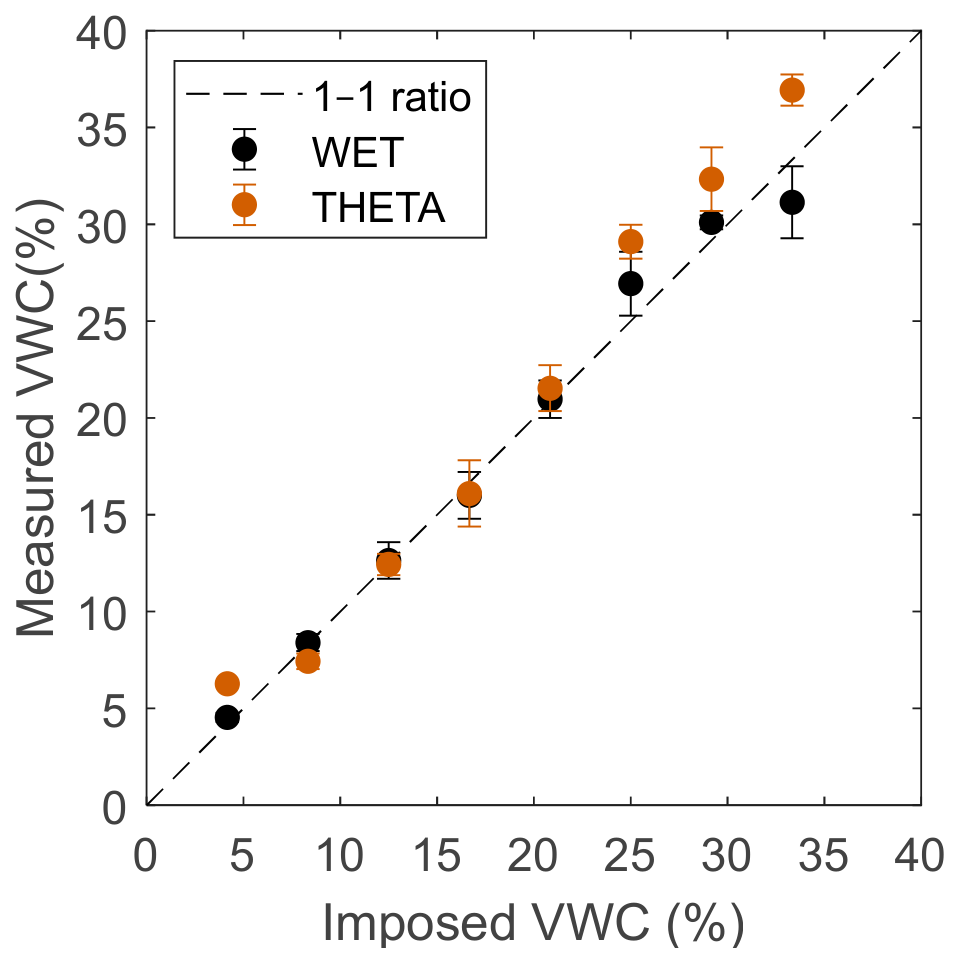
The WET sensor and the ThetaProbe provided accurate VWC estimations when using the default manufacturer calibration settings. In the sandy clay loam soil, the WET sensor showed excellent agreement with the imposed VWCs (R
2 = 0.99, RMSE = 0.011 m
3/m
3), while the ThetaProbe also performed well (R
2 = 0.98, RMSE = 0.024 m
3/m
3). As shown in
Figure 4, both reference sensors closely followed the 1:1 line across the tested moisture range, indicating minimal systematic bias. The error bars represent ±1 standard deviation of the replicate measurements, as described previously for the laboratory calibration experiments.
Given this strong agreement, no additional soil-specific calibration was applied to the WET sensor or the ThetaProbe in this study. The performance of the ThetaProbe is consistent with previous findings reported by [
19], who observed RMSE values in the range 0.011–0.054 m
3/m
3 using manufacturer calibration, and [
20], who reported RMSE values below 0.0523 m
3/m
3. Similarly, the WET sensor performance is in line with results reported by [
21,
22].
3.2. Salinity Effects
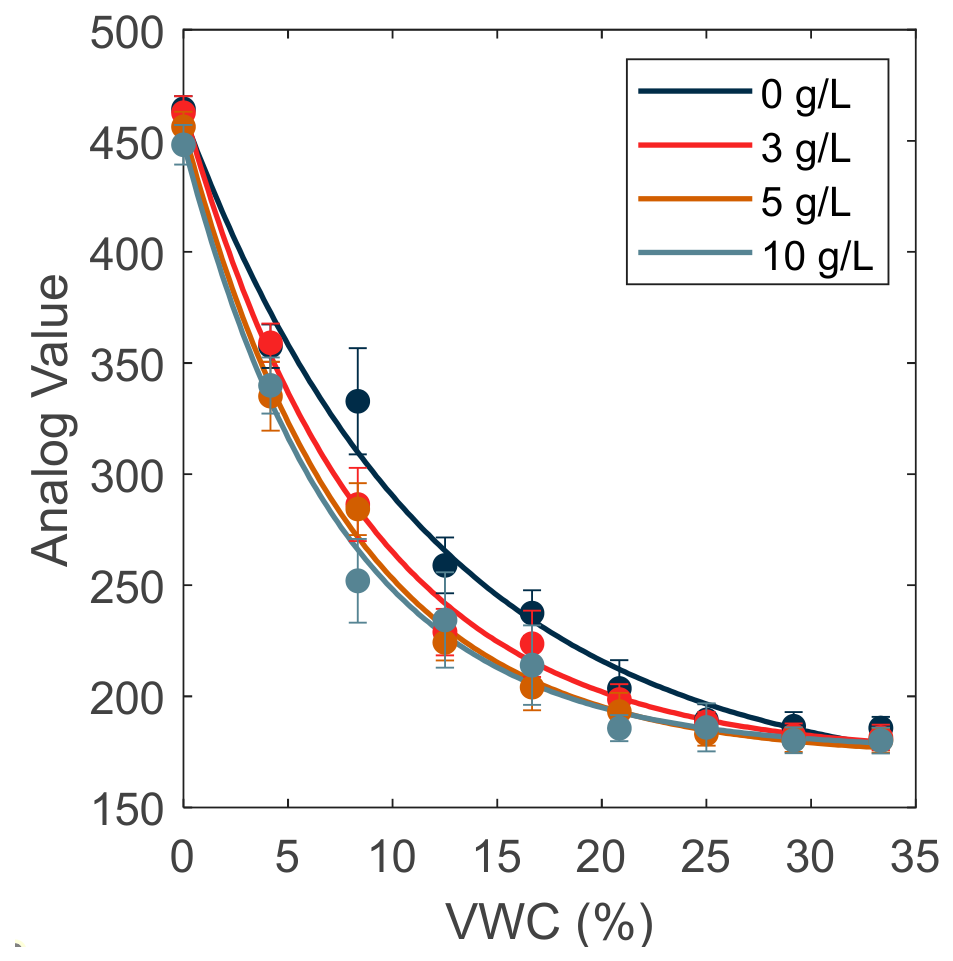
Figure 5 illustrates the influence of increasing salinity on the analogue sensor response. The general effect of salinity is a systematic decrease in analogue output with increasing NaCl concentration at a given VWC. As salinity increases from 0 to 10 g/L, the calibration curves shift downward, particularly at intermediate moisture levels. This indicates that saline conditions cause the sensor to underestimate VWC when using a calibration curve derived under non-saline conditions.
This behaviour is consistent with previous findings [
23,
24,
25] and reflects the influence of increased electrical conductivity on the dielectric response measured by capacitive sensors. Peddinti et al. [
24] found that salinity effects on a low-cost resistivity-capacitance sensor became less pronounced in finer-textured soils such as clay loam compared to sandy soils, underscoring the interplay between salinity and soil physical properties. Gómez-Astorga et al. [
13] demonstrated that calibration curves developed under non-saline conditions can deviate by up to ~30% when salinity is present, particularly at moderate to high salinity levels. In our case (
Figure 5), the deviation from the non-saline calibration curve reached approximately 15% at a NaCl concentration of 10 g/L, especially at intermediate VWCs.
To assess the practical implications of salinity, soils were classified according to the USDA salinity classification system [
26], which categorizes soils based on the electrical conductivity of the saturation extract (EC
s). The EC
s was calculated from the electrical conductivity of the soil water (EC
w) using
where VWC
s is the volumetric water content at saturation. Based on the calculated EC
s values, each sample was assigned to a USDA salinity class. The analogue sensor outputs were converted to VWC using the universal calibration curve, and performance metrics (R
2 and RMSE) were determined for each salinity category.
The results show that sensor performance deteriorates with increasing salinity. In non-saline soils (ECs < 2 dS/m), the universal calibration performed well (R2 = 0.96, RMSE = 0.017 m3/m3). In slightly saline soils (2–4 dS/m), performance decreased substantially (R2 = 0.80, RMSE = 0.043 m3/m3). In moderately saline soils (4–8 dS/m), the RMSE increased further to 0.048 m3/m3, although R2 remained relatively high (0.94). No data were available for highly saline soils (>8 dS/m).
Overall, the experimental results demonstrate that increasing salinity introduces systematic bias and increased uncertainty in VWC estimation. Consequently, the use of the low-cost capacitive (LCC) sensor is recommended primarily for soils classified as non-saline according to the USDA classification, i.e., soils with ECs below 2 dS/m.
The salinity analysis in the present study was limited to NaCl solutions and therefore represents a simplified case compared to the more complex ionic composition of natural soil solutions under field conditions. In practice, soil salinity may reflect varying proportions of different dissolved ions, which can influence electrical conductivity and sensor response in different ways. The results should therefore be interpreted as an indication of the general sensitivity of the LCC sensor to salinity rather than as a complete description of its performance under all saline field conditions.
3.3. Field Tests
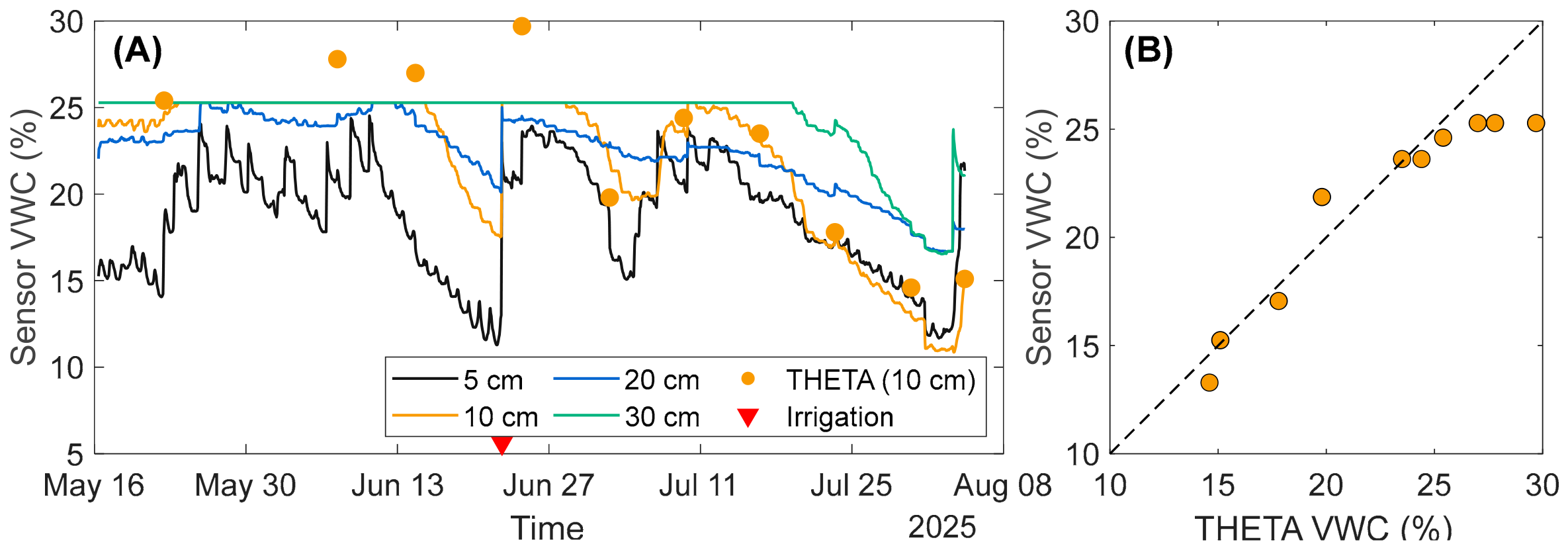
All field tests produced useful time series of VWC. A quantitative analysis showed that the evolution of VWC over time was as expected, i.e., VWC increased after rainfall or irrigation and decreased during dry periods. As an example, the VWC over time for one of the systems (GN2.1) in experiment GN2 is shown in
Figure 6A. The VWC values were calculated using the SSCF.
In GN2, the time series clearly capture distinct wetting events, followed by progressive drying phases. The shallow sensors (5 and 10 cm) respond rapidly to rainfall and irrigation, showing sharp increases and stronger short-term variability. In contrast, the deeper sensors (20 and 30 cm) exhibit a smoother and delayed response, reflecting vertical water redistribution and attenuation of surface forcing with depth. It should be noted that these sensors did not record volumetric VWC higher than ~25%, consistent with the upper detection limit observed in the laboratory calibration. The overall consistency between depths and the agreement with manual ThetaProbe reference measurements at 10 cm, shown in
Figure 6B, confirms that the system reliably captures field-scale soil moisture dynamics.
In each field test, VWC was calculated using the four calibration approaches: soil-specific calibration in the laboratory (SSCL), universal calibration in the laboratory (UCL), soil-specific calibration in the field (SSCF), and one-point calibration (1PC).
Table 5 summarizes the performance of all calibration methods across the experiments in terms of RMSE.
The 1PC can be performed using any of the measured reference VWCs (VWCref) obtained for a given experiment and sensor. Consequently, the number of possible 1PC realizations corresponds to the number of available VWCref measurements. For each field test, the minimum, mean, and maximum RMSE obtained from all possible 1PC combinations are reported.
Across the experiments, SSCF consistently provided the best performance, yielding RMSE values below 0.021 m3/m3 in 8 out of 9 field tests. The second-best method was the mean 1PC, which ranked second in 8 out of 9 experiments. Notably, in 7 out of 9 field tests, even the worst-performing 1PC resulted in lower RMSE than both SSCL and UCL. The highest RMSE values were generally observed for SSCL, with one exception.
To assess the robustness of the 1PC approach, a trend analysis was conducted to evaluate whether RMSE depended on time or VWC. A significant trend (α = 0.05) was detected in only two experiments. In GN1, RMSE increased slightly over time, which may be attributed to gradual structural changes in the repacked soil. In TH, RMSE increased with higher VWCs, possibly due to the relatively wide VWC range and the reduced sensitivity of the LCC sensor at high VWC levels.
In all field tests except GN2, SSCL and UCL generally underestimated VWC. The discrepancies between laboratory- and field-derived calibrations likely arise from several factors, with differences in bulk density being a major contributor, as bulk density has been shown to significantly influence the calibration of low-cost capacitive sensors [
4]. However, no bulk density measurements were made directly around the sensor locations during the field experiments to verify this assumption. It should also be noted that in the laboratory experiments, LCC-derived VWC was compared to gravimetrically determined VWC, whereas in the field experiments it was compared to values obtained from reference sensors. However, separate laboratory calibrations of the WET sensor and the ThetaProbe demonstrated that these reference methods provided accurate VWC measurements for the soils used in the field tests.
4. Discussion
The objectives of this study were (i) to evaluate the performance of laboratory calibration methods for low-cost capacitive (LCC) soil moisture sensors under field conditions and (ii) to develop and assess a practical field calibration method that improves measurement accuracy while remaining feasible for routine application.
The LCC water content sensor can produce high-quality measurements with low errors under the right conditions. In the laboratory calibration experiment, the RMSE ranged from 0.013 to 0.022 m3/m3 for different soil types when using a soil-specific calibration (SSCL), and from 0.018 to 0.032 m3/m3 when a universal calibration curve (UCL) was employed.
The exponential calibration function provided the best fit to the observed sensor response and was therefore selected. Although this equation is empirical, previous studies have shown that similar sensors can also be interpreted using more physically based approaches, where sensor output is related to bulk dielectric permittivity and subsequently converted to volumetric water content using dielectric models (e.g., [
14]). Such approaches provide a stronger physical basis and may improve generality. However, in the present study, the empirical approach was considered more suitable, since the main objective was to obtain a robust and practical calibration for field application.
During the laboratory experiment, a limitation in measuring high VWCs (>0.25 m
3/m
3) was observed, which restricts the usable measurement range. One common application of LCC sensors is irrigation control. Irrigation is typically applied when soil VWC falls below field capacity (FC) and should stop when FC is reached. The lowest reliable reading of the LCC sensor is around 185, which corresponds to approximately 0.25 to 0.30 m
3/m
3 using the universal calibration curve presented in this study. Therefore, the LCC sensor is generally recommended only for soils with a field capacity of around 0.30 m
3/m
3 or less, the exact value depends on soil type and bulk density. Based on the relationship developed by Saxton et al. [
27], this corresponds to a clay content of approximately 35%. Consequently, for irrigation control, the sensor is best suited for soils with less than 35% clay. The limited measurement range of the LCC sensor is therefore an important practical constraint. Since the sensor response became unreliable above approximately 0.25–0.30 m
3/m
3, its applicability is restricted in soils where field capacity exceeds this range, particularly in finer-textured soils with higher clay content. In such cases, the sensor may still be useful for tracking relative drying trends, but it is less suitable for accurately determining when the soil has reached field capacity or for controlling irrigation close to wet conditions. The sensor is therefore most suitable for coarse- to medium-textured non-saline soils, where the relevant water content range falls within the reliable measurement interval.
The influence of salinity was tested under laboratory conditions. Increasing salinity resulted in larger measurement errors. Due to this sensitivity, the LCC sensor is recommended only for soils classified as non-saline according to the USDA classification, i.e., soils with an electrical conductivity of the saturation extract below 2 dS/m. It should be noted that the salinity analysis was limited to NaCl solutions and therefore represents a simplified case compared with the more complex ionic composition of natural soil solutions under field conditions.
To evaluate whether laboratory-derived calibrations can be reliably applied under field conditions, eight field tests were conducted under different environmental and climatic conditions. The field experiments demonstrated that while the LCC sensor can produce stable and consistent long-term measurements, laboratory-based calibrations (both SSCL and UCL) did not always maintain the same level of accuracy in the field. This confirms that laboratory calibration alone is insufficient to guarantee optimal field performance.
Four calibration methods were tested for the field data: soil-specific laboratory calibration (SSCL), universal laboratory calibration (UCL), soil-specific field calibration (SSCF), and one-point calibration (1PC) using field data. A notable result was that the universal laboratory calibration performed better than the soil-specific laboratory calibration in all field experiments. A likely explanation is that the field conditions did not correspond closely enough to the laboratory calibration conditions for the specific soil, particularly with respect to bulk density, soil structure, and sensor installation. In that case, the universal calibration may have performed better because it represents an average response across several soils and conditions and was therefore less sensitive to mismatches between laboratory and field conditions. The result suggests that transferability from laboratory to field may be more important than soil specificity alone. It should also be noted that the description of soil properties was limited, and that texture was the only parameter consistently reported for all soils. Other properties, such as bulk density, organic matter content, and porosity, may also influence sensor response. This should be recognized as a limitation of the study, since a more complete description of soil properties would have improved the interpretation and transferability of the results. The best overall accuracy was nevertheless obtained using soil-specific calibration based on field data (SSCF), indicating that soil-specific calibration can be highly effective when it is based on measurements made under the actual field conditions. However, this approach requires multiple reference measurements and is therefore more labour intensive than the other methods.
The comparison between calibration methods in the present study was primarily based on R2 and RMSE, since these metrics provide a direct and practically relevant assessment of calibration performance in terms of VWC. However, the results also indicated systematic deviations between methods, as SSCL and UCL generally underestimated VWC in most field experiments. A more extensive statistical evaluation could therefore have provided additional information on the nature of the calibration errors. However, this was beyond the scope of the present study.
Although the WET sensor and ThetaProbe were used as reference methods in the field experiments, they are not uncertainty-free, and their accuracy may vary with soil conditions and calibration. In the present study, both sensors showed good agreement with VWC in the laboratory, which supported their use as reference methods in the field soils investigated. It should nevertheless be acknowledged that different reference approaches were used in laboratory and field conditions, with gravimetric measurements serving as the laboratory standard and the WET sensor, ThetaProbe, or gravimetric sampling used in the field. This may have introduced some inconsistency between experiments, but the separate evaluation of the reference sensors indicated that their uncertainty was small relative to the differences observed between calibration methods.
The one-point calibration method, based on a single reference measurement combined with the universal laboratory calibration equation, provided very good accuracy while requiring minimal manual effort. If the reference method is gravimetric soil sampling, only a household scale and an oven are required, making the method accessible and practical for widespread use.