Delay-Doppler Domain Time-Hopping Key Generation and Security Analysis for Orthogonal Time Frequency Space Satellite Communication Systems

Abstract
1. Introduction
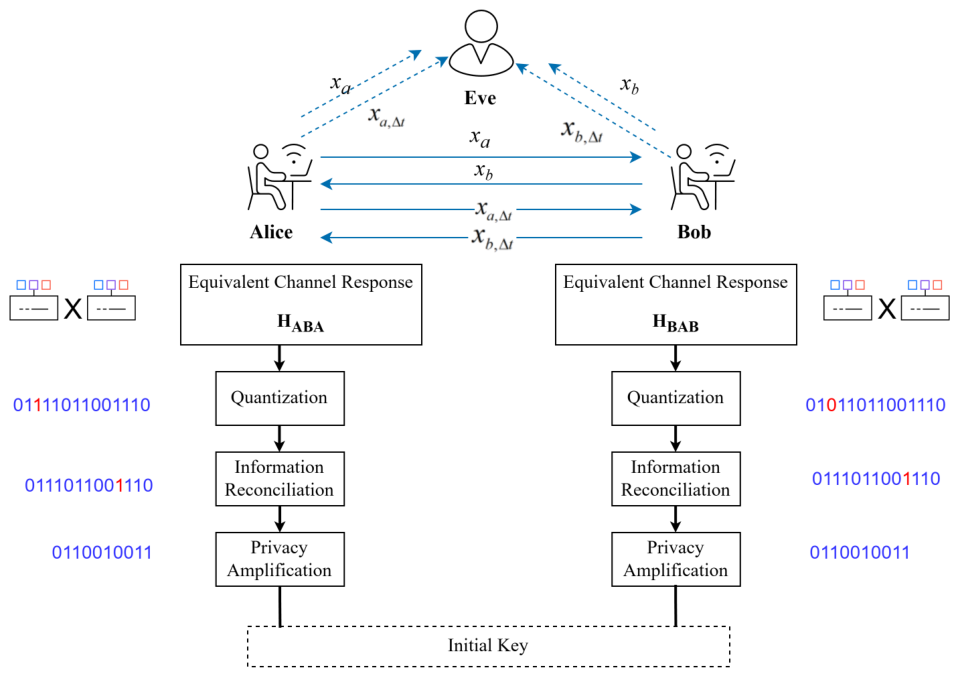
- Time-hopping mechanism: Uses ephemeris-driven pseudorandom sequences for non-uniform sampling on delay-Doppler (DD) domain grid points;
- Equivalent channel construction: Forms the product of two adjacent channel estimates to enhance source entropy and resist prediction attacks;
- Three-dimensional random source: Integrates “ephemeris–channel–time” dynamic factors to counter prediction attacks.
- First OTFS DD domain PLKG scheme for LEO/MEO satellites: Unlike Hao et al. [10] (which uses orbital diversity but uniform sampling and is vulnerable to AI-assisted prediction) and Gunjan et al. [8] (which analyzes secrecy capacity but does not generate keys), we propose the first key generation protocol that exploits the sparse DD domain structure of satellite channels for key extraction.
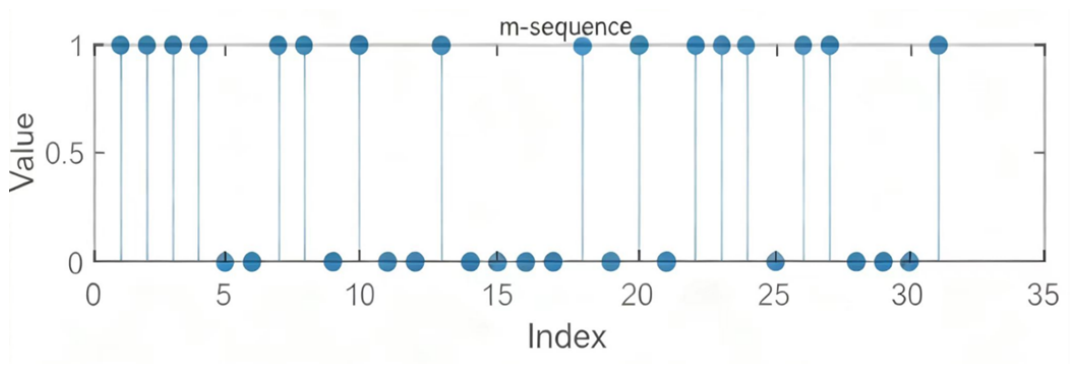
- Ephemeris-driven time-hopping with provable unpredictability: The non-uniform sampling instants are generated by a cascaded nonlinear LFSR with period 3937, making the equivalent channel statistically independent of any single-instant prediction achievable by Eve, even with full ephemeris knowledge. We formally bound Eve’s mutual information as .
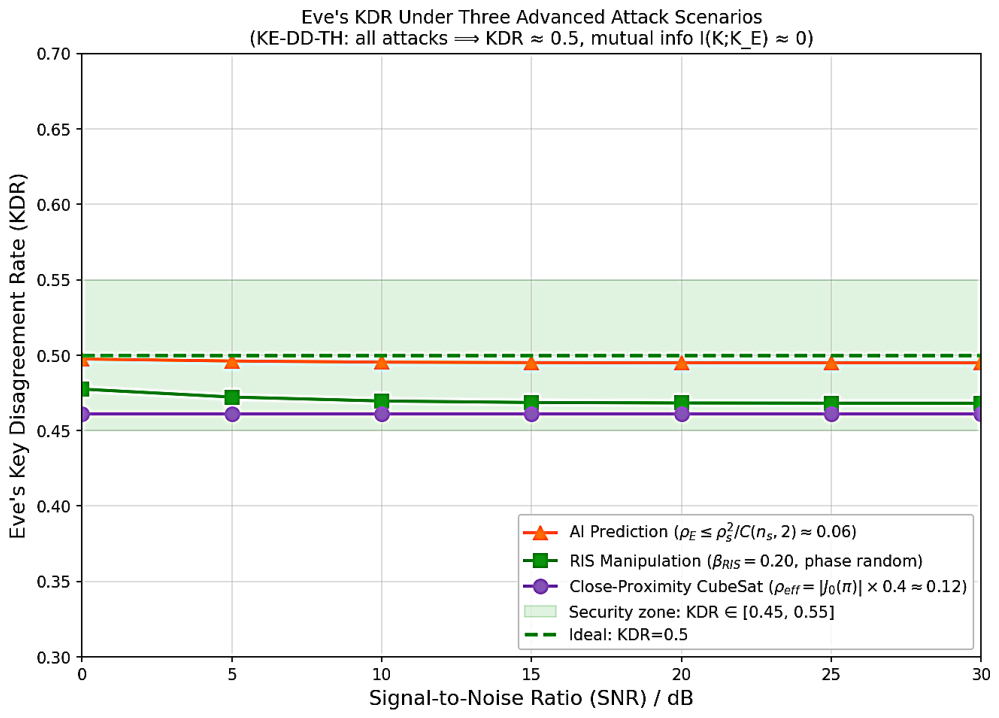
- Formally modeled attack scenarios: Unlike prior satellite PLKG works, we provide explicit mathematical models for AI prediction, RIS manipulation, and CubeSat close-proximity eavesdropping attacks, and demonstrate security against all three.
2. System Model and Proposed Scheme
2.1. System Model
- Alice: A LEO satellite equipped with a single antenna and operating in digital transparent forwarding (bent-pipe) mode, transmitting OTFS pilot signals via Ka/Ku feeder links or inter-satellite links (ISLs).
- Bob: A ground user terminal (UT) or another LEO satellite; if Bob is a ground terminal, the link is a typical satellite-to-ground TDD; if Bob is also a satellite, the link is an inter-satellite TDD.
- Eve: A composite eavesdropping network.
- Ground-based large-aperture phased array + AI server: Leverages publicly available ephemeris, real-time Global Navigation Satellite System (GNSS) corrections, and atmospheric models to achieve millimeter-level Doppler-shift and sub-millisecond delay prediction of the satellite-to-ground channel [10,15].
- Maneuverable picosatellite/CubeSat: (mass ≤ 10 kg, ≥ 50 m/s): Capable of maneuvering within minutes to within half-wavelength (/2 ≈ 1–2 cm at Ka-band) of the Alice–Bob link for close-proximity eavesdropping [15].
2.2. Improved M-Sequence-Based Random Time Interval Generation Using Time-Hopping Sequences
2.2.1. Multi-Stage LFSR Cascading
2.2.2. Forward Feedback Matrix Transformation
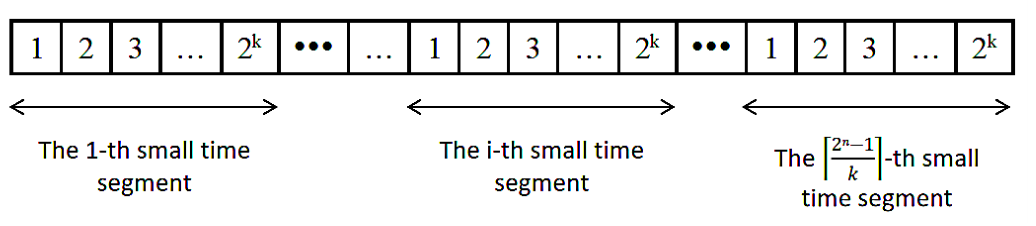
2.2.3. Random Time Interval Generation
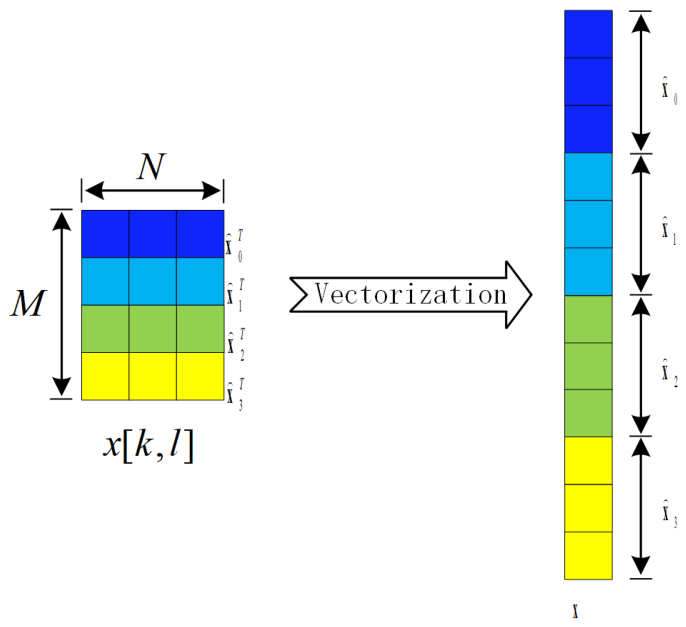
2.3. DD Domain Key Extraction Based on Random Time Intervals
3. System Performance Simulation
3.1. Simulation Parameters
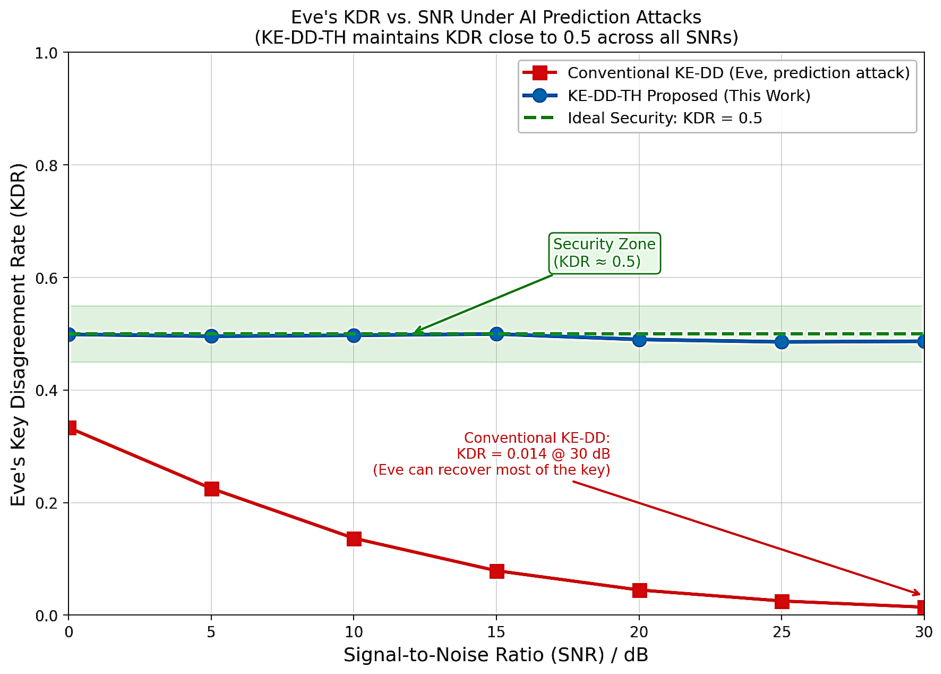
3.2. Eve’s Attack Models
3.3. Correction of KDR Interpretation
3.4. Randomness Testing and Analysis
3.5. Scheme Effectiveness Analysis
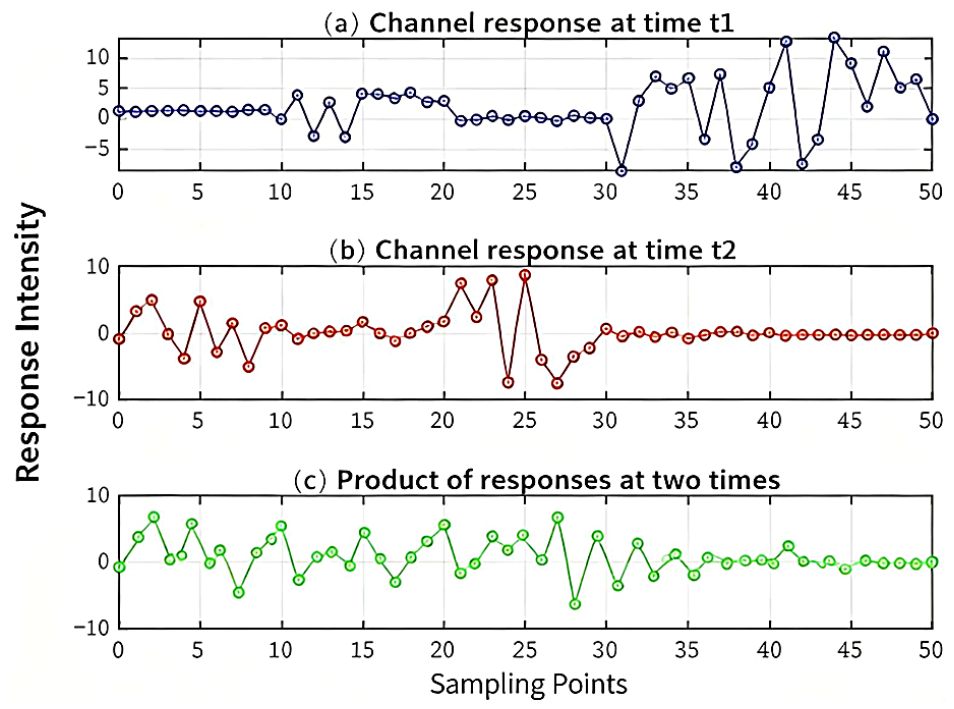
- Enhanced Randomness: When using the channel response at individual time instants or (Figure 7a,b) as the randomness source, the amplitude/phase distribution may exhibit clustering, resulting in low entropy and proneness to producing long runs of 0 s or 1 s after quantization. In contrast, the equivalent channel response (Figure 7c) exhibits a more uniform and random distribution, significantly increasing the entropy of the randomness source.
- Reduced Quantization Difficulty: During certain time periods, the single channel response is weak (e.g., the central region in Figure 7b), leading to low SNR and making it extremely difficult to extract useful information and perform reliable quantization. The equivalent channel, obtained through response multiplication, effectively amplifies weak signals and averages out noise, enhancing the strength of valid signals and thereby substantially reducing quantization difficulty and error rate.
4. Conclusions
- Investigate beam-hopping sequence design in multi-antenna systems to enhance key generation rate;
- Explore integration with quantum key distribution to construct a space-terrestrial integrated security framework;
- Optimize algorithmic complexity to facilitate on-board deployment;
Author Contributions
Funding
Data Availability Statement
Acknowledgments
Conflicts of Interest
References
- Hua, Y. Generalized Channel Probing and Generalized Pre-processing for Secret Key Generation. IEEE Trans. Signal Process. 2023, 71, 1067–1082. [Google Scholar] [CrossRef]
- Hu, L.; Li, G.Y.; Hu, A.Q.; Ng, D.W.K. Exploiting Malicious RIS for Secret Key Acquisition in Physical-layer Key Generation. IEEE Wirel. Commun. Lett. 2024, 13, 73–77. [Google Scholar] [CrossRef]
- Lu, X.; Lei, J.; Shi, Y.; Li, W. Intelligent Reflecting Surface Assisted Secret Key Generation. IEEE Signal Process. Lett. 2021, 28, 1863–1867. [Google Scholar] [CrossRef]
- Zhang, X.; Li, G.; Zhang, J.; Hu, A.; Hou, Z.; Xiao, B. Deep-Learning-Based Physical-Layer Secret Key Generation for FDD Systems. IEEE Internet Things J. 2022, 9, 6081–6094. [Google Scholar] [CrossRef]
- Gaudio, L.; Colavolpe, G.; Caire, G. OTFS versus OFDM in the Presence of Sparsity: A Fair Comparison. IEEE Trans. Wirel. Commun. 2022, 21, 7407–7421. [Google Scholar] [CrossRef]
- Xiao, L.; Li, S.; Qian, Y.; Chen, D.; Jiang, T. An Overview of OTFS for Internet of Things: Concepts, Benefits, and Challenges. IEEE Internet Things J. 2022, 9, 9152–9169. [Google Scholar] [CrossRef]
- Xinjin, L.; Jing, L.; Wei, L.; Xiongkun, L.; Zhe, D. A Low Peak-to-average Ratio Secure Transmission Method Based on U Matrix Transformation in Orthogonal Time and Frequency Space System. J. Electron. Inf. Technol. 2021, 43, 2364–2373. [Google Scholar]
- Gunjan, G.; Shrivastava, S.; Kashyap, S. Modeling and Analysis of Physical Layer Security of OTFS Systems Under Transmit Antenna Selection and Passive Eavesdropping. IEEE Commun. Lett. 2024, 28, 483–487. [Google Scholar] [CrossRef]
- Bora, A.S.; Phan, K.T.; Hong, Y. Mitigating Spatial Correlation in MIMO-OTFS. IEEE Trans. Veh. Technol. 2024, 73, 3608–3622. [Google Scholar] [CrossRef]
- Hao, Y.; Mu, P.; Wang, H.; Jin, L. Key Generation Method Based on Multi-Satellite Cooperation and Random Perturbation. Entropy 2021, 23, 1653. [Google Scholar] [CrossRef] [PubMed]
- Ying, M.; Chen, X.; Qi, Q.; Gerstacker, W. Deep Learning-Based Joint Channel Prediction and Multibeam Precoding for LEO Satellite Internet of Things. IEEE Trans. Wirel. Commun. 2024, 23, 13946–13960. [Google Scholar] [CrossRef]
- Su, N.; Liu, F.; Masouros, C. Sensing-Assisted Eavesdropper Estimation: An ISAC Breakthrough in Physical Layer Security. IEEE Trans. Wirel. Commun. 2024, 23, 3162–3174. [Google Scholar] [CrossRef]
- Zhang, T.; Li, G.; Wang, S.; Zhu, G.; Chen, G.; Wang, R. ISAC-Accelerated Edge Intelligence: Framework, Optimization, and Analysis. IEEE Trans. Green Commun. Netw. 2023, 7, 2249–2263. [Google Scholar] [CrossRef]
- Yang, R.; Wang, C.X.; Huang, J.; Aggoune, E.-H.M.; Hao, Y. A Novel 6G ISAC Channel Model Combining Forward and Backward Scattering. IEEE Trans. Wirel. Commun. 2023, 22, 8050–8065. [Google Scholar] [CrossRef]
- Guo, R.X.; Wang, K.; Deng, Z.L.; Lin, W.; Song, R. A Prediction Model for Channel State Information in Satellite Communication Systems. In Proceedings of the IEEE 31st Annual International Symposium on Personal, Indoor and Mobile Radio Communications (PIMRC), London, UK, 31 August–3 September2020; IEEE: New York, NY, USA, 2020; pp. 1–6. [Google Scholar] [CrossRef]
- Hoang, T.M.; Xu, C.; Vahid, A.; Tuan, H.D.; Duong, T.Q.; Hanzo, L. Secrecy-Rate Optimization of Double RIS-Aided Space-Ground Networks. IEEE Internet Things J. 2023, 10, 19798–19811. [Google Scholar] [CrossRef]
- Yuan, J.; Chen, G.; Wen, M.; Tafazolli, R.; Panayirci, E. Secure Transmission for THz-Empowered RIS-Assisted Non-Terrestrial Networks. arXiv 2022, arXiv:2209.13806. [Google Scholar] [CrossRef]
- Xiu, Y.; Lyu, W.; Yeoh, P.L.; Ai, Y.; Wei, N. Secure Enhancement for RIS-Aided UAV with ISAC: Robust Design and Resource Allocation. arXiv 2024, arXiv:2409.16917. [Google Scholar] [CrossRef]
- Ma, Z.; Liang, Y.; Zhu, Q.; Zheng, J.; Lian, Z.; Zeng, L. Hybrid-RIS-Assisted Cellular ISAC Networks for UAV-Enabled Low-Altitude Economy via Deep Reinforcement Learning with Mixture-of-Experts. IEEE Trans. Cogn. Commun. Netw. 2026, 12, 3875–3888. [Google Scholar] [CrossRef]



| Channel Feature | Satellite Channel Behavior | Impact on PLKG |
|---|---|---|
| Doppler Shift | Extremely large (LEO: ±50 kHz; MEO: ±10–20 kHz) | Destroys OFDM subcarrier orthogonality, causing inter-carrier interference (ICI), channel estimation errors, and breakdown of key agreement [1,2,3,4]. |
| Dynamics and Coherence Time | Highly dynamic ( km/s), extremely short coherence time | Uniform sampling yields fewer independent channel samples, limiting key generation rate (KGR). |
| Propagation Delay | Very long (LEO: ∼10 ms; GEO: ∼250 ms) | In Time Division Duplex (TDD) mode, the prolonged duplex interval degrades channel reciprocity, increasing the key disagreement rate (KDR) between legitimate parties. |
| Randomness and Predictability | Constrained by public ephemeris and orbital mechanics | Attackers can use AI models combined with ephemeris for high-precision channel prediction, threatening key confidentiality. |
| Parameter | Value | Description |
|---|---|---|
| Carrier frequency | 26.5 GHz | Ka band |
| OTFS grid | Doppler × delay grid | |
| Subcarrier spacing | 15 kHz | 3GPP NR NTN |
| Pilot | Single pilot at DD origin | |
| Orbital altitude | 550 km | Typical LEO |
| Satellite velocity | 7580 m/s | |
| Elevation angle | 40° | |
| Max. Doppler | 513 kHz | Clarke model |
| Coherence time | 0.82 s | |
| Paths L | 3 | Sparse DD domain |
| Rician K-factor | 3.0 dB | Line-of-sight (LOS) first path |
| Reciprocity error | 5% | TDD mismatch |
| LFSR orders | 5th + 7th | Period |
| Segment length k | 4 | Equations (1) and (2) |
| Reconciliation code | BCH(255, 131, 23) | Corrects ≤5% errors |
| Test Items | p-Value |
|---|---|
| Frequency Test | 0.746318 |
| Block Frequency Test | 0.376918 |
| Cumulative Sum Test | 0.060982 |
| Run Test | 0.902368 |
| Longest Run of Ones Test | 0.787478 |
| Binary Matrix Rank Test | 0.170485 |
| Discrete Fourier Transform (Spectral) Test | 0.334755 |
| Non-overlapping Template Matching Test | 0.122725 |
| Overlapping Template Matching Test | 0.454146 |
| Random Walk Test | 0.124174 |
| Random Walk State Frequency Test | 0.668913 |
| Linear Complexity Test | 0.903413 |
Disclaimer/Publisher’s Note: The statements, opinions and data contained in all publications are solely those of the individual author(s) and contributor(s) and not of MDPI and/or the editor(s). MDPI and/or the editor(s) disclaim responsibility for any injury to people or property resulting from any ideas, methods, instructions or products referred to in the content. |
© 2026 by the authors. Licensee MDPI, Basel, Switzerland. This article is an open access article distributed under the terms and conditions of the Creative Commons Attribution (CC BY) license.
Share and Cite
Li, W.; Bai, Z.; Wang, J.; Xu, X.; Zhu, X. Delay-Doppler Domain Time-Hopping Key Generation and Security Analysis for Orthogonal Time Frequency Space Satellite Communication Systems. Sensors 2026, 26, 3230. https://doi.org/10.3390/s26103230
Li W, Bai Z, Wang J, Xu X, Zhu X. Delay-Doppler Domain Time-Hopping Key Generation and Security Analysis for Orthogonal Time Frequency Space Satellite Communication Systems. Sensors. 2026; 26(10):3230. https://doi.org/10.3390/s26103230
Chicago/Turabian StyleLi, Wei, Zhendie Bai, Jikang Wang, Xiaofan Xu, and Xianggeng Zhu. 2026. "Delay-Doppler Domain Time-Hopping Key Generation and Security Analysis for Orthogonal Time Frequency Space Satellite Communication Systems" Sensors 26, no. 10: 3230. https://doi.org/10.3390/s26103230
APA StyleLi, W., Bai, Z., Wang, J., Xu, X., & Zhu, X. (2026). Delay-Doppler Domain Time-Hopping Key Generation and Security Analysis for Orthogonal Time Frequency Space Satellite Communication Systems. Sensors, 26(10), 3230. https://doi.org/10.3390/s26103230