Article

Combined Dielectric Spectroscopy and Operando DRIFTS Analysis of Ba-Based NOx Storage Materials for Radio-Frequency-Based NOx Dosimeters


Department of Functional Materials, University of Bayreuth, Universitätsstraße 30, 95447 Bayreuth, Germany
*
Author to whom correspondence should be addressed.
Sensors 2026, 26(10), 3203; https://doi.org/10.3390/s26103203
Submission received: 9 April 2026 / Revised: 11 May 2026 / Accepted: 12 May 2026 / Published: 19 May 2026
(This article belongs to the Special Issue Advanced Sensing Technologies for Environmental Applications)

Highlights

What are the main findings?
  • The dielectric losses (ε″) of a NOx storage catalyst show a linear correlation with NOx loading and Ba site utilization, making them the most reliable indicator of the NOx storage state.
  • DRIFTS and capacitance results confirm temperature-dependent formation of nitrites and nitrates.
What are the implications of the main findings?
  • ε″ serves as a clearly interpretable signal for RF-based NOx dosimeter sensors with Pt/Ba–Al2O3-based materials at 350 °C.
  • The identified nitrate-dominated mechanisms enable targeted optimization of future RF transducers with respect to linearity and performance.

Abstract

This study investigates the dielectric behavior and NOx storage properties of Pt/Ba–Al2O3 NOx storage materials using microwave cavity perturbation, operando DRIFTS, and impedance spectroscopy with respect to their applicability in a radio-frequency-based NOx dosimeter-type sensor. Dielectric losses (ε″) are identified as the most sensitive indicator of NOx storage, exhibiting a clear linear correlation with both the accumulated NOx dose and the utilization of Ba storage sites. Approximately 35% of the available Ba sites participate in nitrite and nitrate formation, and the absolute dielectric loss response increases proportionally with the Ba content of the NOx storage catalyst. In contrast, the permittivity (ε′) shows only minor changes, which are mainly influenced by temperature. Temperature-dependent experiments reveal stable NOx storage with negligible desorption up to 350 °C, whereas pronounced desorption processes at 400 °C significantly limit the linear dosimeter behavior. Operando DRIFTS measurements on Pt/Ba–Al2O3 functional films confirm temperature-dependent formation of nitrites and nitrates, with nitrates dominating the NOx storage at elevated temperatures. Capacitance measurements show a slight increase during NOx storage, indicating a moderate increase in permittivity. Overall, Pt/Ba–Al2O3 NOx storage materials exhibit a robust, quantitatively interpretable dielectric response that is well suited for radio-frequency-based, dosimeter-type NOx sensing.

1. Introduction

The accurate detection and quantification of nitrogen oxides (NOx) remain key requirements for emission monitoring in industrial and automotive applications and for air-quality monitoring. Nitrogen oxides pose significant risks to human health and the environment, with NO2 being particularly harmful, and regulatory frameworks focus strongly on limiting ambient NO2 concentrations. The European Union has therefore set an hourly limit of 200 µg m−3 (≈105 ppb) and an annual limit of 40 µg m−3 for NO2 (Directive 2008/50/EC) [1]. Robust and long-term stable sensor systems are becoming increasingly important for monitoring the limit values in order to comply with the permitted limits and accurately reflect real emission situations. Well-known NOx detection systems, such as chemiluminescence detectors (CLDs), are highly accurate, but are costly, bulky, and require substantial maintenance. With classical gas sensing devices, long-term monitoring at low concentrations is complicated by zero-point drift, signal noise, and nonlinearities [2,3,4,5,6,7,8,9,10].
Gas dosimeters that rely on the accumulation of analytes in sensitive materials circumvent several of these challenges and offer a promising alternative to conventional gas sensing concepts when long-term integrative measurements are required [11]. Since gas dosimeters directly detect the amount or dose of an analyte species by summing up the concentration over an interval, low amounts and concentrations can be detected more precisely, particularly during long-term measurements. The dose of NOx nNOx is, in the case of a constant gas flow rate, calculated according to Equation (1) as the timely integral of the NOx concentration cNOx (t) with the starting point of the sorption phase t0. The dose nNOx is often given in the unit ppm·h, which can be converted to mL if accounting for the applied gas flow rate:
n N O x =     t 0 t c N O x   d t .
For NOx detection, many dosimeter concepts are based on measurable changes in the electrical resistivity of the sensing film due to sorption of NOx molecules, such as potassium- or manganese-based materials [11]. Several studies have indicated the potential of impedimetric NOx dosimeters. Groß et al. demonstrated that KMnO4-based impedimetric dosimeters enable linear monitoring of NOx accumulation with periodic regeneration [12]. However, many NOx storage materials exhibit low electrical conductivity, limiting the applicability of classical low-frequency impedance or resistive measurement techniques. Barium carbonate (BaCO3), for example, is an attractive NOx storage material and well-known NOx storage catalyst (NSC) [13,14,15]; however, BaCO3 exhibits an electrical conductivity of ~10−11 S cm−1, roughly six orders of magnitude lower than potassium carbonate (K2CO3) (~10−5 S cm−1), which itself requires stabilization due to hygroscopic sensitivity [16,17,18].
Radio frequency (RF) characterization has emerged as a powerful approach to overcome these limitations, as it enables the detection of changes in both the dielectric and conductive properties of a gas-sensitive material. RF sensing has proven effective, for instance, in determining the NOx storage state of barium-based catalysts in exhaust gas applications [19]. Complementarily, planar microwave sensor concepts, such as microstrip- or stripline-based resonators, have enabled the development of compact gas sensors. In these sensors, the sensitive film perturbs the electromagnetic field, allowing the detection of analyte through shifts in resonant frequency or quality factor [20,21,22,23,24,25,26,27,28,29,30,31,32,33].
Linking RF signal formation to the underlying chemistry of NOx storage materials is therefore essential for the development of robust RF-based NOx dosimeters. Spectroscopic techniques such as Diffuse Reflectance Infrared Fourier Transformed Spectroscopy (DRIFTS) are well established for studying NOx storage processes on catalytic materials [34,35,36,37,38]. DRIFTS is particularly valuable for identifying nitrate and nitrite species, monitoring their formation pathways, and gaining mechanistic insights into sorption and desorption processes under realistic conditions. Such analytical techniques, especially operando DRIFTS setups, provide essential additional information on the chemical state of NOx storage materials and support the interpretation of electrical and dielectric sensor signals [39,40,41,42,43,44,45]. In an earlier operando DRIFTS study of a resistive NOx dosimeter based on potassium- and manganese-containing NOx storage materials, the formation of nitrates and nitrites was detected, while at the same time a change in the resistance of the NOx storage film was observed as the formation of nitrite/nitrate species increased [39]. Understanding how the formation of nitrates and nitrites affects the dielectric properties is crucial for assessing their suitability as functional films in RF-based NOx dosimeters.
This study investigates the dielectric properties of Pt–BaCO3–Al2O3 NOx storage materials using the microwave cavity perturbation (MCP) method, enabling in-depth analysis of dielectric losses and permittivity during NOx sorption and regeneration [46]. Complementary operando DRIFTS and impedance measurements on screen-printed storage films provide mechanistic insights into the surface chemistry and its correlation with the RF signal. The combined results establish a comprehensive understanding of the material’s dielectric response and form a basis for evaluating Ba-based NOx storage materials for application in radio frequency NOx dosimetry.

2. Materials and Methods

2.1. Preparation of NOx Storage Materials

The barium-containing NOx storage powders were prepared by impregnating an aluminum oxide support. Lanthanum-stabilized γ-aluminum oxide powder with a high specific surface area (Puralox SCFa-140 L3, Sasol Germany GmbH, Hamburg, Germany, purity > 99.7%) was used as support. An aqueous barium acetate Ba(CH3COO)2 (Merck KGaA, Darmstadt, Germany, purity > 99%) solution was infiltrated with different concentrations to achieve different Ba loading amounts. The impregnated powders were dried at 110 °C and calcined afterwards at 550 °C for four hours in air atmosphere. During the calcination process, barium carbonate, barium oxides and barium hydroxide were formed depending on the calcination atmosphere, which contained CO2, O2, and humidity. Three different barium carbonate loadings of 5.6 wt.%, 11.2 wt.%, and 16.9 wt.% (hereinafter denoted to as: NSC-Ba6, NSC-Ba11, and NSC-Ba17) were prepared. In the next step, platinum was added to each Ba-loaded powder to improve the oxidation of NO and achieve sensitivity for both NO2 and NO. Therefore, tetraamine platinum (II) chloride Pt(NH3)4Cl2 dissolved in water (Merck; pure platinum content of approx. 55 wt.%) was added to the powders with an amount of 1 wt.% relative to the mass of the barium-loaded powder. After drying, a reduction step at 500 °C in forming gas (5% H2 in N2) for two hours followed to achieve approximately 0.6 wt.% of elementary platinum [46,47]. Using this fabrication process, Pt/Ba–Al2O3-based NOx storage materials with varying Ba contents were prepared and subsequently characterized.

2.2. Experimental Method for Determining Dielectric Properties Using the Microwave Cavity Perturbation Technique

The dielectric properties of the powdered barium-based NOx storage materials were determined using the microwave cavity perturbation (MCP) method in a cavity resonator optimized for porous powder samples, following Dietrich et al. [48] and Steiner et al. [49] and previously described in [46]. In this technique, a cylindrical metallic cavity acts as a resonator into which electromagnetic waves are coupled, exciting defined resonance modes. The sample is placed inside a glass tube within the resonator, perturbing the electromagnetic field and causing a shift in the resonance frequency fres and the quality factor Q. From these changes, the permittivity ε″ and the dielectric losses ε″ of the material can be derived according to Equations (2) and (3) (from [46]):
Δ f   ~   ( ε 1 )     ,
1 Q ~ ε .
These correlations are only valid when the sample itself has a negligible influence on the electromagnetic field within the resonator. This condition is not met for samples with large volumes or high dielectric losses. Nonetheless, such perturbations can be compensated through established correction procedures. For porous samples, the intrinsic properties of the solid phase can be extracted by incorporating the influence of air on the effective permittivity, typically through the application of appropriate mixing models [46,50,51].
The used measurement setup, described in detail in the literature [46,48], allows temperature control up to 600 °C via an inline heater. The sample temperature was determined as the mean value of two type-K thermocouples that were placed up- and downstream of the powder sample. Furthermore, the NOx storage powders inserted can be exposed to varying gas atmospheres. For NOx storage measurements, a base gas of 20 vol.% O2 in N2 was used with a total flow rate of 500 mL/min, and defined concentrations of NO and NO2 were added. Meanwhile, the concentrations of NO and NO2 downstream of the NOx storage material (and prior to the powder measurements with an empty setup) were analyzed by FTIR spectroscopy. Before and after each NOx storage experiment, a thermal regeneration phase at 600 °C was initiated to release previously sorbed molecules, e.g., stored NOx.
For the investigations, 290 mg of NOx storage powder was filled inside the glass tube of the MCP setup. Due to the high air content (≈90 vol.%) in the powder samples, effective material properties were estimated using the Wiener mixing rule. This assumes a linear relationship between the air fraction and the dielectric properties [52,53]. Although it remains uncertain whether this mixing rule is strictly applicable to the NOx storage powders investigated, it nonetheless provides a consistent basis for comparing their NOx storage and regeneration behavior, as all samples exhibited nearly identical air contents.
For radio frequency measurements during NOx loading and regeneration phases, the scattering parameter S21 was measured using a vector network analyzer (VNA, MS46322B, Anritsu, Atsugi, Kanagawa Prefecture, Japan). The parameters of the resonance mode TM010 (located at a frequency of approximately 1.18 GHz) were analyzed and evaluated in terms of the resonant frequency fres and quality factor Q using the methods described elsewhere [54,55,56]. Prior to each NOx storage catalyst powder, a calibration measurement with an empty sample tube was performed. This step is necessary because the MCP method uses the resonant parameter shift caused by the insertion of the materials to determine their dielectric properties and to achieve a correction of the temperature dependency of the resonant frequency.

2.3. Operando DRIFTS Characterization of NOx Storage Materials

In order to evaluate the NOx storage powders with operando DRIFTS and simultaneous electrical characterization, a defined setup described in [39] was applied. The transducer consists of an alumina substrate with a screen-printed backside platinum heating structure, covered by a protective layer. With the four-wire platinum heating structure, measuring temperatures between 300 °C and 400 °C can be adjusted and the storage materials can be regenerated thermally at 600 °C. On the transducer’s top side, interdigitated gold electrodes with 70 µm line and 70 µm space (Au-IDE 70/70) are applied by screen-printing. The Au-IDE area is covered afterwards by a screen-printed NOx storage film with film thicknesses in the range of 10 µm. Therefore, screen-printable pastes were prepared by mixing the NOx storage powders with an organic binder system (mixture of ethyl cellulose and terpineol). After screen-printing and drying at 100 °C, the films were fired in air atmosphere at 650 °C for two hours.
The transducers were then assembled to the DRIFTS cell inside the FTIR spectrometer (Nicolet 6700 spectrometer, Thermo Fisher Scientific GmbH, Dreieich, Germany). The DRIFTS cell can be exposed to varying gas atmospheres with a flow rate of 500 mL/min, adjusted by mass flow controllers. Here, a base gas composition of 20% O2 in N2 was used and 2 ppm NO were added. In contrast to the studies conducted in the MCP setup, in which the analysis of NOx adsorption of powders with NOx concentrations of 400 ppm and 100 ppm, in some cases up to full NOx loading, was carried out, the NOx concentration was reduced for the investigation of NOx adsorption processes using DRIFTS on porous screen-printed layers. The aim was to examine the range of interest for use as a dosimeter-type sensor, in which the relationship between the measured signal change and the NOx dose is still linear. A higher NOx concentration or dose would lead to rapid, complete loading of the film and thus reduce the signal resolution, particularly of the DRIFTS measurements.
During the gas exposure and resulting NOx storage reactions on the NOx storage films, the electrical properties of the NOx storage films were measured by impedance spectroscopy (Novocontrol α-Analyzer, Novocontrol Technologies GmbH und Co. KG, Montabaur, Germany), and simultaneously, DRIFT spectra were obtained as single beam spectra every 1–2 min. For evaluation of both parameters, the sensors were first thermally regenerated at 600 °C in base gas and after cooling down to measuring temperature and a stabilization time, the measurements were started. After a certain time in base gas, the sensor was exposed to defined NOx concentrations over 35 min, and the operando signals were measured simultaneously. Afterwards, a desorption phase (around 15–20 min) followed before starting the thermally initiated regeneration.
Initial impedance measurements were conducted in a frequency range of 1 MHz to 1 Hz with an effective voltage of 1 V during the NOx sorption phase. The evaluation of the resulting Nyquist and Bode plots during NOx loading indicates 948 kHz as a suitable measuring frequency for timely resolved investigations. The Bode plot showed capacitive and NOx-dependent behavior in the frequency range between 1 MHz and 1 kHz, with a phase angle of almost −90° and an inverse proportionality of the magnitude of the complex impedance |Z| with the frequency. It was checked beforehand that the recorded impedance signal did not vary with the effective voltage; hence, linearity was approved. From the measured magnitude of the complex impedance |Z|, the phase angle φ , and the frequency f, the capacitance C was calculated by Equation (4), considering a parallel RC-equivalent circuit [57,58]:
C =   sin ( φ ) 2   π · f · | Z | .
From the obtained single beam DRIFTS spectra (intensity of the IR beam in a wavenumber range from 600 cm−1 to 4000 cm−1), the absorbance A, defined as the logarithm of the quotient of the intensities of the background spectra I0 (in base gas atmosphere at defined constant T) and the spectra during NOx exposure I (NOx-containing atmosphere at same T), was calculated (Equation (5)):
A = log I 0 I .

3. Results and Discussion

3.1. Dielectric Properties of Pt/Ba-Based NOx Storage Powders with Different Ba Loadings

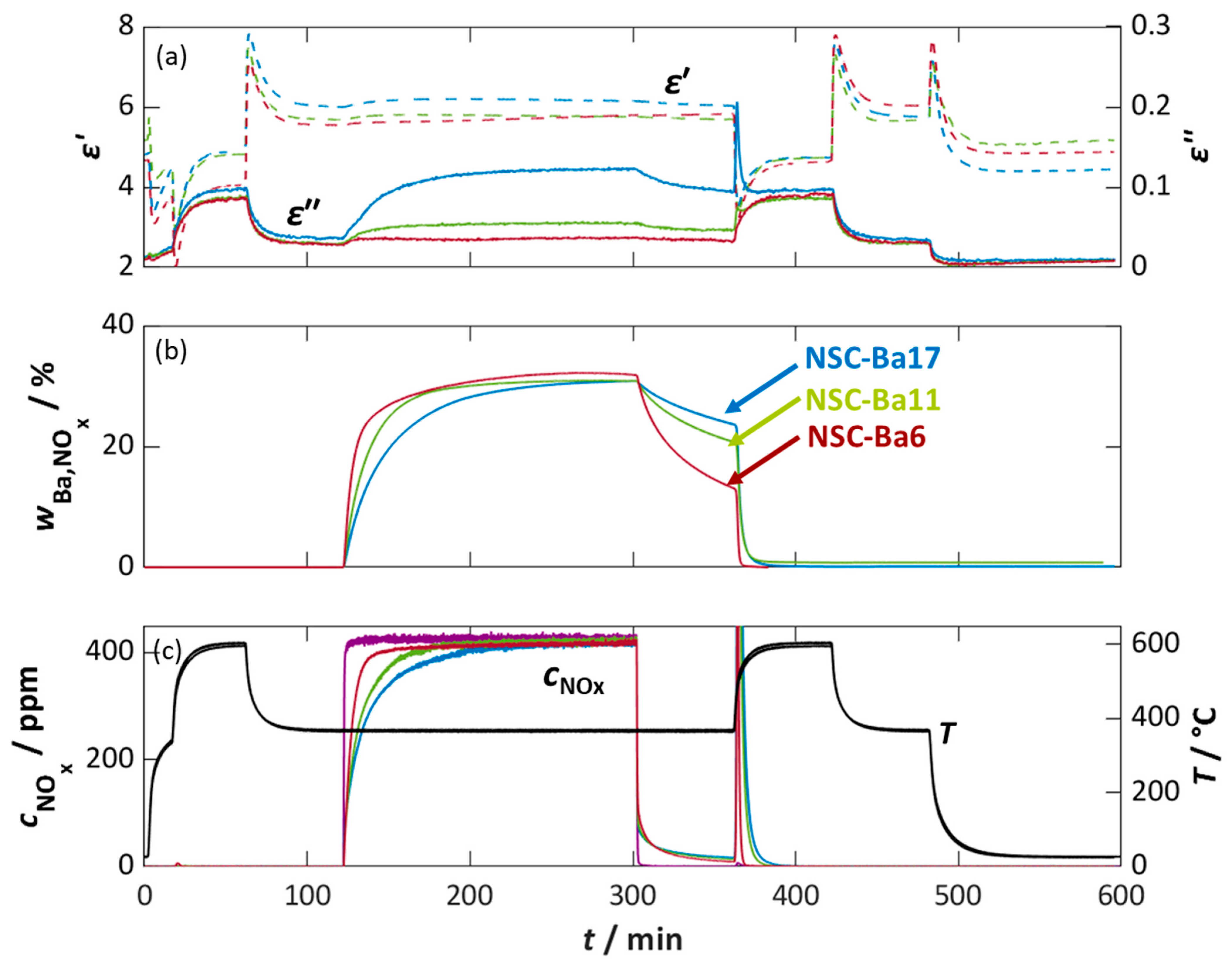
The Pt-containing NOx storage powders with different Ba loadings (NSC-Ba6, NSC-Ba11, and NSC-Ba17) were examined in the MCP setup to evaluate both their dielectric behavior during NOx sorption and their NOx storage properties (Figure 1). Prior to each experiment, the samples were thermally regenerated at 600 °C in base gas (see course of T in Figure 1c) and subsequently cooled to 350 °C. After a 60 min stabilization phase, 400 ppm NO2 was introduced at t = 120 min. The downstream NOx concentration was monitored via FTIR and a reference measurement without powder (purple line in Figure 1c) was conducted. After 180 min, the NOx dosing was stopped. A desorption phase at measuring temperature for 60 min followed, and then the samples were thermally regenerated at 600 °C to release sorbed NOx species and cool down to 350 °C again.
The reference measurement without powder shows a stable NO2 dosing of 400 ppm (cNOx,reference) and does not show any desorbed NOx species. The NOx concentration profiles (cNOx,NSC) of the different storage materials differ markedly (Figure 1c). NSC-Ba17 shows the highest NOx storage, as indicated by the lowest downstream NOx concentration and the slowest increase to 400 ppm (blue line).
With decreasing Ba content, at 11.2% Ba (NSC-Ba11, green line) and 5.6% Ba (NSC-Ba6, red line), the measured NOx concentration value increases more quickly. The time required to reach 400 ppm NOx downstream increases with increasing Ba content. At this point, the catalyst material is fully loaded with NOx. The powder with the lowest Ba content (NSC-Ba6) reaches the reference NOx concentration first, since a lower NOx amount is necessary to completely load this powder. The stored amount of NOx, which corresponds to the difference in the area between the integrated reference NOx concentration curve (purple curve in Figure 1c) and the integrated NSC–NOx concentration curves, increases with Ba loading. This confirms that higher Ba contents provide a higher storage capacity. After all storage powders are fully loaded, a 60 min holding phase in base gas results in a small detectable NOx release, almost independent of Ba content. This desorption is attributed to weakly bound NOx species (e.g., physiosorbed species), resulting in a decreased NOx loading level. During subsequent thermal regeneration at 600 °C (t = 360 min), all stored NOx species are released, producing a pronounced NOx peak. The area under the NOx peak increases with increasing Ba loading. This is in good agreement with the NOx storage capacity of the powders increasing with the content of barium [59,60,61,62,63].
From the resulting NOx concentration difference during NOx storage, the Ba site utilization wBa,NOx was calculated according to Equation (6) and as described in [46]. It indicates what proportion of the available barium carbonate molecules (related to the respective Ba content of each powder nBaCO3) was converted to barium nitrate during NOx storage conditions. Assuming that each BaCO3 molecule is converted to barium nitrate (Ba(NO3)2) by binding two NOx molecules, this results in a factor of two. Here, V ˙ g a s is the total volume flow and V m o l , g a s is the molar volume of the gas:
w B a , N O x = t 0 t ( c N O x , r e f e r e n c e   ( t ) c N O x , N S C   ( t ) ) · V ˙ g a s t V m o l ,   g a s   d t · 1 2 · n B a C O 3 .
As shown in Figure 1b, all materials reach a similar maximum Ba site utilization of approximately 35% in the fully loaded state, regardless of their absolute Ba content. This indicates that only about one third of the available BaCO3 participates in nitrate formation under the applied conditions, which agrees well with the literature [60,61,62,63,64]. After stopping the dosing of NOx (t = 300 min), wBa,NOx decreases due to the desorption of weakly bound NOx species. The decrease is more pronounced for low Ba loadings, where a larger fraction of NOx is weakly stored on the alumina surface rather than on Ba sites; an effect that is also well-known for NOx storage catalysts [60].
The dielectric properties of the storage materials during NOx sorption at 350 °C, derived from MCP measurements, are shown in Figure 1a. From the recorded resonant frequency fres and the inverse quality factor 1/Q, the permittivity ε′ and the dielectric losses ε″ were calculated. As reported previously [46], the permittivity cannot be determined with high accuracy, and only a slight increase in ε′ is observed during NOx exposure (starting at t = 120 min). However, the dielectric losses ε″ provide a more appropriate signal.
Depending on the barium loading, the dielectric losses increase from approximately 0.028 and 0.038 (NSC-Ba6 and NSC-Ba11, and NSC-Ba17, respectively) in the unloaded state to a maximum of 0.13 for the fully loaded NSC-Ba17. For lower Ba loadings, lower dielectric losses in the fully loaded state are determined (0.055 for NSC-Ba11 and 0.038 for NSC-Ba6). Especially for NSC-Ba17 and NSC-Ba11, ε″ increases significantly in the first third of the storage phase and approaches a stable final value as the materials become saturated with NOx. A stable value of ε″ is expected as soon as the catalyst material is fully loaded with NOx and if no desorption reactions occur. A comparison of Figure 1a,c shows that the final value of the dielectric losses coincides with the point at which the downstream NOx concentration reaches the reference value cNOx,reference. For example, NSC-Ba11 is fully loaded at t = 200 min, reflected by both the downstream concentration and the stabilization of ε″ at 0.055. The relative changes in dielectric losses are moderate, since NOx sorption results in increases in the dielectric losses by a factor of 1.2 (NSC-Ba6) to 3.3 (NSC-Ba17). After NOx dosing is stopped (t = 300 min), desorption of weakly bound NOx species causes a slight decrease in ε″, predominantly due to the desorption of NOx species from alumina sites. During thermal regeneration (t = 360 min), ε″ increases due to enhanced conductivity at elevated temperatures and returns to the pre-NOx loading value after cooling down to 350 °C.
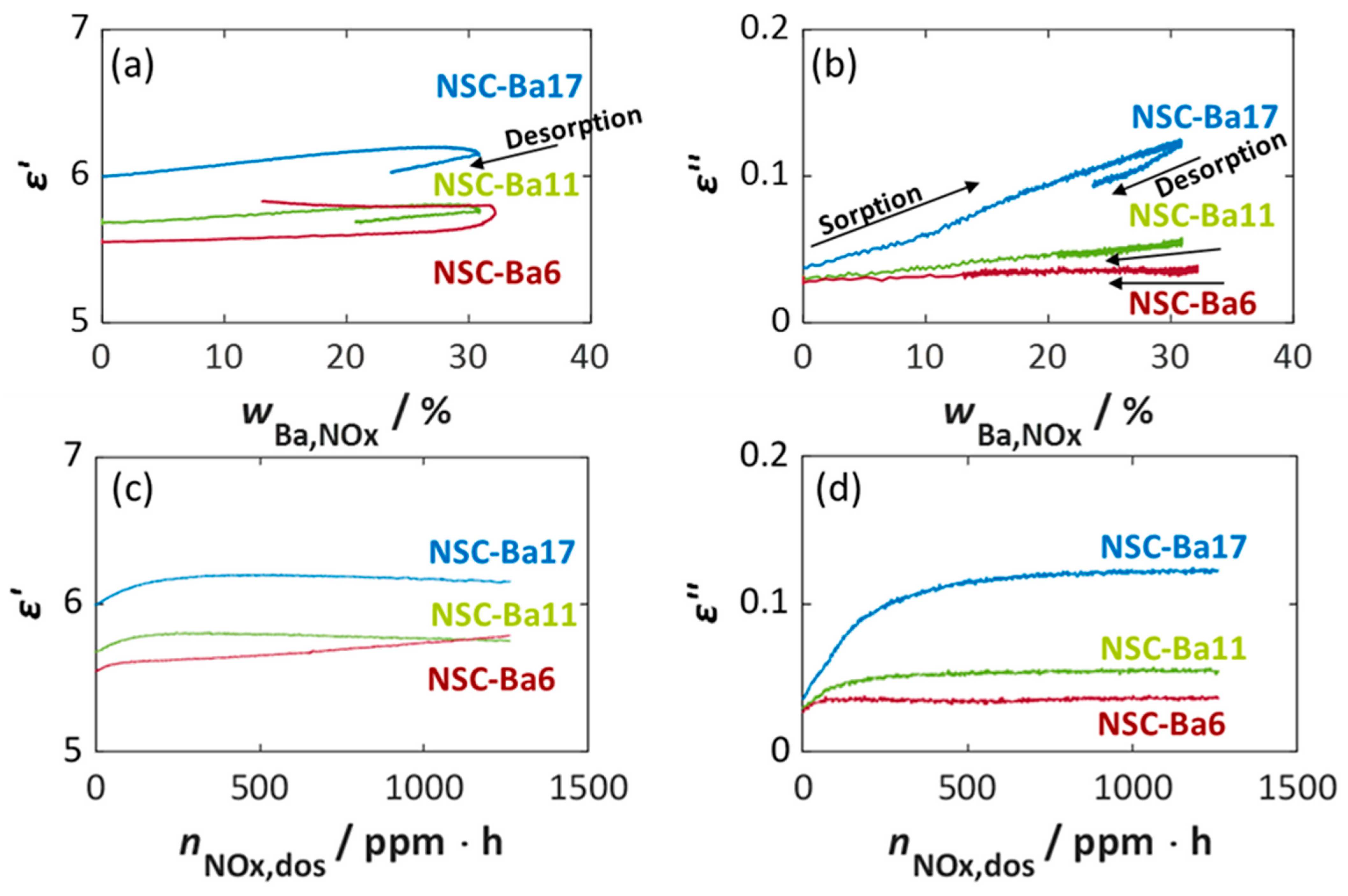
A more detailed correlation between dielectric properties and both the storage utilization wBa,NOx and the dosed NOx amount nNOx,dos at 350 °C is shown in Figure 2. As already indicated in Figure 1, the permittivity ε′ (Figure 2a,c) exhibits only minor changes during NOx storage. Although a weakly increasing trend with storage utilization can be observed, no meaningful dependence on Ba loading or NOx dose can be derived. For this reason, ε′ is not considered further.
In contrast, the dielectric losses ε″ (Figure 2b,d) show a clear and pronounced dependency on Ba loading and consistently display a linear correlation with wBa,NOx (Figure 2b). Since only approximately 35% of the available Ba storage sites are converted to nitrite or nitrate under the applied NOx storing conditions, the linear increase in dielectric losses scales with the fraction of Ba involved in NOx storage, resulting in a varying sensitivity, defined as the slope of the curves [64]. The increase in ε″ can be attributed to the higher electrical conductivity of barium nitrites and nitrates compared to the initial barium carbonate or oxide phases [16,19,46,65]. For pure barium nitrate powder, significantly higher dielectric losses of approx. 0.4 at 350 °C have been reported [46].
The slope of the characteristic curves, meaning the increasing sensitivity, should ideally correspond to the content of barium in the materials. NSC-Ba6, containing roughly one third of the Ba present in NSC-Ba17, also proportionally forms a lower number of nitrate/nitrite species, although the same percentage of barium, approximately 35%, is used for NOx storage [64]. Therefore, NSC-Ba6 shows a lower absolute increase in ε″ and ideally, the slope should be one third of that of NSC-Ba17. Deviations can be attributed to integration uncertainties and the small absolute changes in dielectric losses at low Ba loadings.
Figure 2a,b also show the desorption phase after the NOx dosing was switched off. The decrease in wBa,NOx, which can be seen for all NSC materials, is also evident in a measurable decrease in dielectric losses. This corresponds very well with the storage process, i.e., the curves overlap. This confirms that the decrease in dielectric losses directly reflects the decrease in wBa,NOx due to the release of weakly bound NOx species [62]. With increasing Ba content, the desorption becomes less pronounced, i.e., with higher Ba content, the proportion of weakly sorbed nitrogen oxide species is lower. In accordance with the literature [60,61,62], both the binding strength of the NOx species and the temperature stability increase with increasing Ba content, as the nitrogen oxides are preferentially sorbed at existing barium storage sites and the proportion of nitrogen oxides weakly sorbed on the Al2O3 surface (lower binding strength) thus decreases.
To evaluate the suitability of ε″ as a signal for dosimeter-type NOx sensing, the dielectric losses were plotted against the dosed amount of nitrogen oxides nNOx,dos in ppm·h, i.e., the NOx dose (Figure 2d). At the onset of NOx exposure, a linear relationship is observed, with ε″ increasing proportionally to the NOx dose. This is particularly evident for NSC-Ba17 and NSC-Ba11, while NSC-Ba6 shows only a small increase in ε″. Once the maximum NOx storage capacity of the material is reached, the dielectric losses remain constant and reach an almost stable value. At this NOx dose, which is characteristic for each Ba content, the storage material is completely loaded with NOx (see FTIR data in Figure 1c) and no further NOx storage takes place, even if the NOx dose will be increased. The final value of ε″ therefore corresponds to the maximum achievable value of the dielectric losses and correlates with the number of nitrates and nitrites formed or the number of occupied storage sites, e.g., occupied barium sites. For a RF-based dosimeter-type sensor, the linear region, in which ε″ correlates linearly with the NOx dose, is the most relevant operational range. Assuming that in this region the sorption–desorption equilibrium is fully on the sorption side, all dosed NOx is stored, and no desorption occurs during NOx shut-off phases, the dielectric losses ε″ provide a reliable cumulative measure of NOx dose.
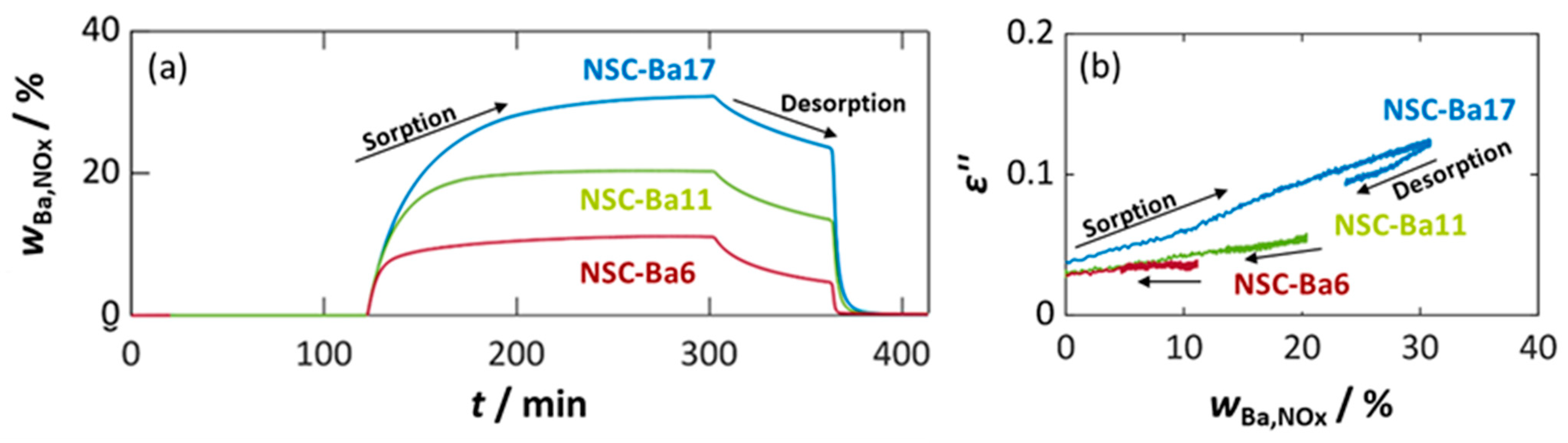
To highlight the influence of the Ba content more clearly, the normalized storage utilization wBa,NOx was recalculated using a different reference value of available barium carbonate molecules. Unlike in Figure 2, the reference value nBaCO3 used for normalization (Equation (6)) in Figure 3 was the maximum Ba content of 16.9% in the NSC-Ba17 material for the NOx storage materials under investigation.
As shown in Figure 3a, the proportion of available barium sites converted to nitrates increases systematically with Ba content. NSC-Ba17 reaches about 35% utilization of the Ba sites at the end of the storage phase (see Figure 1b), whereas NSC-Ba6 reaches only 12%. As expected for different Ba loadings, the normalized storage utilization values differ by approximately a factor of three, consistent with the actual ratio of Ba contents and the corresponding number of available Ba storage sites. Assuming that the reaction rate of nitrate formation is independent of the absolute content of Ba [62], the total amount of nitrate species formed is directly proportional to the Ba content. Consequently, the dielectric losses correlate with the normalized storage utilization, as shown in Figure 3b. For all materials, ε″ increases linearly with wBa,NOx, reflecting the progressive formation of nitrate and nitrite species, which exhibit significantly higher conductivity and thus higher dielectric losses than the initial carbonate phase. While an identical slope for all materials is expected, minor deviations occur that can be attributed to integration uncertainties (refer to Equation (1)). Additionally, relatively small absolute changes in dielectric losses are measured due to the limited storage capacity and the small amount of barium nitrate formed in comparison to the other materials (mostly Al2O3). Differences in ε″ in the unloaded state may also be due to the different material compositions. Nevertheless, a similar dependence of dielectric losses on storage utilization can be observed for different barium contents. Notably, for high Ba loading (NSC-Ba17), a well-defined linear relationship between ε″ and wBa,NOx can be derived, underscoring its suitability for a RF-based dosimeter-type sensor.

3.2. Temperature Dependency of the Dielectric Properties of Pt/Ba-Based NOx Storage Powder NSC-Ba17

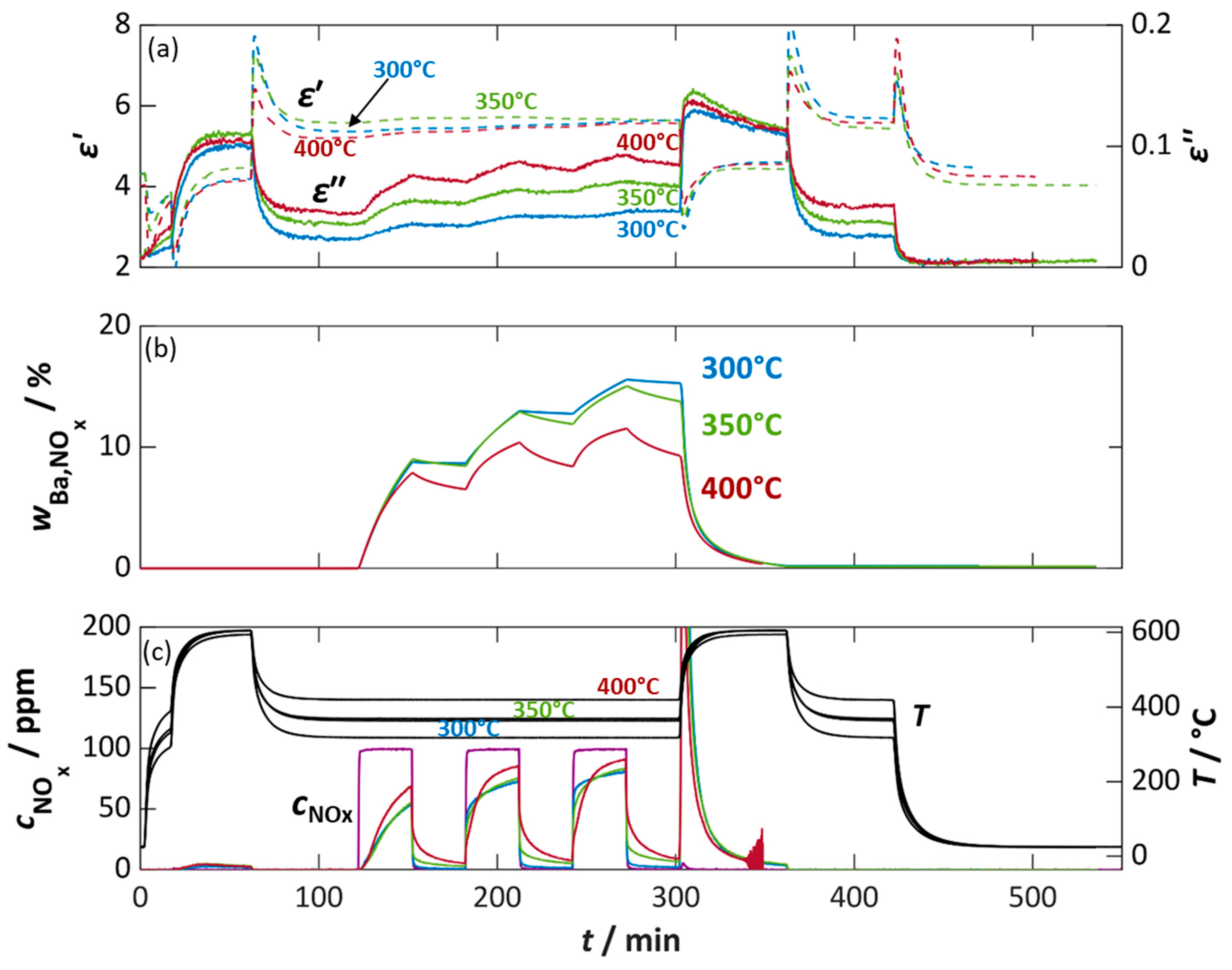
To further evaluate the suitability of NSC-Ba17 for RF-based dosimeter applications, the temperature-dependent behavior of its dielectric properties was investigated using a reduced NOx dose of 150 ppm·h to examine the linear measuring range (see Figure 2). For this purpose, three pulses of 100 ppm NO or NO2 were added for 30 min each, separated by 30 min NOx dosing pauses. The influence of temperature (300 °C, 350 °C, and 400 °C) and the difference between the addition of NO or NO2 were examined. NOx loading was not investigated at temperatures exceeding 400 °C, since the literature consistently reports a decrease in NOx storage capacity and a predominance of thermal desorption at higher temperatures [66,67]. Since dosimeter-type operation relies on an adsorption–desorption equilibrium shifted toward adsorption, temperatures above this range were therefore considered unsuitable.
Figure 4 summarizes the resulting NOx concentration (Figure 4c), dielectric parameters (Figure 4a), and calculated storage utilization (Figure 4b).
The reference curve in Figure 4c (purple curve) shows the added NO2 concentrations without powder in the MCP setup. The curves obtained for NSC-Ba17 at different temperatures reveal initial temperature-dependent differences in the storage capacity. During NO2 pulses, only minor differences can be detected, but during NO2 dosing pauses, more nitrogen oxides are desorbed as the temperature increases. During subsequent thermal desorption starting at t = 300 min, a clear short-term NOx desorption peak occurs, indicating complete thermal regeneration. The calculated utilization of the Ba storage sites shows temperature-dependent differences in NO2 storage behavior (Figure 4b). Firstly, it is noticeable that wBa,NOx only reaches 16%, reflecting the lower amount of NO2 dosed (max. 150 ppm·h) compared to Figure 1b. The loading state of NSC-Ba17 is thus significantly lower. While NOx storage at 300 °C and 350 °C follows an almost similar pattern, pronounced deviation occurs at 400 °C. The amount of NOx stored (utilized amount of Ba) no longer increases linearly with time or NOx dose. In addition, during NOx dosing pauses, a significant desorption of NOx is evident, resulting in a decreased wBa,NOx. Consistent with the literature, the NOx storage capacity decreases with increasing temperature [64]. At 300 °C, on the other hand, there is a linear relationship between the dose of NO2 and the proportion of Ba converted for all NOx pulses. In the absence of NOx, no desorption processes take place, i.e., the sorbed nitrogen oxide species are strongly bound. These properties of the NOx storage material are an essential requirement for dosimeter-type NOx sensing [11]. At 350 °C, similar behavior can be observed until the second NO2 pulse, after which desorption effects become apparent, yielding deviations from linearity.
The dielectric properties of NSC-Ba17 presented in Figure 4a reflect these trends. As observed in Figure 1 and Figure 2, the permittivity ε′ changes only minorly. The dielectric losses ε″, however, closely follow the progression of wBa,NOx, reflecting the formation of nitrite and nitrate species and the associated increase in electrical conductivity. With increasing measuring temperature, ε″ rises in the unloaded state due to its thermally enhanced electrical conductivity. Due to the sorption of NOx, almost linearly increasing dielectric losses are measured at 300 °C and 350 °C. At 400 °C, however, the increase in electrical losses is no longer linear and desorption effects result in a clear decrease in ε″. At 300 °C and 350 °C, ε″ remains stable during NOx dosing pauses. Finally, the time-dependent dielectric losses ε″ behave dosimeter-like at temperatures below 400 °C.
The influence of temperature on the dielectric properties of the unloaded material becomes evident during regeneration at 600 °C compared to measurements at 300–400 °C (Figure 1 and Figure 4). In comparison to 400 °C, the evaluated permittivity is reduced at 600 °C, whereas no clear dependency can be identified between 300 °C and 400 °C, as discussed previously. In contrast, the dielectric losses ε″ exhibit a pronounced temperature dependence, with the highest losses observed at 600 °C and the lowest at 300 °C, or even at room temperature. This behavior is expected and can be attributed to the increase in electrical conductivity with an increase in temperature [16,19,68].
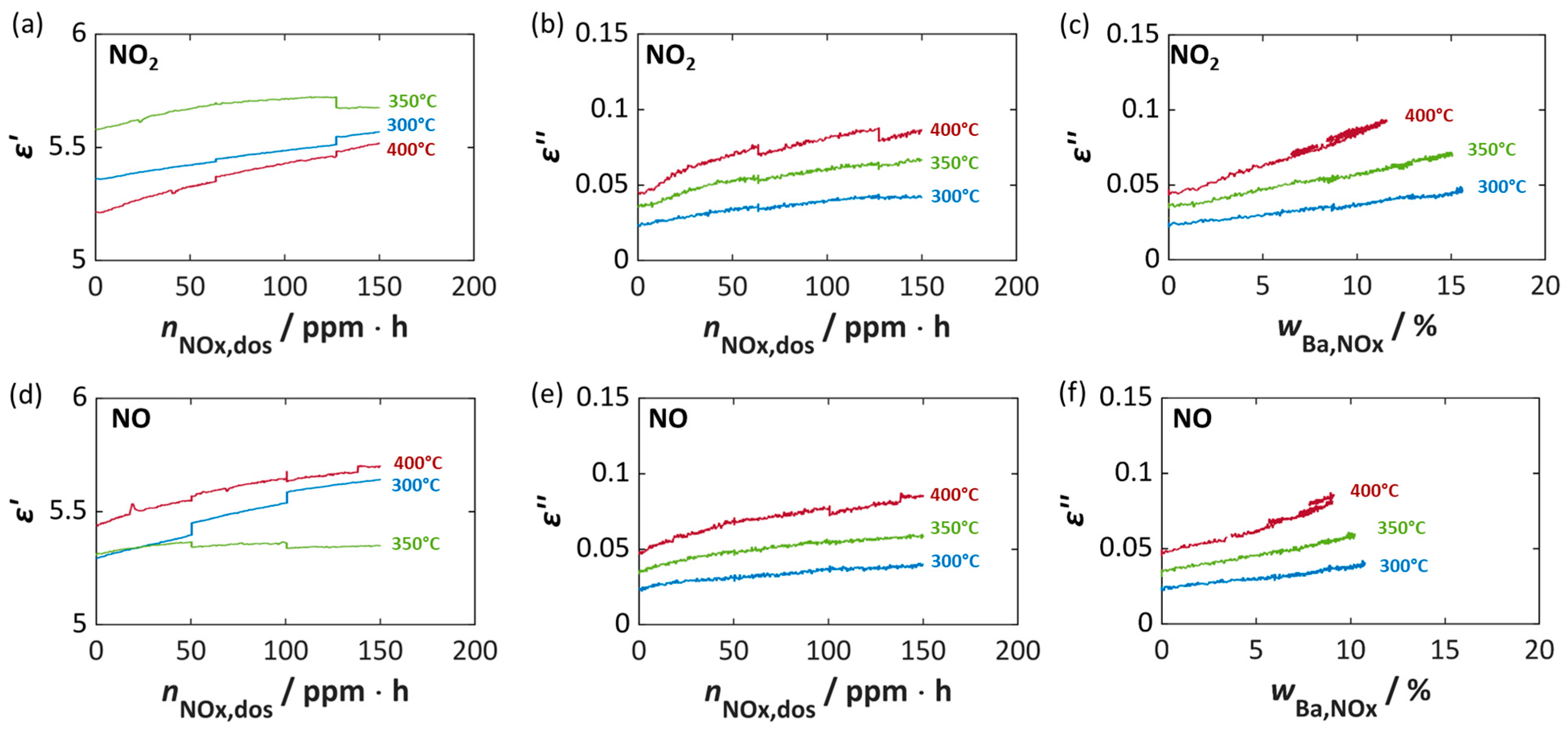
A more detailed interpretation is provided in Figure 5, in which ε′ and ε″ are plotted against the NOx dose nNOx,dos and the storage utilization wBa,NOx for different temperatures and NO2 or NO exposure. As discussed previously and in [46], no clear dependencies can be established for the permittivity ε′ owing to permanent temporal resonant frequency drift and strong temperature influences (NO2 Figure 5a; NO Figure 5d). In [46], a decrease in ε′ with increasing temperature was determined, whereas no clear dependence was measured here. It can be noted that ε′ is in the range of five to six and increases with NOx dose, regardless of whether NO2 or NO was added.
In contrast, Figure 5b and Figure 5e confirm the dependence of the dielectric losses ε″ on the temperature and on the NOx loading of NSC-Ba17. The increase in temperature results in an increase in dielectric losses in the unloaded state from approx. 0.022 (300 °C) to just under 0.048 (400 °C) (at nNOx,dos = 0). With increasing NOx dose and associated nitrate/nitrite formation, ε″ increases approximately linearly. At an accumulated dose of 150 ppm·h, NO2 exposure yields an increase in ε″ by a factor of 1.9, while NO results in a factor of 1.7, with only a slight temperature dependency. Desorption effects become more pronounced at higher temperatures, clearly reflected in the decreasing ε″ during NOx dosing pauses (deviations in the figures at defined nNOx,dos values).
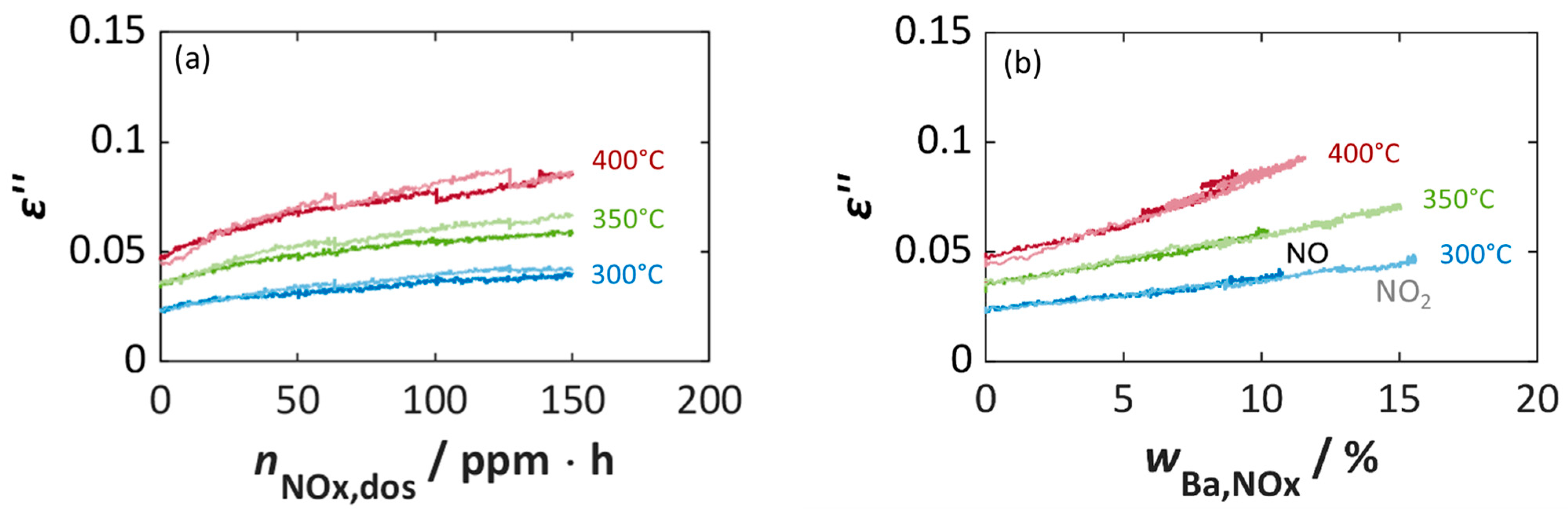
Figure 6a directly compares NO and NO2 addition and shows that both gases lead to nearly identical dielectric loss curves. This means that the same dose of NO2 or NO results in almost the same changes in ε″. The conversion of NO to NO2 takes place due to NO oxidation to NO2 in oxygen-rich atmospheres on platinum sites in the storage material, and the effects of the nitrite or nitrate species formed on the dielectric losses are almost identical, regardless of whether NO or NO2 is added.
A more precise dependence of the dielectric losses on the actual amount of NOx stored or on the calculated proportion of occupied barium storage sites is shown in Figure 5c and Figure 5f. Here, there is also a linear relationship between ε″ and wBa,NOx, whereby the influence of temperature and the added NOx species (NO2 vs. NO) is evident. For both NOx species, the amount of NOx stored decreases with increasing temperature, whereby the change in the dielectric losses, here the slope of ε″ vs. wBa,NOx, increases with increasing temperature from 0.00129 (300 °C) to 0.00366 (400 °C) (NO2) per percent storage utilization wBa,NOx, and 0.00151 (300 °C) to 0.00395 (400 °C) (NO) per percent storage utilization wBa,NOx. Looking at the value of calculated storage utilization wBa,NOx, differences between NO and NO2 exposure become apparent. At 300 °C and 350 °C only 10.3–10.7% Ba is utilized for NO storage, whereby in the case of NO2 14.9–15.5% is reached. The difference becomes smaller at 400 °C, with 8.9% (NO) and 11.5% (NO2).
Figure 6b highlights these differences, that presumably arise from the temperature-dependent Pt-catalyzed oxidation of NO to NO2. Depending on the temperature, NO is not completely oxidized to NO2, or the oxidation reaction and the NO:NO2 equilibrium are kinetically limited [64,69]. Since only NO2 can be stored as nitrate in the storage material, the rate of NO2 formation limits the storage. Importantly, the dielectric losses and their characteristic slopes remain identical regardless of whether NO or NO2 is supplied. Therefore, the NOx storage materials are suitable for use in a RF-based dosimeter-type total NOx sensor.

3.3. Operando DRIFTS Investigation of NSC-Ba17

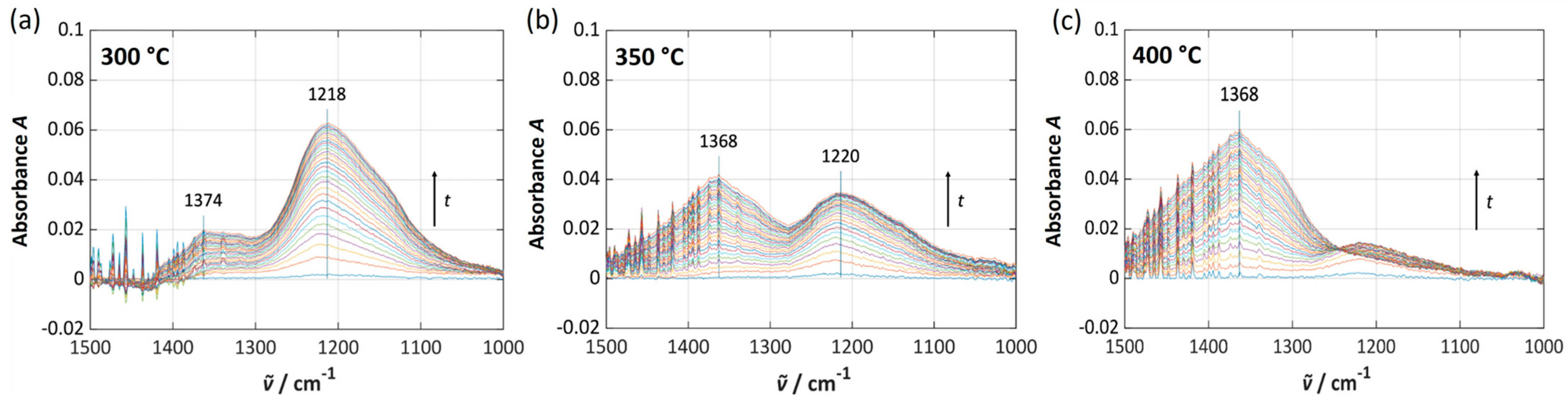
To gain deeper insight into the storage mechanism of NSC-Ba17 and the relationship between sorbate formation and electrical response, operando DRIFTS measurements were performed. A screen-printed NSC-Ba17 film was exposed to 2 ppm NO for t = 35 min at 300 °C, 350 °C, and 400 °C, and the resulting sorbed species (nitrites and nitrates) were monitored. From the recorded spectra (intensity (a.u.) vs. wave number (cm−1)), the absorbance A was calculated. Figure 7 shows the resulting values in the relevant wave number region between 1500 cm−1 and 1000 cm−1. At 300 °C (Figure 7a), two adsorption bands appear at 1374 cm−1 and 1218 cm−1, both increasing in intensity with NO dosing time and resulting NOx loading. According to the literature, the adsorption band at around 1374 cm−1 is assigned to nitrate species and the band at around 1218 cm−1 corresponds to nitrite species [34,70,71]. Both species, nitrites and nitrates, can be formed on alumina or on barium sites. Reported wavenumber ranges for Ba nitrites (1210–1220 cm−1) and Ba nitrates (e.g., 1410–1423 cm−1, 1314–1335 cm−1, 1022–1037 cm−1, 1480 cm−1 and 1130 cm−1) are consistent with the observed band positions [34]. According to [72], nitrates can also be found between 1375 and 1329 cm−1. In [70], bands in the region 1360–1300 cm−1 are attributed to formed ionic nitrates on Pt–Ba–Al2O3 and hypo-nitrates are responsible for bands at 1375 cm−1 during NO exposure. These assignments match the bands visible in Figure 7a quite well. Slight band shifts can occur due to sample preparation and the setup of the DRIFTS cell [72]. With increasing temperature to 350 °C and 400 °C (Figure 7b,c), the nitrate band at 1374–1368 cm−1 becomes more pronounced, while the nitrite band at 1220 cm−1 diminishes and nearly disappears. Two effects contribute to this behavior. First, since NO was used as test gas, it must be oxidized to NO2 on Pt sites before nitrate formation can occur. The kinetic of the NO oxidation accelerates with increasing temperature, enhancing nitrate formation. Second, nitrites are often formed initially as intermediates during NOx storage. With increasing temperature, initially formed barium nitrites are more rapidly oxidized to nitrates [34,73]. Both effects can contribute to the observed changes in the intensity of the bands.
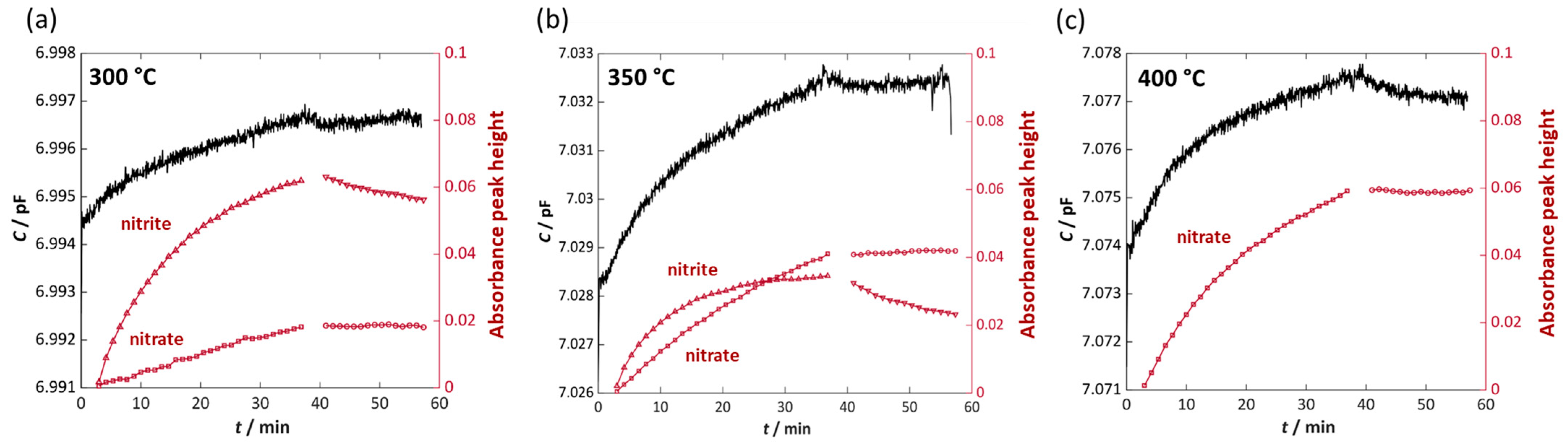
To better illustrate the time-dependent behavior of sorbate formation and the corresponding electrical response, Figure 8 shows the peak heights of the absorbance bands at 1218–1220 cm−1 (denoted as nitrite) and 1374–1368 cm−1 (denoted as nitrate), plotted as a function of NO dosing time. In addition, the operando-measured and calculated capacitance C is inserted. At 300 °C (Figure 8a), the nitrite peak height increases during NO exposure with increasing NO dose. Simultaneously, the nitrate peak height increases nearly linearly with NO dosing time. The simultaneously measured capacitance signal shows a slight increase (ΔC = 1.9 fF). At 40 min, the dosage of NO was stopped. A material appropriate for a NOx gas dosimeter should provide good holding capabilities and the sorbed species should not be desorbed during NOx dosing pauses. The results show that at 300 °C, the absorbance peak height of nitrates remains constant, demonstrating that the nitrate species are strongly bound and no desorption occurs. In contrast, a slight desorption of weakly bound nitrite species occurs, visible by a decreasing peak height of the absorbance. The capacitance shows a slight decrease when NO dosing is stopped but remains almost constant during the following NOx dosing pause.
At 350 °C, the height of the nitrite peak becomes smaller whereas the nitrate peak continues to increase, confirming that higher temperatures promote nitrate formation, as discussed previously. The nitrite band reaches saturation quickly, whereas the nitrate band increases almost linearly throughout the NO exposure period. The capacitance increases more strongly than at 300 °C (ΔC = 4 fF), reflecting the higher fraction of nitrates formed and the associated change in dielectric permittivity ε′. This is consistent with the results discussed in Section 3.1 (see Figure 2 and Figure 5). After switching off the NO dosing, nitrite desorption becomes visible, while the nitrate peak remains constant. The capacitance decreases slightly at first but does not follow nitrite desorption directly, and C remains constant afterwards, like the nitrate peak height. At 400 °C (Figure 8c), only nitrates are detected; the nitrite band is no longer observable (Figure 7c). The nitrate peak height increases continuously with NO dose and does not reach saturation within 35 min, indicating that the material is not fully loaded. The capacitance also increases steadily (ΔC = 3.8 fF), reflecting ongoing nitrate formation throughout the storage phase. Here, like at 350 °C, the nitrate peak remains constant during NOx dosing pause and the capacitance behaves similarly.
A comparison of radio frequency characterization of Pt-Ba-based NOx storage powders with the operando DRIFTS investigations on screen-printed NSC-Ba17 films shows that both methods yield consistent trends in the material’s behavior. The RF measurements demonstrate that both permittivity ε′ and dielectric losses ε″ increase with NOx loading, although a robust quantitative correlation can only be established for ε″. The strong temperature dependence of the resonance frequency makes the evaluation of ε′ difficult, whereas ε″ shows a clear linear relationship with the stored NOx amount, expressed as the fraction of utilized Ba storage sites wBa,NOx. The slope of the respective characteristic curves depends on temperature. Furthermore, RF data show that once the storage capacity is approached, both the stored NOx amount and ε″ begin to level off, indicating saturation of the Ba sites. The operando DRIFTS results confirm that nitrites and nitrates are formed on the storage material during NOx exposure, and their quantities increase with NOx dose. At lower temperatures (300 °C), nitrogen oxides are mainly sorbed as nitrite species, whereas at higher temperatures (400 °C), only nitrate species remain stable. At the same time, a slight increase in measured capacitance was observed, attributable to changes in permittivity, and thus can be linked to the evolving dielectric properties of the NOx storage material. Taken together, these findings demonstrate that the observed changes in both ε′ and ε″ originate from the formation of nitrite and nitrate species. Whether one of the formed species dominates the dielectric properties could not be clarified during the investigations.
The experiments also reveal differences in the desorption behavior. Immediately after NOx dosing stops, both ε″ and the calculated Ba utilization decrease, and this effect becomes stronger with increasing temperature. In contrast, ε′ remains nearly constant during desorption and the measured capacitance, which correlates primarily with ε′, also remains almost constant. Operando DRIFTS measurements show that nitrates do not desorb in NOx free phases, even at elevated temperatures, whereas nitrites desorb readily and less nitrite forms as the temperature increases. The measured capacitance does not display a clear signature of nitrite desorption.
These observations suggest that nitrites and nitrates influence the dielectric properties in different ways and that ε′ and ε″ may be governed by different sorbate species or mechanisms. However, the present data do not allow an unambiguous separation of their respective contributions. Additionally, the RF measurements were performed on powder samples, while the DRIFTS investigations were conducted on porous films, and the applied NOx concentrations and doses differed between the experiments. This likely resulted in different NOx loading states. It can be assumed that the powders reached a more complete NOx loading, which may have led to increased desorption of both nitrite and nitrate species during the NOx-free phases.

4. Conclusions

This study provides a comprehensive analysis of the dielectric behavior and NOx storage characteristics of Pt/Ba–Al2O3-based NOx storage materials using microwave cavity perturbation (MCP), operando DRIFTS, and impedance-based measurements of functional films. Across all experiments, the dielectric losses ε″ were identified as the most robust and sensitive indicator of NOx uptake, while the permittivity ε′ exhibited only minor and temperature-dependent variations. A clear linear correlation was established between ε″ and the amount of stored NOx, expressed as the fraction of occupied Ba storage sites. This linear regime is particularly relevant for RF-based dosimeter-type sensors, as it enables the cumulative quantification of NOx doses.
The NOx storage experiments revealed that, independent of the absolute barium loading, approximately 35% of the available Ba sites participate in the formation of nitrite and nitrate species under the applied storage conditions. However, the absolute amount of stored NOx and the resulting magnitude of the dielectric loss change scale directly with the Ba content. This correlation enables a material-specific sensitivity tuning for RF-based NOx dosimeters. A linear relationship between ε″ and both the NOx dose and the calculated Ba site utilization was established for all powders within their respective linear storage regime. This linear regime is particularly relevant for dosimeter-type sensors, as it defines the region in which cumulative NOx quantification is linearly possible.
Temperature-dependent experiments revealed stable NOx storage and a reproducible ε″ response up to about 350 °C. At 400 °C, desorption becomes significant, leading to deviations from linear dosimeter behavior. Experiments with NO and NO2 showed nearly identical ε″ signatures, confirming that NO is oxidized to NO2 on Pt prior to storage and that the dielectric response is governed by the subsequent formation of nitrite and nitrate species.
Operando DRIFTS provided mechanistic insight into the species responsible for the dielectric response. At lower temperatures, both nitrites and nitrates are formed, whereas at higher temperatures nitrates dominate. Nitrite species desorb readily during NOx-free phases, while nitrates remain strongly bound. A similar dependency of the strongly and weakly bound species was described in [46]. These findings agree with the observed behavior of ε″, which decreases during desorption phases and increases with progressive nitrate formation. Capacitance measurements performed simultaneously with DRIFTS showed only small changes in ε′ and did not correlate directly with nitrite desorption, indicating that nitrates predominantly influence the dielectric properties at the operating temperatures studied.
Overall, the results demonstrate that Pt/Ba–Al2O3 NOx storage materials exhibit a reproducible and chemically interpretable dielectric response to NOx storage, governed by temperature-dependent formation and stability of nitrite and nitrate species. The strong and linear dependence of ε″ on the NOx dose and Ba site utilization confirms the suitability of these materials for RF-based dosimeter-type NOx sensors. The combination of MCP, DRIFTS, and impedance analyses provides a coherent mechanistic understanding of the dielectric signal formation and establishes the methodological framework for future sensor optimization.
Future work will focus on transferring the insights gained from the powder-based MCP studies and the operando investigations on functional films to the high-frequency dosimeter transducer introduced in [46]. A key goal will be to evaluate how the dielectric and sorption-related properties determined from powders and screen-printed films translate to the performance of an NSC-Ba17-coated RF dosimeter. Particular attention will be given to understanding how the temperature-dependent formation and stability of nitrites and nitrates influence sensor linearity, sensitivity, and long-term stability with respect to dosimeter-like NOx detection.

Author Contributions

Conceptualization and methodology, D.S.-K., J.B., G.H. and R.M.; software, J.B. and T.W.; investigation, F.F. and J.B.; validation, D.S.-K., F.F., J.B., T.W., G.H. and R.M.; formal analysis, D.S.-K., F.F. and J.B.; resources, R.M.; data curation, D.S.-K., F.F., J.B. and T.W.; writing—original draft, D.S.-K.; writing—review and editing, D.S.-K., F.F., J.B., T.W., G.H. and R.M.; visualization, D.S.-K., F.F. and J.B.; supervision, D.S.-K., G.H. and R.M.; project administration, R.M. All authors have read and agreed to the published version of the manuscript.

Funding

This research was funded by the German Research Foundation (DFG), grant numbers MO 1060/42-1, project number 465563965.

Institutional Review Board Statement

Not applicable.

Informed Consent Statement

Not applicable.

Data Availability Statement

All relevant data presented in the article are stored according to institutional requirements and as such are not available online. However, all data used in this paper can be made available upon request to the authors.

Acknowledgments

During the preparation of this manuscript, the authors used DeepL (deepl.com) for the purpose of translation and Microsoft Copilot for the purposes of generating and translating text. The authors have reviewed and edited the output and take full responsibility for the content of this publication.

Conflicts of Interest

The authors declare no conflicts of interest.

Abbreviations

The following abbreviations are used in this manuscript:
NSCNOx storage catalyst
RFRadio frequency
MCPMicrowave Perturbation Method
DRIFTSDiffuse Reflectance Infrared Fourier Transformed Spectroscopy
FTIRFourier Transformed Infrared Spectroscopy
ppmParts per million
CLDChemiluminescence detector

References

  1. European Parliament. Directive 2008/50/EC of the European Parliament and of the Council of 21 May 2008 on ambient air quality and cleaner air for Europe. Off. J. Eur. Union 2008, 152, 1–44. [Google Scholar]
  2. Chang, I.-S.; Byun, S.-W.; Lim, T.-B.; Park, G.-M. A Study of Drift Effect in a Popular Metal Oxide Sensor and Gas Recognition Using Public Gas Datasets. IEEE Access 2023, 11, 26383–26392. [Google Scholar] [CrossRef]
  3. Dennler, N.; Rastogi, S.; Fonollosa, J.; van Schaik, A.; Schmuker, M. Drift in a popular metal oxide sensor dataset reveals limitations for gas classification benchmarks. Sens. Actuators B 2022, 361, 131668. [Google Scholar] [CrossRef]
  4. Borrego, C.; Ginja, J.; Coutinho, M.; Ribeiro, C.; Karatzas, K.; Sioumis, T.; Katsifarakis, N.; Konstantinidis, K.; de Vito, S.; Esposito, E.; et al. Assessment of air quality microsensors versus reference methods: The EuNetAir Joint Exercise—Part II. Atmos. Environ. 2018, 193, 127–142. [Google Scholar] [CrossRef]
  5. Penza, M.; Suriano, D.; Pfister, V.; Dipinto, S.; Prato, M.; Cassano, G. Networked Low-Cost Sensor Systems for Urban Air Quality Monitoring: A Long-Term Use-Case in Bari (Italy). Chemosensors 2025, 13, 380. [Google Scholar] [CrossRef]
  6. Spinelle, L.; Gerboles, M.; Villani, M.G.; Aleixandre, M.; Bonavitacola, F. Field calibration of a cluster of low-cost available sensors for air quality monitoring. Part A: Ozone and nitrogen dioxide. Sens. Actuators B 2015, 215, 249–257. [Google Scholar] [CrossRef]
  7. Spinelle, L.; Gerboles, M.; Villani, M.G.; Aleixandre, M.; Bonavitacola, F. Field calibration of a cluster of low-cost commercially available sensors for air quality monitoring. Part B: NO, CO and CO2. Sens. Actuators B 2017, 238, 706–715. [Google Scholar] [CrossRef]
  8. Dilonardo, E.; Penza, M.; Alvisi, M.; Di Franco, C.; Palmisano, F.; Torsi, L.; Cioffi, N. Evaluation of gas-sensing properties of ZnO nanostructures electrochemically doped with Au nanophases. Beilstein J. Nanotechnol. 2016, 7, 22–31. [Google Scholar] [CrossRef]
  9. Castell, N.; Dauge, F.R.; Schneider, P.; Vogt, M.; Lerner, U.; Fishbain, B.; Broday, D.; Bartonova, A. Can commercial low-cost sensor platforms contribute to air quality monitoring and exposure estimates? Environ. Int. 2017, 99, 293–302. [Google Scholar] [CrossRef]
  10. Schütze, A.; Pieper, N.; Zacheja, J. Quantitative ozone measurement using a phthalocyanine thin-film sensor and dynamic signal evaluation. Sens. Actuators B 1995, 23, 215–217. [Google Scholar] [CrossRef]
  11. Marr, I.; Groß, A.; Moos, R. Overview on conductometric solid-state gas dosimeters. J. Sens. Sens. Syst. 2014, 3, 29–46. [Google Scholar] [CrossRef]
  12. Groß, A.; Kremling, M.; Marr, I.; Kubinski, D.J.; Visser, J.H.; Tuller, H.L.; Moos, R. Dosimeter-type NOx sensing properties of KMnO4 and its electrical conductivity during temperature programmed desorption. Sensors 2013, 13, 4428–4449. [Google Scholar] [CrossRef] [PubMed]
  13. Fridell, E.; Skoglundh, M.; Westerberg, B.; Johansson, S.; Smedler, G. NOx Storage in Barium-Containing Catalysts. J. Catal. 1999, 183, 196–209. [Google Scholar] [CrossRef]
  14. Epling, W.S.; Campbell, L.E.; Yezerets, A.; Currier, N.W.; Parks, J.E. Overview of the Fundamental Reactions and Degradation Mechanisms of NOx Storage/Reduction Catalysts. Catal. Rev. 2004, 46, 163–245. [Google Scholar] [CrossRef]
  15. AL-Harbi, M.; Epling, W.S. Investigating the Effect of NO Versus NO2 on the Performance of a Model NOx Storage/Reduction Catalyst. Catal. Lett. 2009, 130, 121–129. [Google Scholar] [CrossRef]
  16. Groß, A.; Bishop, S.R.; Yang, D.J.; Tuller, H.L.; Moos, R. The electrical properties of NOx-storing carbonates during NOx exposure. Solid State Ion. 2012, 225, 317–323. [Google Scholar] [CrossRef]
  17. Alias, N.; Zaini, M.; Kamaruddin, M.J.; You, K.Y. Dielectric properties of potassium carbonate-impregnated cempedak peel for microwave-assisted activation. Asia-Pac. J. Chem. Eng. 2017, 12, 173–181. [Google Scholar] [CrossRef]
  18. Kwak, J.H.; Kim, D.H.; Szailer, T.; Peden, C.H.F.; Szanyi, J. NOx uptake mechanism on Pt/BaO/Al2O3 catalysts. Catal. Lett. 2006, 111, 119–126. [Google Scholar] [CrossRef]
  19. Walter, S.; Ruwisch, L.; Göbel, U.; Hagen, G.; Moos, R. Radio Frequency-Based Determination of the Oxygen and the NOx Storage Level of NOx Storage Catalysts. Top. Catal. 2019, 62, 157–163. [Google Scholar] [CrossRef]
  20. Bailly, G.; Harrabi, A.; Rossignol, J.; Stuerga, D.; Pribetich, P. Microwave gas sensing with a microstrip interdigital capacitor: Detection of NH3 with TiO2 nanoparticles. Sens. Actuators B 2016, 236, 554–564. [Google Scholar] [CrossRef]
  21. Bogner, A.; Steiner, C.; Walter, S.; Kita, J.; Hagen, G.; Moos, R. Planar Microstrip Ring Resonators for Microwave-Based Gas Sensing: Design Aspects and Initial Transducers for Humidity and Ammonia Sensing. Sensors 2017, 17, 2422. [Google Scholar] [CrossRef] [PubMed]
  22. Mohammadi, S.; Zarifi, M.H. Differential Microwave Resonator Sensor for Real-Time Monitoring of Volatile Organic Compounds. IEEE Sens. J. 2021, 21, 6105–6114. [Google Scholar] [CrossRef]
  23. Gugliandolo, G.; Naishadham, K.; Crupi, G.; Donato, N. Design and Characterization of a Microwave Transducer for Gas Sensing Applications. Chemosensors 2022, 10, 127. [Google Scholar] [CrossRef]
  24. Javadian-Saraf, A.; Hosseini, E.; Wiltshire, B.D.; Zarifi, M.H.; Arjmand, M. Graphene oxide/polyaniline-based microwave split-ring resonator: A versatile platform towards ammonia sensing. J. Hazard. Mater. 2021, 418, 126283. [Google Scholar] [CrossRef]
  25. Singh, S.K.; Tiwari, N.K.; Yadav, A.K.; Akhtar, M.J.; Kar, K.K. Design of ZnO/N-Doped Graphene Nanohybrid Incorporated RF Complementary Split Ring Resonator Sensor for Ammonia Gas Detection. IEEE Sens. J. 2019, 19, 7968–7975. [Google Scholar] [CrossRef]
  26. Wang, N.; Zhang, N.; Wang, T.; Liu, F.; Wang, X.; Yan, X.; Wang, C.; Liu, X.; Sun, P.; Lu, G. Microwave gas sensor for detection of ammonia at room-temperature. Sens. Actuators B 2022, 350, 130854. [Google Scholar] [CrossRef]
  27. Reinecke, T.; Walter, J.-G.; Kobelt, T.; Ahrens, A.; Scheper, T.; Zimmermann, S. Design and evaluation of split-ring resonators for aptamer-based biosensors. J. Sens. Sens. Syst. 2018, 7, 101–111. [Google Scholar] [CrossRef]
  28. Dehning, K.J.; Hitzemann, M.; Zimmermann, S. Split-ring resonator with interdigital Split electrodes as detector for liquid and ion chromatography. Sens. Bio-Sens. Res. 2024, 44, 100645. [Google Scholar] [CrossRef]
  29. de Fonseca, B.; Rossignol, J.; Bezverkhyy, I.; Bellat, J.P.; Stuerga, D.; Pribetich, P. Detection of VOCs by microwave transduction using dealuminated faujasite DAY zeolites as gas sensitive materials. Sens. Actuators B 2015, 213, 558–565. [Google Scholar] [CrossRef]
  30. Rossignol, J.; Barochi, G.; de Fonseca, B.; Brunet, J.; Bouvet, M.; Pauly, A.; Markey, L. Microwave-based gas sensor with phthalocyanine film at room temperature. Sens. Actuators B 2013, 189, 213–216. [Google Scholar] [CrossRef]
  31. Free, C.; Hopkins, R. Equivalent circuit for the microstrip ring resonator suitable for broadband materials characterisation. IET Microw. Antennas Propag. 2008, 2, 66–73. [Google Scholar] [CrossRef]
  32. Dehning, K.J.; Hitzemann, M.; Gossmann, A.; Zimmermann, S. Split-Ring Resonator Based Sensor for the Detection of Amino Acids in Liquids. Sensors 2023, 23, 645. [Google Scholar] [CrossRef]
  33. Barochi, G.; Rossignol, J.; Bouvet, M. Development of microwave gas sensors. Sens. Actuators B 2011, 157, 374–379. [Google Scholar] [CrossRef]
  34. Ji, Y.; Toops, T.J.; Pihl, J.A.; Crocker, M. NO storage and reduction in model lean NO trap catalysts studied by in situ DRIFTS. Appl. Catal. B 2009, 91, 329–338. [Google Scholar] [CrossRef]
  35. Castoldi, L.; Forzatti, P.; Lietti, L.; Nova, I. NOx storage chemistry of Pt-Ba/Al2O3 lean NOx trap catalysts. In Progress in Catalysis Research; Bevy, L.P., Antunes, O.A.C., Eds.; Nova Science Publ: New York, NY, USA, 2005; pp. 199–221. ISBN 9781594544415. [Google Scholar]
  36. Westerberg, B.; Fridell, E. A transient FTIR study of species formed during NOx storage in the Pt/BaO/Al2O3 system. J. Mol. Catal. A Chem. 2001, 165, 249–263. [Google Scholar] [CrossRef]
  37. Malpartida, I.; Vargas, M.A.L.; Alemany, L.J.; Finocchio, E.; Busca, G. Pt–Ba–Al2O3 for NO storage and reduction: Characterization of the dispersed species. Appl. Catal. B 2008, 80, 214–225. [Google Scholar] [CrossRef]
  38. Abdulhamid, H.; Dawody, J.; Fridell, E.; Skoglundh, M. A combined transient in situ FTIR and flow reactor study of NOX storage and reduction over M/BaCO3/Al2O3 (M=Pt, Pd or Rh) catalysts. J. Catal. 2006, 244, 169–182. [Google Scholar] [CrossRef]
  39. Schönauer-Kamin, D.; Marr, I.; Zehentbauer, M.; Zängle, C.; Moos, R. Characterization of the sensitive material for a resistive NOx gas dosimeter by DRIFT spectroscopy. Sens. Actuators B 2020, 320, 128568. [Google Scholar] [CrossRef]
  40. Toops, T.J.; Smith, D.B.; Partridge, W.P. Quantification of the in situ DRIFT spectra of Pt/K/γ-Al2O3 NO adsorber catalysts. Appl. Catal. B 2005, 58, 245–254. [Google Scholar] [CrossRef]
  41. Tavaglione, E.; Spagnoli, E.; Valt, M.; Bernardoni, P.; Della Ciana, M.; Bottegoni, F.; Negri, M.; Scali, F.; Zucchetti, C.; Ferroni, M.; et al. Photosensitivity and gas sensing mechanisms: Validation of an operando DRIFT spectroscopy apparatus for light-activated chemoresistive gas sensors. Sens. Actuators B 2025, 444, 138504. [Google Scholar] [CrossRef]
  42. Schmitt, E.A.; Krott, M.; Epifani, M.; Suematsu, K.; Weimar, U.; Barsan, N. Volatile Organic Compound Sensing with WO3-Based Gas Sensors: Surface Chemistry Basics. J. Phys. Chem. C 2024, 128, 1633–1643. [Google Scholar] [CrossRef]
  43. Ewald, C.; Saito, N.; Weimar, U.; Barsan, N. Role of potassium loading in ZnO-based gas sensors under NO2 exposure—Operando diffuse reflectance infrared Fourier transform spectroscopic study. Sens. Actuators B 2023, 393, 134321. [Google Scholar] [CrossRef]
  44. Chen, P.; Simböck, J.; Schönebaum, S.; Rauch, D.; Simons, T.; Palkovits, R.; Moos, R.; Simon, U. Monitoring NH3 storage and conversion in Cu-ZSM-5 and Cu-SAPO-34 catalysts for NH3-SCR by simultaneous impedance and DRIFT spectroscopy. Sens. Actuators B 2016, 236, 1075–1082. [Google Scholar] [CrossRef]
  45. Chen, P.; Schönebaum, S.; Simons, T.; Rauch, D.; Dietrich, M.; Moos, R.; Simon, U. Correlating the Integral Sensing Properties of Zeolites with Molecular Processes by Combining Broadband Impedance and DRIFT Spectroscopy—A New Approach for Bridging the Scales. Sensors 2015, 15, 28915–28941. [Google Scholar] [CrossRef] [PubMed]
  46. Walter, S.; Baumgärtner, J.; Hagen, G.; Schönauer-Kamin, D.; Kita, J.; Moos, R. Dielectric Properties of Materials Used for Microwave-Based NOx Gas Dosimeters. Sensors 2024, 24, 2951. [Google Scholar] [CrossRef]
  47. Lietti, L.; Forzatti, P.; Nova, I.; Tronconi, E. NOx Storage Reduction over Pt-Ba/γ-Al2O3 Catalyst. J. Catal. 2001, 204, 175–191. [Google Scholar] [CrossRef]
  48. Dietrich, M.; Rauch, D.; Porch, A.; Moos, R. A laboratory test setup for in situ measurements of the dielectric properties of catalyst powder samples under reaction conditions by microwave cavity perturbation: Set up and initial tests. Sensors 2014, 14, 16856–16868. [Google Scholar] [CrossRef] [PubMed]
  49. Steiner, C.; Walter, S.; Malashchuk, V.; Hagen, G.; Kogut, I.; Fritze, H.; Moos, R. Determination of the Dielectric Properties of Storage Materials for Exhaust Gas Aftertreatment Using the Microwave Cavity Perturbation Method. Sensors 2020, 20, 6024. [Google Scholar] [CrossRef]
  50. Steiner, C.; Hagen, G.; Kogut, I.; Fritze, H.; Moos, R. Analysis of defect chemistry and microstructural effects of non-stoichiometric ceria by the high-temperature microwave cavity perturbation method. J. Eur. Ceram. Soc. 2022, 42, 499–511. [Google Scholar] [CrossRef]
  51. Walter, S.; Schwanzer, P.; Steiner, C.; Hagen, G.; Rabl, H.-P.; Dietrich, M.; Moos, R. Mixing Rules for an Exact Determination of the Dielectric Properties of Engine Soot Using the Microwave Cavity Perturbation Method and Its Application in Gasoline Particulate Filters. Sensors 2022, 22, 3311. [Google Scholar] [CrossRef]
  52. Sihvola, A. Mixing Rules with Complex Dielectric Coefficients. Subsurf. Sens. Technol. Appl. 2000, 1, 393–415. [Google Scholar] [CrossRef]
  53. Wiener, O. Zur Theorie der Refraktionskonstanten. Math.-Phys. Kl. 1910, 62, 256–277. [Google Scholar]
  54. Leong, K.; Mazierska, J.; Krupka, J. Measurements of unloaded Q-factor of transmission mode dielectric resonators. In Proceedings of the 1997 IEEE MTT-S International Microwave Symposium Digest, Denver, CO, USA, 8–13 June 1997; pp. 1639–1642, ISBN 0-7803-3814-6. [Google Scholar]
  55. Inoue, R.; Miwa, K.; Kitano, H.; Maeda, A.; Odate, Y.; Tanabe, E. Highly Accurate and Real-Time Determination of Resonant Characteristics: Complex Linear Regression of the Transmission Coefficient. IEEE Trans. Microw. Theory Tech. 2004, 52, 2163–2168. [Google Scholar] [CrossRef]
  56. Niedermayer, A.O.; Voglhuber-Brunnmaier, T.; Sell, J.; Jakoby, B. Methods for the robust measurement of the resonant frequency and quality factor of significantly damped resonating devices. Meas. Sci. Technol. 2012, 23, 85107. [Google Scholar] [CrossRef]
  57. Barsukov, Y.; Macdonald, J.R. Electrochemical Impedance Spectroscopy. In Characterization of Materials; Kaufmann, E.N., Ed.; John Wiley & Sons, Ltd.: Hoboken, NJ, USA, 2012; pp. 1–17. [Google Scholar]
  58. Brett, C.M.A. Electrochemical Impedance Spectroscopy in the Characterisation and Application of Modified Electrodes for Electrochemical Sensors and Biosensors. Molecules 2022, 27, 1497. [Google Scholar] [CrossRef] [PubMed]
  59. Roy, S.; Baiker, A. NOx storage-reduction catalysis: From mechanism and materials properties to storage-reduction performance. Chem. Rev. 2009, 109, 4054–4091. [Google Scholar] [CrossRef] [PubMed]
  60. Castoldi, L.; Nova, I.; Lietti, L.; Forzatti, P. Study of the effect of Ba loading for catalytic activity of Pt–Ba/Al2O3 model catalysts. Catal. Today 2004, 96, 43–52. [Google Scholar] [CrossRef]
  61. Mahzoul, H.; Brilhac, J.F.; Gilot, P. Experimental and mechanistic study of NOx adsorption over NOx trap catalysts. Appl. Catal. B 1999, 20, 47–55. [Google Scholar] [CrossRef]
  62. Saito, Y.; Shimizu, K.; Nobukawa, T.; Satsuma, A. Effect of Pt and Ba content on NOx Storage and Reduction Over Pt/Ba/Al2O3. Top. Catal. 2010, 53, 584–590. [Google Scholar] [CrossRef]
  63. Laurent, F.; Pope, C.J.; Mahzoul, H.; Delfosse, L.; Gilot, P. Modelling of NO adsorption over NO adsorbers. Chem. Eng. Sci. 2003, 58, 1793–1803. [Google Scholar] [CrossRef]
  64. Muncrief, R.L.; Khanna, P.; Kabin, K.S.; Harold, M.P. Mechanistic and kinetic studies of NOx storage and reduction on Pt/BaO/Al2O3. Catal. Today 2004, 98, 393–402. [Google Scholar] [CrossRef]
  65. Fremerey, P.; Reiß, S.; Geupel, A.; Fischerauer, G.; Moos, R. Determination of the NOx loading of an automotive lean NOx trap by directly monitoring the electrical properties of the catalyst material itself. Sensors 2011, 11, 8261–8280. [Google Scholar] [CrossRef] [PubMed]
  66. Gill, L.J.; Blakeman, P.G.; Twigg, M.V.; Walker, A.P. The Use of NOx Adsorber Catalysts on Diesel Engines. Top. Catal. 2004, 28, 157–164. [Google Scholar] [CrossRef]
  67. Özyalcin, C.; Mauermann, P.; Dornseiffer, J.; Sterlepper, S.; Günther, M.; Pischinger, S. Contributions of Washcoat Components in Different Configurations to the NOX and Oxygen Storage Performance of LNT Catalysts. Catalysts 2022, 12, 953. [Google Scholar] [CrossRef]
  68. Rossignol, J.; Harrabi, A.; Stuerga, D.; Pribetich, P.; Bailly, G.; Leblois, T. Critical Influence of Dielectric Sensitive Material and Manufactured Process in Microwave Gas-Sensing: Application of Ammonia Detection with an Interdigital Sensor. ACS Omega 2020, 5, 11507–11514. [Google Scholar] [CrossRef]
  69. Olsson, L.; Persson, H.; Fridell, E.; Skoglundh, M.; Andersson, B. A Kinetic Study of NO Oxidation and NOx Storage on Pt/Al2O3 and Pt/BaO/Al2O3. J. Phys. Chem. B 2001, 105, 6895–6906. [Google Scholar] [CrossRef]
  70. Prinetto, F.; Ghiotti, G.; Nova, I.; Lietti, L.; Tronconi, E.; Forzatti, P. FT-IR and TPD Investigation of the NOx Storage Properties of BaO/Al2O3 and Pt−BaO/Al2O3 Catalysts. J. Phys. Chem. B 2001, 105, 12732–12745. [Google Scholar] [CrossRef]
  71. Castoldi, L.; Lietti, L.; Forzatti, P.; Morandi, S.; Ghiotti, G.; Vindigni, F. The NOx storage-reduction on PtK/Al2O3 Lean NOx Trap catalyst. J. Catal. 2010, 276, 335–350. [Google Scholar] [CrossRef]
  72. Roedel, E.; Urakawa, A.; Kureti, S.; Baiker, A. On the local sensitivity of different IR techniques: Ba species relevant in NOx storage-reduction. Phys. Chem. Chem. Phys. 2008, 10, 6190–6198. [Google Scholar] [CrossRef]
  73. Su, Y.; Amiridis, M.D. In situ FTIR studies of the mechanism of NOx storage and reduction on Pt/Ba/Al2O3 catalysts. Catal. Today 2004, 96, 31–41. [Google Scholar] [CrossRef]
Figure 1. Dielectric parameters and NOx storage behavior during NOx sorption at 350 °C and regeneration at 600 °C on the barium content of the NOx storage powders NSC-Ba6 (red), NSC-Ba11 (green), and NSC-Ba17 (blue). (a) Calculated permittivity ε′ (dashed lines) and dielectric losses ε″ (solid lines) of the NOx storage materials, (b) calculated storage utilization wBa,NOx based on the integration of the measured nitrogen oxide concentration difference and the available Ba sites in each powder (Equation (6)), and (c) NOx concentration cNOx without (purple curve) and with the storage materials measured downstream of the MCP setup by FTIR as well as the temperature T of the storage material (black line).
Sensors 26 03203 g001
Figure 2. Permittivity ε′ (a,c) and dielectric losses ε″ (b,d) of the NOx storage materials (NSC-Ba17 (blue), NSC-Ba11 (green), and NSC-Ba6 (red)) over the calculated storage utilization wBa,NOx (a,b) and dependent on the dosed amount of NOx nNOx,dos in ppm·h (dose of NOx) (b,d) at 350 °C.
Sensors 26 03203 g002
Figure 3. (a) Utilized amount of barium sites wBa,NOx, calculated normalized to the maximum available amount of Ba in NSC-Ba17 during NOx storage (data from Figure 1b) and (b) resulting dielectric losses ε″ versus the normalized storage utilization wBa,NOx (data from Figure 2b).
Sensors 26 03203 g003
Figure 4. Dielectric parameters and NOx storage behavior on NSC-Ba17 dependent on temperature (400 °C (red), 350 °C (green), and 300 °C (blue)) during pulse-like NOx dosing of 100 ppm NO2 (three pulses, each 30 min): (a) permittivity ε′ (dashed lines) and dielectric losses ε″ (solid lines) of NSC-Ba17, (b) calculated storage utilization wBa,NOx based on the integration of the measured nitrogen oxide concentration and the available Ba sites, and (c) NOx concentration cNOx without (purple) and with the storage materials measured by FTIR downstream of the MCP setup, as well as the temperatures T of the storage material (black lines).
Sensors 26 03203 g004
Figure 5. Permittivity ε′ (a,d) and dielectric losses ε″ (b,c,e,f) of NSC-Ba17 at different temperatures (400 °C (red), 350 °C (green), and 300 °C (blue)) over the dosed amount of NOx nNOx,dos during exposure to NO2 (a,b) and NO (d,e) and the dielectric losses ε″ over the calculated storage utilization wBa,NOx for NO2 and NO, respectively (c,f). The NOx dose nNOx,dos, given in ppm·h, refers to the integrated concentration of NOx (dose) at the total flow rate of 500 mL/min.
Sensors 26 03203 g005
Figure 6. Dielectric losses ε″ of NSC-Ba17 during steplike NO (bold color tone) and NO2 (pale color) storage at different temperatures over (a) dosed NOx amount nNOx,dos and (b) the calculated NOx storage utilization wBa,NOx (derived from data in Figure 5). The NOx dose nNOx,dos, given in ppm·h, refers to the integrated concentration of NOx (dose) at the total flow rate of 500 mL/min.
Sensors 26 03203 g006
Figure 7. Absorbance A for the most relevant wave number range (from 1500 cm−1 to 1000 cm−1) obtained from DRIFTS during exposure of an NSC-Ba17 film to 2 ppm NO over 35 min at different temperatures: (a) 300 °C, (b) 350 °C, and (c) 400 °C.
Sensors 26 03203 g007
Figure 8. Peak height of the absorbance A evaluated at 1218–1220 cm−1 (denoted as nitrite) and 1374–1368 cm−1 (denoted as nitrate) and the calculated capacitance C during exposure of a NSC-Ba17 film to 2 ppm NO at different temperatures: (a) 300 °C, (b) 350 °C, and (c) 400 °C.
Sensors 26 03203 g008
Disclaimer/Publisher’s Note: The statements, opinions and data contained in all publications are solely those of the individual author(s) and contributor(s) and not of MDPI and/or the editor(s). MDPI and/or the editor(s) disclaim responsibility for any injury to people or property resulting from any ideas, methods, instructions or products referred to in the content.