ANIMATE: Unsupervised Attributed Graph Anomaly Detection with Masked Graph Transformers


Abstract
1. Introduction
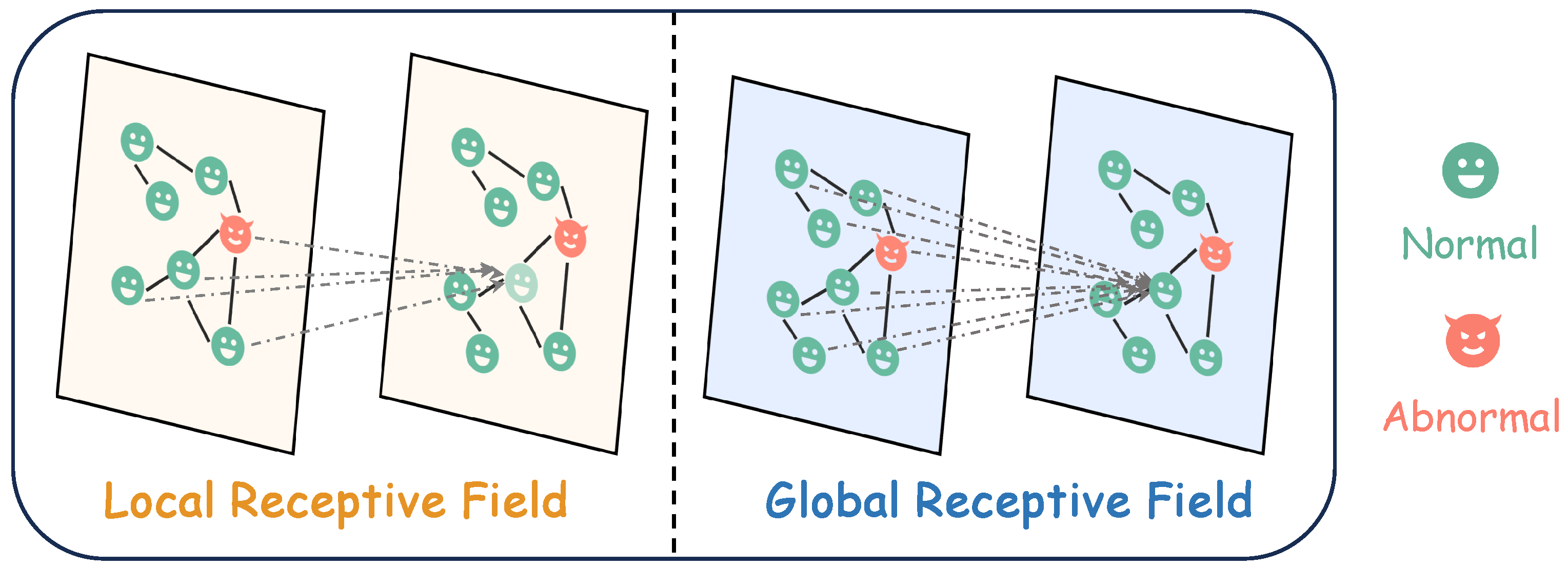
- For the first time, we introduce Graph Transformers for UGAD. The global information acquired by Transformers allows us to focus more on reconstructing normal patterns on the attributed graph.
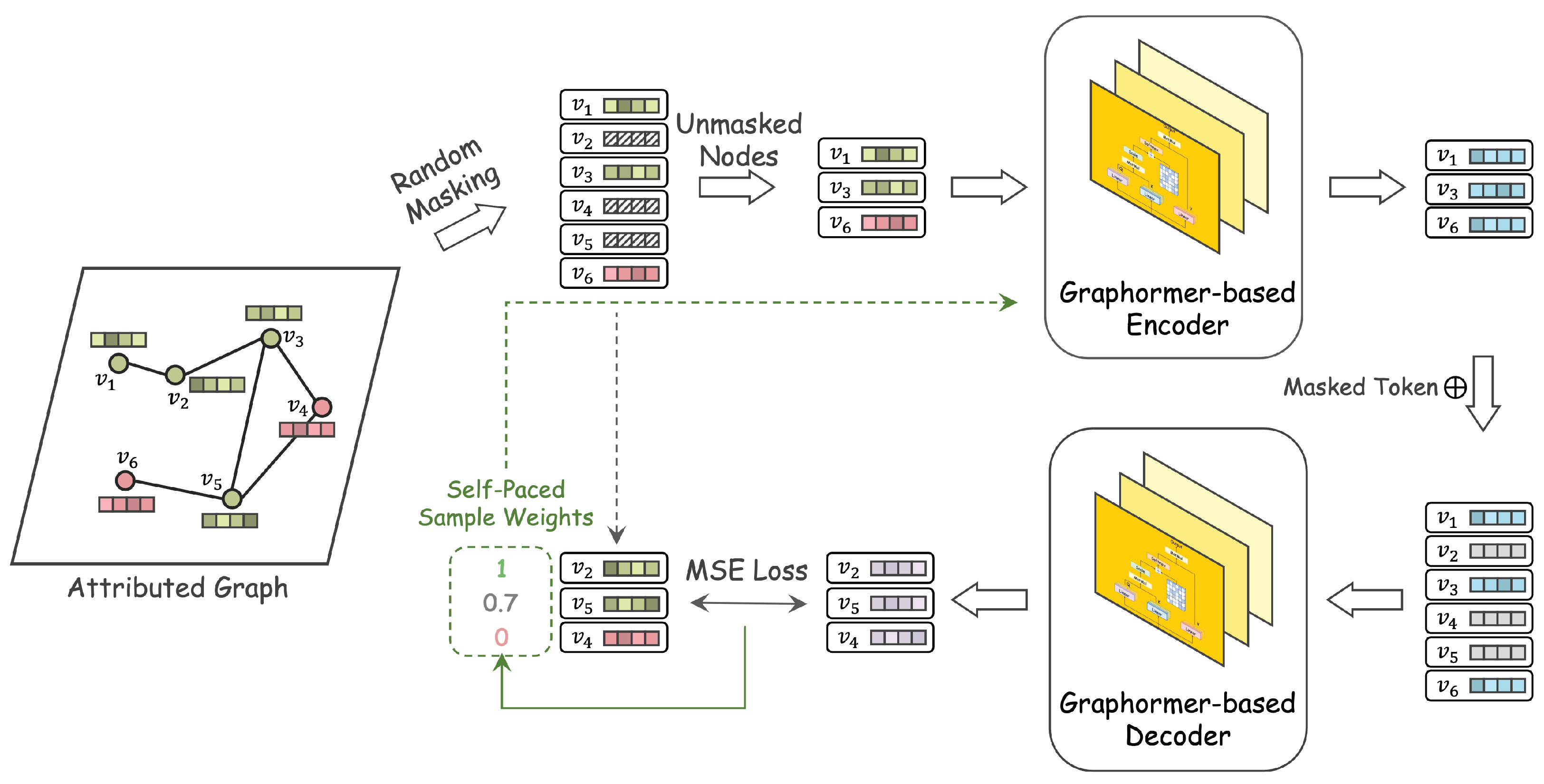
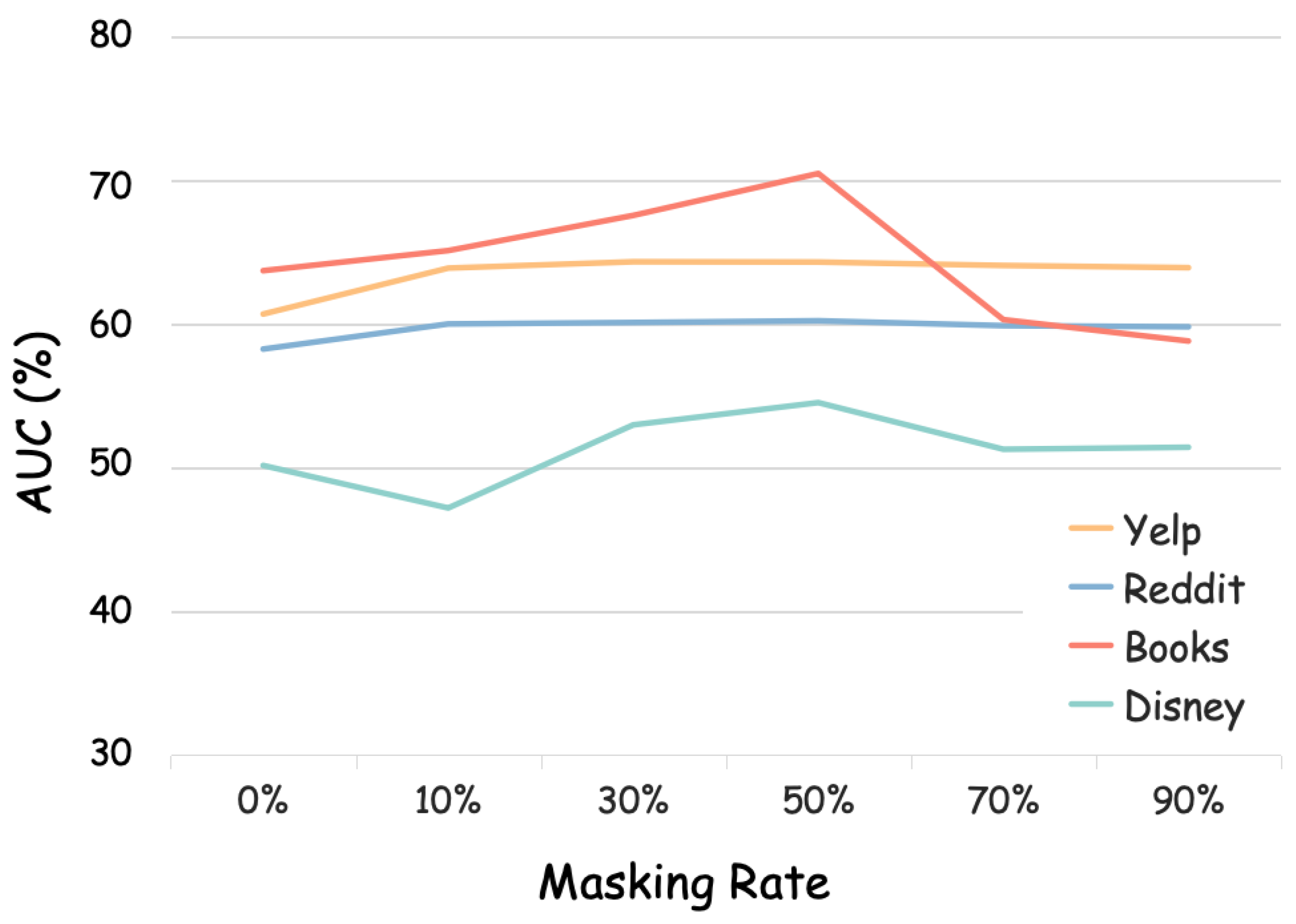
- We determine that the masking node strategy is beneficial for UGAD tasks, which widen the differentiation of normal and abnormal nodes on reconstruction error. Moreover, we design a self-paced enhancement module to further refine the normality model that boosts performance.
- Comprehensive experiments on four real-world benchmark datasets with organic anomalies demonstrate the effectiveness of our proposed method compared to state-of-the-art baselines.
2. Related Work
2.1. Unsupervised Graph Anomaly Detection
2.2. Graph Transformer
3. Notations and Problem Definitions
3.1. Notations
3.2. UGAD Problem Formulation
4. Method
4.1. Graph Transformer with Position Embedding
4.1.1. Basic Transformer
4.1.2. Positional Embedding for UGAD Task
4.2. Masked Graph Transformer Reconstruction
4.3. Self-Paced Enhancement
4.4. Inference Stage
5. Experiments and Discussion
5.1. Datasets
- Disney [44]: Disney is a co-purchase network of movies from the Amazon network, in which the anomaly label is obtained by voting from high school students.
- Books [45]: Books is a graph dataset about books purchased from the Amazon network, in which the anomaly label is determined based on the amazonfail tag information that is provided by Amazon users.
- Reddit [46]: Reddit is a social network dataset derived from the social media platform Reddit where users banned from Reddit sites are flagged as anomalous users.
- Yelp [47]: Yelp contains restaurant reviews from several states in the U.S. where there is a connecting relationship between reviews posted by the same user. The anomaly tag is a fake review.
5.2. Comparison Algorithms
- LOF [48]: Local Outlier Factor(LOF) measures the difference between a node and its neighborhood, where the larger the difference, the more abnormal the node is.
- SCAN [49]: SCAN utilizes graph structure information for clustering to find outliers.
- Radar [50]: Radar adopts residual decomposition to identify anomalous nodes with significant residual errors.
- DOMINANT [9]: DOMINANT consists of three parts, namely a shared GCN encoder, an attribute decoder, and a structure decoder, which work together to reconstruct the raw features. The larger the reconstruction error, the more anomalous the node.
- DONE [51]: DONE mainly contains structure and attribute autoencoders.
- CoLA [21]: CoLA introduces the node–subgraph contrastive strategy, which distinguishes the node that is not similar to its corresponding subgraph as an anomaly.
- ANEMONE [19]: ANEMONE is a multi-scale contrastive graph anomaly detection framework consisting of node–node contrastive and node–subgraph contrastive.
- NLGAD [41]: NLGAD proposes a graph anomaly detection framework based on normality learning to enhance representation learning of normal nodes.
- VGOD [23]: VGOD detects structure and attribute anomalies by calculating the variance between nodes and their neighborhoods and combining the node attribute with the reconstruction module.
- PREM [52]: PREM designs the attribute pre-processing module and ego-neighbor matching network and adopts contrastive learning mode to train.
- GRADATE [40]: GRADATE introduces edge perturbation for graph augmentation and designs a subgraph–subgraph contrastive mode.
- GADAM [53]: GADAM decouples local inconsistency mining from message passing and further detects anomalies beyond local scope via adaptive message passing and global consistency discernment.
5.3. Parameter Settings
5.4. Experimental Analysis
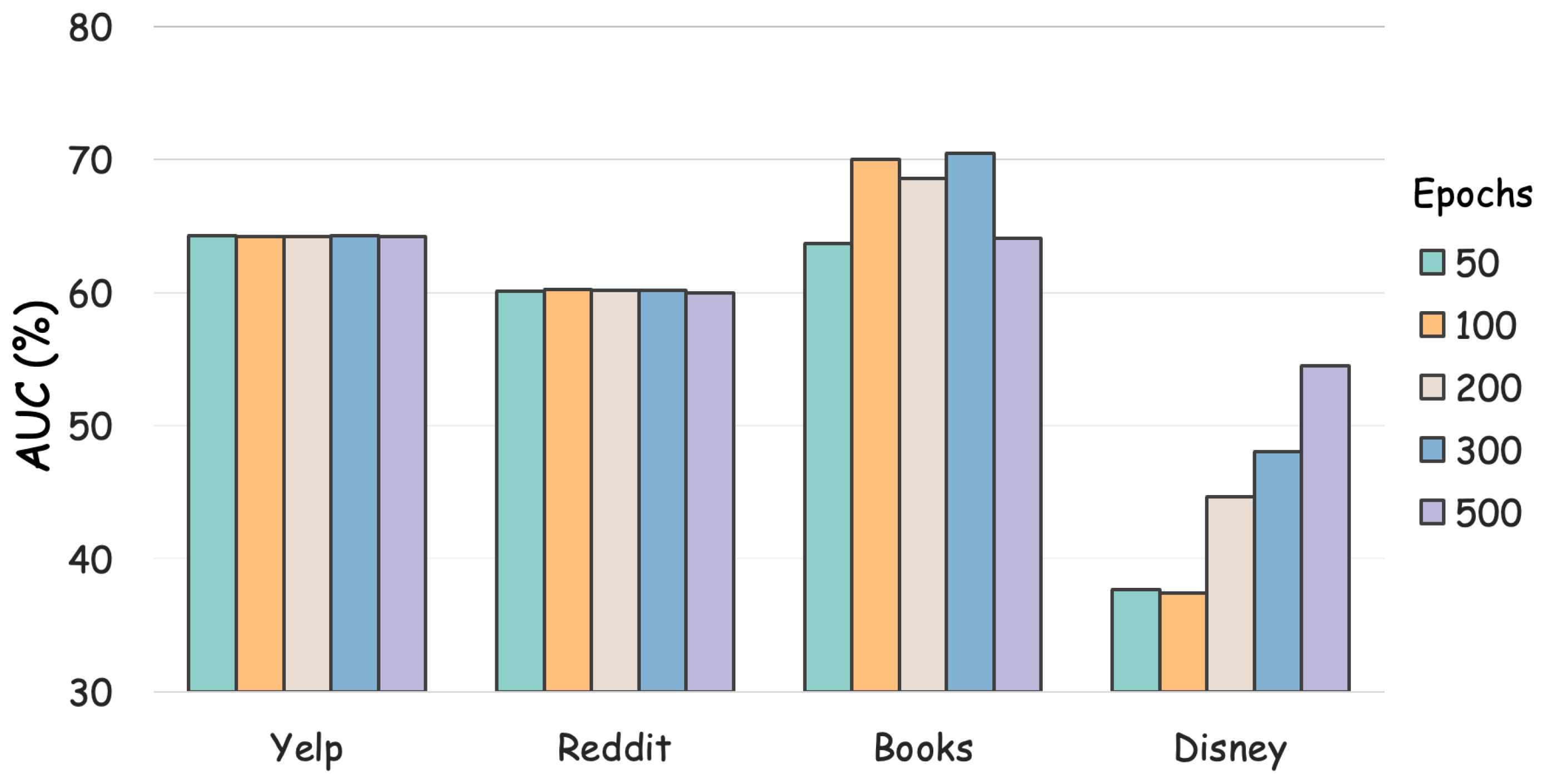
- Our proposed model, ANIMATE, consistently achieves the best performance on the four real-world datasets. In particular, ANIMATE outperforms the second best comparison algorithm by a notable margin, i.e., 16.11% and 9.89% on the Books and Yelp datasets, respectively. These results also demonstrate that utilizing Transformers and MAE as backbone is a promising solution for UGAD tasks.
- The proposed ANIMATE algorithm is capable of extending to large-scale datasets. Specifically, for the Yelp dataset, most deep learning-based graph anomaly detection algorithms suffer from exceeding memory. This is due to the reason that ANIMATE is designed using a batch manner instead of inputting the whole graph. The extensibility of ANIMATE is flexible.
- Compared with contrastive-based graph anomaly detection methods, including CoLA, ANEMONE, SL-GAD, NLGAD, and GRADATE, our proposed generative-based solution enables us to obtain notable AUC growth. Owing to these methods, we focus on changes between nodes and their neighborhoods while ignoring node global long-range dependency information.
5.5. Parameter Sensitivity Analysis
5.6. Ablation Study
6. Conclusions
Author Contributions
Funding
Institutional Review Board Statement
Informed Consent Statement
Data Availability Statement
Acknowledgments
Conflicts of Interest
Abbreviations
| UGAD | Unsupervised graph anomaly detection |
| GNNs | Graph neural networks |
| AUC | Area under curve |
| OOM_G | Out of cuda memory |
| OOM_R | Out of RAM memory |
References
- Wang, Y.; Chang, D.; Fu, Z.; Wen, J.; Zhao, Y. Partially View-aligned Representation Learning via Cross-view Graph Contrastive Network. IEEE Trans. Circuits Syst. Video Technol. 2024, 34, 7272–7283. [Google Scholar] [CrossRef]
- Wen, J.; Deng, S.; Fei, L.; Zhang, Z.; Zhang, B.; Zhang, Z.; Xu, Y. Discriminative regression with adaptive graph diffusion. IEEE Trans. Neural Netw. Learn. Syst. 2022, 35, 1797–1809. [Google Scholar] [CrossRef] [PubMed]
- Chen, M.S.; Lin, J.Q.; Wang, C.D.; Xi, W.D.; Huang, D. On Regularizing Multiple Clusterings for Ensemble Clustering by Graph Tensor Learning. In Proceedings of the 31st ACM International Conference on Multimedia; ACM: New York, NY, USA, 2023; pp. 3069–3077. [Google Scholar]
- Li, X.L.; Chen, M.S.; Wang, C.D.; Lai, J.H. Refining graph structure for incomplete multi-view clustering. IEEE Trans. Neural Netw. Learn. Syst. 2022, 35, 2300–2313. [Google Scholar] [CrossRef] [PubMed]
- Yan, X.; Yu, X.; Hu, S.; Ye, Y. Mutual Boost Network for attributed graph clustering. Expert Syst. Appl. 2023, 229, 120479. [Google Scholar] [CrossRef]
- Gu, X.; Huang, Q.; Yang, J. Overlapping community detection in vehicular social networks based on graph attention autoencoder. Sensors 2025, 25, 2601. [Google Scholar] [CrossRef] [PubMed]
- Zhao, S.; Zhang, H.; Sun, B.; Wang, Y. Spatio-Temporal Graph Neural Networks for Anomaly Detection in Complex Industrial Processes. Sensors 2026, 26, 1597. [Google Scholar] [CrossRef] [PubMed]
- Han, Z.; Gao, X.; Li, Z.; Ren, Y.; Shi, X. A Depth-Aware HGNN Method and Its Application in Anomaly Detection and Correction of Sparse Ocean Sensor Data. Sensors 2026, 26, 1537. [Google Scholar] [CrossRef] [PubMed]
- Ding, K.; Li, J.; Bhanushali, R.; Liu, H. Deep anomaly detection on attributed networks. In Proceedings of the 2019 SIAM International Conference on Data Mining; SIAM: Philadelphia, PA, USA, 2019; pp. 594–602. [Google Scholar]
- Fan, H.; Zhang, F.; Li, Z. Anomalydae: Dual autoencoder for anomaly detection on attributed networks. In Proceedings of the ICASSP 2020-2020 IEEE International Conference on Acoustics, Speech and Signal Processing (ICASSP); IEEE: Piscataway, NJ, USA, 2020; pp. 5685–5689. [Google Scholar]
- Luo, X.; Wu, J.; Beheshti, A.; Yang, J.; Zhang, X.; Wang, Y.; Xue, S. Comga: Community-aware attributed graph anomaly detection. In Proceedings of the Fifteenth ACM International Conference on Web Search and Data Mining; ACM: New York, NY, USA, 2022; pp. 657–665. [Google Scholar]
- Xu, Z.; Huang, X.; Zhao, Y.; Dong, Y.; Li, J. Contrastive attributed network anomaly detection with data augmentation. In Proceedings of the Pacific-Asia Conference on Knowledge Discovery and Data Mining; Springer: Berlin/Heidelberg, Germany, 2022; pp. 444–457. [Google Scholar]
- Qiao, H.; Tong, H.; An, B.; King, I.; Aggarwal, C.; Pang, G. Deep graph anomaly detection: A survey and new perspectives. IEEE Trans. Knowl. Data Eng. 2025, 37, 5106–5126. [Google Scholar] [CrossRef]
- Ying, C.; Cai, T.; Luo, S.; Zheng, S.; Ke, G.; He, D.; Shen, Y.; Liu, T.Y. Do transformers really perform badly for graph representation? Adv. Neural Inf. Process. Syst. 2021, 34, 28877–28888. [Google Scholar]
- Zhang, S.; Chen, H.; Yang, H.; Sun, X.; Yu, P.S.; Xu, G. Graph masked autoencoders with transformers. arXiv 2022, arXiv:2202.08391. [Google Scholar] [CrossRef]
- Yu, G.; Wang, S.; Cai, Z.; Liu, X.; Xu, C.; Wu, C. Deep anomaly discovery from unlabeled videos via normality advantage and self-paced refinement. In Proceedings of the IEEE/CVF Conference on Computer Vision and Pattern Recognition; IEEE: Piscataway, NJ, USA, 2022; pp. 13987–13998. [Google Scholar]
- Ding, K.; Li, J.; Liu, H. Interactive anomaly detection on attributed networks. In Proceedings of the Twelfth ACM International Conference on Web Search and Data Mining; ACM: New York, NY, USA, 2019; pp. 357–365. [Google Scholar]
- Ding, K.; Li, J.; Agarwal, N.; Liu, H. Inductive anomaly detection on attributed networks. In Proceedings of the Twenty-Ninth International Conference on International Joint Conferences on Artificial Intelligence; ACM: New York, NY, USA, 2021; pp. 1288–1294. [Google Scholar]
- Jin, M.; Liu, Y.; Zheng, Y.; Chi, L.; Li, Y.F.; Pan, S. Anemone: Graph anomaly detection with multi-scale contrastive learning. In Proceedings of the 30th ACM International Conference on Information & Knowledge Management; ACM: New York, NY, USA, 2021; pp. 3122–3126. [Google Scholar]
- Yuan, X.; Zhou, N.; Yu, S.; Huang, H.; Chen, Z.; Xia, F. Higher-order structure based anomaly detection on attributed networks. In Proceedings of the 2021 IEEE International Conference on Big Data (Big Data); IEEE: Piscataway, NJ, USA, 2021; pp. 2691–2700. [Google Scholar]
- Liu, Y.; Li, Z.; Pan, S.; Gong, C.; Zhou, C.; Karypis, G. Anomaly detection on attributed networks via contrastive self-supervised learning. IEEE Trans. Neural Netw. Learn. Syst. 2021, 33, 2378–2392. [Google Scholar] [CrossRef] [PubMed]
- Liu, K.; Dou, Y.; Zhao, Y.; Ding, X.; Hu, X.; Zhang, R.; Ding, K.; Chen, C.; Peng, H.; Shu, K.; et al. Bond: Benchmarking unsupervised outlier node detection on static attributed graphs. Adv. Neural Inf. Process. Syst. 2022, 35, 27021–27035. [Google Scholar]
- Huang, Y.; Wang, L.; Zhang, F.; Lin, X. Unsupervised graph outlier detection: Problem revisit, new insight, and superior method. In Proceedings of the 2023 IEEE 39th International Conference on Data Engineering (ICDE); IEEE: Piscataway, NJ, USA, 2023; pp. 2565–2578. [Google Scholar]
- Ma, X.; Wu, J.; Xue, S.; Yang, J.; Zhou, C.; Sheng, Q.Z.; Xiong, H.; Akoglu, L. A comprehensive survey on graph anomaly detection with deep learning. IEEE Trans. Knowl. Data Eng. 2021, 35, 12012–12038. [Google Scholar] [CrossRef]
- Kipf, T.N.; Welling, M. Semi-Supervised Classification with Graph Convolutional Networks. In Proceedings of the International Conference on Learning Representations, San Juan, Puerto Rico, 2–4 May 2016. [Google Scholar]
- Veličković, P.; Cucurull, G.; Casanova, A.; Romero, A.; Liò, P.; Bengio, Y. Graph Attention Networks. In Proceedings of the International Conference on Learning Representations, Vancouver, BC, Canada, 30 April–3 May 2018. [Google Scholar]
- Pei, Y.; Huang, T.; van Ipenburg, W.; Pechenizkiy, M. ResGCN: Attention-based deep residual modeling for anomaly detection on attributed networks. In Proceedings of the 2021 IEEE 8th International Conference on Data Science and Advanced Analytics (DSAA); IEEE: Piscataway, NJ, USA, 2021; pp. 1–2. [Google Scholar]
- Roy, A.; Shu, J.; Li, J.; Yang, C.; Elshocht, O.; Smeets, J.; Li, P. GAD-NR: Graph Anomaly Detection via Neighborhood Reconstruction. In Proceedings of the 17th ACM International Conference on Web Search and Data Mining; ACM: New York, NY, USA, 2024; pp. 576–585. [Google Scholar]
- Vaswani, A.; Shazeer, N.; Parmar, N.; Uszkoreit, J.; Jones, L.; Gomez, A.N.; Kaiser, Ł.; Polosukhin, I. Attention is all you need. Adv. Neural Inf. Process. Syst. 2017, 30. [Google Scholar]
- Zhang, J.; Zhang, H.; Xia, C.; Sun, L. Graph-bert: Only attention is needed for learning graph representations. arXiv 2020, arXiv:2001.05140. [Google Scholar] [CrossRef]
- Dwivedi, V.P.; Bresson, X. A generalization of transformer networks to graphs. arXiv 2020, arXiv:2012.09699. [Google Scholar]
- Mialon, G.; Chen, D.; Selosse, M.; Mairal, J. Graphit: Encoding graph structure in transformers. arXiv 2021, arXiv:2106.05667. [Google Scholar] [CrossRef]
- Kreuzer, D.; Beaini, D.; Hamilton, W.; Létourneau, V.; Tossou, P. Rethinking graph transformers with spectral attention. Adv. Neural Inf. Process. Syst. 2021, 34, 21618–21629. [Google Scholar]
- Wu, Q.; Zhao, W.; Li, Z.; Wipf, D.P.; Yan, J. Nodeformer: A scalable graph structure learning transformer for node classification. Adv. Neural Inf. Process. Syst. 2022, 35, 27387–27401. [Google Scholar]
- Devlin, J.; Chang, M.W.; Lee, K.; Toutanova, K. BERT: Pre-training of Deep Bidirectional Transformers for Language Understanding. In Proceedings of the 2019 Conference of the North American Chapter of the Association for Computational Linguistics: Human Language Technologies, Volume 1 (Long and Short Papers); Association for Computational Linguistics: Stroudsburg, PA, USA, 2019; pp. 4171–4186. [Google Scholar]
- Hou, Z.; Liu, X.; Cen, Y.; Dong, Y.; Yang, H.; Wang, C.; Tang, J. Graphmae: Self-supervised masked graph autoencoders. In Proceedings of the 28th ACM SIGKDD Conference on Knowledge Discovery and Data Mining; ACM: New York, NY, USA, 2022; pp. 594–604. [Google Scholar]
- Hou, Z.; He, Y.; Cen, Y.; Liu, X.; Dong, Y.; Kharlamov, E.; Tang, J. Graphmae2: A decoding-enhanced masked self-supervised graph learner. In Proceedings of the ACM Web Conference 2023; ACM: New York, NY, USA, 2023; pp. 737–746. [Google Scholar]
- Tan, Q.; Liu, N.; Huang, X.; Choi, S.H.; Li, L.; Chen, R.; Hu, X. S2GAE: Self-supervised graph autoencoders are generalizable learners with graph masking. In Proceedings of the Sixteenth ACM International Conference on Web Search and Data Mining; ACM: New York, NY, USA, 2023; pp. 787–795. [Google Scholar]
- Tian, Y.; Dong, K.; Zhang, C.; Zhang, C.; Chawla, N.V. Heterogeneous graph masked autoencoders. In Proceedings of the AAAI Conference on Artificial Intelligence; AAAI: Menlo Park, CA, USA, 2023; Volume 37, pp. 9997–10005. [Google Scholar]
- Duan, J.; Wang, S.; Zhang, P.; Zhu, E.; Hu, J.; Jin, H.; Liu, Y.; Dong, Z. Graph anomaly detection via multi-scale contrastive learning networks with augmented view. In Proceedings of the AAAI Conference on Artificial Intelligence; AAAI: Menlo Park, CA, USA, 2023; Volume 37, pp. 7459–7467. [Google Scholar]
- Duan, J.; Zhang, P.; Wang, S.; Hu, J.; Jin, H.; Zhang, J.; Zhou, H.; Liu, X. Normality Learning-based Graph Anomaly Detection via Multi-Scale Contrastive Learning. In Proceedings of the 31st ACM International Conference on Multimedia; ACM: New York, NY, USA, 2023; pp. 7502–7511. [Google Scholar]
- Kumar, M.; Packer, B.; Koller, D. Self-paced learning for latent variable models. Adv. Neural Inf. Process. Syst. 2010, 23, 1189–1197. [Google Scholar]
- Jiang, L.; Meng, D.; Mitamura, T.; Hauptmann, A.G. Easy samples first: Self-paced reranking for zero-example multimedia search. In Proceedings of the 22nd ACM International Conference on Multimedia; ACM: New York, NY, USA, 2014; pp. 547–556. [Google Scholar]
- Müller, E.; Sánchez, P.I.; Mülle, Y.; Böhm, K. Ranking outlier nodes in subspaces of attributed graphs. In Proceedings of the 2013 IEEE 29th International Conference on Data Engineering Workshops (ICDEW); IEEE: Piscataway, NJ, USA, 2013; pp. 216–222. [Google Scholar]
- Sánchez, P.I.; Müller, E.; Laforet, F.; Keller, F.; Böhm, K. Statistical selection of congruent subspaces for mining attributed graphs. In Proceedings of the 2013 IEEE 13th International Conference on Data Mining; IEEE: Piscataway, NJ, USA, 2013; pp. 647–656. [Google Scholar]
- Kumar, S.; Zhang, X.; Leskovec, J. Predicting dynamic embedding trajectory in temporal interaction networks. In Proceedings of the 25th ACM SIGKDD International Conference on Knowledge Discovery & Data Mining; ACM: New York, NY, USA, 2019; pp. 1269–1278. [Google Scholar]
- Rayana, S.; Akoglu, L. Collective opinion spam detection: Bridging review networks and metadata. In Proceedings of the 21th ACM SIGKDD International Conference on Knowledge Discovery and Data Mining; ACM: New York, NY, USA, 2015; pp. 985–994. [Google Scholar]
- Breunig, M.M.; Kriegel, H.P.; Ng, R.T.; Sander, J. LOF: Identifying density-based local outliers. In Proceedings of the 2000 ACM SIGMOD International Conference on Management of Data; ACM: New York, NY, USA, 2000; pp. 93–104. [Google Scholar]
- Xu, X.; Yuruk, N.; Feng, Z.; Schweiger, T.A. Scan: A structural clustering algorithm for networks. In Proceedings of the 13th ACM SIGKDD International Conference on Knowledge Discovery and Data Mining; ACM: New York, NY, USA, 2007; pp. 824–833. [Google Scholar]
- Li, J.; Dani, H.; Hu, X.; Liu, H. Radar: Residual analysis for anomaly detection in attributed networks. In Proceedings of the IJCAI; ACM: New York, NY, USA, 2017; Volume 17, pp. 2152–2158. [Google Scholar]
- Bandyopadhyay, S.; N, L.; Vivek, S.V.; Murty, M.N. Outlier resistant unsupervised deep architectures for attributed network embedding. In Proceedings of the 13th International Conference on Web Search and Data Mining; ACM: New York, NY, USA, 2020; pp. 25–33. [Google Scholar]
- Pan, J.; Liu, Y.; Zheng, Y.; Pan, S. PREM: A Simple Yet Effective Approach for Node-Level Graph Anomaly Detection. In Proceedings of the 2023 IEEE International Conference on Data Mining (ICDM); IEEE: Piscataway, NJ, USA, 2023; pp. 1253–1258. [Google Scholar]
- Chen, J.; Zhu, G.; Yuan, C.; Huang, Y. Boosting graph anomaly detection with adaptive message passing. In Proceedings of the The Twelfth International Conference on Learning Representations, Vienna, Austria, 7–11 May 2024. [Google Scholar]
- He, K.; Chen, X.; Xie, S.; Li, Y.; Dollár, P.; Girshick, R. Masked autoencoders are scalable vision learners. In Proceedings of the IEEE/CVF Conference on Computer Vision and Pattern Recognition; IEEE: Piscataway, NJ, USA, 2022; pp. 16000–16009. [Google Scholar]



| Dataset | #Nodes | #Edges | #Attributes | #Anomalies | #Anomalous Ratio (%) |
|---|---|---|---|---|---|
| Disney | 124 | 335 | 28 | 6 | 4.84 |
| Books | 1418 | 3695 | 21 | 28 | 1.97 |
| 10,984 | 168,016 | 64 | 366 | 3.31 | |
| Yelp | 45,954 | 3,846,979 | 32 | 6677 | 14.53 |
| Category | Methods | Disney | Books | Yelp | |
|---|---|---|---|---|---|
| Classical | LOF (SIGMOD, 2000) | 47.88 ± 0.0 | 36.52 ± 0.0 | 57.16 ± 0.0 | 54.41 ± 0.0 |
| SCAN (SIGKDD, 2007) | 49.33 ± 4.0 | 49.19 ± 1.7 | 49.56 ± 0.3 | 47.98 ± 2.7 | |
| Radar (IJCAI, 2017) | 51.84 ± 0.0 | 52.18 ± 0.0 | 56.10 ± 1.2 | OOM_G | |
| Deep | DOMINANT (SDM, 2019) | 51.12 ± 3.0 | 46.01 ± 2.7 | 55.35 ± 0.1 | OOM_G |
| DONE (WSDM, 2020) | 44.17 ± 6.2 | 41.92 ± 4.0 | 54.59 ± 2.9 | OOM_G | |
| CoLA (TNNLS, 2021) | 35.03 ± 7.6 | 52.37 ± 4.2 | 55.52 ± 1.1 | 48.04 ± 3.9 | |
| ANEMONE (CIKM, 2021) | 44.35 ± 4.1 | 54.37 ± 3.7 | 53.45 ± 1.4 | 46.97 ± 4.4 | |
| NLGAD (ACM MM,2023) | 33.19 ± 4.8 | 50.95 ± 2.1 | 58.93 ± 0.8 | 46.77 ± 2.5 | |
| VGOD (ICDE, 2023) | 27.82 ± 1.3 | 36.71 ± 3.6 | 52.67 ± 0.7 | OOM_G | |
| PREM (ICDM, 2023) | 39.55 ± 3.6 | 43.07 ± 2.3 | 41.19 ± 1.6 | OOM_G | |
| GRADATE (AAAI, 2023) | 44.20 ± 2.7 | 54.12 ± 3.2 | 58.77 ± 2.1 | OOM_R | |
| GADAM (ICLR, 2024) | 39.66 ± 2.2 | 53.28 ± 2.8 | 47.20 ± 1.5 | 52.89 ± 3.1 | |
| ANIMATE (Ours) | 53.81 ± 1.9 | 70.48 ± 2.1 | 60.22 ± 0.2 | 64.30 ± 2.4 |
| Embedding Dimension | 32 | 64 | 128 | 256 | 512 |
|---|---|---|---|---|---|
| Disney | 49.58 | 50.28 | 48.87 | 53.81 | 50.14 |
| Books | 64.77 | 55.97 | 66.20 | 70.48 | 66.37 |
| 56.81 | 54.26 | 53.74 | 60.22 | 55.17 | |
| Yelp | 56.27 | 55.62 | 54.05 | 64.30 | 59.03 |
| SPE | Disney | Books | Yelp | |
|---|---|---|---|---|
| ✗ | 33.62 | 67.87 | 59.73 | 60.86 |
| ✓ | 53.81 | 70.48 | 60.22 | 64.30 |
Disclaimer/Publisher’s Note: The statements, opinions and data contained in all publications are solely those of the individual author(s) and contributor(s) and not of MDPI and/or the editor(s). MDPI and/or the editor(s) disclaim responsibility for any injury to people or property resulting from any ideas, methods, instructions or products referred to in the content. |
© 2026 by the authors. Licensee MDPI, Basel, Switzerland. This article is an open access article distributed under the terms and conditions of the Creative Commons Attribution (CC BY) license.
Share and Cite
Hu, J.; Zhang, Y.; Zhu, C.; Hou, C. ANIMATE: Unsupervised Attributed Graph Anomaly Detection with Masked Graph Transformers. Sensors 2026, 26, 3176. https://doi.org/10.3390/s26103176
Hu J, Zhang Y, Zhu C, Hou C. ANIMATE: Unsupervised Attributed Graph Anomaly Detection with Masked Graph Transformers. Sensors. 2026; 26(10):3176. https://doi.org/10.3390/s26103176
Chicago/Turabian StyleHu, Jingtao, Yi Zhang, Chengzhang Zhu, and Changsheng Hou. 2026. "ANIMATE: Unsupervised Attributed Graph Anomaly Detection with Masked Graph Transformers" Sensors 26, no. 10: 3176. https://doi.org/10.3390/s26103176
APA StyleHu, J., Zhang, Y., Zhu, C., & Hou, C. (2026). ANIMATE: Unsupervised Attributed Graph Anomaly Detection with Masked Graph Transformers. Sensors, 26(10), 3176. https://doi.org/10.3390/s26103176