Skeletal Muscle Blood Flow and NIRS Oxygenation Kinetics as a Tool to Evaluate Adaptations to High-Intensity Exercise Training

 ,
,
Abstract
1. Introduction
2. Materials and Methods
2.1. Participants
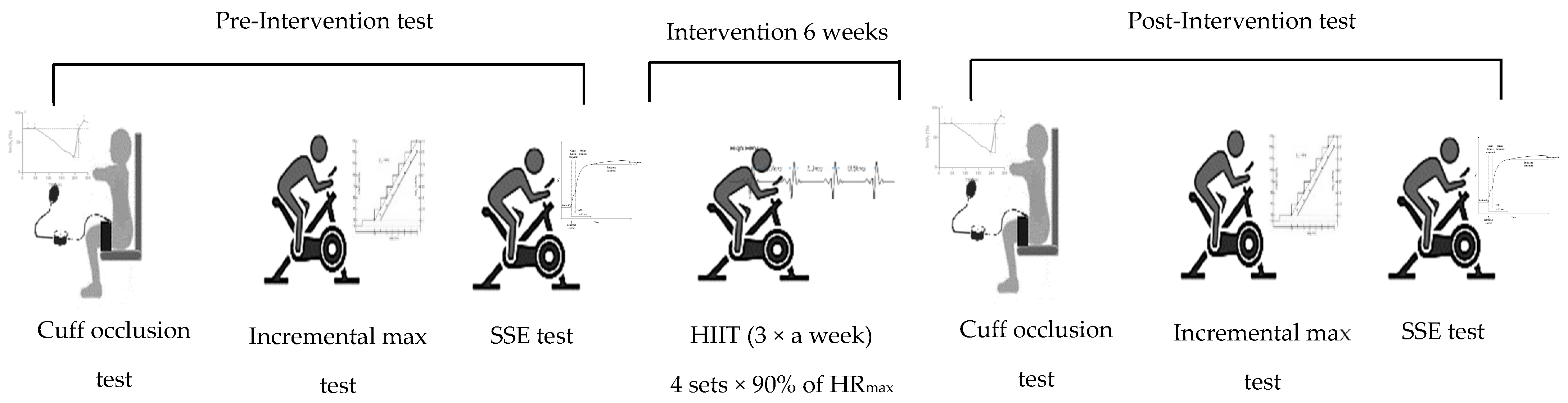
2.2. Protocol
2.2.1. Cuff Occlusion Test
2.2.2. Incremental Maximal Exercise Test
2.2.3. Steady-State Exercise Test
2.3. Interventions
2.4. Measurements
2.4.1. Superficial Femoral Artery Blood Flow
2.4.2. Skeletal Muscle Oxygenation Through Near-Infrared Spectroscopy
2.5. Data Analysis
2.5.1. Maximal Aerobic Capacity
2.5.2. Reactive Hyperemia
2.5.3. NIRS Reoxygenation
2.6. Statistical Analysis
3. Results
3.1. Changes in Classic Parameters Associated with Exercise Training
3.2. Changes in Superficial Femoral Blood Flow
3.3. Changes in Muscle Reoxygenation During and Post-Cuff Occlusion
3.4. Changes in Muscle Reoxygenation Post-Steady-State Exercise at an Absolute Workload
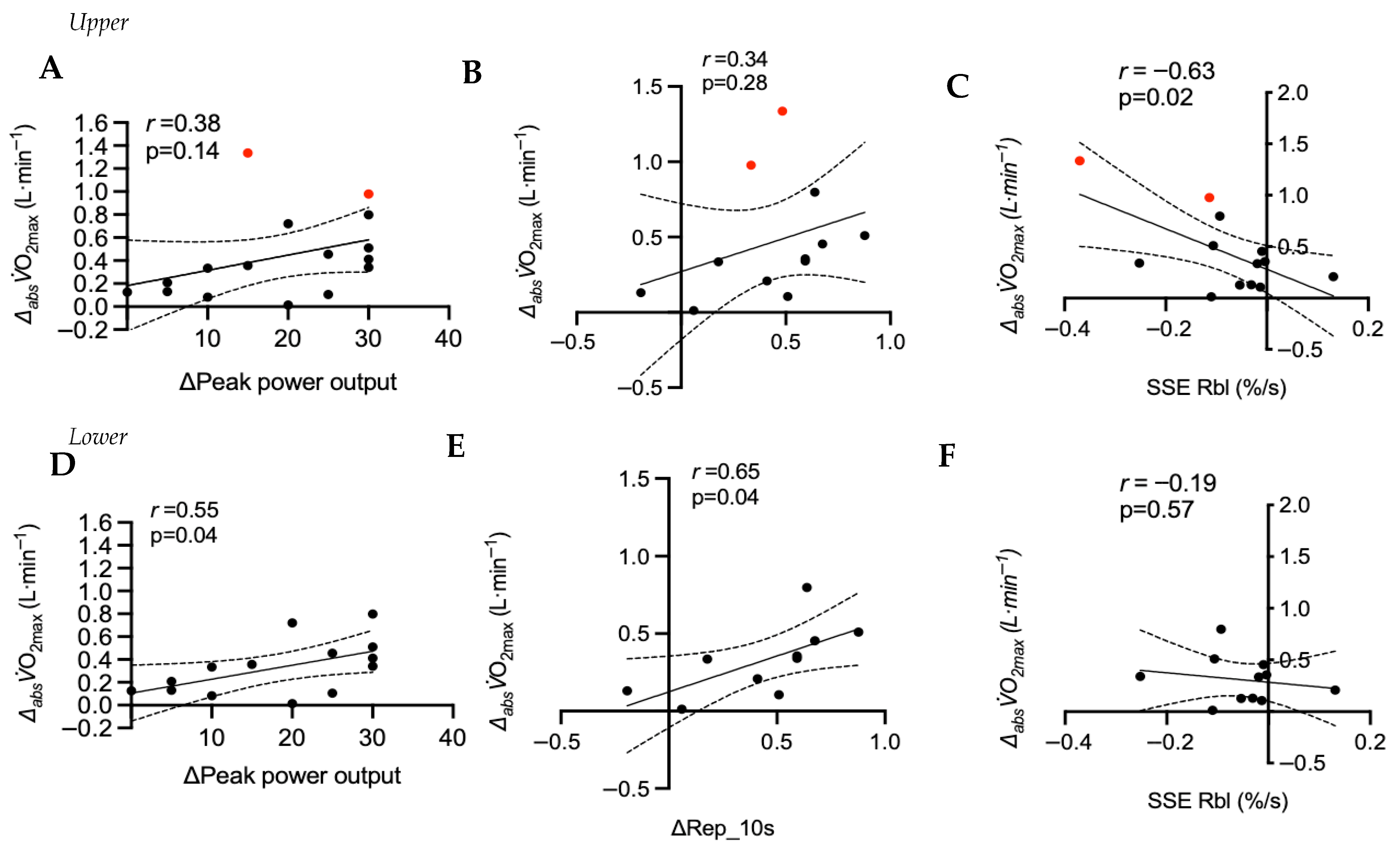
3.5. Relationships Between the Change in Absolute VO2max (absVO2max) and Change in Blood Flow and NIRS Kinetics
4. Discussion
4.1. Improved Aerobic Capacity and Muscle Blood Flow and NIRS Oxygenation Kinetics During and Post-Ischemic Limb Occlusion
4.2. Improved Aerobic Capacity and NIRS Post-Steady-State Oxygenation Recovery Kinetics
4.3. Relationship Between Improvements in Skeletal Muscle Function and VO2max
4.4. Practical Implications
4.5. Limitations
5. Conclusions
Supplementary Materials
Author Contributions
Funding
Institutional Review Board Statement
Informed Consent Statement
Data Availability Statement
Acknowledgments
Conflicts of Interest
References
- Atakan, M.M.; Li, Y.; Koşar, Ş.N.; Turnagöl, H.H.; Yan, X. Evidence-based effects of high-intensity interval training on exercise capacity and health: A review with historical perspective. Int. J. Environ. Res. Public Health 2021, 18, 7201. [Google Scholar] [CrossRef]
- Akalan, C.; Kravitz, L.; Robergs, R.R. VO2max: Essentials of the Most Widely Used Test in Exercise Physiology. ACSM’s Health Fit. J. 2004, 8, 5–9. [Google Scholar] [CrossRef]
- Holloszy, J.O.; Coyle, E.F. Adaptations of skeletal muscle to endurance exercise and their metabolic consequences. J. Appl. Physiol. 1984, 56, 831–838. [Google Scholar] [CrossRef]
- Schmidt, W.; Prommer, N. Effects of various training modalities on blood volume. Scand. J. Med. Sci. Sports 2008, 18, 57–69. [Google Scholar] [CrossRef]
- Granata, C.; Oliveira, R.S.F.; Little, J.P.; Renner, K.; Bishop, D.J. Mitochondrial adaptations to high-volume exercise training are rapidly reversed after a reduction in training volume in human skeletal muscle. FASEB J. 2016, 30, 3413–3423. [Google Scholar] [CrossRef]
- Arnold, J.I.; Yogev, A.; Nelson, H.; van Hooff, M.; Koehle, M.S. Muscle reoxygenation is slower after higher cycling intensity, and is faster and more reliable in locomotor than in accessory muscle sites. Front. Physiol. 2024, 15, 1449384. [Google Scholar] [CrossRef]
- Hamaoka, T.; McCully, K.K. Review of early development of near-infrared spectroscopy and recent advancement of studies on muscle oxygenation and oxidative metabolism. J. Physiol. Sci. 2019, 69, 799–811. [Google Scholar] [CrossRef]
- Koutlas, A.; Smilios, I.; Kokkinou, E.M.; Myrkos, A.; Kounoupis, A.; Dipla, K.; Zafeiridis, A. NIRS-Derived Muscle-Deoxygenation and Microvascular Reactivity During Occlusion–Reperfusion at Rest Are Associated With Whole-Body Aerobic Fitness. Res. Q. Exerc. Sport 2024, 95, 127–139. [Google Scholar] [CrossRef]
- Rasica, L.; Inglis, E.C.; Iannetta, D.; Soares, R.N.; Murias, J.M. Fitness Level- and Sex-Related Differences in Macrovascular and Microvascular Responses during Reactive Hyperemia. Med. Sci. Sports Exerc. 2022, 54, 497–506. [Google Scholar] [CrossRef]
- Beever, A.T.; Tripp, T.R.; Zhang, J.; MacInnis, M.J. NIRS-derived skeletal muscle oxidative capacity is correlated with aerobic fitness and independent of sex. J. Appl. Physiol. 2020, 129, 558–568. [Google Scholar] [CrossRef]
- Lagerwaard, B.; Janssen, J.J.E.; Cuijpers, I.; Keijer, J.; de Boer, V.C.J.; Nieuwenhuizen, A.G. Muscle mitochondrial capacity in high- and low-fitness females using near-infrared spectroscopy. Physiol. Rep. 2021, 9, e14838. [Google Scholar] [CrossRef]
- Ichimura, S.; Murase, N.; Osada, T.; Kime, R.; Homma, T.; Ueda, C.; Nagasawa, T.; Motobe, M.; Hamaoka, T.; Katsumura, T. Age and activity status affect muscle reoxygenation time after maximal cycling exercise. Med. Sci. Sports Exerc. 2006, 38, 1277–1281. [Google Scholar] [CrossRef]
- Paredes-Ruiz, M.J.; Jódar-Reverte, M.; Ferrer-Lopez, V.; Martínez-González-Moro, I. Quadriceps Muscle Oxygenation during a Maximum Stress Test in Middle-Aged Athletes. Montenegrin J. Sports Sci. Med. 2020, 9, 43–49. [Google Scholar] [CrossRef]
- Lesmana, H.S.; Schroeder, B.; Marume, K.; Rodrigues, P.; Lawley, J.S. Validation of muscle oxygenation kinetics to predict aerobic fitness and exercise transition thresholds. Exp. Physiol. 2026, 111, 786–797. [Google Scholar] [CrossRef]
- Lesmana, H.S.; Marume, K.; Lawley, J.S. Optimizing the predictive validity of NIRS kinetic profiles to predict aerobic capacity from a resting skeletal muscle occlusion test. Exp. Physiol. 2026, 111, 738–750. [Google Scholar] [CrossRef]
- Astorino, T.A.; Edmunds, R.M.; Clark, A.; King, L.; Gallant, R.M.; Namm, S.; Fischer, A.; Wood, K.A. Increased cardiac output and maximal oxygen uptake in response to ten sessions of high intensity interval training. J. Sports Med. Phys. Fit. 2018, 58, 164–171. [Google Scholar] [CrossRef]
- Krustrup, P.; Hellsten, Y.; Bangsbo, J. Intense interval training enhances human skeletal muscle oxygen uptake in the initial phase of dynamic exercise at high but not at low intensities. J. Physiol. 2004, 559, 335–345. [Google Scholar] [CrossRef] [PubMed]
- Rasica, L.; Inglis, E.C.; Soares, R.N.; Murias, J.M. Sex differences in vascular adaptations to exercise training within different intensity domains. Am. J. Physiol.-Heart Circ. Physiol. 2025, 329, H459–H470. [Google Scholar] [CrossRef] [PubMed]
- Rodrigues, P.; Simpson, L.L.; Lawley, J.S.; Lesmana, H.S.; Hecksteden, A. Heat to hypoxia cross-adaptation: Effects of 6-week post-exercise hot-water immersion on exercise performance in acute hypoxia. Exp. Physiol. 2026, 111, 124–138. [Google Scholar] [CrossRef] [PubMed]
- Barberan-Garcia, A.; Munoz, P.A.; Gimeno-Santos, E.; Burgos, F.; Torralba, Y.; Gistau, C.; Roca, J.; Rodriguez, D.A. Training-induced changes on quadriceps muscle oxygenation measured by near-infrared spectroscopy in healthy subjects and in chronic obstructive pulmonary disease patients. Clin. Physiol. Funct. Imaging 2019, 39, 284–290. [Google Scholar] [CrossRef]
- Van Der Zwaard, S.; Jaspers, R.T.; Blokland, I.J.; Achterberg, C.; Visser, J.M.; Uil, A.R.D.; Hofmijster, M.J.; Levels, K.; A Noordhof, D.; De Haan, A.; et al. Oxygenation threshold derived from near- Infrared spectroscopy: Reliability and its relationship with the first ventilatory threshold. PLoS ONE 2016, 11, e0162914. [Google Scholar] [CrossRef]
- Amin, S.B.; Hansen, A.B.; Mugele, H.; Willmer, F.; Gross, F.; Reimeir, B.; Cornwell, W.K.; Simpson, L.L.; Moore, J.P.; Romero, S.A.; et al. Whole body passive heating versus dynamic lower body exercise: A comparison of peripheral hemodynamic profiles. J. Appl. Physiol. 2021, 130, 160–171. [Google Scholar] [CrossRef]
- Hanson, B.E.; Proffit, M.; Gifford, J.R. Vascular function is related to blood flow during high-intensity, but not low-intensity, knee extension exercise. J. Appl. Physiol. 2020, 128, 698–708. [Google Scholar] [CrossRef]
- Azevedo, D.d.P.; Medeiros, W.M.; de Freitas, F.F.M.; Amorim, C.F.; Gimenes, A.C.O.; Neder, J.A.; Chiavegato, L.D. High oxygen extraction and slow recovery of muscle deoxygenation kinetics after neuromuscular electrical stimulation in COPD patients. Eur. J. Appl. Physiol. 2016, 116, 1899–1910. [Google Scholar] [CrossRef]
- Ding, H.; Wang, G.; Lei, W.; Wang, R.; Huang, L.; Xia, Q.; Wu, J. Non-invasive quantitative assessment of oxidative metabolism in quadriceps muscles by near infrared spectroscopy. Br. J. Sports Med. 2001, 35, 441–444. [Google Scholar] [CrossRef] [PubMed]
- Rosenberry, R.; Munson, M.; Chung, S.; Samuel, T.J.; Patik, J.; Tucker, W.J.; Haykowsky, M.J.; Nelson, M.D. Age-related microvascular dysfunction: Novel insight from near-infrared spectroscopy. Exp. Physiol. 2018, 103, 190–200. [Google Scholar] [CrossRef]
- MacInnis, M.J.; Gibala, M.J. Physiological adaptations to interval training and the role of exercise intensity. J. Physiol. 2017, 595, 2915–2930. [Google Scholar] [CrossRef] [PubMed]
- Kawano, H.; Fujimoto, K.; Higuchi, M.; Miyachi, M. Effect of combined resistance and aerobic training on reactive hyperemia in men. J. Physiol. Sci. 2009, 59, 457–464. [Google Scholar] [CrossRef]
- Rosenberry, R.; Nelson, M.D. Reactive hyperemia: A review of methods, mechanisms, and considerations. Am. J. Physiol. Regul. Integr. Comp. Physiol. 2020, 318, R605–R618. [Google Scholar] [CrossRef] [PubMed]
- Nystoriak, M.A.; Navedo, M.F. Regulation of microvascular function by voltage-gated potassium channels: New tricks for an “ancient” dog. Microcirculation 2018, 25, e12435. [Google Scholar] [CrossRef]
- Gerovasili, V.; Dimopoulos, S.; Tzanis, G.; Anastasiou-Nana, M.; Nanas, S. Utilizing the vascular occlusion technique with NIRS technology. Int. J. Ind. Ergon. 2010, 40, 218–222. [Google Scholar] [CrossRef]
- Henriksson, J. Training induced adaptation of skeletal muscle and metabolism during submaximal exercise. J. Physiol. 1977, 270, 661–675. [Google Scholar] [CrossRef]
- Skattebo, Ø.; Calbet, J.A.L.; Rud, B.; Capelli, C.; Hallén, J. Contribution of oxygen extraction fraction to maximal oxygen uptake in healthy young men. Acta Physiol. 2020, 230, e13486. [Google Scholar] [CrossRef]
- Matsuo, T.; Saotome, K.; Seino, S.; Shimojo, N.; Matsushita, A.; Iemitsu, M.; Ohshima, H.; Tanaka, K.; Mukai, C. Effects of a Low-Volume Aerobic-Type Interval Exercise on VO2max and Cardiac Mass. Med. Sci. Sports Exerc. 2014, 46, 42–50. [Google Scholar] [CrossRef] [PubMed]
- Paquette, M.; Bieuzen, F.; Billaut, F. The effect of HIIT vs. SIT on muscle oxygenation in trained sprint kayakers. Eur. J. Appl. Physiol. 2021, 121, 2743–2759. [Google Scholar] [CrossRef]
- Ryan, T.E.; Southern, W.M.; Brizendine, J.T.; Mccully, K.K. Activity-Induced Changes in Skeletal Muscle Metabolism Measured with Optical Spectroscopy. Med. Sci. Sports Exerc. 2013, 45, 2346–2352. [Google Scholar] [CrossRef]
- Inglis, E.C.; Rasica, L.; Iannetta, D.; Mackie, M.Z.; Maturana, F.M.; Keir, D.A.; Macinnis, M.J.; Murias, J.M. Changes in VO2max after 6 wk of Intensity Domain-Specific Training: Role of Central and Peripheral Adaptations. Med. Sci. Sports Exerc. 2025, 57, 1669–1680. [Google Scholar] [CrossRef] [PubMed]
- Soares, R.N.; McLay, K.M.; George, M.A.; Murias, J.M. Differences in oxidative metabolism modulation induced by ischemia/reperfusion between trained and untrained individuals assessed by NIRS. Physiol. Rep. 2017, 5, e13384. [Google Scholar] [CrossRef]
- Hovorka, M.; Dieter, S.; Peter, L.; Bernhard, P.; Nimmerichter, A. Alterations in aerobic fitness and muscle deoxygenation during ramp incremental exercise in trained youth cyclists: A ~3-year longitudinal study. J. Sports Sci. 2023, 41, 121–131. [Google Scholar] [CrossRef]
- Solomon, T.P.J.; Laye, M.J. The effect of post-exercise heat exposure (passive heat acclimation) on endurance exercise performance: A systematic review and meta-analysis. BMC Sports Sci. Med. Rehabil. 2025, 17, 4. [Google Scholar] [CrossRef]



| Characteristic | Total (n = 18, 8 Female, 10 Male) |
|---|---|
| Age (year) | 27.9 ± 5.3 |
| Stature (cm) | 176.8 ± 7.7 |
| Body mass (kg) | 75.7 ± 13.6 |
| BMI (kg/m2) | 24.1 ± 3.1 |
| Systolic blood pressure (mmHg) | 130 ± 17.3 |
| Diastolic blood pressure (mmHg) | 80 ± 9.4 |
| Resting HR (bpm) | 74 ± 7.9 |
| Parameter | Incremental Test (n = 16) | |||
|---|---|---|---|---|
| Pre | Post | d | p Value | |
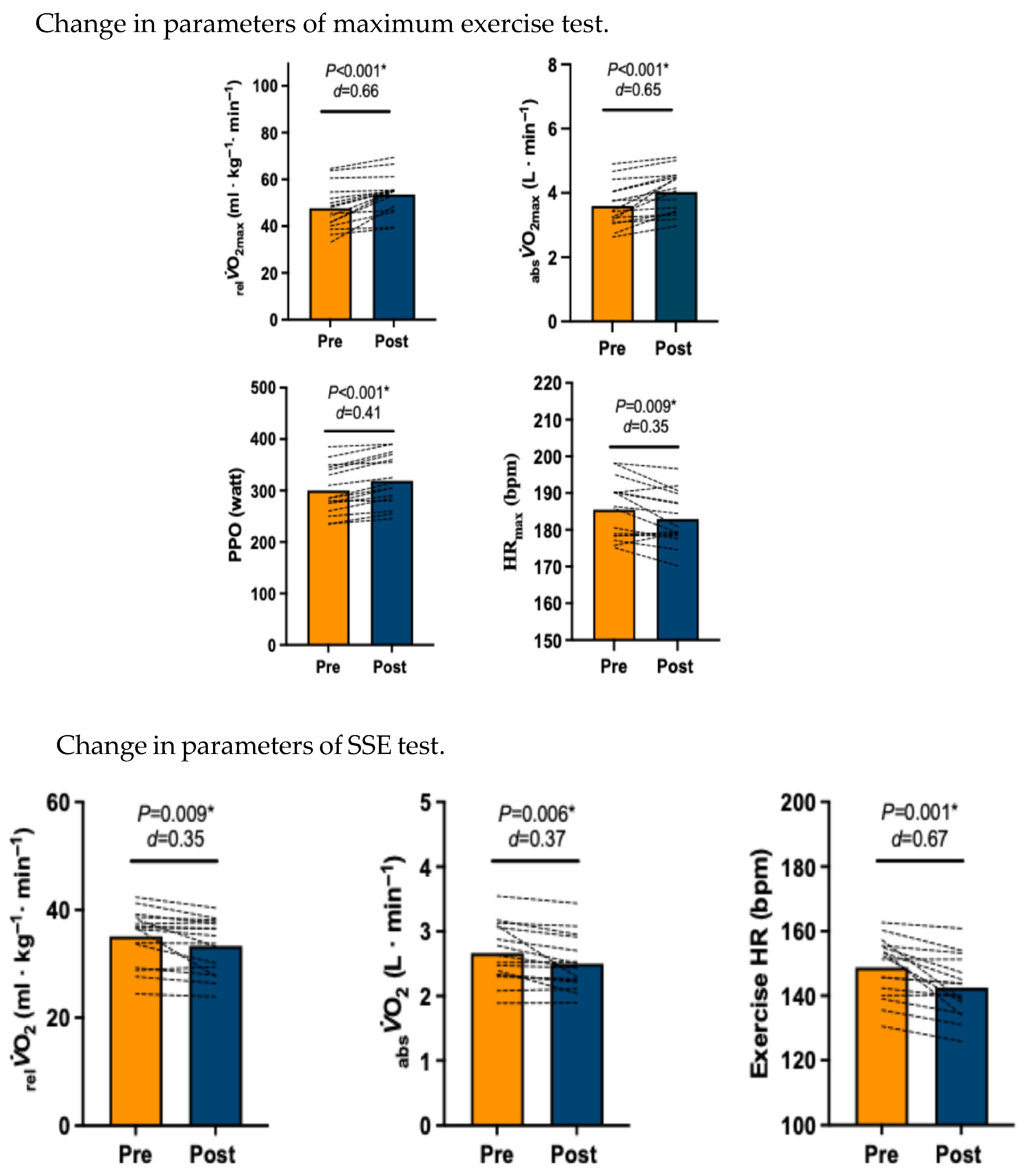
| absVO2max (L·min−1) | 3.60 ± 0.67 | 4.03 ± 0.66 | 0.65 | <0.001 * |
| relVO2max (mL·kg·min−1) | 47.69 ± 9.49 | 53.56 ± 8.29 | 0.66 | <0.001 * |
| HRmax (bpm) | 186 ± 7.92 | 183 ± 7.11 | 0.35 | 0.009 * |
| PPO (w) | 300 ± 47.1 | 320 ± 48.9 | 0.41 | <0.001 * |
| Parameter | Pre | Post | d | p Value |
|---|---|---|---|---|
| Cuff occlusion test | ||||
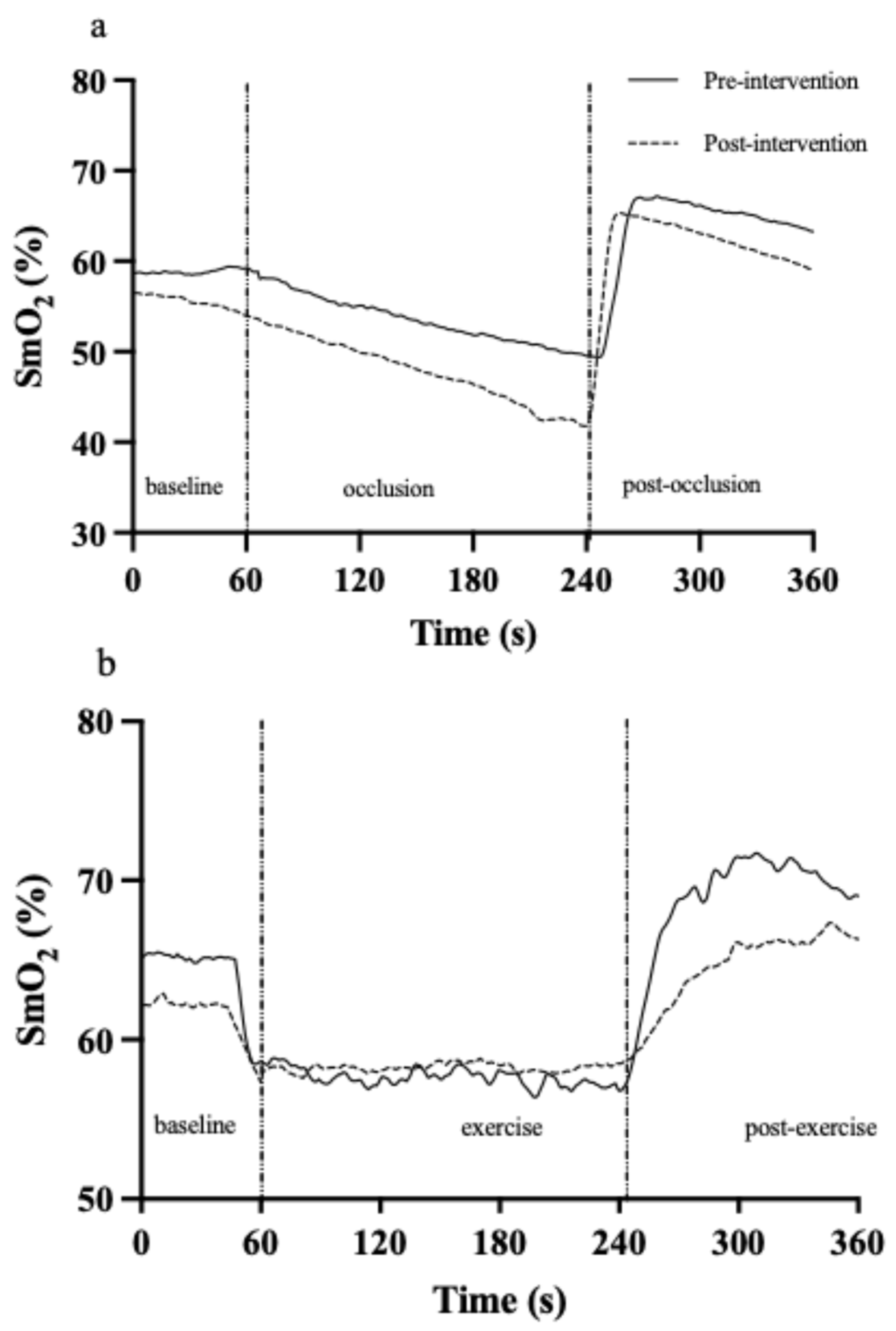
| Baseline sFBF (mL·min−1) | 66.91 ± 22.9 | 77.08 ± 30.8 | 0.33 | 0.13 |
| Baseline SmO2 (%) | 64.58 ± 7.26 | 64.61 ± 4.21 | 0.005 | 0.99 |
| SSE | ||||
| absVO2 (L·min−1) | 2.66 ± 0.46 | 2.50 ± 0.43 | 0.37 | 0.006 * |
| relVO2 (mL·kg·min−1) | 35.1 ± 5.13 | 33.3 ± 5.07 | 0.35 | 0.009 * |
| Exercise HR (bpm) | 149 ± 9.29 | 142 ± 9.25 | 0.67 | 0.001 * |
| PO (w) | 179 ± 27.7 | - | - | |
| Baseline SmO2 (%) | 68.2 ± 5.03 | 67.2 ± 5.71 | 0.02 | 0.25 |
| Pre-recovery SmO2 (%) | 60.4 ± 7.05 | 63.4 ± 6.93 | 0.43 | 0.02 * |
Disclaimer/Publisher’s Note: The statements, opinions and data contained in all publications are solely those of the individual author(s) and contributor(s) and not of MDPI and/or the editor(s). MDPI and/or the editor(s) disclaim responsibility for any injury to people or property resulting from any ideas, methods, instructions or products referred to in the content. |
© 2026 by the authors. Licensee MDPI, Basel, Switzerland. This article is an open access article distributed under the terms and conditions of the Creative Commons Attribution (CC BY) license.
Share and Cite
Lesmana, H.S.; Rodrigues, P.; Simpson, L.L.; Marume, K.; Perkins, D.R.; Lawley, J.S. Skeletal Muscle Blood Flow and NIRS Oxygenation Kinetics as a Tool to Evaluate Adaptations to High-Intensity Exercise Training. Sensors 2026, 26, 3167. https://doi.org/10.3390/s26103167
Lesmana HS, Rodrigues P, Simpson LL, Marume K, Perkins DR, Lawley JS. Skeletal Muscle Blood Flow and NIRS Oxygenation Kinetics as a Tool to Evaluate Adaptations to High-Intensity Exercise Training. Sensors. 2026; 26(10):3167. https://doi.org/10.3390/s26103167
Chicago/Turabian StyleLesmana, Heru S., Patrick Rodrigues, Lydia L. Simpson, Kyohei Marume, Dean R. Perkins, and Justin S. Lawley. 2026. "Skeletal Muscle Blood Flow and NIRS Oxygenation Kinetics as a Tool to Evaluate Adaptations to High-Intensity Exercise Training" Sensors 26, no. 10: 3167. https://doi.org/10.3390/s26103167
APA StyleLesmana, H. S., Rodrigues, P., Simpson, L. L., Marume, K., Perkins, D. R., & Lawley, J. S. (2026). Skeletal Muscle Blood Flow and NIRS Oxygenation Kinetics as a Tool to Evaluate Adaptations to High-Intensity Exercise Training. Sensors, 26(10), 3167. https://doi.org/10.3390/s26103167