A Nonlinear Error Compensation Method for Heterodyne Interferometry Based on Self-Supervised Physics-Informed Neural Networks with Frequency-Domain Priors





Highlights
- We proposed a self-supervised learning paradigm that leverages frequency-domain priors to generate high-confidence pseudo-labels for identifying nonlinear errors in heterodyne interferometric sensing systems.
- We developed a Physics-Informed Neural Network (PINN) featuring a differentiable physical layer to impose explicit hard constraints on the architecture, enabling precise identification of nonlinear physical properties against high background noise.
- The method enables high-precision calibration of nonlinear errors in heterodyne interferometric sensing systems without requiring ground-truth labels or complex hardware modifications.
- It ensures the physical consistency of identification results and enhances the robustness of the identification process against high background noise by integrating explicit physical hard constraints.
Abstract
1. Introduction
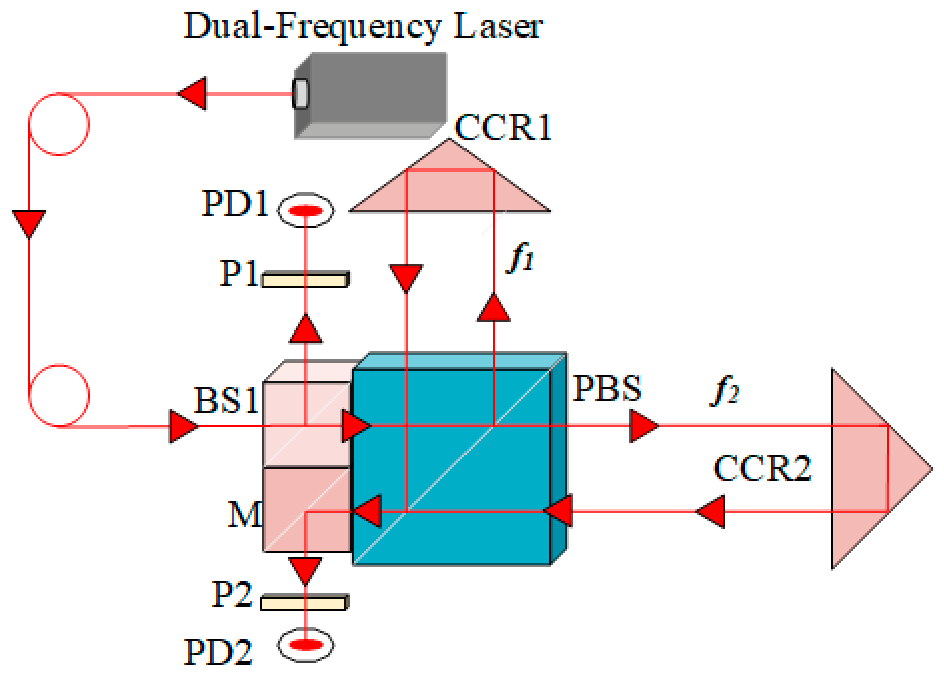
2. Nonlinear Error in Heterodyne Interferometric Sensing Systems
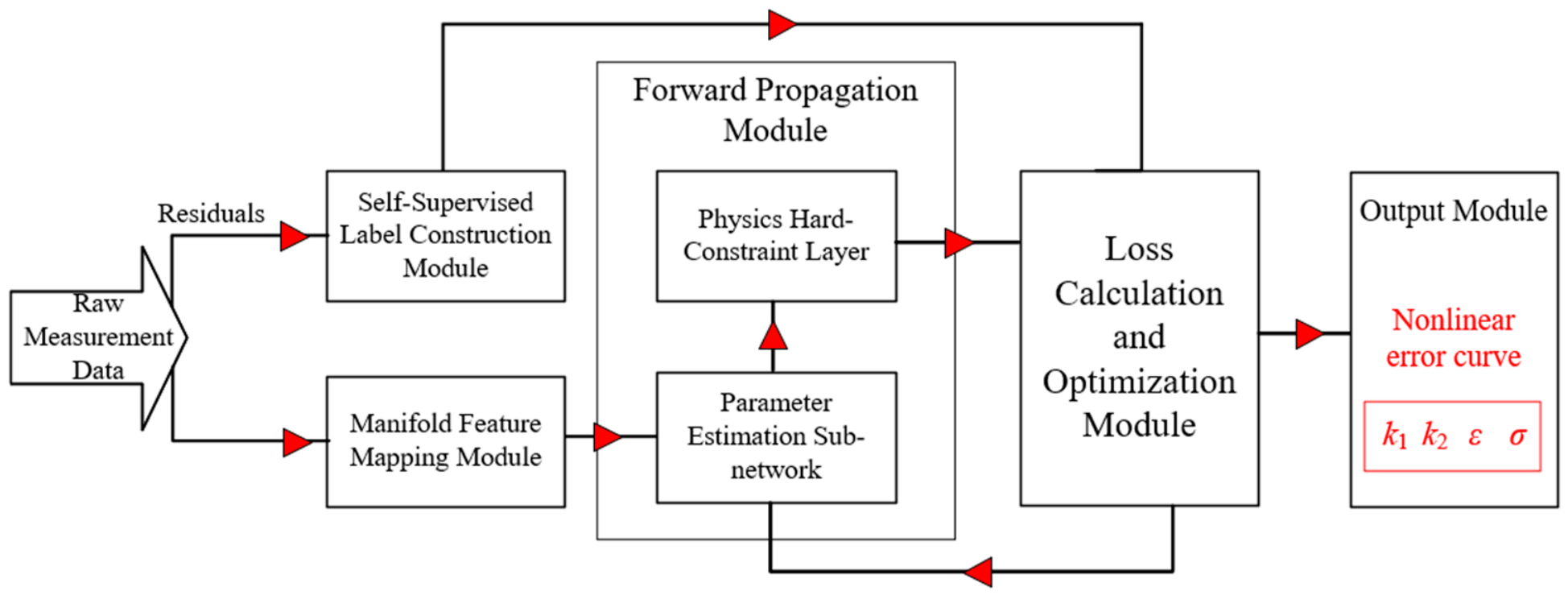
3. Physics-Informed Neural Network Compensation Method Guided by Frequency-Domain Priors
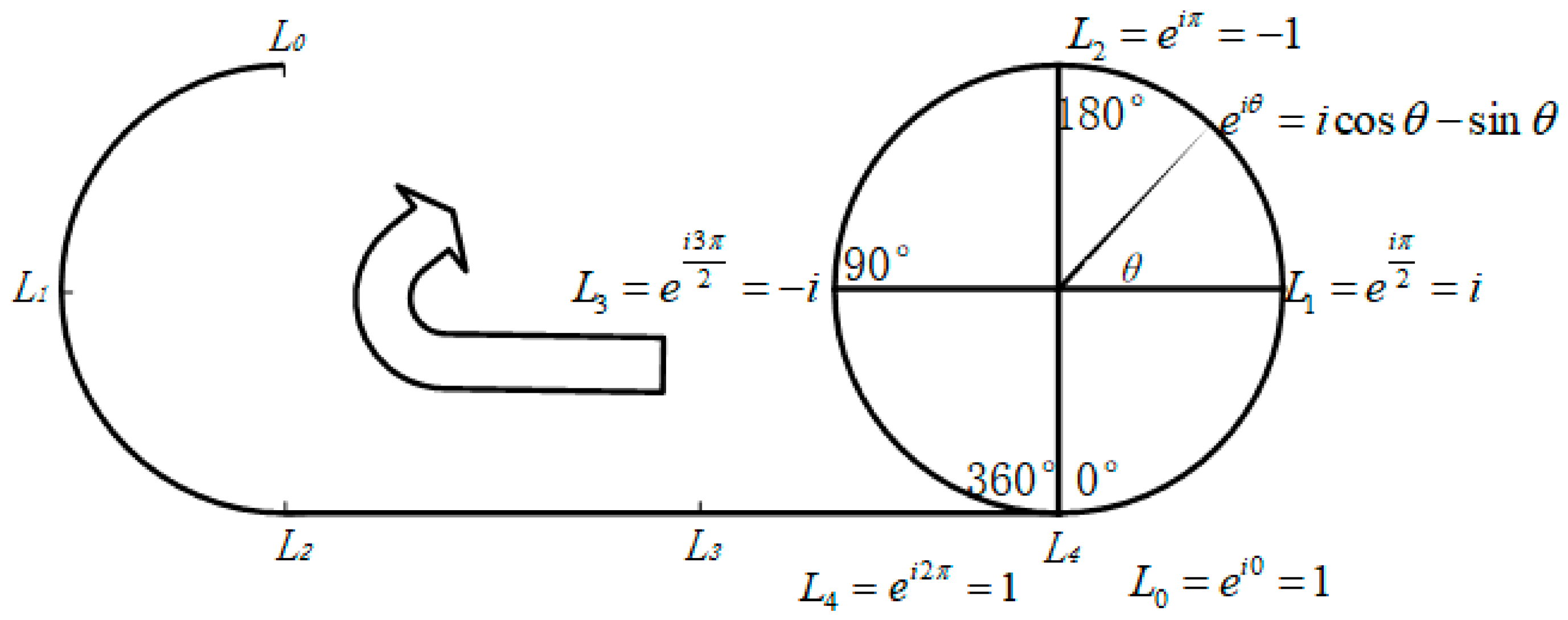
3.1. Manifold Feature Mapping for Sensing Signals
3.2. Frequency-Domain Prior Label Reconstruction Methods
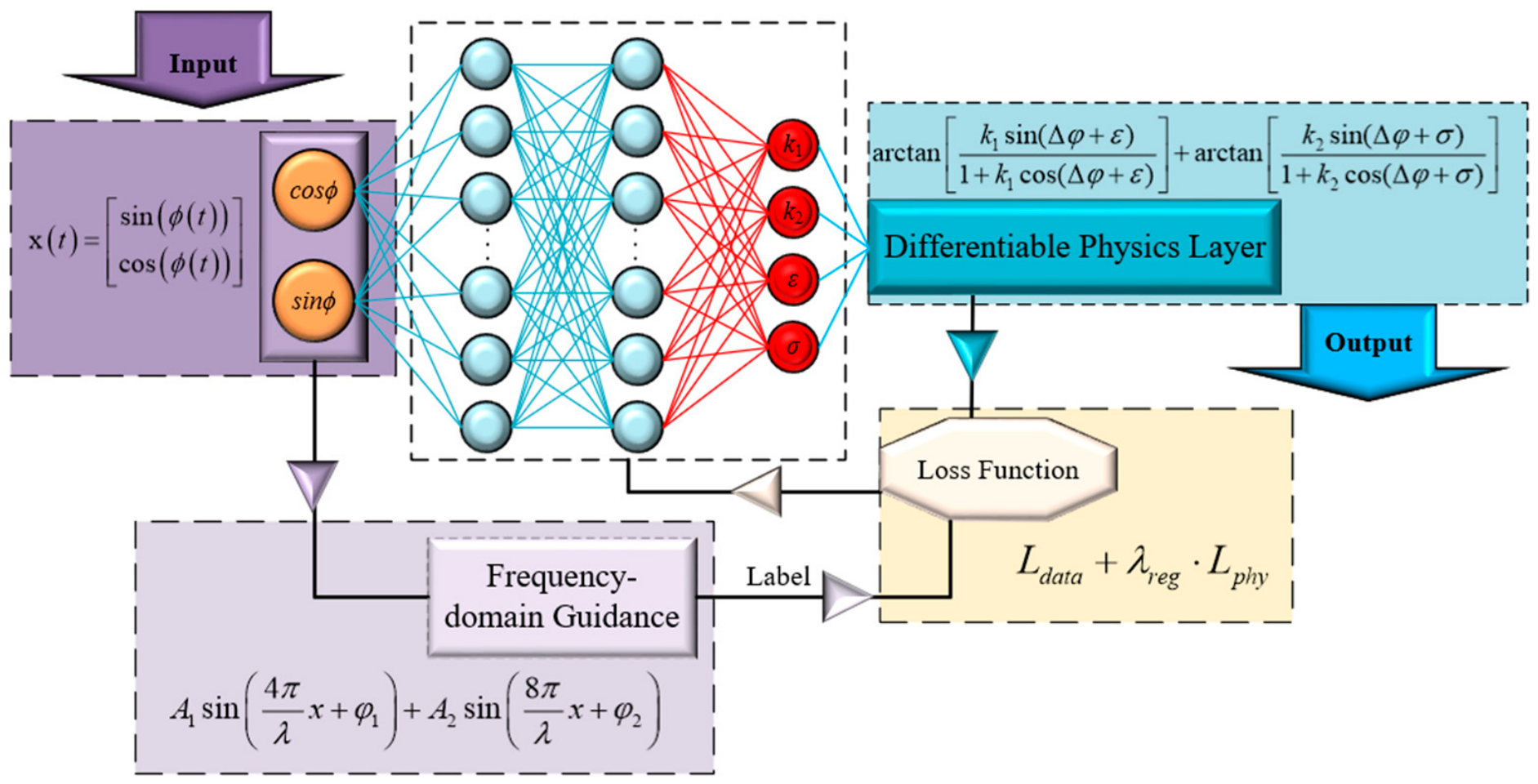
3.3. Construction of Differentiable Physical Hard Constraints and Forward Evolution Mechanism
3.4. Adaptive Loss and Optimization
4. Experiments and Analysis
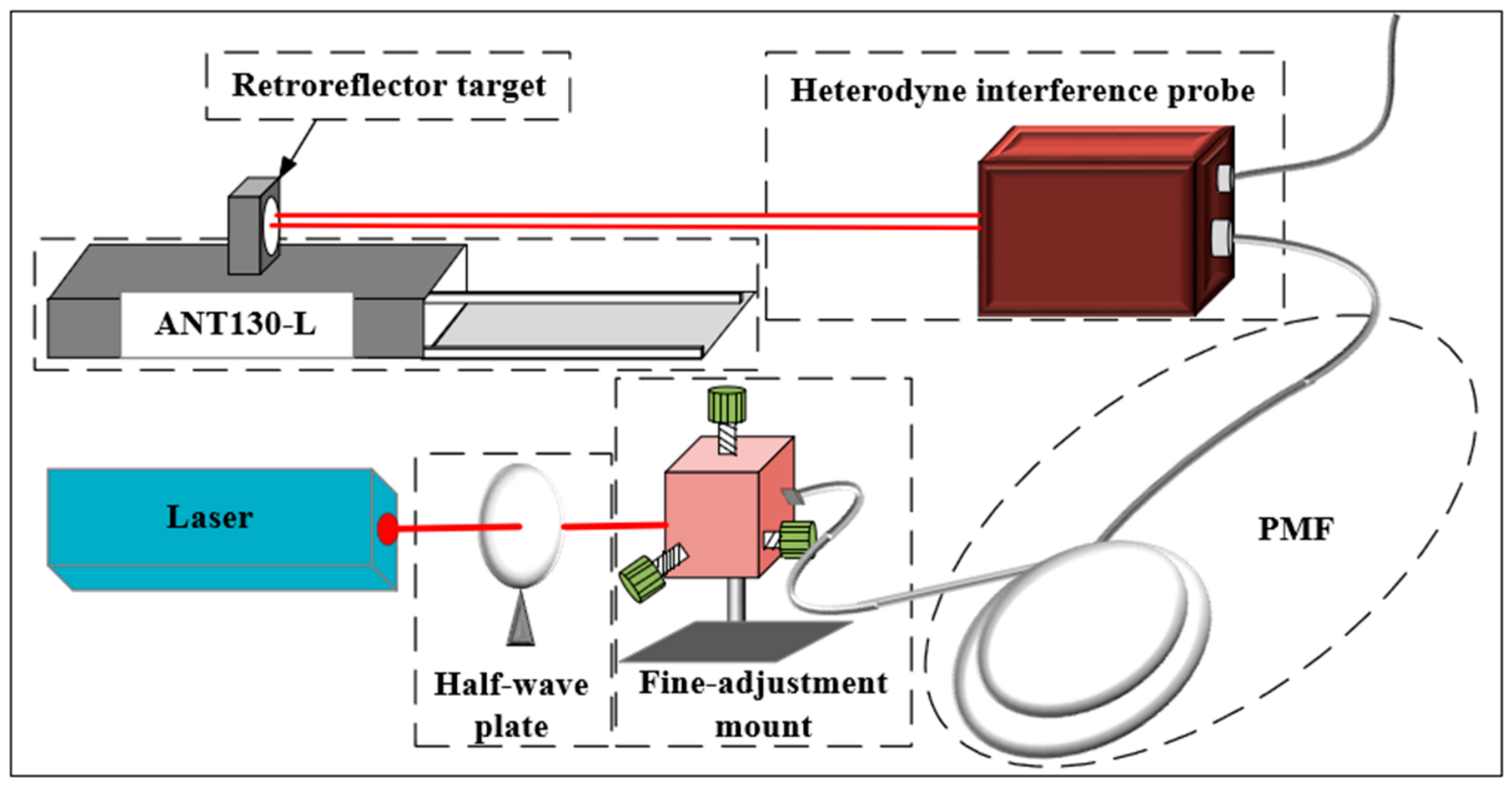
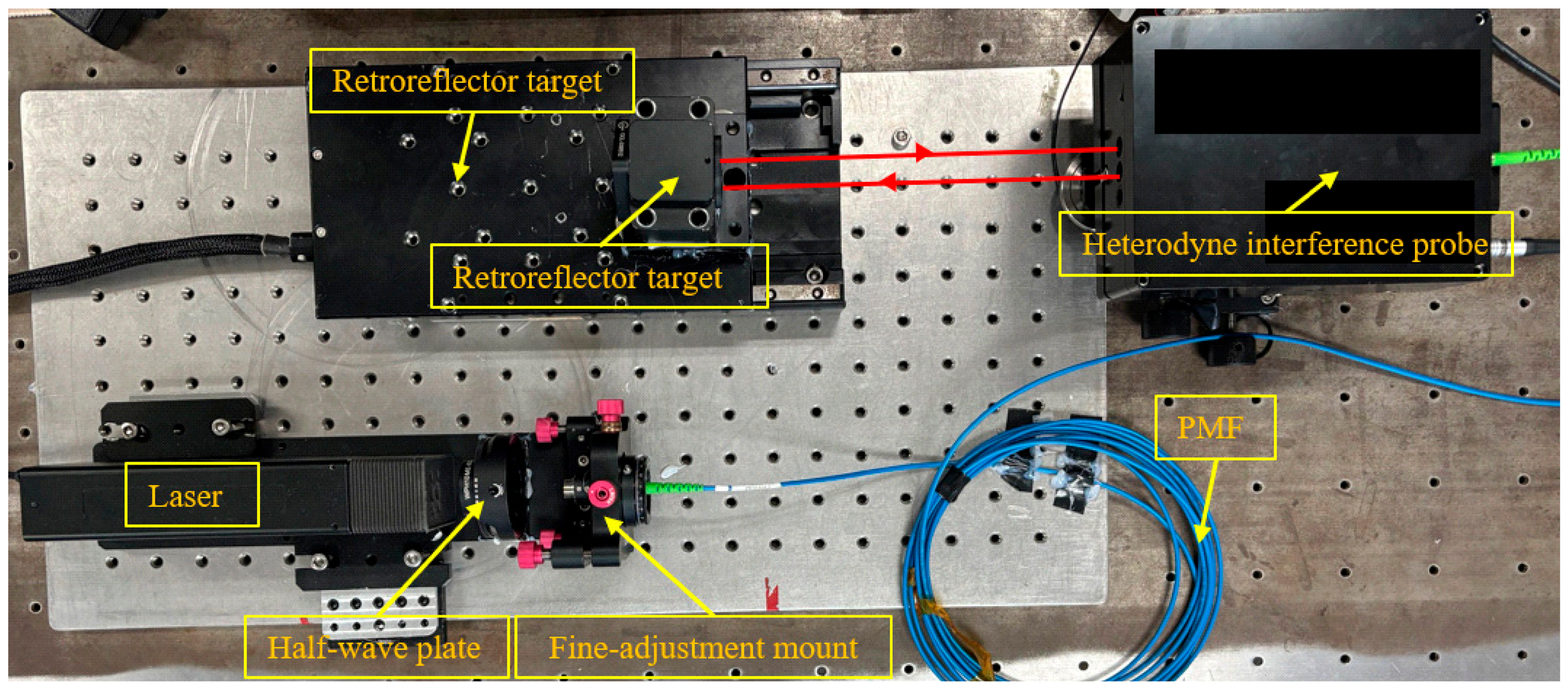
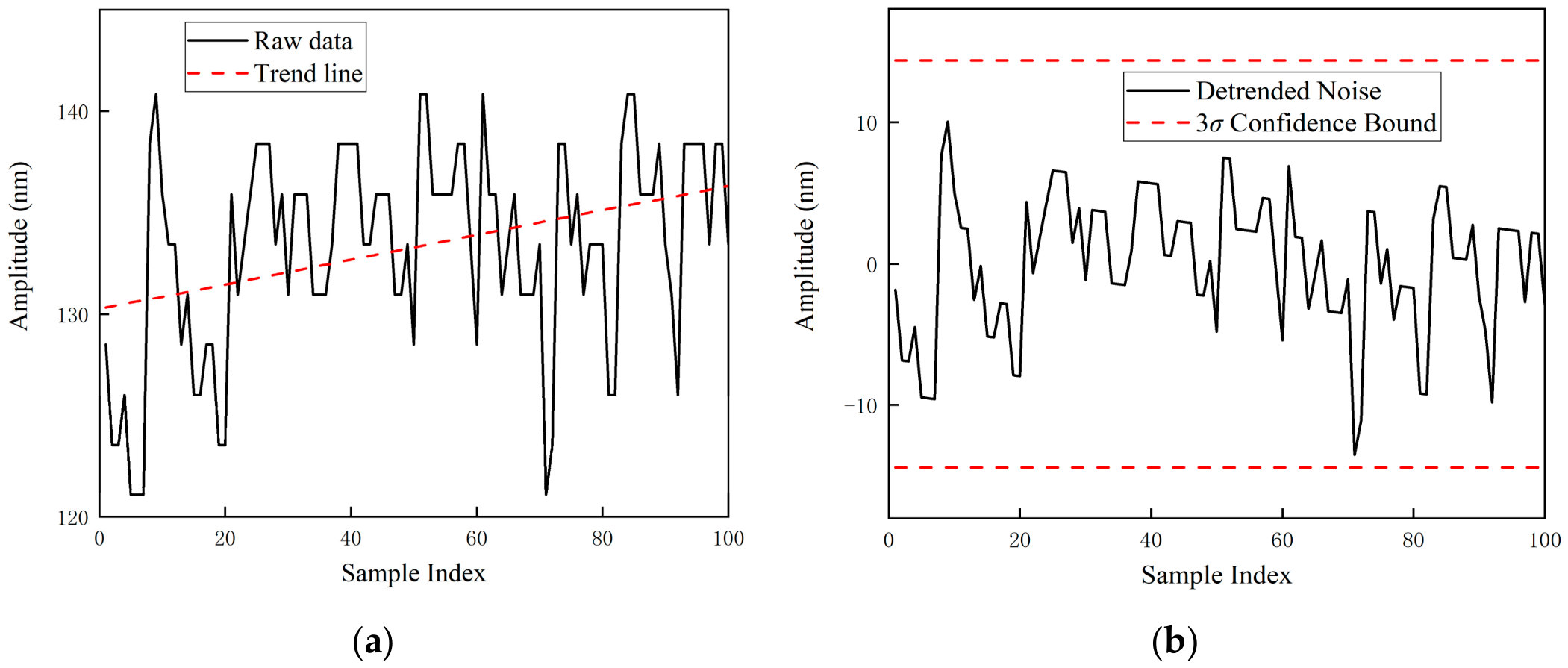
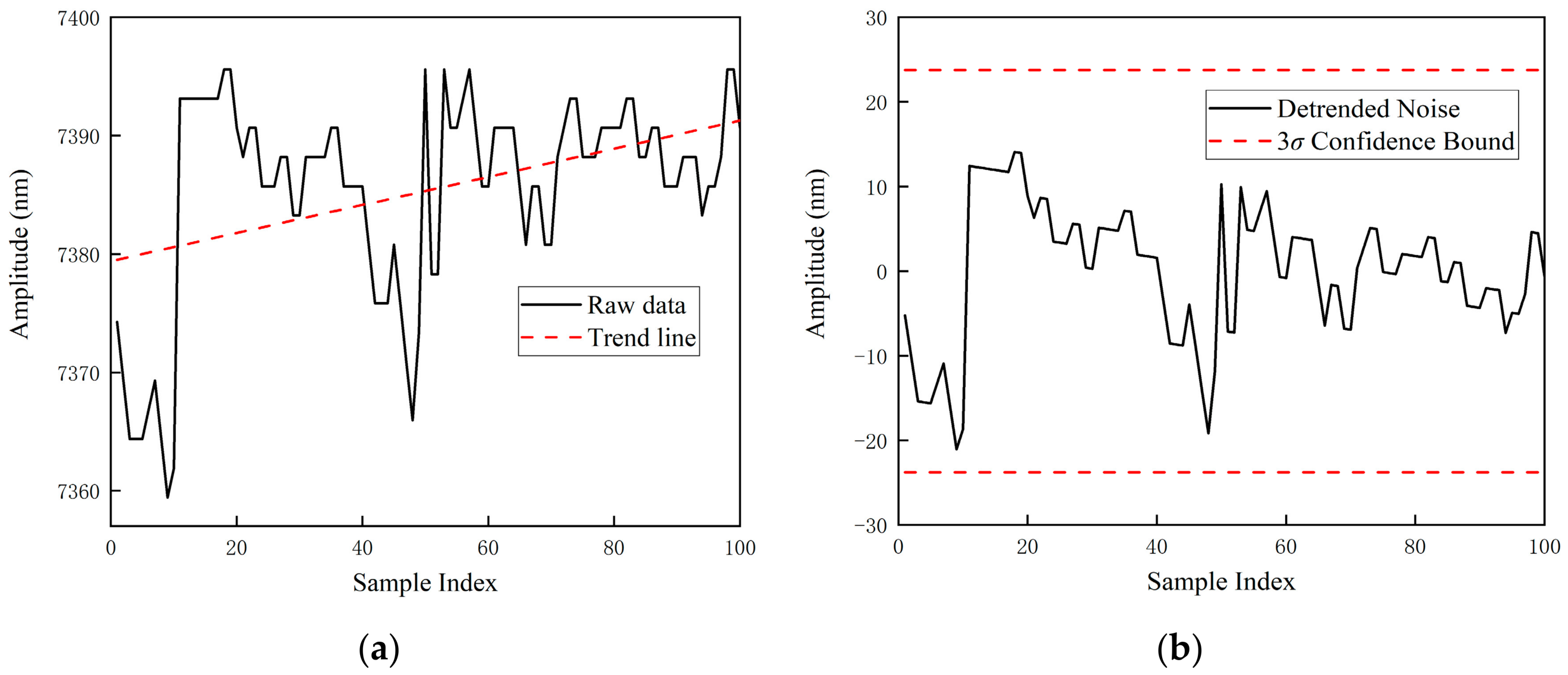
4.1. Data Acquisition and Construction of Noise Fingerprint Library
4.2. High-Fidelity Reconstruction of Heterodyne Sensing Signals Under Non-Ideal Conditions
4.3. Validation of the Effectiveness of the Physics-Driven Reconstruction Mechanism
4.3.1. Reconstruction Fidelity of Frequency-Domain Prior Pseudo-Labels Under Strong Noise Backgrounds
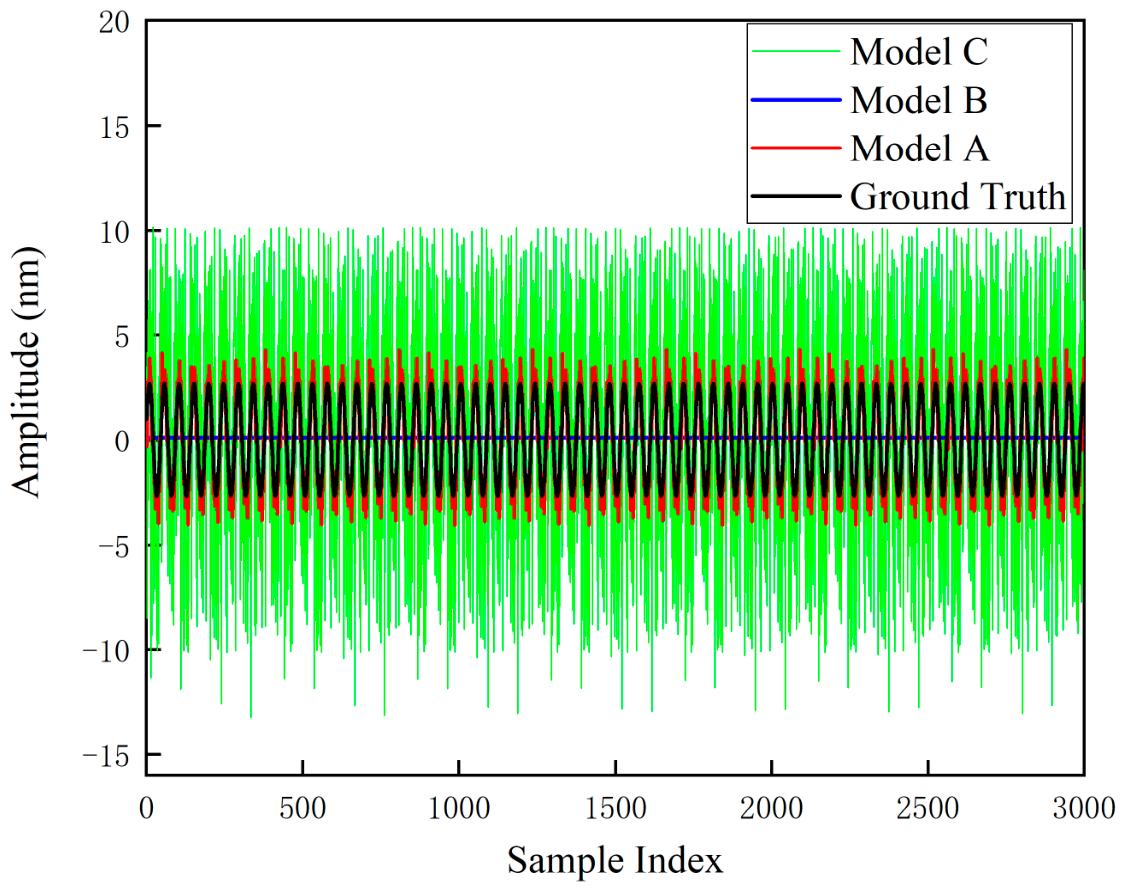
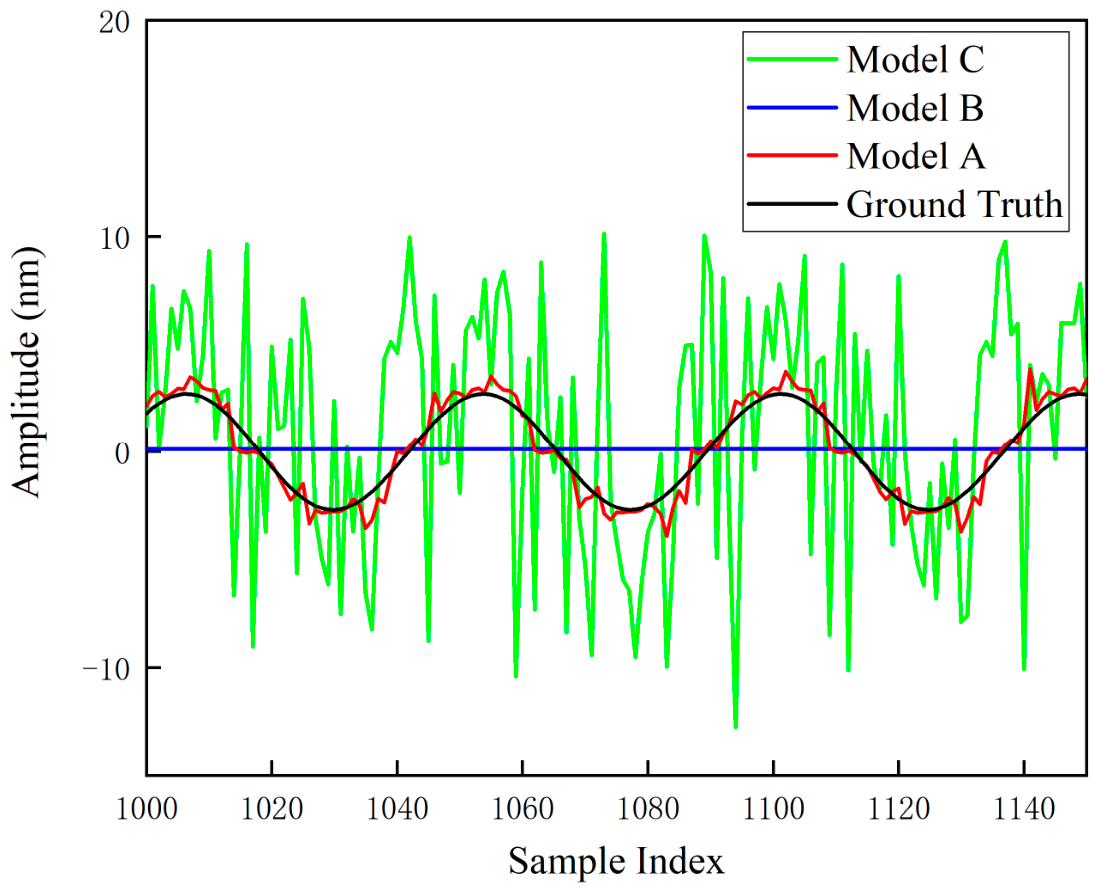
4.3.2. Nonlinear Error Waveform Reconstruction and Verification of Fitting Consistency
4.4. Comprehensive Performance Evaluation and Comparative Study of Models
4.4.1. Ablation Analysis of Key Physical Mechanisms
4.4.2. Performance Benchmarking Against Existing Mainstream Compensation Methods
5. Conclusions
Author Contributions
Funding
Data Availability Statement
Conflicts of Interest
References
- Huang, G.; Cui, C.; Lei, X.; Li, Q.; Yan, S.; Li, X.; Wang, G. A Review of Optical Interferometry for High-Precision Length Measurement. Micromachines 2025, 16, 6. [Google Scholar] [CrossRef]
- Yin, Y.; Sun, X.; Liu, Y.; Yin, S.; Zhao, J.; Mao, Z.; Wang, S.; Li, Z. High-precision 12-times optical subdivision heterodyne laser interferometer for short-distance measurement. Opt. Express 2025, 33, 51192–51204. [Google Scholar] [CrossRef]
- Wang, Y.; Li, J.; Feng, Q.; Han, S.; Wang, X.; Fu, W.; Zhou, M. Dynamic filling and prediction of environmental compensation parameters for positioning error interferometry of CNC machine tools based on a dual hybrid neural network. Opt. Express 2025, 33, 41087–41102. [Google Scholar] [CrossRef]
- Lin, C.; Zhou, S.; Shi, L.; Yang, Y.; Wu, G. Two-dimensional angle measurement with sub-arcsecond precision and MHz update rate using heterodyne interferometry with optical frequency comb. Opt. Lett. 2024, 49, 4. [Google Scholar] [CrossRef]
- Jia, P.; Zhang, B.; Feng, Q.; Zheng, F. Simultaneous Measurement of 6DOF Motion Errors of Linear Guides of CNC Machine Tools Using Different Modes. Sensors 2020, 20, 3439. [Google Scholar] [CrossRef]
- Cui, C.; Gao, L.; Zhao, P.; Yang, M.; Liu, L.; Ma, Y.; Huang, G.; Wang, S.; Luo, L.; Li, X. Towards multi-dimensional atomic-level measurement: Integrated heterodyne grating interferometer with zero dead-zone. Light Adv. Manuf. 2025, 6, 319–332. [Google Scholar] [CrossRef]
- Fu, H.; Wang, Y.; Hu, P.; Tan, J. Nonlinear Errors Resulting from Ghost Reflection and Its Coupling with Optical Mixing in Heterodyne Laser Interferometers. Sensors 2018, 18, 758. [Google Scholar] [CrossRef] [PubMed]
- Quenelle, R. Nonlinearity in interferometric measurements. Hewlett-Packard J. 1983, 34, 10. [Google Scholar]
- Bobroff, N. Residual errors in laser interferometry from air turbulence and nonlinearity. Appl. Opt. 1987, 26, 2676–2682. [Google Scholar] [CrossRef]
- Chen, P.; Hu, P.C.; Ding, X.M.; Tan, J.-B. Current ways and means for reduction or elimination of periodic nonlinearity in heterodyne interferometer. Proc. SPIE Int. Soc. Opt. Eng. 2015, 9446, 602–613. [Google Scholar] [CrossRef]
- Fu, H.; Ji, R.; Hu, P.; Wang, Y.; Wu, G.; Tan, J. Measurement Method for Nonlinearity in Heterodyne Laser Interferometers Based on Double-Channel Quadrature Demodulation. Sensors 2018, 18, 2768. [Google Scholar] [CrossRef]
- Lu, Z.; Zhang, Y.; Liang, Y.; Tan, J. Measuring the laser polarization state and PBS transmission coefficients in a heterodyne laser interferometer. IEEE Trans. Instrum. Meas. 2018, 67, 706–714. [Google Scholar] [CrossRef]
- Guo, J.; Zhang, Y.; Shen, S. Compensation of nonlinearity in a new optical heterodyne interferometer with doubled measurement resolution. Opt. Commun. 2000, 184, 49–55. [Google Scholar] [CrossRef]
- Straube, G.; Calderón, J.S.F.; Ortlepp, I.; Füßl, R.; Manske, E. A Heterodyne Interferometer with Separated Beam Paths for High-Precision Displacement and Angular Measurements. Nanomanuf. Metrol. 2021, 4, 200–207. [Google Scholar] [CrossRef]
- Lawall, J.; Kessler, E. Michelson interferometry with 10 pm accuracy. Rev. Sci. Instrum. 2000, 71, 2669–2676. [Google Scholar] [CrossRef]
- Heydemann, P.L.M. Determination and correction of quadrature fringe measurement errors in interferometers. Appl. Opt. 1981, 20, 3382–3384. [Google Scholar] [CrossRef]
- Wu, C.M.; Su, C.S. Nonlinearity in measurements of length by optical interferometry. Meas. Sci. Technol. 1996, 7, 62. [Google Scholar] [CrossRef]
- Xie, J.; Yan, L.; Chen, B.; Zhang, S. Iterative compensation of nonlinear error of heterodyne interferometer. Opt. Express 2017, 25, 4470–4482. [Google Scholar] [CrossRef] [PubMed]
- Bridges, A.; Yacoot, A.; Kissinger, T.; A Humphreys, D.; Tatam, R.P. Correction of periodic displacement non-linearities by two-wavelength interferometry. Meas. Sci. Technol. 2021, 32, 125202. [Google Scholar] [CrossRef]
- Li, Y.; Dieussaert, E. A compensation method for nonlinearity errors in optical interferometry. Sensors 2023, 23, 7942. [Google Scholar] [CrossRef] [PubMed]
- Liu, X.; Peng, W.; Zhang, X.; Zhao, X.; Zhou, W.; Yao, W.; Chen, X. Enhancing deep learning-based field reconstruction with a differentiable learning framework. Nat. Mach. Intell. 2025, 7, 1129–1140. [Google Scholar] [CrossRef]
- Rehman, A.U.; Jiao, W.; Jiang, Y.; Wei, J.; Sohaib, M.; Sun, J.; Rehman, K.U.; Chi, Y. Deep learning in industrial machinery: A critical review of bearing fault classification methods. Appl. Soft Comput. 2025, 171, 112785. [Google Scholar] [CrossRef]
- Chen, C.; Deng, Y.; Qian, J.; Ma, H.; Ma, L.; Wu, J.; Wu, H. Deep learning-based inversion framework for fractured media characterization by assimilating hydraulic tomography and thermal tracer tomography data: Numerical and field study. Eng. Geol. 2025, 350, 107998. [Google Scholar] [CrossRef]
- Zheng, S.; He, J.; Liu, C.; Shi, Y.; Lu, Z.; Feng, W.; Ju, F.; Wang, J.; Zhu, J.; Min, Y.; et al. Predicting equilibrium distributions for molecular systems with deep learning. Nat. Mach. Intell. 2024, 6, 558–567. [Google Scholar] [CrossRef]
- Meng, Z.; Guan, Z.; Yu, S.; Wu, Y.; Zhao, Y.; Shen, J.; Lim, C.C.; Chen, T.; Yang, D.; Ran, A.R.; et al. Non-invasive biopsy diagnosis of diabetic kidney disease via deep learning applied to retinal images: A population-based study. Lancet Digit. Health 2025, 7, 100868. [Google Scholar] [CrossRef] [PubMed]
- Gao, W.; Yao, W.; Wang, J.; Mou, H.; Li, Y.; Zhao, X.; Duan, J.; Zou, Y.; Yao, Y.; Xu, X. High-precision large-scale optical phased array calibration using physics-informed neural network with transfer learning. J. Light. Technol. 2025, 43, 10203–10209. [Google Scholar] [CrossRef]
- Zhang, L.; Shi, Z.; Cheng, M.M.; Liu, Y.; Bian, J.-W.; Zhou, J.T.; Zheng, G.; Zeng, Z. Nonlinear regression via deep negative correlation learning. IEEE Trans. Pattern Anal. Mach. Intell. 2019, 43, 982–998, Correction in IEEE Trans. Pattern Anal. Mach. Intell. 2021, 43, 2172. https://doi.org/10.1109/TPAMI.2021.3071929. [Google Scholar] [CrossRef]
- Bolibar, J.; Rabatel, A.; Gouttevin, I.; Zekollari, H.; Galiez, C. Nonlinear sensitivity of glacier mass balance to future climate change unveiled by deep learning. Nat. Commun. 2022, 13, 409. [Google Scholar] [CrossRef]
- Li, H.; Ren, T.; Zhao, C. A physics-informed neural network for non-linear laser absorption tomography. J. Quant. Spectrosc. Radiat. Transf. 2025, 330, 109229. [Google Scholar] [CrossRef]
- Gao, S.; Li, Z.; Brand, U. Neural Network Approach for Modelling and Compensation of Local Surface-Tilting-Dependent Topography Measurement Errors in Coherence Scanning Interferometry. Metrology 2024, 4, 27. [Google Scholar] [CrossRef]
- Heo, G.H.; Lee, W.R.; You, K.H. Adaptive Error Compensation of Heterodyne Laser Interferometer using DFNN. Trans. Korean Inst. Electr. Eng. 2008, 57, 1042–1047. [Google Scholar]
- Olyaee, S.; Ebrahimpour, R.; Hamedi, S. Modeling and compensation of periodic nonlinearity in two-mode interferometer using neural networks. IETE J. Res. 2010, 56, 102–110. [Google Scholar] [CrossRef]
- Hou, W.; Zhang, Y.; Le, Y.; Ju, A. Elimination of the Nonlinearity of Heterodyne Displacement Interferometers. Chin. J. Lasers 2012, 39, 908006. [Google Scholar] [CrossRef]
- Wu, C.M.; Deslattes, R.D. Analytical modeling of the periodic nonlinearity in heterodyne interferometry. Appl. Opt. 1998, 37, 6696–6700. [Google Scholar] [CrossRef]



| Input SNR (dB) | Pearson Correlation Coefficient | Original Nonlinear Error RMS (nm) | Compensated Nonlinear Error RMS (nm) | Error Compensation Rate (%) | |
|---|---|---|---|---|---|
| 10 mm | −8.09 | 0.9939 | 1.9 | 0.23 | 88.13% |
| 100 mm | −12.29 | 0.9817 | 1.9 | 0.37 | 80.32% |
| Model | RMSE (nm) | Pearson Correlation Coefficient |
|---|---|---|
| Model A | 0.62 | 0.97 |
| Model B | 1.91 | 0.00 |
| Model C | 5.94 | 0.43 |
| Method | Accuracy (nm) | Hardware Requirements | Ground Truth Label Dependency | Noise Robustness | In Situ Applicability |
|---|---|---|---|---|---|
| SGNN [32] | 7.80 × 10⁻³ | N/A | Yes | Low | No |
| Iterative DPLL [18] | 0.80 | Moderate | N/A | Moderate | Yes |
| DFNN [31] | ≈1.00 | High | Yes | Low | No |
| Proposed PINN | 0.23 | Low | No | High | Yes |
Disclaimer/Publisher’s Note: The statements, opinions and data contained in all publications are solely those of the individual author(s) and contributor(s) and not of MDPI and/or the editor(s). MDPI and/or the editor(s) disclaim responsibility for any injury to people or property resulting from any ideas, methods, instructions or products referred to in the content. |
© 2026 by the authors. Licensee MDPI, Basel, Switzerland. This article is an open access article distributed under the terms and conditions of the Creative Commons Attribution (CC BY) license.
Share and Cite
Wang, Y.; Sun, H.; Li, J.; Ma, C.; Zhang, Y.; Wang, X.; Feng, Q. A Nonlinear Error Compensation Method for Heterodyne Interferometry Based on Self-Supervised Physics-Informed Neural Networks with Frequency-Domain Priors. Sensors 2026, 26, 3000. https://doi.org/10.3390/s26103000
Wang Y, Sun H, Li J, Ma C, Zhang Y, Wang X, Feng Q. A Nonlinear Error Compensation Method for Heterodyne Interferometry Based on Self-Supervised Physics-Informed Neural Networks with Frequency-Domain Priors. Sensors. 2026; 26(10):3000. https://doi.org/10.3390/s26103000
Chicago/Turabian StyleWang, Yao, Hongyu Sun, Jiakun Li, Chenlong Ma, Ying Zhang, Xiao Wang, and Qibo Feng. 2026. "A Nonlinear Error Compensation Method for Heterodyne Interferometry Based on Self-Supervised Physics-Informed Neural Networks with Frequency-Domain Priors" Sensors 26, no. 10: 3000. https://doi.org/10.3390/s26103000
APA StyleWang, Y., Sun, H., Li, J., Ma, C., Zhang, Y., Wang, X., & Feng, Q. (2026). A Nonlinear Error Compensation Method for Heterodyne Interferometry Based on Self-Supervised Physics-Informed Neural Networks with Frequency-Domain Priors. Sensors, 26(10), 3000. https://doi.org/10.3390/s26103000