1. Introduction
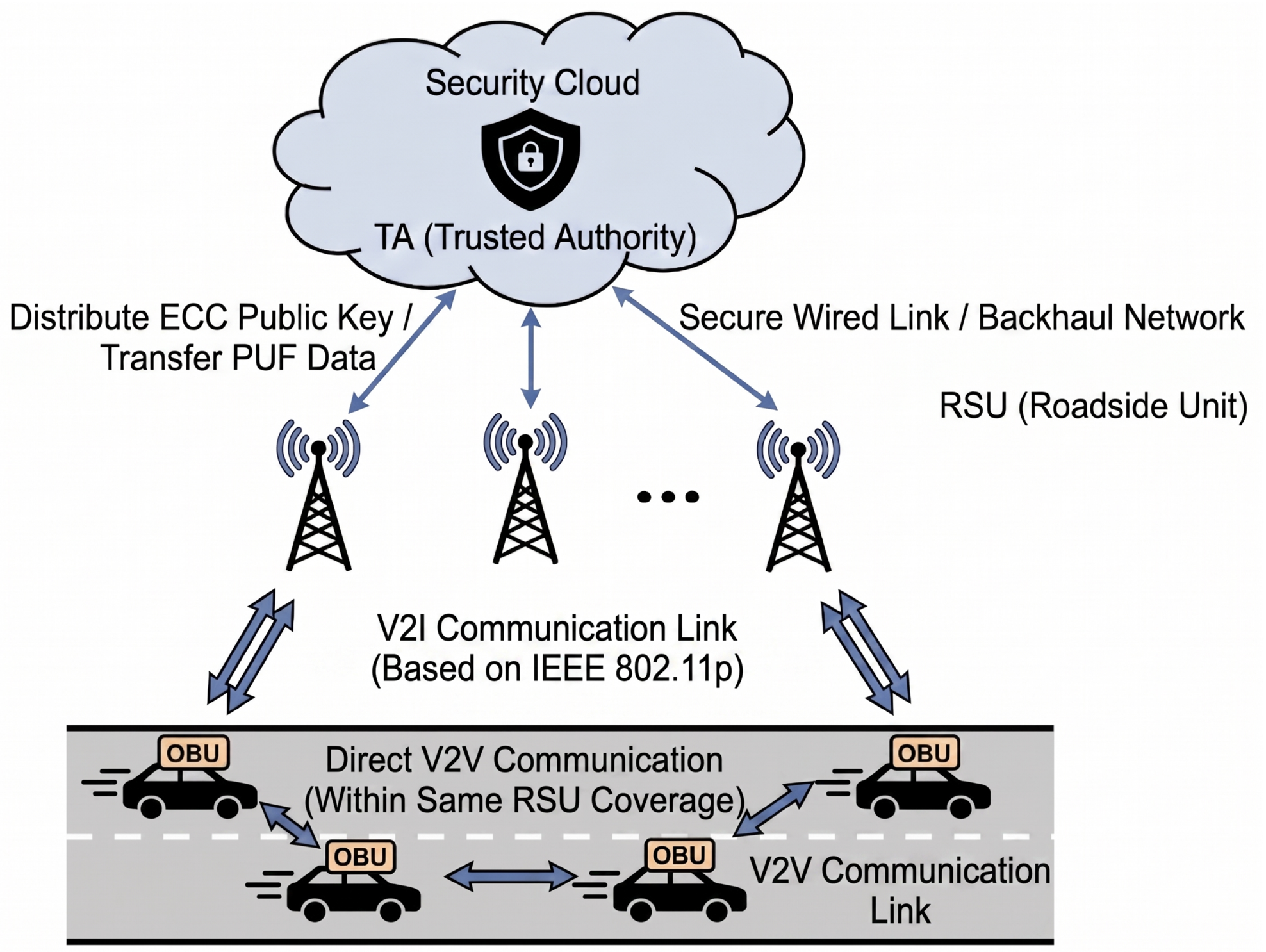
The profound integration of ITSs and autonomous driving technologies has established VANETs as the cornerstone of modern V2X communication [
1]. In complex V2X interaction scenarios, network nodes exhibit significant performance heterogeneity: while autonomous vehicles are typically equipped with high-performance computing units capable of robust data processing, many Roadside Units (RSUs) and sensing nodes, such as smart traffic lights, remain resource-constrained due to deployment costs and power budgets [
2,
3]. This vast asymmetry in processing power renders traditional, heavyweight cryptographic suites impractical for high-stakes traffic environments where balancing low latency with lightweight execution is paramount.
In open wireless environments, identity authentication protocols serve as the primary defense in terms of securing communication [
4]. Recently, the PUF has emerged as a promising hardware security primitive. By leveraging inherent random physical variations during silicon manufacturing to generate unique, unclonable “digital fingerprints”, PUFs provide an ideal security foundation for heterogeneous devices [
5]. PUFs are generally classified into two types: Weak PUFs are primarily used for key generation and include the RO PUF [
6], with uniqueness improved via Look-Up Table (LUT) self-comparison; lightweight RO PUFs [
7] based on XOR gates; the area-efficient Loop PUF [
8]; and the Transient Effect Ring Oscillator (TERO) PUF [
9], which requires complex calibration. Conversely, strong PUFs are better suited for authentication, with examples including the 4:1 MUX APUF [
10] architecture that leverages LUT6 primitives for high hardware utilization.
Despite these advancements, existing protocols [
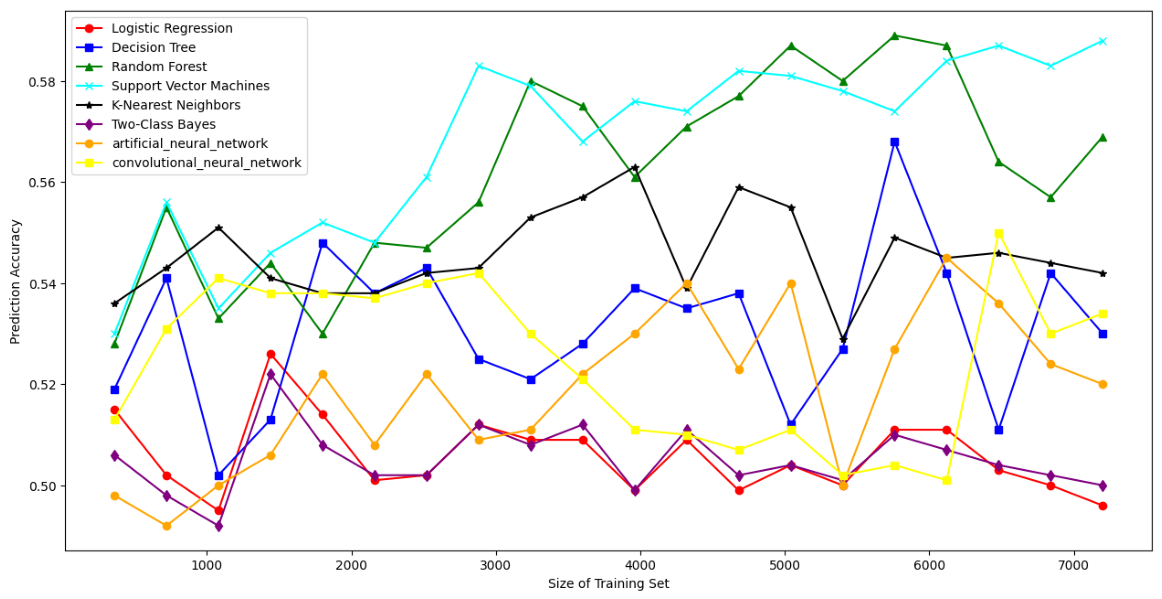
11] remain vulnerable to evolving adversarial tactics. Research indicates that storing CRPs in plaintext format within databases makes systems susceptible to physical capture attacks. More alarmingly, ML and DL attacks can now predict strong PUF responses with high precision. While the Dependency Chain mechanism (DC-PUF) [
12] limits CNN modeling accuracy to approximately 58%, its reliability degrades significantly over successive authentication rounds. Furthermore, traditional schemes struggle with Ephemeral Secret Leakage (ESL) and quantum threats like Shor’s algorithm. For instance, while the ECC-based protocol [
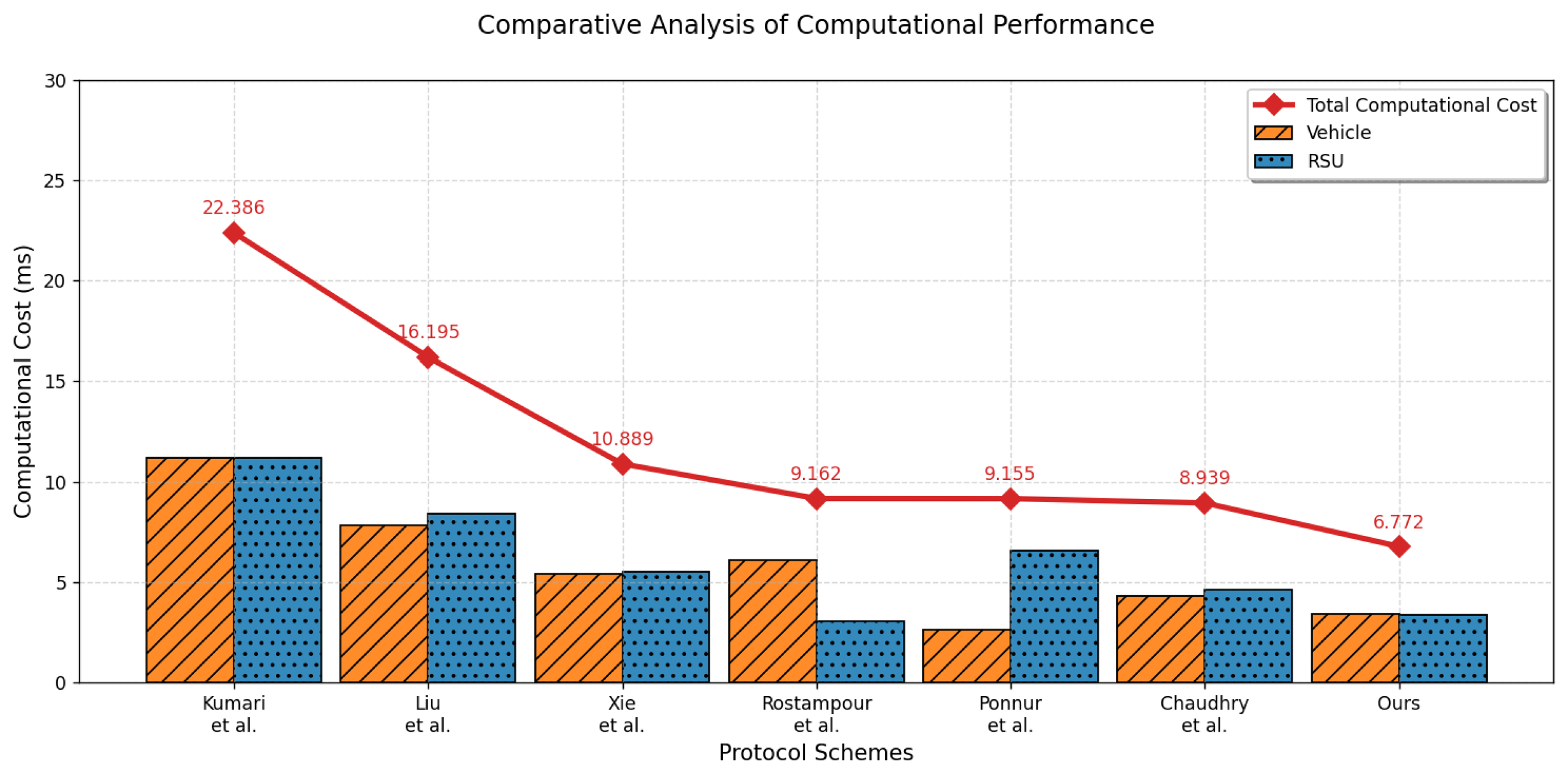
13] optimizes the total computational cost to 8.891 ms, it lacks targeted defense against modeling attacks. Similarly, the authors of [
14] attempted to combine the PUF and ECC to enhance anonymity, but with 24.678 ms latency, the proposed approach remains redundant for dynamic V2X environments. Even the recently proposed EA2S2KA scheme [
15] faces challenges in maintaining robustness under extreme environmental conditions.
To address these limitations, our paper proposes a decentralized anonymous authentication protocol based on the Self-adaption Deviation Locking PUF (SDL PUF) [
16]. By utilizing the deviation locking mechanism of Self-Timed Rings (STRs), the SDL PUF achieves a zero bit-error rate across a wide temperature range of 0∼80 °C, providing exceptional environmental robustness [
16]. The primary contributions of this work are summarized as follows:
We propose a decentralized V2X authentication protocol leveraging the SDL PUF. By restricting the Trusted Authority (TA) to the registration phase, the architecture eliminates single-point bottlenecks, while the SDL PUF ensures a zero bit-error rate across wide temperature and voltage ranges.
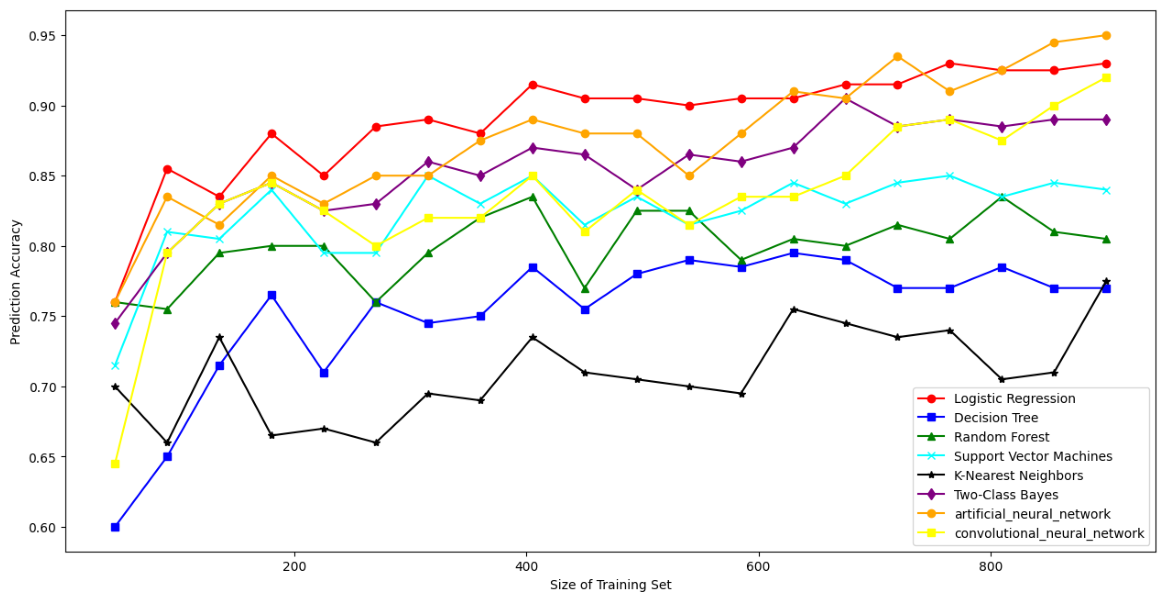
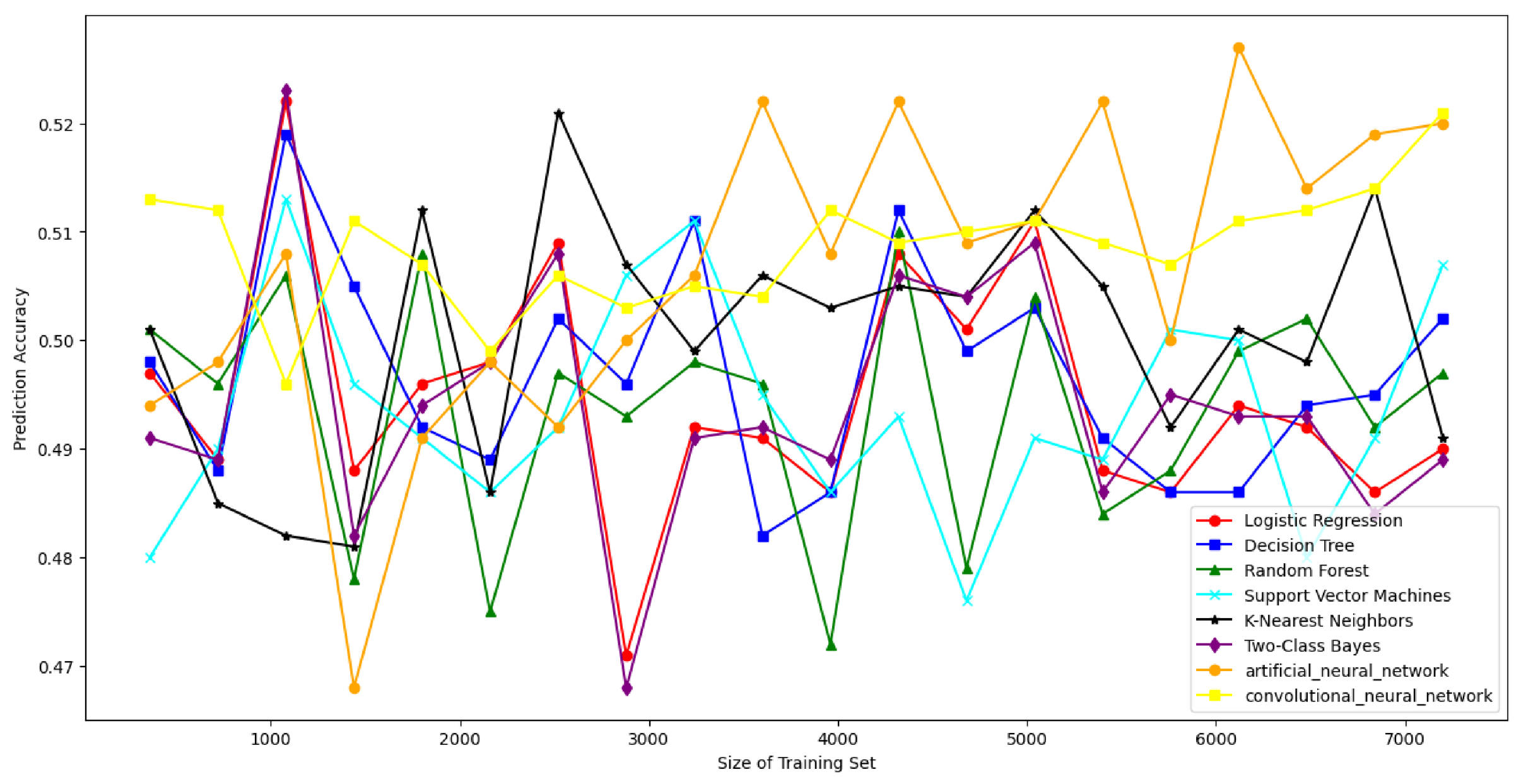
We design the DRO-Obfuscate algorithm, combining ECC and the SDL PUF to enable non-linear dynamic updates of Challenge–Response Pairs (CRPs). This synergism disrupts CRP logical correlation, reducing machine learning and deep learning prediction accuracy by approximately 35% compared to conventional schemes.
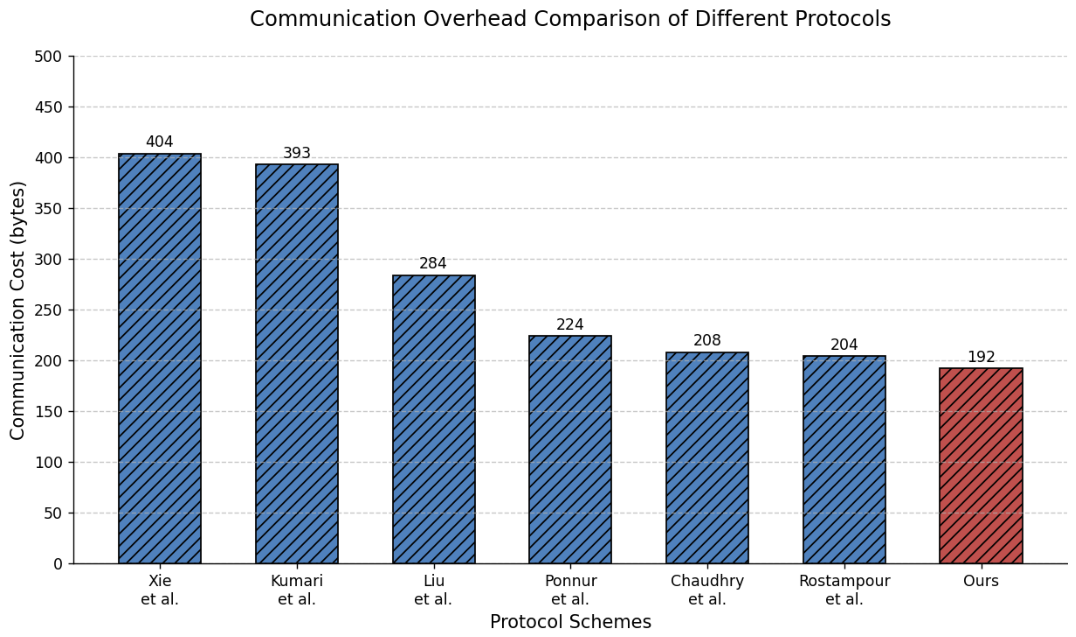
We rigorously verify the protocol’s security under the ROR model and AVISPA tool, confirming its resilience against impersonation, replay, and ephemeral secret leakage. Performance evaluations demonstrate a low single-entity computational cost of 6.77 ms and communication overhead reductions of 23.85% and 72.57% against the models proposed in [
13] and [
14] respectively, achieving superior environmental robustness compared to the model proposed in [
15].
2. Related Works
The quest for enhanced privacy in VANETs began with Public Key Infrastructure (PKI). In 2007, Raya et al. [
17] proposed an aggregate signature scheme based on PKI to strengthen system anonymity, followed by Lu et al. [
18] in 2008, who designed an anonymous PKI-based identity protection framework. However, these early paradigms were plagued by the prohibitive overhead of certificate management. To mitigate this, Zhang et al. [
19] introduced an identity-based conditional privacy scheme. Seeking further performance optimization, Das et al. [
20] explored a dual-factor authentication mechanism combining passwords and smart cards, yet Nyang et al. [
21] later demonstrated its vulnerability to offline guessing attacks. Collectively, while these foundational works [
17,
18,
19,
20,
21] established basic security requirements, their reliance on computationally intensive primitives—such as bilinear pairings or RSA—renders them ill-suited for resource-constrained On-Board Units (OBUs). Furthermore, they remain susceptible to single points of failure at the TA and physical exposure of stored cryptographic keys.
To address the inherent risks of physical key storage, PUFs have emerged as a promising hardware security primitive for VANETs. Guajardo et al. [
22] pioneered the use of SRAM PUFs in FPGA environments for privacy protection, though their approach overlooks PUF reliability under environmental noise and lacks robustness against modeling attacks. In 2010, Sadeghi et al. [
23] utilized bilinear pairings to protect PUF CRPs against ML modeling; however, this came at a staggering computational cost and failed to resolve the underlying reliability issues. In 2012, reliability was addressed by Van Herrewege et al. [
24] through a Reverse Fuzzy Extractor, but this introduced susceptibility to replay and ML modeling attacks. Similarly, Rostami et al. [
25] improved efficiency by discarding fuzzy extractors in favor of random response subsets, yet challenges regarding robustness and scalability persisted. In summary, these early PUF integrations [
22,
23,
24,
25] were hindered by the storage burden of massive CRP databases, susceptibility to noise, and a lack of ECC integration.
Subsequent research sought to overcome standalone PUF limitations by integrating ECC. In 2015, He et al. [
26] optimized batch verification latency in ECC-based VANETs, though they did not focus on the intrinsic properties of the PUF itself. In 2016, Yu et al. [
27] combined ECC with locking techniques to enhance ML resistance, yet once again bypassed the issue of PUF reliability. In 2019, while Gope et al. [
28] avoided explicit CRP storage, their architecture remained vulnerable to insider threats. In the same vein, Yanambaka et al. [
29] and Long et al. [
30] relied on plaintext CRP transmissions, which are easily exploited by ML modeling. Although Chen et al. [
31] improved security by encrypting CRPs via ECC, the resulting latency and the absence of a parameter update mechanism limited their model’s practical deployment. Furthermore, despite efficiency gains, these schemes [
26,
27,
28,
29,
30,
31] generally fail to defend against ESL attacks and remain tethered to a centralized TA for key generation.
To eliminate this TA dependency, Sutrala et al. [
32] incorporated biometrics for mutual authentication, though at the cost of high design complexity. In 2022, Chaudhry et al. [
33] developed a lightweight ECC protocol that, while resilient to common attacks, lacked dynamic parameter updates. In 2023, Xie et al. [
34] and Wei et al. [
35] leveraged smart contracts for TA-free Authentication and Key Agreement (AKA), albeit with heavy computational overhead. Liang et al. [
36] proposed a TA-free PUF-ECC protocol, but the use of fixed pseudonyms introduced location-tracking risks. In 2024, Rostampour et al. [
37] and Kumari et al. [
38] proposed privacy-enhanced and lightweight authentication schemes for smart grids, but the proposed schemed do not address PUF reliability or resistance to modeling attacks in VANETs. While Reddy et al. [
39] and Liu et al. (2025) [
40] proposed decentralized protocols with partial physical resilience, the proposed approaches remain unable to safeguard sensitive parameters in the event of total key leakage. Thus, despite the shift toward decentralization [
32,
33,
34,
35,
36,
37,
38,
39,
40], the trade-off between computational and communication overhead and the balance between privacy and traceability remain unresolved.
Recent literature has delved deeper into hardware-rooted security. Li et al. [
41] deployed PUFs on both vehicles and RSUs to eliminate long-term key storage, while Men et al. [
42] introduced real-time CRP generation. However, these approaches are hindered by TA involvement and a lack of scalability. In 2025, Li et al. [
43] utilized SSL PUFs to improve reliability, but their scheme—along with those proposed in [
41,
42,
43]—remains susceptible to ML modeling. Ponnuru et al. [
44] achieved stronger protection by fusing blockchain, ECC, and PUFs, yet the time complexity remains a barrier for real-time V2X applications. Shang et al. [
13] proposed an ECC protocol resilient to insider and ESL attacks, but the absence of PUF-based hardware security leaves it vulnerable to algorithm-specific ML modeling and quantum threats. Wang et al. [
14] achieved a terminal latency of 2.45 ms through computation offloading; however, the massive communication overhead restricts the model’s use in bandwidth-sensitive scenarios. Finally, in 2026, Li et al. [
15] presented the EA2S2KA scheme, which achieves optimal computational costs but does not consider the reliability of the PUF and its resistance to modeling attacks.
In conclusion, existing solutions have yet to achieve seamless integration of high-reliability PUFs, lightweight ECC, and robust resistance against both ML modeling attacks and various internal attacks, including ESL and insider threats. The emergence of the SDL PUF [
16] provides a novel trajectory for the synergistic optimization of security, efficiency, and hardware-rooted trust, serving as the primary motivation for this research.
Motivation
This paper enhances the PUF-based authentication protocols proposed by Men et al. [
42], focusing on reducing computational and storage overhead while achieving several key security goals. These include mutual authentication to prevent impersonation attacks, session key establishment to ensure the confidentiality of communications, and forward and backward secrecy to protect past and future session keys from being exposed. The protocol is designed to resist modeling attacks leveraging ML/DL while ensuring anonymity and unlinkability to protect vehicle identities and driver privacy. Additionally, the scheme is robust against common attacks such as replay, impersonation, MITM, and DoS attacks [
45], ensuring security in open vehicular networks. The protocol also emphasizes lightweight efficiency, making it suitable for resource-constrained OBUs [
2] and RSUs [
46], supporting large-scale deployment in VANETs.
5. The Proposed Protocol Suite
Table 1 lists the notation used in the protocol. This work uses random numbers and hash functions, adds a challenge/response mechanism to RSUs and vehicles, and develops a TA-free authentication and key agreement protocol for the Internet of V2X [
56]. The protocol uses identity-based credentials and dynamic challenges to implement five core phases.
5.1. Vehicle Registration Phase
As shown in
Table 2, each vehicle (
) registers with the TA before joining the system. A secure channel is assumed between
and the TA during registration. Let
P be the base point of an elliptic curve group of prime order
n.
(1) Vehicle → TA: chooses an SDL PUF challenge () and sends its identifier () and to the TA over a secure channel.
(2) TA processing and response: Upon receiving , the TA verifies , samples a random nonce (), selects a TA-specific challenge (), derives a TA of the SDL PUF response key (), and computes the public token (). The TA returns to via the secure channel.
(3) Vehicle sealing of helper data: evaluates its SDL PUF to obtain and splits it as . It then computes ,.
Finally, securely stores as local helper data and publishes on a public directory for later lookup.
5.2. RSU Node Registration Phase
As shown in
Table 3, RSUs are required to register with the TA before joining the vehicular network. The registration process is performed over a secure channel and runs concurrently with vehicle registration. The detailed procedure is outlined as follows:
(1) RSU → TA: The RSU selects an SDL PUF challenge () and attaches its identity (). The RSU then transmits to the TA through a secure channel.
(2) TA processing and response: Upon receiving and , the TA verifies , randomly selects , chooses the same challenge value (), and computes a TA-specific response (). It then computes the public token as . Finally, the TA returns to the RSU via the secure channel.
(3) RSU sealing of helper data: The RSU computes and splits it into two parts (). It then computes , . The RSU securely stores as helper data and publishes over the public channel.
5.3. Mutual Authentication and Key Agreement Phase
As shown in
Table 4, during this phase, the RSU and the vehicle perform mutual authentication and establish a session key without the involvement of the TA [
57]. The detailed process is outlined as follows:
(1) Vehicle → RSU: The vehicle generates random numbers (), selects an SDL PUF challenge (), and computes the response (). It then derives and . The vehicle computes the PUF-bound temporary private key () and the corresponding public key (). It also generates a pseudonym () and a timestamp (). The authentication value is calculated as . Finally, the vehicle transmits to the RSU via the public channel.
(2) RSU → Vehicle: Upon receiving , the RSU checks the freshness of and verifies . It then generates random numbers (), selects its own SDL PUF challenge (), and computes . The RSU derives and . It computes the PUF-bound temporary private key () and the corresponding public key (), as well as the Diffie–Hellman shared secret (). The RSU then recomputes the authentication value as and checks whether equals the received . If the verification fails, the protocol is aborted. Otherwise, the RSU generates a new timestamp (), computes , updates the pseudonym (), and calculates . It sends back to the vehicle.
(3) Vehicle → RSU: The vehicle verifies the freshness of and computes the Diffie–Hellman shared secret (). It then derives and computes the expected value, i.e., . If matches the received , the vehicle proceeds to generate a fresh timestamp () and derives the session key (). It then computes the key confirmation token (). Additionally, the vehicle selects a new SDL PUF challenge (), computes , and updates its helper data accordingly. Finally, it sends to the RSU.
(4) RSU Confirmation: The RSU checks the freshness of and computes the same session key (). It then calculates and verifies that equals the received . If the verification succeeds, the RSU also updates its helper data using a new SDL PUF challenge () and response (). At this point, mutual authentication and session key agreement are successfully completed, and both parties share the same session key (K).
5.4. Parameter Update Phase
After the RSU and the vehicle complete one round of mutual authentication and key agreement, both parties refresh their local parameters to ensure long-term security and session independence.
(1) Vehicle-side update: The vehicle replaces the previous round’s long-term secret () with the newly generated random value (), updates the TA-derived secret () to the fresh token () obtained during the session, and re-seals its helper data using the new SDL PUF challenge–response pair (): , . The tuple expressed as overwrites the old helper data, and the public token () is replaced by (the temporary public key from the session).
(2) RSU-side update: Similarly, the RSU replaces its previous long-term secret () with the newly generated random value (), updates to , and re-computes its helper data using a new SDL PUF challenge–response pair : (, ). The tuple expressed as overwrites the old helper data, and the public token () is replaced by .
(3) Public tokens: As part of the previous mutual authentication and key agreement round, the public tokens are rotated: and are replaced by and respectively. This periodic refresh prevents linkage across sessions and strengthens forward/backward secrecy.
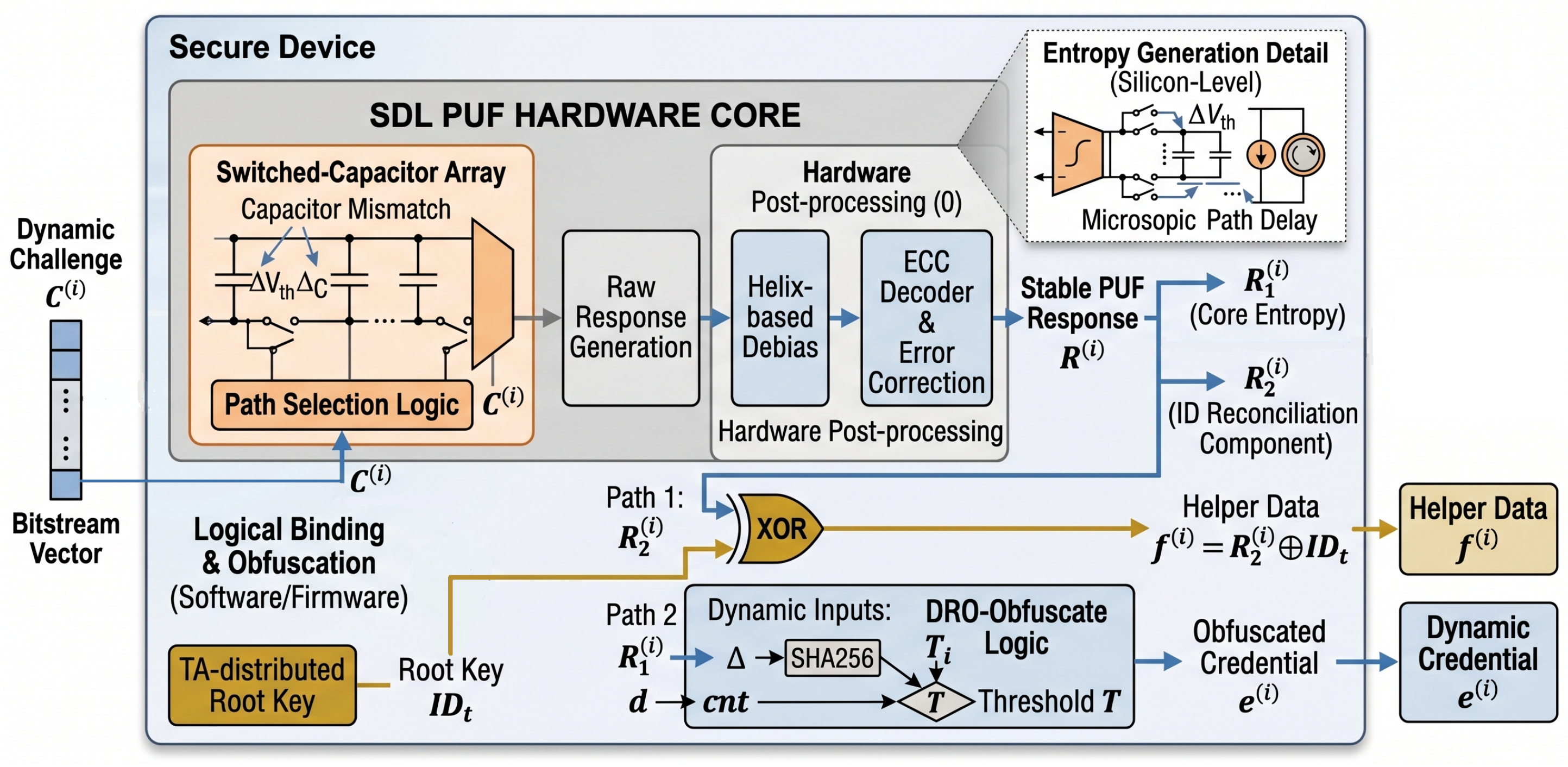
5.5. SDL PUF Obfuscation of the User
In the registration and authentication process of the vehicle and RSU, when the number of vehicles and RSUs exceeds a threshold (
T), the system becomes vulnerable to ML and DL attacks. To defend against such attacks, we employ Algorithm 1 (DRO-Obfuscate) to update the
and
parameters.
| Algorithm 1 DRO-Obfuscate |
- 1:
- 2:
- 3:
- 4:
while do - 5:
- 6:
- 7:
- 8:
break - 9:
end while - 10:
while do - 11:
- 12:
break - 13:
end while - 14:
return
|
In Algorithm 1, d takes a random value from the current round of the protocol process, while refers to the challenge–response pair generated by each party’s SDL PUF. The value of is the timestamp of the current session, and both the vehicle and RSU store a dynamic offset (), which is updated during each session.
6. Formal Security Analysis
To ensure the security of the protocol, this section provides the formal security analysis and proof of the V2X protocol proposed in
Section 5 under the ROR model. We derive step-by-step queries to formally prove that the protocol satisfies the required session key secrecy and mutual authentication security properties. Under clearly defined security assumptions, this section demonstrates how the advantage of an adversary (
) is gradually reduced through each game transition.
Players: In the tripartite V2X environment, we define the protocol () as consisting of three types of entities: , , and V. During protocol execution, the Trusted Authority, Roadside Unit, and Vehicle are instantiated as , , and , respectively. Let and denote the l-th and m-th instances (oracles) of vehicle and , respectively. These instances serve as the logical execution units of the protocol.
Queries: These query statements aim to simulate the capabilities of a real
, with the following query types available to
[
13]:
- 1.
: This query simulates passive eavesdropping. can obtain all messages honestly exchanged between the two parties.
- 2.
: This query simulates active attacks. masquerades as a peer (P) of instance , sends a forged or modified message m to instance , and obtains the response.
- 3.
: This query simulates session key leakage. If has accepted, obtains the current session key (K).
- 4.
: This query simulates the computation of a physical unclonable function. provides a challenge (C) and obtains the simulated response (R).
- 5.
: This query simulates the ability of to compromise the internal storage or secrets of an entity, including the following two scenarios:
For , can obtain auxiliary data stored in the OBU.
For , can obtain the RSU’s local secrets .
- 6.
: This query is used to define the semantic security of the session key rather than to simulate the adversary (). It is executed only once on a fresh session. If instance lacks a session key or the session is not fresh, it returns ⊥. Otherwise, a random bit (b) is chosen. If , the real key (K) is returned; if , a random string of equal length is returned.
In addition, it is necessary to define Partnering, Freshness, Semantic Security, and the Computational Difficulty Problem [
13].
Partnering: Two instances ( and ) are said to be in a partnering state if and only if (1) both entities have successfully completed mutual identity confirmation; (2) both entities share the same session identifier, i.e., ; and (3) the partner identifier () of is and the of is .
Freshness: An instance () is considered fresh if its session key has not been revealed, and does not simultaneously compromise the long-term secrets of both communicating parties. Specifically, (1) identity confirmation is passed, and the session key is not leaked; (2) has not executed a query against or its partner; (3) the query has been executed, at most, once; and (4) has not simultaneously compromised the long-term secrets of both communicating parties.
Semantic Security: The security of the session key (
) is defined by this concept. During the execution of protocol
,
can perform a polynomial number of
,
, and
queries and a single
query on a fresh instance. At the end of the game,
must guess the bit (
b). A correct guess means
successfully broke the semantic security of the protocol, denoted as
. The advantage of
in breaking the semantic security is calculated as
Elliptic Curve Discrete Logarithm Problem (ECDLP): In an elliptic curve (
E) defined over a finite field (
) [
47], given a base point (
P; of prime order (
n)) and a public key point (
Q), for any PPT adversary (
), it is computationally infeasible to solve for the scalar (
d), given
P and
Q.
, where
and
[
48]. The advantage of
in solving
d is defined as [
13]
Elliptic Curve Computational Diffie–Hellman Problem (ECCDHP): Given three points
on an elliptic curve, where
a and
b are unknown random scalars, for a PPT adversary (
), computing the shared secret point (
) is extremely difficult [
47]. In the protocol proof, this ensures that even if an attacker intercepts the ephemeral public keys of both parties, they cannot derive the shared key without the private keys [
13]. Given,
, solve
. The advantage of
is defined as
Theorem 1.
Let be a PPT adversary running in polynomial time, performing, at most, queries, queries, and queries against protocol . Let and denote the advantages of in breaking the ECCDHP and ECDLP problems, respectively. Let l be the bit length of the hash function, n be the order of the elliptic curve group, and be a negligible function representing the modeling unpredictability of the SDL PUF. Under the ROR model, the advantage of in breaking the session key security of the protocol satisfies the following: Proof. To rigorously prove the semantic security of the proposed protocol, we define a sequence of games () and let be the event in which successfully guesses the bit (b) in the query for .
Game : This game corresponds to the real attack by
against our protocol in the random oracle model. The challenger simulates all oracles (
) honestly. By definition, we have
Game : This game models a passive eavesdropping attack.
intercepts the communication transcripts
via the
query. To compute the session key (
),
must derive
from the public keys (
and
). However, this is computationally infeasible due to the
assumption. Thus, the success probability remains unchanged:
Game : This game simulates an active attack where
uses
and
queries to induce collisions or forge messages. (1)
: According to the birthday paradox, the probability of a collision in
is, at most,
. (2)
: The use of fresh nonces
and timestamps
ensures uniqueness, with collision probability bounded by
. Applying the difference lemma, we obtain
Game : This game simulates the physical compromise and modeling attack.
executes
to extract
from OBU storage. (1)
: To derive the private key (
),
needs the PUF response (
). Since
, the extracted
is logically blinded and provides no information about
. (2)
: Our dynamic obfuscation mechanism ensures that the logical correlation between challenges and responses is disrupted, bounding
’s ability to model the SDL PUF to a negligible function (
). Thus, the success probability difference is
Game : In this game, the real shared secret (
) is replaced by a truly random value (
). According to the protocol, the session key is derived as
. The ability of
to distinguish
from
implies that
can solve the
instance, given the public values of
and
from
and
. Consequently, the probability of
distinguishing these two games is bounded by the advantage of solving computational hardness problems.
Game : Since the shared secret (
) has been replaced by a truly random value (
Z) in
, the session key (
K) in this game is produced as
, which is now perfectly independent of any communication transcripts
has gathered. Thus, the probability of
successfully guessing the bit (
b) in the
query is
Based on the Equations (
5) and (
10), the advantage of
can be expressed as
Employing the triangular inequality to decompose the differences between successive games yields
According to Equations (
7)–(
9), we obtain the final bound:
Since all terms on the right side are negligible, the proposed protocol is formally proven to be secure under the ROR model. □
Theorem 2
(Session Key Secrecy)
. Under the ROR model, let be the proposed protocol and be a PPT adversary that performs, at most, hash queries, queries, and queries. Assuming the hash function () is modeled as a random oracle and the underlying SDL PUF satisfies the physical unpredictability assumption, the advantage of in breaking the session key secrecy of the protocol satisfieswhere l is the bit length of the hash output, n is the order of the elliptic curve group, and represents the negligible modeling advantage against the DRO-Obfuscate mechanism. Proof. The proof is established through a sequence of games ( to ). We start from the real attack in and gradually transition to , where the session key (K) is replaced by a truly random string. Specifically, the gap between and accounts for the hash and nonce collision probabilities (). The transition from to incorporates the physical security of the OBU and the anti-modeling capability of the SDL PUF enhanced by the DRO-Obfuscate mechanism (Algorithm 1), contributing . Finally, the gap between and (via ) is bounded by the computational hardness of the ECCDHP and ECDLP problems. By applying the triangular inequality, (), we derive the final advantage bound. Since all terms are negligible, the session key (K) is computationally indistinguishable from a random string. □
Theorem 3
(Mutual Authentication)
. Under the random oracle model and the Dolev–Yao threat model, the proposed protocol ensures mutual authentication between vehicle and roadside unit . Unless an attacker can solve the problem or forge SDL PUF outputs with non-negligible probability, any adversary () attempting to masquerade as a legitimate entity will fail the verification of authentication tags (). The probability of a successful impersonation attack () satisfies Proof. The mutual authentication is guaranteed by the unforgeability of the authentication tags in the three-way handshake. (1) to : The tag () involves the long-term secret term (). Computing this term without the private key (, stored in PUF-protected memory) is equivalent to solving the problem. (2) to : The tag () is masked by and includes secret . An attacker cannot forge without the ephemeral private key () or the TA-distributed secret (), which is obfuscated by the PUF auxiliary data (). (3) Key Confirmation: The tag expressed as in provides explicit confirmation that both parties have computed the same session key (K). As demonstrated in the game-based proof, the probability of forging these tags is bounded by the hash collision probability, the PUF modeling advantage, and the ECCDHP hardness. Combined with the freshness check () which prevents replay attacks, the protocol ensures robust mutual authentication. □
6.1. Formal Security Analysis Using AVISPA Tool
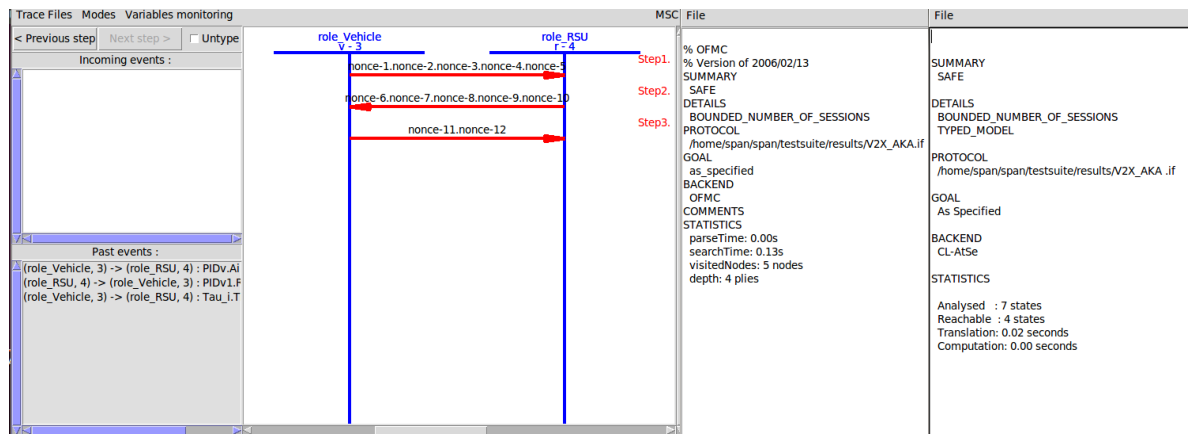
As illustrated in
Figure 3, we utilize the Automated Validation of Internet Security Protocols and Applications (AVISPA) tool [
57,
58] to formally verify the proposed protocol’s session key secrecy and mutual authentication. Under the standard Dolev–Yao adversary model [
59], the OFMC backend evaluated the protocol with a search depth of four plies and five visited nodes, while the CL-AtSe backend reported seven analyzed states and four reachable states [
60]. Specifically, the four reachable states align precisely with the honest three-pass execution trace, whereas the additional analyzed states confirm that all active adversarial attempts (e.g., message injection or forgery) were successfully pruned by the protocol’s strict cryptographic bindings. Ultimately, both backends identically yield a “SAFE” summary, rigorously proving that the protocol is highly resilient against active network interventions and replay attacks [
58].
6.2. Informal Security Analysis
This section evaluates the protocol’s heuristic resilience against common V2X security threats based on the interaction logic defined in
Section 5.
(1) Resilience to Replay Attacks: The protocol incorporates fresh timestamps () and random nonces () in every message. Any intercepted message from previous sessions will fail the freshness check (), ensuring protection against replay.
(2) Mitigation of Impersonation Attacks: Legitimate identities are cryptographically bound to hardware secrets via tags and . Without access to the internal SDL PUF response () or the TA-distributed secret (), an adversary cannot forge valid authentication tokens to masquerade as a vehicle or RSU.
(3) Protection Against MITM Attacks: All critical session parameters, including identities and nonces, are integrity-protected through hash-based bindings in and . Any unauthorized modification of the messages in transit will result in a verification failure.
(4) Mutual Authentication and Key Agreement: The protocol achieves mutual trust through a three-pass handshake. The final verification of key confirmation tokens () ensures that both entities have computed an identical and fresh session key (K).
(5) Guarantee of User Anonymity: To prevent tracking, vehicles utilize dynamic pseudonyms () updated in every session. The link between pseudonyms and the real is protected by random scalars, ensuring full unlinkability across sessions.
(6) Resistance to Known Session Key Attacks: The session key (K) is strongly dependent on ephemeral secrets () and fresh nonces (). The leakage of a specific session key does not compromise previous or future sessions, satisfying forward/backward secrecy.
(7) Robustness against Physical Attacks: The security root is anchored in the SDL PUF, which is inherently unclonable. Even if storage parameters are compromised, the adversary cannot extract the device-specific fingerprints required to regenerate session keys.
(8) Reduction of Denial-of-Service Attack Impact: The protocol employs lightweight primitives (Hash and XOR) and performs early-stage timestamp checks. This minimizes resource consumption and prevents malicious requests from exhausting the computational capacity of entities.