

A Scene-Aware Degradation Universal Re-Identification Framework for Adverse Weather


Highlights
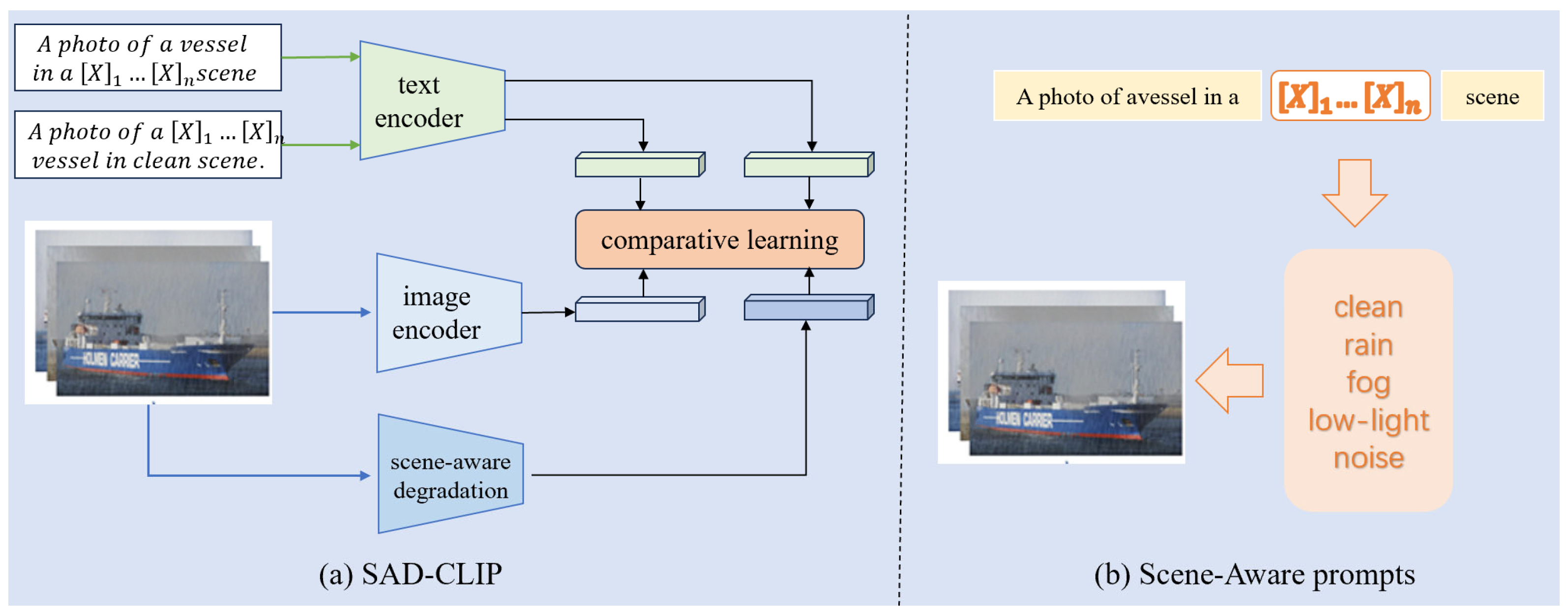
- The proposed ScA-UniReID framework, built upon CLIP, effectively addresses the challenge of ReID under coupled adverse weather (e.g., rain and fog) by dynamically disentangling identity semantics from degradation artifacts using dual textual prompts and an adaptive control module.
- This work provides a novel cross-modal paradigm that moves beyond conventional image-enhancement or robust-feature approaches, offering a new solution for ReID in complex, real-world environments where multiple degradations co-occur.
Abstract
1. Introduction
- We systematically analyze the challenges posed by rain-and-fog coupled degradations to existing ReID systems and reveal the limitations of both image-enhancement and robust-feature paradigms under extreme weather.
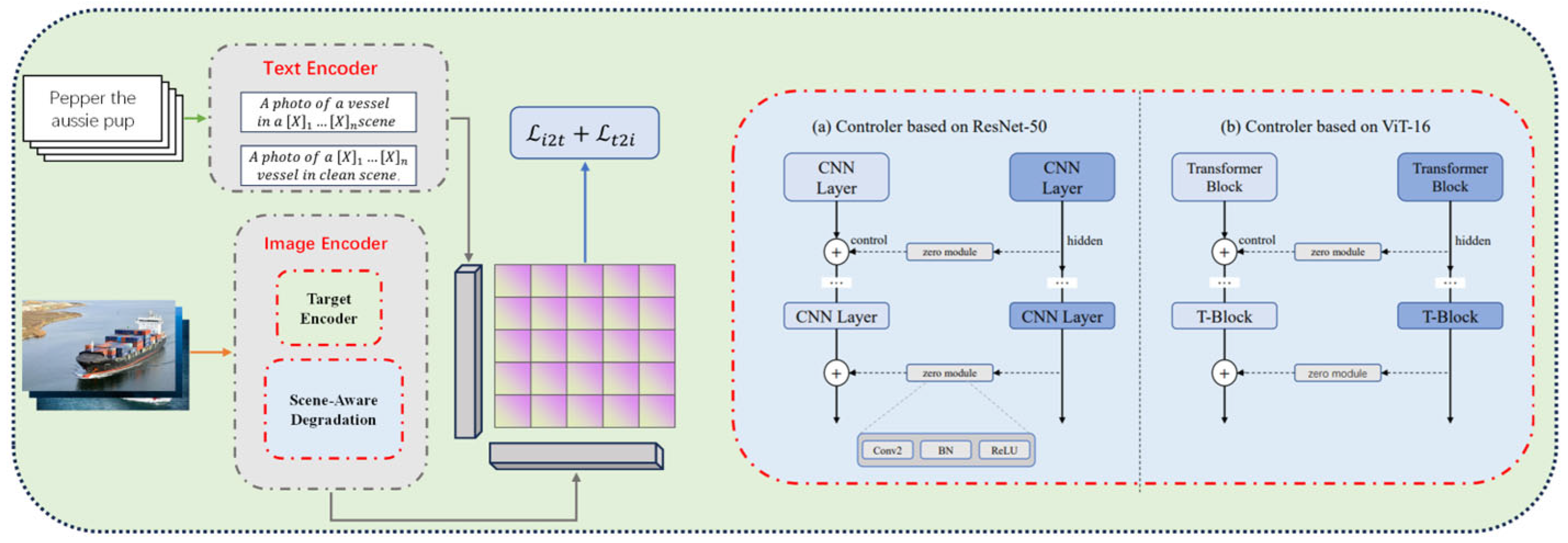
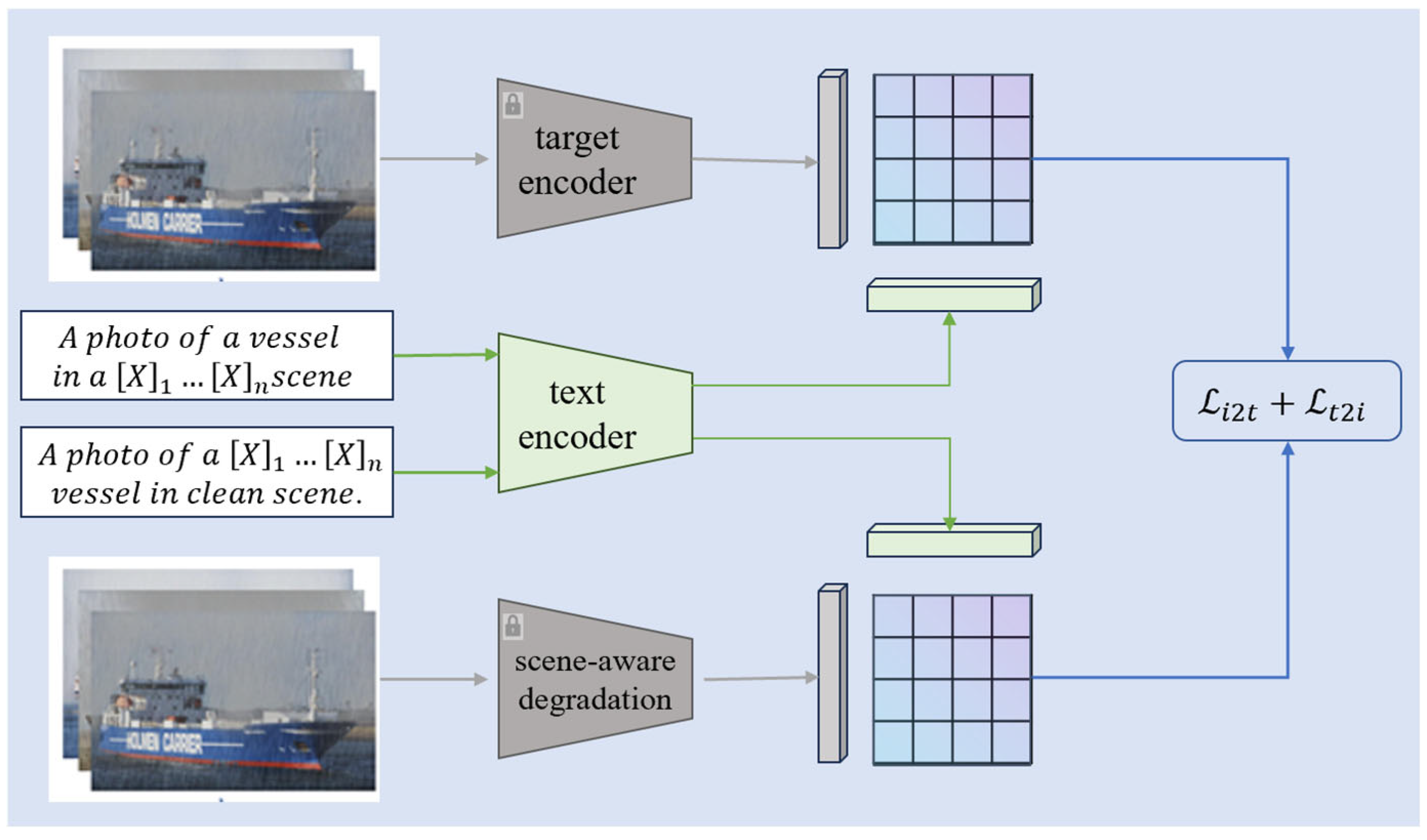
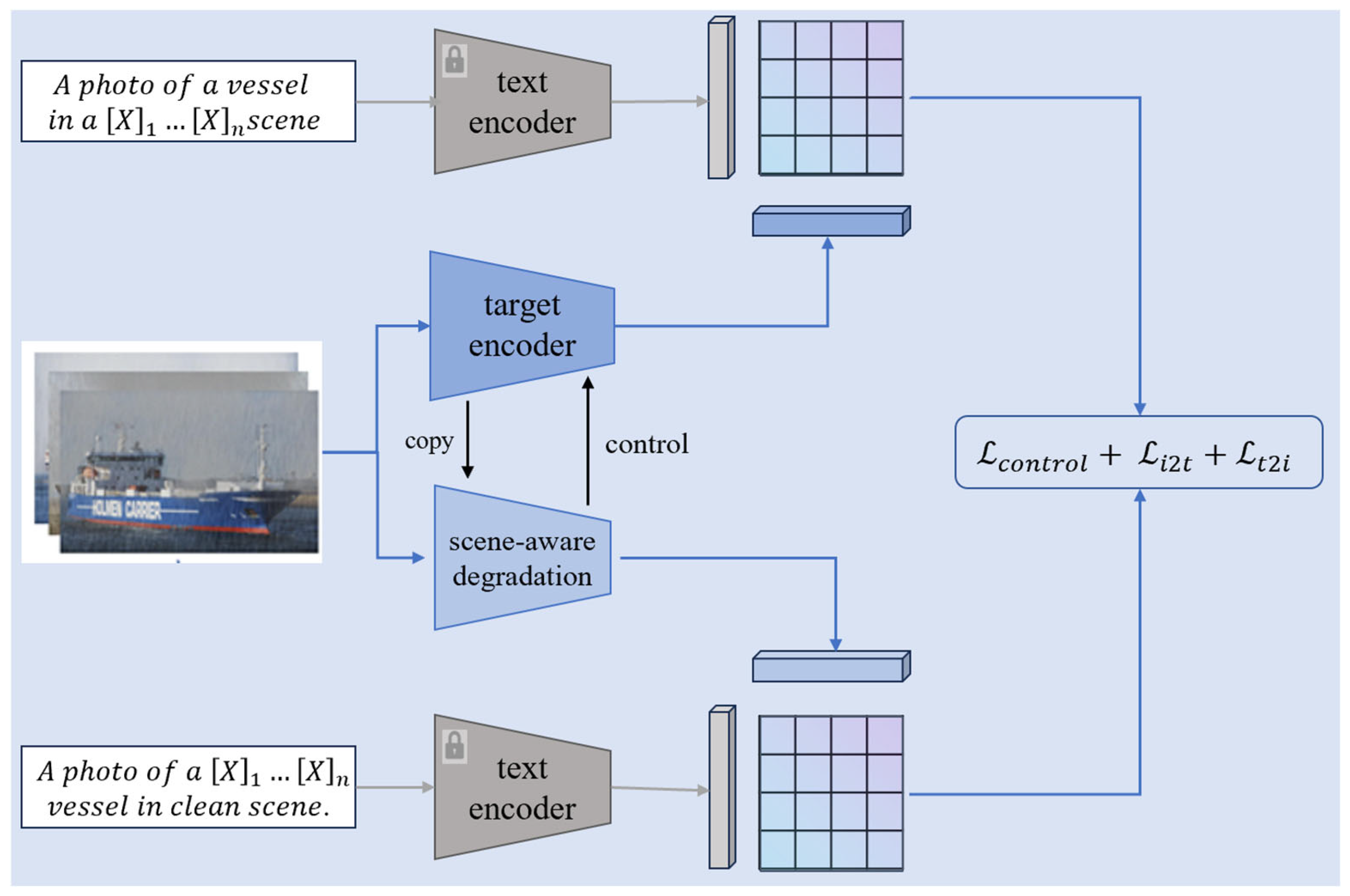
- We propose SCA-UniReID, a scene-aware universal ReID framework that integrates dual textual prompts—target-oriented and degradation-oriented—into a CLIP-style dual-encoder architecture, enabling fine-grained disentanglement of identity semantics from weather noise while preserving discriminability.
- We conduct comprehensive experiments on ship and pedestrian benchmarks under multiple adverse-weather protocols; results demonstrate that SCA-UniReID surpasses state-of-the-art methods and maintains strong generalization across unseen conditions.
2. Related Works
2.1. Image Preprocessing Methods in Re-Identification
2.2. Discriminative Feature Learning Methods in Re-Identification
2.3. Vision-Language Learning
3. Preliminaries
3.1. CLIP Framework
3.2. Scene-Aware-Degradation Module
3.3. Scene-Aware Prompts
4. Implementation Method
4.1. Overview of the Scene Semantic-Aware Feature Decoupling Network Framework
| Algorithm 1 Training Process of Scene Semantic-Aware Feature Decoupling Network Framework |
| Stage 1: Load Pre-trained Models , , , Initialize Learnable Parameters Output: Learnable Text Prompts 1. 2. The target encoder and the scene-aware module extract image features respectively 3. Define dual text learnable prompts as shown in Equation (3) 4. The text encoder encodes the dual text as shown in Equation (4) 5. Update the prompts via backpropagation as shown in Equation (7) 6. End for |
| Stage 2: Load Pre-trained Models , Dual Text Prompts Output: Trained Target Encoder and Scene−Aware Module 7. 8. The text encoder T(⋅) extracts text features from the dual text prompts 9. The target encoder and scene-aware module extract image features respectively 10. Update the parameters of via backpropagation (9) 11. Fix the parameters of and update via backpropagation (10) 12. End for |
4.2. Semantic Prompt Construction and Feature Guidance
4.3. Target-Scene Encoding and Feature Disentanglement
5. Experiment
5.1. Experimental Settings
5.2. Comprehensive Experimental Comparison and Analysis
5.3. Ablation Studies
5.3.1. Ablation Study on Scene Encoder Architecture
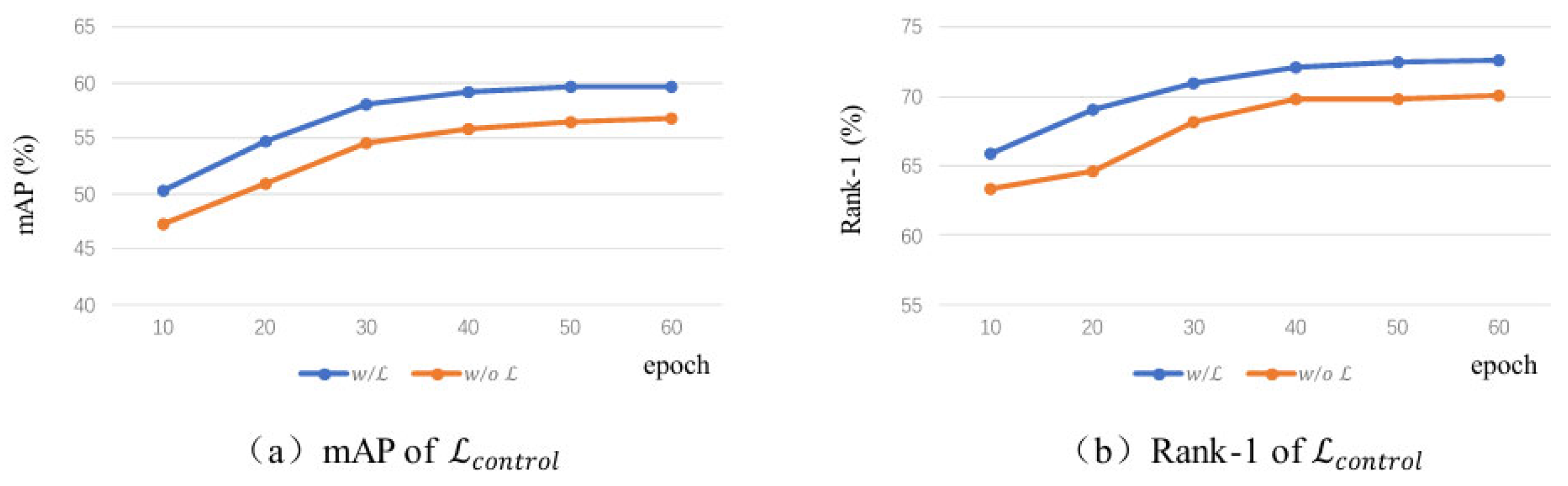
5.3.2. Ablation Study on the Objective Function
5.3.3. Ablation Study on Parameters and
5.4. Visualization Results
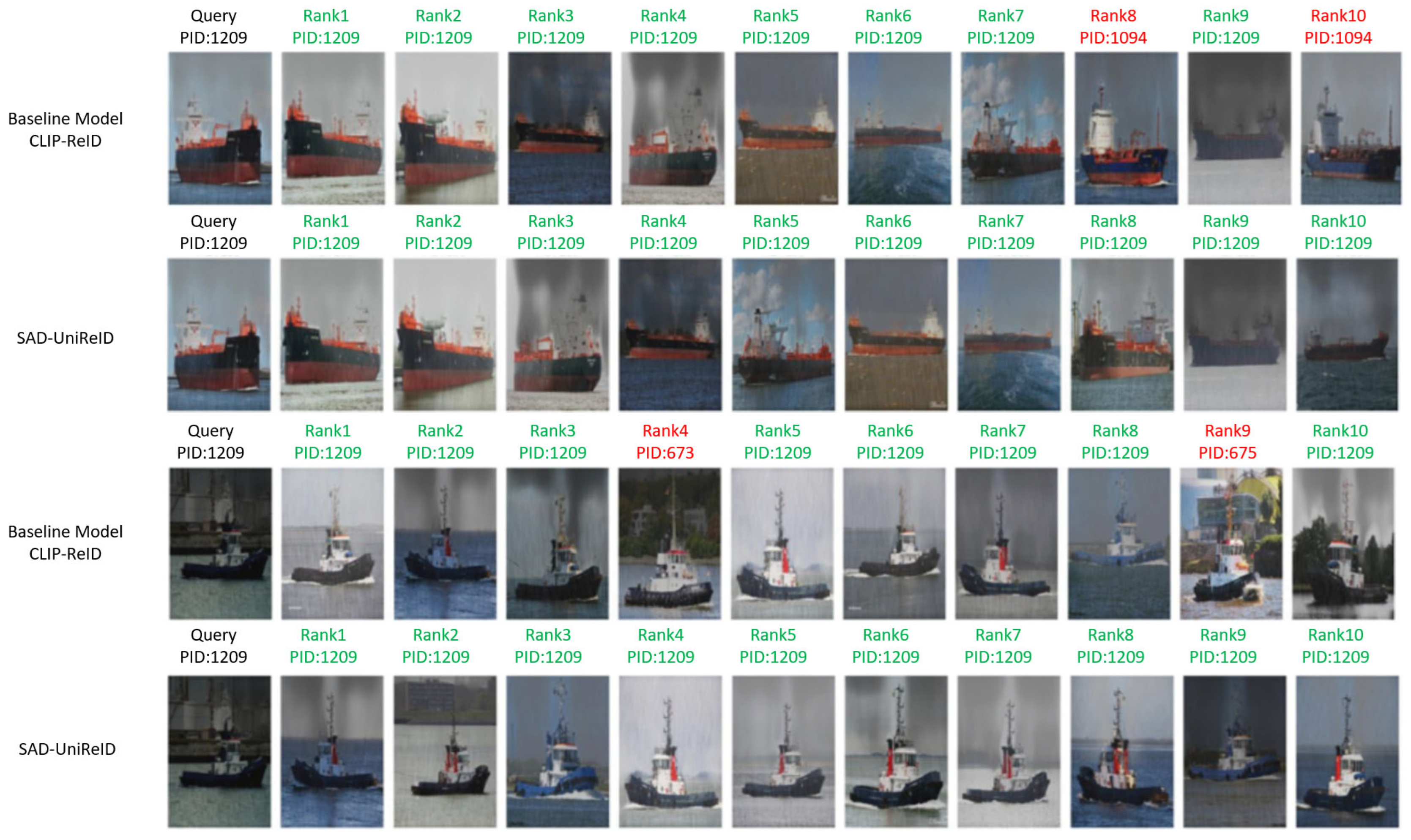
5.4.1. Retrieval Performance Comparison
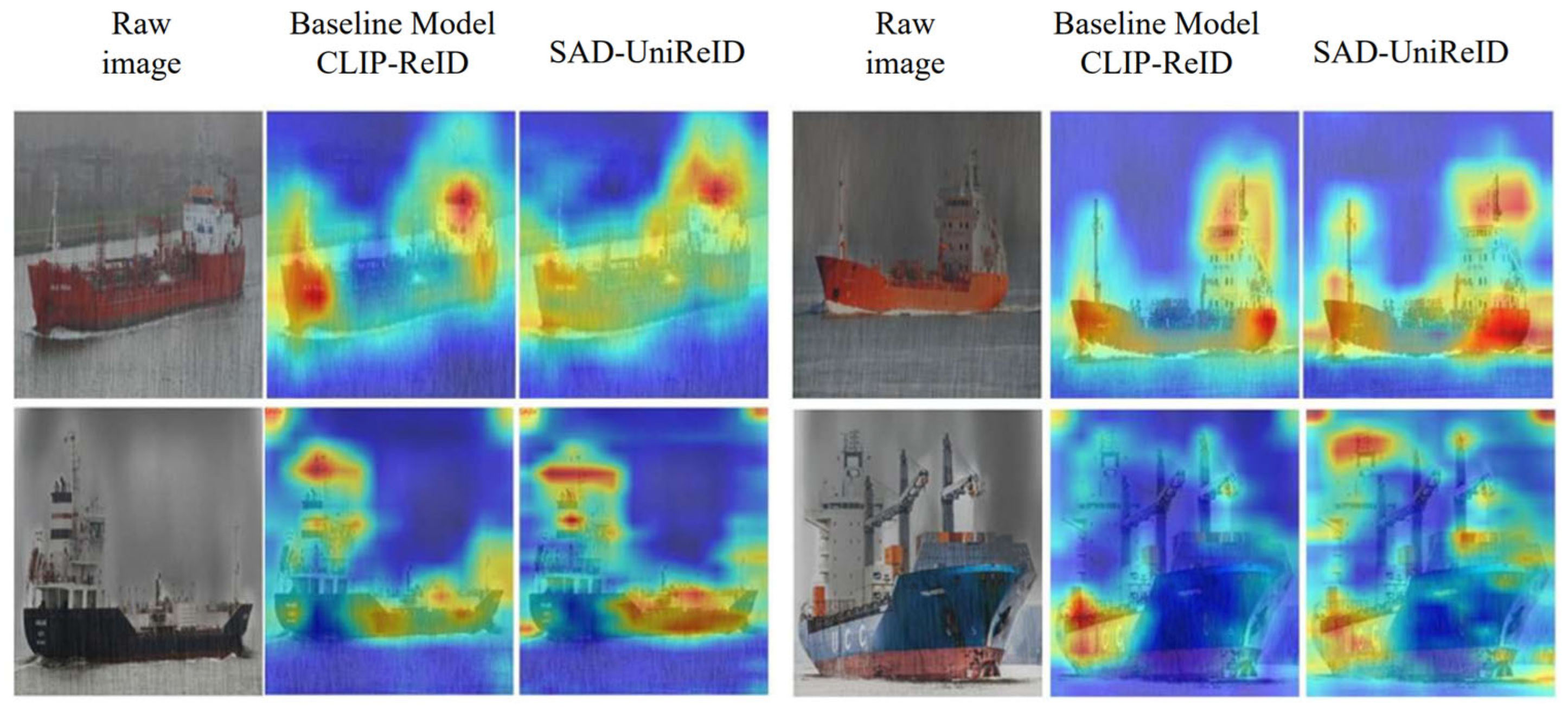
5.4.2. Feature Visualization
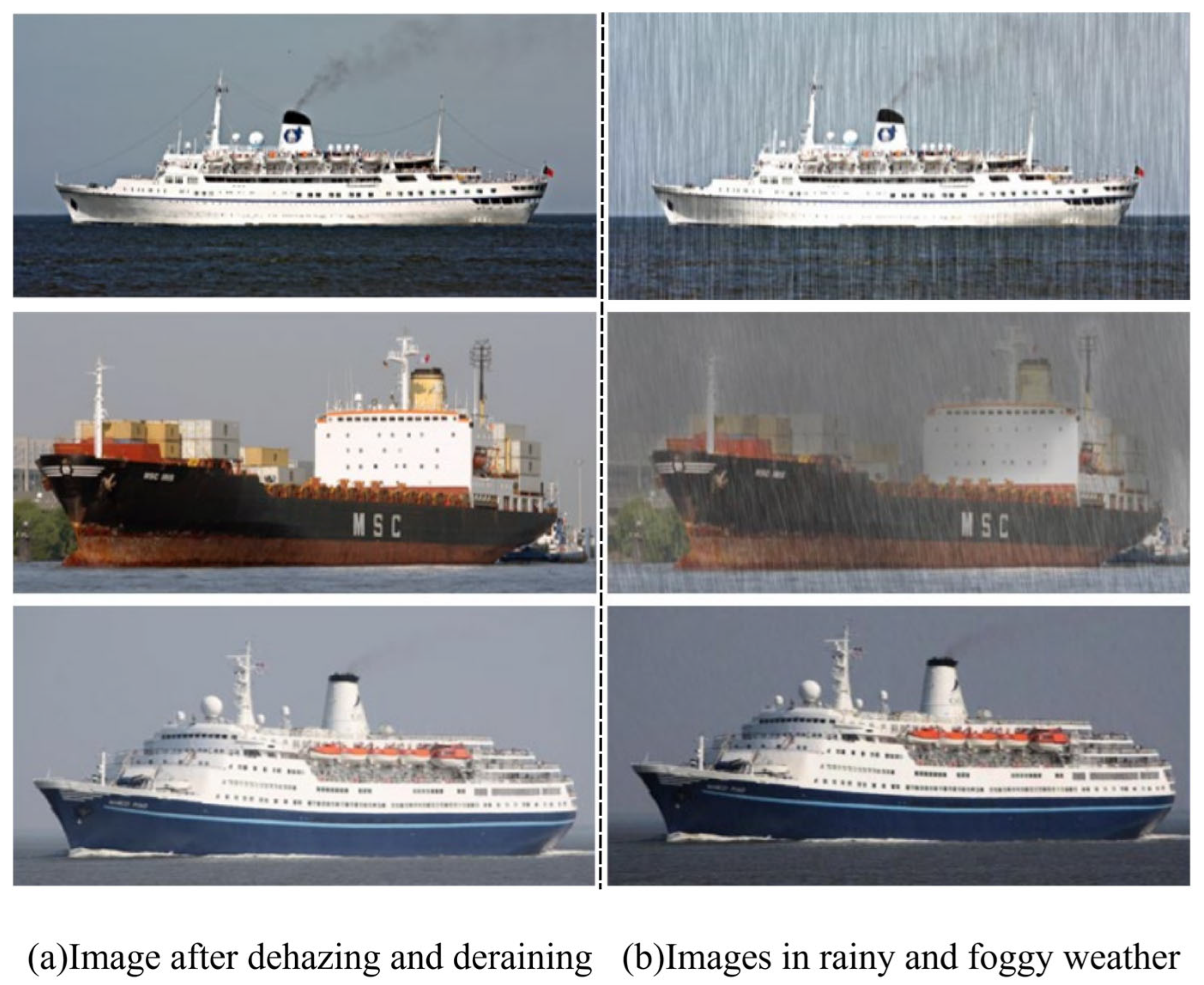
5.4.3. Robustness Analysis Under Adverse Weather Degradations
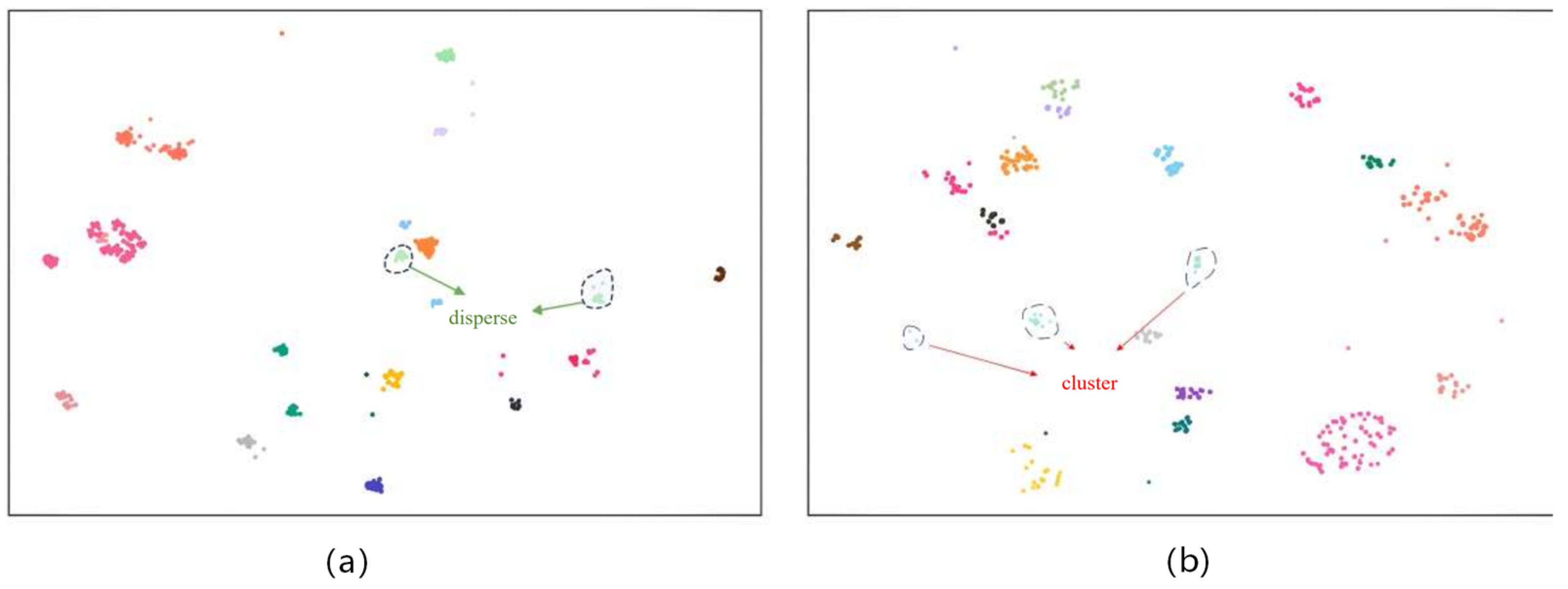
5.4.4. t-SNE Visualization
6. Conclusions
Author Contributions
Funding
Data Availability Statement
Acknowledgments
Conflicts of Interest
Abbreviations
| ReID | Re-identification |
| ScA | Scene-Aware Degradation |
| CLIP | Contrastive Language-Image Pretraining |
| VLP | Vision-Language Pretraining |
References
- Han, X.; Sheng, H.; Bai, C. Exploring training data-free video generation from a single image via a stable diffusion model. J. Vis. Commun. Image Represent. 2025, 111, 104504. [Google Scholar] [CrossRef] [Scilit]
- Oladimeji, D.; Gupta, K.; Kose, N.A.; Gundogan, K.; Ge, L.; Liang, F. Smart transportation: An overview of technologies and applications. Sensors 2023, 23, 3880. [Google Scholar] [CrossRef] [Scilit]
- Milledge, T.J.; Pradhan, B.; Shukla, N. Integrating systems methodologies for australian undersea surveillance: A systematic literature review. Syst. Eng. 2025, 28, 471–497. [Google Scholar] [CrossRef] [Scilit]
- Zhong, X.; Han, X.; Jia, X.; Huang, W.; Liu, W.; Su, S.; Yu, X.; Ye, M. ICLR: Instance credibility-based label refinement for label noisy person re-identification. Pattern Recognit. 2024, 148, 110168. [Google Scholar] [CrossRef] [Scilit]
- Liu, H.; Tian, Y.; Wang, Y.; Pang, L.; Huang, T. Deep relative distance learning: Tell the difference between similar vehicles. In Proceedings of the IEEE Conference on Computer Vision and Pattern Recognition, Las Vegas, NV, USA, 27–30 June 2016; pp. 2167–2175. [Google Scholar]
- Qian, X.; Fu, Y.; Jiang, Y.-G.; Xiang, T.; Xue, X. Multi-scale deep learning architectures for person re-identification. In Proceedings of the IEEE International Conference on Computer Vision, Venice, Italy, 22–29 October 2017; pp. 5399–5408. [Google Scholar]
- Zhang, R.; Xu, L.; Yang, S.; Wang, L. MambaReID: Exploiting vision mamba for multi-modal object re-identification. Sensors 2024, 24, 4639. [Google Scholar] [CrossRef] [Scilit]
- Wang, Y.; Zhang, P.; Liu, X.; Tu, Z.; Lu, H. Unity is strength: Unifying convolutional and transformer features for better person re-identification. IEEE Trans. Intell. Transp. Syst. 2025, 26, 3713–3723. [Google Scholar] [CrossRef] [Scilit]
- Zhang, L.; Wang, L.; Wu, Y.; Chen, M.; Zheng, D.; Cai, Y. ISCDFuse: Interval sampling correlation driven visual state space models for multimodal image fusion. Neurocomputing 2025, 640, 130329. [Google Scholar] [CrossRef] [Scilit]
- Zhang, Q.; Zhang, M.; Liu, J.; He, X.; Song, R.; Zhang, W. Unsupervised maritime vessel re-identification with multi-level contrastive learning. IEEE Trans. Intell. Transp. Syst. 2023, 24, 5406–5418. [Google Scholar] [CrossRef] [Scilit]
- Radford, A.; Kim, J.W.; Hallacy, C.; Ramesh, A.; Goh, G.; Agarwal, S.; Sastry, G.; Askell, A.; Mishkin, P.; Clark, J.; et al. Learning transferable visual models from natural language supervision. In Proceedings of the International Conference on Machine Learning, Virtual Event, 18–24 July 2021; pp. 8748–8763. [Google Scholar]
- Yu, X.; Dong, N.; Zhu, L.; Peng, H.; Tao, D. CLIP-driven semantic discovery network for visible-infrared person re-identification. IEEE Trans. Multimed. 2025, 27, 4137–4150. [Google Scholar] [CrossRef] [Scilit]
- Gao, P.; Geng, S.; Zhang, R.; Ma, T.; Fang, R.; Zhang, Y.; Li, H.; Qiao, Y. CLIP-adapter: Better vision-language models with feature adapters. Int. J. Comput. Vis. 2024, 132, 581–595. [Google Scholar] [CrossRef] [Scilit]
- Li, S.; Sun, L.; Li, Q. CLIP-ReID: Exploiting vision-language model for image re-identification without concrete text labels. In Proceedings of the AAAI Conference on Artificial Intelligence, Washington, DC, USA, 7–14 February 2023; Volume 37, pp. 1405–1413. [Google Scholar]
- Zeng, Z.; Wang, Z.; Wang, Z.; Zheng, Y.; Chuang, Y.Y.; Satoh, S.I. Illumination-adaptive person re-identification. IEEE Trans. Multimed. 2020, 22, 3064–3074. [Google Scholar] [CrossRef] [Scilit]
- Lu, A.; Zhang, Z.; Huang, Y.; Zhang, Y.; Li, C.; Tang, J.; Wang, L. Illumination distillation framework for nighttime person re-identification and a new benchmark. IEEE Trans. Multimed. 2023, 26, 406–419. [Google Scholar] [CrossRef] [Scilit]
- Liu, W.; Zhong, X.; Zhou, Z.; Jiang, K.; Wang, Z.; Lin, C.-W. Dual-recommendation disentanglement network for view fuzz in action recognition. IEEE Trans. Image Process. 2023, 32, 2719–2733. [Google Scholar] [CrossRef] [Scilit]
- Jiao, J.; Zheng, W.-S.; Wu, A.; Zhu, X.; Gong, S. Deep low-resolution person re-identification. In Proceedings of the AAAI Conference on Artificial Intelligence, New Orleans, LA, USA, 2–7 February 2018; Volume 32. [Google Scholar]
- Wang, Z.; Ye, M.; Yang, F.; Bai, X.; Satoh, S. Cascaded SR-GAN for scale-adaptive low resolution person re-identification. In Proceedings of the Twenty-Seventh International Joint Conference on Artificial Intelligence {IJCAI-18}, Stockholm, Sweden, 13–19 July 2018; pp. 3891–3897. [Google Scholar]
- Zhang, S.; Zhang, X.; Shen, L.; Wan, S.; Ren, W. Wavelet-based physically guided normalization network for real-time traffic dehazing. Pattern Recognit. 2025, 172, 112451. [Google Scholar] [CrossRef] [Scilit]
- Liu, Y.; Li, T.; Tan, C.; Ren, W.; Ancuti, C.; Lin, W. Ihdcp: Single image dehazing using inverted haze density correction prior. IEEE Trans. Image Process. 2026, 35, 1448–1461. [Google Scholar] [CrossRef] [Scilit]
- Mao, S.; Zhang, S.; Yang, M. Resolution-invariant person re-identification. arXiv 2019, arXiv:1906.09748. [Google Scholar] [CrossRef] [Scilit]
- Huang, Y.; Zha, Z.J.; Fu, X.; Zhang, W. Illumination-invariant person re-identification. In Proceedings of the 27th ACM International Conference on Multimedia; Association for Computing Machinery: New York, NY, USA, 2019; pp. 365–373. [Google Scholar]
- Ragini, T.; Prakash, K.; Cheruku, R.S. S2VSNet: Single stage V-shaped network for image deraining & dehazing. Digit. Signal Process. 2025, 156, 104786. [Google Scholar]
- Shrivastava, P.; Gupta, R.; Moghe, A.A. Joint Deraining and Dehazing Using a CNN with Dark Channel Prior and Atmospheric Light Hybrid Model for Robust Image Restoration. Int. J. Intell. Eng. Syst. 2025, 18, 241–256. [Google Scholar] [CrossRef] [Scilit]
- Singh, R.; Sharma, A. STAD-ConvBi-LSTM: Spatio-temporal attention-based deep convolutional Bi-LSTM framework for abnormal activity recognition. J. Vis. Commun. Image Represent. 2025, 110, 104465. [Google Scholar] [CrossRef] [Scilit]
- Zhong, X.; Wang, M.; Liu, W.; Yuan, J.; Huang, W. SCPNet: Self-constrained parallelism network for keypoint-based lightweight object detection. J. Vis. Commun. Image Represent. 2023, 90, 103719. [Google Scholar] [CrossRef] [Scilit]
- Huang, Y.; Zha, Z.-J.; Fu, X.; Hong, R.; Li, L. Real-world person re-identification via degradation invariance learning. In Proceedings of the IEEE/CVF Conference on Computer Vision and Pattern Recognition, Seattle, WA, USA, 13–19 June 2020; pp. 14084–14094. [Google Scholar]
- Chen, M.; Wang, Z.; Zheng, F. Benchmarks for corruption invariant person re-identification. In Proceedings of the 35th Conference on Neural Information Processing Systems Datasets and Benchmarks Track, Virtual Event, 6–14 December 2021. [Google Scholar]
- Kanwal, S.; Shah, J.H.; Khan, M.A.; Nisa, M.; Kadry, S.; Sharif, M.; Yasmin, M.; Maheswari, M. Person re-identification using adversarial haze attack and defense: A deep learning framework. Comput. Electr. Eng. 2021, 96, 107542. [Google Scholar] [CrossRef] [Scilit]
- Xu, S.; Zhou, C.; Xiao, J.; Tao, W.; Dai, T. A dual-branch infrared and visible image fusion network using progressive image-wise feature transfer. J. Vis. Commun. Image Represent. 2024, 102, 104190. [Google Scholar] [CrossRef] [Scilit]
- Zheng, W.-S.; Hong, J.; Jiao, J.; Wu, A.; Zhu, X.; Gong, S.; Qin, J.; Lai, J. Joint bilateral-resolution identity modeling for cross-resolution person re-identification. Int. J. Comput. Vis. 2022, 130, 136–156. [Google Scholar] [CrossRef] [Scilit]
- Chen, W.-T.; Chen, I.-H.; Yeh, C.-Y.; Yang, H.-H.; Ding, J.-J.; Kuo, S.-Y. SJDL-vehicle: Semi-supervised joint defogging learning for foggy vehicle re-identification. Proc. AAAI Conf. Artif. Intell. 2022, 36, 347–355. [Google Scholar] [CrossRef] [Scilit]
- Chen, W.-T.; Chen, I.-H.; Yeh, C.-Y.; Yang, H.-H.; Chang, H.-E.; Ding, J.-J.; Kuo, S.-Y. RVSL: Robust vehicle similarity learning in real hazy scenes based on semi-supervised learning. In Proceedings of the European Conference on Computer Vision, Tel Aviv, Israel, 23–27 October 2022; Springer: Cham, Switzerland, 2022; pp. 427–443. [Google Scholar]
- Ginige, Y.; Gunasekara, R.; Hewavitharana, D.; Ariyarathne, M.; Rodrigo, R.; Jayasekara, P. Vessel re-identification and activity detection in thermal domain for maritime surveillance. arXiv 2024, arXiv:2406.08294. [Google Scholar] [CrossRef] [Scilit]
- Zhou, K.; Yang, J.; Loy, C.C.; Liu, Z. Learning to prompt for Vision-Language Models. Int. J. Comput. Vis. 2022, 130, 2337–2348. [Google Scholar] [CrossRef] [Scilit]
- Ye, M.; Shen, J.; Lin, G.; Xiang, T.; Shao, L.; Hoi, S.C.H. Deep learning for person re-identification: A survey and outlook. IEEE Trans. Pattern Anal. Mach. Intell. 2021, 44, 2872–2893. [Google Scholar] [CrossRef] [Scilit]
- He, S.; Luo, H.; Wang, P.; Wang, F.; Li, H.; Jiang, W. Transreid: Transformer-based object re-identification. In Proceedings of the IEEE/CVF International Conference on Computer Vision, Montreal, QC, Canada, 10–17 October 2021; pp. 15013–15022. [Google Scholar]
- Zhao, J.; Zhao, Y.; Li, J.; Yan, K.; Tian, Y. Heterogeneous relational complement for vehicle re-identification. In Proceedings of the IEEE/CVF International Conference on Computer Vision, Montreal, QC, Canada, 10–17 October 2021; pp. 205–214. [Google Scholar]
- Pang, J.; Zhang, D.; Li, H.; Liu, W.; Yu, Z. Hazy re-ID: An interference suppression model for domain adaptation person re-identification under inclement weather condition. arXiv 2021, arXiv:2104.11004. [Google Scholar]



| Tecnology | Conference/ Journal’Year | VesselReID_Adverse | Market_Adverse | ||
|---|---|---|---|---|---|
| mAP | Rank-1 | mAP | Rank-1 | ||
| AWG | TPAMI’21 | 51.2 | 64.8 | 75.9 | 89.9 |
| HRCN | ICCV’21 | 53.9 | 66.3 | 72.1 | 88.0 |
| CIL | NeurIPS’21 | 54.4 | 68.5 | 68.7 | 85.4 |
| ISM | ICME’21 | 54.8 | 68.3 | 79.2 | 92.2 |
| TransReID | ICCV’21 | 54.8 | 68.0 | 78.7 | 90.4 |
| RotTrans | ACMMM’22 | 53.6 | 66.1 | 76.7 | 89.2 |
| SJDL | AAAI’22 | 56.4 | 69.8 | 63.4 | 83.0 |
| PHA | CVPR’23 | 52.5 | 65.5 | 76.2 | 88.7 |
| CLIP-ReID (ViT-16) | AAAI’23 | 57.6 | 70.9 | 78.8 | 89.9 |
| CLIP-ReID | AAAI’23 | 61.2 | 73.3 | 79.7 | 91.4 |
| DenoiseRep | NeurIPS’24 | 53.2 | 68.0 | 79.8 | 89.9 |
| DCCC | ICASSP’24 | 47.3 | 63.4 | - | - |
| DHCCN | TCSVT’24 | 36.8 | 56.0 | - | - |
| CCL | IJCNN’25 | 50.5 | 66.4 | - | - |
| ScA-UniReID (ViT-16) | - | 59.8 | 71.8 | 81.2 | 91.6 |
| ScA-UniReID | - | 63.2 | 75.9 | 80.8 | 92.0 |
| Backbone | Tecnology | mAP | k = 1 | k = 5 | k = 10 |
|---|---|---|---|---|---|
| CLIP+fineune | 60.6 | 73.3 | 89.9 | 93.6 | |
| ResNet-50 | ScA-UniReID w/o zero | 52.5 | 69.8 | 87.8 | 92.2 |
| ScA-UniReID(ours) | 63.2 | 75.9 | 91.0 | 94.6 | |
| CLIP+finetune | 58.1 | 70.8 | 88.5 | 92.8 | |
| ViT-16 | ScA-UniReID w/o zero | 57.3 | 69.9 | 87.1 | 92.5 |
| ScA-UniReID(ours) | 59.8 | 71.8 | 88.7 | 93.2 |
| mAP | k = 1 | k = 5 | k = 10 | ||
|---|---|---|---|---|---|
| 1 | 1 | 59.8 | 71.8 | 88.7 | 93.2 |
| 1 | 2 | 59.8 | 72.2 | 88.7 | 93.2 |
| 1 | 3 | 59.4 | 72.3 | 88.3 | 92.9 |
| 2 | 2 | 59.7 | 72.5 | 88.6 | 92.7 |
| 3 | 1 | 59.3 | 73.3 | 88.4 | 92.9 |
Disclaimer/Publisher’s Note: The statements, opinions and data contained in all publications are solely those of the individual author(s) and contributor(s) and not of MDPI and/or the editor(s). MDPI and/or the editor(s) disclaim responsibility for any injury to people or property resulting from any ideas, methods, instructions or products referred to in the content. |
© 2026 by the authors. Licensee MDPI, Basel, Switzerland. This article is an open access article distributed under the terms and conditions of the Creative Commons Attribution (CC BY) license.
Share and Cite
Wei, S.; Wang, Y.; Yang, M.; Wang, C. A Scene-Aware Degradation Universal Re-Identification Framework for Adverse Weather. Sensors 2026, 26, 2951. https://doi.org/10.3390/s26102951
Wei S, Wang Y, Yang M, Wang C. A Scene-Aware Degradation Universal Re-Identification Framework for Adverse Weather. Sensors. 2026; 26(10):2951. https://doi.org/10.3390/s26102951
Chicago/Turabian StyleWei, Siwei, Yuxin Wang, Mingxuan Yang, and Chunzhi Wang. 2026. "A Scene-Aware Degradation Universal Re-Identification Framework for Adverse Weather" Sensors 26, no. 10: 2951. https://doi.org/10.3390/s26102951
APA StyleWei, S., Wang, Y., Yang, M., & Wang, C. (2026). A Scene-Aware Degradation Universal Re-Identification Framework for Adverse Weather. Sensors, 26(10), 2951. https://doi.org/10.3390/s26102951