Hierarchical MAB Framework for Energy-Aware Beam Training for Near-Field Communications
 and
and
Abstract
1. Introduction
- An energy-aware user scheduling algorithm that addresses the common oversight of terminal energy efficiency in existing mechanisms is developed. By incorporating the residual energy status of devices into UCB strategy as a weighting factor, our approach dynamically prioritizes users with favorable channel conditions and sufficient energy. This strategy not only balances exploration and exploitation, but also significantly enhances overall network energy efficiency, extends the operational lifespan of battery-constrained devices, and improves service fairness in energy-heterogeneous scenarios.
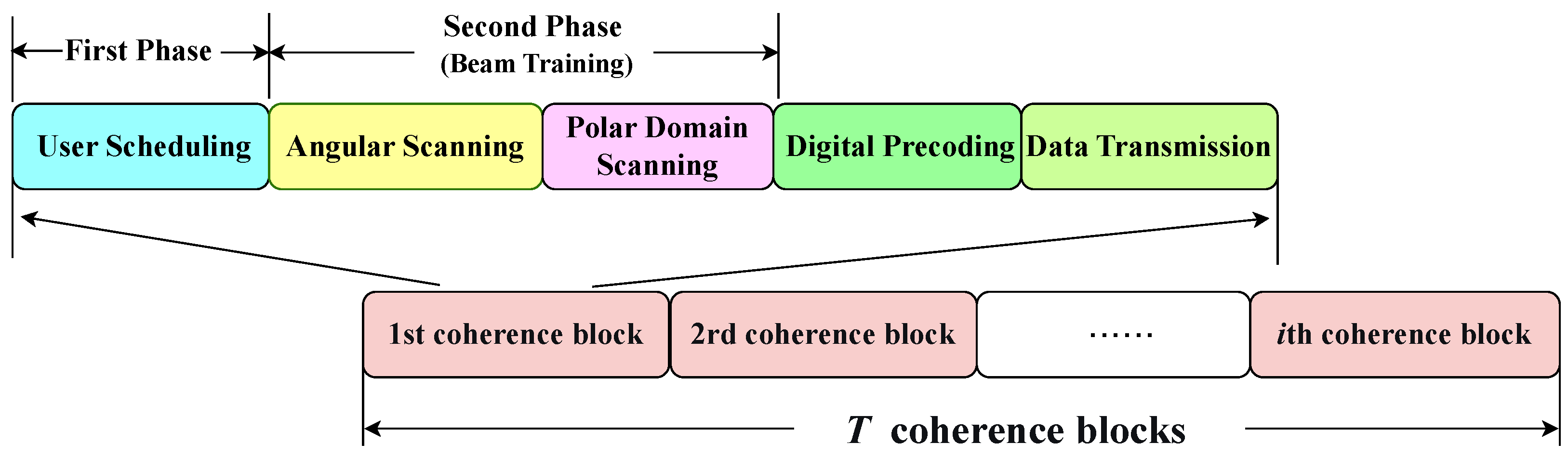
- This paper formulates an integrated framework that co-optimizes user scheduling and near-field beam training (US-NFBT), overcoming the limitations of conventional decoupled designs. The proposed method employs a two-phase combinatorial (C-MAB) model to first carry out energy-aware user selection, followed by a dual-layer beam training mechanism. This hierarchical process begins with coarse-grained angle estimation and advances to fine-grained polar-domain beam training, leading to a substantial reduction in training overhead. As a result, the proposed scheme effectively mitigates the resource consumption problem introduced by the additional ranging requirement inherent to near-field communications.
- A codebook-based non-reciprocal beam training scheme is designed. By efficiently acquiring downlink channel information using a triple UCB strategy with integrated device battery awareness, a practical and energy-efficient multi-user near-field communication solution is offered. This approach not only improves beam training performance, but also extends device battery life, thereby facilitating the real-world deployment of frequency division duplex (FDD) XL-MIMO systems.
2. System Model
2.1. Communication Scenario and Channel Model
2.2. Energy Model
2.3. Problem Formulation
3. Two-Phase Near-Field Beam Training Scheme with User Scheduling
3.1. EA-UCB-Based User Scheduling
| Algorithm 1 EA-UCB-based user scheduling | |
| Input: , M, , | |
| 1: | Initialize and for all k |
| 2: | Initialize , {Initialize valid user set} |
| 3: | forto T do |
| 4: | for each user k do |
| 5: | if then |
| 6: | Compute |
| 7: | if then |
| 8: | Add k to |
| 9: | end if |
| 10: | else |
| 11: | |
| 12: | end if |
| 13: | end for |
| 14: | Determine number of users to schedule |
| 15: | Select top users from with highest to form |
| 16: | Run Algorithm 2 to get the selected polar-domain codewords |
| 17: | Compute achievable rate (excluding the overhead term) for each scheduled user |
| 18: | Update for each scheduled user : |
| 19: | |
| 20: | |
| 21: | |
| 22: | end for |
| Output: | |
| Algorithm 2 Two-layer MAB-Based Beam Training | |
| Input: , , | |
| 1: | Initialize and |
| 2: | Initialize the first and second layers base arms |
| 3: | for to T do |
| 4: | Layer 1: Angular Scanning (DFT Codebook) |
| 5: | Compute via the bisection method |
| 6: | Select codewords to constitute (Remark 2) |
| 7: | Layer 2: Polar-domain scanning (constructed polar-domain codebook) |
| 8: | Construct candidate angle set from |
| 9: | Construct candidate codebook from |
| 10: | Compute via the bisection method |
| 11: | Select codewords to constitute (similar to Remark 2) |
| 12: | Update , , , using received signals |
| 13: | end for |
| Output: , | |
3.2. MAB-Based Angular Scanning
3.3. MAB-Based Polar-Domain Scanning
3.4. Design of Multi-User Digital Precoding
4. Complexity Analysis
5. Numerical Analysis
6. Conclusions
Author Contributions
Funding
Institutional Review Board Statement
Informed Consent Statement
Data Availability Statement
Acknowledgments
Conflicts of Interest
Abbreviations
| UCB | upper confidence bound |
| XL-MIMO | extremely large-scale multiple-input multiple-output |
| CSI | channel state information |
| S-CSI | statistical channel state information |
| I-CSI | instantaneous channel state information |
| UAV | unmanned aerial vehicle |
| MAB | multi-armed bandit |
| EA-UCB | energy-aware upper confidence bound |
| KL-UCB | Kullback-Leibler upper confidence bound |
| US-NFBT | user scheduling and near-field beam training |
| C-MAB | combinatorial multi-armed bandit |
| BS | base station |
| ULA | uniform linear array |
| EAR | effective achievable rate |
| CCM | channel covariance matrix |
| ICSIG | I-CSI-based graph theory algorithm |
| TPBT | Thompson-sampling-based beam training |
| SNR | signal-to-noise ratio |
Appendix A. (Proof of Lemma 1)
Appendix B. (Proof of Lemma 2)
References
- Tariq, F.; Khandaker, M.R.A.; Wong, K.K.; Imran, M.A.; Bennis, M.; Debbah, M. A Speculative Study on 6G. IEEE Wirel. Commun. 2020, 27, 118–125. [Google Scholar] [CrossRef]
- Zeng, Y.; Chen, J.; Xu, J.; Wu, D.; Xu, X.; Jin, S.; Gao, X.; Gesbert, D.; Cui, S.; Zhang, R. A Tutorial on Environment-Aware Communications via Channel Knowledge Map for 6G. IEEE Commun. Surv. Tutor. 2024, 26, 1478–1519. [Google Scholar] [CrossRef]
- Parra-Ullauri, J.M.; Zhang, X.; Bravalheri, A.; Moazzeni, S.; Wu, Y.; Nejabati, R.; Simeonidou, D. Federated Analytics for 6G Networks: Applications, Challenges, and Opportunities. IEEE Netw. 2024, 38, 9–17. [Google Scholar] [CrossRef]
- Na, M.; Lee, J.; Choi, G.; Yu, T.; Choi, J.; Lee, J.; Bahk, S. Operator’s Perspective on 6G: 6G Services, Vision, and Spectrum. IEEE Commun. Mag. 2024, 62, 178–184. [Google Scholar] [CrossRef]
- González-Prelcic, N.; Furkan Keskin, M.; Kaltiokallio, O.; Valkama, M.; Dardari, D.; Shen, X.; Shen, Y.; Bayraktar, M.; Wymeersch, H. The Integrated Sensing and Communication Revolution for 6G: Vision, Techniques, and Applications. Proc. IEEE 2024, 112, 676–723. [Google Scholar] [CrossRef]
- Psomas, C.; Ntougias, K.; Shanin, N.; Xu, D.; Mayer, K.; Tran, N.M.; Cottatellucci, L.; Choi, K.W.; Kim, D.I.; Schober, R.; et al. Wireless Information and Energy Transfer in the Era of 6G Communications. Proc. IEEE 2024, 112, 764–804. [Google Scholar] [CrossRef]
- Liu, W.; Pan, C.; Ren, H.; Wang, J.; Schober, R. Near-Field Multiuser Beam-Training for Extremely Large-Scale MIMO Systems. IEEE Trans. Commun. 2025, 73, 2663–2679. [Google Scholar] [CrossRef]
- Wu, C.; You, C.; Liu, Y.; Chen, L.; Shi, S. Two-Stage Hierarchical Beam Training for Near-Field Communications. IEEE Trans. Veh. Technol. 2024, 73, 2032–2044. [Google Scholar] [CrossRef]
- Lu, Y.; Zhang, Z.; Dai, L. Hierarchical Beam Training for Extremely Large-Scale MIMO: From Far-Field to Near-Field. IEEE Trans. Commun. 2024, 72, 2247–2259. [Google Scholar] [CrossRef]
- Shi, X.; Wang, J.; Sun, Z.; Song, J. Spatial-Chirp Codebook-Based Hierarchical Beam Training for Extremely Large-Scale Massive MIMO. IEEE Trans. Wirel. Commun. 2024, 23, 2824–2838. [Google Scholar] [CrossRef]
- Zhou, C.; Wu, C.; You, C.; Zhou, J.; Shi, S. Near-Field Beam Training with Sparse DFT Codebook. IEEE Trans. Commun. 2025, 73, 4394–4408. [Google Scholar] [CrossRef]
- Li, X.; Jin, S.; Suraweera, H.A.; Hou, J.; Gao, X. Statistical 3-D Beamforming for Large-Scale MIMO Downlink Systems Over Rician Fading Channels. IEEE Trans. Commun. 2016, 64, 1529–1543. [Google Scholar] [CrossRef]
- de Souza, J.H.I.; Filho, J.C.M.; Amiri, A.; Abrão, T. QoS-Aware User Scheduling in Crowded XL-MIMO Systems Under Non-Stationary Multi-State LoS/NLoS Channels. IEEE Trans. Veh. Technol. 2023, 72, 7639–7652. [Google Scholar] [CrossRef]
- González-Coma, J.P.; López-Martínez, F.J.; Castedo, L. Joint User Scheduling and Precoding for XL-MIMO Systems with Imperfect CSI. IEEE Wirel. Commun. Lett. 2023, 12, 1657–1661. [Google Scholar] [CrossRef]
- Li, X.; Zhang, J.; Han, Y.; Jin, S.; Wu, Y. User Scheduling and Height Optimization in UAV-Assisted Maritime XL-MIMO Communications. In Proceedings of the 2023 International Conference on Wireless Communications and Signal Processing (WCSP), Hangzhou, China, 2–4 November 2023; pp. 966–971. [Google Scholar] [CrossRef]
- González-Coma, J.P.; López-Martínez, F.J.; Castedo, L. Low-Complexity Distance-Based Scheduling for Multi-User XL-MIMO Systems. IEEE Wirel. Commun. Lett. 2021, 10, 2407–2411. [Google Scholar] [CrossRef]
- Pérez-Adán, D.; González-Coma, J.P.; Javier López-Martínez, F.; Castedo, L. Interference-Aware Precoding and User Selection for Multi-Cell Near-Field XL-MIMO Systems. IEEE Wirel. Commun. Lett. 2025, 14, 1396–1400. [Google Scholar] [CrossRef]
- Hashima, S.; Hatano, K.; Takimoto, E.; Mahmoud Mohamed, E. Neighbor Discovery and Selection in Millimeter Wave D2D Networks Using Stochastic MAB. IEEE Commun. Lett. 2020, 24, 1840–1844. [Google Scholar] [CrossRef]
- Ni, Y.; Wang, T.; Tong, H.; Yin, C. A Fast Near-Field Beam Training Strategy based on Array Partition. In Proceedings of the 2025 IEEE/CIC International Conference on Communications in China (ICCC), Shanghai, China, 10–13 August 2025; pp. 1–6. [Google Scholar] [CrossRef]
- Huang, K.; Guan, J.; Wang, Y.; Luo, X. A Symmetric Beam Training Method for Near-Field XL-MIMO Systems. In Proceedings of the 2025 6th International Conference on Electrical, Electronic Information and Communication Engineering (EEICE), Shenzhen, China, 18–20 April 2025; pp. 1491–1496. [Google Scholar] [CrossRef]
- Grover, M.; R, S.; Ketha, R.; Chaudhary, P.; Juneja, B.; Sahoo, S.K. Optimal User Scheduling for Downlink Multi-User MIMO Systems Using Convolutional Neural Networks. In Proceedings of the 2025 International Conference on Networks and Cryptology (NETCRYPT), New Delhi, India, 29–31 May 2025; pp. 271–276. [Google Scholar] [CrossRef]
- Zhu, Y.; Li, S.; Guo, L.; Ge, W.; Wei, L. Deep reinforcement learning-based user scheduling methods with low-complexity beamforming for massive MU-MIMO systems. J. Commun. Netw. 2025, 27, 369–385. [Google Scholar] [CrossRef]
- Liang, H.; Liu, C.; Song, Y.; Yin, Z.; Wang, G. Joint Two Stage Beamforming and User Scheduling for LEO Satellite Communications via Hierarchical Multi-armed Bandit. IEEE Trans. Cogn. Commun. Netw. 2025; early access. [Google Scholar] [CrossRef]
- Dong, Z.; Li, X.; Zeng, Y. Characterizing and Utilizing Near-Field Spatial Correlation for XL-MIMO Communication. IEEE Trans. Commun. 2024, 72, 7922–7937. [Google Scholar] [CrossRef]
- Liang, H.; Liu, C.; Song, Y.; Gao, T.; Zou, Y. Neighbor-based joint spatial division and multiplexing in massive MIMO: User scheduling and dynamic beam allocation. EURASIP J. Adv. Signal Process. 2024, 2024, 1. [Google Scholar] [CrossRef]
- You, L.; Qiang, X.; Li, K.X.; Tsinos, C.G.; Wang, W.; Gao, X.; Ottersten, B. Hybrid Analog/Digital Precoding for Downlink Massive MIMO LEO Satellite Communications. IEEE Trans. Wirel. Commun. 2022, 21, 5962–5976. [Google Scholar] [CrossRef]
- Gao, T.; Liu, C.; Song, Y.; Yin, Z.; Liang, H.; Cheng, N. Spectral Efficient TSB Scheme with User Scheduling for FDD Massive MIMO Systems. IEEE Internet Things J. 2024, 11, 6084–6095. [Google Scholar] [CrossRef]
- Liu, L.; You, C.; Zhang, Y.; Liu, T. Side Angle Information Assisted Near-Field Beam Training for XL-Array Communications. IEEE Commun. Lett. 2024, 28, 2201–2205. [Google Scholar] [CrossRef]
- Hashima, S.; Fouda, M.M.; Sakib, S.; Fadlullah, Z.M.; Hatano, K.; Mohamed, E.M.; Shen, X. Energy-Aware Hybrid RF-VLC Multiband Selection in D2D Communication: A Stochastic Multiarmed Bandit Approach. IEEE Internet Things J. 2022, 9, 18002–18014. [Google Scholar] [CrossRef]
- Mohamed, E.M.; Hashima, S.; Hatano, K. Energy Aware Multiarmed Bandit for Millimeter Wave-Based UAV Mounted RIS Networks. IEEE Wirel. Commun. Lett. 2022, 11, 1293–1297. [Google Scholar] [CrossRef]
- Mohamed, E.M.; Ahmed Alnakhli, M.; Fouda, M.M. Joint UAV Trajectory Planning and LEO-Sat Selection in SAGIN. IEEE Open J. Commun. Soc. 2024, 5, 1624–1638. [Google Scholar] [CrossRef]
- Zhang, X.; Sun, S.; Tao, M.; Huang, Q.; Tang, X. Multi-Satellite Cooperative Networks: Joint Hybrid Beamforming and User Scheduling Design. IEEE Trans. Wirel. Commun. 2024, 23, 7938–7952. [Google Scholar] [CrossRef]
- Wei, X.; Dai, L. Channel Estimation for Extremely Large-Scale Massive MIMO: Far-Field, Near-Field, or Hybrid-Field? IEEE Commun. Lett. 2022, 26, 177–181. [Google Scholar] [CrossRef]
- Mauricio, W.V.F.; Maciel, T.F.; Klein, A.; Lima, F.R.M. Scheduling for Massive MIMO with Hybrid Precoding Using Contextual Multi-Armed Bandits. IEEE Trans. Veh. Technol. 2022, 71, 7397–7413. [Google Scholar] [CrossRef]
- Lee, H.S.; Kim, D.Y.; Min, K. Universal Dynamic Pilot Allocation for Beam Alignment Based on Multi-Armed Bandits. IEEE Wirel. Commun. Lett. 2024, 13, 756–760. [Google Scholar] [CrossRef]
- Mohsenivatani, M.; Ali, S.; Rajatheva, N.; Latva-Aho, M. Deep Contextual Bandits Learning-Based Beam Selection for mmWave MIMO Systems. In Proceedings of the 2023 IEEE International Mediterranean Conference on Communications and Networking (MeditCom), Dubrovnik, Croatia, 4–7 September 2023; pp. 211–216. [Google Scholar] [CrossRef]
- Manonmayee Bharatula, S.S.; Ramaiyan, V. Adapting UCB for Correlated Arms in Link Rate Selection for Wireless Channels. In Proceedings of the 2023 21st International Symposium on Modeling and Optimization in Mobile, Ad Hoc, and Wireless Networks (WiOpt), Singapore, 24–27 August 2023; pp. 1–8. [Google Scholar] [CrossRef]
- Song, J.; de Veciana, G.; Shakkottai, S. Meta-Scheduling for the Wireless Downlink Through Learning with Bandit Feedback. IEEE/ACM Trans. Netw. 2022, 30, 487–500. [Google Scholar] [CrossRef]
- Wu, B.; Chen, T.; Ni, W.; Wang, X. Multi-Agent Multi-Armed Bandit Learning for Online Management of Edge-Assisted Computing. IEEE Trans. Commun. 2021, 69, 8188–8199. [Google Scholar] [CrossRef]
- Hashima, S.; Fouda, M.M.; Fadlullah, Z.M.; Mohamed, E.M.; Hatano, K. Improved UCB-based Energy-Efficient Channel Selection in Hybrid-Band Wireless Communication. In Proceedings of the 2021 IEEE Global Communications Conference (GLOBECOM), Madrid, Spain, 7–11December 2021; pp. 1–6. [Google Scholar] [CrossRef]
- Garivier, A.; Cappé, O. The KL-UCB Algorithm for Bounded Stochastic Bandits and Beyond. arXiv 2013, arXiv:1102.2490. [Google Scholar] [CrossRef]
- Cui, M.; Dai, L. Channel Estimation for Extremely Large-Scale MIMO: Far-Field or Near-Field? IEEE Trans. Commun. 2022, 70, 2663–2677. [Google Scholar] [CrossRef]
- Song, Y.; Liu, C.; Liu, Y.; Cheng, N.; Huang, Y.; Shen, X. Joint Spatial Division and Multiplexing in Massive MIMO: A Neighbor-Based Approach. IEEE Trans. Wirel. Commun. 2020, 19, 7392–7406. [Google Scholar] [CrossRef]
- Xiao, M.; Nagamochi, H. Exact algorithms for maximum independent set. Inf. Comput. 2017, 255, 126–146. [Google Scholar] [CrossRef]
- Wilhelmi, F.; Cano, C.; Neu, G.; Bellalta, B.; Jonsson, A.; Barrachina-Muñoz, S. Collaborative Spatial Reuse in wireless networks via selfish Multi-Armed Bandits. Ad Hoc Netw. 2019, 88, 129–141. [Google Scholar] [CrossRef]
- Zhang, Y.; Wu, X.; You, C. Fast Near-Field Beam Training for Extremely Large-Scale Array. arXiv 2022, arXiv:2209.14798. [Google Scholar] [CrossRef]
- Miuccio, L.; Panno, D.; Riolo, S. A Flexible Encoding/Decoding Procedure for 6G SCMA Wireless Networks via Adversarial Machine Learning Techniques. IEEE Trans. Veh. Technol. 2023, 72, 3288–3303. [Google Scholar] [CrossRef]



| Parameter | Value |
|---|---|
| System | |
| Antenna count N | 256 |
| Frequency of carrier | 100 GHz |
| Antennas spacing d | 1.5 mm |
| System circuit power | 44 dBm |
| Efficiency of the power amplifier | 1/3 |
| Predefined energy threshold | 10 Joule |
| Bandwidth | 63 MHz |
| Initial user battery energy | 30 Joule |
| Number of symbols per coherence block | 1386 |
| User number K | |
| Required data per coherence block | 1.5 Mb |
| Maximum number of scheduled users M | |
| Channel | |
| User angle range | |
| Number of clusters S | |
| Scattering cluster distance range | |
| S-CSI invariance interval | 250 coherence block |
| Concentration parameter of the von-Mises PDF | |
| MAB | |
| Exploration coefficient of EA-UCB B | |
| Tuning coefficient of KL-UCB c | 3 |
| Coefficient (Remark 2) | 0.5 |
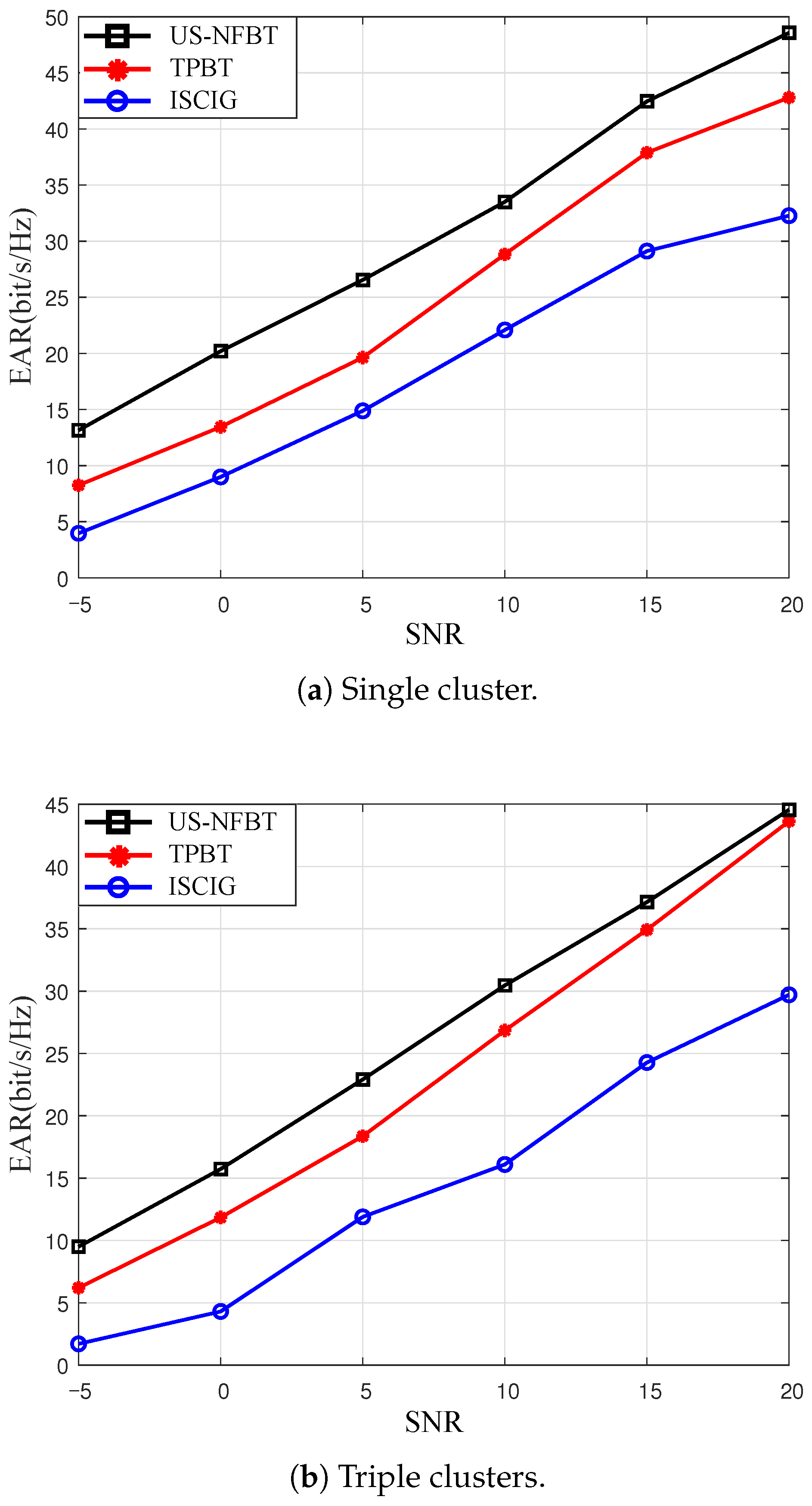
| SNR (dB) | EAR (bit/s/Hz) | ||
|---|---|---|---|
| US-NFBT | TPBT | ISCIG | |
| −5 | 13.17 | 8.93 | 4.14 |
| 0 | 20.19 | 13.63 | 8.86 |
| 5 | 26.54 | 19.93 | 15.04 |
| 10 | 33.50 | 28.53 | 22.42 |
| 15 | 42.45 | 37.56 | 28.86 |
| 20 | 48.57 | 43.21 | 32.47 |
Disclaimer/Publisher’s Note: The statements, opinions and data contained in all publications are solely those of the individual author(s) and contributor(s) and not of MDPI and/or the editor(s). MDPI and/or the editor(s) disclaim responsibility for any injury to people or property resulting from any ideas, methods, instructions or products referred to in the content. |
© 2025 by the authors. Licensee MDPI, Basel, Switzerland. This article is an open access article distributed under the terms and conditions of the Creative Commons Attribution (CC BY) license.
Share and Cite
Xiang, Y.; Yan, Y.; Song, Y.; Gao, J.; You, X.; Wang, J.; Liang, H.; Jiang, Y. Hierarchical MAB Framework for Energy-Aware Beam Training for Near-Field Communications. Sensors 2026, 26, 60. https://doi.org/10.3390/s26010060
Xiang Y, Yan Y, Song Y, Gao J, You X, Wang J, Liang H, Jiang Y. Hierarchical MAB Framework for Energy-Aware Beam Training for Near-Field Communications. Sensors. 2026; 26(1):60. https://doi.org/10.3390/s26010060
Chicago/Turabian StyleXiang, Yunxing, Yi Yan, Yunchao Song, Jing Gao, Xiaohui You, Jun Wang, Huibin Liang, and Yixin Jiang. 2026. "Hierarchical MAB Framework for Energy-Aware Beam Training for Near-Field Communications" Sensors 26, no. 1: 60. https://doi.org/10.3390/s26010060
APA StyleXiang, Y., Yan, Y., Song, Y., Gao, J., You, X., Wang, J., Liang, H., & Jiang, Y. (2026). Hierarchical MAB Framework for Energy-Aware Beam Training for Near-Field Communications. Sensors, 26(1), 60. https://doi.org/10.3390/s26010060