RELoc: An Enhanced 3D WiFi Fingerprinting Indoor Localization Algorithm with RFECV Feature Selection
 , , , and
Abstract
1. Introduction
- ▪
- An RFECV-based feature selection pipeline that leverages cross-validation to identify the most spatially discriminative APs is introduced. This strategy significantly reduces input dimensionality while preserving informative feature sets.
- ▪
- An enhanced WiFi fingerprinting framework called RELoc is proposed that achieves reliable and high-accuracy 2D and 3D coordinate regression.
- ▪
- The effectiveness of the proposed RELoc is validated using the SODIndoorLoc and UTSIndoorLoc WiFi fingerprinting datasets, demonstrating strong generalizability and robustness across diverse indoor environments.
- ▪
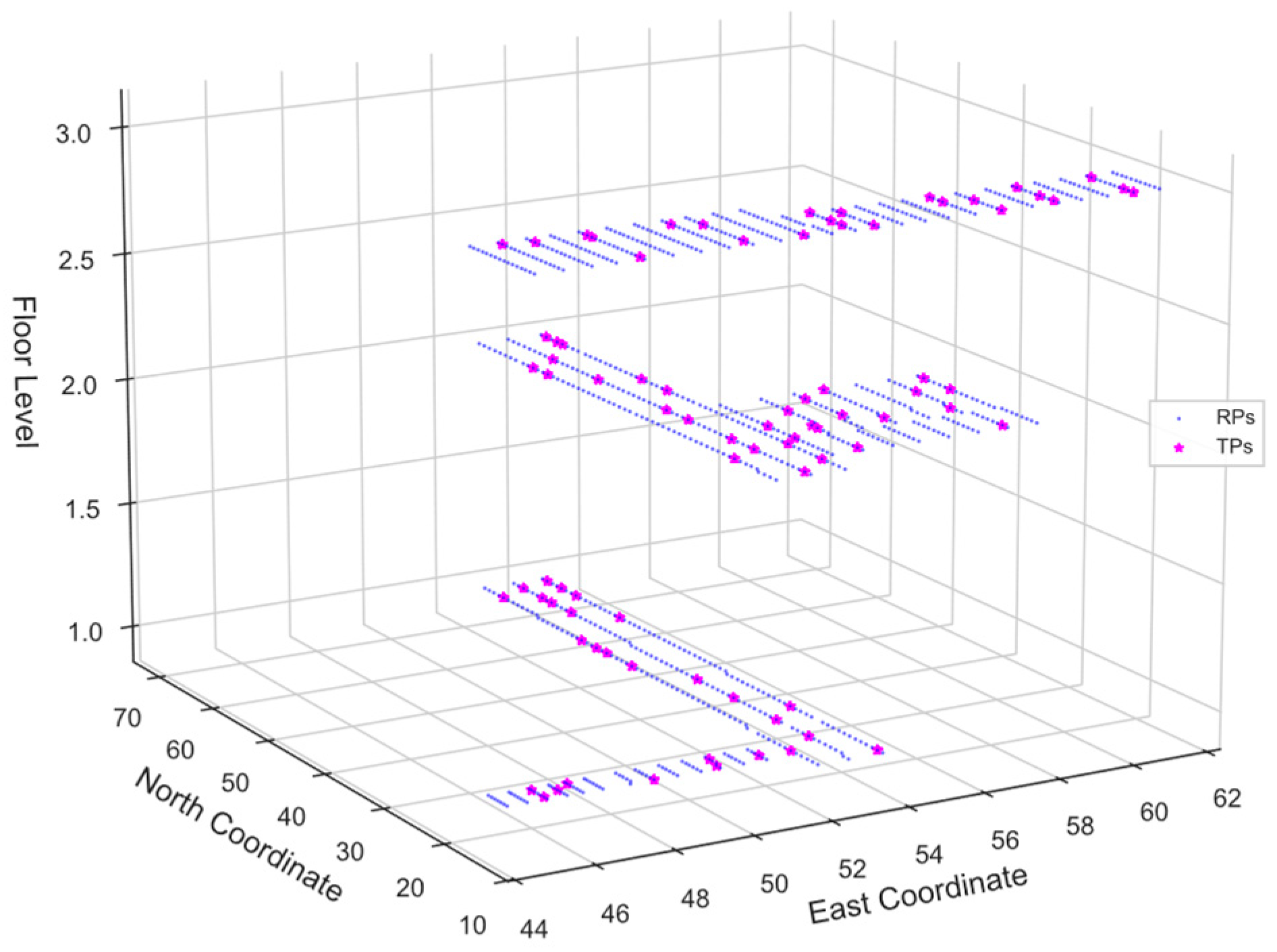
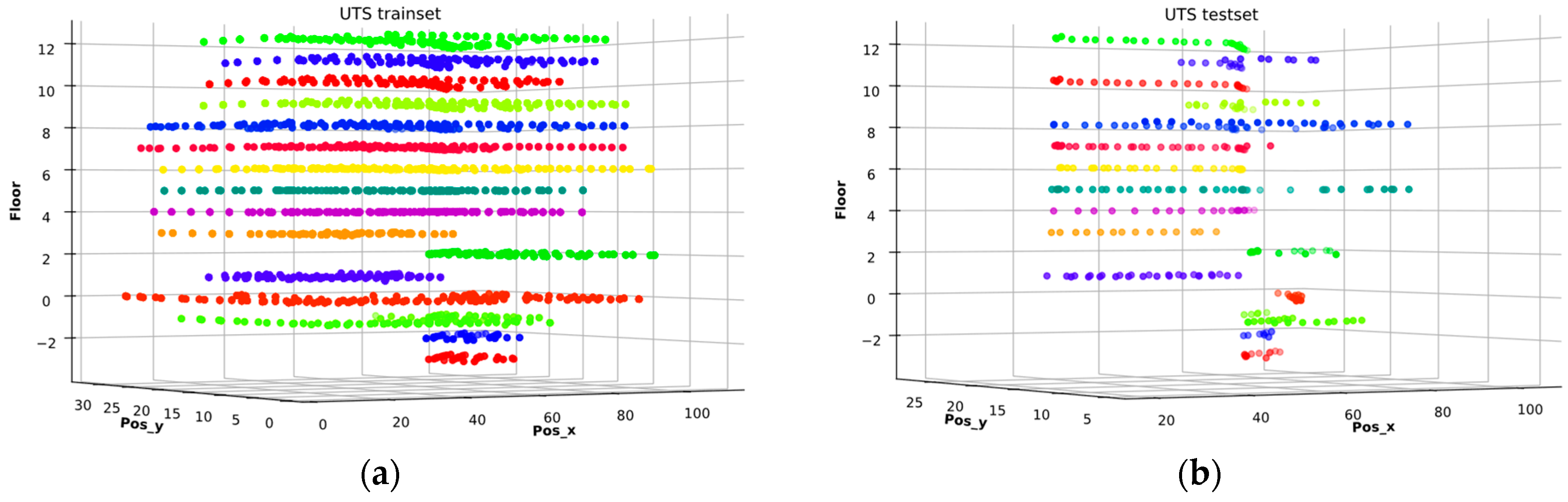
- The incorporation of floor-level information as an additional spatial dimension resolves inter-floor ambiguity and yields consistent performance gains up to 33.15% and 26.88% improvement over 2D localization on the respective datasets. This improvement highlights the necessity of vertical awareness in real-world indoor positioning systems.
2. Related Work
3. Materials and Methods
3.1. RFECV Feature Selection
| Algorithm 1: Pseudocode for RFECV-based feature selection |
| Input: Training set: (): feature matrix, with samples and features and corresponding target vector : ERT_regressor CV parameters: , Number of folds, Shuffle True RFE parameters: Step size , number of features to remove at each iteration, and , min. number of features to retain Output: Optimal feature set: and importance score of each selected feature
end while
|
3.2. Extremely Randomized Trees
| Algorithm 2: Pseudocode for selection of ERT splitting rule |
| 1. Input: training subset |
| -dimensional vector from the sample |
| number of randomly selected features |
| minimum number of instances needed to split a node |
| 2. If or all the node observations have identical label |
| Stop splitting and identify the node as a leaf node |
| 3. else |
| Select a random subset of features among original features |
| 4. For each feature in subset Do: |
| Find and as max. and min. values of the feature in subset |
| Get a random cut-point, , uniformly in the range |
| Set as a potential split |
| end for |
| 5. Choose a split so that |
| 6. end if |
| 7. Output: Return the optimal split at the child node . |
3.3. Optuna-Based Bayesian Hyperparameter Optimization
3.4. Dataset Description
3.5. Performance Metrics
4. Results and Discussion
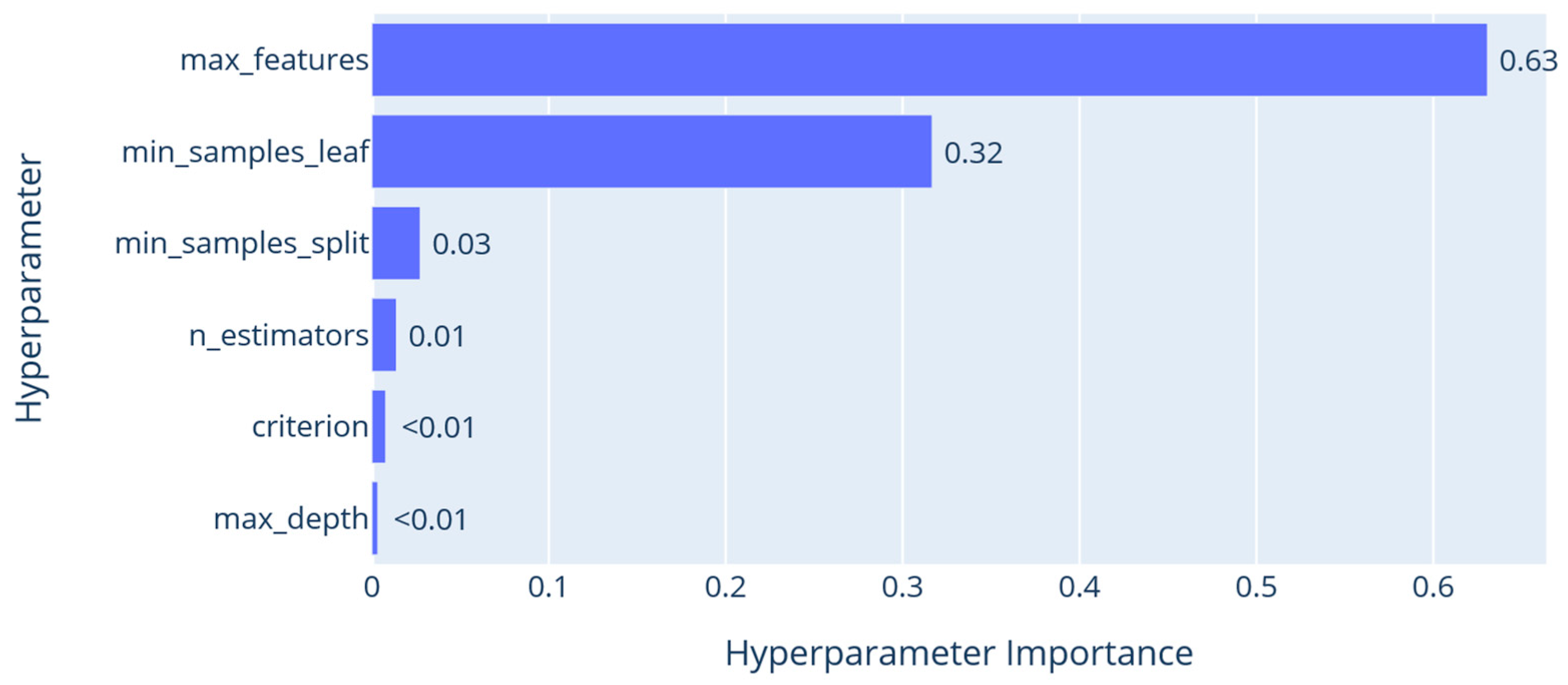
4.1. Hyperparameter Optimization Analysis
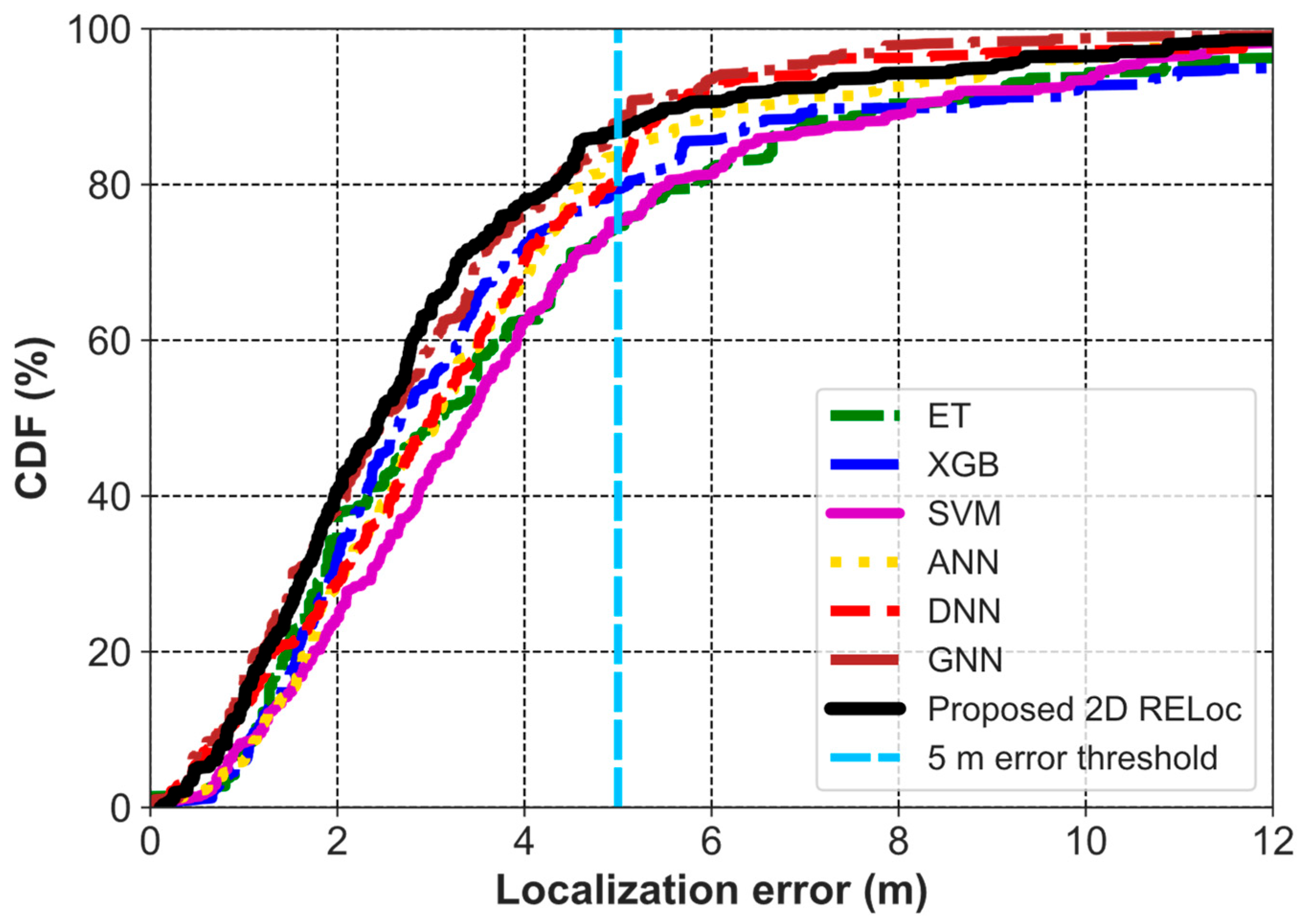
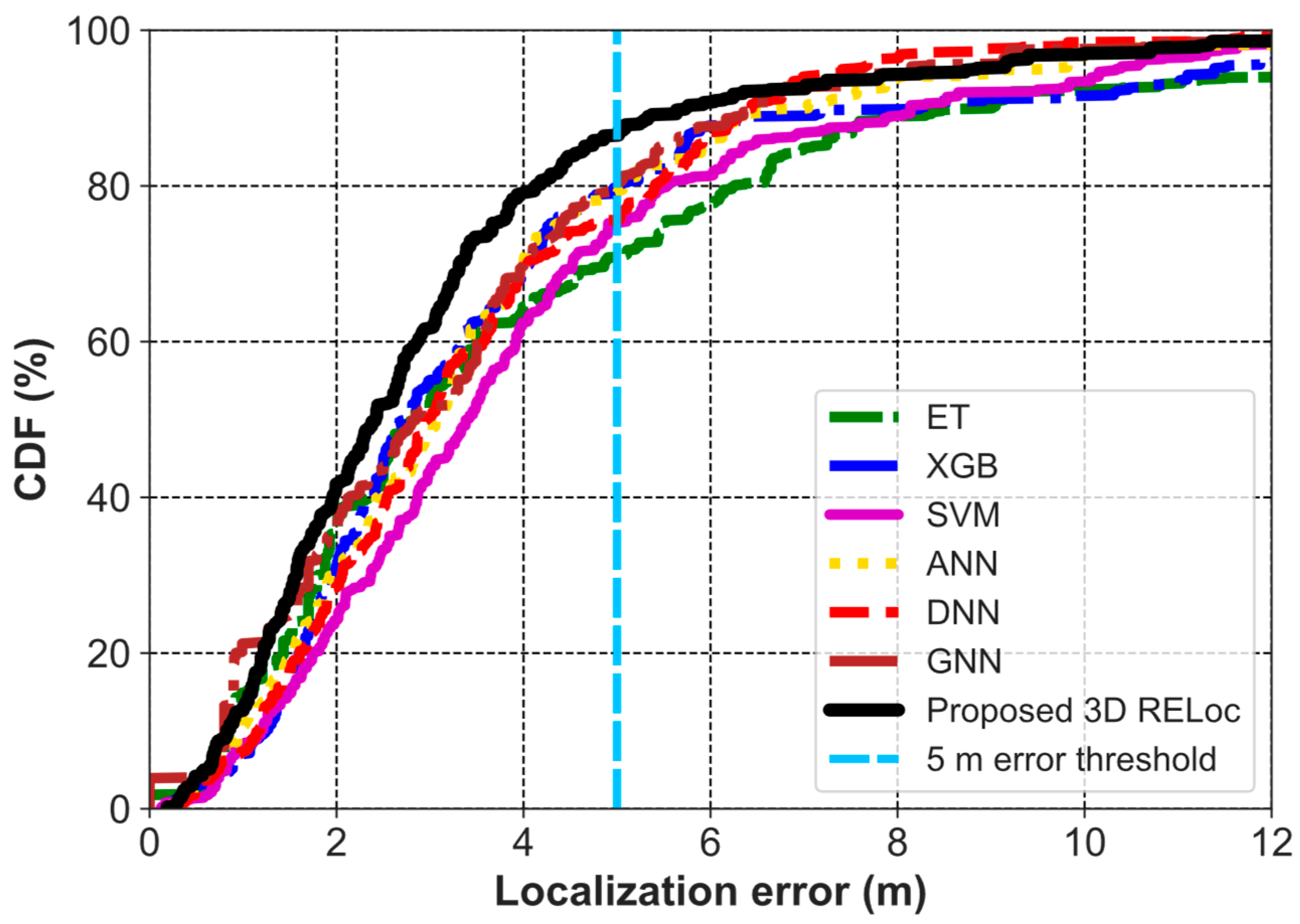
4.2. 3D Localization Performance on SODIndoorLoc
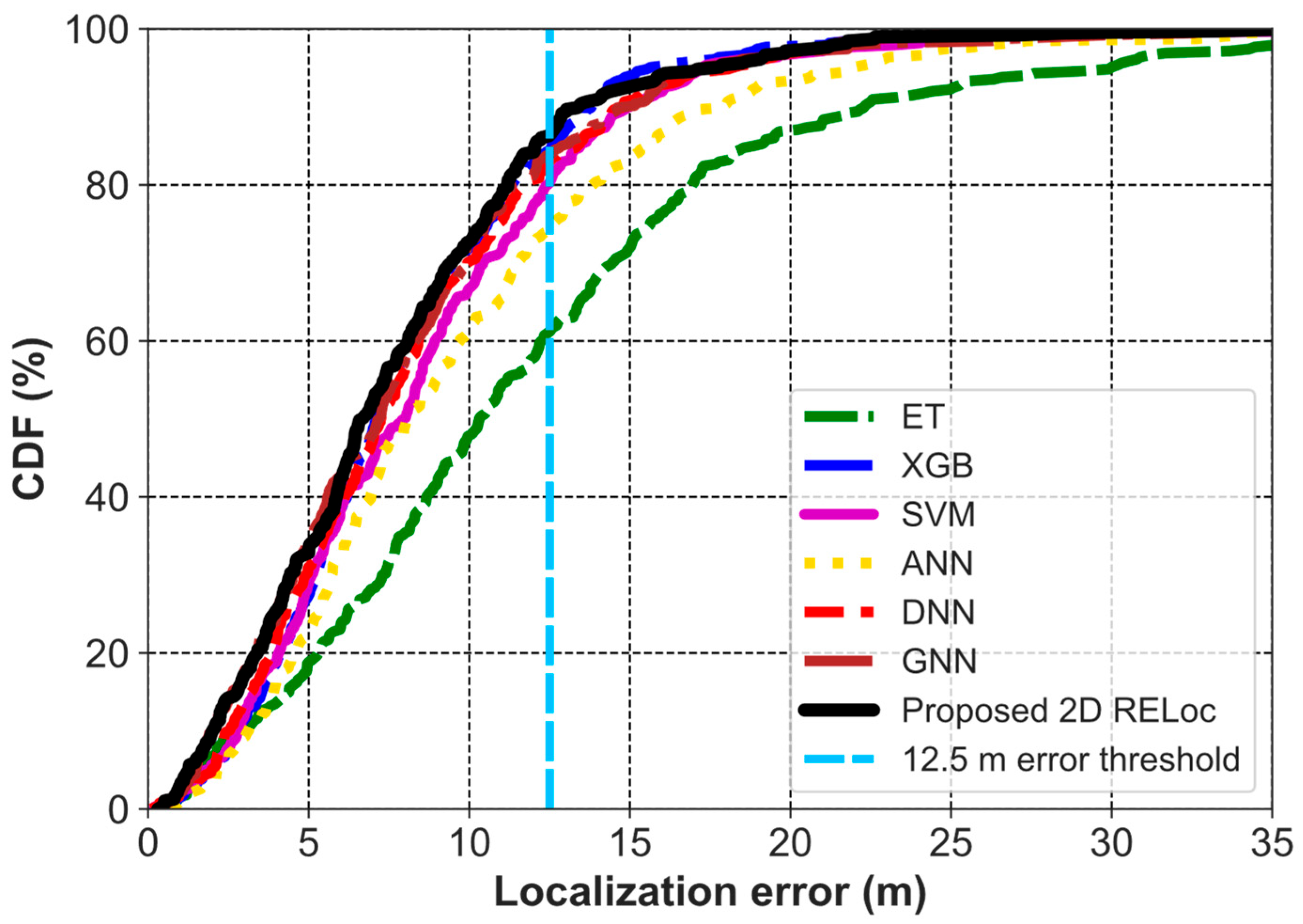
4.3. 3D Localization Performance on UTSIndoorLoc
5. Conclusions
Author Contributions
Funding
Data Availability Statement
Acknowledgments
Conflicts of Interest
Abbreviations
| AI | Artificial Intelligence |
| ANN | Artificial Neural Network |
| APs | Access Points |
| CDF | Cumulative Distribution Function |
| CNN | Convolution Neural Network |
| CSI | Channel State Information |
| DL | Deep leaning |
| EL | Ensemble Learning |
| ERT | Extremely Randomized Trees |
| ET | Extra Tree |
| GPR | Gaussian Process |
| IoT | Internet of Things |
| MAC | Medium Access Control |
| MAE | Mean Absolute Error |
| ML | Machine Learning |
| MLE | Mean Localization Error |
| NLoS | Non-Line-of-Sight |
| RFECV | Recursive Feature Elimination with Cross Validation |
| RF | Random Forest |
| RMSE | Root Mean Squared Error |
| RPs | Reference Points |
| RSSI | Received Signal Strength Indicator |
| PCA | Principal Component Analysis |
| TPs | Testing Points |
| WiFi | Wireless Fidelity |
| WKNN | Weighted K-nearest Neighbours |
| XAI | eXplainable AI |
| XGB | eXtreme Gradient Boosting |
References
- Pettorru, G.; Pilloni, V.; Martalò, M. Trustworthy localization in IoT networks: A survey of localization techniques, threats, and mitigation. Sensors 2024, 24, 2214. [Google Scholar] [CrossRef]
- Wang, S.; Ahmad, N.S. Improved UWB-based indoor positioning system via NLOS classification and error mitigation. Eng. Sci. Technol. Int. J. 2025, 63, 101979. [Google Scholar] [CrossRef]
- Ayinla, S.L.; Abd Aziz, A.; Drieberg, M. SALLoc: An Accurate Target Localization in WiFi-Enabled Indoor Environments via SAE-ALSTM. IEEE Access 2024, 12, 19694–19710. [Google Scholar] [CrossRef]
- Qi, L.; Liu, Y.; Yu, Y.; Chen, L.; Chen, R. Current Status and Future Trends of Meter-Level Indoor Positioning Technology: A Review. Remote Sens. 2024, 16, 398. [Google Scholar] [CrossRef]
- Shang, S.; Wang, L. Overview of WiFi fingerprinting-based indoor positioning. IET Commun. 2022, 16, 725–733. [Google Scholar] [CrossRef]
- Ayinla, S.L.; Abd Aziz, A.; Drieberg, M.; Susanto, M.; Yahya, M. An Enhanced Deep Neural Network Approach for WiFi Fingerprinting-Based Multi-Floor Indoor Localization. IEEE Open J. Commun. Soc. 2025, 6, 560–575. [Google Scholar] [CrossRef]
- Łukasik, S.; Szott, S.; Leszczuk, M. Multimodal image-based indoor localization with machine learning—A systematic review. Sensors 2024, 24, 6051. [Google Scholar] [CrossRef] [PubMed]
- Feng, X.; Nguyen, K.A.; Luo, Z. A review of open access wifi fingerprinting datasets for indoor positioning. IEEE Access 2024. [Google Scholar] [CrossRef]
- Singh, J.; Tyagi, N.; Singh, S.; Ali, F.; Kwak, D. A systematic review of contemporary indoor positioning systems: Taxonomy, techniques, and algorithms. IEEE Internet Things J. 2024, 11, 34717–34733. [Google Scholar] [CrossRef]
- Wang, L.; Shang, S.; Wu, Z. Research on indoor 3D positioning algorithm based on wifi fingerprint. Sensors 2022, 23, 153. [Google Scholar] [CrossRef]
- Alitaleshi, A.; Jazayeriy, H.; Kazemitabar, J. EA-CNN: A smart indoor 3D positioning scheme based on Wi-Fi fingerprinting and deep learning. Eng. Appl. Artif. Intell. 2023, 117, 105509. [Google Scholar] [CrossRef]
- Yaro, A.S.; Maly, F.; Prazak, P. A survey of the performance-limiting factors of a 2-Dimensional RSS fingerprinting-based indoor wireless localization system. Sensors 2023, 23, 2545. [Google Scholar] [CrossRef]
- Suroso, D.J.; Adiyatma, F.Y.M. C-MEL: Consensus-based Multiple Ensemble Learning for Indoor Device-Free Localization through Fingerprinting. IEEE Access 2024, 12, 166381–166392. [Google Scholar] [CrossRef]
- García, C.E.; Koo, I. Extremely randomized trees regressor scheme for mobile network coverage prediction and REM construction. IEEE Access 2023, 11, 65170–65180. [Google Scholar] [CrossRef]
- Grinsztajn, L.; Oyallon, E.; Varoquaux, G. Why do tree-based models still outperform deep learning on typical tabular data? Adv. Neural Inf. Process. Syst. 2022, 35, 507–520. [Google Scholar]
- Tahat, A.; Awwad, R.; Baydoun, N.; Al-Nabih, S.; A. Edwan, T. An Empirical Evaluation of Machine Learning Algorithms for Indoor Localization using Dual-Band WiFi. In Proceedings of the 2021 European Symposium on Software Engineering, New York, NY, USA, 19–21 November 2021; pp. 106–111. [Google Scholar]
- Duong, T.H.; Trinh, A.V.; Hoang, M.K. Efficient and Accurate Indoor Positioning System: A Hybrid Approach Integrating PCA, WKNN, and Linear Regression. J. Commun. 2024, 19, 37–43. [Google Scholar] [CrossRef]
- Kakisim, A.G.; Turgut, Z.; Atmaca, T. XAI empowered dual band Wi-Fi based indoor localization via ensemble learning. In Proceedings of the 2023 14th International Conference on Network of the Future (NoF), Izmir, Turkey, 4–6 October 2023; pp. 150–158. [Google Scholar]
- Bi, J.; Wang, Y.; Yu, B.; Cao, H.; Shi, T.; Huang, L. Supplementary open dataset for WiFi indoor localization based on received signal strength. Satell. Navig. 2022, 3, 25. [Google Scholar] [CrossRef]
- Ding, J.; Wang, Y.; Fu, S.; Si, H.; Zhang, J.; Gao, S. Multiview features fusion and Adaboost based indoor localization on Wifi platform. IEEE Sens. J. 2022, 22, 16607–16616. [Google Scholar] [CrossRef]
- Singh, N.; Choe, S.; Punmiya, R.; Kaur, N. XGBLoc: XGBoost-Based Indoor Localization in Multi-Building Multi-Floor Environments. Sensors 2022, 22, 6629. [Google Scholar] [CrossRef] [PubMed]
- Maduranga, M.W.P.; Tilwari, V.; Abeysekera, R. Improved RSSI Indoor Localization in IoT Systems with Machine Learning Algorithms. Signals 2023, 4, 651–668. [Google Scholar] [CrossRef]
- Narasimman, S.C.; Alphones, A. Dumbloc: Dumb indoor localization framework using wifi fingerprinting. IEEE Sens. J. 2024, 24, 14623–14630. [Google Scholar] [CrossRef]
- Kakisim, A.G.; Turgut, Z. Multi-channel convolutional neural network with attention mechanism using dual-band WiFi signals for indoor positioning systems in smart buildings. Internet Things 2025, 29, 101435. [Google Scholar] [CrossRef]
- Acosta, M.R.C.; Ahmed, S.; Garcia, C.E.; Koo, I. Extremely randomized trees-based scheme for stealthy cyber-attack detection in smart grid networks. IEEE Access 2020, 8, 19921–19933. [Google Scholar] [CrossRef]
- Wang, X.; Jin, Y.; Schmitt, S.; Olhofer, M. Recent advances in Bayesian optimization. ACM Comput. Surv. 2023, 55, 1–36. [Google Scholar] [CrossRef]
- Akiba, T.; Sano, S.; Yanase, T.; Ohta, T.; Koyama, M. Optuna: A next-generation hyperparameter optimization framework. In Proceedings of the Proceedings of the 25th ACM SIGKDD International Conference on Knowledge Discovery & Data Mining, Anchorage, AK, USA, 4–8 August 2019; pp. 2623–2631. [Google Scholar]
- Hanifi, S.; Cammarono, A.; Zare-Behtash, H. Advanced hyperparameter optimization of deep learning models for wind power prediction. Renew. Energy 2024, 221, 119700. [Google Scholar] [CrossRef]
- Song, X.; Fan, X.; Xiang, C.; Ye, Q.; Liu, L.; Wang, Z.; He, X.; Yang, N.; Fang, G. A novel convolutional neural network based indoor localization framework with WiFi fingerprinting. IEEE Access 2019, 7, 110698–110709. [Google Scholar] [CrossRef]
- Aziz, T.; Camana, M.R.; Garcia, C.E.; Hwang, T.; Koo, I. REM-based indoor localization with an extra-trees regressor. Electronics 2023, 12, 4350. [Google Scholar] [CrossRef]
- Zheng, J.; Li, K.; Zhang, X. Wi-Fi fingerprint-based indoor localization method via standard particle swarm optimization. Sensors 2022, 22, 5051. [Google Scholar] [CrossRef]
- Ghoshal, S.; Saif, S.; Biswas, S. Optimizing Indoor Positioning: ANN-GD Fusion for Enhanced Accuracy in WiFi Fingerprint-Based Surveillance Systems. SN Comput. Sci. 2025, 6, 511. [Google Scholar] [CrossRef]
- Cha, J.; Lim, E. A hierarchical auxiliary deep neural network architecture for large-scale indoor localization based on Wi-Fi fingerprinting. Appl. Soft Comput. 2022, 120, 108624. [Google Scholar] [CrossRef]
- Wang, S.; Zhang, S.; Ma, J.; Dobre, O.A. Graph Neural Network-Based WiFi Indoor Localization System With Access Point Selection. IEEE Internet Things J. 2024, 11, 33550–33564. [Google Scholar] [CrossRef]
- Li, S.; Kim, K.S.; Tang, Z.; Smith, J.S. Hierarchical Stage-Wise Training of Linked Deep Neural Networks for Multi-Building and Multi-Floor Indoor Localization Based on Wi-Fi RSSI Fingerprinting. IEEE Sens. J. 2024, 25, 23341–23351. [Google Scholar] [CrossRef]
- Kargar-Barzi, A.; Farahmand, E.; Chatrudi, N.T.; Mahani, A.; Shafique, M. An edge-based WiFi fingerprinting indoor localization using convolutional neural network and convolutional auto-encoder. IEEE Access 2024, 12, 85050–85060. [Google Scholar] [CrossRef]
- Torres-Sospedra, J.; Pendão, C.; Silva, I.; Meneses, F.; Quezada-Gaibor, D.; Montoliu, R.; Crivello, A.; Barsocchi, P.; Pérez-Navarro, A.; Moreira, A. Let’s Talk about k-NN for Indoor Positioning: Myths and Facts in RF-based Fingerprinting. In Proceedings of the 2023 13th International Conference on Indoor Positioning and Indoor Navigation (IPIN), Nuremberg, Germany, 25–28 September 2023; pp. 1–6. [Google Scholar]
- Zhang, S.; Zhang, G.; Chen, R.; Wang, Y. Multiple Similarity Analysis-Based Deep Metric Learning for Enhancing Wi-Fi Fingerprint Indoor Localization. IEEE Internet Things J. 2024, 11, 35681–35688. [Google Scholar] [CrossRef]
- Shen, G.; Sun, Y.; Lu, F. Enhancing Wi-Fi RSS-Based Indoor Positioning under Dynamic AP Availability: Leveraging Virtual Feature Maps and Contrastive Learning. IEEE Sens. J. 2024, 24, 27902–27913. [Google Scholar] [CrossRef]
- Zhuang, C.; Zhang, D. A robust wifi localization algorithm using data augmentation and stacked denoising autoencoder. In Proceedings of the 2023 35th Chinese Control and Decision Conference (CCDC), Yichang, China, 20–23 May 2023; pp. 1445–1450. [Google Scholar]
- Kim, D.; Park, J.-H.; Suh, Y.-J. A Wi-Fi Fingerprinting Indoor Localization Framework Using Feature-Level Augmentation via Variational Graph Auto-Encoder. Electronics 2025, 14, 2807. [Google Scholar] [CrossRef]



| Method | Hyperparameter Combination |
|---|---|
| ET | Criterion = squared error, splitter = random, max_features = 1.0, min_samples_split = 2, and min_samples_leaf = 1 |
| XGB | n_estimators = 500, max_depth = 50, learning_rate = 0.01, objective = reg: squarederror, colsample_bytree = 0.1, min_child_weight = subsample = colsample_bylevel = 1.0 |
| SVM | Kernel = RBF, C = 1, gamma = 0.01, epsilon = 0.001 |
| ANN | HL = 256, 128, 64, max_iter = 100, learning_rate = constant, solver = Adam, activation = ReLU |
| DNN | HL = 256, 128, 64, learning_rate = 0.01, HL activation = ReLU, output activation = Sigmoid, dropout = 0.3, optimizer = Adam |
| GNN | Activation = ReLU, learning_rate = 0.001, dropout = 0.3, optimizer = Adam, Batch size = 8, epochs = 150 |
| Coordinate | Method | MAE (m) | RMSE (m) | R2 (%) | MLE (m) |
|---|---|---|---|---|---|
| 2D | ET | 2.50 | 4.16 | 73.80 | 4.24 |
| XGB | 2.22 | 3.23 | 88.21 | 3.83 | |
| SVM | 2.38 | 3.25 | 85.72 | 4.07 | |
| ANN | 2.14 | 2.95 | 87.55 | 3.60 | |
| DNN | 2.02 | 2.94 | 85.42 | 3.42 | |
| GNN | 1.80 | 2.69 | 85.20 | 2.97 | |
| Proposed 2D RELoc | 1.84 | 2.75 | 90.44 | 3.14 | |
| 3D | ET | 1.74 | 3.03 | 77.02 | 4.45 |
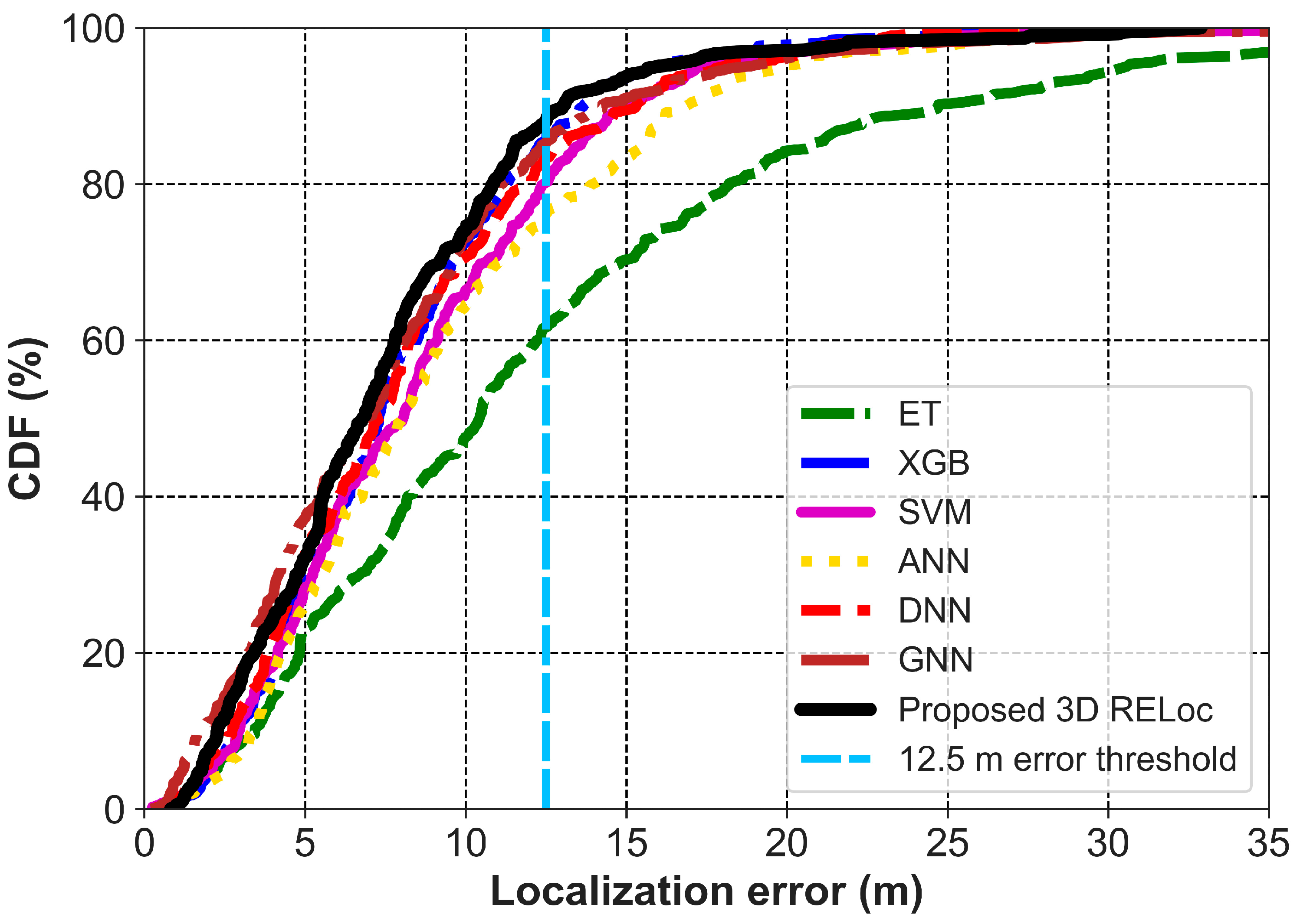
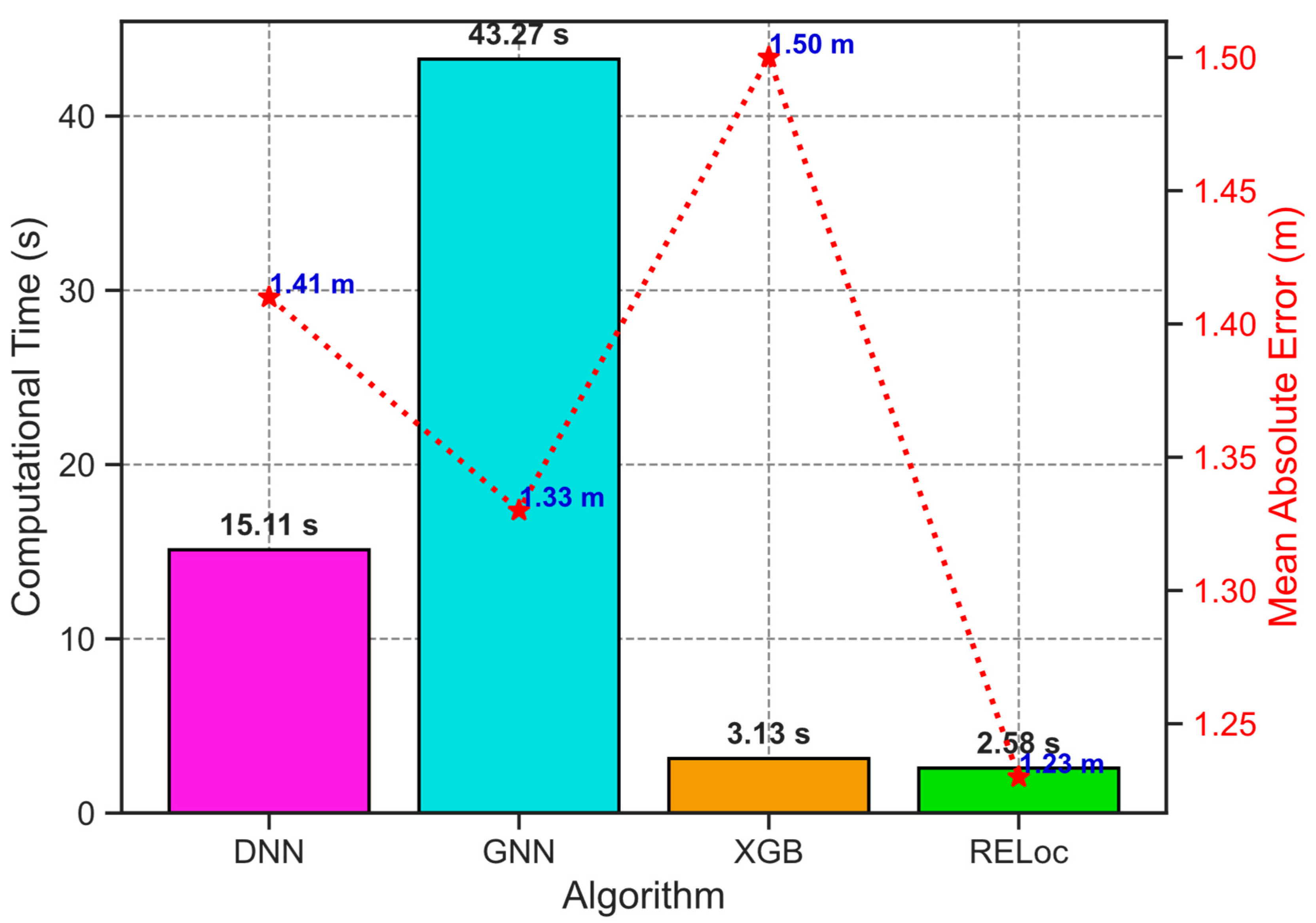
| XGB | 1.50 | 2.20 | 91.59 | 3.86 | |
| SVM | 1.60 | 2.20 | 89.94 | 4.07 | |
| ANN | 1.44 | 2.04 | 91.56 | 3.63 | |
| DNN | 1.41 | 1.97 | 90.46 | 3.57 | |
| GNN | 1.33 | 1.98 | 88.19 | 3.36 | |
| Proposed 3D RELoc | 1.23 | 1.85 | 93.25 | 3.11 |
| Coordinate | Method | MAE (m) | RMSE (m) | R2 (%) | MLE (m) |
|---|---|---|---|---|---|
| 2D | ET | 7.33 | 9.62 | 2.23 | 11.92 |
| XGB | 4.86 | 6.07 | 65.07 | 7.97 | |
| SVM | 5.29 | 6.77 | 52.19 | 8.55 | |
| ANN | 6.31 | 8.07 | 47.80 | 10.45 | |
| DNN | 4.95 | 6.29 | 63.05 | 8.14 | |
| GNN | 4.89 | 6.53 | 52.83 | 7.79 | |
| Proposed 2D RELoc | 4.39 | 5.79 | 68.53 | 7.30 | |
| 3D | ET | 5.37 | 7.41 | 23.09 | 12.41 |
| XGB | 3.36 | 4.22 | 76.44 | 8.03 | |
| SVM | 3.75 | 4.84 | 66.24 | 8.63 | |
| ANN | 3.94 | 4.97 | 70.89 | 9.24 | |
| DNN | 3.46 | 4.50 | 73.59 | 8.16 | |
| GNN | 3.25 | 4.77 | 68.29 | 7.91 | |
| Proposed 3D RELoc | 3.21 | 4.16 | 78.41 | 7.60 |
| SODIndoorLoc | UTSIndoorLoc | ||||||
|---|---|---|---|---|---|---|---|
| Ref. | Method | MAE (m) | RMSE (m) | Ref. | Method | RMSE (m) | MLE (m) |
| [19] | RFR | 3.74 | 4.17 | [35] | HDNN | 7.80 | |
| [19] | MLPR | 5.15 | 3.63 | [36] | CAE-CNN | 7.70 | |
| [37] | WKNN | 2.43 | [29] | CNNLoc | 7.60 | ||
| [38] | 2D CNN-MS | 2.15 | [34] | GNN | 7.48 | ||
| [39] | VF-CLIP | 1.88 | 2.53 | [40] | MLP-SDAE | 7.25 | |
| [24] | MC-ACNNR | 2.06 | 3.08 | [41] | FALoc | 6.26 | 7.14 |
| This work | 2D RELoc | 1.84 | 2.75 | This work | 2D RELoc | 5.79 | 7.30 |
| 3D RELoc | 1.23 | 1.85 | 3D RELoc | 4.16 | 7.60 | ||
Disclaimer/Publisher’s Note: The statements, opinions and data contained in all publications are solely those of the individual author(s) and contributor(s) and not of MDPI and/or the editor(s). MDPI and/or the editor(s) disclaim responsibility for any injury to people or property resulting from any ideas, methods, instructions or products referred to in the content. |
© 2026 by the authors. Licensee MDPI, Basel, Switzerland. This article is an open access article distributed under the terms and conditions of the Creative Commons Attribution (CC BY) license.
Share and Cite
Ayinla, S.L.; Abd Aziz, A.; Drieberg, M.; Susanto, M.; Laouiti, A. RELoc: An Enhanced 3D WiFi Fingerprinting Indoor Localization Algorithm with RFECV Feature Selection. Sensors 2026, 26, 326. https://doi.org/10.3390/s26010326
Ayinla SL, Abd Aziz A, Drieberg M, Susanto M, Laouiti A. RELoc: An Enhanced 3D WiFi Fingerprinting Indoor Localization Algorithm with RFECV Feature Selection. Sensors. 2026; 26(1):326. https://doi.org/10.3390/s26010326
Chicago/Turabian StyleAyinla, Shehu Lukman, Azrina Abd Aziz, Micheal Drieberg, Misfa Susanto, and Anis Laouiti. 2026. "RELoc: An Enhanced 3D WiFi Fingerprinting Indoor Localization Algorithm with RFECV Feature Selection" Sensors 26, no. 1: 326. https://doi.org/10.3390/s26010326
APA StyleAyinla, S. L., Abd Aziz, A., Drieberg, M., Susanto, M., & Laouiti, A. (2026). RELoc: An Enhanced 3D WiFi Fingerprinting Indoor Localization Algorithm with RFECV Feature Selection. Sensors, 26(1), 326. https://doi.org/10.3390/s26010326