The KUYUY Accelerograph and SIPA System: Towards Low-Cost, Real-Time Intelligent Seismic Monitoring in Peru
 , , , , , , and
Abstract
1. Introduction
1.1. Overview of International Accelerographic Networks
1.2. National Background of Accelerographic Instrumentation in Peru
2. Methodology
2.1. Design of the KUYUY Device
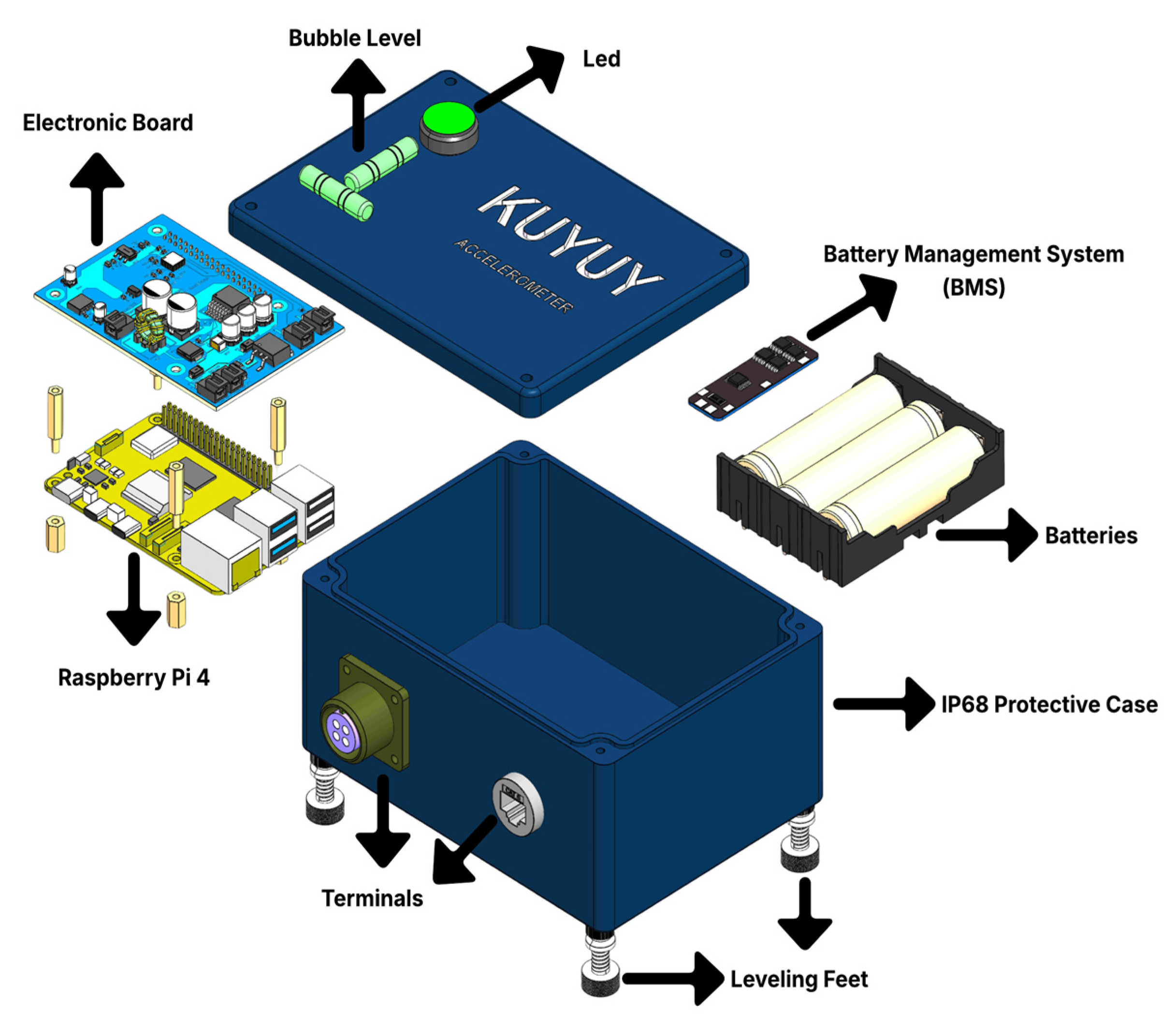
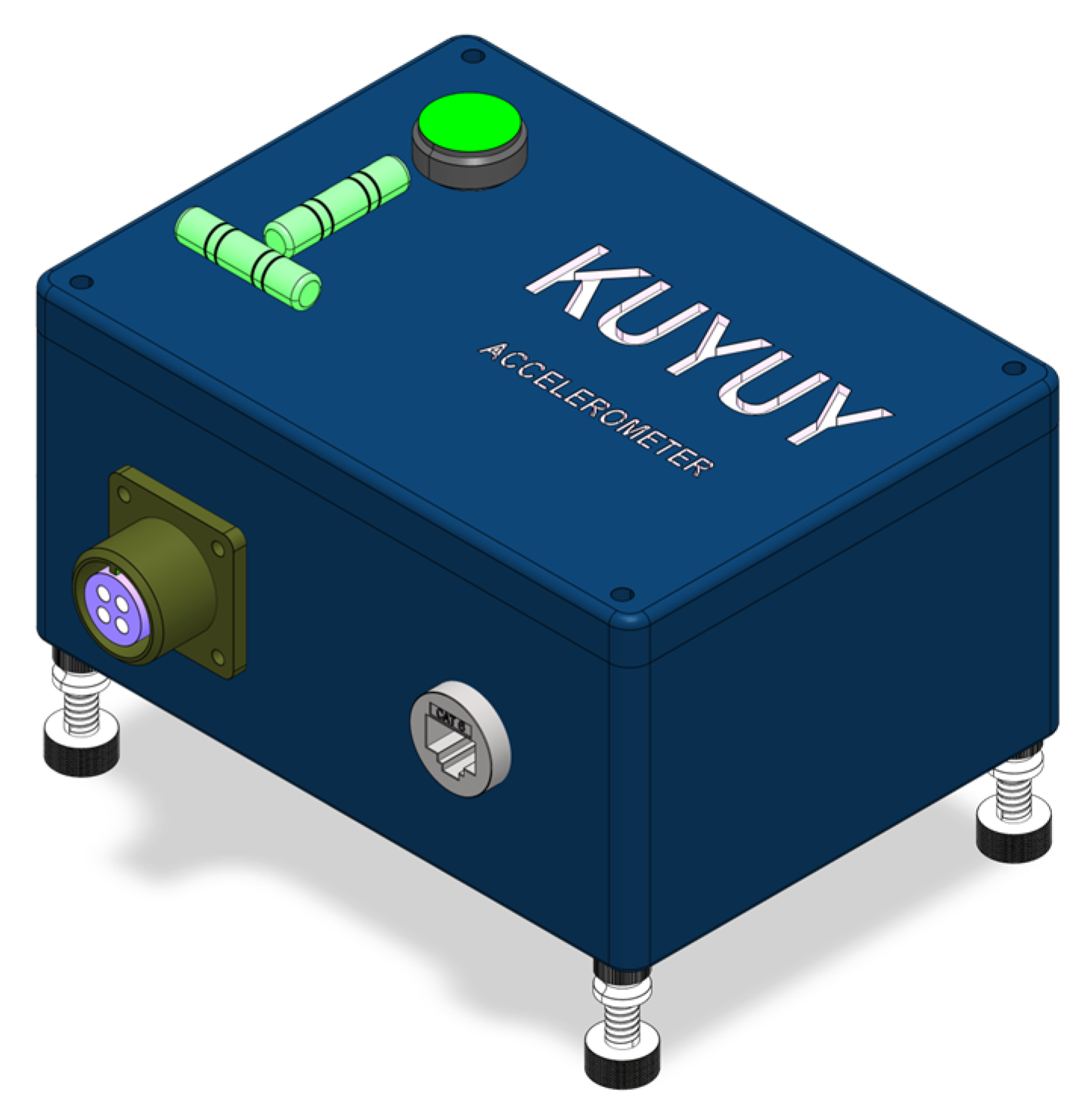
2.1.1. Mechanical Design
2.1.2. Electronic Design
2.2. Data Acquisition and Transmission to the Central Server
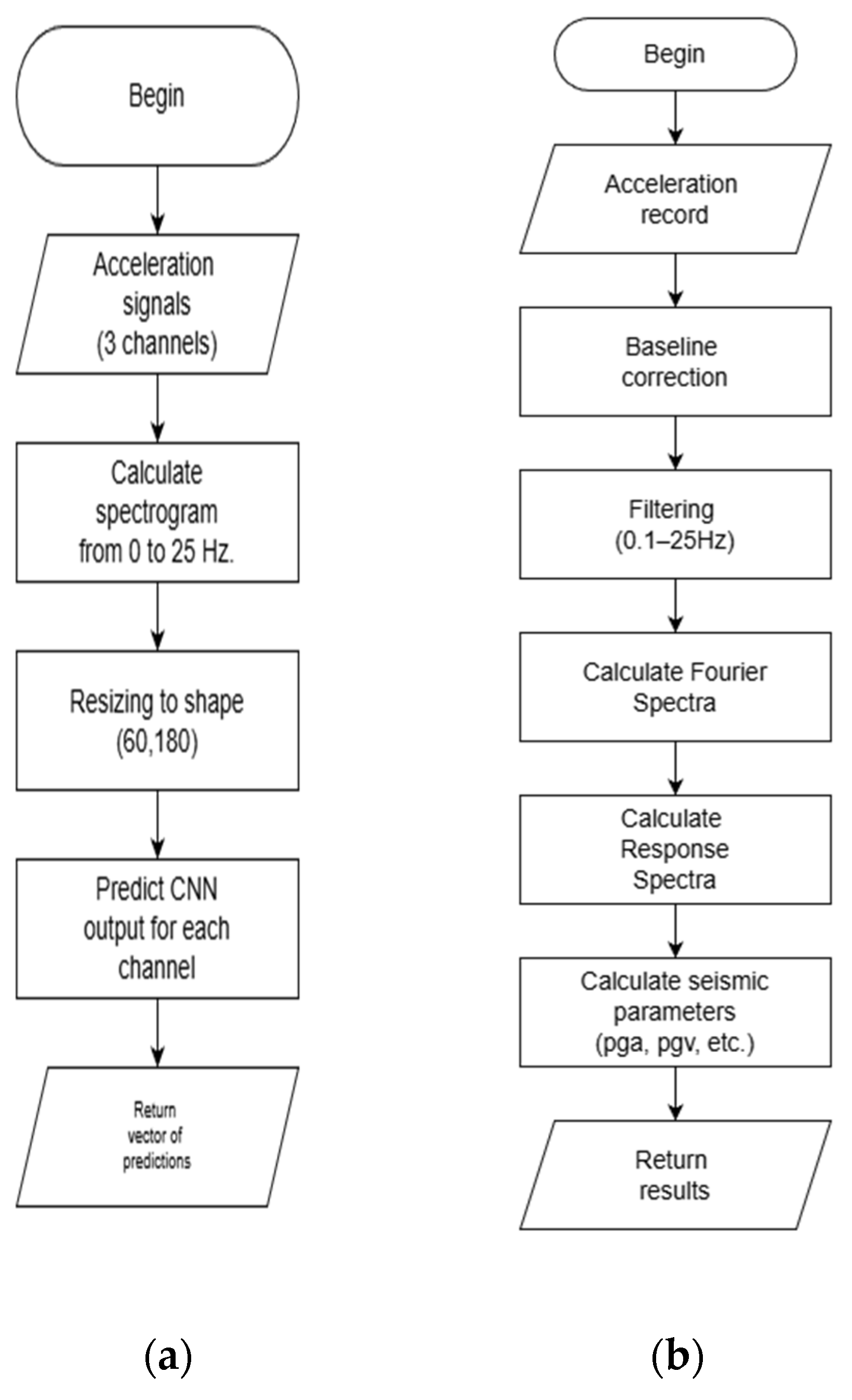
2.3. Intelligent Accelerographic Processing System (SIPA)
- Automatic Seismic–Non-Seismic Discrimination: A deep learning classifier distinguishes ground motions produced by earthquake activity from those generated by non-seismic sources, such as traffic, industrial machinery, wind, or electronic interference.
- Signal Correction and Conditioning: The system performs baseline removal procedures, applies band-pass filtering, and suppresses instrumental noise to ensure the physical consistency of the processed acceleration records.
- Computation of Seismic Engineering Parameters: From the corrected three-component acceleration signals, SIPA derives peak ground acceleration (PGA), peak ground velocity (PGV), Arias intensity, maximum displacement, and elastic response spectra, which are relevant for structural and seismological analyses.
2.3.1. Data Collection
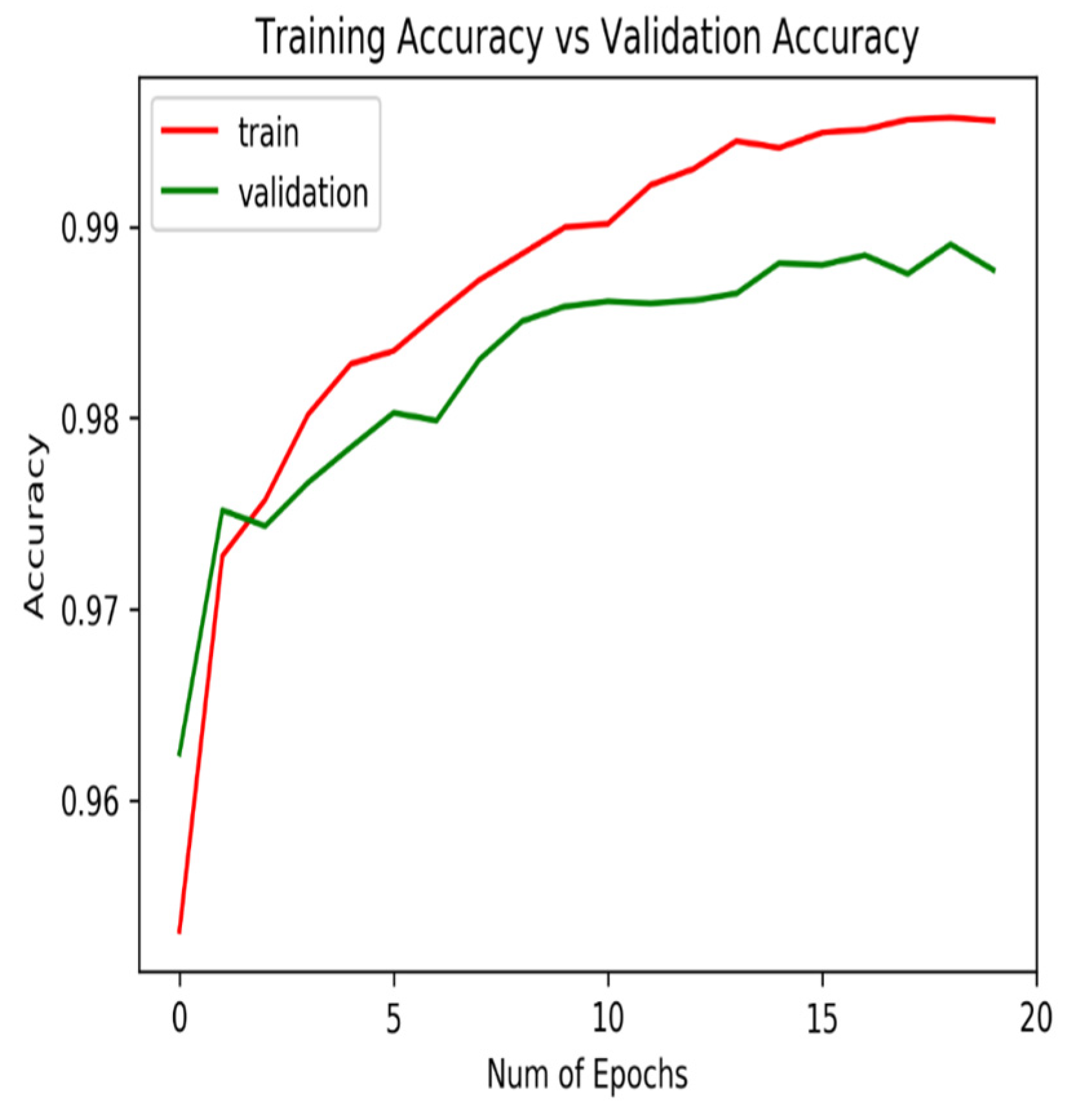
2.3.2. Training Process
2.3.3. Performance of the Model
3. Results
3.1. Static Gravity Calibration
- Z-axis vertical and upward (positive gravity);
- Z-axis vertical and downward (negative gravity);
- X and Y axes are oriented similarly by rotating the device about its axis.
3.2. Dynamic Validation
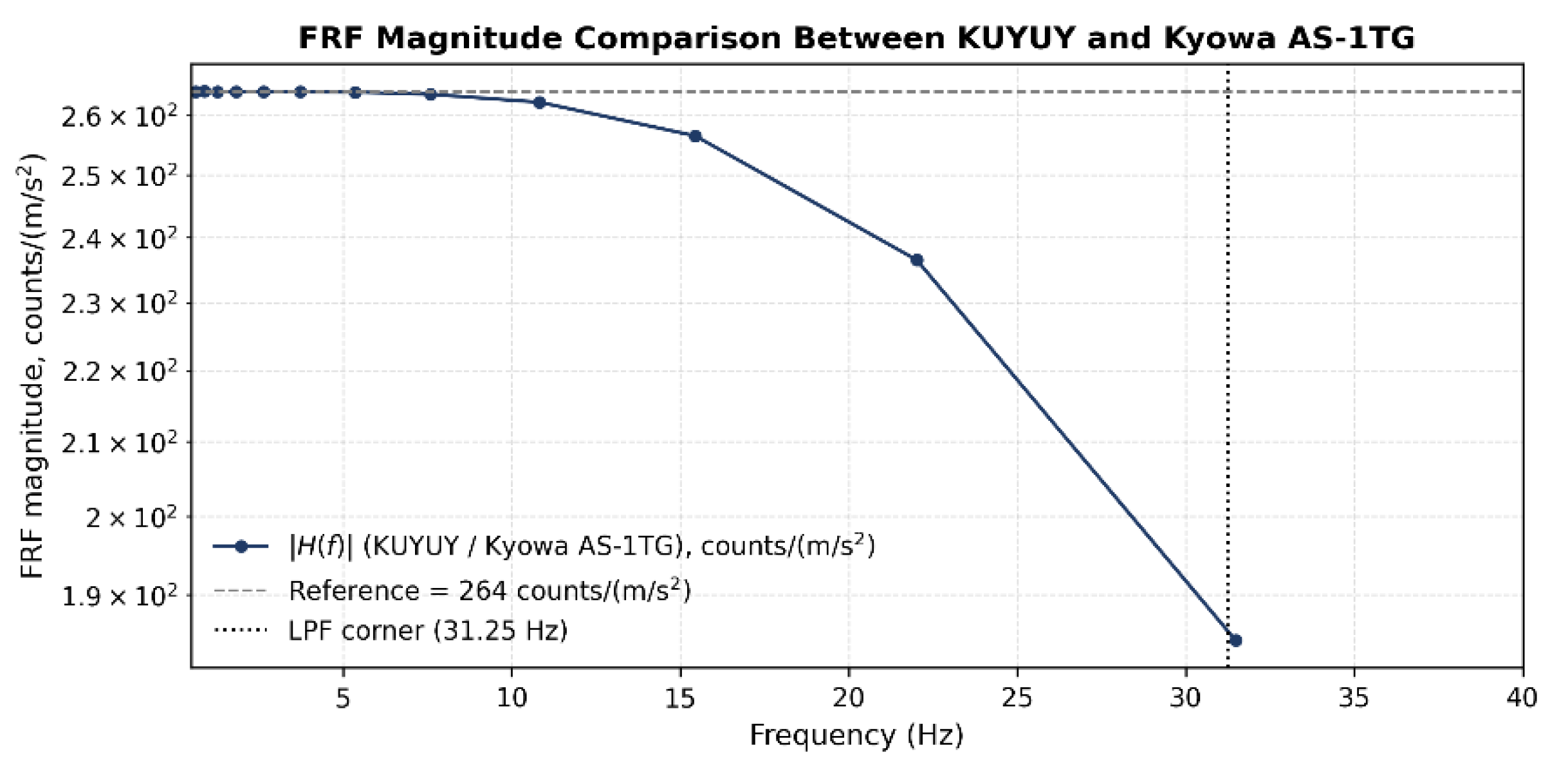
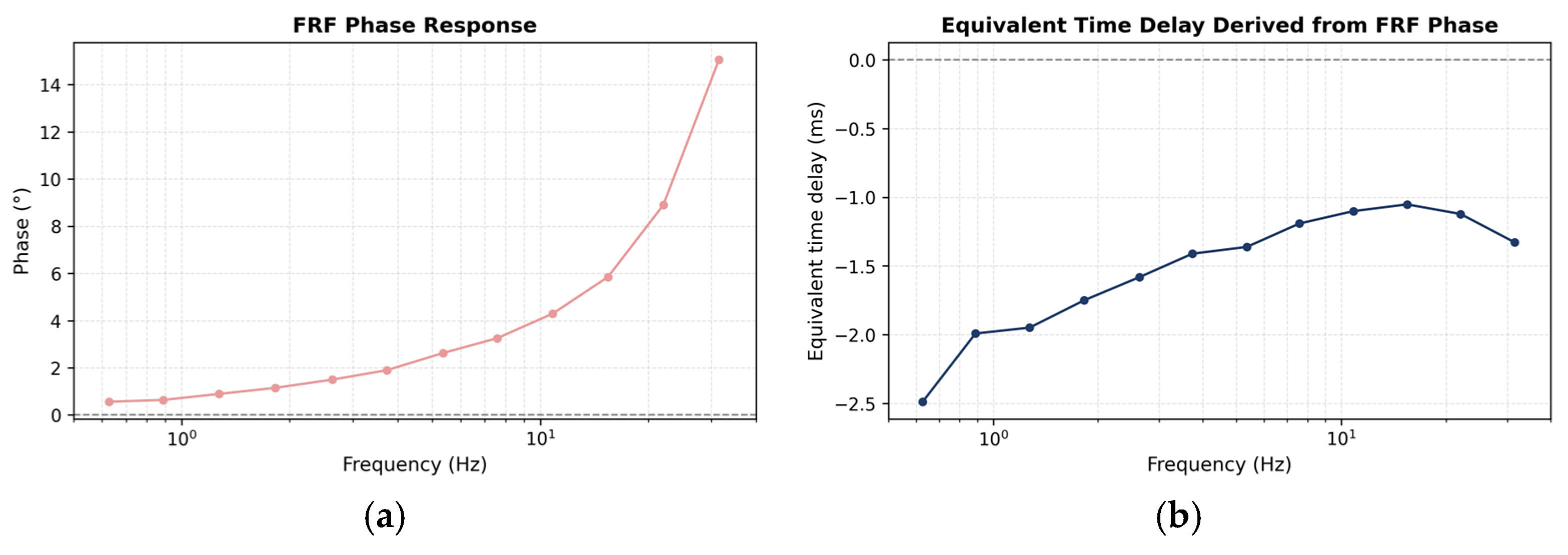
3.3. Validation Against a Reference Accelerograph
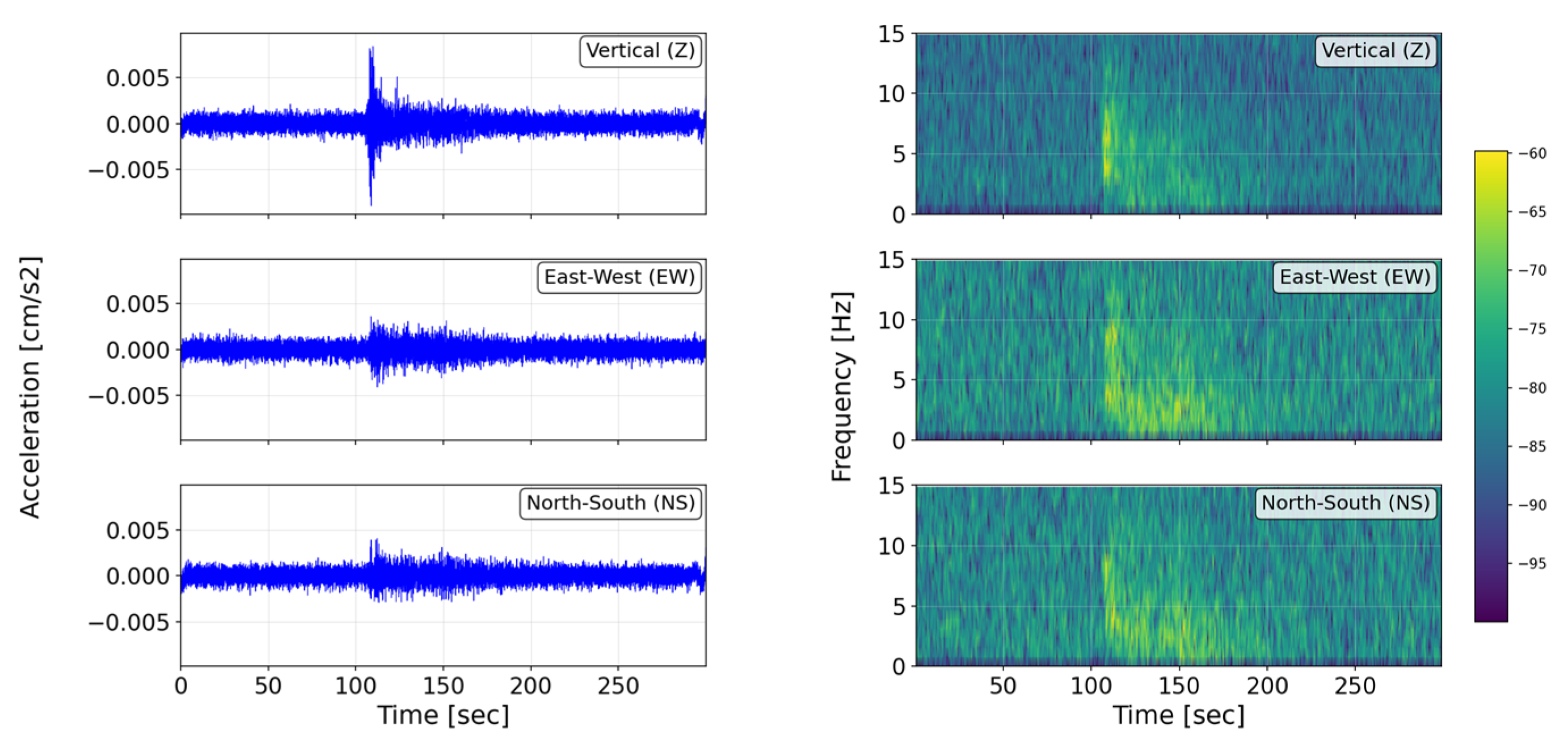
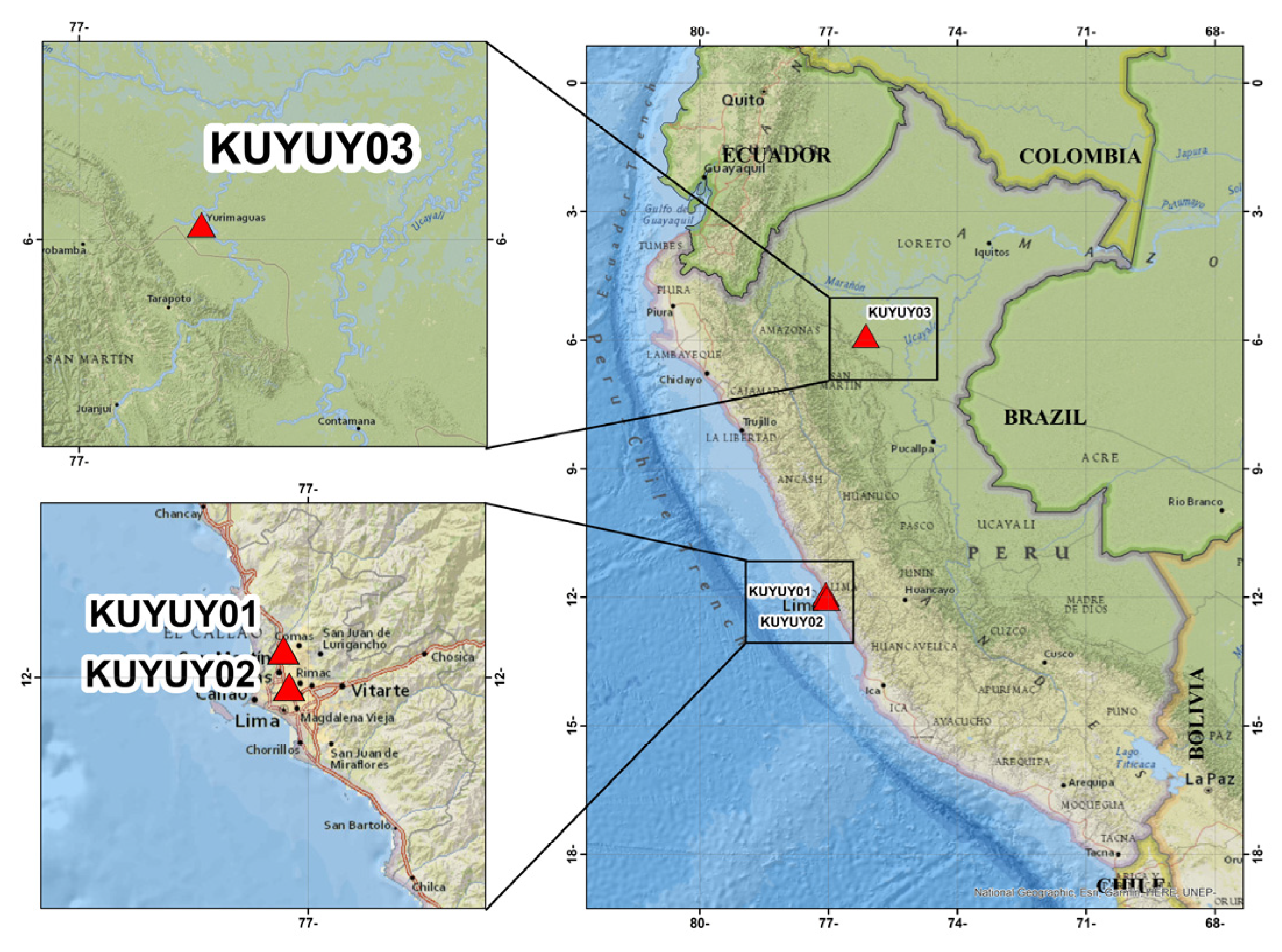
3.4. Field Testing in Real Scenarios
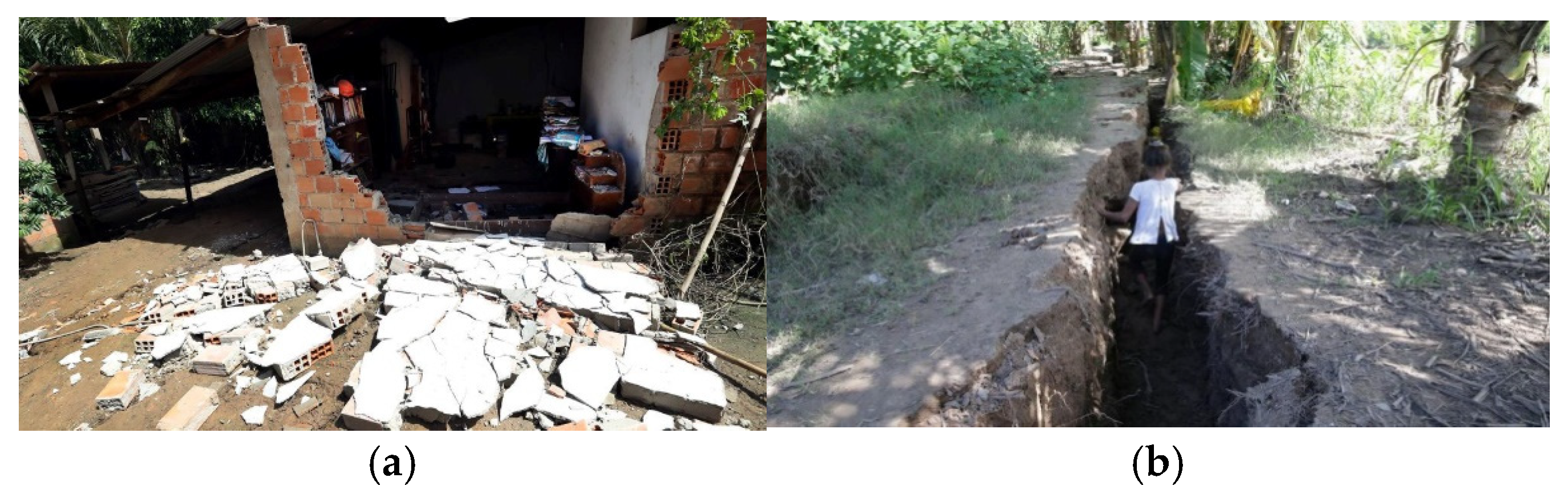
Field Records and Detected Events
3.5. Results from the Intelligent Accelerographic Processing System (SIPA)
4. Discussion of Results
5. Conclusions
6. Patents
Author Contributions
Funding
Institutional Review Board Statement
Informed Consent Statement
Data Availability Statement
Acknowledgments
Conflicts of Interest
References
- Hudson, D.E. Reading and Interpreting Strong-Motion Accelerograms; Earthquake Engineering Research Institute: Oakland, CA, USA, 1979. [Google Scholar]
- Trifunac, M.D.; Todorovska, M.I. Evolution of accelerographs, data processing, strong motion arrays and amplitude and spatial resolution in recording strong earthquake motion. Soil Dyn. Earthq. Eng. 2001, 21, 537–555. [Google Scholar] [CrossRef]
- Trifunac, M.D. 75th anniversary of strong motion observation—A historical review. Soil Dyn. Earthq. Eng. 2009, 29, 591–606. [Google Scholar] [CrossRef]
- Michelini, A.; Margheriti, L.; Cattaneo, M.; Cecere, G.; D’Anna, G.; Delladio, A.; Moretti, M.; Pintore, S.; Amato, A.; Basili, A.; et al. The italian national seismic network and the earthquake and tsunami monitoring and surveillance systems. Adv. Geosci. 2016, 43, 31–38. [Google Scholar] [CrossRef][Green Version]
- Marchetti, A.; Barba, S.; Cucci, L.; Pirro, M. Performances of the italian seismic network, 1985–2002: The hidden thing. Ann. Geophys. 2004, 49. [Google Scholar] [CrossRef]
- Çelebi, M.; Nishenko, S.; Astill, C.; Chung, R.M. Seismic Instrumentation of Federal Buildings: A Proposal Document for Consideration by Federal Agencies; Report No.: 98–117; U.S. Geological Survey: Reston, VA, USA, 1998; pp. 2–16.
- FEMA. NEHRP Recommended Seismic Provisions for New Buildings and Other Structures; Report No. P-1050-1; Federal Emergency Management Agency: Washington, DC, USA, 2015; Volume I, pp. i–xxxvi, 1–410.
- Evans, J.R.; Allen, R.M.; Chung, A.I.; Cochran, E.S.; Guy, R.; Hellweg, M.; Lawrence, J.F. Performance of several low-cost accelerometers. Seismol. Res. Lett. 2014, 85, 147–158. [Google Scholar] [CrossRef]
- Clayton, R.W.; Heaton, T.; Kohler, M.; Chandy, M.; Guy, R.; Bunn, J. Community seismic network: A dense array to sense earthquake strong motion. Seismol. Res. Lett. 2015, 86, 1354–1363. [Google Scholar] [CrossRef]
- Di Nuzzo, F.; Brunelli, D.; Polonelli, T.; Benini, L. Structural health monitoring system with narrowband IoT and MEMS sensors. IEEE Sens. J. 2017, 21, 16371–16380. [Google Scholar] [CrossRef]
- De Alteriis, G.; Conte, C.; Caputo, E.; Chiariotti, P.; Accardo, D.; Cigada, A.; Moriello, R.S.L. Low-cost and high-performance solution for positioning and monitoring of large structures. Sensors 2022, 22, 1788. [Google Scholar] [CrossRef]
- Zhu, W.; Hou, A.; Yang, R.; Datta, A.; Mousavi, S.M.; Ellsworth, W.L.; Beroza, G.C. QuakeFlow: A scalable machine-learning-based earthquake monitoring workflow with cloud computing. Geophys. J. Int. 2023, 232, 684–693. [Google Scholar] [CrossRef]
- Papanikolaou, V.K.; Karakostas, C.Z.; Theodoulidis, N.P. A low-cost instrumentation system for seismic hazard assessment in urban areas. Sensors 2021, 21, 3618. [Google Scholar] [CrossRef]
- Xie, Y.; Zhang, S.; Meng, X.; Nguyen, D.T.; Ye, G.; Li, H. An innovative sensor integrated with GNSS and accelerometer for bridge health monitoring. Remote Sens. 2024, 16, 607. [Google Scholar] [CrossRef]
- Crognale, M.; Rinaldi, C.; Potenza, F.; Gattulli, V.; Colarieti, A.; Franchi, F. Developing and testing high-performance SHM sensors mounting low-noise MEMS accelerometers. Sensors 2024, 24, 2435. [Google Scholar] [CrossRef]
- Vlachos, I.; Anagnostou, M.N.; Avlonitis, M.; Karakostas, V. Upgrading a low-cost seismograph for monitoring local seismicity. GeoHazards 2025, 6, 4. [Google Scholar] [CrossRef]
- Hasani, H.; Freddi, F.; Piazza, R.; Ceruffi, F. A wireless data acquisition system based on MEMS accelerometers for operational modal analysis of bridges. Sensors 2024, 24, 2121. [Google Scholar] [CrossRef]
- Scarfì, V.; Bragato, F.; De Franco, R.; Peruzza, L. A dense micro-electromechanical system (MEMS)-based seismic network in populated areas: Rapid estimation of exposure maps in trentino (NE italy). Nat. Hazards Earth Syst. Sci. 2024, 24, 1249–1260. [Google Scholar]
- Komarizadehasl, S.; Huguenet, P.; Lozano, F.; Lozano-Galant, J.A.; Turmo, J. Operational and analytical modal analysis of a bridge using low-cost wireless arduino-based accelerometers. Sensors 2022, 22, 9808. [Google Scholar] [CrossRef] [PubMed]
- Komarizadehasl, S.; Lozano, F.; Lozano-Galant, J.A.; Ramos, G.; Turmo, J. Low-cost wireless structural health monitoring of bridges. Sensors 2022, 22, 5725. [Google Scholar] [CrossRef]
- Paziewski, J.; Sieradzki, R.; Rapinski, J.; Tomaszewski, D.; Stepniak, K.; Geng, J.; Li, G. Integrating low-cost GNSS and MEMS accelerometer for precise dynamic displacement monitoring. Measurement 2025, 242, 115798. [Google Scholar]
- Saravanan, T.J.; Mishra, M.; Aherwar, A.D.; Lourenço, P.B. Internet of things (IoT)-based structural health monitoring of laboratory-scale civil engineering structures. Innov. Infrastruct. Solut. 2024, 9, 110. [Google Scholar] [CrossRef]
- Costa, G.; Brondi, P.; Cataldi, L.; Cirilli, S.; Cuius, A.; Ertuncay, D.; Falconer, P.; Filippi, L.; Fornasari, S.F.; Pazzi, V.; et al. Near-Real-Time Strong Motion Acquisition at National Scale and Automatic Analysis. Sensors 2022, 22, 5699. [Google Scholar] [CrossRef] [PubMed]
- Gorini, A.; Nicoletti, M.; Marsan, P.; Bianconi, R.; De Nardis, R.; Filippi, L.; Marcucci, S.; Palma, F.; Zambonelli, E. The Italian strong motion network. Bull. Earthq. Eng. 2010, 8, 1075–1090. [Google Scholar] [CrossRef]
- Bragato, P.L.; Boaga, J.; Capotosti, G.; Comelli, P.; Parolai, S.; Rossi, G.; Siracusa, H.; Ziani, P.; Zuliani, D. Implementing a dense accelerometer network in Veneto (NE Italy): A support for rapid earthquake impact assessment. Bull. Earthq. Eng. 2025, 23, 1859–1884. [Google Scholar] [CrossRef]
- Knudson, C.F.; Pérez, V. Accelerograph records from Lima, Peru. In Proceedings of the Sixth World Conference on Earthquake Engineering, New Delhi, India, 10–14 January 1977. [Google Scholar]
- US Geological Survey. M 7.9—20 km WSW of Chimbote, Peru (1970-05-31) [Internet]. Earthquake Event Page. 1970. Available online: https://earthquake.usgs.gov/earthquakes/eventpage/iscgem796163 (accessed on 7 February 2025).
- Repetto, P.; Arango, I.; Seed, H.B. Influence of Site Characteristics on Building Damage During the 3 October 1974 Lima Earthquake [Internet]; Report No.: UCB/EERC-80/41; Earthquake Engineering Research Center, University of California: Berkeley, CA, USA, 1980. Available online: https://nehrpsearch.nist.gov/static/files/NSF/PB81161739.pdf (accessed on 19 June 2025).
- US Geological Survey. Seismic Engineering Program Report, July–September 1976 [Internet]; Report No.: 736-C; U.S. Geological Survey: Reston, VA, USA, 1977. Available online: https://pubs.usgs.gov/circ/1977/0736c/ (accessed on 19 June 2025).
- Rodríguez-Marek, A.; Bay, J.A.; Park, K.; Montalva, G.A.; Cortez-Flores, A.; Wartman, J.; Boroschek, R. Engineering analysis of ground motion records from the 2001 mw 8.4 southern peru earthquake. Earthq. Spectra 2010, 26, 499–524. [Google Scholar] [CrossRef]
- Tavera, H.; Bernal, I.; Strasser, F.O.; Aaango-Gaviria, M.C.; Alarcon, J.E.; Bommer, J.J. Ground motions observed during the 15 august 2007 pisco, peru earthquake. Bull. Earthq. Eng. 2009, 7, 71–111. [Google Scholar] [CrossRef]
- Alva, J.; Ortiz, C.; Chipana, M.; Valverde, J. Intelligent system for accelerographic processing in Peru. In Proceedings of the 17th World Conference on Earthquake Engineering (17WCEE) [Internet], Sendai, Japan, 13–18 September 2020; Available online: https://www.jorgealvahurtado.com/files/alva%20ortiz%20chipana%20valverde_28012020%20INGLES.pdf (accessed on 3 January 2020).



| Layer | Output | Parameters |
|---|---|---|
| Conv2D_1 | (58, 178, 32) | 320 |
| MaxPooling2D_1 | (29, 89, 32) | 0 |
| Dropout_1 | (29, 89, 32) | 0 |
| Conv2D_2 | (27, 87, 32) | 9248 |
| MaxPooling2D_2 | (13, 43, 32) | 0 |
| Dropout_2 | (13, 43, 32) | 0 |
| Conv2D_3 | (11, 41, 16) | 4624 |
| MaxPooling2D_3 | (5, 20, 16) | 0 |
| Dropout_3 | (5, 20, 16) | 0 |
| Flatten | (1600) | 0 |
| Dense_1 | (512) | 819,712 |
| Dense_2 | (2) | 1026 |
| Total | — | 834,930 |
| Class | Precision | Recall | F1-Score |
|---|---|---|---|
| No Event | 0.9830 | 0.9910 | 0.9870 |
| Event | 0.9920 | 0.9849 | 0.9884 |
| Device | Date (UTC) | Magnitude | (km) | PGA (cm/s2) |
|---|---|---|---|---|
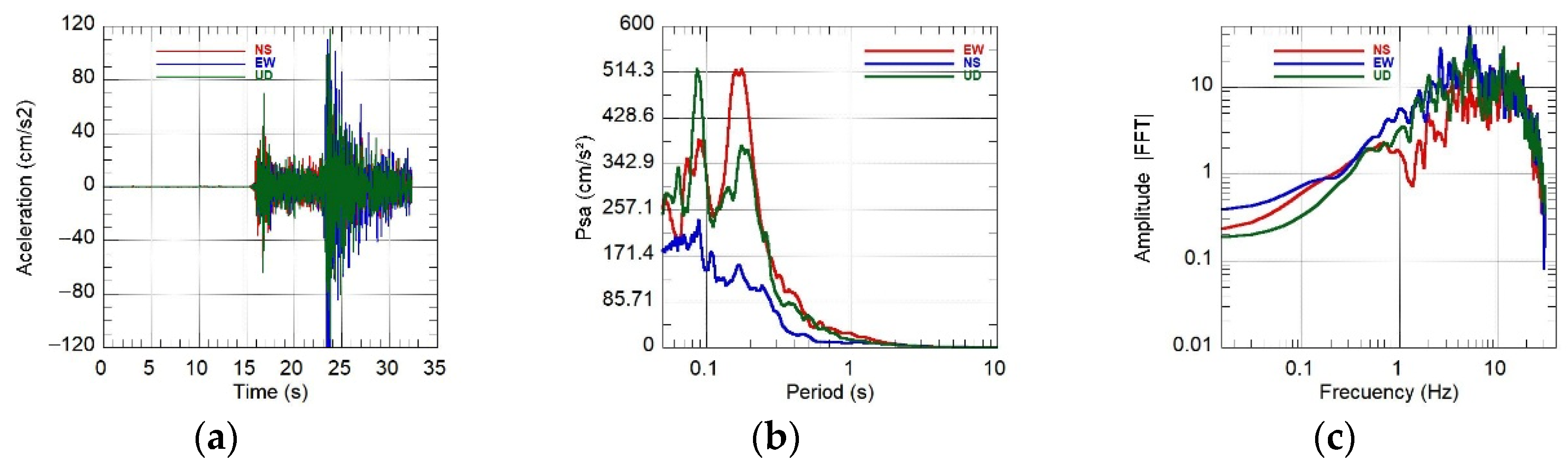
| KUYUY01 | 15 June 2025 16:35:30, Callao | 5.6 Mw | 45.5 | 156.9 |
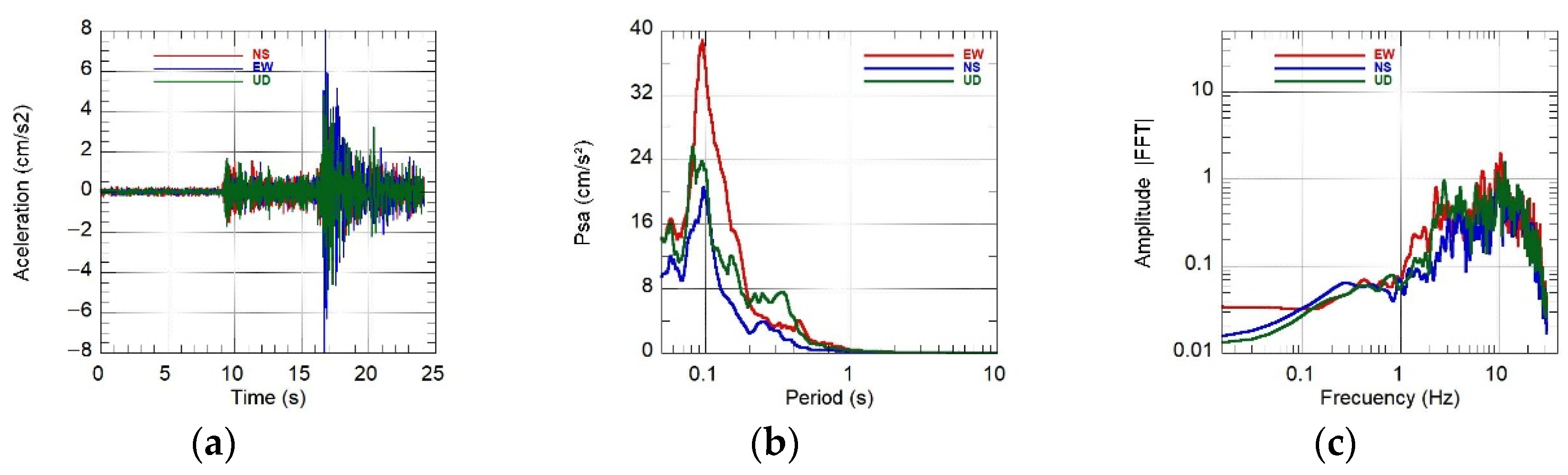
| KUYUY01 | 16 June 2025 17:40:17, Callao | 4.2 ML | 46.6 | 9.2 |
| KUYUY01 | 17 June 2025 05:31:31, Ancón | 3.7 ML | 41.6 | 6.1 |
| KUYUY02 | 15 June 2025 16:35:30, Callao | 5.6 Mw | 41.0 | 123.2 |
| Magnitude Range | Reports (n) | Accelerographs (n) | ||
|---|---|---|---|---|
| min | mean | max | ||
| 1619 | 1 | 3.05 | 26 | |
| 123 | 1 | 8.21 | 34 | |
| 3 | 28 | 34.66 | 44 | |
| Acceleration Range (cm/s2) | Reports (n) |
|---|---|
| 1595 | |
| 135 | |
| 10 | |
| 5 |
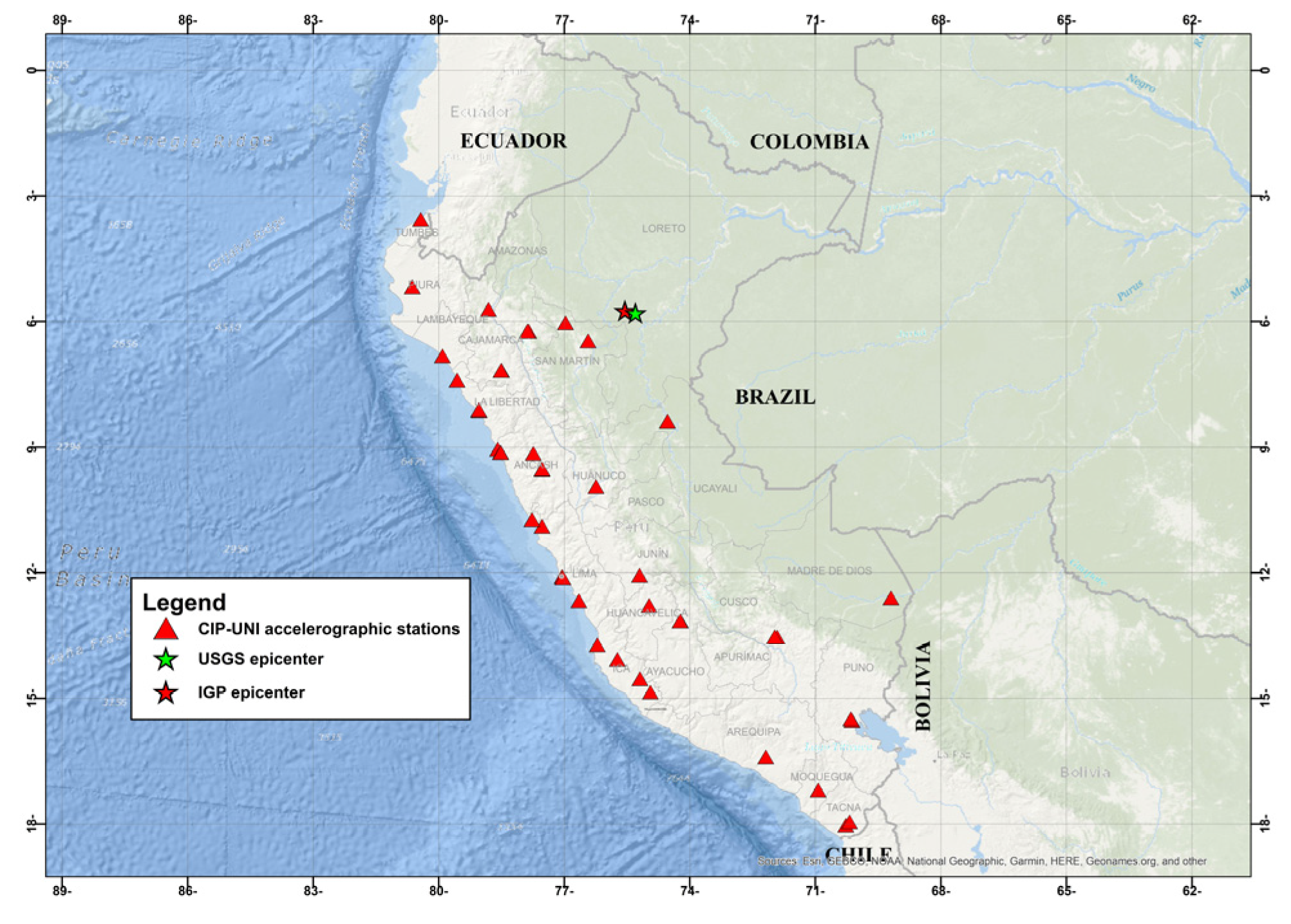
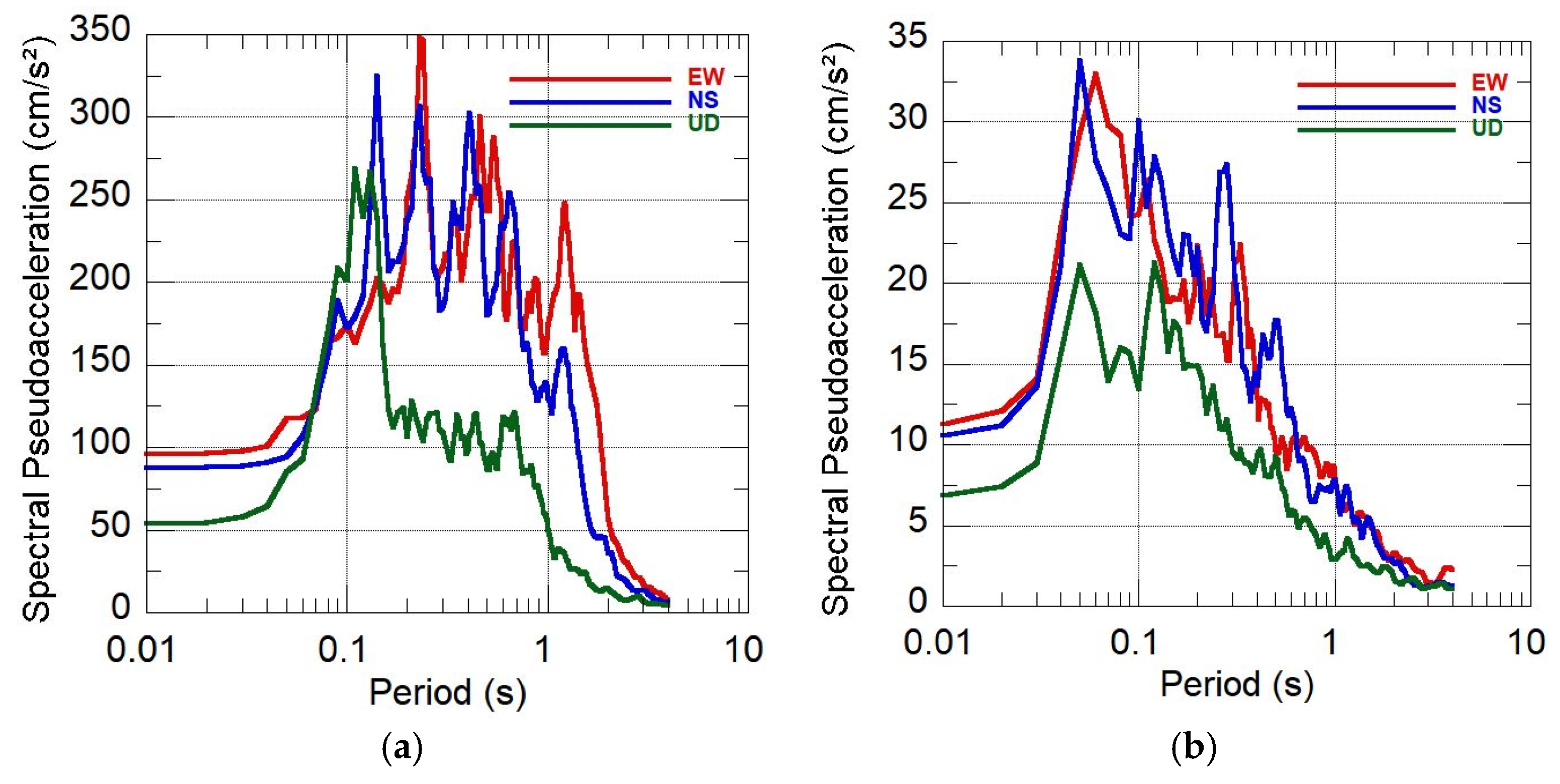
| Station | Comp. | PGA (cm/s2) | PGV (cm/s) | PGD (cm) | (s) | RMS Acc (g) | RMS Vel (cm/s) | RMS Disp (cm) | (m/s) | SED (m2/s) |
|---|---|---|---|---|---|---|---|---|---|---|
| UNTRM | EO | 95.84 | 13.46 | 2.62 | 0.14 | 11.06 | 1.32 | 0.29 | 0.87 | 772.04 |
| NS | 87.45 | 8.34 | 1.49 | 0.10 | 10.64 | 1.06 | 0.20 | 0.81 | 501.81 | |
| V | 53.49 | 3.52 | 0.92 | 0.07 | 6.64 | 0.44 | 0.12 | 0.31 | 84.23 | |
| CIP MOYOBAMBA | EO | 91.29 | 19.13 | 6.62 | 0.21 | 12.96 | 3.40 | 1.51 | 0.81 | 3469.17 |
| NS | 78.76 | 20.85 | 9.14 | 0.26 | 12.39 | 3.48 | 1.64 | 0.74 | 3623.72 | |
| V | 90.16 | 13.08 | 4.21 | 0.15 | 11.43 | 2.09 | 0.70 | 0.63 | 1312.25 | |
| CIP TARAPOTO | EO | 58.18 | 9.00 | 3.04 | 0.15 | 14.15 | 2.03 | 1.07 | 0.35 | 451.00 |
| NS | 79.56 | 10.70 | 3.34 | 0.13 | 16.19 | 2.13 | 0.79 | 0.46 | 491.97 | |
| V | 67.86 | 4.74 | 1.26 | 0.07 | 10.56 | 1.03 | 0.38 | 0.19 | 115.30 | |
| CIP AMAZONAS | EO | 78.91 | 7.32 | 1.70 | 0.09 | 7.79 | 0.79 | 0.20 | 0.43 | 275.13 |
| NS | 53.98 | 5.84 | 1.11 | 0.11 | 7.16 | 0.75 | 0.17 | 0.36 | 249.44 | |
| V | 53.05 | 3.07 | 0.93 | 0.06 | 5.26 | 0.41 | 0.13 | 0.20 | 75.30 | |
| CIP LIMA | EO | 11.06 | 0.74 | 0.28 | 0.07 | 0.92 | 0.08 | 0.06 | 0.01 | 2.89 |
| NS | 10.43 | 0.54 | 0.26 | 0.05 | 0.88 | 0.07 | 0.04 | 0.01 | 2.11 | |
| V | 6.78 | 0.37 | 0.17 | 0.05 | 0.68 | 0.05 | 0.04 | 0.00 | 1.25 |
| Event (UTC) | Mag. | PGAmax (cm/s2) | PGAV (cm/s2) | ||||
|---|---|---|---|---|---|---|---|
| KUYUY01 | RefTek | Deviation (%) | KUYUY01 | RefTek | Deviation (%) | ||
| 15 June 2025 16:35:30 | Mw 5.6 | 156.9 | 159.0 | 117.5 | 114.5 | ||
| 16 June 2025 17:40:17 | ML 4.2 | 9.2 | 9.8 | 5.3 | 4.5 | ||
| 17 June 2025 05:31:31 | ML 3.7 | 6.1 | 6.4 | 4.5 | 4.2 | ||
Disclaimer/Publisher’s Note: The statements, opinions and data contained in all publications are solely those of the individual author(s) and contributor(s) and not of MDPI and/or the editor(s). MDPI and/or the editor(s) disclaim responsibility for any injury to people or property resulting from any ideas, methods, instructions or products referred to in the content. |
© 2025 by the authors. Licensee MDPI, Basel, Switzerland. This article is an open access article distributed under the terms and conditions of the Creative Commons Attribution (CC BY) license.
Share and Cite
Ortiz, C.; Alva, J.; Raucana, R.; Chipana, M.; Oliden, J.; Huarcaya, N.; Riveros, G.; Valverde, J. The KUYUY Accelerograph and SIPA System: Towards Low-Cost, Real-Time Intelligent Seismic Monitoring in Peru. Sensors 2026, 26, 254. https://doi.org/10.3390/s26010254
Ortiz C, Alva J, Raucana R, Chipana M, Oliden J, Huarcaya N, Riveros G, Valverde J. The KUYUY Accelerograph and SIPA System: Towards Low-Cost, Real-Time Intelligent Seismic Monitoring in Peru. Sensors. 2026; 26(1):254. https://doi.org/10.3390/s26010254
Chicago/Turabian StyleOrtiz, Carmen, Jorge Alva, Roberto Raucana, Michael Chipana, José Oliden, Nelly Huarcaya, Grover Riveros, and José Valverde. 2026. "The KUYUY Accelerograph and SIPA System: Towards Low-Cost, Real-Time Intelligent Seismic Monitoring in Peru" Sensors 26, no. 1: 254. https://doi.org/10.3390/s26010254
APA StyleOrtiz, C., Alva, J., Raucana, R., Chipana, M., Oliden, J., Huarcaya, N., Riveros, G., & Valverde, J. (2026). The KUYUY Accelerograph and SIPA System: Towards Low-Cost, Real-Time Intelligent Seismic Monitoring in Peru. Sensors, 26(1), 254. https://doi.org/10.3390/s26010254