A Study on a Low-Cost IMU/Doppler Integrated Velocity Estimation Method Under Insufficient GNSS Observation Conditions


Highlights
- A low-cost differential Doppler and IMU attitude-aided velocity estimation method is proposed, which enables full 3D velocity determination even with only two visible satellites.
- A Doppler–IMU integrated velocity model is established based on satellite differential geometry and vehicle motion constraints, and its effectiveness is validated using real vehicle experiments in complex urban environments.
- The proposed method significantly enhances the continuity and robustness of navigation systems under weak GNSS conditions, providing a practical solution for field applications.
Abstract
1. Introduction
2. Doppler–IMU Velocity Estimation
2.1. Traditional Doppler Velocity Model
2.2. Differential Doppler and IMU Attitude-Aided Velocity Estimation (DDIA-VE)
2.2.1. Basic Principle of NDIA-VE
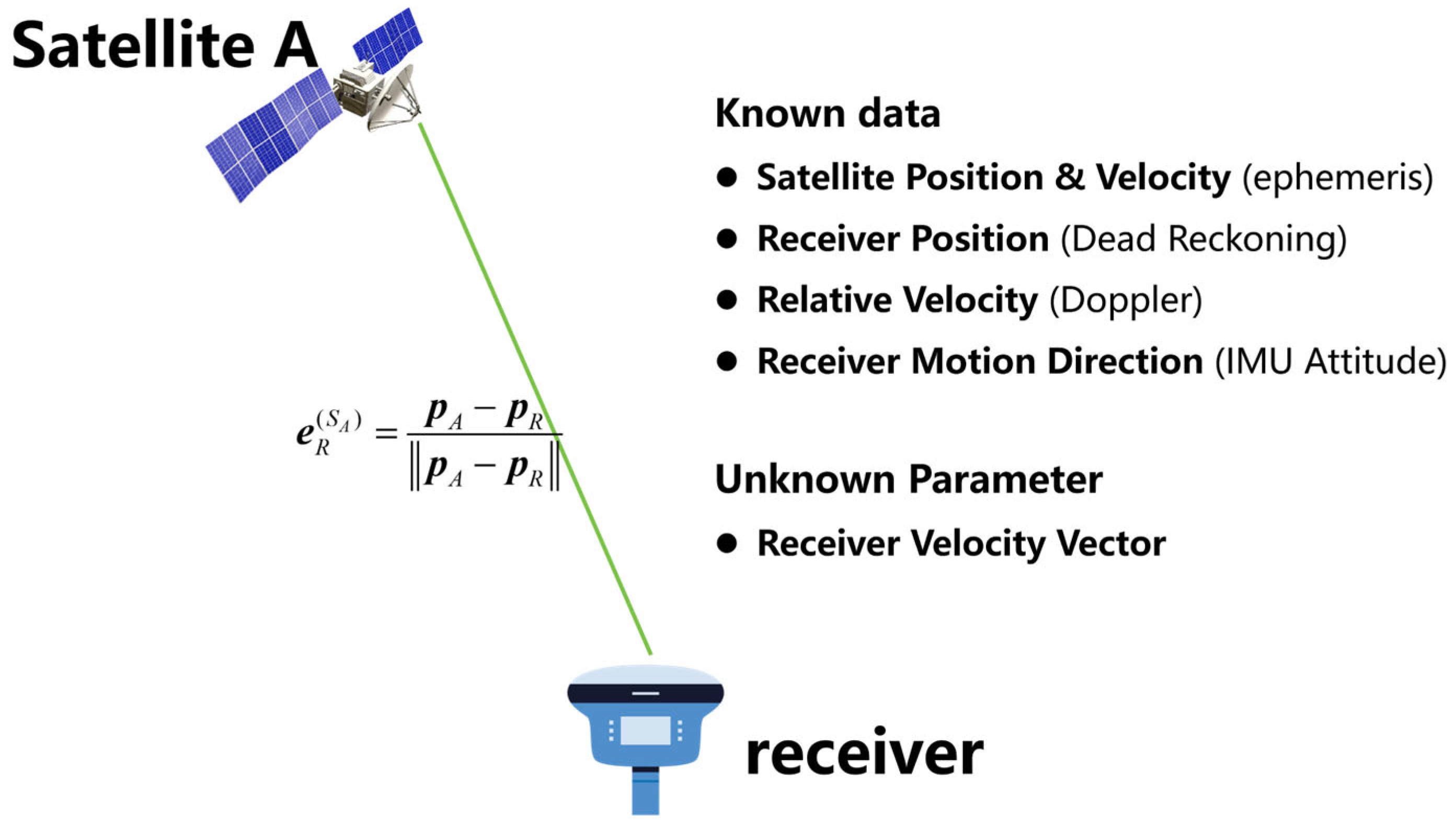
- The velocity and position of the satellite in the Earth-Centered Earth-Fixed (ECEF) coordinate system, obtained from precise or broadcast ephemerides.
- The position of the receiver, determined by GNSS absolute positioning or inertial dead reckoning.
- The Doppler observation values, derived from the observation file, representing the relative line-of-sight velocity between the receiver and the satellite.
- The motion direction of the receiver in the navigation coordinate system, obtained from IMU attitude updates.

- Calculate the Line-of-Sight (LOS) unit vector between the satellite and the receiver (satellite-to-ground direction).
- Project the satellite velocity onto the LOS vector to obtain the satellite’s velocity component along the LOS direction.
- Compute the relative velocity between the receiver and the satellite along the LOS direction from the Doppler observation.
- Derive the receiver’s projected velocity component along the LOS direction.
- Using the receiver’s motion direction in the navigation coordinate system (provided by the IMU), back-calculate the three-dimensional velocity vector of the receiver in the ECEF coordinate system.
2.2.2. Basic Principle of DDIA-VE

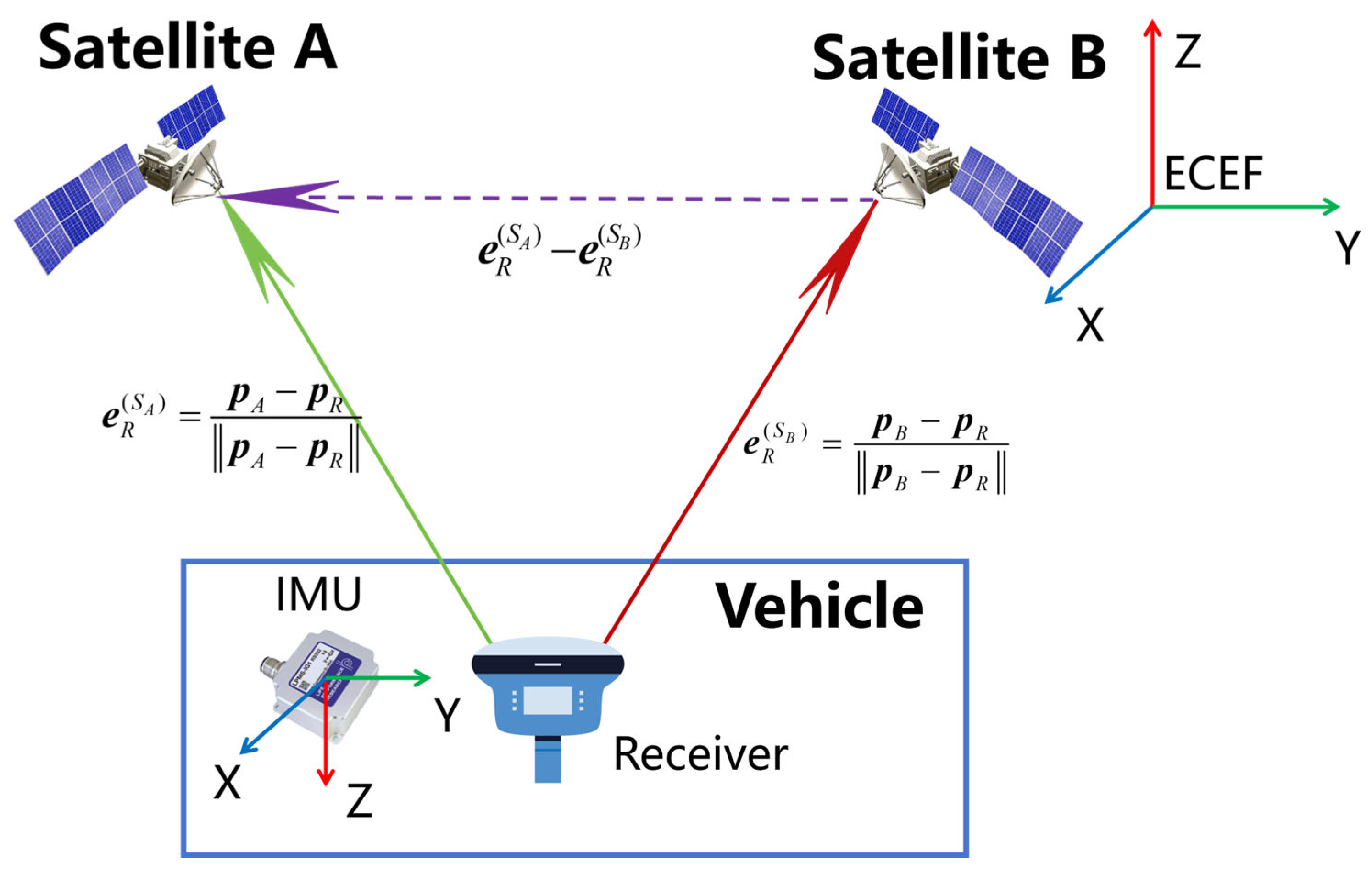
- Step 1: Computation of the LOS Unit Vector
- Step 2: Projecting the satellite velocity onto the line-of-sight direction
- Step 3: Computing the relative velocity along the line-of-sight from Doppler observations
- Step 4: Differential Line-of-Sight Vector and Differential Projected Velocity
- Step 5: Receiver Velocity Direction Unit Vector
- Step 6: Estimation of the Receiver 3D Velocity in ECEF Frame
3. Velocity Accuracy Assessment and Multi-Factor Screening Strategy
3.1. Experimental Data
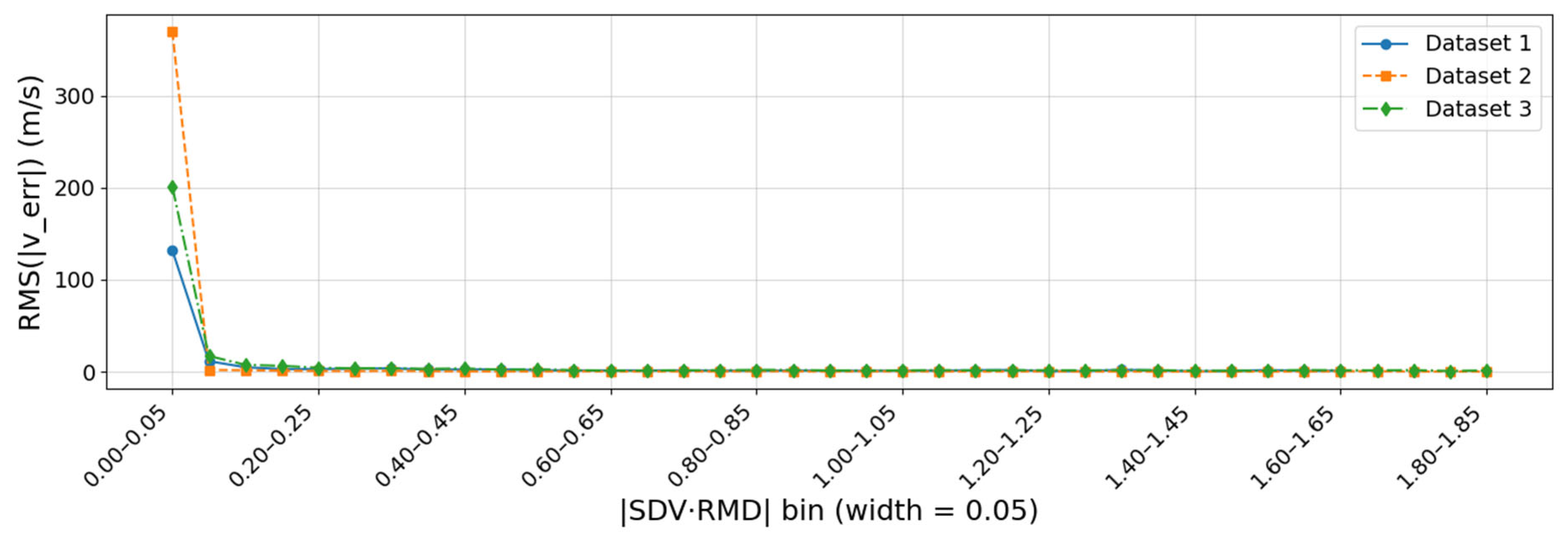
3.2. Geometric Singularity Analysis Based on SDV–RMD Alignment
3.3. Multi-Factor Influence Analysis on Differential Doppler Velocity Accuracy
3.3.1. Data Preprocessing and Gross-Error Rejection
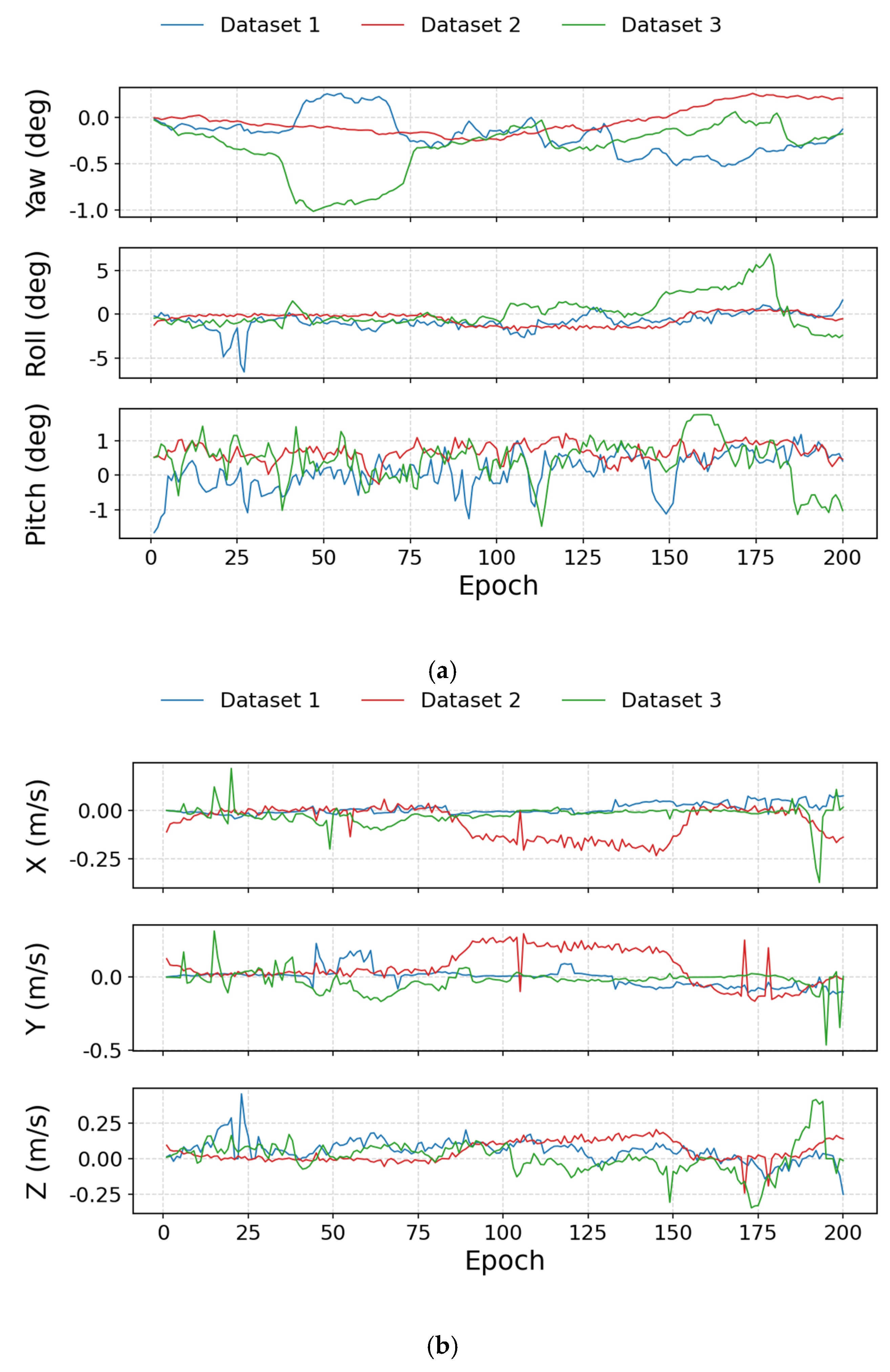
3.3.2. Impact of Attitude Errors on Differential Doppler Velocity Estimation
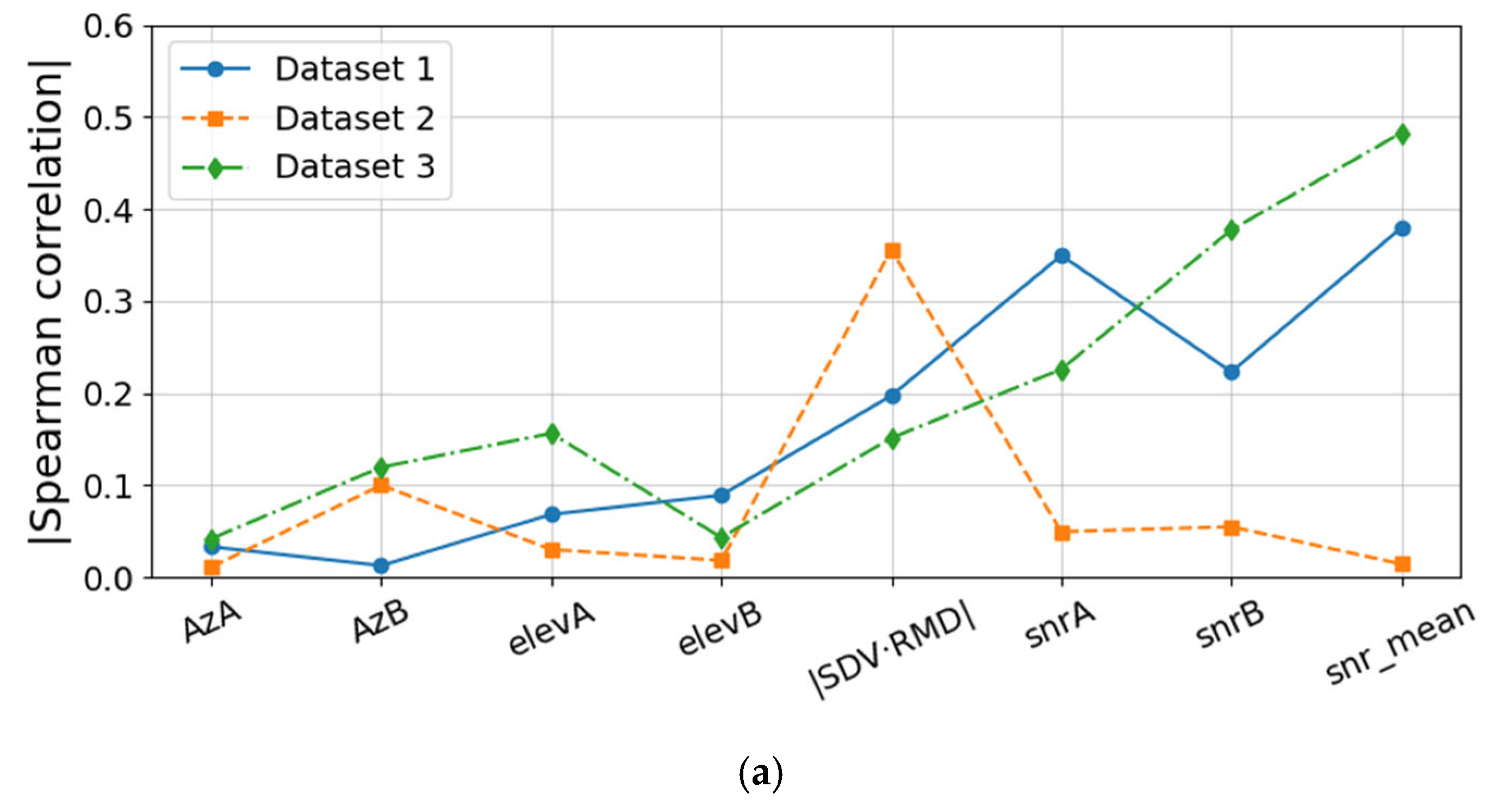
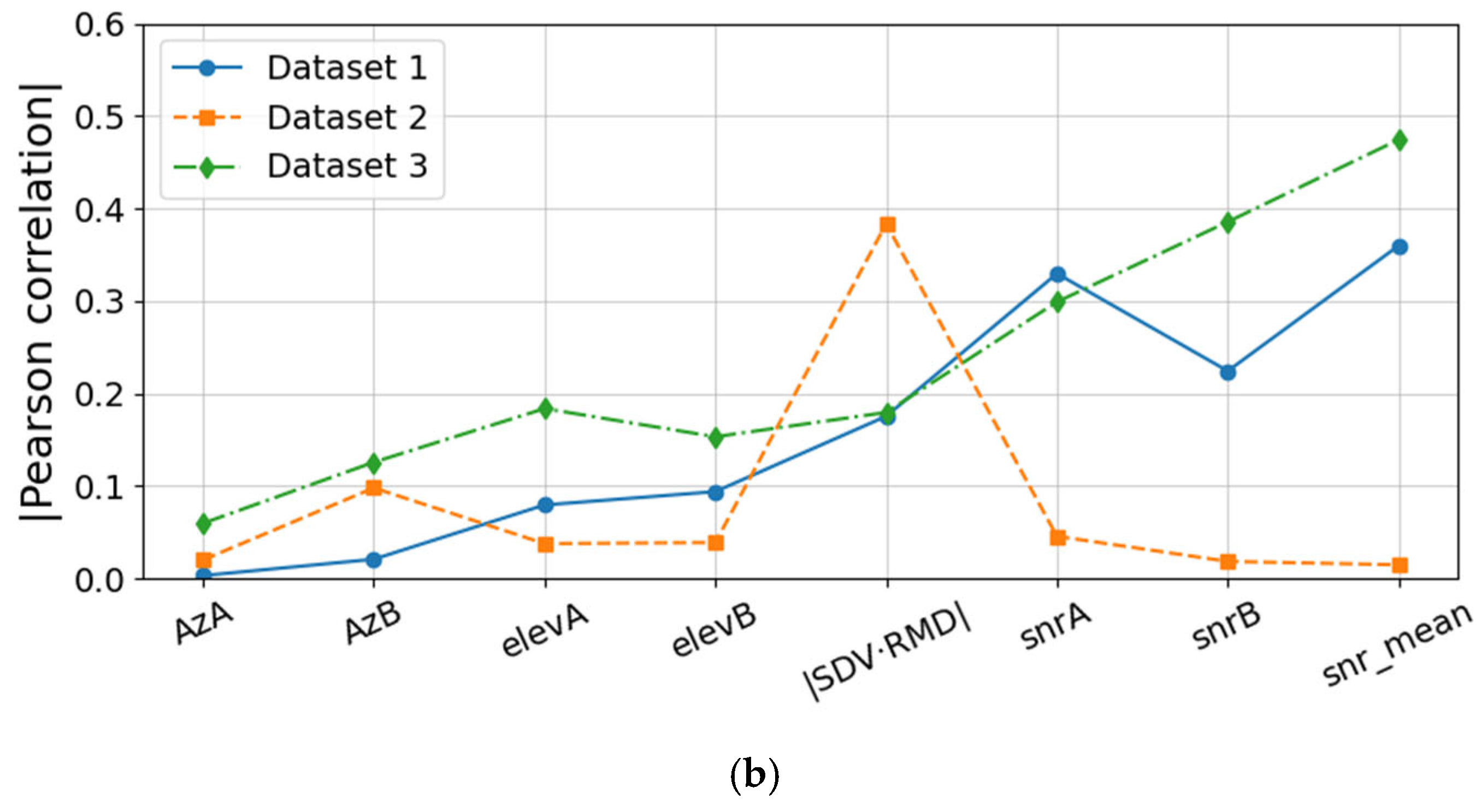
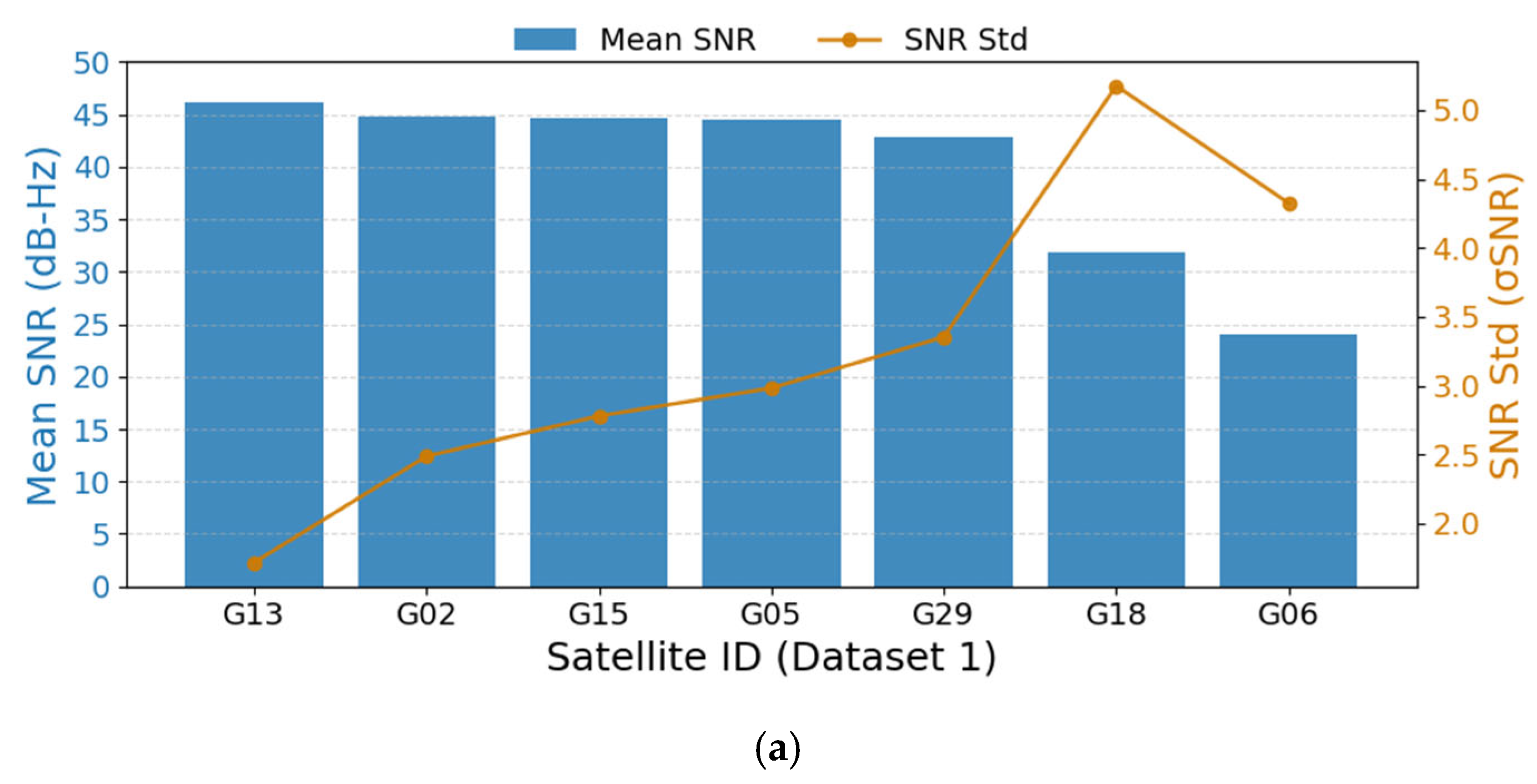
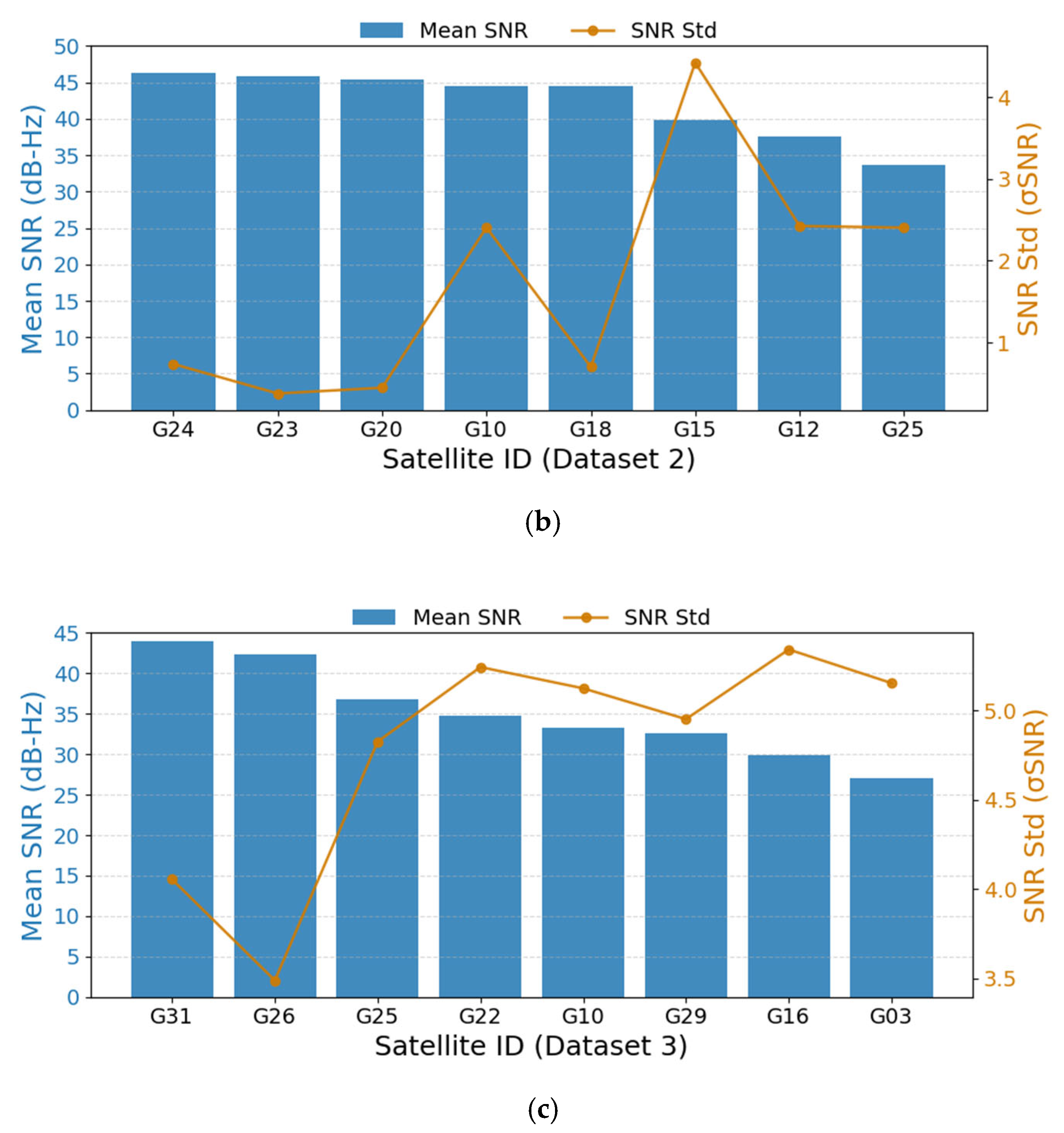
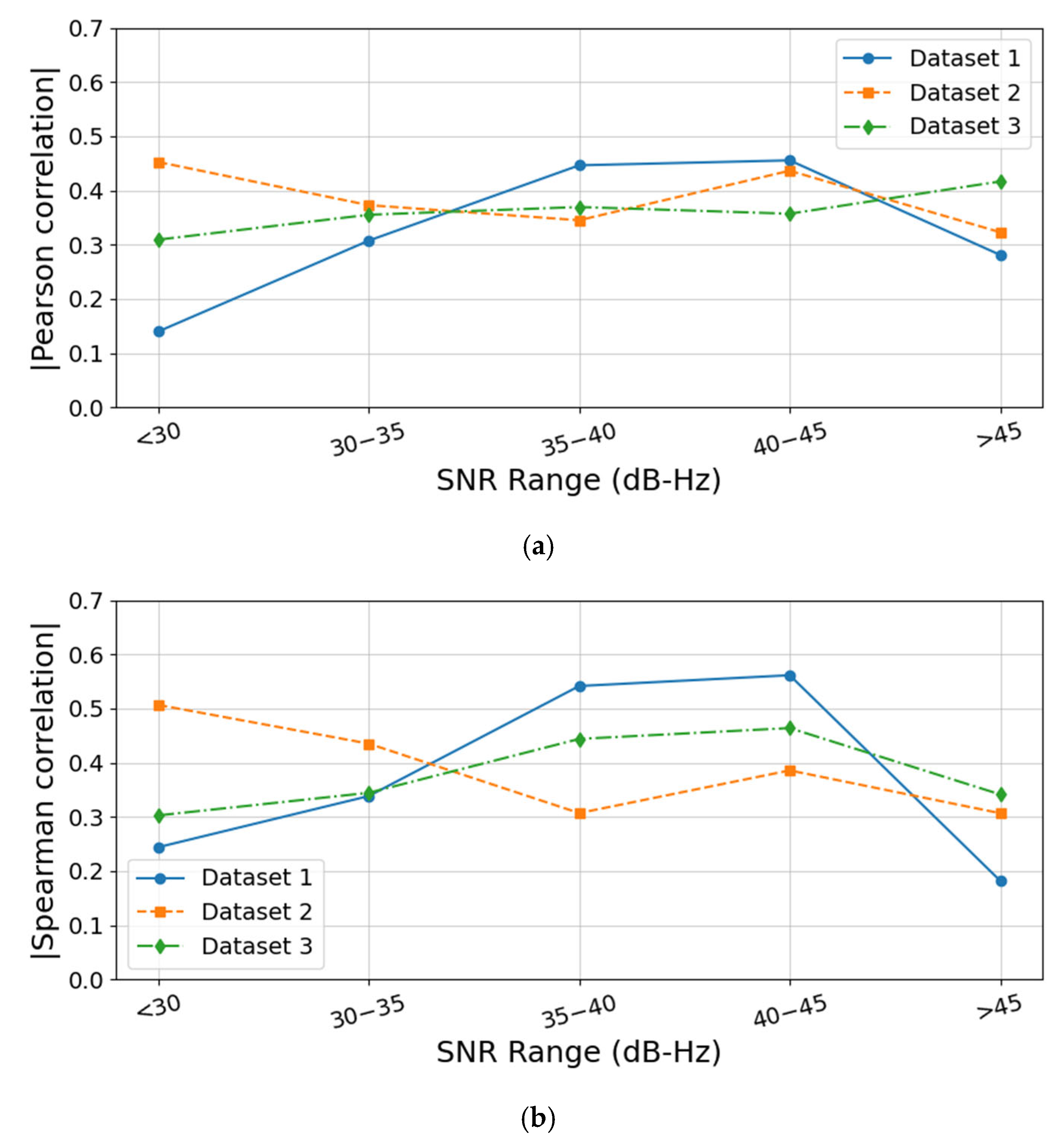
3.3.3. Correlation Analysis
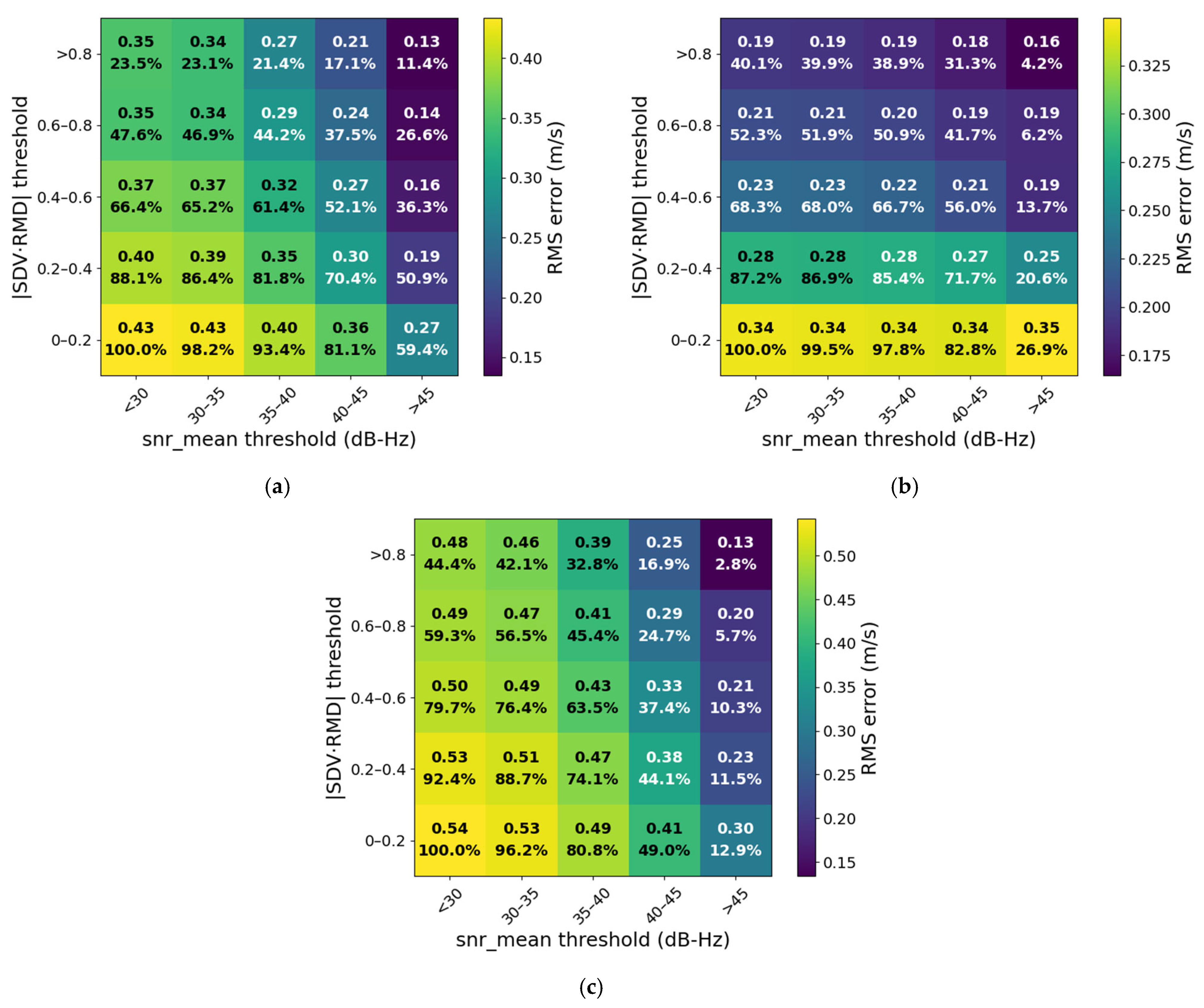
3.3.4. Fixed-Threshold Validation and Development of Multi-Factor Filtering Strategy
4. Discussion
5. Conclusions
- The proposed method enables continuous and robust 3D velocity estimation with as few as two satellites.
- A dual-indicator screening approach based on SNR and differential geometric features effectively enhances Doppler velocity accuracy and availability.
Author Contributions
Funding
Data Availability Statement
Conflicts of Interest
References
- Li, Z.; Lee, P.-H.; Hung, T.H.M.; Zhang, G.; Hsu, L.-T. Intelligent Environment-Adaptive GNSS/INS Integrated Positioning with Factor Graph Optimization. Remote Sens. 2023, 16, 181. [Google Scholar] [CrossRef]
- Zhang, S.; Tu, R.; Gao, Z.; Zou, D.; Wang, S.; Lu, X. LEO-Enhanced GNSS/INS Tightly Coupled Integration Based on Factor Graph Optimization in the Urban Environment. Remote Sens. 2024, 16, 1782. [Google Scholar] [CrossRef]
- Wang, P.; Gao, Y.; Zhao, Q.; Wang, Y.; Zhou, F.; Zhang, D. An Enhanced, Real-Time, Low-Cost GNSS/INS Integrated Navigation Algorithm and Its Platform Design. Sensors 2025, 25, 2119. [Google Scholar] [CrossRef]
- Kim, H.-I.; Park, K.-D. Satellite Positioning Accuracy Improvement in Urban Canyons Through a New Weight Model Utilizing GPS Signal Strength Variability. Sensors 2025, 25, 4678. [Google Scholar] [CrossRef] [PubMed]
- Xu, Q.; Gao, Z.; Yang, C.; Lv, J. High-Accuracy Positioning in GNSS-Blocked Areas by Using the MSCKF-Based SF-RTK/IMU/Camera Tight Integration. Remote Sens. 2023, 15, 3005. [Google Scholar] [CrossRef]
- Dong, Y.; Wang, D.; Zhang, L.; Li, Q.; Wu, J. Tightly Coupled GNSS/INS Integration with Robust Sequential Kalman Filter for Accurate Vehicular Navigation. Sensors 2020, 20, 561. [Google Scholar] [CrossRef]
- Nezhadshahbodaghi, M.; Mosavi, M.R. A Loosely-Coupled EMD-Denoised Stereo VO/INS/GPS Integration System in GNSS-Denied Environments. Measurement 2021, 183, 109895. [Google Scholar] [CrossRef]
- Chai, D.; Song, S.; Wang, K.; Bi, J.; Zhang, Y.; Ning, Y.; Yan, R. Optimization Model-Based Robust Method and Performance Evaluation of GNSS/INS Integrated Navigation for Urban Scenes. Electronics 2025, 14, 660. [Google Scholar] [CrossRef]
- Ibrahim, A.; Abosekeen, A.; Azouz, A.; Noureldin, A. Enhanced Autonomous Vehicle Positioning Using a Loosely Coupled INS/GNSS-Based Invariant-EKF Integration. Sensors 2023, 23, 6097. [Google Scholar] [CrossRef]
- Wang, D.; Dong, Y.; Li, Z.; Li, Q.; Wu, J. Constrained MEMS-Based GNSS/INS Tightly Coupled System with Robust Kalman Filter for Accurate Land Vehicular Navigation. IEEE Trans. Instrum. Meas. 2020, 69, 5138–5148. [Google Scholar] [CrossRef]
- Shen, Z.; Li, X.; Wang, X.; Wu, Z.; Li, X.; Zhou, Y.; Li, S. A Novel Factor Graph Framework for Tightly Coupled GNSS/INS Integration with Carrier-Phase Ambiguity Resolution. IEEE Trans. Intell. Transp. Syst. 2024, 25, 13091–13105. [Google Scholar] [CrossRef]
- Huang, Y.-E.; Tsai, S.; Liu, H.-Y.; Chiang, K.-W.; Tsai, M.-L.; Lee, P.-L.; El-Sheimy, N. The Development and Validation of a Tactical Grade Egi System for Land Vehicular Navigation Applications. Int. Arch. Photogramm. Remote Sens. Spat. Inf. Sci. 2023, XLVIII-1/W2-2023, 821–828. [Google Scholar] [CrossRef]
- Vavilova, N.B.; Vyazmin, V.S.; Golovan, A.A. Development of a Low-Cost INS/GNSS/Odometer Integration Algorithm for a Road Surface Testing Laboratory Software. In Proceedings of the 2019 26th Saint Petersburg International Conference on Integrated Navigation Systems (ICINS), St. Petersburg, Russia, 27–29 May 2019; pp. 1–7. [Google Scholar]
- Xu, Y.; Wang, K.; Yang, C.; Li, Z.; Zhou, F.; Liu, D. GNSS/INS/OD/NHC Adaptive Integrated Navigation Method Considering the Vehicle Motion State. IEEE Sens. J. 2023, 23, 13511–13523. [Google Scholar] [CrossRef]
- Yang, Z.; Zhao, H.; Yang, X. A Novel Navigation Method Fusing Multiple Constraint for Low-Cost INS/GNSS Integrated System in Urban Environments. IEEE Trans. Veh. Technol. 2024, 73, 7616–7629. [Google Scholar] [CrossRef]
- Ng, H.F.; Hsu, L.T.; Lee, M.J.L.; Feng, J.; Naeimi, T.; Beheshti, M.; Rizzo, J.R. Real-Time Loosely Coupled 3DMA GNSS/Doppler Measurements Integration Using a Graph Optimization and Its Performance Assessments in Urban Canyons of New York. Sensors 2022, 22, 6533. [Google Scholar] [CrossRef]
- Ji, L.; Sun, R.; Cheng, Q.; Wang, J. Evaluation of the Performance of GNSS-Based Velocity Estimation Algorithms. Satell. Navig. 2022, 3, 18. [Google Scholar] [CrossRef]
- Vincent, F.; Vilà-Valls, J.; Besson, O.; Medina, D.; Chaumette, E. Doppler-Aided Positioning in GNSS Receivers—A Performance Analysis. Signal Process. 2020, 176, 107713. [Google Scholar] [CrossRef]
- Pisoni, F.; Palella, N.M.; Di Grazia, D.; Colombo, L.; Gogliettino, G. A Loosely Coupled Architecture for INS/GNSS Integration with Tracking Loops Aiding. In Proceedings of the 2023 IEEE International Workshop on Metrology for Automotive (MetroAutomotive), Modena, Italy, 28–30 June 2023; IEEE: Modena, Italy, 2023; pp. 111–116. [Google Scholar]
- Villien, C.; Denis, B. UWB-Aided GNSS/INS Fusion for Resilient Positioning in GNSS Challenged Environments. In Proceedings of the 2023 IEEE/ION Position, Location and Navigation Symposium (PLANS), Monterey, CA, USA, 24–27 April 2023; pp. 167–178. [Google Scholar] [CrossRef]
- Cannon, M.E.; Lachapelle, G.; Szarmes, M.C.; Hebert, J.M.; Keith, J.; Jokerst, S. DGPS Kinematic Carrier Phase Signal Simulation Analysis for Precise Velocity and Position Determination. Navigation 1997, 44, 231–245. [Google Scholar] [CrossRef]
- Szarmes, M.; Ryan, S.; Lachapelle, G.; Fenton, P.; Szarmes, M. DGPS High Accuracy Aircraft Velocity Determination Using Doppler Measurements. Eng. Phys. 1997. Available online: https://api.semanticscholar.org/CorpusID:17432145 (accessed on 2 November 2025).
- Wang, Z. Research on Vehicular Velocity Estimation Methods Based on BDS-3/GNSS Carrier Phase and Doppler Observations. Master’s Thesis, China University of Mining and Technology, Xuzhou, China, 2022. [Google Scholar]
- Tang, L.; Xu, F.; Zhang, F.; Zhang, H.; Chen, W. Detection of Medium-Scale Traveling Ionospheric Disturbance Using GNSS Doppler Measurements. IEEE Trans. Geosci. Remote Sens. 2024, 62, 5802406. [Google Scholar] [CrossRef]
- Guo, H.; Liu, X.; Jin, X.; Wang, G.; Jiang, Y.; Guo, J. GNSS Standard Point Positioning Method Based on Spherical Harmonic Expansion of Signal Propagation Path Relating Errors. Adv. Space Res. 2023, 72, 1153–1171. [Google Scholar] [CrossRef]
- Du, Z. Research on the Optimization Technology of Doppler Velocimetry in GNSS Receiver. Master’s Thesis, Harbin Engineering University, Harbin, China, 2020. [Google Scholar]
- Guo, F.; Du, C.; Zhang, X.; Guo, B. Influence of Clock Jump on the Velocity and Acceleration Estimation with a Single GPS Receiver Based on Carrier-Phase-Derived Doppler. GPS Solut. 2013, 17, 549–559. [Google Scholar] [CrossRef]
- Chu, B.; Li, G.; Geng, J. High-Precision Velocity Determination Using Mass-Market Android GNSS Measurements in the Case of Anomalous Clock Variations. GPS Solut. 2023, 27, 98. [Google Scholar] [CrossRef]
- Petovello, M.; Aumayer, B. Effect of Sampling Rate Error on GNSS Velocity and Clock Drift Estimation. Annu. Navig. 2015, 62, 229–238. [Google Scholar] [CrossRef]
- Fan, S.; Hao, Q.; Wu, Z.; Luo, Y.; Wu, H. Vehicle Incomplete Constraint Algorithm Based on M-Estimation. In Proceedings of the 2023 IEEE International Conference on Mechatronics and Automation (ICMA), Harbin, China, 6–9 August 2023; pp. 1990–1995. [Google Scholar] [CrossRef]
- Chen, G.; Hu, H.; Wang, J. An Integrated GNSS/INS/DR Positioning Strategy Considering Nonholonomic Constraints for Intelligent Vehicle. In Proceedings of the 2022 6th CAA International Conference on Vehicular Control and Intelligence (CVCI), Nanjing, China, 8–30 October 2022; pp. 1–6. [Google Scholar] [CrossRef]
- El-Sheimy, N.; Niu, X.; Nassar, S. An Accurate Land-Vehicle MEMS IMU/GPS Navigation System Using 3D Auxiliary Velocity Updates. Annu. Navig. 2007, 54, 177–188. [Google Scholar] [CrossRef]
- Tahsin, M.; Sultana, S.; Reza, T.; Hossam-E-Haider, M. Analysis of DOP and Its Preciseness in GNSS Position Estimation. In Proceedings of the 2015 IEEE International Conference on Electrical Engineering and Information Communication Technology (ICEEICT), Savar, Bangladesh, 21–23 May 2015; pp. 1–6. [Google Scholar]
- Verma, P.; Hajra, K.; Banerjee, P.; Bose, A. Evaluating PDOP in Multi-GNSS Environment. IETE J. Res. 2019, 68, 1705–1712. [Google Scholar] [CrossRef]
- Skorepa, J.; Kovar, P.; Puricer, P. PDOP Parameters Improvement Using Multi-GNSS and Signal Re-Transmission at Lunar Distances. Adv. Space Res. 2021, 68, 3700–3716. [Google Scholar] [CrossRef]
- Biswas, S.K.; Qiao, L.; Dempster, A.G. Effect of PDOP on Performance of Kalman Filters for GNSS-Based Space Vehicle Position Estimation. GPS Solut. 2017, 21, 1379–1387. [Google Scholar] [CrossRef]
- (GNSS + REsearch, Application and Teaching) Group from SGG of Wuhan University. GREAT Dataset: A Vehicle-Mounted Multi-Sensor Raw Observation Dataset in Complex Urban Environments; Wuhan University: Wuhan, China, 2024; Available online: https://github.com/GREAT-WHU/GREAT-Dataset (accessed on 2 November 2025).
- Ma, J.; Wang, W.; Deng, C.; Tang, W.; Qiu, S. A Robust Factor Graph Optimization Algorithm with Dynamic Observation Weight Adjusting. Geomat. Inf. Sci. Wuhan Univ. 2025, 1–16. [Google Scholar] [CrossRef]
- Zhou, H.; Wang, X.; Zhong, S.; Xi, K.; Shen, H. A Multipath Hemispherical Map with Strict Quality Control for Multipath Mitigation. Remote Sens. 2025, 17, 767. [Google Scholar] [CrossRef]
- Shi, J.; Li, X.; Li, L.; Ouyang, C.; Xu, C. An Efficient Deep Learning-Based Troposphere ZTD Dataset Generation Method for Massive GNSS CORS Stations. IEEE Trans. Geosci. Remote Sens. 2023, 61, 5801311. [Google Scholar] [CrossRef]
- He, T.; Liu, S.; Shen, H.; Gong, J. Quantitative Prediction of Relativistic Electron Flux at Geosynchronous Orbit with Geomagnetic Pulsations Parameters. Chin. J. Space Sci. 2013, 33, 20–27. [Google Scholar] [CrossRef]
- Heuvel, E.V.D.; Zhan, Z. Myths about Linear and Monotonic Associations: Pearson’s r, Spearman’s ρ, and Kendall’s τ. Am. Stat. 2022, 76, 44–52. [Google Scholar] [CrossRef]



| Model | Parameter | Gyro | Accel |
|---|---|---|---|
| ADIS-16470 | Bias | 8 °/h | 0.34 °/√h |
| Random walk |
| Dataset 1 | 11,035 | 514 | 95.34% |
| Dataset 2 | 53,317 | 3449 | 93.53% |
| Dataset 3 | 11,590 | 387 | 96.66% |
| RMS (m/s) | 3RMS (m/s) | ||||
|---|---|---|---|---|---|
| Dataset 1 | 10,521 | 2.92 | 8.76 | 178 | 10,343 (98.3%) |
| Dataset 2 | 49,868 | 0.66 | 1.99 | 559 | 49,309 (98.9%) |
| Dataset 3 | 11,203 | 4.15 | 12.45 | 178 | 11,024 (98.4%) |
| Att/Vel | Dataset 1 | Dataset 2 | Dataset 3 | |
|---|---|---|---|---|
| Attitude | Yaw (deg) | 0.274 | 0.153 | 0.433 |
| Roll (deg) | 1.305 | 0.870 | 1.812 | |
| Pitch (deg) | 0.540 | 0.718 | 0.747 | |
| Velocity | x (m/s) | 0.028 | 0.100 | 0.054 |
| y (m/s) | 0.060 | 0.135 | 0.074 | |
| z (m/s) | 0.098 | 0.087 | 0.110 | |
| Mean SNR (dB-Hz) | Std of SNR (dB-Hz) | |
|---|---|---|
| Dataset 1 | 42.16 | 5.37 |
| Dataset 2 | 42.47 | 3.15 |
| Dataset 3 | 38.26 | 5.32 |
Disclaimer/Publisher’s Note: The statements, opinions and data contained in all publications are solely those of the individual author(s) and contributor(s) and not of MDPI and/or the editor(s). MDPI and/or the editor(s) disclaim responsibility for any injury to people or property resulting from any ideas, methods, instructions or products referred to in the content. |
© 2025 by the authors. Licensee MDPI, Basel, Switzerland. This article is an open access article distributed under the terms and conditions of the Creative Commons Attribution (CC BY) license (https://creativecommons.org/licenses/by/4.0/).
Share and Cite
Wang, Y.; Zhang, H.; Li, K.; Xu, H.; Chen, Y. A Study on a Low-Cost IMU/Doppler Integrated Velocity Estimation Method Under Insufficient GNSS Observation Conditions. Sensors 2025, 25, 7674. https://doi.org/10.3390/s25247674
Wang Y, Zhang H, Li K, Xu H, Chen Y. A Study on a Low-Cost IMU/Doppler Integrated Velocity Estimation Method Under Insufficient GNSS Observation Conditions. Sensors. 2025; 25(24):7674. https://doi.org/10.3390/s25247674
Chicago/Turabian StyleWang, Yinggang, Hongli Zhang, Kemeng Li, Hanghang Xu, and Yijin Chen. 2025. "A Study on a Low-Cost IMU/Doppler Integrated Velocity Estimation Method Under Insufficient GNSS Observation Conditions" Sensors 25, no. 24: 7674. https://doi.org/10.3390/s25247674
APA StyleWang, Y., Zhang, H., Li, K., Xu, H., & Chen, Y. (2025). A Study on a Low-Cost IMU/Doppler Integrated Velocity Estimation Method Under Insufficient GNSS Observation Conditions. Sensors, 25(24), 7674. https://doi.org/10.3390/s25247674