On Multi-Parameter Optimization and Proactive Reliability in 5G and Beyond Cellular Networks

Abstract
1. Introduction
1.1. Related Work
1.2. Contributions
- (1)
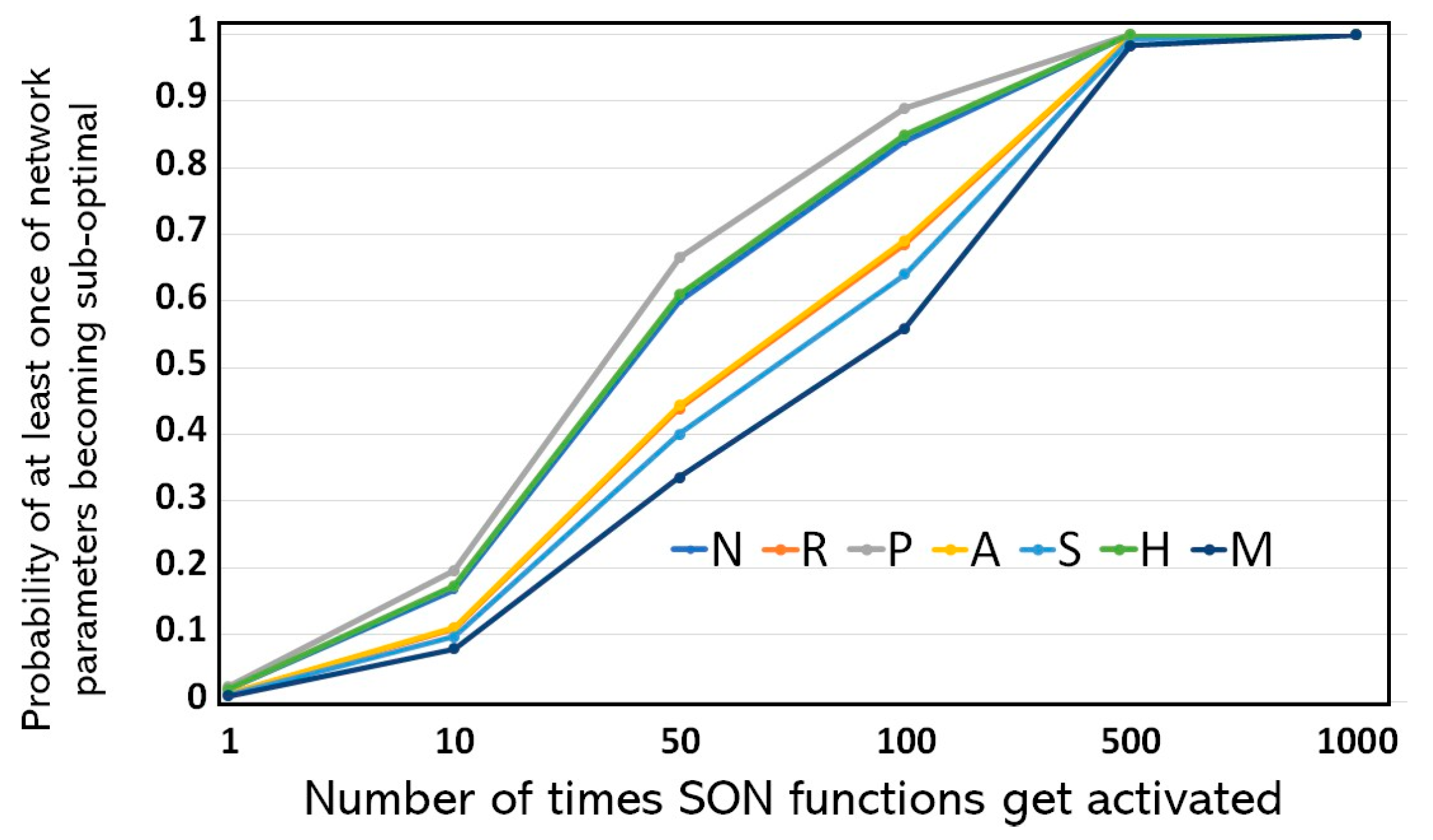
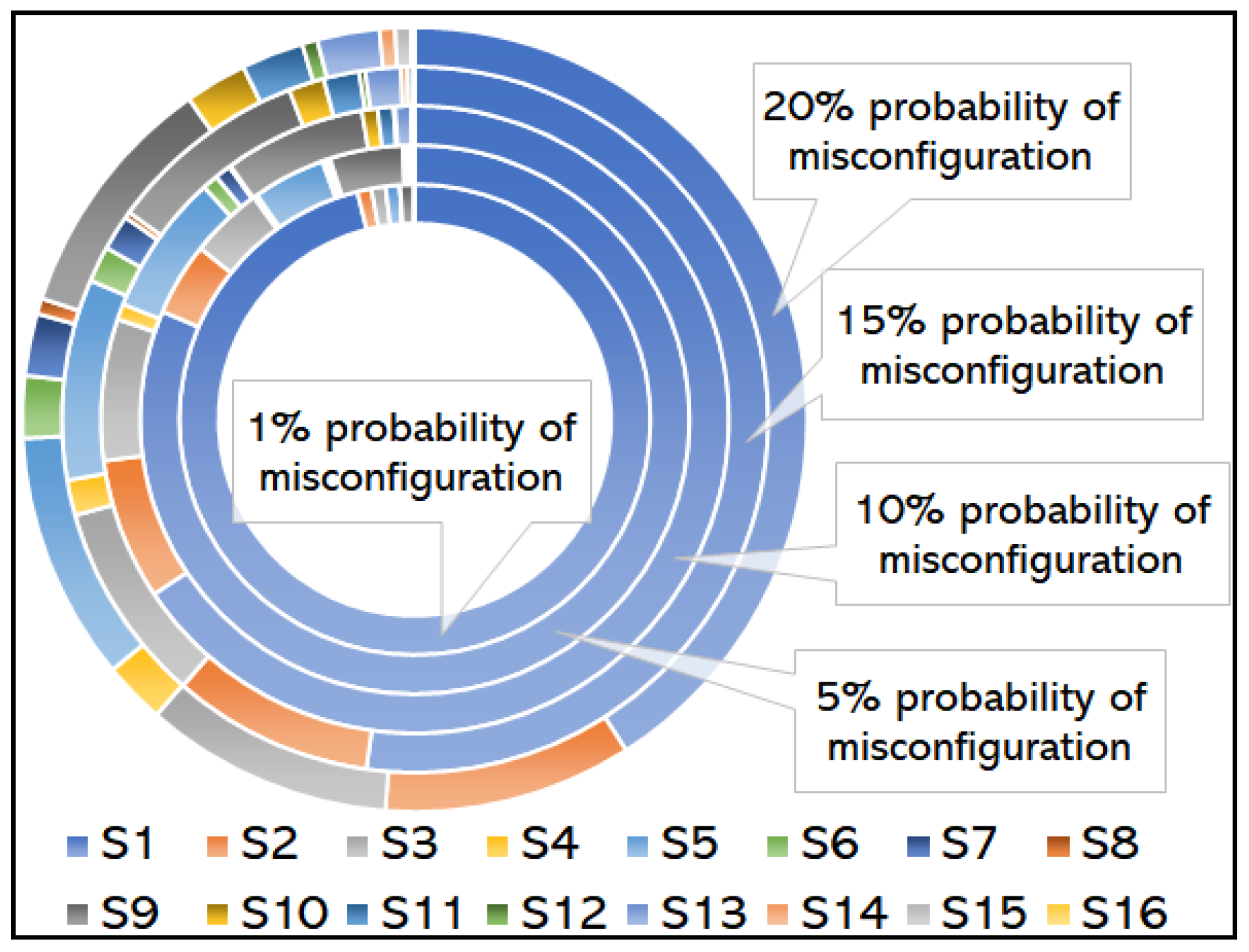
- By leveraging a realistic and generalized model, we formulate the probability of the network parameters to become suboptimal as a consequence of manual operations or network automation function conflicts. The misconfiguration probabilities for the given parameters are evaluated by the proposed reliability analysis to optimize the troubleshooting process.
- (2)
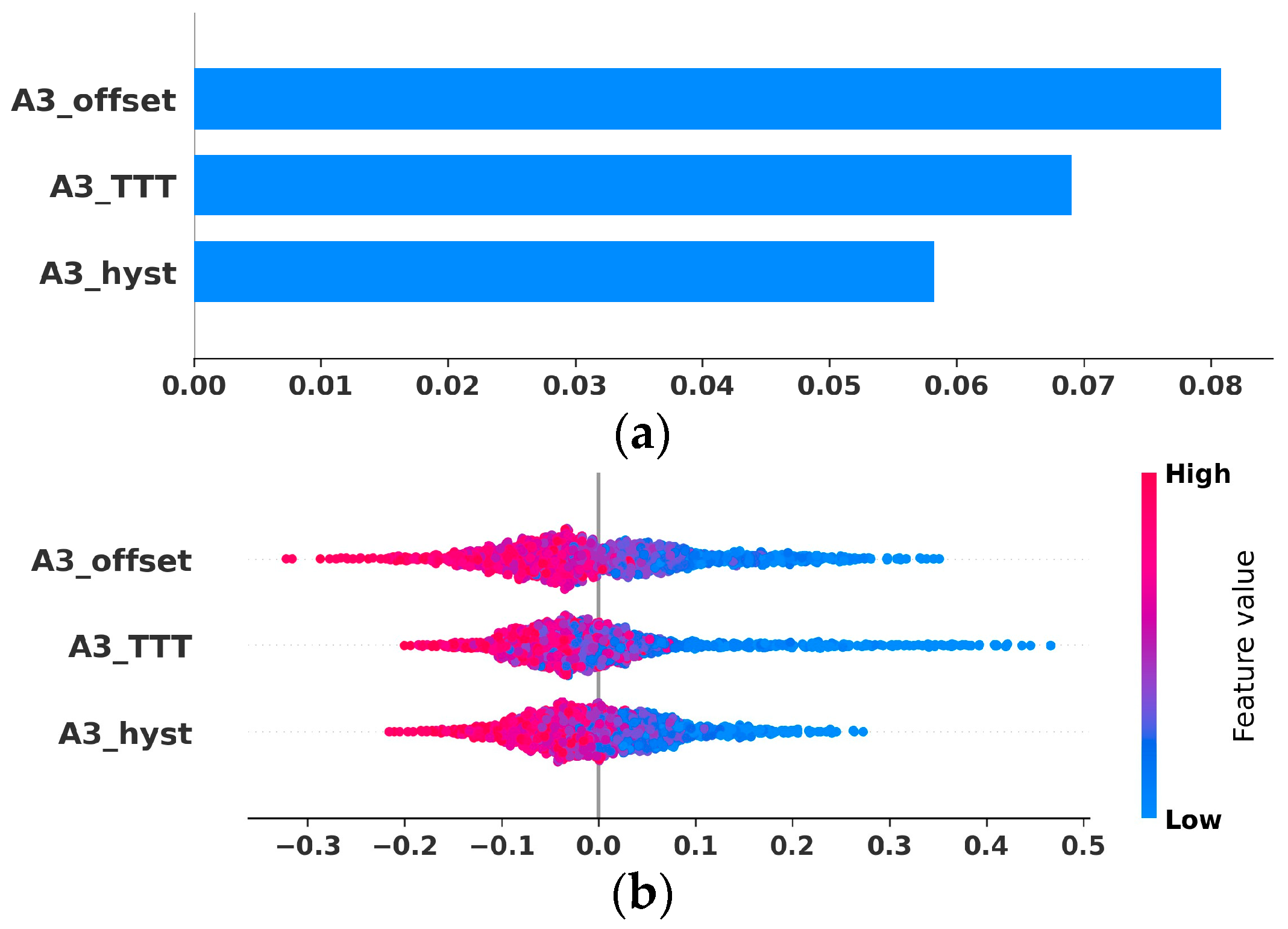
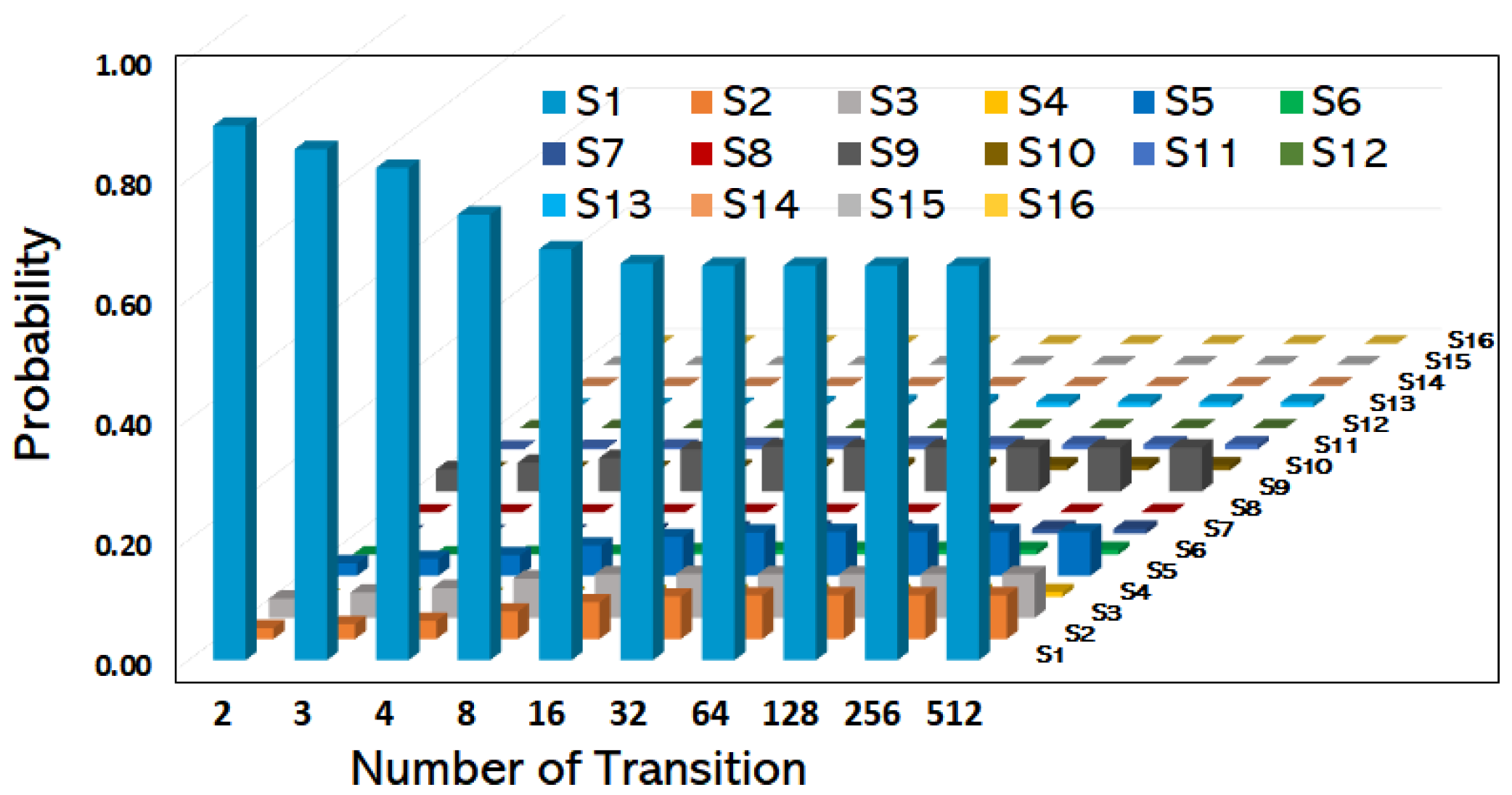
- We present the stochastic analysis for the evaluation of long-term network behavior by exploiting Discrete Time Markov Chain (DTMC). The analysis is performed using four of the most impactful network parameters in terms of coverage reliability. We demonstrate through the state transition models that the small deviation in the values of these parameters can have a significant impact on the user quality of experience (QoE). Also, it is worth mentioning that our proposed model is general and can be applicable to other parameters.
- (3)
- We formulate a tradeoff between the design parameters which overlap in multiple network automation and demonstrate that misconfiguration of primary parameters can cause the network performance degradation with the highest probability. For the proactive maintenance procedures, this model can be used to prioritize and schedule the parameter configuration verification.
- (4)
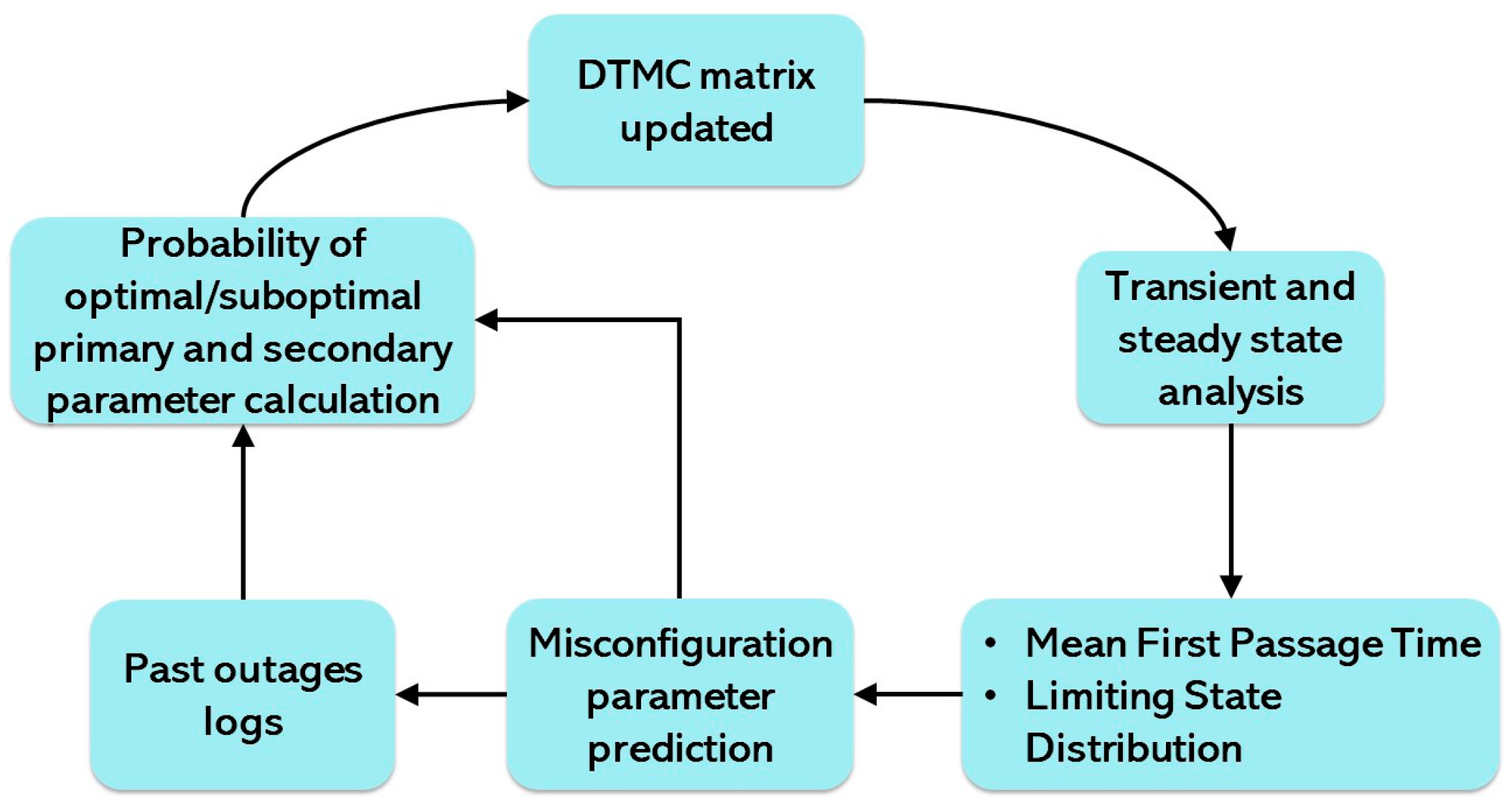
- To observe the impact of the multi-parametric conflicts in network automation function, we devise two performance metrics, i.e., mean first passage time and limiting or steady-state distribution. By leveraging these metrics, we can evaluate the probability of the network degradation and perform the multi-parameter optimization.
2. Analysis
2.1. Assumptions
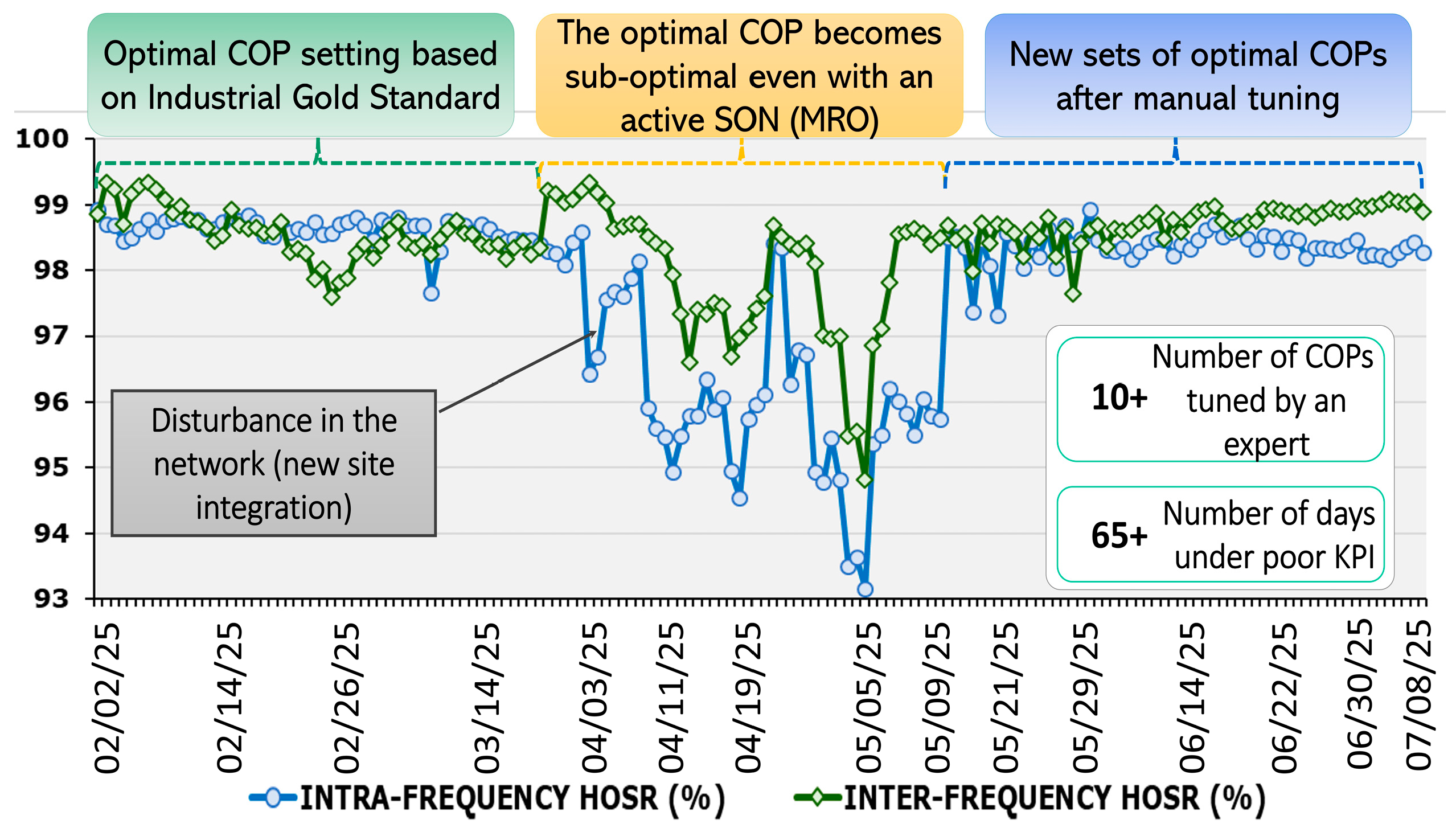
- A cell or node is defined as being in a suboptimal state (i.e., performance degradation or partial outage) if at least one of its network configuration parameters is set to a suboptimal value. This premise is based on the fact that the misconfiguration of even a single primary or secondary parameter can significantly degrade the network’s key performance indicators (KPIs), as illustrated by the real-network example in Figure 2.
- When an ANF is called (reactively or proactively), it will reconfigure only one of its associated parameters per call. This constraint is commonly adopted as an operational best practice for fault isolation and easier conflict resolution, preventing conflicts among interdependent parameters, which is a core focus of this work [33].
2.2. Model Development
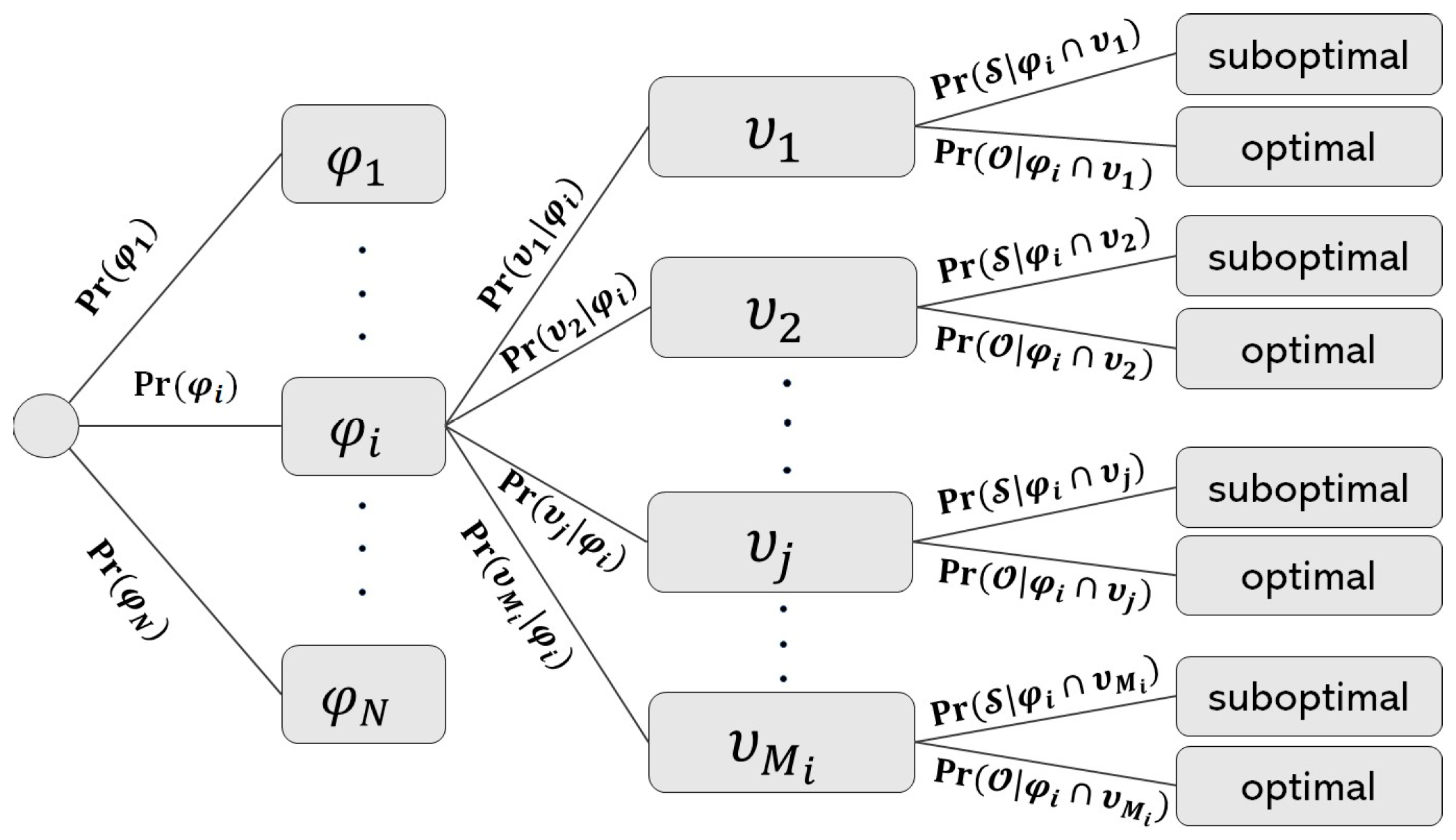
- If the network automation function ϕi operates on all of its Mi parameters with equal priority, then the probability of υj given ϕi gets called is: Pr(υj|ϕi) = ().
- If the network automation function ϕi has Mpi and Msi number of primary and secondary parameters, respectively, such that Mi = Mpi + Msi, then the probability of υj given ϕi is:
2.3. Markov Analysis
2.4. Transition Matrix Properties
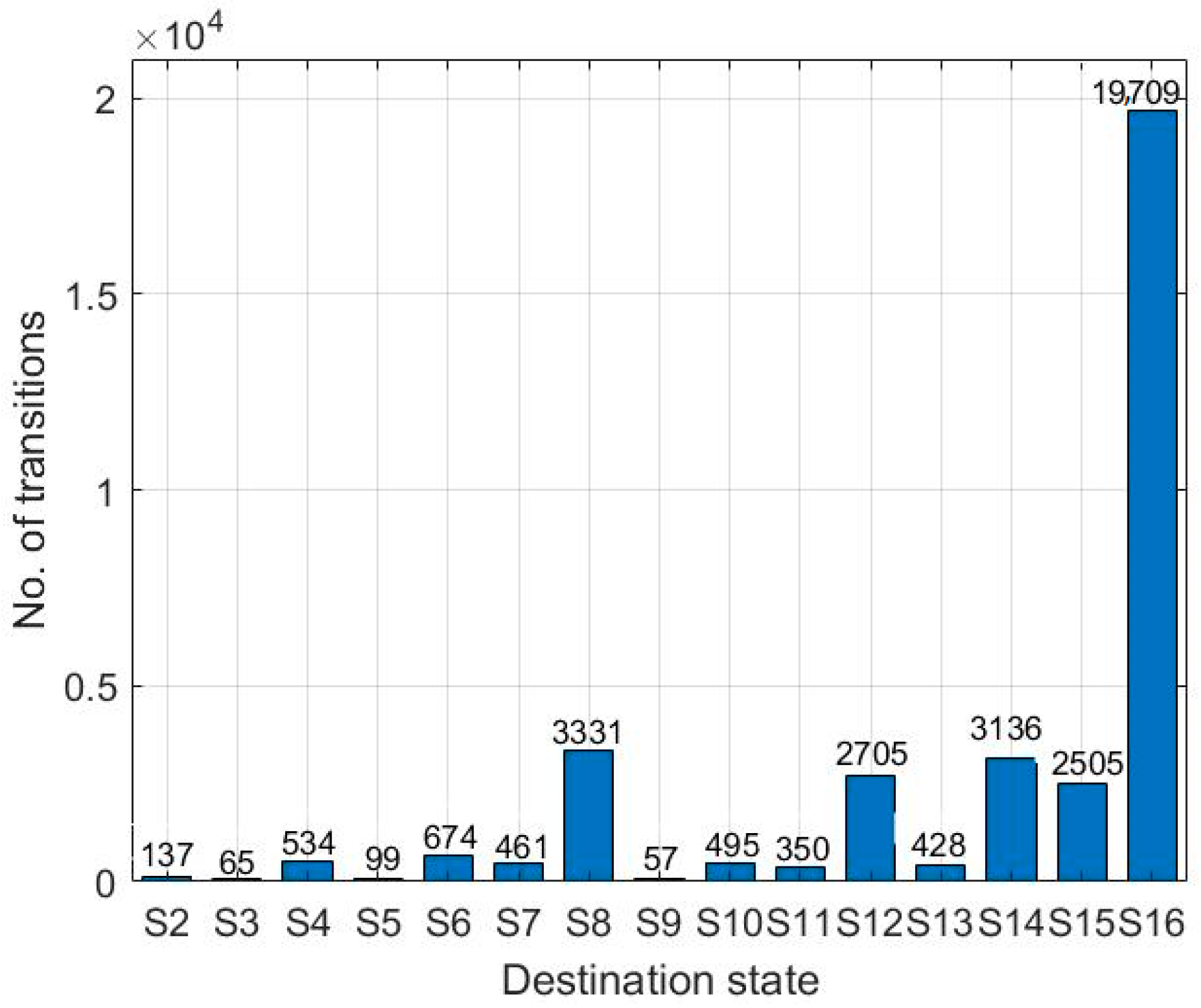
- As the number of parameters is finite, i.e., four in our case, therefore, the DTMC State Space S will be finite, consisting of 24 = 16 states.
- is a positive real number between 0 and 1
- T will be a right stochastic matrix, i.e.,
2.5. Transition Matrix Initialization

| States | Parameters Configuration ✓: Optimal ✗: Suboptimal | |||
|---|---|---|---|---|
| P | A | H | M | |
| S1 | ✓ | ✓ | ✓ | ✓ |
| S2 | ✓ | ✓ | ✓ | ✗ |
| S3 | ✓ | ✓ | ✗ | ✓ |
| S4 | ✓ | ✓ | ✗ | ✗ |
| S5 | ✓ | ✗ | ✓ | ✓ |
| S6 | ✓ | ✗ | ✓ | ✗ |
| S7 | ✓ | ✗ | ✗ | ✓ |
| S8 | ✓ | ✗ | ✗ | ✗ |
| S9 | ✗ | ✓ | ✓ | ✓ |
| S10 | ✗ | ✓ | ✓ | ✗ |
| S11 | ✗ | ✓ | ✗ | ✓ |
| S12 | ✗ | ✓ | ✗ | ✗ |
| S13 | ✗ | ✗ | ✓ | ✓ |
| S14 | ✗ | ✗ | ✓ | ✗ |
| S15 | ✗ | ✗ | ✗ | ✓ |
| S16 | ✗ | ✗ | ✗ | ✗ |
2.6. Transition Matrix Analysis
3. Numerical Results
4. Utility of the Proposed Framework
5. Conclusions
Author Contributions
Funding
Institutional Review Board Statement
Informed Consent Statement
Data Availability Statement
Conflicts of Interest
References
- Khaloopour, L.; Su, Y.; Raskob, F.; Meuser, T.; Bless, R.; Janzen, L.; Abedi, K.; Andjelkovic, M.; Chaari, H.; Chakraborty, P.; et al. Resilience-by-design in 6g networks: Literature review and novel enabling concepts. IEEE Access 2024, 12, 155666–155695. [Google Scholar] [CrossRef]
- Mathur, H.; Deepa, T. A survey on advanced multiple access techniques for 5g and beyond wireless communications. Wirel. Pers. Commun. 2021, 118, 1775–1792. [Google Scholar] [CrossRef]
- Karaman, B.; Basturk, I.; Taskin, S.; Zeydan, E.; Kara, F.; Beyazıt, E.A.; Camelo, M.; Björnson, E.; Yanikomeroglu, H. Solutions for sustainable and resilient communication infrastructure in disaster relief and management scenarios. IEEE Commun. Surv. Tutor. 2025. [Google Scholar] [CrossRef]
- Sanneck, H. 5G Network slicing management for challenged network scenarios. In Proceedings of the 12th Workshop on Challenged Networks, Snowbird, UT, USA, 20 October 2017; pp. 19–20. [Google Scholar]
- Rong, B.; Dianati, M.; Zhou, L.; Karagiannidis, G.K.; Wang, C. 5G mmWave small cell networks: Architecture, self-organization, and management. IEEE Wirel. Commun. 2018, 25, 8–9. [Google Scholar] [CrossRef]
- Pérez, M.G.; Perez, G.M.; Giardina, P.G.; Bernini, G.; Neves, P.; Alcaraz-Calero, J.M.; Wang, Q.; Koutsopoulos, K. Self-organizing capabilities in 5G networks: NFV & SDN coordination in a complex use case. In Proceedings of the EuCNC, Ljubljana, Slovenia, 18–21 June 2018; pp. 1–5. [Google Scholar]
- Koucheryavy, Y.; Lisovskaya, E.; Moltchanov, D.; Kovalchukov, R.; Samuylov, A. Quantifying the millimeter wave new radio base stations density for network slicing with prescribed slas. Comput. Commun. 2021, 174, 13–27. [Google Scholar] [CrossRef]
- Kordestani, M.; Saif, M.; Orchard, M.E.; Razavi-Far, R.; Khorasani, K. Failure prognosis and applications—A survey of recent literature. IEEE Trans. Reliab. 2019, 70, 728–748. [Google Scholar] [CrossRef]
- Guidotti, A.; Vanelli-Coralli, A.; Conti, M.; Andrenacci, S.; Chatzinotas, S.; Maturo, N.; Evans, B.; Awoseyila, A.; Ugolini, A.; Foggi, T.; et al. Architectures and key technical challenges for 5G systems incorporating satellites. IEEE Trans. Veh. Technol. 2019, 68, 2624–2639. [Google Scholar] [CrossRef]
- Zhao, X.; Liu, B.; Liu, Y. Reliability modeling and analysis of load-sharing systems with continuously degrading components. IEEE Trans. Reliab. 2018, 67, 1096–1110. [Google Scholar] [CrossRef]
- Elhoseny, M.; Shankar, K. Reliable data transmission model for mobile ad hoc network using signcryption technique. IEEE Trans. Reliab. 2019, 69, 1077–1086. [Google Scholar] [CrossRef]
- Yang, S.-I.; Frangopol, D.M.; Neves, L.C. Service life prediction of structural systems using lifetime functions with emphasis on bridges. Reliab. Eng. Syst. Saf. 2004, 86, 39–51. [Google Scholar] [CrossRef]
- Adhikari, B.; Jaseemuddin, M.; Anpalagan, A. Resource allocation for co-existence of embb and urllc services in 6g wireless networks: A survey. IEEE Access 2023, 12, 552–581. [Google Scholar] [CrossRef]
- Liu, Q.; Zhang, Z. The analysis of coverage probability, ase and ee in heterogeneous ultra-dense networks with power control. Digit. Commun. Netw. 2020, 6, 524–533. [Google Scholar] [CrossRef]
- Varghese, A.; Tandur, D. Wireless requirements and challenges in industry 4.0. In Proceedings of the 2014 International Conference on Contemporary Computing and Informatics (IC3I), Mysore, India, 27–29 November 2014; IEEE: New York, NY, USA, 2014; pp. 634–638. [Google Scholar]
- Vitturi, S.; Zunino, C.; Sauter, T. Industrial communication systems and their future challenges: Next-generation Ethernet, IIoT, and 5G. Proc. IEEE 2019, 107, 944–961. [Google Scholar] [CrossRef]
- Experimentation Results and Evaluation of Achievements in Terms of KPIs. Available online: https://euprojects.netcom.it.uc3m.es/5g-transformer/wp-content/uploads/2019/06/D5.3_Experimentation_results_and_evaluation_of_achievements_in_terms_of_KPIs.pdf (accessed on 16 October 2021).
- Li, C.-P.; Jiang, J.; Chen, W.; Ji, T.; Smee, J. 5g ultra-reliable and low-latency systems design. In Proceedings of the 2017 European Conference on Networks and Communications (EuCNC), Oulu, Finland, 12–15 June 2017; IEEE: New York, NY, USA, 2017; pp. 1–5. [Google Scholar]
- 3GPP. TR 36.913: Requirements for Further Advancements for Evolved Universal Terrestrial Radio Access (E-UTRA). Available online: https://portal.3gpp.org/desktopmodules/Specifications/SpecificationDetails.aspx?specificationId=2585 (accessed on 10 August 2021).
- 3GPP. TS 32.500 Version 10.1.0: Universal Mobile Telecommunications System (UMTS); LTE; Telecommunication Management; Self Organizing Networks (SON); Concepts and Requirements. Available online: https://portal.3gpp.org/desktopmodules/Specifications/SpecificationDetails.aspx?specificationId=2031 (accessed on 10 August 2021).
- Imran, A.; Zoha, A.; Abu-Dayya, A. Challenges in 5G: How to empower SON with big data for enabling 5G. IEEE Netw. 2014, 28, 27–33. [Google Scholar] [CrossRef]
- Aliu, O.G.; Imran, A.; Imran, M.A.; Evans, B. A survey of self organisation in future cellular networks. IEEE Commun. Surv. Tutor. 2012, 15, 336–361. [Google Scholar] [CrossRef]
- Xu, J.; Yao, J.; Wang, L.; Wu, K.; Chen, L.; Lou, W. Revolution of self-organizing network for 5G mmWave small cell management: From reactive to proactive. IEEE Wirel. Commun. 2018, 25, 66–73. [Google Scholar] [CrossRef]
- Räisänen, V.; Tang, H. Knowledge modeling for conflict detection in self-organized networks. In Proceedings of the International Conference on Mobile Networks and Management, Aveiro, Portugal, 21–23 September 2011; Springer: Berlin/Heidelberg, Germany, 2011; pp. 107–119. [Google Scholar]
- Lateef, H.Y.; Imran, A.; Imran, M.A.; Giupponi, L.; Dohler, M. Lte-advanced self-organizing network conflicts and coordination algorithms. IEEE Wirel. Commun. 2015, 22, 108–117. [Google Scholar] [CrossRef][Green Version]
- Lateef, H.Y.; Imran, A.; Abu-Dayya, A. A framework for classifica- tion of self-organising network conflicts and coordination algorithms. In Proceedings of the 2013 IEEE 24th Annual International Symposium on Personal, Indoor, and Mobile Radio Communications (PIMRC), London, UK, 8–11 September 2013; pp. 2898–2903. [Google Scholar]
- Intent-Based-Networks. Available online: https://www.ericsson.com/en/ai/intent-based-networks (accessed on 16 October 2021).
- Rojas, D.F.P.; Nazmetdinov, F.; Mitschele-Thiel, A. Zero-touch coordi- nation framework for Self-Organizing Functions in 5G. In Proceedings of the 2020 IEEE Wireless Commun. and Networking Conference (WCNC), Seoul, Republic of Korea, 25–28 May 2020; pp. 1–8. [Google Scholar]
- Asghar, A.; Farooq, H.; Imran, A. Concurrent optimization of coverage, capacity, and load balance in hetnets through soft and hard cell association parameters. IEEE Trans. Veh. Technol. 2018, 67, 8781–8795. [Google Scholar] [CrossRef]
- Moysen, J.; Garcia-Lozano, M.; Giupponi, L.; Ruiz, S. Conflict resolution in mobile networks: A self-coordination framework based on non-dominated solutions and machine learning for data analytics. IEEE Comput. Intell. Mag. 2018, 13, 52–64. [Google Scholar] [CrossRef]
- Bag, T.; Garg, S.; Rojas, D.F.P.; Mitschele-Thiel, A. Machine learning-based recommender systems to achieve self-coordination be- tween son functions. IEEE Trans. Netw. Serv. Manag. 2020, 17, 2131–2144. [Google Scholar] [CrossRef]
- Iacoboaiea, O.; Sayrac, B.; Jemaa, S.B.; Bianchi, P. SON Coordination for parameter conflict resolution: A reinforcement learning framework. In Proceedings of the 2014 IEEE Wireless Communications and Networking Conference Workshops (WCNCW), Istanbul, Turkey, 6–9 April 2014; pp. 196–201. [Google Scholar]
- Frenzel, C.; Bauer, B.; Schmelz, C.; Sanneck, H. Objective-driven coordination in self-organizing networks. In Proceedings of the 2015 IEEE 26th Annual International Symposium on Personal, Indoor, and Mobile Radio Communications (PIMRC), Hong Kong, China, 30 August–2 September 2015; pp. 1453–1458. [Google Scholar]
- APrasad, A.; Uusitalo, M.A.; Li, Z.; Lundén, P. Reflection Environ- ment Maps for Enhanced Reliability in 5G Self-Organizing Networks. In Proceedings of the 2016 IEEE Globecom Workshops (GC Wkshps), Washington, DC, USA, 4–8 December 2016; pp. 1–6. [Google Scholar]
- Stefanovic, C. Industry 4.0 from 5G perspective: Use-cases, require- ments, challenges and approaches. In Proceedings of the 2018 11th CMI International Conference: Prospects and Challenges Towards Developing a Digital Economy within the EU, Copenhagen, Denmark, 29–30 November 2018; IEEE: New York, NY, USA, 2018; pp. 44–48. [Google Scholar]
- Zoha, A.; Saeed, A.; Farooq, H.; Rizwan, A.; Imran, A.; Imran, M.A. Leveraging intelligence from network cdr data for interference aware energy consumption minimization. IEEE Trans. Mob. Comput. 2017, 17, 1569–1582. [Google Scholar] [CrossRef]
- Kumar, Y.; Farooq, H.; Imran, A. Fault prediction and reliability analysis in a real cellular network. In Proceedings of the IEEE International Wireless Communications and Mobile Computing (IWCMC), Valencia, Spain, 26–30 June 2017; pp. 1090–1095. [Google Scholar]
- Papoulis, A.; Saunders, H. Probability, random variables and stochastic processes. J. Vib. Acoust. 1989, 111, 123–125. [Google Scholar] [CrossRef]
- Nikmanesh, S.; Akbari, M.; Joda, R. Proactive Self-Healing Analysis-Framework Based on Discrete-Time Markov Decision Process in 5G Network and Beyond. In Proceedings of the 2018 9th International Symposium on Telecommunications (IST), Tehran, Iran, 17–19 December 2018; IEEE: New York, NY, USA, 2018; pp. 690–695. [Google Scholar]
- Farooq, H.; Parwez, M.S.; Imran, A. Continuous time markov chain based reliability analysis for future cellular networks. In Proceedings of the 2015 IEEE Global Communications Conference (GLOBECOM), San Diego, CA, USA, 6–10 December 2015; pp. 1–6. [Google Scholar]
- Zaidi, S.M.A.; Manalastas, M.; Farooq, H.; Imran, A. SyntheticNET: A 3GPP compliant simulator for AI enabled 5G and beyond. IEEE Access 2020, 8, 82938–82950. [Google Scholar] [CrossRef]


| Ref No. | ANF Function | Parameters | Contributions | |
|---|---|---|---|---|
| Lateef et al. 2015 [25] | Combination of any 2 SON functions (CCO, ICIC, COC, MLB, etc.) | Antenna tilt, Tx power, CIO, TTT, hysteresis, filter co-efficient | Identification and classification of potential conflicts among the distinctive SON functions | |
| Rojas et al. 2020 [28] | MLB, MRO | CIO, TTT, hysteresis | A machine learning framework for self adaption of SON function and network optimization once conflicts happened | |
| Asghar et al. 2018 [29] | CCO, LB | Tx power, antenna tilt | Concurrent optimization of coverage, capacity, and load balancing SON functions in hetNETs through soft and hard cell association parameters. | |
| Moysen et al. 2018 [30] | MLB, MRO | CIO, hysteresis, and TTT | A ML model and multi-objective algorithm that resolves SON conflicts and predicts network performance based on historical UE measurement | |
| Bag et al. 2020 [31] | ICIC, CCO | Power factor, antenna tilt, edge to center boundary | Recommender System that determines coverage and capacity in different cells and recommends configuration parameters to maximize the multi-objective performance of both SON functions | |
| Iacoboaiea et al. 2014 [32] | MRO, MLB | CIO, hysteresis | Reinforcement learning framework SONCO to resolve conflicts by jointly optimizing both SON functions based on the operator priorities | |
| Frenzel et al. 2015 [33] | CCO, MLB, MRO | CQI, CIO | The conflict resolution of objective-driven SON functions by giving CCO SON function the highest priority compared to the MLB and MRO. The SON objective manager concept is modeled as a constraint optimization problem | |
| Our work | Combination of ANF functions CCO, ICIC, EE, etc.) | any 4 (MLB, MRO, | Neighbor list, Radio bearer assignment, Downlink Tx power, antenna tilt and azimuth, switching on/off cell, handover parameters (CIO, hysteresis, and TTT), MIMO configuration | Discrete Time Markov Chain (DTMC analysis is performed using four of the most impactful network parameters in terms of coverage reliability, thus joint optimization of 4 ANF functions |
| ANF Function | Description | Primary Parameters | Secondary Parameters |
|---|---|---|---|
| ANR/PCI | ANR automatically builds and maintains neighbor relationships. PCI automatically configures Physical Cell Identity of an eNB | N | - |
| ICIC | Reduces intercell interference | R | P, A, S |
| Coverage hole management | Automatically detects and compensates coverage holes in timely manner | P, A | H, M |
| eNB insertion/removal | Self-configures home eNBs | N, P, H | - |
| CCO | Optimizes eNB coverage and capacity of eNB | P, A | R, H, M |
| Energy saving | Optimizes eNB energy consumption of eNB | P, S, M | - |
| MLB | Optimizes cell reselection/handover parameters | P, A, S, H | - |
| MRO | Automatically sets the handover parameters | H | N |
| Relay/repeater management | Self-configures and optimizes relays and repeaters | R, P, S | H, M |
| p | SON Function changes power to optimal value | |
| a | SON Function changes antenna parameters to optimal value | |
| h | SON Function changes handover parameters to optimal value | |
| m | SON Function changes MIMO configuration to optimal value | |
| p′ | SON Function changes power to suboptimal value | |
| a′ | SON Function changes antenna parameters to suboptimal value | |
| h′ | SON Function changes handover parameters to suboptimal value | |
| m′ | SON Function changes MIMO configuration to suboptimal value |
| Probability of the network automation function to be selected | Equally Likely, 1/9 |
| Probability of the primary parameter to be selected | 70% of the time |
| Probability of any secondary parameter to be selected | 30% of the time |
| Probability of a ANF to correctly configure any of its parameter (optimal value) | 90% of the time |
| Probability of a ANF to misconfigure any of its parameter (suboptimal value) | 10% of the time |
| System Parameters | Value |
|---|---|
| Number of BSs | 3 |
| Number of Users | 50 |
| Operating frequency of BSs | 1.7 GHz |
| Bandwidth of BSs | 15 MHz |
| Pathloss exponent | 3 |
| Shadowing standard deviation | 4 dB |
Disclaimer/Publisher’s Note: The statements, opinions and data contained in all publications are solely those of the individual author(s) and contributor(s) and not of MDPI and/or the editor(s). MDPI and/or the editor(s) disclaim responsibility for any injury to people or property resulting from any ideas, methods, instructions or products referred to in the content. |
© 2025 by the authors. Licensee MDPI, Basel, Switzerland. This article is an open access article distributed under the terms and conditions of the Creative Commons Attribution (CC BY) license (https://creativecommons.org/licenses/by/4.0/).
Share and Cite
Ijaz, A.; Raza, W.; Riaz, S.; Imran, A. On Multi-Parameter Optimization and Proactive Reliability in 5G and Beyond Cellular Networks. Sensors 2025, 25, 7651. https://doi.org/10.3390/s25247651
Ijaz A, Raza W, Riaz S, Imran A. On Multi-Parameter Optimization and Proactive Reliability in 5G and Beyond Cellular Networks. Sensors. 2025; 25(24):7651. https://doi.org/10.3390/s25247651
Chicago/Turabian StyleIjaz, Aneeqa, Waseem Raza, Sajid Riaz, and Ali Imran. 2025. "On Multi-Parameter Optimization and Proactive Reliability in 5G and Beyond Cellular Networks" Sensors 25, no. 24: 7651. https://doi.org/10.3390/s25247651
APA StyleIjaz, A., Raza, W., Riaz, S., & Imran, A. (2025). On Multi-Parameter Optimization and Proactive Reliability in 5G and Beyond Cellular Networks. Sensors, 25(24), 7651. https://doi.org/10.3390/s25247651