Distributed Deep Learning in IoT Sensor Network for the Diagnosis of Plant Diseases

 , , ,
, , ,  and
and
Abstract
1. Introduction
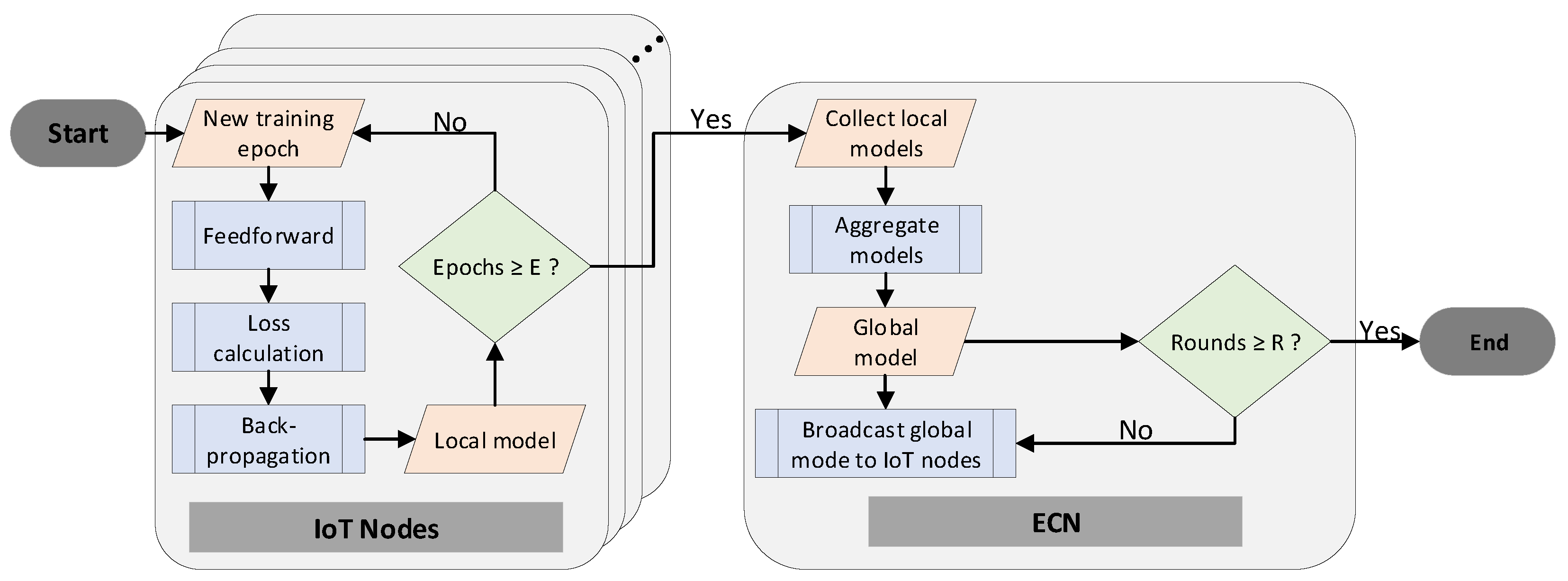
- First, we design and implement a fully distributed deep learning architecture that integrates IoT sensor nodes and an edge computing node using a federated learning paradigm. Each IoT node performs local model training on plant image data, while the edge node aggregates model updates through the Federated Averaging (FedAvg) algorithm to create a global model without requiring data centralization.
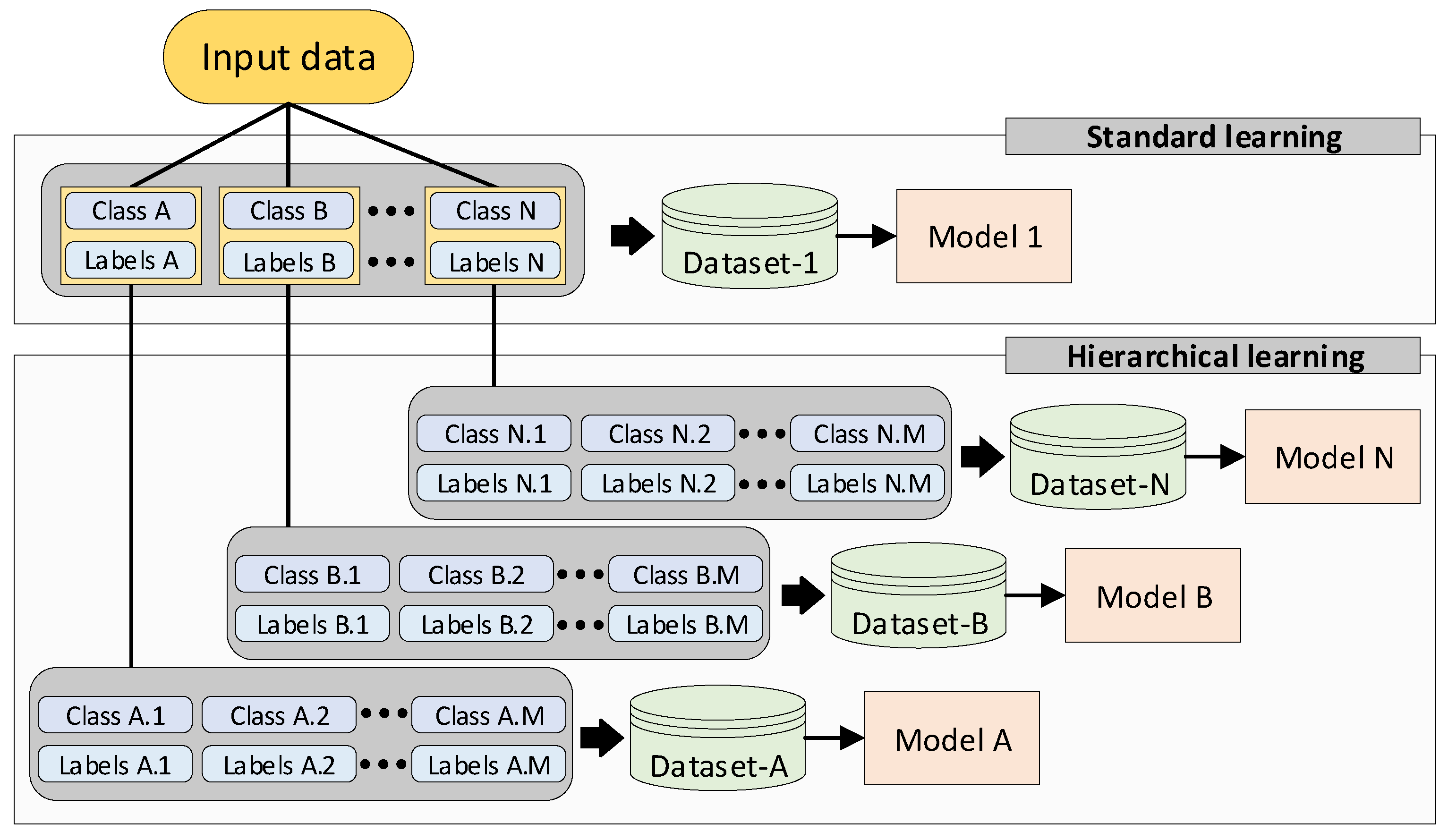
- Second, we introduce and evaluate two complementary FL training pipelines, a standard single model approach and a hierarchical approach combining a crop classifier with crop-specific disease models.
- Third, we present a detailed power consumption model for heterogeneous IoT nodes, comparing CPU-only and GPU-enabled devices, and quantifying the computational costs of each training configuration.
2. Related Work
3. Background
4. Methodology
4.1. System Architecture
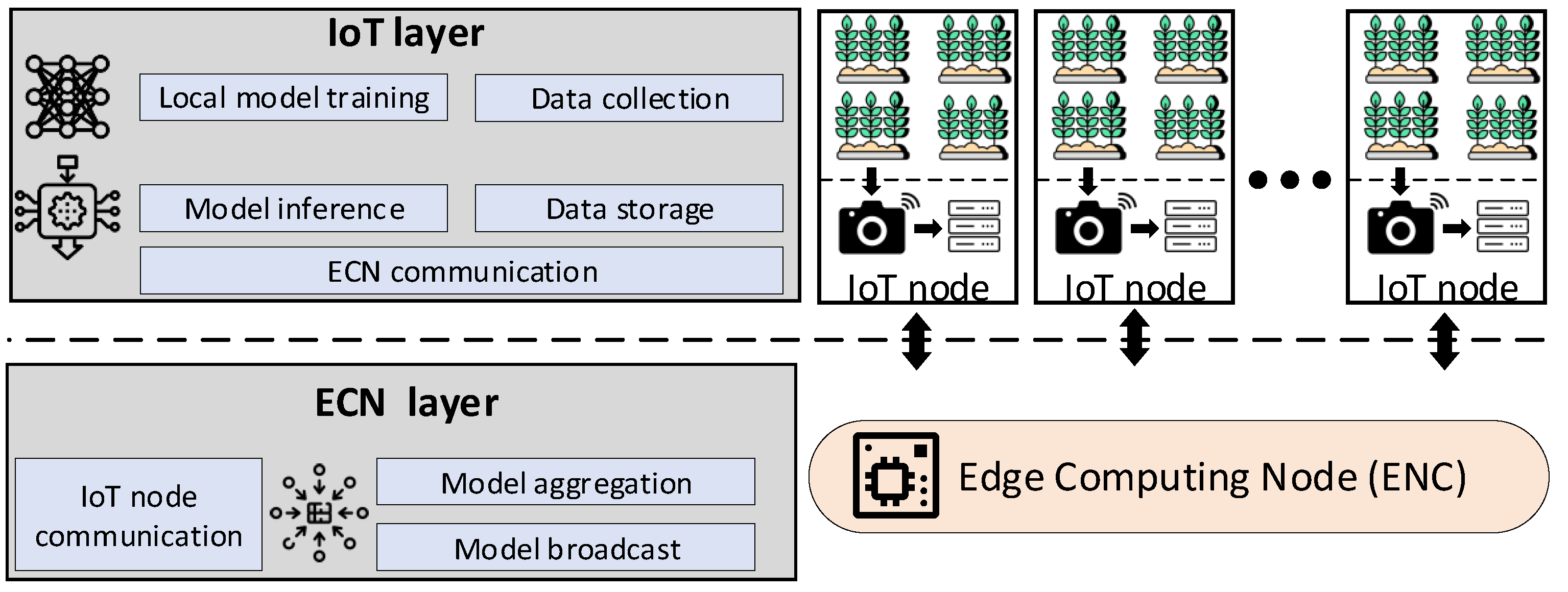
- Data collection: Each IoT node is equipped with a camera and is able to take photos in real-time from its surrounding environment. In this work, we deploy a distributed learning method for agricultural applications, and thus, we consider such images to capture different types of plants. Nonetheless, this method is generalizable to other types of data as well.
- Data storage: Each IoT node is able to locally store the data collected (in our case the plant images). As a result, each node i can formulate a local dataset that can be used to train a local DNN model.
- Local model training: Each IoT node has the computational capacity to train a DNN model that fits the locally stored dataset .
- Model inference: IoT nodes can utilize their trained models to perform inference (i.e., model testing) upon the collected data.
- Communication with ECN: Each IoT can communicate only with the ECN and is able to send and receive information. IoT nodes cannot communicate between themselves, since this would require a more complex communication infrastructure, which is unfit for sensor networks.
- Model aggregation: ECN can collect and then aggregate the models from the corresponding IoT nodes. This process results in a global model that is broadcasted back to the IoT nodes. In this paper, we use the FedAvg technique for the model aggregation operation, as in [24].
- Communication with IoT nodes: ECN can establish a bidirectional communication channel with each IoT node individually.
4.2. Design of Federated Learning Pipeline
4.3. Power Modeling of IoT Nodes
- CPU-only node: This node features an ARM-based processor without CUDA acceleration. It performs on-device inference and participates in local FL training using only CPU resources.
- GPU-enabled node: This node integrates an ARM CPU with a CUDA-capable embedded GPU (e.g., an NVIDIA Jetson-class device). It supports both inference and local FL training, benefiting from parallelized tensor operations.
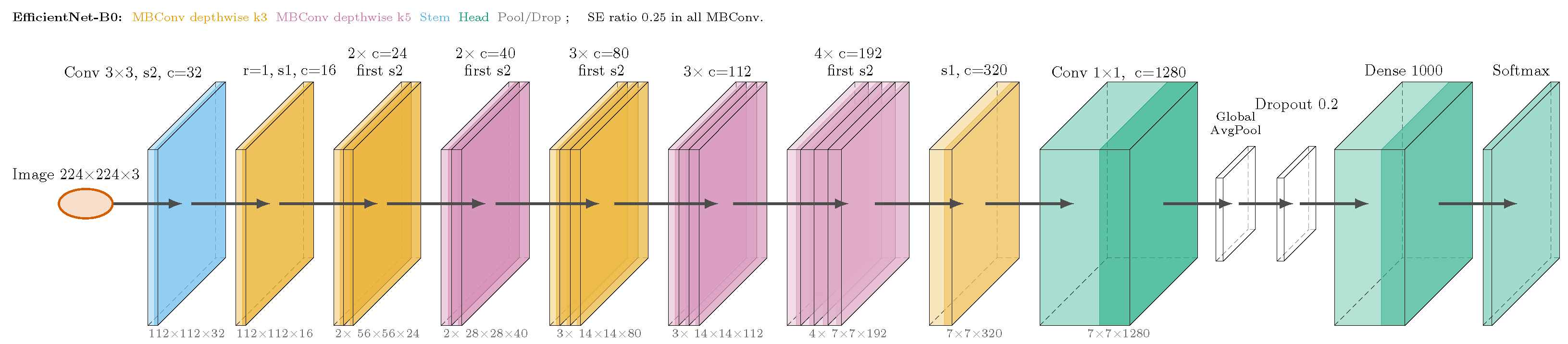
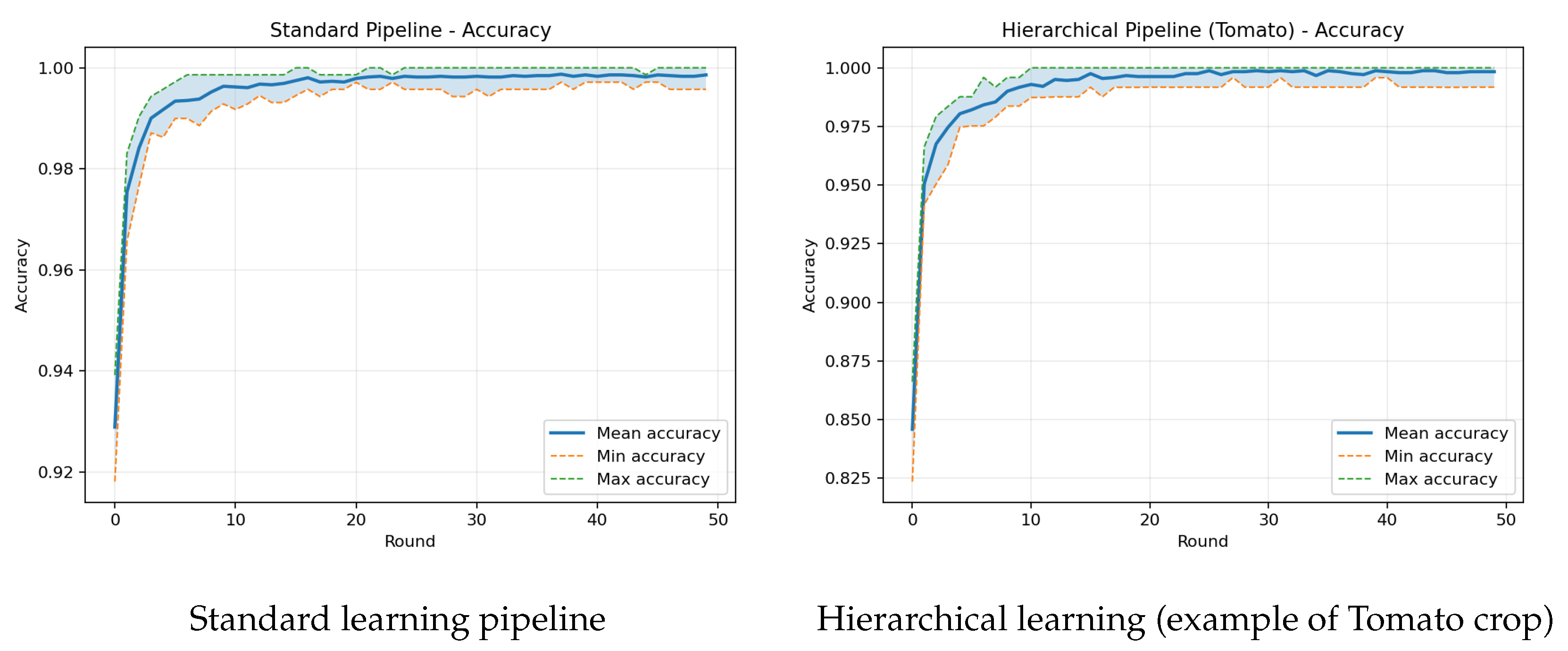
- Standard learning pipeline: a monolithic single-head model (EfficientNet-B0) trained to classify all disease classes across crops.
- Hierarchical learning pipeline: a modular structure consisting of a crop router that identifies the plant type and a corresponding crop-specific disease classification head.
5. Experimental Setup
5.1. Dataset and Use Cases Description
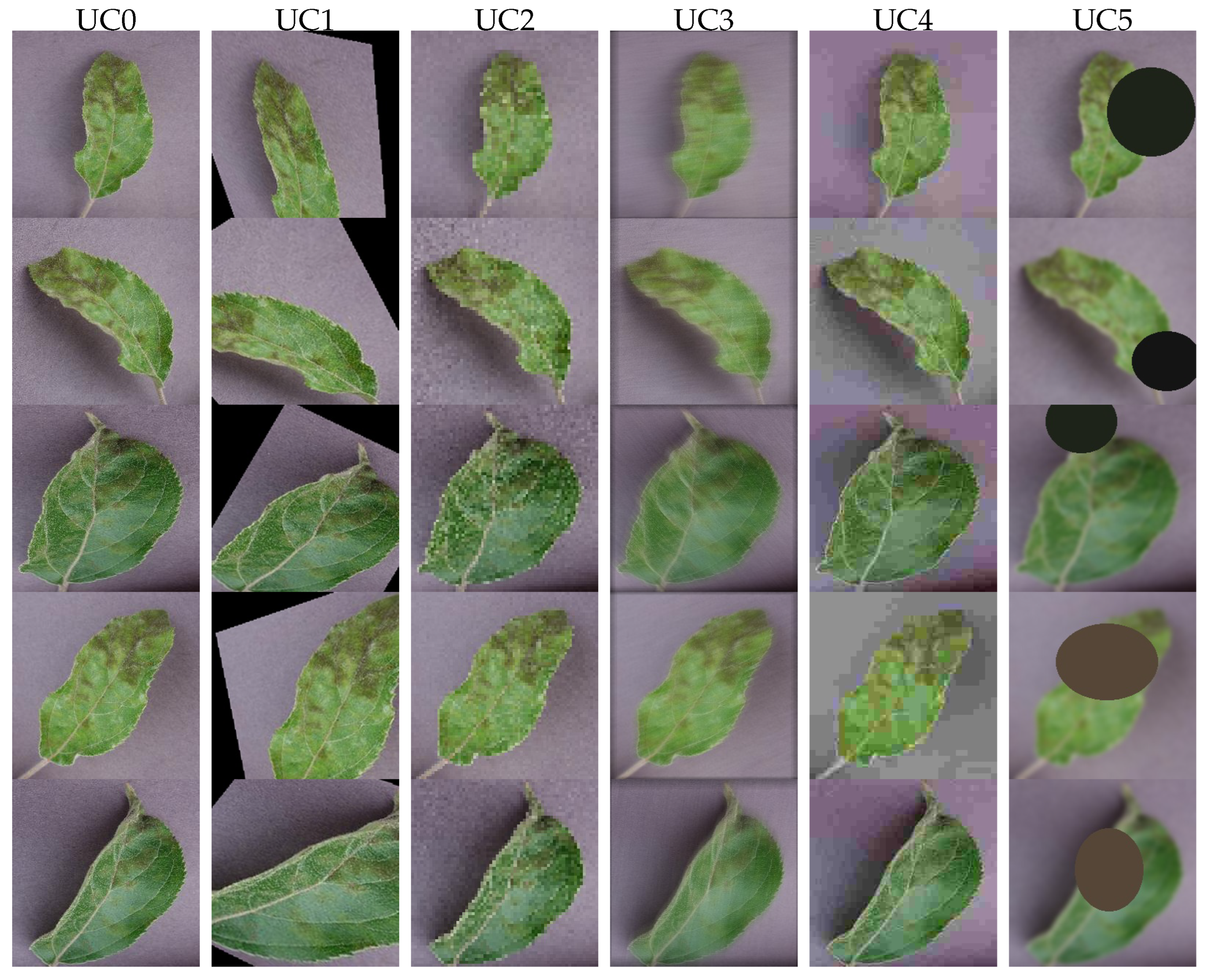
- UC0: The Lab Environment UC refers to the original dataset, untampered images, which are the baseline for comparisons.
- UC1: The SunnyAngle UC refers to an environment with the following characteristics: slight perspective tilt, small rotation, mild brightening/contrast, soft shadow; bright and strong sunlight, oblique camera angles, and leaf or hand shadows in the field.
- UC2: The OvercastNoise UC refers to an environment with the following characteristics: darker, lower contrast, slight desaturation, Gaussian sensor noise; mimics cloudy or dusk conditions with higher camera ISO and muted colors.
- UC3: The Defocus UC refers to an environment with the following characteristics: mild blur with small zoom jitter and rotation; motion-blurred image, wind-driven motion, or shallow depth-of-field misfocus.
- UC4: The JPEGandCast UC refers to an environment with the following characteristics: JPEG re-compression artifacts and warm/cool color cast; mimics on-device compression, messaging/export pipelines, and automatic white-balance drift.
- UC5: The OffCenter UC refers to an environment with the following characteristics: off-center crop, re-centering, light exposure/contrast changes; mimics imperfect framing from mobile mounts or partial leaf capture.
5.2. Federated Learning Training Procedure
5.3. Evaluation Metrics
6. Experimental Evaluation
7. Discussion and Practical Applicability
- Client dropout and intermittent connectivity are common in open field deployments, due to weather signal degradation, long communication distances and low-power sleep schedules of edge devices.
- Synchronous FL may stall when waiting for all clients, reducing practicality in scenarios with unstable links.
- Lightweight error-tolerant protocols for nodes with constrained energy budgets.
- A client selection strategy (or mechanism) that prioritizes nodes with stable connectivity. Additionally, possible rotation selection to improve robustness.
- Semi-asynchronous aggregation policy, which allows the ECN to update global models using available client updates without taking into consideration offline nodes.
8. Conclusions
Author Contributions
Funding
Institutional Review Board Statement
Informed Consent Statement
Data Availability Statement
Conflicts of Interest
References
- Wolfert, S.; Ge, L.; Verdouw, C.; Bogaardt, M.J. Big Data in Smart Farming—A review. Agric. Syst. 2017, 153, 69–80. [Google Scholar] [CrossRef]
- Vishnoi, V.K.; Kumar, K.; Kumar, B. Plant disease detection using computational intelligence and image processing. J. Plant Dis. Prot. 2021, 128, 19–53. [Google Scholar] [CrossRef]
- Elijah, O.; Rahman, T.A.; Orikumhi, I.; Leow, C.Y.; Hindia, M.N. An overview of Internet of Things (IoT) and data analytics in agriculture: Benefits and challenges. IEEE Internet Things J. 2018, 5, 3758–3773. [Google Scholar] [CrossRef]
- Saleem, M.H.; Potgieter, J.; Arif, K.M. Plant disease classification: A comparative evaluation of convolutional neural networks and deep learning optimizers. Plants 2020, 9, 1319. [Google Scholar] [CrossRef]
- Mahlein, A.K. Plant disease detection by imaging sensors–parallels and specific demands for precision agriculture and plant phenotyping. Plant Dis. 2016, 100, 241–251. [Google Scholar] [CrossRef]
- Upadhyay, A.; Chandel, N.S.; Singh, K.P.; Chakraborty, S.K.; Nandede, B.M.; Kumar, M.; Subeesh, A.; Upendar, K.; Salem, A.; Elbeltagi, A. Deep learning and computer vision in plant disease detection: A comprehensive review of techniques, models, and trends in precision agriculture. Artif. Intell. Rev. 2025, 58, 92. [Google Scholar] [CrossRef]
- Delnevo, G.; Girau, R.; Ceccarini, C.; Prandi, C. A deep learning and social iot approach for plants disease prediction toward a sustainable agriculture. IEEE Internet Things J. 2021, 9, 7243–7250. [Google Scholar] [CrossRef]
- Kashyap, P.K.; Kumar, S.; Jaiswal, A.; Prasad, M.; Gandomi, A.H. Towards precision agriculture: IoT-enabled intelligent irrigation systems using deep learning neural network. IEEE Sens. J. 2021, 21, 17479–17491. [Google Scholar] [CrossRef]
- Zou, Z.; Jin, Y.; Nevalainen, P.; Huan, Y.; Heikkonen, J.; Westerlund, T. Edge and fog computing enabled AI for IoT-an overview. In Proceedings of the 2019 IEEE International Conference on Artificial Intelligence Circuits and Systems (AICAS), Hsinchu, Taiwan, 18–20 March 2019; IEEE: New York, NY, USA, 2019; pp. 51–56. [Google Scholar]
- Beltrán, E.T.M.; Pérez, M.Q.; Sánchez, P.M.S.; Bernal, S.L.; Bovet, G.; Pérez, M.G.; Pérez, G.M.; Celdrán, A.H. Decentralized federated learning: Fundamentals, state of the art, frameworks, trends, and challenges. IEEE Commun. Surv. Tutor. 2023, 25, 2983–3013. [Google Scholar] [CrossRef]
- Dembani, R.; Karvelas, I.; Akbar, N.A.; Rizou, S.; Tegolo, D.; Fountas, S. Agricultural data privacy and federated learning: A review of challenges and opportunities. Comput. Electron. Agric. 2025, 232, 110048. [Google Scholar] [CrossRef]
- Ayaz, M.; Ammad-Uddin, M.; Sharif, Z.; Mansour, A.; Aggoune, E.H.M. Internet-of-Things (IoT)-based smart agriculture: Toward making the fields talk. IEEE Access 2019, 7, 129551–129583. [Google Scholar] [CrossRef]
- Nevavuori, P.; Narra, N.; Lipping, T. Crop yield prediction with deep convolutional neural networks. Comput. Electron. Agric. 2019, 163, 104859. [Google Scholar] [CrossRef]
- Balafas, V.; Karantoumanis, E.; Louta, M.; Ploskas, N. Machine learning and deep learning for plant disease classification and detection. IEEE Access 2023, 11, 114352–114377. [Google Scholar] [CrossRef]
- Singh, D.; Jain, N.; Jain, P.; Kayal, P.; Kumawat, S.; Batra, N. PlantDoc: A dataset for visual plant disease detection. In Proceedings of the 7th ACM IKDD CoDS and 25th COMAD, Hyderabad, India, 5–7 January 2020; pp. 249–253. [Google Scholar]
- Redmon, J.; Divvala, S.; Girshick, R.; Farhadi, A. You only look once: Unified, real-time object detection. In Proceedings of the IEEE Conference on Computer Vision and Pattern Recognition, Las Vegas, NV, USA, 27–30 June 2016; pp. 779–788. [Google Scholar]
- He, K.; Zhang, X.; Ren, S.; Sun, J. Deep residual learning for image recognition. In Proceedings of the IEEE Conference on Computer Vision and Pattern Recognition, Las Vegas, NV, USA, 27–30 June 2016; pp. 770–778. [Google Scholar]
- Tragoudaras, A.; Stoikos, P.; Fanaras, K.; Tziouvaras, A.; Floros, G.; Dimitriou, G.; Kolomvatsos, K.; Stamoulis, G. Design space exploration of a sparse mobilenetv2 using high-level synthesis and sparse matrix techniques on FPGAs. Sensors 2022, 22, 4318. [Google Scholar] [CrossRef]
- Khattab, A.; Habib, S.E.; Ismail, H.; Zayan, S.; Fahmy, Y.; Khairy, M.M. An IoT-based cognitive monitoring system for early plant disease forecast. Comput. Electron. Agric. 2019, 166, 105028. [Google Scholar] [CrossRef]
- Thorat, A.; Kumari, S.; Valakunde, N.D. An IoT based smart solution for leaf disease detection. In Proceedings of the 2017 international conference on big data, IoT and data science (BID), Pune, India, 20–22 December 2017; IEEE: New York, NY, USA, 2017; pp. 193–198. [Google Scholar]
- Devi, R.D.; Nandhini, S.A.; Hemalatha, R.; Radha, S. IoT enabled efficient detection and classification of plant diseases for agricultural applications. In Proceedings of the 2019 International Conference on Wireless Communications Signal Processing and Networking (WiSPNET), Chennai, India, 21–23 March 2019; IEEE: New York, NY, USA, 2019; pp. 447–451. [Google Scholar]
- Manoj, T.; Makkithaya, K.; Narendra, V.G. A Federated Learning-Based Crop Yield Prediction for Agricultural Production Risk Management. In Proceedings of the 2022 IEEE Delhi Section Conference (DELCON), New Delhi, India, 11–13 February 2022; pp. 1–7. [Google Scholar] [CrossRef]
- Zhang, C.; Xie, Y.; Bai, H.; Yu, B.; Li, W.; Gao, Y. A survey on federated learning. Knowl.-Based Syst. 2021, 216, 106775. [Google Scholar] [CrossRef]
- McMahan, B.; Moore, E.; Ramage, D.; Hampson, S.; Arcas, B.A.y. Communication-Efficient Learning of Deep Networks from Decentralized Data. In Proceedings of the 20th International Conference on Artificial Intelligence and Statistics, Fort Lauderdale, FL, USA, 20–22 April 2017; Singh, A., Zhu, J., Eds.; PMLR: 2017. Volume 54, pp. 1273–1282. [Google Scholar]
- Li, T.; Sahu, A.K.; Zaheer, M.; Sanjabi, M.; Talwalkar, A.; Smith, V. Federated Optimization in Heterogeneous Networks. In Proceedings of the Machine Learning and Systems, Austin, TX, USA, 2–4 March 2020; Dhillon, I., Papailiopoulos, D., Sze, V., Eds.; 2020; Volume 2, pp. 429–450. [Google Scholar]
- Wang, J.; Liu, Q.; Liang, H.; Joshi, G.; Poor, H.V. Tackling the Objective Inconsistency Problem in Heterogeneous Federated Optimization. In Proceedings of the Advances in Neural Information Processing Systems, Virtual, 6–12 December 2020; Larochelle, H., Ranzato, M., Hadsell, R., Balcan, M., Lin, H., Eds.; Curran Associates, Inc.: Red Hook, NY, USA, 2020; Volume 33, pp. 7611–7623. [Google Scholar]
- Karimireddy, S.P.; Kale, S.; Mohri, M.; Reddi, S.; Stich, S.; Suresh, A.T. SCAFFOLD: Stochastic Controlled Averaging for Federated Learning. In Proceedings of the 37th International Conference on Machine Learning, Virtual Event, 13–18 July 2020; Daume, H., III, Singh, A., Eds.; PMLR: 2020. Volume 119, pp. 5132–5143. [Google Scholar]
- Li, Q.; He, B.; Song, D. Model-Contrastive Federated Learning. In Proceedings of the IEEE/CVF Conference on Computer Vision and Pattern Recognition (CVPR), Virtual Conference, 19–25 June 2021; pp. 10713–10722. [Google Scholar]
- Foukalas, F.; Tziouvaras, A.; Tsiftsis, T.A. An Overview of Enabling Federated Learning over Wireless Networks. In Proceedings of the 2021 IEEE International Mediterranean Conference on Communications and Networking (MeditCom), Athens, Greece, 7–10 September 2021; pp. 271–276. [Google Scholar] [CrossRef]
- Tan, M.; Le, Q.V. EfficientNet: Rethinking Model Scaling for Convolutional Neural Networks. arXiv 2019, arXiv:1905.11946. [Google Scholar]
- Kim, M.S.; Son, C.H.; Choi, S.H. A Novel Federated Learning-Based Image Classification Model for Improving Chinese Character Recognition Performance. IEEE Access 2024, 12, 185971–185991. [Google Scholar] [CrossRef]
- Alhonainy, A.; Rao, P. Evaluation of Federated Learning Techniques on Edge Devices Using Synthetic Medical Imaging Datasets. In Proceedings of the 2023 IEEE Applied Imagery Pattern Recognition Workshop (AIPR), St. Louis, MO, USA, 27–29 September 2023; pp. 1–6. [Google Scholar] [CrossRef]
- Ben Youssef, B.; Alhmidi, L.; Bazi, Y.; Zuair, M. Federated Learning Approach for Remote Sensing Scene Classification. Remote Sens. 2024, 16, 2194. [Google Scholar] [CrossRef]
- Pateria, S.; Subagdja, B.; Tan, A.h.; Quek, C. Hierarchical Reinforcement Learning: A Comprehensive Survey. ACM Comput. Surv. 2021, 54, 1–35. [Google Scholar] [CrossRef]
- An, G.; Akiba, M.; Omodaka, K.; Nakazawa, T.; Yokota, H. Hierarchical deep learning models using transfer learning for disease detection and classification based on small number of medical images. Sci. Rep. 2021, 11, 4250. [Google Scholar] [CrossRef]
- Triantafyllidis, E.; Acero, F.; Liu, Z.; Li, Z. Hybrid hierarchical learning for solving complex sequential tasks using the robotic manipulation network ROMAN. Nat. Mach. Intell. 2023, 5, 991–1005. [Google Scholar] [CrossRef]
- Imteaj, A.; Thakker, U.; Wang, S.; Li, J.; Amini, M.H. A survey on federated learning for resource-constrained IoT devices. IEEE Internet Things J. 2021, 9, 1–24. [Google Scholar] [CrossRef]
- Manni, A.; Caroppo, A.; Rescio, G.; Siciliano, P.; Leone, A. Benchmarking of Contactless Heart Rate Measurement Systems in ARM-Based Embedded Platforms. Sensors 2023, 23, 3507. [Google Scholar] [CrossRef]
- Holly, S.; Wendt, A.; Lechner, M. Profiling Energy Consumption of Deep Neural Networks on NVIDIA Jetson Nano. In Proceedings of the 2020 11th International Green and Sustainable Computing Workshops (IGSC), Pullman, WA, USA, 19–22 October 2020; pp. 1–6. [Google Scholar] [CrossRef]
- Van Rossum, G.; Drake, F.L. Python 3 Reference Manual; CreateSpace: Scotts Valley, CA, USA, 2009. [Google Scholar]
- Paszke, A.; Gross, S.; Massa, F.; Lerer, A.; Bradbury, J.; Chanan, G.; Killeen, T.; Lin, Z.; Gimelshein, N.; Antiga, L.; et al. PyTorch: An Imperative Style, High-Performance Deep Learning Library. In Proceedings of the Advances in Neural Information Processing Systems, Vancouver, BC, Canada, 8–14 December 2019. [Google Scholar]
- Marcel, S.; Rodriguez, Y. Torchvision: Models, Datasets and Image Transformations for Computer Vision. In Proceedings of the 18th ACM International Conference on Multimedia, Firenze, Italy, 25–29 October 2010. [Google Scholar]
- Beutel, D.J.; Topal, T.; Mathur, A.; Qiu, X.; Parcollet, T.; Lane, N.D. Flower: A Friendly Federated Learning Research Framework. In Proceedings of the 13th ACM International Conference on Systems and Storage (SYSTOR), Haifa, Israel, 13–15 October 2020. [Google Scholar]
- Pedregosa, F.; Varoquaux, G.; Gramfort, A.; Michel, V.; Thirion, B.; Grisel, O.; Blondel, M.; Prettenhofer, P.; Weiss, R.; Dubourg, V.; et al. Scikit-learn: Machine Learning in Python. J. Mach. Learn. Res. 2011, 12, 2825–2830. [Google Scholar]
- Clark, A. Pillow (PIL Fork) Documentation; Python Software Foundation: Wilmington, DE, USA, 2015. [Google Scholar]
- Harris, C.R.; Millman, K.J.; van der Walt, S.J.; Gommers, R.; Virtanen, P.; Cournapeau, D.; Wieser, E.; Taylor, J.; Berg, S.; Smith, N.J.; et al. Array Programming with NumPy. Nature 2020, 585, 357–362. [Google Scholar] [CrossRef]
- Rodola, G. psutil: Cross-Platform Process and System Utilities. 2024. Available online: https://github.com/giampaolo/psutil (accessed on 16 November 2025).



| Parameter | Value |
|---|---|
| Loss function | CrossEntropyLoss (label_smoothing = 0.1) |
| Optimizer | Adam |
| Learning rate | |
| Weight decay | |
| Batch size | 32 |
| Training epochs | 5 |
| Training rounds | 10 |
| Clients | 10 |
| Crop | Global Acc | Per-Crop Acc (CropAcc × DiseaseAcc) | Global F1 | Per-Crop F1 |
|---|---|---|---|---|
| Apple | 0.771 | 0.807 (0.950 × 0.850) | 0.664 | 0.821 |
| Blueberry | 0.890 | 0.933 (0.933 × 1.000) | 0.785 | 0.966 |
| Cherry | 0.709 | 0.842 (0.916 × 0.920) | 0.638 | 0.867 |
| Corn | 0.852 | 0.723 (0.975 × 0.741) | 0.762 | 0.724 |
| Grape | 0.730 | 0.666 (0.879 × 0.758) | 0.791 | 0.685 |
| Orange | 0.897 | 0.952 (0.952 × 1.000) | 0.840 | 0.976 |
| Peach | 0.736 | 0.866 (0.976 × 0.887) | 0.823 | 0.853 |
| Bell Pepper | 0.577 | 0.659 (0.693 × 0.951) | 0.667 | 0.770 |
| Potato | 0.599 | 0.501 (0.718 × 0.699) | 0.726 | 0.565 |
| Raspberry | 0.830 | 0.920 (0.920 × 1.000) | 0.899 | 0.958 |
| Soybean | 0.734 | 0.892 (0.892 × 1.000) | 0.809 | 0.943 |
| Squash | 0.766 | 0.718 (0.718 × 1.000) | 0.792 | 0.836 |
| Strawberry | 0.729 | 0.814 (0.903 × 0.901) | 0.817 | 0.840 |
| Tomato | 0.660 | 0.642 (0.924 × 0.694) | 0.650 | 0.661 |
| Device | Processing Time (ms) | Average Power per Image (W) | Peak RAM (MB) | |||
|---|---|---|---|---|---|---|
| Standard | Hierarchical | Standard | Hierarchical | Standard | Hierarchical | |
| Raspberry-like | 4.267 | 7.694 (4.24 + 3.454) | 0.003556 | 0.006412 (0.003533 + 0.002878) | 894.199 | 1831.443 (915.721 + 915.722) |
| Jetson-like | 4.379 | 7.698 (4.238 +3.46) | 0.006082 | 0.010692 (0.005886 + 0.004805) | 859.27 | 1847.715 (923.855 + 923.861) |
Disclaimer/Publisher’s Note: The statements, opinions and data contained in all publications are solely those of the individual author(s) and contributor(s) and not of MDPI and/or the editor(s). MDPI and/or the editor(s) disclaim responsibility for any injury to people or property resulting from any ideas, methods, instructions or products referred to in the content. |
© 2025 by the authors. Licensee MDPI, Basel, Switzerland. This article is an open access article distributed under the terms and conditions of the Creative Commons Attribution (CC BY) license (https://creativecommons.org/licenses/by/4.0/).
Share and Cite
Papanikolaou, A.; Tziouvaras, A.; Floros, G.; Xenakis, A.; Bonsignorio, F. Distributed Deep Learning in IoT Sensor Network for the Diagnosis of Plant Diseases. Sensors 2025, 25, 7646. https://doi.org/10.3390/s25247646
Papanikolaou A, Tziouvaras A, Floros G, Xenakis A, Bonsignorio F. Distributed Deep Learning in IoT Sensor Network for the Diagnosis of Plant Diseases. Sensors. 2025; 25(24):7646. https://doi.org/10.3390/s25247646
Chicago/Turabian StylePapanikolaou, Athanasios, Athanasios Tziouvaras, George Floros, Apostolos Xenakis, and Fabio Bonsignorio. 2025. "Distributed Deep Learning in IoT Sensor Network for the Diagnosis of Plant Diseases" Sensors 25, no. 24: 7646. https://doi.org/10.3390/s25247646
APA StylePapanikolaou, A., Tziouvaras, A., Floros, G., Xenakis, A., & Bonsignorio, F. (2025). Distributed Deep Learning in IoT Sensor Network for the Diagnosis of Plant Diseases. Sensors, 25(24), 7646. https://doi.org/10.3390/s25247646