1. Introduction
Reinforcement learning (RL) has achieved remarkable success in a wide range of complex decision-making domains, from strategic games [
1,
2,
3,
4] and robotics [
5,
6] to, more recently, the post-training of large language models (LLMs) [
7,
8,
9]. These successes highlight the capability of RL to learn effective sequential decision-making strategies directly from interaction.
However, applying RL to real-world problems remains challenging due to the complexity and high dimensionality of observations, and the need for stable and efficient policy learning. In many practical domains, raw observations often contain redundant or irrelevant information, which can distract the policy and slow down convergence. To address this issue, the information bottleneck (IB) principle [
10] provides a theoretically grounded approach to learning compact and robust representations. By constraining the amount of information the latent representation retains about the input while preserving the information relevant to the task, IB helps extract the essential features for decision-making and improves generalization and robustness.
Despite extensive progress in RL for control and IB for representation learning, their applications to operations research (OR) problems remains comparatively underexplored. Many OR tasks, such as vehicle routing, delivery scheduling, and resource allocation, involve inherently sequential decision-making under constraints. For instance, a logistics company must plan efficient delivery routes for multiple vehicles to minimize cost and travel time; a ride-hailing platform must dynamically assign and route drivers to serve customers optimally. These problems are typically modeled as combinatorial optimization tasks, often framed as variants of the Traveling Salesman Problem (TSP) or Vehicle Routing Problem (VRP) [
11,
12]. Solving them efficiently can yield significant improvements in logistics, transportation, and supply chain management [
13,
14,
15,
16].
In addition, such routing and scheduling tasks are central to smart manufacturing and industrial automation systems, where sensors and Internet of Things (IoT) devices continuously generate real-time data about production status, machine conditions, and material flows. Leveraging reinforcement learning to process and act upon this sensing data enables intelligent and adaptive decision-making in dynamic industrial environments, thereby improving operational efficiency, flexibility, and sustainability in Industry 4.0 settings.
Recent works on OR have shown that RL-based methods can generalize across problem instances, enabling data-driven solvers that adapt to different task configurations [
13,
14,
15,
17]. However, two major challenges persist: (1) robust state representation, as the state space grows combinatorially with problem size and structure; (2) effective exploration, as naive exploration strategies often fail in large and highly structured decision spaces. Addressing these challenges is key to developing RL agents that are both stable during training and generalizable to unseen problem instances.
In this work, we propose Information Bottleneck-Enhanced (IBE) RL method, a novel framework that integrates the information bottleneck principle with attention-based RL architectures to improve both representation learning and exploration in combinatorial optimization tasks. Specifically, IBE introduces two complementary IB objectives:
A state representation bottleneck, which encourages the encoder to learn compact and task-relevant representations of the environment by minimizing unnecessary information;
A policy bottleneck, which regularizes the policy optimization with an IB-based exploration bonus, encouraging the agent to balance exploitation of known strategies with exploration of informative actions.
Furthermore, we employ attention mechanisms as feature extractors in IBE, leveraging their ability to model complex spatial–temporal dependencies inherent in routing and scheduling problems. This design allows the agent to capture global relational structures among nodes, routes, or time steps, enhancing representation quality and training efficiency. Our key contributions can be summarized as follows:
We propose IBE, a new RL framework that integrates dual information bottleneck objectives into both state representation learning and policy optimization. This design improves representation robustness and enhances exploration efficiency in structured decision spaces.
We conduct extensive experiments on multiple benchmarks, including two routing tasks and one scheduling problem. Across all settings, IBE consistently outperforms other competitive baselines in terms of performance, generalization, and stability.
We perform comprehensive ablation studies to examine the contribution of each component, including the effects of bottleneck strength and the use of the attention encoder. These analyses provide insights into how IB principles improve both learning dynamics and policy generalization.
Overall, IBE bridges the gap between information-theoretic representation learning and reinforcement learning for combinatorial optimization, offering a principled approach to more robust and generalizable RL solutions in operations research domains.
2. Related Work and Preliminaries
In this section, we provide a brief overview of related work and introduce the preliminaries necessary to understand this study.
2.1. Reinforcement Learning in Operations Research Problems
RL has emerged as a promising paradigm for tackling complex problems in operations research (OR), where traditional optimization algorithms often struggle with scalability, adaptivity, or generalization to dynamic environments. Applications of RL in OR include the Traveling Salesman Problem (TSP) [
18], bin and machine packing [
19], supply chain management [
20], and various Vehicle Routing Problem (VRP) variants [
13], among others. Recently, RL has been applied to increasingly complex real-world domains, such as bridge maintenance via multi-agent ranking proximal policy optimization [
21] and advanced path planning through ensemble RL [
22]. Complementing these practical applications, recent surveys have outlined the field’s emerging challenges and future prospects [
23]. These works demonstrate that RL can learn data-driven heuristics capable of generalizing across diverse problem instances, offering a flexible alternative to handcrafted optimization algorithms.
However, most prior approaches focus on task-specific designs and do not pay attention to compact representation learning with IB, where the learning architecture is tightly coupled to a particular OR formulation. In contrast, our work proposes IBE, a general framework that achieves robust performance across multiple OR domains.
2.1.1. Reinforcement Learning Framework
Following the formal definition of a Markov Decision Process (MDP) introduced by Sutton et al. [
24], we define an MDP as a 5-tuple:
where
denotes the state space, representing all possible states of the environment;
denotes the action space, consisting of all actions available to the agent;
defines the state transition probability, i.e., the probability of reaching state after taking action a in state s;
is the reward function, specifying the scalar feedback received after executing action a in state s;
is the discount factor, controlling the importance of future rewards.
At each discrete time step
t, the agent observes a state
, selects an action
according to its policy
, receives a reward
, and transitions to the next state
sampled from
. The objective of the agent is to learn an optimal policy
that maximizes the expected cumulative discounted reward:
where
T is the time horizon.
In practice, various RL algorithms are used to optimize this objective. Value-based methods (e.g., DQN [
25]) estimate the expected return of state–action pairs, while policy-based methods (e.g., REINFORCE [
24]) directly optimize the policy parameters via gradient ascent. Actor–critic methods [
26,
27] combine both paradigms to improve stability and sample efficiency. The proposed IBE model incorporates IB objectives into actor–critic methods and PPO.
2.1.2. Proximal Policy Optimization
We base our approach on the Proximal Policy Optimization (PPO) algorithm [
27], a robust on-policy reinforcement learning method widely adopted for continuous-control and combinatorial optimization tasks. PPO improves stability by constraining the policy update through a clipped surrogate objective:
where
is the probability ratio between the new and old policies,
is the advantage estimate, and
controls the size of the trust region.
2.2. Information Bottleneck in Reinforcement Learning
The information bottleneck (IB) principle [
10] has been widely adopted in RL to promote compact and task-relevant representations, improving both robustness and generalization. Early studies applied the IB to enhance representation learning in Atari games [
28], demonstrating that compressed latent representations can mitigate overfitting to irrelevant visual details. Lu et al. [
29] proposed a dynamics-based IB objective to enable rapid adaptation to new environments with changing system dynamics, while Fan and Li [
30] extended this idea to temporal and multi-view settings, learning representations robust to task-irrelevant distractions. In the meta-RL context, Xiang et al. [
31] integrated variational IB into meta-learning to encourage transferability across tasks, and Igl et al. [
32] introduced the Information Bottleneck Actor–Critic (IBAC) framework, which utilizes variational bottlenecks to improve generalization in noisy, low-data regimes.
Despite these advances, most IB-based RL methods primarily target representation robustness or domain generalization in continuous-control or visual domains. Our approach differs by integrating IB principles at two levels in OR problems: (1) a state representation bottleneck, which enforces compressed and informative embeddings; (2) a policy bottleneck, which introduces an IB-inspired regularization term that serves as an exploration bonus. This dual design explicitly connects the IB principle to both representation learning and exploration in combinatorial optimization settings.
2.3. Exploration Bonus in Reinforcement Learning
Exploration remains one of the most fundamental challenges in RL, requiring a balance between exploiting known high-reward actions and exploring new, potentially better strategies. A broad range of methods has been proposed to encourage exploration, such as curiosity-driven rewards [
33,
34] and diversity-based intrinsic motivation [
35], which augment the reward signal with intrinsic bonuses for visiting novel or informative states.
In policy-gradient methods, exploration is often encouraged through entropy regularization, which promotes stochasticity in the policy distribution [
27,
36]. Entropy-based exploration has proven effective across diverse domains, including robotic control [
37], video games [
38], and reinforcement learning for large language models [
39]. However, its application to operations research problems remains largely unexplored, where the structured and combinatorial nature of decision spaces demands more targeted exploration strategies. In this work, we extend the concept of entropy-based regularization by incorporating an information bottleneck-inspired exploration bonus within our attention-based RL framework. This approach not only encourages more diverse and informative exploration but also leads to consistent performance improvements across routing and scheduling tasks.
2.4. Attention Mechanisms in Reinforcement Learning
The attention mechanism has become a cornerstone of modern deep learning, enabling models to selectively focus on relevant parts of the input. Its integration into RL has led to significant advances in both representation quality and decision-making efficiency. The Deep Attention Network (DAN) [
40] extends DQN [
25] with soft and hard attention modules, allowing the agent to attend to salient regions in visual inputs. Subsequent works have incorporated self-attention within convolutional or recurrent architectures to enhance feature extraction and long-range dependency modeling, yielding notable performance gains in environments such as Atari games [
41]. More recently, attention has been explored in various RL settings: Cherepanov et al. [
42] proposed a transformer architecture with memory for offline RL in partially observable environments, improving temporal credit assignment; Pramanik et al. [
43] investigated efficient recurrent self-attention mechanisms to reduce computational cost while retaining the ability to capture long-term dependencies; and Hu et al. [
44] provided a comprehensive overview of attention in multi-agent reinforcement learning (MARL) [
45], highlighting its role in communication and coordination among agents. In this work, we leverage attention as a representation backbone for combinatorial optimization tasks, where spatial and temporal dependencies are central. By combining attention with the information bottleneck principle, our IBE framework achieves robust feature extraction and effective exploration in large, structured decision spaces.
Attention as a Feature Encoder
We employ an attention mechanism [
14] as the feature encoder to extract rich and task-relevant information from the input state. Given an input state represented as feature vectors
the self-attention mechanism projects these features into queries (
Q), keys (
K), and values (
V),
and computes contextualized embeddings as
This allows each element to attend to all others, integrating both local and global context. Compared to fully connected encoders, attention provides several advantages for RL: (1) permutation invariance, enabling the model to handle unordered sets; (2) global reasoning, as each entity’s representation depends on all others; (3) scalability and stability, due to parallel computation and effective gradient flow.
In the IBE framework, the attention encoder produces latent representations that feed into the information bottleneck module.
3. Problem Statement
In this section, following the formalization of previous work [
46] and definitions in
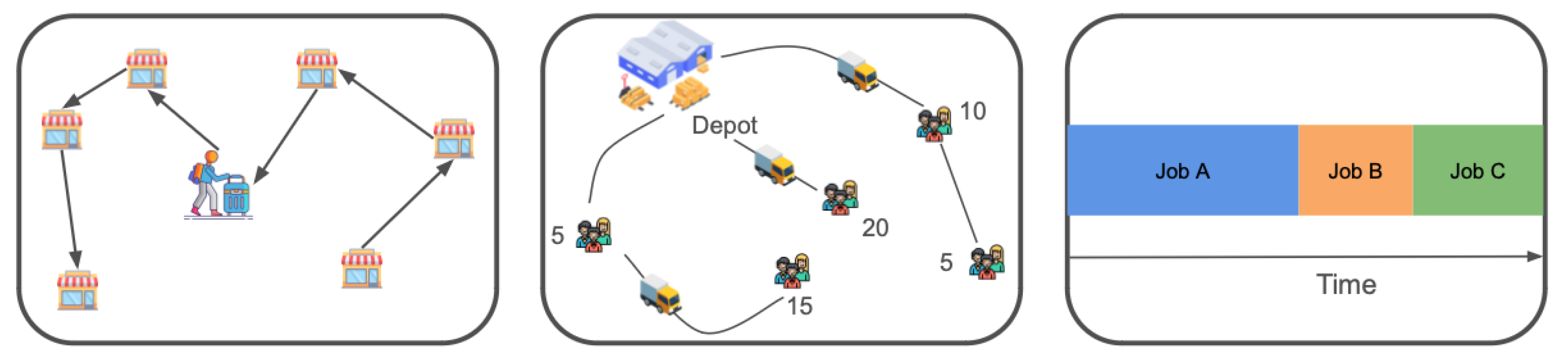
Section 2, we describe how we formalize three tasks used in this work as MDPs, which can be tackled by reinforcement learning techniques. We consider three different tasks, two routing tasks and one scheduling task. Illustrations of all three tasks can be seen in
Figure 1.
3.1. Task 1: Traveling Salesman Problem
As shown in the left sub-figure of
Figure 1, at each decision step, the agent selects the next city to visit. The reward remains zero until all cities have been visited. Once every city has been visited, the reward is defined as the negative total path length. Consequently, maximizing the reward is equivalent to minimizing the total travel distance.
3.1.1. State Space
The state space of the TSP task can be found in
Table 1.
3.1.2. Action Space
At each decision step, the agent selects the next city to visit from the set of unvisited cities. The action space is therefore discrete and defined as
where
N is the total number of cities. Each action
corresponds to the index of the next city to visit.
3.1.3. Reward Function
The reward function is designed to encourage shorter tours by assigning a terminal reward equal to the negative total tour length. During intermediate steps, the agent receives zero reward until the tour is complete. Maximizing the cumulative reward is therefore equivalent to minimizing the total tour length.
3.2. Task 2: Split-Delivery Vehicle Routing Problem
The Split-Delivery Vehicle Routing Problem (SDVRP) is a generalization of the Capacitated Vehicle Routing Problem (CVRP), in which customers can be visited multiple times and their demand may be fulfilled partially during each visit. As shown in the middle sub-figure in
Figure 1, at each step, the agent selects the next customer to visit based on its current location and remaining vehicle capacity. Upon visiting a customer, the remaining capacity is updated accordingly. If the remaining capacity is insufficient to serve any remaining customers, the agent must return to the depot to reload. The agent receives a reward of 0 unless all customers are fully served. Once all demands are met, the reward equals the negative total route length. Thus, maximizing the reward is equivalent to minimizing the total travel distance.
3.2.1. State Space
The state space of the SDVRP task can be found in
Table 2.
3.2.2. Action Space
At each decision step t, the agent selects an action , where 0 represents returning to the depot and correspond to customer indices. Only feasible actions (i.e., customers whose remaining demand can be partially or fully served given the remaining capacity, or the depot when capacity is exhausted) are allowed. After executing an action, the environment updates the current location, adjusts the remaining demand and vehicle capacity, and recalculates the action mask accordingly.
3.2.3. Reward Function
The environment provides a sparse, terminal reward that encourages the agent to minimize the total travel distance while satisfying all customer demands. Maximizing the cumulative reward is equivalent to minimizing the total travel distance while fully satisfying all customer demands.
3.3. Task 3: Single-Machine Total Weighted Tardiness Problem
The SMTWTP involves scheduling a set of jobs on a single machine. As shown in the right sub-figure of
Figure 1, each job
i is characterized by a processing time, a weight, and a due date. The goal is to minimize the total weighted tardiness, defined as the sum over all jobs of the product between each job’s weight and its tardiness—where tardiness is the amount by which a job’s completion time exceeds its due date (zero if completed on time). In a reinforcement learning formulation, the agent sequentially selects which job to process next. The agent receives a reward of 0 for all intermediate steps and a final reward equal to the negative of the total weighted tardiness once all jobs are completed. Thus, maximizing the cumulative reward corresponds to minimizing the total weighted tardiness objective.
3.3.1. State Space
The state space of the SMTWTP task can be found in
Table 3.
3.3.2. Action Space
At each decision step
t, the agent selects one job
to process next on the single machine. A dummy starting node (indexed as 0) is masked out and never chosen. After each selection, the chosen job is marked as processed in the action mask,
and the current processing time is increased by the selected job’s processing duration. The episode terminates once all jobs have been scheduled.
3.3.3. Reward Function
The SMTWTP environment provides a sparse terminal reward that encourages minimizing the total weighted tardiness of all jobs. During intermediate steps, the agent receives no reward while selecting the next job to process. After all jobs are completed, the environment calculates the total weighted tardiness based on how late each job finishes relative to its due date, weighted by its importance. The final reward is the negative of this value, so higher rewards correspond to schedules with lower overall tardiness. Maximizing the reward therefore leads the agent to prioritize jobs efficiently to minimize delays and meet due dates.
4. Proposed Method: Information Bottleneck-Enhanced RL (IBE)
4.1. Overview and Motivation
IBE introduces two additional information-theoretic regularizers to the standard reinforcement learning objective (in our work, we employ PPO). Specifically, IBE incorporates (1) a state representation bottleneck that encourages the encoder to extract compact, task-relevant representations while discarding irrelevant details; (2) a policy bottleneck that promotes more diverse and balanced exploration.
4.2. State Representation Bottleneck (Contribution 1)
Let
S denote the input state and
the latent embedding produced by the attention encoder. We model the encoder as a stochastic mapping
which allows control over the amount of information transmitted from
S to
T. In all experiments, we set
= 0.1. This value follows standard practice in variational information bottleneck implementations and produces stable behavior across tasks. According to the IB principle [
10], we aim to maximize the expected return while minimizing the mutual information between
S and
T:
In practice, the mutual information
is approximated by the KL divergence between the encoder distribution and a prior
, leading to the following regularization term:
where
is a Gaussian prior
and
controls the strength of state compression. The Gaussian prior represents a maximally entropic distribution under fixed variance, corresponding to a neutral “uninformative” latent space that encourages compact, noise-robust state representations. The KL term
serves as a variational upper bound on the mutual information
, consistent with the variational information bottleneck framework. While this bound may be loose when the true marginal distribution of
T deviates significantly from the Gaussian prior
, it provides a tractable and stable surrogate objective that effectively controls the representation compression in practice, which is crucial for high-dimensional OR problems.
4.3. Policy Bottleneck for Exploration (Contribution 2)
Similarly, we introduce a policy bottleneck that constrains the mutual information between states and actions:
where
is a uniform prior distribution over the action space. If
is uniform, this KL divergence simplifies to
, which recovers the standard entropy regularization term. Hence, the policy bottleneck generalizes entropy-based exploration by offering a principled information-theoretic interpretation: actions are encouraged to remain as uninformative about the state as possible while still maximizing expected return. Crucially, this formulation exposes the prior
as a flexible design parameter. Unlike standard entropy bonuses, which are rigidly tied to a uniform target, our framework allows
to be tailored to the problem structure. This flexibility enables the injection of domain knowledge directly into the regularization term, anchoring the agent to plausible solutions while still allowing deviation when profitable. For example, in a vehicle routing problem, a non-uniform prior
could be designed to assign higher probability to nearest-neighbor transitions or routes that respect time windows. This effectively ‘soft-starts’ the exploration process, preventing the agent from wasting computational resources on obviously invalid solutions while preserving the stochasticity needed to escape local optima.
4.4. Integration with PPO and Training Algorithm (Contribution 3)
By combining the two bottleneck regularizers with the PPO surrogate loss (see Equation (
1)), the overall optimization objective is given by
Here, controls the degree of compression in the attention encoder and regulates the exploration–exploitation balance in the policy. When and are uniform, the objective reduces to the original PPO. We set for all experiments, unless otherwise specified.
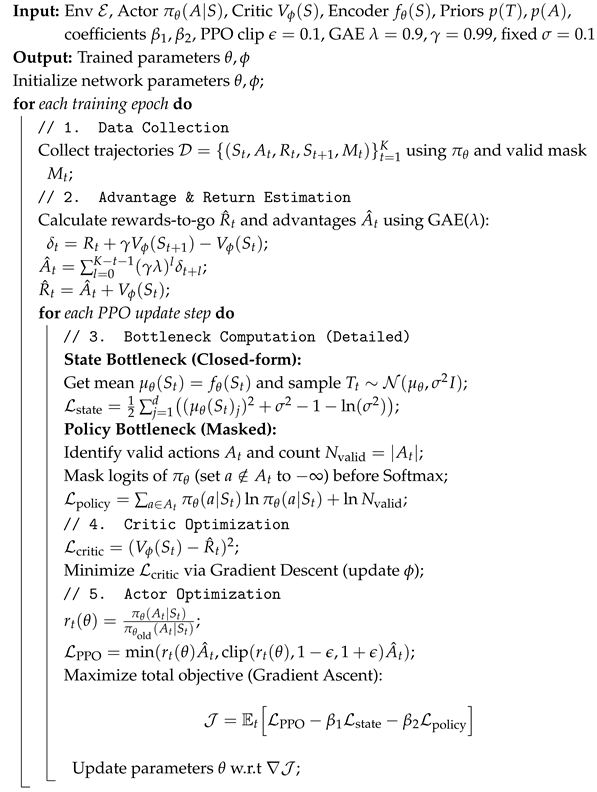
The pseudo-code of IBE is presented in Algorithm 1. Empirically, the coefficients and can be tuned to balance compression and exploration: smaller values recover standard PPO behavior, whereas larger values encourage more compact latent representations and smoother, more exploratory policies.
To handle the masked actions in routing and scheduling problems, the prior
is defined as a dynamic uniform distribution over the set of feasible actions at step
t. Specifically,
if action
a is valid, and 0 otherwise. During optimization, we calculate the KL divergence strictly over the valid action space. This is implemented by masking the logits of invalid actions prior to the softmax operation, ensuring the policy assigns zero probability to infeasible moves.
| Algorithm 1: Information Bottleneck-Enhanced (IBE) PPO |
 |
5. Experiments
In this section, we empirically evaluate the proposed IBE framework and compare it with six baseline methods: PPO, REINFORCE, Nearest Neighbor, AM, NeuOpt, and a random policy. We begin by describing the experimental environments and setup, followed by quantitative evaluations and ablation studies that assess the contribution of each component within IBE.
Through these experiments, we aim to address the following key research questions:
How does IBE perform on routing and scheduling tasks compared with standard reinforcement learning baselines?
What is the individual contribution of each component, particularly the two information bottleneck objectives, to the overall performance of IBE?
What does the learned policy of IBE look like, and how does it evolve during training?
5.1. Environments
We evaluate IBE on three benchmark environments introduced in
Section 3: the Traveling Salesman Problem (TSP), the Split-Delivery Vehicle Routing Problem (SDVRP), and the Single-Machine Total Weighted Tardiness Problem (SMTWTP). These environments represent canonical tasks in routing and scheduling, allowing us to assess the generality and scalability of the proposed approach.
For the TSP environment, we generated problem instances with three different scales, where the number of cities (nodes) was set to 50, 100, and 200. In the SDVRP environment, we considered three scales, corresponding to 20, 50, and 100 customers. For the SMTWTP environment, we evaluated instances with 10, 20, and 50 jobs.
5.2. Baselines
We compare the proposed IBE framework against four RL representative baselines:
5.3. Implementation Details
We used a learning rate = 1 × 10
−4, batch size = 512, and the `Adam’ optimizer. In each epoch, we sampled data and performed gradient updates until all data was sampled. In total, we trained for 10 epochs. In GAE, we set
and
. For the attention encoder, we used four attention heads and three layers, with 128-D embedding and a ReLU activation function. We did not use any normalization layers within the transformer blocks. For the fully connected (FC) layers used in the policy/value heads, we used the same 128 embedding dimensions; different numbers of layers were examined in
Table 5. All non-attention-based baselines use the same underlying fully connected encoder architecture (three FC layers with 128-D embedding), and AM uses the same attention encoder (three layers, four heads, 128-D embedding) as the IBE framework for fair comparison. The hyper-parameters for all baselines are consistent with the ones used for our method.
5.4. Performance in the TSP Environment
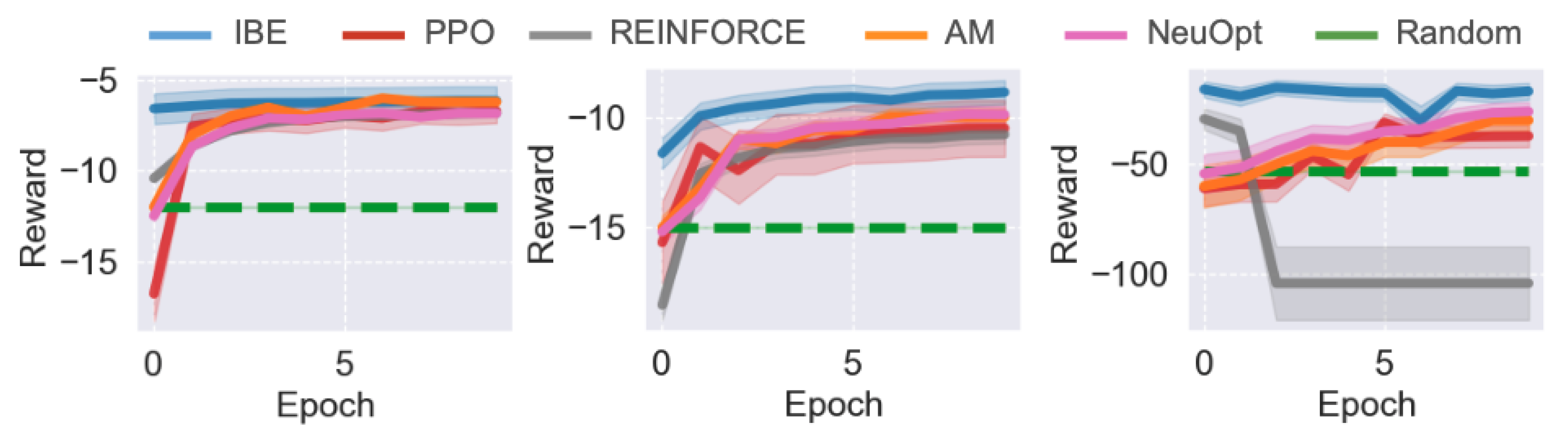
We first evaluate the performance of IBE and baseline methods in the TSP environment. The comparative results across different problem scales are shown in
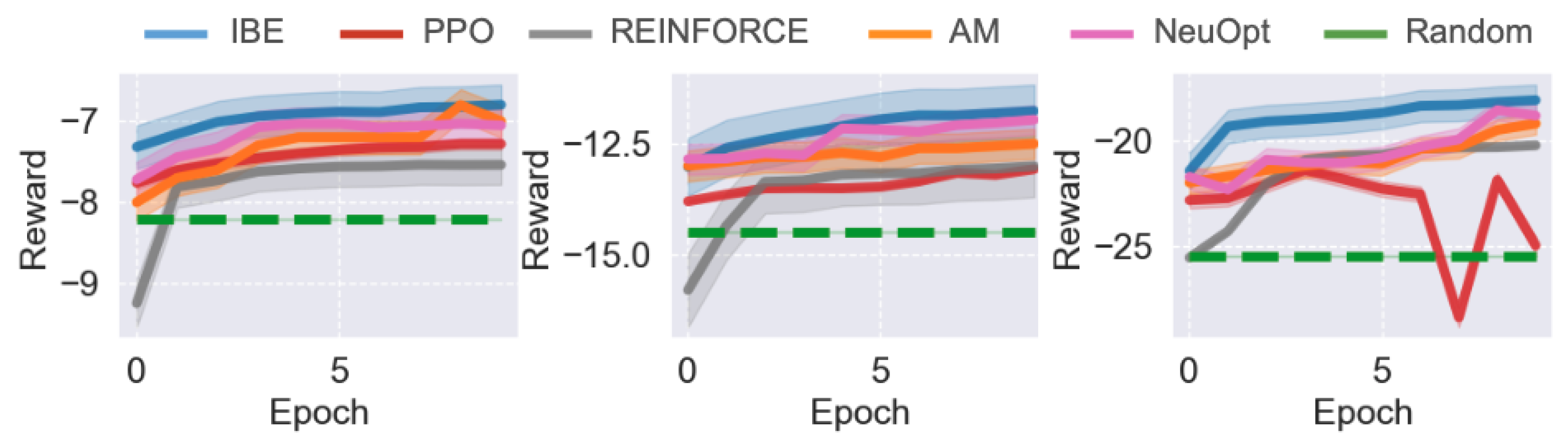
Figure 2. Overall, IBE consistently outperforms PPO, REINFORCE, and Random in both convergence speed and final solution quality, demonstrating the effectiveness of the information bottleneck design for representation learning and exploration.
When the task scale is relatively small (), all five agents—IBE, PPO, REINFORCE, AM, and NeuOpt—are able to learn reasonable solutions. However, IBE exhibits significantly faster convergence, achieving near-optimal performance within a fraction of the training epochs required by other baselines. While AM eventually converges to a similar performance level as IBE, it requires more training epochs to do so.
As the problem size increases (), the performance gap between IBE and the baselines widens. All baseline methods show slower learning and converge to suboptimal performance, whereas IBE maintains a smooth and steady improvement curve, ultimately achieving notably higher rewards. This result highlights IBE’s superior scalability and sample efficiency as problem complexity grows. For large-scale tasks (), PPO and REINFORCE struggle to maintain stable training, often exhibiting sharp performance fluctuations or even sudden collapses. With attention, AM is quite stable but learns slowly, possibly attributable to the absence of IB objectives. In contrast, IBE demonstrates much greater training stability and robustness, attributed to the dual information bottleneck objectives that regularize both state representations and policy updates. These results suggest that the proposed IBE method effectively improves policy consistency and performance.
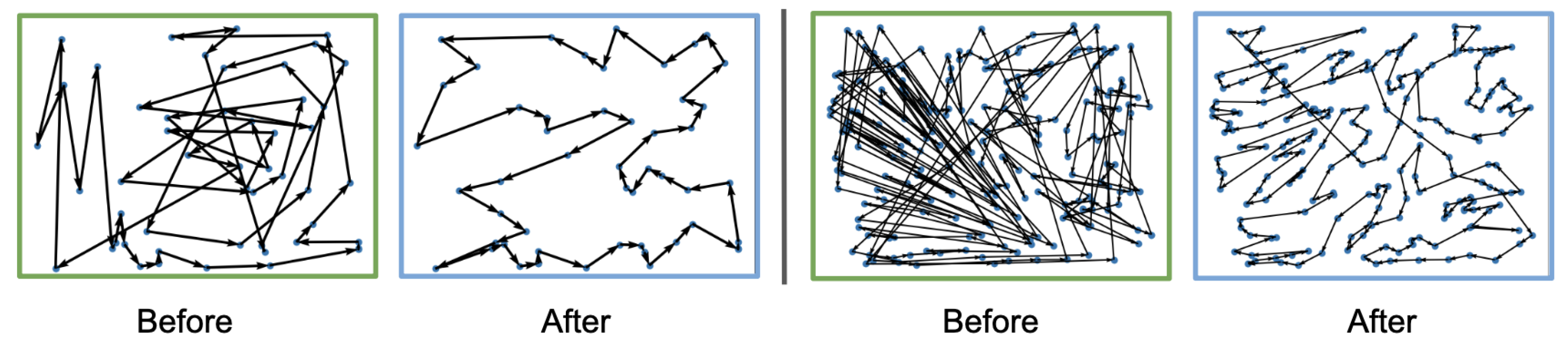
We further visualize the learned policies in
Figure 3, which depicts the agents’ trajectories at the beginning and end of training for two different TSP instances. Before training, the paths generated by the IBE agent are random and unstructured, reflecting the agent’s lack of prior knowledge. After 10 training epochs, the agent learns to construct clear and efficient routes that closely approximate optimal solutions.
5.5. Performance in the SDVRP Environment
We further evaluate IBE and baseline methods in the SDVRP environment. The quantitative results across different task scales are presented in
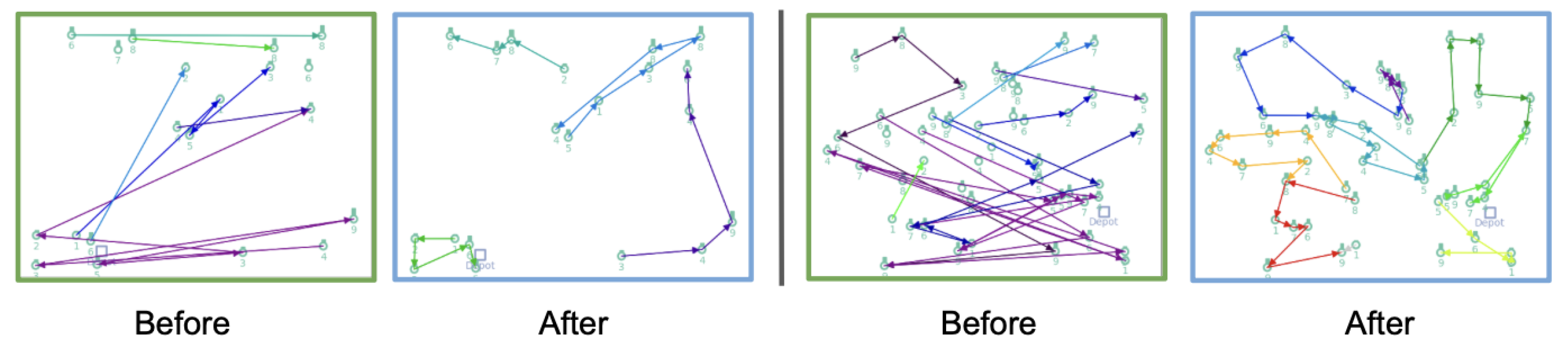
Figure 4, and corresponding trajectory visualizations are shown in
Figure 5. Overall, IBE consistently achieves superior performance, demonstrating faster convergence and greater stability compared to PPO, REINFORCE, and AM.
For the smaller-scale problems ( and ), all methods successfully learn feasible routing strategies that outperform the random agent. However, IBE quickly reaches near-optimal performance within the first few training epochs, while PPO, REINFORCE, and AM improve more gradually and plateau at lower reward levels. This result suggests that the information bottleneck helps IBE capture the essential structural patterns of the routing problem more efficiently.
In the large-scale SDVRP setting (), PPO shows unstable training and exhibits severe performance degradation. In contrast, IBE continues to improve steadily, achieving a significant margin over all baselines.
The qualitative visualizations of IBE’s solutions can be seen in
Figure 5. At the start of training (green box), the routes produced by the IBE agent are random and inefficient, with overlapping paths and redundant deliveries. After training (blue box), the agent learns to construct well-organized delivery routes that minimize travel distance and effectively split deliveries among vehicles. The clear evolution from disordered to structured trajectories demonstrates IBE’s ability to discover efficient routing strategies.
5.6. Performance in the SMTWTP Environment
Finally, we evaluate IBE and the baseline methods on the SMTWTP task, a classic scheduling benchmark. The results for different problem scales are shown in
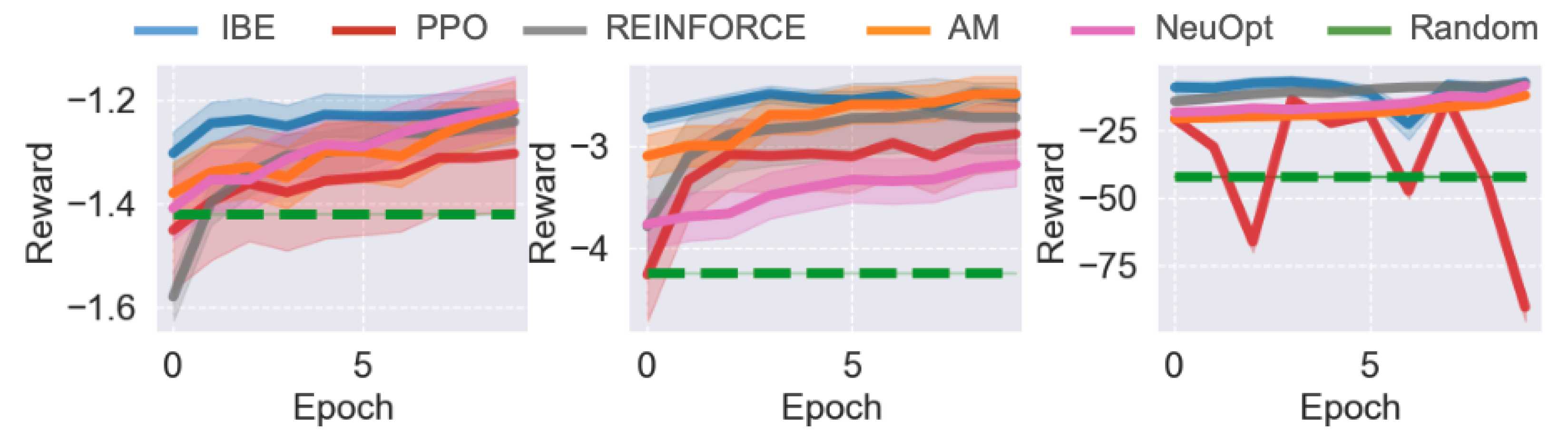
Figure 6. Consistent with our previous findings on routing tasks, IBE outperforms all baseline methods across all SMTWTP instances, though the performance margins are relatively smaller.
For the smaller-scale problems ( and ), IBE, REINFORCE, and AM achieve comparable final performance, indicating that REINFORCE is capable of learning reasonable scheduling strategies in simpler settings (AM also uses REINFORCE as its underlying learning algorithm). However, IBE converges much faster, reaching near-optimal performance within the early training epochs. PPO, on the other hand, learns significantly slower and converges to a suboptimal solution.
As the task size increases (), the performance differences become more evident. IBE continues to improve smoothly and maintains high stability throughout training, while PPO exhibits strong fluctuations and often fails to consistently improve. Interestingly, REINFORCE performs competitively in this setting, achieving similar final performance to IBE but with slightly slower convergence. This suggests that the IB objectives primarily enhances training efficiency and stability in smaller scheduling problems.
Ffinal performance results and computation times are shown in
Table 4. Overall, these results confirm that IBE generalizes well beyond routing tasks and remains robust across different combinatorial optimization settings. Its faster convergence and smoother learning dynamics demonstrate the effectiveness of incorporating information-theoretic regularization. However, IBE requires more computation time than other methods, as leveraging PPO for updates and employing an attention-based encoder introduces additional computational overhead.
Table 4.
Final performance (R is short for reward) and computation time (T in minutes) comparison across methods on different tasks, illustrated with standard deviation (±std) values. Results are averaged over 3 independent runs.
Table 4.
Final performance (R is short for reward) and computation time (T in minutes) comparison across methods on different tasks, illustrated with standard deviation (±std) values. Results are averaged over 3 independent runs.
| Task | N | IBE | PPO | REINFORCE |
| R (±std) | T (±std) | R (±std) | T (±std) | R (±std) | T (±std) |
| TSP | 50 | −5.5 ± 0.58 | 32 ± 6.2 | −6 ± 0.96 | 29 ± 4.1 | −6 ± 0.44 | 6 ± 0.44 |
| 100 | −9 ± 0.48 | 58 ± 11.3 | −10.5 ± 1.8 | 56 ± 4.6 | −10.6 ± 0.8 | 13 ± 1.0 |
| 200 | −10 ± 1.4 | 108 ± 7.7 | −31 ± 2.9 | 106 ± 11.1 | −105 ± 12.4 | 33 ± 5.5 |
| SDVRP | 20 | −6.8 ± 0.96 | 26 ± 2.0 | −7.3 ± 0.44 | 25 ± 4.8 | −7.6 ± 1.48 | 5 ± 0.86 |
| 50 | −11.7 ± 0.8 | 56 ± 7.0 | −13.1 ± 0.7 | 53 ± 9.9 | −13.1 ± 1.2 | 11 ± 1.6 |
| 100 | −18 ± 3.5 | 103 ± 17.1 | −25 ± 4.8 | 100 ± 18.4 | −20 ± 2.8 | 22 ± 4.1 |
| SMTWTP | 10 | −1.25 ± 0.14 | 11 ± 1.0 | −1.31 ± 0.23 | 9 ± 0.93 | −1.27 ± 0.12 | 2 ± 0.26 |
| 20 | −2.72 ± 0.17 | 18 ± 3.6 | −2.95 ± 0.49 | 14 ± 1.1 | −2.83 ± 0.14 | 3 ± 0.52 |
| 50 | −19 ± 3.1 | 33 ± 2.0 | −85 ± 1.2 | 29 ± 2.0 | −19 ± 3.4 | 17 ± 2.4 |
| Task | N | AM | NeuOpt | NN |
| R (±std) | T (±std) | R (±std) | T (±std) | R (±std) | T (±std) |
| TSP | 50 | −5.5 ± 0.32 | 8 ± 1.44 | −5.5 ± 0.2 | 40 ± 3.5 | −5.6 ± 0.78 | 0.50 ± 0.078 |
| 100 | −10 ± 1.0 | 16 ± 2.1 | −10.2 ± 0.6 | 105 ± 7.2 | −10.2 ± 1.2 | 0.50 ± 0.047 |
| 200 | −25 ± 2.0 | 38 ± 4.8 | −22 ± 1.2 | 243 ± 9.4 | −12 ± 1.7 | 1 ± 0.06 |
| SDVRP | 20 | −7 ± 0.67 | 7 ± 0.45 | −6.5 ± 0.5 | 43 ± 2.5 | −7.2 ± 1.10 | 0.50 ± 0.058 |
| 50 | −12.5 ± 1.2 | 14 ± 1.8 | −12.5 ± 0.8 | 112 ± 5 | −11.9 ± 1.6 | 0.50 ± 0.039 |
| 100 | −19 ± 1.2 | 25 ± 2.0 | −17 ± 0.8 | 265 ± 3.2 | −19.5 ± 1.1 | 1 ± 0.10 |
| SMTWTP | 10 | −1.25 ± 0.09 | 3 ± 0.51 | −1.25 ± 0.8 | 18 ± 1.0 | - | - |
| 20 | −2.72 ± 0.42 | 5 ± 0.80 | −3.2 ± 0.3 | 39 ± 2.5 | - | - |
| 50 | −22 ± 0.4 | 20 ± 1.2 | −21.5 ± 0.3 | 65 ± 4.6 | - | - |
5.7. Ablation Study
5.7.1. IB Objectives
To better understand the contribution of each component of the proposed IBE framework, we conducted an ablation study focusing on the two information bottleneck (IB) objectives. As illustrated in Algorithm 1, IBE introduces two coefficients, and , to control the strength of the state representation bottleneck and the policy bottleneck, respectively. Specifically, determines the degree of information compression in the attention-based encoder, encouraging the agent to learn compact and task-relevant representations. Meanwhile, regulates the exploration–exploitation trade-off in the policy by controlling the regularization strength applied during policy optimization.
We systematically varied these coefficients and evaluated their impact on performance in all three environments (see
Table 5). When both IB objectives are disabled (
), the agent effectively reduces to a standard attention-based RL model without information constraints. In this case, the performance significantly deteriorates, confirming that the inclusion of the IB objectives plays a crucial role in stabilizing learning and improving generalization.
On the other hand, setting excessively large coefficients () leads to severe performance degradation or even collapse. This is because overly strong compression in the latent representation removes useful task information, while excessive policy regularization hinders effective learning and reduces exploration efficiency. These results highlight the importance of balancing compression and expressiveness: moderate information constraints help prevent overfitting and encourage robust representations, but excessive constraints can suppress critical information flow.
Empirically, we find that setting both coefficients to small values (
) provides the best trade-off between stability and performance across all tasks, as reported in
Section 5.4,
Section 5.5 and
Section 5.6.
Table 5.
Performance comparison across different tasks (TSP, SDVRP, and SMTWTP) for various problem sizes (N) and pairs. Overall, the combination of small values for and yields the best performance across all tasks. Results are averaged over 3 independent runs.
Table 5.
Performance comparison across different tasks (TSP, SDVRP, and SMTWTP) for various problem sizes (N) and pairs. Overall, the combination of small values for and yields the best performance across all tasks. Results are averaged over 3 independent runs.
| Task | N | (1, 2) Pairs |
|---|
|
(0, 0)
|
(1, 1)
|
(0.01, 0.01)
|
(0.5, 0.5)
|
(0, 1)
|
(1, 0)
|
|---|
| TSP | 50 | −6.7 ± 0.8 | −7.3 ± 0.4 | −5.5 ± 0.58 | −7.1 ± 0.6 | −7.5 ± 0.5 | −7.9 ± 1.0 |
| 100 | −10.5 ± 1.2 | −11.2 ± 1.6 | −9 ± 0.48 | −9.4 ± 0.6 | −10.6 ± 1.0 | −11.1 ± 0.6 |
| 200 | −37.1 2.7 | −42.4 ± 4.3 | −10 ± 1.4 | −30.2 ± 1.6 | −35.6 ± 2.5 | −33.2 ± 3.8 |
| SDVRP | 20 | −7.2 ± 0.8 | −8.1 ± 0.6 | −6.8 ± 0.96 | −7.8 ± 0.8 | −8.0 ± 1.0 | −8.4 ± 0.4 |
| 50 | −12.4 ± 1.6 | −13.5 ± 1.6 | −11.7 ± 0.8 | −10.9 ± 0.9 | −12.1 ± 0.8 | −12.9 ± 1.9 |
| 100 | −21.5 ± 1.8 | −18.2 ± 1.1 | −18 ± 3.5 | −24.5 ± 1.5 | −19.8 ± 2.7 | −28.0 ± 3.1 |
| SMTWTP | 10 | −1.8 ± 0.2 | −1.5 ± 0.2 | −1.25 ± 0.14 | −2.0 ± 0.2 | −2.8 ± 0.4 | −2.1 ± 0.2 |
| 20 | −3.1 ± 0.3 | −4.4 ± 0.6 | −2.72 ± 0.17 | −3.8 ± 0.4 | −5.9 ± 0.8 | −4.2 ± 0.5 |
| 50 | −22.4 ± 2.7 | −19.9 ± 1.1 | −19 ± 3.1 | −24.1 ± 1.8 | −23.5 ± 1.9 | −24 ± 1.4 |
5.7.2. Attention Encoder
A critical component of the proposed IBE framework is the attention-based encoder, which serves as the primary mechanism for extracting compact, task-relevant state representations. Unlike conventional feed-forward networks, the attention mechanism explicitly models pairwise dependencies between elements in the input, allowing the agent to reason about global structural relationships, such as spatial proximity among nodes in routing problems or temporal dependencies in scheduling tasks.
To assess the contribution of the attention encoder, we compared IBE using attention against variants employing different numbers of fully connected (FC) layers in their encoders under identical training conditions. The results in
Table 6 report performance on TSP tasks of different sizes. Across all scales, the attention-based encoder significantly outperforms its FC counterpart, and the gap widens as problem size increases, illustrating that attention becomes increasingly critical for scalability and generalization.
Among the different numbers of layers, a three-layer FC structure works the best, indicating that although deeper networks have more capacity for expression, they also take more time and data to train, resulting in poor performance within the given budget. We elaborate the comparison with the three-layer FC structure below. For smaller TSP instances (), IBE with attention achieves a final reward of , compared to for the FC encoder. As the problem size grows to and , the gap expands sharply ( vs. and vs. ), indicating that feed-forward architectures fail to capture complex relational dependencies among nodes. These findings confirm that attention mechanisms provide a strong inductive bias for learning structured representations, leading to more effective information compression under the state bottleneck objective.
6. Conclusions and Future Work
In this work, we proposed IBE, an Information Bottleneck-Enhanced RL method that integrates the information bottleneck principle with attention-based reinforcement learning to improve representation learning, exploration, and training stability in combinatorial optimization tasks. IBE introduces two complementary regularizers: a state representation bottleneck, which enforces compact and task-relevant embeddings, and a policy bottleneck, which encourages information-efficient exploration by constraining the mutual information between states and actions.
Extensive experiments on two routing tasks and one scheduling task demonstrate that IBE consistently outperforms PPO, REINFORCE, AM, and NeuOpt in convergence speed, performance, and stability across multiple problem scales. Ablation studies confirm that both bottlenecks and the attention encoder contribute synergistically to improved performance.
In our work, the coefficients of two IB objectives are fixed. It would be interesting to explore adaptive scheduling of the these coefficients to dynamically balance compression and exploration. Furthermore, extending IBE to more complex constraints and larger-scale industrial instances is also a promising direction.
Author Contributions
Conceptualization, R.X., Y.N. and W.W.; methodology, R.X., Y.N. and W.W.; software, R.X.; validation, R.X.; formal analysis, W.W.; investigation, R.X.; writing—original draft preparation, R.X.; writing—review and editing, Y.N. and W.W.; visualization, R.X.; supervision, Y.N. and W.W.; project administration, Y.N.; funding acquisition, Y.N. All authors have read and agreed to the published version of the manuscript.
Funding
This work was supported in part by Guangdong Basic and Applied Basic Research Foundation (2023A1515110319), Science and Technology Projects in Guangzhou (2025A04J3757), and the Key Science and Technology Program of Henan Province (242102210171). The authors gratefully acknowledge their financial support.
Institutional Review Board Statement
Not applicable.
Informed Consent Statement
Not applicable.
Data Availability Statement
The data used in this study were generated using publicly available benchmark environments for combinatorial optimization, including the Traveling Salesman Problem, Split-Delivery Vehicle Routing Problem, and Single-Machine Total Weighted Tardiness Problem. All data are synthetic and can be reproduced by following the experimental setup and parameter settings described in the paper. The code used to generate the data and conduct the experiments is available from the corresponding authors upon reasonable request.
Conflicts of Interest
The authors declare no conflict of interest.
References
- Mnih, V.; Kavukcuoglu, K.; Silver, D.; Rusu, A.A.; Veness, J.; Bellemare, M.G.; Graves, A.; Riedmiller, M.; Fidjeland, A.K.; Ostrovski, G.; et al. Human-level control through deep reinforcement learning. Nature 2015, 518, 529–533. [Google Scholar] [CrossRef] [PubMed]
- Silver, D.; Schrittwieser, J.; Simonyan, K.; Antonoglou, I.; Huang, A.; Guez, A.; Hubert, T.; Baker, L.; Lai, M.; Bolton, A.; et al. Mastering the game of Go without human knowledge. Nature 2017, 550, 354–359. [Google Scholar] [CrossRef]
- Berner, C.; Brockman, G.; Chan, B.; Cheung, V.; Dębiak, P.; Dennison, C.; Farhi, D.; Fischer, Q.; Hashme, S.; Hesse, C.; et al. Dota 2 with large scale deep reinforcement learning. arXiv 2019, arXiv:1912.06680. [Google Scholar] [CrossRef]
- Pleines, M.; Addis, D.; Rubinstein, D.; Zimmer, F.; Preuss, M.; Whidden, P. Pokemon red via reinforcement learning. In Proceedings of the 2025 IEEE Conference on Games (CoG), Lisbon, Portugal, 26–29 August 2025; pp. 1–8. [Google Scholar]
- Kober, J.; Bagnell, J.A.; Peters, J. Reinforcement learning in robotics: A survey. Int. J. Robot. Res. 2013, 32, 1238–1274. [Google Scholar] [CrossRef]
- Zhang, K.; Zuo, Y.; He, B.; Sun, Y.; Liu, R.; Jiang, C.; Fan, Y.; Tian, K.; Jia, G.; Li, P.; et al. A survey of reinforcement learning for large reasoning models. arXiv 2025, arXiv:2509.08827. [Google Scholar] [CrossRef]
- Christiano, P.; Leike, J.; Brown, T.B.; Martić, M.; Legg, S.; Amodei, D. Deep reinforcement learning from human preferences. In Proceedings of the 31st International Conference on Neural Information Processing Systems, Long Beach, CA, USA, 4–9 December 2017. [Google Scholar]
- Ouyang, L.; Wu, J.; Jiang, X.; Almeida, D.; Wainwright, C.; Mishkin, P.; Zhang, C.; Agarwal, S.; Slama, K.; Ray, A.; et al. Training language models to follow instructions with human feedback. In Proceedings of the NeurIPS, New Orleans, LA, USA, 28 November–9 December 2022. [Google Scholar]
- Tang, C.; Abbatematteo, B.; Hu, J.; Chandra, R.; Martín-Martín, R.; Stone, P. Deep reinforcement learning for robotics: A survey of real-world successes. In Proceedings of the AAAI Conference on Artificial Intelligence, Philadelphia, PA, USA, 25 February–4 March 2025; Volume 39, pp. 28694–28698. [Google Scholar]
- Tishby, N.; Pereira, F.C.; Bialek, W. The information bottleneck method. arXiv 2000, arXiv:physics/0004057. [Google Scholar]
- Toth, P.; Vigo, D. The Vehicle Routing Problem; SIAM: Philadelphia, PA, USA, 2002. [Google Scholar]
- Kochenderfer, M.J.; Wheeler, T.A.; Wray, K.H. Algorithms for Decision Making; MIT Press: Cambridge, UK, 2022. [Google Scholar]
- Nazari, M.; Oroojlooy, A.; Snyder, L.; Takác, M. Reinforcement learning for solving the vehicle routing problem. In Proceedings of the NeurIPS, Montréal, QC, Canada, 3–8 December 2018. [Google Scholar]
- Kool, W.; Van Hoof, H.; Welling, M. Attention, learn to solve routing problems! arXiv 2018, arXiv:1803.08475. [Google Scholar]
- Bello, I.; Pham, H.; Le, Q.V.; Norouzi, M.; Bengio, S. Neural combinatorial optimization with reinforcement learning. arXiv 2016, arXiv:1611.09940. [Google Scholar]
- Yang, Y.; Whinston, A. A survey on reinforcement learning for combinatorial optimization. In Proceedings of the 2023 IEEE World Conference on Applied Intelligence and Computing (AIC), Sonbhadra, India, 29–30 July 2023; pp. 131–136. [Google Scholar]
- Vinyals, O.; Fortunato, M.; Jaitly, N. Pointer networks. Adv. Neural Inf. Process. Syst. 2015, 28, 1–9. [Google Scholar]
- Zhang, R.; Zhang, C.; Cao, Z.; Song, W.; Tan, P.S.; Zhang, J.; Wen, B.; Dauwels, J. Learning to solve multiple-TSP with time window and rejections via deep reinforcement learning. IEEE Trans. Intell. Transp. Syst. 2022, 24, 1325–1336. [Google Scholar] [CrossRef]
- Verma, R.; Singhal, A.; Khadilkar, H.; Basumatary, A.; Nayak, S.; Singh, H.V.; Kumar, S.; Sinha, R. A generalized reinforcement learning algorithm for online 3d bin-packing. arXiv 2020, arXiv:2007.00463. [Google Scholar] [CrossRef]
- Rolf, B.; Jackson, I.; Müller, M.; Lang, S.; Reggelin, T.; Ivanov, D. A review on reinforcement learning algorithms and applications in supply chain management. Int. J. Prod. Res. 2023, 61, 7151–7179. [Google Scholar] [CrossRef]
- Zhang, J.; Li, X.; Yuan, Y.; Yang, D.; Xu, P.; Au, F.T. A multi-agent ranking proximal policy optimization framework for bridge network life-cycle maintenance decision-making. Struct. Multidiscip. Optim. 2024, 67, 194. [Google Scholar] [CrossRef]
- Chen, X.; Liu, S.; Zhao, J.; Wu, H.; Xian, J.; Montewka, J. Autonomous port management based AGV path planning and optimization via an ensemble reinforcement learning framework. Ocean. Coast. Manag. 2024, 251, 107087. [Google Scholar] [CrossRef]
- Zhang, Y.; Zhao, W.; Wang, J.; Yuan, Y. Recent progress, challenges and future prospects of applied deep reinforcement learning: A practical perspective in path planning. Neurocomputing 2024, 608, 128423. [Google Scholar] [CrossRef]
- Sutton, R.S.; Barto, A.G. Reinforcement Learning: An Introduction; MIT Press: Cambridge, UK, 1998; Volume 1. [Google Scholar]
- Mnih, V.; Kavukcuoglu, K.; Silver, D.; Graves, A.; Antonoglou, I.; Wierstra, D.; Riedmiller, M. Playing atari with deep reinforcement learning. arXiv 2013, arXiv:1312.5602. [Google Scholar] [CrossRef]
- Haarnoja, T.; Zhou, A.; Hartikainen, K.; Tucker, G.; Ha, S.; Tan, J.; Kumar, V.; Zhu, H.; Gupta, A.; Abbeel, P.; et al. Soft actor-critic algorithms and applications. arXiv 2018, arXiv:1812.05905. [Google Scholar]
- Schulman, J.; Wolski, F.; Dhariwal, P.; Radford, A.; Klimov, O. Proximal policy optimization algorithms. arXiv 2017, arXiv:1707.06347. [Google Scholar] [CrossRef]
- Yingjun, P.; Xinwen, H. Learning representations in reinforcement learning: An information bottleneck approach. arXiv 2019, arXiv:1911.05695. [Google Scholar] [CrossRef]
- Lu, X.; Lee, K.; Abbeel, P.; Tiomkin, S. Dynamics generalization via information bottleneck in deep reinforcement learning. arXiv 2020, arXiv:2008.00614. [Google Scholar] [CrossRef]
- Fan, J.; Li, W. Dribo: Robust deep reinforcement learning via multi-view information bottleneck. In Proceedings of the International Conference on Machine Learning, PMLR, Baltimore, MD, USA, 17–23 July 2022; pp. 6074–6102. [Google Scholar]
- Xiang, G.; Dian, S.; Du, S.; Lv, Z. Variational information bottleneck regularized deep reinforcement learning for efficient robotic skill adaptation. Sensors 2023, 23, 762. [Google Scholar] [CrossRef]
- Igl, M.; Ciosek, K.; Li, Y.; Tschiatschek, S.; Zhang, C.; Devlin, S.; Hofmann, K. Generalization in reinforcement learning with selective noise injection and information bottleneck. Adv. Neural Inf. Process. Syst. 2019, 32, 1–13. [Google Scholar]
- Pathak, D.; Agrawal, P.; Efros, A.A.; Darrell, T. Curiosity-driven exploration by self-supervised prediction. In Proceedings of the International Conference on Machine Learning, PMLR, Sydney, Australia, 6–11 August 2017; pp. 2778–2787. [Google Scholar]
- Tang, H.; Houthooft, R.; Foote, D.; Stooke, A.; Xi Chen, O.; Duan, Y.; Schulman, J.; DeTurck, F.; Abbeel, P. # Exploration: A study of count-based exploration for deep reinforcement learning. Adv. Neural Inf. Process. Syst. 2017, 30. [Google Scholar]
- Eysenbach, B.; Gupta, A.; Ibarz, J.; Levine, S. Diversity is all you need: Learning skills without a reward function. arXiv 2018, arXiv:1802.06070. [Google Scholar] [CrossRef]
- Schulman, J.; Levine, S.; Abbeel, P.; Jordan, M.; Moritz, P. Trust region policy optimization. In Proceedings of the International Conference on Machine Learning, PMLR, Lille, France, 6–11 July 2015; pp. 1889–1897. [Google Scholar]
- Ahmed, Z.; Le Roux, N.; Norouzi, M.; Schuurmans, D. Understanding the impact of entropy on policy optimization. In Proceedings of the International Conference on Machine Learning, PMLR, Long Beach, CA, USA, 9–15 June 2019; pp. 151–160. [Google Scholar]
- Nadali, A.; Ebadzadeh, M.M. Maximum Entropy Dueling Network Architecture in Atari Domain. arXiv 2021, arXiv:2107.14457. [Google Scholar]
- Cui, G.; Zhang, Y.; Chen, J.; Yuan, L.; Wang, Z.; Zuo, Y.; Li, H.; Fan, Y.; Chen, H.; Chen, W.; et al. The entropy mechanism of reinforcement learning for reasoning language models. arXiv 2025, arXiv:2505.22617. [Google Scholar] [CrossRef]
- Sorokin, I.; Seleznev, A.; Pavlov, M.; Fedorov, A.; Ignateva, A. Deep attention recurrent Q-network. arXiv 2015, arXiv:1512.01693. [Google Scholar] [CrossRef]
- Manchin, A.; Abbasnejad, E.; Van Den Hengel, A. Reinforcement learning with attention that works: A self-supervised approach. In Proceedings of the International Conference on Neural Information Processing, Sydney, NSW, Australia, 12–15 December 2019; Springer: Berlin/Heidelberg, Germany, 2019; pp. 223–230. [Google Scholar]
- Cherepanov, E.; Staroverov, A.; Yudin, D.; Kovalev, A.K.; Panov, A.I. Recurrent action transformer with memory. arXiv 2023, arXiv:2306.09459. [Google Scholar]
- Pramanik, S.; Elelimy, E.; Machado, M.C.; White, A. AGaLiTe: Approximate Gated Linear Transformers for Online Reinforcement Learning. arXiv 2023, arXiv:2310.15719. [Google Scholar]
- Hu, K.; Xu, K.; Xia, Q.; Li, M.; Song, Z.; Song, L.; Sun, N. An overview: Attention mechanisms in multi-agent reinforcement learning. Neurocomputing 2024, 598, 128015. [Google Scholar] [CrossRef]
- Huh, D.; Mohapatra, P. Multi-agent reinforcement learning: A comprehensive survey. arXiv 2023, arXiv:2312.10256. [Google Scholar] [CrossRef]
- Berto, F.; Hua, C.; Park, J.; Luttmann, L.; Ma, Y.; Bu, F.; Wang, J.; Ye, H.; Kim, M.; Choi, S.; et al. Rl4co: An extensive reinforcement learning for combinatorial optimization benchmark. In Proceedings of the 31st ACM SIGKDD Conference on Knowledge Discovery and Data Mining V. 2, Toronto, ON, Canada, 3–7 August 2025; pp. 5278–5289. [Google Scholar]
- Ma, Y.; Cao, Z.; Chee, Y.M. Learning to search feasible and infeasible regions of routing problems with flexible neural k-opt. Adv. Neural Inf. Process. Syst. 2023, 36, 49555–49578. [Google Scholar]
| Disclaimer/Publisher’s Note: The statements, opinions and data contained in all publications are solely those of the individual author(s) and contributor(s) and not of MDPI and/or the editor(s). MDPI and/or the editor(s) disclaim responsibility for any injury to people or property resulting from any ideas, methods, instructions or products referred to in the content. |
© 2025 by the authors. Licensee MDPI, Basel, Switzerland. This article is an open access article distributed under the terms and conditions of the Creative Commons Attribution (CC BY) license (https://creativecommons.org/licenses/by/4.0/).