Inter-Channel Error Calibration Method for Real-Time DBF-SAR System Based on FPGA
 ,
,  , , , , and
Abstract
1. Introduction
2. Error Calibration Method
2.1. Analysis of the Causes of Channel Errors
2.2. The Principle of Error Calibration Algorithm
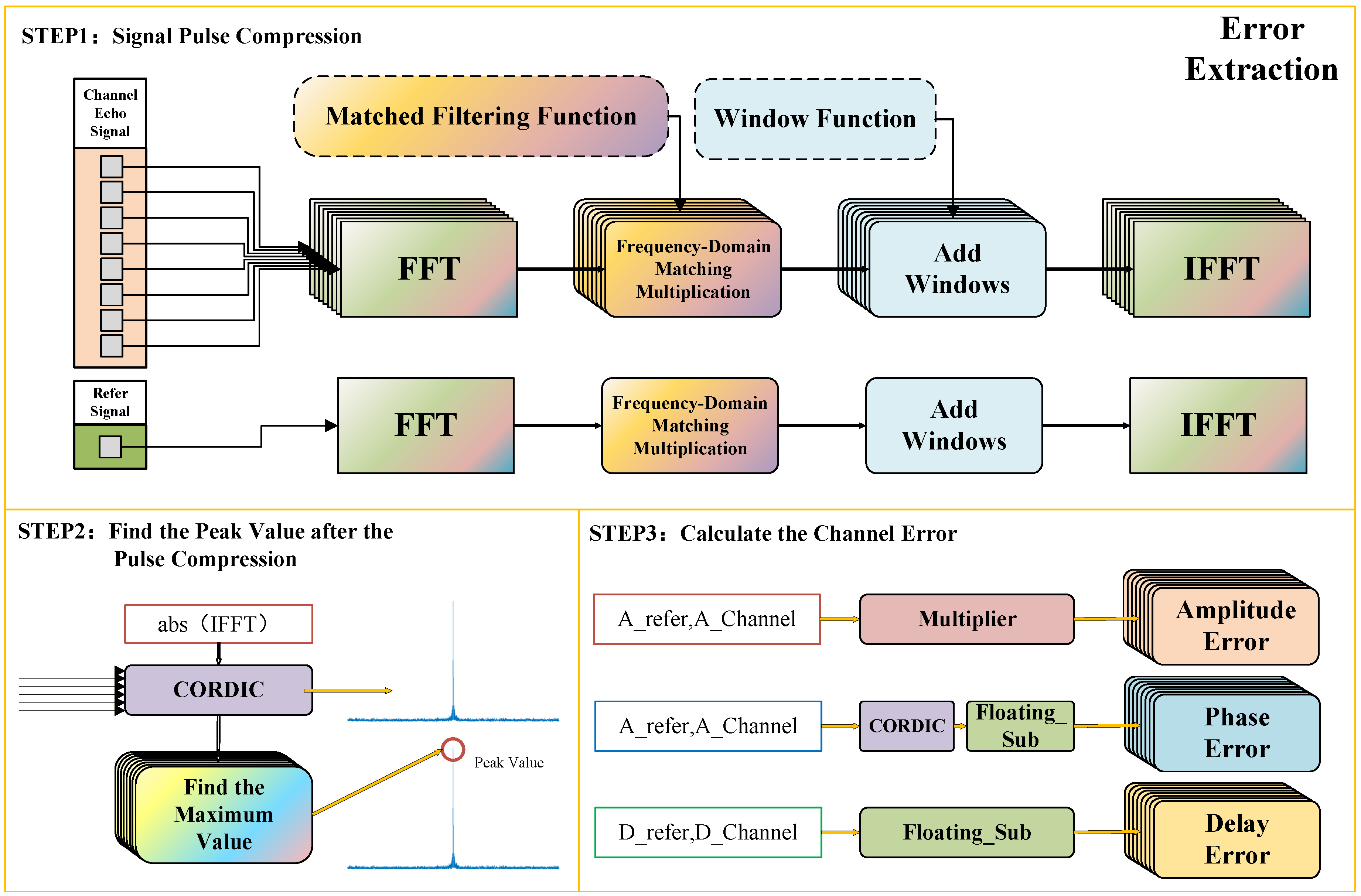
2.2.1. Pulse Compression and SNR Analysis
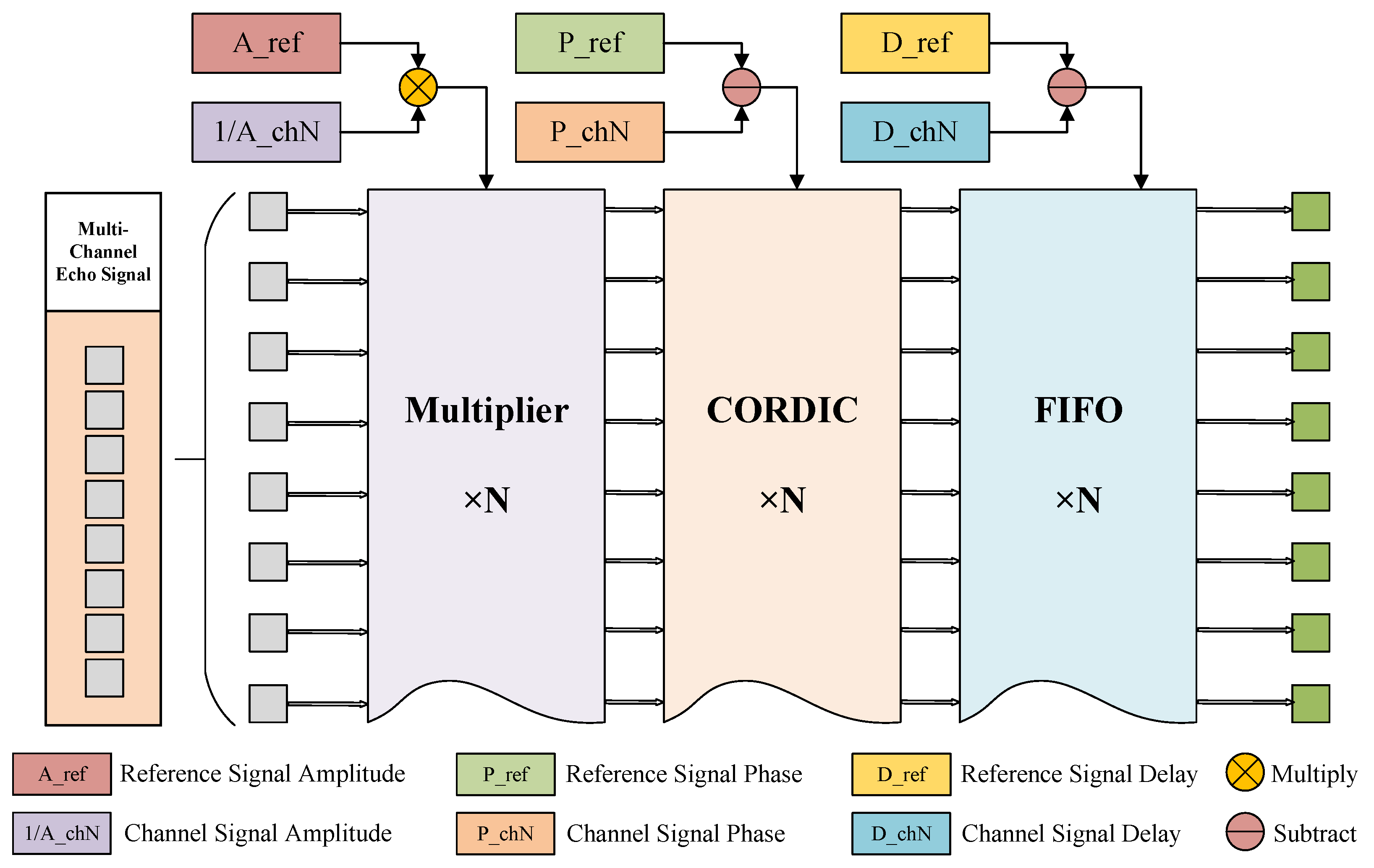
2.2.2. Algorithm Processing Flow and Mathematical Model
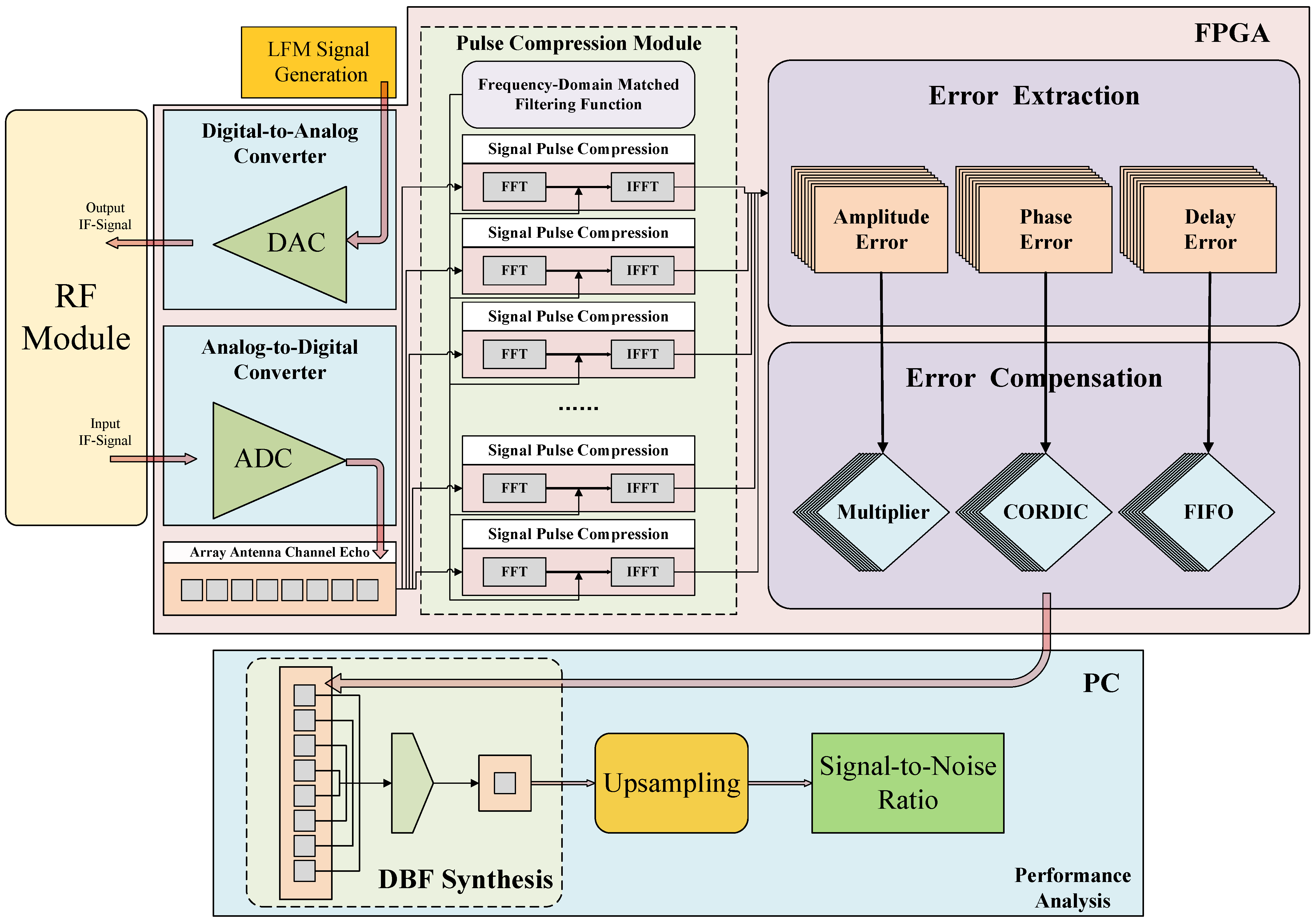
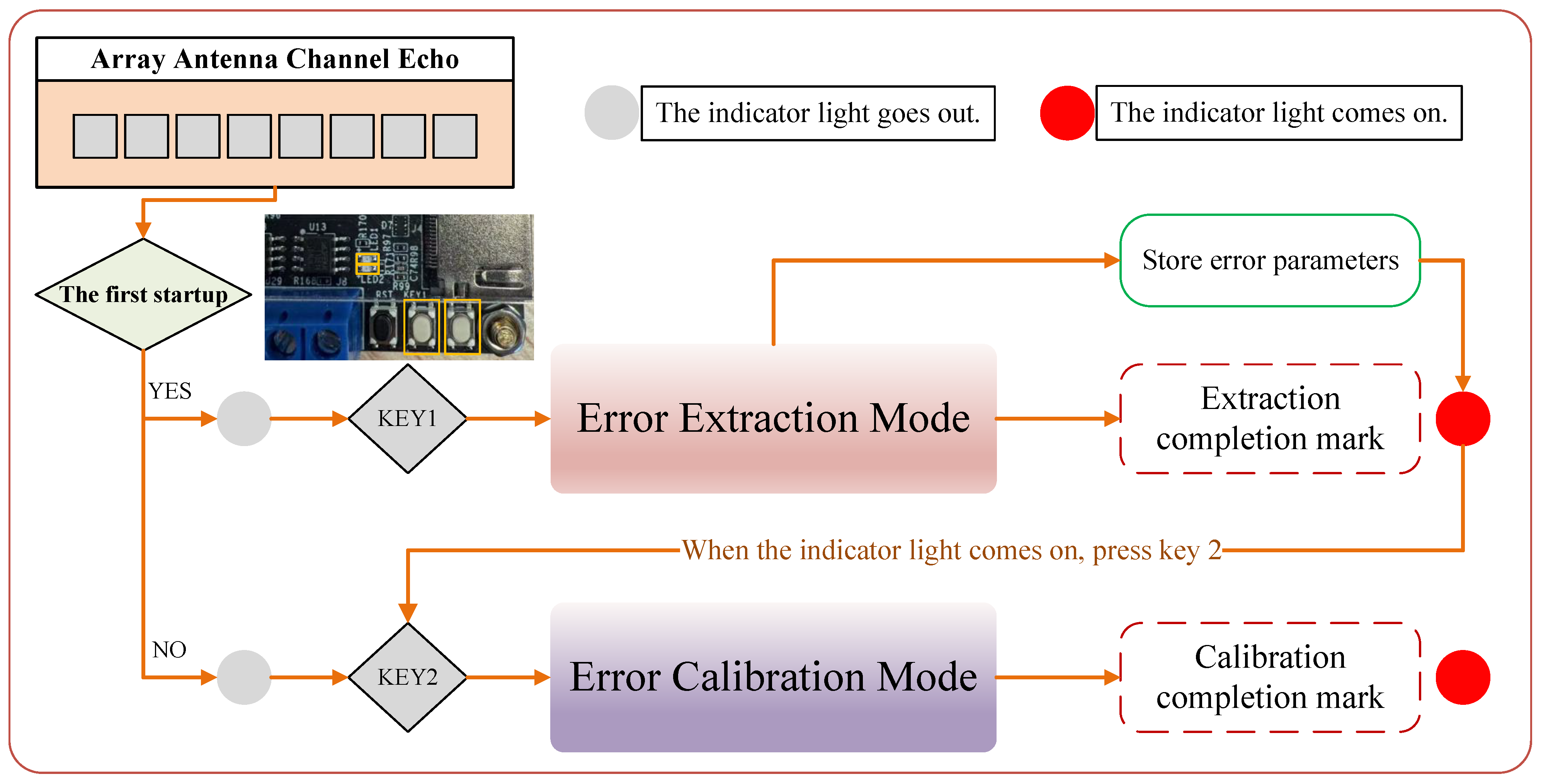
2.3. Design Scheme of DBF-SAR Error Calibration System
3. Experiments and Results
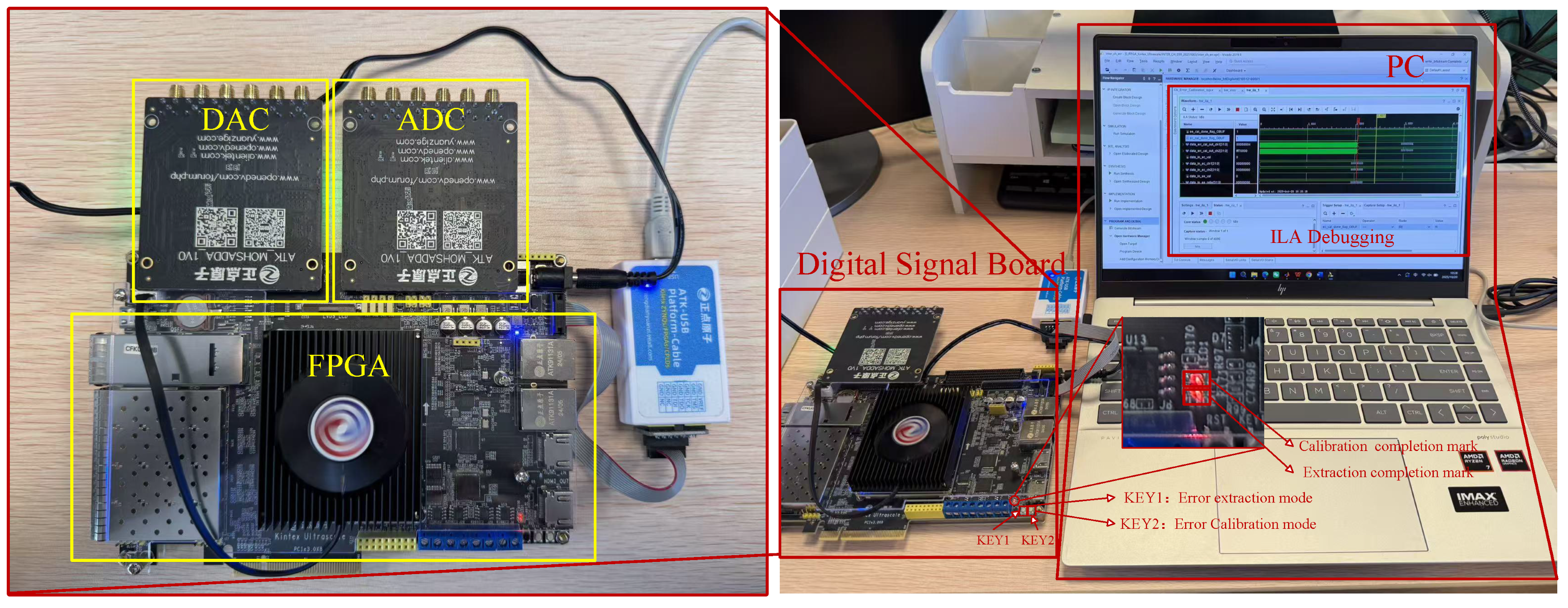
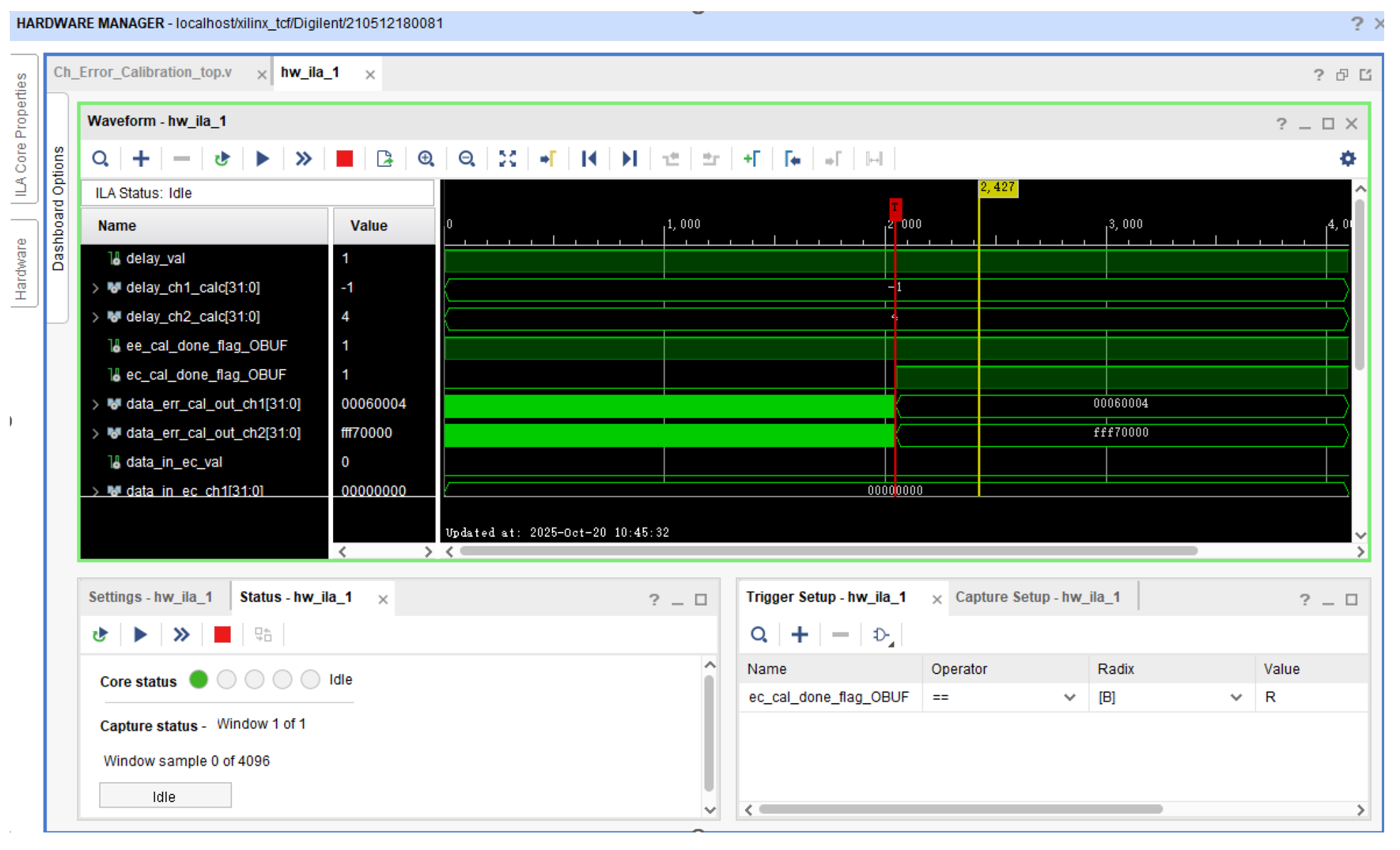
3.1. Hardware Implementation and Real-Time Optimization
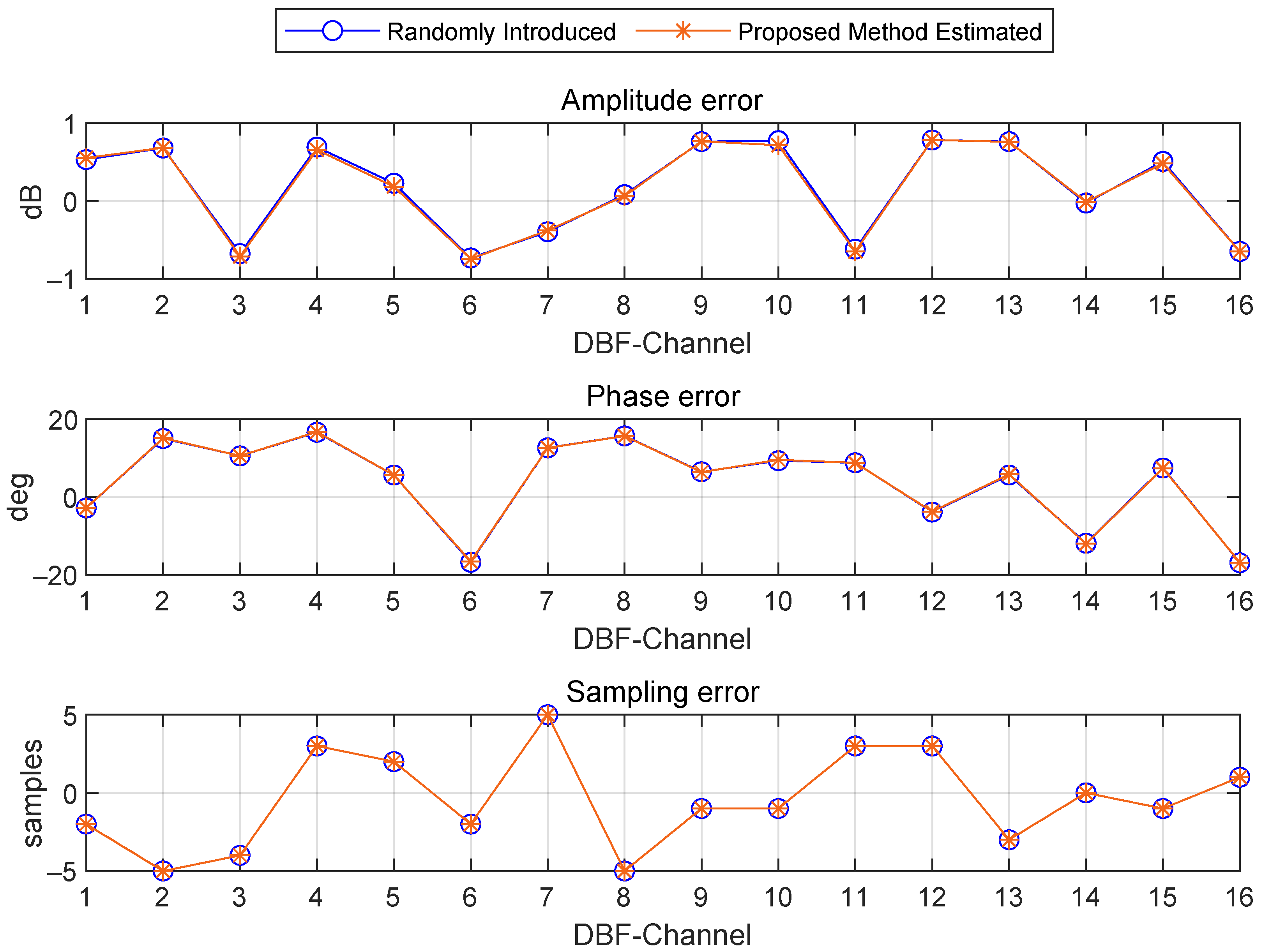
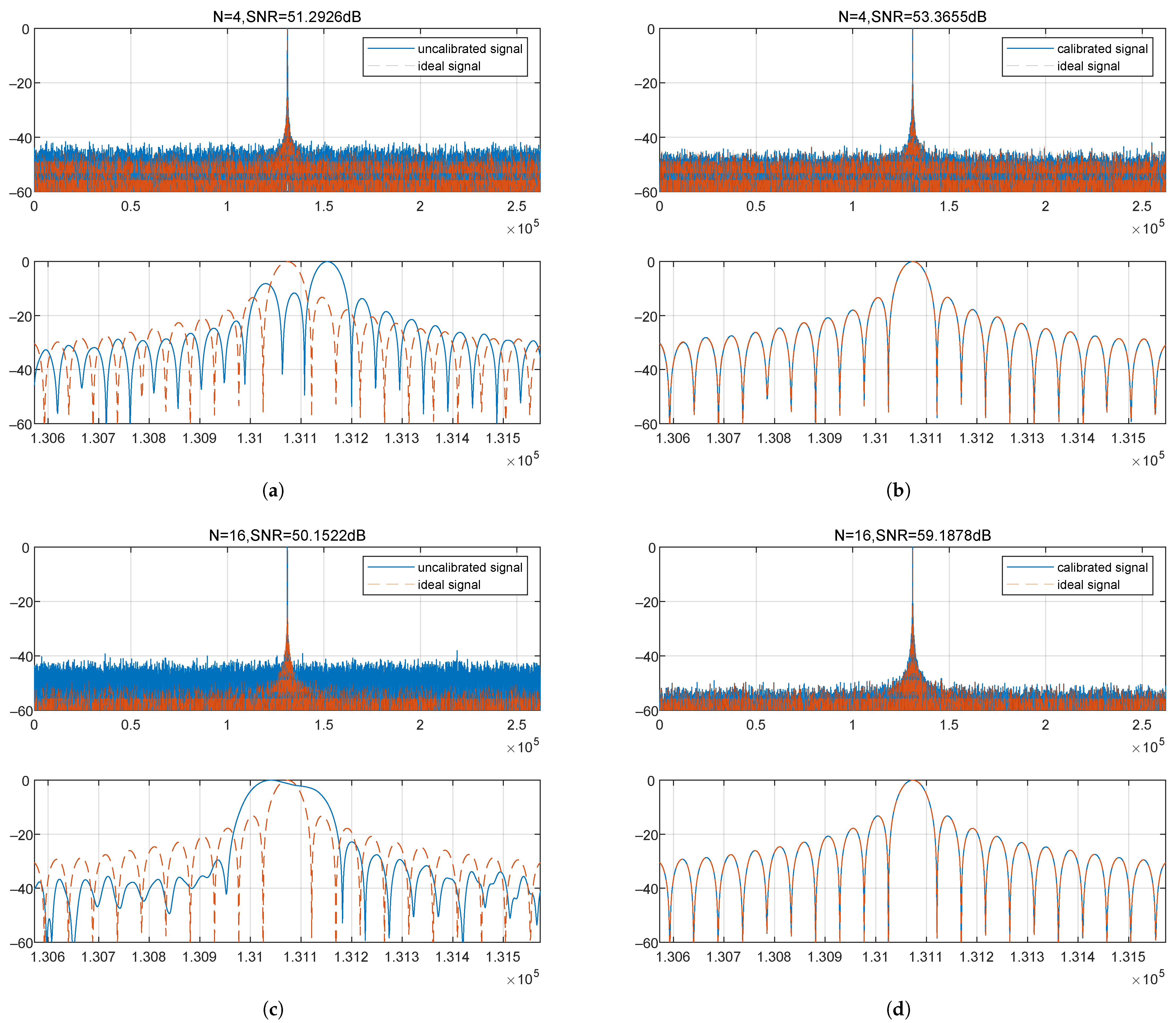
3.2. Simulation Experiment Results
3.3. Engineering Constraints and Power Analysis for Spaceborne Platforms
- (1)
- Resource Utilization: As shown in Table 5 and Table 6, on the Kintex Ultrascale FPGA, the occupancy rates of LUT (core logic) and DSP units of the error calibration system are only 5.7% and 3.48%, respectively. This extremely low resource utilization rate (approximately 10%) holds significant engineering significance: it not only avoids the congestion risk during large-scale multi-channel parallel processing but also reserves sufficient chip space for the subsequent integration of more complex imaging algorithms and other designs.
- (2)
- Power Consumption Analysis: The power consumption analysis report based on Vivado Post-Implementation shows that at an operating frequency of 100 MHz for the system clock, the total on-chip power consumption of the real-time error calibration module is only 0.963 W, among which the dynamic power consumption caused by logic flipping and signal processing is 0.333 W, and the static leakage power consumption of the device is 0.63 W. This scheme significantly reduces energy consumption while ensuring accuracy. For the spaceborne environment that is extremely sensitive to thermal design, this low-power characteristic means that the pressure on the thermal management subsystem can be reduced, and valuable power budgets can be reserved for other high-throughput data processing tasks on the satellite, fully verifying the robustness and feasibility of the scheme in engineering applications.
- (3)
- Real-time Constraints: Compared with high-complexity iterative algorithms, this design is based on a pipelined architecture, and the processing latency from data input to error parameter extraction is approximately 300 µs. This deterministic low-latency characteristic ensures that the system can adapt to the high Pulse Repetition Frequency (PRF) operating mode and meet the real-time constraints of HRWS imaging.

| Resource | Estimation | Available | Utilization % |
|---|---|---|---|
| LUT | 36,793 | 331,680 | 11.09 |
| LUTRAM | 29,696 | 146,880 | 20.22 |
| FF | 10,461 | 663,360 | 1.58 |
| BRAM | 16 | 1080 | 1.48 |
| IO | 7 | 520 | 1.35 |
| BFUG | 1 | 624 | 0.16 |
| Resource | Utilization | Available | Utilization % |
|---|---|---|---|
| LUT | 18,902 | 331,680 | 5.70 |
| LUTRAM | 1659 | 146,880 | 1.13 |
| FF | 23,209 | 663,360 | 3.50 |
| DSP | 97 | 2760 | 3.48 |
| IO | 7 | 520 | 1.35 |
| BFUG | 7 | 624 | 1.12 |
4. Conclusions
Author Contributions
Funding
Institutional Review Board Statement
Informed Consent Statement
Data Availability Statement
Conflicts of Interest
References
- Zhang, C. Synthetic Aperture Radar. Bull. Chin. Acad. Sci. 1987, 2, 337–338. [Google Scholar]
- Pi, Y.; Yang, J.; Fu, Y.; Yang, X. Principles of Synthetic Aperture Radar Imaging; University of Electronic Science and Technology of China Press: Chengdu, China, 2007. [Google Scholar]
- Cumming, I.G.; Wong, F.H. Synthetic Aperture Radar Imaging: Algorithms and Implementation; Electronics Industry Press: Beijing, China, 2007. [Google Scholar]
- Wei, Z. Synthetic Aperture Radar Satellites; Science Press: Beijing, China, 2001. [Google Scholar]
- Zhang, G.; Zhao, Y. Phased Array Radar Technology; Electronics Industry Press: Beijing, China, 2006. [Google Scholar]
- Bao, Z.; Xing, M.; Wang, T. Radar Imaging Technology; Electronics Industry Press: Beijing, China, 2005. [Google Scholar]
- Deng, Y.; Zhao, F.; Wang, Y. Development Trends and Applications of Spaceborne SAR Technology. J. Radars 2012, 1, 1–10. [Google Scholar] [CrossRef] [Scilit]
- Gao, X. Research on Spaceborne Spotlight-Mode Synthetic Aperture Radar System. Ph.D. Thesis, Graduate University of the Chinese Academy of Sciences, Beijing, China, 2004. [Google Scholar]
- De Zan, F.; Guarnieri, A.M. TOPSAR: Terrain Observation by Progressive Scans. IEEE Trans. Geosci. Remote Sens. 2006, 44, 2352–2360. [Google Scholar] [CrossRef] [Scilit]
- Feng, F.; Li, S.; Yu, W.; Huang, P.; Xu, W. Echo separation in multidimensional waveform encoding SAR remote sensing using an advanced null-steering beamformer. IEEE Trans. Geosci. Remote Sens. 2012, 50, 4157–4171. [Google Scholar] [CrossRef] [Scilit]
- Zamparelli, V.; Fornaro, G.; Lanari, R.; Perna, S.; Reale, D. Processing of Sliding Spotlight SAR Data in Presence of Squint. In Proceedings of the 2012 IEEE International Geoscience and Remote Sensing Symposium (IGARSS), Munich, Germany, 22–27 July 2012; pp. 2137–2140. [Google Scholar]
- Naftaly, U.; Levy–Nathansohn, R. Overview of the TECSAR Satellite Hardware and Mosaic Mode. IEEE Geosci. Remote Sens. Lett. 2008, 5, 423–426. [Google Scholar] [CrossRef] [Scilit]
- Lanari, R.; Tesauro, M.; Sansosti, E.; Fornaro, G. Spotlight SAR Data Focusing Based on a Two-Step Processing Approach. IEEE Trans. Geosci. Remote Sens. 2002, 39, 1993–2004. [Google Scholar] [CrossRef] [Scilit]
- Krieger, G.; Gebert, N.; Moreira, A. SAR Signal Reconstruction from Non-Uniform Displaced Phase Centre Sampling. In IGARSS 2004: IEEE International Geoscience and Remote Sensing Symposium; IEEE: New York, NY, USA, 2004; Volume 3, pp. 1763–1766. [Google Scholar]
- Kim, J.-H.; Younis, M.; Prats-Iraola, P.; Gabele, M.; Krieger, G. First Spaceborne Demonstration of Digital Beamforming for Azimuth Ambiguity Suppression. IEEE Trans. Geosci. Remote Sens. 2012, 51, 579–590. [Google Scholar] [CrossRef] [Scilit]
- Fusco, A.; Pepe, A.; Lanari, R. Sentinel-1 TOPS Data Focusing Based on a Modified Two-Step Processing Approach. In Proceedings of the 2017 IEEE International Geoscience and Remote Sensing Symposium (IGARSS), Fort Worth, TX, USA, 23–28 July 2017; pp. 2389–2391. [Google Scholar]
- Fornaro, G.; Lanari, R.; Sansosti, E.; Tesauro, M. A Two-Step Spotlight SAR Data Focusing Approach. In IGARSS 2000: IEEE 2000 International Geoscience and Remote Sensing Symposium; IEEE: New York, NY, USA, 2000; Volume 1, pp. 84–86. [Google Scholar]
- Krieger, G.; Gebert, N.; Moreira, A. Unambiguous SAR Signal Reconstruction from Nonuniform Displaced Phase Center Sampling. IEEE Geosci. Remote Sens. Lett. 2004, 1, 260–264. [Google Scholar] [CrossRef] [Scilit]
- An, D.; Huang, X.; Zhou, Z. A New Deramping Algorithm for Airborne Squint-Mode Spotlight SAR Data Processing. In Proceedings of the 2009 2nd Asian-Pacific Conference on Synthetic Aperture Radar, Xi’an, China, 26–30 October 2009; pp. 84–88. [Google Scholar]
- An, D.; Huang, X.; Jin, T.; Zhou, Z. Extended Two-Step Focusing Approach for Squinted Spotlight SAR Imaging. IEEE Trans. Geosci. Remote Sens. 2011, 50, 2889–2900. [Google Scholar] [CrossRef]
- Limbach, M.; Gabler, B.; Horn, R.; Kosc, A.; Di Maria, A.; Scheiber, R. P-Band Antenna Array for Airborne SAR Application and DBF SAR Demonstration. In Proceedings of the 2015 9th European Conference on Antennas and Propagation (EuCAP), Lisbon, Portugal, 12–17 April 2015; pp. 1–5. [Google Scholar]
- Ye, S.; Yang, T.; Li, W. A Novel Algorithm for Spaceborne SAR DBF Based on Sparse Spatial Spectrum Estimation. In Proceedings of the 2018 China International SAR Symposium (CISS), Shanghai, China, 10–12 October 2018; pp. 1–4. [Google Scholar]
- Li, B.; Sun, G.; Xing, M. The Study on Range DBF Method for Real Data Processing. In Proceedings of the 2018 China International SAR Symposium (CISS), Shanghai, China, 10–12 October 2018; pp. 1–5. [Google Scholar]
- Jing, G.; Xing, M.; Chen, J.; Sun, G.; Bao, Z. A Novel Digital Beam-Forming (DBF) Method for Multi-Mode MIMO-SAR. In Proceedings of the 2016 CIE International Conference on Radar (RADAR), Guangzhou, China, 10–13 October 2016; pp. 1–5. [Google Scholar]
- Liu, X.; Gao, W.; Deng, Y. Synthesis Technique of Array-Fed Shaped-Reflector Antenna for DBF-SAR Application. IEEE Antennas Wirel. Propag. Lett. 2011, 11, 30–33. [Google Scholar]
- Bordoni, F.; López-Dekker, F.; Sanjuan-Ferrer, M.J. Beam-Switch Wide-Swath Mode for Interferometrically Compatible Products of the Post-Sentinel HRWS SAR System. In Proceedings of the 2017 18th International Radar Symposium (IRS), Prague, Czech Republic, 28–30 June 2017; pp. 1–6. [Google Scholar]
- Gebert, N.; Krieger, G.; Moreira, A. Digital Beamforming on Receive: Techniques and Optimization Strategies for High-Resolution Wide-Swath SAR Imaging. IEEE Trans. Aerosp. Electron. Syst. 2009, 45, 564–592. [Google Scholar] [CrossRef] [Scilit]
- Younis, M.; Fischer, C.; Wiesbeck, W. Digital Beamforming in SAR Systems. IEEE Trans. Geosci. Remote Sens. 2003, 41, 1735–1739. [Google Scholar] [CrossRef] [Scilit]
- Schmidt, R. Multiple Emitter Location and Signal Parameter Estimation. IEEE Trans. Antennas Propag. 1986, 34, 276–280. [Google Scholar] [CrossRef] [Scilit]
- Roy, R.; Kailath, T. ESPRIT-Estimation of Signal Parameters via Rotational Invariance Techniques. IEEE Trans. Acoust. Speech Signal Process. 2002, 37, 984–995. [Google Scholar] [CrossRef] [Scilit]


| Parameter | Value |
|---|---|
| Carrier Frequency | 9.65 GHz |
| Orbit Height | 567 km |
| Sample Rate | 240 MHz |
| Signal Pulse Duration | 10 µs |
| Signal Bandwidth | 40 MHz |
| Antenna Installation Angle | |
| Number of Channels | 16 |
| Signal-to-Noise Ratio | 10 dB |
| Look Angle of the Antenna Normal Direction | 23∼27° |
| Error Type | Scope | Unit |
|---|---|---|
| Amplitude Error | −1∼1 | dB |
| Phase Error | −20∼20 | ° |
| Time-Delay Error | −5∼5 | Sampling Point |
| Object | SNR (dB) |
|---|---|
| Channel 1 | 38.1559 |
| Channel 2 | 38.2921 |
| … | … |
| Channel 16 | 38.1219 |
| DBF Synthetic Result | 46.7913 |
| Average Improvement | 8.4759 |
| Object | SNR (dB) |
|---|---|
| Channel 1 | 38.1559 |
| Channel 2 | 38.2921 |
| … | … |
| Channel 16 | 38.1219 |
| DBF Synthetic Result | 49.9628 |
| Average Improvement | 11.6474 |
Disclaimer/Publisher’s Note: The statements, opinions and data contained in all publications are solely those of the individual author(s) and contributor(s) and not of MDPI and/or the editor(s). MDPI and/or the editor(s) disclaim responsibility for any injury to people or property resulting from any ideas, methods, instructions or products referred to in the content. |
© 2025 by the authors. Licensee MDPI, Basel, Switzerland. This article is an open access article distributed under the terms and conditions of the Creative Commons Attribution (CC BY) license (https://creativecommons.org/licenses/by/4.0/).
Share and Cite
Meng, Y.; Qiu, J.; Wang, P.; Liu, Y.; Yang, Z.; Wei, Y.; Cheng, X.; Feng, Y. Inter-Channel Error Calibration Method for Real-Time DBF-SAR System Based on FPGA. Sensors 2025, 25, 7561. https://doi.org/10.3390/s25247561
Meng Y, Qiu J, Wang P, Liu Y, Yang Z, Wei Y, Cheng X, Feng Y. Inter-Channel Error Calibration Method for Real-Time DBF-SAR System Based on FPGA. Sensors. 2025; 25(24):7561. https://doi.org/10.3390/s25247561
Chicago/Turabian StyleMeng, Yao, Jinsong Qiu, Pei Wang, Yang Liu, Zhen Yang, Yihai Wei, Xuerui Cheng, and Yihang Feng. 2025. "Inter-Channel Error Calibration Method for Real-Time DBF-SAR System Based on FPGA" Sensors 25, no. 24: 7561. https://doi.org/10.3390/s25247561
APA StyleMeng, Y., Qiu, J., Wang, P., Liu, Y., Yang, Z., Wei, Y., Cheng, X., & Feng, Y. (2025). Inter-Channel Error Calibration Method for Real-Time DBF-SAR System Based on FPGA. Sensors, 25(24), 7561. https://doi.org/10.3390/s25247561