Signal Quality Assessment and Reconstruction of PPG-Derived Signals for Heart Rate and Variability Estimation in In-Vehicle Applications: A Comparative Review and Empirical Validation


Abstract
1. Introduction
1.1. ECG and PPG Processing: Previous Research
1.1.1. ECG
1.1.2. BVP

| Type | Norms | References |
|---|---|---|
| Sampling Rate | ≥25 Hz is suggested. | [51] |
| Low Frequency Filtering | 0.5 Hz to remove the direct current (DC) component below 0.1 Hz and respiratory component in the 0.1–0.5 Hz band. | [22] |
| High Frequency Filtering | 10 Hz, corresponding to the position of fourth harmonics at 150 bpm, or third harmonics at 200 bpm. | [22] |
| Artifact Removal | - Decomposition-based: ICA, EMD, wavelet decomposition. - Adaptive filtering: RLS, LMS. - Deep neural network. | [26,27,28,29,30,31,32,33,34,35,52] |
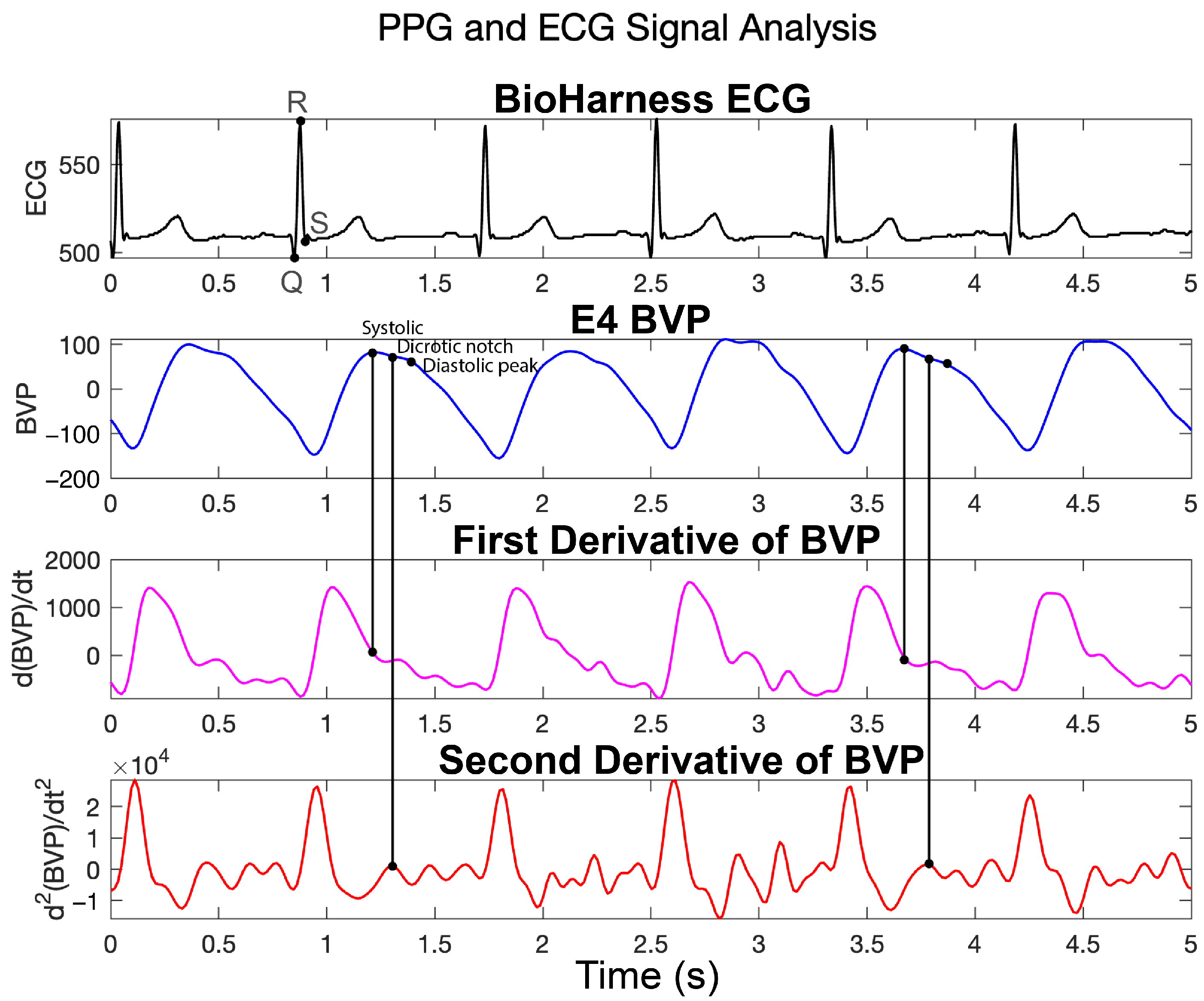
| Fiducial Point Identification | - Zero crossing (change of slope sign). - Local maxima/minima with adaptive thresholding. - Deep neural network. | [39,40] |
| Signal Quality Index | - Machine learning with statistical features. - Deep neural network. | [36,37,38] |
| Feature Extraction | - PR: spectral peak tracking. - PRV: Extract the pulse-pulse interval and calculate features similar to HRV. | [41,42,43,53] |
1.1.3. Studies Using Pulse Rate Features as Natural Proxies for Heart Rate Features
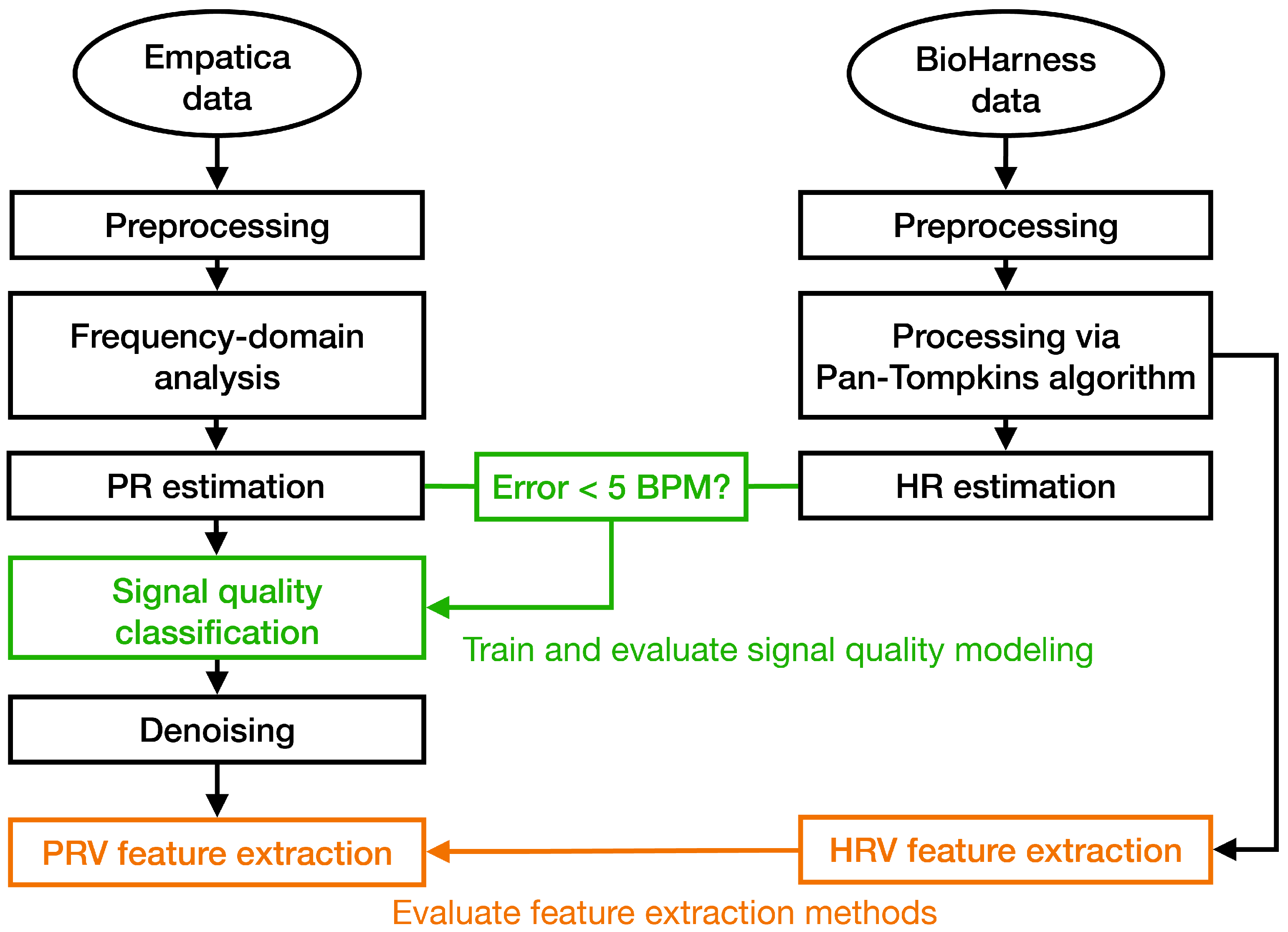
1.2. Present Study Objectives
2. Methods
2.1. Data Source
2.2. Data Processing
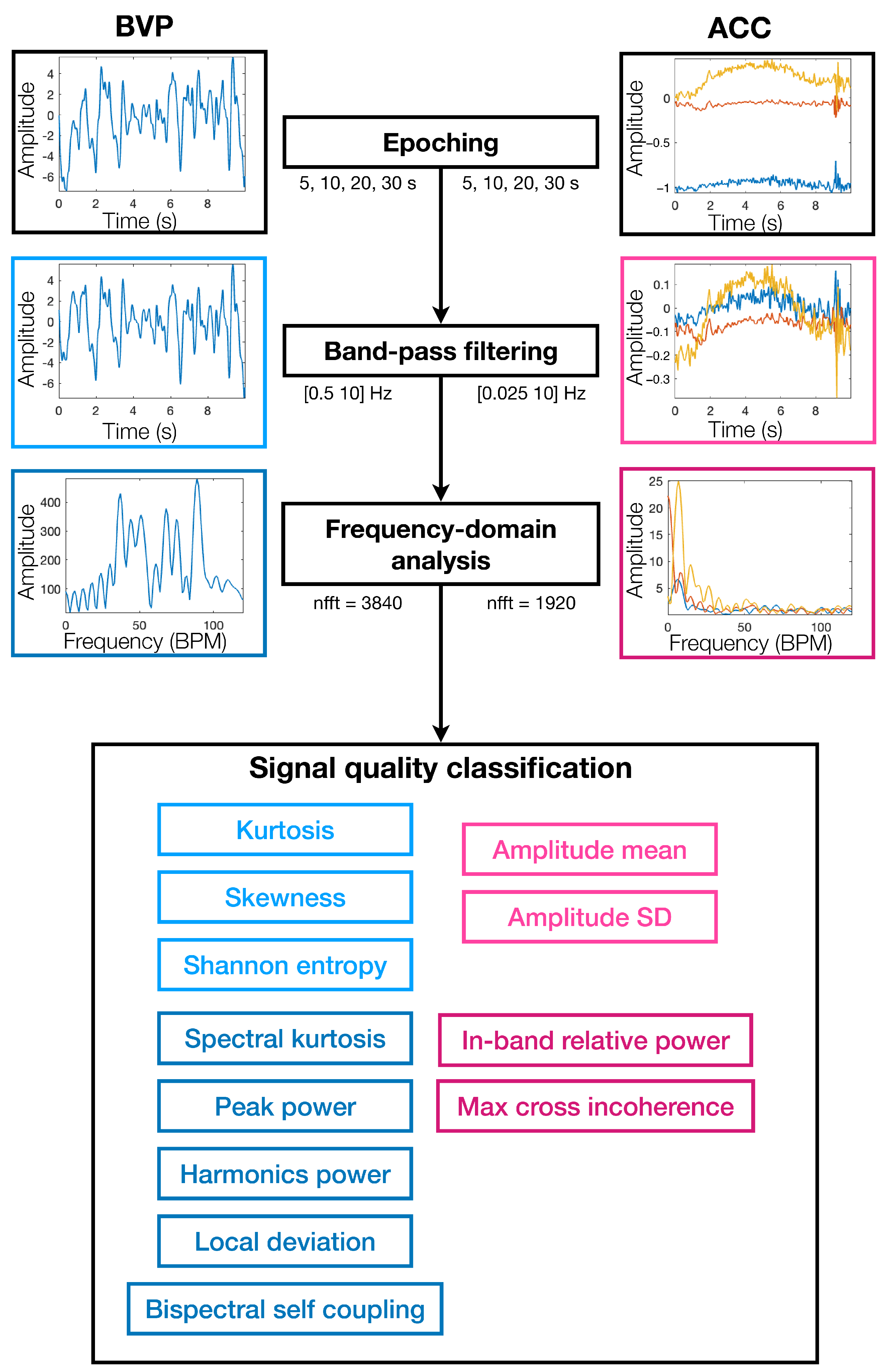
2.2.1. Signal Quality Assessment
| Source | Feature | Description | References |
|---|---|---|---|
| BVP time domain | Kurtosis | Scaled version of the fourth moment of the PPG distribution, representing the tailedness of the PPG signal distribution. Measures peakedness of the waveform; high kurtosis may indicate clean, sharp pulse waves | [30] |
| Skewness | Measure of the asymmetry of the PPG signal around zero. Describes waveform asymmetry; deviations from symmetry may signal noise or distortion | [30] | |
| Shannon entropy | Measure of the disorder in the PPG signal probability distribution. Quantifies signal complexity; higher entropy may suggest irregularity due to noise | [30] | |
| BVP frequency domain | Spectral kurtosis | Scaled version of the fourth moment of the PPG spectral distribution, representing the tailedness of the PPG frequency-domain signal. Detects spectral sparsity; flatter spectra may indicate noise or artifact | [30] |
| Relative power of dominant peak | Power ratio of the dominant peak in the PPG spectrum compared to the total power. Power of the peak frequency in the heart rate band; used to confirm signal periodicity | [67] | |
| Relative power of harmonics | Power ratio of the 2nd and 3rd harmonics of the PPG spectral dominant peak compared to the total power. Power in harmonic components; supports waveform integrity checks | [67] | |
| HRF deviation from moving median | Absolute difference between the spectral peak of the current PPG epoch and the median spectral peak of the nearest 1 min segment. Measures abrupt change in pulse frequency; used to detect transient noise | ||
| Bispectral self-coupling | Number of self-coupling events among the three most prominent peaks (f0, f1, f2) in the diagonal slice of the bispectrum. Assesses cross-frequency coupling around HRF; reduced coupling may signal distortion | [68] | |
| Accelerometer time domain | Amplitude mean | Average magnitude of the accelerometer data. Indicates overall movement intensity; elevated values may suggest a potential motion artifact | [38] |
| Amplitude SD | Standard deviation of the accelerometer magnitude. Captures motion variability; high standard deviation often correlates with motion-induced noise | [38] | |
| Accelerometer frequency domain | Maximal cross-bicoherence to PPG | Maximum bicoherence between the PPG signal and the accelerometer data from the x-, y-, or z-axis. Measures motion energy overlapping the HR band; used to detect confounding artifact sources | [66] |
| Relative power of heart rate frequency band | Relative power of the [2/3, 10/3] Hz band, corresponding to the heart-rate frequency band ranging from 40 BPM to 200 BPM. Estimates nonlinear coupling between motion and the pulse signal; high values imply motion contamination | Inspired by [69] |
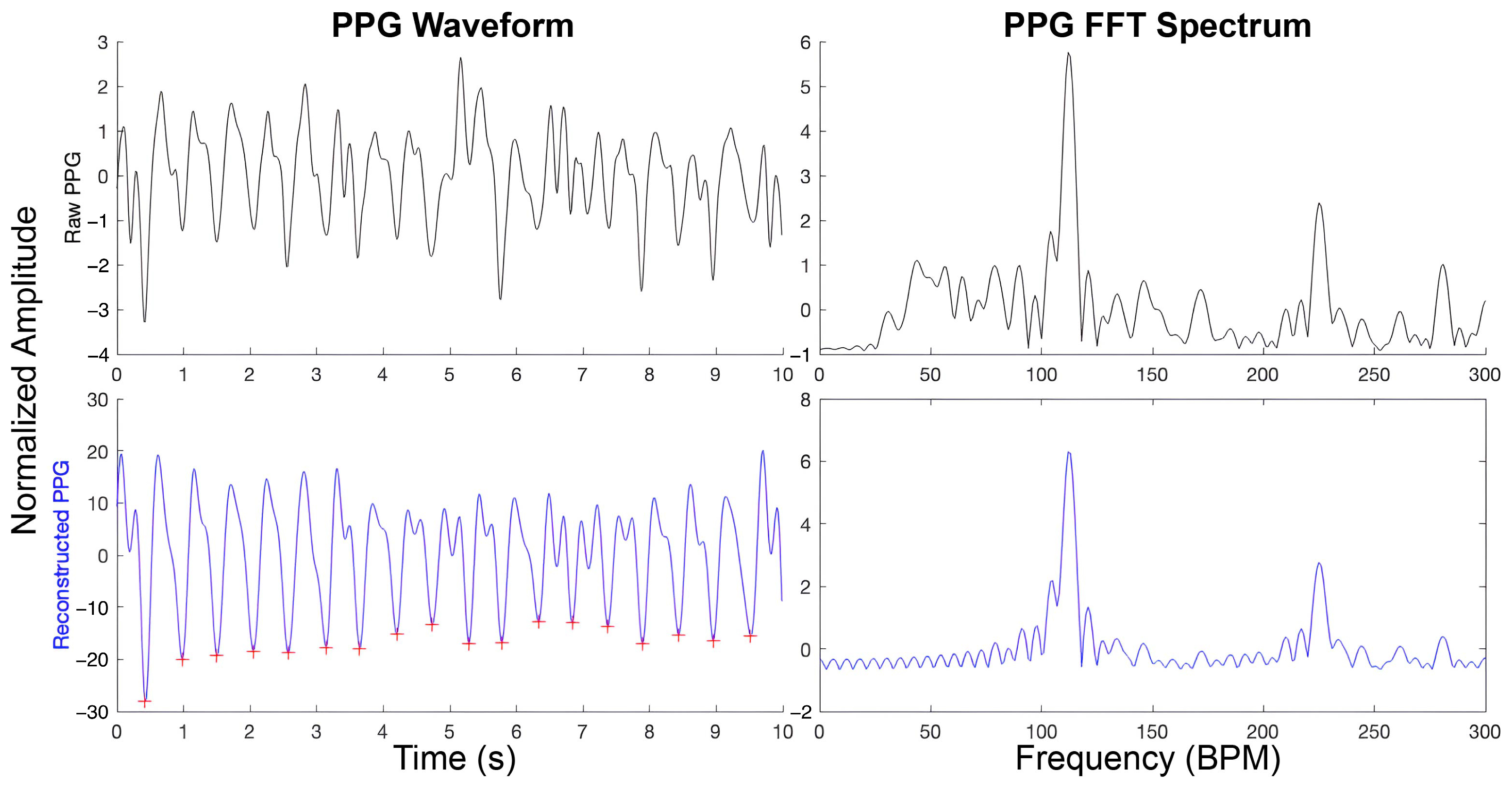
2.2.2. Signal Reconstruction
2.2.3. Fiducial Point Detection and Evaluation
- (1)
- Raw signal + MSPTD.
- (2)
- Raw signal + MNDEI.
- (3)
- SQ-threshold signal + MSPTD.
- (4)
- SQ-threshold signal + MNDEI.
- (5)
- SQ-threshold signal + reconstruction + MSPTD.
- (6)
- SQ-threshold signal + reconstruction + MNDEI.
3. Results
3.1. Signal Quality Assessment Classification Model: Performance
3.2. Comparison of Signal Processing Methods for PRV Features
3.2.1. Percentage of Valid Epochs
3.2.2. Pearson Correlation
3.2.3. Cliff’s δ Effect Size
3.2.4. Bland–Altman Analysis
3.2.5. Summary of Signal Processing Methods for PRV Features
4. Discussion
5. Limitation
6. Conclusions
Author Contributions
Funding
Institutional Review Board Statement
Informed Consent Statement
Data Availability Statement
Acknowledgments
Conflicts of Interest
References
- Kusumoto, F. ECG Interpretation: From Pathophysiology to Clinical Application; Springer Nature: New York, NY, USA, 2020. [Google Scholar]
- Immanuel, S.; Teferra, M.N.; Baumert, M.; Bidargaddi, N. Heart rate variability for evaluating psychological stress changes in healthy adults: A scoping review. Neuropsychobiology 2023, 82, 187–202. [Google Scholar] [CrossRef]
- Lu, K.; Dahlman, A.S.; Karlsson, J.; Candefjord, S. Detecting driver fatigue using heart rate variability: A systematic review. Accid. Anal. Prev. 2022, 178, 106830. [Google Scholar] [CrossRef] [PubMed]
- Su, H.; Qing, X.; He, X.; Wang, J.; Cai, H.; Wang, X.; Xu, L.; Jiang, J.; Xie, R.; Fan, S.; et al. Field Experiment on Wearable EEG/PPG-based Monitoring of Mental Fatigue in Drillers: Impact of Prolonged Working Hours and Night Shifts. SSRN J. 2024. [Google Scholar] [CrossRef]
- Peng, Y.; Zhou, J.; Fan, C.; Wu, Z.; Zhou, W.; Sun, D.; Lin, Y.; Xu, D.; Xu, Q. A review of passenger ride comfort in railway: Assessment and improvement method. Transp. Saf. Environ. 2022, 4, tdac016. [Google Scholar] [CrossRef]
- Böttcher, S.; Vieluf, S.; Bruno, E.; Joseph, B.; Epitashvili, N.; Biondi, A.; Zabler, N.; Glasstetter, M.; Dümpelmann, M.; Van Laerhoven, K.; et al. Data quality evaluation in wearable monitoring. Sci. Rep. 2022, 12, 21412. [Google Scholar] [CrossRef]
- Koerber, D.; Khan, S.; Shamsheri, T.; Kirubarajan, A.; Mehta, S. Accuracy of Heart Rate Measurement with Wrist-Worn Wearable Devices in Various Skin Tones: A Systematic Review. J. Racial Ethn. Health Disparities 2023, 10, 2676–2684. [Google Scholar] [CrossRef] [PubMed]
- D’Acquisto, L.; Scardulla, F.; Montinaro, N.; Pasta, S.; Zangla, D.; Bellavia, D. A preliminary investigation of the effect of contact pressure on the accuracy of heart rate monitoring by wearable PPG wrist band. In Proceedings of the 2019 II Workshop on Metrology for Industry 4.0 and IoT (MetroInd4.0&IoT), Naples, Italy, 4–6 June 2019; pp. 334–338. [Google Scholar]
- Charlton, P.H.; Pilt, K.; Kyriacou, P.A. Establishing best practices in photoplethysmography signal acquisition and processing. Physiol. Meas. 2022, 43, 050301. [Google Scholar] [CrossRef]
- Wang, K.; Tan, B.; Wang, X.; Qiu, S.; Zhang, Q.; Wang, S.; Yen, Y.-T.; Jing, N.; Liu, C.; Chen, X.; et al. Machine Learning-Assisted Point-of-Care Diagnostics for Cardiovascular Healthcare. Bioeng. Transl. Med. 2025, 10, e70002. [Google Scholar] [CrossRef] [PubMed]
- Grant, A.O. Cardiac Ion Channels. Circ. Arrhythm. Electrophysiol. 2009, 2, 185–194. [Google Scholar] [CrossRef]
- Deserno, T.; Marx, N. Computational Electrocardiography: Revisiting Holter ECG Monitoring. Methods Inf. Med. 2016, 55, 305–311. [Google Scholar] [CrossRef]
- Vavrinsky, E.; Subjak, J.; Donoval, M.; Wagner, A.; Zavodnik, T.; Svobodova, H. Application of modern multi-sensor holter in diagnosis and treatment. Sensors 2020, 20, 2663. [Google Scholar] [CrossRef] [PubMed]
- Hirokawa, J.; Hitosugi, T.; Miki, Y.; Miki, Y.; Tsukamoto, M.; Yamasaki, F.; Kawakubo, Y.; Yokoyama, T. The influence of electrocardiogram (ECG) filters on the heights of R and T waves in children. Sci. Rep. 2022, 12, 13279. [Google Scholar] [CrossRef]
- Kligfield, P.; Gettes, L.S.; Bailey, J.J.; Childers, R.; Deal, B.J.; Hancock, E.W.; Van Herpen, G.; Kors, J.A.; Macfarlane, P.; Mirvis, D.M.; et al. Recommendations for the Standardization and Interpretation of the Electrocardiogram: Part I: The Electrocardiogram and Its Technology: A Scientific Statement From the American Heart Association Electrocardiography and Arrhythmias Committee, Council on Clinical Cardiology; the American College of Cardiology Foundation; and the Heart Rhythm Society: Endorsed by the International Society for Computerized Electrocardiology. Circulation 2007, 115, 1306–1324. [Google Scholar] [CrossRef]
- Pinna, G.D.; Maestri, R.; Di Cesare, A.; Colombo, R.; Minuco, G. The accuracy of power-spectrum analysis of heart-rate variability from annotated RR lists generated by Holter systems. Physiol. Meas. 1994, 15, 163. [Google Scholar] [CrossRef] [PubMed]
- Luo, S.; Johnston, P. A review of electrocardiogram filtering. J. Electrocardiol. 2010, 43, 486–496. [Google Scholar] [CrossRef]
- Nakagawa, M.; Tsunemitsu, C.; Katoh, S.; Kamiyama, Y.; Sano, N.; Ezaki, K.; Miyazaki, H.; Teshima, Y.; Yufu, K.; Takahashi, N.; et al. Effect of ECG filter settings on J-waves. J. Electrocardiol. 2014, 47, 7–11. [Google Scholar] [CrossRef] [PubMed]
- Fariha, M.A.Z.; Ikeura, R.; Hayakawa, S.; Tsutsumi, S. Analysis of Pan-Tompkins algorithm performance with noisy ECG signals. J. Phys. Conf. Ser. 2020, 1532, 012022. [Google Scholar] [CrossRef]
- Jovic, A.; Bogunovic, N. Electrocardiogram analysis using a combination of statistical, geometric, and nonlinear heart rate variability features. Artif. Intell. Med. 2011, 51, 175–186. [Google Scholar] [CrossRef]
- Laborde, S.; Mosley, E.; Thayer, J.F. Heart Rate Variability and Cardiac Vagal Tone in Psychophysiological Research—Recommendations for Experiment Planning, Data Analysis, and Data Reporting. Front. Psychol. 2017, 8, 213. [Google Scholar] [CrossRef] [PubMed]
- Park, J.; Seok, H.S.; Kim, S.-S.; Shin, H. Photoplethysmogram Analysis and Applications: An Integrative Review. Front. Physiol. 2022, 12, 808451. [Google Scholar] [CrossRef] [PubMed]
- Castaneda, D.; Esparza, A.; Ghamari, M.; Soltanpur, C.; Nazeran, H. A review on wearable photoplethysmography sensors and their potential future applications in health care. Int. J. Biosens. Bioelectron. 2018, 4, 195. [Google Scholar] [CrossRef]
- Hartmann, V.; Liu, H.; Chen, F.; Qiu, Q.; Hughes, S.; Zheng, D. Quantitative comparison of photoplethysmographic waveform characteristics: Effect of measurement site. Front. Physiol. 2019, 10, 198. [Google Scholar] [CrossRef]
- Fine, J.; Branan, K.L.; Rodriguez, A.J.; Boonya-Ananta, T.; Ajmal; Ramella-Roman, J.C.; McShane, M.J.; Cote, G.L. Sources of inaccuracy in photoplethysmography for continuous cardiovascular monitoring. Biosensors 2021, 11, 126. [Google Scholar] [CrossRef] [PubMed]
- Pan, H.; Temel, D.; AlRegib, G. HeartBEAT: Heart beat estimation through adaptive tracking. In Proceedings of the 2016 IEEE-EMBS International Conference on Biomedical and Health Informatics (BHI), Las Vegas, NV, USA, 24–27 February 2016; pp. 587–590. [Google Scholar]
- Islam, M.T.; Tanvir Ahmed, S.; Zabir, I.; Shahnaz, C.; Fattah, S.A. Cascade and parallel combination (CPC) of adaptive filters for estimating heart rate during intensive physical exercise from photoplethysmographic signal. Healthc. Technol. Lett. 2018, 5, 18–24. [Google Scholar] [CrossRef]
- Ram, M.R.; Madhav, K.V.; Krishna, E.H.; Komalla, N.R.; Reddy, K.A. A novel approach for motion artifact reduction in PPG signals based on AS-LMS adaptive filter. IEEE Trans. Instrum. Meas. 2011, 61, 1445–1457. [Google Scholar] [CrossRef]
- Lee, J.; Kim, M.; Park, H.-K.; Kim, I.Y. Motion artifact reduction in wearable photoplethysmography based on multi-channel sensors with multiple wavelengths. Sensors 2020, 20, 1493. [Google Scholar] [CrossRef]
- Islam, M.S.; Shifat-E-Rabbi, M.; Dobaie, A.M.A.; Hasan, M.K. PREHEAT: Precision heart rate monitoring from intense motion artifact corrupted PPG signals using constrained RLS and wavelets. Biomed. Signal Process. Control 2017, 38, 212–223. [Google Scholar] [CrossRef]
- Ye, Y.; Cheng, Y.; He, W.; Hou, M.; Zhang, Z. Combining nonlinear adaptive filtering and signal decomposition for motion artifact removal in wearable photoplethysmography. IEEE Sens. J. 2016, 16, 7133–7141. [Google Scholar] [CrossRef]
- Rao, B.V.; Krishna, E.H.; Reddy, K.A. Wavelet transform generated inherent noise reference for adaptive filtering to de-noise pulse oximeter signals. Serbian J. Electr. Eng. 2024, 21, 251–273. [Google Scholar] [CrossRef]
- Wan, C.; Chen, D.; Yang, J.; Huang, M. Combining parallel adaptive filtering and wavelet threshold denoising for photoplethysmography-based pulse rate monitoring during intensive physical exercise. IEICE Trans. Inf. Syst. 2020, 103, 612–620. [Google Scholar] [CrossRef]
- Afandizadeh Zargari, A.H.; Aqajari, S.A.H.; Khodabandeh, H.; Rahmani, A.; Kurdahi, F. An Accurate Non-accelerometer-based PPG Motion Artifact Removal Technique using CycleGAN. ACM Trans. Comput. Healthc. 2023, 4, 1–14. [Google Scholar] [CrossRef]
- Shin, H. Deep convolutional neural network-based signal quality assessment for photoplethysmogram. Comput. Biol. Med. 2022, 145, 105430. [Google Scholar] [CrossRef] [PubMed]
- Orphanidou, C. Quality Assessment for the Photoplethysmogram (PPG). In Signal Quality Assessment in Physiological Monitoring; Springer International Publishing: Cham, Switzerland, 2018; pp. 41–63. [Google Scholar] [CrossRef]
- Mohagheghian, F.; Han, D.; Peitzsch, A.; Nishita, N.; Ding, E.; Dickson, E.L.; DiMezza, D.; Otabil, E.M.; Noorishirazi, K.; Scott, J.; et al. Optimized signal quality assessment for photoplethysmogram signals using feature selection. IEEE Trans. Biomed. Eng. 2022, 69, 2982–2993. [Google Scholar] [CrossRef] [PubMed]
- Moscato, S.; Lo Giudice, S.; Massaro, G.; Chiari, L. Wrist photoplethysmography signal quality assessment for reliable heart rate estimate and morphological analysis. Sensors 2022, 22, 5831. [Google Scholar] [CrossRef]
- Mejia-Mejia, E.; Allen, J.; Budidha, K.; El-Hajj, C.; Kyriacou, P.A.; Charlton, P.H. Photoplethysmography signal processing and synthesis. In Photoplethysmography; Elsevier: Amsterdam, The Netherlands, 2022; pp. 69–146. [Google Scholar]
- Charlton, P.H.; Kotzen, K.; Mejía-Mejía, E.; Aston, P.J.; Budidha, K.; Mant, J.; Pettit, C.; Behar, J.A.; Kyriacou, P.A. Detecting beats in the photoplethysmogram: Benchmarking open-source algorithms. Physiol. Meas. 2022, 43, 085007. [Google Scholar] [CrossRef]
- Zhang, Z.; Pi, Z.; Liu, B. TROIKA: A General Framework for Heart Rate Monitoring Using Wrist-Type Photoplethysmographic Signals During Intensive Physical Exercise. IEEE Trans. Biomed. Eng. 2015, 62, 522–531. [Google Scholar] [CrossRef] [PubMed]
- Islam, M.T.; Zabir, I.; Ahamed, S.T.; Yasar, M.T.; Shahnaz, C.; Fattah, S.A. A time-frequency domain approach of heart rate estimation from photoplethysmographic (PPG) signal. Biomed. Signal Process. Control 2017, 36, 146–154. [Google Scholar] [CrossRef]
- Temko, A. Accurate heart rate monitoring during physical exercises using PPG. IEEE Trans. Biomed. Eng. 2017, 64, 2016–2024. [Google Scholar] [CrossRef]
- Ichimaru, Y.; Moody, G.B. MIT-BIH Polysomnographic Database, Version 1.0.0. Physionet. 1992. Available online: https://physionet.org/content/slpdb/1.0.0/ (accessed on 19 January 2025).
- Pimentel, M.; Johnson, A.E.W.; Charlton, P.; Clifton, D. BIDMC PPG and Respiration Dataset, Version 1.0.0. Physionet. 2018. Available online: https://physionet.org/content/bidmc/1.0.0/ (accessed on 19 January 2025).
- Karlen, W. CSL Pulse Oximetry Artifact Labels, Version 1. Borealis. 2021. Available online: https://borealisdata.ca/dataset.xhtml?persistentId=doi:10.5683/SP2/SJAKCB (accessed on 19 January 2025).
- Tan, C.W.; Bergmeir, C.; Petitjean, F.; Webb, G.I. IEEEPPG Dataset. 2020. Available online: https://zenodo.org/records/3902710 (accessed on 19 January 2025).
- Jarchi, D.; Casson, A.J. Description of a database containing wrist PPG signals recorded during physical exercise with both accelerometer and gyroscope measures of motion. Data 2016, 2, 1. [Google Scholar] [CrossRef]
- Karlen, W. CapnoBase IEEE TBME Respiratory Rate Benchmark. 2021. Available online: https://borealisdata.ca/dataset.xhtml?persistentId=doi:10.5683/SP2/NLB8IT (accessed on 19 January 2025).
- Moody, B.; Moody, G.; Villarroel, M.; Clifford, G.D.; Silva, I. MIMIC-III Waveform Database. 2017. Available online: https://physionet.org/content/mimic3wdb/1.0/ (accessed on 19 January 2025).
- Choi, A.; Shin, H. Photoplethysmography sampling frequency: Pilot assessment of how low can we go to analyze pulse rate variability with reliability? Physiol. Meas. 2017, 38, 586. [Google Scholar] [CrossRef]
- Ban, D.; Kwon, S. Movement noise cancellation in PPG signals. In Proceedings of the 2016 IEEE International Conference on Consumer Electronics (ICCE), Las Vegas, NV, USA, 7–11 January 2016; pp. 47–48. [Google Scholar]
- Mejía-Mejía, E.; May, J.M.; Torres, R.; Kyriacou, P.A. Pulse rate variability in cardiovascular health: A review on its applications and relationship with heart rate variability. Physiol Meas 2020, 41, 07TR01. [Google Scholar] [CrossRef]
- Taoum, A.; Bisiaux, A.; Tilquin, F.; Le Guillou, Y.; Carrault, G. Validity of ultra-short-term hrv analysis using ppg—A preliminary study. Sensors 2022, 22, 7995. [Google Scholar] [CrossRef]
- Stuyck, H.; Dalla Costa, L.; Cleeremans, A.; Van den Bussche, E. Validity of the Empatica E4 wristband to estimate resting-state heart rate variability in a lab-based context. Int. J. Psychophysiol. 2022, 182, 105–118. [Google Scholar] [CrossRef]
- Menghini, L.; Gianfranchi, E.; Cellini, N.; Patron, E.; Tagliabue, M.; Sarlo, M. Stressing the accuracy: Wrist-worn wearable sensor validation over different conditions. Psychophysiology 2019, 56, e13441. [Google Scholar] [CrossRef]
- Milstein, N.; Gordon, I. Validating measures of electrodermal activity and heart rate variability derived from the empatica E4 utilized in research settings that involve interactive dyadic states. Front. Behav. Neurosci. 2020, 14, 148. [Google Scholar] [CrossRef]
- Schuurmans, A.A.; de Looff, P.; Nijhof, K.S.; Rosada, C.; Scholte, R.H.; Popma, A.; Otten, R. Validity of the Empatica E4 wristband to measure heart rate variability (HRV) parameters: A comparison to electrocardiography (ECG). J. Med. Syst. 2020, 44, 190. [Google Scholar] [CrossRef]
- Van Voorhees, E.E.; Dennis, P.A.; Watkins, L.L.; Patel, T.A.; Calhoun, P.S.; Dennis, M.F.; Beckham, J.C. Ambulatory heart rate variability monitoring: Comparisons between the Empatica E4 wristband and Holter electrocardiogram. Psychosom. Med. 2022, 84, 210–214. [Google Scholar] [CrossRef]
- Mejía-Mejía, E.; Budidha, K.; Abay, T.Y.; May, J.M.; Kyriacou, P.A. Heart rate variability (HRV) and pulse rate variability (PRV) for the assessment of autonomic responses. Front. Physiol. 2020, 11, 534985. [Google Scholar] [CrossRef] [PubMed]
- Yuda, E.; Shibata, M.; Ogata, Y.; Ueda, N.; Yambe, T.; Yoshizawa, M.; Hayano, J. Pulse rate variability: A new biomarker, not a surrogate for heart rate variability. J. Physiol. Anthropol. 2020, 39, 21. [Google Scholar] [CrossRef] [PubMed]
- Winslow, B.D.; Chadderdon, G.L.; Dechmerowski, S.J.; Jones, D.L.; Kalkstein, S.; Greene, J.L.; Gehrman, P. Development and clinical evaluation of an mHealth application for stress management. Front. Psychiatry 2016, 7, 130. [Google Scholar] [CrossRef] [PubMed]
- Krishnan, R.; Natarajan, B.; Warren, S. Two-stage approach for detection and reduction of motion artifacts in photoplethysmographic data. IEEE Trans. Biomed. Eng. 2010, 57, 1867–1876. [Google Scholar] [CrossRef]
- Selvaraj, N.; Mendelson, Y.; Shelley, K.H.; Silverman, D.G.; Chon, K.H. Statistical approach for the detection of motion/noise artifacts in Photoplethysmogram. In Proceedings of the 2011 Annual International Conference of the IEEE Engineering in Medicine and Biology Society, Boston, MA, USA, 30 August–3 September 2011; pp. 4972–4975. [Google Scholar] [CrossRef]
- Dubey, H.; Kumaresan, R.; Mankodiya, K. Harmonic sum-based method for heart rate estimation using PPG signals affected with motion artifacts. J. Ambient. Intell. Humaniz. Comput. 2018, 9, 137–150. [Google Scholar] [CrossRef]
- Kim, S.; Im, S.; Park, T. Characterization of quadratic nonlinearity between motion artifact and acceleration data and its application to heartbeat rate estimation. Sensors 2017, 17, 1872. [Google Scholar] [CrossRef] [PubMed]
- Dao, D.; Salehizadeh, S.M.; Noh, Y.; Chong, J.W.; Cho, C.H.; McManus, D.; Darling, C.E.; Mendelson, Y.; Chon, K.H. A robust motion artifact detection algorithm for accurate detection of heart rates from photoplethysmographic signals using time–frequency spectral features. IEEE J. Biomed. Health Inform. 2016, 21, 1242–1253. [Google Scholar] [CrossRef] [PubMed]
- Krishnan, R.; Natarajan, B.; Warren, S. Analysis and detection of motion artifact in photoplethysmographic data using higher order statistics. In Proceedings of the 2008 IEEE International Conference on Acoustics, Speech and Signal Processing, Las Vegas, NV, USA, 31 March–4 April 2008; pp. 613–616. [Google Scholar]
- Ahamed, S.T.; Islam, M.T. An efficient method for heart rate monitoring using wrist-type photoplethysmographic signals during intensive physical exercise. In Proceedings of the 2016 5th International Conference on Informatics, Electronics and Vision (ICIEV), Dhaka, Bangladesh, 13–14 May 2016; pp. 863–868. [Google Scholar]
- Peng, H.; Long, F.; Ding, C. Feature selection based on mutual information criteria of max-dependency, max-relevance, and min-redundancy. IEEE Trans. Pattern Anal. Mach. Intell. 2005, 27, 1226–1238. [Google Scholar] [CrossRef]
- Wang, M.; Li, Z.; Zhang, Q.; Wang, G. Removal of motion artifacts in photoplethysmograph sensors during intensive exercise for accurate heart rate calculation based on frequency estimation and notch filtering. Sensors 2019, 19, 3312. [Google Scholar] [CrossRef]
- Bishop, S.M.; Ercole, A. Multi-scale peak and trough detection optimised for periodic and quasi-periodic neuroscience data. In Intracranial Pressure & Neuromonitoring XVI; Springer: Cham, Switzerland, 2018; pp. 189–195. [Google Scholar]
- Vest, A.N.; Da Poian, G.; Li, Q.; Liu, C.; Nemati, S.; Shah, A.J.; Clifford, G.D. An open-source benchmarked toolbox for cardiovascular waveform and interval analysis. Physiol. Meas. 2018, 39, 105004. [Google Scholar] [CrossRef]
- Cajal, D.; Hernando, D.; Lázaro, J.; Laguna, P.; Gil, E.; Bailón, R. Effects of missing data on heart rate variability metrics. Sensors 2022, 22, 5774. [Google Scholar] [CrossRef]


| Type | Standards | References |
|---|---|---|
| Sampling Rates | Optimal: 250–500 Hz. Minimum: 100 Hz with parabolic interpolation. | [16] |
| Low Frequency Filtering | Optimal: 0.05 Hz. | [17] |
| High Frequency Filtering | Adults: 150 Hz. Children: 250 Hz. | [14,18] |
| Fiducial Point Identification | Use a well-tested algorithm (derivative + threshold, template, or correlation method) to locate a stable, noise-independent reference point. | [19] |
| Feature Extraction | - Heart rate. - Time-domain HRV: SDNN, RMSSD, pNN50. - Frequency-domain HRV: ULF, VLF, LF, HF, LF/HF. - Nonlinear HRV: SD1 and SD2, approximate entropy, sample entropy, MSE, DFA. | [20] |
| Epoch (s) | Classifier | Optimal Feature N | Optimal Cost | Accuracy | Specificity | Sensitivity | Min of Specificity and Sensitivity |
|---|---|---|---|---|---|---|---|
| 5 | Logistic | 13 | 5 | 0.874 | 0.885 | 0.871 | 0.871 |
| SVM | 10 | 5 | 0.868 | 0.888 | 0.862 | 0.862 | |
| NB | 9 | 9 | 0.872 | 0.874 | 0.872 | 0.872 | |
| LDA | 9 | 10 | 0.877 | 0.876 | 0.878 | 0.876 | |
| 10 | Logistic | 4 | 3 | 0.890 | 0.878 | 0.892 | 0.878 |
| SVM | 8 | 3 | 0.885 | 0.884 | 0.885 | 0.884 | |
| NB | 6 | 2 | 0.870 | 0.873 | 0.869 | 0.869 | |
| LDA | 4 | 7 | 0.890 | 0.881 | 0.892 | 0.881 | |
| 20 | Logistic | 12 | 2 | 0.810 | 0.811 | 0.810 | 0.810 |
| SVM | 7 | 2 | 0.799 | 0.824 | 0.789 | 0.789 | |
| NB | 4 | 2 | 0.805 | 0.804 | 0.805 | 0.804 | |
| LDA | 9 | 3 | 0.798 | 0.844 | 0.780 | 0.780 | |
| 30 | Logistic | 1 | 1 | 0.750 | 0.699 | 0.780 | 0.699 |
| SVM | 1 | 1 | 0.745 | 0.739 | 0.749 | 0.739 | |
| NB | 1 | 1 | 0.721 | 0.715 | 0.725 | 0.715 | |
| LDA | 1 | 1 | 0.747 | 0.715 | 0.765 | 0.715 |
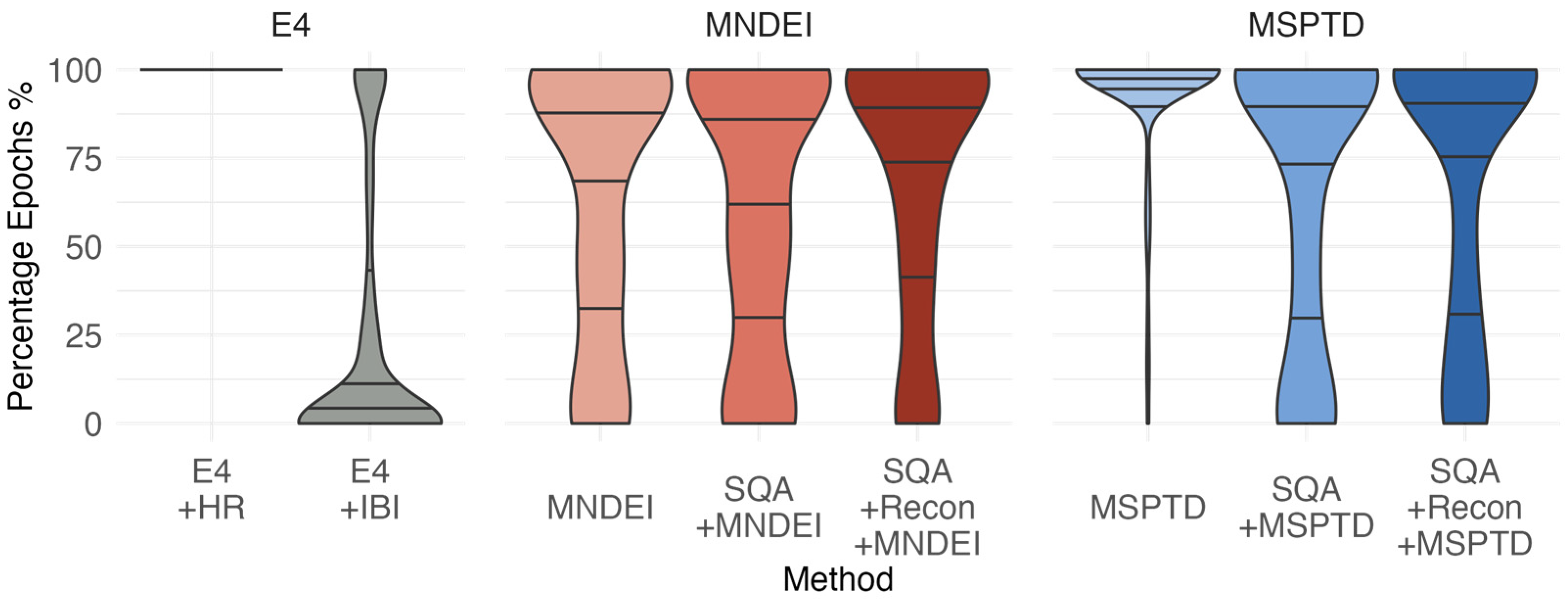
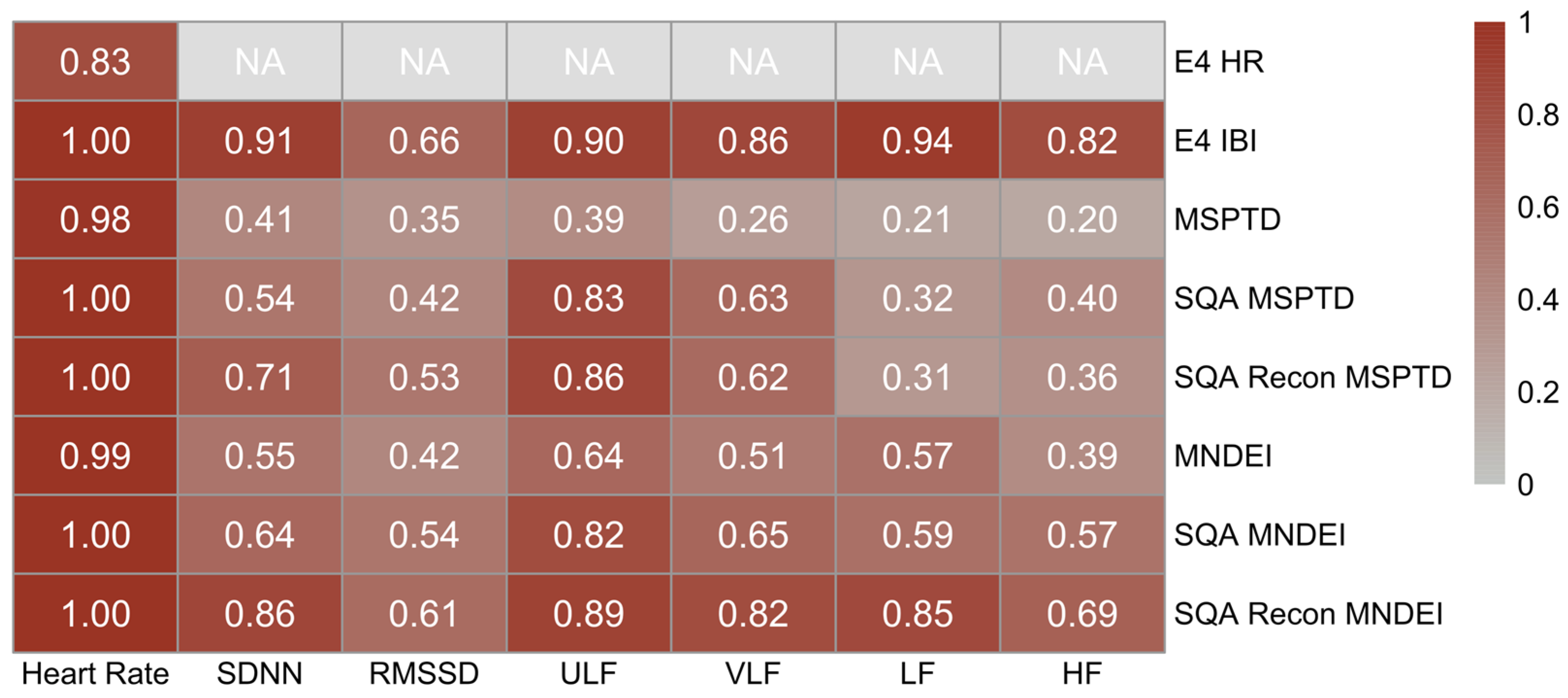
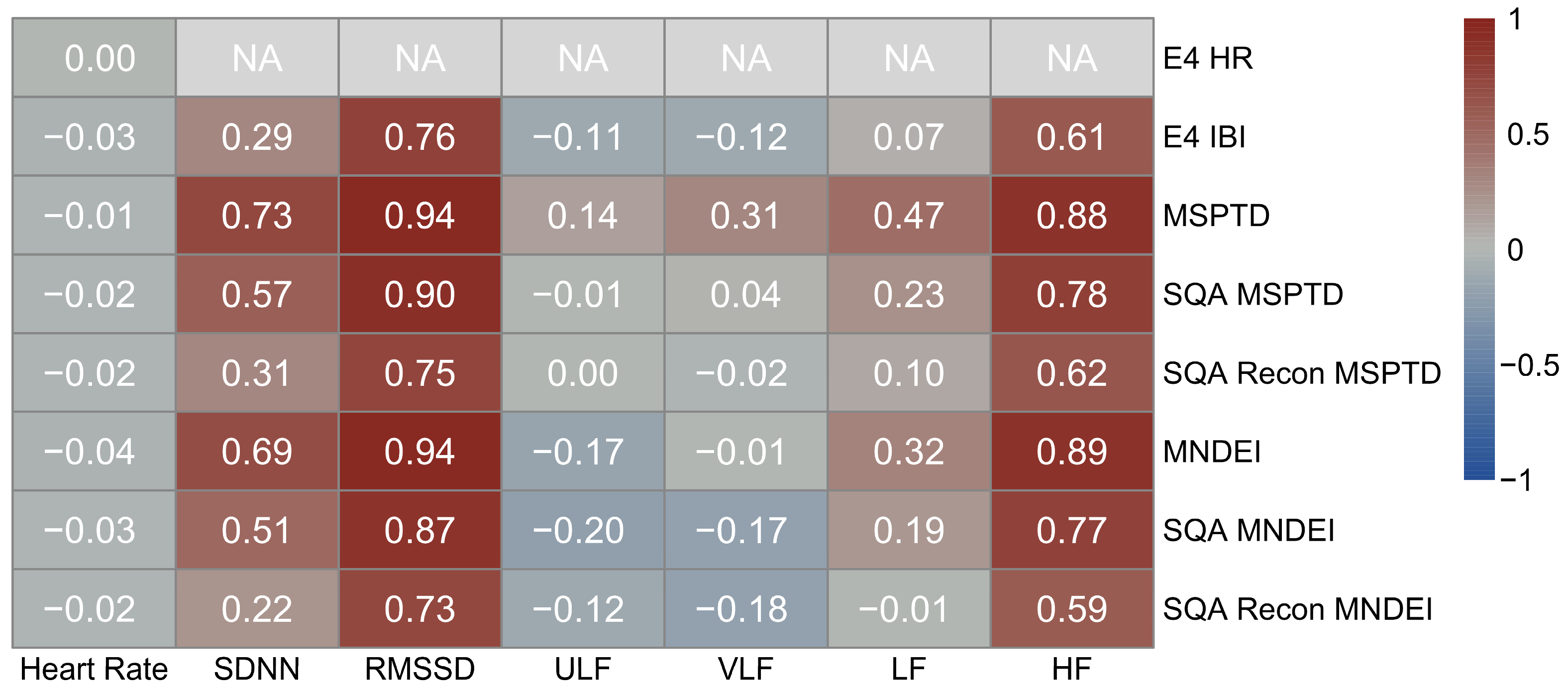
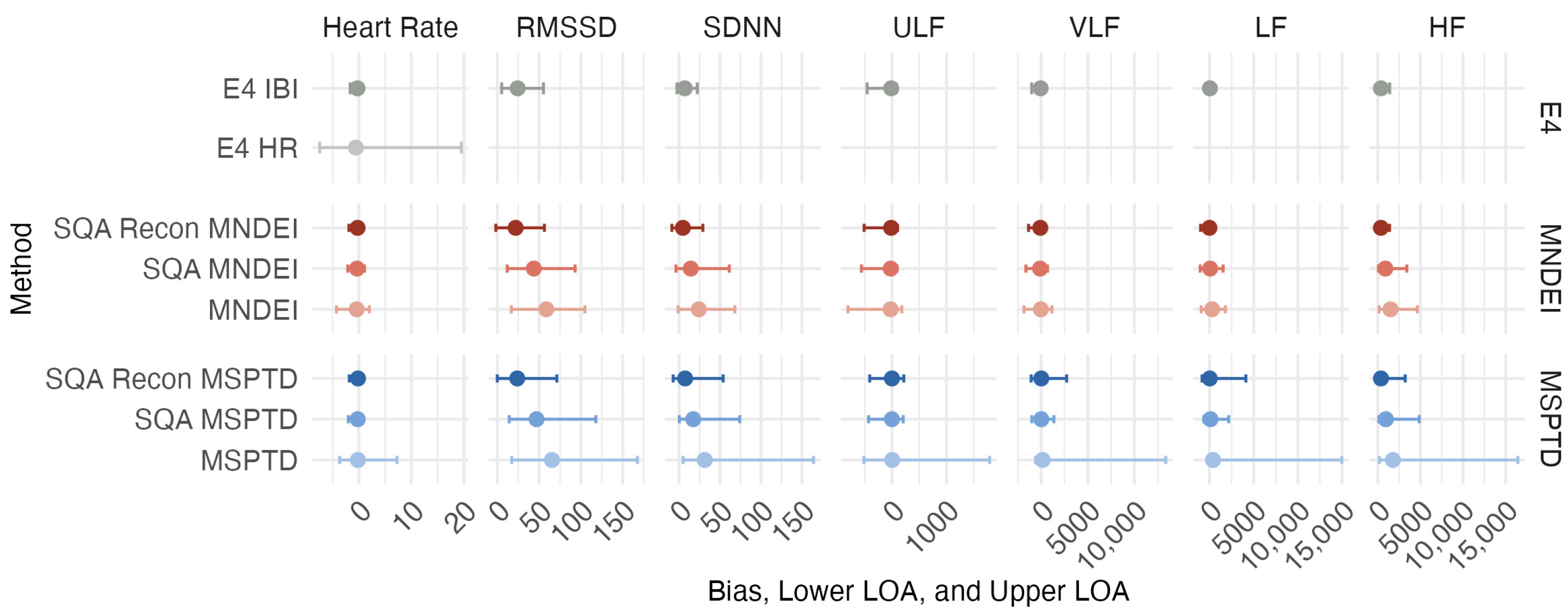
| Method | Valid Epoch | Heart Rate | Heart Rate Variability | ||||
|---|---|---|---|---|---|---|---|
| Pearson r | Cliff’s δ | Bias | Pearson r | Cliff’s δ | Bias | ||
| E4 HR | 100.00% | 0.83 | −0.01 | −0.77% | NA | NA | NA |
| E4 IBI | 22.70% | 1.00 | −0.03 | −0.37% | 0.85 | 0.25 | 47.43% |
| MSPTD | 94.70% | 0.98 | −0.01 | −0.25% | 0.31 | 0.58 | 205.47% |
| SQA MSPTD | 66.80% | 1.00 | −0.02 | −0.30% | 0.53 | 0.42 | 110.83% |
| SQA Recon MSPTD | 70.30% | 1.00 | −0.02 | −0.25% | 0.57 | 0.29 | 55.90% |
| MNDEI | 64.30% | 0.99 | −0.04 | −0.60% | 0.51 | 0.44 | 143.84% |
| SQA MNDEI | 60.90% | 1.00 | −0.03 | −0.49% | 0.64 | 0.33 | 93.44% |
| SQA Recon MNDEI | 69.50% | 1.00 | −0.02 | −0.34% | 0.79 | 0.21 | 41.66% |
Disclaimer/Publisher’s Note: The statements, opinions and data contained in all publications are solely those of the individual author(s) and contributor(s) and not of MDPI and/or the editor(s). MDPI and/or the editor(s) disclaim responsibility for any injury to people or property resulting from any ideas, methods, instructions or products referred to in the content. |
© 2025 by the authors. Licensee MDPI, Basel, Switzerland. This article is an open access article distributed under the terms and conditions of the Creative Commons Attribution (CC BY) license (https://creativecommons.org/licenses/by/4.0/).
Share and Cite
Gao, R.; Miller, C.S.; Lin, B.T.W.; Schwarz, C.W.; Jones, M.L.H. Signal Quality Assessment and Reconstruction of PPG-Derived Signals for Heart Rate and Variability Estimation in In-Vehicle Applications: A Comparative Review and Empirical Validation. Sensors 2025, 25, 7556. https://doi.org/10.3390/s25247556
Gao R, Miller CS, Lin BTW, Schwarz CW, Jones MLH. Signal Quality Assessment and Reconstruction of PPG-Derived Signals for Heart Rate and Variability Estimation in In-Vehicle Applications: A Comparative Review and Empirical Validation. Sensors. 2025; 25(24):7556. https://doi.org/10.3390/s25247556
Chicago/Turabian StyleGao, Ruimin, Carl S. Miller, Brian T. W. Lin, Chris W. Schwarz, and Monica L. H. Jones. 2025. "Signal Quality Assessment and Reconstruction of PPG-Derived Signals for Heart Rate and Variability Estimation in In-Vehicle Applications: A Comparative Review and Empirical Validation" Sensors 25, no. 24: 7556. https://doi.org/10.3390/s25247556
APA StyleGao, R., Miller, C. S., Lin, B. T. W., Schwarz, C. W., & Jones, M. L. H. (2025). Signal Quality Assessment and Reconstruction of PPG-Derived Signals for Heart Rate and Variability Estimation in In-Vehicle Applications: A Comparative Review and Empirical Validation. Sensors, 25(24), 7556. https://doi.org/10.3390/s25247556