A Comparative Overview of Technological Advances in Fall Detection Systems for Elderly People

 , , , , and
Highlights
- AI, IoT, and wearable devices improve accuracy in fall detection.
- Technology enables smarter, more preventative systems.
- Intelligent systems reduce fall response times.
- Predictive technologies lower unnecessary hospitalisations.
Abstract
1. Introduction
2. Methodology
2.1. Inclusion Criteria
2.2. Exclusion Criteria
3. Results
3.1. Developments of Fall Detection Systems in Older Adults
3.1.1. Inertial Sensors
3.1.2. Machine Vision
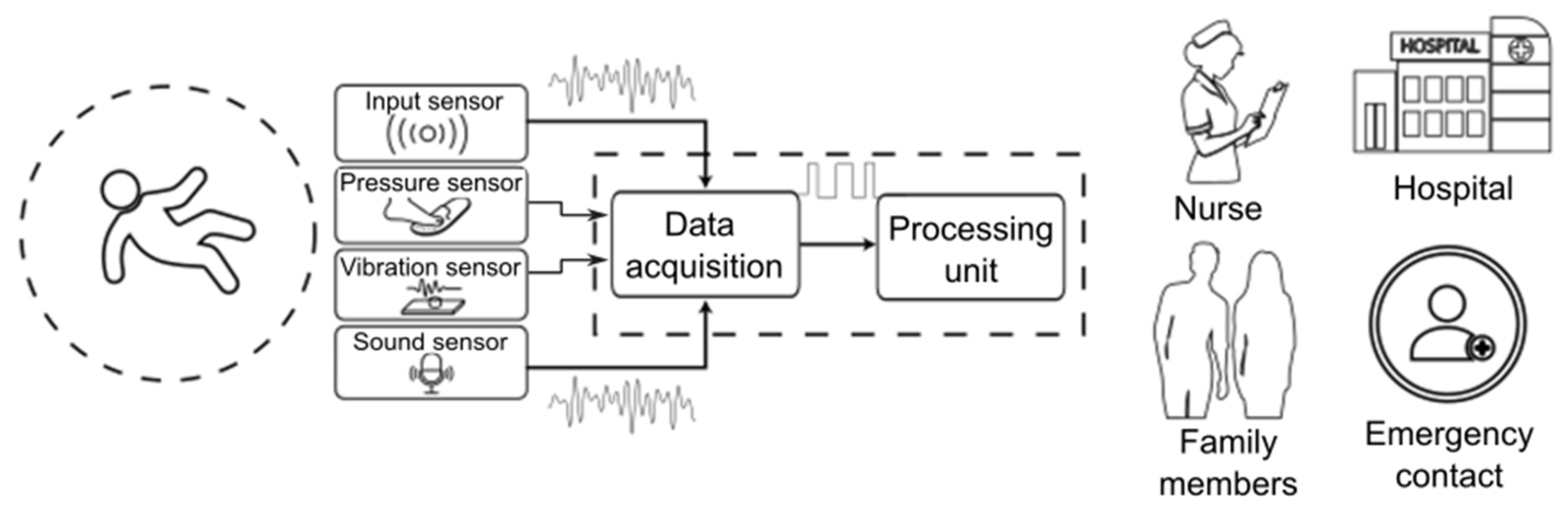
3.1.3. Pressure, Vibration and Sound Sensors
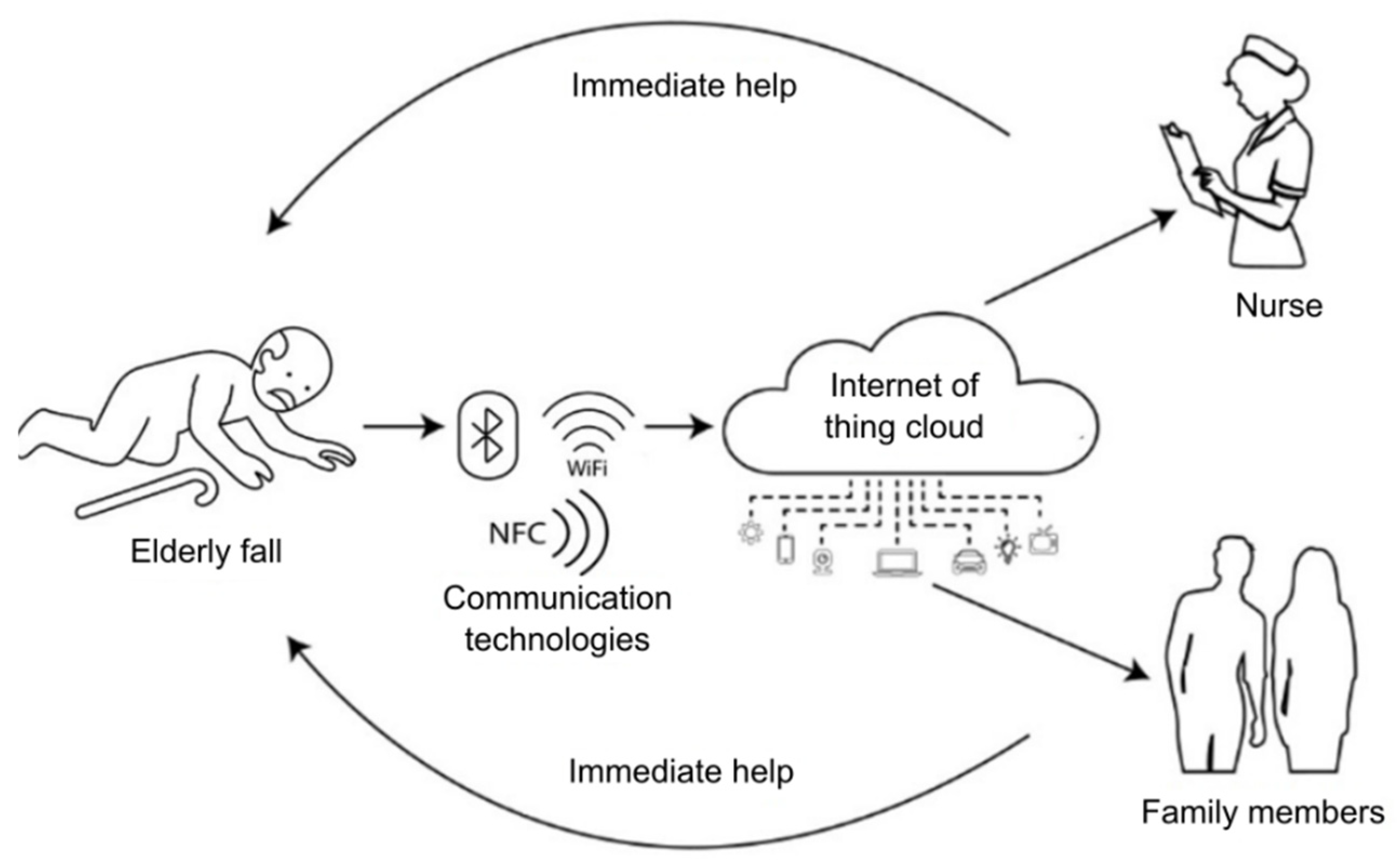
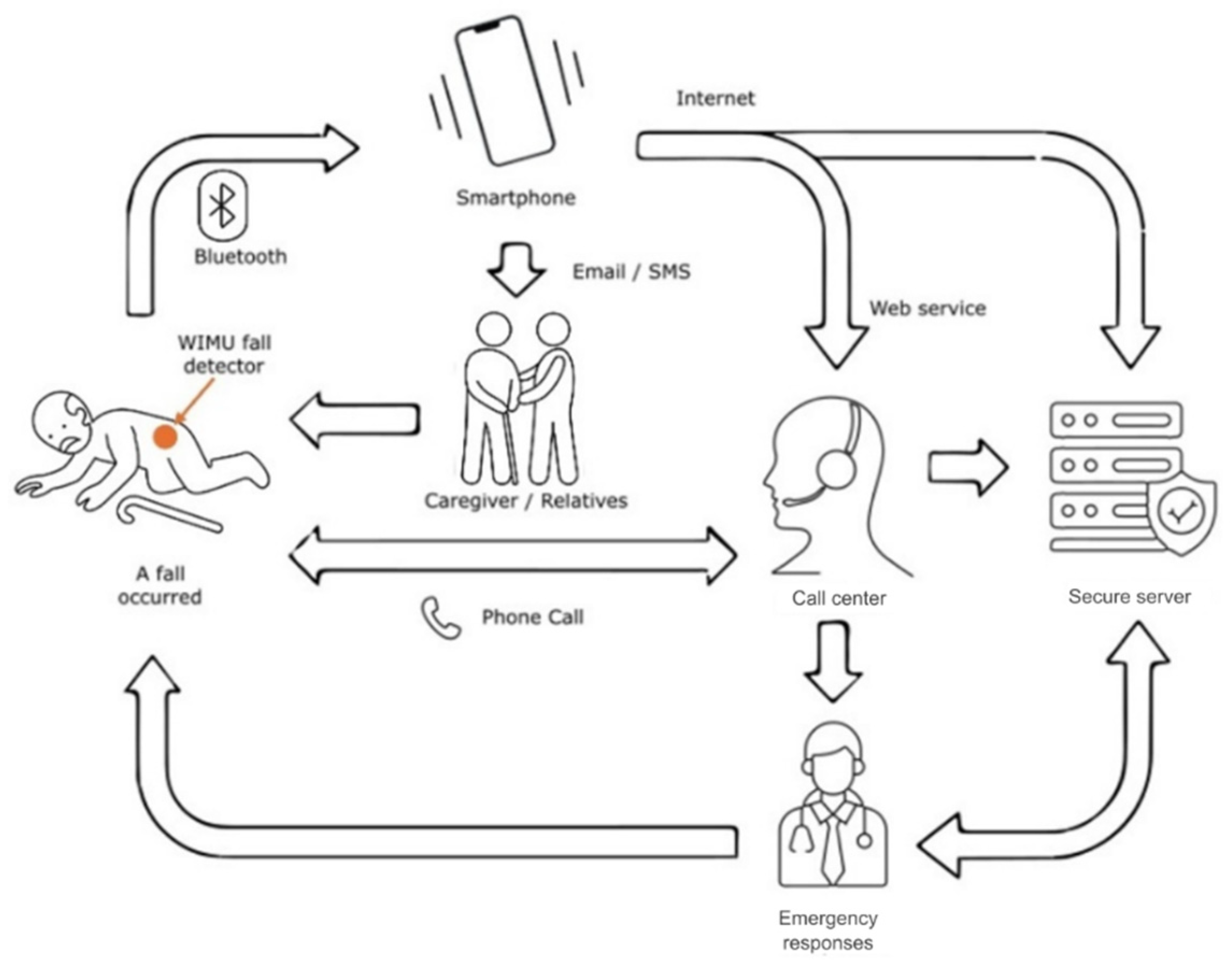
3.1.4. Internet of Things
3.1.5. Portable Devices
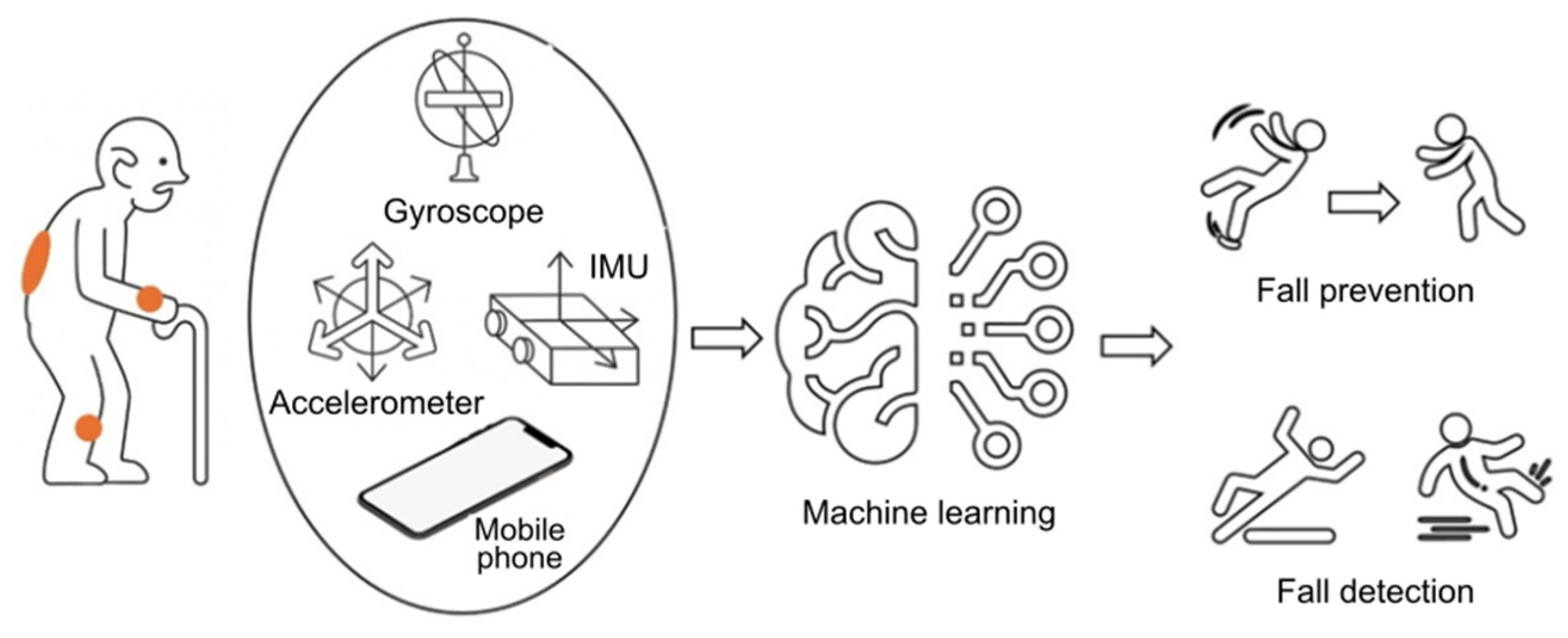
3.1.6. Machine Learning
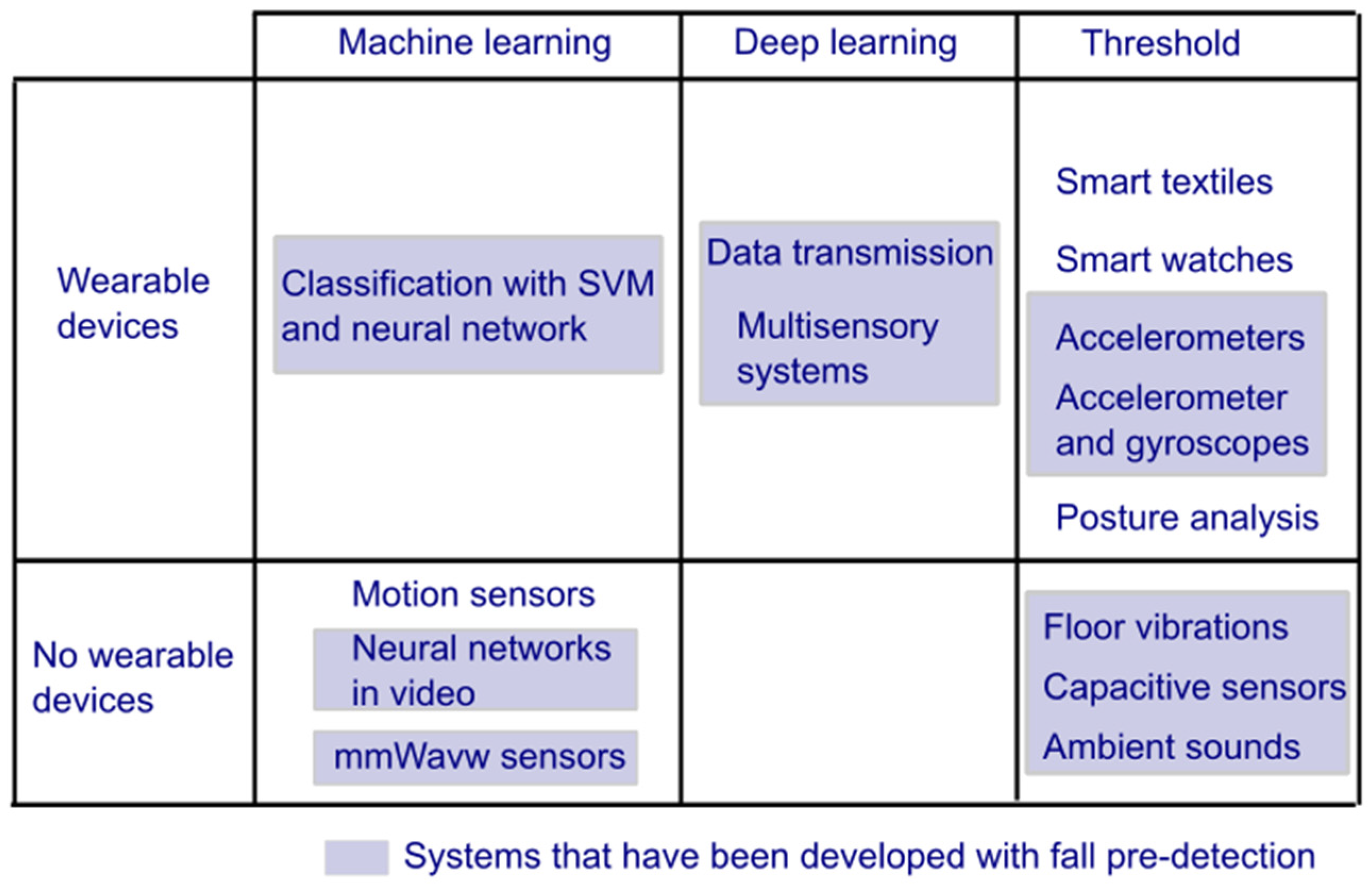
3.1.7. Advances in Early Fall Detection Systems for Older Adults
3.2. Technical and Functional Aspects of Fall Detection Systems
3.3. Key Technologies of Fall Detection Systems in Older Adults
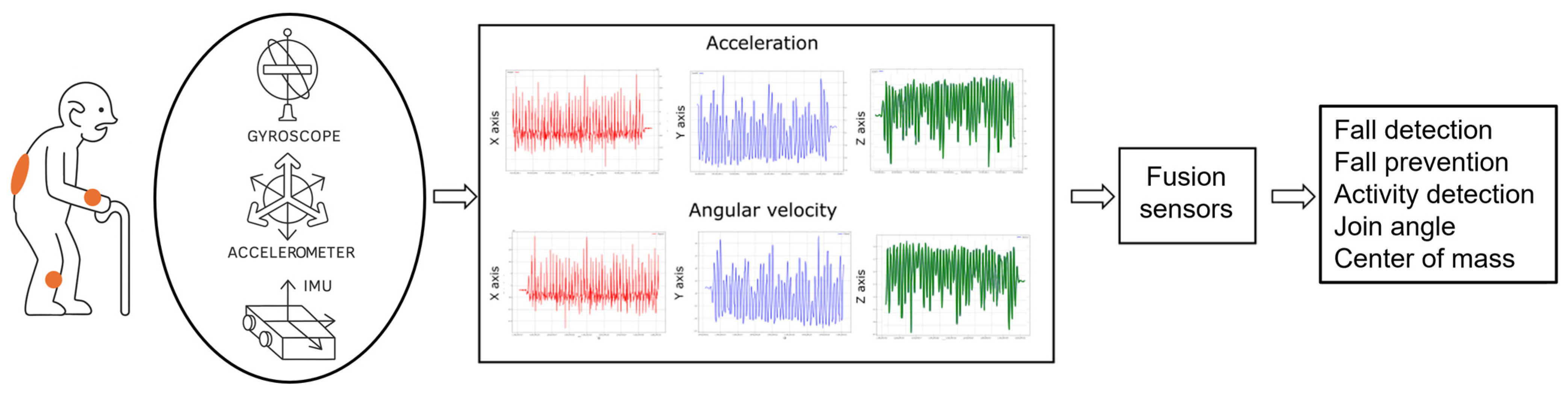
3.3.1. Inertial Sensors for Fall Detection Systems of Elderly People
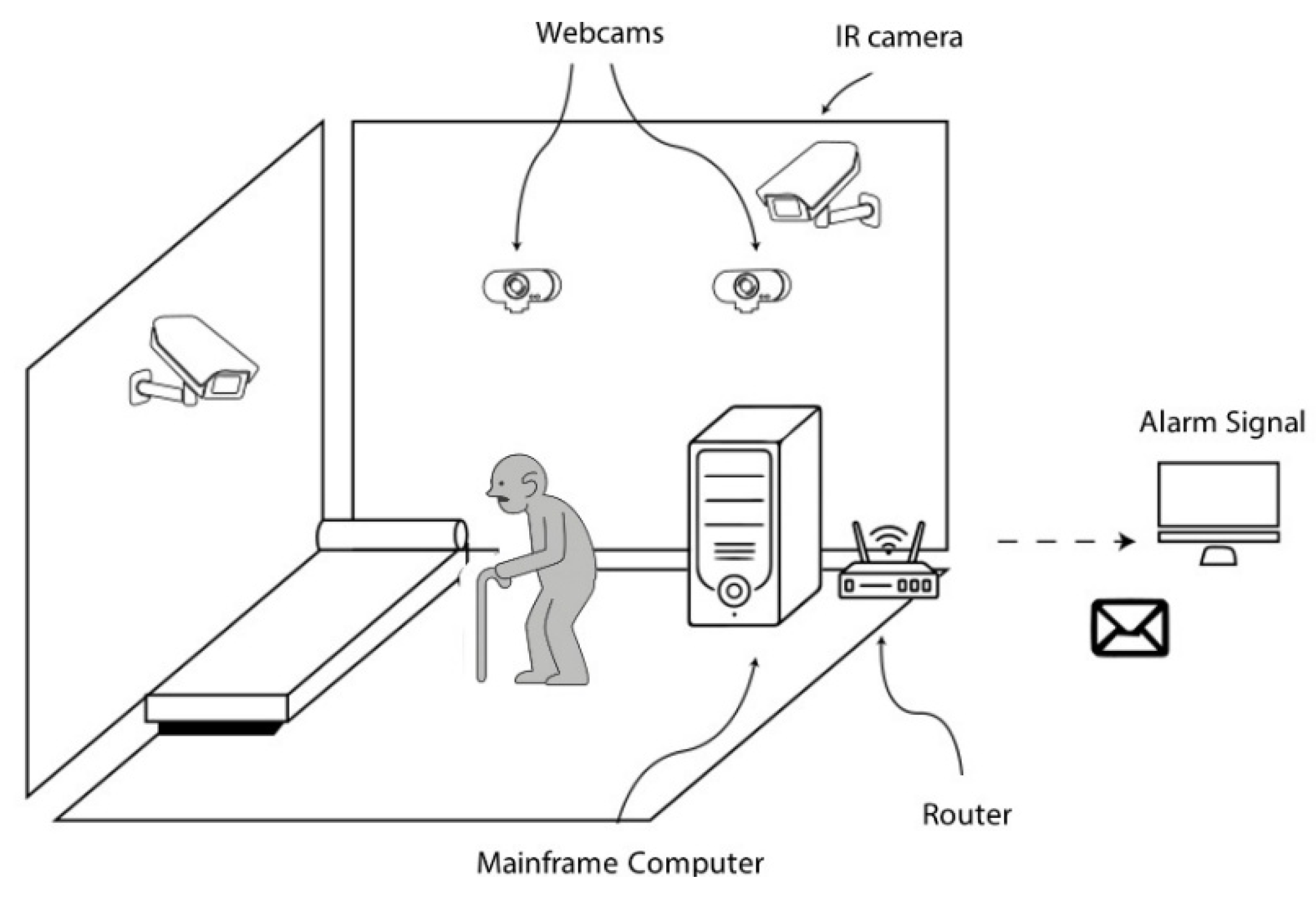
3.3.2. Fall Detection System for Elderly People Based on Computer Vision
3.3.3. Fall Detection Systems Based on Pressure, Vibration and Sound Sensors
Pressure Sensor-Based Systems
Systems Based on Vibration Sensors
Sound Sensor-Based Systems
3.3.4. Fall Detection Systems Based on IoT and Sensor Networks
3.3.5. Wearable Devices for Fall Detection Systems
3.3.6. Fall Detection Systems Using Machine Learning and Neural Networks
3.4. Advantages and Disadvantages of Fall Detection Systems
3.4.1. Advantages and Disadvantages of Inertial Sensor-Based Fall Detection Systems for Adults
3.4.2. Advantages and Disadvantages of Computer Vision-Based Adult Fall Detection Systems
3.4.3. Advantages and Disadvantages of Fall Detection Systems in Older Adults Based on Pressure, Vibration, and Sound Sensors
3.4.4. Advantages and Disadvantages of IoT-Based Fall Detection Systems and Sensor Networks
3.4.5. Advantages and Disadvantages of Fall Detection Systems Based on Wearable Devices
3.4.6. Advantages and Disadvantages of Fall Detection Systems for Older Adults Based on Machine Learning Models and Neural Networks
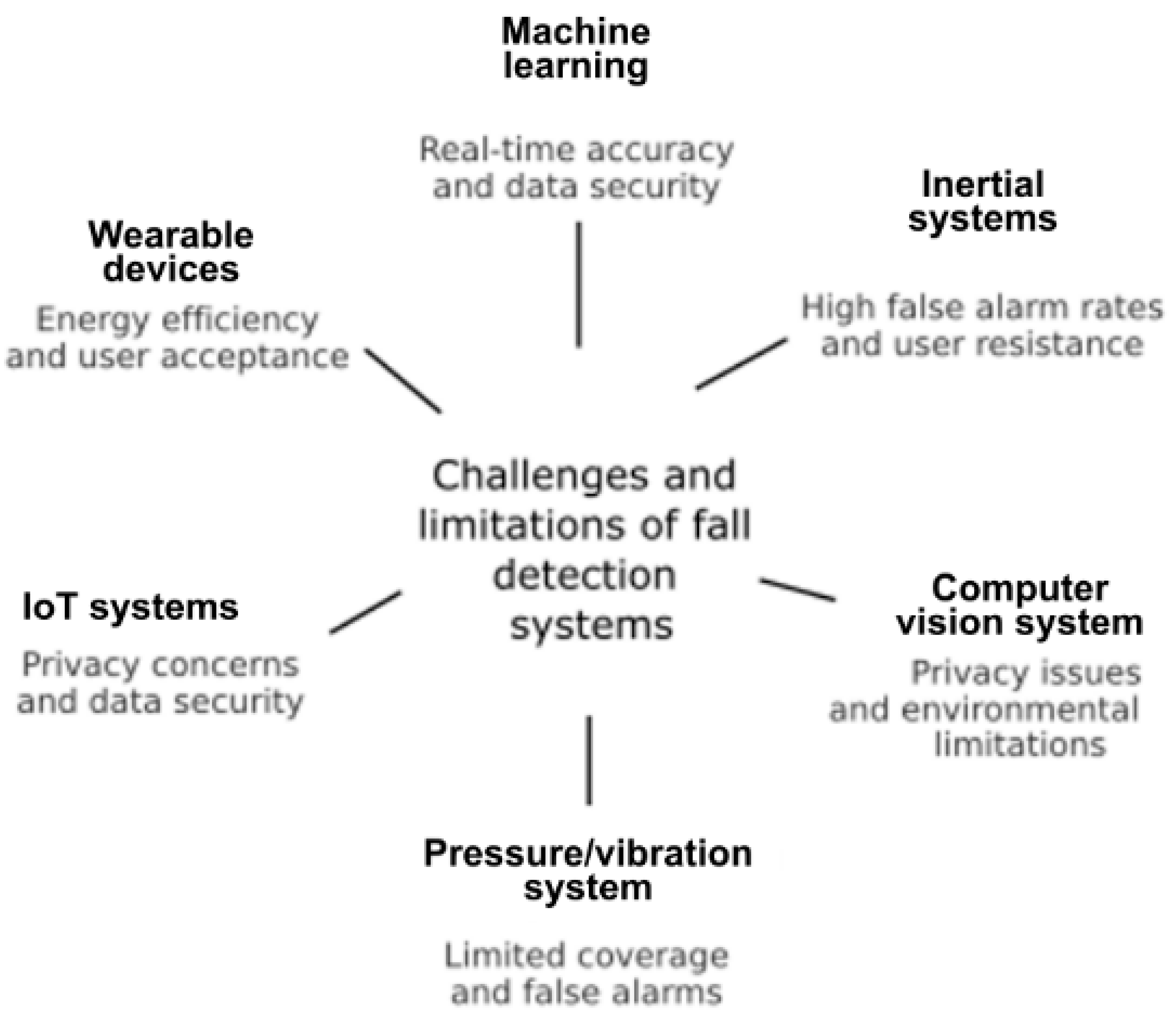
3.5. Challenges and Limitations
3.5.1. C&L in Inertial Sensor-Based Fall Detection Systems
3.5.2. C&L in Fall Detection Systems in Adults Based on Machine Vision
3.5.3. C&L in Fall Detection Systems Based on Pressure, Vibration and Sound Sensors
3.5.4. C&L in IoT-Based Fall Detection Systems and Sensor Networks
3.5.5. C&L in Fall Detection Systems Based on Portable Devices and Wearable Devices
3.5.6. C&L in Fall Detection Systems Based on Machine Learning Models and Neural Networks
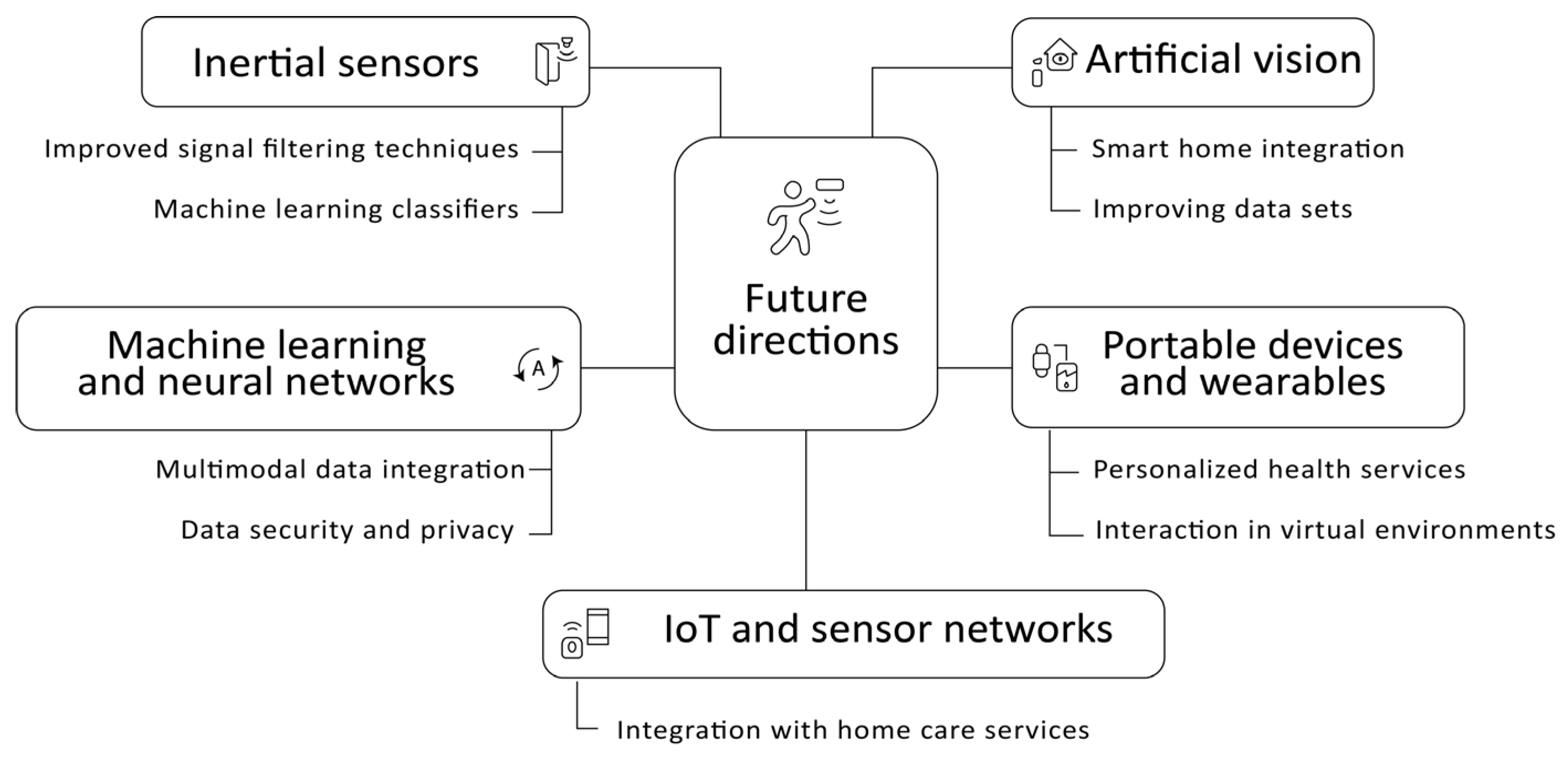
3.6. Future Directions
3.6.1. Improvements Integration and Signal Processing
3.6.2. Improvements in Systems Using AI
4. Discussion
4.1. Technological Advances
4.2. Accuracy and Reliability
4.3. User Adoption and Acceptance
4.4. Privacy, Ethics and Data Security
4.5. Research Gaps and Future Directions
4.6. Physiotherapy
5. Conclusions
Author Contributions
Funding
Institutional Review Board Statement
Informed Consent Statement
Acknowledgments
Conflicts of Interest
Abbreviations
| IoT | Internet of Things |
| SDGs | United Nations Sustainable Development Goals |
| SVMs | Support Vector Machines |
| RGB | Red, Green, Blue |
| IR | Infrared |
| YOLO | You only look once |
| GANs | Generative adversarial networks |
| CNNs | Convolutional neural networks |
| RNNs | Recurrent neural networks |
| RFID | Radio Frequency Identification |
| NFC | Near Field Communication |
| ML | Machine Learning |
| IMUs | Inertial Measurement Units |
| KNN | K-Nearest Neighbours |
| C&L | The Challenges and Limitations |
Appendix A

| Section | Item | PRISMA-ScR Checklist Item | Reported on Page Number |
|---|---|---|---|
| Title | |||
| Title | 1 | Identify the report as a scoping review. | 1 |
| Abstract | |||
| Structured summary | 2 | Provide a structured summary that includes (as applicable): background, objectives, eligibility criteria, sources of evidence, charting methods, results, and conclusions that relate to the review questions and objectives. | 2, 3, 4 |
| Introduction | |||
| Rationale | 3 | Describe the rationale for the review in the context of what is already known. Explain why the review questions/objectives lend themselves to a scoping review approach. | 2, 3, 4 |
| Objectives | 4 | Provide an explicit statement of the questions and objectives being addressed with reference to their key elements (e.g., population or participants, concepts, and context) or other relevant key elements used to conceptualise the review questions and/or objectives. | 3, 4 |
| Methods | |||
| Protocol and registration | 5 | Indicate whether a review protocol exists; state if and where it can be accessed (e.g., a Web address); and if available, provide registration information, including the registration number. | 5, 6 |
| Eligibility criteria | 6 | Specify characteristics of the sources of evidence used as eligibility criteria (e.g., years considered, language, and publication status), and provide a rationale. | 6, 7 |
| Information sources * | 7 | Describe all information sources in the search (e.g., databases with dates of coverage and contact with authors to identify additional sources), as well as the date the most recent search was executed. | 7 |
| Search | 8 | Present the full electronic search strategy for at least 1 database, including any limits used, such that it could be repeated. | 5 |
| Selection of sources of evidence † | 9 | State the process for selecting sources of evidence (i.e., screening and eligibility) included in the scoping review. | 5 |
| Data charting process ‡ | 10 | Describe the methods of charting data from the included sources of evidence (e.g., calibrated forms or forms that have been tested by the team before their use, and whether data charting was performed independently or in duplicate) and any processes for obtaining and confirming data from investigators. | 5 |
| Data items | 11 | List and define all variables for which data were sought and any assumptions and simplifications made. | 5 |
| Critical appraisal of individual sources of evidence § | 12 | If performed, provide a rationale for conducting a critical appraisal of included sources of evidence; describe the methods used and how this information was used in any data synthesis (if appropriate). | 5, 6 |
| Synthesis of results | 13 | Describe the methods of handling and summarising the data that were charted. | 6, 7 |
| Results | |||
| Selection of sources of evidence | 14 | Give numbers of sources of evidence screened, assessed for eligibility, and included in the review, with reasons for exclusions at each stage, ideally using a flow diagram. | 7–26 |
| Characteristics of sources of evidence | 15 | For each source of evidence, present characteristics for which data were charted and provide the citations. | - |
| Critical appraisal within sources of evidence | 16 | If performed, present data on critical appraisal of included sources of evidence (see item 12). | - |
| Results of individual sources of evidence | 17 | For each included source of evidence, present the relevant data that were charted that relate to the review questions and objectives. | - |
| Synthesis of results | 18 | Summarise and/or present the charting results as they relate to the review questions and objectives. | 25, 26 |
| Discussion | |||
| Summary of evidence | 19 | Summarise the main results (including an overview of concepts, themes, and types of evidence available), link to the review questions and objectives, and consider the relevance to key groups. | 26, 29 |
| Limitations | 20 | Discuss the limitations of the scoping review process. | 27, 28 |
| Conclusions | 21 | Provide a general interpretation of the results with respect to the review questions and objectives, as well as potential implications and/or next steps. | 29, 30 |
| Funding | |||
| Funding | 22 | Describe sources of funding for the included sources of evidence, as well as sources of funding for the scoping review. Describe the role of the funders of the scoping review. | 30 |
References
- World Health Organization. WHO Global Report on Falls Prevention in Older Age, Ageing Life Course Family, Community Health: WHO Global Report on Falls Prevention in Older Age. 2008. Available online: https://iris.who.int/handle/10665/43811 (accessed on 23 September 2025).
- Requena, C.; Plaza-Carmona, M.; Álvarez-Merino, P.; López-Fernández, V. Technological applications to enhance independence in daily activities for older adults: A systematic review. Front. Public Health 2024, 12, 1476916. [Google Scholar] [CrossRef] [Scilit] [PubMed]
- Guan, Q.; Li, C.; Guo, X.; Shen, B. Infrared Signal Based Elderly Fall Detection for In-Home Monitoring. In Proceedings of the 2017 9th International Conference on Intelligent Human-Machine Systems and Cybernetics (IHMSC), Hangzhou, China, 26–27 August 2017; pp. 373–376. [Google Scholar] [CrossRef] [Scilit]
- Yang, K.; Ahn, C.R.; Vuran, M.C.; Aria, S.S. Semi-supervised near-miss fall detection for ironworkers with a wearable inertial measurement unit. Autom. Constr. 2016, 68, 194–202. [Google Scholar] [CrossRef] [Scilit]
- De Backere, F.; Ongenae, F.; Abeele, F.V.D.; Nelis, J.; Bonte, P.; Clement, E.; Philpott, M.; Hoebeke, J.; Verstichel, S.; Ackaert, A.; et al. Towards a social and context-aware multi-sensor fall detection and risk assessment platform. Comput. Biol. Med. 2015, 64, 307–320. [Google Scholar] [CrossRef] [Scilit] [PubMed]
- Cippitelli, E.; Fioranelli, F.; Gambi, E.; Spinsante, S. Radar and RGB-Depth Sensors for Fall Detection: A Review. IEEE Sens. J. 2017, 17, 3585–3604. [Google Scholar] [CrossRef] [Scilit]
- Selvabala, V.S.N.; Ganesh, A.B. Implementation of wireless sensor network based human fall detection system. Procedia Eng. 2012, 30, 767–773. [Google Scholar] [CrossRef] [Scilit]
- Tomoya, A.; Nakayama, S.; Hoshina, A.; Sugaya, M. A Mobile Robot for Following, Watching and Detecting Falls for Elderly Care. Procedia Comput. Sci. 2017, 112, 1994–2003. [Google Scholar] [CrossRef] [Scilit]
- Nadi, M.; El-Bendary, N.; Mahmoud, H.; Hassanien, A.E. Fall detection system of elderly people based on integral image and histogram of oriented gradient feature. In Proceedings of the 2014 14th International Conference on Hybrid Intelligent Systems, Kuwait, Kuwait, 14–16 December 2014; pp. 23–29. [Google Scholar] [CrossRef] [Scilit]
- Boutellaa, E.; Kerdjidj, O.; Ghanem, K. Covariance matrix based fall detection from multiple wearable sensors. J. Biomed. Inform. 2019, 94, 103189. [Google Scholar] [CrossRef] [Scilit]
- Kurniawan, A.; Hermawan, A.R.; Purnama, I.K.E. A wearable device for fall detection elderly people using tri dimensional accelerometer. In Proceedings of the 2016 International Seminar on Intelligent Technology and Its Applications (ISITIA), Lombok, Indonesia, 28–30 July 2016; pp. 671–674. [Google Scholar] [CrossRef] [Scilit]
- Torres, G.G.; Henriques, R.V.B.; Pereira, C.E.; Müller, I. An EnOcean Wearable Device with Fall Detection Algorithm Integrated with a Smart Home System. IFAC-Pap. 2018, 51, 9–14. [Google Scholar] [CrossRef] [Scilit]
- Irtaza, A.; Adnan, S.M.; Aziz, S.; Javed, A.; Ullah, M.O.; Mahmood, M.T. A framework for fall detection of elderly people by analyzing environmental sounds through acoustic local ternary patterns. In Proceedings of the 2017 IEEE International Conference on Systems, Man, and Cybernetics (SMC), Banff, AB, Canada, 5–8 October 2017; pp. 1558–1563. [Google Scholar] [CrossRef] [Scilit]
- Bilski, P.; Mazurek, P.; Wagner, J. Application of k Nearest Neighbors Approach to the fall detection of elderly people using depth-based sensors. In Proceedings of the 2015 IEEE 8th International Conference on Intelligent Data Acquisition and Advanced Computing Systems: Technology and Applications (IDAACS), Warsaw, Poland, 24–26 September 2015; pp. 733–739. [Google Scholar] [CrossRef] [Scilit]
- Nguyen, V.D.; Le, M.T.; Do, A.D.; Duong, H.H.; Thai, T.D.; Tran, D.H. An efficient camera-based surveillance for fall detection of elderly people. In Proceedings of the 2014 9th IEEE Conference on Industrial Electronics and Applications, Hangzhou, China, 9–11 June 2014; pp. 994–997. [Google Scholar] [CrossRef] [Scilit]
- Alhimale, L.; Zedan, H.; Al-Bayatti, A. The implementation of an intelligent and video-based fall detection system using a neural network. Appl. Soft Comput. 2014, 18, 59–69. [Google Scholar] [CrossRef] [Scilit]
- Wang, H.; Li, M.; Li, J.; Cao, J.; Wang, Z. An improved fall detection approach for elderly people based on feature weight and Bayesian classification. In Proceedings of the 2016 IEEE International Conference on Mechatronics and Automation, Harbin, China, 7–10 August 2016; pp. 471–476. [Google Scholar] [CrossRef] [Scilit]
- Wang, K.; Zhao, Y.; Xiong, Q.; Shen, X.; Fan, M.; Gao, M. Video Recognition of Human Fall Based on Spatiotemporal Features. Intell. Autom. Soft Comput. 2016, 22, 303–309. [Google Scholar] [CrossRef] [Scilit]
- Ghods, L.P.Y.V. Human fall detection using machine vision techniques on RGB–D images. Biomed. Signal Process. Control 2018, 44, 146–153. [Google Scholar] [CrossRef] [Scilit]
- Ren, L.; Shi, W. Chameleon: Personalised and adaptive fall detection of elderly people in home-based environments. Int. J. Sens. Netw. 2016, 20, 163. [Google Scholar] [CrossRef] [Scilit]
- Nizam, Y.; Mohd, M.N.H.; Jamil, M.M.A. Human Fall Detection from Depth Images using Position and Velocity of Subject. Procedia Comput. Sci. 2017, 105, 131–137. [Google Scholar] [CrossRef] [Scilit]
- Gomathy, C.K.; Geetha, V.; Reddy, A.S.; Kiran, A.U. Fall detection for elderly people using machine learning. In Proceedings of the International Conference on Emerging Trends in Electronics and Communication Engineering-2023, Nandyala, India, 8 July 2024; p. 020018. [Google Scholar] [CrossRef] [Scilit]
- Flor, O. Cybersecurity Vulnerabilities in Latin America; Mendeley Data: Dublin, Ireland, 2023. [Google Scholar] [CrossRef]
- Bustos, S.; Flores, M.J.; Pozo-Espín, D.; Solórzano, S. Embedded System for Fall Detection in Activities of Daily Living ADLs: A Time Window Analysis. In Artificial Intelligence, Computer and Software Engineering Advances; Botto-Tobar, M., Cruz, H., Cadena, A.D., Eds.; Advances in Intelligent Systems and Computing; Springer International: Cham, Switzerland, 2021; Volume 1326, pp. 228–238. [Google Scholar] [CrossRef] [Scilit]
- Rezaee, K.; Khosravi, M.R.; Moghimi, M.K. Intelligent Elderly People Fall Detection Based on Modified Deep Learning Deep Transfer Learning and IoT Using Thermal Imaging-Assisted Pervasive Surveillance. In Intelligent Healthcare; Chakraborty, C., Khosravi, M.R., Eds.; Springer Nature: Singapore, 2022; pp. 113–132. [Google Scholar] [CrossRef] [Scilit]
- Okumura, N.; Yamanoi, Y.; Kato, R.; Yamamura, O. Fall detection and walking estimation using floor vibration for solitary elderly people. In Proceedings of the 2019 IEEE International Conference on Systems, Man and Cybernetics (SMC), Bari, Italy, 6–9 October 2019; pp. 1437–1442. [Google Scholar] [CrossRef] [Scilit]
- Shabadi, L.; Chaitra, M.; Monik, L.; Pavan, S.G.; Deekshith, R.K.; Narayan, L. Real-Time Elderly Fall Detection as Ambient Intelligence in Old Age Homes. In Proceedings of the 2025 International Conference on Intelligent and Innovative Technologies in Computing, Electrical and Electronics (IITCEE), Bangalore, India, 16–17 January 2025; pp. 1–6. [Google Scholar] [CrossRef] [Scilit]
- Gia, T.N.; Sarker, V.K.; Tcarenko, I.; Rahmani, A.M.; Westerlund, T.; Liljeberg, P.; Tenhunen, H. Energy efficient wearable sensor node for IoT-based fall detection systems. Microprocess. Microsyst. 2018, 56, 34–46. [Google Scholar] [CrossRef] [Scilit]
- He, J.; Bai, S.; Wang, X. An Unobtrusive Fall Detection and Alerting System Based on Kalman Filter and Bayes Network Classifier. Sensors 2017, 17, 1393. [Google Scholar] [CrossRef] [Scilit]
- Vallabh, P.; Malekian, R. Fall detection monitoring systems: A comprehensive review. J. Ambient. Intell. Humaniz. Comput. 2018, 9, 1809–1833. [Google Scholar] [CrossRef] [Scilit]
- Rahemtulla, Z.; Wickenden, R.; Hughes-Riley, T. Using a human centred design approach to develop a fall detection sock for older women. Des. Health 2024, 8, 318–335. [Google Scholar] [CrossRef] [Scilit]
- Villaverde, A.C.; R-Moreno, M.D.; Barrero, D.F.; Rodriguez, D. Triaxial Accelerometer Located on the Wrist for Elderly People’s Fall Detection. In Intelligent Data Engineering and Automated Learning–IDEAL 2016; Yin, H., Gao, Y., Li, B., Zhang, D., Yang, M., Li, Y., Klawonn, F., Tallón-Ballesteros, A.J., Eds.; Lecture Notes in Computer Science; Springer International: Cham, Switzerland, 2016; Volume 9937, pp. 523–532. [Google Scholar] [CrossRef] [Scilit]
- Yang, M.; Li, X.; Liu, J.; Wang, S.; Liu, L. A Survey of Computer Vision-Based Fall Detection and Technology Perspectives. In Computer Supported Cooperative Work and Social Computing; Sun, Y., Lu, T., Guo, Y., Song, X., Fan, H., Liu, D., Gao, L., Du, B., Eds.; Communications in Computer and Information Science; Springer Nature: Singapore, 2023; Volume 1682, pp. 595–609. [Google Scholar] [CrossRef] [Scilit]
- Mrozek, D.; Koczur, A.; Małysiak-Mrozek, B. Fall detection in older adults with mobile IoT devices and machine learning in the cloud and on the edge. Inf. Sci. 2020, 537, 132–147. [Google Scholar] [CrossRef] [Scilit]
- Barabas, J.; Bednar, T.; Vychlopen, M. Kinect-Based Platform for Movement Monitoring and Fall-Detection of Elderly People. In Proceedings of the 2019 12th International Conference on Measurement, Smolenice, Slovakia, 27–29 May 2019; pp. 199–202. [Google Scholar] [CrossRef] [Scilit]
- Iazzi, A.; Rziza, M.; Thami, R.O.H.; Aboutajdine, D. A New Method for Fall Detection of Elderly Based on Human Shape and Motion Variation. In Advances in Visual Computing; Bebis, G., Boyle, R., Parvin, B., Koracin, D., Porikli, F., Skaff, S., Entezari, A., Min, J., Iwai, D., Sadagic, A., et al., Eds.; Lecture Notes in Computer Science; Springer International: Cham, Switzerland, 2016; Volume 10073, pp. 156–167. [Google Scholar] [CrossRef] [Scilit]
- Alaoui, A.Y.; El Fkihi, S.; Thami, R.O.H. Fall Detection for Elderly People Using the Variation of Key Points of Human Skeleton. IEEE Access 2019, 7, 154786–154795. [Google Scholar] [CrossRef] [Scilit]
- Yacchirema, D.; De Puga, J.S.; Palau, C.; Esteve, M. Fall detection system for elderly people using IoT and Big Data. Procedia Comput. Sci. 2018, 130, 603–610. [Google Scholar] [CrossRef] [Scilit]
- De Raeve, N.; Shahid, A.; de Schepper, M.; De Poorter, E.; Moerman, I.; Verhaevert, J.; Van Torre, P.; Rogier, H. Bluetooth-Low-Energy-Based Fall Detection and Warning System for Elderly People in Nursing Homes. J. Sens. 2022, 2022, 1–14. [Google Scholar] [CrossRef] [Scilit]
- Nie, H.; He, D.; Shen, J.; Wang, S.; Dong, A. On Non-Invasive Fall Detection Based on Multimodal Fusion. In Proceedings of the 2024 IEEE International Symposium on Parallel and Distributed Processing with Applications (ISPA), Kaifeng, China, 30 October–2 November 2024; pp. 974–980. [Google Scholar] [CrossRef] [Scilit]
- Alaoui, A.Y.; Tabii, Y.; Thami, R.O.H.; Daoudi, M.; Berretti, S.; Pala, P. Fall Detection of Elderly People Using the Manifold of Positive Semidefinite Matrices. J. Imaging 2021, 7, 109. [Google Scholar] [CrossRef] [Scilit] [PubMed]
- Kadhum, A.A.; Al-Libawy, H.; Hussein, E.A. An Accurate Fall Detection System for the Elderly People Using Smartphone Inertial Sensors. J. Phys. Conf. Ser. 2020, 1530, 012102. [Google Scholar] [CrossRef] [Scilit]
- Chen, L.; Li, R.; Zhang, H.; Tian, L.; Chen, N. Intelligent fall detection method based on accelerometer data from a wrist-worn smart watch. Measurement 2019, 140, 215–226. [Google Scholar] [CrossRef] [Scilit]
- Feng, W.; Liu, R.; Zhu, M. Fall detection for elderly person care in a vision-based home surveillance environment using a monocular camera. Signal Image Video Process. 2014, 8, 1129–1138. [Google Scholar] [CrossRef] [Scilit]
- Yang, L.; Ren, Y.; Zhang, W. 3D depth image analysis for indoor fall detection of elderly people. Digit. Commun. Netw. 2016, 2, 24–34. [Google Scholar] [CrossRef] [Scilit]
- Fáñez, M.; Villar, J.R.; De La Cal, E.; González, V.M.; Sedano, J.; Khojasteh, S.B. Mixing user-centered and generalized models for Fall Detection. Neurocomputing 2021, 452, 473–486. [Google Scholar] [CrossRef] [Scilit]
- Mekruksavanich, S.; Jantawong, P.; Jitpattanakul, A. Pre-Impact Fall Detection Based on Wearable Inertial Sensors using Hybrid Deep Residual Neural Network. In Proceedings of the 2022 6th International Conference on Information Technology (InCIT), Nonthaburi, Thailand, 10–11 November 2022; pp. 450–453. [Google Scholar] [CrossRef] [Scilit]
- Ahn, S.; Kim, J.; Koo, B.; Kim, Y. Evaluation of Inertial Sensor-Based Pre-Impact Fall Detection Algorithms Using Public Dataset. Sensors 2019, 19, 774. [Google Scholar] [CrossRef] [Scilit]
- Yu, X.; Qiu, H.; Xiong, S. A Novel Hybrid Deep Neural Network to Predict Pre-impact Fall for Older People Based on Wearable Inertial Sensors. Front. Bioeng. Biotechnol. 2020, 8, 63. [Google Scholar] [CrossRef] [Scilit]
- Hnoohom, N.; Mekruksavanich, S.; Jitpattanakul, A. Pre-Impact and Impact Fall Detection Based on a Multimodal Sensor Using a Deep Residual Network. Intell. Autom. Soft Comput. 2023, 36, 3371–3385. [Google Scholar] [CrossRef] [Scilit]
- Liu, N.; Zhang, D.; Su, Z.; Wang, T. Preimpact Fall Detection for Elderly Based on Fractional Domain. Math. Probl. Eng. 2021, 2021, 1–17. [Google Scholar] [CrossRef] [Scilit]
- Chen, K.-H.; Yang, J.-J.; Jaw, F.-S. Accelerometer-based fall detection using feature extraction and support vector machine algorithms. Instrum. Sci. Technol. 2016, 44, 333–342. [Google Scholar] [CrossRef] [Scilit]
- Álvarez De La Concepción, M.Á.; Soria Morillo, L.M.; Álvarez García, J.A.; González-Abril, L. Mobile activity recognition and fall detection system for elderly people using Ameva algorithm. Pervasive Mob. Comput. 2017, 34, 3–13. [Google Scholar] [CrossRef] [Scilit]
- Villar, J.R.; Chira, C.; De La Cal, E.; González, V.M.; Sedano, J.; Khojasteh, S.B. Autonomous on-wrist acceleration-based fall detection systems: Unsolved challenges. Neurocomputing 2021, 452, 404–413. [Google Scholar] [CrossRef] [Scilit]
- Tsai, Y.-G.W.Y.S.-L. Fall event detection by gyroscopic and accelerometer sensors in smart phone. Int. J. Comput. Appl. 2015, 37, 60–66. [Google Scholar] [CrossRef] [Scilit]
- Pierleoni, P.; Pernini, L.; Belli, A.; Palma, L.; Valenti, S.; Paniccia, M. SVM-based fall detection method for elderly people using Android low-cost smartphones. In Proceedings of the 2015 IEEE Sensors Applications Symposium (SAS), Zadar, Croatia, 13–15 April 2015; pp. 1–5. [Google Scholar] [CrossRef] [Scilit]
- Chen, Y.; Lin, Y.; Fang, W. A video-based human fall detection system for smart homes. J. Chin. Inst. Eng. 2010, 33, 681–690. [Google Scholar] [CrossRef] [Scilit]
- Harrou, F.; Zerrouki, N.; Sun, Y.; Houacine, A. Vision-based fall detection system for improving safety of elderly people. IEEE Instrum. Meas. Mag. 2017, 20, 49–55. [Google Scholar] [CrossRef] [Scilit]
- Bosch-Jorge, M.; Sánchez-Salmerón, A.-J.; Valera, Á.; Ricolfe-Viala, C. Fall detection based on the gravity vector using a wide-angle camera. Expert Syst. Appl. 2014, 41, 7980–7986. [Google Scholar] [CrossRef] [Scilit]
- Haffner, J.; Margo, C.; Oussar, Y.; Holé, S.; Casimiro, J.; Mabire, P. A smart capacitive measurement system for fall detection. J. Electrost. 2018, 92, 45–53. [Google Scholar] [CrossRef] [Scilit]
- Delgado-Escaño, R.; Castro, F.M.; Cózar, J.R.; Marín-Jiménez, M.J.; Guil, N.; Casilari, E. A cross-dataset deep learning-based classifier for people fall detection and identification. Comput. Methods Programs Biomed. 2020, 184, 105265. [Google Scholar] [CrossRef] [Scilit]
- Gharghan, S.K.; Mohammed, S.L.; Al-Naji, A.; Abu-AlShaeer, M.J.; Jawad, H.M.; Jawad, A.M.; Chahl, J. Accurate Fall Detection and Localization for Elderly People Based on Neural Network and Energy-Efficient Wireless Sensor Network. Energies 2018, 11, 2866. [Google Scholar] [CrossRef] [Scilit]
- Usmani, S.; Saboor, A.; Haris, M.; Khan, M.A.; Park, H. Latest Research Trends in Fall Detection and Prevention Using Machine Learning: A Systematic Review. Sensors 2021, 21, 5134. [Google Scholar] [CrossRef] [Scilit]
- Lin, C.-L.; Chiu, W.-C.; Chen, F.-H.; Ho, Y.-H.; Chu, T.-C.; Hsieh, P.-H. Fall Monitoring for the Elderly Using Wearable Inertial Measurement Sensors on Eyeglasses. IEEE Sens. Lett. 2020, 4, 1–4. [Google Scholar] [CrossRef] [Scilit]
- Aziz, O.; Russell, C.M.; Park, E.J.; Robinovitch, S.N. The effect of window size and lead time on pre-impact fall detection accuracy using support vector machine analysis of waist mounted inertial sensor data. In Proceedings of the 2014 36th Annual International Conference of the IEEE Engineering in Medicine and Biology Society, Chicago, IL, USA, 26–30 August 2014; pp. 30–33. [Google Scholar] [CrossRef] [Scilit]
- Ros, D.; Dai, R. A Flexible Fall Detection Framework Based on Object Detection and Motion Analysis. In Proceedings of the 2023 International Conference on Artificial Intelligence in Information and Communication (ICAIIC), Bali, Indonesia, 20–23 February 2023; pp. 63–68. [Google Scholar] [CrossRef] [Scilit]
- Khan, A.A.; Alsadoon, A.; Al-Khalisy, S.H.; Prasad, P.W.C.; Jerew, O.D.; Manoranjan, P. A Novel Hybrid Fall Detection Technique Using Body Part Tracking and Acceleration. In Proceedings of the 2020 5th International Conference on Innovative Technologies in Intelligent Systems and Industrial Applications (CITISIA), Sydney, Australia, 25–27 November 2020; pp. 1–8. [Google Scholar] [CrossRef] [Scilit]
- Chua, J.L.; Chang, Y.C.; Lim, W.K. Intelligent Visual Based Fall Detection Technique for Home Surveillance. In Proceedings of the 2012 International Symposium on Computer, Consumer and Control, Taichung, Taiwan, 4–6 June 2012; pp. 183–187. [Google Scholar] [CrossRef] [Scilit]
- Abdoul-Halim, M.A.; Vengusamy, S. Deep Learning Based Computer Vision Bound Fall Detection for Elderly People. In Proceedings of the 2023 IEEE 21st Student Conference on Research and Development (SCOReD), Kuala Lumpur, Malaysia, 13–14 December 2023; pp. 262–269. [Google Scholar] [CrossRef] [Scilit]
- Gutiérrez, J.; Martin, S.; Rodriguez, V. Human stability assessment and fall detection based on dynamic descriptors. IET Image Process. 2023, 17, 3177–3195. [Google Scholar] [CrossRef] [Scilit]
- Kaur, A.P.; Nsugbe, E.; Drahota, A.; Oldfield, M.; Mohagheghian, I.; Sporea, R.A. State-of-the-art fall detection techniques with emphasis on floor-based systems—A review. Biomed. Eng. Adv. 2025, 9, 100179. [Google Scholar] [CrossRef] [Scilit]
- Santos, V.M.; Gomes, B.B.; Neto, M.A.; Amaro, A.M. A Systematic Review of Insole Sensor Technology: Recent Studies and Future Directions. Appl. Sci. 2024, 14, 6085. [Google Scholar] [CrossRef] [Scilit]
- Cates, B.; Sim, T.; Heo, H.M.; Kim, B.; Kim, H.; Mun, J.H. A Novel Detection Model and Its Optimal Features to Classify Falls from Low- and High-Acceleration Activities of Daily Life Using an Insole Sensor System. Sensors 2018, 18, 1227. [Google Scholar] [CrossRef] [Scilit] [PubMed]
- Guo, W.; Liu, X.; Lu, C.; Jing, L. PIFall: A Pressure Insole-Based Fall Detection System for the Elderly Using ResNet3D. Electronics 2024, 13, 1066. [Google Scholar] [CrossRef] [Scilit]
- Chaccour, K.; Darazi, R.; El Hassans, A.H.; Andres, E. Smart carpet using differential piezoresistive pressure sensors for elderly fall detection. In Proceedings of the 2015 IEEE 11th International Conference on Wireless and Mobile Computing, Networking and Communications (WiMob), Abu Dhabi, United Arab Emirates, 19–21 October 2015; pp. 225–229. [Google Scholar] [CrossRef] [Scilit]
- Zigel, Y.; Litvak, D.; Gannot, I. A Method for Automatic Fall Detection of Elderly People Using Floor Vibrations and Sound—Proof of Concept on Human Mimicking Doll Falls. IEEE Trans. Biomed. Eng. 2009, 56, 2858–2867. [Google Scholar] [CrossRef] [Scilit]
- Popescu, M.; Li, Y.; Skubic, M.; Rantz, M. An acoustic fall detector system that uses sound height information to reduce the false alarm rate. In Proceedings of the 2008 30th Annual International Conference of the IEEE Engineering in Medicine and Biology Society, Vancouver, BC, USA, 20–25 August 2008; pp. 4628–4631. [Google Scholar] [CrossRef] [Scilit]
- Er, P.V.; Tan, K.K. Wearable solution for robust fall detection. In Assistive Technology for the Elderly; Elsevier: Amsterdam, The Netherlands, 2020; pp. 81–105. [Google Scholar] [CrossRef] [Scilit]
- Er, P.V.; Tan, K.K. Non-intrusive fall detection monitoring for the elderly based on fuzzy logic. Measurement 2018, 124, 91–102. [Google Scholar] [CrossRef] [Scilit]
- Chen, Y.; Lin, H.; Den, P.; Zhu, C.; Huang, L. Human Behavior Recognition Based on Millimeter Wave Radar. In Proceedings of the 6th International Technical Conference on Advances in Computing, Control and Industrial Engineering (CCIE 2021), Hangzhou, China, 16–17 October 2021; Shmaliy, Y.S., Zekry, A.A., Eds.; Lecture Notes in Electrical Engineering. Springer Nature: Singapore, 2022; Volume 920, pp. 807–813. [Google Scholar] [CrossRef] [Scilit]
- Zhou, M.; Gong, P.; Wu, Y.; Liu, J. Point Cloud Classification Fall Detection Method Based on Millimeter Wave Radar. In Proceedings of the 2024 4th International Joint Conference on Robotics and Artificial Intelligence, Shanghai, China, 13–15 September 2024; pp. 60–63. [Google Scholar] [CrossRef] [Scilit]
- Sang, P.; Qin, H.; Ding, S.; Wang, X.; Cao, X.; Zhuang, Y. RTFDNet: ResNet-Transformer-Based Fall Detection Network Using MmWave Radar. In Proceedings of the 2025 10th International Conference on Computer and Communication System (ICCCS), Chengdu, China, 18–21 April 2025; pp. 1202–1208. [Google Scholar] [CrossRef] [Scilit]
- Li, W.; Zhang, D.; Li, Y.; Wu, Z.; Chen, J.; Zhang, D.; Hu, Y.; Sun, Q.; Chen, Y. Real-Time Fall Detection Using Mmwave Radar. In Proceedings of the ICASSP 2022–2022 IEEE International Conference on Acoustics, Speech and Signal Processing (ICASSP), Singapore, 23–27 May 2022; pp. 16–20. [Google Scholar] [CrossRef] [Scilit]
- Shrivastava, R.; Pandey, M. Real time fall detection in fog computing scenario. Clust. Comput. 2020, 23, 2861–2870. [Google Scholar] [CrossRef] [Scilit]
- Alabdulkreem, E.; Alduhayyem, M.; Al-Hagery, M.A.; Motwakel, A.; Hamza, M.A.; Marzouk, R. Artificial Rabbit Optimizer with deep learning for fall detection of disabled people in the IoT Environment. AIMS Math. 2024, 9, 15486–15504. [Google Scholar] [CrossRef] [Scilit]
- Fang, K.; Pan, J.; Li, L.; Xiang, R. A Novel Fall Detection Framework Using Skip-DSCGAN Based on Inertial Sensor Data. Comput. Mater. Contin. 2024, 78, 493–514. [Google Scholar] [CrossRef] [Scilit]
- Basu, I.; Ray, S.; Sarkar, S.; Saha, S.; Panda, S. Advancements in Fall Detection Technologies: A Comprehensive Review and Innovative Solutions. In Proceedings of the 2023 7th International Conference on Electronics, Materials Engineering & Nano-Technology (IEMENTech), Kolkata, India, 18–20 December 2023; pp. 1–3. [Google Scholar] [CrossRef] [Scilit]
- Kang, S. A Study on Programs Applying the Internet of Things (IoT) for Prevention of Falls in the Elderly. In IT Convergence and Security 2017; Kim, K.J., Kim, H., Baek, N., Eds.; Lecture Notes in Electrical Engineering; Springer: Singapore, 2018; Volume 450, pp. 49–53. [Google Scholar] [CrossRef] [Scilit]
- Wang, X.; Ellul, J.; Azzopardi, G. Elderly Fall Detection Systems: A Literature Survey. Front. Robot. AI 2020, 7, 71. [Google Scholar] [CrossRef] [Scilit] [PubMed]
- Rodrigues, M.J.; Postolache, O.; Cercas, F. Wearable Smart Sensing and UWB System for Fall Detection in AAL Environments. In Proceedings of the 2023 IEEE Sensors Applications Symposium (SAS), Ottawa, ON, Canada, 18–20 July 2023; pp. 1–6. [Google Scholar] [CrossRef] [Scilit]
- Guo, Y.; He, Y.; Wang, C.; Hu, J.; Xu, H.; Zhu, J.; Li, S. Design of IoT Platform for Elderly Care Utilizing LSTM Fall Detection Algorithm. In Proceedings of the 2024 Guangdong-Hong Kong-Macao Greater Bay Area International Conference on Digital Economy and Artificial Intelligence, Hongkong, China, 19–21 January 2024; pp. 978–981. [Google Scholar] [CrossRef] [Scilit]
- Nandi, P.; Anupama, K. Implementation of Stacking-Based Algorithms with Data Pruning on Qualcomm Snapdragon 820c. In Proceedings of the 2023 IEEE International Conference on E-health Networking, Application & Amp, Services (Healthcom), Chongqing, China, 15–17 December 2023; pp. 137–143. [Google Scholar] [CrossRef] [Scilit]
- Subasri, R.; Sandeep, R.; Santhiya, S.; Veerakkannan, K. Elder alert: Rapid emergency communication for seniors. In Proceedings of the 7th International Conference on Civil Engineering for Sustainable Development: ICCESD24, Khulna, Bangladesh, 7–9 February 2024; p. 030009. [Google Scholar] [CrossRef] [Scilit]
- Chavan, S.C.; Chavan, A. Smart wearable system for fall detection in elderly people using Internet of Things platform. In Proceedings of the 2017 International Conference on Intelligent Computing and Control Systems (ICICCS), Madurai, India, 15–16 June 2017; pp. 1135–1140. [Google Scholar] [CrossRef] [Scilit]
- Khalifeh, A.F.; Saleh, A.; AL-Nuimat, M.; Abou-Tair, D.E.D.I.; Alnuman, N. Design and Implementation of Internet of Things and Cloud Based Platform for Remote Health Monitoring and Fall Detection. In New Technologies to Improve Patient Rehabilitation; Fardoun, H.M., Hassan, A.A.M., De La Guía, M.E., Eds.; Communications in Computer and Information Science; Springer International: Cham, Switzerland, 2019; Volume 1002, pp. 84–97. [Google Scholar] [CrossRef] [Scilit]
- Mahesh, G.; Kalidas, M. A Real-Time IoT Based Fall Detection and Alert System for Elderly. In Proceedings of the 2023 International Conference on Advances in Computation, Communication and Information Technology (ICAICCIT), Faridabad, India, 23–24 November 2023; pp. 327–331. [Google Scholar] [CrossRef] [Scilit]
- Bergh, J.V.D.; Coppers, S.; Elprama, S.; Nelis, J.; Verstichel, S.; Jacobs, A.; Coninx, K.; Ongenae, F.; De Turck, F.; De Backere, F. Social-aware Event Handling within the FallRisk Project. Methods Inf. Med. 2017, 56, 63–73. [Google Scholar] [CrossRef] [Scilit] [PubMed]
- Gupta, S.N.; Hussain, A.; Kumar, A.; Pramanik, I. IoT based Smart Fall Detection Device for Elderly People. In Proceedings of the 2024 International Conference on Electrical Electronics and Computing Technologies (ICEECT), Greater Noida, India, 29–31 August 2024; pp. 1–5. [Google Scholar] [CrossRef] [Scilit]
- Genovese, V.; Mannini, A.; Guaitolini, M.; Sabatini, A.M. Wearable Inertial Sensing for ICT Management of Fall Detection, Fall Prevention, and Assessment in Elderly. Technologies 2018, 6, 91. [Google Scholar] [CrossRef] [Scilit]
- Zhang, T.; Li, B.; Xu, C.; Wang, J. Research on General Wearable Technology Based on Embedded Operating System. In Cyber Security Intelligence and Analytics; Xu, Z., Choo, K.-K.R., Dehghantanha, A., Parizi, R., Hammoudeh, M., Eds.; Advances in Intelligent Systems and Computing; Springer International: Cham, Switzerland, 2020; Volume 928, pp. 1200–1204. [Google Scholar] [CrossRef] [Scilit]
- Zhang, T.; Li, B.; Xu, C.; Wang, J. Wearable Technology: If the Tech Fits, Wear It. J. Electron. Resour. Med. Libr. 2014, 11, 204–216. [Google Scholar] [CrossRef] [Scilit]
- Papic, A.; Durdevic, K. Young Adults’ Privacy Concerns about Wearable Technology. In Proceedings of the 2021 44th International Convention on Information, Communication and Electronic Technology (MIPRO), Opatija, Croatia, 27 September–1 October 2021; pp. 537–541. [Google Scholar] [CrossRef] [Scilit]
- Goleva, R.I.; Ganchev, I.; Dobre, C.; Garcia, N.; Valderrama, C. Enhanced Living Environments: From Models to Technologies; IET: Stevenage, UK, 2017. [Google Scholar] [CrossRef] [Scilit]
- Nahavandi, D.; Alizadehsani, R.; Khosravi, A.; Acharya, U.R. Application of artificial intelligence in wearable devices: Opportunities and challenges. Comput. Methods Programs Biomed. 2022, 213, 106541. [Google Scholar] [CrossRef] [Scilit]
- Yadav, A.S.; Srivastava, G.; Singh, S. Wearable Technologies in AI and Smart HealthCare. In Concepts of Artificial Intelligence and its Application in Modern Healthcare Systems, 1st ed.; CRC Press: Boca Raton, FL, USA, 2023; pp. 233–249. [Google Scholar] [CrossRef] [Scilit]
- Basaklar, T.; Tuncel, Y.; An, S.; Ogras, U. Wearable Devices and Low-Power Design for Smart Health Applications: Challenges and Opportunities. In Proceedings of the 2021 IEEE/ACM International Symposium on Low Power Electronics and Design (ISLPED), Boston, MA, USA, 26–28 July 2021; p. 1. [Google Scholar] [CrossRef] [Scilit]
- Baba, S.M.; Banday, M.T. Application Development for Wearable Internet of Things using Hexiwear. In Proceedings of the 2020 7th International Conference on Signal Processing and Integrated Networks (SPIN), Noida, India, 27–28 February 2020; pp. 542–548. [Google Scholar] [CrossRef] [Scilit]
- Sekar, A.; Pulim, S.R.; Jeyasekar, A. Wearable Virtual Keyboard for Visually Impaired Person. J. Phys. Conf. Ser. 2022, 2335, 012036. [Google Scholar] [CrossRef] [Scilit]
- Ramachandran, A.; Ramesh, A.; Pahwa, P.; Atreyaa, A.P.; Murari, S.; Anupama, K.R. Performance Analysis of Machine Learning Algorithms for Fall Detection. In Proceedings of the 2019 IEEE International Conference on E-health Networking, Application & Services (HealthCom), Bogota, Colombia, 14–16 October 2019; pp. 1–6. [Google Scholar] [CrossRef] [Scilit]
- Ramachandran, A.; Ramesh, A.; Sukhlecha, A.; Pandey, A.; Karuppiah, A. Machine learning algorithms for fall detection using kinematic and heart rate parameters-a comprehensive analysis. IAES Int. J. Artif. Intell. IJ-AI 2020, 9, 772. [Google Scholar] [CrossRef] [Scilit]
- Ray, P.P. A review on TinyML: State-of-the-art and prospects. J. King Saud Univ. Comput. Inf. Sci. 2022, 34, 1595–1623. [Google Scholar] [CrossRef] [Scilit]
- Michaelides, A.; Hameed, N.; Walker, A. FallGuardian: Wear OS-Based Machine Learning Fall Detection Framework. In Applied Intelligence and Informatics; Mahmud, M., Ben-Abdallah, H., Kaiser, M.S., Ahmed, M.R., Zhong, N., Eds.; Communications in Computer and Information Science; Springer Nature: Cham, Switzerland, 2024; Volume 2065, pp. 298–308. [Google Scholar] [CrossRef] [Scilit]
- Mekruksavanich, S.; Jantawong, P.; Hnoohom, N.; Jitpattanakul, A. Automatic Fall Detection using Deep Neural Networks with Aggregated Residual Transformation. In Proceedings of the 2022 37th International Technical Conference on Circuits/Systems, Computers and Communications (ITC-CSCC), Phuket, Thailand, 5–8 July 2022; pp. 811–814. [Google Scholar] [CrossRef] [Scilit]
- Zhang, J.; Li, Z.; Liu, Y.; Li, J.; Qiu, H.; Li, M.; Hou, G.; Zhou, Z. An Effective Deep Learning Framework for Fall Detection: Model Development and Study Design. J. Med. Internet Res. 2024, 26, e56750. [Google Scholar] [CrossRef] [Scilit]
- Mekruksavanich, S.; Jantawong, P.; Hnoohom, N.; Jitpattanakul, A. The Effect of Sensor Placement for Accurate Fall Detection based on Deep Learning Model. In Proceedings of the 2022 Research, Invention, and Innovation Congress: Innovative Electricals and Electronics (RI2C), Bangkok, Thailand, 4–5 August 2022; pp. 124–129. [Google Scholar] [CrossRef] [Scilit]
- Liu, C.-P.; Li, J.-H.; Chu, E.-P.; Hsieh, C.-Y.; Liu, K.-C.; Chan, C.-T.; Tsao, Y. Deep Learning-based Fall Detection Algorithm Using Ensemble Model of Coarse-fine CNN and GRU Networks. In Proceedings of the 2023 IEEE International Symposium on Medical Measurements and Applications (MeMeA), Jeju, Republic of Korea, 14–16 June 2023; pp. 1–5. [Google Scholar] [CrossRef] [Scilit]
- Mukherjee, P.; Roy, A.H.; Mitra, A.; Singh, K. A Novel Machine Learning Based Fall Detection System using Acclerometer and Gyroscope. In Proceedings of the 2023 8th International Conference on Computers and Devices for Communication (CODEC), Kolkata, India, 14–16 December 2023; pp. 1–2. [Google Scholar] [CrossRef] [Scilit]
- Afuan, L.; Isnanto, R.R. A comparative study of machine learning algorithms for fall detection in technology-based healthcare system: Analyzing SVM, KNN, decision tree, random forest, LSTM, and CNN. E3S Web Conf. 2025, 605, 03051. [Google Scholar] [CrossRef] [Scilit]
- Garcia, A.; Huang, X. SAFE: Sound Analysis for Fall Event detection using machine learning. Smart Health 2025, 35, 100539. [Google Scholar] [CrossRef] [Scilit]
- Fan, X.; Zhang, H.; Leung, C.; Shen, Z. Robust unobtrusive fall detection using infrared array sensors. In Proceedings of the 2017 IEEE International Conference on Multisensor Fusion and Integration for Intelligent Systems (MFI), Daegu, Republic of Korea, 16–18 November 2017; pp. 194–199. [Google Scholar] [CrossRef] [Scilit]
- Mahfouz, Y.A.; Fawzi, S.A. Motion Sensor-Based Fall Detection Using 1D-FCN. In Proceedings of the 2024 6th Novel Intelligent and Leading Emerging Sciences Conference (NILES), Giza, Egypt, 19–21 October 2024; pp. 483–488. [Google Scholar] [CrossRef] [Scilit]
- Vavoulas, G.; Pediaditis, M.; Spanakis, E.G.; Tsiknakis, M. The MobiFall dataset: An initial evaluation of fall detection algorithms using smartphones. In Proceedings of the 13th IEEE International Conference on BioInformatics and BioEngineering, Chania, Greece, 10–13 November 2013; pp. 1–4. [Google Scholar] [CrossRef] [Scilit]
- Lee, Y.; Pokharel, S.; Muslim, A.A.; Kc, D.B.; Lee, K.H.; Yeo, W.-H. Experimental Study: Deep Learning-Based Fall Monitoring among Older Adults with Skin-Wearable Electronics. Sensors 2023, 23, 3983. [Google Scholar] [CrossRef] [Scilit]
- Riquelme, F.; Espinoza, C.; Rodenas, T.; Minonzio, J.-G.; Taramasco, C. eHomeSeniors Dataset: An Infrared Thermal Sensor Dataset for Automatic Fall Detection Research. Sensors 2019, 19, 4565. [Google Scholar] [CrossRef] [Scilit]
- Mounika, D.; Kalyani, B.S.; Kondababu, C.; Aruna, V.B.K.L. A technical review on the methodologies of fall detection. In Proceedings of the Conference on Mathematical Sciences and Applications in Engineering: CMSAE-2021, Chennai, India, 9–10 December 2021; p. 140001. [Google Scholar] [CrossRef] [Scilit]
- Singh, A.; Rehman, S.U.; Yongchareon, S.; Chong, P.H.J. Sensor Technologies for Fall Detection Systems: A Review. IEEE Sens. J. 2020, 20, 6889–6919. [Google Scholar] [CrossRef] [Scilit]
- Rajaei, H.; Upendra, S. Intelligent Fall Detection Monitoring System. In Proceedings of the 2023 Congress in Computer Science, Computer Engineering, & Applied Computing (CSCE), Las Vegas, NV, USA, 24–27 July 2023; pp. 1721–1727. [Google Scholar] [CrossRef] [Scilit]
- Joshi, N.B.; Nalbalwar, S. A fall detection and alert system for an elderly using computer vision and Internet of Things. In Proceedings of the 2017 2nd IEEE International Conference on Recent Trends in Electronics, Information & Communication Technology (RTEICT), Bangalore, India, 19–20 May 2017; pp. 1276–1281. [Google Scholar] [CrossRef] [Scilit]
- Wang, Y.; Deng, T. Enhancing elderly care: Efficient and reliable real-time fall detection algorithm. Digit. Health 2024, 10, 20552076241233690. [Google Scholar] [CrossRef] [Scilit]
- Hajari, N.; Cheng, I. A Real-Time Fall Classification Model Based on Frame Series Motion Deformation. In Smart Multimedia; Berretti, S., Su, G.-M., Eds.; Lecture Notes in Computer Science; Springer International: Cham, Switzerland, 2022; Volume 13497, pp. 159–173. [Google Scholar] [CrossRef] [Scilit]
- Mistry, D.; Tonmoy, M.R.; Anower, M.S.; Hasan, A.S.M.T. Federated Transfer Learning for Vision-Based Fall Detection. In Proceedings of the 2nd International Conference on Big Data, IoT and Machine Learning; Arefin, M.S., Kaiser, M.S., Bhuiyan, T., Dey, N., Mahmud, M., Eds.; Lecture Notes in Networks and Systems; Springer Nature: Singapore, 2024; Volume 867, pp. 961–975. [Google Scholar] [CrossRef] [Scilit]
- Kaudki, B.; Surve, A. Human Fall Detection Using RFID Technology. In Proceedings of the 2018 9th International Conference on Computing, Communication and Networking Technologies (ICCCNT), Bangalore, India, 10–12 July 2018; pp. 1–5. [Google Scholar] [CrossRef] [Scilit]
- Kang, Y.; Kang, H.-Y.; Kim, J.-B. A Study of Fall Detection System Using Context Cognition Method. In Proceedings of the 2021 21st ACIS International Winter Conference on Software Engineering, Artificial Intelligence, Networking and Parallel/Distributed Computing (SNPD-Winter), Ho Chi Minh City, Vietnam, 28–30 January 2021; pp. 79–83. [Google Scholar] [CrossRef] [Scilit]
- Lin, Z.; Wang, Z.; Dai, H.; Xia, X. Efficient fall detection in four directions based on smart insoles and RDAE-LSTM model. Expert Syst. Appl. 2022, 205, 117661. [Google Scholar] [CrossRef] [Scilit]
- Jeon, S.-B.; Nho, Y.-H.; Park, S.-J.; Kim, W.-G.; Tcho, I.-W.; Kim, D.; Kwon, D.-S.; Choi, Y.-K. Self-powered fall detection system using pressure sensing triboelectric nanogenerators. Nano Energy 2017, 41, 139–147. [Google Scholar] [CrossRef] [Scilit]
- Lu, C.; Huang, J.; Lan, Z.; Wang, Q. Bed exiting monitoring system with fall detection for the elderly living alone. In Proceedings of the 2016 International Conference on Advanced Robotics and Mechatronics (ICARM), Macau, China, 18–20 August 2016; pp. 59–64. [Google Scholar] [CrossRef] [Scilit]
- Yazar, A.; Keskin, F.; Töreyin, B.U.; Çetin, A.E. Fall detection using single-tree complex wavelet transform. Pattern Recognit. Lett. 2013, 34, 1945–1952. [Google Scholar] [CrossRef] [Scilit]
- Gharghan, S.K.; Hashim, H.A. A comprehensive review of elderly fall detection using wireless communication and artificial intelligence techniques. Measurement 2024, 226, 114186. [Google Scholar] [CrossRef] [Scilit]
- Xefteris, V.-R.; Tsanousa, A.; Meditskos, G.; Vrochidis, S.; Kompatsiaris, I. Performance; Challenges, and Limitations in Multimodal Fall Detection Systems: A Review. IEEE Sens. J. 2021, 21, 18398–18409. [Google Scholar] [CrossRef] [Scilit]
- Greene, S.; Thapliyal, H.; Carpenter, D. IoT-Based Fall Detection for Smart Home Environments. In Proceedings of the 2016 IEEE International Symposium on Nanoelectronic and Information Systems (iNIS), Gwalior, India, 19–20 December 2016; pp. 23–28. [Google Scholar] [CrossRef] [Scilit]
- Ozcan, K.; Velipasalar, S. Wearable Camera- and Accelerometer-Based Fall Detection on Portable Devices. IEEE Embed. Syst. Lett. 2016, 8, 6–9. [Google Scholar] [CrossRef] [Scilit]
- Ramachandran, A.; Ramesh, A.; Karuppiah, A. Evaluation of Feature Engineering on Wearable Sensor-based Fall Detection. In Proceedings of the 2020 International Conference on Information Networking (ICOIN), Barcelona, Spain, 7–10 January 2020; pp. 110–114. [Google Scholar] [CrossRef] [Scilit]
- Casilari, E.; Oviedo-Jiménez, M.A. Automatic Fall Detection System Based on the Combined Use of a Smartphone and a Smartwatch. PLoS ONE 2015, 10, e0140929. [Google Scholar] [CrossRef] [Scilit]
- Zhang, H.; Alrifaai, M.; Zhou, K.; Hu, H. A novel fuzzy logic algorithm for accurate fall detection of smart wristband. Trans. Inst. Meas. Control 2020, 42, 786–794. [Google Scholar] [CrossRef] [Scilit]
- Casilari, F.J.G.-C.Y.E. Consumption Analysis of Smartphone based Fall Detection Systems with Multiple External Wireless Sensors. Sensors 2020, 20, 622. [Google Scholar] [CrossRef] [Scilit]
- Saha, B.; Islam, M.S.; Riad, A.K.; Tahora, S.; Shahriar, H.; Sneha, S. BlockTheFall: Wearable Device-based Fall Detection Framework Powered by Machine Learning and Blockchain for Elderly Care. In Proceedings of the 2023 IEEE 47th Annual Computers, Software, and Applications Conference (COMPSAC), Torino, Italy, 26–30 June 2023; pp. 1412–1417. [Google Scholar] [CrossRef] [Scilit]
- Yuan, J.; Yue, L.; Tian, Z.; Wang, X.; Song, C.; Chen, G.; Wang, G. The Design of Binocular Human Fall Detection System Based on Fusion of Vision and Multi-sensor Algorithm. In Signal and Information Processing, Networking and Computers; Wang, Y., Zou, J., Xu, L., Ling, Z., Cheng, X., Eds.; Lecture Notes in Electrical Engineering; Springer Nature: Singapore, 2024; Volume 1188, pp. 312–317. [Google Scholar] [CrossRef] [Scilit]
- Casilari, E.; Santoyo-Ramón, J.A.; Cano-García, J.M. Analysis of a Smartphone-Based Architecture with Multiple Mobility Sensors for Fall Detection. PLoS ONE 2016, 11, e0168069. [Google Scholar] [CrossRef] [Scilit]
- Nguyen, H.; Mai, T.; Nguyen, M. A Holistic Approach to Elderly Safety: Sensor Fusion, Fall Detection, and Privacy-Preserving Techniques. In Image and Video Technology; Yan, W.Q., Nguyen, M., Li, N., Eds.; Lecture Notes in Computer Science; Springer Nature: Singapore, 2024; Volume 14403, pp. 380–393. [Google Scholar] [CrossRef] [Scilit]
- Ye, L.; Cao, K.; Guo, Y.J.; Huang, X.; Beadle, P.; Argha, A.; Piccardi, M.; Zhang, G.; Su, S.W. Inertial Sensor based Post Fall Analysis for False Alarming Reduction. In Telehealth and Assistive Technology/847: Intelligent Systems and Robotics; ACTAPRESS: Zurich, Switzerland, 2016. [Google Scholar] [CrossRef] [Scilit]
- Kwolek, B.; Kepski, M. Human fall detection on embedded platform using depth maps and wireless accelerometer. Comput. Methods Programs Biomed. 2014, 117, 489–501. [Google Scholar] [CrossRef] [Scilit]
- Shaafi, A.; Salem, O.; Mehaoua, A. Fall Detection for Elderly Person Monitoring using Wearable Inertial Sensors and Locality Sensitive Hashing. In Proceedings of the 2021 8th International Conference on Internet of Things: Systems, Management and Security (IOTSMS), Gandia, Spain, 6–9 December 2021; pp. 1–8. [Google Scholar] [CrossRef] [Scilit]
- Zi, X.; Chaturvedi, K.; Braytee, A.; Li, J.; Prasad, M. Detecting Human Falls in Poor Lighting: Object Detection and Tracking Approach for Indoor Safety. Electronics 2023, 12, 1259. [Google Scholar] [CrossRef] [Scilit]
- Xu, T.; Zhou, Y.; Zhu, J. New Advances and Challenges of Fall Detection Systems: A Survey. Appl. Sci. 2018, 8, 418. [Google Scholar] [CrossRef] [Scilit]
- Khan, S.S.; Hoey, J. Review of fall detection techniques: A data availability perspective. Med. Eng. Phys. 2017, 39, 12–22. [Google Scholar] [CrossRef] [Scilit] [PubMed]
- Chaudhuri, S.; Thompson, H.; Demiris, G. Fall Detection Devices and Their Use With Older Adults: A Systematic Review. J. Geriatr. Phys. Ther. 2014, 37, 178–196. [Google Scholar] [CrossRef] [Scilit] [PubMed]
- Kim, H.; Jang, S.J.; Lee, H.D.; Ko, J.H.; Lim, J.Y. Smart Floor Mats for a Health Monitoring System Based on Textile Pressure Sensing: Development and Usability Study. JMIR Form. Res. 2023, 7, e47325. [Google Scholar] [CrossRef] [Scilit]
- Tran, T.-H.; Le, T.-L.; Hoang, V.-N.; Vu, H. Continuous detection of human fall using multimodal features from Kinect sensors in scalable environment. Comput. Methods Programs Biomed. 2017, 146, 151–165. [Google Scholar] [CrossRef] [Scilit]
- Labrador, Y.D.Y.M. Survey on Fall Detection and Fall Prevention Using Wearable and External Sensors. Sensors 2014, 14, 19806–19842. [Google Scholar] [CrossRef] [Scilit]
- Umba, S.M.W.; Abu-Mahfouz, A.M.; Ramotsoela, D. Artificial Intelligence-Driven Intrusion Detection in Software-Defined Wireless Sensor Networks: Towards Secure IoT-Enabled Healthcare Systems. Int. J. Environ. Res. Public Health 2022, 19, 5367. [Google Scholar] [CrossRef] [Scilit]
- Liu, Q.; Li, T.; Yu, Y.; Cai, Z.; Zhou, T. Data security and privacy preserving techniques for wearable devices: A survey. J. Comput. Res. Dev. 2018, 55, 14–29. [Google Scholar] [CrossRef]
- Das, A.K.; Wazid, M.; Kumar, N.; Khan, M.K.; Choo, K.-K.R.; Park, Y. Design of Secure and Lightweight Authentication Protocol for Wearable Devices Environment. IEEE J. Biomed. Health Inform. 2018, 22, 1310–1322. [Google Scholar] [CrossRef] [Scilit]
- Ashok, R.; Agrawal, D. Next-generation wearable networks. Computer 2003, 36, 31–39. [Google Scholar] [CrossRef]
- Yang, R. Privacy and surveillance concerns in machine learning fall prediction models: Implications for geriatric care and the internet of medical things. AI Soc. 2024, 39, 1969–1973. [Google Scholar] [CrossRef] [Scilit]
- Casilari, E.; Álvarez-Marco, M.; García-Lagos, F. A Study of the Use of Gyroscope Measurements in Wearable Fall Detection Systems. Symmetry 2020, 12, 649. [Google Scholar] [CrossRef] [Scilit]
- Garg, S.; Panigrahi, B.K.; Joshi, D. An accelerometer based fall detection system using Deep Neural Network. In Proceedings of the 2019 IEEE 5th International Conference for Convergence in Technology (I2CT), Bombay, India, 29–37 March 2019; pp. 1–7. [Google Scholar] [CrossRef] [Scilit]
- Gutiérrez, J.; Rodríguez, V.; Martin, S. Comprehensive Review of Vision-Based Fall Detection Systems. Sensors 2021, 21, 947. [Google Scholar] [CrossRef] [Scilit] [PubMed]
- Krebs, M.; Aihara, Y. Applications—Portable Applications | Battery Based. In Encyclopedia of Electrochemical Power Sources; Elsevier: Amsterdam, The Netherlands, 2025; pp. 1–11. [Google Scholar] [CrossRef] [Scilit]
- Yue, W.; Voronova, L.I.; Voronov, V.I. Design and Implementation of a Remote Monitoring Human Health System. In Proceedings of the 2020 Systems of Signals Generating and Processing in the Field of on Board Communications, Moscow, Russia, 19–20 March 2020; pp. 1–7. [Google Scholar] [CrossRef] [Scilit]
- Budiarto, A.; Febriana, T.; Suparyanto, T.; Caraka, R.E.; Pardamean, B. Health Assistant Wearable-Based Data Science System Model: A Pilot Study. In Proceedings of the 2018 International Conference on Information Management and Technology (ICIMTech), Jakarta, Indonesia, 3–5 September 2018; pp. 438–442. [Google Scholar] [CrossRef] [Scilit]
- Li, Y.; Liu, P.; Fang, Y.; Wu, X.; Xie, Y.; Xu, Z.; Ren, H.; Jing, F. A Decade of Progress in Wearable Sensors for Fall Detection (2015–2024): A Network-Based Visualization Review. Sensors 2025, 25, 2205. [Google Scholar] [CrossRef] [Scilit]
- Naz, S.; Khan, M.H.; Farid, M.S. Enhancing fall detection using multimodal time-series sensory data and VLAD encoding: A framework. J. Supercomput. 2025, 81, 890. [Google Scholar] [CrossRef] [Scilit]
- Tahir, A.; Taylor, W.; Taha, A.; Usman, M.; Shah, S.A.; Imran, M.A.; Abbasi, Q.H. IoT Based Fall Detection System for Elderly Healthcare. In Internet of Things for Human-Centered Design; Scataglini, S., Imbesi, S., Marques, G., Eds.; Studies in Computational Intelligence; Springer Nature: Singapore, 2022; Volume 1011, pp. 209–232. [Google Scholar] [CrossRef] [Scilit]
- Köhler, S.; Perry, J.; Biernetzky, O.A.; Kirste, T.; Teipel, S.J. Ethics; design, and implementation criteria of digital assistive technologies for people with dementia from a multiple stakeholder perspective: A qualitative study. BMC Med. Ethics 2024, 25, 84. [Google Scholar] [CrossRef] [Scilit]
- Kim, Y.; Jung, H.; Koo, B.; Kim, J.; Kim, T.; Nam, Y. Detection of Pre-Impact Falls from Heights Using an Inertial Measurement Unit Sensor. Sensors 2020, 20, 5388. [Google Scholar] [CrossRef] [Scilit]
- Yu, X.; Koo, B.; Jang, J.; Kim, Y.; Xiong, S. A comprehensive comparison of accuracy and practicality of different types of algorithms for pre-impact fall detection using both young and old adults. Measurement 2022, 201, 111785. [Google Scholar] [CrossRef] [Scilit]
- Koo, B.; Yu, X.; Lee, S.; Yang, S.; Kim, D.; Xiong, S.; Kim, Y. TinyFallNet: A Lightweight Pre-Impact Fall Detection Model. Sensors 2023, 23, 8459. [Google Scholar] [CrossRef] [Scilit]
- Yu, X.; Jang, J.; Xiong, S. A Large-Scale Open Motion Dataset (KFall) and Benchmark Algorithms for Detecting Pre-impact Fall of the Elderly Using Wearable Inertial Sensors. Front. Aging Neurosci. 2021, 13, 692865. [Google Scholar] [CrossRef] [Scilit]
- Wu, Y.; Su, Y.; Feng, R.; Yu, N.; Zang, X. Wearable-sensor-based pre-impact fall detection system with a hierarchical classifier. Measurement 2019, 140, 283–292. [Google Scholar] [CrossRef] [Scilit]
- Sun, R.; Sosnoff, J.J. Novel sensing technology in fall risk assessment in older adults: A systematic review. BMC Geriatr. 2018, 18, 14. [Google Scholar] [CrossRef] [Scilit]
- Aziz, O.; Klenk, J.; Schwickert, L.; Chiari, L.; Becker, C.; Park, E.J.; Mori, G.; Robinovitch, S.N. Validation of accuracy of SVM-based fall detection system using real-world fall and non-fall datasets. PLoS ONE 2017, 12, e0180318. [Google Scholar] [CrossRef] [Scilit]
- Hussain, F.; Hussain, F.; Ehatisham-ul-Haq, M.; Azam, M.A. Activity-Aware Fall Detection and Recognition Based on Wearable Sensors. IEEE Sens. J. 2019, 19, 4528–4536. [Google Scholar] [CrossRef] [Scilit]
- Mekruksavanich, S.; Jantawong, P.; Charoenphol, A.; Jitpattanakul, A. Fall Detection from Smart Wearable Sensors using Deep Convolutional Neural Network with Squeeze-and-Excitation Module. In Proceedings of the 2021 25th International Computer Science and Engineering Conference (ICSEC), Chiang Rai, Thailand, 18–20 November 2021; pp. 448–453. [Google Scholar] [CrossRef] [Scilit]
- Rajesh, N.; Ramachandra, A.C.; Viswanatha, V.; Chathurima, V.; Pallavi, V.N.; Pujari, S. Smart Device Fall Detection System for Real-Time Monitoring and Emergency Response for Specially Abled Individuals. In Proceedings of the 2024 First International Conference on Software, Systems and Information Technology (SSITCON), Tumkur, India, 18–19 October 2024; pp. 1–7. [Google Scholar] [CrossRef] [Scilit]
- Rantz, M.; Skubic, M.; Abbott, C.; Galambos, C.; Popescu, M.; Keller, J.; Stone, E.; Back, J.; Miller, S.J.; Petroski, G.F. Automated In-Home Fall Risk Assessment and Detection Sensor System for Elders. Gerontologist 2015, 55, S78–S87. [Google Scholar] [CrossRef] [Scilit]
- Guamán-Egas, J.; Castro-Martin, A.P. Fall Detection with Artificial Intelligence and IoT Health Monitoring System. In Proceedings of the 2023 IEEE Seventh Ecuador Technical Chapters Meeting (ECTM), Ambato, Ecuador, 10–13 October 2023; pp. 1–6. [Google Scholar] [CrossRef] [Scilit]
- Mudiyanselage, S.P.K.; Yao, C.T.; Maithreepala, S.D.; Lee, B.O. Emerging Digital Technologies Used for Fall Detection in Older Adults in Aged Care: A Scoping Review. J. Am. Med. Dir. Assoc. 2025, 26, 105330. [Google Scholar] [CrossRef] [Scilit]


| Quality Assessment Questions | Answer |
|---|---|
| Does the document describe the technologies used in adult fall detection systems? | (+1) Yes/(+0) No |
| Does the document describe the operating characteristics and efficiency of fall detection systems in older adults? | (+1) Yes/(+0) No |
| Does the paper discuss the ethical considerations related to the use of new technologies in fall detection systems in older adults? | (+1) Yes/(+0) No |
| Is the journal or conference in which the article was published indexed in SJR *? | (+1) if it is ranked Q1, (+0.75) if it is ranked Q2, (+0.50) if it is ranked Q3, (+0.25) if it is ranked Q4, (+0.0) if it is not ranked |
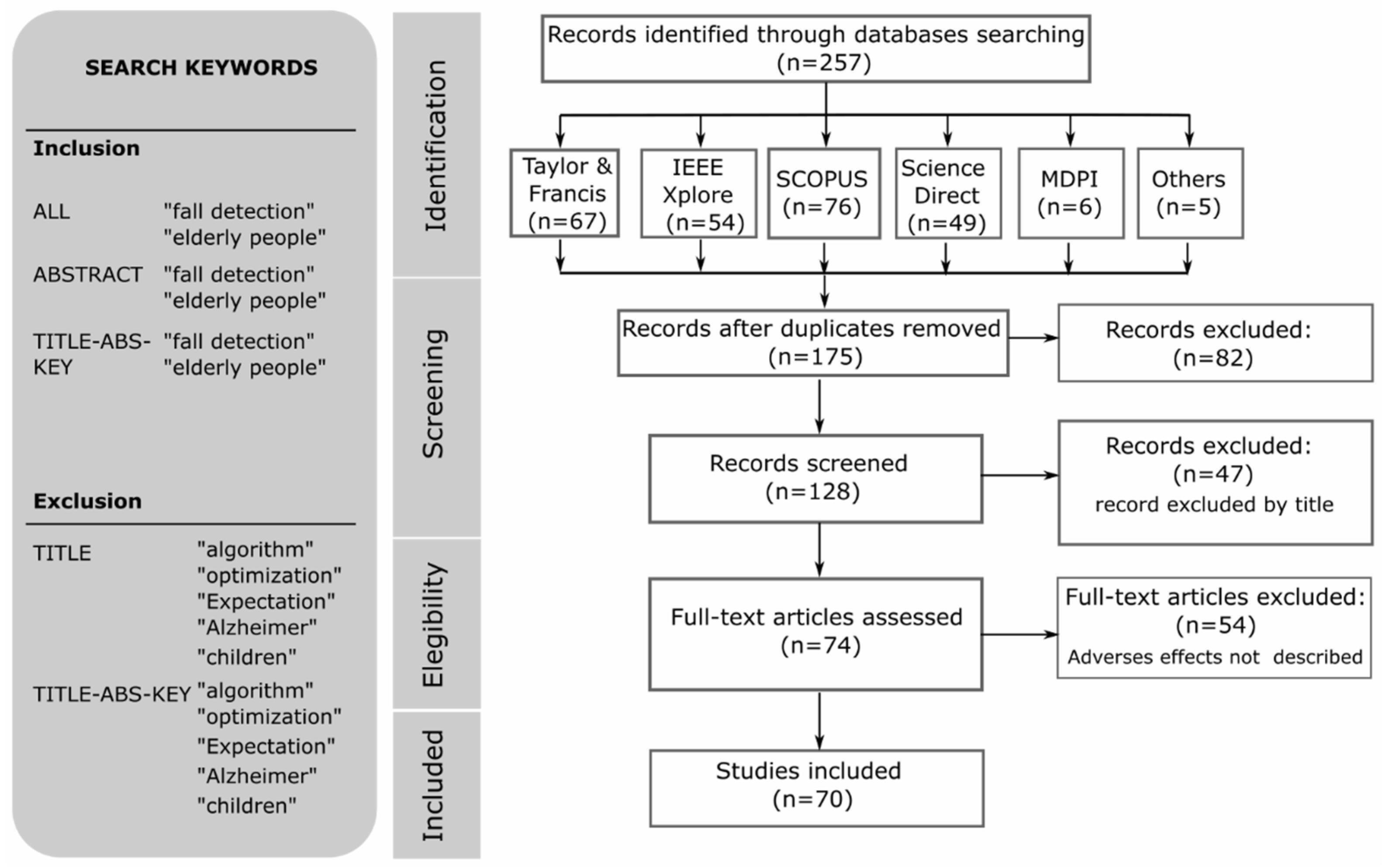
| Database | String | Number of Papers |
|---|---|---|
| SCOPUS | (TITLE (fall detection) AND TITLE (elderly people)) | 76 |
| Science Direct | Title, abstract, keywords: “fall detection” AND “elderly people” | 49 |
| MDPI | “fall detection” AND “elderly people” (Topic) and Preprint Citation Index (Exclude-Database) | 6 |
| Others | Search: “fall detection” AND “elderly people” “fall detection” [All Fields] AND “elderly people” [All Fields] | 5 |
| IEEE xplore | (“Document Title”: fall detection) AND (“Document Title”: elderly people) | 54 |
| Taylor & Francis | Search: [All: “fall detection”] AND [All: “elderly people”] | 67 |
| Total papers | 257 |
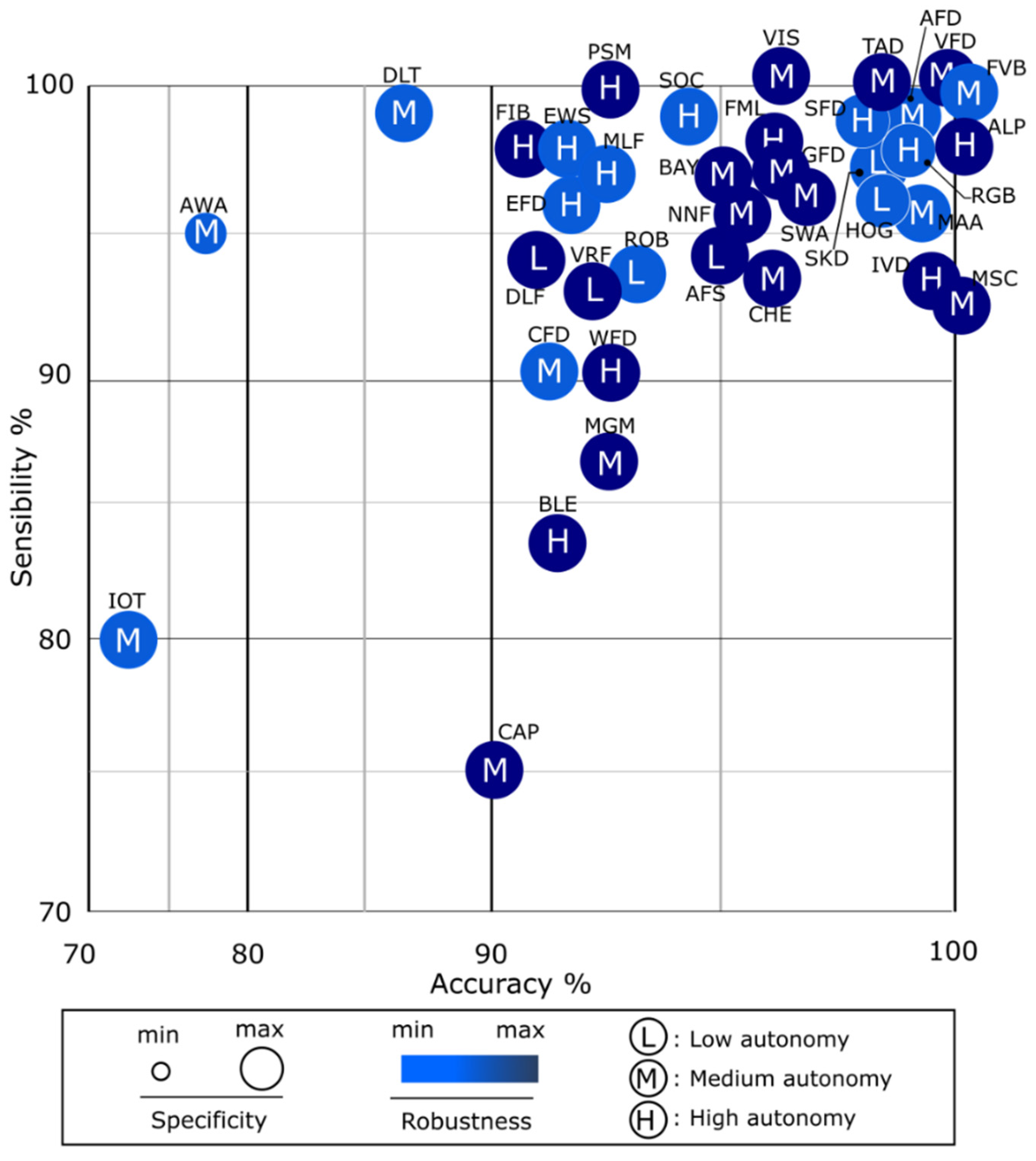
| Article Title | Ref | Sensitivity/Recall | Accuracy | Specificity | Robustness | Autonomy | Portability | Number of Evaluations | Number of False Positives | Real, Simulated or Controlled Environment |
|---|---|---|---|---|---|---|---|---|---|---|
| Inertial sensors | ||||||||||
| Accelerometer-based fall detection using feature extraction and support vector machine algorithms (AFS). | [52] | 95.00 | 94.58 | 96.70 | 100.00 | 33 | 100 | 20 | 3.3% | Controlled |
| Fall detection for older adults using machine learning (FML). | [30] | 97.50 | 95.87 | 96.50 | 100 | 100 | 100 | 8 | - | Controlled |
| A Wearable Device for Fall Detection in Elderly People Using Tri Three-Dimensional Accelerometer | [11] | 100.00 | - | 95.68 | 100 | 100 | 100 | - | - | Controlled |
| Fall detection system for older adults using IoT and Big Data (FIB). | [38] | 97.5. | 91.67 | 96.50 | 100 | 100 | 100 | - | - | Controlled |
| Mobile activity recognition and fall detection system for older adults using the Ameva algorithm (MAA). | [53] | 96.22 | 98.72 | 94.60 | 66 | 66 | 100 | - | - | Semi-real |
| Mixing user-centred and generalised models for Fall Detection (MGM). | [46] | 87.43 | 93.80 | 89.62 | 100 | 66 | 100 | - | - | Simulated |
| Autonomous on-wrist acceleration-based fall detection systems: unsolved challenges (AWA). | [54] | 95.45 | 78.12 | 74.62 | 66 | 66 | 100 | - | - | Simulated |
| Covariance matrix-based fall detection from multiple wearable sensors (COV). | [10] | 100.00 | 100.00 | - | 100 | 66 | 100 | 300 | 4% | Controlled |
| Chameleon: personalised and adaptive fall detection of older adults in home-based environments (CHE). | [20] | 93.11 | 96.83 | 99.07 | 100 | 66 | 100 | - | - | - |
| Fall event detection by gyroscopic and accelerometer sensors in a smartphone | [55] | 95.00 | - | 96.67 | 66 | 66 | 100 | - | - | Controlled |
| SVM-Based Fall Detection Method for Elderly People Using Android Low-Cost Smartphones (SFD). | [56] | 99.30 | 98.10 | 96.00 | 66 | 100 | 100 | - | - | Controlled |
| An EnOcean Wearable Device with a Fall Detection Algorithm Integrated with a Smart Home System (EFD). | [12] | 96.00 | 92.10 | 100.00 | 66 | 100 | 100 | 100 | - | Controlled |
| Implementation of a wireless sensor network-based human fall detection system (WFD). | [7] | 98.00 | 90.00 | 93.00 | 100 | 100 | 100 | 191 | 12.6% | - |
| An Accurate Fall Detection System for Elderly People Using Smartphone Inertial Sensors (AFD). | [42] | 98.88 | 99.27 | 99.66 | 66 | 66 | 100 | - | - | Controlled |
| Based on computer vision (cameras and image processing) | ||||||||||
| A video-based human fall detection system for smart homes (VFD). | [57] | 100.00 | 100.00 | 93.75 | 100 | 66 | 33 | 54 | 6.3% | Simulated |
| Video Recognition of Human Fall Based on Spatiotemporal Features (VRF). | [18] | 93.10 | 93.04 | 100.00 | 100 | 33 | 66 | 70 | - | Controlled |
| An Efficient Camera-based Surveillance for Fall Detection of Elderly People (CFD). | [15] | 90.00 | 92.50 | 98.93 | 66 | 66 | 33 | - | - | Controlled |
| Vision-Based Fall Detection System for Improving the Safety of Elderly People (VIS). | [58] | 100.00 | 96.66 | 100.00 | 100 | 66 | 100 | - | - | Simulated |
| Fall detection for older adults using the variation of key points of the human skeleton (SKD). | [37] | 97.00 | 98.50 | 100.00 | 66 | 33 | 100 | - | - | Controlled |
| Application of k Nearest Neighbours Approach to the Fall Detection of Elderly People Using Depth-Based Sensors (KNN). | [14] | 100.00 | 99.00 | - | 100 | 66 | 100 | 35 | 20% | - |
| A fall detection system for older adults based on integral image and histogram of oriented Gradient feature (HOG). | [9] | 97.00 | 98.50 | 100.00 | 66 | 33 | 33 | 191 | 12.6% | Controlled |
| Fall detection based on the gravity vector using a wide-angle camera (GFD). | [59] | 97.00 | 96.70 | 100.00 | 100 | 66 | 100 | - | 3% | Controlled |
| 3D depth image analysis for indoor fall detection of elderly people (3DD) | [45] | 100.00 | 98.33 | - | 100 | 66 | 100 | - | - | Controlled |
| Human fall detection using machine vision techniques on RGB–D images (RGB). | [19] | 97.05 | 98.34 | 97.20 | 66 | 100 | 100 | - | - | Controlled |
| Fall Detection of Elderly People Using the Manifold of Positive Semidefinite Matrices (PSM). | [41] | 100.00 | 93.38 | 93.00 | 100 | 100 | 100 | - | - | Simulated |
| Kinect-Based Platform for Movement Monitoring and Fall-Detection of Elderly People (KIN). | [35] | 100.00 | 98.33 | - | 66 | 33 | 100 | - | - | Controlled |
| A Mobile Robot for Following, Watching and Detecting Falls for Elderly Care (ROB). | [8] | 94.00 | 93.00 | 91.30 | 66 | 33 | 33 | 3996 | 1% | - |
| The implementation of an intelligent and video-based fall detection (IVD). | [16] | 93.80 | 99.20 | 94.80 | 100 | 100 | 33 | - | - | Controlled |
| Intelligent Elderly People Fall Detection Based on Modified Deep Learning, Deep Transfer Learning and IoT Using Thermal Imaging-Assisted Pervasive Surveillance (DLT). | [25] | 99.00 | 86.08 | 99.68 | 66 | 66 | 100 | - | - | Controlled |
| Based on pressure, vibration and sound sensors | ||||||||||
| Fall detection and walking estimation using floor vibration for solitary elderly people (FVB). | [26] | 100.00 | 100.00 | 98.60 | 66 | 66 | 33 | - | - | Real |
| A smart capacitive measurement system for fall detection (CAP). | [60] | 75.00 | 90.40 | 90.00 | 100 | 66 | 100 | 11719 | 0.3% | Controlled |
| A Framework for Fall Detection of Elderly People by Analysing Environmental Sounds through Acoustic Local Ternary Patterns (ALP). | [13] | 98.00 | 100.00 | 95.00 | 100 | 100 | 33 | 10 | 0% | - |
| Based on the Internet of Things (IoT) and sensor networks | ||||||||||
| Fall detection in older adults with mobile IoT devices and machine learning in the cloud and on the edge (IOT). | [34] | 80.00 | 73.00 | 100 | 66 | 66 | 33 | - | 0 | Controlled |
| Bluetooth-Low-Energy-Based Fall Detection and Warning System for Elderly People in Nursing Homes (BLE). | [39] | 84.89 | 92.65 | 95.68 | 100 | 100 | 100 | - | 0 | Controlled |
| Energy-efficient wearable sensor node for IoT-based fall detection systems (EWS). | [28] | 98.70 | 92.10 | 81.70 | 66 | 100 | 100 | - | - | Controlled |
| Towards a social and context-aware multi-sensor fall detection and risk assessment platform (MSC). | [5] | 93.00 | 91.00 | 88.00 | 100 | 66 | 100 | 98 | - | Controlled |
| Based on wearable devices | ||||||||||
| Using a human-centred design approach to develop a fall detection sock for older women (SOC). | [31] | 99.07 | 94.22 | 91.16 | 66 | 100 | 100 | 17 | 0 | Real |
| Intelligent fall detection method based on accelerometer data from a wrist-worn smart watch (SWA). | [43] | 96.09 | 97.45 | 98.92 | 100 | 66 | 100 | 786 | 9.3% | Simulated |
| Triaxial Accelerometer Located on the Wrist for Elderly People’s Fall Detection (TAD). | [32] | 100.00 | 98.00 | 98.10 | 100 | 66 | 100 | - | - | - |
| Based on machine learning models and neural networks | ||||||||||
| Fall detection for older adults using machine learning (MLF). | [22] | 98.70 | 92.10 | 81.70 | 66 | 100 | 100 | 8 | - | Controlled |
| A Cross-dataset Deep Learning-based Classifier for People Fall Detection and Identification (DLF). | [61] | 98.00 | 92.50 | 99.00 | 100 | 66 | 100 | - | 1% | Simulated |
| An Improved Fall Detection Approach for Elderly People Based on Feature Weight and Bayesian Classification (BAY). | [17] | 95.75 | 95.67 | 98.76 | 100 | 66 | 100 | - | 1.2% | - |
| Accurate Fall Detection and Localisation for Elderly People Based on Neural Network and Energy-Efficient Wireless Sensor Network (NNF). | [62] | 96.50 | 95.25 | 94.00 | 100 | 66 | 100 | 80 | - | Controlled |
| Sensor Type | Application | Advantages | Challenges |
|---|---|---|---|
| Pressure sensors | Insoles, smart carpets | High accuracy, reliable | Limited to specific environments |
| Vibration sensors | Floor-based systems | Effective in detecting falls and walking | Requires installation in living spaces |
| Sound sensors | Combined with other sensors | Enhances accuracy when combined | Not reliable alone, prone to false alarms |
| Device Type | Sensors Used | Detection Method | Notification System | Accuracy | Additional Features |
|---|---|---|---|---|---|
| Smartphones, Raspberry Pi, Arduino, NodeMcu, Custom embedded systems | Accelerometer | Machine learning model | SMS, buzzer, emergency services | 99.7% | Device-type invariant, real-time monitoring |
| Node MCU microcontroller | MPU6050 (Accelerometer, gyroscope) | Predefined thresholds | Not specified | Dual-notification system | |
| LowPAN device wearable | 3D-axis accelerometer | Decision trees-based big data model | Notifications to caregivers | High success rates | Cloud services for data storage and analysis |
| Multiple Sensors (Wi-Fi, Floor Pressure, Smart carpets, accelerometers, gyroscopes, GPS, pulse sensors) | Various | Sensor integration | Real-time tracking | Not specified | Advanced sensing technologies |
| Tri-axial accelerometer, Kinect camera systems | Accelerometer, camera | SVM algorithm, PCA features | Smartphones, healthcare centres | Not specified | Cloud processing |
| Wearable Sensors (Gyroscope, Accelerometer) | Gyroscope, accelerometer | Data analysis | Notification system | 97% | Monitoring various ADLs |
| Bracelet-type Device | Accelerometer | Machine learning algorithm | Mobile application | 91% | Vital signs monitoring |
| MEMS Sensor, GSM Module, Arduino UNO | Not specified | Not specified | Nearby individuals | Not specified | Designed for wheelchair users |
| Wearable sensor | 3-axis accelerometer | Threshold-based approach | Android application | Not specified | Cloud storage for data access |
| Wearable devices | Accelerometers, gyroscopes | Hybrid HSSTL optimisation model | Blockchain network | 97.4% | Secure data storage, emergency response |
| Advantages | Disadvantages |
|---|---|
| Based on inertial sensors | |
| High accuracy and sensitivity | False alarms and missed detections |
| Real-time detection and alerts | Power consumption and battery life |
| Portability and comfort | Data processing and computational demands |
| Privacy preservation | User adaptability and installation complexity |
| Low costs | |
| Based on computer vision | |
| Non-invasive and comfortable | Privacy issues |
| High precision and efficiency | High computational cost |
| Ease of deployment | Dependence on environmental conditions |
| IoT integration | Difficulties in generalisation |
| Robustness in different scenarios | High initial cost |
| Based on pressure, vibration, and sound sensors | |
| High accuracy | False alarms, limited scope |
| Non-intrusive | Installation complexity |
| Cost-effective | More possibility of False positives |
| High sensitivity | Noise interference |
| Non-wearable | Privacy concerns |
| Complementary detection | |
| Based on the internet of things (IoT) and sensor networks | |
| Enhanced safety and well-being | Usability and acceptability issues |
| High accuracy | Technical challenges |
| Non-intrusive monitoring | Privacy concerns |
| Integration with smart home environments | |
| Based on wearable devices | |
| Portability and ubiquity | User compliance and comfort |
| Enhanced detection accuracy | Battery life and maintenance |
| Cost-effectiveness | False alarms |
| Real-time monitoring and alerts | Detection limitations |
| Privacy concerns | |
| Based on machine learning models and neural networks | |
| High accuracy and sensitivity | Data collection |
| Improved fall detection ratios | Personalisation challenges |
| Robustness to false positives | Complexity and computational load |
| Data fusion and multimodal approaches | Dependence on sensor quality and placement |
| Low computational cost | Energy efficiency concerns |
| Privacy issues | |
Disclaimer/Publisher’s Note: The statements, opinions and data contained in all publications are solely those of the individual author(s) and contributor(s) and not of MDPI and/or the editor(s). MDPI and/or the editor(s) disclaim responsibility for any injury to people or property resulting from any ideas, methods, instructions or products referred to in the content. |
© 2025 by the authors. Licensee MDPI, Basel, Switzerland. This article is an open access article distributed under the terms and conditions of the Creative Commons Attribution (CC BY) license (https://creativecommons.org/licenses/by/4.0/).
Share and Cite
Flor-Unda, O.; Arcos-Reina, R.; Estrella-Caicedo, C.; Toapanta, C.; Villao, F.; Palacios-Cabrera, H.; Nunez-Nagy, S.; Alarcos, B. A Comparative Overview of Technological Advances in Fall Detection Systems for Elderly People. Sensors 2025, 25, 7423. https://doi.org/10.3390/s25247423
Flor-Unda O, Arcos-Reina R, Estrella-Caicedo C, Toapanta C, Villao F, Palacios-Cabrera H, Nunez-Nagy S, Alarcos B. A Comparative Overview of Technological Advances in Fall Detection Systems for Elderly People. Sensors. 2025; 25(24):7423. https://doi.org/10.3390/s25247423
Chicago/Turabian StyleFlor-Unda, Omar, Rafael Arcos-Reina, Cristina Estrella-Caicedo, Carlos Toapanta, Freddy Villao, Héctor Palacios-Cabrera, Susana Nunez-Nagy, and Bernardo Alarcos. 2025. "A Comparative Overview of Technological Advances in Fall Detection Systems for Elderly People" Sensors 25, no. 24: 7423. https://doi.org/10.3390/s25247423
APA StyleFlor-Unda, O., Arcos-Reina, R., Estrella-Caicedo, C., Toapanta, C., Villao, F., Palacios-Cabrera, H., Nunez-Nagy, S., & Alarcos, B. (2025). A Comparative Overview of Technological Advances in Fall Detection Systems for Elderly People. Sensors, 25(24), 7423. https://doi.org/10.3390/s25247423