Remote Sensing Inversion of Full-Profile Topography Data for Coastal Wetlands Using Synergistic Multi-Platform Sensors from Space, Air, and Ground


Abstract
1. Introduction
2. Materials and Methods
2.1. Study Area
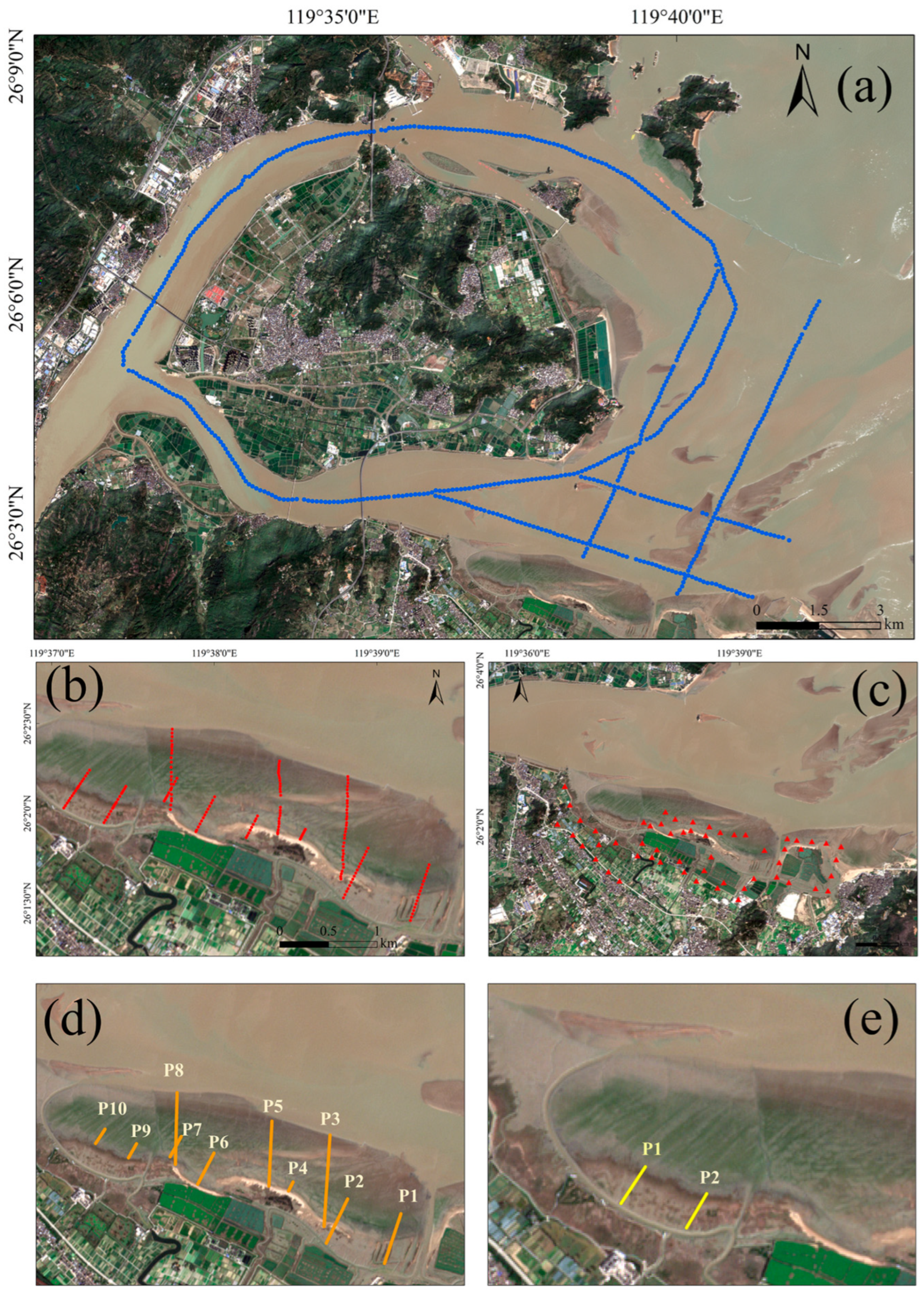
2.2. Data Acquisition and Processing
2.2.1. Spaceborne Sensors Data Acquisition and Processing
2.2.2. UAV Oblique Photography Data and Processing
2.2.3. Field Observation Transect Data
2.3. Methods
2.3.1. Topographic Inversion Method for the Inundated Zone
2.3.2. Topographic Monitoring Method for the Bare Flat Zone
2.3.3. Topographic Monitoring Method for the Vegetated Zone
3. Results
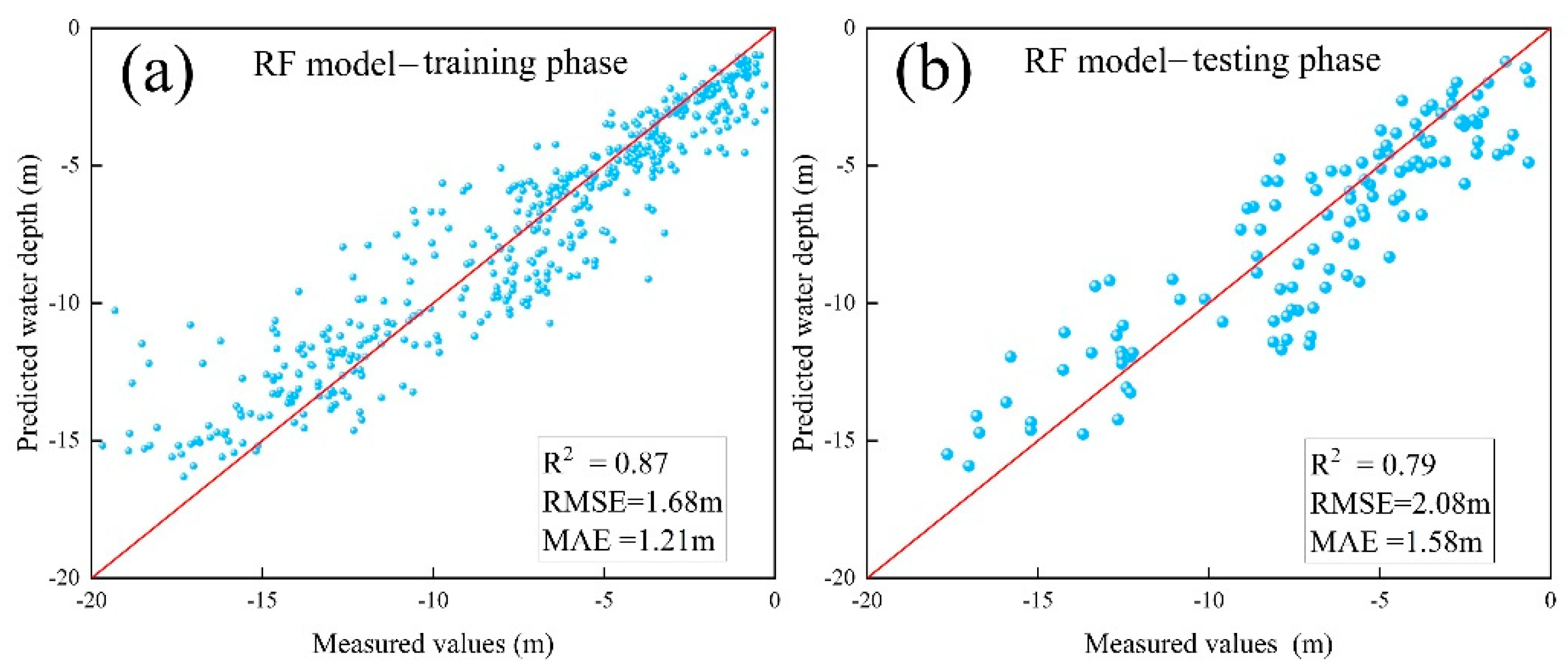
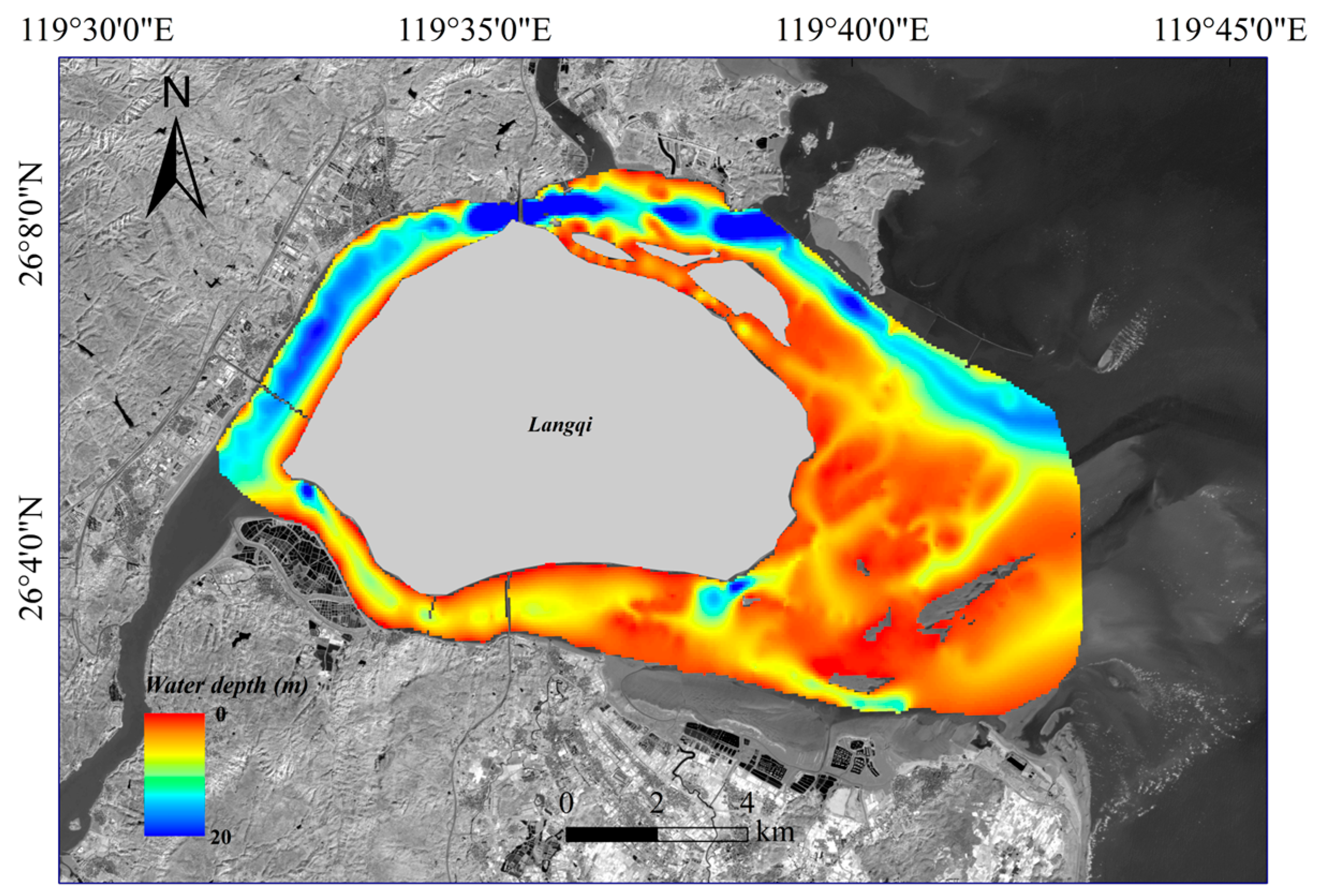
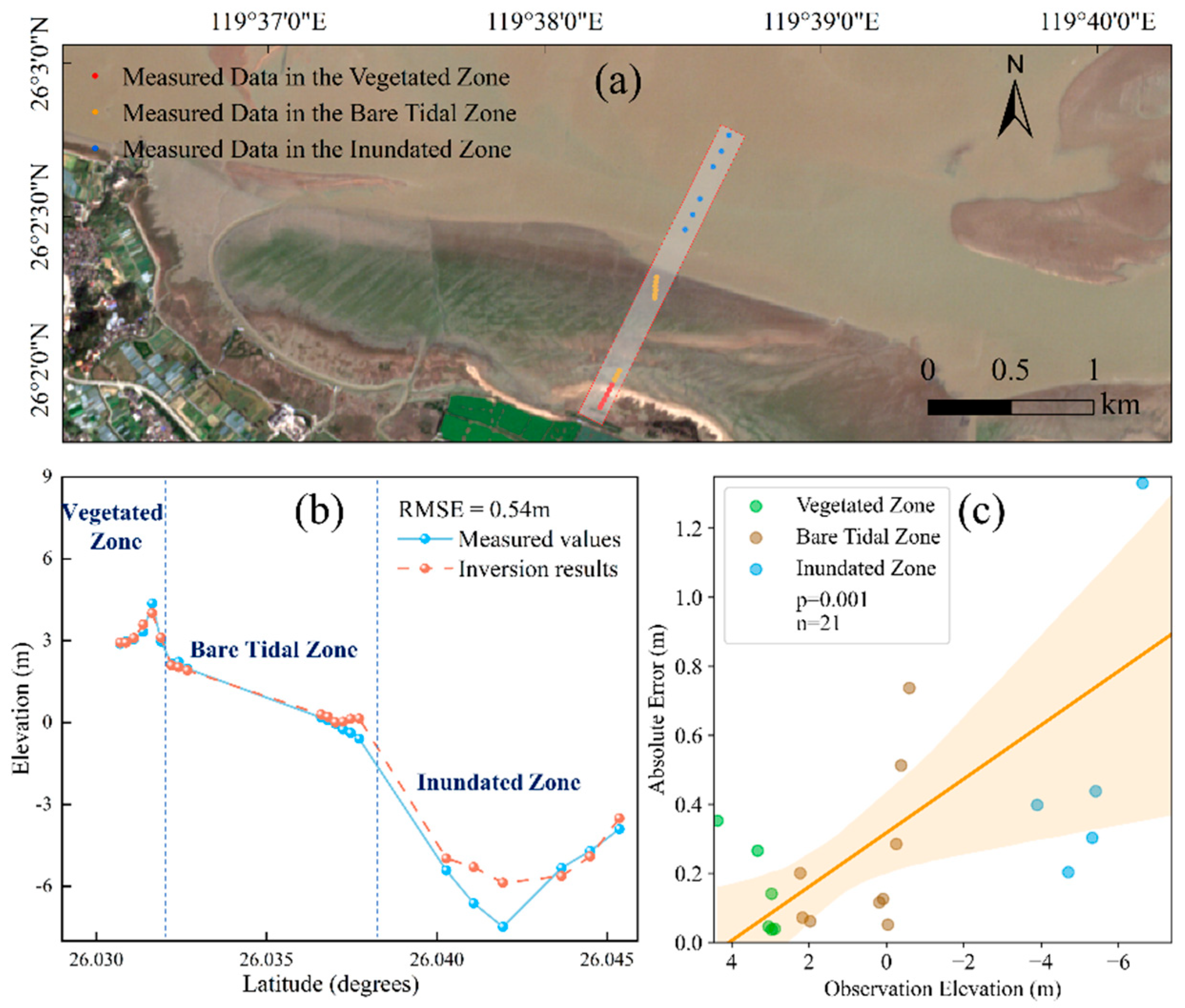
3.1. Topographic Inversion Results and Accuracy Assessment for the Inundated Zone
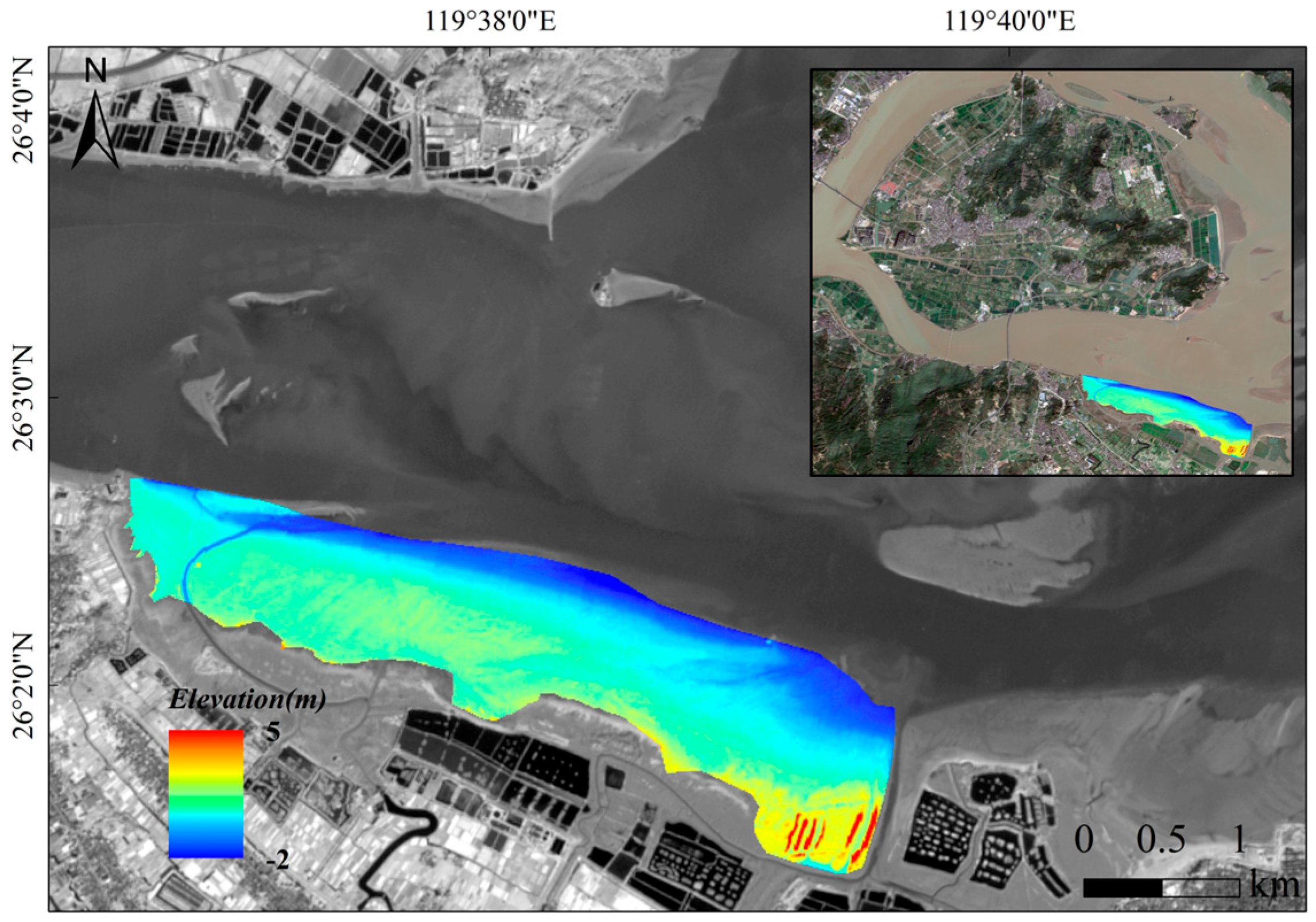
3.2. Topographic Inversion Results and Accuracy Assessment for the Bare Flat Zone
3.3. Topographic Inversion Results and Accuracy Assessment for the Vegetated Zone
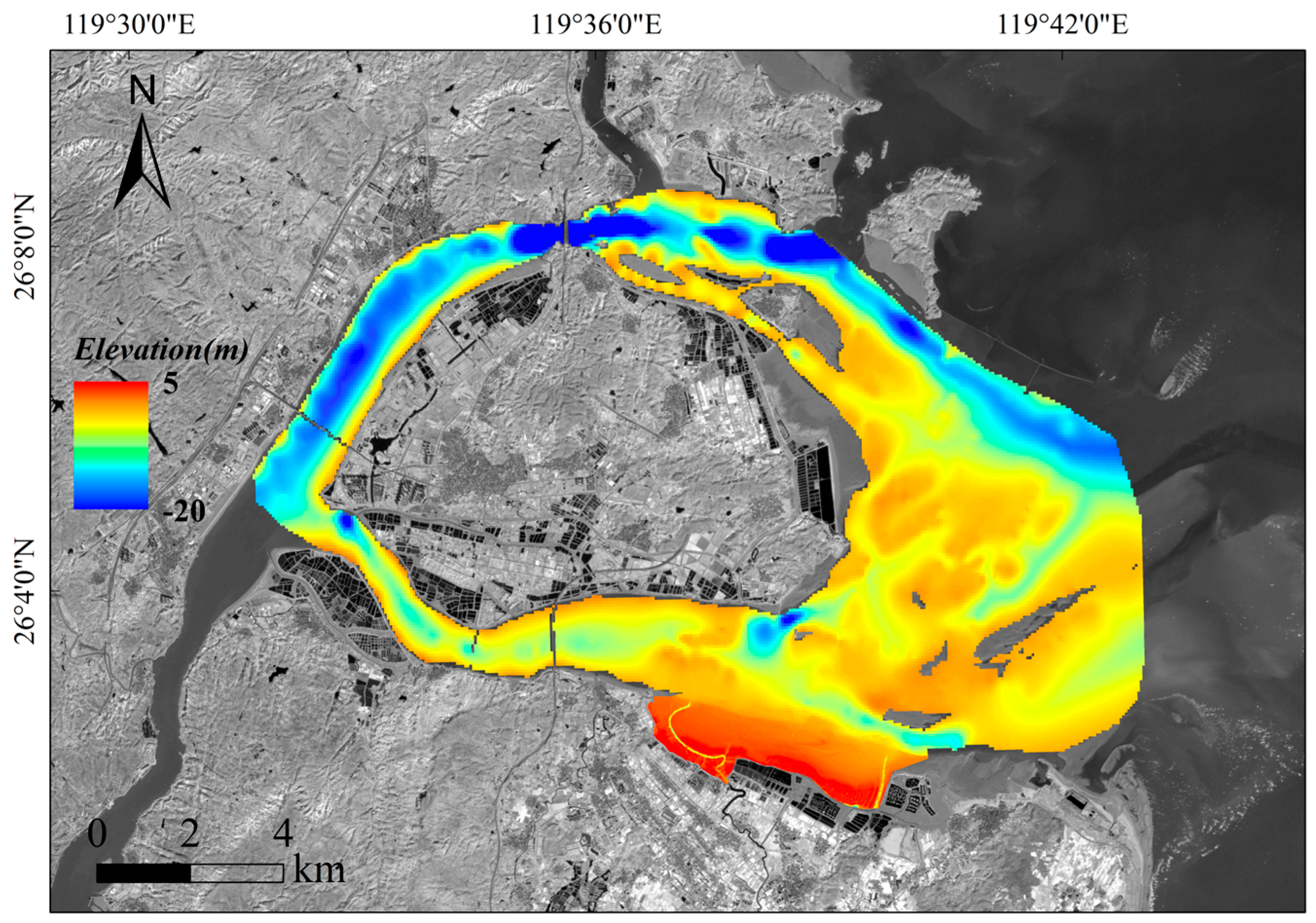
3.4. Full-Profile Topographic Inversion Results
4. Discussion
4.1. Applicability and Limitation of the Inundation Frequency Method for the Bare Flat Zone
4.2. Key Issues in Vegetated Zone Topographic Reconstruction
4.3. Challenges and Solutions for Multi-Source DEM Seamless Mosaicking
5. Conclusions
Author Contributions
Funding
Data Availability Statement
Conflicts of Interest
References
- He, Q.; Li, Z.; Daleo, P.; Lefcheck, J.S.; Thomsen, M.S.; Adams, J.B.; Bouma, T.J. Coastal wetland resilience through local, regional and global conservation. Nat. Rev. Biodivers. 2025, 1, 50–67. [Google Scholar] [CrossRef]
- Wang, F.; Lu, X.; Sanders, C.J.; Tang, J. Tidal wetland resilience to sea level rise increases their carbon sequestration capacity in United States. Nat. Commun. 2019, 10, 1–11. [Google Scholar] [CrossRef] [PubMed]
- Narayan, S.; Beck, M.W.; Reguero, B.G.; Losada, I.J.; Van Wesenbeeck, B.; Pontee, N.; Sanchirico, J.N.; Ingram, J.C.; Lange, G.-M.; A Burks-Copes, K. The Effectiveness, Costs and Coastal Protection Benefits of Natural and Nature-Based Defences. PLoS ONE 2016, 11, e0154735. [Google Scholar] [CrossRef] [PubMed]
- Zhou, Z.; Ye, Q.; Coco, G. A one-dimensional biomorphodynamic model of tidal flats: Sediment sorting, marsh distribution, and carbon accumulation under sea level rise. Adv. Water Resour. 2016, 93, 288–302. [Google Scholar] [CrossRef]
- Fagherazzi, S.; Wiberg, P.L.; Temmerman, S.; Struyf, E.; Zhao, Y.; A Raymond, P. Fluxes of water, sediments, and biogeochemical compounds in salt marshes. Ecol. Process. 2013, 2, 3. [Google Scholar] [CrossRef]
- Bouma, T.; Temmerman, S.; van Duren, L.; Martini, E.; Vandenbruwaene, W.; Callaghan, D.; Balke, T.; Biermans, G.; Klaassen, P.; van Steeg, P.; et al. Organism traits determine the strength of scale-dependent bio-geomorphic feedbacks: A flume study on three intertidal plant species. Geomorphology 2013, 180–181, 57–65. [Google Scholar] [CrossRef]
- He, Q.; Li, Z.; Elphick, C.S.; Sun, Y.; Sutherland, W.J.; Taylor, N.G.; Wasson, K. Making Restoration Effective for Dynamic Coastal Wetlands. Glob. Chang. Biol. 2025, 31, e70455. [Google Scholar] [CrossRef]
- Khan, J.U.; Ansary, N.; Durand, F.; Testut, L.; Ishaque, M.; Calmant, S.; Krien, Y.; Islam, A.S.; Papa, F. High-Resolution Intertidal Topography from Sentinel-2 Multi-Spectral Imagery: Synergy between Remote Sensing and Numerical Modeling. Remote Sens. 2019, 11, 2888. [Google Scholar] [CrossRef]
- Chust, G.; Galparsoro, I.; Borja, Á.; Franco, J.; Uriarte, A. Coastal and estuarine habitat mapping, using LIDAR height and intensity and multi-spectral imagery. Estuar. Coast. Shelf Sci. 2008, 78, 633–643. [Google Scholar] [CrossRef]
- Xu, N.; Ma, Y.; Yang, J.; Wang, X.H.; Wang, Y.; Xu, R. Deriving Tidal Flat Topography Using ICESat-2 Laser Altimetry and Sentinel-2 Imagery. Geophys. Res. Lett. 2022, 49, e2021GL096813. [Google Scholar] [CrossRef]
- Tang, P.; Guo, S.; Qie, L.; Zhang, X.; Fang, H.; Wan, L.; Chanussot, J.; Du, P. Tidal flat topography mapping with Sentinel time series using cross-modal sample transfer and deep learning. ISPRS J. Photogramm. Remote Sens. 2025, 225, 69–87. [Google Scholar] [CrossRef]
- Sagar, S.; Roberts, D.; Bala, B.; Lymburner, L. Extracting the intertidal extent and topography of the Australian coastline from a 28 year time series of Landsat observations. Remote Sens. Environ. 2017, 195, 153–169. [Google Scholar] [CrossRef]
- Zhang, X.; Zuo, L.; Lu, Y.; Li, H.; Zhao, Y. An improved approach for retrieval of tidal flat elevation based on inundation frequency. Estuar. Coast. Shelf Sci. 2024, 313, 109061. [Google Scholar] [CrossRef]
- Chen, Y.-C.; Wang, S.-F. LogiTide2DEM: A method for reconstructing intertidal topography in complex tidal flats using logistic regression with multi-temporal Sentinel-2 and Landsat imagery. Int. J. Appl. Earth Obs. Geoinf. 2025, 139, 104561. [Google Scholar] [CrossRef]
- Sun, M.; Feng, W.; Wang, X.; Xu, N.; Peng, F.; Chen, X.; An, D.; Fenoglio, L.; Yang, M.; Zhong, M. Deriving Intertidal Topography From SWOT Data and Sentinel-2 Data. Geophys. Res. Lett. 2025, 52, e2025GL117329. [Google Scholar] [CrossRef]
- Xu, H.; Zhang, S.; Hou, H.; Hu, H.; Xiong, J.; Wan, J. Detailed Hierarchical Classification of Coastal Wetlands Using Multi-Source Time-Series Remote Sensing Data Based on Google Earth Engine. Remote Sens. 2025, 17, 3640. [Google Scholar] [CrossRef]
- Wang, Y.; Jin, S.; Dardanelli, G. Vegetation Classification and Evaluation of Yancheng Coastal Wetlands Based on Random Forest Algorithm from Sentinel-2 Images. Remote Sens. 2024, 16, 1124. [Google Scholar] [CrossRef]
- Yang, S.; Li, H.; Ysebaert, T.; Bouma, T.; Zhang, W.; Wang, Y.; Li, P.; Li, M.; Ding, P. Spatial and temporal variations in sediment grain size in tidal wetlands, Yangtze Delta: On the role of physical and biotic controls. Estuar. Coast. Shelf Sci. 2008, 77, 657–671. [Google Scholar] [CrossRef]
- Liu, S.; Hu, Z.; Grandjean, T.J.; Wang, Z.B.; van Zelst, V.T.M.; Qi, L.; Xu, T.; Seo, J.Y.; Bouma, T.J. Dynamics and drivers of tidal flat morphology in China. Nat. Commun. 2025, 16, 1–14. [Google Scholar] [CrossRef]
- Fagherazzi, S.; Mariotti, G.; Leonardi, N.; Canestrelli, A.; Nardin, W.; Kearney, W.S. Salt Marsh Dynamics in a Period of Accelerated Sea Level Rise. J. Geophys. Res. Earth Surf. 2020, 125, e2019JF005200. [Google Scholar] [CrossRef]
- Murray, N.J.; Phinn, S.R.; DeWitt, M.; Ferrari, R.; Johnston, R.; Lyons, M.B.; Clinton, N.; Thau, D.; Fuller, R.A. The global distribution and trajectory of tidal flats. Nature 2018, 565, 222–225. [Google Scholar] [CrossRef]
- Fivash, G.S.; Temmerman, S.; Kleinhans, M.G.; Heuner, M.; van der Heide, T.; Bouma, T.J. Early indicators of tidal ecosystem shifts in estuaries. Nat. Commun. 2023, 14, 1–11. [Google Scholar] [CrossRef]
- Wang, C.; Smolders, S.; Callaghan, D.P.; van Belzen, J.; Bouma, T.J.; Hu, Z.; Wen, Q.; Temmerman, S. Identifying Hydro-Geomorphological Conditions for State Shifts from Bare Tidal Flats to Vegetated Tidal Marshes. Remote Sens. 2020, 12, 2316. [Google Scholar] [CrossRef]
- He, J.; Zhang, S.; Cui, X.; Feng, W. Remote sensing for shallow bathymetry: A systematic review. Earth-Science Rev. 2024, 258, 104957. [Google Scholar] [CrossRef]
- Lyzenga, D.R. Shallow-water bathymetry using combined lidar and passive multispectral scanner data. Int. J. Remote Sens. 1985, 6, 115–125. [Google Scholar] [CrossRef]
- Stumpf, R.P.; Holderied, K.; Sinclair, M. Determination of water depth with high-resolution satellite imagery over variable bottom types. Limnol. Oceanogr. 2003, 48, 547–556. [Google Scholar] [CrossRef]
- Xu, X.; Pan, Q.; Wu, H.; Zhang, D.; Zhang, Z.; Gu, Y.; Wang, Z. Research on improving the accuracy of remote sensing-based bathymetry on muddy coasts. Estuar. Coast. Shelf Sci. 2025, 313, 109126. [Google Scholar] [CrossRef]
- Sagawa, T.; Yamashita, Y.; Okumura, T.; Yamanokuchi, T. Satellite Derived Bathymetry Using Machine Learning and Multi-Temporal Satellite Images. Remote Sens. 2019, 11, 1155. [Google Scholar] [CrossRef]
- Zhou, W.; Tang, Y.; Jing, W.; Li, Y.; Yang, J.; Deng, Y.; Zhang, Y. A Comparison of Machine Learning and Empirical Approaches for Deriving Bathymetry from Multispectral Imagery. Remote Sens. 2023, 15, 393. [Google Scholar] [CrossRef]
- Costa, W.L.L.; Bryan, K.R.; Coco, G. Modelling extreme water levels using intertidal topography and bathymetry derived from multispectral satellite images. Nat. Hazards Earth Syst. Sci. 2023, 23, 3125–3146. [Google Scholar] [CrossRef]
- Fereshtehpour, M.; Karamouz, M. DEM Resolution Effects on Coastal Flood Vulnerability Assessment: Deterministic and Probabilistic Approach. Water Resour. Res. 2018, 54, 4965–4982. [Google Scholar] [CrossRef]
- Zhang, H.; Wang, L.; Zhao, Y.; Cao, J.; Xu, M. Application of Airborne LiDAR Measurements to the Topographic Survey of the Tidal Flats of the Northern Jiangsu Radial Sand Ridges in the Southern Yellow Sea. Front. Mar. Sci. 2022, 9, 871156. [Google Scholar] [CrossRef]
- Laengner, M.L.; van der Wal, D. Satellite-derived trends in inundation frequency reveal the fate of saltmarshes. Front. Mar. Sci. 2022, 9, 942719. [Google Scholar] [CrossRef]
- Ma, S.; Wang, N.; Zhou, L.; Yu, J.; Chen, X.; Chen, Y. Inversion of Tidal Flat Topography Based on the Optimised Inundation Frequency Method—A Case Study of Intertidal Zone in Haizhou Bay, China. Remote Sens. 2024, 16, 685. [Google Scholar] [CrossRef]
- Duan, Z.; Zhao, D.; Zeng, Y.; Zhao, Y.; Wu, B.; Zhu, J. Assessing and Correcting Topographic Effects on Forest Canopy Height Retrieval Using Airborne LiDAR Data. Sensors 2015, 15, 12133–12155. [Google Scholar] [CrossRef]
- Bigdeli, B.; Amirkolaee, H.A.; Pahlavani, P. DTM extraction under forest canopy using LiDAR data and a modified invasive weed optimization algorithm. Remote Sens. Environ. 2018, 216, 289–300. [Google Scholar] [CrossRef]
- Liu, A.; Cheng, X.; Chen, Z. Performance evaluation of GEDI and ICESat-2 laser altimeter data for terrain and canopy height retrievals. Remote Sens. Environ. 2021, 264, 112571. [Google Scholar] [CrossRef]
- Schlund, M.; Baron, D.; Magdon, P.; Erasmi, S. Canopy penetration depth estimation with TanDEM-X and its compensation in temperate forests. ISPRS J. Photogramm. Remote Sens. 2019, 147, 232–241. [Google Scholar] [CrossRef]
- El Hajj, M.; Baghdadi, N.; Bazzi, H.; Zribi, M. Penetration Analysis of SAR Signals in the C and L Bands for Wheat, Maize, and Grasslands. Remote Sens. 2018, 11, 31. [Google Scholar] [CrossRef]
- Pham, T.D.; Yokoya, N.; Bui, D.T.; Yoshino, K.; Friess, D.A. Remote Sensing Approaches for Monitoring Mangrove Species, Structure, and Biomass: Opportunities and Challenges. Remote Sens. 2019, 11, 230. [Google Scholar] [CrossRef]
- Na, J.; Xue, K.; Xiong, L.; Tang, G.; Ding, H.; Strobl, J.; Pfeifer, N. UAV-Based Terrain Modeling under Vegetation in the Chinese Loess Plateau: A Deep Learning and Terrain Correction Ensemble Framework. Remote Sens. 2020, 12, 3318. [Google Scholar] [CrossRef]
- Samadzadegan, F.; Toosi, A.; Javan, F.D. A critical review on multi-sensor and multi-platform remote sensing data fusion approaches: Current status and prospects. Int. J. Remote Sens. 2024, 46, 1327–1402. [Google Scholar] [CrossRef]
- Lokhorst, I.R.; Braat, L.; Leuven, J.R.F.W.; Baar, A.W.; van Oorschot, M.; Selaković, S.; Kleinhans, M.G. Morphological effects of vegetation on the tidal–fluvial transition in Holocene estuaries. Earth Surf. Dyn. 2018, 6, 883–901. [Google Scholar] [CrossRef]
- Masek, J.G.; Wulder, M.A.; Markham, B.; McCorkel, J.; Crawford, C.J.; Storey, J.; Jenstrom, D.T. Landsat 9: Empowering open science and applications through continuity. Remote Sens. Environ. 2020, 248, 111968. [Google Scholar] [CrossRef]
- Drusch, M.; Del Bello, U.; Carlier, S.; Colin, O.; Fernandez, V.; Gascon, F.; Hoersch, B.; Isola, C.; Laberinti, P.; Martimort, P.; et al. Sentinel-2: ESA’s Optical High-Resolution Mission for GMES Operational Services. Remote Sens. Environ. 2012, 120, 25–36. [Google Scholar] [CrossRef]
- Ye, M.; Yang, C.; Zhang, X.; Li, S.; Peng, X.; Li, Y.; Chen, T. Shallow Water Bathymetry Inversion Based on Machine Learning Using ICESat-2 and Sentinel-2 Data. Remote Sens. 2024, 16, 4603. [Google Scholar] [CrossRef]
- Nguyen, T.-T.; Huang, J.Z. Unbiased Feature Selection in Learning Random Forests for High-Dimensional Data. Sci. World J. 2015, 2015, 471371. [Google Scholar] [CrossRef]
- Xin, H.; Xu, N.; Xu, H.; Yang, H.; Wang, Z.; Zhang, Z.; Ding, Y.; Luan, H.; Ou, Y.; Yang, Y. Mapping tidal flat topography by combining ICESat-2 laser altimetry and multi-source satellite imagery. Int. J. Digit. Earth 2025, 18, 2554313. [Google Scholar] [CrossRef]
- Luo, W.; Liu, H.; Zhao, H.; Zeng, S.; Huang, Y.; Zheng, Z.; Lei, J.; Liu, G.; Su, J. Remote sensing analysis of tidal flat evolution in the Yangtze River Estuary over the past 50 years: Dynamics, patterns, and driving factors. Ecol. Indic. 2025, 179, 114253. [Google Scholar] [CrossRef]
- Xu, H. Modification of normalised difference water index (NDWI) to enhance open water features in remotely sensed imagery. Int. J. Remote Sens. 2006, 27, 3025–3033. [Google Scholar] [CrossRef]
- Zarychta, R.; Zarychta, A. Application of geostatistical approach in generating DEM for relief studies using UAV in forest areas. Geomorphology 2025, 487, 109916. [Google Scholar] [CrossRef]
- Cao, J.; Liu, Q.; Yu, C.; Chen, Z.; Dong, X.; Xu, M.; Zhao, Y. Extracting waterline and inverting tidal flats topography based on Sentinel-2 remote sensing images: A case study of the northern part of the North Jiangsu radial sand ridges. Geomorphology 2024, 461, 109323. [Google Scholar] [CrossRef]
- Meng, X.; Shang, N.; Zhang, X.; Li, C.; Zhao, K.; Qiu, X.; Weeks, E. Photogrammetric UAV Mapping of Terrain under Dense Coastal Vegetation: An Object-Oriented Classification Ensemble Algorithm for Classification and Terrain Correction. Remote Sens. 2017, 9, 1187. [Google Scholar] [CrossRef]
- Chen, C.; Zhang, C.; Tian, B.; Wu, W.; Zhou, Y. Tide2Topo: A new method for mapping intertidal topography accurately in complex estuaries and bays with time-series Sentinel-2 images. ISPRS J. Photogramm. Remote Sens. 2023, 200, 55–72. [Google Scholar] [CrossRef]


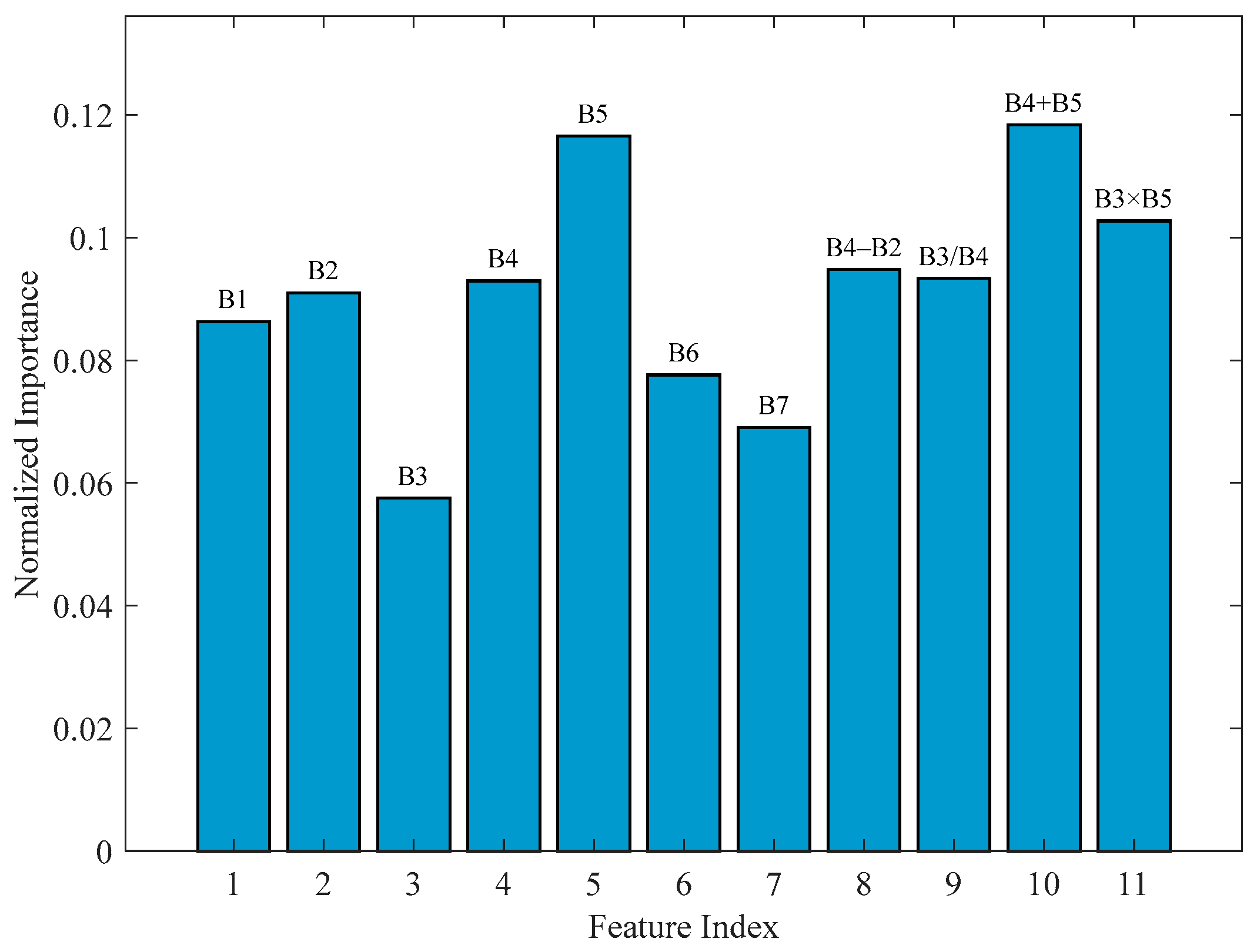

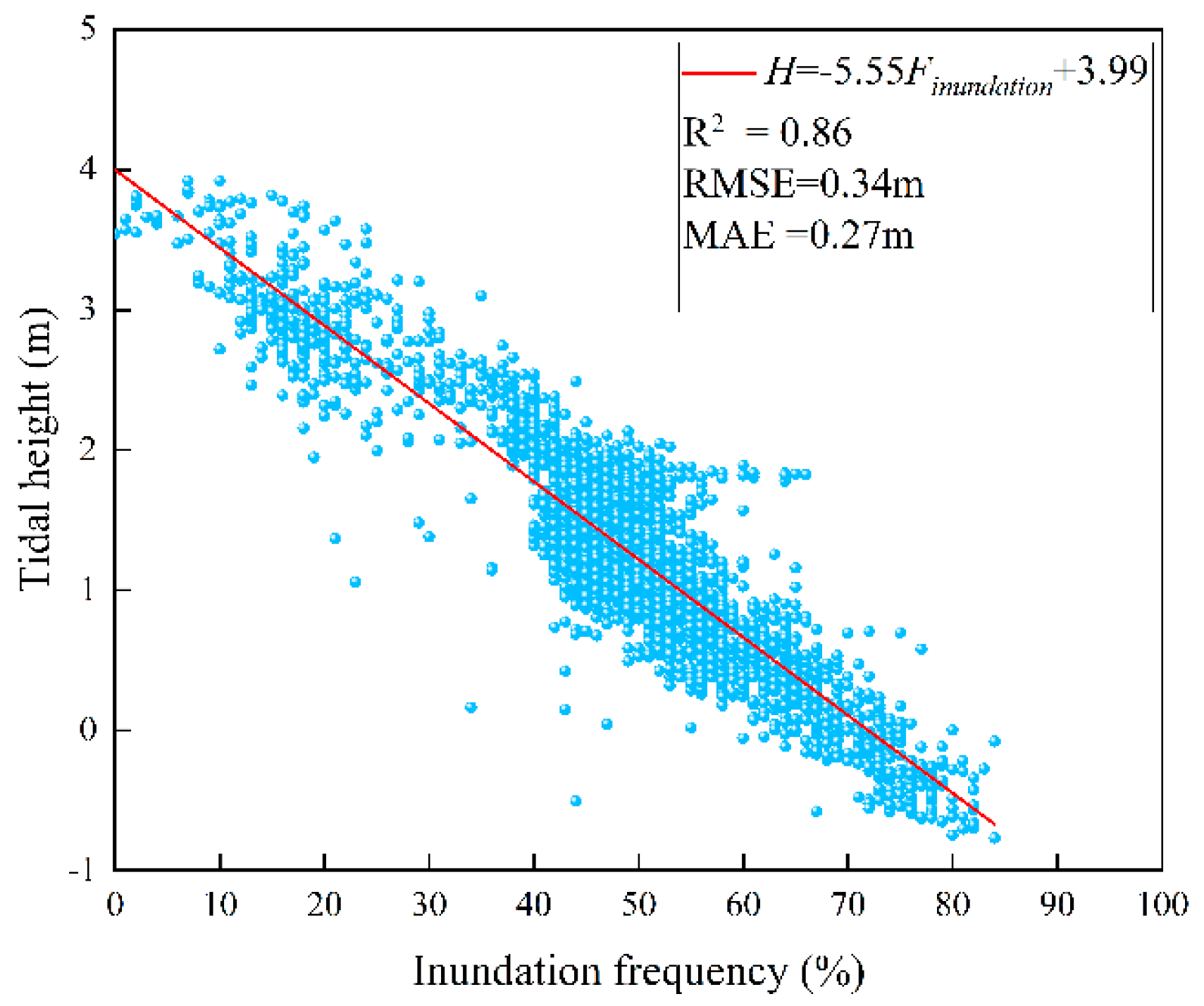


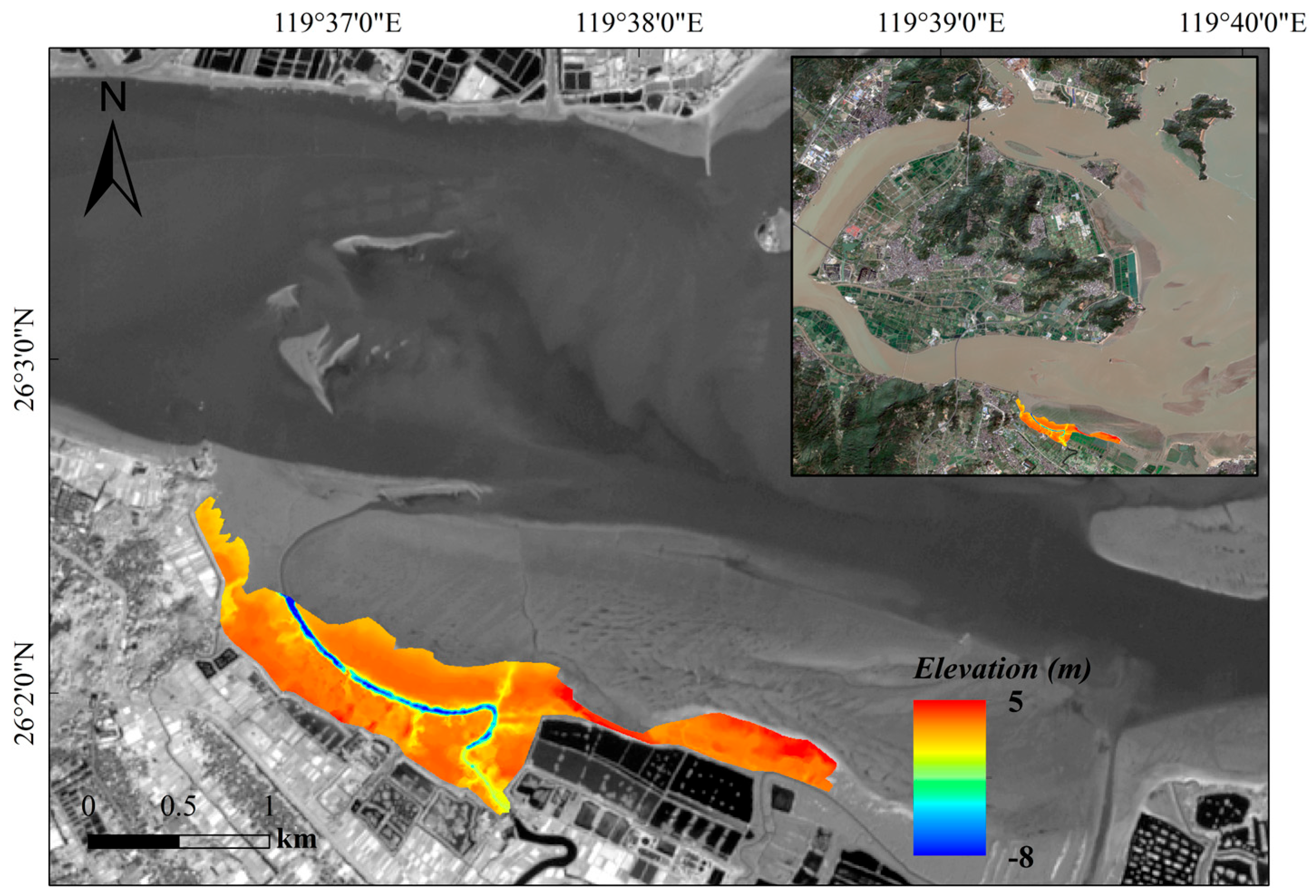
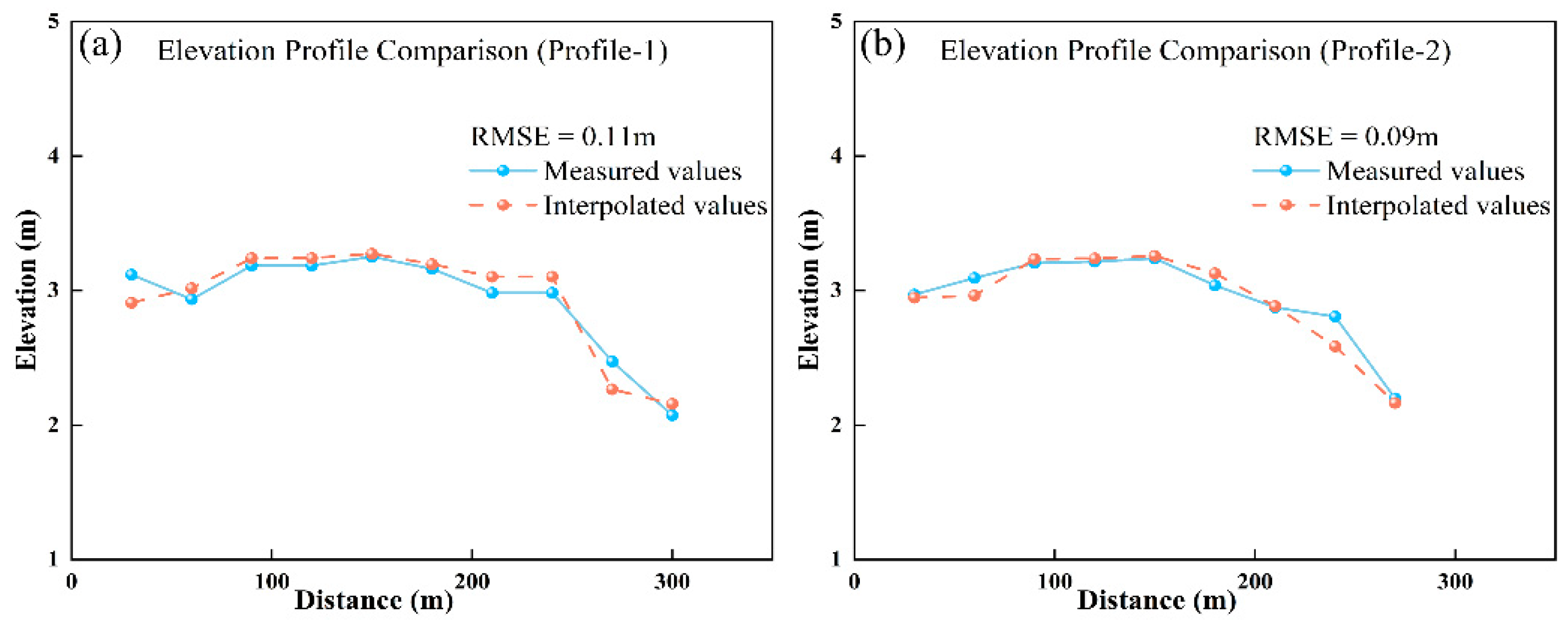

| Model Type | R2 | RMSE (m) | MAE(m) |
|---|---|---|---|
| SVR | 0.62 | 2.91 | 2.20 |
| BP | 0.73 | 2.47 | 1.74 |
| CNN | 0.75 | 2.25 | 1.77 |
| RF | 0.79 | 2.08 | 1.58 |
Disclaimer/Publisher’s Note: The statements, opinions and data contained in all publications are solely those of the individual author(s) and contributor(s) and not of MDPI and/or the editor(s). MDPI and/or the editor(s) disclaim responsibility for any injury to people or property resulting from any ideas, methods, instructions or products referred to in the content. |
© 2025 by the authors. Licensee MDPI, Basel, Switzerland. This article is an open access article distributed under the terms and conditions of the Creative Commons Attribution (CC BY) license (https://creativecommons.org/licenses/by/4.0/).
Share and Cite
Zhang, J.; Wang, J.; Dai, Y.; Miao, Y.; Li, H. Remote Sensing Inversion of Full-Profile Topography Data for Coastal Wetlands Using Synergistic Multi-Platform Sensors from Space, Air, and Ground. Sensors 2025, 25, 7405. https://doi.org/10.3390/s25247405
Zhang J, Wang J, Dai Y, Miao Y, Li H. Remote Sensing Inversion of Full-Profile Topography Data for Coastal Wetlands Using Synergistic Multi-Platform Sensors from Space, Air, and Ground. Sensors. 2025; 25(24):7405. https://doi.org/10.3390/s25247405
Chicago/Turabian StyleZhang, Jiabao, Jin Wang, Yu Dai, Yiyang Miao, and Huan Li. 2025. "Remote Sensing Inversion of Full-Profile Topography Data for Coastal Wetlands Using Synergistic Multi-Platform Sensors from Space, Air, and Ground" Sensors 25, no. 24: 7405. https://doi.org/10.3390/s25247405
APA StyleZhang, J., Wang, J., Dai, Y., Miao, Y., & Li, H. (2025). Remote Sensing Inversion of Full-Profile Topography Data for Coastal Wetlands Using Synergistic Multi-Platform Sensors from Space, Air, and Ground. Sensors, 25(24), 7405. https://doi.org/10.3390/s25247405