Article

Intraocular Cytokine Level Prediction from Fundus Images and Optical Coherence Tomography

1
Center for Cyber Medicine Research, University of Tsukuba, Tsukuba 305-8575, Japan
2
Department of Ophthalmology, Jichi Medical University, Shimotsuke 329-0498, Japan
3
DeepEyeVision Inc., Shimotsuke 329-0498, Japan
4
Department of Visual Reconstructive Surgery, Yokohama City University, Yokohama 232-0024, Japan
5
Retina Research Group, Singapore Eye Research Institute, Singapore 168751, Singapore
6
Department of Ophthalmology, University of Tsukuba, Tsukuba 305-8575, Japan
7
Department of Ophthalmology, Nihon University, Tokyo 173-8610, Japan
8
Department of Technology, the University of Tokyo, Tokyo 113-8656, Japan
*
Author to whom correspondence should be addressed.
Sensors 2025, 25(23), 7382; https://doi.org/10.3390/s25237382
Submission received: 16 October 2025 / Revised: 24 November 2025 / Accepted: 3 December 2025 / Published: 4 December 2025
(This article belongs to the Section Optical Sensors)

Highlights

What are the main findings?
  • Deep learning models using fundus and OCT images showed limited ability to predict intraocular cytokine concentrations, with overall low R2 values across approaches.
  • Including demographic and clinical features did not improve model performance compared with image-only inputs.
What is the implication of the main finding?
  • The findings suggest that cytokine levels may not be strongly reflected in retinal image features alone.
  • Further refinement of model design and incorporation of additional modalities may be needed to achieve reliable prediction.

Abstract

The relationship between retinal images and intraocular cytokine profiles remains largely unexplored, and no prior work has systematically compared fundus- and OCT-based deep learning models for cytokine prediction. We aimed to predict intraocular cytokine concentrations using color fundus photographs (CFP) and retinal optical coherence tomography (OCT) with deep learning. Our pipeline consisted of image preprocessing, convolutional neural network–based feature extraction, and regression modeling for each cytokine. Deep learning was implemented using AutoGluon, which automatically explored multiple architectures and converged on ResNet18, reflecting the small dataset size. Four approaches were tested: (1) CFP alone, (2) CFP plus demographic/clinical features, (3) OCT alone, and (4) OCT plus these features. Prediction performance was defined as the mean coefficient of determination (R2) across 34 cytokines, and differences were evaluated using paired two-tailed t-tests. We used data from 139 patients (152 eyes) and 176 aqueous humor samples. The cohort consisted of 85 males (61%) with a mean age of 73 (SD 9.8). Diseases included 64 exudative age-related macular degeneration, 29 brolucizumab-associated endophthalmitis, 19 cataract surgeries, 15 retinal vein occlusion, and 8 diabetic macular edema. Prediction performance was generally poor, with mean R2 values below zero across all approaches. The CFP-only model (–0.19) outperformed CFP plus demographics (–24.1; p = 0.0373), and the OCT-only model (–0.18) outperformed OCT plus demographics (–14.7; p = 0.0080). No significant difference was observed between CFP and OCT (p = 0.9281). Notably, VEGF showed low predictability (31st with CFP, 12th with OCT).

1. Introduction

Intraocular cytokine concentrations play a crucial role in ocular pathology [1,2,3,4]. Intraocular cytokine concentrations play a crucial role in ocular pathology [1,2,3,4]. Anti-VEGF therapy, which has substantially reduced the global burden of blindness [5], was originally developed following studies that demonstrated correlations between intraocular VEGF levels and disease severity [1,2,3]. Numerous investigations have since examined associations between intraocular protein concentrations and diverse ocular disorders, thereby advancing our understanding of disease mechanisms. For example, elevated intraocular PDGF levels observed in proliferative diabetic retinopathy have highlighted the importance of PDGF in fibrovascular proliferation [4]. Anti-VEGF therapy, which has substantially reduced the global burden of blindness [5], was originally developed following studies that demonstrated correlations between intraocular VEGF levels and disease severity [1,2,3]. Numerous investigations have since examined associations between intraocular protein concentrations and diverse ocular disorders, thereby advancing our understanding of disease mechanisms. For example, elevated intraocular PDGF levels observed in proliferative diabetic retinopathy have highlighted the importance of PDGF in fibrovascular proliferation [4].
However, obtaining aqueous humor samples in routine clinical practice is inherently invasive and therefore restricted to circumstances with clear clinical justification, such as diagnostic evaluation for intraocular lymphoma [6]. Globally, aqueous humor sampling for cytokine measurement has remained largely confined to research settings or performed incidentally during other intraocular procedures. Consequently, most published studies have been limited to relatively small cohorts and have relied on conventional statistics or, at most, relatively simple machine learning approaches such as random forests [7,8]. Given the high dimensionality of cytokine profiling data, hundreds of cases are generally required to train more advanced algorithms, a scale that is practically unattainable in a single-center prospective study. These constraints have hindered the translation of cytokine profiling into practical clinical tools and have left unexplored whether more powerful machine learning algorithms applied to larger integrated datasets could yield deeper insights or enable clinically useful prediction.
Recent advances in artificial intelligence have demonstrated that deep learning models can infer systemic or molecular states directly from non-invasive imaging and clinical data, suggesting a broader potential for image-based biomarker prediction. For example, large-scale multimodal learning frameworks have successfully estimated metabolic and inflammatory status from retinal photographs [9], while data-driven feature extraction approaches have been shown to capture molecular signatures from structural medical images [10]. In addition, multimodal models integrating imaging and clinical profiles have improved the prediction of systemic biomarkers such as HbA1c and cardiometabolic risk factors [11]. These developments indicate that modern machine learning can recover biological information beyond human-perceptible image features, raising the question of whether retinal imaging may likewise contain sufficient signal to approximate intraocular cytokine concentrations.
Building on these considerations, we aimed to develop machine learning models to predict intraocular cytokine concentrations from retinal imaging modalities such as color fundus photographs (CFP) and optical coherence tomography (OCT). Over the past decade, we have collected more than 20,000 intraocular fluid samples. From these, we analyzed the cytokine concentrations of specimens that had both CFP and OCT examinations performed within one week of each other, using machine learning techniques. The cytokine measurement results of these samples have been individually reported over the past ten years in disease-specific analyses using conventional statistical approaches such as multivariate regression [12,13,14,15,16,17,18,19,20,21]. These previous studies originally established the detailed inclusion criteria and cytokine measurement protocols. These references are self-citations but are indispensable for ensuring methodological transparency and data provenance. By analyzing the dataset without separating it by disease category, however, we hypothesized that advanced machine learning approaches might enable more comprehensive inference and that cytokine profiles may serve as biological intermediates linking retinal images with clinical phenotypes.
We consider cytokine profiles as potential biological intermediates between retinal imaging and clinical phenotypes. In this sense, cytokine inference from imaging does not merely aim to replace invasive sampling, but rather represents a conceptual step toward future AI systems that can capture molecular and cellular states beyond expert human interpretation of images. We therefore regarded the present study as an exploratory attempt to test whether large-scale integration of cytokine datasets could support machine learning models capable of approximating intraocular cytokine profiles. Such efforts may ultimately contribute to the development of next-generation AI frameworks that integrate structural imaging with biological context.
The contributions of this study are threefold.
First, we present the largest integrated dataset to date combining retinal imaging (CFP and OCT) with intraocular cytokine measurements, enabling analysis beyond the scope of conventional disease-specific studies.
Second, we systematically compare multiple deep learning pipelines for cytokine prediction, incorporating image-only, multimodal, and clinical feature–augmented models, thereby clarifying the extent to which current algorithms can extract cytokine-related information from retinal images.
Third, by evaluating model behavior across 34 cytokines—including those of high clinical relevance such as VEGF—we provide new empirical evidence regarding the feasibility and limitations of inferring intraocular molecular states from noninvasive imaging. These findings help define realistic boundaries for future AI systems aiming to integrate structural imaging with underlying biological context.
The remainder of this paper is organized as follows. Section 2 describes the dataset, cytokine measurement procedures, and imaging modalities. Section 3 presents the results of the prediction experiments. Section 4 discusses the implications, limitations, and potential applications of cytokine inference from retinal imaging. Section 5 concludes the study.

2. Materials and Methods

2.1. Study Design and Approval

This study was conducted under the ethical approvals of both Jichi Medical University (E12-86) and the Japan Community Healthcare Organization Tokyo Shinjuku Medical Center (H22-8-9), in accordance with the Declaration of Helsinki (2013 revision). All participants provided written informed consent, and the study was registered with the University Hospital Medical Information Network (UMIN000020718).
The present cohort comprised eyes with a variety of retinal diseases as well as control eyes. Whereas conventional studies often restrict their analyses to single disease groups (e.g., comparing AMD with normal controls), deep learning models are generally better trained on more heterogeneous case distributions to reduce bias and improve generalizability. Therefore, we chose not to restrict the analysis to a single disease category.

2.2. Outcome Variazbles

The details of sample collection procedures and multiplex cytokine assays have been described previously [12,13,14,15,16,17,18,19,20,21]. For cytokines that were measured, values below the detection limit were replaced with one-half of the minimum detectable concentration in order to preserve the log-normal distribution generally observed in cytokine levels. Because cytokine concentrations typically follow a log-normal distribution, all cytokine values were log10-transformed prior to model training and statistical analysis. Because different studies measured different sets of cytokines, the presence or absence of values depended on which cytokines the investigators had chosen to analyze in each study. These missing values were therefore considered to be missing at random (MAR). Missing values not measured, regarded as MAR, were imputed using the Automated Data Imputation (ADI) method implemented in JMP Pro 18.0.2 (JMP Statistical Discovery LLC, Cary, NC, USA). The ADI method imputes missing values by applying a low-rank matrix approximation based on the Soft-Impute algorithm, which automatically determines the optimal rank from the data and provides a flexible and robust approach applicable to various types of datasets. In total, cytokine concentrations were available for 825 aqueous humor samples across the ten studies, and these were used as the basis for data imputation.

2.3. Predictor Variables

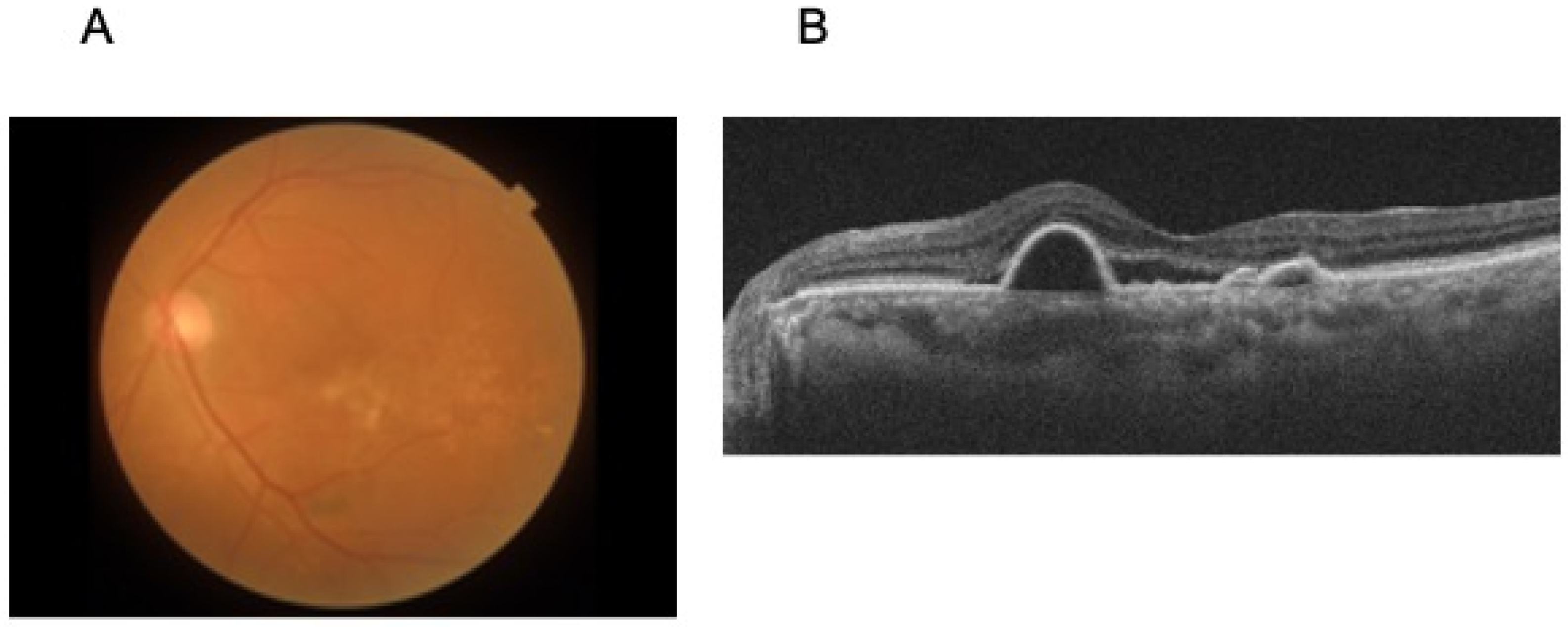
CFP and OCT were obtained within one week of aqueous humor sampling. For CFP, only 45° central color fundus photographs were used, and for OCT, only central horizontal B-scan images were included in the analysis. In addition, demographic and clinical information was extracted from medical records, including age, sex, axial length, best-corrected visual acuity, history of prior treatment, time since prior treatment, history of cataract surgery, history of vitrectomy, posterior vitreous detachment status, and central retinal thickness. Among these, 176 samples had both CFP and OCT images available and were included in the present analysis. OCT images were supplied to the AutoGluon framework without manual resizing. AutoGluon automatically applied its standard preprocessing pipeline, which includes resizing and center-cropping each B-scan to match the input dimensions required for pretrained convolutional neural networks (224 × 224 pixels). This procedure ensures compatibility with CNN-based feature extraction while preserving the essential macular structures within the central slice. Representative examples of the CFP and OCT images used in the analysis are shown in Figure 1A,B. Of the 35 cytokines measured, Galectin-1 was excluded because only two samples had observed values, resulting in unstable estimates.

2.4. Model Construction

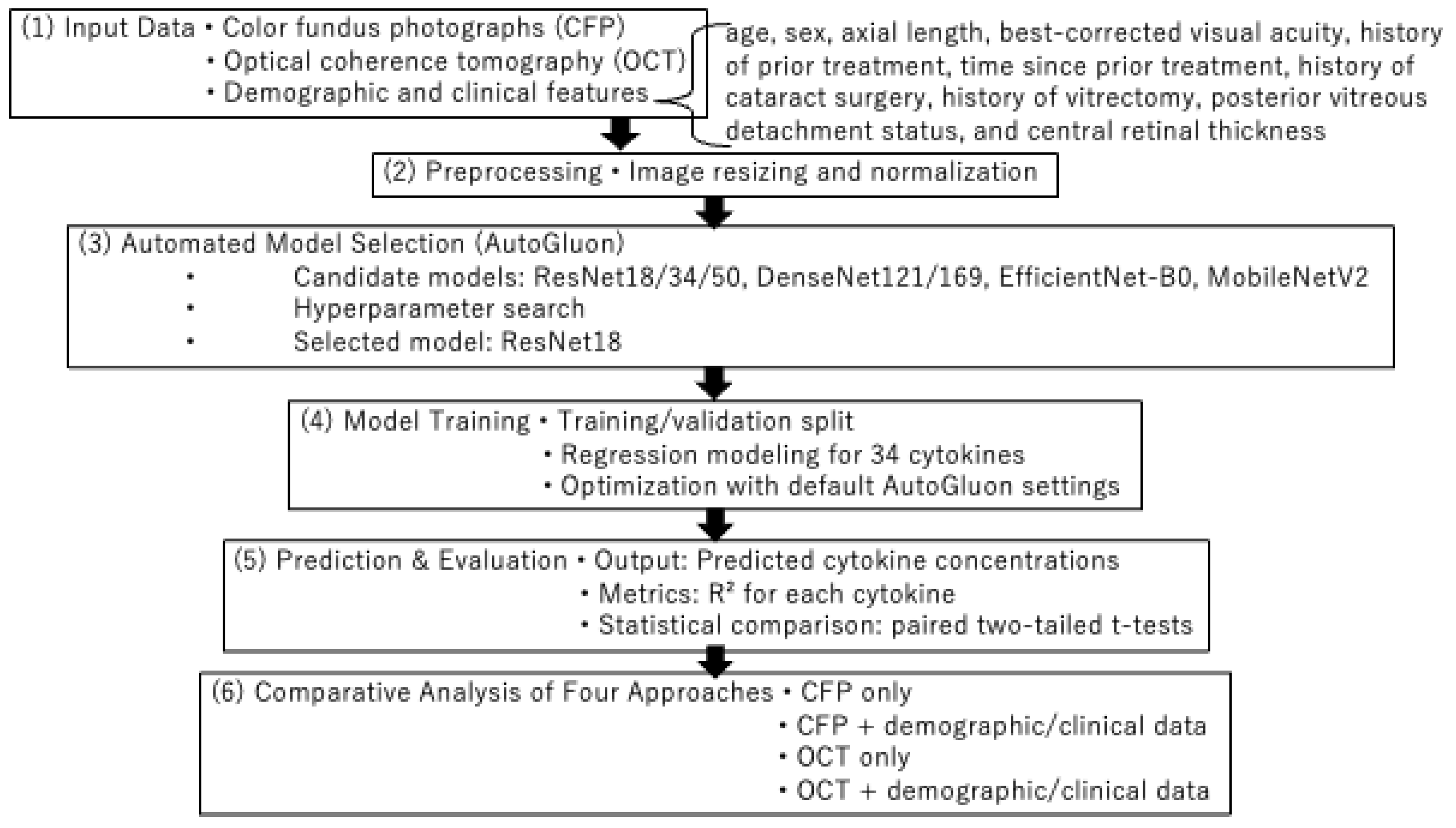
An overview of the analytical workflow is summarized in Figure 2. We employed the AutoGluon library (stable release as of May 2025; https://auto.gluon.ai/, accessed on 18 August 2025) implemented in Python 3.10 on Ubuntu Linux (LTS release). AutoGluon automatically selects and optimizes machine learning algorithms such as CatBoost and LightGBM for structured data and applies convolutional neural networks such as ResNet and DenseNet for image data. OCT images were fed into the AutoGluon framework without manual resizing; AutoGluon automatically applied its standard image preprocessing pipeline (resizing and center-cropping to 224 × 224 pixels) before extracting latent embeddings with convolutional neural networks (e.g., ResNet18). AutoGluon automatically integrates image and structured modalities by extracting latent embeddings from CNNs (e.g., ResNet18) for CFP and OCT images, and combining them with demographic/clinical variables modeled using algorithms such as CatBoost and LightGBM. These components are fused through a stack-ensemble architecture, in which AutoGluon internally explores multiple multimodal combinations and selects the best-performing model through cross-validation. Thus, all demographic and clinical features were incorporated into the fusion process without manual tuning. Demographic and clinical variables were processed using AutoGluon’s default tabular preprocessing pipeline, which performs categorical encoding, and model-appropriate handling of numerical variables. No additional manual normalization was applied, as the tree-based models (LightGBM, CatBoost) used for tabular features do not require feature scaling. Prediction models were trained using these methods, and cytokines were subsequently ranked according to their prediction accuracy, as evaluated by the coefficient of determination (R2). To assess the contribution of different input modalities, four approaches were tested: (1) CFP alone, (2) CFP combined with demographic and clinical features, (3) OCT alone, and (4) OCT combined with these features.

2.5. Statistical Analysis

Prediction performance was defined as the mean coefficient of determination (R2) across the 34 cytokines. Differences in prediction accuracy between models were evaluated using paired two-tailed Student’s t-tests conducted in JMP Pro 18.0.2 (JMP Statistical Discovery LLC, Cary, NC, USA). A significance level of α = 0.05 was adopted.

3. Results

3.1. Patient Characteristics

A total of 176 aqueous humor samples were collected from 152 eyes of 139 patients across multiple multiplex cytokine assay studies. The cohort consisted of 85 males (61%) and 54 females, with a mean age of 73 years (SD, 9.8). The underlying diseases included exudative age-related macular degeneration (n = 64), brolucizumab-associated intraocular inflammation (n = 29), cataract surgery controls (n = 19), retinal vein occlusion (n = 15), diabetic macular edema (n = 8), tilted disc syndrome (n = 1), and macular pucker (n = 1) (Table 1). Figure 2 shows a typical example of CFP and OCT, along with age, sex, and cytokine measurement values.

3.2. Image Acquisition

Fundus images were obtained using Triton (Topcon Corporation, Tokyo, Japan; n = 94), VX-10 (Kowa Company, Ltd., Tokyo, Japan; n = 52), and other devices including Optos (Optos plc, Dunfermline, United Kingdom) and VX-20 (Kowa Company, Ltd., Tokyo, Japan). OCT images were available for 157 eyes. Among these, 111 images were captured with Triton (Topcon Corporation, Tokyo, Japan), while the remainder were taken with Atlantis (Topcon Corporation, Tokyo, Japan) or RS-3000 (Nidek Co., Ltd., Gamagori, Japan).

3.3. Cytokine Prediction Using CFP

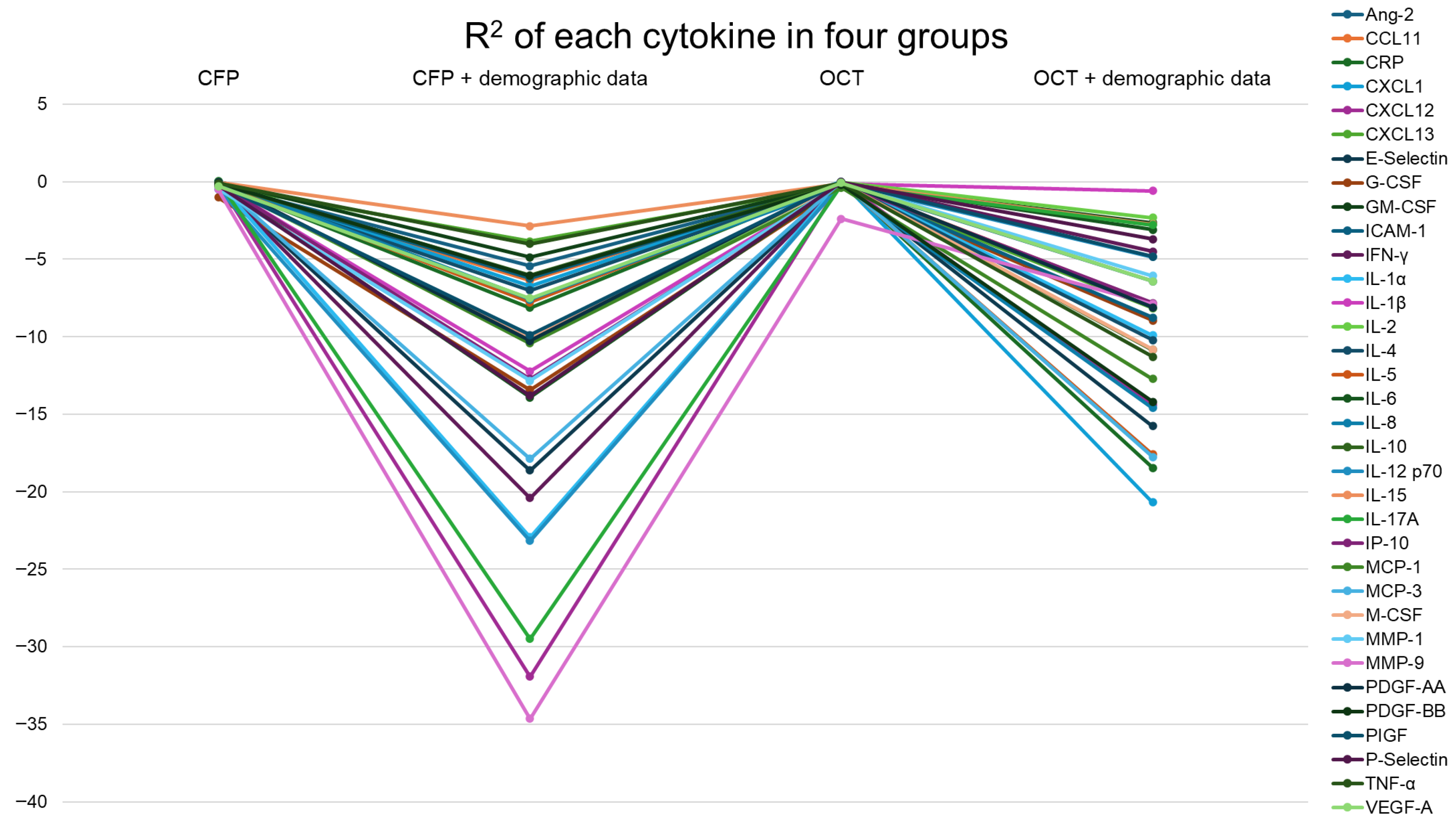
The CFP-only model demonstrated significantly better performance than the model incorporating demographic and clinical variables (mean R2 –0.19 vs. –24.1; p = 0.0373). Based on the CFP-only model, the cytokines with the highest R2 values, indicating the highest prediction accuracy, were IL-17A, IL-8, and MCP-1. In contrast, the cytokines with the lowest R2 values, reflecting the lowest prediction accuracy, were G-CSF, MMP-9, and IL-12 p70. Notably, VEGF ranked 30th out of the 34 cytokines in terms of prediction accuracy (Table 2).

3.4. Cytokine Prediction Using OCT

Similarly, the OCT-only model outperformed the OCT plus demographics model (mean R2 –0.18 vs. –14.7; p = 0.0080). In the OCT-only analysis, two cytokines demonstrated positive R2 values. The top three cytokines with the highest R2 were PDGF-AA, MCP-3, and CXCL1, whereas the lowest were MMP-9, MCP-1, and G-CSF. VEGF ranked 12th among the 34 cytokines (Table 2, Figure 3). Notably, the predictive performance remained stable even when plotted against the number of observed (not imputed) samples for each cytokine, indicating that the results were not substantially affected by the variation in sample size (see Figure S1). An illustrative example of predicted versus observed IL-6 concentrations is provided in Figure S2.

3.5. Comparison Between CFP and OCT

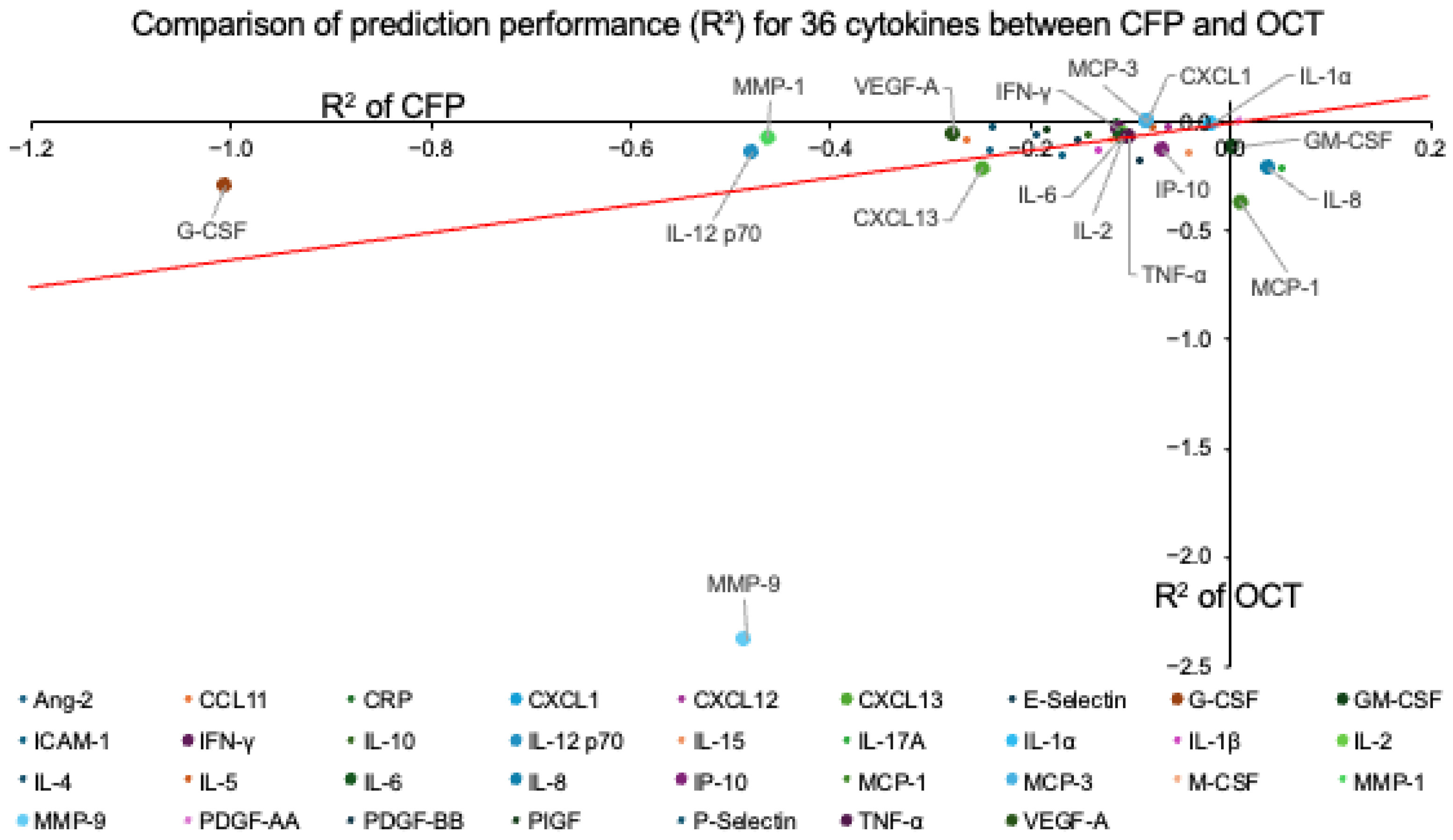
When the CFP-only and OCT-only models were directly compared, no significant difference in overall performance was observed between the two modalities (p = 0.9281). To further explore differences at the individual cytokine level, the R2 values of OCT minus CFP were calculated for each cytokine. The top three cytokines with the largest positive differences were G-CSF, MMP-1, and IL-12 p70, whereas the largest negative differences were MMP-9, MCP-1, and IL-17A. Notably, VEGF ranked 4th among the 34 cytokines in this comparison. For clarity, Figure 4 illustrates the comparison as a scatter plot, with selected cytokines labeled to highlight representative examples.
(OCT R2 = –0.062053 + 0.6495 × CFP R2),
illustrating the overall relationship between the two imaging modalities. To reduce visual clutter while emphasizing cytokines supported by more robust empirical data, labels are shown only for cytokines with 150 or more directly measured (non-imputed) samples. Negative R2 values indicate poor predictive performance relative to a mean predictor.

4. Discussion

Most previous studies have compared cytokine concentrations among several groups [12,13,14,16,17,18,20,21,22,23,24], and some have used cytokine levels as explanatory variables to predict disease diagnosis or prognosis. These analyses have primarily relied on multivariate statistical models [15,19], with only a few reports applying machine learning approaches [7,8]. These approaches, however, provide only indirect estimations based on clinical classifications rather than image-derived features. In contrast, the present study attempted to estimate aqueous humor cytokine concentrations directly from ocular imaging, specifically CFP and OCT, thereby offering a more granular and potentially pathophysiologically relevant approach.
However, previous machine learning studies were limited by (1) small disease-specific datasets, (2) restricted cytokine panels, and (3) models that depended on manually selected clinical variables, which may not fully capture the morphological information embedded in retinal images. These constraints prevented those methods from assessing whether imaging contains sufficient signal to approximate intraocular molecular states. By integrating a larger cytokine dataset and systematically examining image-only and multimodal deep learning pipelines, our study provides a clearer evaluation of these methodological limitations and demonstrates both the potential advantages and the remaining challenges of cytokine prediction from retinal imaging.
Our findings yielded several noteworthy observations. First, adding demographic or clinical information did not improve prediction accuracy, suggesting that image-based features alone contained the dominant signals relevant to cytokine profiles. Second, OCT achieved higher accuracy than CFP, particularly in eyes with age-related macular degeneration (AMD). This indicates that OCT may better capture morphological correlates of intraocular cytokine activity compared with CFP, which provides only en face retinal images. Interestingly, the prediction accuracy for VEGF, the most clinically relevant cytokine in neovascular AMD, was modest, highlighting that not all cytokines can be equally inferred from structural imaging features.
These results have several implications. They suggest that intraocular cytokine estimation from OCT could serve as an intermediate surrogate linking noninvasive imaging to intraocular molecular pathology. Such surrogate markers may help in understanding disease mechanisms, stratifying patients, and evaluating treatment response, particularly in conditions such as AMD where cytokine signaling plays a pivotal role. Furthermore, the observation that demographics did not meaningfully enhance performance underscores the central importance of image-derived information in modeling intraocular biology.
Notably, VEGF ranked substantially higher when comparing OCT with CFP, reaching fifth place in the OCT–CFP differential analysis. A plausible explanation is that VEGF-driven edema [25] is more readily visualized on OCT than on CFP. This finding suggests that further investigations may help clarify which cytokines are preferentially reflected in specific imaging features, thereby supporting the value of pursuing cytokine-specific imaging correlates.

Limitations

This study has several limitations. First, all participants were Japanese, and the findings may not generalize to populations with different ethnic backgrounds or fundus pigmentation. Second, the cohort was skewed toward age-related macular degeneration, reflecting the authors’ specialty and the patient population of a tertiary referral center. Although this reflects real-world practice in such settings, the distribution is not representative of the general population. Third, the overall sample size was modest, which may have limited the prediction accuracy of the deep learning models. Larger, multi-center studies with more balanced case distributions are needed to confirm and extend these findings. In addition, while OCT outperformed CFP in this study, future work should explore whether multimodal imaging or more advanced model architectures can improve prediction of difficult targets such as VEGF.

5. Conclusions

Overall prediction performance was limited, with mean R2 values below zero across all models (e.g., –0.19 for CFP-only and –0.18 for OCT-only). Demographic and clinical factors did not meaningfully improve prediction accuracy. Current deep learning approaches appear insufficient for reliable cytokine prediction from imaging alone. Future work should involve larger multi-institutional datasets, more advanced architectures, and multimodal integration to better capture intraocular molecular states.

Supplementary Materials

The following supporting information can be downloaded at: https://www.mdpi.com/article/10.3390/s25237382/s1, Figure S1: Comparison of predictions by number of observation samples and type of image; Figure S2: Scatter plot of observed vs. predicted IL-6 concentrations (log10 scale).

Author Contributions

Conceptualization, H.T.; methodology, H.T. and Y.K.; software, T.T. and Y.K.; validation, H.T. and T.T.; formal analysis, H.T.; investigation, T.T.; resources, H.T., S.I., S.M., Y.S., T.O. and T.Y.; data curation, H.T.; writing—original draft preparation, H.T.; writing—review and editing, Y.Y., S.I., S.M., Y.S., T.K., T.O. and T.Y.; visualization, H.T. and T.T.; supervision, H.T. and T.Y.; project administration, H.T.; funding acquisition, H.T. and T.Y. All authors have read and agreed to the published version of the manuscript.

Funding

This work was supported by JSPS KAKENHI (Grant Number 21K09751). The funding organization had no role in study design, conducting the study, data collection, management, analysis, or interpretation, or preparation, review, or approval of the manuscript in this research.

Institutional Review Board Statement

The study was conducted in accordance with the Declaration of Helsinki (2013 revision) and approved by the Institutional Review Boards of Jichi Medical University (E12-86) and the Japan Community Healthcare Organization Tokyo Shinjuku Medical Center (H22-8-9).

Informed Consent Statement

Written informed consent was obtained from all participants involved in the study.

Data Availability Statement

All data and figures are available from the figshare database (https://doi.org/10.6084/m9.figshare.30154360.v1).

Acknowledgments

The authors acknowledge the assistance of Mayumi Chiba in data compilation and figure preparation. The authors acknowledge the use of generative artificial intelligence technology (ChatGPT, GPT-5, OpenAI, San Francisco, CA, USA; accessed August 2025) to assist in language editing of the manuscript. All content generated or edited by this tool was manually reviewed, verified for accuracy, and revised by the authors, who take full responsibility for the final text.

Conflicts of Interest

Hidenori Takahashi reports consultancy fees, speaker honoraria, travel support, or research funding from Boehringer, Santen, Senju, Novartis, Bayer, Chugai, HOYA, SPS, and Kyowa Kirin, and is the founder of DeepEyeVision Inc. Taiki Tsuge is employed by DeepEyeVision Inc. Yusuke Kondo received funding from the Information-Technology Promotion Agency and has intellectual property involvement with DeepEyeVision Inc. Yasuo Yanagi reports consultancy or financial relationships with Roche, Boehringer, Alcon, Sanbio, Kowa, Chugai, Santen, Novartis, and Bayer. Satoru Inoda reports speaker or financial relationships with Kowa, Chugai, Santen, Novartis, Bayer, and SPS. Toshikatsu Kaburaki reports speaker or financial relationships with SPS, Santen, Eisai, AbbVie, Kowa, Senju, Daiichi-Sankyo, HOYA, Alcon, Tanabe-Mitsubishi, Wakamoto, Ono, Otsuka, and Chugai. The remaining authors (Shohei Morikawa, Yuki Senoo, Tetsuro Oshika, and Toshihiko Yamasaki) declare that the research was conducted in the absence of any commercial or financial relationships that could be construed as a potential conflict of interest. The funders had no role in the design of the study; in the collection, analyses, or interpretation of data; in the writing of the manuscript; or in the decision to publish the results.

Abbreviations

The following abbreviations are used in this manuscript:
CFPColor fundus photographs
OCTOptical coherence tomography
AMDAge-related Macular Degeneration
MARMissing at random
ADIAutomated Data Imputation

References

  1. Kvanta, A.; Algvere, P.V.; Berglin, L.; Seregard, S. Subfoveal Fibrovascular Membranes in Age-Related Macular Degeneration Express Vascular Endothelial Growth Factor. Investig. Ophthalmol. Vis. Sci. 1996, 37, 1929–1934. [Google Scholar] [CrossRef]
  2. Funatsu, H.; Yamashita, H.; Noma, H.; Mimura, T.; Yamashita, T.; Hori, S. Increased Levels of Vascular Endothelial Growth Factor and Interleukin-6 in the Aqueous Humor of Diabetics with Macular Edema. Am. J. Ophthalmol. 2002, 133, 70–77. [Google Scholar] [CrossRef] [PubMed]
  3. Noma, H.; Funatsu, H.; Yamasaki, M.; Tsukamoto, H.; Mimura, T.; Sone, T.; Hirayama, T.; Tamura, H.; Yamashita, H.; Minamoto, A.; et al. Aqueous Humour Levels of Cytokines Are Correlated with Vitreous Levels and Severity of Macular Oedema in Branch Retinal Vein Occlusion. Eye 2008, 22, 42–48. [Google Scholar] [CrossRef] [PubMed]
  4. Freyberger, H.; Bröcker, M.; Yakut, H.; Hammer, J.; Effert, R.; Schifferdecker, E.; Schatz, H.; Derwahl, M. Increased Levels of Platelet-Derived Growth Factor in Vitreous Fluid of Patients with Proliferative Diabetic Retinopathy. Exp. Clin. Endocrinol. Diabetes 2000, 108, 106–109. [Google Scholar] [CrossRef]
  5. Bloch, S.B.; Larsen, M.; Munch, I.C. Incidence of Legal Blindness from Age-Related Macular Degeneration in Denmark: Year 2000 to 2010. Am. J. Ophthalmol. 2012, 153, 209–213. [Google Scholar] [CrossRef]
  6. Park, Y.G.; Park, W.K.; Kim, R.Y.; Kim, M.; Park, Y.H. Serial Changes in the Aqueous IL-10 Level after Intravitreal Methotrexate Injection as an Indicator of Primary Vitreoretinal Lymphoma Recurrence. Sci. Rep. 2020, 10, 15992. [Google Scholar] [CrossRef]
  7. Nezu, N.; Usui, Y.; Saito, A.; Shimizu, H.; Asakage, M.; Yamakawa, N.; Tsubota, K.; Wakabayashi, Y.; Narimatsu, A.; Umazume, K.; et al. Machine Learning Approach for Intraocular Disease Prediction Based on Aqueous Humor Immune Mediator Profiles. Ophthalmology 2021, 128, 1197–1208. [Google Scholar] [CrossRef]
  8. Sugawara, R.; Usui, Y.; Saito, A.; Nezu, N.; Komatsu, H.; Tsubota, K.; Asakage, M.; Yamakawa, N.; Wakabayashi, Y.; Sugimoto, M.; et al. An Approach to Predict Intraocular Diseases by Machine Learning Based on Vitreous Humor Immune Mediator Profile. Investig. Ophthalmol. Vis. Sci. 2025, 66, 38. [Google Scholar] [CrossRef]
  9. Lu, Y.; Liu, F.; Yu, Y.; Chen, B.; Yu, W.; Zou, Z.; Li, K.; Man, M.; Ou, C.; Wang, C.; et al. AI-Enabled Molecular Phenotyping and Prognostic Predictions in Lung Cancer Through Multimodal Clinical Information Integration. Cell Rep. Med. 2025, 6, 102216. [Google Scholar] [CrossRef]
  10. Miladinović, A.; Biscontin, A.; Ajčević, M.; Kresevic, S.; Accardo, A.; Marangoni, D.; Tognetto, D.; Inferrera, L. Evaluating deep learning models for classifying OCT images with limited data and noisy labels. Sci. Rep. 2024, 14, 30321. [Google Scholar] [CrossRef]
  11. White, T.; Selvarajah, V.; Wolfhagen-Sand, F.; Svangård, N.; Mohankumar, G.; Fenici, P.; Rough, K.; Onyango, N.; Lyons, K.; Mack, C.; et al. Prediction of Cardiovascular Risk Factors from Retinal Fundus Photographs: Validation of a Deep Learning Algorithm in a Prospective Non-Interventional Study in Kenya. Diabetes Obes. Metab. 2024, 26, 2722–2731. [Google Scholar] [CrossRef] [PubMed]
  12. Takahashi, H.; Nomura, Y.; Tan, X.; Fujino, Y.; Kawashima, H.; Yanagi, Y. Effects of Posterior Vitreous Detachment on Aqueous Humour Levels of VEGF and Inflammatory Cytokines. Br. J. Ophthalmol. 2015, 99, 1065–1069. [Google Scholar] [CrossRef] [PubMed]
  13. Nomura, Y.; Takahashi, H.; Tan, X.; Fujino, Y.; Kawashima, H.; Yanagi, Y. Effect of Posterior Vitreous Detachment on Aqueous Humor Level of Vascular Endothelial Growth Factor in Exudative Age-Related Macular Degeneration Patients. Graefes Arch. Clin. Exp. Ophthalmol. 2016, 254, 53–57. [Google Scholar] [CrossRef] [PubMed]
  14. Sakamoto, S.; Takahashi, H.; Tan, X.; Inoue, Y.; Nomura, Y.; Arai, Y.; Fujino, Y.; Kawashima, H.; Yanagi, Y. Changes in Multiple Cytokine Concentrations in the Aqueous Humor of Neovascular Age-Related Macular Degeneration after Two Months of Ranibizumab Therapy. Br. J. Ophthalmol. 2018, 102, 448–454. [Google Scholar] [CrossRef]
  15. Arai, Y.; Takahashi, H.; Inoda, S.; Tan, X.; Sakamoto, S.; Inoue, Y.; Fujino, Y.; Kawashima, H.; Yanagi, Y. Aqueous Humour Proteins and Treatment Outcomes of Anti-VEGF Therapy in Neovascular Age-Related Macular Degeneration. PLoS ONE 2020, 15, e0229342. [Google Scholar] [CrossRef]
  16. Hayashi, T.; Takahashi, H.; Inoda, S.; Shimizu, T.; Kobayashi, A.; Kawashima, H.; Yamaguchi, T.; Yamagami, S. Aqueous Humour Cytokine Profiles after Descemet’s Membrane Endothelial Keratoplasty. Sci. Rep. 2021, 11, 17064. [Google Scholar] [CrossRef]
  17. Inoda, S.; Takahashi, H.; Inoue, Y.; Tan, X.; Tampo, H.; Arai, Y.; Yanagi, Y.; Kawashima, H. Cytokine Profiles of Macular Neovascularization in the Elderly Based on a Classification from a Pachychoroid/Drusen Perspective. Graefes Arch. Clin. Exp. Ophthalmol. 2021, 260, 747–758. [Google Scholar] [CrossRef]
  18. Terao, R.; Obata, R.; Okubo, A.; Aoki, S.; Azuma, K.; Ahmed, T.; Inoda, S.; Hashimoto, Y.; Takahashi, R.; Yoshida, H.; et al. Cytokine Profiles in the Aqueous Humor Following Brolucizumab Administration for Exudative Age-Related Macular Degeneration. Graefes Arch. Clin. Exp. Ophthalmol. 2023, 261, 2465–2476. [Google Scholar] [CrossRef]
  19. Hashimoto, Y.; Inoda, S.; Takahashi, H.; Takahashi, R.; Yoshida, H.; Fujino, Y.; Sakamoto, S.; Kawashima, H.; Yanagi, Y. Factors Associated with Intraocular Inflammation in Neovascular Age-Related Macular Degeneration Patients Treated with Brolucizumab. Investig. Ophthalmol. Vis. Sci. 2024, 65, 8. [Google Scholar] [CrossRef]
  20. Arai, Y.; Takahashi, H.; Inoda, S.; Sakamoto, S.; Kawashima, H.; Yanagi, Y. Effectiveness and Cytokine Profile of Combined Anti-Vascular Endothelial Growth Factor and Corticosteroid Therapy for Chronic Retinal Vein Occlusion. Graefes Arch. Clin. Exp. Ophthalmol. 2025, 263, 1427–1434. [Google Scholar] [CrossRef]
  21. Inoda, S.; Takahashi, H.; Takahashi, R.; Hashimoto, Y.; Yoshida, H.; Takahashi, H.; Fujino, Y.; Aizawa, K.; Kawashima, H.; Yanagi, Y. Effect of Combination Use of Aqueous Humor Secretion Inhibitor Eye Drops on Aflibercept Level: A Preliminary Analysis. Transl. Vis. Sci. Technol. 2025, 14, 21. [Google Scholar] [CrossRef] [PubMed]
  22. Nonogaki, R.; Ota, H.; Takeuchi, J.; Nakano, Y.; Sajiki, A.F.; Todoroki, T.; Nakamura, K.; Kaneko, H.; Nishiguchi, K.M. Analysis of the Aqueous Humor Before and After the Administration of Faricimab in Patients with nAMD. Sci. Rep. 2024, 14, 31951. [Google Scholar] [CrossRef] [PubMed]
  23. Kadoh, Y.; Takayanagi, Y.; Sugihara, K.; Kaidzu, S.; Takai, Y.; Tanito, M. Aqueous Humor Cytokine Profiling Reveals Distinct Roles for Serum Amyloid A, Interleukin-8, and Endothelin-1 in Pseudoexfoliation Syndrome and Glaucoma. Int. J. Mol. Sci. 2025, 26, 1461. [Google Scholar] [CrossRef] [PubMed]
  24. Asakage, M.; Noma, H.; Yasuda, K.; Goto, H.; Shimura, M. The Dynamics of Inflammatory Factors in Patients with or without IOI after Brolucizumab Treatment. Medicina 2025, 61, 372. [Google Scholar] [CrossRef]
  25. Funatsu, H.; Yamashita, H.; Ikeda, T.; Mimura, T.; Eguchi, S.; Hori, S. Vitreous Levels of Interleukin-6 and Vascular Endothelial Growth Factor Are Related to Diabetic Macular Edema. Ophthalmology 2003, 110, 1690–1696. [Google Scholar] [CrossRef]
Figure 1. Representative input images used in the analysis. (A) Color fundus photograph (45° central field) from a 76-year-old female patient with exudative age-related macular degeneration, (B) Horizontal macular B-scan OCT from the same eye, showing the central foveal region. These examples illustrate the imaging modalities used as inputs for model construction.
Sensors 25 07382 g001
Figure 2. An overview of the analytical workflow. This flowchart summarizes the sequential steps of the proposed algorithm, including (1) input data (CFP, OCT, and demographic/clinical features), (2) preprocessing with automated image resizing and normalization, (3) model selection within AutoGluon including exploration of multiple CNN architectures (converging on ResNet18), (4) model training for 34 cytokines, (5) prediction and evaluation using R2 and paired t-tests, and (6) comparison of the four analytical approaches.
Sensors 25 07382 g002
Figure 3. Coefficient of determination (R2) for each cytokine across the four analysis groups. CFP alone, CFP plus demographic/clinical features, OCT alone, and OCT plus these features. Bars represent prediction performance for 34 cytokines.
Sensors 25 07382 g003
Figure 4. Comparison of prediction performance (R2) between CFP- and OCT-based analyses for 34 cytokines. Each point represents one cytokine, plotted using R2 values obtained from CFP-based predictions (x-axis) and OCT-based predictions (y-axis). The red line represents the regression line fitted across cytokines.
Sensors 25 07382 g004
Table 1. Participant Characteristics. Summary of demographic and clinical data of the study participants.
VariableValue
Number of aqueous humor samples176 from 152 eyes of 139 patients
Number of participantsMale: 85, Female: 54
Age (years)Mean: 73, SD: 9.8, Range: 36–101
Exudative Age-related Macular Degeneration64
Brolucizumab-associated Intraocular
Inflammation
29
Cataract Surgery as Controls19
Retinal Vein Occlusion15
Diabetic Macular Edema8
Tilted Disc Syndrome1
Macular Pucker1
Table 2. The Coefficient of Determination (R2) of each Cytokine Concentrations. Coefficient of determination values for each of the 34 cytokines under four prediction settings: color fundus photography (CFP), CFP combined with demographic features, optical coherence tomography (OCT), and OCT combined with demographic features. The number of observed samples used for each cytokine is also shown.
CytokineCFPCFP & Demographic FeaturesOCTOCT & Demographic FeaturesNumber of Observed Samples
Ang-2−0.24−5.4−0.14−6.422
CCL11−0.26−6.4−0.097−7.931
CRP−0.11−8.1−0.0057−1822
CXCL1−0.082−6.8−0.0028−21154
CXCL12−0.059−32−0.038−1450
CXCL13−0.25−3.8−0.21−8.2176
E-Selectin−0.15−19−0.09−16101
G-CSF−1−13−0.3−9150
GM-CSF0.0023−4.9−0.12−2.7150
ICAM−1−0.17−6.2−0.16−8.875
IFN-γ−0.11−20−0.039−4.5150
IL-1α−0.018−23−0.0081−9.9150
IL-1β−0.13−12−0.15−0.6101
IL-2−0.11−10−0.056−2.3150
IL-4−0.19−7−0.064−1075
IL-5−0.075−7.8−0.034−18101
IL-6−0.11−14−0.064−3.1176
IL-80.038−7.6−0.21−15172
IL-10−0.14−6−0.071−11105
IL-12 p70−0.48−23−0.14−4.8150
IL-15−0.039−2.9−0.15−2.749
IL-17A0.053−29−0.22−2.875
IP-10−0.067−13−0.13−7.8176
M-CSF−0.12−10−0.096−1153
MCP-10.011−10−0.37−13176
MCP-3−0.083−180.00009−18150
MMP-1−0.46−13−0.067−6.1150
MMP-9−0.49−35−2.4−7.9150
P-Selectin−0.24−14−0.033−3.763
PDGF-AA0.0092−100.00022−8.149
PDGF-BB−0.088−6.1−0.18−1422
PIGF−0.18−9.9−0.049−4.822
TNF-α−0.1−4−0.068−11150
VEGF-A−0.28−7.5−0.062−6.4172
Disclaimer/Publisher’s Note: The statements, opinions and data contained in all publications are solely those of the individual author(s) and contributor(s) and not of MDPI and/or the editor(s). MDPI and/or the editor(s) disclaim responsibility for any injury to people or property resulting from any ideas, methods, instructions or products referred to in the content.