4.2.2. Quantitative Analysis Results of Diseases
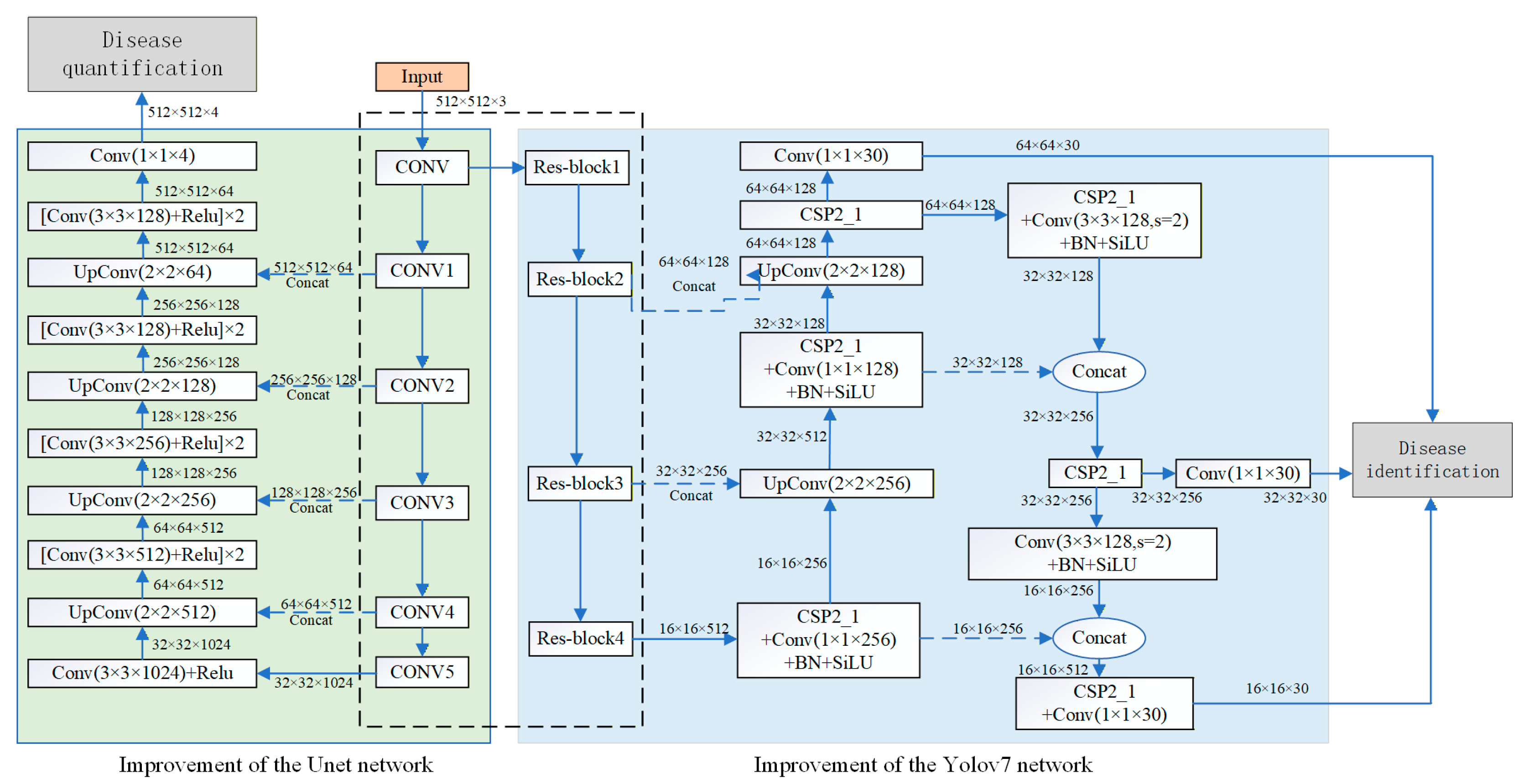
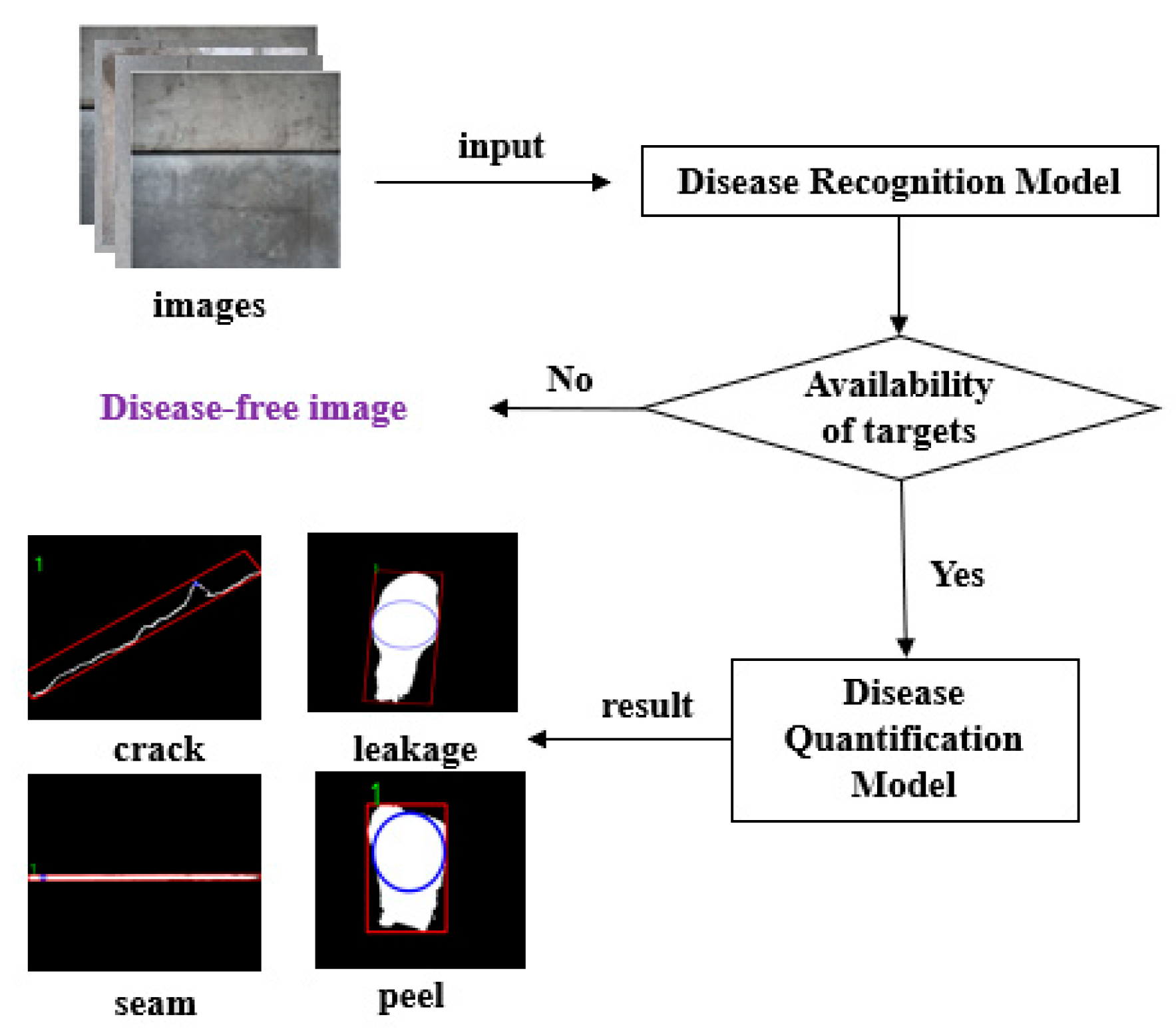
Following accurate disease detection by the YOLOv7-based target detection network, the identified disease regions in the images are segmented and quantified.
- (1)
Quantization results of crack identification
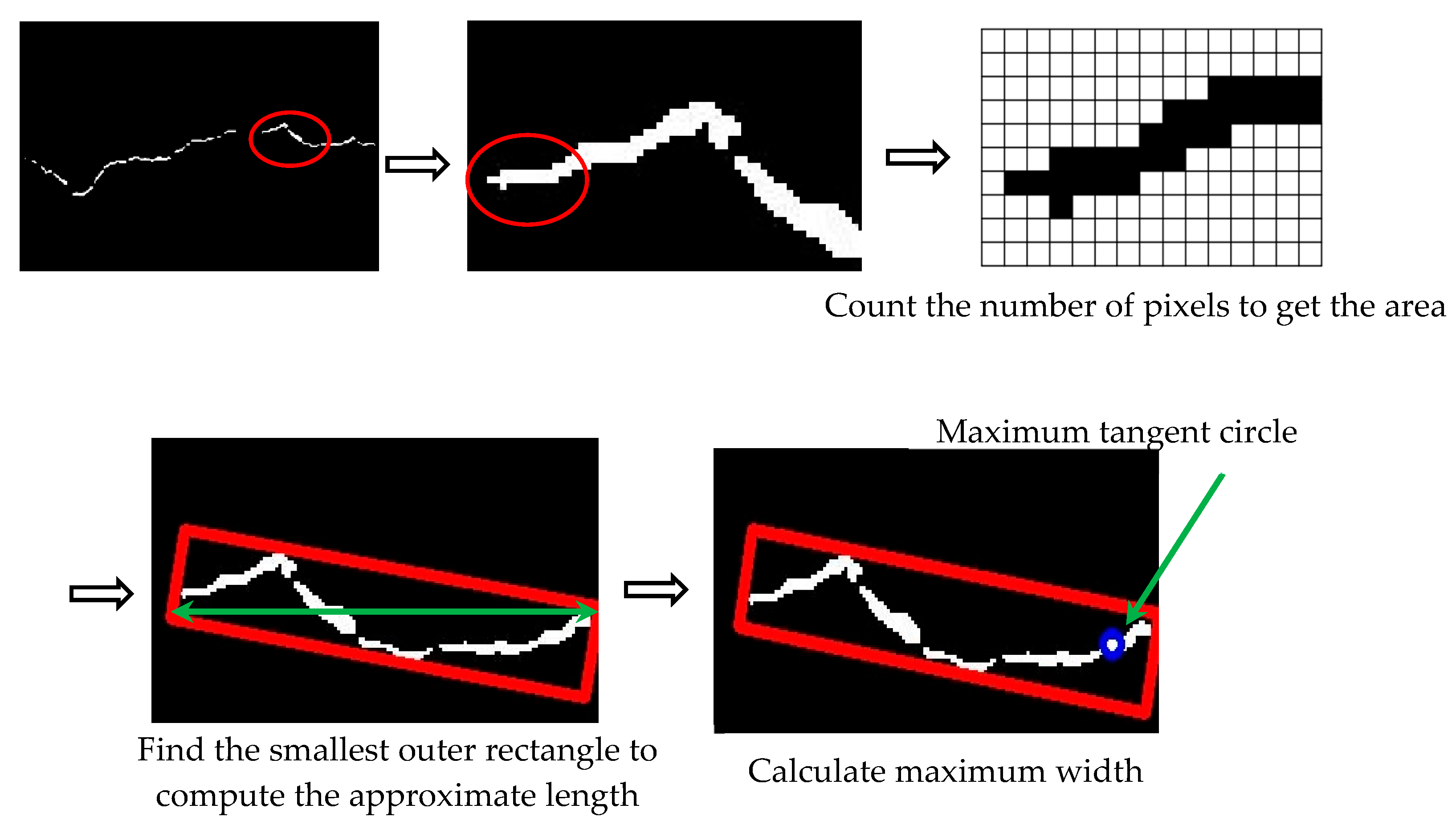
The key geometric parameters measured for cracks are the maximum width and length [
25]. The specific values for maximum width and length are determined by referencing
Section 2.4.
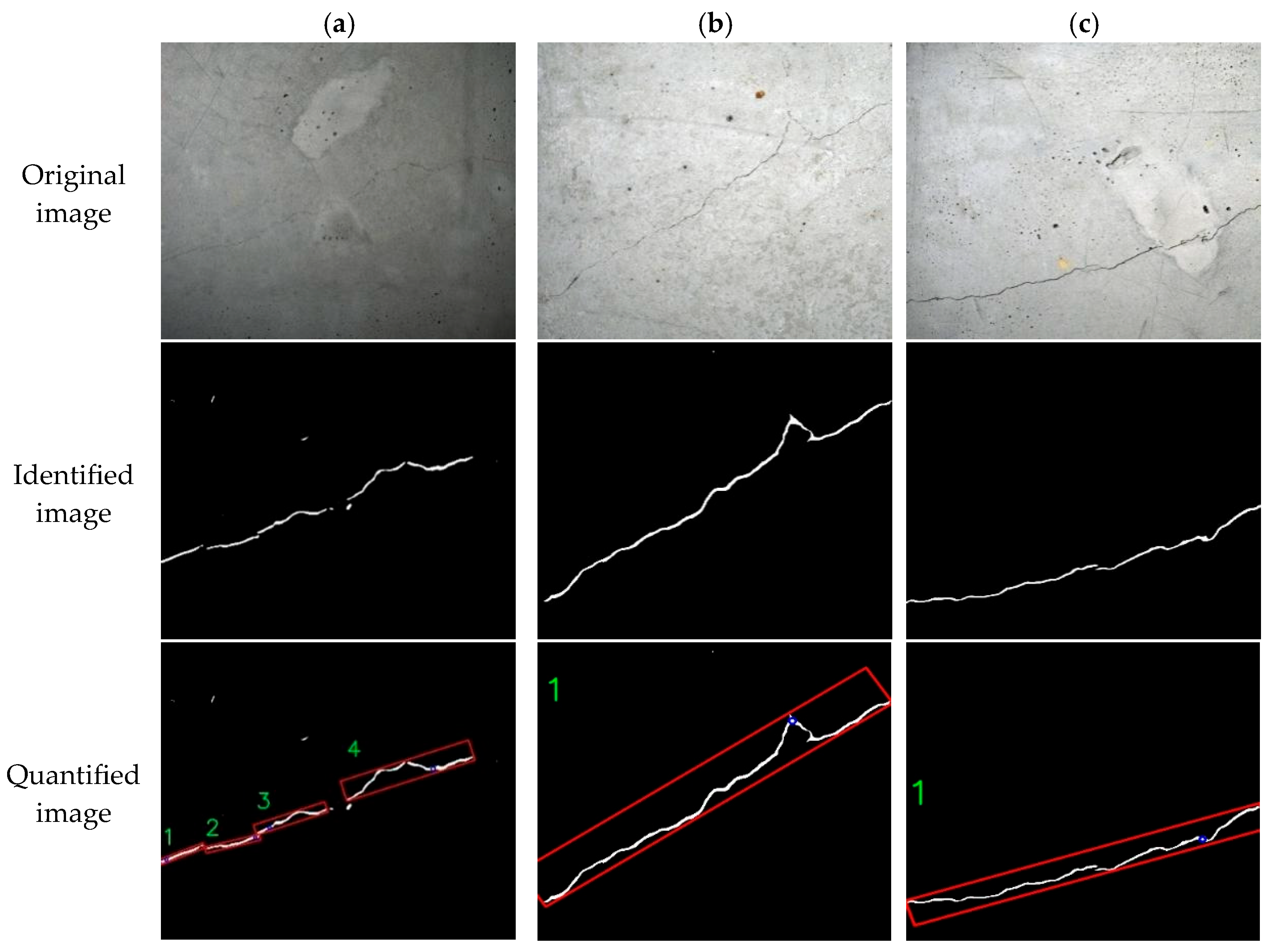
Figure 14 presents an example to demonstrates the accuracy of the crack parameter calculations.
Figure 14 shows three typical crack images processed by the UNet-based segmentation network to produce segmentation maps. Then, a quantitative analysis model measures the geometric parameters of the identified cracks. In
Figure 14a, four crack regions are sequentially labeled and measured. The oriented minimum bounding rectangle surrounding each crack is highlighted by a red rectangle, and the maximum inscribed circle is denoted by a blue circle. These four labeled regions in fact form a single continuous crack. Hence, the maximum width of the entire crack can be determined by integrating the using the methodology for identifying multiple cracks through labeling with maximum inscribed circle algorithm. Subsequently,
Figure 14b,c are identified as depicting a single continuous crack. The results of the quantitative identification of specific crack information are presented in
Table 6 and
Table 7.
The four regions identified in
Figure 14a constitute a single crack, and the manual measurement of its widths are consistent with the quantitative calculation results from the semantic segmentation model, suggesting accurate identification. However, the initial width estimation method produced substantial calculation errors, resulting in undesirable outcomes. Hence, the maximum inscribe circle width method was adopted for all width calculation. Owing to segmentation errors, absolute errors range from 0.22 mm to 0.33 mm, with corresponding relative errors of 7.3–35.0%. Conversely, for the wider cracks in
Figure 14b,c, both absolute and relative errors are significantly reduced, demonstrating better measurement accuracy. Measurement variability increases for narrower cracks, particularly those below 1 mm, due to the limited resolution where each pixel represents 0.1 mm. Thus, selecting a camera with higher spatial resolution would improve the measurement precision for fine crack.
- (2)
Quantitative results of seam identification
As width is a decisive parameter for seam identification, determining the maximum width of the seam using the maximum inscribe circle width method is more accurate.
In this paper, 12 concrete slabs were sequentially spliced to simulate tunnel seams, controlling the widths within the 1–4 mm range. A crack observer was used to measure the actual seam widths manually for subsequent accuracy assessment of quantitative calculations.
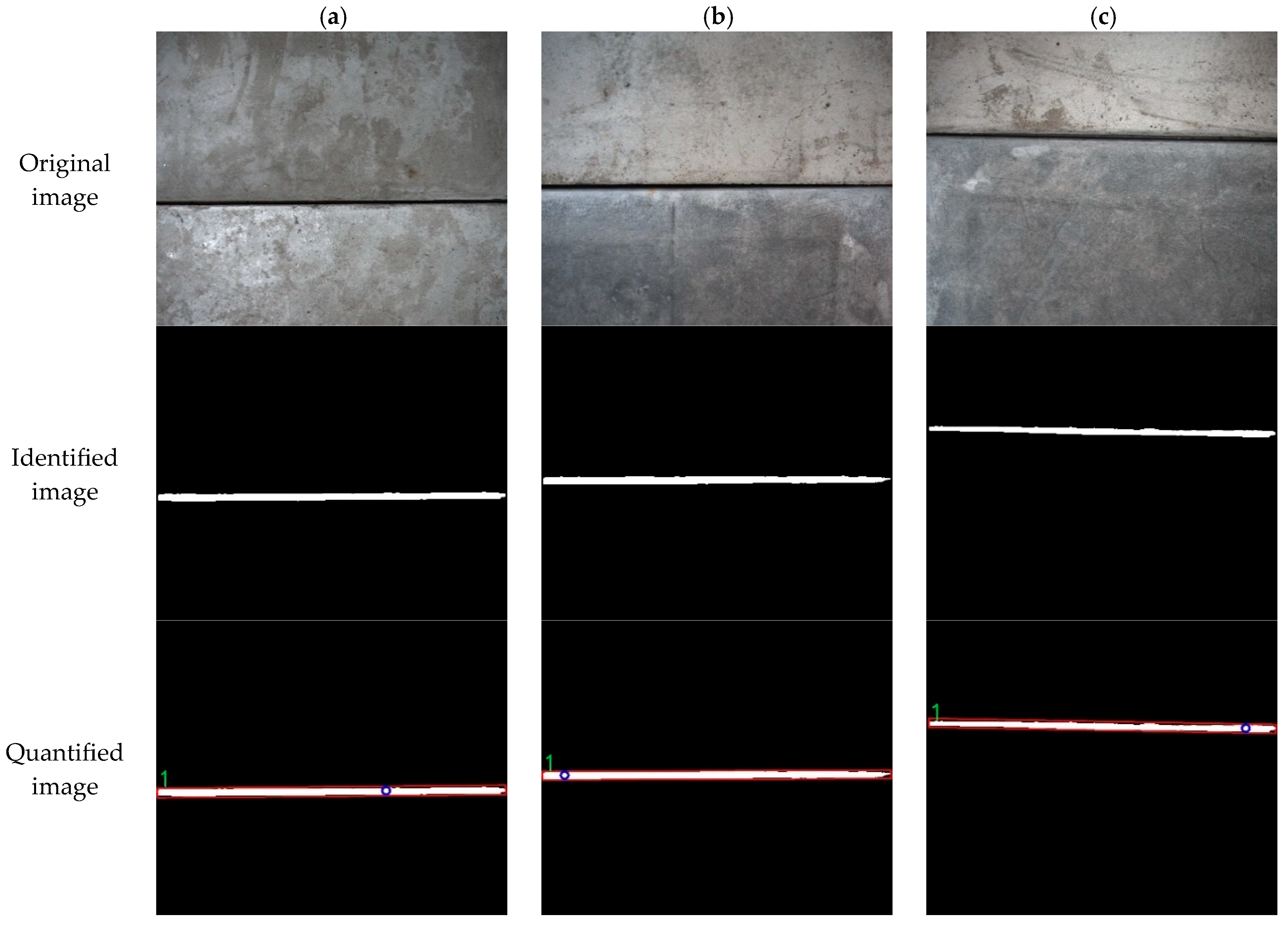
Figure 15 exhibits the parameter information calculation for the test seams.
Figure 15 shows three typical seam images, processed using the same workflow as for the crack tests. The measured seam widths are 2.60 mm, 2.50 mm, and 2.50 mm, for
Figure 15a–c, respectively. The seam widths are wider than the cracks. According to relevant tunnel specifications, 4 mm serves as a critical value for seam width. The results of quantitative identification for specific seam information are summarized in
Table 8.
The seams display a regular, predominantly straight shape, and the measured lengths agree well with the lengths calculated by the algorithm. When the actual width is over 1 mm, the calculation results from quantitative identification produce small absolute errors. The widths determined using the maximum inscribe circle width method closely approximate the actual values, with relative errors under 10%. These findings further emphasize the effect of spatial resolution on the precision of disease detection and identification.
- (3)
Quantitative results of spalling identification
Detection and identification of spalling diseases are relatively straightforward, with area serving as the primary parameters for quantification.
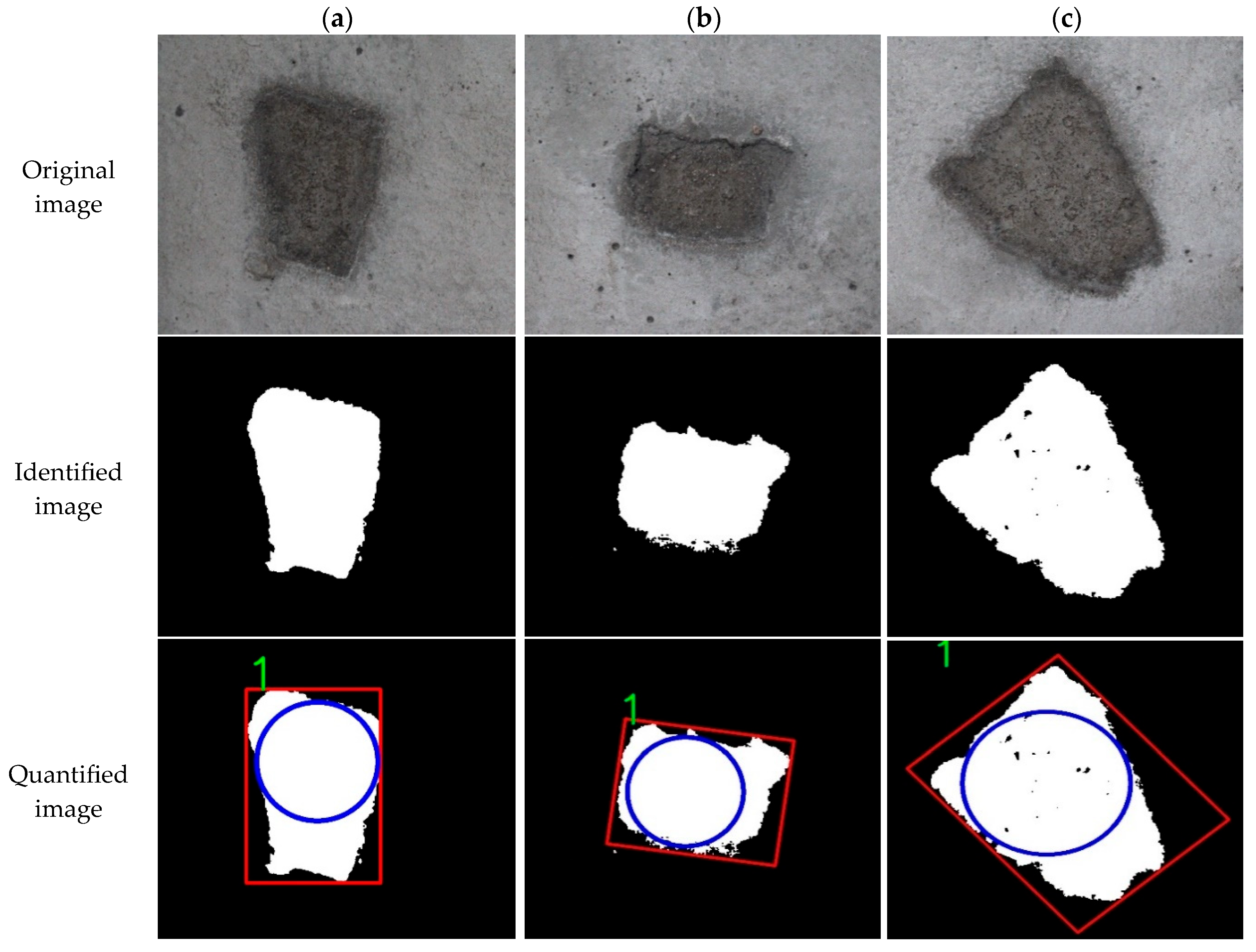
Figure 16 shows three typical images depicting spalling diseases. Compared to cracks and seams, spalling in tunnel environments usually covers larger areas. With the unit pixel accuracy remaining consistent at 0.1 mm/pixel, the system guarantees adequate accuracy for detecting and identifying spalling damage. The quantification results for the spalling information are summarized in
Table 9.
The number of pixels occupied by the spalling disease substantially exceeds that of cracks, seams, and other diseases, which facilitated more reliable detection due to their larger spatial extent. The area of the spalling, determined based on the number of pixels, closely aligns with the measured area, meeting the detection requirements effectively.
- (4)
Quantitative results of water leakage identification
The water leakage area serves as the core index for quantitative identification. To perform the quantitative identification test of water leakage information, concrete slabs were mounted against a wall and simulated to develop water leakage. The local length and width of the water leakage were then determined with a tape measure.
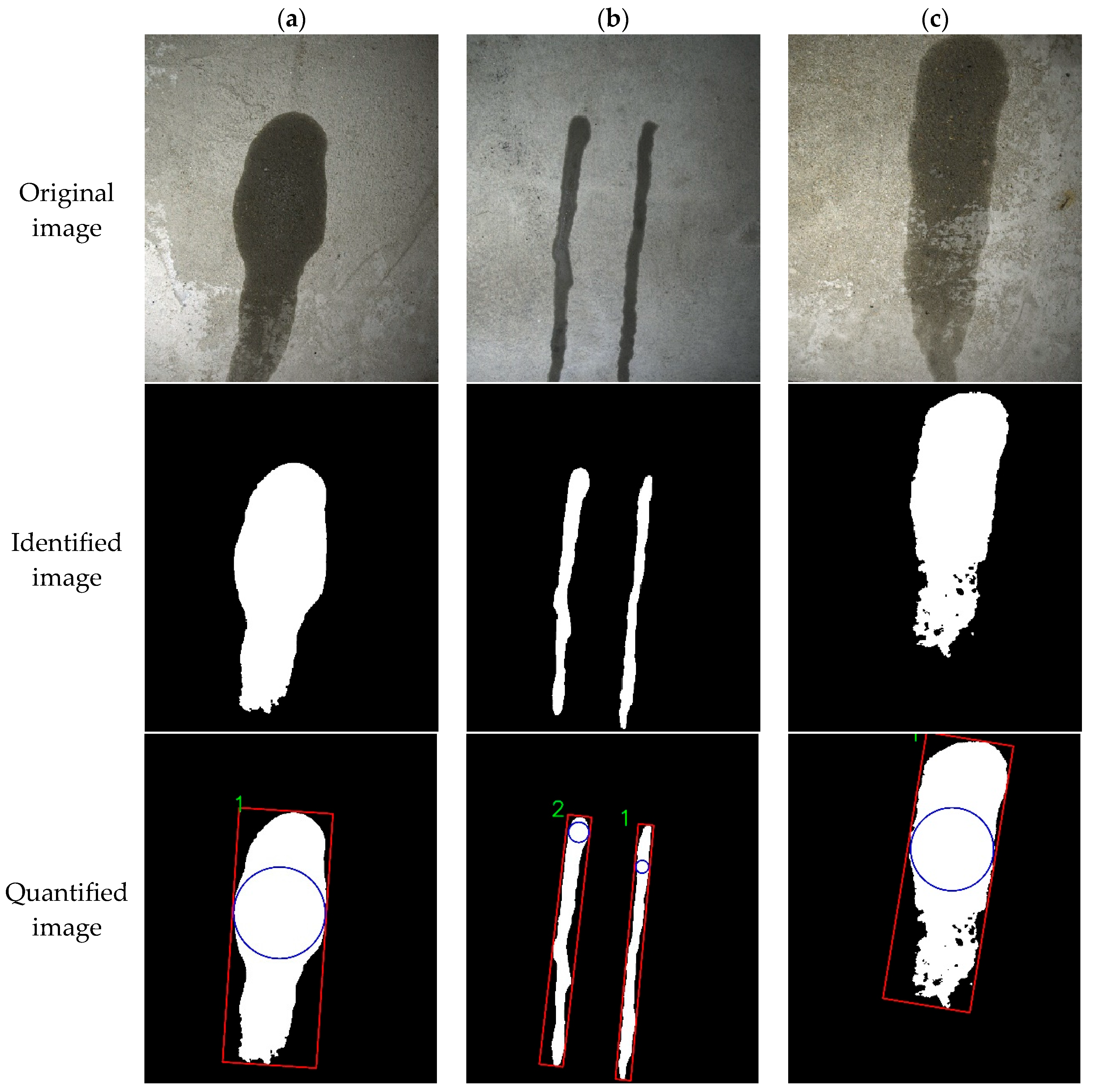
Figure 17 illustrates three typical images containing water leakage, and the water leakage region occupies a considerable part of the entire image. The results of quantitatively identifying specific water leakage information are shown in
Figure 17.
Similar to the spalling diseases the water leakage diseases observed in the tunnel typically cover large areas. Consequently, the overall size occupies a larger number of pixels at the spatial resolution of 0.1 mm/pixel. This unit pixel accuracy is sufficient for accurately detecting and identifying water leakage diseases. The results of quantitative results for water leakage information are shown in
Table 10.
The quantification of water leakage diseases involves parameters such as length and area. Their characteristic shapes, typically narrow vertical lines or spindle forms that occupy a lot of pixels, contribute to dependable detection accuracy. As shown in
Figure 17b, the quantification identification algorithm presented in this paper can sequentially quantify and identify multiple instances of water leakage within a single image. This advantage enables comprehensive detection of multi-disease targets within an image, maximizing detection capability.
- (5)
Quantitative results of multi-disease identification
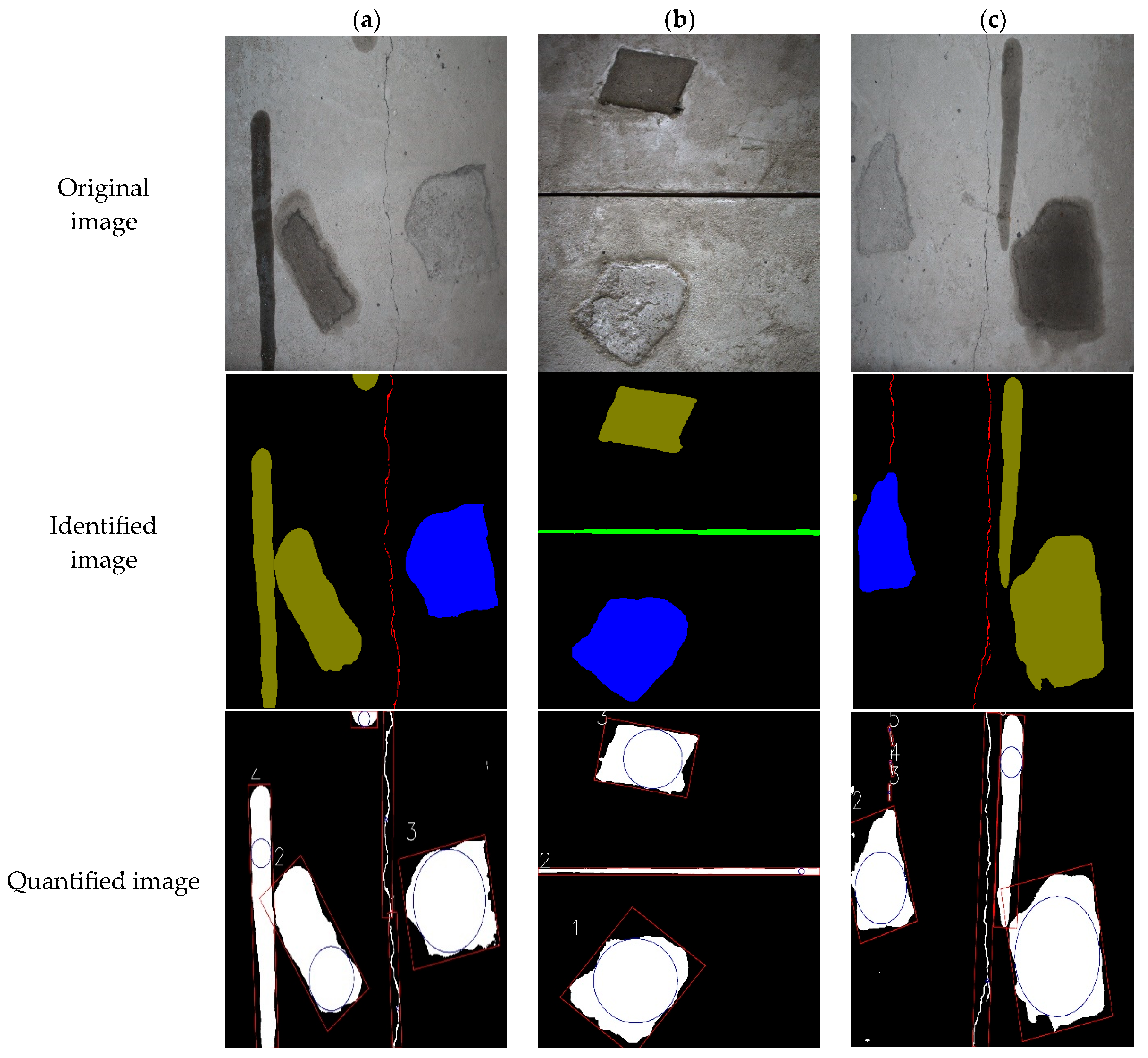
In the daily inspection of tunnels, encountering areas with multiple tunnel structure diseases is common. To assess the quantitative identification of multi-disease information on tunnel concrete lining, fabricated concrete slabs were mounted against the wall to simulate scenarios with multiple diseases in this paper. The same methodology described previously was applied to identify and quantify the corresponding key parameters of multiple diseases. The results of the quantitative identification of specific water leakage information are shown in
Figure 18.
Figure 18 displays three images with multiple diseases. The network trained in this paper successfully identifies images containing multiple diseases and distinguishes between several types of diseases by assigning different color regions, namely, red for cracks, blue for spalling, olive for water leakage, and green for seams. Subsequently, the proposed feature measurement methods are used for quantification, and the specific quantitative identification results for multi-disease information are presented in
Table 11 and
Table 12.
In this paper, the quantified information of multiple diseases in images is calculated separately. The experimental results of the quantitative identification of multiple diseases reveal that the proposal fusion network model can effectively identify multiple diseases within a single picture, with an accuracy comparable to that achieve for single diseases mentioned previously. The identification accuracy for larger diseases such as spalling and water leakage meets detection requirements, with relative errors below 10%. However, for cracks and seams, the identification error is influenced by the actual width. While wider cracks show relative errors below 12%, narrow ones exhibit larger relative errors.
Overall, the quantitative identification method of tunnel damage based on deep learning effectively extracts various disease features. Based on the connected component analysis, the calculation of parameter information for various diseases exhibits a certain degree of reliability. However, accurate quantitative identification of fine cracks requires high-performance imaging hardware to ensure result reliability.