Deep Learning-Enabled Diagnosis of Abdominal Aortic Aneurysm Using Pulse Volume Recording Waveforms: An In Silico Study

 , , , and
Abstract
1. Introduction
2. Materials and Methods
2.1. Data Generation
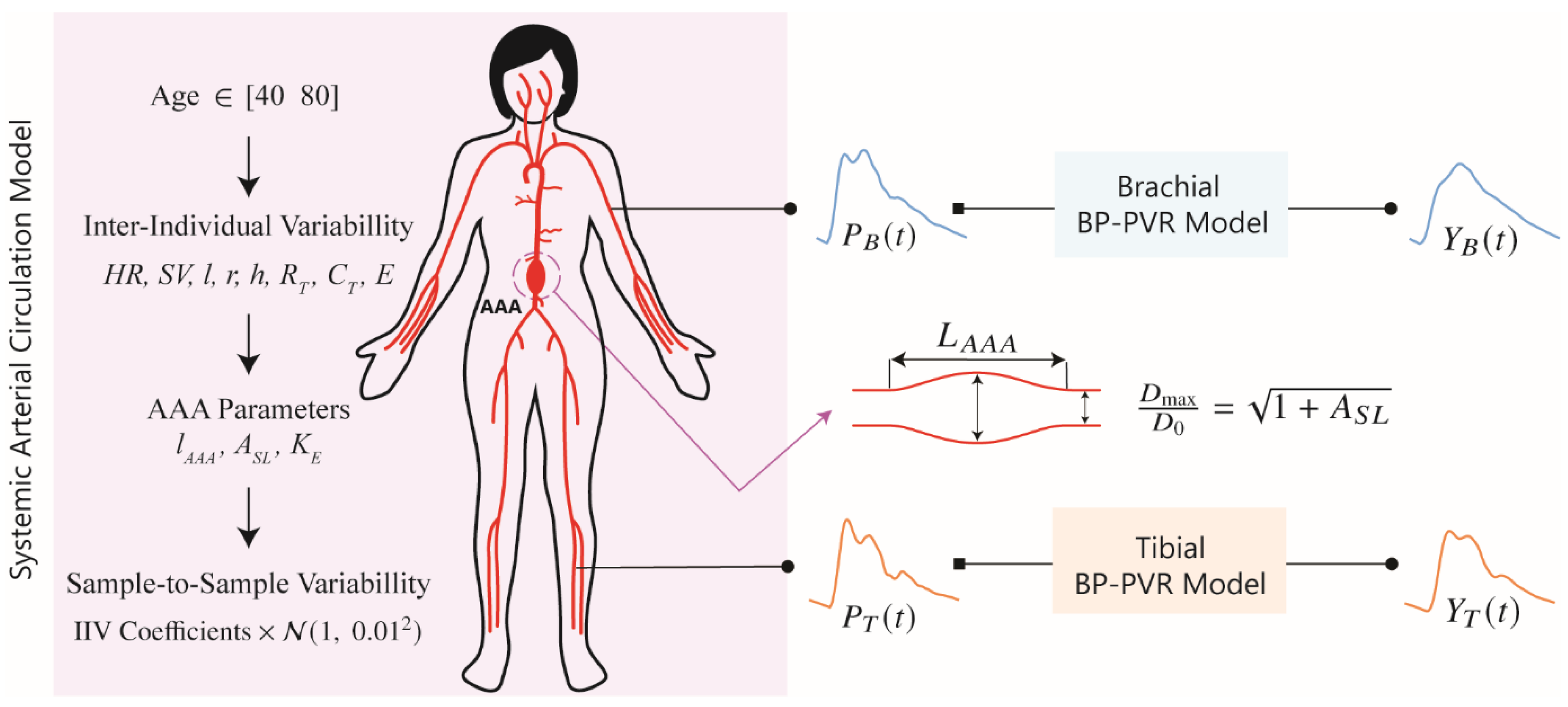
- A cohort of synthetic patients between 40 and 80 years old with age-specific cardiovascular parameters is initialized.
- Each patient is made unique by varying the parameters in the systemic arterial circulation model using inter-individual variability coefficients.
- AAA is introduced in each subject.
- Arterial BP waveform samples corresponding to each subject are generated while including sample-to-sample variability.
- In each patient, the parameters in the viscoelastic model are sampled from previously obtained distributions.
- PVR waveform samples corresponding to the arterial BP waveform samples are generated while incorporating sample-to-sample variability in the BP-PVR model.
2.1.1. Generation of Arterial BP Waveform Signals
2.1.2. Generation of Brachial and Tibial Pulse Volume Recording Signals
2.1.3. Data Summary
2.2. Abdominal Aortic Aneurysm Diagnosis Algorithm
2.3. Data Analysis
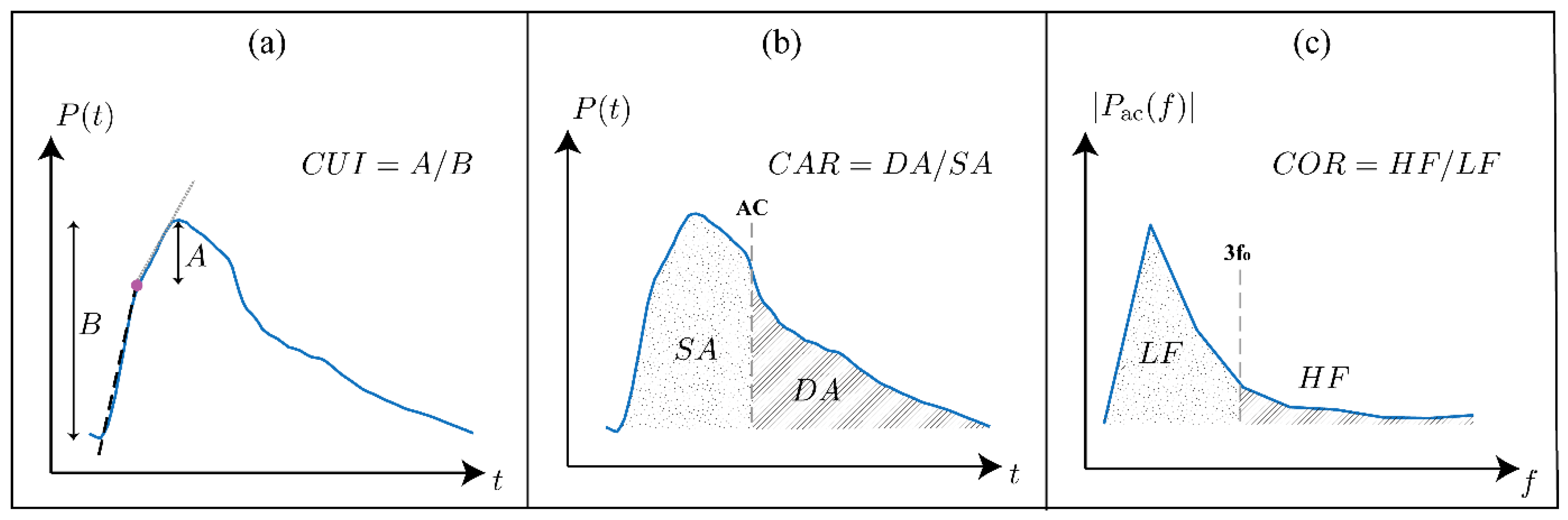
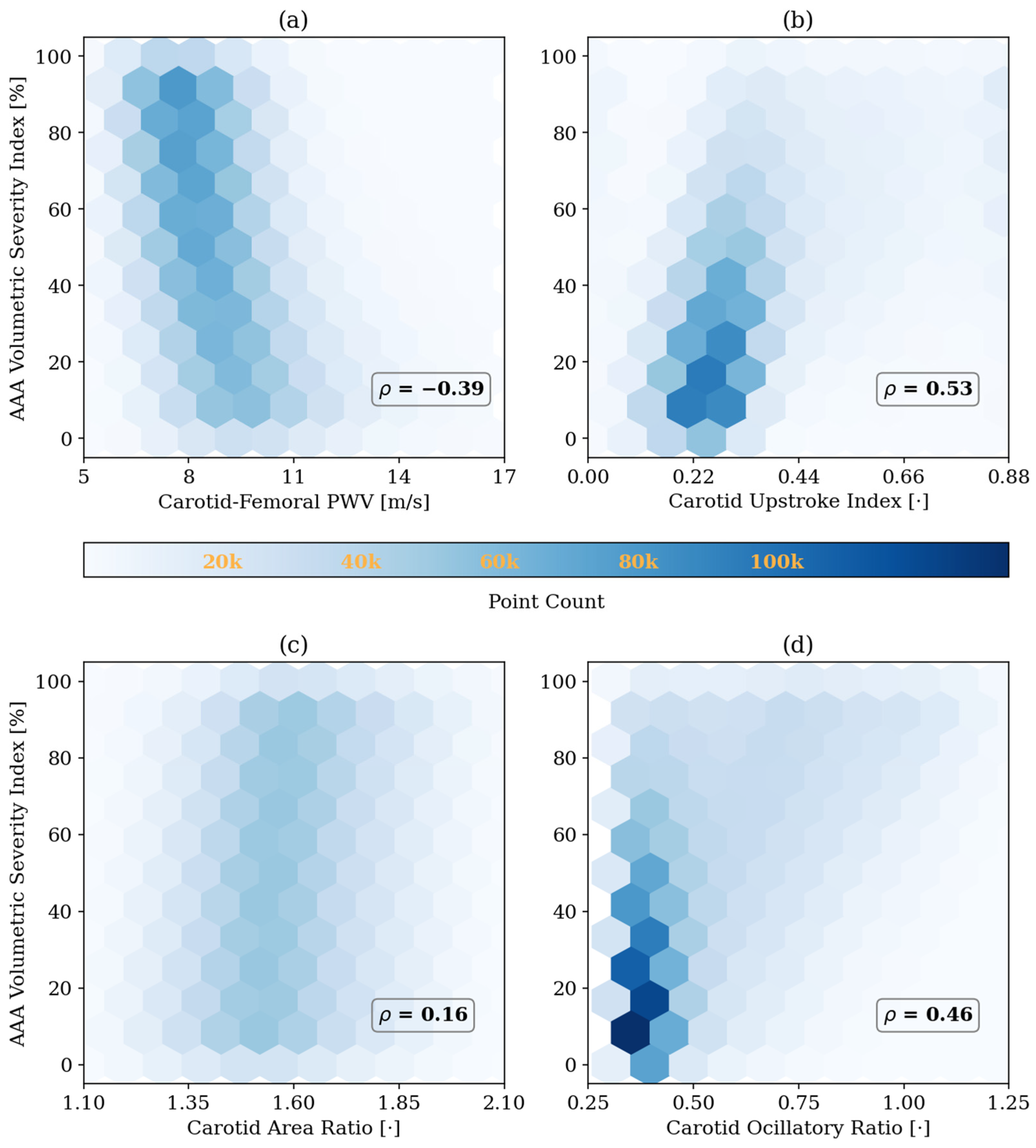
- CUI was computed by dividing the foot-to-peak upstroke of the carotid arterial BP waveform into two regions and then fitting a line to each region (Figure 3a). The segmentation point was selected as the time point that minimizes the total root-mean-squared error of both linear fits. CUI was then calculated as the ratio of the peak-to-intersection amplitude to the pulse pressure and should generally increase with the presence of AAA, capturing the change in the early systole period of the carotid arterial BP waveform caused by the negative wave reflection due to the presence of AAA [37].
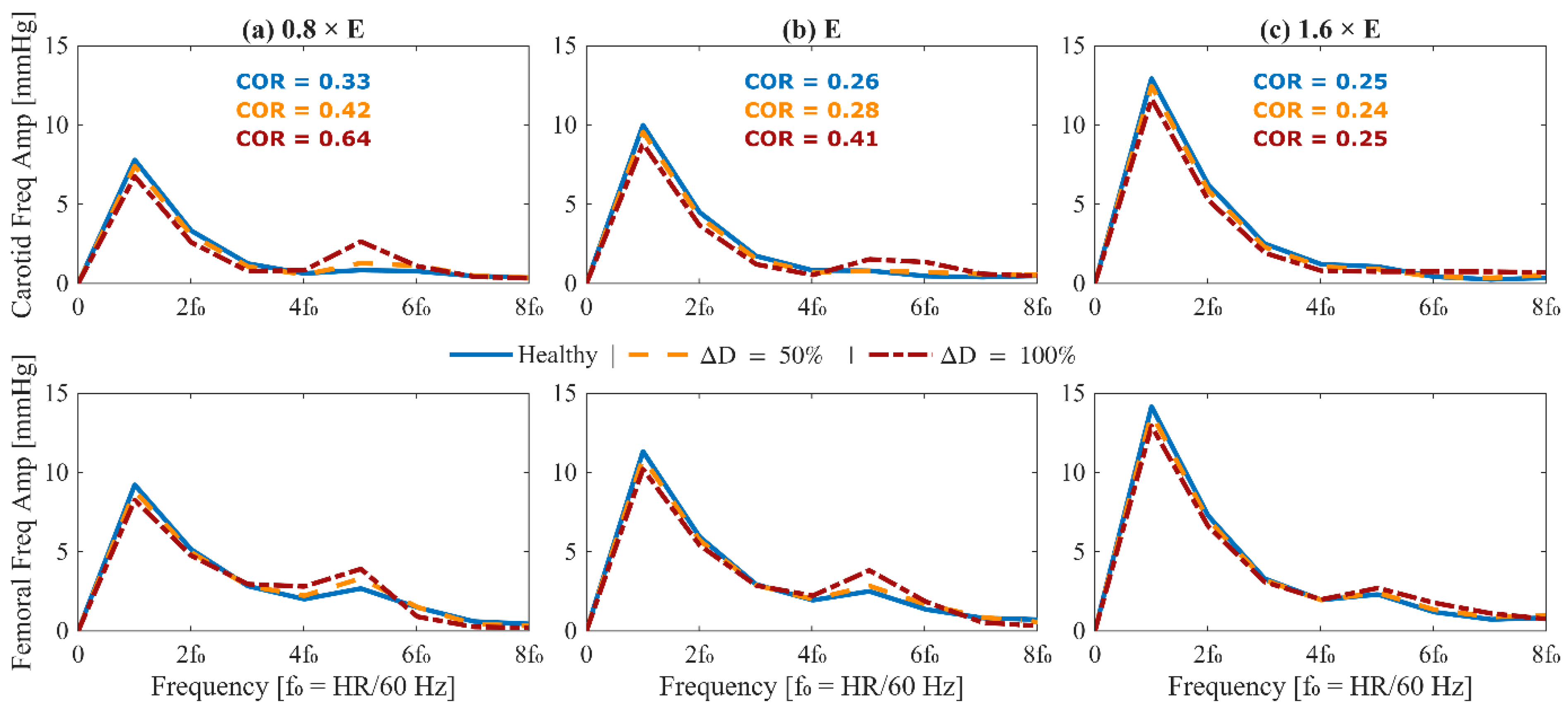
- To calculate COR, the carotid arterial BP waveform was mean-subtracted and transformed into the frequency domain. Then, COR was calculated as the ratio of the spectral energy in the high-frequency band (defined as 3–8 times the fundamental frequency = HR/60) to that in the low-frequency band (defined as 0–3 times the fundamental frequency) (Figure 3c). COR is expected to increase with AAA severity because of the presence of more oscillations in the arterial BP waveforms due to increased wave reflections [13].
3. Results
4. Discussion
4.1. Mathematical Model of Arterial Circulation: Physiological Plausibility
4.2. Efficacy of DL-Enabled PVR/BP Waveform Analysis-Based AAA Diagnosis
4.3. Relevance of Volumetric vs. Diameter-Based AAA Severity Metrics to BP Waveform Morphology
4.4. Study Limitations
5. Conclusions
Supplementary Materials
Author Contributions
Funding
Data Availability Statement
Conflicts of Interest
Abbreviations
| AAA | Abdominal Aortic Aneurysm |
| BP | Blood Pressure |
| CNN | Convolutional Neural Network |
| CPAR | Continuous Property-Adversarial Regularization |
| CUI | Carotid Upstroke Index |
| CAR | Carotid Area Ratio |
| COR | Carotid Oscillatory Ratio |
| CT | Computed Tomography |
| DL | Deep Learning |
| DL-ABP | DL-enabled algorithm for AAA diagnosis based on arterial BP waveform analysis |
| DL-PVR | DL-enabled algorithm for AAA diagnosis based on PVR waveform analysis |
| HR | Heart Rate |
| IIV | Inter-Individual Variability |
| MAE | Mean Absolute Error |
| MRI | Magnetic Resonance Imaging |
| NPV | Negative Predictive Value |
| PP | Pulse Pressure |
| PPV | Positive Predictive Value |
| PRC | Precision–Recall Curve |
| PVR | Pulse Volume Recording |
| PWV | Pulse Wave Velocity |
| ROC | Receiver Operating Characteristic |
| RMSE | Root Mean Squared Error |
| SSV | Sample-to-Sample Variability |
| USPSTF | US Preventive Services Task Force |
| VSI | Volumetric Severity Index |
References
- Wanhainen, A.; Van Herzeele, I.; Bastos Goncalves, F.; Bellmunt Montoya, S.; Berard, X.; Boyle, J.R.; D’Oria, M.; Prendes, C.F.; Karkos, C.D.; Kazimierczak, A.; et al. Editor’s Choice—European Society for Vascular Surgery (ESVS) 2024 Clinical Practice Guidelines on the Management of Abdominal Aorto-Iliac Artery Aneurysms. Eur. J. Vasc. Endovasc. Surg. 2024, 67, 192–331. [Google Scholar] [CrossRef] [PubMed]
- Song, P.; He, Y.; Adeloye, D.; Zhu, Y.; Ye, X.; Yi, Q.; Rahimi, K.; Rudan, I. The Global and Regional Prevalence of Abdominal Aortic Aneurysms: A Systematic Review and Modeling Analysis. Ann. Surg. 2023, 277, 912–919. [Google Scholar] [CrossRef]
- Haller, S.J.; Azarbal, A.F.; Rugonyi, S. Predictors of Abdominal Aortic Aneurysm Risks. Bioengineering 2020, 7, 79. [Google Scholar] [CrossRef]
- Bobadilla, J.L.; Kent, K.C. Screening for Abdominal Aortic Aneurysms. Adv. Surg. 2012, 46, 101–109. [Google Scholar] [CrossRef]
- Li, B.; Eisenberg, N.; Witheford, M.; Lindsay, T.F.; Forbes, T.L.; Roche-Nagle, G. Sex Differences in Outcomes Following Ruptured Abdominal Aortic Aneurysm Repair. JAMA Netw. Open 2022, 5, e2211336. [Google Scholar] [CrossRef] [PubMed]
- Roosendaal, L.C.; Kramer, G.M.; Wiersema, A.M.; Wisselink, W.; Jongkind, V. Outcome of Ruptured Abdominal Aortic Aneurysm Repair in Octogenarians: A Systematic Review and Meta-Analysis. Eur. J. Vasc. Endovasc. Surg. 2020, 59, 16–22. [Google Scholar] [CrossRef]
- Beck, A.W.; Goodney, P.P.; Nolan, B.W.; Likosky, D.S.; Eldrup-Jorgensen, J.; Cronenwett, J.L. Predicting 1-Year Mortality after Elective Abdominal Aortic Aneurysm Repair. J. Vasc. Surg. 2009, 49, 838–844. [Google Scholar] [CrossRef] [PubMed]
- Owens, D.K.; Davidson, K.W.; Krist, A.H.; Barry, M.J.; Cabana, M.; Caughey, A.B.; Doubeni, C.A.; Epling, J.W.; Kubik, M.; Landefeld, C.S.; et al. Screening for Abdominal Aortic Aneurysm: US Preventive Services Task Force Recommendation Statement. JAMA 2019, 322, 2211–2218. [Google Scholar] [CrossRef]
- Ho, V.T.; Tran, K.; George, E.L.; Asch, S.M.; Chen, J.H.; Dalman, R.L.; Lee, J.T. Most Privately Insured Patients Do Not Receive Federally Recommended Abdominal Aortic Aneurysm Screening. J. Vasc. Surg. 2023, 77, 1669–1673.e1. [Google Scholar] [CrossRef]
- McKay, E.; Wong, J.; Ward, S.; Ruwende, J.; Kerrison, R. Barriers and Facilitators of Abdominal Aortic Aneurysm Screening in London: A Cross-Sectional Survey. J. Med. Screen. 2025, 32, 53–56. [Google Scholar] [CrossRef]
- Mynard, J.P.; Kondiboyina, A.; Kowalski, R.; Cheung, M.M.H.; Smolich, J.J. Measurement, Analysis and Interpretation of Pressure/Flow Waves in Blood Vessels. Front. Physiol. 2020, 11, 564252. [Google Scholar] [CrossRef]
- Kolipaka, A.; Illapani, V.S.P.; Kenyhercz, W.; Dowell, J.D.; Go, M.R.; Starr, J.E.; Vaccaro, P.S.; White, R.D. Quantification of Abdominal Aortic Aneurysm Stiffness Using Magnetic Resonance Elastography and Its Comparison to Aneurysm Diameter. J. Vasc. Surg. 2016, 64, 966–974. [Google Scholar] [CrossRef] [PubMed]
- Swillens, A.; Lanoye, L.; De Backer, J.; Stergiopulos, N.; Verdonck, P.R.; Vermassen, F.; Segers, P. Effect of an Abdominal Aortic Aneurysm on Wave Reflection in the Aorta. IEEE Trans. Biomed. Eng. 2008, 55, 1602–1611. [Google Scholar] [CrossRef] [PubMed]
- Lee, C.W.; Sung, S.H.; Chen, C.K.; Chen, I.M.; Cheng, H.M.; Yu, W.C.; Shih, C.C.; Chen, C.H. Measures of Carotid–Femoral Pulse Wave Velocity and Augmentation Index Are Not Reliable in Patients with Abdominal Aortic Aneurysm. J. Hypertens. 2013, 31, 1853–1860. [Google Scholar] [CrossRef]
- Chakshu, N.K.; Sazonov, I.; Nithiarasu, P. Towards Enabling a Cardiovascular Digital Twin for Human Systemic Circulation Using Inverse Analysis. Biomech. Model. Mechanobiol. 2021, 20, 449–465. [Google Scholar] [CrossRef]
- Jones, G.; Parr, J.; Nithiarasu, P.; Pant, S. Machine Learning for Detection of Stenoses and Aneurysms: Application in a Physiologically Realistic Virtual Patient Database. Biomech. Model. Mechanobiol. 2021, 20, 2097–2146. [Google Scholar] [CrossRef]
- Hackstein, U.; Krüger, T.; Mair, A.; Degünther, C.; Krickl, S.; Schlensak, C.; Bernhard, S. Early Diagnosis of Aortic Aneurysms Based on the Classification of Transfer Function Parameters Estimated from Two Photoplethysmographic Signals. Inf. Med. Unlocked 2021, 25, 100652. [Google Scholar] [CrossRef]
- Wang, T.; Jin, W.; Liang, F.; Alastruey, J. Machine Learning-Based Pulse Wave Analysis for Early Detection of Abdominal Aortic Aneurysms Using In Silico Pulse Waves. Symmetry 2021, 13, 804. [Google Scholar] [CrossRef]
- Mehrotra, A.; Huckfeldt, P.J.; Haviland, A.M.; Gascue, L.; Sood, N. Patients Who Choose Primary Care Physicians Based On Low Office Visit Price Can Realize Broader Savings. Health Aff. 2017, 35, 2319–2326. [Google Scholar] [CrossRef]
- Shen, C.; Moss, J.L. Large Variations in Hospital Pricing for Standard Procedures Revealed. BMC Res. Notes 2022, 15, 129. [Google Scholar] [CrossRef] [PubMed]
- Xiao, H.; Avolio, A.; Zhao, M. Modeling and hemodynamic simulation of human arterial stenosis via transmission line model. J. Mech. Med. Biol. 2016, 16, 1650067. [Google Scholar] [CrossRef]
- He, W.; Xiao, H.; Liu, X. Numerical simulation of human systemic arterial hemodynamics based on a transmission line model and recursive algorithm. J. Mech. Med. Biol. 2012, 12, 1250020. [Google Scholar] [CrossRef]
- Kim, S.; Hahn, J.O.; Youn, B.D. Deep Learning-Based Diagnosis of Peripheral Artery Disease via Continuous Property-Adversarial Regularization: Preliminary in Silico Study. IEEE Access 2021, 9, 127433–127443. [Google Scholar] [CrossRef]
- Xiao, H.; Tan, I.; Butlin, M.; Li, D.; Avolio, A.P. Arterial Viscoelasticity: Role in the Dependency of Pulse Wave Velocity on Heart Rate in Conduit Arteries. Am. J. Physiol.-Heart Circ. Physiol. 2017, 312, H1185–H1194. [Google Scholar] [CrossRef]
- Charlton, P.H.; Mariscal Harana, J.; Vennin, S.; Li, Y.; Chowienczyk, P.; Alastruey, J. Modeling Arterial Pulse Waves in Healthy Aging: A Database for in Silico Evaluation of Hemodynamics and Pulse Wave Indexes. Am. J. Physiol.-Heart Circ. Physiol. 2019, 317, 1062–1085. [Google Scholar] [CrossRef]
- Shum, J.; Martufi, G.; Di Martino, E.; Washington, C.B.; Grisafi, J.; Muluk, S.C.; Finol, E.A. Quantitative Assessment of Abdominal Aortic Aneurysm Geometry. Ann. Biomed. Eng. 2011, 39, 277–286. [Google Scholar] [CrossRef] [PubMed]
- Lee, J.; Ghasemi, Z.; Kim, C.S.; Cheng, H.M.; Chen, C.H.; Sung, S.H.; Mukkamala, R.; Hahn, J.O. Investigation of Viscoelasticity in the Relationship between Carotid Artery Blood Pressure and Distal Pulse Volume Waveforms. IEEE J. Biomed. Health Inf. 2018, 22, 460–470. [Google Scholar] [CrossRef]
- Masoumi Shahrbabak, S.; Kim, S.; Youn, B.D.; Cheng, H.M.; Chen, C.H.; Mukkamala, R.; Hahn, J.O. Peripheral Artery Disease Diagnosis Based on Deep Learning-Enabled Analysis of Non-Invasive Arterial Pulse Waveforms. Comput. Biol. Med. 2024, 168, 107813. [Google Scholar] [CrossRef] [PubMed]
- Krizhevsky, A.; Sutskever, I.; Hinton, G.E. ImageNet Classification with Deep Convolutional Neural Networks. Commun. ACM 2017, 60, 84–90. [Google Scholar] [CrossRef]
- Woo, S.; Park, J.; Lee, J.Y.; Kweon, I.S. CBAM: Convolutional Block Attention Module. In Computer Vision – ECCV 2018; Lecture Notes in Computer Science; Ferrari, V., Hebert, M., Sminchisescu, C., Weiss, Y., Eds.; Springer: Cham, Switzerland, 2018; Volume 11211, pp. 3–19. [Google Scholar] [CrossRef]
- Ganin, Y.; Ustinova, E.; Ajakan, H.; Germain, P.; Larochelle, H.; Laviolette, F.; Marchand, M.; Lempitsky, V. Domain-Adversarial Training of Neural Networks. In Advances in Computer Vision and Pattern Recognition; Springer: London, UK, 2017; Volume 17, pp. 189–209. [Google Scholar]
- Wang, H.; He, H.; Katabi, D. Continuously Indexed Domain Adaptation. In Proceedings of the 37th International Conference on Machine Learning, ICML 2020, Online, 13–18 July 2020; pp. 9840–9849. [Google Scholar] [CrossRef]
- Mitchell, G.F.; Parise, H.; Benjamin, E.J.; Larson, M.G.; Keyes, M.J.; Vita, J.A.; Vasan, R.S.; Levy, D. Changes in Arterial Stiffness and Wave Reflection with Advancing Age in Healthy Men and Women. Hypertension 2004, 43, 1239–1245. [Google Scholar] [CrossRef] [PubMed]
- Smulyan, H.; Marchais, S.J.; Pannier, B.; Guerin, A.P.; Safar, M.E.; London, G.M. Influence of Body Height on Pulsatile Arterial Hemodynamic Data 11Financial Support for This Study Was Provided by Groupe d’Etude Physiopathologie Insuffisance Renale, Fleury Mérogis and by Laboratoires Synthelabo, Meudon-La-Foret, France. J. Am. Coll. Cardiol. 1998, 31, 1103–1109. [Google Scholar] [CrossRef]
- Akiba, T.; Sano, S.; Yanase, T.; Ohta, T.; Koyama, M. Optuna: A Next-Generation Hyperparameter Optimization Framework. In Proceedings of the ACM SIGKDD International Conference on Knowledge Discovery and Data Mining, Anchorage, AK, USA, 4–8 August 2019; pp. 2623–2631. [Google Scholar] [CrossRef]
- Gerónimo, J.F.; Alastruey, J.; Keramat, A. Signatures of Obstructions and Expansions in the Arterial Frequency Response. Comput. Methods Programs Biomed. 2023, 240, 107628. [Google Scholar] [CrossRef]
- Yavarimanesh, M.; Cheng, H.-M.; Chen, C.-H.; Sung, S.-H.; Mahajan, A.; Chaer, R.A.; Shroff, S.G.; Hahn, J.-O.; Mukkamala, R. Abdominal Aortic Aneurysm Monitoring via Arterial Waveform Analysis: Towards a Convenient Point-of-Care Device. NPJ Digit. Med. 2022, 5, 168. [Google Scholar] [CrossRef]
- Bailey, M.A.; Davies, J.M.; Griffin, K.J.; Bridge, K.I.; Johnson, A.B.; Sohrabi, S.; Baxter, P.D.; Scott, D.J.A. Carotid-Femoral Pulse Wave Velocity Is Negatively Correlated with Aortic Diameter. Hypertens. Res. 2014, 37, 926–932. [Google Scholar] [CrossRef] [PubMed]
- Kim, D.; Narayanan, D.; Sung, S.H.; Cheng, H.M.; Chen, C.H.; Kim, C.S.; Mukkamala, R.; Hahn, J.O. Transmission Line Model as a Digital Twin for Abdominal Aortic Aneurysm Patients. npj Digit. Med. 2024, 7, 301. [Google Scholar] [CrossRef]
- Chiu, Y.C.; Arand, P.W.; Shroff, S.G.; Feldman, T.; Carroll, J.D. Determination of Pulse Wave Velocities with Computerized Algorithms. Am. Heart J. 1991, 121, 1460–1470. [Google Scholar] [CrossRef]
- Fink, H.A.; Lederle, F.A.; Roth, C.S.; Bowles, C.A.; Nelson, D.B.; Haas, M.A. The Accuracy of Physical Examination to Detect Abdominal Aortic Aneurysm. Arch. Intern. Med. 2000, 160, 833–836. [Google Scholar] [CrossRef] [PubMed]
- Jin, W.; Alastruey, J. Arterial Pulse Wave Propagation across Stenoses and Aneurysms: Assessment of One-Dimensional Simulations against Three-Dimensional Simulations and in Vitro Measurements. J. R. Soc. Interface 2021, 18, 20200881. [Google Scholar] [CrossRef]
- Haller, S.J.; Crawford, J.D.; Courchaine, K.M.; Bohannan, C.J.; Landry, G.J.; Moneta, G.L.; Azarbal, A.F.; Rugonyi, S. Intraluminal Thrombus Is Associated with Early Rupture of Abdominal Aortic Aneurysm. J. Vasc. Surg. 2018, 67, 1051–1058.e1. [Google Scholar] [CrossRef] [PubMed]
- Siika, A.; Lindquist Liljeqvist, M.; Hultgren, R.; Gasser, T.C.; Roy, J. Aortic Lumen Area Is Increased in Ruptured Abdominal Aortic Aneurysms and Correlates to Biomechanical Rupture Risk. J. Endovasc. Ther. 2018, 25, 750–756. [Google Scholar] [CrossRef]
- Martufi, G.; Lindquist Liljeqvist, M.; Sakalihasan, N.; Panuccio, G.; Hultgren, R.; Roy, J.; Gasser, T.C. Local Diameter, Wall Stress and Thrombus Thickness Influence the Local Growth of Abdominal Aortic Aneurysms. Eur. J. Vasc. Endovasc. Surg. 2014, 48, 957–966. [Google Scholar] [CrossRef]
- Kollias, A.; Xilomenos, A.; Protogerou, A.; Dimakakos, E.; Stergiou, G.S. Automated Determination of the Ankle-Brachial Index Using an Oscillometric Blood Pressure Monitor: Validation vs. Doppler Measurement and Cardiovascular Risk Factor Profile. Hypertens. Res. 2011, 34, 825–830. [Google Scholar] [CrossRef] [PubMed]
- Natarajan, K.; Cheng, H.M.; Liu, J.; Gao, M.; Sung, S.H.; Chen, C.H.; Hahn, J.O.; Mukkamala, R. Central Blood Pressure Monitoring via a Standard Automatic Arm Cuff. Sci. Rep. 2017, 7, 14441. [Google Scholar] [CrossRef] [PubMed]
- Shahrbabak, S.M.; Mousavi, A.; Mukkamala, R.; Hahn, J.O. In Silico Investigation of a Mathematical Model Relating the Ballistocardiogram to Aortic Blood Pressure. IEEE Trans. Biomed. Eng. 2025. [Google Scholar] [CrossRef]





| Batch Size | |||||||
|---|---|---|---|---|---|---|---|
| DL-ABP | 16 | ||||||
| DL-PVR | 16 |
| Accuracy | F1 Score | Sensitivity | Specificity | PPV | NPV | |
|---|---|---|---|---|---|---|
| DL-ABP | 88.8 ± 0.6% | 88.9 ± 0.7% | 89.5 ± 2.0% | 88.2 ± 2.0% | 88.4 ± 1.5% | 89.4 ± 1.6% |
| DL-PVR | 85.8 ± 0.7% | 85.9 ± 0.8% | 86.6 ± 2.6% | 84.9 ± 2.0% | 85.2 ± 1.4% | 86.4 ± 2.0% |
| PWV | CUI | CAR | COR | |
|---|---|---|---|---|
| Maximum Diameter | −0.389 | 0.472 | 0.143 | 0.413 |
| VSI | −0.393 | 0.532 | 0.160 | 0.458 |
Disclaimer/Publisher’s Note: The statements, opinions and data contained in all publications are solely those of the individual author(s) and contributor(s) and not of MDPI and/or the editor(s). MDPI and/or the editor(s) disclaim responsibility for any injury to people or property resulting from any ideas, methods, instructions or products referred to in the content. |
© 2025 by the authors. Licensee MDPI, Basel, Switzerland. This article is an open access article distributed under the terms and conditions of the Creative Commons Attribution (CC BY) license (https://creativecommons.org/licenses/by/4.0/).
Share and Cite
Masoumi Shahrbabak, S.; Youn, B.D.; Cheng, H.-M.; Chen, C.-H.; Sung, S.-H.; Mukkamala, R.; Hahn, J.-O. Deep Learning-Enabled Diagnosis of Abdominal Aortic Aneurysm Using Pulse Volume Recording Waveforms: An In Silico Study. Sensors 2025, 25, 6678. https://doi.org/10.3390/s25216678
Masoumi Shahrbabak S, Youn BD, Cheng H-M, Chen C-H, Sung S-H, Mukkamala R, Hahn J-O. Deep Learning-Enabled Diagnosis of Abdominal Aortic Aneurysm Using Pulse Volume Recording Waveforms: An In Silico Study. Sensors. 2025; 25(21):6678. https://doi.org/10.3390/s25216678
Chicago/Turabian StyleMasoumi Shahrbabak, Sina, Byeng Dong Youn, Hao-Min Cheng, Chen-Huan Chen, Shih-Hsien Sung, Ramakrishna Mukkamala, and Jin-Oh Hahn. 2025. "Deep Learning-Enabled Diagnosis of Abdominal Aortic Aneurysm Using Pulse Volume Recording Waveforms: An In Silico Study" Sensors 25, no. 21: 6678. https://doi.org/10.3390/s25216678
APA StyleMasoumi Shahrbabak, S., Youn, B. D., Cheng, H.-M., Chen, C.-H., Sung, S.-H., Mukkamala, R., & Hahn, J.-O. (2025). Deep Learning-Enabled Diagnosis of Abdominal Aortic Aneurysm Using Pulse Volume Recording Waveforms: An In Silico Study. Sensors, 25(21), 6678. https://doi.org/10.3390/s25216678