An Automatic Modulation Recognition Method Based on the Multimodal Kernel Harmonic Feature Fusion Network




Abstract
1. Introduction
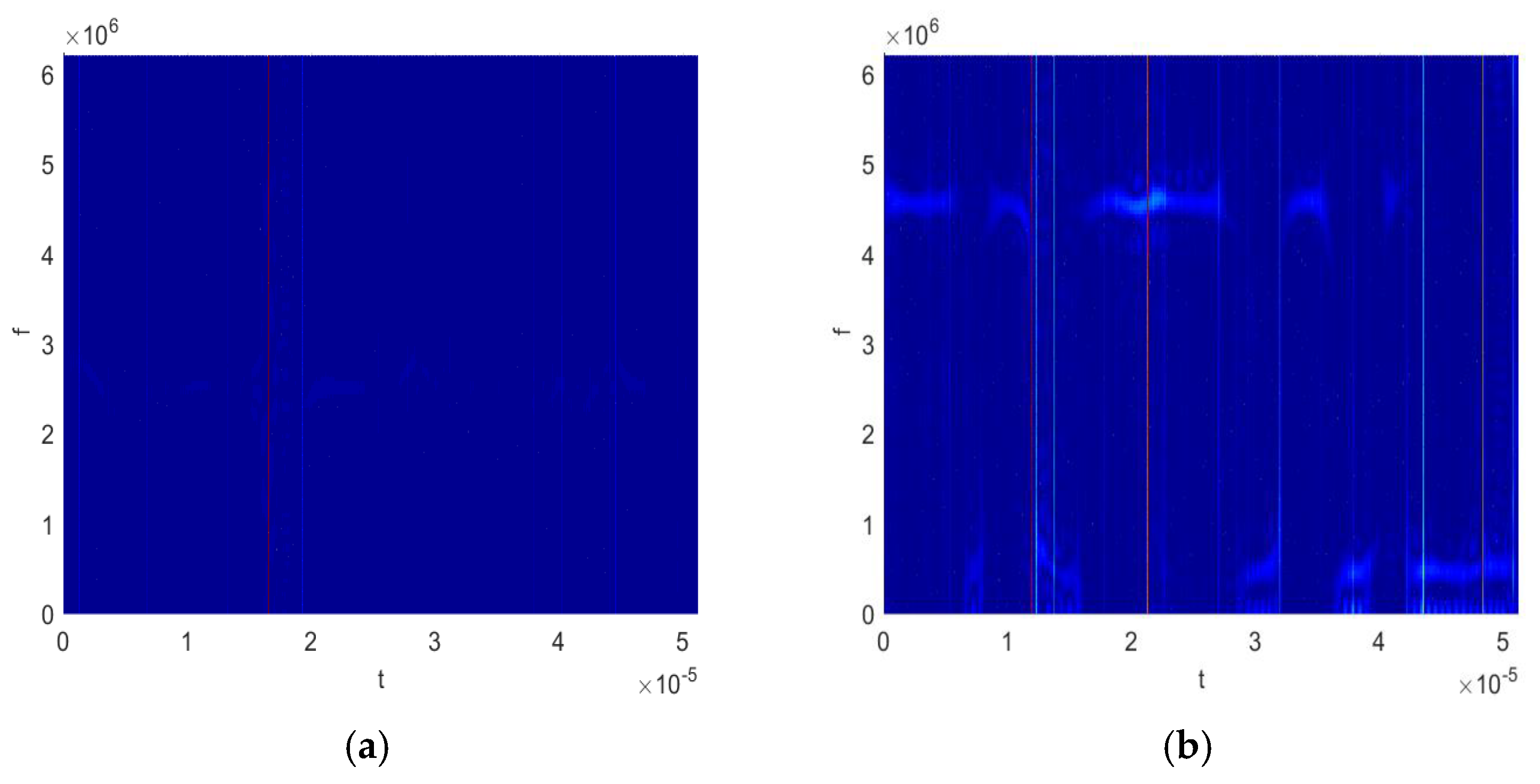
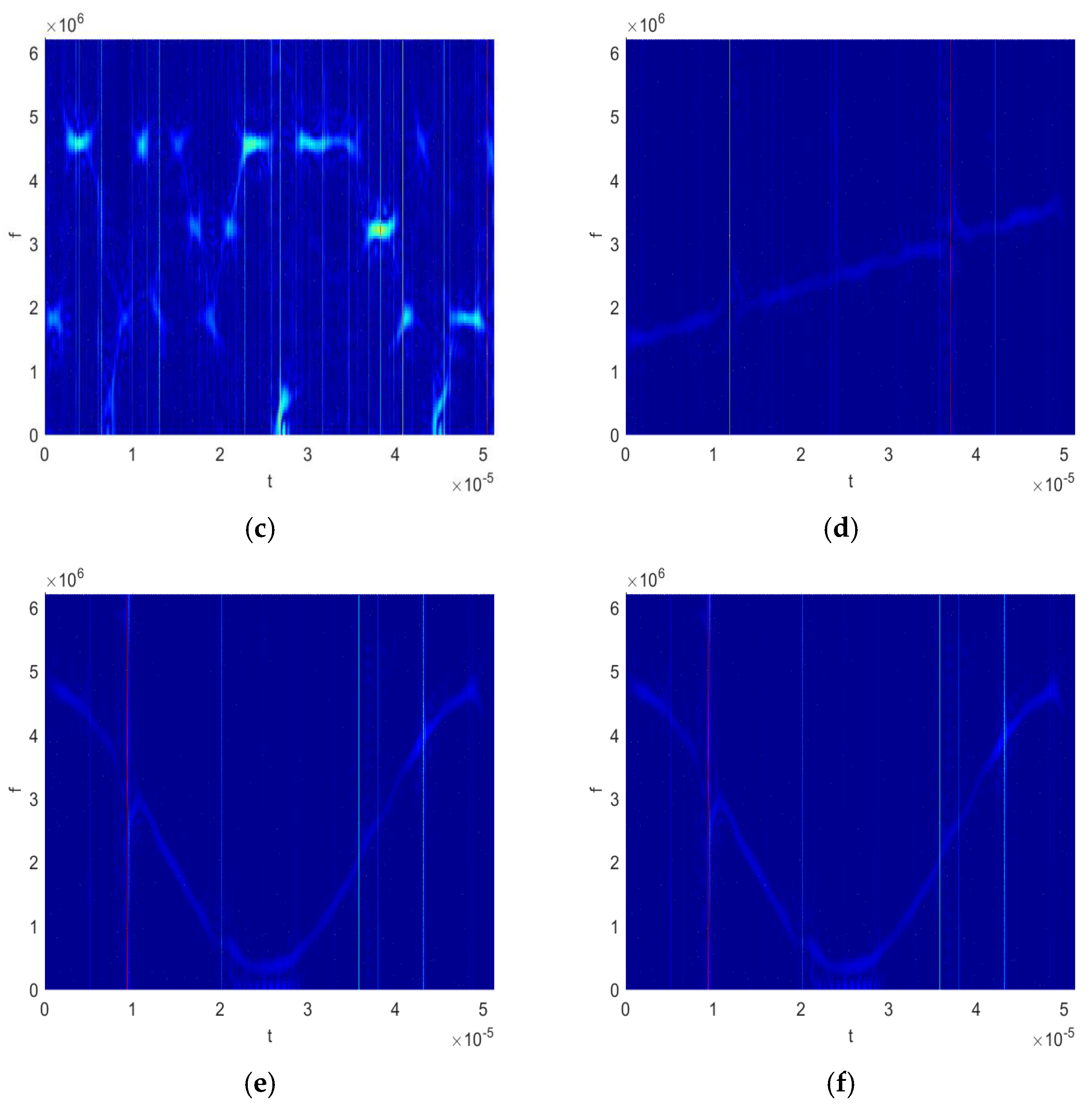
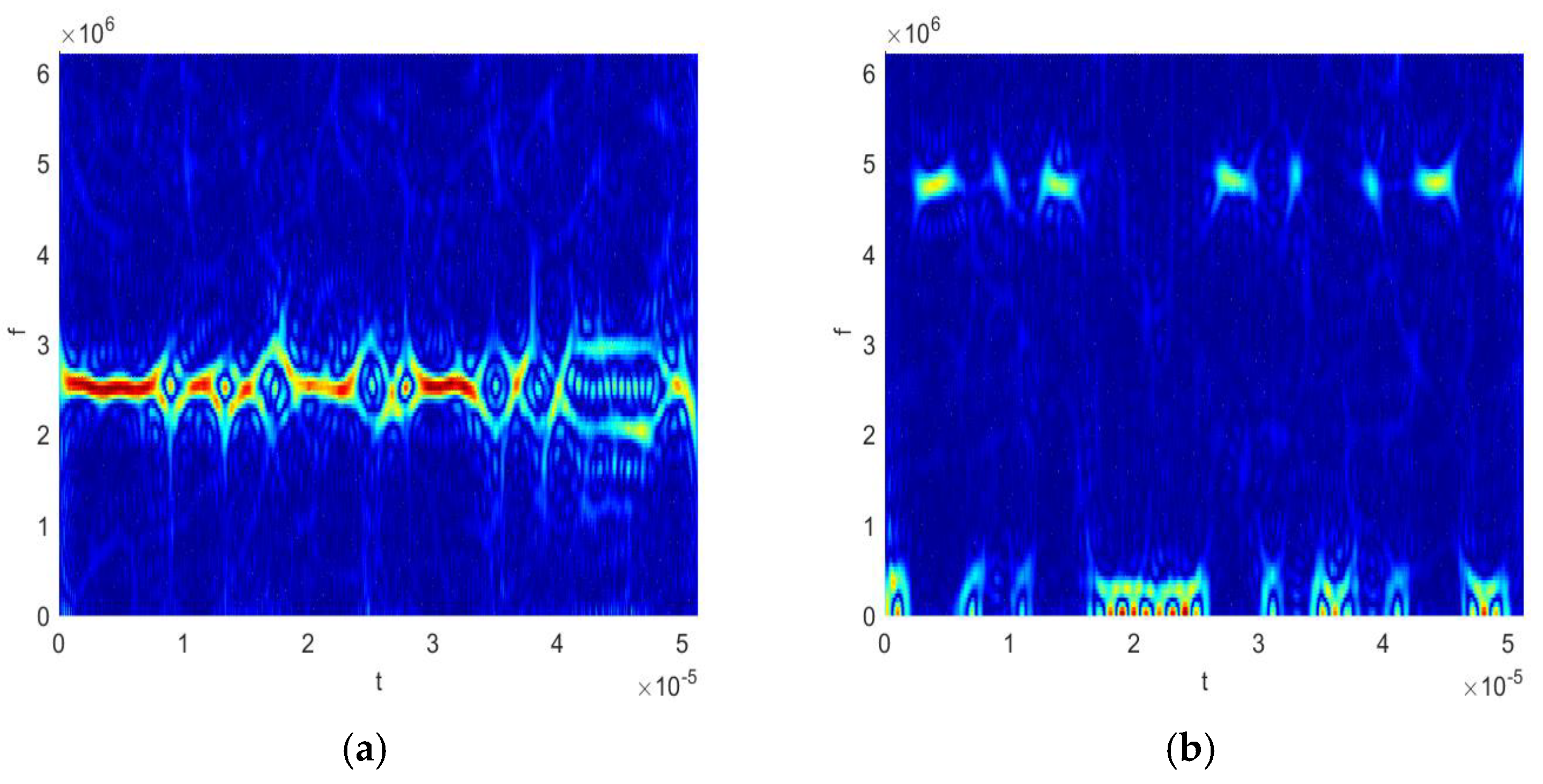
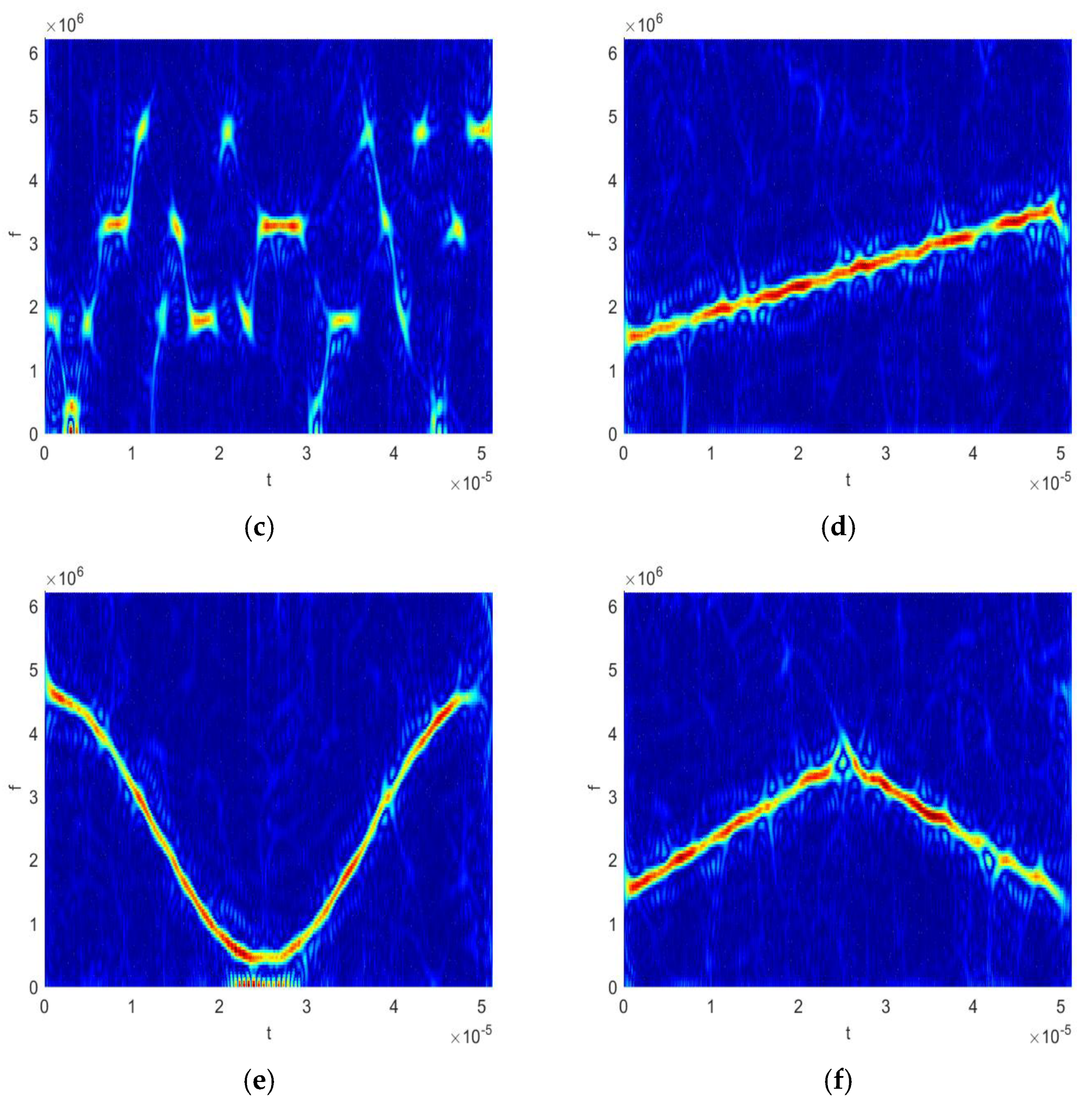
- A time–frequency analysis method based on kernel space mapping is proposed. By incorporating kernel space mapping technology into time–frequency analysis, the discernibility of time–frequency features in pulsed noise environments is improved, solving the performance degradation issue in traditional methods under such conditions.
- A multimodal kernel harmonic feature fusion network was constructed. This network fuses three types of modal information, including time–frequency features, cyclostationary features, and kernel space mapping sequences, solving the problem that a single modality struggles with, comprehensively characterizing complex modulation characteristics. It employs a graph for local–global joint modeling of signals, comprehensively enhancing the network’s feature representation capability.
2. Related Work
2.1. Noise Model
2.2. Choi–Williams Distribution
3. Proposed Method
3.1. The Kernel-Based Choi–Williams Distribution
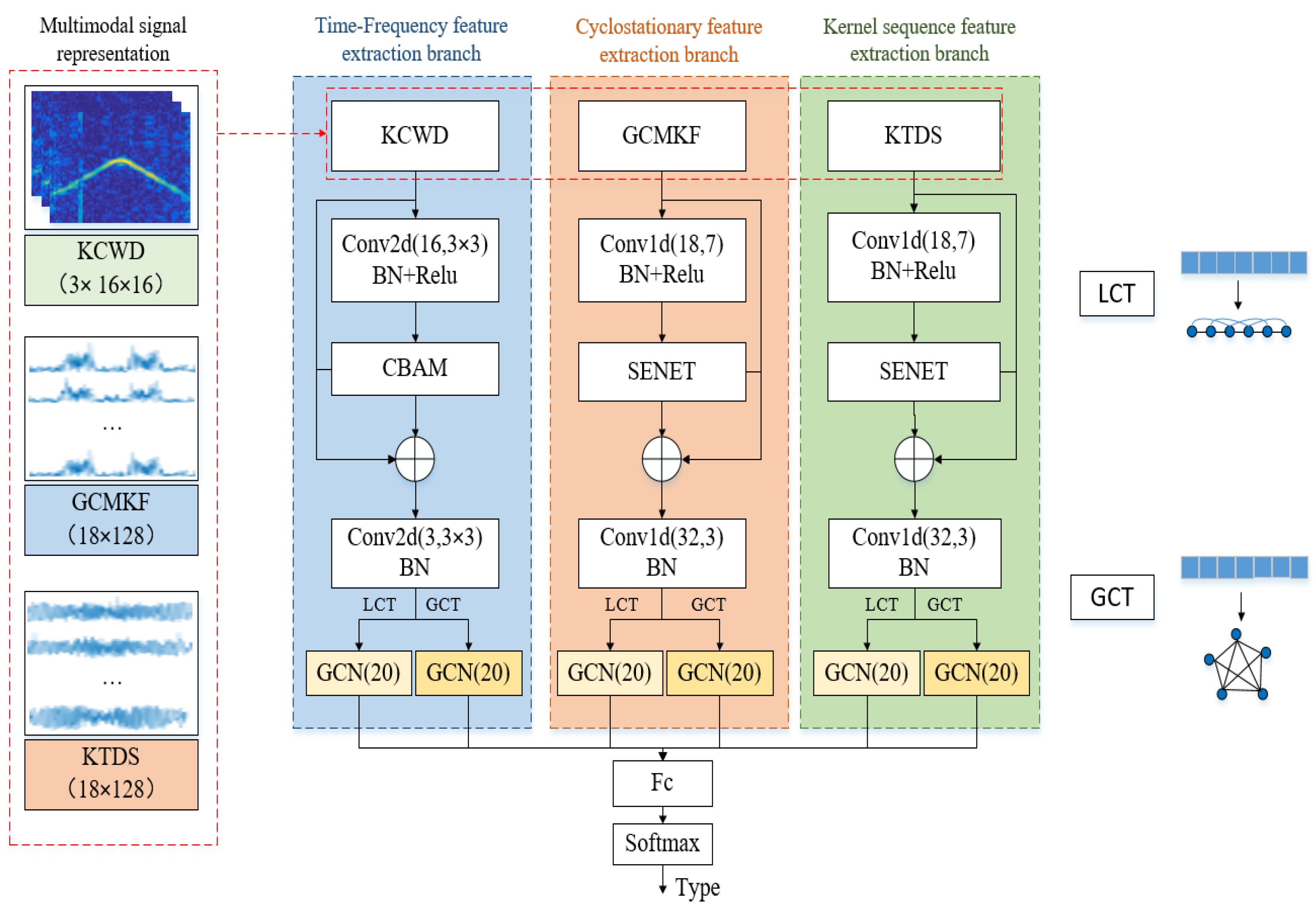
3.2. The Multimodal Kernel Harmonic Feature Fusion Network
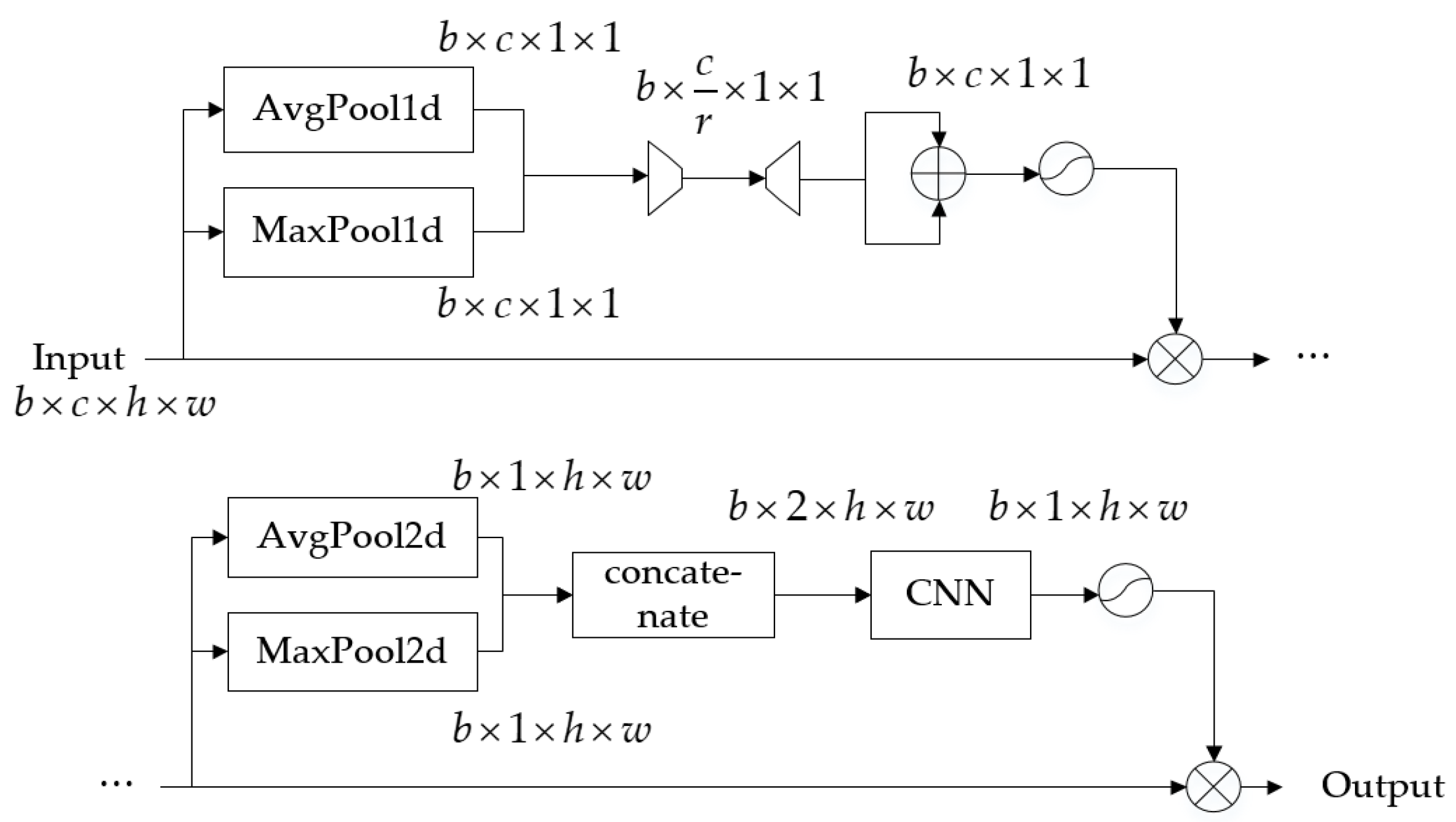
3.2.1. The Time–Frequency Feature Extraction Branch
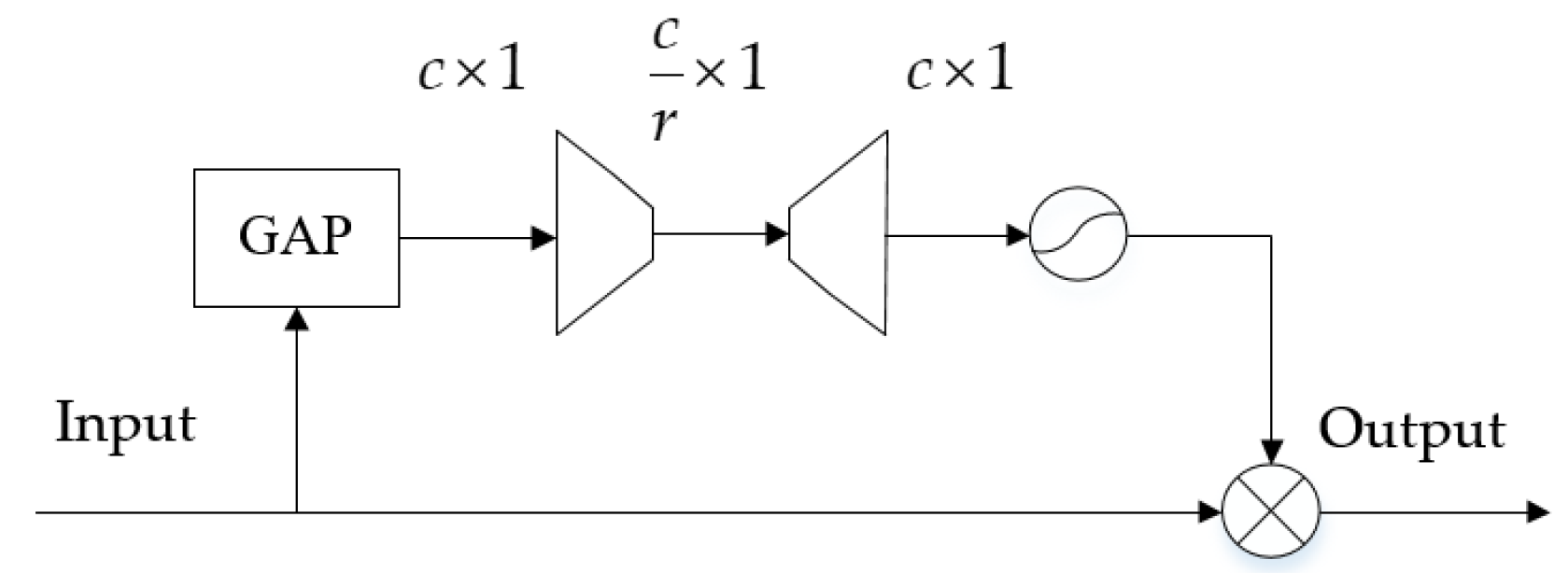
3.2.2. The Cyclostationary Feature Extraction Branch
3.2.3. The Kernel Space Mapping Sequence
4. Simulation
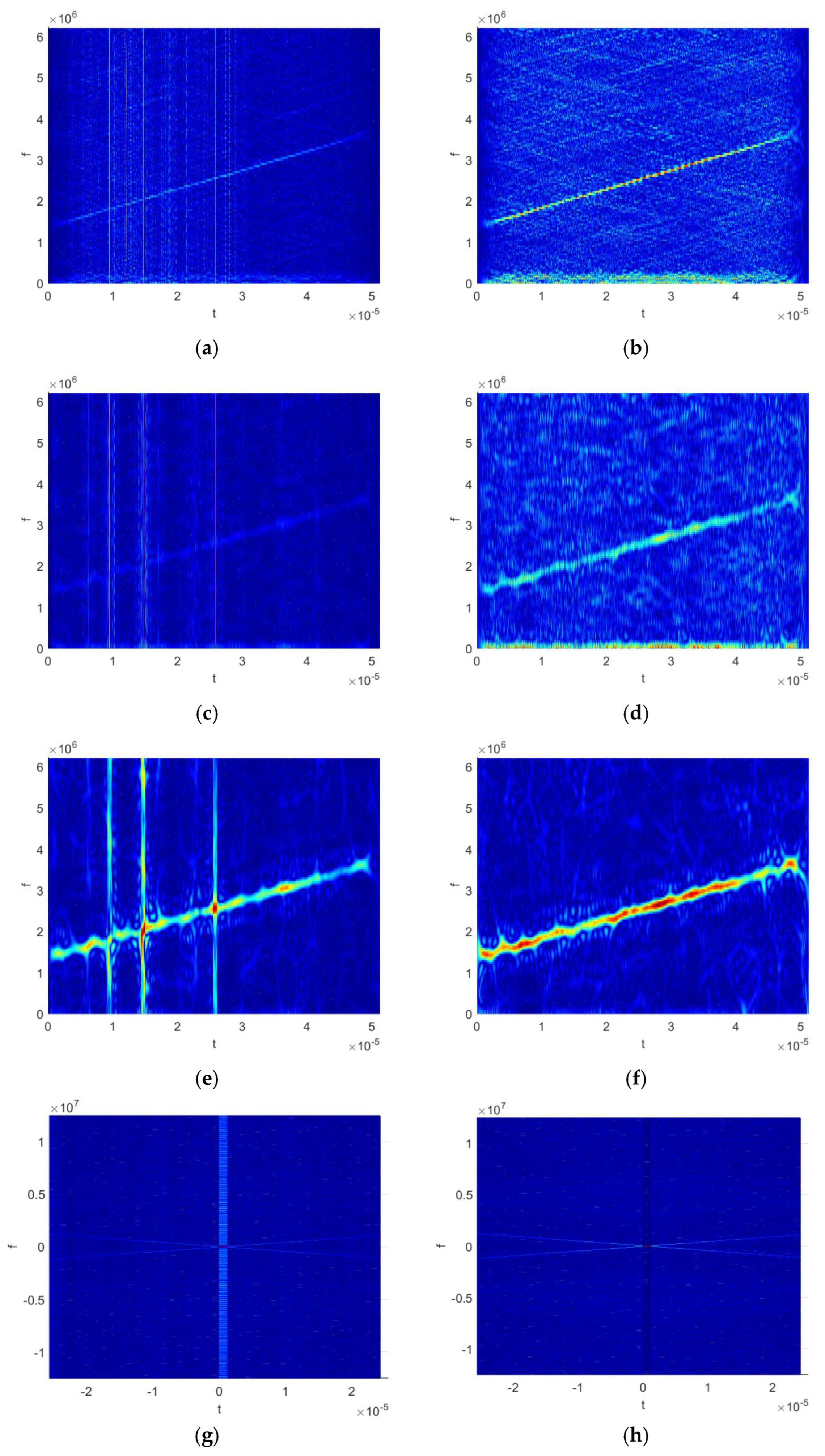
4.1. Parameter Estimation of the LFM Signal Based on the KCWD
4.2. Classification Accuracy Under Different Models and Different Inputs
4.2.1. Dataset
4.2.2. Comparison of Recognition Accuracy
4.2.3. Comparison of Computational Complexity
5. Conclusions
Author Contributions
Funding
Data Availability Statement
Conflicts of Interest
References
- Zheleva, M.; Chandra, R.; Chowdhery, A.; Kapoor, A.; Garnett, P. Txminer: Identifying transmitters in real-world spectrum measurements. In Proceedings of the 2015 IEEE International Symposium on Dynamic Spectrum Access Networks (DySPAN), Stockholm, Sweden, 29 September–2 October 2015; IEEE: Piscataway, NJ, USA, 2015; pp. 94–105. [Google Scholar]
- Dobre, O.A.; Abdi, A.; Bar-Ness, Y.; Su, W. Survey of automatic modulation classification techniques: Classical approaches and new trends. IET Commun. 2007, 1, 137–156. [Google Scholar] [CrossRef]
- Yang, W.; Ren, K.; Du, Y.; Zheng, J.; Ping, Y.; Wang, S.; Yang, X.; Li, L. Modulation recognition method of mixed signals based on cyclic spectrum projection. Sci. Rep. 2023, 13, 21459. [Google Scholar] [CrossRef] [PubMed]
- Satija, U.; Mohanty, M.; Ramkumar, B. Cyclostationary features based modulation classification in presence of non Gaussian noise using sparse signal decomposition. Wirel. Pers. Commun. 2017, 96, 5723–5741. [Google Scholar] [CrossRef]
- Luan, S.; Qiu, T.; Zhu, Y.; Yu, L. Cyclic correntropy and its spectrum in frequency estimation in the presence of impulsive noise. Signal Process. 2016, 120, 503–508. [Google Scholar] [CrossRef]
- Ma, J.; Qiu, T. Automatic Modulation Classification Using Cyclic Correntropy Spectrum in Impulsive Noise. IEEE Wirel. Commun. Lett. 2018, 8, 440–443. [Google Scholar] [CrossRef]
- Zhang, Q.; Ji, H.; Jin, Y. Cyclostationary signals analysis methods based on high-dimensional space transformation under impulsive noise. IEEE Signal Process. Lett. 2021, 28, 1724–1728. [Google Scholar] [CrossRef]
- Zuo, X.; Yang, Y.; Yao, R.; Fan, Y.; Li, L. An Automatic Modulation Recognition Algorithm Based on Time–Frequency Features and Deep Learning with Fading Channels. Remote Sens. 2024, 16, 4550. [Google Scholar] [CrossRef]
- Wang, P.; Cheng, Y.; Dong, B.; Hu, R.; Li, S. WIR-transformer: Using transformers for wireless interference recognition. IEEE Wirel. Commun. Lett. 2022, 11, 2472–2476. [Google Scholar] [CrossRef]
- Zhang, Z.; Wang, C.; Gan, C.; Sun, S.; Wang, M. Automatic modulation classification using convolutional neural network with features fusion of SPWVD and BJD. IEEE Trans. Signal Inf. Process. Netw. 2019, 5, 469–478. [Google Scholar] [CrossRef]
- Huang, D.; Yan, X.; Hao, X.; Dai, J.; Wang, X. Low SNR multi-emitter signal sorting and recognition method based on low-order cyclic statistics CWD time-frequency images and the YOLOv5 deep learning model. Sensors 2022, 22, 7783. [Google Scholar] [CrossRef] [PubMed]
- Li, S.; Du, X.; Cui, G.; Chen, X.; Zheng, J. A Multiscale Dual Attention Sparse Dual Network for Time-Frequency Image Denoising of Radar Signal. IEEE Sens. J. 2024, 24, 13. [Google Scholar] [CrossRef]
- Brcich, R.F.; Iskander, D.R.; Zoubir, A.M. The stability test for symmetric alpha-stable distributions. IEEE Trans. Signal Process. 2005, 53, 977–986. [Google Scholar] [CrossRef]
- Woo, S.; Park, J.; Lee, J.Y.; Kweon, I.S. Cbam: Convolutional block attention module. In Proceedings of the European Conference on Computer Vision (ECCV), Munich, Germany, 8–14 September 2018; pp. 3–19. [Google Scholar]
- Zhang, Q.; Ji, H.; Li, L.; Zhu, Z. Automatic modulation recognition of unknown interference signals based on graph model. IEEE Wirel. Commun. Lett. 2024, 13, 2317–2321. [Google Scholar] [CrossRef]
- Hu, J.; Shen, L.; Sun, G. Squeeze-and-excitation networks. In Proceedings of the IEEE Conference on Computer Vision and Pattern Recognition (CVPR), Salt Lake City, UT, USA, 18–23 June 2018; pp. 7132–7141. [Google Scholar]
- O’Shea, T.J.; Corgan, J.; Clancy, T.C. Convolutional radio modulation recognition networks. In Proceedings of the International Conference on Engineering Applications of Neural Networks (EANN), Aberdeen, UK, 2–5 September 2016; Springer International Publishing: Cham, Switzerland, 2016; pp. 213–226. [Google Scholar]
- Jiang, J.; Wang, Z.; Zhao, H.; Qiu, S.; Li, J. Modulation recognition method of satellite communication based on CLDNN model. In Proceedings of the 2021 IEEE 30th International Symposium on Industrial Electronics (ISIE), Kyoto, Japan, 20–23 June 2021; IEEE: Piscataway, NJ, USA, 2021; pp. 1–6. [Google Scholar]
- Dao, T.T.; Noh, D.I.; Pham, Q.V.; Hasegawa, M.; Sekiya, H.; Hwang, W.J. VT-MCNet: High-accuracy automatic modulation classification model based on vision transformer. IEEE Commun. Lett. 2023, 28, 98–102. [Google Scholar] [CrossRef]



| Parameters (k) | Training Time (s/epoch) | |
|---|---|---|
| MKHFFN | 206 | 35 |
| CNN-A | 167 | 15 |
| CLDNN-A | 211 | 32 |
| FEA-Transformer-A | 323 | 76 |
| MKHFFN-F | 176 | 28 |
| MKHFFN-G | 159 | 24 |
| MKHFFN-H | 135 | 17 |
Disclaimer/Publisher’s Note: The statements, opinions and data contained in all publications are solely those of the individual author(s) and contributor(s) and not of MDPI and/or the editor(s). MDPI and/or the editor(s) disclaim responsibility for any injury to people or property resulting from any ideas, methods, instructions or products referred to in the content. |
© 2025 by the authors. Licensee MDPI, Basel, Switzerland. This article is an open access article distributed under the terms and conditions of the Creative Commons Attribution (CC BY) license (https://creativecommons.org/licenses/by/4.0/).
Share and Cite
Zhang, Q.; Ji, H.; Li, L. An Automatic Modulation Recognition Method Based on the Multimodal Kernel Harmonic Feature Fusion Network. Sensors 2025, 25, 6352. https://doi.org/10.3390/s25206352
Zhang Q, Ji H, Li L. An Automatic Modulation Recognition Method Based on the Multimodal Kernel Harmonic Feature Fusion Network. Sensors. 2025; 25(20):6352. https://doi.org/10.3390/s25206352
Chicago/Turabian StyleZhang, Qiancheng, Hongbing Ji, and Lin Li. 2025. "An Automatic Modulation Recognition Method Based on the Multimodal Kernel Harmonic Feature Fusion Network" Sensors 25, no. 20: 6352. https://doi.org/10.3390/s25206352
APA StyleZhang, Q., Ji, H., & Li, L. (2025). An Automatic Modulation Recognition Method Based on the Multimodal Kernel Harmonic Feature Fusion Network. Sensors, 25(20), 6352. https://doi.org/10.3390/s25206352